
植物生态学报 ›› 2010, Vol. 34 ›› Issue (8): 979-988.DOI: 10.3773/j.issn.1005-264x.2010.08.011 cstr: 32100.14.j.issn.1005-264x.2010.08.011
蒋婧, 宋明华*( )
)
收稿日期:2009-12-29
接受日期:2010-04-13
出版日期:2010-12-29
发布日期:2010-09-28
作者简介:* E-mail: songmh@igsnrr.ac.cn
JIANG Jing, SONG Ming-Hua*()
Received:2009-12-29
Accepted:2010-04-13
Online:2010-12-29
Published:2010-09-28
摘要:
陆地生态系统的地上、地下是相互联系的。植物与土壤微生物作为陆地生态系统中的重要组成部分, 它们之间的相互作用是生态系统地上、地下结合的重要纽带。该文首先介绍了植物在养分循环中对营养元素的吸收、积累和归还等作用, 阐述了土壤微生物对养分有效性及土壤质量具有重要的作用。其次, 重点综述了植物与土壤微生物之间相互依存、相互竞争的关系。植物通过其凋落物与分泌物为土壤微生物提供营养, 土壤微生物作为分解者提供植物可吸收的营养元素, 比如共生体菌根真菌即可使植物根与土壤真菌达到互惠。然而, 植物的养分吸收与微生物的养分固持同时存在, 因而两者之间存在对养分的竞争。通过植物多样性对土壤微生物多样性的影响分析, 以及土壤微生物直接或间接作用于植物多样性和生产力的分析, 探讨了植物物种多样性与土壤微生物多样性之间的内在联系。针对当前植物与土壤微生物对养分循环的调控机制的争论, 提出植物凋落物是调节植物与土壤微生物养分循环的良好媒介, 植物与土壤微生物的共同作用对维持整个生态系统的稳定性具有重要意义。也指出了目前在陆地生态系统地上、地下研究中存在的不足和亟待解决的问题。
蒋婧, 宋明华. 植物与土壤微生物在调控生态系统养分循环中的作用. 植物生态学报, 2010, 34(8): 979-988. DOI: 10.3773/j.issn.1005-264x.2010.08.011
JIANG Jing, SONG Ming-Hua. Review of the roles of plants and soil microorganisms in regulating ecosystem nutrient cycling. Chinese Journal of Plant Ecology, 2010, 34(8): 979-988. DOI: 10.3773/j.issn.1005-264x.2010.08.011
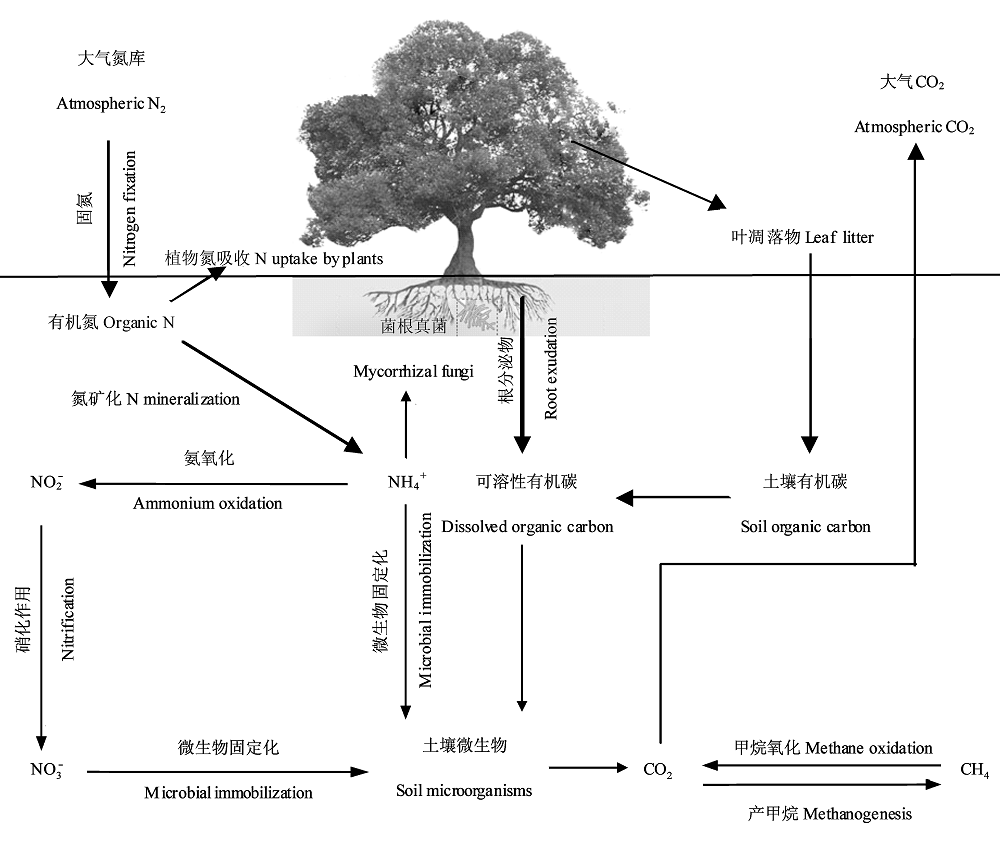
图1 植物与土壤微生物在自然生态系统中的关系(改自Leake et al., 2004; van der Heijden et al., 2008)。
Fig. 1 Relationships between plant and soil microorganisms in natural ecosystem (Modified from Leake et al., 2004; van der Heijden et al., 2008).
| [1] |
Bardgett RD, Bowman WD, Kaufmann B, Schmidt SK (2005). A temporal approach to linking aboveground and belowground ecology. Trends in Ecology and Evolution, 20, 634-641.
URL PMID |
| [2] | Bardgett RD, Frankland JC, Whittaker JB (1993). The effects of agricultural practices on the soil biota of some upland grasslands. Agriculture, Ecosystems and Environment, 45, 25-45. |
| [3] | Bardgett RD, Hobbs PJ, Frostegård Å (1996). Changes in soil fungal: bacterial biomass ratios following reductions in the intensity of management of an upland grassland. Biology and Fertility of Soils, 22, 261-264. |
| [4] | Bardgett RD, Leemans DK, Cook R, Hobbs PJ (1997). Seasonality of the soil biota of grazed and ungrazed hill grasslands. Soil Biology and Biochemistry, 29, 1285-1294. |
| [5] | Bardgett RD, Shine A (1999). Linkages between plant litter diversity, soil microbial biomass and ecosystem function in temperate grasslands. Soil Biology and Biochemistry, 31, 317-321. |
| [6] |
Bardgett RD, Smith RS, Shiel RS, Peacock S, Simkin JM, Qurik H, Hobbs PJ (2006). Parasitic plants indirectly regulate below-ground properties in grassland ecosystems. Nature, 439, 969-972.
URL PMID |
| [7] | Berg B, Laskowski R (2006). Litter decomposition: a guide to carbon and nutrient turnover. Advances in Ecological Research, 38, 421. |
| [8] | Berman T, Holm-Hansen O (1974). Release of photoassimilated carbon as dissolved organic matter by marine phytoplankton. Marine Biology, 28, 305-310. |
| [9] | Berman-Frank I, Dubinsky Z (1999). Balanced growth in aquatic plants: myth or reality? Phytoplankton use the imbalance between carbon assimilation and biomass production to their strategic advantage. BioScience, 49, 29-37. |
| [10] | Bever JD, Westover KM, Antonovics J (1997). Incorporating the soil community into plant population dynamics: the utility of the feedback approach. Journal of Ecology, 85, 561-573. |
| [11] |
Blum JD, Klaue A, Nezat CA, Driscoll CT, Johnson CE, Siccama TG, Eagar C, Fahey TJ, Likens GE (2002). Mycorrhizal weathering of apatite as important calcium source in base-poor forest ecosystems. Nature, 417, 729-731.
URL PMID |
| [12] | Brooker RW (2006). Plant-plant interactions and environmental change. New Phytologist, 171, 271-284. |
| [13] |
Burdon JJ, Thrall PH, Ericson L (2006). The current and future dynamics of disease in plant communities. Annual Review of Phytopathology, 44, 19-39.
URL PMID |
| [14] |
Callaway RM, Brooker RW, Choler P, Kikvidze Z, Lortie CJ, Michalet R, Paolini L, Pugnaire FI, Newingham B, Aschehoug ET, Armas C, Kikvidze D, Cook BJ (2002). Positive interactions among alpine plants increase with stress. Nature, 417, 844-848.
DOI URL PMID |
| [15] | Chapman SK, Langley JA, Hart SC, Koch GW (2006). Plants actively control nitrogen cycling: uncorking the microbial bottleneck. New Phytologist, 169, 27-34. |
| [16] | Cheng XM, Bledsoe CS (2004). Competition for inorganic and organic N by blue oak (Quercus douglasii) seedlings, an annual grass, and soil microorganisms in a pot study. Soil Biology and Biochemistry, 36, 135-144. |
| [17] | Compton JE, Watrud LS, Arlene Porteous L, DeGrood S (2004). Response of soil microbial biomass and community composition to chronic nitrogen additions at Harvard forest. Forest Ecology and Management, 196, 143-158. |
| [18] | Dong YS (董云社), Qi YC (齐玉春) (2006). Progress of carbon cycle research in grassland ecosystem. Geographical Research (地理研究), 25, 183. (in Chinese) |
| [19] | Farley RA, Fitter AH (1999). Temporal and spatial variation in soil resources in a deciduous woodland. Journal of Ecology, 87, 688-696. |
| [20] | Freeman C, Ostle NJ, Fenner N, Kang H (2004). A regulatory role for phenol oxidase during decomposition in peatlands. Soil Biology and Biochemistry, 36, 1663-1667. |
| [21] | Gong MQ (弓明钦), Chen Y (陈羽), Wang FZ (王凤珍), Chen YL (陈应龙) (1999). Inhibitory effect of ectomycorrhizal fungi on bacteria wilt of Eucalyptus. Forest Research (林业科学研究), 12, 339-345. (in Chinese with English abstract) |
| [22] | Gordon DR (1998). Effects of invasive, non-indigenous plant species on ecosystem processes: lessons from Florida. Ecological Applications, 8, 975-989. |
| [23] | Guo XL (郭雪莲), Lü XG (吕宪国), Xi M (郗敏) (2007). Roles of plant in nutrient cycling in wetland. Chinese Journal of Ecology (生态学杂志), 26, 1628-1633. (in Chinese with English abstract) |
| [24] | Grime JP (1979). Plant Strategies and Vegetation Processes. John Wiley & Sons, Chichester. |
| [25] | Han GY (韩桂云), Sun TH (孙铁珩), Li PJ (李培军), Zhang CG (张春桂), Zhang HR (张海荣), Yao DM (姚德明) (2002). Ecological reconstruction of large opencut coal mine through ectomycorrhizal biotechnology. Chinese Journal of Applied Ecology (应用生态学报), 13, 1150-1152. (in Chinese with English abstract) |
| [26] | Harte J, Kinzig AP (1993). Mutualism and competition between plants and decomposers: implications for nutrient allocation in ecosystems. The American Naturalist, 141, 839-846. |
| [27] | He ZL (何振立) (1997). Soil microbial biomass and its signification in nutrients cycle and environmental quality evaluation. Soils (土壤), (2), 61-69. (in Chinese) |
| [28] |
Hobbie SE (1992). Effects of plant species on nutrient cycling. Trends in Ecology and Evolution, 7, 336-339.
URL PMID |
| [29] | Hodge A (2003). Plant nitrogen capture from organic matter as affected by spatial dispersion, interspecific competition and mycorrhizal colonization. New Phytologist, 157, 303-314. |
| [30] | Hodge A, Robinson D, Fitter A (2000). Are microorganisms more effective than plants at competing for nitrogen? Trends in Plant Sciences, 5, 304-308. |
| [31] |
Högberg P, Read DJ (2006). Towards a more plant physiological perspective on soil ecology. Trends in Ecology and Evolution, 21, 548-554.
URL PMID |
| [32] | Jaeger CH III, Monson RK, Fisk MC, Schmidt SK (1999). Seasonal partitioning of nitrogen by plants and soil microorganisms in an alpine ecosystem. Ecology, 80, 1883-1891. |
| [33] |
Kaye JP, Hart SC (1997). Competition for nitrogen between plants and soil microorganisms. Trends in Ecology and Evolution, 12, 139-143.
URL PMID |
| [34] | Knops AMH, Bradley KL, Wedin DA (2002). Mechanisms of plant species impacts on ecosystem nitrogen cycling. Ecology Letters, 5, 454-466. |
| [35] |
Lambers H, Raven JA, Shaver GR, Smith SE (2008). Plant nutrient-acquisition strategies change with soil age. Trends in Ecology and Evolution, 23, 95-103.
DOI URL PMID |
| [36] | Leake J, Johnson D, Donnelly D, Muckle G, Boddy L, Read D (2004). Networks of power and influence: the role of mycorrhizal mycelium in controlling plant communities and agroecosystem functioning. Canadian Journal of Botany, 82, 1016-1045. |
| [37] | Lin HM (林鹤鸣), Zhou YZ (周玉芝), Jiang FQ (姜凤岐), Song X (宋轩), Guo H (郭浩), Qang SZ (王世中) (2001). Application of ectomycorrhiza fungi in young Pinus tabulaeformis Carr. forest. Journal of Shenyang Agricultural University (沈阳农业大学学报), 32, 274-277. (in Chinese with English abstract) |
| [38] | Liu RJ (刘润进), Li XL (李晓林) (2000). Arbuscular Mycorrhizal and Application (丛枝菌根及其应用). Science Press, Beijing. (in Chinese) |
| [39] | Lovett GM, Weathers KC, Arthur MA, Schultz JC (2004). Nitrogen cycling in a northern hardwood forest: Do species matter? Biogeochemistry, 67, 289-308. |
| [40] | Luo YQ, Su B, Currie WS, Ducks JS, Finzi A, Hartwing U, Hungate B, McMurtrie RE, Oren R, Parton WJ, Pataki DE, Shaw MR, Zak DR, Field CB (2004). Progressive nitrogen limitation of ecosystem responses to rising atmospheric carbon dioxide. BioScience, 54, 731-739. |
| [41] |
Manzoni S, Jackson RB, Trofymow JA, Porporato A (2008). The global stoichiometry of litter nitrogen mineralization. Science, 321, 684-686.
URL PMID |
| [42] |
Meier CL, Bowman WD (2008). Links between plant litter chemistry, species diversity, and below-ground ecosystem function. Proceedings of the National Academy of Sciences of the United States of America, 105, 19780-19785.
URL PMID |
| [43] | Moore TR, Trofymow JA, Prescott CE, Fyles J, Titus BD (2006). Patterns of carbon, nitrogen and phosphorus dynamics in decomposing foliar litter in Canadian forests. Ecosystems, 9, 46-62. |
| [44] | Muyzer G, Dewaal EC, Uitterlinden AG (1993). Profiling of complex microbial populations by denaturing gradient gel electrophoresis analysis of polymerase chain reaction-amplified genes coding for 16S rRNA. Applied and Environmental Microbiology, 59, 695-700. |
| [45] | Ogram A (2000). Soil molecular microbial ecology at age 20: methodological challenges for the future. Soil Biology and Biochemistry, 32, 1499-1504. |
| [46] |
Parton W, Silver WL, Burke IC, Grassens L, Harmon ME, Currie WS, King JY, Carol Adair E, Brandt LA, Hart SC, Fasth B (2007). Global-scale similarities in nitrogen release patterns during long-term decomposition. Science, 315, 361-364.
DOI URL PMID |
| [47] | Peng Q (彭琴), Dong YS (董云社), Qi YC (齐玉春) (2008). Influence of external nitrogen input on key processses of carbon cycle in terrestrial ecosystem. Advances in Earth Science (地球科学进展), 23, 874-883. (in Chinese with English abstract) |
| [48] | Personeni E, Lüscher A, Loiseau P (2005). Rhizosphere activity, grass species and N availability effects on the soil C and N cycles. Soil Biology and Biochemistry, 37, 819-827. |
| [49] |
Piao SL, Fang JY, Ciais P, Peylin P, Huang Y, Sitch S, Wang T (2009). The carbon balance of terrestrial ecosystems in China. Nature, 458, 1009-1014.
URL PMID |
| [50] | Porazinska DL, Bardgett RD, Blaauw MB, Hunt HW, Parson AN, Seastedt TR, Wall DR (2003). Relationship at the aboveground-belowground interface: plants, soil biota, and soil processes. Ecological Monographs, 73, 377-395. |
| [51] |
Redman RS, Sheehan KB, Stout RG, Rodriguez RJ, Henson JM (2002). Thermotolerance generated by plant/fungal symbiosis. Science, 298, 1581.
DOI URL PMID |
| [52] | Reeves FB, Wagner D, Moorman T, Kiel J (1979). The role of endomycorrhizae in revegetation practices in the semi-arid West. I. A comparison of incidence of mycorrhizae in severely disturbed vs. natural environments. American Journal of Botany, 66, 6-13. |
| [53] | Reynolds HL, Packer A, Bever JD, Clay K (2003). Grassroots ecology: plant-microbe-soil interactions as drivers of plant community structure and dynamics. Ecology, 84, 2281-2291. |
| [54] | Rothstein DE, Vitousek PM, Simmons BL (2004). An exotic tree alters decomposition and nutrient cycling in a Hawaiian montane forest. Ecosystem, 7, 805-814. |
| [55] | Schortemeyer M, Santruckova H, Sadowsky MJ (1997). Relationship between root length density and soil microorganisms in the rhizospheres of white clover and perennial ryegrass. Communications in Soil Science and Plant Analysis, 28, 1675-1682. |
| [56] |
Schwieger F, Tebbe CC (1998). A new approach to utilize PCR-single-strand-conformation polymorphism for 16S rRNA gene-based microbial community analysis. Applied and Environmental Microbiology, 64, 4870-4876.
DOI URL PMID |
| [57] | Smith JL, Paul EA (1990). The significance of soil microbial biomass estimations. Soil Biochemistry, 6, 357-395. |
| [58] | Song MH, Xu XL, Hu QW, Tian YQ, Ouyang H, Zhou CP (2007). Interactions of plant species mediated plant competition for inorganic nitrogen with soil microorganisms in an alpine meadow. Plant and Soil, 297, 127-137. |
| [59] | Spehn EM, Joshi J, Schmid B, Alphei J, Körnor C (2000). Plant diversity effects on soil heterotrophic activity in experimental grassland ecosystems. Plant and Soil, 224, 217-230. |
| [60] | Stark JM, Hart SC (1997). High rates of nitrification and nitrate turnover in undisturbed coniferous forests. Nature, 385, 61-64. |
| [61] | Ste-Marie C, Houle D (2006). Forest floor gross and net nitrogen mineralization in three forest types in Quebec, Canada. Soil Biology and Biochemistry, 38, 2135-2143. |
| [62] | Stephan A, Meyer AH, Schmid B (2000). Plant diversity affects culturable soil bacteria in experimental grassland communities. Journal of Ecology, 88, 988-998. |
| [63] | Tilman D (1982). Resource Competition and Community Structure. Princeton University Press, Princeton. |
| [64] | Tilman D (1987). Secondary succession and the pattern of plant dominance along experimental nitrogen gradients. Ecological Monographs, 57, 189-214. |
| [65] | Torsvik VL (1980). Isolation of bacterial DNA from soil. Soil Biology and Biochemistry, 12, 15-21. |
| [66] |
Torsvik VL, Goksøyr J, Daae FL (1990). High diversity in DNA of soil bacteria. Applied and Environmental Microbiology, 56, 782-787.
DOI URL PMID |
| [67] |
van der Heijden MGA, Bardgett RD, van Straalen NM (2008). The unseen majority: soil microbes as drivers of plant diversity and productivity in terrestrial ecosystems. Ecology Letters, 11, 296-310.
DOI URL PMID |
| [68] | van der Heijden MGA, Boller T, Wiemken A, Sanders IR (1998a). Different arbuseular mycorrhizal fungi species are potential determinants of plant community structure. Ecology, 79, 2082-2091. |
| [69] | van der Heijden MGA, Klironomos JN, Ursic M, Moutoglis P, Streitwolf-Engel R, Boller T, Wiemken A, Sanders IR (1998b). Mycorrhizal fungal diversity determines plant biodiversity, ecosystem variability and productivity. Nature, 396, 69-72. |
| [70] | Waldrop MP, Zak DR, Sinsabaugh RL, Gallo M, Lauber C (2004). Nitrogen deposition modifies soil carbon storage through changes in microbial enzymatic activity. Ecological Application, 14, 1172-1177. |
| [71] | Wall DH, Moore JC (1999). Interactions underground: soil biodiversity, mutualism, and ecosystem process. BioScience, 49, 109-117. |
| [72] | Wardle DA (1999). Biodiversity, ecosystem and interactions that transcend the interface. Trends in Ecology and Evolution, 14, 125-127. |
| [73] | Wardle DA (2002). Communities and Ecosystems: Linking the Aboveground and Belowground Components. Princeton University Press, Princeton. |
| [74] |
Wardle DA, Bardgett RD, Klironomos JN, Setälä H, van der Putten WH, Wall DH (2004). Ecological linkages between aboveground and belowground biota. Science, 304, 1629-1633.
URL PMID |
| [75] | William Hamilton E III, Frank DA (2001). Can plants stimulate soil microbes and their own nutrient supply? Evidence from a grazing tolerant grass. Ecology, 82, 2397-2402. |
| [76] | Wilson JB, Agnew ADQ (1992). Positive-feedback switches in plant communities. Advances in Ecological Research, 23, 263-336. |
| [77] | Wolfe BE, Husband BC, Klironomos JN (2005). Effects of a belowground mutualism on an aboveground mutualism. Ecology Letters, 8, 218-223. |
| [78] | Xu ZZ (许振柱), Zhou GS (周广胜) (2007). Relationship between carbon and nitrogen and environmental regulation in plants under global change―from molecule to ecosystem. Journal of Plant Ecology (Chinese Version) (植物生态学报), 31, 738-747. (in Chinese with English abstract) |
| [79] | Xu XL, Ouyang H, Pei ZY, Zhou CP (2004). Long-term partitioning of 15N labeled ammonium and nitrate among different components in an alpine meadow ecosystem. Acta Botanica Sinica, 46, 279-283. |
| [80] | Xu XL, Ouyang H, Kuzyakov Y, Richter A, Wanek W (2006). Significance of organic nitrogen acquisition for dominant species in an alpine meadow on the Tibet Plateau, China. Plant and Soil, 285, 221-231. |
| [81] | Yang WP (杨维平) (2002). Mycorrhizal fungi―an important factor affecting plant community structure. Biology Teaching (生物学教学), 27(4), 22-24. (in Chinese) |
| [82] | Zak DR, Groffman PM, Pregitzer KS, Christensen S, Tiedje JM (1990). The vernal dam: plant-microbe competition for nitrogen in northern hardwood forests. Ecology, 71, 651-656. |
| [83] | Zhang Y (张英), Guo LD (郭良栋), Liu RJ (刘润进) (2003). Diversity and ecology of arbuscular mycorrhizal fungi in Dujiangyan. Acta Phytoecologica Sinica (植物生态学报), 27, 537-544. (in Chinese with English abstract) |
| [84] | Zhou XM (周兴民) (2001). Kobresia Meadow in China (中国嵩草草甸). Science Press, Beijing. 839-846. (in Chinese) |
| [1] | 肖治术, 范宗骥, 于桂清, 范明亮. 油麻藤属(Mucuna)植物的传粉和种子传播研究进展: 现状与展望[J]. , 2027, 51(动植物互作): 0-. |
| [2] | 刘志祥, 黎凤兰, 黄晓磊. 昆虫虫瘿生态系统的复杂性及成瘿机制研究进展[J]. , 2027, 51(动植物互作): 0-. |
| [3] | 曹伊菲, 苏涛, 曹敏, 汪海燕, 杨洁. 新生代被子植物叶脉密度演化的驱动因素研究:气候适应与植食压力[J]. , 2027, 51(动植物互作): 0-. |
| [4] | 赵掷艺, 黄伟权, 胡婧妍, 王义越, 虞梦婕, 吴玉环. 泥炭沼泽湿地植物残体分解及微生物作用机理研究进展[J]. , 2026, 50(预发表): 0-. |
| [5] | 柯嘉雯, 程张浩, 高雪夷, 徐云剑, 王毅. 镉污染下的植物响应:从吸收、转运到应答与缓解机制[J]. 植物生态学报, 2026, 50(预发表): 1-. |
| [6] | 陈欣蕊, 宋维峰, 王燚, 王浩, 孙诗瑶, 王彩江, 蔡世鹏, 任红, 何玉陶, 潘珉, 曹光秀, 严毅, 谢志勇, 王行. 滇池湖滨带典型挺水植物氮磷重吸收特征及其适应策略[J]. , 2026, 50(预发表): 0-. |
| [7] | 何青, 袁旭东, 任博申, 冯治洋, 鲁梦珍, 林巧玲, 姜庆虎, 杨林森, 余辉亮, 姚辉, 杨敬元, 刘峰, 江明喜. 一年蓬(Erigeron annuus)入侵对亚高山泥炭湿地植物群落结构与多样性的影响[J]. 植物生态学报, 2026, 50(预发表): 0-. |
| [8] | 胡光明, 欧旭, 龙文兴. 热带云雾林宿主树皮粗糙度对附生维管植物多样性与孢子定殖的影响[J]. 植物生态学报, 2026, 50(预发表): 1-. |
| [9] | 段建林, 孟晟, 陈仁利, 熊林峰, 卢春洋, 席念勋. 全球变化因子多样性对菌根植物性状的影响[J]. , 2026, 50(预发表): 0-. |
| [10] | 杨梅花, 张子嘉, 乔栋, 冯俊娜, 庞子杰, 钱龙, 刘志晖, 蔡娜娜, 胡中民, 杨国姣. 海南热带森林乔木群落调查和多样性数据集[J]. 植物生态学报, 2026, 50(预发表): 0-. |
| [11] | 封逸凡, 朱时应, 周淑荣, 江乐乐, 陈隆, 王苗, 邓国芳, 刘兰. 热带次生林恢复中土壤微生物对菌根化树苗存活和生长性状的影响[J]. 植物生态学报, 2026, 50(预发表): 1-. |
| [12] | 任曦彤, 李颖, 张雨, 熊胡安赫, 张蕊科, 祁珊珊, 戴志聪, 杜道林. 丛枝菌根真菌与凋落物互作有助于加拿大一枝黄花应对营养胁迫[J]. 植物生态学报, 2026, 50(3): 710-721. |
| [13] | 段世龙, 余成瑾, 许心垚, 冯固, 谢贤安, 张林. 植物-丛枝菌根真菌-细菌连续体及其维持机制[J]. 植物生态学报, 2026, 50(3): 600-611. |
| [14] | 邹纪开, 吴佳怡, 谷云懿, 陈宝明. 不同形态氮添加与丛枝菌根真菌对外来入侵植物白花鬼针草竞争力的影响[J]. 植物生态学报, 2026, 50(3): 722-730. |
| [15] | 姜庆宏, 丁露, 王哲, 郑春丽, 冯昭绰. 丛枝菌根真菌与不同功能细菌联用对苜蓿的促生作用[J]. 植物生态学报, 2026, 50(3): 774-788. |
| 阅读次数 | ||||||
|
全文 |
|
|||||
|
摘要 |
|
|||||
Copyright © 2026 版权所有 《植物生态学报》编辑部
地址: 北京香山南辛村20号, 邮编: 100093
Tel.: 010-62836134, 62836138; Fax: 010-82599431; E-mail: apes@ibcas.ac.cn, cjpe@ibcas.ac.cn
备案号: 京ICP备16067583号-19

