
植物生态学报 ›› 2015, Vol. 39 ›› Issue (5): 466-476.DOI: 10.17521/cjpe.2015.0045 cstr: 32100.14.cjpe.2015.0045
所属专题: 生态化学计量
梁儒彪1,2, 梁进1, 乔明锋1,2, 徐振锋3, 刘庆1, 尹华军1*( )
)
收稿日期:2014-12-08
接受日期:2015-03-17
出版日期:2015-05-01
发布日期:2015-05-26
作者简介:*作者简介:E-mail:
基金资助:
LIANG Ru-Biao1,2, LIANG Jin1, QIAO Ming-Feng1,2, XU Zhen-Feng3, LIU Qing1, YIN Hua-Jun1,*()
Received:2014-12-08
Accepted:2015-03-17
Online:2015-05-01
Published:2015-05-26
About author:# Co-first authors
摘要:
目前有关森林根系分泌物及其诱导的土壤生态学效应研究主要关注根系碳(C)源输入, 而极少关注根系分泌物氮(N)源输入及其伴随的C:N化学计量特征对土壤过程和功能的影响, 极大地限制了我们对森林根系-土壤-微生物互作机制的深入认识。该研究以川西亚高山天然林和云杉(Picea asperata)人工林土壤为对象, 模拟配制不同C:N化学计量特征(只有N、C:N = 10、C:N = 50、C:N = 100和只有C处理)的根系分泌物溶液进行人工添加试验, 以探究根系分泌物化学计量特征对两种林分土壤碳动态及其微生物群落结构的影响差异。结果表明: 模拟根系分泌物C添加总体促进了两种林分土壤有机质分解激发效应而降低了土壤总碳(TC)含量, 而N添加在一定程度上缓和了两种林分土壤TC含量的降低幅度, 且C添加导致天然林土壤TC含量的降低幅度明显低于土壤N有效性更低的人工林。几种根系分泌物添加处理对两种林分土壤活性和惰性碳库的影响无明显规律。另外, 根系分泌物C添加总体降低了天然林土壤微生物总磷脂脂肪酸(PLFA)含量和细菌、放线菌、真菌PLFA含量, 而总体增加人工林土壤微生物PLFA总量和细菌、放线菌、真菌PLFA含量, 并诱导两种林分土壤微生物群落结构(细菌:真菌相对丰度)也发生了各自不同的变化。上述结果表明森林根系分泌物N源输入和土壤N有效性共同调控根系C源输入对土壤有机质分解激发效应的方向和幅度。研究结果为深入揭示典型森林根系分泌物化学计量特征对土壤生物化学循环过程的调控机制提供了一定的理论依据。
梁儒彪, 梁进, 乔明锋, 徐振锋, 刘庆, 尹华军. 模拟根系分泌物C:N化学计量特征对川西亚高山森林土壤碳动态和微生物群落结构的影响. 植物生态学报, 2015, 39(5): 466-476. DOI: 10.17521/cjpe.2015.0045
LIANG Ru-Biao,LIANG Jin,QIAO Ming-Feng,XU Zhen-Feng,LIU Qing,YIN Hua-Jun. Effects of simulated exudate C:N stoichiometry on dynamics of carbon and microbial community composition in a subalpine coniferous forest of western Sichuan, China. Chinese Journal of Plant Ecology, 2015, 39(5): 466-476. DOI: 10.17521/cjpe.2015.0045
| 理化性质 Physical-chemical properties | 天然林 Natural forest | 人工林 Plantation |
|---|---|---|
| pH值 pH value | 6.97 ± 0.02 | 6.73 ± 0.03 |
| 含水量 Water content (%) | 52.52 ± 1.76 | 37.70 ± 2.46 |
| 总碳 Total C (mg·g-1) | 114.87 ± 1.10 | 49.22 ± 1.18 |
| 总氮 Total N (mg·g-1) | 8.46 ± 0.31 | 3.20 ± 0.12 |
| 碳氮比 C:N | 13.59 ± 0.51 | 15.41 ± 0.55 |
表1 天然林和人工林土壤理化性质(平均值±标准偏差)
Table 1 Soil physical and chemical properties in both natural forest and plantation (mean ± SD)
| 理化性质 Physical-chemical properties | 天然林 Natural forest | 人工林 Plantation |
|---|---|---|
| pH值 pH value | 6.97 ± 0.02 | 6.73 ± 0.03 |
| 含水量 Water content (%) | 52.52 ± 1.76 | 37.70 ± 2.46 |
| 总碳 Total C (mg·g-1) | 114.87 ± 1.10 | 49.22 ± 1.18 |
| 总氮 Total N (mg·g-1) | 8.46 ± 0.31 | 3.20 ± 0.12 |
| 碳氮比 C:N | 13.59 ± 0.51 | 15.41 ± 0.55 |
| 处理 Treatment | 葡萄糖 Glucose (g) | 柠檬酸 Citric acid (g) | 谷氨酸 Glutamic acid (g) | 氯化铵 NH4Cl (g) | 去离子水 Deionized water (mL) |
|---|---|---|---|---|---|
| 对照 Control (CK) | - | - | - | - | 1 000 |
| 仅添加N N-only | - | - | - | 0.022 9 | 1 000 |
| C:N = 10 | 0.075 3 | 0.075 3 | 0.016 8 | 0.016 8 | 1 000 |
| C:N = 50 | 0.083 0 | 0.083 0 | 0.003 4 | 0.003 4 | 1 000 |
| C:N = 100 | 0.084 0 | 0.084 0 | 0.001 7 | 0.001 7 | 1 000 |
| 仅添加C C-only | 0.085 0 | 0.085 0 | - | - | 1 000 |
表2 不同C:N化学计量特征的根系分泌物模拟溶液的化学组成和含量
Table 2 Chemical components and contents of simulated root exudates in different C:N stoichiometry
| 处理 Treatment | 葡萄糖 Glucose (g) | 柠檬酸 Citric acid (g) | 谷氨酸 Glutamic acid (g) | 氯化铵 NH4Cl (g) | 去离子水 Deionized water (mL) |
|---|---|---|---|---|---|
| 对照 Control (CK) | - | - | - | - | 1 000 |
| 仅添加N N-only | - | - | - | 0.022 9 | 1 000 |
| C:N = 10 | 0.075 3 | 0.075 3 | 0.016 8 | 0.016 8 | 1 000 |
| C:N = 50 | 0.083 0 | 0.083 0 | 0.003 4 | 0.003 4 | 1 000 |
| C:N = 100 | 0.084 0 | 0.084 0 | 0.001 7 | 0.001 7 | 1 000 |
| 仅添加C C-only | 0.085 0 | 0.085 0 | - | - | 1 000 |
| 处理 Treatment | 天然林 Natural forest | 人工林 Plantation |
|---|---|---|
| 对照 Control (CK) | 7.09 ± 0.02d | 7.03 ± 0.05d |
| 仅添加N N-only | 7.26 ± 0.02c | 7.12 ± 0.02c |
| C:N = 10 | 7.32 ± 0.03b | 7.15 ± 0.01bc |
| C:N = 50 | 7.39 ± 0.03a | 7.20 ± 0.02ab |
| C:N = 100 | 7.35 ± 0.03b | 7.27 ± 0.02a |
| 仅添加C C-only | 7.26 ± 0.03c | 7.14 ± 0.02bc |
表3 不同C:N化学计量特征的根系分泌物模拟添加对天然林和人工林土壤pH的影响(平均值±标准偏差)
Table 3 Effects of simulated root exudates under different C:N stoichiometry on soil pH in both natural forest and plantation (mean ± SD)
| 处理 Treatment | 天然林 Natural forest | 人工林 Plantation |
|---|---|---|
| 对照 Control (CK) | 7.09 ± 0.02d | 7.03 ± 0.05d |
| 仅添加N N-only | 7.26 ± 0.02c | 7.12 ± 0.02c |
| C:N = 10 | 7.32 ± 0.03b | 7.15 ± 0.01bc |
| C:N = 50 | 7.39 ± 0.03a | 7.20 ± 0.02ab |
| C:N = 100 | 7.35 ± 0.03b | 7.27 ± 0.02a |
| 仅添加C C-only | 7.26 ± 0.03c | 7.14 ± 0.02bc |
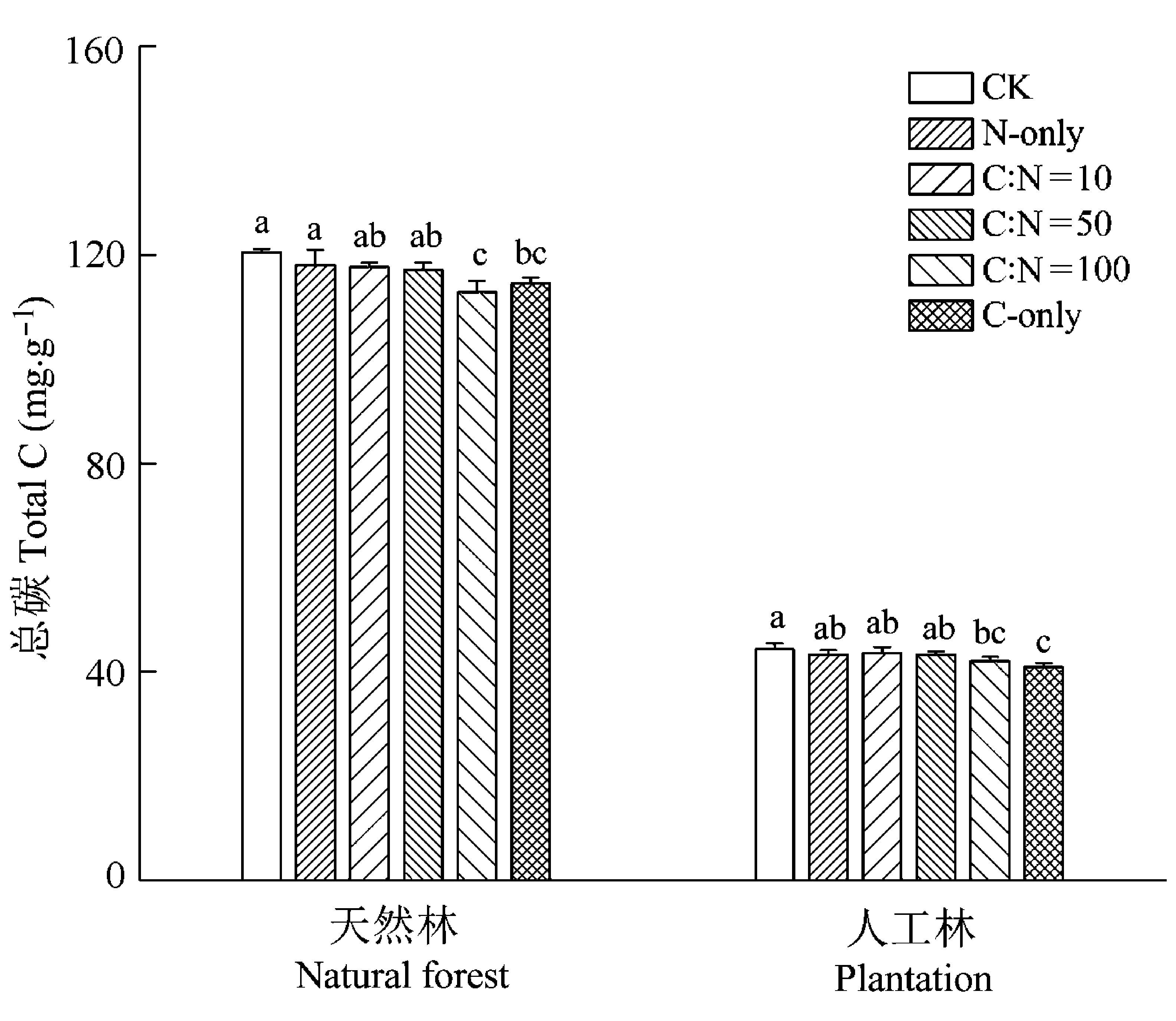
图1 不同C:N化学计量特征的根系分泌物模拟添加对天然林和人工林土壤总碳含量的影响(平均值±标准偏差)。CK, 对照; C-only, 仅添加C; N-only, 仅添加N。不同小写字母表示同一林型各处理间在p < 0.05水平上差异显著。
Fig. 1 Effects of simulated root exudates under different C:N stoichiometry on total carbon content in natural forest and the plantation (mean ± SD). CK, control. Different lowercase letters mean significant differences (p < 0.05) among treatments at a given forest type.
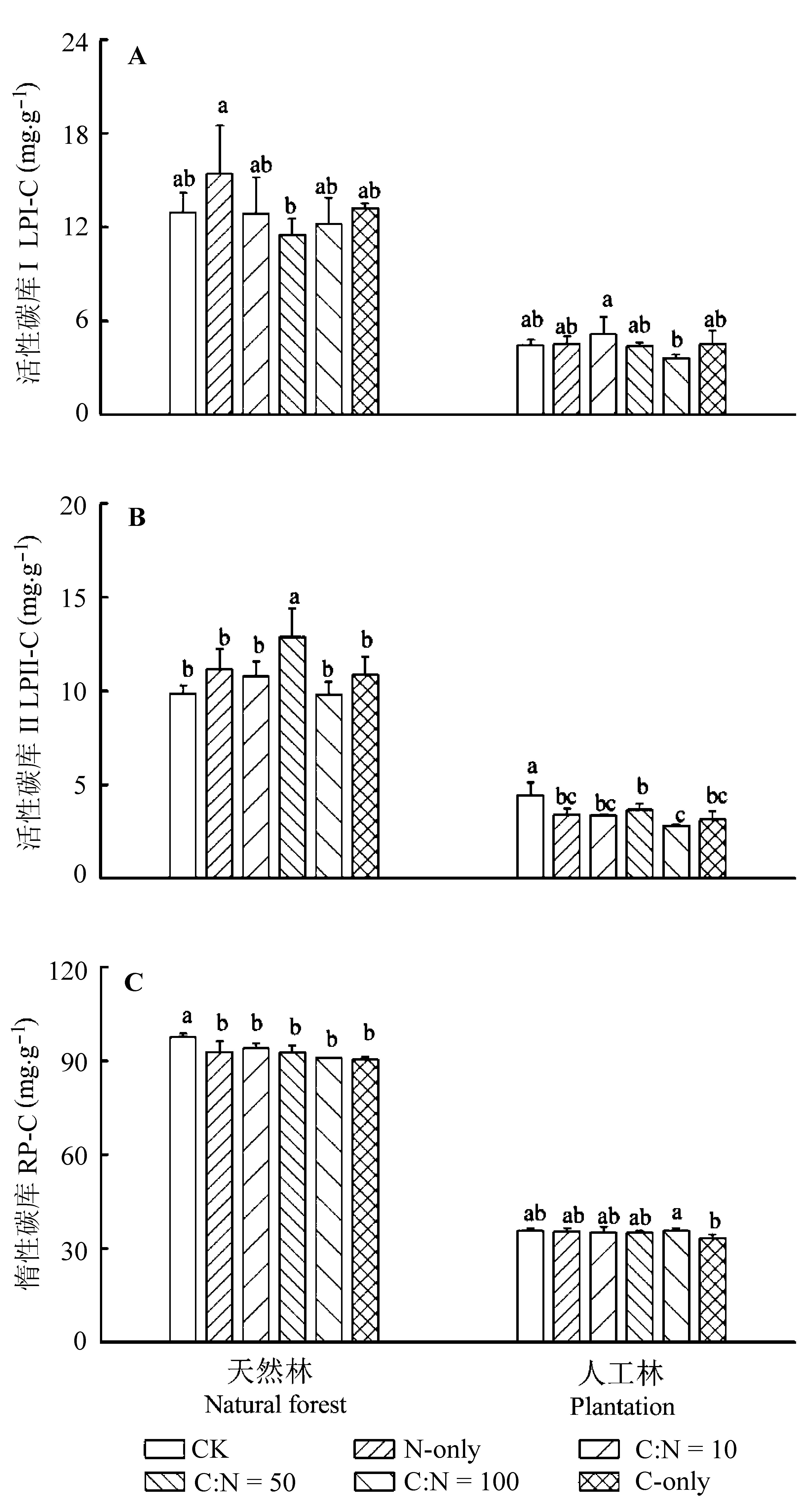
图2 不同C:N化学计量特征的根系分泌物模拟添加对天然林和人工林土壤活性和惰性碳库的影响(平均值±标准偏差)。A, 活性碳库I。B, 活性碳库II。C, 惰性碳库。CK, 对照; C-only, 仅添加C; N-only, 仅添加N。不同小写字母表示同一林型各处理间在p < 0.05水平上差异显著。
Fig. 2 Effects of simulated root exudates under different C:N stoichiometry on soil labile and recalcitrant carbon pool in natural forest and the plantation (mean ± SD). A, labile carbon pool I (LPI-C). B, labile carbon pool II (LPII-C). C, recalcitrant carbon pool (RP-C). CK, control. Lowercase letters mean significant differences (p < 0.05) among treatments at a given forest type.
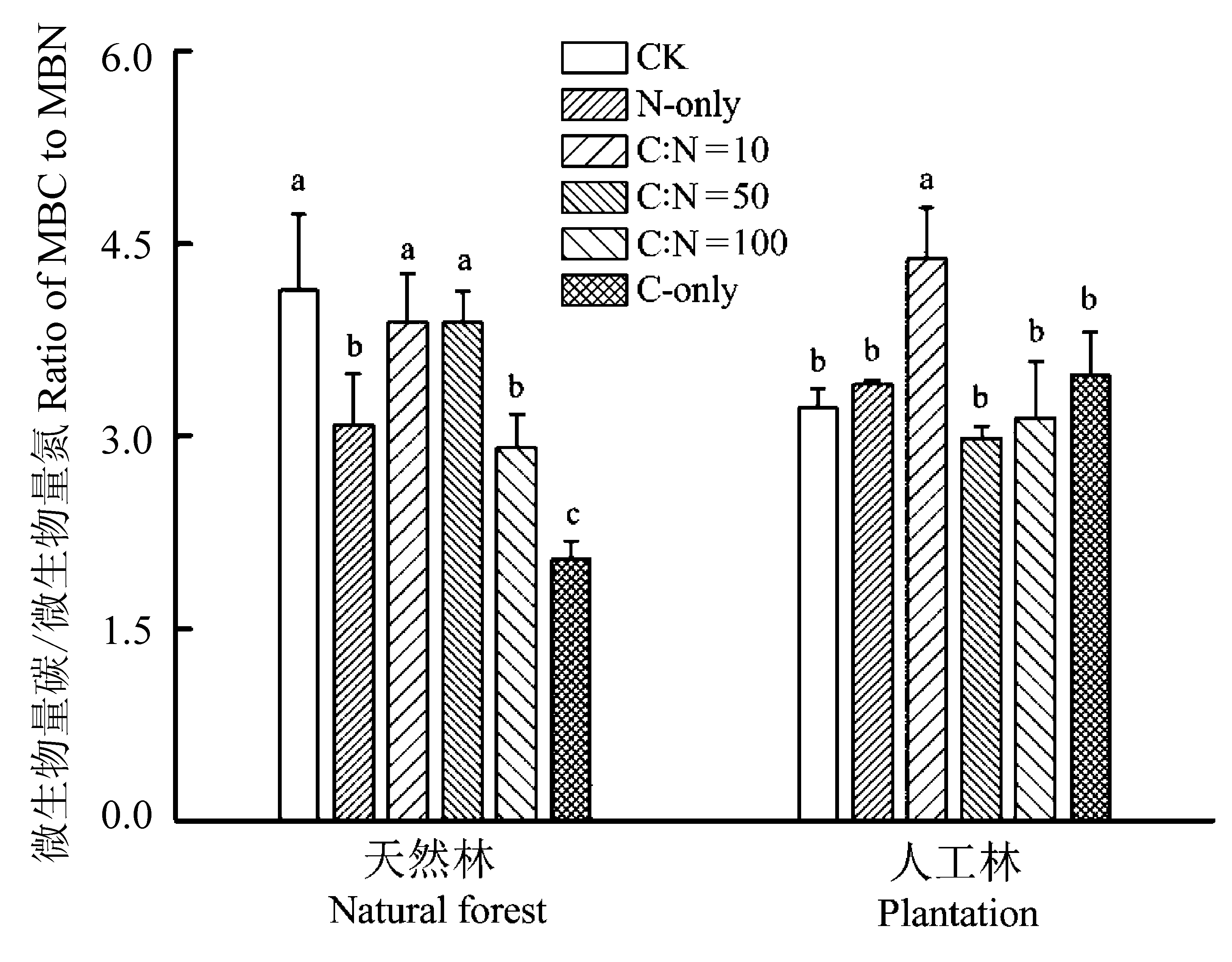
图3 不同C:N化学计量特征的根系分泌物添加对天然林和人工林不同C:N化学计量特征根系分泌物模拟溶液对天然林和人工林土壤微生物生物量碳氮比的影响(平均值±标准偏差)。CK, 对照; C-only, 仅添加C; N-only, 仅添加N。不同小写字母表示同一林型各处理间在p < 0.05水平上差异显著。
Fig. 3 Effects of simulated root exudates under different C:N stoichiometry on ratio of (microbial biomass C : microbial biomass N) MBC:MBN in natural forest and the plantation (mean ± SD). CK, control. Lowercase letters mean significant differences (p < 0.05) among treatments at a given forest type.
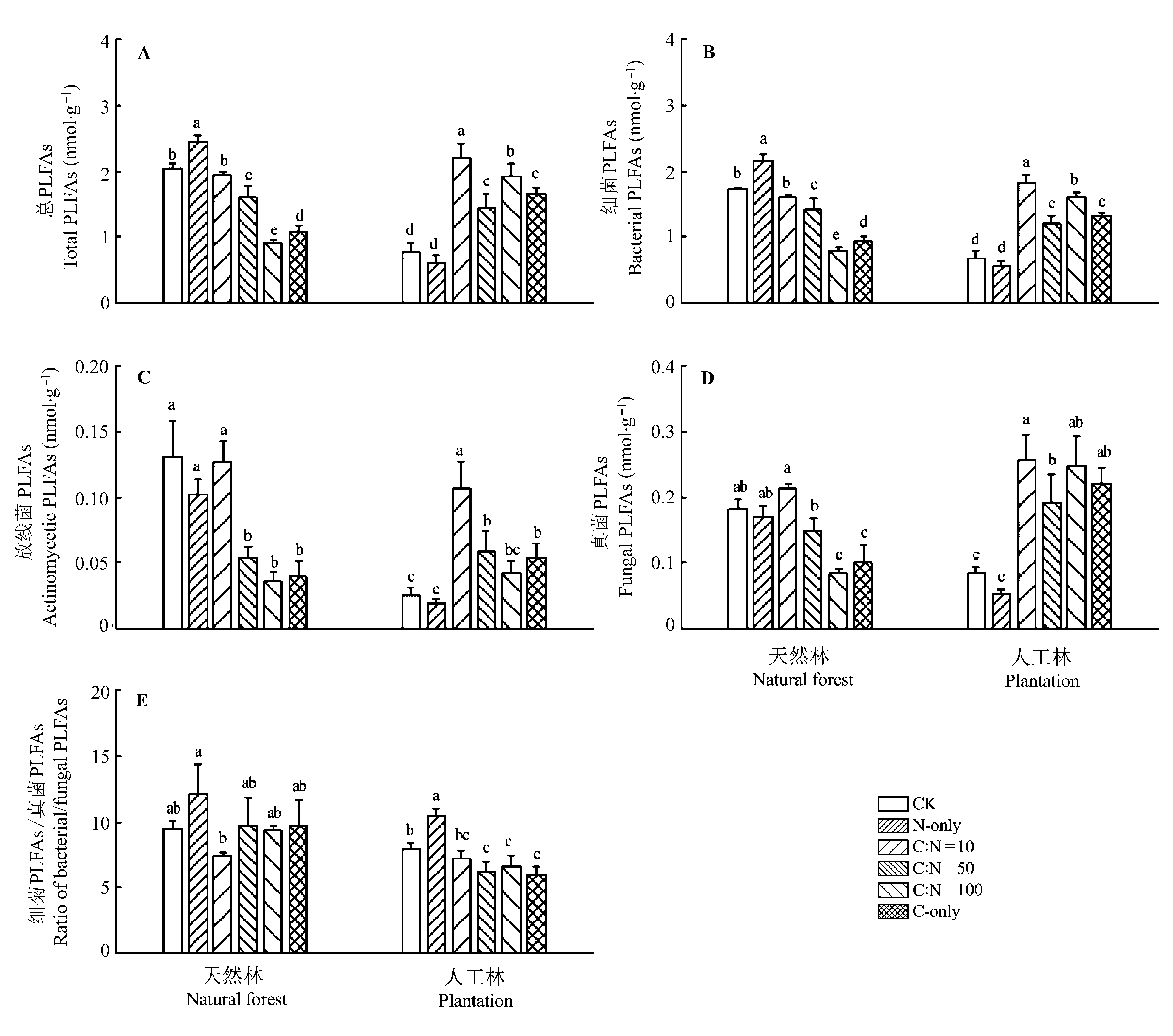
图4 不同C:N化学计量特征的根系分泌物添加对天然林和人工林土壤微生物磷酸脂肪酸(PLFA)含量的影响(平均值±标准偏差)。A, 微生物总PLFA。B, 细菌PLFA。C, 放线菌PLFA。D, 真菌PLFA。E, 细菌PLFA/真菌PLFA。CK, 对照; C-only, 仅添加C; N-only, 仅添加N。不同小写字母表示同一林型各处理间在p < 0.05水平上差异显著。
Fig. 4 Effects of simulated root exudates under different C:N stoichiometry on contents of soil microbial phospholipid fatty acid (PLFA) in natural forest and the plantation (mean ± SD). A, total PLFA in microbia. B, bacterial PLFA. C, actinomycetic PLFA. D, fungal PLFA. E, ratio of bacterial/fungal PLFA. CK, control. Lowercase letters mean significant differences (p < 0.05) among treatments at a given forest type.
| 1 | Bengtson P, Barker J, Grayston SJ (2012). Evidence of a strong coupling between root exudation, C and N availability, and stimulated SOM decomposition caused by rhizosphere priming effects.Ecology and Evolution, 2, 1843-1852. |
| 2 | Blagodatskaya Е, Kuzyakov Y (2008). Mechanisms of real and apparent priming effects and their dependence on soil microbial biomass and community structure: Critical review.Biology and Fertility of Soils, 45, 115-131. |
| 3 | Bossio DA, Scow KM, Gunapala N, Graham KJ (1998). Determinants of soil microbial communities: Effects of agricultural management, season, and soil type on phospholipid fatty acid profiles.Microbial Ecology, 36, 1-12. |
| 4 | Burns RG, DeForest JL, Marxsen J, Sinsabaugh RL, Stromberger ME, Wallenstein MD, Weintraub MN, Zoppini A (2013). Soil enzymes in a changing environment: Current knowledge and future directions.Soil Biology & Biochemistry, 58, 216-234. |
| 5 | Carney KM, Hungate BA, Drake BG, Megonigal JP (2007). Altered soil microbial community at elevated CO2 leads to loss of soil carbon.Proceedings of the National Academy of Sciences of the United States of America, 104, 4990-4995. |
| 6 | Chapin FS III, McFarland J, David McGuire A, Euskirchen ES, Ruess RW, Kielland K (2009). The changing global carbon cycle: Linking plant-soil carbon dynamics to global consequences.Journal of Ecology, 97, 840-850. |
| 7 | Chen RR, Senbayram M, Blagodatsky S, Myachina O, Dittert K, Lin XG, Blagodatskaya E, Kuzyakov Y (2014). Soil C and N availability determine the priming effect: Microbial N mining and stoichiometric decomposition theories.Global Change Biology, 20, 2356-2367. |
| 8 | Cheng WX, Parton WJ, Gonzalez-Meler MA, Phillips R, Asao S, McNickle GG, Brzostek E, Jastrow JD (2014). Synthesis and modeling perspectives of rhizosphere priming.New Phytologist, 201, 31-44. |
| 9 | Cleveland CC, Liptzin D (2007). C:N:P stoichiometry in soil: Is there a “Redfield ratio” for the microbial biomass?Biogeochemistry, 85, 235-252. |
| 10 | Craine JM, Morrow C, Fierer N (2007). Microbial nitrogen limitation increases decomposition.Ecology, 88, 2105-2113. |
| 11 | de Graaff MA, Classen AT, Castro HF, Schadt CW (2010). Labile soil carbon inputs mediate the soil microbial community composition and plant residue decomposition rates. New Phytologist, 188, 1055-1064. |
| 12 | Dijkstra FA, Cheng WX (2007). Interactions between soil and tree roots accelerate long-term soil carbon decomposition.Ecology Letters, 10, 1046-1053. |
| 13 | Dorodnikov M, Blagodatskaya E, Blagodatsky S, Marhan S, Fangmeier A, Kuzyakov Y (2009). Stimulation of microbial extracellular enzyme activities by elevated CO2 depends on soil aggregate size.Global Change Biology, 15, 1603-1614. |
| 14 | Drake J, Darby B, Giasson MA, Kramer M, Phillips R, Finzi A (2013). Stoichiometry constrains microbial response to root exudation-insights from a model and a field experiment in a temperate forest.Biogeosciences, 10, 821-838. |
| 15 | Espinosa-Urgel M, Ramos JL (2001). Expression of a Pseudomonas putida aminotransferase involved in lysine catabolism is induced in the rhizosphere.Applied and Environmental Microbiology, 67, 5219-5224. |
| 16 | Fontaine S, Bardoux G, Abbadie L, Mariotti A (2004). Carbon input to soil may decrease soil carbon content.Ecology Letters, 7, 314-320. |
| 17 | Fontaine S, Henault C, Aamor A, Bdioui N, Bloor JMG, Maire V, Mary B, Revaillot S, Maron PA (2011). Fungi mediate long term sequestration of carbon and nitrogen in soil through their priming effect.Soil Biology & Biochemistry, 43, 86-96. |
| 18 | Fontaine S, Mariotti A, Abbadie L (2003). The priming effect of organic matter: A question of microbial competition?Soil Biology & Biochemistry, 35, 837-843. |
| 19 | Fransson P, Johansson EM (2010). Elevated CO2 and nitrogen influence exudation of soluble organic compounds by ectomycorrhizal root systems.FEMS Microbiology Ecology, 71, 186-196. |
| 20 | Güsewell S, Gessner MO (2009). N:P ratios influence litter decomposition and colonization by fungi and bacteria in microcosms.Functional Ecology, 23, 211-219. |
| 21 | Grayston SJ, Vaughan D, Jones D (1997). Rhizosphere carbon flow in trees, in comparison with annual plants: The importance of root exudation and its impact on microbial activity and nutrient availability.Applied Soil Ecology, 5, 29-56. |
| 22 | Hessen DO, Ågren GI, Anderson TR, Elser JJ, de Ruiter PC (2004). Carbon sequestration in ecosystems: The role of stoichiometry.Ecology, 85, 1179-1192. |
| 23 | Jones DL, Hodge A, Kuzyakov Y (2004). Plant and mycorrhizal regulation of rhizodeposition.New Phytologist, 163, 459-480. |
| 24 | Kuzyakov Y (2002). Review: Factors affecting rhizosphere priming effects.Journal of Plant Nutrition and Soil Science, 165, 382-396. |
| 25 | Liu Q (2002). Ecological Research on Subalpine Coniferous Forests in China. Sichuan University Press, Chengdu. 142.(in Chinese) |
| [刘庆 (2002). 亚高山针叶林生态学研究. 四川大学出版社, 成都. 142.] | |
| 26 | McGill WB, Cole CV (1981). Comparative aspects of cycling of organic C, N, S and P through soil organic matter.Geoderma, 26, 267-286. |
| 27 | Moorhead DL, Sinsabaugh RL (2006). A theoretical model of litter decay and microbial interaction.Ecological Monographs, 76, 151-174. |
| 28 | Phillips RP, Bernhardt ES, Schlesinger WH (2009). Elevated CO2 increases root exudation from loblolly pine (Pinus taeda) seedlings as an N-mediated response.Tree Physiology, 29, 1513-1523. |
| 29 | Phillips RP, Finzi AC, Bernhardt ES (2011). Enhanced root exudation induces microbial feedbacks to N cycling in a pine forest under long-term CO2 fumigation.Ecology Letters, 14, 187-194. |
| 30 | Ramirez KS, Craine JM, Fierer N (2012). Consistent effects of nitrogen amendments on soil microbial communities and processes across biomes.Global Change Biology, 18, 1918-1927. |
| 31 | Rovira P, Vallejo VR (2002). Labile and recalcitrant pools of carbon and nitrogen in organic matter decomposing at different depths in soil: An acid hydrolysis approach.Geoderma, 107, 109-141. |
| 32 | Schmidt MW, Torn MS, Abiven S, Dittmar T, Guggenberger G, Janssens IA, Kleber M, Kögel-Knabner I, Lehmann J, Manning DA, Nannipieri P, Rasse DP, Weiner S, Trumbore SE (2011). Persistence of soil organic matter as an ecosystem property.Nature, 478, 49-56. |
| 33 | Shi SJ, Condron L, Larsen S, Richardson AE, Jones E, Jiao J, O’Callaghan M, Stewart A (2011). In situ sampling of low molecular weight organic anions from rhizosphere of radiata pine (Pinus radiata) grown in a rhizotron system.Environmental and Experimental Botany, 70, 131-142. |
| 34 | Strickland MS, Rousk J (2010). Considering fungal: Bacterial dominance in soils-Methods, controls, and ecosystem implications.Soil Biology & Biochemistry, 42, 1385-1395. |
| 35 | Sullivan BW, Hart SC (2013). Evaluation of mechanisms controlling the priming of soil carbon along a substrate age gradient.Soil Biology & Biochemistry, 58, 293-301. |
| 36 | Sun Y, Xu XL, Kuzyakov Y (2014). Mechanisms of rhizos- phere priming effects and their ecological significance. Chinese Journal of Plant Ecology, 38, 62-75.(in Chinese with English abstract) |
| [孙悦, 徐兴良, Kuzyakov Y (2014). 根际激发效应的发生机制及其生态重要性. 植物生态学报, 38, 62-75.] | |
| 37 | Wu LK, Lin XM, Lin WX (2014). Advances and perspective in research on plant-soil-microbe interactions mediated by root exudates.Chinese Journal of Plant Ecology, 38, 298-310.(in Chinese with English abstract) |
| [吴林坤, 林向民, 林文雄 (2014). 根系分泌物介导下植物-土壤-微生物互作关系研究进展与展望. 植物生态学报, 38, 298-310.] | |
| 38 | Xu ZF, Wan C, Xiong P, Tang Z, Hu R, Cao G, Liu Q (2010). Initial responses of soil CO2 efflux and C, N pools to experimental warming in two contrasting forest ecosys- tems, Eastern Tibetan Plateau, China.Plant and Soil, 336, 183-195. |
| 39 | Yin HJ, Li YF, Xiao J, Xu ZF, Cheng XY, Liu Q (2013). Enhanced root exudation stimulates soil nitrogen transformations in a subalpine coniferous forest under experimental warming.Global Change Biology, 19, 2158-2167. |
| 40 | Yin HJ, Wheeler E, Phillips RP (2014). Root-induced changes in nutrient cycling in forests depend on exudation rates.Soil Biology & Biochemistry, 78, 213-221. |
| 41 | Zhang WD, Wang XF, Wang SL (2013). Addition of external organic carbon and native soil organic carbon decomposi- tion: A meta-analysis.PLoS ONE, 8, e54779. |
| 42 | Zhao Q, Zeng DH, Fan ZP (2010). Nitrogen and phosphorus transformations in the rhizospheres of three tree species in a nutrient-poor sandy soil.Applied Soil Ecology, 46, 341-346. |
| [1] | 刘润洪, 阳柳蓉, 梁慧婷, 申卫军. 丛枝菌根和外生菌根植物磷获取与利用策略研究进展与展望[J]. 植物生态学报, 2026, 50(3): 566-583. |
| [2] | 田地, 迟小龙, 石亮, 刘宵含, 赵常提, 吴梅, 张玉忠, 高永亮. 塞罕坝地区优势造林树种叶片化学计量特征及其环境驱动[J]. 植物生态学报, 2026, 50(2): 362-373. |
| [3] | 于江珊, 许浩, 郭永忠, 侯继华. 器官年龄在油松叶、枝、根化学计量特征变异以及协调中的重要作用[J]. 植物生态学报, 2026, 50(2): 306-317. |
| [4] | 郝欢欢, 李丹, 郭子华, 周澳, 李彦颉, 杨亮, 张冉, 卢英帅, 赵祥, 陈晓鹏. 盐胁迫对长穗偃麦草根系分泌氨基酸及其衍生物的影响[J]. 植物生态学报, 2026, 50(1): 202-212. |
| [5] | 夏琦, 聂秀青, 陈轶群, 刘世荣. 南亚热带纯林和混交林根系分泌物代谢组学分析[J]. 植物生态学报, 2026, 50(1): 188-201. |
| [6] | 常鹏飞, 李平, 纳尔斯格, 王静, 王振华, 杨森, 贾舟, 杨璐, 刘玲莉, 邓美凤. 内蒙古温带草原不同草地类型土壤有机碳和无机碳储量对总碳储量的贡献及其驱动因素[J]. 植物生态学报, 2025, 49(9): 1374-1387. |
| [7] | 赵常明, 熊高明, 申国珍, 葛结林, 徐文婷, 徐凯, 武元帅, 谢宗强. 2010年神农架常绿落叶阔叶混交林和亚高山针叶林长期监测样地植物物种组成和群落特征数据集[J]. 植物生态学报, 2025, 49(8): 1215-1228. |
| [8] | 梁天豪, 熊德成, 刘源豪, 杜旭龙, 杨智杰, 黄锦学. 不同菌根类型树种的根系分泌物特征及其根际效应研究进展[J]. 植物生态学报, 2025, 49(7): 1038-1052. |
| [9] | 王娟, 张登山, 肖元明, 裴全帮, 王博, 樊博, 周国英. 长期围封后高寒草原植物根系分泌物特征与环境因子关系[J]. 植物生态学报, 2025, 49(4): 596-609. |
| [10] | 胡璟, 吕世琪, 李冰, 马志波, 符利勇, 殷建章, 肖玖金, 闫佳源, 胡宗达. 温带过渡区4种典型天然林土壤有机碳组分与碳库管理指数变化特征[J]. 植物生态学报, 2025, 49(11): 1957-1972. |
| [11] | 胡同欣, 石林, 窦旭, 于澄, 韩宇, 孙龙. 林火对兴安落叶松根际与非根际土壤微生物群落的影响[J]. 植物生态学报, 2025, 49(10): 1755-1766. |
| [12] | 马煦晗, 黄菊莹, 余海龙, 韩翠, 李冰. 降水量变化及氮添加下荒漠草原土壤有机碳及其易分解组分研究[J]. 植物生态学报, 2024, 48(8): 1065-1077. |
| [13] | 王燕, 张全智, 王传宽, 郭万桂, 蔺佳玮. 恢复方式对东北东部森林土壤碳氮磷计量特征的影响[J]. 植物生态学报, 2024, 48(7): 943-954. |
| [14] | 龙吉兰, 蒋铮, 刘定琴, 缪宇轩, 周灵燕, 冯颖, 裴佳宁, 刘瑞强, 周旭辉, 伏玉玲. 干旱下植物根系分泌物及其介导的根际激发效应研究进展[J]. 植物生态学报, 2024, 48(7): 817-827. |
| [15] | 刘瑶, 钟全林, 徐朝斌, 程栋梁, 郑跃芳, 邹宇星, 张雪, 郑新杰, 周云若. 不同大小刨花楠细根功能性状与根际微环境关系[J]. 植物生态学报, 2024, 48(6): 744-759. |
| 阅读次数 | ||||||
|
全文 |
|
|||||
|
摘要 |
|
|||||
Copyright © 2026 版权所有 《植物生态学报》编辑部
地址: 北京香山南辛村20号, 邮编: 100093
Tel.: 010-62836134, 62836138; Fax: 010-82599431; E-mail: apes@ibcas.ac.cn, cjpe@ibcas.ac.cn
备案号: 京ICP备16067583号-19

