
植物生态学报 ›› 2026, Vol. 50 ›› Issue (1): 123-133.DOI: 10.17521/cjpe.2025.0024 cstr: 32100.14.cjpe.2025.0024
刘子晨1, 陈文娜2, 黄久香1, 李玉玲1, 姚纲1,*( )
)
收稿日期:2025-01-14
接受日期:2025-05-28
出版日期:2026-01-20
发布日期:2026-02-13
通讯作者:
*姚纲(gyao@scau.edu.cn)基金资助:
LIU Zi-Chen1, CHEN Wen-Na2, HUANG Jiu-Xiang1, LI Yu-Ling1, YAO Gang1,*()
Received:2025-01-14
Accepted:2025-05-28
Online:2026-01-20
Published:2026-02-13
Contact:
*YAO Gang (gyao@scau.edu.cn)Supported by:摘要:
气候变化在很大程度上影响着生物类群的演化历史, 多肉植物是适应干旱气候条件的特殊植物类群。龙树科含3亚科6属约20种, 均为多肉植物, 分布于非洲大陆南部至东部以及马达加斯加西南部的干旱地区, 然而该科类群物种多样化历程是否与其分布区干旱气候的建立有关, 到目前为止尚不清楚。该研究基于6个叶绿体序列片段(rps16、rpl16、trnL-F、trnT-trnL、trnG-S、trnQ-rps16)构建了该科系统发生关系, 并对该科类群进行了分化时间估算和物种多样化分析。结果表明: 龙树科是一个获得很高支持的单系类群, 该科类群在古新世中期约62.3百万年前(Ma)开始分化, 但物种多样性相对较高的马齿苋树亚科与龙树亚科分别在约14.9 Ma和11.1 Ma才开始分化, 该科类群在约11 Ma出现过分化速率明显增加的情况, 这与其地理分布区在中新世15‒10 Ma期间的干旱气候建立在时间尺度上高度吻合。该研究认为龙树科地理分布区在中新世中晚期干旱气候的建立可能是促进其物种快速分化的潜在环境因子。该研究不仅深化了对龙树科物种多样性演化的认识, 同样增进了对多肉植物类群在时间尺度上进化历史的理解。
刘子晨, 陈文娜, 黄久香, 李玉玲, 姚纲. 中新世中晚期干旱气候的建立对龙树科物种分化的潜在影响. 植物生态学报, 2026, 50(1): 123-133. DOI: 10.17521/cjpe.2025.0024
LIU Zi-Chen, CHEN Wen-Na, HUANG Jiu-Xiang, LI Yu-Ling, YAO Gang. Potential impact of the establishment of drought climate during the mid-late Miocene on promoting species diversification of Didiereaceae. Chinese Journal of Plant Ecology, 2026, 50(1): 123-133. DOI: 10.17521/cjpe.2025.0024
| 类群 Taxon | trnL-trnF | trnT-trnL | trnG-trnS | trnQ-rps16 | rps16 | rpl16 |
|---|---|---|---|---|---|---|
| 直立亚龙木 Alluaudia ascendens | KM261932 | KM262007 | KM261984 | KM261959 | KM261907 | KM261883 |
| 多叶亚龙木1 Alluaudia comosa 1 | KM261934 | KM262008 | KM261986 | KM261961 | KM261909 | KM261885 |
| 多叶亚龙木2 Alluaudia comosa 2 | KM261933 | - | KM261985 | KM261960 | KM261908 | KM261884 |
| 丛生亚龙木 Alluaudia dumosa | KM261935 | KM262009 | KM261987 | KM261962 | KM261910 | KM261886 |
| 木竹桃 Alluaudia humbertii | KM261936 | - | KM261988 | KM261963 | KM261911 | KM261887 |
| 苍岩亚龙木 Alluaudia montagnacii | KM261937 | KM262010 | KM261989 | KM261964 | KM261912 | KM261888 |
| 亚龙木 Alluaudia procera | KM261938 | KM262011 | KM261990 | KM261965 | KM261913 | KM261889 |
| 枝龙木 Alluaudiopsis fiherenensis | KM261939 | KM262012 | KM261991 | KM261966 | KM261914 | KM261890 |
| 双刺枝龙木 Alluaudiopsis marnieriana | KM261940 | KM262013 | KM261992 | KM261967 | KM261915 | KM261891 |
| 缨苋树 Calyptrotheca somalensis | AF094845 | AF095914 | - | - | - | AF101139 |
| 曲龙木 Decarya madagascariensis | KM261941 | - | KM261993 | KM261968 | KM261916 | KM261892 |
| 刺戟木1 Didierea madagascariensis 1 | KM261943 | KM262015 | KM261995 | KM261970 | KM261918 | KM261894 |
| 刺戟木2 Didierea madagascariensis 2 | KM261942 | KM262014 | KM261994 | KM261969 | KM261917 | KM261893 |
| 平枝刺戟木 Didierea trollii | KM261944 | KM262016 | KM261996 | KM261971 | KM261919 | KM261895 |
| 马齿苋树 Portulacaria afra | KM261950 | KM262022 | KM262002 | KM261977 | KM261925 | KM261901 |
| 高序苋树 Portulacaria armiana | KM261951 | KM262023 | KM262003 | KM261978 | KM261926 | KM261902 |
| 大叶蜡苋树 Portulacaria carrissoana | KM261945 | KM262017 | KM261997 | KM261972 | KM261920 | KM261896 |
| 灌状蜡苋树 Portulacaria fruticulosa | KM261946 | KM262018 | KM261998 | KM261973 | KM261921 | KM261897 |
| 狭叶蜡苋树 Portulacaria longipedunculata | KM261947 | KM262019 | KM261999 | KM261974 | KM261922 | KM261898 |
| 蜡苋树 Portulacaria namaquensis | KM261948 | KM262020 | KM262000 | KM261975 | KM261923 | KM261899 |
| 矮蜡苋树 Portulacaria pygmaea | KM261949 | KM262021 | KM262001 | KM261976 | KM261924 | KM261900 |
| 落葵薯 Anredera cordifolia | NC_041274 | NC_041274 | NC_041274 | NC_041274 | NC_041274 | NC_041274 |
| 落葵 Basella alba | NC_041293 | NC_041293 | NC_041293 | NC_041293 | NC_041293 | NC_041293 |
| 南荒蓬 Halophytum ameghinoi | NC_040949 | NC_040949 | NC_040949 | NC_040949 | NC_040949 | NC_040949 |
表1 取样类群的名称及DNA序列信息
Table 1 Information on taxa name and DNA sequences used
| 类群 Taxon | trnL-trnF | trnT-trnL | trnG-trnS | trnQ-rps16 | rps16 | rpl16 |
|---|---|---|---|---|---|---|
| 直立亚龙木 Alluaudia ascendens | KM261932 | KM262007 | KM261984 | KM261959 | KM261907 | KM261883 |
| 多叶亚龙木1 Alluaudia comosa 1 | KM261934 | KM262008 | KM261986 | KM261961 | KM261909 | KM261885 |
| 多叶亚龙木2 Alluaudia comosa 2 | KM261933 | - | KM261985 | KM261960 | KM261908 | KM261884 |
| 丛生亚龙木 Alluaudia dumosa | KM261935 | KM262009 | KM261987 | KM261962 | KM261910 | KM261886 |
| 木竹桃 Alluaudia humbertii | KM261936 | - | KM261988 | KM261963 | KM261911 | KM261887 |
| 苍岩亚龙木 Alluaudia montagnacii | KM261937 | KM262010 | KM261989 | KM261964 | KM261912 | KM261888 |
| 亚龙木 Alluaudia procera | KM261938 | KM262011 | KM261990 | KM261965 | KM261913 | KM261889 |
| 枝龙木 Alluaudiopsis fiherenensis | KM261939 | KM262012 | KM261991 | KM261966 | KM261914 | KM261890 |
| 双刺枝龙木 Alluaudiopsis marnieriana | KM261940 | KM262013 | KM261992 | KM261967 | KM261915 | KM261891 |
| 缨苋树 Calyptrotheca somalensis | AF094845 | AF095914 | - | - | - | AF101139 |
| 曲龙木 Decarya madagascariensis | KM261941 | - | KM261993 | KM261968 | KM261916 | KM261892 |
| 刺戟木1 Didierea madagascariensis 1 | KM261943 | KM262015 | KM261995 | KM261970 | KM261918 | KM261894 |
| 刺戟木2 Didierea madagascariensis 2 | KM261942 | KM262014 | KM261994 | KM261969 | KM261917 | KM261893 |
| 平枝刺戟木 Didierea trollii | KM261944 | KM262016 | KM261996 | KM261971 | KM261919 | KM261895 |
| 马齿苋树 Portulacaria afra | KM261950 | KM262022 | KM262002 | KM261977 | KM261925 | KM261901 |
| 高序苋树 Portulacaria armiana | KM261951 | KM262023 | KM262003 | KM261978 | KM261926 | KM261902 |
| 大叶蜡苋树 Portulacaria carrissoana | KM261945 | KM262017 | KM261997 | KM261972 | KM261920 | KM261896 |
| 灌状蜡苋树 Portulacaria fruticulosa | KM261946 | KM262018 | KM261998 | KM261973 | KM261921 | KM261897 |
| 狭叶蜡苋树 Portulacaria longipedunculata | KM261947 | KM262019 | KM261999 | KM261974 | KM261922 | KM261898 |
| 蜡苋树 Portulacaria namaquensis | KM261948 | KM262020 | KM262000 | KM261975 | KM261923 | KM261899 |
| 矮蜡苋树 Portulacaria pygmaea | KM261949 | KM262021 | KM262001 | KM261976 | KM261924 | KM261900 |
| 落葵薯 Anredera cordifolia | NC_041274 | NC_041274 | NC_041274 | NC_041274 | NC_041274 | NC_041274 |
| 落葵 Basella alba | NC_041293 | NC_041293 | NC_041293 | NC_041293 | NC_041293 | NC_041293 |
| 南荒蓬 Halophytum ameghinoi | NC_040949 | NC_040949 | NC_040949 | NC_040949 | NC_040949 | NC_040949 |
| 属 Genus | 属级物种取样比例 Sampling fraction in genus | 属级所有物种数目 Species number accepted in genus |
|---|---|---|
| 亚龙木属 Alluaudia | 1 | 6 |
| 龙树属 Didierea | 1 | 2 |
| 曲龙木属 Decarya | 1 | 1 |
| 枝龙木属 Alluaudiopsis | 1 | 2 |
| 缨苋树属 Calyptrotheca | 0.5 | 2 |
| 马齿苋树属 Portulacaria | 1 | 7 |
表2 龙树科属级物种取样比例
Table 2 Information regarding the taxon sampling fraction for each genus of Didiereaceae
| 属 Genus | 属级物种取样比例 Sampling fraction in genus | 属级所有物种数目 Species number accepted in genus |
|---|---|---|
| 亚龙木属 Alluaudia | 1 | 6 |
| 龙树属 Didierea | 1 | 2 |
| 曲龙木属 Decarya | 1 | 1 |
| 枝龙木属 Alluaudiopsis | 1 | 2 |
| 缨苋树属 Calyptrotheca | 0.5 | 2 |
| 马齿苋树属 Portulacaria | 1 | 7 |
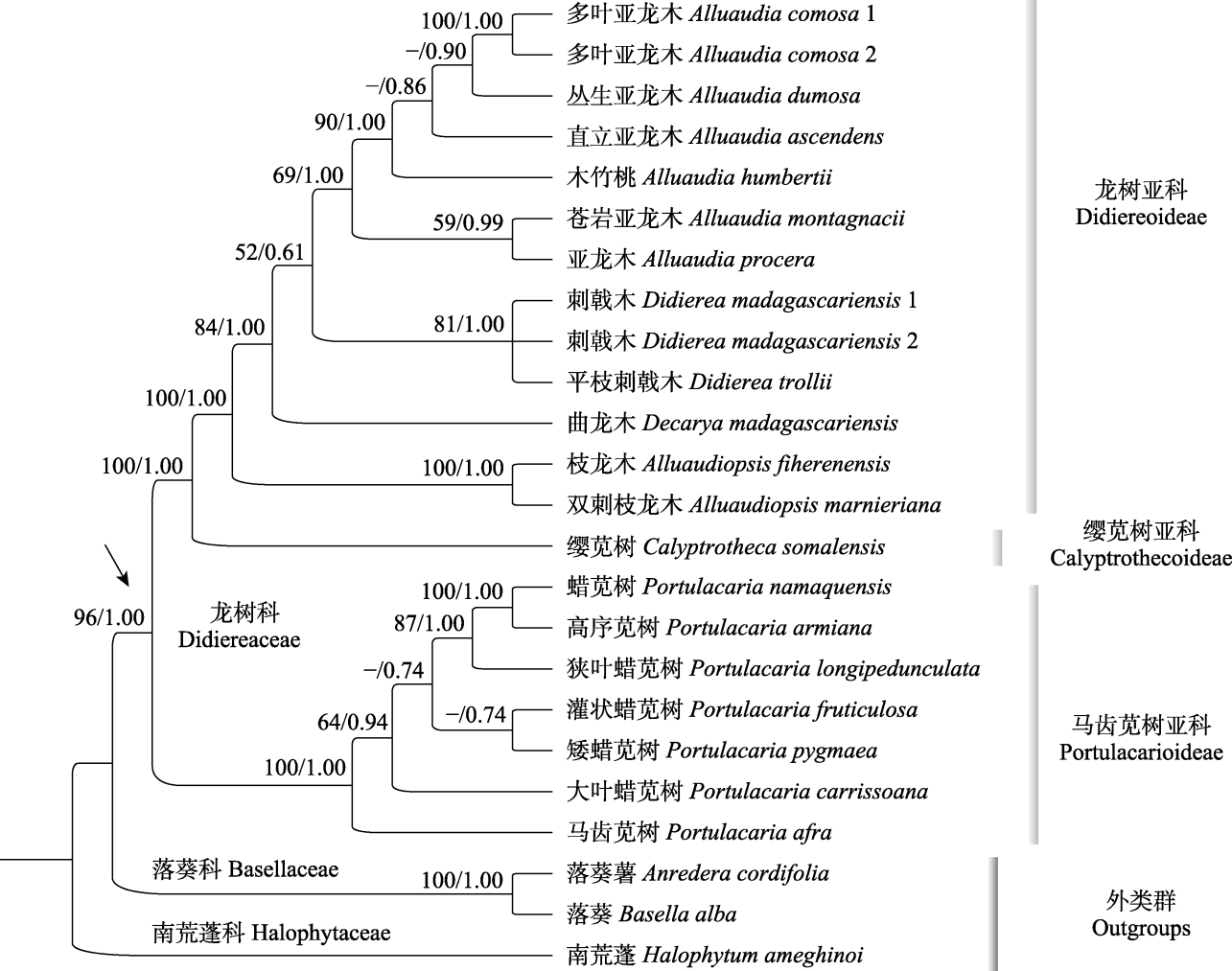
图1 基于6个叶绿体序列片段(trnL-trnF、trnT-trnL、trnG-trnS、trnQ-rps16、rps16、rpl16)联合矩阵采用贝叶斯分析所得龙树科系统发生关系。分支节点数据代表“最大似然法自展支持率/贝叶斯后验概率”; -, 该节点关系在最大似然法分析中未获得支持或支持率不足50%。
Fig. 1 Bayesian consensus tree inferred from a combined dataset (including trnL-trnF, trnT-trnL, trnG-trnS, trnQ-rps16, rps16, rpl16). Bootstrap (BS) support value in maximum likelihood (ML) analysis/Posterior probability (PP) in Bayesian inference (BI) are indicated near each phylogenetic node. - indicates the topology was not present in ML analysis or BS value in ML analysis was less than 50%.
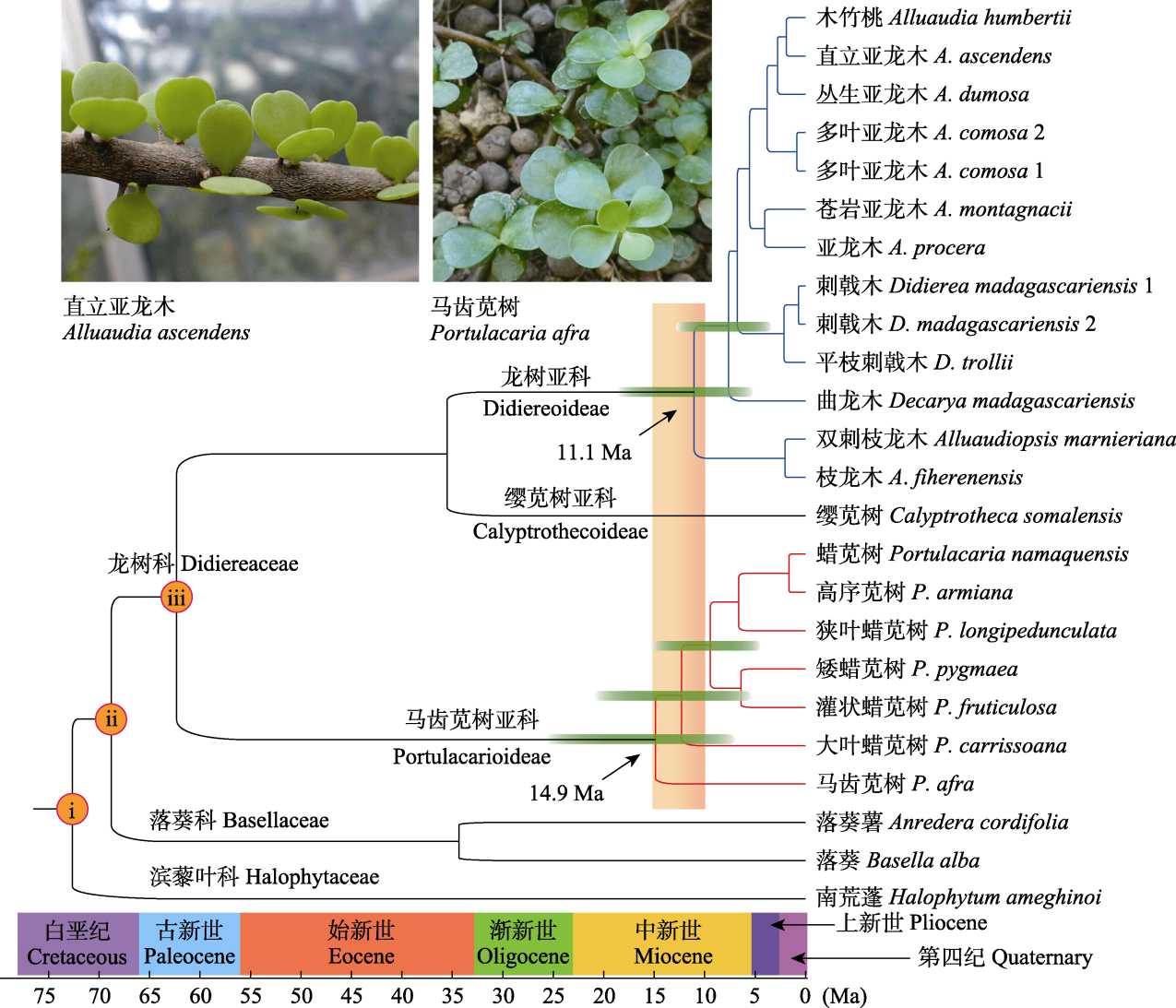
图2 龙树科物种直立亚龙木、马齿苋树枝条(示叶片肉质化)以及基于6个叶绿体序列片段联合矩阵与3个时间校准点采用BEAST分析所得龙树科物种水平分化时间图。i-iii为3个时间校准点, 其中i为南荒蓬科干群节点, ii为落葵科干群节点, iii为龙树科冠群节点。橙色条块示中新世中晚期15‒10百万年前(Ma)期间全球性干旱化事件发生的时间区间; 绿色横杠示关键节点分化时间的95%置信区间(95%最大后验密度)。
Fig. 2 Branchlets of Alluaudia ascendens and Portulacaria afra (all have succulent leaves), and the chronogram of Didiereaceae inferred from BEAST analysis of combined dataset (including trnL-trnF, trnT-trnL, trnG-trnS, trnQ-rps16, rps16, rpl16) and three calibrations. Calibration points i‒iii indicate: (i) stem node of Halophytaceae, (ii) stem node of Basellaceae, and (iii) crown node of Didiereaceae. The orange band marks the 15‒10 million years ago (Ma) period of widespread arid climate establishment. Green bars represent 95% highest posterior density (HPD) intervals for divergence ages at key nodes.
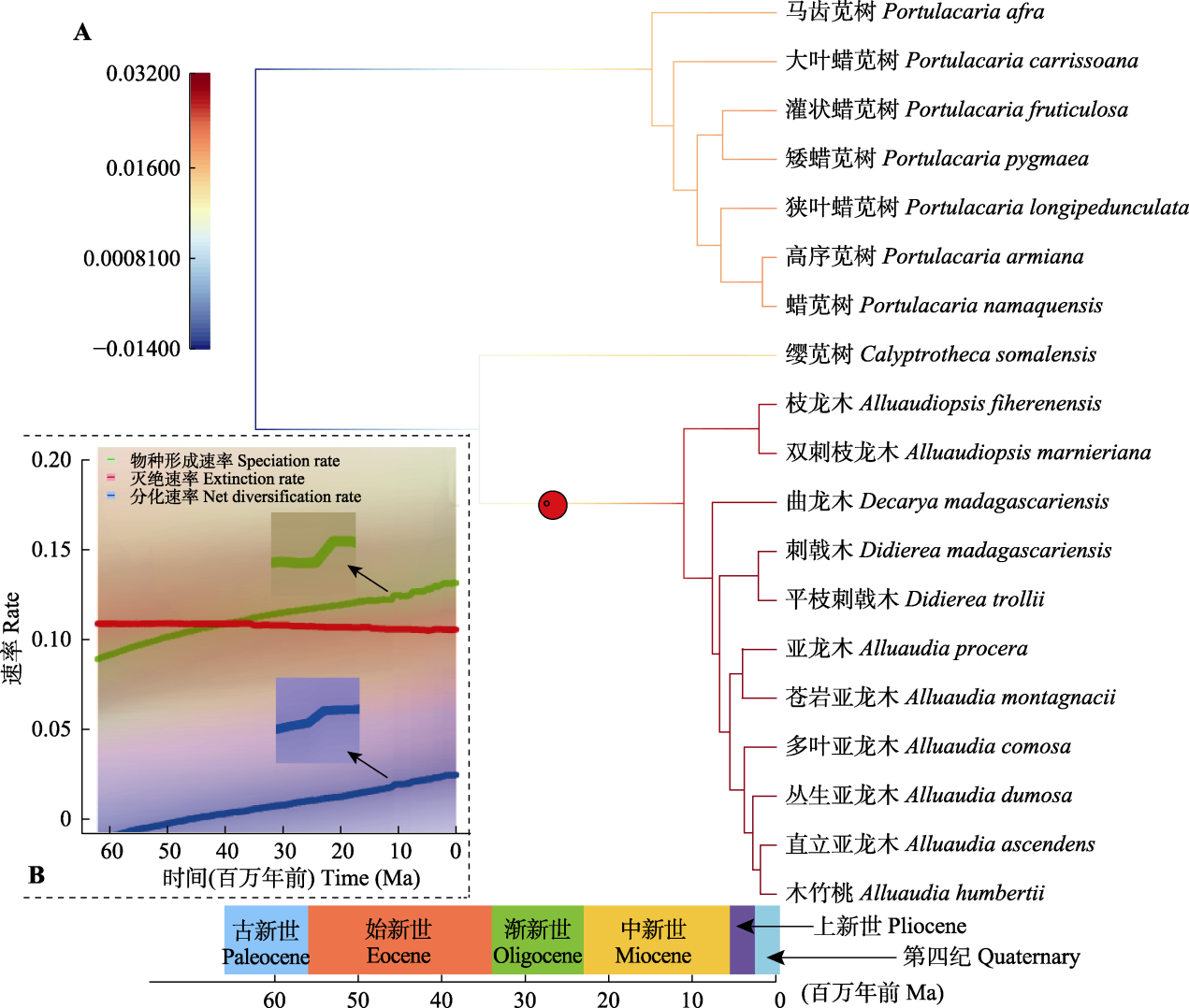
图3 基于时间树对龙树科进行物种多样化过程推测的基于宏观进化混合软件的贝叶斯分析(BAMM)分析结果。A, 龙树科Phylorate图, 分支颜色根据物种分化速率变化过程进行标记; 红点暗示该分支存在分化速率明显增加的转变波动。B, 龙树科物种形成速率、物种灭绝速率以及物种分化速率随时间波动的具体过程。
Fig. 3 Diversification history of Didiereaceae inferred from Bayesian Analysis of Macroevolutionary Mixtures (BAMM) analysis. A, Phylorate plot showing net diversification rate (branch colors). The red dot indicates an increased diversification rate shift. B, Rate-through-time plots for speciation, extinction and net diversification. Ma, million years ago.
| [1] |
Arakaki M, Christin PA, Nyffeler R, Lendel A, Eggli U, Ogburn RM, Spriggs E, Moore MJ, Edwards EJ (2011). Contemporaneous and recent radiations of the world’s major succulent plant lineages. Proceedings of the National Academy of Sciences of the United States of America, 108, 8379-8384.
DOI PMID |
| [2] |
Bobe R (2006). The evolution of arid ecosystems in eastern Africa. Journal of Arid Environments, 66, 564-584.
DOI URL |
| [3] |
Bruyns PV, Klak C, Hanáček P (2011). Age and diversity in old world succulent species of Euphorbia (Euphorbiaceae). Taxon, 60, 1717-1733.
DOI URL |
| [4] |
Bruyns PV, Oliveira-Neto M, Melo-de-Pinna GF, Klak C (2014). Phylogenetic relationships in the Didiereaceae with special reference to subfamily Portulacarioideae. Taxon, 63, 1053-1064.
DOI URL |
| [5] |
Cowling RM, Procheş Ş, Partridge TC (2009). Explaining the uniqueness of the cape flora: incorporating geomorphic evolution as a factor for explaining its diversification. Molecular Phylogenetics and Evolution, 51, 64-74.
DOI PMID |
| [6] |
de Wit MJ (2003). Madagascar: heads it’s a continent, tails it’s an island. Annual Review of Earth and Planetary Sciences, 31, 213-248.
DOI URL |
| [7] | Gamisch A, Comes HP (2019). Clade-age-dependent diversification under high species turnover shapes species richness disparities among tropical rainforest lineages of Bulbophyllum (Orchidaceae). BMC Evolutionary Biology, 19, 93. DOI: 10.1186/s12862-019-1416-1. |
| [8] | Grace OM, Buerki S, Symonds MRE, Forest F, van Wyk AE, Smith GF, Klopper RR, Bjorå CS, Neale S, Demissew S, Simmonds MSJ, Rønsted N (2015). Evolutionary history and leaf succulence as explanations for medicinal use in aloes and the global popularity of Aloe vera. BMC Evolutionary Biology, 15, 29. DOI: 10.1186/s12862-015-0291-7. |
| [9] |
Gupta AK, Yuvaraja A, Prakasam M, Clemens SC, Velu A (2015). Evolution of the South Asian monsoon wind system since the late Middle Miocene. Palaeogeography, Palaeoclimatology, Palaeoecology, 438, 160-167.
DOI URL |
| [10] |
Hernández-Hernández T, Brown JW, Schlumpberger BO, Eguiarte LE, Magallón S (2014). Beyond aridification: multiple explanations for the elevated diversification of cacti in the New World Succulent Biome. New Phytologist, 202, 1382-1397.
DOI PMID |
| [11] |
Hoffmann AA, Sgrò CM (2011). Climate change and evolutionary adaptation. Nature, 470, 479-485.
DOI |
| [12] |
Kandziora M, Kadereit JW, Gehrke B (2017). Dual colonization of the Palaearctic from different regions in the Afrotropics by Senecio. Journal of Biogeography, 44, 147-157.
DOI URL |
| [13] |
Katoh K, Standley DM (2013). MAFFT multiple sequence alignment software version 7: improvements in performance and usability. Molecular Biology and Evolution, 30, 772-780.
DOI PMID |
| [14] |
Kong HH, Condamine FL, Harris AJ, Chen JL, Pan B, Möller M, Hoang VS, Kang M (2017). Both temperature fluctuations and East Asian monsoons have driven plant diversification in the karst ecosystems from Southern China. Molecular Ecology, 26, 6414-6429.
DOI PMID |
| [15] | Lei RH, Frasier CL, Hawkins MTR, Engberg SE, Bailey CA, Johnson SE, McLain AT, Groves CP, Perry GH, Nash SD, Mittermeier RA, Louis EE (2017). Phylogenomic reconstruction of sportive lemurs (genus Lepilemur) recovered from mitogenomes with inferences for Madagascar biogeography. Journal of Heredity, 108, 107-119. |
| [16] | Logan RF (1968). Causes, climates, and distribution of deserts// Brown GW. Desert Biology: Special Topics on the Physical and Biological Aspects of Arid Regions: Volume 1. Academic Press, New York. 21-50. |
| [17] | Miller MA, Pfeiffer W, Schwartz T (2010). Creating the CIPRES Science Gateway for inference of large phylogenetics trees// Proceedings of the Gateway Computing Environments Workshop (GCE). New Orleans, USA. |
| [18] |
Nylinder S, Razafimandimbison SG, Anderberg AA (2016). From the Namib around the world: biogeography of the Inuleae-Plucheinae (Asteraceae). Journal of Biogeography, 43, 1705-1716.
DOI URL |
| [19] |
Ocampo G, Columbus JT (2010). Molecular phylogenetics of suborder Cactineae (Caryophyllales), including insights into photosynthetic diversification and historical biogeography. American Journal of Botany, 97, 1827-1847.
DOI PMID |
| [20] | Plummer M, Best N, Cowles K, Vines K (2006). CODA: convergence diagnosis and output analysis for MCMC. R News, 6, 7-11. |
| [21] |
Posada D (2008). jModelTest: phylogenetic model averaging. Molecular Biology and Evolution, 25, 1253-1256.
DOI PMID |
| [22] |
Qin SY, Zuo ZY, Guo C, Du XY, Liu SY, Yu XQ, Xiang XG, Rong J, Liu B, Liu ZF, Ma PF, Li DZ (2023). Phylogenomic insights into the origin and evolutionary history of evergreen broadleaved forests in East Asia under Cenozoic climate change. Molecular Ecology, 32, 2850-2868.
DOI URL |
| [23] | Rambaut A (2012). FigTree version 1.4.0. [2025-06-19]. http://tree.bio.ed.ac.uk/software/figtree/. |
| [24] | Rambaut A, Suchard MA, Drummond AJ (2014). Tracer v1.6. [2025-06-19]. http://beast.bio.ed.ac.uk/Tracer. |
| [25] |
Riddell EA, Iknayan KJ, Hargrove L, Tremor S, Patton JL, Ramirez R, Wolf BO, Beissinger SR (2021). Exposure to climate change drives stability or collapse of desert mammal and bird communities. Science, 371, 633-636.
DOI PMID |
| [26] | Roberts GG, Paul JD, White N, Winterbourne J (2012). Temporal and spatial evolution of dynamic support from river profiles: a framework for Madagascar. Geochemistry, Geophysics, Geosystems, 13, Q04004. DOI: 10.1029/2012GC004040. |
| [27] |
Rabosky DL, Grundler M, Anderson C, Title P, Shi JJ, Brown JW, Huang H, Larson JG (2014). BAMMTOOLS: an R package for the analysis of evolutionary dynamics on phylogenetic trees. Methods in Ecology and Evolution, 5, 701-707.
DOI URL |
| [28] |
Ronquist F, Huelsenbeck JP (2003). MrBayes 3: Bayesian phylogenetic inference under mixed models. Bioinformatics, 19, 1572-1574.
DOI PMID |
| [29] |
Sage RF, Sage TL, Kocacinar F (2012). Photorespiration and the evolution of C4 photosynthesis. Annual Review of Plant Biology, 63, 19-47.
DOI URL |
| [30] | Singh RK, Gupta AK (2014). Miocene history of Indian monsoon: a review of marine records. The Palaeontological Society of India, 5, 101-109. |
| [31] |
Stamatakis A (2006). RAxML-VI-HPC: maximum likelihood-based phylogenetic analyses with thousands of taxa and mixed models. Bioinformatics, 22, 2688-2690.
DOI PMID |
| [32] |
Tripati AK, Roberts CD, Eagle RA (2009). Coupling of CO2 and ice sheet stability over major climate transitions of the last 20 million years. Science, 326, 1394-1397.
DOI URL |
| [33] |
Urban MC (2015). Accelerating extinction risk from climate change. Science, 348, 571-573.
DOI PMID |
| [34] |
Valente LM, Britton AW, Powell MP, Papadopulos AST, Burgoyne PM, Savolainen V (2014). Correlates of hyperdiversity in southern African ice plants (Aizoaceae). Botanical Journal of the Linnean Society, 174, 110-129.
PMID |
| [35] |
Walker JF, Yang Y, Feng T, Timoneda A, Mikenas J, Hutchison V, Edwards C, Wang N, Ahluwalia S, Olivieri J, Walker-Hale N, Majure LC, Puente R, Kadereit G, Lauterbach M, et al. (2018). From cacti to carnivores: Improved phylotranscriptomic sampling and hierarchical homology inference provide further insight into the evolution of Caryophyllales. American Journal of Botany, 105, 446-462.
DOI PMID |
| [36] | Wu SD, Zhang LJ, Lin L, Yu SX, Chen ZD, Wang W (2018). Insights into the historical assembly of global dryland floras: the diversification of Zygophyllaceae. BMC Evolutionary Biology, 18, 166. DOI: 10.1186/S12862-018-127-2. |
| [37] | Xue B, Guo X, Landis JB, Sun M, Tang CC, Soltis PS, Soltis DE, Saunders RK (2020). Accelerated diversification correlated with functional traits shapes extant diversity of the early divergent angiosperm family Annonaceae. Molecular Phylogenetics and Evolution, 142, 106659. DOI: 10.1016/j.ympev.2019.106659. |
| [38] |
Xue BE, Huang EF, Zhao GH, Wei R, Song ZQ, Zhang XC, Yao G (2024). ‘Out of Africa’ origin of the pantropical staghorn fern genus Platycerium (Polypodiaceae) supported by plastid phylogenomics and biogeographical analysis. Annals of Botany, 133, 697-710.
DOI URL |
| [39] | Xue BE, Song ZQ, Cai J, Ma ZH, Huang JX, Li YL, Yao G (2023). Phylogenetic analysis and temporal diversification of the tribe Alsineae (Caryophyllaceae) with the description of three new Genera, Hesperostellaria, Reniostellaria and Torreyostellaria. Frontiers in Plant Science, 14, 1127443. DOI: 10.3389/fpls.2023.1127443. |
| [40] |
Yao G, Jin JJ, Li HT, Yang JB, Mandala VS, Croley M, Mostow R, Douglas NA, Chase MW, Christenhusz MJM, Soltis DE, Soltis PS, Smith SA, Brockington SF, Moore MJ, et al. (2019). Plastid phylogenomic insights into the evolution of Caryophyllales. Molecular Phylogenetics and Evolution, 134, 74-86.
DOI PMID |
| [41] |
Yu XQ, Gao LM, Soltis DE, Soltis PS, Yang JB, Fang L, Yang SX, Li DZ (2017). Insights into the historical assembly of East Asian subtropical evergreen broadleaved forests revealed by the temporal history of the tea family. New Phytologist, 215, 1235-1248.
DOI URL |
| [42] | Zachos JC, Dickens GR, Zeebe RE (2008). An early Cenozoic perspective on greenhouse warming and carbon-cycle dynamics. Nature, 451, 279-283. |
| [43] |
Zhang GJ, Hu Y, Huang MZ, Huang WC, Liu DK, Zhang DY, Hu HH, Downing JL, Liu ZJ, Ma H (2023). Comprehensive phylogenetic analyses of Orchidaceae using nuclear genes and evolutionary insights into epiphytism. Journal of Integrative Plant Biology, 65, 1204-1225.
DOI |
| [44] | Zhou BF, Yuan S, Crowl AA, Liang YY, Shi Y, Chen XY, An QQ, Kang M, Manos PS, Wang BS (2022). Phylogenomic analyses highlight innovation and introgression in the continental radiations of Fagaceae across the Northern Hemisphere. Nature Communications, 13, 1320. DOI: 10.1038/s41467-022-28917-1. |
| [45] |
Zuntini AR, Carruthers T, Maurin O, Bailey PC, Leempoel K, Brewer GE, Epitawalage N, Françoso E, Gallego-Paramo B, McGinnie C, Negrão R, Roy SR, Simpson L, Romero ET, Barber VMA, et al. (2024). Phylogenomics and the rise of the angiosperms. Nature, 629, 843-850.
DOI |
| [1] | 冯哲, 许格希, 刘顺, 陈健, 李非凡, 巩闪闪, 贾磊, 孙镇, 余美霓, 史作民, 周庆宏, 蒋冬梅. 生境因子和系统发育协同驱动云南金沙江干热河谷植物叶片化学计量特征[J]. 植物生态学报, 2026, 50(2): 352-361. |
| [2] | 王振宇, 黄志群. 亚热带27种木本植物叶片性状对植食作用的影响: 验证生长-防御权衡假说[J]. 植物生态学报, 2024, 48(11): 1501-1509. |
| [3] | 陈雨婷, 马松梅, 张丹, 张林, 王春成. 新疆同域分布梭梭和白梭梭多样性格局及其形成机制[J]. 植物生态学报, 2024, 48(1): 56-67. |
| [4] | 杨鑫, 任明迅. 环南海区域红树物种多样性分布格局及其形成机制[J]. 植物生态学报, 2023, 47(8): 1105-1115. |
| [5] | 项伟, 黄冬柳, 朱师丹. 热带亚热带26种蕨类植物的吸收根解剖特征[J]. 植物生态学报, 2022, 46(5): 593-601. |
| [6] | 王春成, 张云玲, 马松梅, 黄刚, 张丹, 闫涵. 中国扁桃亚属四种野生扁桃的系统发育与物种分化[J]. 植物生态学报, 2021, 45(9): 987-995. |
| [7] | 杨克彤, 常海龙, 陈国鹏, 俞筱押, 鲜骏仁. 兰州市主要绿化植物气孔性状特征[J]. 植物生态学报, 2021, 45(2): 187-196. |
| [8] | 柴永福, 许金石, 刘鸿雁, 刘全儒, 郑成洋, 康慕谊, 梁存柱, 王仁卿, 高贤明, 张峰, 福臣, 刘晓, 岳明. 华北地区主要灌丛群落物种组成及系统发育结构特征[J]. 植物生态学报, 2019, 43(9): 793-805. |
| [9] | 闫雅楠, 叶小齐, 吴明, 闫明, 张昕丽. 入侵植物加拿大一枝黄花根际解钾菌多样性及解钾活性[J]. 植物生态学报, 2019, 43(6): 543-556. |
| [10] | 王雪, 陈光水, 闫晓俊, 陈廷廷, 姜琦, 陈宇辉, 范爱连, 贾林巧, 熊德成, 黄锦学. 亚热带常绿阔叶林89种木本植物一级根直径的变异[J]. 植物生态学报, 2019, 43(11): 969-978. |
| [11] | 赵乐文, 陈梓熠, 邹滢, 付子钊, 吴桂林, 刘小容, 罗琦, 林忆雪, 李雄炬, 刘智通, 刘慧. 九种维管植物水力性状的演化趋势[J]. 植物生态学报, 2018, 42(2): 220-228. |
| [12] | 车应弟, 刘旻霞, 李俐蓉, 焦骄, 肖卫. 基于功能性状及系统发育的亚高寒草甸群落构建[J]. 植物生态学报, 2017, 41(11): 1157-1167. |
| [13] | 姜超, 谭珂, 任明迅. 季风对亚洲热带植物分布格局的影响[J]. 植物生态学报, 2017, 41(10): 1103-1112. |
| [14] | 路宁娜,赵志刚. 花对称性与植物花大小的变异性: 在高寒草甸植物群落检验Berg的假说[J]. 植物生态学报, 2014, 38(5): 460-467. |
| [15] | 王璐,雷耘,张明理. 基于序列trnL-trnF和ITS的榉属系统发育与地理分布格局的初步分析[J]. 植物生态学报, 2013, 37(5): 407-414. |
| 阅读次数 | ||||||
|
全文 |
|
|||||
|
摘要 |
|
|||||
Copyright © 2026 版权所有 《植物生态学报》编辑部
地址: 北京香山南辛村20号, 邮编: 100093
Tel.: 010-62836134, 62836138; Fax: 010-82599431; E-mail: apes@ibcas.ac.cn, cjpe@ibcas.ac.cn
备案号: 京ICP备16067583号-19

