
植物生态学报 ›› 2026, Vol. 50 ›› Issue (1): 34-44.DOI: 10.17521/cjpe.2024.0350 cstr: 32100.14.cjpe.2024.0350
皮惠之1, 张秋芳1,*( ), 孙浩1, 曾泉鑫1, 彭园珍1, 元晓春2, 徐建国3, 陈岳民1
收稿日期:2024-10-08
接受日期:2025-01-14
出版日期:2026-01-20
发布日期:2026-02-13
通讯作者:
*张秋芳(qiufangzh@fjnu.edu.cn)基金资助:
PI Hui-Zhi1, ZHANG Qiu-Fang1,*(), SUN Hao1, ZENG Quan-Xin1, PENG Yuan-Zhen1, YUAN Xiao-Chun2, XU Jian-Guo3, CHEN Yue-Min1
Received:2024-10-08
Accepted:2025-01-14
Online:2026-01-20
Published:2026-02-13
Contact:
*ZHANG Qiu-Fang (qiufangzh@fjnu.edu.cn)Supported by:摘要:
微生物氮利用效率(NUE)描述了微生物用于生长的氮相对于吸收的总有机氮的比例, 是调节土壤氮循环的重要参数。18O-H2O法和生态酶化学计量模型广泛应用于评估微生物NUE。然而, 目前关于氮富集对森林土壤微生物NUE影响的研究仍不充分, 这会影响对土壤氮供应的准确预测。该研究以亚热带罗浮栲(Castanopsis faberi)林土壤为研究对象, 通过施加尿素模拟大气氮沉降, 设置对照(CK, 0 kg N·hm-2·a-1)、低氮(LN, 40 kg N·hm-2·a-1)和高氮(HN, 80 kg N·hm-2·a-1) 3个处理, 使用18O-H2O法和生态酶化学计量模型, 比较不同氮富集水平下土壤微生物NUE的差异。同时还测定了土壤理化性质、微生物生物量、胞外酶活性、化学计量不平衡等, 以期探究调控微生物NUE对氮富集响应的因子。结果表明, 不同方法得到的微生物NUE均随着氮富集速率的增加而降低。不同氮处理的矢量角度值均大于55°, 这表明该研究区土壤微生物整体上受到磷限制, 但氮富集并没有加剧该样地土壤微生物受到的磷限制。相反, 氮富集对微生物碳氮不平衡具有显著的负效应, 且微生物NUE与微生物碳氮不平衡呈显著的正相关关系。综上, 氮富集可能不利于亚热带森林土壤氮储存。为改善这一现状, 建议进一步调控土壤生态化学计量平衡。
皮惠之, 张秋芳, 孙浩, 曾泉鑫, 彭园珍, 元晓春, 徐建国, 陈岳民. 微生物碳氮不平衡影响罗浮栲林土壤微生物氮利用效率对氮富集的响应. 植物生态学报, 2026, 50(1): 34-44. DOI: 10.17521/cjpe.2024.0350
PI Hui-Zhi, ZHANG Qiu-Fang, SUN Hao, ZENG Quan-Xin, PENG Yuan-Zhen, YUAN Xiao-Chun, XU Jian-Guo, CHEN Yue-Min. Microbial carbon-nitrogen imbalance affects the response of microbial nitrogen use efficiency to nitrogen enrichment in Castanopsis faberi forest soils. Chinese Journal of Plant Ecology, 2026, 50(1): 34-44. DOI: 10.17521/cjpe.2024.0350
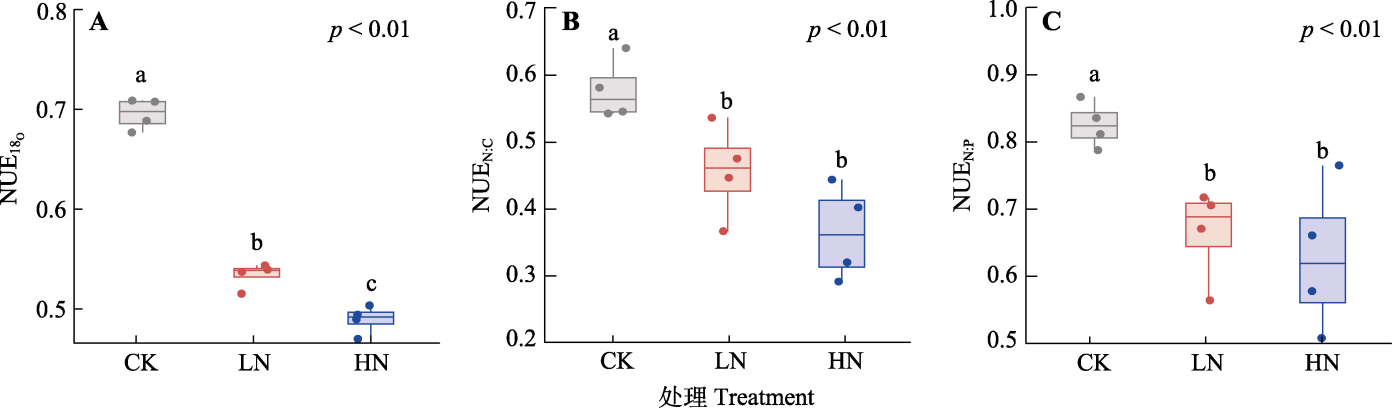
图1 氮富集对微生物氮利用效率(NUE)的影响。A, 基于18O-H2O方法测定的微生物NUE。B和C, 基于生态酶化学计量模型计算得到的微生物NUE。箱线图中的横线显示中位数, 上下横线表示1/4和3/4分位数。点表示不同处理的重复数(n = 4)。CK, 对照; HN, 高氮富集; LN, 低氮富集。图中p值表示氮富集影响的主效应。不同小写字母表示不同氮富集处理差异显著(p < 0.05)。
Fig. 1 Effect of nitrogen enrichment on microbial nitrogen use efficiency (NUE). A, NUE18O, microbial NUE based on 18O-H2O method. B and C, NUEN:C, NUEN:P, microbial NUE based on ecological enzyme stoichiometric model. The horizontal lines in the boxplot show the median, and the upper and lower horizontal lines indicate the quarters and three-quarters quantiles. The dots represent the number of repetitions for different processes (n = 4). CK, control; HN, high nitrogen enrichment; LN, low nitrogen enrichment. The p value in the figure represents the main effect of nitrogen enrichment. Different lowercase letters indicated significant difference among different nitrogen enrichment treatments (p < 0.05).
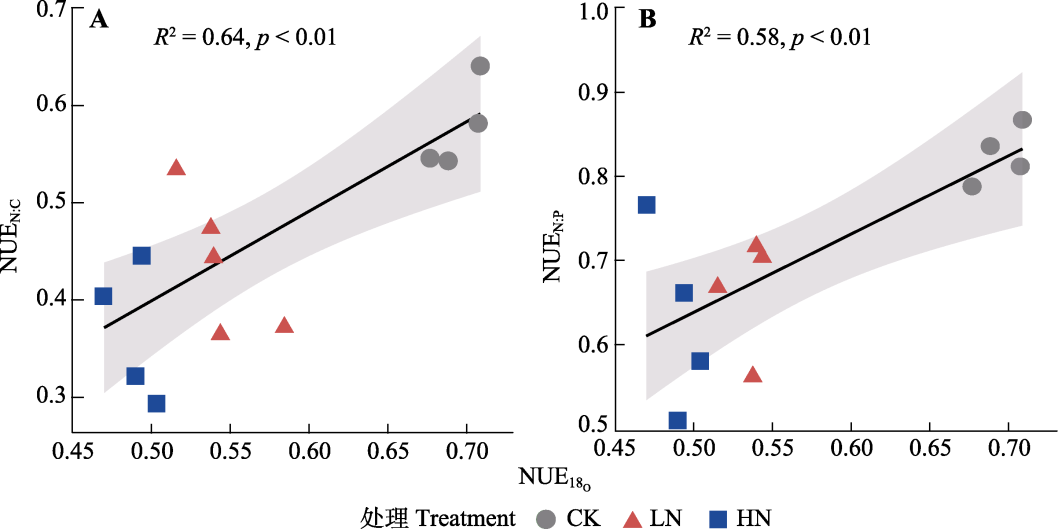
图2 使用18O-H2O法和生态酶化学计量模型测定的微生物氮利用效率(NUE)之间的线性回归关系(n = 12)。A, 使用18O-H2O法(NUE18O)和N:C生态酶化学计量模型(NUEN:C)测定的微生物NUE之间的线性回归关系。B, 使用18O-H2O法(NUE18O)和N:P生态酶化学计量模型(NUEN:P)测定的微生物NUE之间的线性回归关系。灰色区域表示95%置信区间。CK, 对照; HN, 高氮富集; LN, 低氮富集。
Fig. 2 Linear regression relationship between microbial nitrogen use efficiency (NUE) measured by 18O-H2O method and ecological enzyme stoichiometric model (n = 12). A, Linear regression relationship between microbial NUE measured using 18O-H2O method (NUE18O) and N:C ecological enzyme stoichiometric model (NUEN:C). B, Linear regression relationship between microbial NUE measured using 18O-H2O method (NUE18O) and N:P ecological enzyme stoichiometric model (NUEN:P). The gray area represents the 95% confidence interval. CK, control; HN, high nitrogen enrichment; LN, low nitrogen enrichment.
| 指标 Index | 对照 CK | 低氮 LN | 高氮 HN | p |
|---|---|---|---|---|
| 土壤理化性质 Soil physical and chemical property | ||||
| 土壤pH Soil pH | 4.37 ± 0.02a | 4.29 ± 0.04ab | 4.27 ± 0.02b | 0.07 |
| 土壤总有机碳含量 SOC content (g·kg-1) | 52.64 ± 0.74b | 57.80 ± 0.86a | 57.80 ± 1.35a | 0.01 |
| 总氮含量 Total N content (g·kg-1) | 1.97 ± 0.25c | 3.07 ± 0.05b | 4.51 ± 0.45a | <0.01 |
| 总磷含量 Total P content (g·kg-1) | 0.34 ± 0.02a | 0.24 ± 0.01b | 0.19 ± 0.01c | <0.01 |
| 可溶性有机碳含量 DOC content (mg·kg-1) | 148.33 ± 9.92a | 140.79 ± 4.75a | 117.22 ± 2.89b | 0.02 |
| 无机氮含量 IN content (mg·kg-1) | 24.20 ± 0.82b | 34.29 ± 2.08a | 35.23 ± 1.03a | <0.01 |
| 有效磷含量 AP content (mg·kg-1) | 3.24 ± 0.38 | 3.01 ± 0.14 | 3.24 ± 0.18 | 0.77 |
| 酶活性和微生物生物量 Enzyme activity and microbial biomass | ||||
| β-葡萄糖苷酶活性 βG activity (nmol·g-1·h-1) | 7.76 ± 0.09a | 6.70 ± 0.64a | 4.99 ± 0.22b | <0.01 |
| β-N-乙酰氨基葡萄糖苷酶活性 NAG activity (nmol·g-1·h-1) | 21.90 ± 1.29 | 23.37 ± 1.40 | 20.38 ± 0.77 | 0.26 |
| 亮氨酸氨肽酶活性 LAP activity (nmol·g-1·h-1) | 2.31 ± 0.40 | 1.62 ± 0.32 | 1.61 ± 0.39 | 0.36 |
| 酸性磷酸酶活性 ACP activity (nmol·g-1·h-1) | 880.39 ± 4.71 | 684.72 ± 122.17 | 680.25 ± 98.62 | 0.26 |
| 微生物生物量碳含量 MBC content (mg·kg-1) | 1035.94 ± 59.24 | 1025.00 ± 58.28 | 1005.38 ± 48.22 | 0.93 |
| 微生物生物量氮含量 MBN content (mg·kg-1) | 79.87 ± 2.51b | 85.54 ± 3.77b | 96.79 ± 2.60a | 0.01 |
| 微生物生物量磷含量 MBP content (mg·kg-1) | 220.06 ± 17.14a | 177.93 ± 5.41b | 144.53 ± 5.81b | <0.01 |
| 化学计量比 Stoichiometric ratio | ||||
| DOC:IN | 6.20 ± 0.64a | 4.14 ± 0.22b | 3.33 ± 0.02b | <0.01 |
| DOC:AP | 46.98 ± 4.35 | 47.31 ± 3.97 | 36.38 ± 1.26 | 0.09 |
| IN:AP | 7.84 ± 1.08b | 11.52 ± 1.17a | 10.93 ± 0.37a | 0.05 |
| MBC:MBN | 13.01 ± 0.85a | 12.02 ± 0.67ab | 10.40 ± 0.54b | 0.07 |
| MBC:MBP | 4.74 ± 0.16c | 5.78 ± 0.41b | 6.95 ± 0.18a | <0.01 |
| MBN:MBP | 0.37 ± 0.03c | 0.48 ± 0.03b | 0.67 ± 0.02a | <0.01 |
| βG:(NAG + LAP) | 0.32 ± 0.02a | 0.28 ± 0.04ab | 0.23 ± 0.00b | 0.10 |
| βG:ACP | 0.01 ± 0.01 | 0.01 ± 0.01 | 0.01 ± 0.01 | 0.41 |
| (NAG + LAP):ACP | 0.03 ± 0.01 | 0.04 ± 0.01 | 0.03 ± 0.01 | 0.15 |
| 化学计量不平衡 Stoichiometric imbalance | ||||
| 碳:氮计量不平衡 Imbalance C:N | 0.47 ± 0.03a | 0.35 ± 0.02b | 0.32 ± 0.02b | <0.01 |
| 碳:磷计量不平衡 Imbalance C:P | 10.01 ± 1.16a | 8.38 ± 1.16a | 5.24 ± 0.21b | 0.02 |
| 氮:磷计量不平衡 Imbalance N:P | 21.67 ± 3.59 | 24.20 ± 2.90 | 16.36 ± 0.98 | 0.17 |
| 矢量长度 Vector length | 0.24 ± 0.02a | 0.21 ± 0.05ab | 0.19 ± 0.01b | 0.07 |
| 矢量角度 Vector angle (°) | 87.94 ± 0.22 | 87.18 ± 0.76 | 87.61 ± 0.63 | 0.23 |
表1 氮富集对土壤理化性质、微生物特征、化学计量特征、矢量长度和矢量角度的影响(平均值±标准差, n = 4)
Table 1 Effects of nitrogen enrichment on soil physical and chemical properties, microbial characteristics, stoichiometric characteristics, vector length and vector angle (mean ± SD, n = 4)
| 指标 Index | 对照 CK | 低氮 LN | 高氮 HN | p |
|---|---|---|---|---|
| 土壤理化性质 Soil physical and chemical property | ||||
| 土壤pH Soil pH | 4.37 ± 0.02a | 4.29 ± 0.04ab | 4.27 ± 0.02b | 0.07 |
| 土壤总有机碳含量 SOC content (g·kg-1) | 52.64 ± 0.74b | 57.80 ± 0.86a | 57.80 ± 1.35a | 0.01 |
| 总氮含量 Total N content (g·kg-1) | 1.97 ± 0.25c | 3.07 ± 0.05b | 4.51 ± 0.45a | <0.01 |
| 总磷含量 Total P content (g·kg-1) | 0.34 ± 0.02a | 0.24 ± 0.01b | 0.19 ± 0.01c | <0.01 |
| 可溶性有机碳含量 DOC content (mg·kg-1) | 148.33 ± 9.92a | 140.79 ± 4.75a | 117.22 ± 2.89b | 0.02 |
| 无机氮含量 IN content (mg·kg-1) | 24.20 ± 0.82b | 34.29 ± 2.08a | 35.23 ± 1.03a | <0.01 |
| 有效磷含量 AP content (mg·kg-1) | 3.24 ± 0.38 | 3.01 ± 0.14 | 3.24 ± 0.18 | 0.77 |
| 酶活性和微生物生物量 Enzyme activity and microbial biomass | ||||
| β-葡萄糖苷酶活性 βG activity (nmol·g-1·h-1) | 7.76 ± 0.09a | 6.70 ± 0.64a | 4.99 ± 0.22b | <0.01 |
| β-N-乙酰氨基葡萄糖苷酶活性 NAG activity (nmol·g-1·h-1) | 21.90 ± 1.29 | 23.37 ± 1.40 | 20.38 ± 0.77 | 0.26 |
| 亮氨酸氨肽酶活性 LAP activity (nmol·g-1·h-1) | 2.31 ± 0.40 | 1.62 ± 0.32 | 1.61 ± 0.39 | 0.36 |
| 酸性磷酸酶活性 ACP activity (nmol·g-1·h-1) | 880.39 ± 4.71 | 684.72 ± 122.17 | 680.25 ± 98.62 | 0.26 |
| 微生物生物量碳含量 MBC content (mg·kg-1) | 1035.94 ± 59.24 | 1025.00 ± 58.28 | 1005.38 ± 48.22 | 0.93 |
| 微生物生物量氮含量 MBN content (mg·kg-1) | 79.87 ± 2.51b | 85.54 ± 3.77b | 96.79 ± 2.60a | 0.01 |
| 微生物生物量磷含量 MBP content (mg·kg-1) | 220.06 ± 17.14a | 177.93 ± 5.41b | 144.53 ± 5.81b | <0.01 |
| 化学计量比 Stoichiometric ratio | ||||
| DOC:IN | 6.20 ± 0.64a | 4.14 ± 0.22b | 3.33 ± 0.02b | <0.01 |
| DOC:AP | 46.98 ± 4.35 | 47.31 ± 3.97 | 36.38 ± 1.26 | 0.09 |
| IN:AP | 7.84 ± 1.08b | 11.52 ± 1.17a | 10.93 ± 0.37a | 0.05 |
| MBC:MBN | 13.01 ± 0.85a | 12.02 ± 0.67ab | 10.40 ± 0.54b | 0.07 |
| MBC:MBP | 4.74 ± 0.16c | 5.78 ± 0.41b | 6.95 ± 0.18a | <0.01 |
| MBN:MBP | 0.37 ± 0.03c | 0.48 ± 0.03b | 0.67 ± 0.02a | <0.01 |
| βG:(NAG + LAP) | 0.32 ± 0.02a | 0.28 ± 0.04ab | 0.23 ± 0.00b | 0.10 |
| βG:ACP | 0.01 ± 0.01 | 0.01 ± 0.01 | 0.01 ± 0.01 | 0.41 |
| (NAG + LAP):ACP | 0.03 ± 0.01 | 0.04 ± 0.01 | 0.03 ± 0.01 | 0.15 |
| 化学计量不平衡 Stoichiometric imbalance | ||||
| 碳:氮计量不平衡 Imbalance C:N | 0.47 ± 0.03a | 0.35 ± 0.02b | 0.32 ± 0.02b | <0.01 |
| 碳:磷计量不平衡 Imbalance C:P | 10.01 ± 1.16a | 8.38 ± 1.16a | 5.24 ± 0.21b | 0.02 |
| 氮:磷计量不平衡 Imbalance N:P | 21.67 ± 3.59 | 24.20 ± 2.90 | 16.36 ± 0.98 | 0.17 |
| 矢量长度 Vector length | 0.24 ± 0.02a | 0.21 ± 0.05ab | 0.19 ± 0.01b | 0.07 |
| 矢量角度 Vector angle (°) | 87.94 ± 0.22 | 87.18 ± 0.76 | 87.61 ± 0.63 | 0.23 |
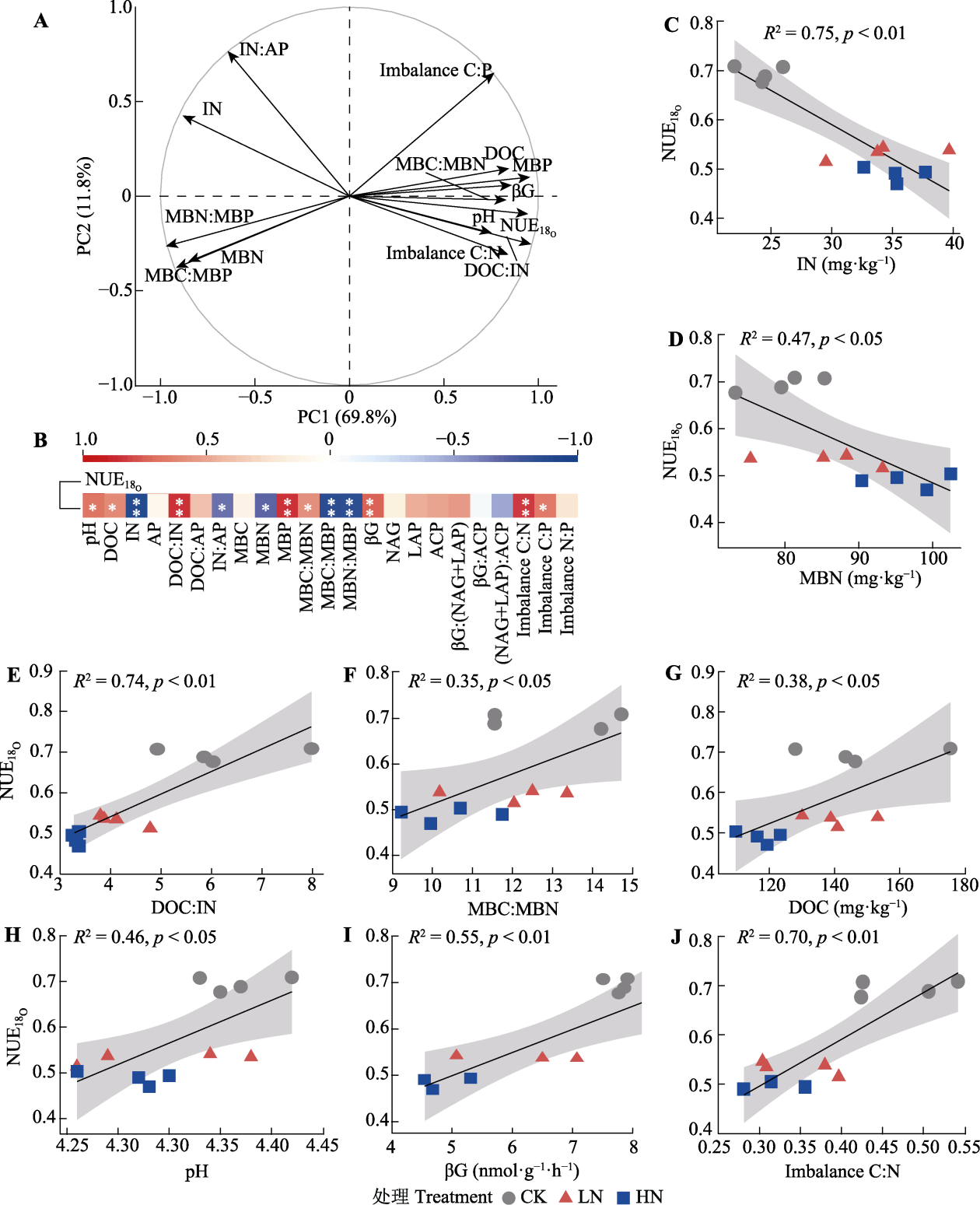
图3 18O-H2O法计算的微生物氮利用效率(NUE18O)与土壤性质(包括土壤理化性质、微生物特性、化学计量特征)之间的关系(n = 12)。A, 土壤性质与微生物NUE18O相关关系的主成分(PC)分析。B, 微生物NUE18O与土壤性质之间的相关性热图。*, p < 0.05; **, p < 0.01。C-J, 微生物NUE18O与无机氮含量(IN)、微生物生物量氮含量(MBN)、可溶性有机碳:无机氮(DOC:IN)、微生物生物量碳:氮(MBC:MBN)、可溶性有机碳含量(DOC)、土壤pH、β-1,4-葡萄糖苷酶活性(βG)和碳:氮化学计量不平衡(Imbalance C:N)之间的线性回归关系。灰色区域表示95%置信区间。AP, 有效磷含量; NAG, β-N-乙酰氨基葡萄糖苷酶活性; LAP, 亮氨酸氨肽酶活性; ACP, 酸性磷酸酶活性。CK, 对照; HN, 高氮富集; LN, 低氮富集。
Fig. 3 Relationship between microbial nitrogen use efficiency (NUE18O) measured by the 18O-H2O method and soil properties (including soil physical and chemical characteristics, microbial characteristics, and stoichiometric characteristics) (n = 12). A, Principal component (PC) analysis between soil properties and microbial NUE18O. B, Heatmap of correlation between microbial NUE18O and soil properties. *, p < 0.05; **, p < 0.01. C-J, Microbial NUE18O and inorganic nitrogen content (IN), microbial biomass nitrogen content (MBN), dissolved organic carbon content: inorganic nitrogen content (DOC:IN), microbial biomass carbon content: microbial biomass nitrogen content (MBC:MBN), dissolved organic carbon content (DOC), soil pH, β-1,4-glucosidase activity (βG), and carbon: nitrogen stoichiometric imbalance (Imbalance C:N). The gray area plot represents the 95% confidence interval. ACP, acid phosphatase activity; AP, available phosphate content; LAP, leucine aminopeptidase activity; NAG, β-1,4-N-acetyl-glucosaminidase activity. CK, control; HN, high nitrogen enrichment; LN, low nitrogen enrichment.
| [1] | Ackerman D, Millet DB, Chen X (2019). Global estimates of inorganic nitrogen deposition across four decades. Global Biogeochemical Cycles, 33, 100-107. |
| [2] |
Bobbink R, Hicks K, Galloway J, Spranger T, Alkemade R, Ashmore M, Bustamante M, Cinderby S, Davidson E, Dentener F, Emmett B, Erisman JW, Fenn M, Gilliam F, Nordin A, et al. (2010). Global assessment of nitrogen deposition effects on terrestrial plant diversity: a synthesis. Ecological Applications, 20, 30-59.
PMID |
| [3] |
Brant JB, Sulzman EW, Myrold DD (2006). Microbial community utilization of added carbon substrates in response to long-term carbon input manipulation. Soil Biology & Biochemistry, 38, 2219-2232.
DOI URL |
| [4] |
Brookes PC, Powlson DS, Jenkinson DS (1982). Measurement of microbial biomass phosphorus in soil. Soil Biology & Biochemistry, 14, 319-329.
DOI URL |
| [5] |
Buchkowski RW, Schmitz OJ, Bradford MA (2015). Microbial stoichiometry overrides biomass as a regulator of soil carbon and nitrogen cycling. Ecology, 96, 1139-1149.
PMID |
| [6] |
Chen H, Li DJ, Zhao J, Xiao KC, Wang KL (2018). Effects of nitrogen addition on activities of soil nitrogen acquisition enzymes: a meta-analysis. Agriculture, Ecosystems & Environment, 252, 126-131.
DOI URL |
| [7] |
Cleveland CC, Liptzin D (2007). C:N:P stoichiometry in soil: Is there a “redfield ratio” for the microbial biomass? Biogeochemistry, 85, 235-252.
DOI URL |
| [8] | Cui YX, Moorhead DL, Peng SS, Sinsabaugh RL, Peñuelas J (2024). Predicting microbial nutrient limitations from a stoichiometry-based threshold framework. The Innovation Geoscience, 2, 100048. DOI: 10.59717/j.xinn-geo.2024.100048. |
| [9] | Cui YX, Wang X, Zhang XC, Ju WL, Duan CJ, Guo XB, Wang YQ, Fang LC (2020). Soil moisture mediates microbial carbon and phosphorus metabolism during vegetation succession in a semiarid region. Soil Biology & Biochemistry, 147, 107814. DOI: 10.1016/j.soilbio.2020.107814. |
| [10] |
Du EZ, Terrer C, Pellegrini AFA, Ahlström A, van Lissa CJ, Zhao X, Xia N, Wu XH, Jackson RB (2020). Global patterns of terrestrial nitrogen and phosphorus limitation. Nature Geoscience, 13, 221-226.
DOI |
| [11] |
Elrys AS, Ali A, Zhang HM, Cheng Y, Zhang JB, Cai ZC, Müller C, Chang SX (2021). Patterns and drivers of global gross nitrogen mineralization in soils. Global Change Biology, 27, 5950-5962.
DOI PMID |
| [12] |
Elser JJ, Sterner RW, Gorokhova E, Fagan WF, Markow TA, Cotner JB, Harrison JF, Hobbie SE, Odell GM, Weider LW (2000). Biological stoichiometry from genes to ecosystems. Ecology Letters, 3, 540-550.
DOI URL |
| [13] |
Feng JG, Zhang QF, Yuan X, Zhu B (2022). Effects of nitrogen and phosphorus addition on soil organic carbon: review and prospects. Chinese Journal of Plant Ecology, 46, 855-870.
DOI URL |
|
[冯继广, 张秋芳, 袁霞, 朱彪 (2022). 氮磷添加对土壤有机碳的影响: 进展与展望. 植物生态学报, 46, 855-870.]
DOI |
|
| [14] |
Fu W, Wu H, Zhao AH, Hao ZP, Chen BD (2020). Ecological impacts of nitrogen deposition on terrestrial ecosystems: research progresses and prospects. Chinese Journal of Plant Ecology, 44, 475-493.
DOI URL |
|
[付伟, 武慧, 赵爱花, 郝志鹏, 陈保冬 (2020). 陆地生态系统氮沉降的生态效应: 研究进展与展望. 植物生态学报, 44, 475-493.]
DOI |
|
| [15] |
Geyer KM, Dijkstr Sinsabaugh R, Frey SD (2019). Clarifying the interpretation of carbon use efficiency in soil through methods comparison. Soil Biology & Biochemistry, 128, 79-88.
DOI URL |
| [16] | He XJ, Abs E, Allison SD, Tao F, Huang YY, Manzoni S, Abramoff R, Bruni E, Bowring SPK, Chakrawal A, Ciais P, Elsgaard L, Friedlingstein P, Georgiou K, Hugelius G, et al. (2024). Emerging multiscale insights on microbial carbon use efficiency in the land carbon cycle. Nature Communications, 15, 8010. DOI: 10.1038/s41467-024-52160-5. |
| [17] | Jia XY, Zhong YQW, Liu J, Zhu GY, Shangguan ZP, Yan WM (2020). Effects of nitrogen enrichment on soil microbial characteristics: from biomass to enzyme activities. Geoderma, 366, 114256. DOI: 10.1016/j.geoderma.2020.114256. |
| [18] |
Kirkham D, Bartholomew WV (1954). Equations for following nutrient transformations in soil, utilizing tracer data. Soil Science Society of America Journal, 18, 33-34.
DOI URL |
| [19] | Li J, Sang CP, Yang JY, Qu LR, Xia ZW, Sun H, Jiang P, Wang XG, He HB, Wang C (2021). Stoichiometric imbalance and microbial community regulate microbial elements use efficiencies under nitrogen addition. Soil Biology & Biochemistry, 156, 108207. DOI: 10.1016/j.soilbio.2021.108207. |
| [20] | Li MJ, He ZS, Jiang L, Gu XG, Jin MR, Chen B, Liu JF (2021). Distribution pattern and driving factors of species diversity and phylogenetic diversity along altitudinal gradient on the south slope of Daiyun Mountain. Acta Ecologica Sinica, 41, 1148-1157. |
| [李梦佳, 何中声, 江蓝, 谷新光, 晋梦然, 陈博, 刘金福 (2021). 戴云山物种多样性与系统发育多样性海拔梯度分布格局及驱动因子. 生态学报, 41, 1148-1157.] | |
| [21] |
Manzoni S, Taylor P, Richter A, Porporato A, Ågren GI (2012). Environmental and stoichiometric controls on microbial carbon-use efficiency in soils. New Phytologist, 196, 79-91.
DOI PMID |
| [22] |
Mehlich A (1984). Mehlich 3 soil test extractant: a modification of Mehlich 2 extractant. Communications in Soil Science and Plant Analysis, 15, 1409-1416.
DOI URL |
| [23] |
Moorhead DL, Sinsabaugh RL, Hill BH, Weintraub MN (2016). Vector analysis of ecoenzyme activities reveal constraints on coupled C, N and P dynamics. Soil Biology & Biochemistry, 93, 1-7.
DOI URL |
| [24] | Mooshammer M, Wanek W, Hämmerle I, Fuchslueger L, Hofhansl F, Knoltsch A, Schnecker J, Takriti M, Watzka M, Wild B, Keiblinger KM, Zechmeister-Boltenstern S, Richter A (2014a). Adjustment of microbial nitrogen use efficiency to carbon: nitrogen imbalances regulates soil nitrogen cycling. Nature Communications, 5, 3694. DOI: 10.1038/ncomms4694. |
| [25] | Mooshammer M, Wanek W, Zechmeister-Boltenstern S, Richter A (2014b). Stoichiometric imbalances between terrestrial decomposer communities and their resources: mechanisms and implications of microbial adaptations to their resources. Frontiers in Microbiology, 5, 22. DOI: 10.3389/fmicb.2014.00022. |
| [26] | Pei ZF, Hong M (2024). Effect of nitrogen addition on soil dissolved organic carbon and microbial biomass carbon: a meta-analysis. Soils, 56, 1129-1136. |
| [裴志福, 红梅 (2024). 氮添加对土壤可溶性有机碳和微生物量碳的影响及驱动过程: 基于meta分析. 土壤, 56, 1129-1136.] | |
| [27] |
Peleg M (2022). A new look at models of the combined effect of temperature, pH, water activity, or other factors on microbial growth rate. Food Engineering Reviews, 14, 31-44.
DOI |
| [28] | Quinn Thomas R, Canham CD, Weathers KC, Goodale CL (2009). Increased tree carbon storage in response to nitrogen deposition in the US. Nature Geoscience, 3, 13-17. |
| [29] |
Saiya-Cork KR, Sinsabaugh RL, Zak DR (2002). The effects of long term nitrogen deposition on extracellular enzyme activity in an Acer saccharum forest soil. Soil Biology & Biochemistry, 34, 1309-1315.
DOI URL |
| [30] | Schimel J, Weintraub MN, Moorhead D (2022). Estimating microbial carbon use efficiency in soil: isotope-based and enzyme-based methods measure fundamentally different aspects of microbial resource use. Soil Biology & Biochemistry, 169, 108677. DOI: 10.1016/j.soilbio.2022.108677. |
| [31] | Shen Y, Luo YH, Du L, Tian R, Shao WQ, Zhang JT, Li N, Zhang JB, Wang S, Mahmood M, Xu ZW (2024). Nitrogen addition alleviates the negative effects of reduction in precipitation on soil multifunctionality in a typical steppe. Applied Soil Ecology, 204, 105727. DOI: 10.1016/j.apsoil.2024.105727. |
| [32] |
Sinsabaugh RL, Hill BH, Follstad Shah JJ (2009). Ecoenzymatic stoichiometry of microbial organic nutrient acquisition in soil and sediment. Nature, 462, 795-798.
DOI |
| [33] |
Sinsabaugh RL, Lauber CL, Weintraub MN, Ahmed B, Allison SD, Crenshaw C, Contosta AR, Cusack D, Frey S, Gallo ME, Gartner TB, Hobbie SE, Holland K, Keeler BL, Powers JS, et al. (2008). Stoichiometry of soil enzyme activity at global scale. Ecology Letters, 11, 1252-1264.
DOI PMID |
| [34] |
Sinsabaugh RL, Turner BL, Talbot JM, Waring BG, Powers JS, Kuske CR, Moorhead DL, Follstad Shah JJ (2016). Stoichiometry of microbial carbon use efficiency in soils. Ecological Monographs, 86, 172-189.
DOI URL |
| [35] |
Spohn M, Klaus K, Wanek W, Richter A (2016). Microbial carbon use efficiency and biomass turnover times depending on soil depth-Implications for carbon cycling. Soil Biology & Biochemistry, 96, 74-81.
DOI URL |
| [36] |
Sterner R (1997). Modelling interactions of food quality and quantity in homeostatic consumers. Freshwater Biology, 38, 473-481.
DOI URL |
| [37] | Sterner RW, Elser JJ (2017). Ecological stoichiometry:the biology of elements from molecules to the biosphere// Ecological Stoichiometry. Princeton University Press, Princeton. |
| [38] | Sun LF, Li J, Qu LR, Wang X, Sang CP, Wang J, Sun MZ, Wanek W, Moorhead DL, Bai E, Wang C (2023). Phosphorus limitation reduces microbial nitrogen use efficiency by increasing extracellular enzyme investments. Geoderma, 432, 116416. DOI: 10.1016/j.geoderma.2023.116416. |
| [39] | Sun LF, Qu LR, Moorhead DL, Cui YX, Wanek W, Li SL, Sang CP, Wang C (2024). Interpreting the differences in microbial carbon and nitrogen use efficiencies estimated by 18O labeling and ecoenzyme stoichiometry. Geoderma, 444, 116856. DOI: 10.1016/j.geoderma.2024.116856. |
| [40] |
Takriti M, Wild B, Schnecker J, Mooshammer M, Knoltsch A, Lashchinskiy N, Eloy Alves RJ, Gentsch N, Gittel A, Mikutta R, Wanek W, Richter A (2018). Soil organic matter quality exerts a stronger control than stoichiometry on microbial substrate use efficiency along a latitudinal transect. Soil Biology & Biochemistry, 121, 212-220.
DOI URL |
| [41] | Tian DS, Niu SL (2015). A global analysis of soil acidification caused by nitrogen addition. Environmental Research Letters, 10, 024019. DOI: 10.1088/1748-9326/10/2/024019. |
| [42] | Tian Y, Schindlbacher A, Malo CU, Shi CP, Heinzle J, Kwatcho Kengdo S, Inselsbacher E, Borken W, Wanek W (2023). Long-term warming of a forest soil reduces microbial biomass and its carbon and nitrogen use efficiencies. Soil Biology & Biochemistry, 184, 109109. DOI: 10.1016/j.soilbio.2023.109109. |
| [43] |
Vance ED, Brookes PC, Jenkinson DS (1987). An extraction method for measuring soil microbial biomass C. Soil Biology & Biochemistry, 19, 703-707.
DOI URL |
| [44] | Vitousek PM, Howarth RW (1991). Nitrogen limitation on land and in the sea: How can it occur? Biogeochemistry, 13, 87-115. |
| [45] |
Wild B, Schnecker J, Bárta J, Čapek P, Guggenberger G, Hofhansl F, Kaiser C, Lashchinsky N, Mikutta R, Mooshammer M, Šantrůčková H, Shibistova O, Urich T, Zimov SA, Richter A (2013). Nitrogen dynamics in turbic cryosols from Siberia and greenland. Soil Biology & Biochemistry, 67, 85-93.
DOI URL |
| [46] |
Wu JM, Zeng QX, Mei KC, Lin HY, Xie H, Liu YY, Xu JG, Chen YM (2024). Soil phosphorus availability regulates the response of soil enzyme activity and enzymatic stoichiometry to litter addition in a subtropical forest. Chinese Journal of Plant Ecology, 48, 242-253.
DOI URL |
|
[吴君梅, 曾泉鑫, 梅孔灿, 林惠瑛, 谢欢, 刘苑苑, 徐建国, 陈岳民 (2024). 土壤磷有效性调控亚热带森林土壤酶活性和酶化学计量对凋落叶输入的响应. 植物生态学报, 48, 242-253.]
DOI |
|
| [47] | Xu HW, Qu Q, Li GW, Liu GB, Geissen V, Ritsema CJ, Xue S (2022). Impact of nitrogen addition on plant-soil-enzyme C-N-P stoichiometry and microbial nutrient limitation. Soil Biology & Biochemistry, 170, 108714. DOI: 10.1016/j.soilbio.2022.108714. |
| [48] | Yang XY, Duan PP, Wang KL, Li DJ (2023). Topography modulates effects of nitrogen deposition on soil nitrogen transformations by impacting soil properties in a subtropical forest. Geoderma, 432, 116381. DOI: 10.1016/j.geoderma.2023.116381. |
| [49] |
Yang YH, Zhang DY, Wei B, Liu Y, Feng XH, Mao C, Xu WJ, He M, Wang L, Zheng ZH, Wang YY, Chen LY, Peng YF (2023). Nonlinear responses of community diversity, carbon and nitrogen cycles of grassland ecosystems to external nitrogen input. Chinese Journal of Plant Ecology, 47, 1-24.
DOI URL |
|
[杨元合, 张典业, 魏斌, 刘洋, 冯雪徽, 毛超, 徐玮婕, 贺美, 王璐, 郑志虎, 王媛媛, 陈蕾伊, 彭云峰 (2023). 草地群落多样性和生态系统碳氮循环对氮输入的非线性响应及其机制. 植物生态学报, 47, 1-24.]
DOI |
|
| [50] | Yuan L, Li WZ, Chen WW, Zhang JB, Cai ZC (2016). Characteristics of nitrogen deposition in Daiyun Mountain National Nature Reserve. Environmental Science, 37, 4142-4146. |
| [袁磊, 李文周, 陈文伟, 张金波, 蔡祖聪 (2016). 戴云山国家级自然保护区大气氮沉降特点. 环境科学, 37, 4142-4146.] | |
| [51] | Yuan XB, Niu DC, Gherardi LA, Liu YB, Wang Y, Elser JJ, Fu H (2019). Linkages of stoichiometric imbalances to soil microbial respiration with increasing nitrogen addition: evidence from a long-term grassland experiment. Soil Biology & Biochemistry, 138, 107580. DOI: 10.1016/j.soilbio.2019.107580. |
| [52] |
Zechmeister-Boltenstern S, Keiblinger KM, Mooshammer M, Peñuelas J, Richter A, Sardans J, Wanek W (2015). The application of ecological stoichiometry to plant-microbial-soil organic matter transformations. Ecological Monographs, 85, 133-155.
DOI URL |
| [53] |
Zhang SS, Zheng Q, Noll L, Hu YT, Wanek W (2019). Environmental effects on soil microbial nitrogen use efficiency are controlled by allocation of organic nitrogen to microbial growth and regulate gross N mineralization. Soil Biology & Biochemistry, 135, 304-315.
DOI URL |
| [54] |
Zhang TA, Chen HYH, Ruan HH (2018). Global negative effects of nitrogen deposition on soil microbes. The ISME Journal, 12, 1817-1825.
DOI URL |
| [55] |
Zheng Q, Hu YT, Zhang SS, Noll L, Böckle T, Richter A, Wanek W (2019). Growth explains microbial carbon use efficiency across soils differing in land use and geology. Soil Biology & Biochemistry, 128, 45-55.
DOI URL |
| [56] | Zhou GY, Yan JH (2001). The influences of regional atmospheric precipitation characteristics and its element inputs on the existence and development of Dinghushan forest ecosystems. Acta Ecologica Sinica, 21, 2002-2012. |
| [周国逸, 闫俊华 (2001). 鼎湖山区域大气降水特征和物质元素输入对森林生态系统存在和发育的影响. 生态学报, 21, 2002-2012.] | |
| [57] |
Zhou ZH, Wang CK, Zheng MH, Jiang LF, Luo YQ (2017). Patterns and mechanisms of responses by soil microbial communities to nitrogen addition. Soil Biology & Biochemistry, 115, 433-441.
DOI URL |
| [1] | 封逸凡, 朱时应, 周淑荣, 江乐乐, 陈隆, 王苗, 邓国芳, 刘兰. 热带次生林恢复中土壤微生物对菌根化树苗存活和生长性状的影响[J]. 植物生态学报, 2026, 50(预发表): 1-. |
| [2] | 杨梅花, 张子嘉, 乔栋, 冯俊娜, 庞子杰, 钱龙, 刘志晖, 蔡娜娜, 胡中民, 杨国姣. 海南热带森林乔木群落调查和多样性数据集[J]. 植物生态学报, 2026, 50(预发表): 0-. |
| [3] | 李燚, 黄欢, 赵艳超, 陈立同. 养分添加对不同海拔高寒草甸群落多样性及组成的影响[J]. 植物生态学报, 2026, 50(预发表): 0-. |
| [4] | 张安宁, 肖亚宁, 赵霞, 张淼, 崔瀚文, 陈书燕, 安黎哲. 青藏高原灌木化与氮添加对土壤线虫及功能性状的交互作用[J]. 植物生态学报, 2026, 50(预发表): 0-. |
| [5] | 陈淼, 陈健, 刘顺, 许格希, 冯秋红, 史作民. 外生菌根真菌对青藏高原东缘岷江冷杉和糙皮桦氮获取的贡献及其影响因素[J]. 植物生态学报, 2026, 50(3): 731-741. |
| [6] | 方迪, 马宁, 李胜功, 郑甲佳, 褚云馨, 杨锦昌, 杨赞明, 张龙宁, 孟盛旺, 高德才, 戴晓琴, 付晓莉, 王辉民, 寇亮. 菌根共生类型对森林养分内循环的调控作用[J]. 植物生态学报, 2026, 50(3): 552-565. |
| [7] | 李文竹, 栾军伟, 邸雅平, 王一, 聂秀青, 刘世荣. 模拟干旱对暖温带锐齿槲栎林菌根介导下土壤酶活性和土壤有机碳组分的影响[J]. 植物生态学报, 2026, 50(3): 660-673. |
| [8] | 王蓉钧, 吴福忠, 吴秋霞, 朱晶晶, 倪祥银. 不同生活型植物叶片氮重吸收效率的差异[J]. 植物生态学报, 2026, 50(2): 344-351. |
| [9] | 张竟文, 李晶, 王汝苗, 王贺年, 崔丽娟. 不同纬度滨海湿地植物根系与土壤生态化学计量特征及内稳性分析[J]. 植物生态学报, 2026, 50(2): 461-473. |
| [10] | 汪子轩, 邢爱军, 陈子歆, 沈海花, 方精云. 长期氮添加对北方森林林下植物功能性状的影响[J]. 植物生态学报, 2026, 50(2): 244-255. |
| [11] | 谭聪, 石亮, 赵常提, 甘沛钦, 陈冰瑞, 谭深, 卜燕华, 田地. 基于叶片功能性状多维特征的北京平原林生态优化策略解析[J]. 植物生态学报, 2026, 50(2): 388-399. |
| [12] | 侯霄帆, 马辰涵, 孙语倩, 高钰涵, 李品. 臭氧胁迫下叶片与细根凋落物分解的生态化学计量特征差异[J]. 植物生态学报, 2026, 50(2): 268-278. |
| [13] | 冉佳鑫, 何舒婷, 罗素萍, 王云, 毛超. 森林土壤氮转化速率特征及其影响因素[J]. 植物生态学报, 2026, 50(1): 45-54. |
| [14] | 冯梅, 欧阳胜男, 李迈和, 周晓倩, 铁烈华, 申卫军, 段洪浪. 前期氮添加对无梗花栎幼苗干旱响应中地上-地下碳氮分配动态的影响[J]. 植物生态学报, 2025, 49(9): 1527-1542. |
| [15] | 张法伟, 李红琴, 祝景彬, 樊博, 周华坤, 李英年, 梁乃申. 氮添加和降水改变对高寒草甸生态系统地上与地下碳储的影响[J]. 植物生态学报, 2025, 49(9): 1399-1409. |
| 阅读次数 | ||||||
|
全文 |
|
|||||
|
摘要 |
|
|||||
Copyright © 2026 版权所有 《植物生态学报》编辑部
地址: 北京香山南辛村20号, 邮编: 100093
Tel.: 010-62836134, 62836138; Fax: 010-82599431; E-mail: apes@ibcas.ac.cn, cjpe@ibcas.ac.cn
备案号: 京ICP备16067583号-19

