
植物生态学报 ›› 2026, Vol. 50 ›› Issue (3): 649-659.DOI: 10.17521/cjpe.2024.0474 cstr: 32100.14.cjpe.2024.0474
张诚航, 卫星*( ), 吴纯泽, 王裕尧, 李浩楠
收稿日期:2024-12-30
接受日期:2025-04-08
出版日期:2026-03-20
发布日期:2025-04-09
通讯作者:
*卫星(weixing@nefu.edu.cn)基金资助:
ZHANG Cheng-Hang, WEI Xing*(), WU Chun-Ze, WANG Yu-Yao, LI Hao-Nan
Received:2024-12-30
Accepted:2025-04-08
Online:2026-03-20
Published:2025-04-09
Contact:
*WEI Xing(weixing@nefu.edu.cn)
Supported by:摘要:
研究还原态氮增加背景下东北主要造林树种水曲柳(Fraxinus mandshurica, 阔叶, 具丛枝菌根)和兴安落叶松(Larix gmelinii, 针叶, 具外生菌根)苗木对干湿还原态氮沉降的生长响应, 有助于深入了解不同类型苗木生长与大气氮沉降形态的关系, 为苗木培育精准养分管理提供理论依据。该研究以水曲柳和兴安落叶松播种苗为试验材料, 模拟不同浓度的干湿氮沉降, 即0 (CK)、35 (ND-35)、70 (ND-70)、35 (NW-35)、70 (NW-70) kg N·hm-2·a-1, 观测两种苗木生长、光合能力、吸收根发育及菌根侵染率的变化。主要结果: 大气干湿氮沉降下, 两种菌根类型的苗木均逐渐减少对菌根真菌的依赖性, 以提高自身光合性能或根系吸收能力作为主要响应形式。(1)具有丛枝菌根的水曲柳在氮干沉降时, 主要通过改变光合能力促进叶片及总生物量的积累, 在ND-70处理下, 净光合速率、总叶绿素含量和叶片生物量比对照分别增加49.61%、76.29%和53.84%。氮湿沉降时主要通过增加吸收根与土壤的接触面积, 在NW-35和NW-70处理下, 吸收根表面积比对照增加14.96%和16.17%, 提高了氮利用效率。(2)具有外生菌根的兴安落叶松对氮湿沉降响应更明显, 主要通过吸收根变长变细来促进根系的吸收能力, 在NW-70处理下, 吸收根长度比对照增加20.70%, 吸收根平均直径和皮层厚度比对照减少10.14%和27.25%。研究有助于深入分析菌根类型与大气还原态氮沉降之间的关系, 为不同菌根类型苗木精准养分管理提供借鉴。
张诚航, 卫星, 吴纯泽, 王裕尧, 李浩楠. 大气还原态氮干湿沉降下水曲柳和兴安落叶松菌根化苗木生长响应. 植物生态学报, 2026, 50(3): 649-659. DOI: 10.17521/cjpe.2024.0474
ZHANG Cheng-Hang, WEI Xing, WU Chun-Ze, WANG Yu-Yao, LI Hao-Nan. Growth response of mycorrhizal Fraxinus mandshurica and Larix gmelinii seedlings to dry and wet deposition of atmospheric reduced nitrogen. Chinese Journal of Plant Ecology, 2026, 50(3): 649-659. DOI: 10.17521/cjpe.2024.0474
| 树种 Tree species | 处理 Treatment | 铵态氮含量 NH4+-N content (mg.kg-1) | 硝态氮含量 NO3--N content (mg.kg-1) | 有效氮含量 AN content (mg.kg-1) | 土壤pH Soil pH |
|---|---|---|---|---|---|
| 水曲柳 Fraxinus mandshurica | CK | 14.76 ± 1.22c | 45.67 ± 1.33c | 61.10 ± 1.87c | 5.67 ± 0.09a |
| ND-35 | 15.15 ± 1.61c | 48.84 ± 3.55c | 63.98 ± 1.96c | 5.64 ± 0.07a | |
| ND-70 | 17.90 ± 1.04c | 50.20 ± 1.72c | 68.10 ± 2.09c | 5.57 ± 0.06a | |
| NW-35 | 69.16 ± 2.49b | 60.63 ± 1.61b | 119.79 ± 3.38b | 5.57 ± 0.04a | |
| NW-70 | 136.02 ± 4.38a | 71.11 ± 2.77a | 168.41 ± 3.68a | 5.48 ± 0.03a | |
| 兴安落叶松 Larix gmelinii | CK | 13.60 ± 2.18c | 46.77 ± 1.12c | 60.37 ± 2.87c | 5.66 ± 0.08a |
| ND-35 | 15.14 ± 2.10c | 47.74 ± 1.28c | 62.88 ± 3.37c | 5.63 ± 0.06a | |
| ND-70 | 15.95 ± 2.61c | 49.93 ± 1.04c | 65.89 ± 2.07c | 5.57 ± 0.04a | |
| NW-35 | 74.53 ± 2.40b | 62.28 ± 1.24b | 136.70 ± 2.09b | 5.53 ± 0.04a | |
| NW-70 | 107.68 ± 5.07a | 77.16 ± 1.75a | 184.84 ± 4.88a | 5.51 ± 0.06a |
表1 大气干湿氮沉降下水曲柳和兴安落叶松苗木土壤理化性质的响应(平均值±标准误)
Table 1 Response of chemo-physical properties of Fraxinus mandshurica and Larix gmelinii soil to different dry or wet nitrogen deposition levels (mean ± SE)
| 树种 Tree species | 处理 Treatment | 铵态氮含量 NH4+-N content (mg.kg-1) | 硝态氮含量 NO3--N content (mg.kg-1) | 有效氮含量 AN content (mg.kg-1) | 土壤pH Soil pH |
|---|---|---|---|---|---|
| 水曲柳 Fraxinus mandshurica | CK | 14.76 ± 1.22c | 45.67 ± 1.33c | 61.10 ± 1.87c | 5.67 ± 0.09a |
| ND-35 | 15.15 ± 1.61c | 48.84 ± 3.55c | 63.98 ± 1.96c | 5.64 ± 0.07a | |
| ND-70 | 17.90 ± 1.04c | 50.20 ± 1.72c | 68.10 ± 2.09c | 5.57 ± 0.06a | |
| NW-35 | 69.16 ± 2.49b | 60.63 ± 1.61b | 119.79 ± 3.38b | 5.57 ± 0.04a | |
| NW-70 | 136.02 ± 4.38a | 71.11 ± 2.77a | 168.41 ± 3.68a | 5.48 ± 0.03a | |
| 兴安落叶松 Larix gmelinii | CK | 13.60 ± 2.18c | 46.77 ± 1.12c | 60.37 ± 2.87c | 5.66 ± 0.08a |
| ND-35 | 15.14 ± 2.10c | 47.74 ± 1.28c | 62.88 ± 3.37c | 5.63 ± 0.06a | |
| ND-70 | 15.95 ± 2.61c | 49.93 ± 1.04c | 65.89 ± 2.07c | 5.57 ± 0.04a | |
| NW-35 | 74.53 ± 2.40b | 62.28 ± 1.24b | 136.70 ± 2.09b | 5.53 ± 0.04a | |
| NW-70 | 107.68 ± 5.07a | 77.16 ± 1.75a | 184.84 ± 4.88a | 5.51 ± 0.06a |
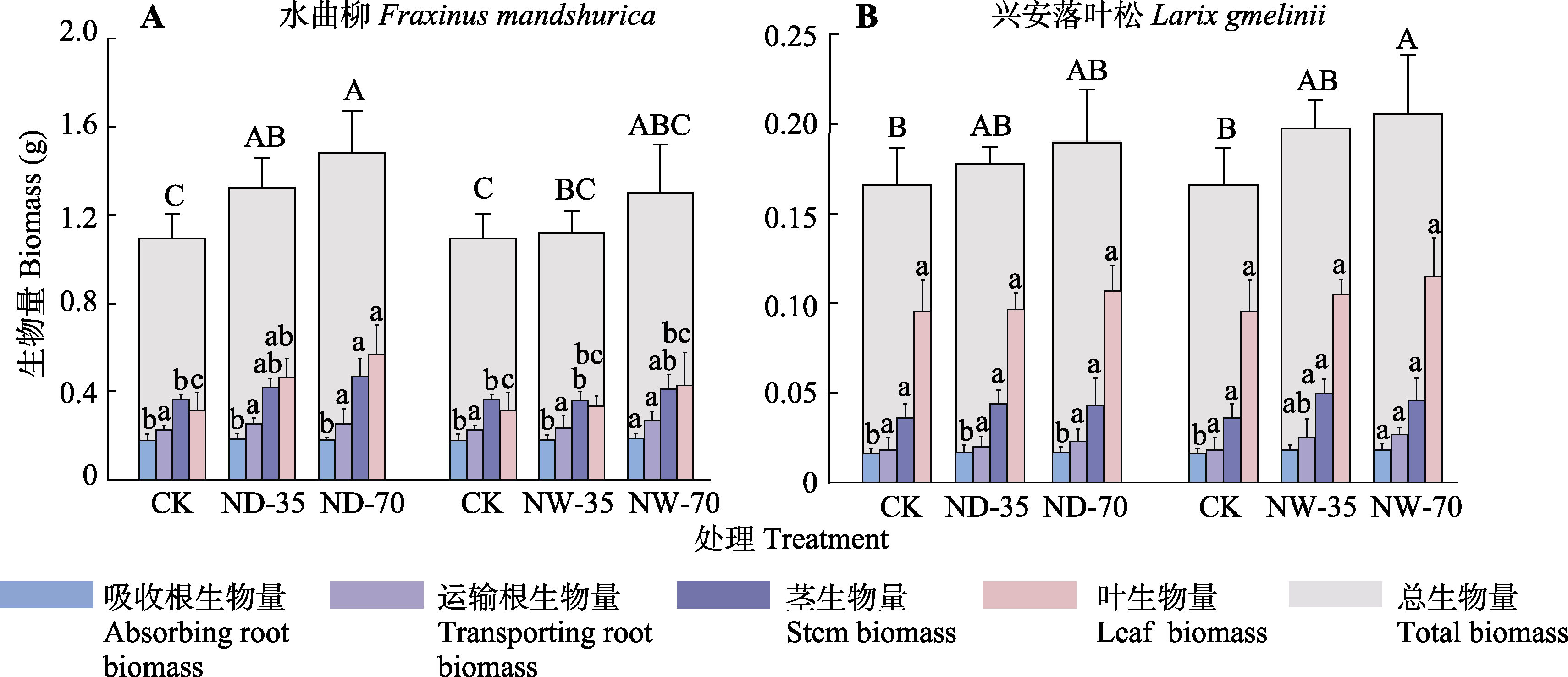
图1 不同浓度干湿氮沉降下水曲柳和兴安落叶松苗木生物量分配的响应(平均值±标准误)。不同大写字母表示同种苗木的总生物量在不同处理间差异显著(p < 0.05), 不同小写字母表示同种苗木的同一器官在不同处理间差异显著(p < 0.05)。CK, 未经任何氮处理; ND-35, 35 kg N·hm-2·a-1的干沉降; ND-70, 70 kg N·hm-2·a-1的干沉降; NW-35, 35 kg N·hm-2·a-1的湿沉降; NW-70, 70 kg N·hm-2·a-1的湿沉降。
Fig. 1 Responses of biomass partitioning of Fraxinus mandshurica and Larix gmelinii under different dry or wet nitrogen deposition levels (mean ± SE). Different uppercase letters indicate significant differences in total biomass for the same seedling species across various treatments (p < 0.05), while different lowercase letters indicate significant differences within the same organ of the same seedling species across different treatments (p < 0.05). CK, without any nitrogen treatment; ND-35, dry deposition of nitrogen at rate of 35 kg N·hm-2·a-1; ND-70, dry deposition of nitrogen at rate of 70 kg N·hm-2·a-1; NW-35, wet deposition of nitrogen at rate of 35 kg N·hm-2·a-1; NW-70, wet deposition of nitrogen at rate of 70 kg N·hm-2·a-1.
| 树种 Tree species | 处理 Treatment | 叶面积 Leaf area (cm2) | 净光合速率 Pn (μmol·m-2·s-1) | 气孔导度 Gs (μmol·m-2·s-1) | 蒸腾速率 Tr (μmol·m-2·s-1) | 胞间CO2浓度 Ci (μmol·m-2·s-1) |
|---|---|---|---|---|---|---|
| 水曲柳 Fraxinus mandshurica | CK | 87.05 ± 6.47b | 2.62 ± 0.26b | 0.03 ± 0.01b | 1.01 ± 0.06c | 233.20 ± 9.76b |
| ND-35 | 108.68 ± 5.71ab | 3.76 ± 0.22a | 0.04 ± 0.01a | 1.31 ± 0.09ab | 243.40 ± 8.82ab | |
| ND-70 | 133.92 ± 13.01a | 3.92 ± 0.26a | 0.04 ± 0.01a | 1.52 ± 0.09a | 265.20 ± 10.24a | |
| NW-35 | 90.29 ± 5.61b | 2.96 ± 0.12b | 0.03 ± 0.01b | 0.93 ± 0.05c | 247.40 ± 9.44ab | |
| NW-70 | 107.02 ± 12.93ab | 3.10 ± 0.15b | 0.03 ± 0.01b | 1.11 ± 0.07bc | 265.60 ± 5.31a | |
| 兴安落叶松 Larix gmelinii | CK | 13.74 ± 1.62a | 2.07 ± 0.14a | 0.03 ± 0.01a | 0.67 ± 0.04a | 261.80 ± 15.22b |
| ND-35 | 14.53 ± 0.55a | 2.29 ± 0.12a | 0.03 ± 0.01a | 0.69 ± 0.03a | 257.00 ± 10.77b | |
| ND-70 | 16.08 ± 2.30a | 2.39 ± 0.16a | 0.03 ± 0.01a | 0.72 ± 0.03a | 280.80 ± 13.26ab | |
| NW-35 | 15.91 ± 1.40a | 2.25 ± 0.19a | 0.03 ± 0.01a | 0.71 ± 0.04a | 270.60 ± 10.62b | |
| NW-70 | 17.07 ± 1.46a | 2.44 ± 0.13a | 0.03 ± 0.01a | 0.72 ± 0.02a | 309.40 ± 10.66a |
表2 不同浓度干湿氮沉降下水曲柳与兴安落叶松苗木光合参数的响应(平均值±标准误)
Table 2 Response of photosynthetic parameters of Fraxinus mandshurica and Larix gmelinii to different dry or wet nitrogen deposition levels (mean ± SE)
| 树种 Tree species | 处理 Treatment | 叶面积 Leaf area (cm2) | 净光合速率 Pn (μmol·m-2·s-1) | 气孔导度 Gs (μmol·m-2·s-1) | 蒸腾速率 Tr (μmol·m-2·s-1) | 胞间CO2浓度 Ci (μmol·m-2·s-1) |
|---|---|---|---|---|---|---|
| 水曲柳 Fraxinus mandshurica | CK | 87.05 ± 6.47b | 2.62 ± 0.26b | 0.03 ± 0.01b | 1.01 ± 0.06c | 233.20 ± 9.76b |
| ND-35 | 108.68 ± 5.71ab | 3.76 ± 0.22a | 0.04 ± 0.01a | 1.31 ± 0.09ab | 243.40 ± 8.82ab | |
| ND-70 | 133.92 ± 13.01a | 3.92 ± 0.26a | 0.04 ± 0.01a | 1.52 ± 0.09a | 265.20 ± 10.24a | |
| NW-35 | 90.29 ± 5.61b | 2.96 ± 0.12b | 0.03 ± 0.01b | 0.93 ± 0.05c | 247.40 ± 9.44ab | |
| NW-70 | 107.02 ± 12.93ab | 3.10 ± 0.15b | 0.03 ± 0.01b | 1.11 ± 0.07bc | 265.60 ± 5.31a | |
| 兴安落叶松 Larix gmelinii | CK | 13.74 ± 1.62a | 2.07 ± 0.14a | 0.03 ± 0.01a | 0.67 ± 0.04a | 261.80 ± 15.22b |
| ND-35 | 14.53 ± 0.55a | 2.29 ± 0.12a | 0.03 ± 0.01a | 0.69 ± 0.03a | 257.00 ± 10.77b | |
| ND-70 | 16.08 ± 2.30a | 2.39 ± 0.16a | 0.03 ± 0.01a | 0.72 ± 0.03a | 280.80 ± 13.26ab | |
| NW-35 | 15.91 ± 1.40a | 2.25 ± 0.19a | 0.03 ± 0.01a | 0.71 ± 0.04a | 270.60 ± 10.62b | |
| NW-70 | 17.07 ± 1.46a | 2.44 ± 0.13a | 0.03 ± 0.01a | 0.72 ± 0.02a | 309.40 ± 10.66a |
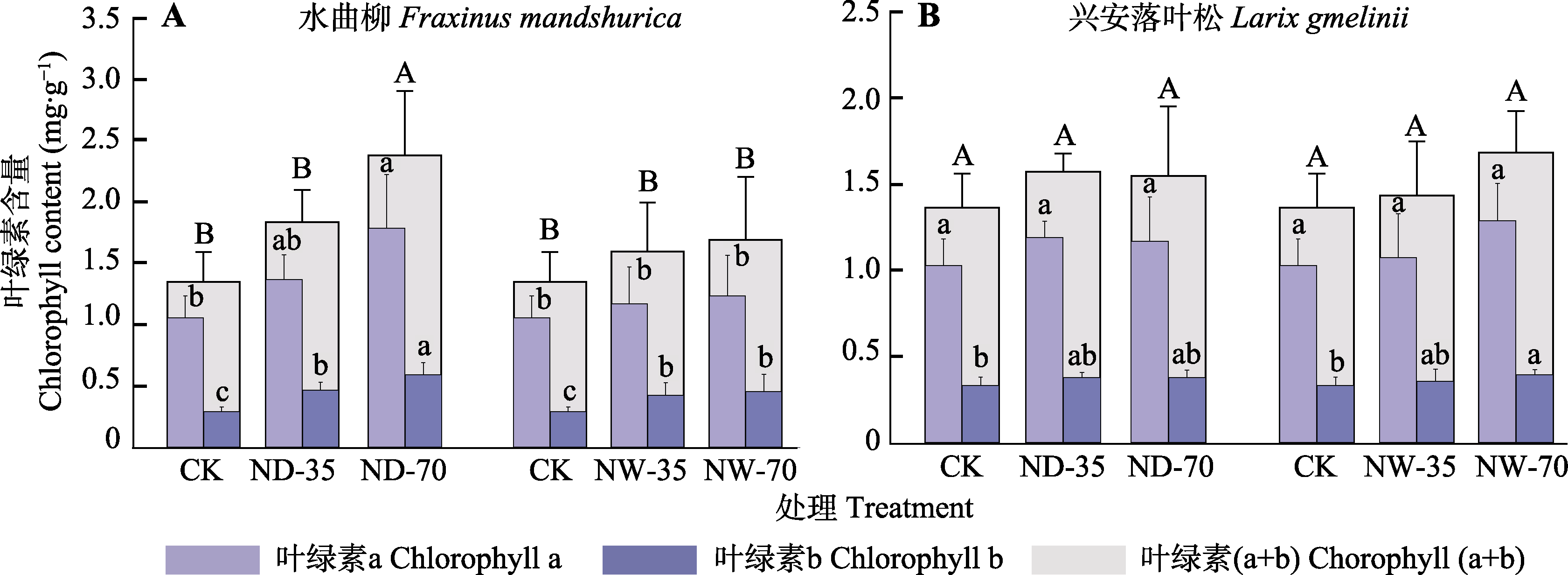
图2 不同浓度干湿氮沉降下水曲柳和兴安落叶松苗木叶绿素含量的响应(平均值±标准误)。不同大写字母表示同种苗木的叶绿素(a+b)含量在不同处理间差异显著(p < 0.05), 不同小写字母表示同种苗木的同一指标在不同处理间差异显著(p < 0.05)。CK, 未经任何氮处理; ND-35, 35 kg N·hm-2·a-1的干沉降; ND-70, 70 kg N·hm-2·a-1的干沉降; NW-35, 35 kg N·hm-2·a-1的湿沉降; NW-70, 70 kg N·hm-2·a-1的湿沉降。
Fig. 2 Responses of chlorophyll content of Fraxinus mandshurica and Larix gmelinii to different dry or wet nitrogen deposition levels (mean ± SE). Different uppercase letters indicate significant differences in chlorophyll (a+b) content of the same seedling under different treatments (p < 0.05), while different lowercase letters signify significant differences in the same parameter for the same seedling species across different treatments (p < 0.05). CK, without any nitrogen treatment; ND-35, dry deposition of nitrogen at rate of 35 kg N·hm-2·a-1; ND-70, dry deposition of nitrogen at rate of 70 kg N·hm-2·a-1; NW-35, wet deposition of nitrogen at rate of 35 kg N·hm-2·a-1; NW-70, wet deposition of nitrogen at rate of 70 kg N·hm-2·a-1.
| 树种 Tree species | 处理 Treatment | 根尖数 Root tips | 根长度 Root length (cm) | 根表面积 Root surface area (cm2) | 根体积 Root volume (cm3) | 根平均直径 Root average diameter (μm) |
|---|---|---|---|---|---|---|
| 水曲柳 Fraxinus mandshurica | CK | 3608.33 ± 212.69b | 1394.02 ± 34.07ab | 133.27 ± 3.96c | 1.08 ± 0.02a | 985.16 ± 12.52c |
| ND-35 | 4068.67 ± 105.66ab | 1372.66 ± 35.26b | 137.71 ± 2.13c | 1.13 ± 0.03a | 1020.39 ± 18.39bc | |
| ND-70 | 4200.00 ± 186.58ab | 1515.32 ± 54.77ab | 140.27 ± 2.99bc | 1.12 ± 0.02a | 1041.25 ± 13.46b | |
| NW-35 | 4278.00 ± 291.16ab | 1480.63 ± 46.04ab | 153.21 ± 6.21ab | 1.12 ± 0.02a | 1034.18 ± 34.13bc | |
| NW-70 | 4577.00 ± 264.68a | 1548.23 ± 68.31a | 154.83 ± 4.88a | 1.14 ± 0.02a | 1123.01 ± 12.92a | |
| 兴安落叶松 Larix gmelinii | CK | 539.33 ± 21.30a | 112.50 ± 3.99b | 11.64 ± 0.29a | 0.11 ± 0.01b | 978.77 ± 25.63a |
| ND-35 | 535.33 ± 18.62a | 121.67 ± 6.60ab | 11.71 ± 0.13a | 0.12 ± 0.01ab | 976.02 ± 35.47ab | |
| ND-70 | 547.67 ± 12.14a | 125.97 ± 7.78ab | 11.68 ± 0.11a | 0.12 ± 0.01ab | 923.84 ± 19.36ab | |
| NW-35 | 587.67 ± 34.38a | 127.48 ± 8.17ab | 12.20 ± 0.10a | 0.12 ± 0.01ab | 919.01 ± 16.56ab | |
| NW-70 | 583.67 ± 25.56a | 135.79 ± 3.91a | 11.84 ± 0.18a | 0.13 ± 0.01a | 879.49 ± 34.22b |
表3 干湿氮沉降对水曲柳与兴安落叶松苗木吸收根形态的影响(平均值±标准误)
Table 3 Effects of dry or wet nitrogen deposition on the morphology of absorbing roots of Fraxinus mandshurica and Larix gmelinii seedlings (mean ± SE)
| 树种 Tree species | 处理 Treatment | 根尖数 Root tips | 根长度 Root length (cm) | 根表面积 Root surface area (cm2) | 根体积 Root volume (cm3) | 根平均直径 Root average diameter (μm) |
|---|---|---|---|---|---|---|
| 水曲柳 Fraxinus mandshurica | CK | 3608.33 ± 212.69b | 1394.02 ± 34.07ab | 133.27 ± 3.96c | 1.08 ± 0.02a | 985.16 ± 12.52c |
| ND-35 | 4068.67 ± 105.66ab | 1372.66 ± 35.26b | 137.71 ± 2.13c | 1.13 ± 0.03a | 1020.39 ± 18.39bc | |
| ND-70 | 4200.00 ± 186.58ab | 1515.32 ± 54.77ab | 140.27 ± 2.99bc | 1.12 ± 0.02a | 1041.25 ± 13.46b | |
| NW-35 | 4278.00 ± 291.16ab | 1480.63 ± 46.04ab | 153.21 ± 6.21ab | 1.12 ± 0.02a | 1034.18 ± 34.13bc | |
| NW-70 | 4577.00 ± 264.68a | 1548.23 ± 68.31a | 154.83 ± 4.88a | 1.14 ± 0.02a | 1123.01 ± 12.92a | |
| 兴安落叶松 Larix gmelinii | CK | 539.33 ± 21.30a | 112.50 ± 3.99b | 11.64 ± 0.29a | 0.11 ± 0.01b | 978.77 ± 25.63a |
| ND-35 | 535.33 ± 18.62a | 121.67 ± 6.60ab | 11.71 ± 0.13a | 0.12 ± 0.01ab | 976.02 ± 35.47ab | |
| ND-70 | 547.67 ± 12.14a | 125.97 ± 7.78ab | 11.68 ± 0.11a | 0.12 ± 0.01ab | 923.84 ± 19.36ab | |
| NW-35 | 587.67 ± 34.38a | 127.48 ± 8.17ab | 12.20 ± 0.10a | 0.12 ± 0.01ab | 919.01 ± 16.56ab | |
| NW-70 | 583.67 ± 25.56a | 135.79 ± 3.91a | 11.84 ± 0.18a | 0.13 ± 0.01a | 879.49 ± 34.22b |
| 树种 Tree species | 处理 Treatment | 皮层厚度 Root cortex thickness (μm) | 中柱直径 Root stele diameter (μm) | 菌根侵染率 Mycorrhizal colonization rate (%) |
|---|---|---|---|---|
| 水曲柳 Fraxinus mandshurica | CK | 340.16 ± 14.63b | 645.01 ± 15.43a | 60.00 ± 5.74ab |
| ND-35 | 351.47 ± 22.02ab | 668.92 ± 17.74a | 58.67 ± 3.33ab | |
| ND-70 | 364.71 ± 15.82ab | 676.54 ± 13.88a | 56.67 ± 5.78ab | |
| NW-35 | 360.35 ± 16.17ab | 673.50 ± 18.92a | 75.00 ± 2.89a | |
| NW-70 | 412.09 ± 15.29a | 694.24 ± 17.71a | 48.33 ± 4.41b | |
| 兴安落叶松 Larix gmelinii | CK | 285.35 ± 13.10a | 693.42 ± 16.64a | 38.33 ± 4.41a |
| ND-35 | 259.22 ± 11.87ab | 686.80 ± 36.23a | 36.67 ± 1.67ab | |
| ND-70 | 239.62 ± 23.74ab | 684.22 ± 30.88a | 31.67 ± 1.67ab | |
| NW-35 | 247.11 ± 16.98ab | 671.90 ± 30.62a | 28.34 ± 4.41ab | |
| NW-70 | 207.59 ± 19.18b | 671.90 ± 15.60a | 26.67 ± 3.33b |
表4 干湿氮沉降对水曲柳与兴安落叶松苗木吸收根解剖结构和菌根侵染率的影响(平均值±标准误)
Table 4 Effects of dry or wet nitrogen deposition on anatomic structure and mycorrhizal infection rates of absorbing root of Fraxinus mandshurica and Larix gmelinii seedlings (mean ± SE)
| 树种 Tree species | 处理 Treatment | 皮层厚度 Root cortex thickness (μm) | 中柱直径 Root stele diameter (μm) | 菌根侵染率 Mycorrhizal colonization rate (%) |
|---|---|---|---|---|
| 水曲柳 Fraxinus mandshurica | CK | 340.16 ± 14.63b | 645.01 ± 15.43a | 60.00 ± 5.74ab |
| ND-35 | 351.47 ± 22.02ab | 668.92 ± 17.74a | 58.67 ± 3.33ab | |
| ND-70 | 364.71 ± 15.82ab | 676.54 ± 13.88a | 56.67 ± 5.78ab | |
| NW-35 | 360.35 ± 16.17ab | 673.50 ± 18.92a | 75.00 ± 2.89a | |
| NW-70 | 412.09 ± 15.29a | 694.24 ± 17.71a | 48.33 ± 4.41b | |
| 兴安落叶松 Larix gmelinii | CK | 285.35 ± 13.10a | 693.42 ± 16.64a | 38.33 ± 4.41a |
| ND-35 | 259.22 ± 11.87ab | 686.80 ± 36.23a | 36.67 ± 1.67ab | |
| ND-70 | 239.62 ± 23.74ab | 684.22 ± 30.88a | 31.67 ± 1.67ab | |
| NW-35 | 247.11 ± 16.98ab | 671.90 ± 30.62a | 28.34 ± 4.41ab | |
| NW-70 | 207.59 ± 19.18b | 671.90 ± 15.60a | 26.67 ± 3.33b |
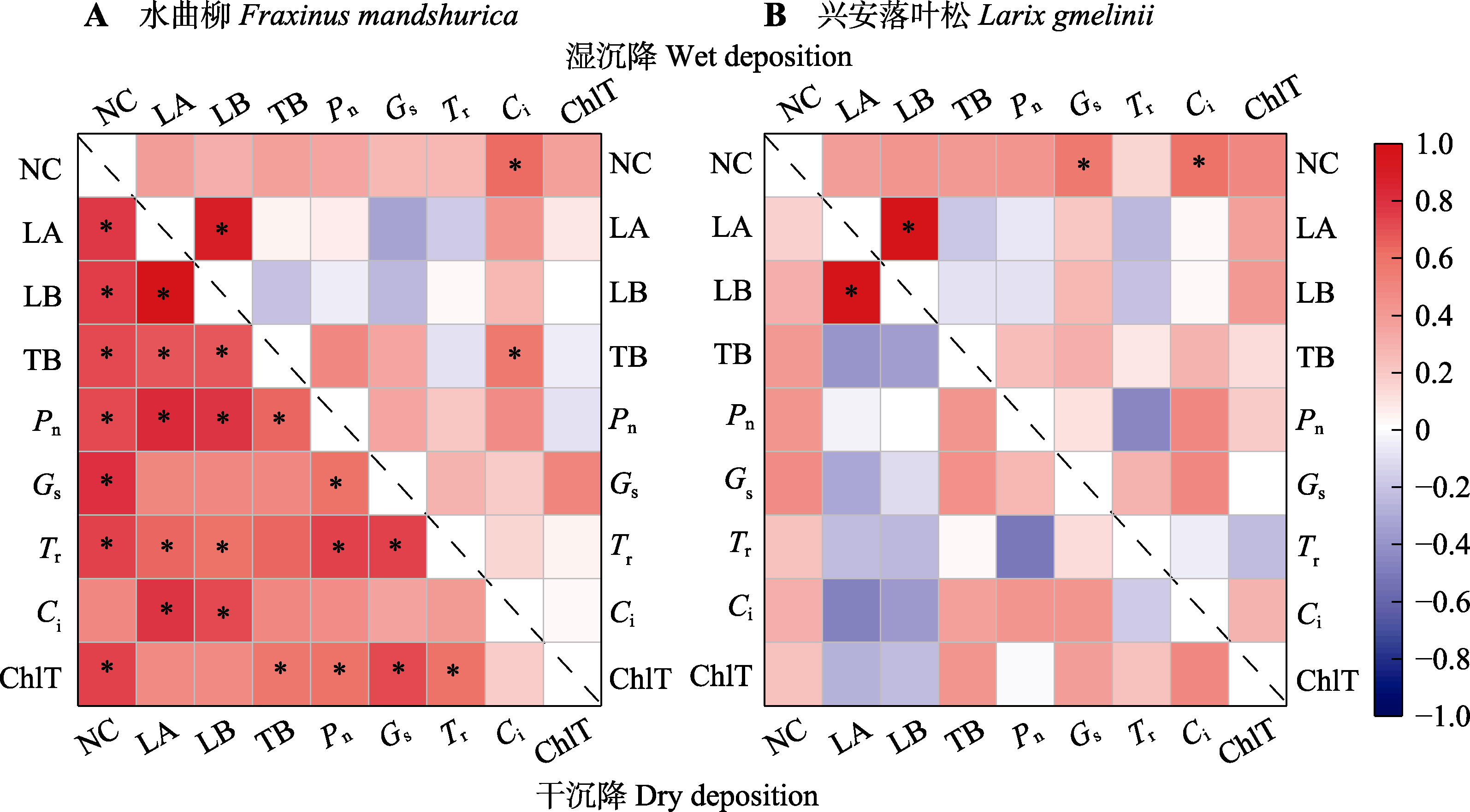
图3 干湿氮沉降下两种苗木生长及光合能力的相关性。*, p ≤ 0.05。ChlT, 总叶绿素含量; Ci, 胞间CO2浓度; Gs, 气孔导度; LA, 叶面积; LB, 叶生物量; NC, 氮浓度; Pn, 净光合速率; TB, 总生物量; Tr, 蒸腾速率。
Fig. 3 Correlation between growth and photosynthetic capacity of two seedling species under dry and wet nitrogen deposition. *, p ≤ 0.05. ChlT, total chlorophyll content; Ci, intercellular CO2 concentration; Gs, stomatal conductance; LA, leaf area; LB, leaf biomass; NC, nitrogen concentration; Pn, net photosynthetic rate; TB, total biomass; Tr, transpiration rate.
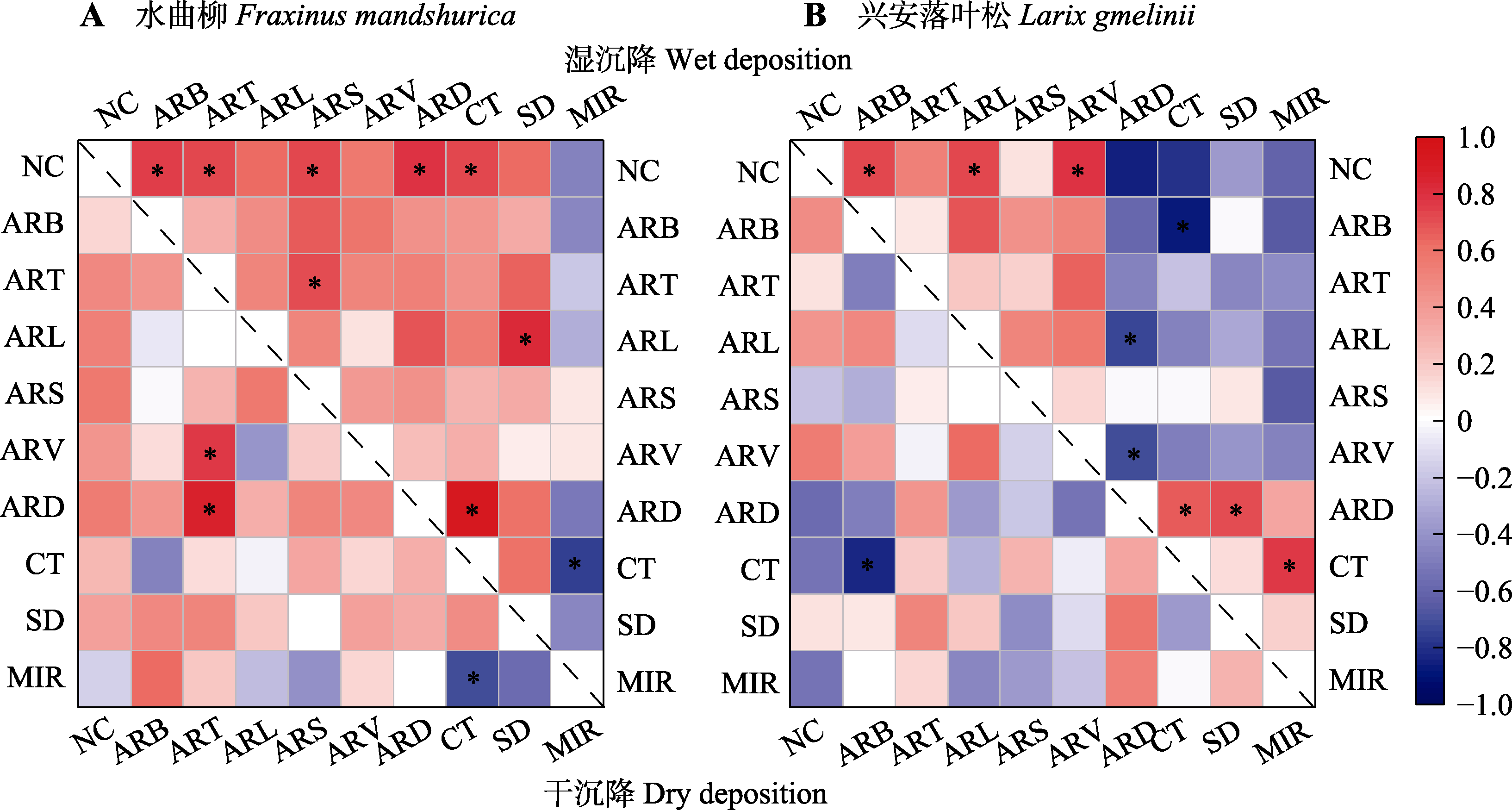
图4 干湿氮沉降下两种苗木吸收根和菌根发育的相关性。*, p ≤ 0.05。ARB, 吸收根生物量; ARD, 吸收根平均直径; ARL, 吸收根长度; ARS, 吸收根表面积; ART, 吸收根根尖数; ARV, 吸收根体积; CT, 皮层厚度; MIR, 菌根侵染率; NC, 氮浓度; SD, 中柱直径。
Fig. 4 Correlation between absorbing root and mycorrhizal development of two seedling species under dry and wet nitrogen deposition. *, p ≤ 0.05. ARB, absorbing root biomass; ARD, average absorbing root diameter; ARL, absorbing root length; ARS, absorbing root surface area; ART, number of absorbing root tips; ARV, absorbing root volume; CT, cortex thickness; MIR, mycorrhizal infection rate; NC, nitrogen concentration; SD, stele diameter.
| [1] | Armand T, Cullen M, Boiziot F, Li LY, Fricke W (2019). Cortex cell hydraulic conductivity, endodermal apoplastic barriers and root hydraulics change in barley (Hordeum vulgare L.) in response to a low supply of N and P. Annals of Botany, 124, 1091-1107. |
| [2] |
Averill C, Dietze MC, Bhatnagar JM (2018). Continental-scale nitrogen pollution is shifting forest mycorrhizal associations and soil carbon stocks. Global Change Biology, 24, 4544-4553.
DOI PMID |
| [3] |
Bödeker ITM, Clemmensen KE, de Boer W, Martin F, Olson Å, Lindahl BD (2014). Ectomycorrhizal Cortinarius species participate in enzymatic oxidation of humus in northern forest ecosystems. New Phytologist, 203, 245-256.
DOI PMID |
| [4] | Bonfante P, Genre A (2010). Mechanisms underlying beneficial plant-fungus interactions in mycorrhizal symbiosis. Nature Communications, 1, 48. DOI: 10.1038/ncomms1046. |
| [5] |
Brzostek ER, Fisher JB, Phillips RP (2014). Modeling the carbon cost of plant nitrogen acquisition: mycorrhizal trade-offs and multipath resistance uptake improve predictions of retranslocation. Journal of Geophysical Research: Biogeosciences, 119, 1684-1697.
DOI URL |
| [6] | Chen SL, Chen B, Wang SQ, Sun LG, Shi H, Liu ZH, Wang QY, Li H, Zhu TT, Li DH, Xia Y, Zhao ZQ, Wang LC, Wang LZ (2023). Spatiotemporal variations of atmospheric nitrogen deposition in China during 2008-2020. Atmospheric Environment, 315, 120120. DOI: 10.1016/j.atmosenv.2023.120120. |
| [7] |
Chen XL, Ren XL, Hussain S, Hussain S, Saqib M (2020). Effects of elevated ammonia concentration on corn growth and grain yield under different nitrogen application rates. Journal of Soil Science and Plant Nutrition, 20, 1961-1968.
DOI |
| [8] | Cheng X, Wu CZ, Wei QY, Li W, Wei X (2023). Growth and physiological responses of Fraxinus mandshurica seedlings inoculated with arbuscular mycorrhizal fungi to drought stress. Scientia Silvae Sinicae, 59(2), 58-66. |
| [程鑫, 吴纯泽, 韦庆钰, 李伟, 卫星 (2023). 水曲柳丛枝菌根真菌接菌苗对干旱胁迫的生长和生理响应. 林业科学, 59(2), 58-66.] | |
| [9] |
Cheng Y, Wang J, Chang SX, Cai ZC, Müller C, Zhang JB (2019). Nitrogen deposition affects both net and gross soil nitrogen transformations in forest ecosystems: a review. Environmental Pollution, 244, 608-616.
DOI PMID |
| [10] | Cui XY, Song JF (2005). Soil NH4+/NO3-nitrogen characteristics in primary forests and the adaptability of some coniferous species. Acta Ecologica Sinica, 25, 3082-3092. |
| [崔晓阳, 宋金凤 (2005). 原始森林土壤NH4+/NO3- 生境特征与某些针叶树种的适应性. 生态学报, 25, 3082-3092.] | |
| [11] | Du XL, Yu H, Gao YL, Liu XF, Huang JX, Xiong DC (2023). Effects of nitrogen deposition on biomass and biomass allocation in Chinese fir saplings. Journal of Forest and Environment, 43, 523-529. |
| [杜旭龙, 余恒, 高艳丽, 刘小飞, 黄锦学, 熊德成 (2023). 氮沉降对杉木幼树生物量及其分配的影响. 森林与环境学报, 43, 523-529.] | |
| [12] |
Eissenstat DM, Kucharski JM, Zadworny M, Adams TS, Koide RT (2015). Linking root traits to nutrient foraging in arbuscular mycorrhizal trees in a temperate forest. New Phytologist, 208, 114-124.
DOI PMID |
| [13] |
Erktan A, McCormack ML, Roumet C (2018). Frontiers in root ecology: recent advances and future challenges. Plant and Soil, 424, 1-9.
DOI |
| [14] | Gaige E, Dail DB, Hollinger DY, Davidson EA, Fernandez IJ, Sievering H, White A, Halteman W (2007). Changes in canopy processes following whole-forest canopy nitrogen fertilization of a mature spruce-hemlock forest. Ecosystems, 10, 1133-1147. |
| [15] | Galloway JN, Townsend AR, Erisman JW, Bekunda M, Cai Z, Freney JR, Martinelli LA, Seitzinger SP, Sutton MA (2008). Transformation of the nitrogen cycle: recent trends, questions, and potential solutions. Science, 5878, 889-892. |
| [16] | Gao CL, Jin GZ, Liu ZL (2019). Variation of morphological and anatomical traits of fine roots of three plant species in Xiaoxing’an Mountains, China. Chinese Journal of Applied Ecology, 30, 4041-4048. |
|
[高彩龙, 金光泽, 刘志理 (2019). 小兴安岭3种植物细根形态和解剖性状的变异. 应用生态学报, 30, 4041-4048.]
DOI |
|
| [17] | Gao WC, Chen DM, Hu XP, Fang XM, Li Q, Huang Q, Sun FD, Zhou JQ, Bai YF, Zhang J, Li Z, Zhao JM, Yuan DG, Cui XL, Liu L (2023). Nitrogen deposition drives the intricate changes of fine root traits. Global Ecology and Conservation, 43, e02443. DOI: 10.1016/j.gecco.2023.e02443. |
| [18] |
García IV, Mendoza RE (2008). Relationships among soil properties, plant nutrition and arbuscular mycorrhizal fungi-plant symbioses in a temperate grassland along hydrologic, saline and sodic gradients. FEMS Microbiology Ecology, 63, 359-371.
DOI PMID |
| [19] |
Guo DL, Xia MX, Wei X, Chang WJ, Liu Y, Wang ZQ (2008). Anatomical traits associated with absorption and mycorrhizal colonization are linked to root branch order in twenty-three Chinese temperate tree species. New Phytologist, 180, 673-683.
DOI PMID |
| [20] | Gurmesa GA, Wang A, Li SL, Peng SS, de Vries W, Gundersen P, Ciais P, Phillips OL, Hobbie EA, Zhu WX, Nadelhoffer K, Xi Y, Bai E, Sun T, Chen DX, et al. (2022). Retention of deposited ammonium and nitrate and its impact on the global forest carbon sink. Nature Communications, 13, 880. DOI: 10.1038/s41467-022-28345-1. |
| [21] |
Hong JT, Ma XX, Yan Y, Zhang XK, Wang XD (2018). Which root traits determine nitrogen uptake by alpine plant species on the Tibetan Plateau? Plant and Soil, 424, 63-72.
DOI URL |
| [22] |
Jones MR, Raven JA, Leith ID, Cape JN, Smith RI, Fowler D (2008). Short-term flux chamber experiment to quantify the deposition of gaseous 15N-NH3 to Calluna vulgaris. Agricultural and Forest Meteorology, 148, 893-901.
DOI URL |
| [23] |
Kong DL, Wu HF, Wang M, Simmons M, Lü XT, Yu Q, Han XG (2010). Structural and chemical differences between shoot-and root-derived roots of three perennial grasses in a typical steppe in Inner Mongolia China. Plant and Soil, 336, 209-217.
DOI URL |
| [24] | Liang XY, Zhang T, Lu XK, Ellsworth DS, BassiriRad H, You CM, Wang D, He PC, Deng Q, Liu H, Mo JM, Ye Q (2020). Global response patterns of plant photosynthesis to nitrogen addition: a meta-analysis. Global Change Biology, 26, 3585-3600. |
| [25] | Lin CY, Wang YX, Liu MH, Li Q, Xiao WF, Song XZ (2020). Effects of nitrogen deposition and phosphorus addition on arbuscular mycorrhizal fungi of Chinese fir (Cunninghamia lanceolata). Scientific Reports, 10, 12260. DOI: 10.1038/s41598-020-69213-6. |
| [26] | Liu M, Wen JH, Xu WJ, Chen YM, Ma ZL (2023). The impact of nitrogen application on leaf and root functional traits of Davidia involucrata saplings. Forests, 14, 1668. DOI: 10.3390/f14081668. |
| [27] |
Liu SE, Li YY, Fang X, Huang WJ, Long FL, Liu JX (2015). Effects of the level and regime of nitrogen addition on seedling growth of four major tree species in subtropical China. Chinese Journal of Plant Ecology, 39, 950-961.
DOI URL |
|
[刘双娥, 李义勇, 方熊, 黄文娟, 龙凤玲, 刘菊秀 (2015). 不同氮添加量和添加方式对南亚热带4个主要树种幼苗生长的影响. 植物生态学报, 39, 950-961.]
DOI |
|
| [28] | Lu XK, Mo JM, Zhang W, Mao QG, Liu RZ, Wang C, Wang SH, Zheng MH, Mori T, Mao JH, Zhang YQ, Wang YF, Huang J (2019). Effects of simulated atmospheric nitrogen deposition on forest ecosystems in China: an overview. Journal of Tropical and Subtropical Botany, 27, 500-522. |
| [鲁显楷, 莫江明, 张炜, 毛庆功, 刘荣臻, 王聪, 王森浩, 郑棉海, Mori T, 毛晋花, 张勇群, 王玉芳, 黄娟 (2019). 模拟大气氮沉降对中国森林生态系统影响的研究进展. 热带亚热带植物学报, 27, 500-522.] | |
| [29] | Ma XM, Zhu B, Nie YX, Liu Y, Kuzyakov Y (2021). Root and mycorrhizal strategies for nutrient acquisition in forests under nitrogen deposition: a meta-analysis. Soil Biology & Biochemistry, 163, 108418. DOI: 10.1016/j.soilbio.2021.108418. |
| [30] |
Masclaux-Daubresse C, Daniel-Vedele F, Dechorgnat J, Chardon F, Gaufichon L, Suzuki A (2010). Nitrogen uptake, assimilation and remobilization in plants: challenges for sustainable and productive agriculture. Annals of Botany, 105, 1141-1157.
DOI PMID |
| [31] |
Nair RK, Perks MP, Weatherall A, Baggs EM, Mencuccini M (2016). Does canopy nitrogen uptake enhance carbon sequestration by trees? Global Change Biology, 22, 875-888.
DOI PMID |
| [32] | Nakaji T, Takenaga S, Kuroha M, Izuta T (2002). Photosynthetic response of Pines densiflora seedlings to high nitrogen load. Environmental Sciences, 9, 269-282. |
| [33] |
Phillips RP, Brzostek E, Midgley MG (2013). The mycorrhizal-associated nutrient economy: a new framework for predicting carbon-nutrient couplings in temperate forests. New Phytologist, 199, 41-51.
DOI PMID |
| [34] |
Poorter H, Niklas KJ, Reich PB, Oleksyn J, Poot P, Mommer L (2012). Biomass allocation to leaves, stems and roots: meta-analyses of interspecific variation and environmental control. New Phytologist, 193, 30-50.
DOI PMID |
| [35] |
Rosling A, Midgley MG, Cheeke T, Urbina H, Fransson P, Phillips RP (2016). Phosphorus cycling in deciduous forest soil differs between stands dominated by ecto- and arbuscular mycorrhizal trees. New Phytologist, 209, 1184-1195.
DOI PMID |
| [36] |
Sheppard LJ, Leith ID, Mizunuma T, Neil Cape J, Crossley A, Leeson S, Sutton MA, van Dijk N, Fowler D (2011). Dry deposition of ammonia gas drives species change faster than wet deposition of ammonium ions: evidence from a long-term field manipulation. Global Change Biology, 17, 3589-3607.
DOI URL |
| [37] | Shi W, Wang ZQ, Liu JL, Gu JC, Guo DL (2008). Fine root morphology of twenty hardwood species in Maoershan natural secondary forest in northeastern China. Journal of Plant Ecology (Chinese Version), 32, 1217-1226. |
|
[师伟, 王政权, 刘金梁, 谷加存, 郭大立 (2008). 帽儿山天然次生林20个阔叶树种细根形态. 植物生态学报, 32, 1217-1226.]
DOI |
|
| [38] |
Sturchio MA, Chieppa J, Simpson LT, Feller IC, Chapman SK, Aspinwall MJ (2023). Contrasting effects of nitrogen addition on leaf photosynthesis and respiration in black mangrove in north Florida. Estuaries and Coasts, 46, 182-197.
DOI |
| [39] | Sun XF, Liu F, Zhang QZ, Li YC, Zhang LF, Wang J, Zhang HY, Wang CK, Wang XC (2021). Biotic and climatic controls on the interannual variation in canopy litterfall of a deciduous broad-leaved forest. Agricultural and Forest Meteorology, 307, 108483. DOI: 10.1016/j.agrformet.2021.108483. |
| [40] |
Ugawa S, Iwamoto K, Matsuura Y, Takahashi M, Fukuda K (2010). Root-tip diameters of woody species in subalpine Abies forest. Plant and Soil, 326, 303-310.
DOI URL |
| [41] | Wang Q, Li ZS, Yang FC, Liang JF, Lu JK (2021). Nitrogen uptake promoting mechanism of trees in ectomycorrhizal symbioses. World Forestry Research, 34(3), 19-24. |
| [王倩, 李振双, 杨富成, 梁俊峰, 陆俊锟 (2021). 外生菌根共生对林木氮素吸收的促进作用. 世界林业研究, 34(3), 19-24.] | |
| [42] |
Wang X, Wang B, Wang CZ, Wang ZH, Li J, Jia Z, Yang S, Li P, Wu YT, Pan SN, Liu LL (2021). Canopy processing of N deposition increases short-term leaf N uptake and photosynthesis, but not long-term N retention for aspen seedlings. New Phytologist, 229, 2601-2610.
DOI PMID |
| [43] | Wang XK, Hang JL (2015). Principles and Techniques of Plant Physiological Biochemical Experiment. 3rd ed. Higher Education Press, Beijing. 35. |
| [王学奎, 黄见良 (2015). 植物生理生化实验原理与技术. 3版. 高等教育出版社, 北京. 35.] | |
| [44] |
Warner JX, Dickerson RR, Wei Z, Strow LL, Wang Y, Liang Q (2017). Increased atmospheric ammonia over the world’s major agricultural areas detected from space. Geophysical Research Letters, 44, 2875-2884.
DOI PMID |
| [45] | Wen Z, Xu W, Li Q, Han MJ, Tang AH, Zhang Y, Luo XS, Shen JL, Wang W, Li KH, Pan YP, Zhang L, Li WQ, Collett JL, Zhong BQ, et al. (2020). Changes of nitrogen deposition in China from 1980 to 2018. Environment International, 144, 106022. DOI: 10.1016/j.envint.2020.106022. |
| [46] | Wu CZ, Zhou SY, Cheng X, Wei X (2023). Alternating processes of dry and wet nitrogen deposition have different effects on the function of canopy leaves: implications for leaf photosynthesis. Frontiers in Plant Science, 13, 1105075. DOI: 10.1016/j.scitotenv.2024.171325. |
| [47] |
Yao M, Kang RH, Wang A, Ma FY, Li J, Tai ZH, Fang YT (2023). Foliar assimilation and distribution of NO2 in Schima superba and Pinus massoniana seedlings using 15N stable isotope tracing technique. Chinese Journal of Plant Ecology, 47, 114-122.
DOI URL |
|
[姚萌, 康荣华, 王盎, 马方园, 李靳, 台子晗, 方运霆 (2023). 利用15N示踪技术研究木荷与马尾松幼苗叶片对NO2的吸收与分配. 植物生态学报, 47, 114-122.]
DOI |
| [1] | 马云瀚, 鲁显楷, 贾永霞, 朱晓敏. 长期氮沉降改变热带森林土壤木质素酚积累的调控路径[J]. 植物生态学报, 2026, 50(预发表): 0-. |
| [2] | 马建辉, 童鑫, 张思榕, 毛子昆, 秦俊, 马克平. 菌根真菌生理生态功能研究进展及展望[J]. 植物生态学报, 2026, 50(3): 498-514. |
| [3] | 王海浪, 付伟, 伍松林, 陈保冬. 丛枝菌根真菌生态功能及群落调控[J]. 植物生态学报, 2026, 50(3): 515-535. |
| [4] | 秦斐斐, 唐朝辉, 司彤, 慈敦伟. 盐碱耐受型和敏感型花生生长发育及根际土壤特性对丛枝菌根真菌的响应[J]. 植物生态学报, 2026, 50(3): 742-759. |
| [5] | 邹纪开, 吴佳怡, 谷云懿, 陈宝明. 不同形态氮添加与丛枝菌根真菌对外来入侵植物白花鬼针草竞争力的影响[J]. 植物生态学报, 2026, 50(3): 722-730. |
| [6] | 何正嘉, 曾歆然, 王琳影, 薛昕宇, 苏钦泽, 李宇, 张寅杰, 吴辉煌, 陈成聪, 吴良泉, 魏安妮, 仇云鹏, 郭梨锦. 茶园丛枝菌根真菌群落和土壤有机碳对镁肥的响应[J]. 植物生态学报, 2026, 50(3): 700-709. |
| [7] | 段世龙, 余成瑾, 许心垚, 冯固, 谢贤安, 张林. 植物-丛枝菌根真菌-细菌连续体及其维持机制[J]. 植物生态学报, 2026, 50(3): 600-611. |
| [8] | 江康威, 吕程, 王亚菲, 李宏, 张芷晴, 王雨, 张青青, 吐尔逊娜依•热依木. 放牧干扰下丛枝菌根真菌群落对土壤多功能性的影响[J]. 植物生态学报, 2026, 50(3): 685-699. |
| [9] | 何堂庆, 王变变, 曹鑫鑫, 张康成, 汪晓东, 王浩, 白彤硕, 赵叶新, 张艺, 王益, 仇云鹏, 胡水金. 半干旱草地植物和丛枝菌根真菌群落对长期降水增加的响应[J]. 植物生态学报, 2026, 50(3): 674-684. |
| [10] | 李文竹, 栾军伟, 邸雅平, 王一, 聂秀青, 刘世荣. 模拟干旱对暖温带锐齿槲栎林菌根介导下土壤酶活性和土壤有机碳组分的影响[J]. 植物生态学报, 2026, 50(3): 660-673. |
| [11] | 姜庆宏, 丁露, 王哲, 郑春丽, 冯昭绰. 丛枝菌根真菌与不同功能细菌联用对苜蓿的促生作用[J]. 植物生态学报, 2026, 50(3): 774-788. |
| [12] | 周春菡, 熊智诚, 杨明新, 史海兰, 周亚星, 唐玉, 张静, 纪宝明, 代心灵. 黄河源园区高寒湿地菌根真菌群落特征及其影响因素[J]. 植物生态学报, 2026, 50(3): 625-638. |
| [13] | 魏莉, 王鹏森, 刘珊, 樊锐, 黄楠, 张建国, 其美拉姆, 苟扬, 刘沫含, 黄婷, 周冀琼. 丛枝菌根真菌对豆禾混播植物垂直生态位养分吸收的影响[J]. 植物生态学报, 2026, 50(3): 760-773. |
| [14] | 谭秋颜, 张清, 高程, 褚海燕, 杨腾. 外生菌根真菌: 高寒生态系统碳氮循环的关键驱动者[J]. 植物生态学报, 2026, 50(3): 584-599. |
| [15] | 贾会丽, 王睿, 常玉良, 林茂, 栗国梁, 武帅楷, 苏原, 董宽虎, $\boxed{\hbox{王常慧}}$. 不同水平氮添加下晋北赖草叶片化学计量特征及其对光合的影响[J]. 植物生态学报, 2026, 50(2): 429-441. |
| 阅读次数 | ||||||
|
全文 |
|
|||||
|
摘要 |
|
|||||
Copyright © 2026 版权所有 《植物生态学报》编辑部
地址: 北京香山南辛村20号, 邮编: 100093
Tel.: 010-62836134, 62836138; Fax: 010-82599431; E-mail: apes@ibcas.ac.cn, cjpe@ibcas.ac.cn
备案号: 京ICP备16067583号-19

