
植物生态学报 ›› 2026, Vol. 50 ›› Issue (3): 639-648.DOI: 10.17521/cjpe.2024.0414 cstr: 32100.14.cjpe.2024.0414
杨密1,2, 鲁梦珍1,2, 冯治洋1,2, 袁旭东1,2, 赵小祥3, 刘峰1, 田秋香1,2,*( )
)
收稿日期:2024-11-19
接受日期:2025-03-21
出版日期:2026-03-20
发布日期:2026-04-03
通讯作者:
*田秋香(tianqiuxiang@wbgcas.cn)基金资助:
YANG Mi1,2, LU Meng-Zhen1,2, FENG Zhi-Yang1,2, YUAN Xu-Dong1,2, ZHAO Xiao-Xiang3, LIU Feng1, TIAN Qiu-Xiang1,2,*()
Received:2024-11-19
Accepted:2025-03-21
Online:2026-03-20
Published:2026-04-03
Contact:
*TIAN Qiu-Xiang(tianqiuxiang@wbgcas.cn)
Supported by:摘要:
磷(P)是植物生长的必需营养元素, 也是制约森林生产力的重要因素。陆地上大部分植物可与丛枝菌根(AM)或外生菌根(ECM)真菌形成共生关系, 以增强其对磷的吸收。AM和ECM在磷的利用策略上存在差异, 影响生态系统磷循环过程。了解不同菌根类型下森林土壤磷有效性的变化, 对于理解亚热带森林的生产力维持机制和指导森林管理具有重要意义。该研究以湖南省八大公山自然保护区内35个森林样地(ECM树种优势度呈梯度变化)为研究对象, 测定表层土壤4种生物有效磷(氯化钙-P、酶-P、柠檬酸-P、盐酸-P)的含量, 分析土壤有效磷随ECM树种优势度变化而变化的规律, 并探究影响土壤磷有效性的主要因素。结果表明, 氯化钙-P、柠檬酸-P、盐酸-P含量与外生菌根优势度无显著相关关系, 但酶-P含量随ECM树种优势度的增加而显著增加。氯化钙-P含量与凋落物磷含量呈显著正相关关系; 柠檬酸-P和盐酸-P含量与土壤有机碳、总氮、微生物生物量碳含量呈显著正相关关系; 而酶-P含量与土壤有机碳、可溶性有机碳含量呈显著正相关关系, 与土壤pH呈负相关关系。此外, 土壤酸性磷酸酶活性与ECM树种优势度呈显著正相关关系。综上, 以ECM树种为主的森林土壤具有更高的酶可水解磷含量和酸性磷酸酶活性, 可通过有机磷的矿化, 释放更多的磷, 进而促进亚热带森林ECM树种的快速生长。
杨密, 鲁梦珍, 冯治洋, 袁旭东, 赵小祥, 刘峰, 田秋香. 亚热带森林土壤磷有效性与外生菌根优势度的关联分析. 植物生态学报, 2026, 50(3): 639-648. DOI: 10.17521/cjpe.2024.0414
YANG Mi, LU Meng-Zhen, FENG Zhi-Yang, YUAN Xu-Dong, ZHAO Xiao-Xiang, LIU Feng, TIAN Qiu-Xiang. Correlation relationship between soil phosphorus availability and ectomycorrhizal tree dominance in a subtropical forest. Chinese Journal of Plant Ecology, 2026, 50(3): 639-648. DOI: 10.17521/cjpe.2024.0414
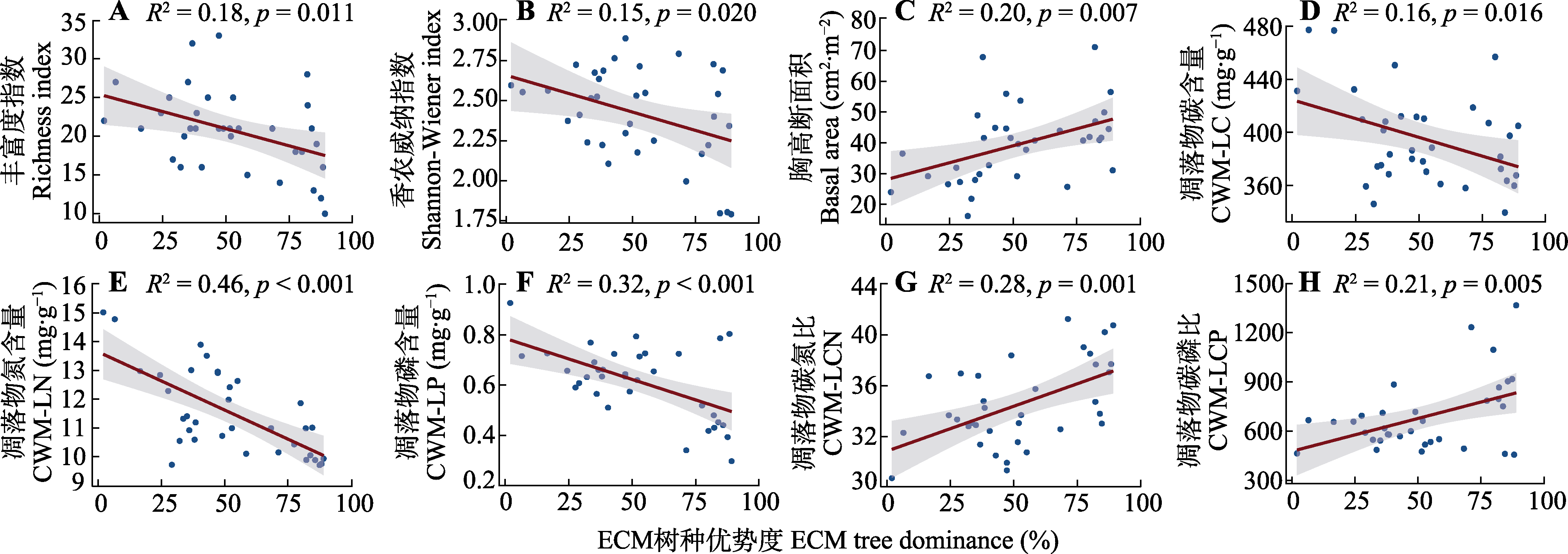
图1 外生菌根(ECM)树种优势度与物种丰富度(A)、香农威纳指数(B)、胸高断面积(C)、凋落物碳含量(D)、凋落物氮含量(E)、凋落物磷含量(F)、凋落物碳氮比(G)和凋落物碳磷比(H)的关系(n = 35)。图中实线表示相关性显著(p < 0.05)。凋落物碳含量、氮含量、磷含量、碳氮比和碳磷比分别表示加权平均后样方水平上凋落物的碳含量、氮含量、磷含量、碳氮比和碳磷比。
Fig. 1 Relationships between ectomycorrhizal (ECM) tree dominance and species richness (A), Shannon-Weiner index (B), basal area of trees (C), the community weighted mean litter carbon content (CWM-LC) (D), the community weighted mean litter nitrogen content (CWM-LN) (E), the community weighted mean litter phosphorus content (CWM-LP) (F), the community weighted mean litter carbon and nitrogen ratio (CWM-LCN) (G) the community weighted mean litter carbon and phosphorus ratio (CWM-LCP) (H) (n = 35). Solid lines indicate significant correlation (p < 0.05). The C, N, P content, C-to-N ratio and C-to-P ratio of the litter represent the weighted average of the C, N, P content, C-to-N ratio and C-to-P ratio of the litter at the plot level.
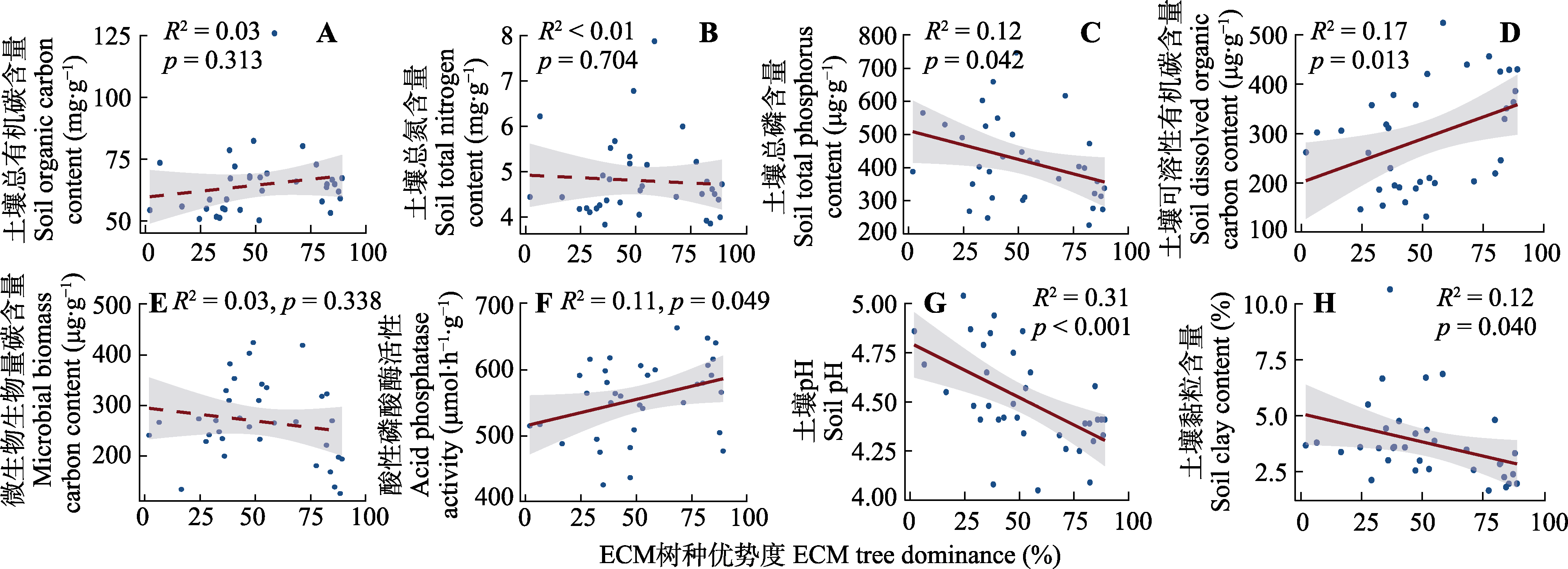
图2 外生菌根(ECM)树种优势度与土壤有机碳含量(A)、总氮含量(B)、总磷含量(C)、可溶性有机碳含量(D)、微生物生物量碳含量(E)、酸性磷酸酶活性(F)、土壤pH值(G)、土壤黏粒含量(H)的关系(n = 35)。图中实线表示相关性显著(p < 0.05), 虚线表示相关性不显著(p > 0.05)。
Fig. 2 Relationships between ectomycorrhizal (ECM) tree dominance and soil organic carbon content (A), soil total nitrogen content (B), soil total phosphorus content (C), soil dissolved organic carbon content (D), microbial biomass carbon content (E), acid phosphatase activity (F), soil pH (G), and soil clay content (H) (n = 35). Solid lines indicate significant correlation (p < 0.05), and dashed lines indicate non-significant correlation (p > 0.05).
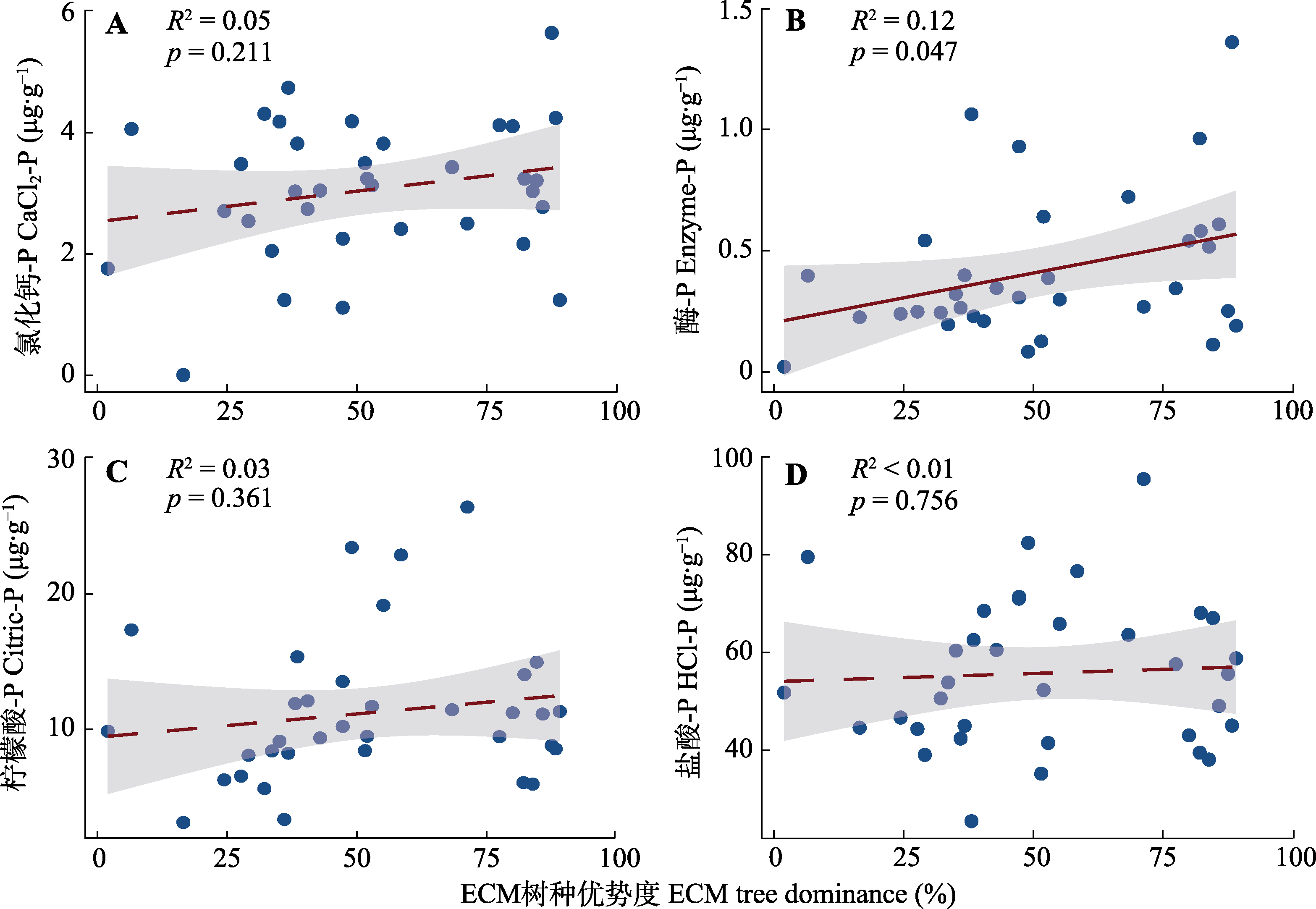
图3 外生菌根(ECM)树种优势度与土壤中的氯化钙-P (A)、酶-P (B)、柠檬酸-P (C)和盐酸-P (D)含量的关系(n = 35)。图中实线表示相关性显著(p < 0.05), 虚线表示相关性不显著(p ≥ 0.05)。
Fig. 3 Relationships between ectomycorrhizal (ECM) tree dominance and contents of soil CaCl2-P (A), enzyme-P (B), citric-P (C) and HCl-P (D) (n = 35). Solid lines indicate significant correlation (p < 0.05), and dashed lines indicate non-significant correlation (p ≥ 0.05).
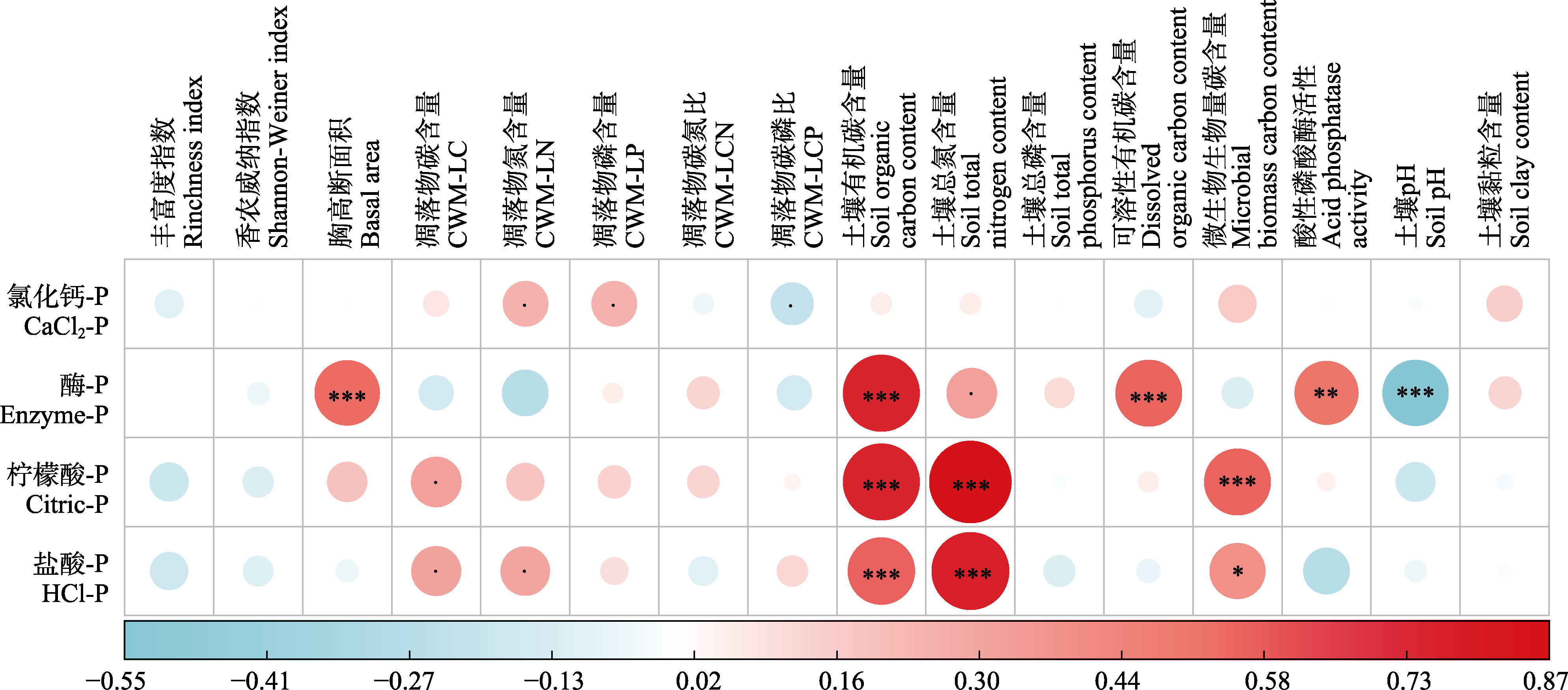
图4 植被特征和土壤理化因子与4种土壤生物有效磷含量之间的Pearson相关关系。·、*、**和***分别代表相关性水平p < 0.1、p < 0.05、p < 0.01和p < 0.001。
Fig. 4 Pearson correlation between plant properties, soil physico-chemical characteristics and the four bioavailable phosphorus contents CWM-LC, community weighted mean litter carbon content; CWM-LCN, community weighted mean litter carbon and nitrogen ratio; CWM-LCP, community weighted mean litter carbon and phosphorus ratio; CWM-LN, community weighted mean litter nitrogen content; CWM-LP, community weighted mean litter phosphorus content. ·, *, ** and *** in the figure represent correlation levels p < 0.1, p < 0.05, p < 0.01 and p < 0.001, respectively.
| [1] | Arai Y, Sparks DL (2007). Phosphate reaction dynamics in soils and soil components: a multiscale approach. Advances in Agronomy, 94, 135-179. |
| [2] |
Becquer A, Garcia K, Amenc L, Rivard C, Doré J, Trives-Segura C, Szponarski W, Russet S, Baeza Y, Lassalle-Kaiser B, Gay G, Zimmermann SD, Plassard C (2018). The Hebeloma cylindrosporum HcPT2 Pi transporter plays a key role in ectomycorrhizal symbiosis. New Phytologist, 220, 1185-1199.
DOI PMID |
| [3] |
Brundrett MC, Tedersoo L (2018). Evolutionary history of mycorrhizal symbioses and global host plant diversity. New Phytologist, 220, 1108-1115.
DOI PMID |
| [4] | Cao YT, Yu SQ, Shao HM, Tan R, Xu XY, Wang WF (2023). Effects of different mycorrhizal types in dominant tree species on soil extracellular enzyme activity. Acta Ecologica Sinica, 43, 1971-1980. |
| [曹雨婷, 于水强, 邵慧妹, 谭蕊, 徐新颖, 王维枫 (2023). 不同优势树种菌根类型差异对土壤胞外酶活性的影响. 生态学报, 43, 1971-1980.] | |
| [5] |
Cheeke TE, Phillips RP, Brzostek ER, Rosling A, Bever JD, Fransson P (2017). Dominant mycorrhizal association of trees alters carbon and nutrient cycling by selecting for microbial groups with distinct enzyme function. New Phytologist, 214, 432-442.
DOI PMID |
| [6] |
Clarholm M, Skyllberg U, Rosling A (2015). Organic acid induced release of nutrients from metal-stabilized soil organic matter the unbutton model. Soil Biology & Biochemistry, 84, 168-176.
DOI URL |
| [7] | Comerford N (2005). Soil factors affecting nutrient bioavailability// BassiriRad H. Nutrient Acquisition by Plants: an Ecological Perspective. Springer, Berlin. |
| [8] |
Cunha HFV, Andersen KM, Lugli LF, Santana FD, Aleixo IF, Moraes AM, Garcia S, Di Ponzio R, Mendoza EO, Brum B, Rosa JS, Cordeiro AL, Portela BTT, Ribeiro G, Coelho SD, et al. (2022). Direct evidence for phosphorus limitation on Amazon forest productivity. Nature, 608, 558-562.
DOI |
| [9] |
DeLuca TH, Glanville HC, Harris M, Emmett BA, Pingree MRA, de Sosa LL, Cerdá-Moreno C, Jones DL (2015). A novel biologically-based approach to evaluating soil phosphorus availability across complex landscapes. Soil Biology & Biochemistry, 88, 110-119.
DOI URL |
| [10] | Deng PY, Zhou YC, Tang FH, Chen WS (2024). Tree species identity affects soil P bioavailability by altering labile organic P after tree mixing in subtropical China. European Journal of Soil Science, 75, e13571. DOI: 10.1111/ejss.13571. |
| [11] | Gao MH, Li LL, Yang HY, Li HY, Tian XH, Zhang L (2023). Research progress of mycorrhizal fungi promoting nitrogen and phosphorus uptake in plants. Heilongjiang Agricultural Sciences, (10), 126-131. |
| [高明含, 李丽丽, 杨洪一, 李红艳, 田新华, 张玲 (2023). 菌根真菌促进植物氮磷吸收的研究进展. 黑龙江农业科学, (10), 126-131.] | |
| [12] |
Hou EQ, Luo YQ, Kuang YW, Chen CR, Lu XK, Jiang LF, Luo XZ, Wen DZ (2020). Global meta-analysis shows pervasive phosphorus limitation of aboveground plant production in natural terrestrial ecosystems. Nature Communications, 11, 637. DOI: 10.1038/s41467-020-14492-w.
PMID |
| [13] | Jia N, Li L, Guo H, Xie MY (2024). Important role of Fe oxides in global soil carbon stabilization and stocks. Nature Communications, 15, 10318. DOI: 10.1038/s41467-024-54832-8. |
| [14] |
Jiang ZH, Luo WQ, Zhu EX, Zhao YP, Liu CZ, Zhou L, Feng XJ (2024). Changing plant phosphorus acquisition strategies in relation to altered soil phosphorus fractions after wetland drainage. Functional Ecology, 38, 2433-2446.
DOI URL |
| [15] | Kafle A, Cope KR, Raths R, Krishna Yakha J, Subramanian S, Bücking H, Garcia K (2019). Harnessing soil microbes to improve plant phosphate efficiency in cropping systems. Agronomy, 9, 127. DOI: 10.3390/agronomy9030127. |
| [16] | Lang AK, Pett-Ridge J, McFarlane KJ, Phillips RP (2023). Climate, soil mineralogy and mycorrhizal fungi influence soil organic matter fractions in eastern US temperate forests. Journal of Ecology, 111, 1254-1269. |
| [17] | Li M, He X, Zhang PP, Wang RH, Wang JP, Zhang XJ, Yin HJ (2024). Close linkage between available and microbial biomass phosphorus in the rhizosphere of alpine coniferous forests along an altitudinal gradient. Rhizosphere, 30, 100904. DOI: 10.1016/j.rhisph.2024.100904. |
| [18] | Lian PP, Xu LL, Yang LM, Yue K, Peñuelas J (2024). Divergent soil P accrual in ectomycorrhizal and arbuscular mycorrhizal trees: insights from a common garden experiment in subtropical China. Frontiers in Plant Science, 15, 1333505. DOI: 10.3389/fpls.2024.1333505. |
| [19] | Liang MX, Zhang XY, Zhang JJ, Liu XB (2024). Different phosphorus preferences among arbuscular and ectomycorrhizal trees in a subtropical forest. Soil Biology & Biochemistry, 194, 109448. DOI: 10.1016/j.soilbio.2024.109448. |
| [20] |
Lin GG, McCormack ML, Ma CG, Guo DL (2017). Similar below-ground carbon cycling dynamics but contrasting modes of nitrogen cycling between arbuscular mycorrhizal and ectomycorrhizal forests. New Phytologist, 213, 1440-1451.
DOI PMID |
| [21] |
Liu XB, Burslem DFRP, Taylor JD, Taylor AFS, Khoo E, Majalap-Lee N, Helgason T, Johnson D (2018). Partitioning of soil phosphorus among arbuscular and ectomycorrhizal trees in tropical and subtropical forests. Ecology Letters, 21, 713-723.
DOI PMID |
| [22] | Lu P, Li WH, Niu JC, Javkhlan B, Zhang SL, Yang XY (2022). Phosphorus availability and transformation of inorganic phosphorus forms under different organic carbon levels in a tier soil. Scientia Agricultura Sinica, 55(1), 111-122. |
|
[路鹏, 李文海, 牛金璨, Javkhlan B, 张树兰, 杨学云 (2022). 不同有机碳水平下(土楼)土磷的有效性及无机磷形态转化. 中国农业科学, 55(1), 111-122.]
DOI |
|
| [23] | Mao ZK, van der Plas F, Corrales A, Anderson-Teixeira KJ, Bourg NA, Chu CJ, Hao ZQ, Jin GZ, Lian JY, Lin F, Li BH, Luo WQ, McShea WJ, Myers JA, Shen GC, et al. (2023). Scale-dependent diversity-biomass relationships can be driven by tree mycorrhizal association and soil fertility. Ecological Monographs, 93, e1568. DOI: 10.1002/ecm.1568. |
| [24] | Marschner H (1995). Marschner’s Mineral Nutrition of Higher Plants. 2nd ed. Elsevier, Amsterdam. |
| [25] |
Mei Y, Dai CC, Jia Y (2022). Research progress of synergistic phosphorus solubilization between ectomycorrhizal fungi and ectomycorrhizal helper bacteria. Chinese Journal of Ecology, 41, 1619-1627.
DOI |
| [梅言, 戴传超, 贾永 (2022). 外生菌根真菌及其菌根辅助细菌协同解磷的研究进展. 生态学杂志, 41, 1619-1627.] | |
| [26] |
Nehls U, Plassard C (2018). Nitrogen and phosphate metabolism in ectomycorrhizas. New Phytologist, 220, 1047-1058.
DOI PMID |
| [27] |
Ouyang S, Xiang WH, Gou MM, Chen L, Lei PF, Xiao WF, Deng XW, Zeng LX, Li JR, Zhang T, Peng CH, Forrester DI (2021). Stability in subtropical forests: the role of tree species diversity, stand structure, environmental and socio-economic conditions. Global Ecology and Biogeography, 30, 500-513.
DOI URL |
| [28] |
Paries M, Gutjahr C (2023). The good, the bad, and the phosphate: regulation of beneficial and detrimental plant-microbe interactions by the plant phosphate status. New Phytologist, 239, 29-46.
DOI URL |
| [29] | Peng Y, Schmidt IK, Zheng HF, Heděnec P, Bachega LR, Yue K, Wu FZ, Vesterdal L (2020). Tree species effects on topsoil carbon stock and concentration are mediated by tree species type, mycorrhizal association, and N-fixing ability at the global scale. Forest Ecology and Management, 478, 118510. DOI: 10.1016/j.foreco.2020.118510. |
| [30] |
Phillips RP, Brzostek E, Midgley MG (2013). The mycorrhizal- associated nutrient economy: a new framework for predicting carbon-nutrient couplings in temperate forests. New Phytologist, 199, 41-51.
DOI PMID |
| [31] | Qi XX, Chen L, Zhu JG, Li Z, Lei HM, Shen Q, Wu HL, Ouyang S, Zeng YL, Hu YT, Xiang WH (2022). Increase of soil phosphorus bioavailability with ectomycorrhizal tree dominance in subtropical secondary forests. Forest Ecology and Management, 521, 120435. DOI: 10.1016/j.foreco.2022.120435. |
| [32] | Reichert T, Rammig A, Papastefanou P, Lugli LF, Darela Filho JP, Gregor K, Fuchslueger L, Quesada CA, Fleischer K (2023). Modeling the carbon costs of plant phosphorus acquisition in Amazonian forests. Ecological Modelling, 485, 110491. DOI: 10.1016/j.ecolmodel.2023.110491. |
| [33] |
Rosling A, Midgley MG, Cheeke T, Urbina H, Fransson P, Phillips RP (2016). Phosphorus cycling in deciduous forest soil differs between stands dominated by ecto- and arbuscular mycorrhizal trees. New Phytologist, 209, 1184-1195.
DOI PMID |
| [34] |
Saiya-Cork KR, Sinsabaugh RL, Zak DR (2002). The effects of long term nitrogen deposition on extracellular enzyme activity in an Acer saccharum forest soil. Soil Biology & Biochemistry, 34, 1309-1315.
DOI URL |
| [35] |
Shi JC, Zhao BY, Zheng S, Zhang XW, Wang XL, Dong WT, Xie QJ, Wang G, Xiao YP, Chen F, Yu N, Wang ET (2021). A phosphate starvation response-centered network regulates mycorrhizal symbiosis. Cell, 184, 5527-5540.
DOI PMID |
| [36] | Soudzilovskaia NA, Vaessen S, Barcelo M, He JH, Rahimlou S, Abarenkov K, Brundrett MC, Gomes SIF, Merckx V, Tedersoo L (2020). FungalRoot: global online database of plant mycorrhizal associations. New Phytologist, 227, 955-966. |
| [37] |
Spohn M (2020). Increasing the organic carbon stocks in mineral soils sequesters large amounts of phosphorus. Global Change Biology, 26, 4169-4177.
DOI URL |
| [38] |
Tian QX, Wang DY, Li D, Huang L, Wang M, Liao C, Liu F (2020). Variation of soil carbon accumulation across a topographic gradient in a humid subtropical mountain forest. Biogeochemistry, 149, 337-354.
DOI |
| [39] |
Turner BL, Condron LM, Richardson SJ, Peltzer DA, Allison VJ (2007). Soil organic phosphorus transformations during pedogenesis. Ecosystems, 10, 1166-1181.
DOI URL |
| [40] |
Ullah AHJ, Gibson DM (1988). Purification and characterization of acid phosphatase from cotyledons of germinating soybean seeds. Archives of Biochemistry and Biophysics, 260, 514-520.
DOI PMID |
| [41] |
Vance CP, Uhde-Stone C, Allan DL (2003). Phosphorus acquisition and use: critical adaptations by plants for securing a nonrenewable resource. New Phytologist, 157, 423-447.
DOI PMID |
| [42] |
Vance ED, Brookes PC, Jenkinson DS (1987). An extraction method for measuring soil microbial biomass C. Soil Biology & Biochemistry, 19, 703-707.
DOI URL |
| [43] | Wu YT, Deng MF, Huang JS, Yang S, Guo LL, Yang L, Ahirwal J, Peng ZY, Liu WX, Liu LL (2022). Global patterns in mycorrhizal mediation of soil carbon storage, stability, and nitrogen demand: a meta-analysis. Soil Biology & Biochemistry, 166, 108578. DOI: 10.1016/j.soilbio.2022.108578. |
| [44] |
Yang X, Post WM (2011). Phosphorus transformations as a function of pedogenesis: a synthesis of soil phosphorus data using Hedley fractionation method. Biogeosciences, 8, 2907-2916.
DOI URL |
| [45] |
Yu GR, Chen Z, Piao SL, Peng CH, Ciais P, Wang QF, Li XR, Zhu XJ (2014). High carbon dioxide uptake by subtropical forest ecosystems in the East Asian monsoon region. Proceedings of the National Academy of Sciences of the United States of America, 111, 4910-4915.
DOI PMID |
| [46] |
Yuan TY, Chen S, Zhang YH, Ji LM, Dari B, Sihi D, Xu DH, Zhang ZY, Yan ZJ, Wang XL (2022). Mechanism of increased soil phosphorus availability in a calcareous soil by ammonium polyphosphate. Biology and Fertility of Soils, 58, 649-665.
DOI |
| [47] | Zhao LQ, Wu XN, He YJ, Shang HY, Hu CX, Duan CQ, Fu DG (2024). Changes in plant carbon inputs alter soil phosphorus dynamics in a coniferous forest ecosystem in subtropical mountain area. Catena, 247, 108572. DOI: 10.1016/j.catena.2024.108572. |
| [48] |
Zhu LQ, Yao XD, Chen WL, Robinson D, Wang XH, Chen TT, Jiang Q, Jia LQ, Fan AL, Wu DM, Chen GS (2023). Plastic responses of below-ground foraging traits to soil phosphorus-rich patches across 17 coexisting AM tree species in a subtropical forest. Journal of Ecology, 111, 830-844.
DOI URL |
| [1] | 陈亚松, 兰志春, 王银柳, 姜昕怡, 牛国祥. 氮磷输入对鄱阳湖湿地优势植物种间竞争的影响[J]. 植物生态学报, 2026, 50(预发表): 1-. |
| [2] | 林琳琳, 肖劲祥, 黄深深, 赵杨梅, 张德旭, 程毅康, 龙文兴. 磷添加对热带云雾林幼苗及幼树功能性状的影响[J]. 植物生态学报, 2026, 50(4): 917-928. |
| [3] | 李燚, 黄欢, 赵艳超, 陈立同. 养分添加对不同海拔高寒草甸群落多样性及组成的影响[J]. 植物生态学报, 2026, 50(4): 870-882. |
| [4] | 刘润洪, 阳柳蓉, 梁慧婷, 申卫军. 丛枝菌根和外生菌根植物磷获取与利用策略研究进展与展望[J]. 植物生态学报, 2026, 50(3): 566-583. |
| [5] | 戴允泽, 姚良锦, 陈淼, 徐小牛. 氮磷添加对常绿阔叶林土壤团聚体稳定性及其碳氮含量的影响[J]. 植物生态学报, 2026, 50(1): 55-69. |
| [6] | 张斌, 张浩成, 乔天, 吕治兵, 许亚男, 李雪芹, 原向阳, 冯美臣, 张美俊. 接种丛枝菌根真菌对干旱胁迫燕麦非结构性碳水化合物及碳氮磷化学计量特征的影响[J]. 植物生态学报, 2025, 49(7): 1082-1095. |
| [7] | 唐远翔, 熊仕臣, 朱洪锋, 张新生, 游成铭, 刘思凝, 谭波, 徐振锋. 长期氮添加对四川盆地西缘常绿阔叶林优势树种凋落叶产量及碳氮磷归还的影响[J]. 植物生态学报, 2025, 49(5): 720-731. |
| [8] | 郭李琦, 闫晓蕾, 曹磊, 高景, 刘瑞强, 周旭辉. 树种菌根类型与根系性状对根际微生物网络复杂性的影响[J]. 植物生态学报, 2025, 49(4): 573-584. |
| [9] | 李亚超, 张慧, 许珊珊, 李明, 马祥庆, 吴鹏飞. 低磷胁迫下外源挥发性有机化合物对杉木幼苗根系磷利用的影响[J]. 植物生态学报, 2025, 49(10): 1744-1754. |
| [10] | 房凯, 王迎新, 黄建辉, 段俊光, 张琦, 张倩, 甘红豪, 褚建民. 内蒙古典型草原不同退化阶段植被恢复的养分限制因子解析[J]. 植物生态学报, 2025, 49(1): 7-18. |
| [11] | 冉佳鑫, 张宇辉, 王云, 杨智杰, 毛超. 增温和氮磷添加对亚热带森林凋落物溶解有机碳生物可降解性的影响[J]. 植物生态学报, 2024, 48(9): 1232-1242. |
| [12] | 焦荟颖, 刘立强, 杨佳鑫, 秦伟, 王睿哲. 新疆野苹果自然种群根际固氮菌、解磷菌及解钾菌对叶片养分和生理指标的影响[J]. 植物生态学报, 2024, 48(7): 930-942. |
| [13] | 王晓颖, 孙志高, 陈冰冰, 武慧慧, 张党玉. 闽江河口互花米草残体异位分解及磷养分释放特征[J]. 植物生态学报, 2024, 48(7): 844-857. |
| [14] | 俞庆水, 倪晓凤, 吉成均, 朱江玲, 唐志尧, 方精云. 10年氮磷添加对海南尖峰岭热带雨林优势植物叶片非结构性碳水化合物的影响[J]. 植物生态学报, 2024, 48(6): 690-700. |
| [15] | 吴君梅, 曾泉鑫, 梅孔灿, 林惠瑛, 谢欢, 刘苑苑, 徐建国, 陈岳民. 土壤磷有效性调控亚热带森林土壤酶活性和酶化学计量对凋落叶输入的响应[J]. 植物生态学报, 2024, 48(2): 242-253. |
| 阅读次数 | ||||||
|
全文 |
|
|||||
|
摘要 |
|
|||||
Copyright © 2026 版权所有 《植物生态学报》编辑部
地址: 北京香山南辛村20号, 邮编: 100093
Tel.: 010-62836134, 62836138; Fax: 010-82599431; E-mail: apes@ibcas.ac.cn, cjpe@ibcas.ac.cn
备案号: 京ICP备16067583号-19

