
植物生态学报 ›› 2025, Vol. 49 ›› Issue (9): 1485-1497.DOI: 10.17521/cjpe.2025.0122 cstr: 32100.14.cjpe.2025.0122
周雨婷1, 肖江1, 黄欣瑞1, 龚定康1, 刘镌垚1, 刘雕1, 雷泞菲1,2,*( ), 王琦1, 李玲娟1, 李琪1,2, 裴向军1,2,*()
收稿日期:2025-04-03
接受日期:2025-09-09
出版日期:2025-09-20
发布日期:2025-10-25
通讯作者:
*雷泞菲 (470226504@qq.com);基金资助:
ZHOU Yu-Ting1, XIAO Jiang1, HUANG Xin-Rui1, GONG Ding-Kang1, LIU Juan-Yao1, LIU Diao1, LEI Ning-Fei1,2,*(), WANG Qi1, LI Ling-Juan1, LI Qi1,2, PEI Xiang-Jun1,2,*()
Received:2025-04-03
Accepted:2025-09-09
Online:2025-09-20
Published:2025-10-25
Supported by:摘要: 花岗岩弃渣堆积破坏土壤结构导致碳排放加剧, 生态修复后土壤仍存在碳库稳定性低等问题。根系作为植物-土壤-微生物互作的关键界面, 构型特征显著影响土壤有机碳的转化过程。该研究通过对比直根系紫花苜蓿(Medicago sativa)根际土(MR)与非根际土(MNR)和须根系披碱草(Elymus dahuricus)根际土(PR)与非根际土(PNR)的有机碳组分含量, 结合土壤理化性质、酶活性与细菌群落特征的调控作用, 揭示根系构型对花岗岩弃渣场重构土壤有机碳组分含量的影响。结果表明: (1)两种植物均显著提高总有机碳(TOC)、溶解性有机碳(DOC)和颗粒有机碳(POC)含量; (2)须根系披碱草对TOC和DOC的根际效应(50.36%和78.60%)显著高于苜蓿(13.38%和-7.10%), 表明其对碳含量的提升作用更强; (3) PR较MR更能显著提升土壤速效养分含量, 增强纤维素酶活性, 并富集变形菌门(相对丰度41.09%), 为碳积累创造更适宜的微环境; (4)相关性分析显示, 铵态氮含量、有效磷含量及纤维素酶活性与TOC、DOC和POC含量均呈显著正相关关系。综上, 相比直根系苜蓿, 须根系披碱草对花岗岩弃渣重构土壤有机碳积累的驱动效应更为显著。该研究结果为促进花岗岩弃渣场有机碳库的稳定、生态修复植物筛选和群落配置提供理论支撑。
周雨婷, 肖江, 黄欣瑞, 龚定康, 刘镌垚, 刘雕, 雷泞菲, 王琦, 李玲娟, 李琪, 裴向军. 植物根系构型对花岗岩弃渣土壤有机碳组分的影响. 植物生态学报, 2025, 49(9): 1485-1497. DOI: 10.17521/cjpe.2025.0122
ZHOU Yu-Ting, XIAO Jiang, HUANG Xin-Rui, GONG Ding-Kang, LIU Juan-Yao, LIU Diao, LEI Ning-Fei, WANG Qi, LI Ling-Juan, LI Qi, PEI Xiang-Jun. Influence of root architecture on soil organic carbon fraction in a granite spoil dump. Chinese Journal of Plant Ecology, 2025, 49(9): 1485-1497. DOI: 10.17521/cjpe.2025.0122
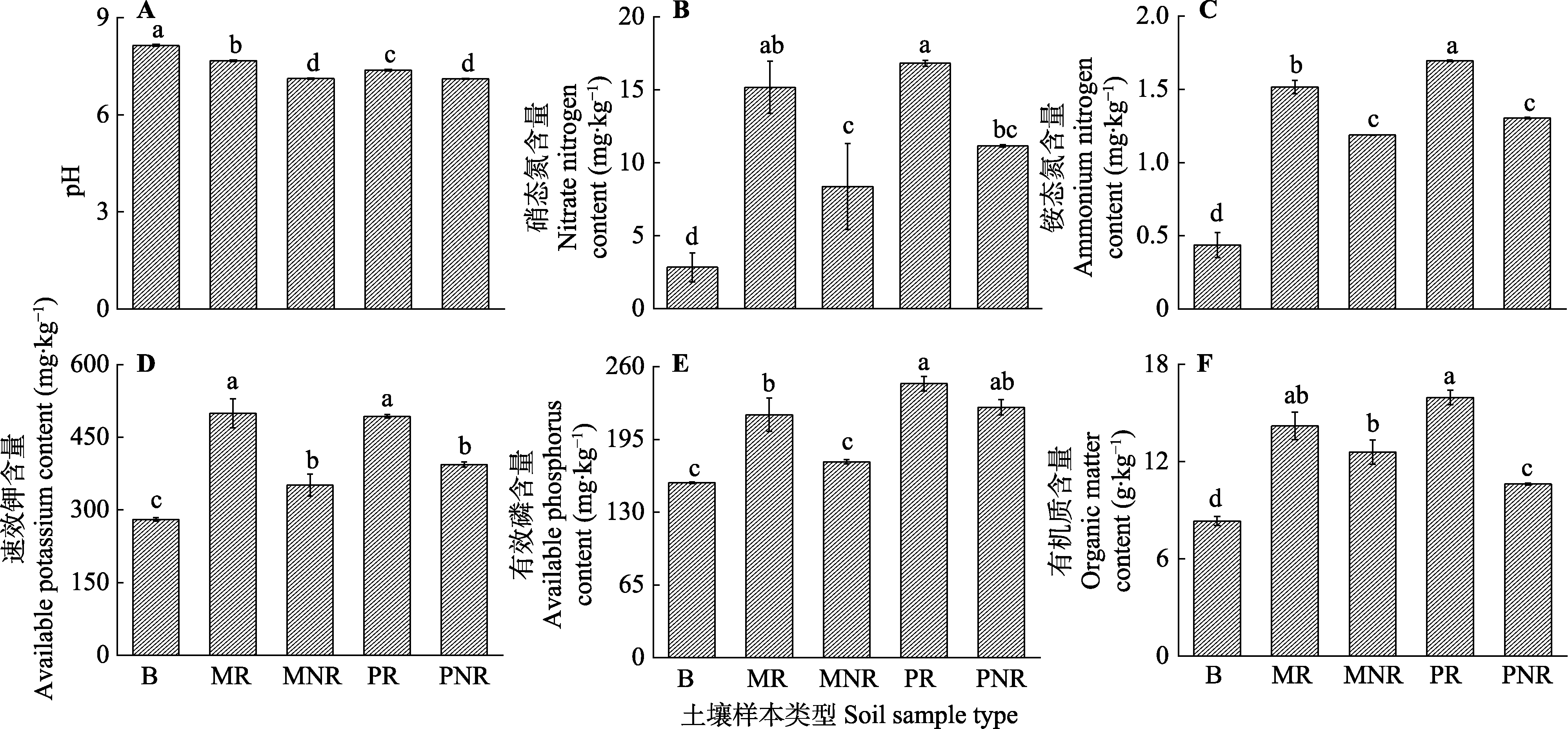
图1 不同植物根系构型对土壤理化性质(平均值±标准误)的影响。B, 生态修复初期土; MNR, 苜蓿非根际土; MR, 苜蓿根际土; PNR, 披碱草非根际土; PR, 披碱草根际土。不同小写字母表示不同土壤样本之间差异显著(p < 0.05)。
Fig. 1 Effects of different root architecture on soil physico-chemical properties (mean ± SE). B, soil at the beginning of ecological restoration; MNR, Medicago sativa bulk soil; MR, Medicago sativa rhizosphere soil; PNR, Elymus dahuricus bulk soil; PR, Elymus dahuricus rhizosphere soil. Different lowercase letters indicate significant differences between different soil samples significantly (p < 0.05).
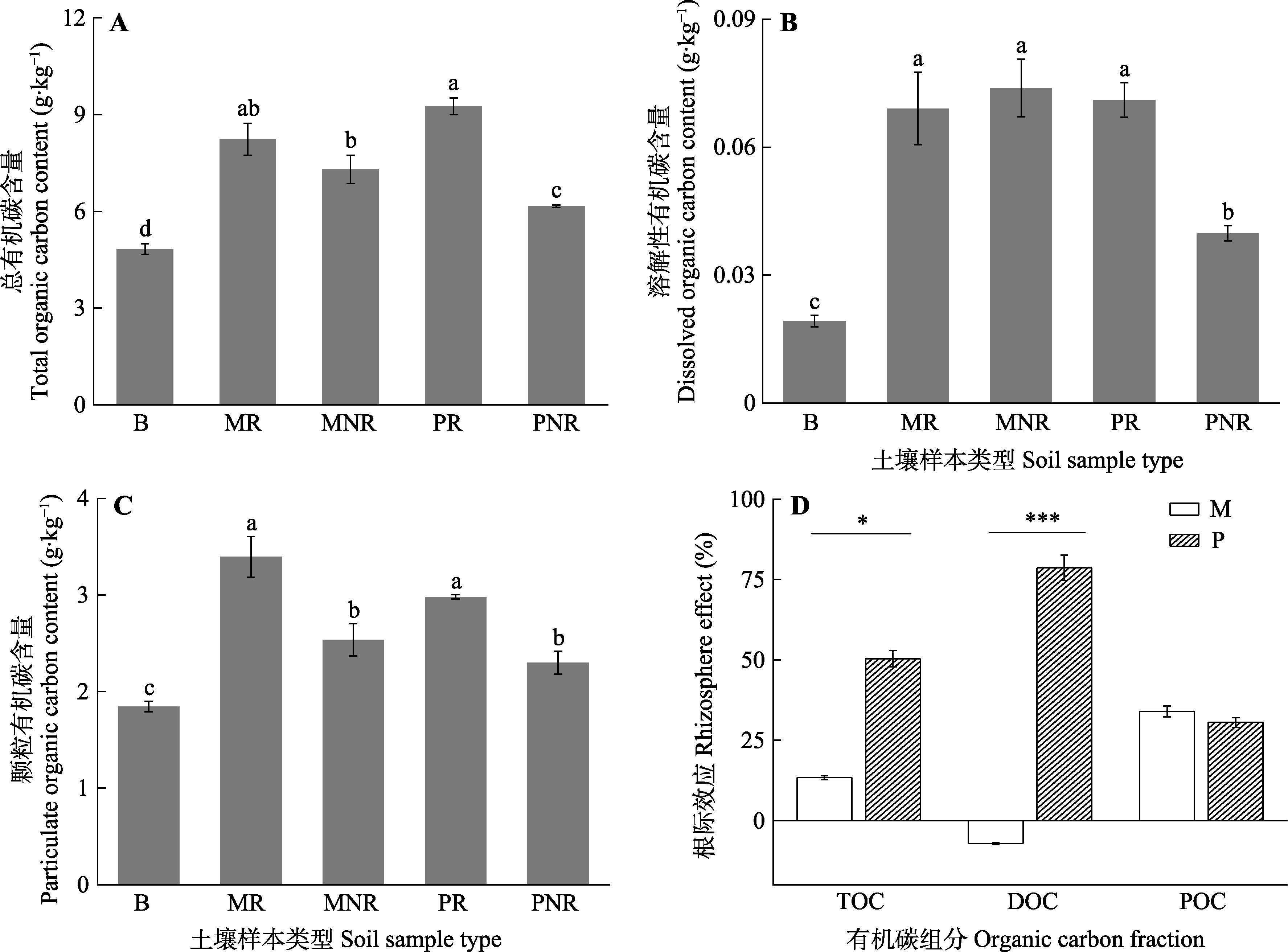
图2 不同植物根系构型对有机碳组分的影响(A-C)及根际效应(D) (平均值±标准误)。B, 生态修复初期土; MNR, 苜蓿非根际土; MR, 苜蓿根际土; PNR, 披碱草非根际土; PR, 披碱草根际土。M, 苜蓿; P, 披碱草。DOC, 溶解性有机碳; POC, 颗粒有机碳; TOC, 总有机碳。不同小写字母表示不同土壤样本之间差异显著(p < 0.05); *, p < 0.05; ***, p < 0.001。
Fig. 2 Effects of different root architecture on organic carbon fractions (A-C) and rhizosphere effects (D) (mean ± SE). B, soil at the beginning of ecological restoration; MNR, Medicago sativa bulk soil; MR, Medicago sativa rhizosphere soil; PNR, Elymus dahuricus bulk soil; PR, Elymus dahuricus rhizosphere soil. M, Medicago sativa; P, Elymus dahuricus. DOC, Dissolved organic carbon; POC, Particulate organic carbon; TOC, Total organic carbon. Different lowercase letters indicate significant differences between different soil samples significantly (p < 0.05); *, p < 0.05; ***, p < 0.001.
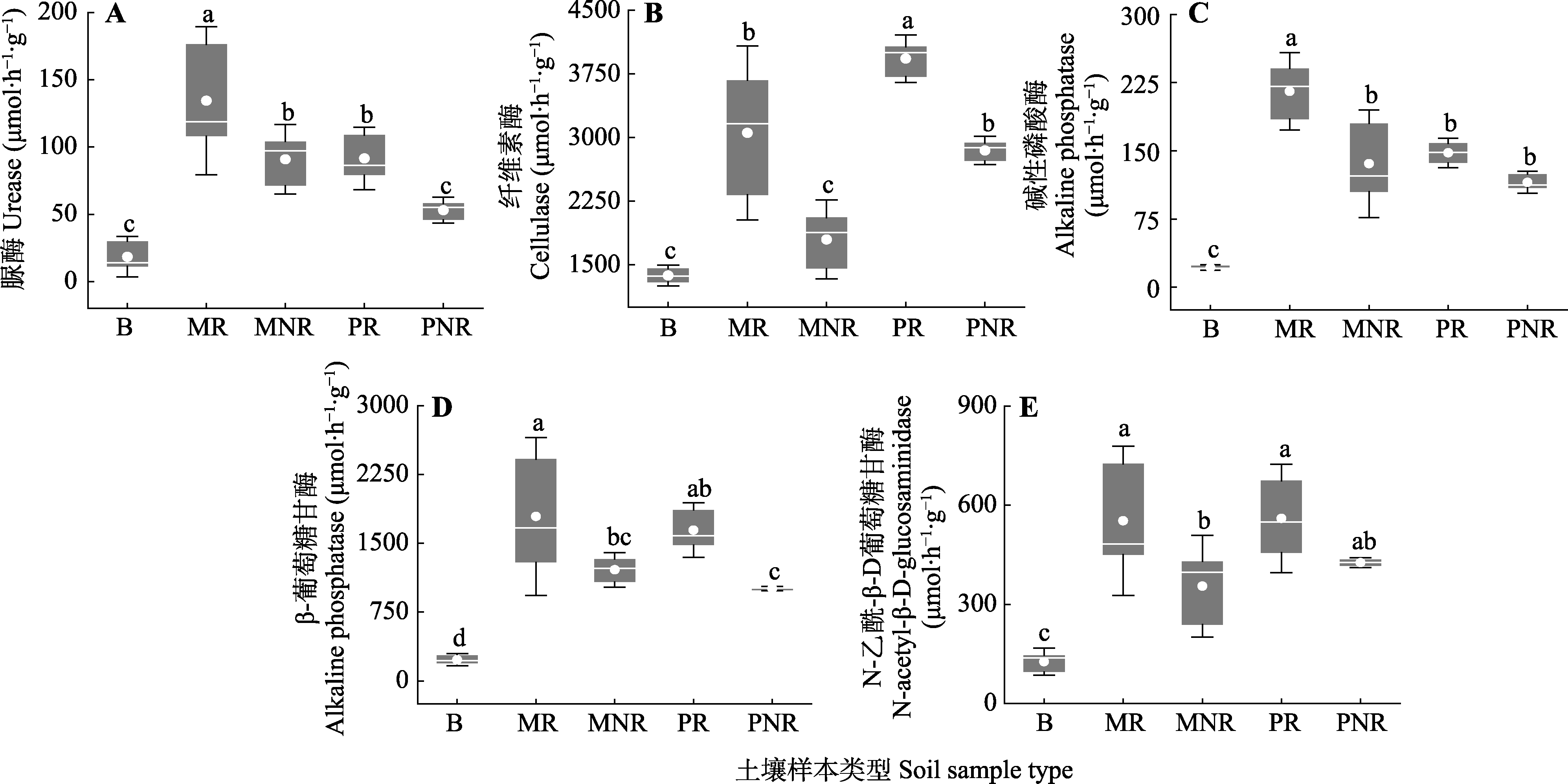
图3 不同植物根系构型对土壤酶活性(平均值±标准误)的影响。B, 生态修复初期土; MNR, 苜蓿非根际土; MR, 苜蓿根际土; PNR, 披碱草非根际土; PR, 披碱草根际土。不同小写字母表示不同土壤样本之间差异显著(p < 0.05)。
Fig. 3 Effects of different root architecture on soil enzyme activities (mean ± SE). B, soil at the beginning of ecological restoration; MNR, Medicago sativa bulk soil; MR, Medicago sativa rhizosphere soil; PNR, Elymus dahuricus bulk soil; PR, Elymus dahuricus rhizosphere soil. Different lowercase letters indicate significant differences between different soil samples significantly (p < 0.05).
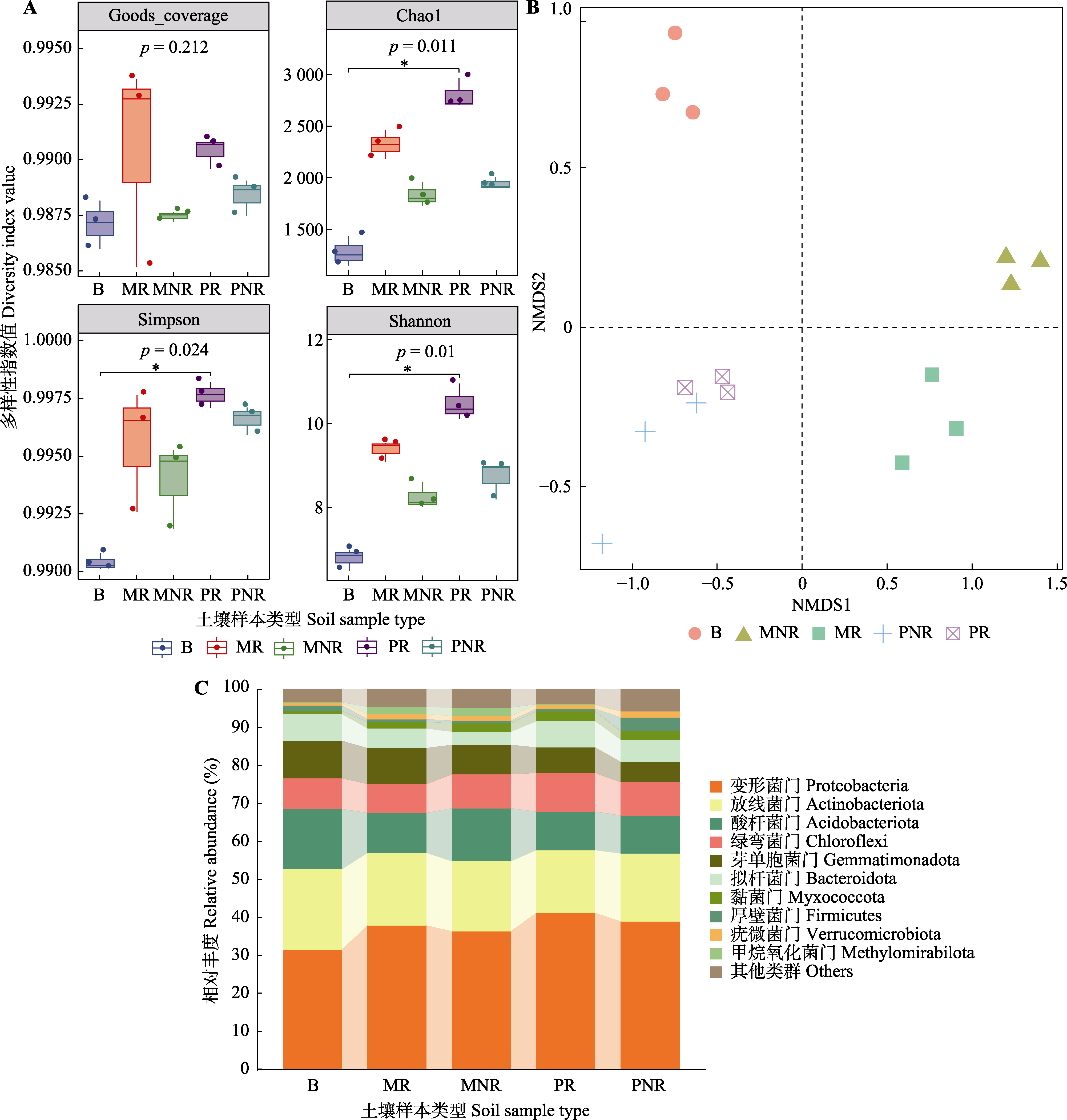
图4 不同植物根系构型对细菌群落多样性(A、B)及结构(C)的影响。B, 生态修复初期土; MNR, 苜蓿非根际土; MR, 苜蓿根际土; PNR, 披碱草非根际土; PR, 披碱草根际土。*, p < 0.05。NMDS, 非度量多维尺度分析。
Fig. 4 Effects of different root architecture on bacterial community diversity (A, B) and structure (C). B, soil at the beginning of ecological restoration; MNR, Medicago sativa bulk soil; MR, Medicago sativa rhizosphere soil; PNR, Elymus dahuricus bulk soil; PR, Elymus dahuricus rhizosphere soil. *, p < 0.05. NMOS, non-metric multidimensional scaling.
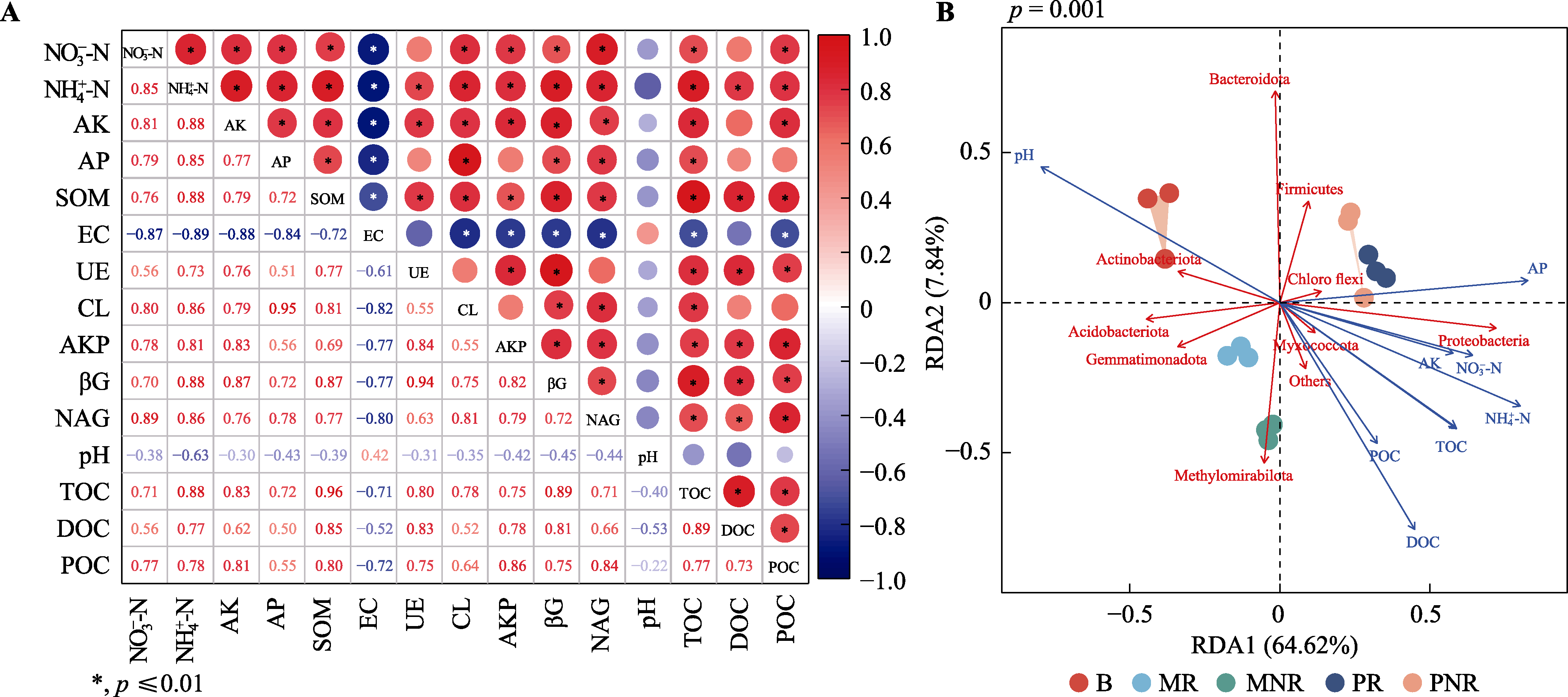
图5 有机碳与环境因子的相关性分析(A)和冗余分析(RDA, B)。B, 生态修复初期土; MR, 苜蓿根际土; MNR, 苜蓿非根际土; PR, 披碱草根际土; PNR, 披碱草非根际土。AK, 速效钾含量; AKP, 碱性磷酸酶活性; AP, 有效磷含量; βG, β-葡萄糖甘酶活性; CL, 纤维素酶活性; DOC, 溶解性有机碳含量; EC, 电导率; NAG, N-乙酰-β-D葡萄糖甘酶活性; NH4+-N, 铵态氮含量; NO3--N, 硝态氮含量; POC, 颗粒有机碳含量; SOM, 有机质含量; TOC, 总有机碳含量; UE, 脲酶活性。Acidobacteriota, 酸杆菌门; Actinobacteriota, 放线菌门; Bacteroidota, 拟杆菌门; Chloroflexi, 绿弯菌门; Firmicutes, 厚壁菌门; Gemmatimonadota, 芽单胞菌门; Methylomirabilota, 甲烷氧化菌门; Myxococcota, 黏菌门; Proteobacteria, 变形菌门; Others, 其他类群; Verrucomicrobiota, 疣微菌门。
Fig. 5 Correlation analysis (A) and redundancy analysis (RDA, B) of organic carbon with environmental factors. B, soil at the beginning of ecological restoration; MR, Medicago sativa rhizosphere soil; MNR, Medicago sativa bulk soil; PR, Elymus dahuricus rhizosphere soil; PNR, Elymus dahuricus bulk soil. AK, available potassium content; AKP, Alkaline phosphatase activity; AP, available phosphorus content; βG, β-glucosidase activity; CL, cellulase activity; DOC, dissolved organic carbon content; EC, conductivity; NAG, N-acetyl-β-D-glucosaminidase activity; NH4+-N, ammonium nitrogen content; NO3--N, nitrate nitrogen content; POC, particulate organic carbon content; SOM, organic matter content; TOC, total organic carbon content; UE, urease activity.
| [1] |
Callesen I, Harrison R, Stupak I, Hatten J, Raulund-Rasmussen K, Boyle J, Clarke N, Zabowski D (2016). Carbon storage and nutrient mobilization from soil minerals by deep roots and rhizospheres. Forest Ecology and Management, 359, 322-331.
DOI URL |
| [2] | Chang BR, Chen RL, Wang B, Lan T, Deng L, Xue HY (2024). Characteristics of soil organic carbon and its component distribution in different forest stand types on Mount Zola in southeastern Tibet. Ecology and Environmental Sciences, 33, 1495-1505. |
|
[常博然, 陈茹岚, 王彪, 蓝天, 邓琳, 薛会英 (2024). 藏东南折拉山不同林分类型土壤有机碳及其组分分布特征. 生态环境学报, 33, 1495-1505.]
DOI |
|
| [3] | Chen AR, Wang ZW (2012). Progress in the study of water-soluble organic carbon in soils//Chinese Society for Environment Sciences. Proceedings of the Annual Academic Conference of the Chinese Society for Environmental Sciences, Volume 3, China Environment Publishing Group, Beijing. 2570-2575. |
| [陈安冉, 王祖伟 (2012). 土壤中水溶性有机碳研究进展//中国环境科学学会. 中国环境科学学会学术年会论文集(第三卷), 中国环境科学出版社, 北京. 2570-2575.] | |
| [4] |
Chen X, Ding ZJ, Tang M, Zhu B (2018). Greater variations of rhizosphere effects within mycorrhizal group than between mycorrhizal group in a temperate forest. Soil Biology & Biochemistry, 126, 237-246.
DOI URL |
| [5] | Dang C, Morrissey EM (2024). The size and diversity of microbes determine carbon use efficiency in soil. Environmental Microbiology, 26, e16633. DOI: 10.1111/1462-2920.16633. |
| [6] |
de la Puente L, Echevarría L, Igual JM, Ferrio JP, Palacio S (2024). Changes in soil microbiota alter root exudation and rhizosphere pH of the gypsum endemic Ononis tridentata L. Plant and Soil, 505, 581-594.
DOI |
| [7] |
di Lonardo DP, de Boer W, Klein Gunnewiek PJA, Hannula SE, van der Wal A(2017). Priming of soil organic matter: chemical structure of added compounds is more important than the energy content. Soil Biology & Biochemistry, 108, 41-54.
DOI URL |
| [8] |
Dijkstra FA, Zhu B, Cheng WX (2021). Root effects on soil organic carbon: a double-edged sword. New Phytologist, 230, 60-65.
DOI PMID |
| [9] |
Ekenler M, Tabatabai M (2002). β-Glucosaminidase activity of soils: effect of cropping systems and its relationship to nitrogen mineralization. Biology and Fertility of Soils, 36, 367-376.
DOI URL |
| [10] |
Gharechahi J, Vahidi MF, Bahram M, Han JL, Ding XZ, Salekdeh GH (2021). Metagenomic analysis reveals a dynamic microbiome with diversified adaptive functions to utilize high lignocellulosic forages in the cattle rumen. The ISME Journal, 15, 1108-1120.
DOI URL |
| [11] | Guan SY (1986). Soil Enzyme and Its Research Methods. Chinese Agricultural Press, Beijing. 294-297. |
| [关松荫 (1986). 土壤酶及其研究方法. 农业出版社, 北京. 294-297.] | |
| [12] | He L (2023). Ecological restoration practice of high steep rocky slopes in open pit mines. China Metal Bulletin, (9), 116-118. |
| [何丽 (2023). 露天矿山高陡岩质边坡生态修复实践. 中国金属通报, (9), 116-118. ] | |
| [13] | He M, Wang YC, Wang LG, Li CQ, Wang LM, Li YH, Liu PQ (2020). Effects of subsoiling combined with fertilization on the fractions of soil active organic carbon and soil active nitrogen, and enzyme activities in black soil in northeast China. Acta Pedologica Sinica, 57, 446-456. |
| [贺美, 王迎春, 王立刚, 李成全, 王利民, 李玉红, 刘平奇 (2020). 深松施肥对黑土活性有机碳氮组分及酶活性的影响. 土壤学报, 57, 446-456.] | |
| [14] | Iqbal A, Maqsood Ur Rehman M, Sajjad W, Degen AA, Rafiq M, Niu JH, Khan S, Shang ZH (2024). Patterns of bacterial communities in the rhizosphere and rhizoplane of alpine wet meadows. Environmental Research, 241, 117672. DOI: 10.1016/j.envres.2023.117672. |
| [15] | Jiang XS, Zhong XM, Yu G, Zhang XH, Liu J (2023). Different effects of taproot and fibrous root crops on pore structure and microbial network in reclaimed soil. Science of the Total Environment, 901, 165996. DOI: 10.1016/j.scitotenv.2023.165996. |
| [16] |
Kallenbach CM, Frey SD, Grandy AS (2016). Direct evidence for microbial-derived soil organic matter formation and its ecophysiological controls. Nature Communications, 7, 13630. DOI: 10.1038/ncomms13630.
PMID |
| [17] |
Li J, Wen YC, Li XH, Li YT, Yang XD, Lin ZA, Song ZZ, Cooper JM, Zhao BQ (2018). Soil labile organic carbon fractions and soil organic carbon stocks as affected by long-term organic and mineral fertilization regimes in the North China Plain. Soil and Tillage Research, 175, 281-290.
DOI URL |
| [18] | Li JY, Yuan XL, Ge L, Li Q, Li ZG, Wang L, Liu Y (2020). Rhizosphere effects promote soil aggregate stability and associated organic carbon sequestration in rocky areas of desertification. Agriculture, Ecosystems & Environment, 304, 107126. DOI: 10.1016/j.agee.2020.107126. |
| [19] |
Li S, Zhang SR, Pu YL, Li T, Xu XX, Jia YX, Deng OP, Gong GS (2016). Dynamics of soil labile organic carbon fractions and C-cycle enzyme activities under straw mulch in Chengdu Plain. Soil and Tillage Research, 155, 289-297.
DOI URL |
| [20] | Li ZQ, Zhang X, Wang JH, Cao K, Xu CX, Cao WD (2018). Effects of Chinese milk vetch (Astragalus sinicus L.) application rate on soil labile organic carbon and C-transformation enzyme activities. Soil and Fertilizer Sciences in China, (4), 14-20. |
| [李增强, 张贤, 王建红, 曹凯, 徐昌旭, 曹卫东 (2018). 紫云英施用量对土壤活性有机碳和碳转化酶活性的影响. 中国土壤与肥料, (4), 14-20.] | |
| [21] | Liang AZ, Zhang XP, Yang XM, Shen Y, Shi XH, Fan RQ, Fang HJ (2010). Dynamics of soil particulate organic carbon and mineral-incorporated organic carbon in black soils in Northeast China. Acta Pedologica Sinica, 47, 153-158. |
| [梁爱珍, 张晓平, 杨学明, 申艳, 时秀焕, 范如芹, 方华军 (2010). 黑土颗粒态有机碳与矿物结合态有机碳的变化研究. 土壤学报, 47, 153-158.] | |
| [22] | Lin Q (2006). Study on Soil Erosion and Its Control Technology of the Granite Mineral Area—Taking the Granite Mineral Area in Tiefeng mountain of Anxi County as an Example. Master degree dissertation, Fujian Agricultural and Forestry University, Fuzhou. |
| [林强 (2006). 花岗岩矿区水土流失及其治理技术研究——以安溪县铁峰山花岗岩矿区为例. 硕士学位论文, 福建农林大学, 福州.] | |
| [23] | Liu B, Xia H, Jiang CC, Riaz M, Yang L, Chen YF, Fan XP, Xia XG (2022). 14 year applications of chemical fertilizers and crop straw effects on soil labile organic carbon fractions, enzyme activities and microbial community in rice-wheat rotation of middle China. Science of the Total Environment, 841, 156608. DOI: 10.1016/j.scitotenv.2022.156608. |
| [24] | Liu FT, Wang D, Zhang BB, Huang J (2021). Concentration and biodegradability of dissolved organic carbon derived from soils: a global perspective. Science of the Total Environment, 754, 142378. DOI: 10.1016/j.scitotenv.2020.142378. |
| [25] |
Liu SB, Zamanian K, Schleuss PM, Zarebanadkouki M, Kuzyakov Y (2018). Degradation of Tibetan grasslands: consequences for carbon and nutrient cycles. Agriculture, Ecosystems & Environment, 252, 93-104.
DOI URL |
| [26] | Luo JC, Wang YQ, Xu Y, Wang M (2020). Evaluation of tourism climate and human comfort in Kangding City. Journal of Green Science and Technology, 22(16), 174-175. |
| [罗竟成, 王严琪, 徐瑗, 王敏 (2020). 康定市旅游气候及人体舒适度评价. 绿色科技, 22(16), 174-175.] | |
| [27] | Lv CH, Wang CK, Cai AD, Zhou ZH (2023). Global magnitude of rhizosphere effects on soil microbial communities and carbon cycling in natural terrestrial ecosystems. Science of the Total Environment, 856, 158961. DOI: 10.1016/j.scitotenv.2022.158961. |
| [28] |
Mitra D, Mondal R, Khoshru B, Senapati A, Radha TK, Mahakur B, Uniyal N, Myo EM, Boutaj H, Sierra BEG, Panneerselvam P, Ganeshamurthy AN, Elković SA, Vasić T, Rani A, et al. (2022). Actinobacteria-enhanced plant growth, nutrient acquisition, and crop protection: advances in soil, plant, and microbial multifactorial interactions. Pedosphere, 32, 149-170.
DOI URL |
| [29] |
Moreau D, Bardgett RD, Finlay RD, Jones DL, Philippot L (2019). A plant perspective on nitrogen cycling in the rhizosphere. Functional Ecology, 33, 540-552.
DOI |
| [30] |
Phillips RP, Fahey TJ (2006). Tree species and mycorrhizal associations influence the magnitude of rhizosphere effects. Ecology, 87, 1302-1313.
PMID |
| [31] | Pu YL, Ye C, Zhang SR, Long GF, Yang LR, Jia YX, Xu XX, Li Y (2017). Effects of different ecological restoration patterns on labile organic carbon and carbon pool management index of desertification grassland soil in zoige. Acta Ecologica Sinica, 37, 367-377. |
| [蒲玉琳, 叶春, 张世熔, 龙高飞, 杨丽蓉, 贾永霞, 徐小逊, 李云 (2017). 若尔盖沙化草地不同生态恢复模式土壤活性有机碳及碳库管理指数变化. 生态学报, 37, 367-377.] | |
| [32] | Qin WK, Feng JG, Hu YL, Zhang QF, Zhu B (2024). Mechanisms and influencing factors of soil priming effect: a review. Acta Scientiarum Naturalium Universitatis Pekinensis, 60, 957-970. |
| [秦文宽, 冯继广, 胡云龙, 张秋芳, 朱彪 (2024). 土壤激发效应的机制及影响因素研究进展. 北京大学学报(自然科学版), 60, 957-970.] | |
| [33] | Ramírez PB, Fuentes-Alburquenque S, Díez B, Vargas I, Bonilla CA (2020). Soil microbial community responses to labile organic carbon fractions in relation to soil type and land use along a climate gradient. Soil Biology & Biochemistry, 141, 107692. DOI: 10.1016/j.soilbio.2019.107692. |
| [34] | Ran JM, Song XY, Wang D, Wang CT (2025). Changes in soil organic carbon fractions and carbon sequestration potential of the degraded alpine meadows. Acta Prataculturae Sinica, 34(9), 38-52. |
|
[冉健民, 宋小艳, 王丹, 王长庭 (2025). 退化高寒草甸土壤有机碳组分变化与增汇潜力研究. 草业学报, 34(9), 38-52.]
DOI |
|
| [35] |
Shi SJ, Richardson AE, O’Callaghan M, DeAngelis KM, Jones EE, Stewart A, Firestone MK, Condron LM (2011). Effects of selected root exudate components on soil bacterial communities. FEMS Microbiology Ecology, 77, 600-610.
DOI PMID |
| [36] |
Shih PM, Ward LM, Fischer WW (2017). Evolution of the 3-hydroxypropionate bicycle and recent transfer of anoxygenic photosynthesis into the Chloroflexi. Proceedings of the National Academy of Sciences of the United States of America, 114, 10749-10754.
DOI PMID |
| [37] |
Sokol NW, Slessarev E, Marschmann GL, Nicolas A, Blazewicz SJ, Brodie EL, Firestone MK, Foley MM, Hestrin R, Hungate BA, Koch BJ, Stone BW, Sullivan MB, Zablocki O, Pett-Ridge J (2022). Life and death in the soil microbiome: How ecological processes influence biogeochemistry. Nature Reviews Microbiology, 20, 415-430.
DOI PMID |
| [38] |
Srivastava RK, Yetgin A (2024). An overall review on influence of root architecture on soil carbon sequestration potential. Theoretical and Experimental Plant Physiology, 36, 165-178.
DOI |
| [39] | Sun XD, Ye YQ, Ma QX, Guan QW, Jones DL (2021). Variation in enzyme activities involved in carbon and nitrogen cycling in rhizosphere and bulk soil after organic mulching. Rhizosphere, 19, 100376. DOI: 10.1016/j.rhisph.2021.100376. |
| [40] |
Wang CQ, Kuzyakov Y (2024). Rhizosphere engineering for soil carbon sequestration. Trends in Plant Science, 29, 447-468.
DOI URL |
| [41] | Wang D, Yi WB, Zhou YL, He SR, Tang L, Yin XH, Zhao P, Long GQ (2021). Intercropping and N application enhance soil dissolved organic carbon concentration with complicated chemical composition. Soil and Tillage Research, 210, 104979. DOI: 10.1016/j.still.2021.104979. |
| [42] |
Wang P, Zheng XB, Liang HB, Song WJ, Ji X, Xu YL, Kuang S, Dong JX (2021). Effects of different fertilization models on active organic carbon components and enzyme activities of Tobacco-growing brown soil. Acta Agriculturae Boreali-Sinica, 36(1), 187-196.
DOI |
|
[王鹏, 郑学博, 梁洪波, 宋文静, 季璇, 徐艳丽, 况帅, 董建新 (2021). 不同施肥模式对植烟棕壤活性有机碳组分和酶活性的影响. 华北农学报, 36(1), 187-196.]
DOI |
|
| [43] | Wang PP, Su XM, Zhou ZC, Wang N, Liu J, Zhu BB (2023). Differential effects of soil texture and root traits on the spatial variability of soil infiltrability under natural revegetation in the Loess Plateau of China. Catena, 220, 106693. DOI: 10.1016/j.catena.2022.106693. |
| [44] | Wang ZW, Ma SQ, Hu Y, Chen YC, Jiang HM, Duan BL, Lu XY (2022). Links between chemical composition of soil organic matter and soil enzyme activity in alpine grassland ecosystems of the Tibetan Plateau. Catena, 218, 106565. DOI: 10.1016/j.catena.2022.106565. |
| [45] |
Wickings K, Grandy AS, Reed SC, Cleveland CC (2012). The origin of litter chemical complexity during decomposition. Ecology Letters, 15, 1180-1188.
DOI PMID |
| [46] |
Witzgall K, Vidal A, Schubert DI, Höschen C, Schweizer SA, Buegger F, Pouteau V, Chenu C, Mueller CW (2021). Particulate organic matter as a functional soil component for persistent soil organic carbon. Nature Communications, 12, 4115. DOI: 10.1038/s41467-021-24192-8.
PMID |
| [47] |
Wu H, Tang T, Zhu F, Wei XM, Hartley W, Xue SG (2021). Long term natural restoration creates soil-like microbial communities in bauxite residue: a 50-year filed study. Land Degradation & Development, 32, 1606-1617.
DOI URL |
| [48] | Wu WZ, Ren QR, Zhang SQ, Wang KJ, Liu JX, Wei YQ, Chai BF (2024). Structure and stability of soil organic carbon pools along depths in forests and grasslands in Luya Mountains. Environmental Science, 46, 6567-6575. |
| [武文卓, 任倩茹, 张仕琪, 王鲲娇, 刘晋仙, 魏雨其, 柴宝峰 (2024). 芦芽山森林和草地不同深度土壤有机碳库结构与稳定性. 环境科学, 46, 6567-6575.] | |
| [49] | Xiao Y, Huang ZG, Wu HT, Lü XG (2015). Compositions and contents of active organic carbon in different wetland soils in Sanjiang Plain, Northeast China. Acta Ecologica Sinica, 35, 7625-7633. |
| [肖烨, 黄志刚, 武海涛, 吕宪国 (2015). 三江平原不同湿地类型土壤活性有机碳组分及含量差异. 生态学报, 35, 7625-7633.] | |
| [50] |
Xu XK, Luo XB, Jiang SH, Xu ZJ (2012). Biodegradation of dissolved organic carbon in soil extracts and leachates from a temperate forest stand and its relationship to ultraviolet absorbance. Chinese Science Bulletin, 57, 912-920.
DOI URL |
| [51] | Yang ZY, Xiao SH, Ma JJ, Gao CJ, Wei L, Li JH, He DJ (2025). Characteristics and influencing factors of soil organic carbon components in typical mangrove wetlands. Journal of West China Forestry Science, 54(1), 126-134. |
| [杨泽宇, 肖石红, 马姣娇, 高常军, 魏龙, 李佳鸿, 何东进 (2025). 典型红树林湿地土壤有机碳组分特征及影响因素. 西部林业科学, 54(1), 126-134.] | |
| [52] |
Zhan J, Sun QY (2014). Development of microbial properties and enzyme activities in copper mine wasteland during natural restoration. Catena, 116, 86-94.
DOI URL |
| [53] | Zhang HK, Fang YY, Zhang BG, Luo Y, Yi XY, Wu JS, Chen YC, Sarker TC, Cai YJ, Chang SX (2022a). Land-use-driven change in soil labile carbon affects microbial community composition and function. Geoderma, 426, 116056. DOI: 10.1016/j.geoderma.2022.116056. |
| [54] |
Zhang ZL, Kaye JP, Bradley BA, Amsili JP, Suseela V (2022b). Cover crop functional types differentially alter the content and composition of soil organic carbon in particulate and mineral-associated fractions. Global Change Biology, 28, 5831-5848.
DOI URL |
| [55] |
Zheng H, Wang X, Luo XX, Wang ZY, Xing BS (2018). Biochar-induced negative carbon mineralization priming effects in a coastal wetland soil: roles of soil aggregation and microbial modulation. Science of the Total Environment, 610-611, 951-960.
DOI URL |
| [56] | Zhu F, Zhang XC, Guo XY, Yang XW, Xue SG (2023). Root architectures differentiate the composition of organic carbon in bauxite residue during natural vegetation. Science of the Total Environment, 883, 163588. DOI: 10.1016/j.scitotenv.2023.163588. |
| [57] | Zhu HY, Wang ZF, Lu C, Chen SQ, Wang FH, Lü S, Gao M (2021). Variation characteristics of soil active organic carbon and carbon pools under five vegetation types in Jinyun Mountain. Soils, 53, 354-360. |
| [朱浩宇, 王子芳, 陆畅, 陈仕奇, 王富华, 吕盛, 高明 (2021). 缙云山5种植被下土壤活性有机碳及碳库变化特征. 土壤, 53, 354-360.] | |
| [58] | Zhu LJ, Pei XJ, Zhang XC, Ren T, Yang QW (2020). A study of water retention and ecological effects of loess improved by double polymers. Hydrogeology & Engineering Geology, 47(4), 158-166. |
| [朱利君, 裴向军, 张晓超, 任童, 杨晴雯 (2020). 双聚材料改良黄土持水性及生态效应研究. 水文地质工程地质, 47(4), 158-166.] |
| [1] | 邢强, 赵斌, 胡永红, 杨君, 秦俊, 刘何铭, 王红兵, 周鹏. 华东地区两种典型立体绿化植物根系性状特征及对新型土壤基质的响应[J]. 植物生态学报, 2025, 49(9): 1498-1514. |
| [2] | 梁天豪, 熊德成, 刘源豪, 杜旭龙, 杨智杰, 黄锦学. 不同菌根类型树种的根系分泌物特征及其根际效应研究进展[J]. 植物生态学报, 2025, 49(7): 1038-1052. |
| [3] | 付粱晨, 丁宗巨, 唐茂, 曾辉, 朱彪. 北京东灵山白桦和蒙古栎的根际效应及其季节动态[J]. 植物生态学报, 2024, 48(4): 508-522. |
| [4] | 颜辰亦, 龚吉蕊, 张斯琦, 张魏圆, 董学德, 胡宇霞, 杨贵森. 氮添加对内蒙古温带草原土壤活性有机碳的影响[J]. 植物生态学报, 2024, 48(2): 229-241. |
| [5] | 贺强. 生物互作与全球变化下的生态系统动态: 从理论到应用[J]. 植物生态学报, 2021, 45(10): 1075-1093. |
| [6] | 祝维, 余立璇, 赵德海, 贾黎明. 基于根系发育分级的砂壤土下成熟林木根系构型分析[J]. 植物生态学报, 2019, 43(2): 119-130. |
| [7] | 莫雪丽, 戴晓琴, 王辉民, 付晓莉, 寇亮. 中亚热带典型人工林常见乔灌木根际效应——以江西泰和千烟洲为例[J]. 植物生态学报, 2018, 42(7): 723-733. |
| [8] | 赵睿宇, 李正才, 王斌, 葛晓改, 戴云喜, 赵志霞, 张雨洁. 毛竹林地表覆盖年限对土壤有机碳的影响[J]. 植物生态学报, 2017, 41(4): 418-429. |
| [9] | 辜翔, 张仕吉, 项文化, 李雷达, 刘兆丹, 孙伟军, 方晰. 中亚热带4种森林类型土壤活性有机碳的季节动态特征[J]. 植物生态学报, 2016, 40(10): 1064-1076. |
| [10] | 宋清华, 赵成章, 史元春, 杜晶, 王继伟, 陈静. 高寒草地甘肃臭草根系分形结构的坡向差异性[J]. 植物生态学报, 2015, 39(8): 816-824. |
| [11] | 宋清华, 赵成章, 史元春, 杜晶, 王继伟, 陈静. 不同坡向甘肃臭草根系分叉数和连接长度的权衡关系[J]. 植物生态学报, 2015, 39(6): 577-585. |
| [12] | 郑慧玲, 赵成章, 徐婷, 段贝贝, 韩玲, 冯威. 红砂根系分叉数和分支角度权衡关系的坡向差异[J]. 植物生态学报, 2015, 39(11): 1062-1070. |
| [13] | 郭京衡, 曾凡江, 李尝君, 张波. 塔克拉玛干沙漠南缘三种防护林植物根系构型及其生态适应策略[J]. 植物生态学报, 2014, 38(1): 36-44. |
| [14] | 孙宝伟, 杨晓东, 张志浩, 马文济, 黄海侠, 阎恩荣. 浙江天童常绿阔叶林演替过程中土壤碳库与植被碳归还的关系[J]. 植物生态学报, 2013, 37(9): 803-810. |
| [15] | 付登高, 何锋, 郭震, 阎凯, 吴晓妮, 段昌群. 滇池流域富磷区退化山地马桑-蔗茅植物群落的生态修复效能评价[J]. 植物生态学报, 2013, 37(4): 326-334. |
| 阅读次数 | ||||||
|
全文 |
|
|||||
|
摘要 |
|
|||||
Copyright © 2026 版权所有 《植物生态学报》编辑部
地址: 北京香山南辛村20号, 邮编: 100093
Tel.: 010-62836134, 62836138; Fax: 010-82599431; E-mail: apes@ibcas.ac.cn, cjpe@ibcas.ac.cn
备案号: 京ICP备16067583号-19

