
植物生态学报 ›› 2026, Vol. 50 ›› Issue (3): 612-624.DOI: 10.17521/cjpe.2025.0178 cstr: 32100.14.cjpe.2025.0178
王发园1, 张莘2,3, 陈保冬2,3,*( )(
)( )
)
收稿日期:2025-05-16
接受日期:2025-10-17
出版日期:2026-03-20
发布日期:2026-04-03
通讯作者:
*陈保冬(bdchen@rcees.ac.cn)基金资助:
WANG Fa-Yuan1, ZHANG Xin2,3, CHEN Bao-Dong2,3,*()()
Received:2025-05-16
Accepted:2025-10-17
Online:2026-03-20
Published:2026-04-03
Contact:
*CHEN Bao-Dong(bdchen@rcees.ac.cn)
Supported by:摘要:
微塑料是全球性分布的一类新污染物, 常见于包括农田在内的陆地生态系统。已有证据显示, 微塑料会改变土壤理化性质, 影响土壤生物、植物性状及生态系统功能。作为土壤中最常见的植物共生真菌, 丛枝菌根(AM)真菌通过多种机制增强宿主植物的抗逆能力, 对于维持生态系统稳定具有重要作用。结合当前最新研究进展, 该文综述了土壤微塑料与AM真菌的相互作用。一方面微塑料可以通过吸附固持作用, 以及释放所携带的污染物直接影响AM真菌, 也可以通过改变土壤性质(如pH、养分有效性)、污染物形态及毒性、土壤微生物群落组成及其活性、植物性状等间接影响AM真菌的侵染能力和群落结构。另一方面, AM真菌对微塑料具有较强的耐性, 可能通过多种途径缓解微塑料对植物和土壤环境的不利影响, 包括改善土壤结构、缓解微塑料引起的植物营养限制、通过菌根结构(如根外菌丝)固持微塑料, 减少植物对微塑料的吸收和转运等。总体上, 微塑料与AM真菌之间的相互作用依赖于微塑料的特性(如种类、剂量、尺寸、形状)、植物种类、土壤性质及暴露条件, 难以得到统一的结果。最后, 基于对当前研究中存在问题和不足的分析, 展望了未来研究方向, 提出建立可靠的土壤植物体系中微塑料定量分析方法, 加强微塑料代谢产物和复合污染对AM真菌的生态毒理效应研究, 揭示AM真菌对微塑料环境行为的影响及其生态效应, 从而为应用菌根技术解决土壤微塑料污染问题提供理论和技术支撑。
王发园, 张莘, 陈保冬. 土壤微塑料与丛枝菌根真菌的相互作用. 植物生态学报, 2026, 50(3): 612-624. DOI: 10.17521/cjpe.2025.0178
WANG Fa-Yuan, ZHANG Xin, CHEN Bao-Dong. Interactions between soil microplastics and arbuscular mycorrhizal fungi. Chinese Journal of Plant Ecology, 2026, 50(3): 612-624. DOI: 10.17521/cjpe.2025.0178
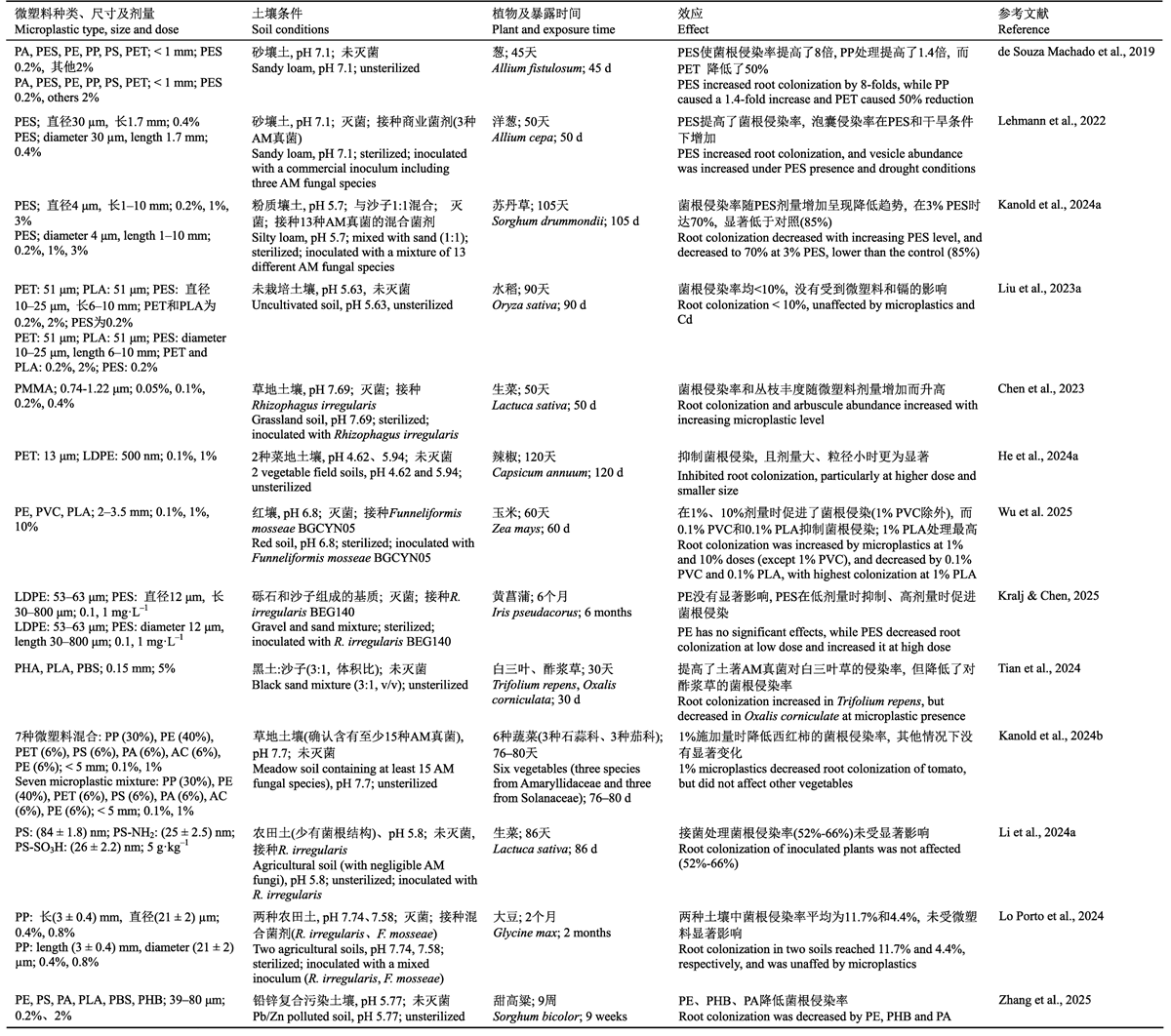 |
表1 微塑料对菌根侵染率的影响
Table 1 Effects of microplastics on mycorrhizal colonization rate
| |
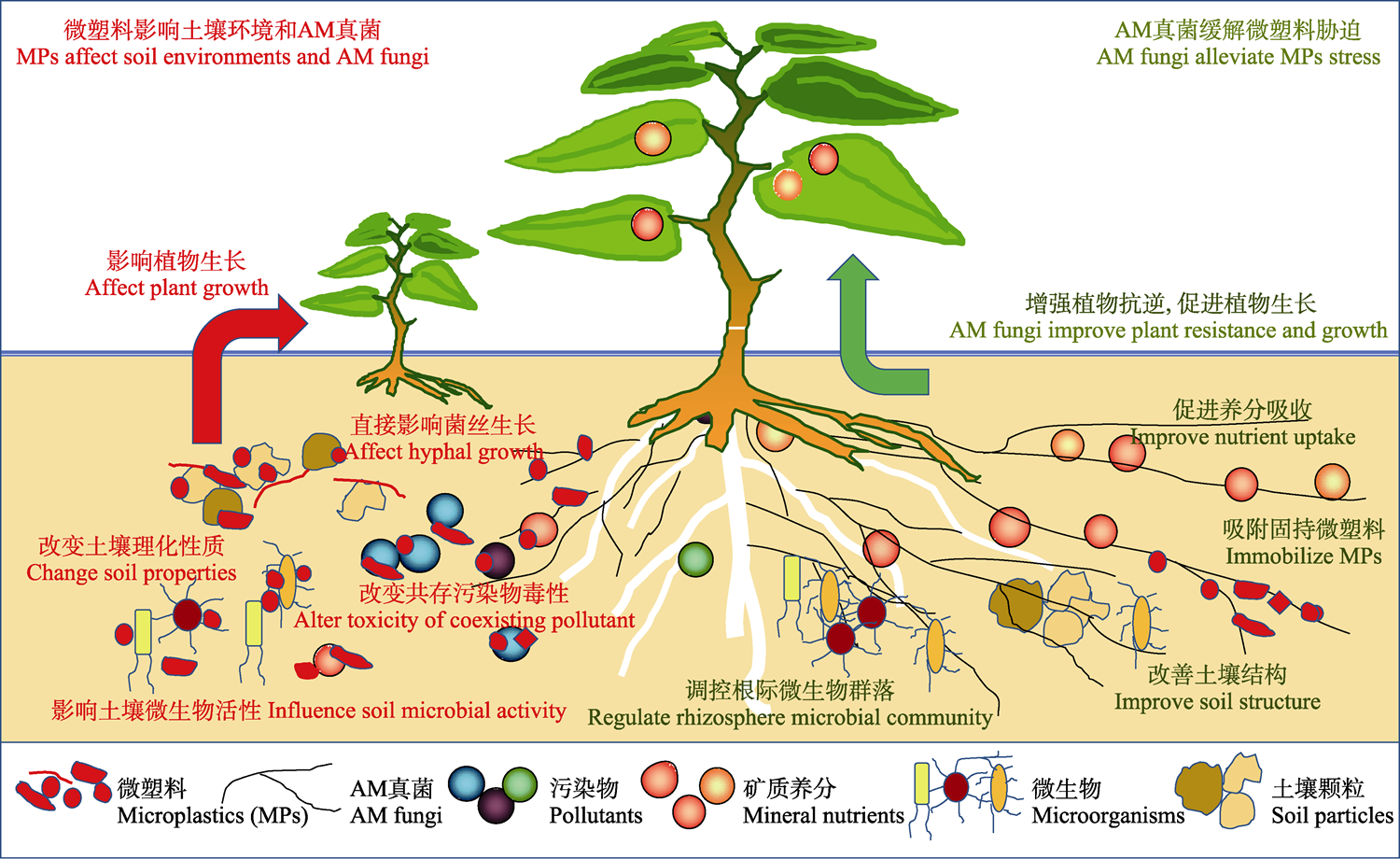
图1 土壤微塑料与丛枝菌根(AM)真菌的相互作用。
Fig. 1 Interactions between soil microplastics and arbuscular mycorrhizal (AM) fungi.
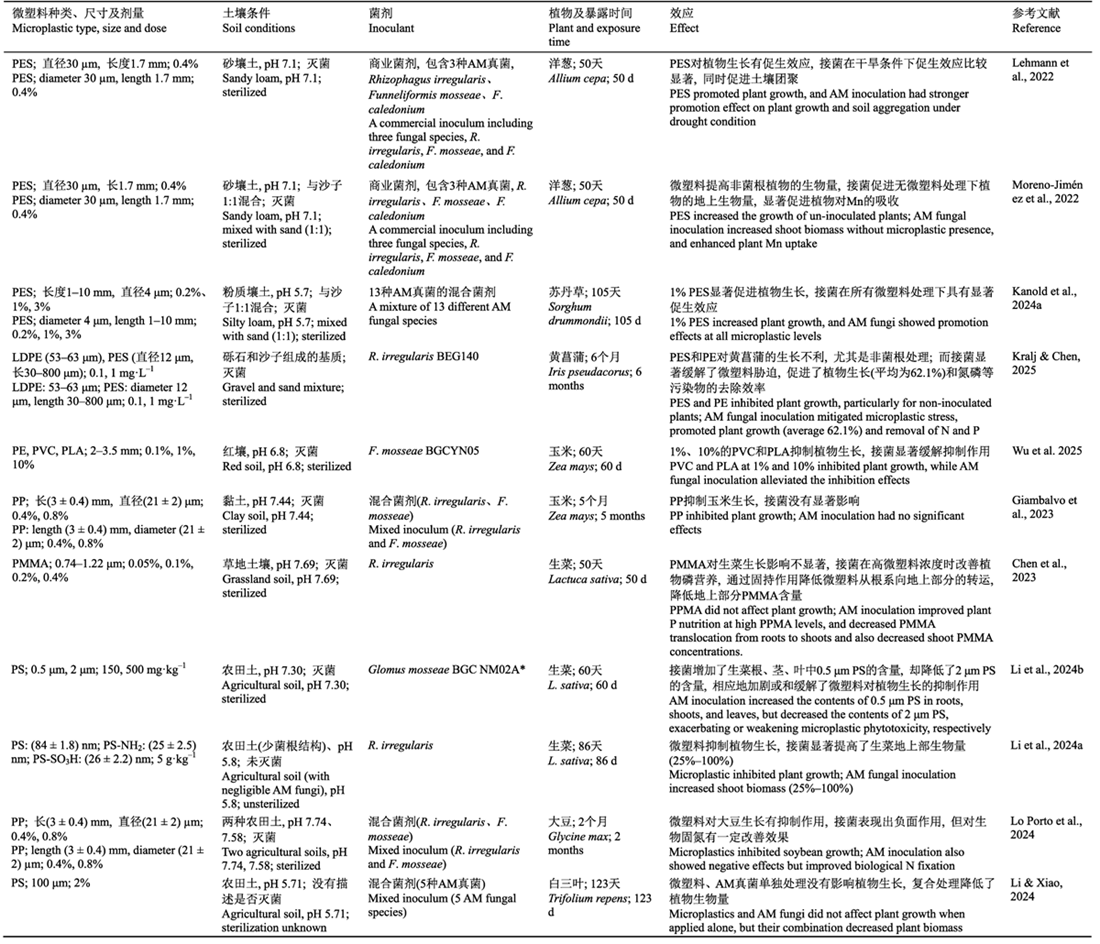 |
表2 微塑料对植物的影响及AM真菌的接种效应
Table 2 Effects of microplastics on plant performance and AM fungal inoculation
| |
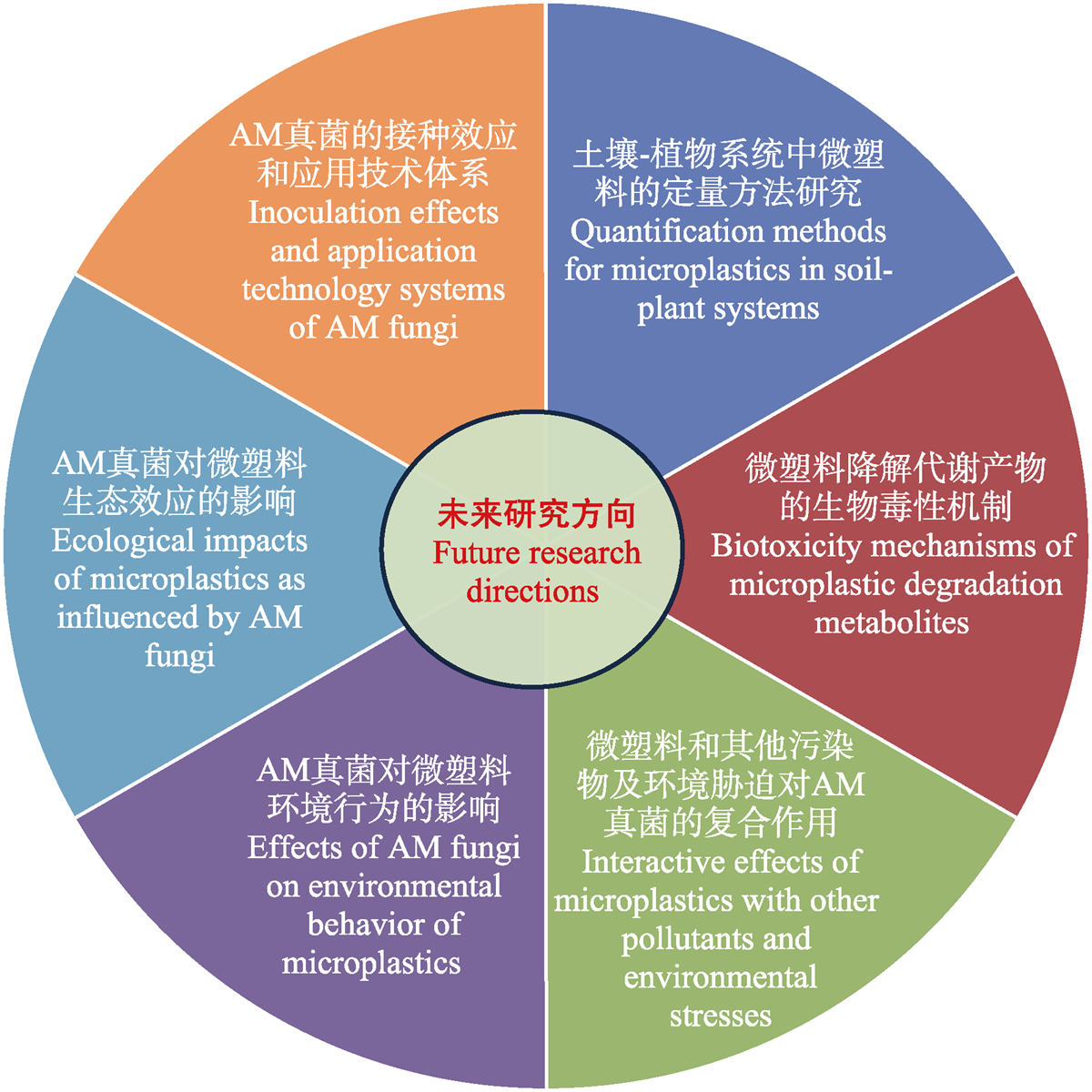
图2 土壤微塑料与丛枝菌根(AM)真菌相互作用未来研究方向。
Fig. 2 Future research directions relevant to the interactions of soil microplastics with arbuscular mycorrhizal (AM) fungi.
| [1] | Camuy-Velez L, Chakraborty D, Young A, Paudel S, Elvers R, Vanderhyde M, Walter K, Herzog C, Banerjee S (2025). Context-dependent contributions of arbuscular mycorrhizal fungi to host performance under global change factors. Soil Biology & Biochemistry, 204, 109707. DOI: 10.1016/j.soilbio.2024.109707. |
| [2] |
Chen H, Zhang X, Wang H, Xing S, Yin R, Fu W, Rillig MC, Chen B, Zhu Y (2023). Arbuscular mycorrhizal fungi can inhibit the allocation of microplastics from crop roots to aboveground edible parts. Journal of Agricultural and Food Chemistry, 71, 18323-18332.
DOI PMID |
| [3] | Chen L, Qiu TY, Huang FY, Zeng Y, Cui YX, Chen J, White JC, Fang LC (2024). Micro/nanoplastics pollution poses a potential threat to soil health. Global Change Biology, 30, e17470. DOI: 10.1111/gcb.17470. |
| [4] |
Covacevich F, Echeverría HE, Aguirrezabal LAN (2007). Soil available phosphorus status determines indigenous mycorrhizal colonization of field and glasshouse-grown spring wheat from Argentina. Applied Soil Ecology, 35, 1-9.
DOI URL |
| [5] |
de Souza Machado AA, Kloas W, Zarfl C, Hempel S, Rillig MC (2018). Microplastics as an emerging threat to terrestrial ecosystems. Global Change Biology, 24, 1405-1416.
DOI PMID |
| [6] |
de Souza Machado AA, Lau CW, Kloas W, Bergmann J, Bachelier JB, Faltin E, Becker R, Görlich AS, Rillig MC (2019). Microplastics can change soil properties and affect plant performance. Environmental Science & Technology, 53, 6044-6052.
DOI URL |
| [7] |
Fuller S, Gautam A (2016). A procedure for measuring microplastics using pressurized fluid extraction. Environmental Science & Technology, 50, 5774-5780.
DOI URL |
| [8] | Giambalvo D, Amato G, Ingraffia R, Lo Porto A, Mirabile G, Ruisi P, Torta L, Frenda AS (2023). Nitrogen fertilization and arbuscular mycorrhizal fungi do not mitigate the adverse effects of soil contamination with polypropylene microfibers on maize growth. Environmental Pollution, 334, 122146. DOI: 10.1016/j.envpol.2023.122146. |
| [9] | He BP, Liu ZH, Wang X, Li MH, Lin XG, Xiao QQ, Hu JL (2024a). Dosage and exposure time effects of two micro(nono)plastics on arbuscular mycorrhizal fungal diversity in two farmland soils planted with pepper (Capsicum annuum L.). Science of the Total Environment, 917, 170216. DOI: 10.1016/j.scitotenv.2024.170216. |
| [10] | He MX, Yao WS, Meng ZR, Liu J, Yan W, Meng WQ (2024b). Microplastic-contamination can reshape plant community by affecting soil properties. Ecotoxicology and Environmental Safety, 283, 116844. DOI: 10.1016/j.ecoenv.2024.116844. |
| [11] | Hu Z, Xiao M, Wu J, Tong Y, Ji J, Huang Q, Ding F, Ding J, Zhu Z, Chen J, Ge T (2024). Effects of microplastics on photosynthesized C allocation in a rice-soil system and its utilization by soil microbial groups. Journal of Hazardous Materials, 466, 133540. DOI: 10.1016/j.jhazmat.2024.133540. |
| [12] |
Kanold E, Buchanan SW, Dunfield K, Antunes PM (2024a). Microplastic additions modulate intraspecific variability in root traits and mycorrhizal responses across root-life history strategies. Functional Ecology, 38, 2369-2377.
DOI URL |
| [13] | Kanold E, Buchanan S-W, Tosi M, Fahey C, Dunfield KE, Antunes PM (2024b). Addition of polyester microplastic fibers to soil alters the diversity and abundance of arbuscular mycorrhizal fungi and affects plant growth and nutrition. European Journal of Soil Biology, 122, 103666. DOI: 10.1016/j.ejsobi.2024.103666. |
| [14] | Kedzierski M, Cirederf-Boulant D, Palazot M, Yvin M, Bruzaud S (2023). Continents of plastics: An estimate of the stock of microplastics in agricultural soils. Science of the Total Environment, 880, 163294. DOI: 10.1016/j.scitotenv.2023.163294. |
| [15] | Kralj K, Chen Z (2025). Arbuscular mycorrhizal fungi improve treatment performance and vegetative resilience in constructed wetlands exposed to microplastics. Environmental Research, 270, 121049. DOI: 10.1016/j.envres.2025.121049. |
| [16] |
Lammel DR, Kim SW, Rong L, Chen H, Ingraffia R, Rillig MC (2025). Effects of microplastic types and shapes on the community structure of arbuscular mycorrhizal fungi in different soil types. Environmental Science and Pollution Research, 32, 12504-12512.
DOI |
| [17] |
Latef AAHA, Hashem A, Rasool S, Abd_Allah EF, Alqarawi A, Egamberdieva D, Jan S, Anjum NA, Ahmad P (2016). Arbuscular mycorrhizal symbiosis and abiotic stress in plants: a review. Journal of Plant Biology, 59, 407-426.
DOI URL |
| [18] | Lehmann A, Leifheit EF, Feng L, Bergmann J, Wulf A, Rillig MC (2022). Microplastic fiber and drought effects on plants and soil are only slightly modified by arbuscular mycorrhizal fungi. Soil Ecology Letters, 41, 32-44. |
| [19] | Leifheit EF, Lehmann A, Rillig MC (2021). Potential effects of microplastic on arbuscular mycorrhizal fungi. Frontiers in Plant Science, 12, 15. DOI: 10.3389/fpls.2021.626709. |
| [20] |
Li HH, Chen XW, Zhai FH, Li YT, Zhao HM, Mo CH, Luo Y, Xing B, Li H (2024a). Arbuscular mycorrhizal fungus alleviates charged nanoplastic stress in host plants via enhanced defense-related gene expressions and hyphal capture. Environmental Science & Technology, 58, 6258-6273.
DOI URL |
| [21] |
Li W, Xiao Y (2024). Effects of microplastic polystyrene, simulated acid rain and arbuscular mycorrhizal fungi on Trifolium repens growth and soil microbial community composition. Pedosphere, 34, 424-437.
DOI URL |
| [22] | Li X, Shi F, Zhou M, Wu F, Su H, Liu X, Wei Y, Wang F (2024b). Migration and accumulation of microplastics in soil-plant systems mediated by symbiotic microorganisms and their ecological effects. Environment International, 191, 108965. DOI: 10.1016/j.envint.2024.108965. |
| [23] |
Li Y, Zhang J, Xu L, Li R, Zhang R, Li M, Ran C, Rao Z, Wei X, Chen M, Wang L, Li Z, Xue Y, Peng C, Liu C, Sun H, Xing B, Lei W (2025). Leaf absorption contributes to accumulation of microplastics in plants. Nature, 641, 666-673.
DOI |
| [24] | Liu JQ, Cui L, Zhou ZZ, Ding Q, Yang YY, Jiang YY, Xu L (2024). Microplastics in soils: a review of types, carrier effects, migration behavior, and potential risks. Acta Ecologica Sinica, 44, 3586-3599. |
| [刘加强, 崔陆, 周子振, 丁千, 杨杨阳, 蒋园园, 徐蕾 (2024). 土壤中的微塑料: 类型、载体效应、迁移行为和潜在风险综述. 生态学报, 44, 3586-3599.] | |
| [25] | Liu Y, Cui W, Li W, Xu S, Sun Y, Xu G, Wang F (2023). Effects of microplastics on cadmium accumulation by rice and arbuscular mycorrhizal fungal communities in cadmium-contaminated soil. Journal of Hazardous Materials, 442, 130102. DOI: 10.1016/j.jhazmat.2022.130102. |
| [26] | Lo Porto A, Amato G, Gargano G, Giambalvo D, Ingraffia R, Torta L, Frenda AS (2024). Polypropylene microfibers negatively affect soybean growth and nitrogen fixation regardless of soil type and mycorrhizae presence. Journal of Hazardous Materials, 480, 135781. DOI: 10.1016/j.jhazmat.2024.135781. |
| [27] |
Luo Y, Li L, Feng Y, Li R, Yang J, Peijnenburg WJ, Tu C (2022). Quantitative tracing of uptake and transport of submicrometre plastics in crop plants using lanthanide chelates as a dual-functional tracer. Nature Nanotechnology, 17, 424-431.
DOI PMID |
| [28] |
Moreno-Jiménez E, Leifheit EF, Plaza C, Feng L, Bergmann J, Wulf A, Lehmann A, Rillig MC (2022). Effects of microplastics on crop nutrition in fertile soils and interaction with arbuscular mycorrhizal fungi. Journal of Sustainable Agriculture and Environment, 1, 66-72.
DOI URL |
| [29] | Okeke ES, Okoye CO, Atakpa EO, Ita RE, Nyaruaba R, Mgbechidinma CL, Akan OD (2022). Microplastics in agroecosystems-impacts on ecosystem functions and food chain. Resources, Conservation and Recycling, 177, 105961. DOI: 10.1016/j.resconrec.2021.105961. |
| [30] | Pu ZT, Wang DD, Song WX, Wang C, Li ZY, Chen YL, Shimozono T, Yang ZM, Tian YQ, Xie ZH (2024). The impact of arbuscular mycorrhizal fungi and endophytic bacteria on peanuts under the combined pollution of cadmium and microplastics. Journal of Hazardous Materials, 469, 133934. DOI: 10.1016/j.jhazmat.2024.133934. |
| [31] |
Ren S, Wang K, Zhang J, Li J, Zhang H, Qi R, Xu W, Yan C, Liu X, Zhang F, Jones DL, Chadwick DR (2024). Potential sources and occurrence of macro-plastics and microplastics pollution in farmland soils: a typical case of China. Critical Reviews in Environmental Science and Technology, 54, 533-556.
DOI URL |
| [32] |
Rillig MC, Lehmann A (2020). Microplastic in terrestrial ecosystems. Science, 368, 1430-1431.
DOI PMID |
| [33] | Rillig MC, Leifheit E, Lehmann J (2021). Microplastic effects on carbon cycling processes in soils. PLoS Biology, 19, e3001130. DOI: 10.1371/journal.pbio.3001130. |
| [34] |
Sangwan S, Prasanna R (2022). Mycorrhizae helper bacteria: unlocking their potential as bioenhancers of plant-arbuscular mycorrhizal fungal associations. Microbial Ecology, 84, 1-10.
DOI |
| [35] | Shirin J, Chen Y, Hussain Shah A, Da Y, Zhou G, Sun Q (2024). Micro plastic driving changes in the soil microbes and lettuce growth under the influence of heavy metals contaminated soil. Frontiers in Plant Science, 15, 1427166. DOI: 10.3389/fpls.2024.1427166. |
| [36] |
Thompson RC, Olsen Y, Mitchell RP, Davis A, Rowland SJ, John AW, McGonigle D, Russell AE (2004). Lost at sea: Where is all the plastic? Science, 304, 838. DOI: 10.1126/science.1094559.
PMID |
| [37] | Tian M, Qiao B, Xu Z, Liang Q, Xie X, Chen K, Zhang Y, Zhao C, Li C (2024). Invasion of Trifolium repens L. aggravated by biodegradable plastics: adjustable strategy for foraging N and P. Journal of Hazardous Materials, 474, 134777. DOI: 10.1016/j.jhazmat.2024.134777. |
| [38] | Tunali MM, Myronyuk O, Tunali M, Yenigün O (2022). Microplastic abundance in human-influenced soils in recreational, residential, and industrial areas. Water, Air, & Soil Pollution, 233, 433. DOI: 10.1007/s11270-022-05901-5. |
| [39] |
van Aarle IM, Olsson PA, Söderström B (2002). Arbuscular mycorrhizal fungi respond to the substrate pH of their extraradical mycelium by altered growth and root colonization. New Phytologist, 155, 173-182.
DOI PMID |
| [40] |
van der Heyde M, Ohsowski B, Abbott LK, Hart M (2017). Arbuscular mycorrhizal fungus responses to disturbance are context-dependent. Mycorrhiza, 27, 431-440.
DOI PMID |
| [41] | Wang F (2017a). Arbuscular mycorrhizas and ecosystem restoration//Wu QS. Arbuscular Mycorrhizas and Stress Tolerance of Plants. Springer, Singapore. |
| [42] |
Wang F (2017b). Occurrence of arbuscular mycorrhizal fungi in mining-impacted sites and their contribution to ecological restoration: mechanisms and applications. Critical Reviews in Environmental Science and Technology, 47, 1901-1957.
DOI URL |
| [43] |
Wang F, Adams CA, Yang W, Sun Y, Shi Z (2020a). Benefits of arbuscular mycorrhizal fungi in reducing organic contaminant residues in crops: implications for cleaner agricultural production. Critical Reviews in Environmental Science and Technology, 50, 1580-1612.
DOI URL |
| [44] | Wang F, Feng X, Liu Y, Adams CA, Sun Y, Zhang S (2022a). Micro(nano)plastics and terrestrial plants: up-to-date knowledge on uptake, translocation, and phytotoxicity. Resources, Conservation and Recycling, 185, 106503. DOI: 10.1016/j.resconrec.2022.106503. |
| [45] |
Wang F, Rengel Z (2024). Disentangling the contributions of arbuscular mycorrhizal fungi to soil multifunctionality. Pedosphere, 34, 269-278.
DOI URL |
| [46] | Wang F, Wang Q, Adams CA, Sun Y, Zhang S (2022b). Effects of microplastics on soil properties: current knowledge and future perspectives. Journal of Hazardous Materials, 424, 127531. DOI: 10.1016/j.jhazmat.2021.127531. |
| [47] | Wang F, Zhang X, Zhang S, Zhang S, Sun Y (2020b). Interactions of microplastics and cadmium on plant growth and arbuscular mycorrhizal fungal communities in an agricultural soil. Chemosphere, 254, 126791. DOI: 10.1016/j.chemosphere.2020.126791. |
| [48] |
Wang J, Liu X, Li Y, Powell T, Wang X, Wang G, Zhang P (2019). Microplastics as contaminants in the soil environment: a mini-review. Science of the Total Environment, 691, 848-857.
DOI |
| [49] | Wang JH, Li B, Hou YQ, Wang LJ, Wang J, Zhu LS (2023). Research process on the occurrence, migration, and ecological effects of microplastics in farmland soil. Journal of Agro-Environment Science, 42, 951-965. |
| [王金花, 李冰, 侯宇晴, 王兰君, 王军, 朱鲁生 (2023). 农田土壤中微塑料的赋存、迁移及生态效应研究进展. 农业环境科学学报, 42, 951-965.] | |
| [50] |
Wang M, Chen J, Lee T-M, Xi J, Veresoglou SD (2023). Context-dependent plant responses to arbuscular mycorrhiza mainly reflect biotic experimental settings. New Phytologist, 240, 13-16.
DOI URL |
| [51] | Wang Y, Hou P, Liu K, Hayat K, Liu W (2024). Depth distribution of nano-and microplastics and their contribution to carbon storage in Chinese agricultural soils. Science of the Total Environment, 913, 169709. DOI: 10.1016/j.scitotenv.2023.169709. |
| [52] |
Weerasinghe WM, Madawala HM (2022). Potential impacts of two types of microplastics on Solanum lycopersicum L. and arbuscular mycorrhizal fungi. Ceylon Journal of Science, 51, 137-146.
DOI URL |
| [53] | Wei X, Tian X, Zhao K, Yu X, Chen Q, Zhang L, Liao D, Penttinen P, Gu Y (2024). Bacterial community in the buckwheat rhizosphere responds more sensitively to single microplastics in lead-contaminated soil compared to the arbuscular mycorrhizal fungi community. Ecotoxicology and Environmental Safety, 281, 116683. DOI: 10.1016/j.ecoenv.2024.116683. |
| [54] | Wu S, Shi Z, Chen X, Gao J, Wang X (2022). Arbuscular mycorrhizal fungi increase crop yields by improving biomass under rainfed condition: a meta-analysis. PeerJ, 10, e12861. DOI: 10.7717/peerj.12861. |
| [55] | Wu X, Wang L, Li ZR, Zhan FD, Li Y (2024). Research progress on toxicological effects of microplastics-heavy metal pollution on plant-arbuscular mycorrhizal fungi symbiosis system. Asian Journal of Ecotoxicology, 19(3), 169-179. |
| [吴鑫, 王磊, 李祖然, 湛方栋, 李元 (2024). 微塑料-重金属污染对植物-丛枝菌根真菌共生体系的生态毒性效应研究进展. 生态毒理学报, 19(3), 169-179.] | |
| [56] | Wu X, Xie XY, Li Y, Zhan FD, Li ZR, Wang L (2025). Arbuscular mycorrhizal fungi alleviated the toxicities of microplastics to biomass and antioxidant enzymes of Zea mays L. Journal of Agricultural Resources and Environment, 42, 1032-1042. |
| [吴鑫, 谢晓燕, 李元, 湛方栋, 李祖然, 王磊 (2025). 丛枝菌根真菌缓解微塑料对玉米生物量和抗氧化酶的毒性. 农业资源与环境学报, 42, 1032-1042.] | |
| [57] | Xu S, Zhao R, Sun J, Sun Y, Xu G, Wang F (2024). Microplastics change soil properties, plant performance, and bacterial communities in salt-affected soils. Journal of Hazardous Materials, 471, 134333. DOI: 10.1016/j.jhazmat.2024.134333. |
| [58] | Yang GR, Chen LR, Lin DM (2021). Status, sources, environmental fate and ecological consequences of microplastic pollution in soil. China Environmental Science, 41, 353-365. |
| [杨光蓉, 陈历睿, 林敦梅 (2021). 土壤微塑料污染现状、来源、环境命运及生态效应. 中国环境科学, 41, 353-365.] | |
| [59] | Yang W, Cheng P, Adams CA, Zhang S, Sun Y, Yu H, Wang F (2021). Effects of microplastics on plant growth and arbuscular mycorrhizal fungal communities in a soil spiked with ZnO nanoparticles. Soil Biology & Biochemistry, 155, 108179. DOI: 10.1016/j.soilbio.2021.108179. |
| [60] | Zhang M, Feng X, Adams CA, Shi Z, Wang F (2025). Microplastics modify plant-arbuscular mycorrhizal fungi systems in a Pb-Zn contaminated soil. Applied Soil Ecology, 213, 106301. DOI: 10.1016/j.apsoil.2025.106301. |
| [61] |
Zhang S, Lehmann A, Zheng W, You Z, Rillig MC (2019). Arbuscular mycorrhizal fungi increase grain yields: a meta-analysis. New Phytologist, 222, 543-555.
DOI PMID |
| [62] | Zhang Z, Cui Q, Chen L, Zhu X, Zhao S, Duan C, Zhang X, Song D, Fang L (2022). A critical review of microplastics in the soil-plant system: distribution, uptake, phytotoxicity and prevention. Journal of Hazardous Materials, 424, 127750. DOI: 10.1016/j.jhazmat.2021.127750. |
| [63] | Zhou J, Wen Y, Marshall MR, Zhao J, Gui H, Yang Y, Zeng Z, Jones DL, Zang H (2021). Microplastics as an emerging threat to plant and soil health in agroecosystems. Science of the Total Environment, 787, 147444. DOI: 10.1016/j.scitotenv.2021.147444. |
| [64] |
Zhou Y, He G, Bhagwat G, Palanisami T, Yang Y, Liu W, Zhang Q (2023). Nanoplastics alter ecosystem multifunctionality and may increase global warming potential. Global Change Biology, 29, 3895-3909.
DOI PMID |
| [65] | Zhu YG, Zhu D, Xu T, Ma J (2019). Impacts of (micro)plastics on soil ecosystem: progress and perspective. Journal of Agro-Environment Science, 38(1), 1-6. |
| [朱永官, 朱冬, 许通, 马军 (2019). (微)塑料污染对土壤生态系统的影响: 进展与思考. 农业环境科学学报, 38(1), 1-6.] |
| [1] | 卢萍, 牛亚平, 孟媛超, 周丽娜, 刘洋, 杨元合, 程晓莉, 彭云峰. 高寒草地生态功能耦合特征与植物多样性的关联[J]. 植物生态学报, 2026, 50(预发表): 0-. |
| [2] | 段建林, 孟晟, 陈仁利, 熊林峰, 卢春洋, 席念勋. 全球变化因子多样性对菌根植物性状的影响[J]. 植物生态学报, 2026, 50(4): 907-916. |
| [3] | 王海浪, 付伟, 伍松林, 陈保冬. 丛枝菌根真菌生态功能及群落调控[J]. 植物生态学报, 2026, 50(3): 515-535. |
| [4] | 方迪, 马宁, 李胜功, 郑甲佳, 褚云馨, 杨锦昌, 杨赞明, 张龙宁, 孟盛旺, 高德才, 戴晓琴, 付晓莉, 王辉民, 寇亮. 菌根共生类型对森林养分内循环的调控作用[J]. 植物生态学报, 2026, 50(3): 552-565. |
| [5] | 谭秋颜, 张清, 高程, 褚海燕, 杨腾. 外生菌根真菌: 高寒生态系统碳氮循环的关键驱动者[J]. 植物生态学报, 2026, 50(3): 584-599. |
| [6] | 邓蓓, 王晓锋, 廖君. 环境胁迫影响三峡库区消落带草本和木本植物生理生态特征的meta分析[J]. 植物生态学报, 2024, 48(5): 623-637. |
| [7] | 杨佳婷, 潘应骥, 常春玲, 刘艳杰. 本地植物与土壤微生物互作对植物入侵影响的研究进展[J]. 植物生态学报, 2024, 48(12): 1547-1560. |
| [8] | 杜忠毓, 王佳, 陈光才. 土壤种子库特征对全球变化和人类活动的响应: 研究进展与展望[J]. 植物生态学报, 2024, 48(12): 1561-1575. |
| [9] | 陈保冬, 付伟, 伍松林, 朱永官. 菌根真菌在陆地生态系统碳循环中的作用[J]. 植物生态学报, 2024, 48(1): 1-20. |
| [10] | 何敏, 许秋月, 夏允, 杨柳明, 范跃新, 杨玉盛. 植物磷获取机制及其对全球变化的响应[J]. 植物生态学报, 2023, 47(3): 291-305. |
| [11] | 谢伟, 郝志鹏, 张莘, 陈保冬. 丛枝菌根网络介导的植物间信号交流研究进展及展望[J]. 植物生态学报, 2022, 46(5): 493-515. |
| [12] | 秦文超, 陶至彬, 王永健, 刘艳杰, 黄伟. 资源脉冲对外来植物入侵影响的研究进展和展望[J]. 植物生态学报, 2021, 45(6): 573-582. |
| [13] | 徐光来, 李爱娟, 徐晓华, 杨先成, 杨强强. 中国生态功能保护区归一化植被指数动态及气候因子驱动[J]. 植物生态学报, 2021, 45(3): 213-223. |
| [14] | 井新, 贺金生. 生物多样性与生态系统多功能性和多服务性的关系: 回顾与展望[J]. 植物生态学报, 2021, 45(10): 1094-1111. |
| [15] | 王晴晴, 高燕, 王嵘. 全球变化对食物网结构影响机制的研究进展[J]. 植物生态学报, 2021, 45(10): 1064-1074. |
| 阅读次数 | ||||||
|
全文 |
|
|||||
|
摘要 |
|
|||||
Copyright © 2026 版权所有 《植物生态学报》编辑部
地址: 北京香山南辛村20号, 邮编: 100093
Tel.: 010-62836134, 62836138; Fax: 010-82599431; E-mail: apes@ibcas.ac.cn, cjpe@ibcas.ac.cn
备案号: 京ICP备16067583号-19

