
植物生态学报 ›› 2018, Vol. 42 ›› Issue (9): 917-925.DOI: 10.17521/cjpe.2018.0087 cstr: 32100.14.cjpe.2018.0087
高思涵,葛珏希,周李奕,朱宝琳,葛星宇,李凯( ),倪健()
收稿日期:2018-04-16
修回日期:2018-06-09
出版日期:2018-09-20
发布日期:2018-06-11
基金资助:
GAO Si-Han,GE Yu-Xi,ZHOU Li-Yi,ZHU Bao-Lin,GE Xing-Yu,LI Kai(),NI Jian()
Received:2018-04-16
Revised:2018-06-09
Online:2018-09-20
Published:2018-06-11
Supported by:摘要:
植物形态性状叶面积简单易测, 能够反映植物对环境的适应与响应, 指示生态系统的功能与过程。在野外测定叶面积时, 叶片取样数量往往采用约定俗成的10-20片, 但到底采集多少叶片才是最优和最具代表性, 却少有探究。该研究以浙江金华山常绿落叶阔叶混交林的优势树种木荷(Schima superba)与枫香树(Liquidambar formosana)为研究对象, 通过对5个胸径等级植株和每个植株6个方位开展大批量叶片取样(>2 500个), 分析两个树种的叶面积变异特征, 探讨叶片取样数量为多少才能最代表该森林类型的叶片大小性状规律。结果表明, 常绿乔木木荷平均叶面积与变幅均小于落叶乔木枫香树。木荷叶面积与胸径无显著相关性, 而枫香树叶面积与胸径有较显著相关性, 但两个树种均在中胸径等级(15-20 cm)差异不显著; 两个树种的叶面积与采样方位无显著相关性, 但在东、西和底部的差异不显著。因此, 综合考虑代表性与野外可操作性, 叶片采集首选中胸径成树的底部叶片。随机抽样统计可知, 树木叶面积测定的最适叶片采集数量因物种而异, 木荷的最适叶片采集数量为40, 而枫香树最少为170片。因此, 在叶面积测定时, 叶片采集的数量应该不能只局限在10-20片, 在人力、物力和时间等条件允许的情况下, 应该尽可能多地测定较多叶片的叶面积。
高思涵, 葛珏希, 周李奕, 朱宝琳, 葛星宇, 李凯, 倪健. 测定森林树木叶面积的最适叶片数是多少?. 植物生态学报, 2018, 42(9): 917-925. DOI: 10.17521/cjpe.2018.0087
GAO Si-Han, GE Yu-Xi, ZHOU Li-Yi, ZHU Bao-Lin, GE Xing-Yu, LI Kai, NI Jian. What is the optimal number of leaves when measuring leaf area of tree species in a forest community?. Chinese Journal of Plant Ecology, 2018, 42(9): 917-925. DOI: 10.17521/cjpe.2018.0087
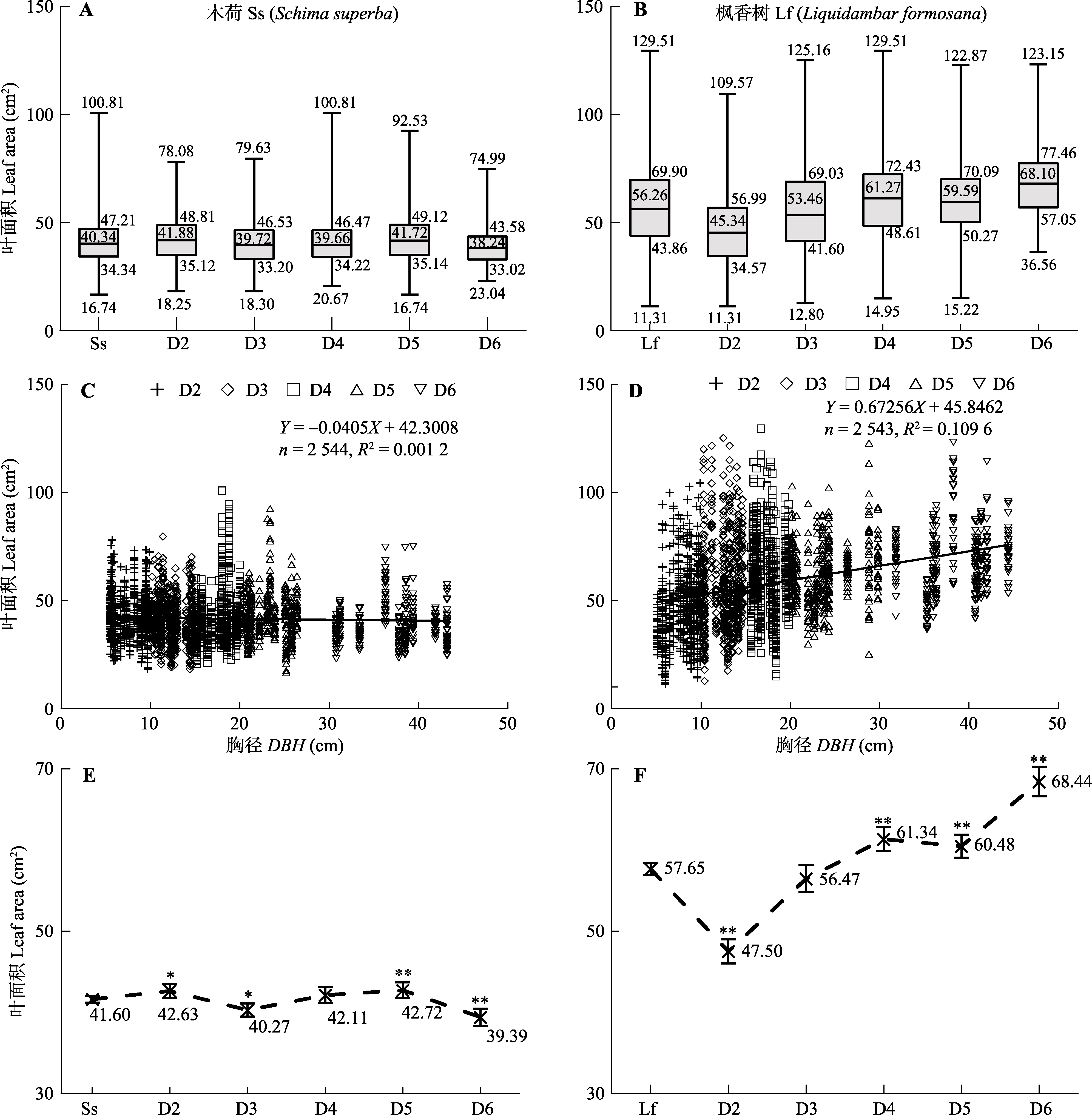
图1 两个树种叶面积与胸径的关系。A, B, 四分位图; C, D, 散点图; E, F, 置信区间图。Ss, Lf, 木荷与枫香树所有胸径等级样品的平均值。D2-D6, 胸径等级D2-D6。*, p < 0.05; **, p < 0.01。
Fig. 1 Relationship between leaf area and diameter at breast height of two tree species. A, B, Quartile map; C, D, Scatter plot; E, F, Confidence interval. Ss, Lf, mean values of all samples in all classes of diameter at breast height for Schima superba and Liquidambar formosana, respectively. D2-D6, D2-D6 classes of diameter at breast height. *, p < 0.05; **, p < 0.01.
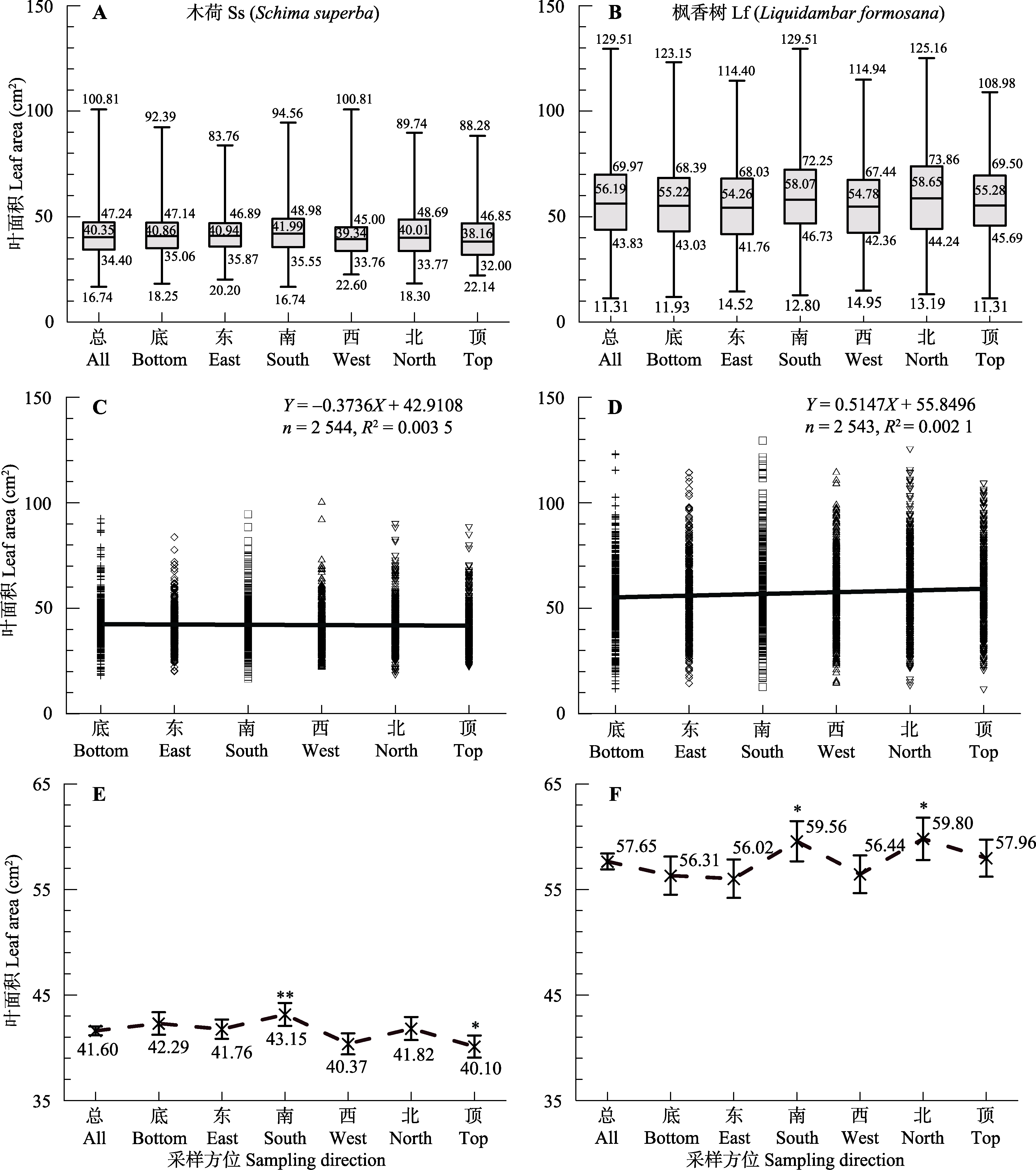
图2 两个树种叶面积与采样方位的关系。A, B, 四分位图; C, D, 散点图; E, F, 置信区间图。*, p < 0.05; **, p < 0.01。
Fig. 2 Relationship between leaf area and sampling direction of two tree species. A, B, Quartile map; C, D, Scatter plot; E, F, Confidence interval. *, p < 0.05; **, p < 0.01.
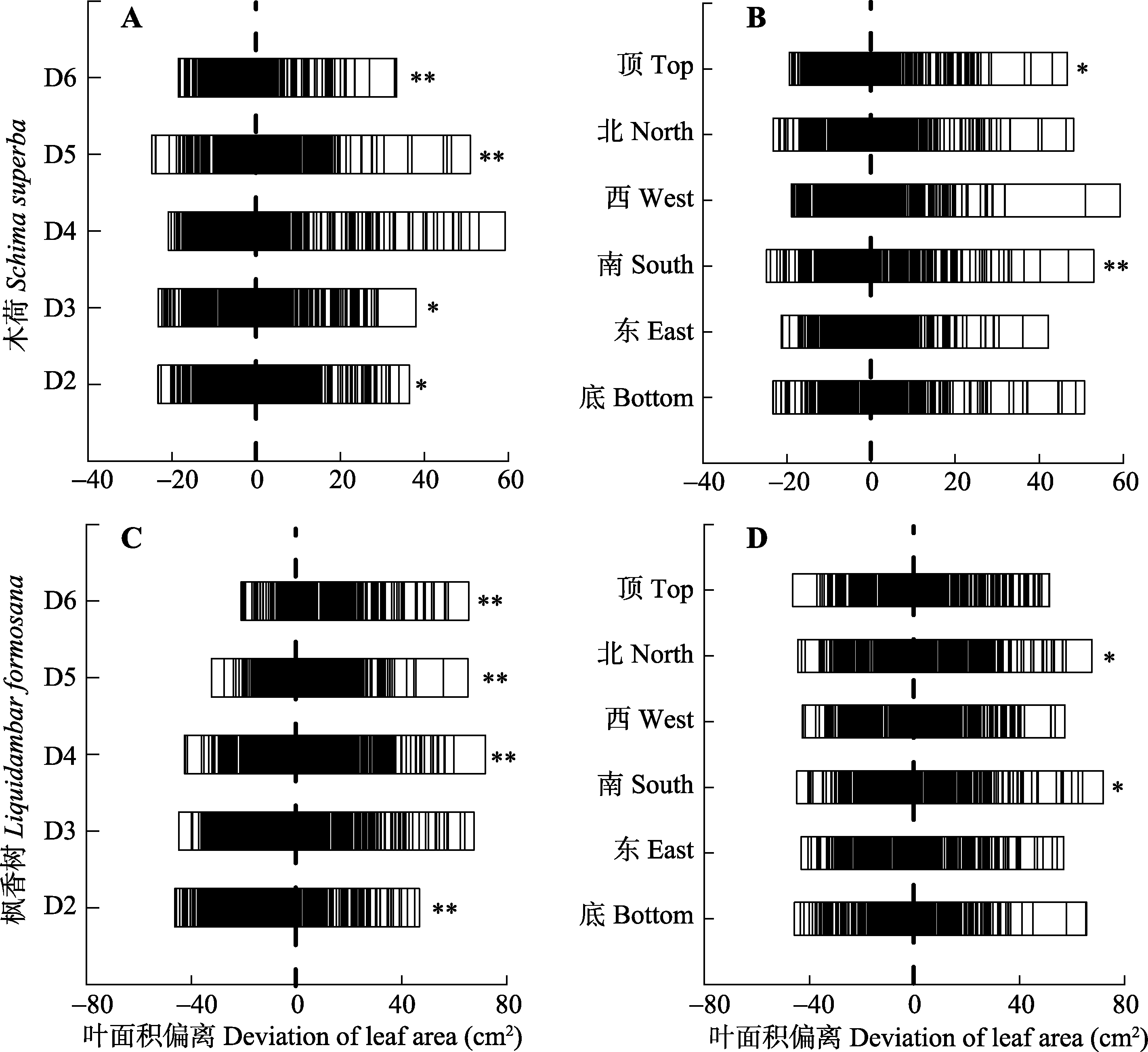
图3 两个树种叶面积在胸径与采样方位的偏离。A, 木荷胸径。B, 木荷采样方位。C, 枫香树胸径。D, 枫香树采样方位。*, p < 0.05; **, p < 0.01。竖线表示归零后的均值。
Fig. 3 Deviation of leaf area to diameter and sampling direction of two tree species. A, Diameter of Ss; B, Sampling direction of Ss; C, Diameter of Lf; D, Sampling direction of Lf. *, p < 0.05; **, p < 0.01. The vertical line indicates the mean value returning to zero.
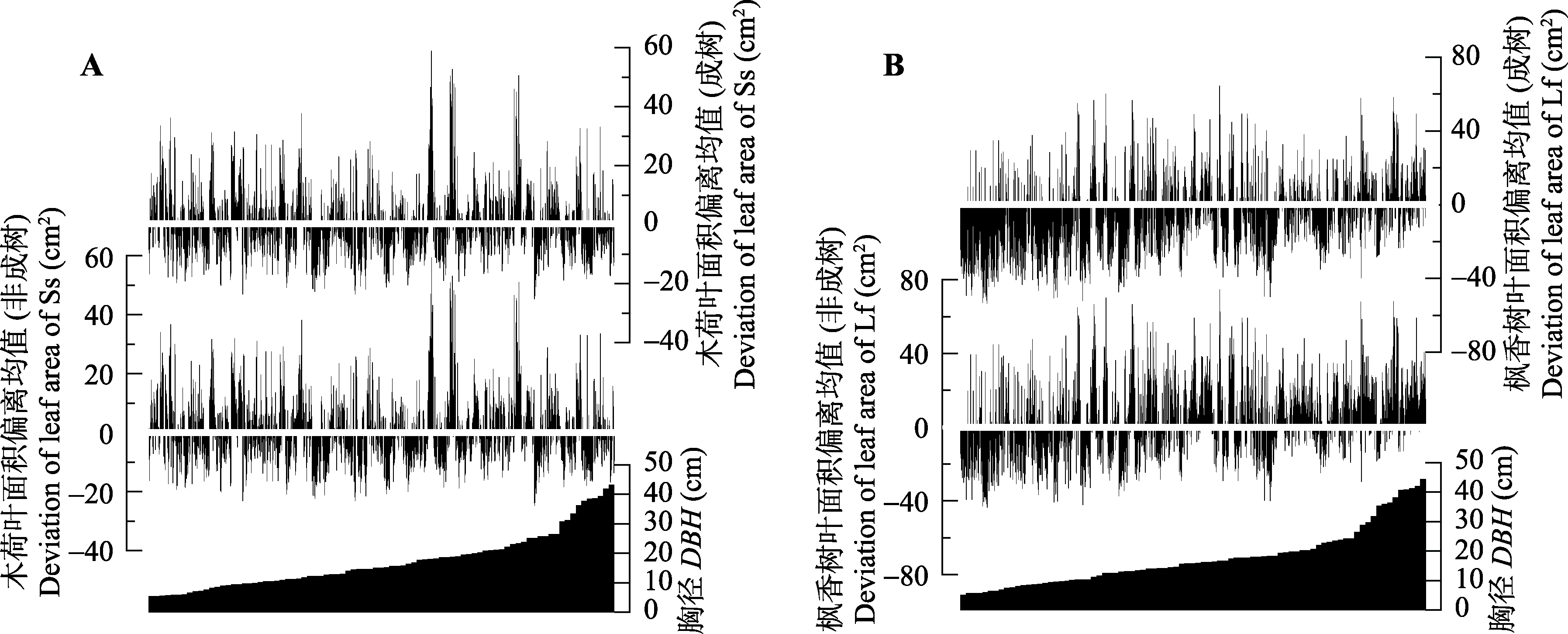
图4 两个树种成树与非成树叶面积在胸径上的偏离。A, 木荷。B, 枫香树。横线表示归零后的均值。
Fig. 4 Deviation of mature and non-mature leaf areas to diameter at breast height (DBH) of two tree species. A, Schima superba (Ss). B, Liquidambar formosana (Lf). The horizontal line indicates the mean value returning to zero.
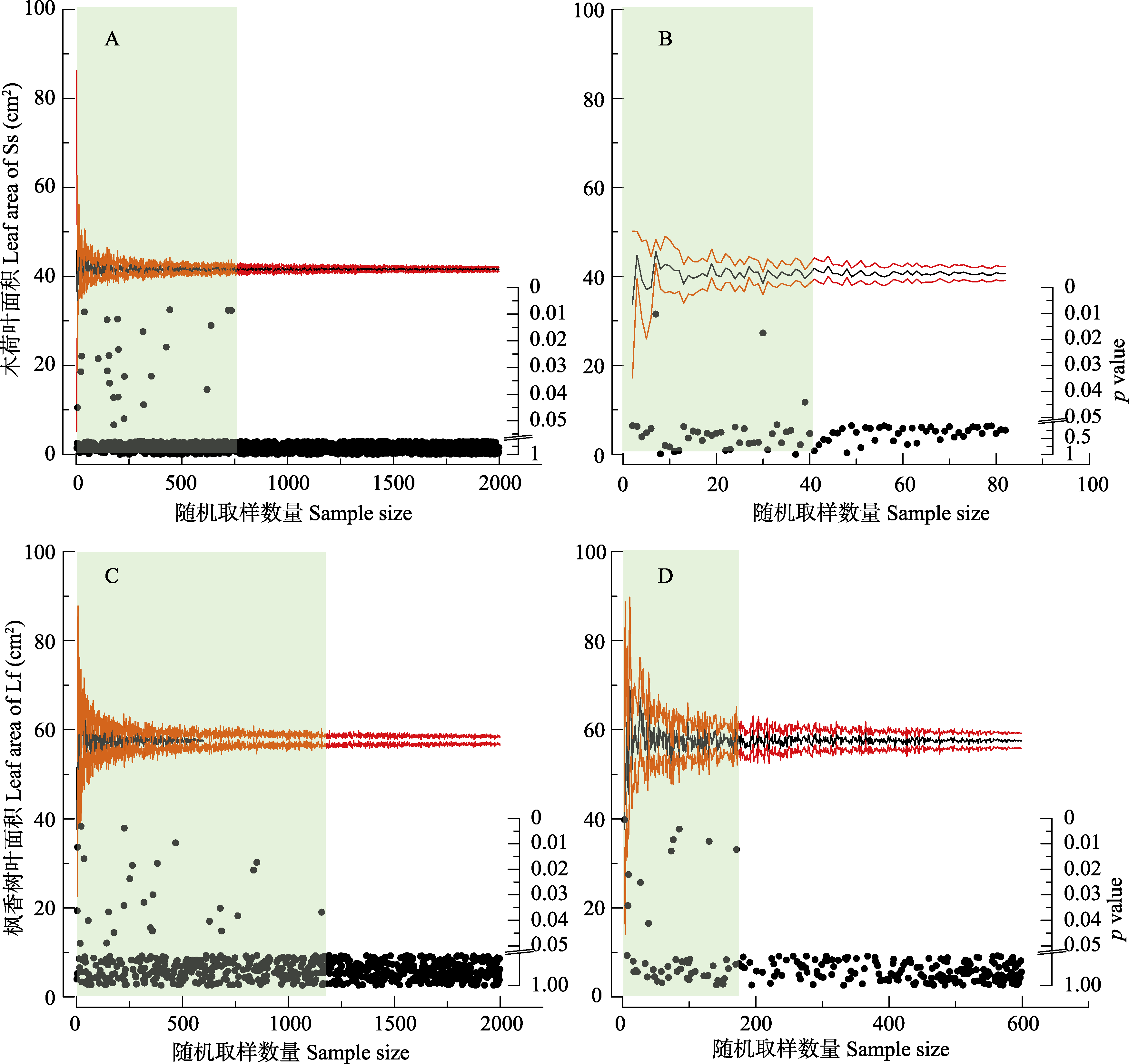
图5 两个树种叶面积的随机抽样均值和95%置信区间及其差异性检验。A, C, 全部叶片样品。B, D, 中等胸径等级、底部叶片样品。叶面积图上的黑色线代表随机抽样均值, 红色线代表95%置信区间; 淡蓝色区块表示差异性检验显著区域, 亦即该区块最右侧的取样数量即为叶片最适取样数量。
Fig. 5 Mean of random sampling, 95% confidence interval and significant test of leaf areas of two tree species. A, C, All leaf samples. B, D, Leaf samples of medium diameter class and bottom sampling direction. The black line of the leaf area plot indicates the mean value of random sampling, and the red line indicates the 95% confidence interval; the light blue block is the area of significant difference, indicating that the sample size of the right position of the block is the optimal sampling number of leaves. Ss, Schima superba; Lf, Liquidambar formosana.
| [1] |
Aerts R ( 1995). The advantages of being evergreen. Trends in Ecology and Evolution, 10, 402-407.
DOI URL PMID |
| [2] |
Albert CH, Thuiller W, Yoccoz NG, Soudant A, Boucher F, Saccone P, Lavorel S ( 2010). Intraspecific functional variability: Extent, structure and sources of variation. Journal of Ecology, 98, 604-613.
DOI URL |
| [3] |
Auger S, Shipley B ( 2013). Inter-specific and intra-specific trait variation along short environmental gradients in an old-growth temperate forest. Journal of Vegetation Science, 24, 419-428.
DOI URL |
| [4] |
Bolnick DI, Amarasekare P, Araojo MS, Burger R, Levine JM, Novak M, Rudolf VHW, Schreiber SJ, Urban MC, Vasseur DA ( 2011). Why intraspecific trait variation matters in community ecology. Trends in Ecology and Evolution, 26, 183-192.
DOI URL PMID |
| [5] |
Bu WS, Schmid B, Liu XJ, Li Y, Hardtle W, von Oheimb G, Liang Y, Sun ZK, Huang YY, Bruelheide H, Ma KP ( 2017). Interspecific and intraspecific variation in specific root length drives aboveground biodiversity effects in young experimental forest stands. Journal of Plant Ecology, 10, 158-169.
DOI URL |
| [6] |
Chen YT, Xu ZZ ( 2014). Review on research of leaf economics spectrum. Chinese Journal of Plant Ecology, 38, 1135-1153.
DOI URL |
|
[ 陈莹婷, 许振柱 ( 2014). 植物叶经济谱的研究进展. 植物生态学报, 38, 1135-1153.]
DOI URL |
|
| [7] |
Cornelissen JHC, Lavorel S, Garnier E, Diaz S, Buchmann N, Gurvich DE, Reich PB, Ter Steege H, Morgan HD, van der Heijden MGA, Pausas JG, Poorter H ( 2003). A handbook of protocols for standardized and easy measurement of plant functional traits worldwide. Australian Journal of Botany, 51, 335-380.
DOI URL |
| [8] |
Díaz S, Kattge J, Cornelissen JHC, Wright IJ, Lavorel S, Dray S, Reu B, Kleyer M, Wirth C, Prentice IC, Garnier E, Boenisch G, Westoby M, Poorter H, Reich PB, Moles AT, Dickie J, Gillison AN, Zanne AE, Chave J, Wright SJ, Sheremet’ev S, Jactel H, Baraloto C, Cerabolini B, Pierce S, Shipley B, Kirkup D, Casanoves F, Joswig J, Günther A, Falczuk V, Rüger N, Mahecha MD, Gorné LD ( 2016). The global spectrum of plant form and function. Nature, 529, 167-171.
DOI URL PMID |
| [9] |
Donovan LA, Maherali H, Caruso CM, Huber H, de Kroon H ( 2011). The evolution of the worldwide leaf economics spectrum. Trends in Ecology and Evolution, 26, 88-95.
DOI URL PMID |
| [10] |
Fang F, Guo SL ( 2004). DCA ordination on woody plant communities in Beishan Mountain of Jinhua, Zhejiang Province. Journal of Zhejiang Normal University (Natural Science), 27(1), 55-61.
DOI URL |
|
[ 方芳, 郭水良 ( 2004). 浙江金华北山木本植物群落的DCA排序. 浙江师范大学学报(自然科学版), 27(1), 55-61.]
DOI URL |
|
| [11] | Givnish TJ ( 2002). Adaptive significance of evergreen vs. deciduous leaves: Solving the triple paradox. Silva Fennica, 36, 703-743. |
| [12] | Guo SL, Liu P, Chen G, Lu X ( 1993). Observations on the floristic and vegetation in Beishan Mountain of Jinhua in Zhejiang Province. Journal of Zhejiang Normal University (Natural Science), 16(2), 59-67. |
| [ 郭水良, 刘鹏, 陈刚, 卢晓 ( 1993). 浙江金华北山植物区系及植被. 浙江师范大学学报(自然科学版), 16(2), 59-67.] | |
| [13] | Li MC, Zhu JJ, Sun YR ( 2009). Responses of specific leaf area of dominant tree species in Northeast China secondary forests to light intensity. Chinese Journal of Ecology, 28, 1437-1442. |
| [ 李明财, 朱教君, 孙一荣 ( 2009). 东北次生林主要树种比叶面积对光照强度的响应. 生态学杂志, 28, 1437-1442.] | |
| [14] |
Liu XJ, Ma KP ( 2015). Plant functional traits—Concepts, applications and future directions. Scientia Sinica Vitae, 45, 325-339.
DOI URL |
|
[ 刘晓娟, 马克平 ( 2015). 植物功能性状研究进展. 中国科学: 生命科学, 45, 325-339.]
DOI URL |
|
| [15] |
McDonald PG, Fonseca CR, Overton J, Westoby M ( 2003). Leaf-size divergence along rainfall and soil-nutrient gradients: Is the method of size reduction common among clades? Functional Ecology, 17, 50-57.
DOI URL |
| [16] |
Meng TT, Ni J, Wang GH ( 2007). Plant functional traits, environments and ecosystem functioning. Journal of Plant Ecology (Chinese Version), 31, 150-165.
DOI URL |
|
[ 孟婷婷, 倪健, 王国宏 ( 2007). 植物功能性状与环境和生态系统功能. 植物生态学报, 31, 150-165.]
DOI URL |
|
| [17] |
Messier J, Lechowicz MJ, McGill BJ, Violle C, Enquist BJ ( 2017). Interspecific integration of trait dimensions at local scales: The plant phenotype as an integrated network. Journal of Ecology, 105, 1775-1790.
DOI URL |
| [18] |
Peppe DJ, Royer DL, Cariglino B, Oliver SY, Newman S, Leight E, Enikolopov G, Fernandez-Burgos M, Herrera F, Adams JM, Correa E, Currano ED, Erickson JM, Hinojosa LF, Hoganson JW, Iglesias A, Jaramillo CA, Johnson KR, Jordan GJ, Kraft NJ, Lovelock EC, Lusk CH, Niinemets U, Pe?uelas J, Rapson G, Wing SL, Wright IJ ( 2011). Sensitivity of leaf size and shape to climate: Global patterns and paleoclimatic applications. New Phytologist, 190, 724-739.
DOI URL PMID |
| [19] |
Pérez-Harguindeguy N, Diaz S, Garnier E, Lavorel S, Poorter H, Jaureguiberry P, Bret-Harte MS, Cornwell WK, Craine JM, Gurvich DE, Urcelay C, Veneklaas EJ, Reich PB, Poorter L, Wright IJ, Ray P, Enrico L, Pausas JG, de Vos AC, Buchmann N, Funes G, Quétier F, Hodgson JG, Thompson K, Morgan HD, ter Steege H, van der Heijden MG A, Sack L, Blonder B, Poschlod P, Vaieretti MV, Conti G, Staver AC, Aquino S, Cornelissen JHC ( 2013). New handbook for standardised measurement of plant functional traits worldwide. Australian Journal of Botany, 61, 167-234.
DOI URL |
| [20] | Royer DL, McElwain JC, Adams JM, Wilf P ( 2008). Sensitivity of leaf size and shape to climate within Acer rubrum and Quercus kelloggii. New Phytologist, 179, 808-817. |
| [21] |
Siefert A, Violle C, Chalmandrier L, Albert CH, Taudiere A, Fajardo A, Aarssen LW, Baraloto C, Carlucci MB, Cianciaruso MV, Dantas VD, DeBello F, Duarte LDS, Fonseca CR, Freschet GT, Gaucherand S, Gross N, Hikosaka K, Jackson B, Jung V, Kamiyama C, Katabuchui M, Kembel SW, Kichenin E, Kraft NJB, Lagerstrom A, Le Bagousse-Pinguer Y, Li YZ, Mason N, Messier J, Nakashizuka T, Overton JM, Peltzer DA, Perez-Ramos IM, Pillar VD, Prentice HC, Richardson S, Sasaki T, Schamp BS, Vandewalle M, Wardle DA ( 2015). A global meta-analysis of the relative extent of intraspecific trait variation in plant communities. Ecology Letters, 18, 1406-1419.
DOI URL PMID |
| [22] |
Violle C, Enquist BJ, McGill BJ, Jiang L, Albert CH, Huishof C, Jung V, Messier J ( 2012). The return of the variance: Intraspecific variability in community ecology. Trends in Ecology and Evolution, 27, 244-252.
DOI URL |
| [23] |
Wang CS, Wang SP ( 2015). A review of research on responses of leaf traits to climate change. Chinese Journal of Plant Ecology, 39, 206-216.
DOI URL |
|
[ 王常顺, 汪诗平 ( 2015). 植物叶片性状对气候变化的响应研究进展. 植物生态学报, 39, 206-216.]
DOI URL |
|
| [24] |
Westoby M, Falster DS, Moles AT, Vesk PA, Wright IJ ( 2002). Plant ecological strategies: Some leading dimensions of variation between species. Annual Review of Ecology and Systematics, 33, 125-159.
DOI URL |
| [25] |
Wright IJ, Reich PB, Westoby M, Ackerly DD, Baruch Z, Bongers F, Cavender-Bares J, Chapin T, Cornelissen JHC, Diemer M, Flexas J, Garnier E, Groom PK, Gulias J, Hikosaka K, Lamont BB, Lee T, Lee W, Lusk C, Midgley JJ, Navas ML, Niinemets U, Oleksyn J, Osada N, Poorter H, Poot P, Prior L, Pyankov VI, Roumet C, Thomas SC, Tjoelker MG, Veneklaas EJ, Villar R ( 2004). The worldwide leaf economics spectrum. Nature, 428, 821-827.
DOI URL |
| [1] | 段建林, 孟晟, 陈仁利, 熊林峰, 卢春洋, 席念勋. 全球变化因子多样性对菌根植物性状的影响[J]. , 2026, 50(预发表): 0-. |
| [2] | 郑子仪, 陈江慧, 刘慧颖. 气候变暖提高青藏高原高寒草甸优势物种的根系分泌速率[J]. 植物生态学报, 2025, 49(9): 1363-1373. |
| [3] | 赵常明, 熊高明, 申国珍, 葛结林, 徐文婷, 徐凯, 武元帅, 谢宗强. 2010年神农架常绿落叶阔叶混交林和亚高山针叶林长期监测样地植物物种组成和群落特征数据集[J]. 植物生态学报, 2025, 49(8): 1215-1228. |
| [4] | 崔冬晴, 田晨, 宋慧敏, 鲁小名, 萨其日, 徐国庆, 杨培志, 白永飞, 田建卿. 典型草原优势植物根际细菌群落多样性和功能群组成对长期放牧的响应机制[J]. 植物生态学报, 2025, 49(7): 1163-1176. |
| [5] | 杜英杰, 范爱连, 王雪, 闫晓俊, 陈廷廷, 贾林巧, 姜琦, 陈光水. 亚热带天然常绿阔叶林乔木树种与林下灌木树种根-叶功能性状协调性及差异[J]. 植物生态学报, 2025, 49(4): 585-595. |
| [6] | 张晓婷, 王俊杰. 盐和铜处理下红树植物叶绿素荧光特性变化与叶片结构及生化组分关系[J]. 植物生态学报, 2025, 49(11): 1944-1956. |
| [7] | 童金莲, 张博纳, 汤璐瑶, 叶琳峰, 李姝雯, 谢江波, 李彦, 王忠媛. C4植物狗尾草功能性状网络沿降水梯度带的区域分异规律[J]. 植物生态学报, 2025, 49(11): 1817-1832. |
| [8] | 秦嘉晨, 王欢, 朱江, 王扬, 田晨, 白永飞, 杨培志, 郑淑霞. 基于种内与种间性状变异的放牧过滤作用及其尺度效应[J]. 植物生态学报, 2024, 48(7): 858-871. |
| [9] | 付粱晨, 丁宗巨, 唐茂, 曾辉, 朱彪. 北京东灵山白桦和蒙古栎的根际效应及其季节动态[J]. 植物生态学报, 2024, 48(4): 508-522. |
| [10] | 王思琦, 金光泽. 五角槭不同生活史阶段叶枝根性状的变异与权衡[J]. 植物生态学报, 2024, 48(11): 1510-1523. |
| [11] | 胡楚婷, 杨柳依依, 石绍林, 周琰, 陈婷婷, 郑博瀚, 杨暘, 卢小玲, 王陈玲, 倪健. 浙江金华典型人工植被的植物功能性状[J]. 植物生态学报, 2024, 48(10): 1336-1350. |
| [12] | 汤璐瑶, 方菁, 钱海蓉, 张博纳, 上官方京, 叶琳峰, 李姝雯, 童金莲, 谢江波. 落羽杉和池杉功能性状随高度的变异与协同[J]. 植物生态学报, 2023, 47(11): 1561-1575. |
| [13] | 王广亚, 陈柄华, 黄雨晨, 金光泽, 刘志理. 着生位置对水曲柳小叶性状变异及性状间相关性的影响[J]. 植物生态学报, 2022, 46(6): 712-721. |
| [14] | 张义, 程杰, 苏纪帅, 程积民. 长期封育演替下典型草原植物群落生产力与多样性关系[J]. 植物生态学报, 2022, 46(2): 176-187. |
| [15] | 郑周涛, 张扬建. 1982-2018年青藏高原水分利用效率变化及归因分析[J]. 植物生态学报, 2022, 46(12): 1486-1496. |
| 阅读次数 | ||||||
|
全文 |
|
|||||
|
摘要 |
|
|||||
Copyright © 2026 版权所有 《植物生态学报》编辑部
地址: 北京香山南辛村20号, 邮编: 100093
Tel.: 010-62836134, 62836138; Fax: 010-82599431; E-mail: apes@ibcas.ac.cn, cjpe@ibcas.ac.cn
备案号: 京ICP备16067583号-19

