
植物生态学报 ›› 2011, Vol. 35 ›› Issue (2): 214-222.DOI: 10.3724/SP.J.1258.2011.00214 cstr: 32100.14.SP.J.1258.2011.00214
王华田1,*( ), 杨阳1, 王延平1, 姜岳忠2, 王宗芹1
收稿日期:2010-01-04
接受日期:2010-11-01
出版日期:2011-01-04
发布日期:2011-01-21
作者简介:王华田, E-mail: wanght@sdau.edu.cn
WANG Hua-Tian1,*(), YANG Yang1, WANG Yan-Ping1, JIANG Yue-Zhong2, WANG Zong-Qin1
Received:2010-01-04
Accepted:2010-11-01
Online:2011-01-04
Published:2011-01-21
摘要:
连作杨树人工林地力衰退可能与土壤中累积的酚酸存在密切的关系。土壤氮素供应是决定杨树生长发育的重要因素, 而硝态氮是土壤无机氮化合物的主要形式之一。研究酚酸作用下杨树对硝态氮的吸收利用对于揭示酚酸化感机理、明确林地改良的途径和方法具有重要意义。以欧美杨‘I-107’ (Populus × euramericana ‘Neva’)水培苗为试验材料, 采用改良Hoagland营养液培养, 以二代杨树连作人工林土壤酚酸的实际含量为参照浓度(X), 设置5个酚酸浓度水平(0, 0.5X, 1.0X, 1.5X, 2.0X), 分析不同浓度酚酸混合物对杨树硝态氮吸收利用的影响。分别在酚酸处理后第1、5、10、20、30和40天测定分析与硝态氮吸收利用密切相关的生理特性。试验结果表明: 酚酸处理导致根系伤害度明显提高, 根系活力受到酚酸物质的明显抑制, 处理后第40天各处理间表现出显著差异(p < 0.05); 48 h动态测定发现酚酸物质对硝态氮的吸收存在显著的抑制作用(p < 0.05); 处理后第40天, 低浓度酚酸(0.5X, 1.0X)导致硝态氮在植株体内发生积累, 而高浓度酚酸(1.5X, 2.0X)导致植株硝态氮含量下降; 酚酸物质明显抑制植株硝酸还原酶活性, 处理后第40天各处理间表现出显著差异(p < 0.05), 酚酸物质处理后期则引起亚硝态氮含量的升高。酚酸浓度与处理时间对杨树水培苗硝态氮的生理效应关系可以用多元线性模型描述。
王华田, 杨阳, 王延平, 姜岳忠, 王宗芹. 外源酚酸对欧美杨‘I-107’水培幼苗硝态氮吸收利用的影响. 植物生态学报, 2011, 35(2): 214-222. DOI: 10.3724/SP.J.1258.2011.00214
WANG Hua-Tian, YANG Yang, WANG Yan-Ping, JIANG Yue-Zhong, WANG Zong-Qin. Effects of exogenous phenolic acids on nitrate absorption and utilization of hydroponic cuttings of Populus × euramericana ‘Neva’. Chinese Journal of Plant Ecology, 2011, 35(2): 214-222. DOI: 10.3724/SP.J.1258.2011.00214
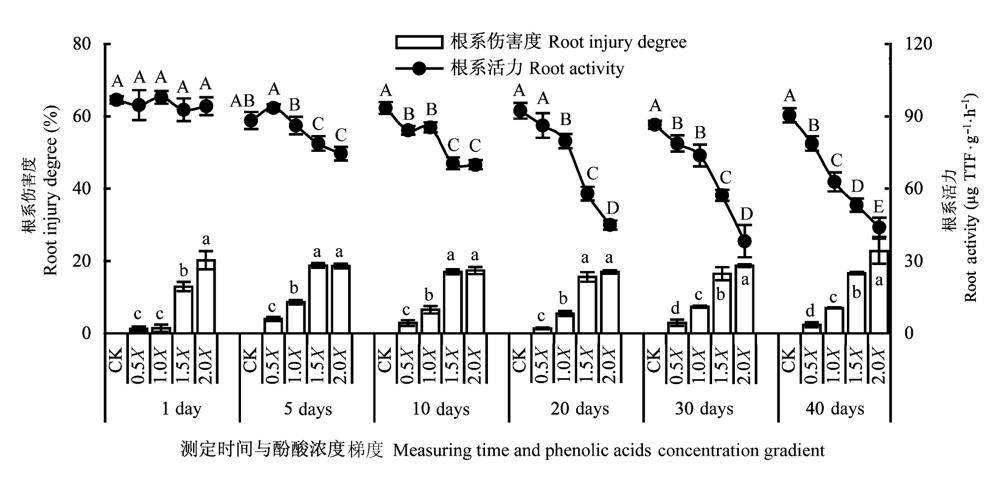
图1 外源酚酸影响下杨树水培幼苗根系伤害度与根系活力的动态变化(平均值±标准误差)。按照Duncan多重极差检验, 标记不同字母的均值间存在显著差异(p < 0.05)。X, 二代杨树连作人工林土壤酚酸含量。
Fig. 1 Dynamic changes of root injury degree and root activity of poplar hydroponic cuttings under effect of exogenous phenolic acids (mean ± SE). Means marked with different letters are significantly different according to Duncan’s multiple range tests (p < 0.05). X, phenolic acids content in the soil of a second-generation poplar plantation.
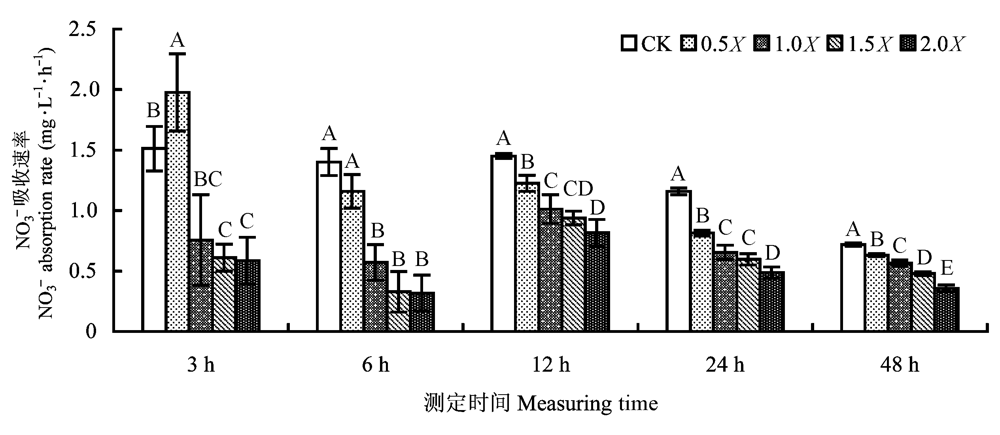
图2 外源酚酸影响下杨树水培幼苗硝态氮吸收速率的动态变化(平均值±标准误差)。标记不同字母的均值间存在显著差异 (p < 0.05)。X, 二代杨树连作人工林土壤酚酸含量。
Fig. 2 Dynamic absorption of nitrate nitrogen of poplar hydroponic cuttings under effect of exogenous phenolic acids (mean ± SE). Means marked with different letters are significantly different according to Duncan’s multiple range tests (p < 0.05). X, phenolic acids content in the soil of a second-generation poplar plantation.
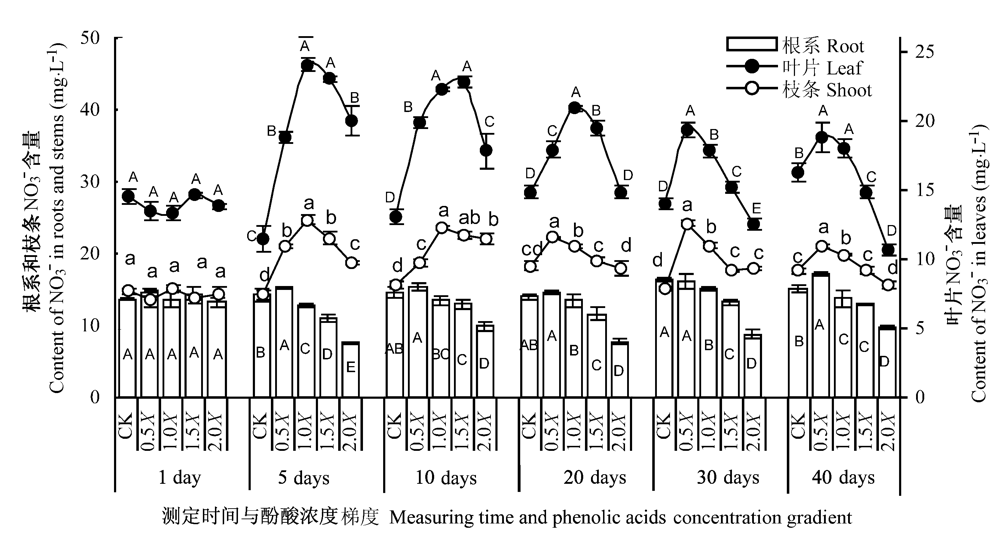
图3 外源酚酸影响下杨树水培幼苗体内硝态氮含量的动态变化(平均值±标准误差)。标记不同字母的均值间存在显著差异 (p < 0.05)。X, 二代杨树连作人工林土壤酚酸含量。
Fig. 3 Dynamic content of nitrate nitrogen of poplar hydroponic cuttings under effect of exogenous phenolic acids (mean ± SE). Means marked with different letters are significantly different according to Duncan’s multiple range tests (p < 0.05). X, phenolic acids content in the soil of a second-generation poplar plantation.
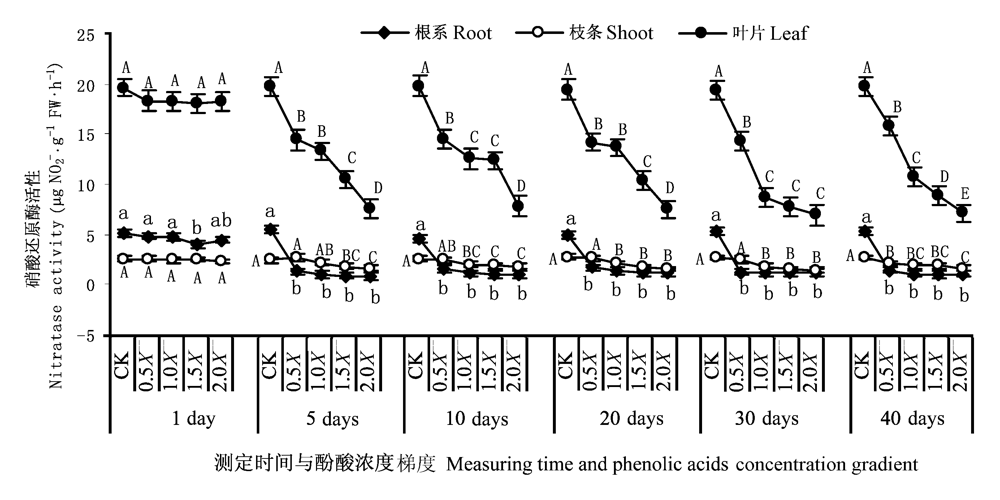
图4 外源酚酸影响下杨树水培幼苗体内硝酸还原酶活性动态变化(平均值±标准误差)。标记不同字母的均值间存在显著差异 (p < 0.05)。X, 二代杨树连作人工林土壤酚酸含量。
Fig. 4 Dynamic changes of nitratase activity of poplar hydroponic cuttings under effect of exogenous phenolic acids (mean ± SE). Means marked with different letters are significantly different according to Duncan’s multiple range tests (p < 0.05). X, phenolic acids content in the soil of a second-generation poplar plantation.
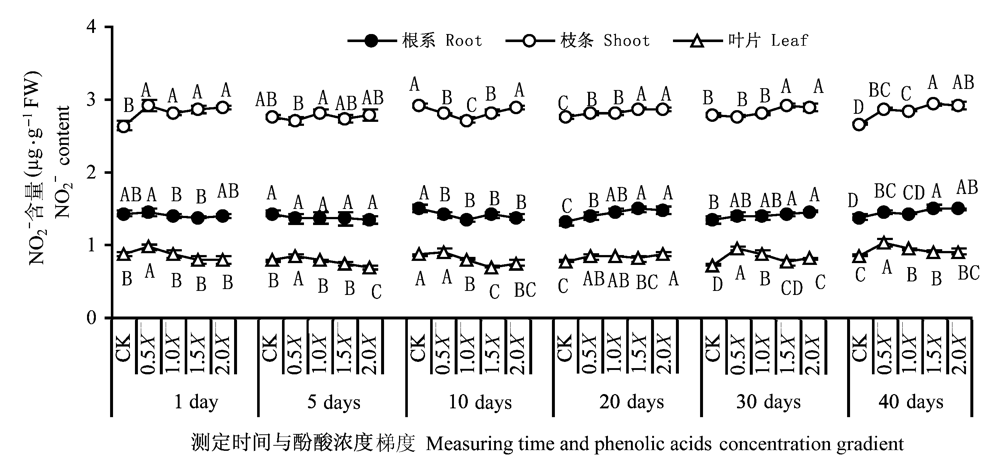
图5 外源酚酸影响下杨树水培幼苗体内亚硝态氮含量的动态变化(平均值±标准误差)。标记不同字母的均值间存在显著差异 (p < 0.05)。X, 二代杨树连作人工林土壤酚酸含量。
Fig. 5 Dynamic content of trite nitrogen of poplar hydroponic cuttings under effect of exogenous phenolic acids (mean ± SE). Means marked with different letters are significantly different according to Duncan’s multiple range tests (p < 0.05). X, phenolic acids content in the soil of a second-generation poplar plantation.
| [1] |
Attiwill PM, Adams MA (1993). Nutrient cycling in forests. New Phytologist, 124, 561-582.
DOI URL |
| [2] |
Baziramakenga R, Leroux GD, Simard RR (1995). Effects of benzoic and cinnamic acids on membrane permeability of soybean roots. Journal of Chemical Ecology, 21, 1271-1285.
DOI URL PMID |
| [3] |
Blum U, Dalton BR, Shann JR (1985). Effects of various mixtures of ferulic acid and some of its microbial metabolic products on cucumber leaf expansion and dry matter in nutrient culture. Journal of Chemical Ecology, 11, 619-641.
DOI URL PMID |
| [4] |
Blum U, Gerig TM (2005). Relationships between phenolic acid concentrations, transpiration, water utilization, leaf area expansion, and uptake of phenolic acids: nutrient culture studies. Journal of Chemical Ecology, 31, 1907-1932.
DOI URL PMID |
| [5] |
Blum U, Rebbeck J (1989). Inhibition and recovery of cucumber roots given multiple treatments of ferulic acid in nutrient culture. Journal of Chemical Ecology, 15, 917-928.
DOI URL PMID |
| [6] |
Chon SU, Choi SK, Jung S, Jang HG, Pyo BS, Kim SM (2002). Effects of alfalfa leaf extracts and phenolic allelochemicals on early seedling growth and root morphology of alfalfa and barnyard grass. Crop Protection, 21, 1077-1082.
DOI URL |
| [7] | Devi RS, Prasad MNV (1996). Ferulic acid mediated changes in oxidative enzymes of maize seedlings: implications in growth. Biologia Plantarum, 38, 387-395. |
| [8] | Einhellig FA (1985). Effects of Allelopathic Chemicals on Crop Productivity. American Chemical Society, Washington DC. 109-130. |
| [9] | Einhellig FA (1995). Mechanism of Action of Allelochemicals in Allelopathy. American Chemical Society,Washington DC. 96-116. |
| [10] |
Einhellig FA (1996). Interactions involving allelopathy in cropping systems. Agronomy Journal, 88, 886-893.
DOI URL |
| [11] |
Glass ADM, Dunlop J (1974). Influence of phenolic acids on ion uptake. IV. Depolarization of membrane potentials. Plant Physiology, 54, 855-858.
DOI URL PMID |
| [12] | He HQ (何华勤), Lin WX (林文雄) (2001). Studies on allelopathic physiobiochemical characteristics of rice. Chinese Journal of Eco-Agriculture (中国生态农业学报), 9(3), 56-57. (in Chinese with English abstract) |
| [13] |
Holappa LD, Blum U (1991). Effects of exogenously applied ferulic acid, a potential allelopathic compound, on leaf growth, water utilization, and endogenous abscisic acid levels of tomato, cucumber, and bean. Journal of Chemical Ecology, 17, 865-886.
DOI URL PMID |
| [14] |
Inderjit, Dakshini KMM (1995). On laboratory bioassays in allelopathy. Botanical Review, 61, 28-44.
DOI URL |
| [15] | Kong CH (孔垂华), Xu T (徐涛), Hu F (胡飞), Huang SS (黄寿山) (2000). Allelopathy under environmental stress and its induced mechanism. Acta Ecologica Sinica (生态学报), 20, 849-854. (in Chinese with English abstract) |
| [16] | Kong XS (孔祥生), Yi XF (易现峰) (2008). Plant Physiological Experimental Techniques (植物生理学实验技术). China Agriculture Press, Beijing. (in Chinese) |
| [17] |
Lehman ME, Blum U (1999). Evaluation of ferulic acid uptake a same asurement of allelochemical dose: effective concentration. Journal of Chemical Ecology, 25, 2585-2600.
DOI URL |
| [18] | Lin SZ (林思祖), Du L (杜玲), Cao GQ (曹光球) (2002). Advance and application prospects on allelopathy research in forestry. Journal of Fujian College of Forestry (福建林学院学报), 22, 184-188. (in Chinese with English abstract) |
| [19] | Liu FD (刘福德), Jiang YZ (姜岳忠), Wang HT (王华田), Kong LG (孔令刚), Wang Y (王迎) (2005). Effect of continuous cropping on poplar plantation. Journal of Soil and Water Conservation (水土保持学报), 19(2), 102-105. (in Chinese with English abstract) |
| [20] | Lü WG (吕卫光), Zhang CL (张春兰), Yuan F (袁飞), Peng Y (彭宇) (2002). Mechanism of allelochemicals inhibiting continuous cropping cucumber growth. Scientia Agricultura Sinica (中国农业科学), 35, 106-109. (in Chinese with English abstract) |
| [21] | Politycka B (1996). Peroxidase activity and lipid peroxidation in roots of cucumber seedlings influenced by derivatives of cinnamic and benzoic Acids. Acta Physiologiae Plantarum, 18, 365-370. |
| [22] | Rice EL (1984). Allelopathy 2nd edn. Academic Press, New York. 267-290. |
| [23] |
Romagni JG, Allen SN, Dayan FE (2000). Allelopathic effects of volatile cineoles on two weedy plants. Journal of Chemical Ecology, 26, 303-314.
DOI URL |
| [24] | Roshchina VV, Roshchina VD (1993). The Excretory Function of Higher Plant. Spinger-Verlag, New York. 213-215. |
| [25] |
Sang UC, Seong KC, Sunyo J (2002). Effects of alfalfa leaf extracts and phenolic allelochemicals on early seedling growth and root morphology of alfalfa and barnyard. Grass. Crop Protection, 21, 1077-1082.
DOI URL |
| [26] | Sun CL (孙翠玲), Zhu ZX (朱占学), Wang Z (王珍), Tong CR (佟超然) (1995). Study on the soil degradation of the poplar plantation and the technique to preserve and increase soil fertility. Scientia Silvae Sinicae (林业科学), 31, 506-512. (in Chinese with English abstract) |
| [27] | Tan XM (谭秀梅), Wang HT (王华田), Kong LG (孔令刚), Wang YP (王延平) (2008). Accumulation of phenolic acids in soil of a continuous cropping poplar plantation and their effects on soil microbes. Journal of Shandong University (Natural Science) (山东大学学报(理学版)), 43(1), 14-19. (in Chinese with English abstract) |
| [28] |
Tang CS, Young CC (1982). Collection and identification of allelopathic compounds from the undisturbed root system of Bigalta Limpo grass Hemarthria altissima). Plant Physiology, 69, 155-160.
DOI URL |
| [29] |
Vitousek PM, Gosz JR, Grier CC, Melillo JM, Reiners WA (1982). A comparative analysis of potential nitrification and nitrate mobility in forest ecosystems. Ecological Monographs, 52, 155-177.
DOI URL |
| [30] | Waller GR (1987). Allelochemicals: Role in Agriculture and Forestry. American Chemical Society, Washington. |
| [31] | Wu FZ (吴凤芝), Zhao FX (赵凤艳), Ma FM (马凤鸣) (2001). Phenolic acid substances and allelopathy mechanisms. Journal of Northeast Agricultural University (东北农业大学学报), 32, 313-319. (in Chinese with English abstract) |
| [32] | Wu XH (吴晓辉) (2005). Studies on the Allelopathy of Several Submerged Potamogetonaceae Species on Planktonic Algae (常见眼子菜科沉水植物对浮游藻类的化感作用研究). PhD dissertation, Institute of Hydrobiology, Chinese Academy of Sciences, Wuhan. 24-25. (in Chinese) |
| [33] |
Yu JQ, Matsui Y (1997). Effects of root exudates of cucumber ( Cucumis sativus L.) and allelochemicals on uptake by cucumber seedlings. Journal of Chemical Ecology, 23, 817-827.
DOI URL |
| [34] | Zhang SX (张淑香), Gao ZQ (高子勤) (2000). Continuous cropping obstacle and rhizospheric microecology. II. Root exudates and phenolic acids. Chinese Journal of Applied Ecology (应用生态学报), 11, 152-156. (in Chinese with English abstract) |
| [35] | Zhao SJ (赵世杰), Zou Q (邹琦), Gao HY (高辉远), Meng QW (孟庆伟) (2004). Plant Physiologic Experimental Guide (植物生理学实验指导). Chinese Agricultural Science and Technology Press, Beijing. 98-101. (in Chinese) |
| [1] | 陈欣蕊, 宋维峰, 王燚, 王浩, 孙诗瑶, 王彩江, 蔡世鹏, 任红, 何玉陶, 潘珉, 曹光秀, 严毅, 谢志勇, 王行. 滇池湖滨带典型挺水植物氮磷重吸收特征及其适应策略[J]. , 2026, 50(预发表): 0-. |
| [2] | 陈淼, 陈健, 刘顺, 许格希, 冯秋红, 史作民. 外生菌根真菌对青藏高原东缘岷江冷杉和糙皮桦氮获取的贡献及其影响因素[J]. 植物生态学报, 2026, 50(3): 731-741. |
| [3] | 魏莉, 王鹏森, 刘珊, 樊锐, 黄楠, 张建国, 其美拉姆, 苟扬, 刘沫含, 黄婷, 周冀琼. 丛枝菌根真菌对豆禾混播植物垂直生态位养分吸收的影响[J]. 植物生态学报, 2026, 50(3): 760-773. |
| [4] | 张诚航, 卫星, 吴纯泽, 王裕尧, 李浩楠. 大气还原态氮干湿沉降下水曲柳和兴安落叶松菌根化苗木生长响应[J]. 植物生态学报, 2026, 50(3): 649-659. |
| [5] | 王蓉钧, 吴福忠, 吴秋霞, 朱晶晶, 倪祥银. 不同生活型植物叶片氮重吸收效率的差异[J]. 植物生态学报, 2026, 50(2): 344-351. |
| [6] | 马腾飞, 郝杰, 刁华杰, 宁亚楠, $\boxed{\hbox{王常慧}}$, 董宽虎. 晋北农牧交错带草地土壤无机氮含量的季节变化及其对放牧强度的响应[J]. 植物生态学报, 2025, 49(6): 965-974. |
| [7] | 闫小莉, 刘贵梅, 李小玉, 江宇翔, 全小强, 王燕茹, 曲鲁平, 汤行昊. 不同氮添加水平和铵硝态氮配比环境下木荷幼苗光合及叶绿素荧光特性[J]. 植物生态学报, 2025, 49(4): 624-637. |
| [8] | 苗春, 刘靓, 朱冠男, 白宇轩, 佘维维, 秦树高, 郭焱培, 张宇清. 毛乌素沙地黑沙蒿对邻近草本植物氮吸收速率及比例的影响[J]. 植物生态学报, 2025, 49(3): 446-459. |
| [9] | 田彤彤, 尚博, 徐彦森, 袁相洋, 刘硕, 冯兆忠. 臭氧浓度升高和氮添加对杨树不同叶位和生长时期光合特性的影响[J]. 植物生态学报, 2025, 49(11): 1919-1933. |
| [10] | 全小强, 王燕茹, 李小玉, 梁海燕, 王立冬, 闫小莉. 氮添加和铵硝态氮配比对杉木幼苗光合特性及叶绿素荧光参数的影响[J]. 植物生态学报, 2024, 48(8): 1050-1064. |
| [11] | 杨尚锦, 范云翔, 章毓文, 韩巧玲, 赵玥, 段劼, 邸楠, 席本野. 树木夜间液流组分划分方法对比——以毛白杨为例[J]. 植物生态学报, 2024, 48(4): 496-507. |
| [12] | 刘倩愿, 俞振东, 张微微. 河北坝上乔灌木植物根系无机和有机氮吸收速率及其偏好[J]. 植物生态学报, 2024, 48(10): 1361-1373. |
| [13] | 张学渊, 高翠萍, 汤靖磊, 朱毅, 田磊, 韩国栋, 任海燕. 内蒙古荒漠草原土壤CH4和CO2通量在不同冻融 阶段对增温和氮添加的响应[J]. 植物生态学报, 2024, 48(10): 1291-1301. |
| [14] | 张慧玲, 张耀艺, 彭清清, 杨静, 倪祥银, 吴福忠. 中亚热带同质园不同生活型树种微量元素重吸收效率的差异[J]. 植物生态学报, 2023, 47(7): 978-987. |
| [15] | 胡昭佚, 陈天松, 赵丽, 许培轩, 吴正江, 董李勤, 张昆. 水位下降对若尔盖高寒草本沼泽木里薹草氮磷重吸收的影响[J]. 植物生态学报, 2023, 47(6): 847-855. |
| 阅读次数 | ||||||
|
全文 |
|
|||||
|
摘要 |
|
|||||
Copyright © 2026 版权所有 《植物生态学报》编辑部
地址: 北京香山南辛村20号, 邮编: 100093
Tel.: 010-62836134, 62836138; Fax: 010-82599431; E-mail: apes@ibcas.ac.cn, cjpe@ibcas.ac.cn
备案号: 京ICP备16067583号-19

