
植物生态学报 ›› 2011, Vol. 35 ›› Issue (4): 371-379.DOI: 10.3724/SP.J.1258.2011.00371 cstr: 32100.14.SP.J.1258.2011.00371
毛学刚, 范文义*( ), 李明泽, 于颖, 杨金明
收稿日期:2010-07-13
接受日期:2010-12-21
出版日期:2011-07-13
发布日期:2011-04-13
作者简介:*E-mail: fanwy@163.com
MAO Xue-Gang, FAN Wen-Yi*(), LI Ming-Ze, YU Ying, YANG Jin-Ming
Received:2010-07-13
Accepted:2010-12-21
Online:2011-07-13
Published:2011-04-13
摘要:
森林生物量碳储量的空间分布及其变化信息, 对揭示地表空间变化规律及驱动因子、分析评价森林生产力及生态功能具有重要意义。该文以20世纪70年代、80年代、90年代和21世纪初4个时期的遥感数据和同期的森林资源清查样地数据为基础, 应用遥感信息模型, 估算了黑龙江长白山地区的森林生物量, 分析了该地区森林生物量的时空动态变化, 以及森林生物量随高程、坡度和坡向的变化规律。结果表明: 该地区4个时期的森林平均生物量分别为81.56、44.27、48.27和54.82 t·hm-2。4个时期总的森林生物量分别为5.37 × 10 8、2.83 × 10 8、3.06 × 10 8和3.46 × 10 8 t。20世纪70年代到21世纪初森林平均生物量和总的森林生物量都呈现出先降低后增加的趋势, 呈先下降趋势的主要原因是20世纪70-80年代以森林采伐为主, 后增加趋势的主要原因是实施天然林保护工程起到了很大的作用。该地区4个时期森林生物量随高程、坡度和坡向都表现出一致性的变化规律, 森林生物量随高程和坡度变化都呈先增加后减少的趋势, 导致这一现象的主要原因是, 高程、坡度和坡向变化引起了局地气候条件的变化, 从而直接影响森林生长环境, 造成森林分布的变化。森林生物量在200-400 m高程所占的比例最大, 约为35%, 在坡度5°-15°所占的比例接近50%。森林生物量在南坡和西南坡所占的比例最小, 为7%; 平坡所占的比例最大, 为28%; 南坡次之, 为19%。
毛学刚, 范文义, 李明泽, 于颖, 杨金明. 黑龙江长白山森林生物量的时空变化分析. 植物生态学报, 2011, 35(4): 371-379. DOI: 10.3724/SP.J.1258.2011.00371
MAO Xue-Gang, FAN Wen-Yi, LI Ming-Ze, YU Ying, YANG Jin-Ming. Temporal and spatial analysis of forest biomass in Changbai Mountains, Heilongjiang, China. Chinese Journal of Plant Ecology, 2011, 35(4): 371-379. DOI: 10.3724/SP.J.1258.2011.00371
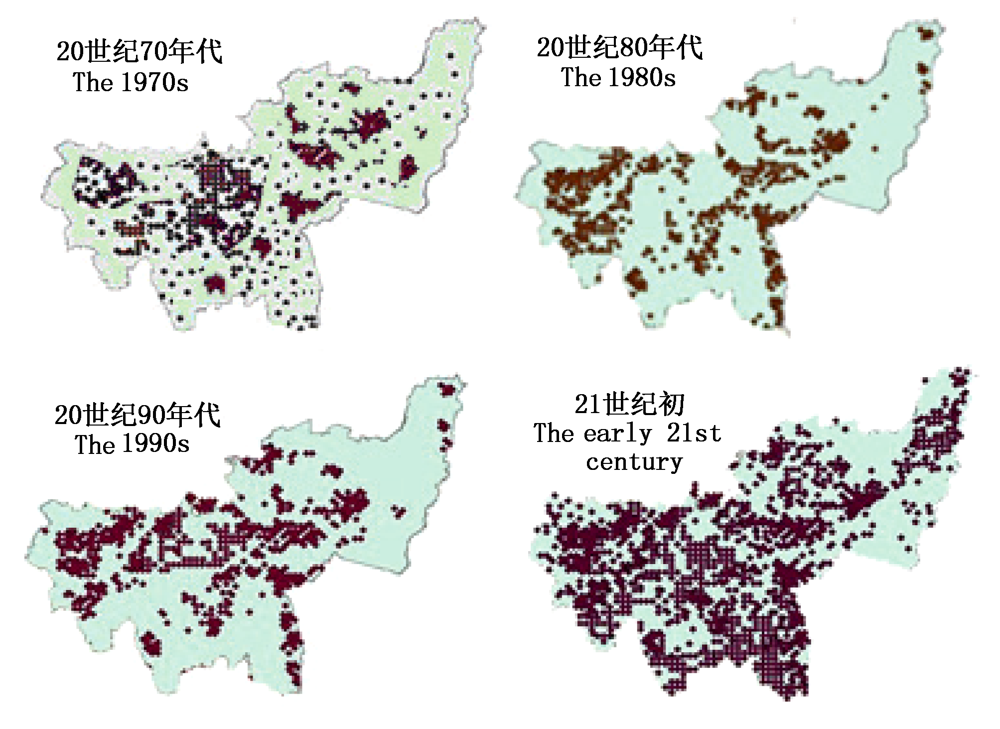
图1 20世纪70年代-21世纪初的样地分布图。
Fig. 1 Sample plot distribution from the 1970s to the early 21st century.
| 类型 Type | n | 生物量模型 Biomass model | R2 |
|---|---|---|---|
| 灌木 Shrub | 38 | bio = 0.0398 × h - 0.3326 | 0.88 |
| 草本 Herb | 79 | bio = 0.0175 × h - 0.2888 | 0.89 |
表1 灌木和草本生物量模型
Table 1 Shrub and herb biomass models
| 类型 Type | n | 生物量模型 Biomass model | R2 |
|---|---|---|---|
| 灌木 Shrub | 38 | bio = 0.0398 × h - 0.3326 | 0.88 |
| 草本 Herb | 79 | bio = 0.0175 × h - 0.2888 | 0.89 |
| 年代 Decade | 生物量模型 Biomass model | n | R2 | 预估精度 Precision |
|---|---|---|---|---|
| 20世纪70年代 The 1970s | bio = 0.1053 × gc + 0.0003408 × Y - 0.0117 × TM4-1 616.9939 | 198 | 0.73 | 69.61% |
| 20世纪80年代 The 1980s | bio = -285.5049 × TM452 + 4.4959 × SR + 0.0481 × gc + 214.7325 | 256 | 0.74 | 70.17% |
| 20世纪90年代 The 1990s | bio = 0.0046 × DVI + 0.0018 × gc - 0.0321 × TM5 + 88.5821 | 201 | 0.76 | 72.34% |
| 21世纪初 The early 21st century | bio = 0.0878 × gc - 0.0186 × TM5 + 0.000067 83 × Y + 8.9101 × TM73 + 0.04088 × TM3 + 179.1037 × TM452 - 0.0127 × TM6 - 470.0561 | 272 | 0.76 | 71.43% |
表2 生物量遥感估测模型
Table 2 Estimation models of biomass by remote sense
| 年代 Decade | 生物量模型 Biomass model | n | R2 | 预估精度 Precision |
|---|---|---|---|---|
| 20世纪70年代 The 1970s | bio = 0.1053 × gc + 0.0003408 × Y - 0.0117 × TM4-1 616.9939 | 198 | 0.73 | 69.61% |
| 20世纪80年代 The 1980s | bio = -285.5049 × TM452 + 4.4959 × SR + 0.0481 × gc + 214.7325 | 256 | 0.74 | 70.17% |
| 20世纪90年代 The 1990s | bio = 0.0046 × DVI + 0.0018 × gc - 0.0321 × TM5 + 88.5821 | 201 | 0.76 | 72.34% |
| 21世纪初 The early 21st century | bio = 0.0878 × gc - 0.0186 × TM5 + 0.000067 83 × Y + 8.9101 × TM73 + 0.04088 × TM3 + 179.1037 × TM452 - 0.0127 × TM6 - 470.0561 | 272 | 0.76 | 71.43% |
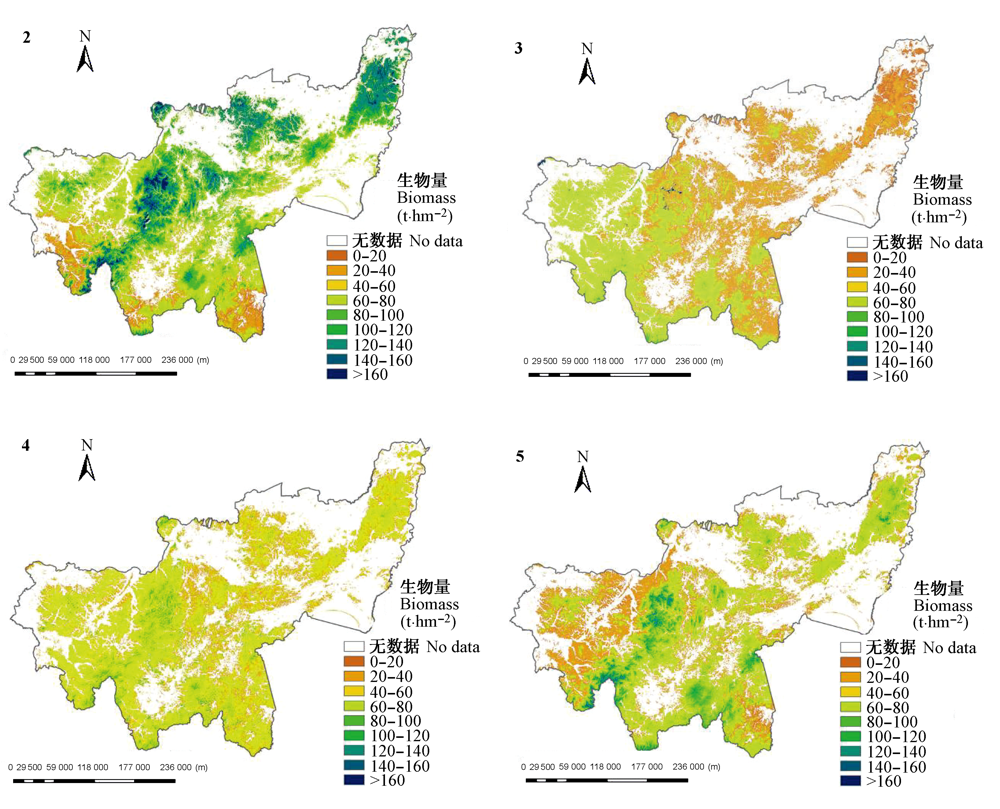
图2-5 森林生物量等级分布图。2. 20世纪70年代。3. 20世纪80年代。4. 20世纪90年代。5. 21世纪初。
Figs. 2-5 Distribution map of forest biomass ranks. 2. The 1970s. 3. The 1980s. 4. The 1990s. 5. The early 21st century.
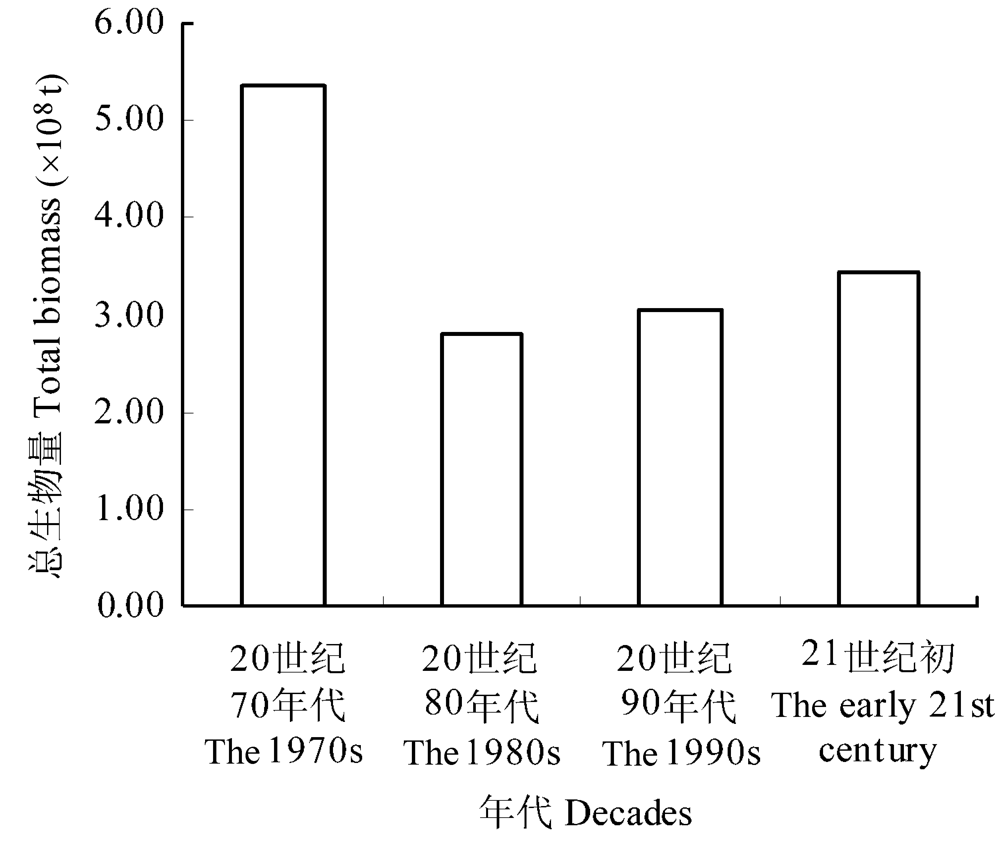
图6 20世纪70年代-21世纪初森林总生物量。
Fig. 6 Forest total biomass between the 1970s and the early 21st century.
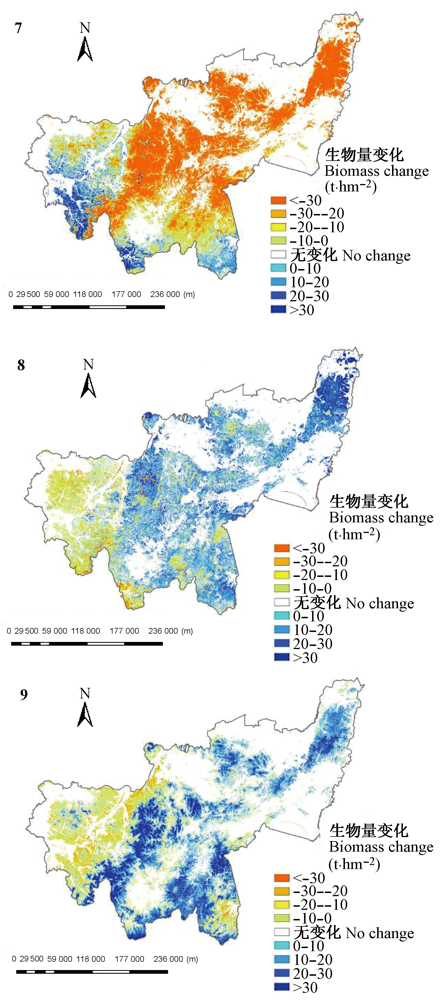
图7-9 森林生物量变化分布图。7. 20世纪70-80年代。8. 20世纪80-90年代。9. 20世纪90-21世纪初。
Figs. 7-9 Distribution map of forest biomass changes. 7. Between the 1970s and 1980s. 8. Between the 1980s and 1990s. 9. Between the 1990s and early 21st century.
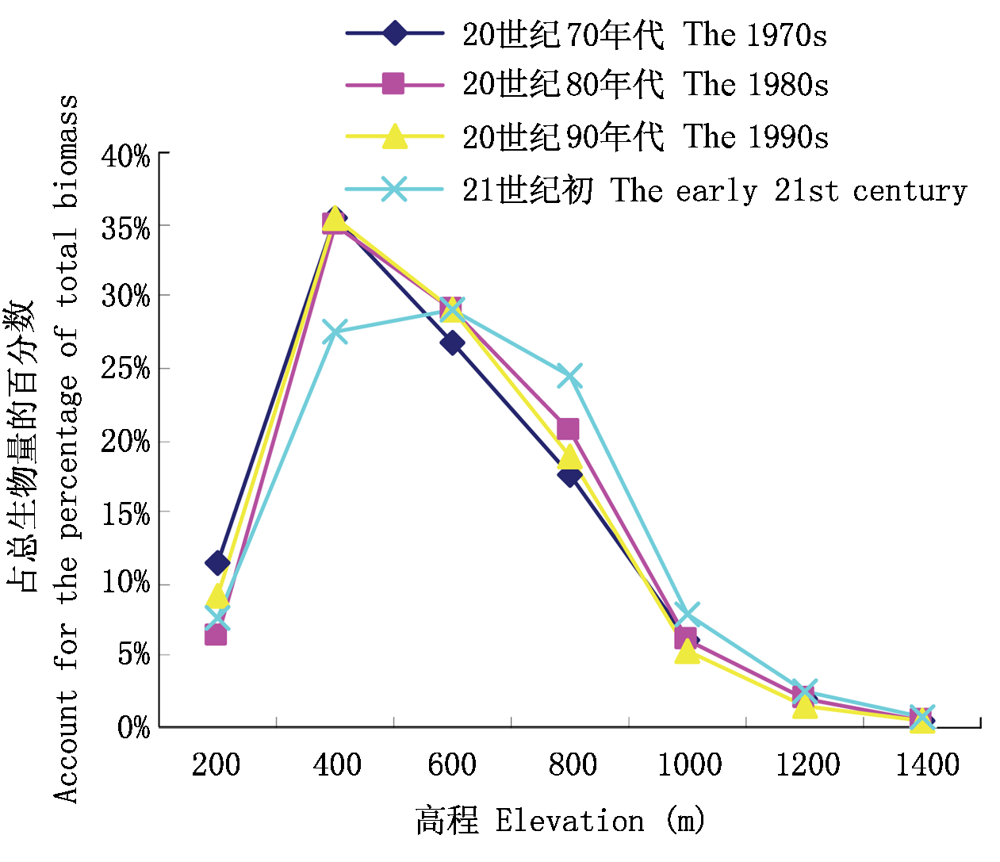
图10 森林生物量随高程的变化。
Fig. 10 Change of forest biomass with elevation.
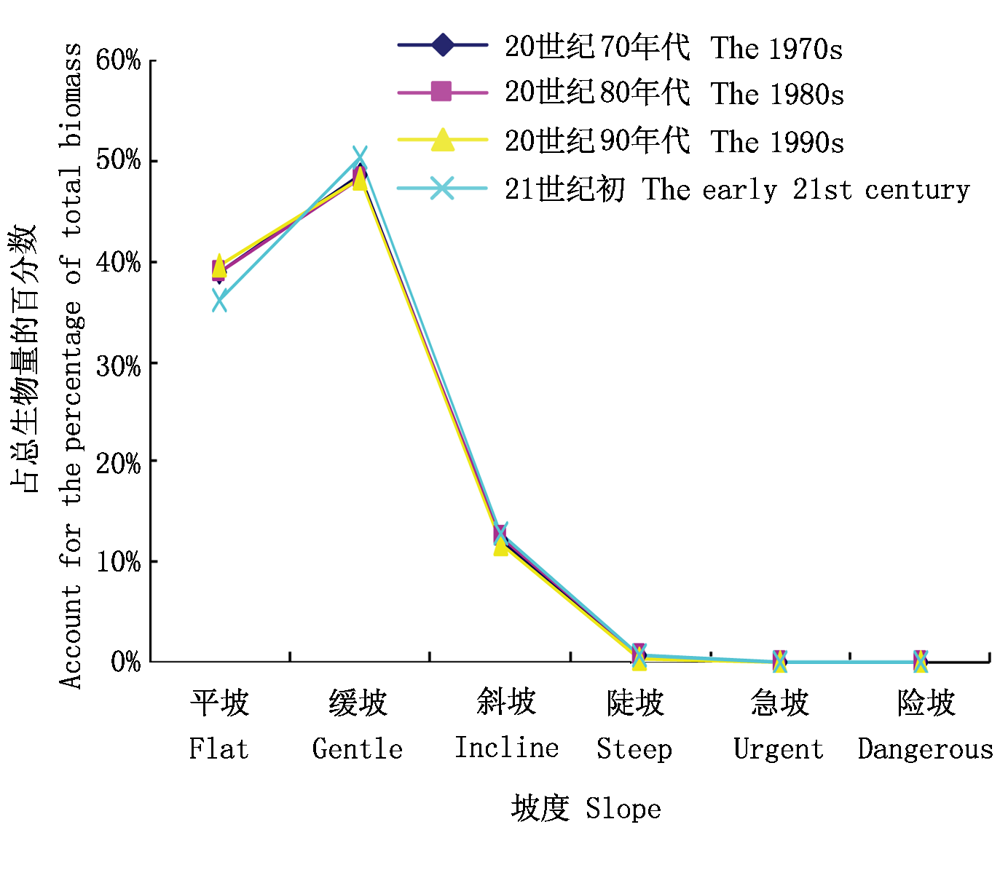
图11 森林生物量随坡度的变化。
Fig. 11 Change of forest biomass with slope.
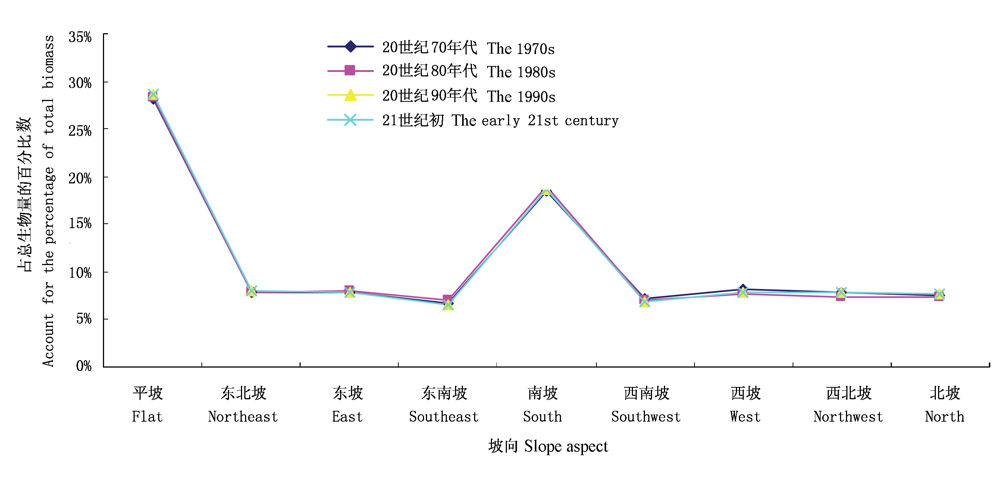
图12 森林生物量随坡向的变化。
Fig. 12 Change of forest biomass with slope aspect.
| [1] |
Alban DH, Perala DA, Schlaegel BE (1978). Biomass and nutrient distribution in aspen, pine, and spruce stands on the same soil type in Minnesota. Canadian Journal of Forest Research, 8, 290-299.
DOI URL |
| [2] |
Brown SL, Schroeder P, Kern JS (1999). Spatial distribution of biomass in forests of the eastern USA. Forest Ecology and Management, 123, 81-90.
DOI URL |
| [3] |
Dixon RK, Solomon AM, Brown S, Houghton RA, Trexier MC, Wisniewski J (1994). Carbon pools and flux of global forest ecosystems. Science, 263, 185-190.
DOI URL PMID |
| [4] | Fang JY (方精云) (2000). Forest biomass carbon pool of middle and high latitudes in North Hemisphere is probably much smaller than present estimates. Acta Phytoecologica Sinica (植物生态学报), 24, 635-638. (in Chinese with English abstract) |
| [5] | Fang JY (方精云), Chen AP (陈安平), Zhao SQ (赵淑清), Ci LJ (慈龙骏) (2002). Estimating biomass and carbon of China’s forests: supplementary notes on report published in Science (291: 2320-2322) by Fang et al. (2001). Acta Phytoecologica Sinica (植物生态学报), 26, 243-249. (in Chinese with English abstract) |
| [6] | Feng ZW (冯宗炜), Chen CY (陈楚莹), Zhang JW (张家武), Wang KP (王开平), Zhao JL (赵吉录), Gao H (高虹) (1982). Determination of biomass of Pinus massoniana stand in HUITONG county, HUNAN Province. Scientia Silvae Sinicae (林业科学), 18, 127-134. (in Chinese with English abstract) |
| [7] | Guo ZH (郭志华), Peng SL (彭少麟), Wang BS (王伯荪) (2002). Estimating forest biomass in western Guangdong using Landsat TM data. Acta Ecologica Sinica (生态学报), 22, 1833-1839. (in Chinese with English abstract) |
| [8] | Kang HN (康蕙宁), Ma QY (马钦彦), Yuan JZ (袁嘉祖) (1996). Estimation of carbon sink function of forests in China. Chinese Journal of Applied Ecology (应用生态学报), 7, 230-234. (in Chinese with English abstract) |
| [9] | Li WH (李文华), Deng KM (邓坤枚), Li F (李飞) (1981). Study on biomass and primary production of main ecosystems in Changbai Mountain. Research of Forest Ecosystem (森林生态系统研究), 2, 34-50. (in Chinese with English abstract) |
| [10] | Li KH (李凯辉), Hu YK (胡玉昆), Wang X (王鑫) (2007). Relationships between aboveground biomass and environmental factors along an altitude gradient of alpine grassland. Chinese Journal of Applied Ecology (应用生态学报), 18, 2020-2024. (in Chinese with English abstract) |
| [11] | Luo TX (罗天祥), Li WH (李文华), Leng YF (冷允法), Yue YZ (岳燕珍) (1998). Estimation of total biomass and potential distribution of net primary productivity in the Tibetan Plateau. Geographical Research (地理研究), 17, 337-344. (in Chinese with English abstract) |
| [12] | Luo TX (罗天祥), Li WH (李文华), Zhao SD (赵士洞) (1999). Productivity distribution patterns and modeling of Pinus tabulaeformis forest in China. Chinese Journal of Applied Ecology (应用生态学报), 10, 257-261. (in Chinese with English abstract) |
| [13] |
Mokany K, Raison JR, Prokushkin SA (2006). Critical analysis of root: shoot ratios in terrestrial biomes. Global Change Biology, 12, 84-96.
DOI URL |
| [14] |
Muukkonen P (2007). Generalized allometric volume and biomass equations for some tree species in Europe. European Journal of Forest Research, 126, 157-166.
DOI URL |
| [15] | Reichle DE, Franklin JF, Goodwell DE eds (1975). Productivity of World Ecosystems. National Academy of Sciences, Washington, D.C. |
| [16] | Remezon NP (1959). Method studying the biological cycles of elements in forest. Soviet Soil Science, 1, 59-67. |
| [17] | Wang XK (王效科), Feng ZW (冯宗炜), Ouyang ZY (欧阳志云) (2001). Vegetation carbon storage and density of forest ecosystems in China. Chinese Journal of Applied Ecology (应用生态学报), 12, 13-16. (in Chinese with English abstract) |
| [18] | Zhao M (赵敏), Zhou GS (周广胜) (2004). Forest inventory data (FID)-based biomass models and their prospects. Chinese Journal of Applied Ecology (应用生态学报), 15, 1468-1472. (in Chinese with English abstract) |
| [19] | Zhao M (赵敏), Zhou GS (周广胜) (2005). Modeling variation trend of boreal forest NPP in China and its relations to temperature and precipitation. Acta Botanica Boreali- Occidentalia Sinica (西北植物学报), 25, 466-471. (in Chinese with English abstract) |
| [1] | 张静, 陈洁, 李艳朋, 盘李军, 许涵, 李意德, 何海生. 南亚热带针阔混交人工林植物生物量比较及其影响因子分析[J]. 植物生态学报, 2026, 50(2): 400-416. |
| [2] | 徐恩相, 周蕾, 章晓炜, 张国萍, 仲杜伟, 黄智, 刘派, 迟永刚. 基于不同生育阶段冠层光谱和碳通量的水稻产量估算[J]. 植物生态学报, 2026, 50(1): 82-93. |
| [3] | 张法伟, 李红琴, 祝景彬, 樊博, 周华坤, 李英年, 梁乃申. 氮添加和降水改变对高寒草甸生态系统地上与地下碳储的影响[J]. 植物生态学报, 2025, 49(9): 1399-1409. |
| [4] | 邢强, 赵斌, 胡永红, 杨君, 秦俊, 刘何铭, 王红兵, 周鹏. 华东地区两种典型立体绿化植物根系性状特征及对新型土壤基质的响应[J]. 植物生态学报, 2025, 49(9): 1498-1514. |
| [5] | 宋珊珊, 唐志尧. 河北塞罕坝草甸草原根际土壤真菌与植物地上生物量的关系[J]. 植物生态学报, 2025, 49(9): 1461-1471. |
| [6] | 朱瑞德, 杨俊薇, 刘宵含, 陈冰瑞, 池秀莲, 田地, 杨光, 程蒙, 戴亚峰, 王诗文. 霍山石斛设施和林下栽培模式中养分对植物-微生物关联的调控[J]. 植物生态学报, 2025, 49(9): 1434-1447. |
| [7] | 樊月玲, 蒋正德, 叶佳舒, 郑立臣, 陈欣. 2005-2015年下辽河平原农田长期观测样地主要农作物收获期性状和产量数据集[J]. 植物生态学报, 2025, 49(8): 1271-1282. |
| [8] | 刘新月, 王立平, 刘春和, 孙艳丽, 刘鹏, 田赟, 贾昕, 查天山, 钱多. 北京不同林龄人工林生物量空间格局及其影响因素[J]. 植物生态学报, 2025, 49(6): 939-951. |
| [9] | 马腾飞, 郝杰, 刁华杰, 宁亚楠, $\boxed{\hbox{王常慧}}$, 董宽虎. 晋北农牧交错带草地土壤无机氮含量的季节变化及其对放牧强度的响应[J]. 植物生态学报, 2025, 49(6): 965-974. |
| [10] | 陈文义, 王智勇, 周梦岩, 麻文俊, 王军辉, 罗志斌, 周婧. 幼龄楸树生物量分配规律与异速生长模型[J]. 植物生态学报, 2025, 49(2): 356-366. |
| [11] | 郝毅晴, 刘伟, 杨阳, 安冰儿, 范冰, 李超, 崔久辉, 程延彬, 孙佳美, 潘庆民. 有机肥和无机肥对退化草原羊草种群密度和个体生物量的影响[J]. 植物生态学报, 2025, 49(1): 148-158. |
| [12] | 王袼, 胡姝娅, 李阳, 陈晓鹏, 李红玉, 董宽虎, 何念鹏, 王常慧. 不同类型草原土壤净氮矿化速率的温度敏感性[J]. 植物生态学报, 2024, 48(4): 523-533. |
| [13] | 梁逸娴, 王传宽, 臧妙涵, 上官虹玉, 刘逸潇, 全先奎. 落叶松径向生长和生物量分配对气候变暖的响应[J]. 植物生态学报, 2024, 48(4): 459-468. |
| [14] | 黄玲, 王榛, 马泽, 杨发林, 李岚, SEREKPAYEV Nurlan, NOGAYEV Adilbek, 侯扶江. 长期放牧和氮添加对黄土高原典型草原长芒草种群生长的影响[J]. 植物生态学报, 2024, 48(3): 317-330. |
| [15] | 耿雪琪, 唐亚坤, 王丽娜, 邓旭, 张泽凌, 周莹. 氮添加增加中国陆生植物生物量并降低其氮利用效率[J]. 植物生态学报, 2024, 48(2): 147-157. |
| 阅读次数 | ||||||
|
全文 |
|
|||||
|
摘要 |
|
|||||
Copyright © 2026 版权所有 《植物生态学报》编辑部
地址: 北京香山南辛村20号, 邮编: 100093
Tel.: 010-62836134, 62836138; Fax: 010-82599431; E-mail: apes@ibcas.ac.cn, cjpe@ibcas.ac.cn
备案号: 京ICP备16067583号-19

