
Chin J Plant Ecol ›› 2025, Vol. 49 ›› Issue (10): 1755-1766.DOI: 10.17521/cjpe.2024.0380 cstr: 32100.14.cjpe.2024.0380
• Research Articles • Previous Articles
HU Tong-Xin( ), SHI Lin, DOU Xu, YU Cheng, HAN Yu, SUN Long*(
 )
)
Received:2024-10-24
Accepted:2025-03-21
Online:2025-10-20
Published:2025-11-26
Contact:
SUN Long
Supported by:HU Tong-Xin, SHI Lin, DOU Xu, YU Cheng, HAN Yu, SUN Long. Effects of forest fires on rhizosphere and bulk soil microbial communities of Larix gmelinii[J]. Chin J Plant Ecol, 2025, 49(10): 1755-1766.
Add to citation manager EndNote|Ris|BibTeX
URL: https://www.plant-ecology.com/EN/10.17521/cjpe.2024.0380
| 处理 Treatment | 土壤有机碳含量 SOC content (g·kg-1) | 土壤全氮含量 TN content (g·kg-1) | 碳氮比 C:N | 溶解性有机碳含量 DOC content (mg·kg-1) | 溶解性无机氮含量 DIN content (mg·kg-1) |
|---|---|---|---|---|---|
| CR | 115.76 ± 5.09 | 79.31 ± 6.21 | 1.47 ± 0.16 | 92.36 ± 13.79 | 119.78 ± 39.32 |
| FR | 69.42 ± 5.07 | 38.63 ± 4.43 | 1.81 ± 0.19 | 83.24 ± 23.99 | 145.02 ± 40.31 |
| CB | 66.93 ± 6.82 | 55.38 ± 4.95 | 1.20 ± 0.13 | 88.46 ± 34.42 | 33.90 ± 11.25 |
| FB | 56.39 ± 5.17 | 33.83 ± 2.71 | 1.67 ± 0.12 | 91.04 ± 30.66 | 180.28 ± 51.56 |
| 土壤区 Soil zone1) | 367.69*** | 110.07*** | 20.53*** | 0.06ns | 5.17* |
| 处理 Treat2) | 310.79*** | 516.14*** | 81.76** | 0.18ns | 59.34*** |
| 土壤区 × 处理 Soil zone × Treat | 123.11*** | 48.72*** | 1.72ns | 0.57ns | 29.57*** |
Table 1 Impact of forest fires on the properties of rhizosphere and bulk soils of Larix gmelinii forest in Da Hinggan Ling (mean ± SD)
| 处理 Treatment | 土壤有机碳含量 SOC content (g·kg-1) | 土壤全氮含量 TN content (g·kg-1) | 碳氮比 C:N | 溶解性有机碳含量 DOC content (mg·kg-1) | 溶解性无机氮含量 DIN content (mg·kg-1) |
|---|---|---|---|---|---|
| CR | 115.76 ± 5.09 | 79.31 ± 6.21 | 1.47 ± 0.16 | 92.36 ± 13.79 | 119.78 ± 39.32 |
| FR | 69.42 ± 5.07 | 38.63 ± 4.43 | 1.81 ± 0.19 | 83.24 ± 23.99 | 145.02 ± 40.31 |
| CB | 66.93 ± 6.82 | 55.38 ± 4.95 | 1.20 ± 0.13 | 88.46 ± 34.42 | 33.90 ± 11.25 |
| FB | 56.39 ± 5.17 | 33.83 ± 2.71 | 1.67 ± 0.12 | 91.04 ± 30.66 | 180.28 ± 51.56 |
| 土壤区 Soil zone1) | 367.69*** | 110.07*** | 20.53*** | 0.06ns | 5.17* |
| 处理 Treat2) | 310.79*** | 516.14*** | 81.76** | 0.18ns | 59.34*** |
| 土壤区 × 处理 Soil zone × Treat | 123.11*** | 48.72*** | 1.72ns | 0.57ns | 29.57*** |
| 酶活性 Enzyme activity | β-1,4-葡萄糖苷酶 BG (μmol·g-1·min-1) | β-1,4-N-乙酰氨基葡萄糖苷酶 NAG (μmol·g-1·min-1) | 酸性磷酸酶 AP (μmol·g-1·min-1) |
|---|---|---|---|
| CR | 117.32 ± 35.42 | 71.43 ± 13.45 | 185.20 ± 62.56 |
| FR | 19.52 ± 5.13 | 32.44 ± 12.45 | 130.92 ± 75.98 |
| CB | 41.43 ± 22.49 | 29.91 ± 14.36 | 135.85 ± 78.90 |
| FB | 11.31 ± 4.90 | 33.81 ± 11.90 | 113.16 ± 75.64 |
| 土壤区 Soil zone1) | 46.85*** | 28.30*** | 2.50ns |
| 处理 Treat2) | 108.43*** | 21.61*** | 3.29ns |
| 土壤区 × 处理 Soil zone × Treat | 30.35*** | 32.31*** | 0.55ns |
Table 2 Impact of forest fires on enzyme activity in rhizosphere and bulk soils (mean ± SD)
| 酶活性 Enzyme activity | β-1,4-葡萄糖苷酶 BG (μmol·g-1·min-1) | β-1,4-N-乙酰氨基葡萄糖苷酶 NAG (μmol·g-1·min-1) | 酸性磷酸酶 AP (μmol·g-1·min-1) |
|---|---|---|---|
| CR | 117.32 ± 35.42 | 71.43 ± 13.45 | 185.20 ± 62.56 |
| FR | 19.52 ± 5.13 | 32.44 ± 12.45 | 130.92 ± 75.98 |
| CB | 41.43 ± 22.49 | 29.91 ± 14.36 | 135.85 ± 78.90 |
| FB | 11.31 ± 4.90 | 33.81 ± 11.90 | 113.16 ± 75.64 |
| 土壤区 Soil zone1) | 46.85*** | 28.30*** | 2.50ns |
| 处理 Treat2) | 108.43*** | 21.61*** | 3.29ns |
| 土壤区 × 处理 Soil zone × Treat | 30.35*** | 32.31*** | 0.55ns |
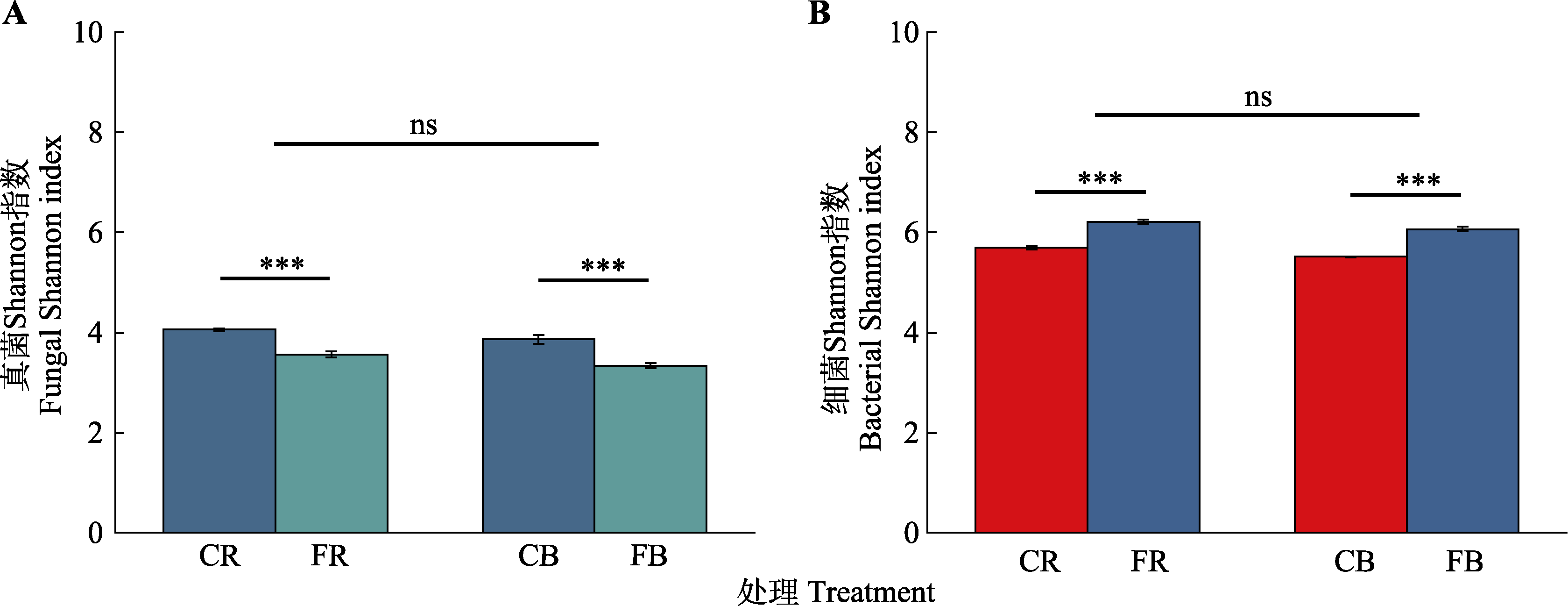
Fig. 1 Soil fungal and bacterial alpha diversity between different treatments (measured by Shannon index) (mean ± SD). CB, unburned bulk soil; CR, unburned rhizosphere soil; FB, burned bulk soil; FR, burned rhizosphere soil. ***, p < 0.001; ns, no significant difference.
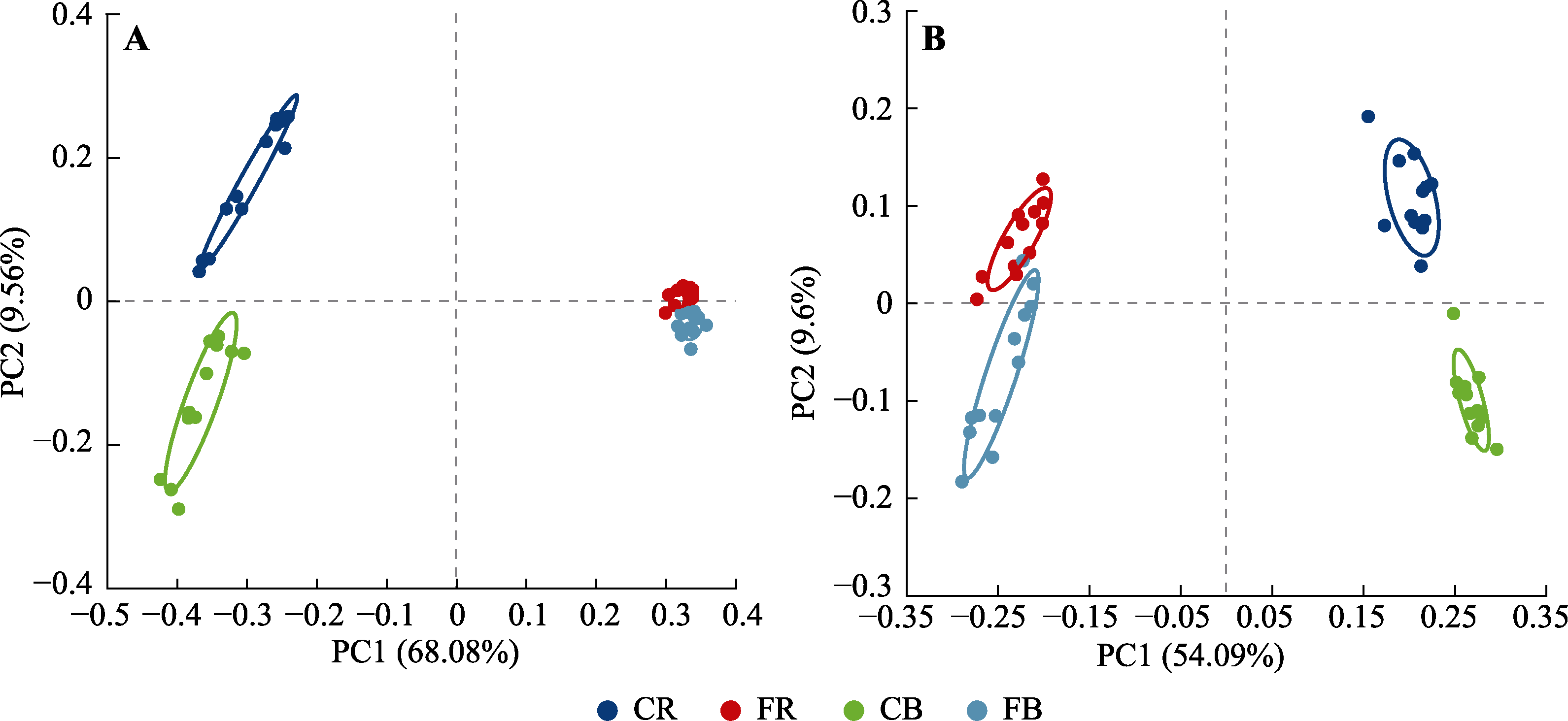
Fig. 2 Principal Co-ordinate Axisanalysis (PCoA) of operational taxonomic units (OTU) level of soil microorganisms between different treatments. A, β diversity of fungal communities, R2 = 0.90, p = 0.001. B, β diversity of bacterial communities, R2 = 0.90, p = 0.001. CB, unburned bulk soil; CR, unburned rhizosphere soil; FB, burned bulk soil; FR, burned rhizosphere soil. Perform inter group difference test using ANOSIM method with 999 permutations.
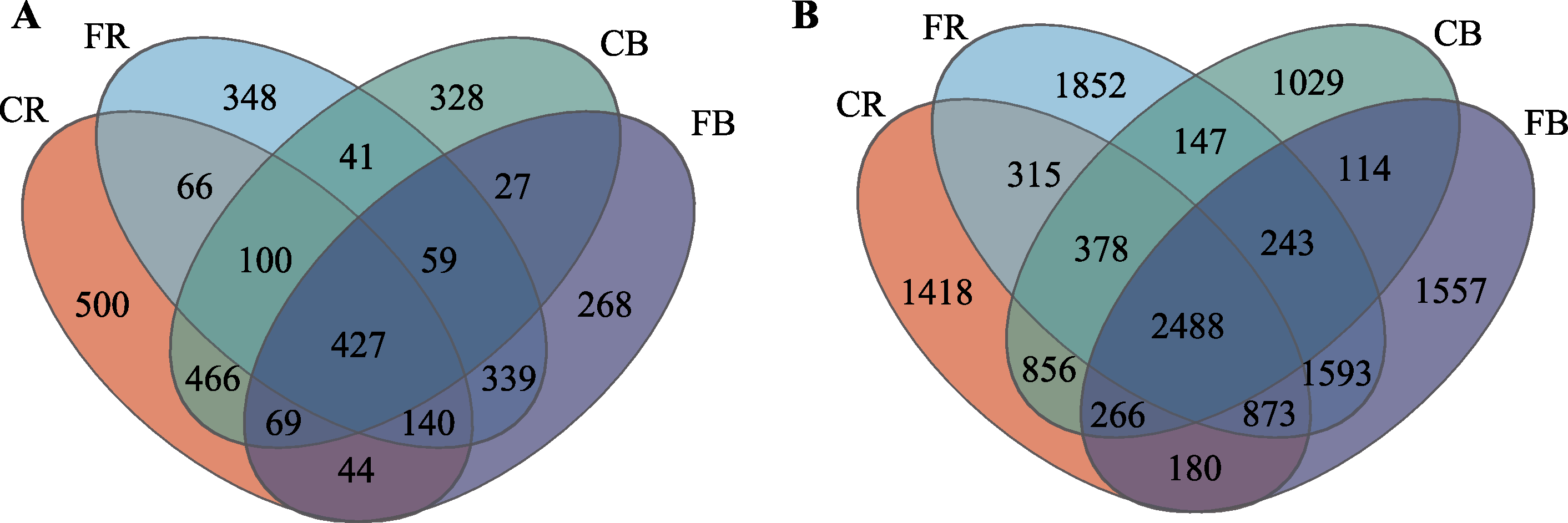
Fig. 3 Wayne diagram of operational taxonomic units (OTU) distribution in soil microbial communities under different treatments. A, Fungi. B, Bacteria. CB, unburned bulk soil; CR, unburned rhizosphere soil; FB, burned bulk soil; FR, burned rhizosphere soil.
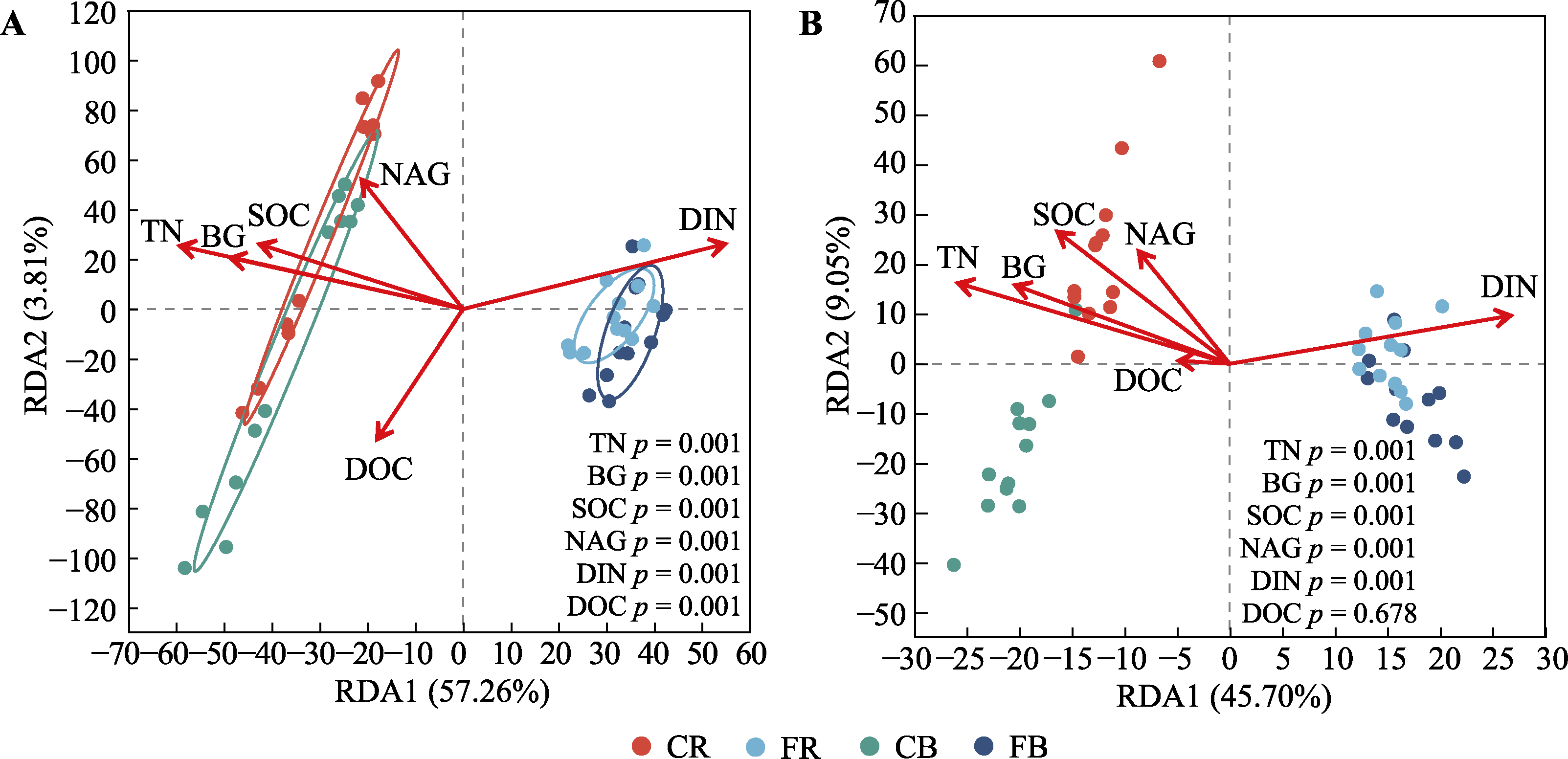
Fig. 4 Redundancy analysis (RDA) of operational taxonomic units (OTU) level microbial community composition and soil properties. A, Fungal community. B, Bacterial community. BG, β-1,4-glucosidase activity; DIN, dissolved inorganic nitrogen content; DOC, dissolved organic carbon content; NAG, β-1,4-N-acetylglucosamine glucosidase activity; SOC, soil organic carbon content; TN, total nitrogen content in soil.
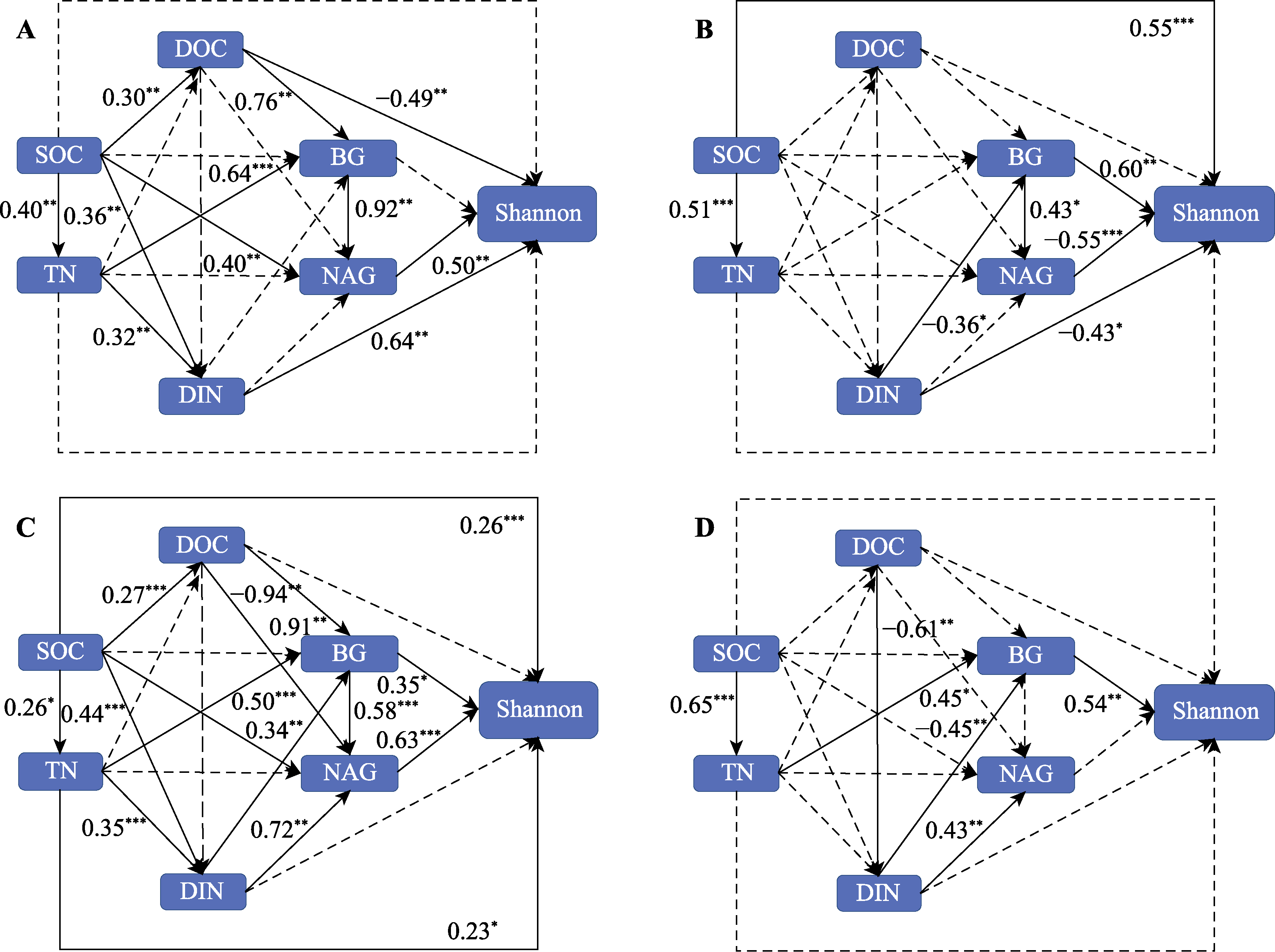
Fig. 5 Structural equation model (SEM) of soil organic carbon content (SOC), total nitrogen content (TN), dissolved organic carbon content (DOC), dissolved inorganic nitrogen content (DIN), β-1,4-glucosidase activity (BG), and β-1,4-N-acetylglucosamine glucosidase activity (NAG) on soil microbial diversity (Shannon index). A, Diversity of unburned fungi, χ² = 0.34, p = 0.56. B, Diversity of burned fungi, χ² = 0.61, p = 0.43. C, Diversity of unburned bacteria, χ² = 0.12, p = 0.73. D, Diversity of burned bacteria, χ² = 2.61, p = 0.11. The solid line represents the significant path (*, p < 0.05; **, p < 0.01; ***, p <0.001), while the dashed line represents the insignificant path (p > 0.05).
| [1] | Adkins J, Docherty KM, Gutknecht J LM, Miesel JR (2020). How do soil microbial communities respond to fire in the intermediate term? Investigating direct and indirect effects associated with fire occurrence and burn severity. Science of the Total Environment, 745, 140957. DOI: 10.1016/j.scitotenv.2020.140957. |
| [2] |
Butler OM, Elser JJ, Lewis T, MacKey B, Chen C (2018). The phosphorus-rich signature of fire in the soil-plant system: a global meta-analysis. Ecology Letters, 21, 335-344.
DOI PMID |
| [3] |
Cai HY, Liang YT, Lou H, Yang G, Sun L (2024). Changes of fine root functional traits and rhizosphere bacterial community of Betula platyphylla after fire. Chinese Journal of Plant Ecology, 48, 828-843.
DOI URL |
|
[蔡慧颖, 梁亚涛, 娄虎, 杨光, 孙龙 (2024). 白桦细根功能性状和根际细菌群落随火后时间的变化. 植物生态学报, 48, 828-843.]
DOI |
|
| [4] | Coats VC, Rumpho ME (2014). The rhizosphere microbiota of plant invaders: an overview of recent advances in the microbiomics of invasive plants. Frontiers in Microbiology, 5, 368. DOI: 10.3389/fmicb.2014.00368. |
| [5] | Cotrufo MF, Haddix ML, Kroeger ME, Stewart CE (2022). The role of plant input physical-chemical properties, and microbial and soil chemical diversity on the formation of particulate and mineral-associated organic matter. Soil Biology & Biochemistry, 168, 108648. DOI: 10.1016/j. soilbio.2022.108648. |
| [6] | Cui FX (2022). Effects of Fire Disturbance on Soil Microbial Diversity and Greenhouse Gas Emissions in Xing’an Larch Forest. PhD dissertation, Northeast Forestry University, Harbin. |
| [崔福星 (2022). 火干扰对兴安落叶松林土壤微生物多样性及温室气体排放的影响. 博士学位论文, 东北林业大学, 哈尔滨.] | |
| [7] | Du JL, Hu HQ (2014). Effects of low-intensity forest fires on soil properties of Larix gmelinii. Journal of Anhui Agricultural Sciences, 42, 4305-4308. |
| [杜嘉林, 胡海清 (2014). 低强度林火对兴安落叶松林土壤理化性质的影响. 安徽农业科学, 42, 4305-4308.] | |
| [8] |
Grace JB, Keeley JE (2006). A structural equation model analysis of postfire plant diversity in California shrublands. Ecological Applications, 16, 503-514.
PMID |
| [9] | Guo P, Xing PJ, Song J, Wu LL, Li BQ, Si YJ, Li Y, Ji RQ (2022). Fungal community in roots and the root zone of Quercus mongolica and the correlations with the environmental factors. Journal of Fungal Research, 20(3), 173-182. |
| [郭璞, 邢鹏杰, 宋佳, 吴玲玲, 李彬琦, 司滟汲, 李玉, 冀瑞卿 (2022). 蒙古栎根系与根区土壤真菌群落组成及与环境因子的关系. 菌物研究, 20(3), 173-182.] | |
| [10] | Guo XW (2020). Effects of Litter Manipulation and Nitrogen Addition on Forest Soil Carbon and Nitrogen Fractions and Microbial Process. PhD dissertation, Beijing Forestry University, Beijing. |
| [郭晓伟 (2020). 凋落物处理和氮添加对森林土壤碳氮组分和微生物过程的影响. 博士学位论文, 北京林业大学, 北京.] | |
| [11] | Han XY, Gao LS, Qin L, Pang RR, Liu MQ, Zhu YH, Tian YY, Zhang J (2024). Effect of stand density on radial growth-climate relationship of Larix gmelinii. Journal of Nanjing Forestry University (Natural Sciences Edition), 48(2), 182-190. |
|
[韩新宇, 高露双, 秦莉, 庞荣荣, 刘鸣谦, 朱一泓, 田益雨, 张金 (2024). 林分密度对兴安落叶松径向生长-气候关系的影响. 南京林业大学学报(自然科学版), 48(2), 182-190.]
DOI |
|
| [12] |
Hinsinger P, Bengough AG, Vetterlein D, Young IM (2009). Rhizosphere: biophysics, biogeochemistry and ecological relevance. Plant and Soil, 321, 117-152.
DOI URL |
| [13] | Hu TX, Song HR, Li F, Sun L (2023). Effect of different burning intensities on decomposition of Larix gmelinii root system and its contribution to soil organic carbon. Journal of Northeast Forestry University, 51(11), 115-124. |
| [胡同欣, 宋浩然, 李飞, 孙龙 (2023). 不同火烧强度对兴安落叶松根系分解和土壤有机碳的影响. 东北林业大学学报, 51(11), 115-124.] | |
| [14] | Kong JJ, Yang J (2014). Short-and long-term effects of fire on soil properties in a Dahurian larch forest in Great Xing’an Mountains. Chinese Journal of Ecology, 33, 1445-1450. |
| [孔健健, 杨健 (2014). 林火对大兴安岭落叶松林土壤性质的短期与长期影响. 生态学杂志, 33, 1445-1450.] | |
| [15] | Konopiński MK (2020). Shannon diversity index: a call to replace the original Shannon’s formula with unbiased estimator in the population genetics studies. PeerJ, 8, e9391. DOI: 10.7717/peerj.9391. |
| [16] | Li J, Zhao BQ, Li XY, Jiang RB, Bing S (2008). Changes of soil microbial properties affected by different long-term fertilization regimes. Journal of Plant Ecology (Chinese Version), 32, 891-899. |
|
[李娟, 赵秉强, 李秀英, 姜瑞波,SO Hwat Bing (2008). 长期不同施肥制度下几种土壤微生物学特征变化. 植物生态学报, 32, 891-899.]
DOI |
|
| [17] | Li LS, Wang ZY, Bai HH, Zhang KY, Liu ML, Shi JG, Duan YZ (2024). Structure and diversity of bacterial communities in rhizosphere soil of four plant species in Mu Us Sandy Land. Journal of Arid Land Resources and Environment, 38(2), 142-149. |
| [李林山, 王梓瑜, 白慧慧, 张凯煜, 刘米利, 史建国, 段义忠 (2024). 毛乌素沙地4种不同植物根际土壤细菌群落结构和多样性特征. 干旱区资源与环境, 38(2), 142-149.] | |
| [18] | Li WK (2019). Effects of Forest Fire on Soil Microbial Community Characteristics and Dynamic Changes in Pinus tabulaeformis Stands. PhD dissertation, Beijing Forestry University, Beijing. |
| [李伟克 (2019). 林火对河北平泉油松林土壤微生物群落特征影响. 博士学位论文, 北京林业大学, 北京.] | |
| [19] | Liu FL (2017). Simulating the effects of fire disturbance on microbial activity and nitrogen mineralization in forest soil. Acta Ecologica Sinica, 37, 2188-2196. |
| [刘发林 (2017). 模拟火干扰对森林土壤微生物活性及氮矿化的影响. 生态学报, 37, 2188-2196.] | |
| [20] | Liu JD, Lin W, Wang YZ, Jiang J, Fang X, Yi ZG (2018). Effects of fire on soil enzyme activities and organic carbon fractions in Pinus massoniana forest. Acta Ecologica Sinica, 38, 5374-5382. |
| [刘俊第, 林威, 王玉哲, 姜婧, 方熊, 易志刚 (2018). 火烧对马尾松林土壤酶活性和有机碳组分的影响. 生态学报, 38, 5374-5382.] | |
| [21] |
Liu M, Wang CT, Zi HB, Hu L, Yang XZ, Yang YF (2016). Effects of fire disturbance on the functional diversity of soil microbial community in alpine meadows. Chinese Journal of Applied and Environmental Biology, 22, 263-270.
DOI URL |
| [刘敏, 王长庭, 字洪标, 胡雷, 杨希智, 杨有芳 (2016). 火烧干扰下高寒草甸土壤微生物群落功能多样性变化特征. 应用与环境生物学报, 22, 263-270.] | |
| [22] | Liu MX, Li BW, Sun RD, Zhang YY, Song JY, Zhang GJ, Xu L, Mu RL (2021). Characteristics of culturable microbial communities in rhizosphere/non-rhizosphere soil of Ligularia virgaurea in alpine meadow elevation gradient. Acta Ecologica Sinica, 41, 4853-4863. |
| [刘旻霞, 李博文, 孙瑞弟, 张娅娅, 宋佳颖, 张国娟, 徐璐, 穆若兰 (2021). 高寒草甸黄帚橐吾种群根际/非根际土壤可培养微生物群落特征. 生态学报, 41, 4853-4863.] | |
| [23] |
Loeppmann S, Semenov M, Blagodatskaya E, Kuzyakov Y (2016). Substrate quality affects microbial- and enzyme activities in rooted soil. Journal of Plant Nutrition and Soil Science, 179, 39-47.
DOI URL |
| [24] | Lou H, Cai HY, Fu R, Guo C, Fan BZ, Hu HQ, Zhang J, Sun L (2023). Effects of wildfire disturbance on forest soil microbes and colonization of ericoid mycorrhizal fungi in northern China. Environmental Research, 231, 116220. DOI: 10.1016/j.envres.2023.116220. |
| [25] | Nan PH, Cao NY, Qi L, Su BL (2017). Effects of forest fire on organic carbon in deep soil of boreal forests. Forest Resources Management, (5), 52-60. |
| [南鹏辉, 曹宁阳, 齐麟, 苏宝玲 (2017). 林火对北方森林深层土壤有机碳的影响. 林业资源管理, (5), 52-60.] | |
| [26] | Nelson AR, Fegel TS, Danczak RE, Caiafa MV, Roth HK, Dunn OI, Turvold CA, Borch T, Glassman SI, Barnes RT, Rhoades CC, Wilkins MJ (2024). Soil microbiome feedbacks during disturbance-driven forest ecosystem conversion. The ISME Journal, 18, wrae047. DOI: 10.1093/ismejo/wrae047. |
| [27] |
Nelson AR, Narrowe AB, Rhoades CC, Fegel TS, Daly RA, Roth HK, Chu RK, Amundson KK, Young RB, Steindorff AS, Mondo SJ, Grigoriev IV, Salamov A, Borch T, Wilkins MJ (2022). Wildfire-dependent changes in soil microbiome diversity and function. Nature Microbiology, 7, 1419-1430.
DOI PMID |
| [28] | Niboyet A, Brown JR, Dijkstra P, Blankinship JC, Leadley PW, Le Roux X, Barthes L, Barnard RL, Field CB, Hungate BA (2011). Global change could amplify fire effects on soil greenhouse gas emissions. PLoS ONE, 6, e20105. DOI: 10.1371/journal.pone.0020105. |
| [29] | Panico SC, Ceccherini MT, Memoli V, Maisto G, Pietramellara G, Barile R, de Marco A (2020). Effects of different vegetation types on burnt soil properties and microbial communities. International Journal of Wildland Fire, 29, 628. DOI: 10.1071/wf19081. |
| [30] |
Pellegrini AFA, Ahlström A, Hobbie SE, Reich PB, Nieradzik LP, Carla Staver A, Scharenbroch BC, Jumpponen A, Anderegg WRL, Randerson JT, Jackson RB (2018). Fire frequency drives decadal changes in soil carbon and nitrogen and ecosystem productivity. Nature, 553, 194-198.
DOI URL |
| [31] | Philippot L, Raaijmakers JM, Lemanceau P,van der Putten WH (2013). Going back to the roots: the microbial ecology of the rhizosphere. Nature Reviews: Microbiology, 11, 789-799. |
| [32] |
Phillips RP, Fahey TJ (2008). The influence of soil fertility on rhizosphere effects in northern hardwood forest soils. Soil Science Society of America Journal, 72, 453-461.
DOI URL |
| [33] | Qin PW, Wu KM, Liu JZ, Wu YH (2018). Effects of exogenous organic carbon concentration on the algae-bacteria relationship and removal of nitrogen and phosphorus. Journal of Wuhan University of Science and Technology, 41(3), 195-200. |
| [秦攀伟, 吴克明, 刘俊琢, 吴永红 (2018). 外源有机碳浓度对藻菌关系及氮磷去除的影响. 武汉科技大学学报, 41(3), 195-200.] | |
| [34] | Ribeiro-Kumara C, Pumpanen J, Heinonsalo J, Metslaid M, Orumaa A, Jõgiste K, Berninger F, Köster K (2020). Long-term effects of forest fires on soil greenhouse gas emissions and extracellular enzyme activities in a hemiboreal forest. Science of the Total Environment, 718, 135291. DOI: 10.1016/j.scitotenv.2019.135291. |
| [35] |
Sasse J, Martinoia E, Northen T (2018). Feed your friends: do plant exudates shape the root microbiome? Trends in Plant Science, 23, 25-41.
DOI PMID |
| [36] | Shen Y, Qin T, Guo YH, Zhang H, Zhou ZY (2022). Short-term effects of forest fire on soil microorganism and enzyme activities of Pinus tabuliformis forest in Taiyue Mountain, Shanxi Province of northern China. Journal of Beijing Forestry University, 44(4), 76-85. |
| [沈颖, 秦涛, 郭银花, 张欢, 周志勇 (2022). 林火对山西太岳山油松林土壤微生物-酶活性的短期影响. 北京林业大学学报, 44(4), 76-85.] | |
| [37] | Song LC, He PP, Cui XY (2015). Effects of severe forest fire on soil habitat factors in Greater Xing’an Mountains. Chinese Journal of Ecology, 34, 1809-1814. |
| [宋利臣, 何平平, 崔晓阳 (2015). 重度林火对大兴安岭土壤生境因子的影响. 生态学杂志, 34, 1809-1814.] | |
| [38] |
Sun L, Li WB, Lou H, Yu C, Han Y, Hu TX (2024). Effects of fire disturbance on seed germination of Larix gmelinii. Chinese Journal of Plant Ecology, 48, 770-779.
DOI URL |
|
[孙龙, 李文博, 娄虎, 于澄, 韩宇, 胡同欣 (2024). 火干扰对兴安落叶松种子萌发的影响. 植物生态学报, 48, 770-779.]
DOI |
|
| [39] | Sun MM, Tian L, Qiao ZW, Zhang XY, Gao ZW (2024). Physicochemical properties and fungal community characteristics of rhizosphere and non-rhizosphere soils of Hippophae rhamnoides in Pisha sandstone area of Inner Mongolia. Acta Microbiologica Sinica, 64, 1747-1765. |
| [孙美美, 田丽, 乔紫薇, 张雪雅, 高泽文 (2024). 内蒙古砒砂岩地区沙棘根际和非根际土壤理化性质及真菌群落特征. 微生物学报, 64, 1747-1765.] | |
| [40] | Tao YZ (2014). Fire Disturbance to Tahe Forest Soil Microbes and Enzyme Activity. PhD dissertation, Northeast Forestry University, Harbin. |
| [陶玉柱 (2014). 火对塔河森林土壤微生物及酶活性的干扰作用. 博士学位论文, 东北林业大学, 哈尔滨.] | |
| [41] |
Wang D, Rui YC, Ding K, Cui XY, Hao YB, Tang L, Pang Z, Zhang B, Zhou ST, Wang K, Wang YF (2018). Precipitation drives the biogeographic distribution of soil fungal community in Inner Mongolian temperate grasslands. Journal of Soils and Sediments, 18, 222-228.
DOI URL |
| [42] | Wang LL, Zhou QQ, Su WH, Xu YJ, Qian QD, Yang X, Chen DY, Chen Z, Wu JP (2023). Responses of fungal community to forest fire are species-specific in Yunnan Plateau, southwest China. Journal of Plant Ecology, 16, rtac043. DOI: 10.1093/jpe/rtac043. |
| [43] | Wang N, Weng YT, Yang G, Di XY, Quan XK (2020). Effects of fire disturbanceon soil microbial community of Larix gmelinii forest. Journal of Northeast Forestry University, 48(5), 21-28. |
| [王楠, 瓮岳太, 杨光, 邸雪颖, 全先奎 (2020). 火干扰对兴安落叶松森林土壤微生物群落的影响. 东北林业大学学报, 48(5), 21-28.] | |
| [44] | Wang S, Ta L, Wang JN, Han DX, Wang QX, Ji HN (2021). Study of the influence of a forest fire on the stand structure of a natural Larix gmelinii forest. Journal of Temperate Forestry Research, 4(4), 24-30. |
| [王烁, 塔丽, 王剑南, 韩大校, 王千雪, 纪昊男 (2021). 林火对兴安落叶松天然林林分结构影响研究. 温带林业研究, 4(4), 24-30.] | |
| [45] | Wang YZ, Zheng JQ, Liu X, Yan Q, Hu YL (2020). Short-term impact of fire-deposited charcoal on soil microbial community abundance and composition in a subtropical plantation in China. Geoderma, 359, 113992. DOI: 10.1016/j.geoderma.2019.113992. |
| [46] | Yan SX, Liu M, Liu CX, Zhao ML, Qiu W, Gu JY, Feng GL, Gao J, Cai LX, Xu QF (2022). Soil microbial diversity is higher in pure stands of moso bamboo than in pure stands of Chinese fir. Acta Pedologica Sinica, 59, 1704-1717. |
| [严淑娴, 刘茗, 刘彩霞, 赵梦丽, 邱巍, 顾佳悦, 冯歌林, 高竞, 蔡铃潇, 徐秋芳 (2022). 毛竹纯林土壤微生物多样性高于杉木纯林. 土壤学报, 59, 1704-1717.] | |
| [47] | Yao ZY, Zhang NL, Cui XY (2014). Impacts of fire and N addition on microbial C utilization potential in a semi-arid grassland of Inner Mongolia. Acta Agrestia Sinica, 22, 713-721. |
|
[么中元, 张乃莉, 崔喜艳 (2014). 火烧和施氮对内蒙古半干旱草原土壤微生物群落碳源利用潜力的影响. 草地学报, 22, 713-721.]
DOI |
|
| [48] | Zhang BH, Jin DS, Zhang Q, Gao CH, Li JH, Lu JJ, Ji SY (2020). Response of fungal diversity to fertilization application in reclaimed soil in coal gangue landfill area. Journal of Arid Land Resources and Environment, 34(4), 183-188. |
| [张变华, 靳东升, 张强, 郜春花, 李建华, 卢晋晶, 籍晟煜 (2020). 煤矸石填埋区复垦土壤真菌多样性对施肥方式的响应. 干旱区资源与环境, 34(4), 183-188.] | |
| [49] | Zhang C, Zhang XY, Kuzyakov Y, Wang HM, Fu XL, Yang Y, Chen FS, Dungait JAJ, Green SM, Fang XM (2020). Responses of C-, N- and P-acquiring hydrolases to P and N fertilizers in a subtropical Chinese fir plantation depend on soil depth. Applied Soil Ecology, 150, 103465. DOI: 10.1016/j.apsoil.2019.103465. |
| [50] | Zhang Y, Wang CM, Xu K, Yang XT (2017). Effect of simulated nitrogen deposition on soil enzyme activities in a temperate forest. Acta Ecologica Sinica, 37, 1956-1965. |
| [张艺, 王春梅, 许可, 杨欣桐 (2017). 模拟氮沉降对温带森林土壤酶活性的影响. 生态学报, 37, 1956-1965.] | |
| [51] | Zhao B, Sun L, Hu HQ, Sun ZH (2011). Post-fire soil microbial biomass and nutrient content of Larix gmelinii forest in autumn. Journal of Natural Resources, 26, 450-459. |
| [赵彬, 孙龙, 胡海清, 孙志虎 (2011). 兴安落叶松林火后对土壤养分和土壤微生物生物量的影响. 自然资源学报, 26, 450-459.] | |
| [52] | Zheng Q, Cui XY, Di XY, Jin S (2012). Effects of different forest fire intensities on microbial community functional diversity in forest soil in Daxing’anling. Scientia Silvae Sinicae, 48(5), 95-100. |
| [郑琼, 崔晓阳, 邸雪颖, 金森 (2012). 不同林火强度对大兴安岭偃松林土壤微生物功能多样性的影响. 林业科学, 48(5), 95-100.] | |
| [53] | Zheng W, Wu Q, Guo XB, Zhou P, Wu JS, Yan WD (2024). Rocky desertification succession alters soil microbial communities and survival strategies in the karst context. Science of the Total Environment, 927, 172171. DOI: 10.1016/j.scitotenv.2024.172171. |
| [54] |
Zhu B, Cheng WX (2011). Rhizosphere priming effect increases the temperature sensitivity of soil organic matter decomposition. Global Change Biology, 17, 2172-2183.
DOI URL |
| [1] | ZHANG Cheng-Hang, WEI Xing, WU Chun-Ze, WANG Yu-Yao, LI Hao-Nan. Growth response of mycorrhizal Fraxinus mandshurica and Larix gmelinii seedlings to dry and wet deposition of atmospheric reduced nitrogen [J]. Chin J Plant Ecol, 2026, 50(3): 649-659. |
| [2] | YU Pu, ZHANG Quan-Zhi, WANG Chuan-Kuan. Radial variation and its influencing factors of Fraxinus mandshurica and Larix gmelinii in Mao’ershan [J]. Chin J Plant Ecol, 2026, 50(1): 160-172. |
| [3] | LI Dong-Mei, SUN Long, HAN Yu, HU Tong-Xin, YANG Guang, CAI Hui-Ying. Impact of prescribed burning on biodiversity and ecosystem multifunctionality of Pinus koraiensis plantation [J]. Chin J Plant Ecol, 2025, 49(3): 379-392. |
| [4] | LU Lei-Qin, SUN Long, SONG Yu-Xuan, YANG Guang, CAI Hui-Ying. Post-fire time impacts on nonstructural carbohydrates in leaves-branches-roots of Vaccinium vitis-idaea in Da Hinggan Mountains [J]. Chin J Plant Ecol, 2025, 49(12): 2105-2118. |
| [5] | LIU Yao, ZHONG Quan-Lin, XU Chao-Bin, CHENG Dong-Liang, ZHENG Yue-Fang, ZOU Yu-Xing, ZHANG Xue, ZHENG Xin-Jie, ZHOU Yun-Ruo. Relationship between fine root functional traits and rhizosphere microenvironment of Machilus pauhoi at different sizes [J]. Chin J Plant Ecol, 2024, 48(6): 744-759. |
| [6] | SUN Long, LI Wen-Bo, LOU Hu, YU Cheng, HAN Yu, HU Tong-Xin. Effects of fire disturbance on seed germination of Larix gmelinii [J]. Chin J Plant Ecol, 2024, 48(6): 770-779. |
| [7] | LIANG Yi-Xian, WANG Chuan-Kuan, ZANG Miao-Han, SHANGGUAN Hong-Yu, LIU Yi-Xiao, QUAN Xian-Kui. Responses of radial growth and biomass allocation of Larix gmelinii to climate warming [J]. Chin J Plant Ecol, 2024, 48(4): 459-468. |
| [8] | ZANG Miao-Han, WANG Chuan-Kuan, LIANG Yi-Xian, LIU Yi-Xiao, SHANGGUAN Hong-Yu, QUAN Xian-Kui. Stoichiometric characteristics of leaf, branch and root in Larix gmelinii in response to climate warming based on latitudinal transplantation [J]. Chin J Plant Ecol, 2024, 48(4): 469-482. |
| [9] | ZHANG Yu-Jian, LIU Yan-Hong. Tree physiology and major influencing factors under forest fires [J]. Chin J Plant Ecol, 2024, 48(3): 269-286. |
| [10] | WANG Liang, ZHAO Xue-Chao, YANG Shao-Bo, WANG Qing-Kui. Priming effect of soil organic carbon decomposition induced by Cunninghamia lanceolate leaf litter and fine root and its response to nitrogen addition in subtropical forests [J]. Chin J Plant Ecol, 2024, 48(11): 1434-1444. |
| [11] | ZHANG Ying, ZHANG Chang-Hong, WANG Qi-Tong, ZHU Xiao-Min, YIN Hua-Jun. Difference of soil carbon sequestration between rhizosphere and bulk soil in a mountain coniferous forest in southwestern China under nitrogen deposition [J]. Chin J Plant Ecol, 2023, 47(9): 1234-1244. |
| [12] | SHEN Jian, HE Zong-Ming, DONG Qiang, GAO Shi-Lei, LIN Yu. Effects of mild fire on soil respiration rate and abiotic factors in coastal sandy plantation [J]. Chin J Plant Ecol, 2023, 47(7): 1032-1042. |
| [13] | ZHANG Qi, FENG Ke, CHANG Zhi-Hui, HE Shuang-Hui, XU Wei-Qi. Effects of shrub encroachment on plant and soil microbial in the forest-grassland ecotone [J]. Chin J Plant Ecol, 2023, 47(6): 770-781. |
| [14] | FENG Ke, LIU Dong-Mei, ZHANG Qi, AN Jing, HE Shuang-Hui. Effect of tourism disturbance on soil microbial diversity and community structure in a Pinus tabuliformis forest [J]. Chin J Plant Ecol, 2023, 47(4): 584-596. |
| [15] | ZHANG Yao, CHEN Lan, WANG Jie-Ying, LI Yi, WANG Jun, GUO Yao-Xin, REN Cheng-Jie, BAI Hong-Ying, SUN Hao-Tian, ZHAO Fa-Zhu. Differences and influencing factors of microbial carbon use efficiency in forest rhizosphere soils at different altitudes in Taibai Mountain, China [J]. Chin J Plant Ecol, 2023, 47(2): 275-288. |
| Viewed | ||||||
|
Full text |
|
|||||
|
Abstract |
|
|||||
Copyright © 2026 Chinese Journal of Plant Ecology
Tel: 010-62836134, 62836138, E-mail: apes@ibcas.ac.cn, cjpe@ibcas.ac.cn

