
Chin J Plant Ecol ›› 2025, Vol. 49 ›› Issue (11): 1778-1790.DOI: 10.17521/cjpe.2025.0099 cstr: 32100.14.cjpe.2025.0099
• Research Articles • Previous Articles Next Articles
DU Hua-Dong1,2,3, WANG Meng-Yu1, NIE Wen-Jie1,2,3,*( ), SUN Hao1, CHE Xu-Xi1, TANG Xun1
Received:2025-03-27
Accepted:2025-09-09
Online:2025-11-20
Published:2025-11-20
Contact:
NIE Wen-Jie
Supported by:DU Hua-Dong, WANG Meng-Yu, NIE Wen-Jie, SUN Hao, CHE Xu-Xi, TANG Xun. Influence of photovoltaic arrays construction on plant community characteristics in subsidence areas in semi-arid coal mining area[J]. Chin J Plant Ecol, 2025, 49(11): 1778-1790.
Add to citation manager EndNote|Ris|BibTeX
URL: https://www.plant-ecology.com/EN/10.17521/cjpe.2025.0099
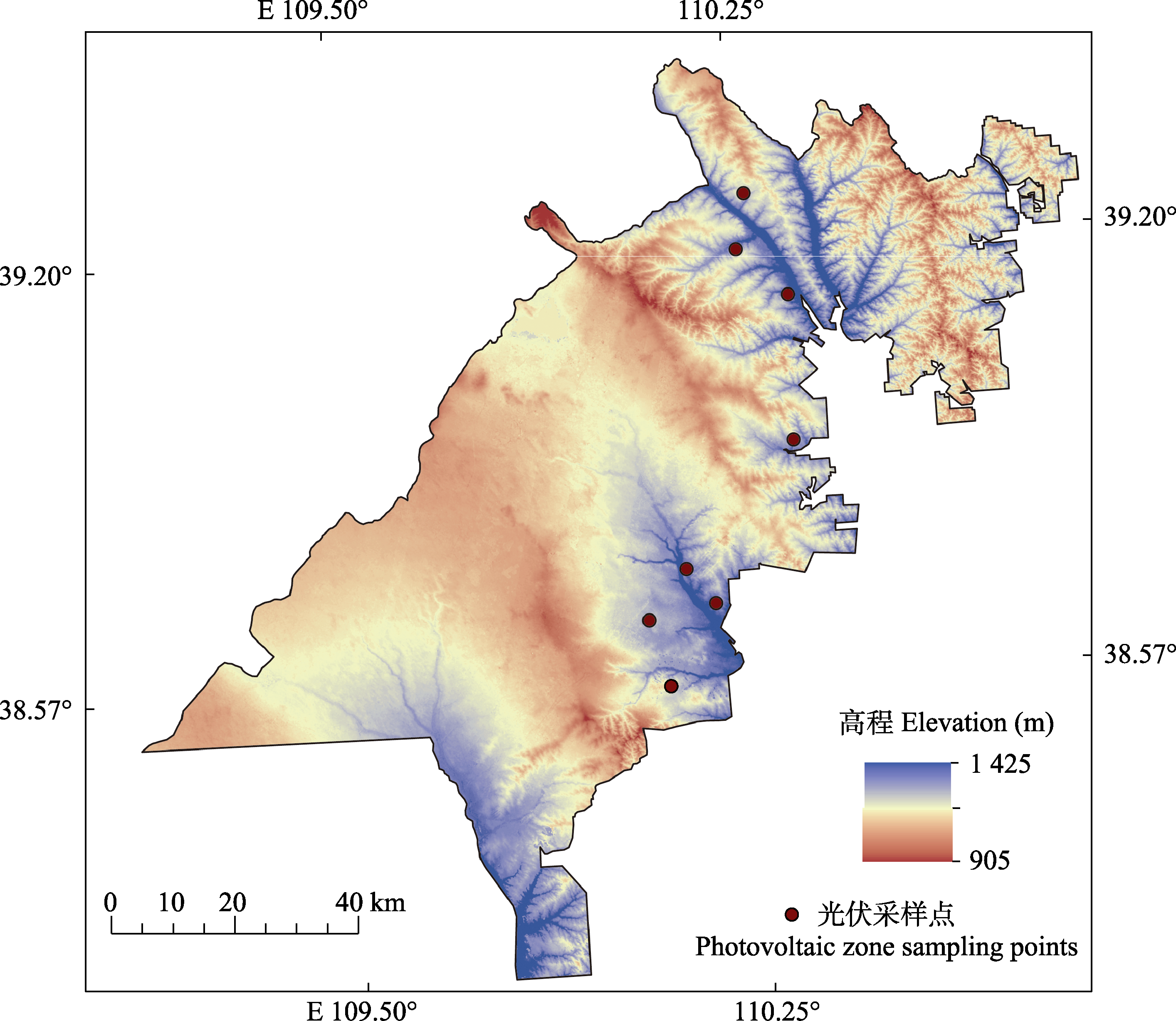
Fig. 1 Location of the Yushenfu mining area and distribution of sampling points.
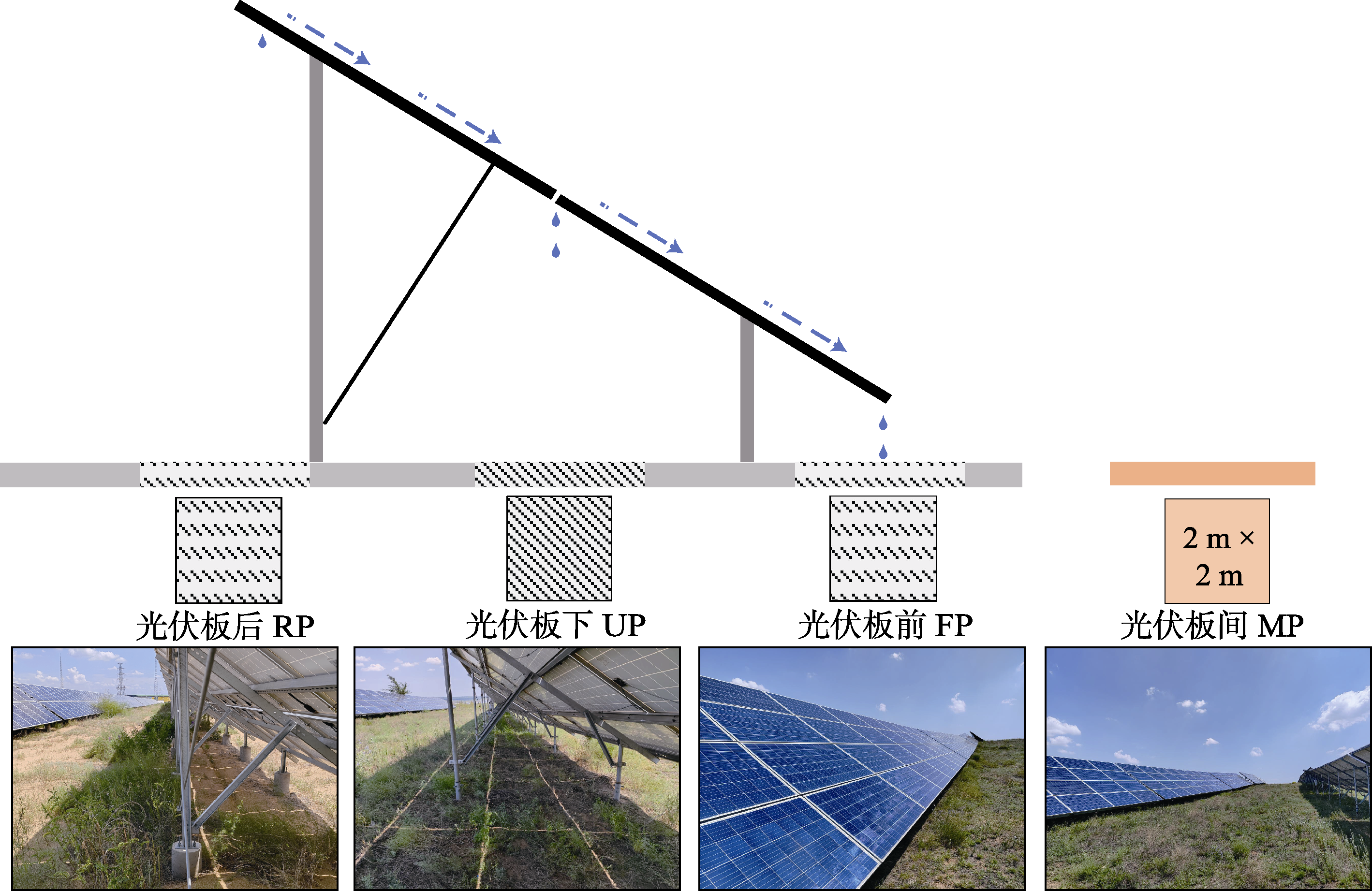
Fig. 2 Sampling units at different sites in the photovoltaic zone. FP, front eaves of the photovoltaic panel; MP, middle of the photovoltaic panel; RP, rear eaves of the photovoltaic panel; UP, underside of the photovoltaic panel.
| 研究区 Study area | 地理位置 Location | 海拔 Altitude (m) | 建站时间 Installation year of PV plant (a) | 主要植被类型 Dominant vegetation | 地貌类型 Geomorphological type | 光伏建设区面积 Plot area within PV zone (km2) |
|---|---|---|---|---|---|---|
| PV 01 | 39.27° N, 110.28° E | 1 220 | 9 | 长芒草+黑沙蒿 Stipa bungeana + Artemisia ordosica | 黄土区 Loess area | 1.91 |
| PV 02 | 39.18° N, 110.25° E | 1 200 | 8 | 长芒草+赖草 Stipa bungeana + Leymus secalinus | 黄土区 Loess area | 1.30 |
| PV 03 | 39.11° N, 110.34° E | 1 170 | 9 | 长芒草+猪毛蒿 Stipa bungeana + Artemisia scoparia | 黄土区 Loess area | 0.80 |
| PV 04 | 38.90° N, 110.34° E | 1 170 | 9 | 长芒草+黑沙蒿 Stipa bungeana + Artemisia ordosica | 黄土区 Loess area | 1.10 |
| PV 05 | 38.78° N, 110.16° E | 1 210 | 8 | 长芒草+蒙古莸 Stipa bungeana + Caryopteris mongholica | 黄土区 Loess area | 0.58 |
| PV 06 | 38.67° N, 110.20° E | 1 095 | 8 | 黑沙蒿+二色补血草 Artemisia ordosica + Limonium bicolor | 黄土区 Loess area | 4.55 |
| PV 07 | 38.65° N, 110.05° E | 1 170 | 9 | 长芒草+达乌里胡枝子 Stipa bungeana + Lespedeza davurica | 黄土区 Loess area | 0.53 |
| PV 08 | 38.55° N, 110.07° E | 1 240 | 8 | 长芒草+黑沙蒿 Stipa bungeana + Artemisia ordosica | 黄土区 Loess area | 4.40 |
Table 1 Information of sampling sites of photovoltaic (PV) study areas
| 研究区 Study area | 地理位置 Location | 海拔 Altitude (m) | 建站时间 Installation year of PV plant (a) | 主要植被类型 Dominant vegetation | 地貌类型 Geomorphological type | 光伏建设区面积 Plot area within PV zone (km2) |
|---|---|---|---|---|---|---|
| PV 01 | 39.27° N, 110.28° E | 1 220 | 9 | 长芒草+黑沙蒿 Stipa bungeana + Artemisia ordosica | 黄土区 Loess area | 1.91 |
| PV 02 | 39.18° N, 110.25° E | 1 200 | 8 | 长芒草+赖草 Stipa bungeana + Leymus secalinus | 黄土区 Loess area | 1.30 |
| PV 03 | 39.11° N, 110.34° E | 1 170 | 9 | 长芒草+猪毛蒿 Stipa bungeana + Artemisia scoparia | 黄土区 Loess area | 0.80 |
| PV 04 | 38.90° N, 110.34° E | 1 170 | 9 | 长芒草+黑沙蒿 Stipa bungeana + Artemisia ordosica | 黄土区 Loess area | 1.10 |
| PV 05 | 38.78° N, 110.16° E | 1 210 | 8 | 长芒草+蒙古莸 Stipa bungeana + Caryopteris mongholica | 黄土区 Loess area | 0.58 |
| PV 06 | 38.67° N, 110.20° E | 1 095 | 8 | 黑沙蒿+二色补血草 Artemisia ordosica + Limonium bicolor | 黄土区 Loess area | 4.55 |
| PV 07 | 38.65° N, 110.05° E | 1 170 | 9 | 长芒草+达乌里胡枝子 Stipa bungeana + Lespedeza davurica | 黄土区 Loess area | 0.53 |
| PV 08 | 38.55° N, 110.07° E | 1 240 | 8 | 长芒草+黑沙蒿 Stipa bungeana + Artemisia ordosica | 黄土区 Loess area | 4.40 |
| 样地 Sample plot | 酸碱度 pH | 含水率 Moisture (%) | 有机质含量 Organic matter content (g·kg-1) | 容重 Bulk density (g·cm-3) | 有效磷含量 Available phosphorus content (mg·kg-1) | 有效钾含量 Available potassium content (mg·kg-1) | 有效氮含量 Available nitrogen content (mg·kg-1) |
|---|---|---|---|---|---|---|---|
| CK | 8.90 ± 0.40b | 7.47 ± 3.69d | 7.68 ± 3.15ab | 1.19 ± 0.19b | 5.00 ± 1.22a | 115.85 ± 41.33a | 52.30 ± 24.19a |
| NA | 8.72 ± 0.22b | 7.10 ± 3.86d | 5.65 ± 0.40b | 1.14 ± 0.04b | 3.12 ± 0.78b | 117.53 ± 16.36a | 40.32 ± 5.25b |
| RP | 9.37 ± 0.52a | 8.53 ± 6.05c | 9.97 ± 5.04a | 1.38 ± 0.14a | 1.01 ± 0.32c | 118.48 ± 43.97a | 43.62 ± 9.83b |
| UP | 9.21 ± 0.45a | 10.88 ± 3.01b | 3.90 ± 1.48c | 1.13 ± 0.12b | 5.47 ± 1.78a | 107.43 ± 12.34b | 54.55 ± 21.16a |
| FP | 8.81 ± 0.39b | 12.95 ± 6.81a | 10.38 ± 3.28a | 1.25 ± 0.20ab | 4.08 ± 1.31b | 121.42 ± 46.20a | 49.94 ± 11.50a |
| MP | 9.34 ± 0.56a | 7.00 ± 3.14d | 3.12 ± 0.80c | 1.39 ± 0.11a | 0.81 ± 0.21d | 111.23 ± 45.24b | 21.57 ± 5.24c |
Table 2 Soil physicochemical properties at coal mining subsidence areas with natural recovery and photovoltaic plant in Yushenfu mining area (mean ± SD)
| 样地 Sample plot | 酸碱度 pH | 含水率 Moisture (%) | 有机质含量 Organic matter content (g·kg-1) | 容重 Bulk density (g·cm-3) | 有效磷含量 Available phosphorus content (mg·kg-1) | 有效钾含量 Available potassium content (mg·kg-1) | 有效氮含量 Available nitrogen content (mg·kg-1) |
|---|---|---|---|---|---|---|---|
| CK | 8.90 ± 0.40b | 7.47 ± 3.69d | 7.68 ± 3.15ab | 1.19 ± 0.19b | 5.00 ± 1.22a | 115.85 ± 41.33a | 52.30 ± 24.19a |
| NA | 8.72 ± 0.22b | 7.10 ± 3.86d | 5.65 ± 0.40b | 1.14 ± 0.04b | 3.12 ± 0.78b | 117.53 ± 16.36a | 40.32 ± 5.25b |
| RP | 9.37 ± 0.52a | 8.53 ± 6.05c | 9.97 ± 5.04a | 1.38 ± 0.14a | 1.01 ± 0.32c | 118.48 ± 43.97a | 43.62 ± 9.83b |
| UP | 9.21 ± 0.45a | 10.88 ± 3.01b | 3.90 ± 1.48c | 1.13 ± 0.12b | 5.47 ± 1.78a | 107.43 ± 12.34b | 54.55 ± 21.16a |
| FP | 8.81 ± 0.39b | 12.95 ± 6.81a | 10.38 ± 3.28a | 1.25 ± 0.20ab | 4.08 ± 1.31b | 121.42 ± 46.20a | 49.94 ± 11.50a |
| MP | 9.34 ± 0.56a | 7.00 ± 3.14d | 3.12 ± 0.80c | 1.39 ± 0.11a | 0.81 ± 0.21d | 111.23 ± 45.24b | 21.57 ± 5.24c |
| 样地 Sampling plot | 地表温度 Surface temperature (℃) | 空气湿度 Air humidity (%) | 光照强度 Light intensity (lx) | 地表风速 Surface wind speed (m·s-1) |
|---|---|---|---|---|
| CK | 32.11 ± 0.15a | 36.31 ± 1.16bc | 20.53 ± 4.57a | 2.11 ± 0.29a |
| NA | 32.83 ± 0.11a | 36.11 ± 0.56bc | 20.34 ± 3.23a | 1.96 ± 0.16a |
| RP | 31.44 ± 0.41a | 37.12 ± 1.45b | 18.17 ± 7.46a | 0.57 ± 0.45c |
| UP | 29.93 ± 2.21bc | 42.51 ± 6.05a | 8.79 ± 3.49c | 0.38 ± 0.31d |
| FP | 30.74 ± 0.78b | 41.11 ± 3.59a | 11.75 ± 2.99b | 0.73 ± 0.44b |
| MP | 33.63 ± 0.17a | 35.45 ± 1.27c | 20.70 ± 4.78a | 0.75 ± 0.39b |
Table 3 Micro-meteorological factors at coal mining subsidence areas with natural recovery and photovoltaic arrays in Yushenfu mining area (mean ± SD)
| 样地 Sampling plot | 地表温度 Surface temperature (℃) | 空气湿度 Air humidity (%) | 光照强度 Light intensity (lx) | 地表风速 Surface wind speed (m·s-1) |
|---|---|---|---|---|
| CK | 32.11 ± 0.15a | 36.31 ± 1.16bc | 20.53 ± 4.57a | 2.11 ± 0.29a |
| NA | 32.83 ± 0.11a | 36.11 ± 0.56bc | 20.34 ± 3.23a | 1.96 ± 0.16a |
| RP | 31.44 ± 0.41a | 37.12 ± 1.45b | 18.17 ± 7.46a | 0.57 ± 0.45c |
| UP | 29.93 ± 2.21bc | 42.51 ± 6.05a | 8.79 ± 3.49c | 0.38 ± 0.31d |
| FP | 30.74 ± 0.78b | 41.11 ± 3.59a | 11.75 ± 2.99b | 0.73 ± 0.44b |
| MP | 33.63 ± 0.17a | 35.45 ± 1.27c | 20.70 ± 4.78a | 0.75 ± 0.39b |
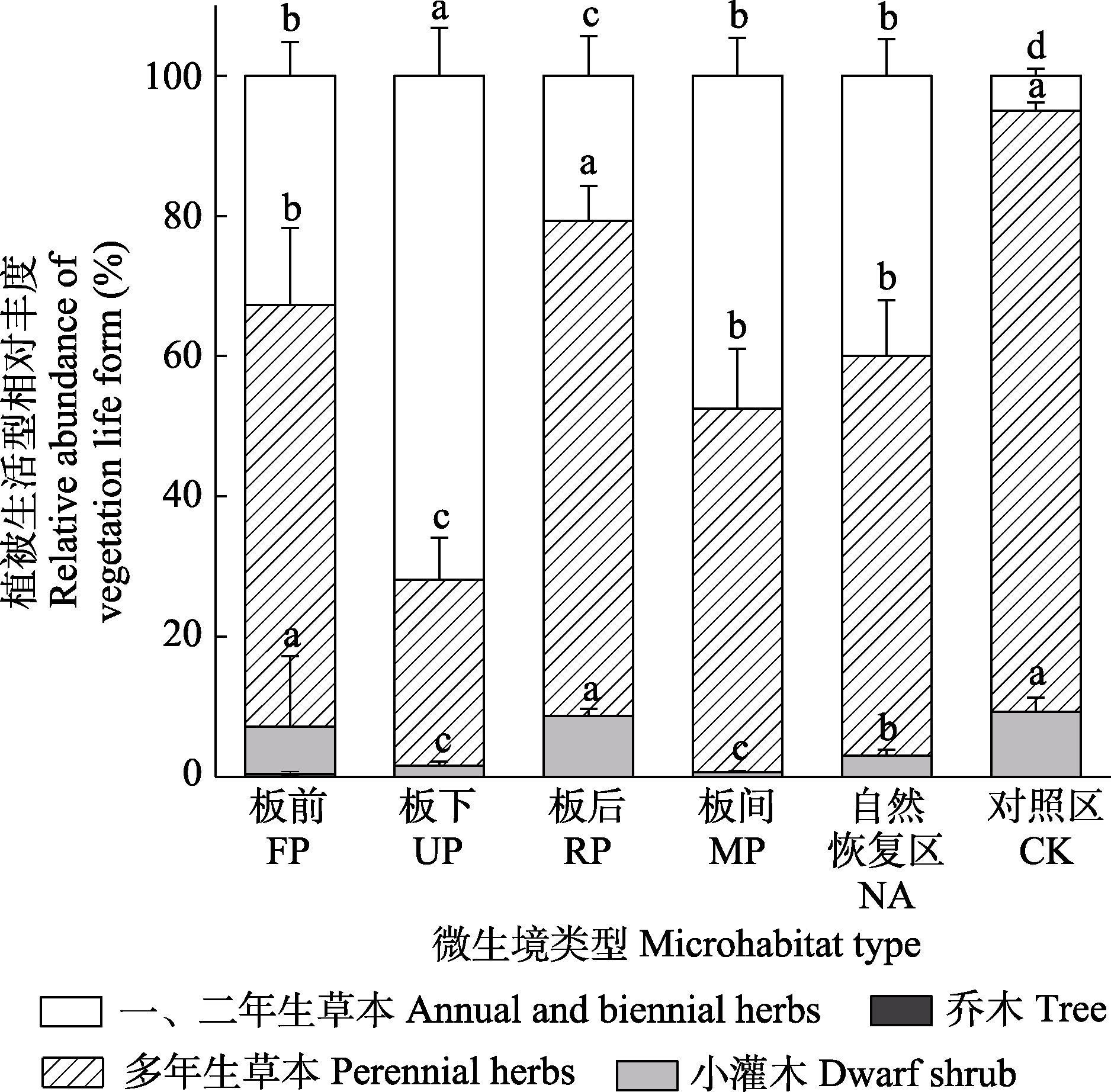
Fig. 3 Life form compositional of vegetation in naturally recovered subsidence areas and photovoltaic zones across different microhabitat units in the Yushenfu mining region (mean ± SD). CK, control area; FP, front eaves of the photovoltaic panel; MP, middle of the photovoltaic panel; NA, coal mining subsidence areas with natural recovery; RP, rear eaves of the photovoltaic panel; UP, underside of the photovoltaic panel. Different lowercase letters indicate significant differences among different sampling sites (p < 0.05).
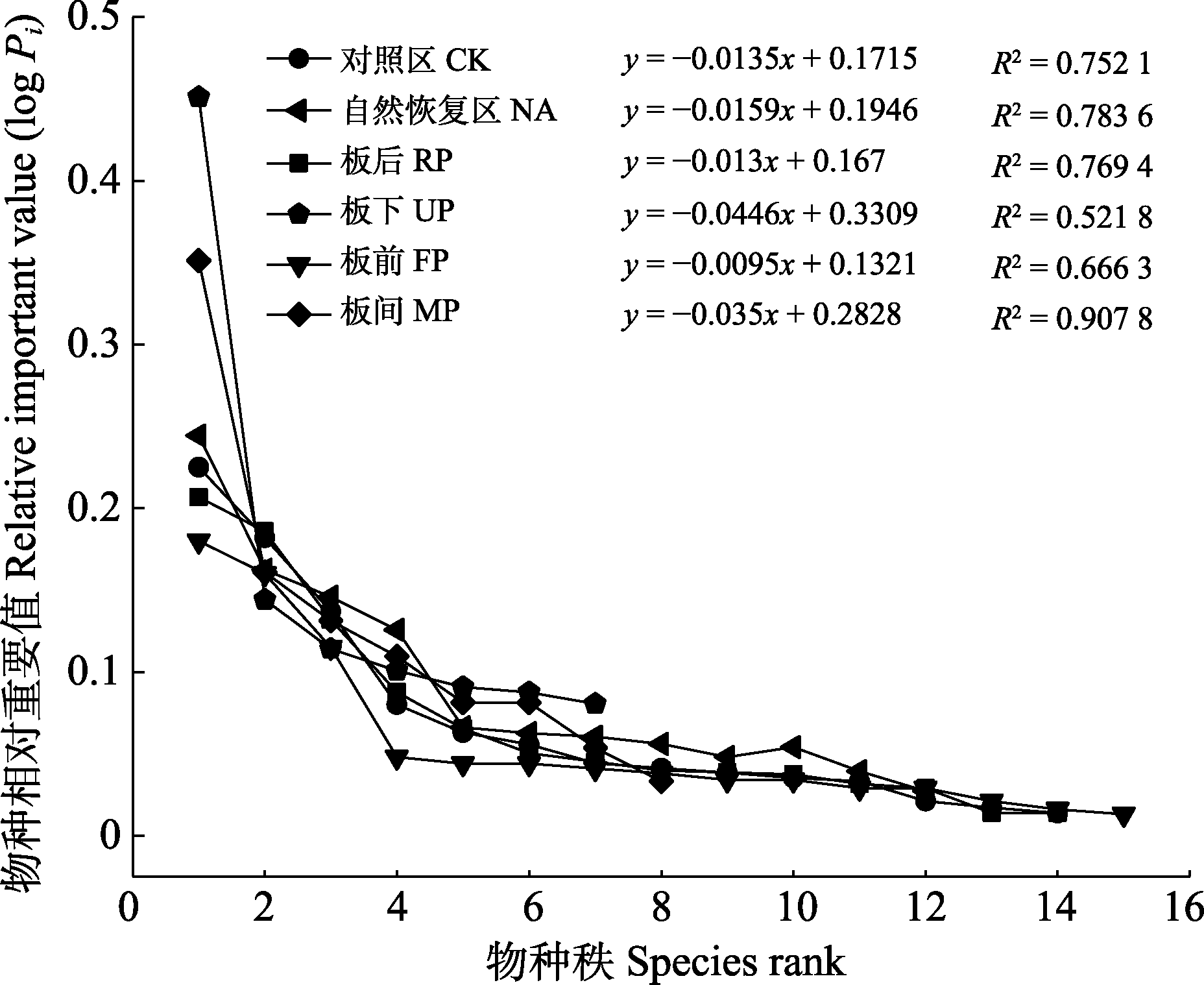
Fig. 4 Species ranks by relative importance value in naturally recovered subsidence areas and photovoltaic zones across different microhabitat units of the Yushenfu mining region. CK, control area; FP, front eaves of the photovoltaic panel; MP, middle of the photovoltaic panel; NA, coal mining subsidence areas with natural recovery; RP, rear eaves of the photovoltaic panel; UP, underside of the photovoltaic panel.
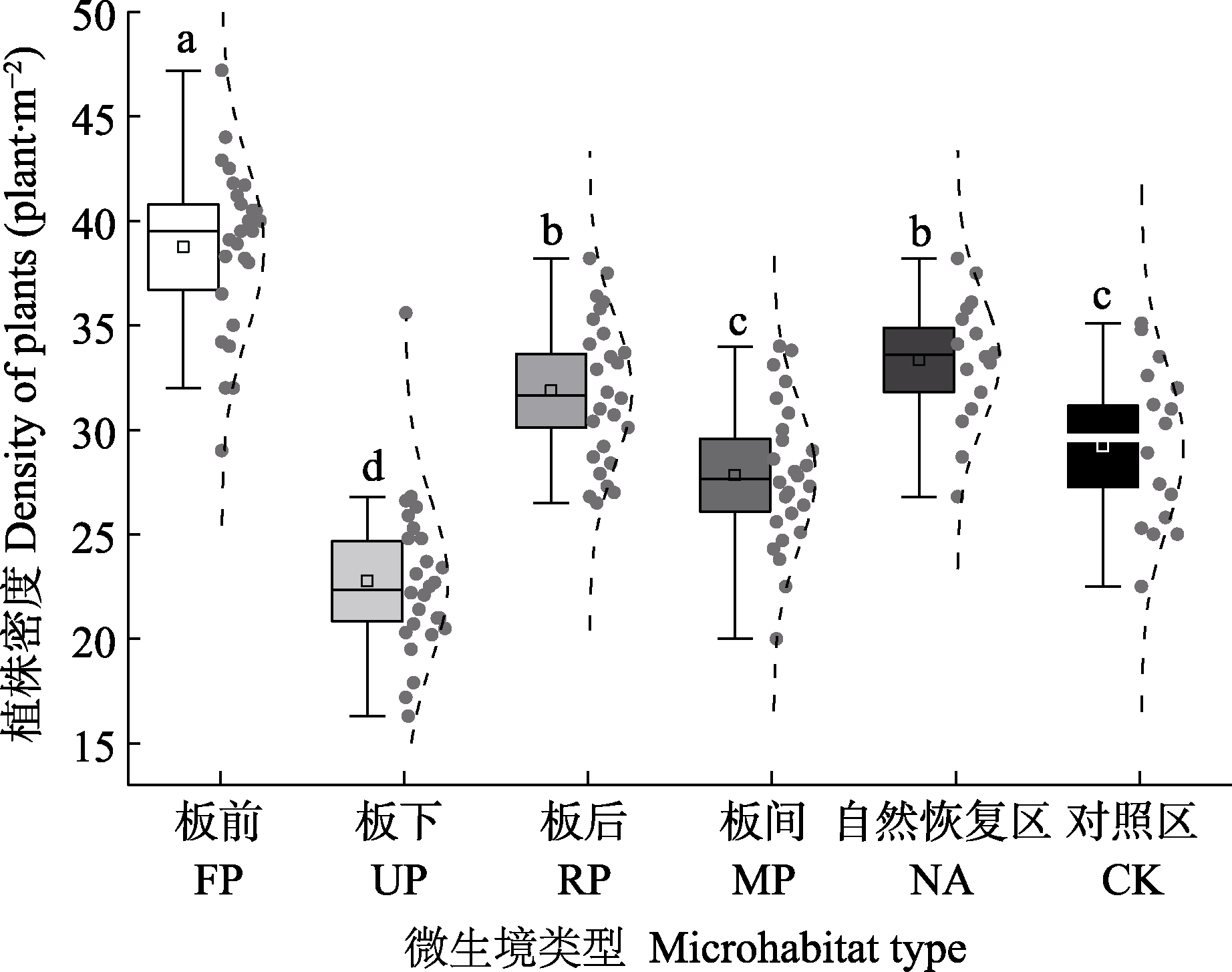
Fig. 5 Plant density in naturally recovered subsidence areas and photovoltaic zones across different microhabitat units in the Yushenfu mining region. CK, control area; FP, front eaves of the photovoltaic panel; MP, middle of the photovoltaic panel; NA, coal mining subsidence areas with natural recovery; RP, rear eaves of the photovoltaic panel; UP, underside of the photovoltaic panel. Different lowercase letters indicate significant differences among different sampling sites (p < 0.05).
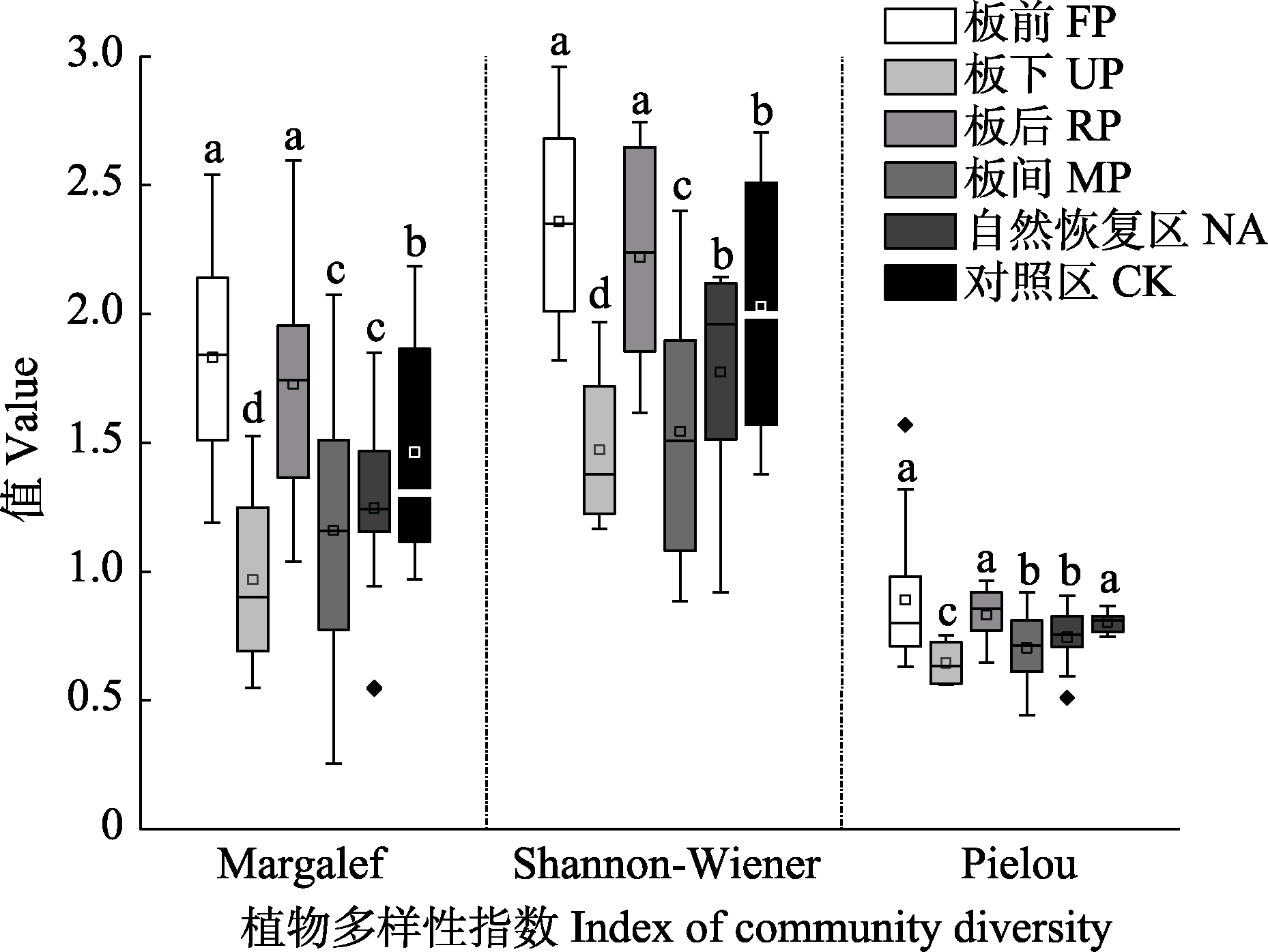
Fig. 6 Plant diversity indices in naturally recovered subsidence areas and photovoltaic zones across different microhabitat units in the Yushenfu mining region. CK, control area; FP, front eaves of the photovoltaic panel; MP, middle of the photovoltaic panel; NA, coal mining subsidence areas with natural recovery; RP, rear eaves of the photovoltaic panel; UP, underside of the photovoltaic panel. Different lowercase letters indicate significant differences among different sampling sites (p < 0.05).
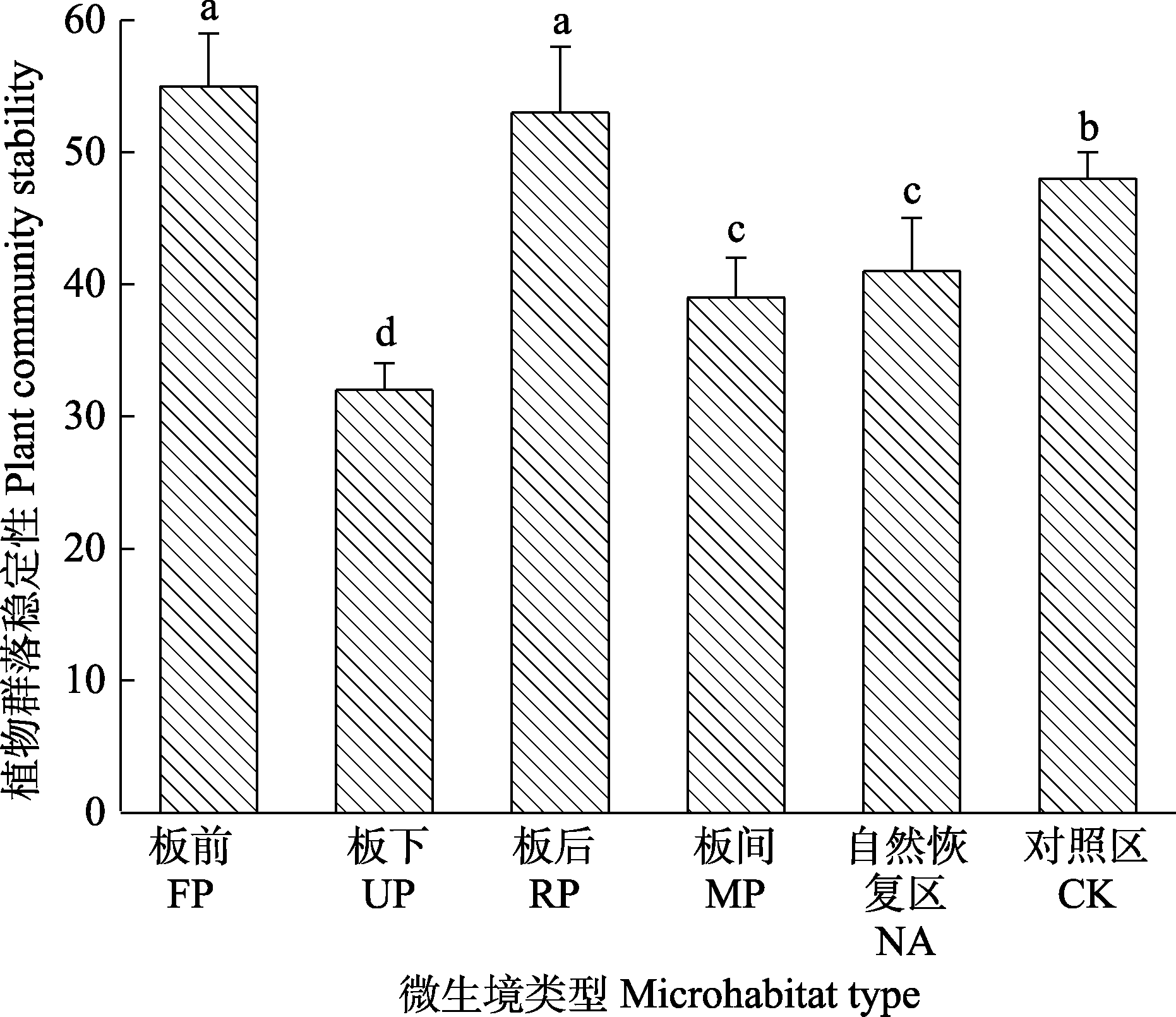
Fig. 7 Plant community stability in naturally recovered subsidence areas and photovoltaic zones across different microhabitat units in the Yushenfu mining region (mean ± SD). CK, control area; FP, front eaves of the photovoltaic panel; MP, middle of the photovoltaic panel; NA, coal mining subsidence areas with natural recovery; RP, rear eaves of the photovoltaic panel; UP, underside of the photovoltaic panel. Different lowercase letters indicate significant differences among different sampling sites (p < 0.05).
| 样地 Sample plot | 板前 FP | 板下 UP | 板后 RP | 板间 MP | 自然 恢复区 NA | 对照区 CK | |
|---|---|---|---|---|---|---|---|
| 板前 FP | 1 | ||||||
| 板下 UP | 0.33 | 1 | |||||
| 板后 RP | 0.60 | 0.41 | 1 | ||||
| 板间 MP | 0.34 | 0.41 | 0.59 | 1 | |||
| 自然恢复区 NA | 0.44 | 0.37 | 0.48 | 0.51 | 1 | ||
| 对照区 CK | 0.57 | 0.31 | 0.55 | 0.48 | 0.51 | 1 | |
Table 4 Composition similarity of plant communities among non-subsided lands, naturally recovered subsidence areas, and photovoltaic microhabitat units in the Yushenfu mining region
| 样地 Sample plot | 板前 FP | 板下 UP | 板后 RP | 板间 MP | 自然 恢复区 NA | 对照区 CK | |
|---|---|---|---|---|---|---|---|
| 板前 FP | 1 | ||||||
| 板下 UP | 0.33 | 1 | |||||
| 板后 RP | 0.60 | 0.41 | 1 | ||||
| 板间 MP | 0.34 | 0.41 | 0.59 | 1 | |||
| 自然恢复区 NA | 0.44 | 0.37 | 0.48 | 0.51 | 1 | ||
| 对照区 CK | 0.57 | 0.31 | 0.55 | 0.48 | 0.51 | 1 | |
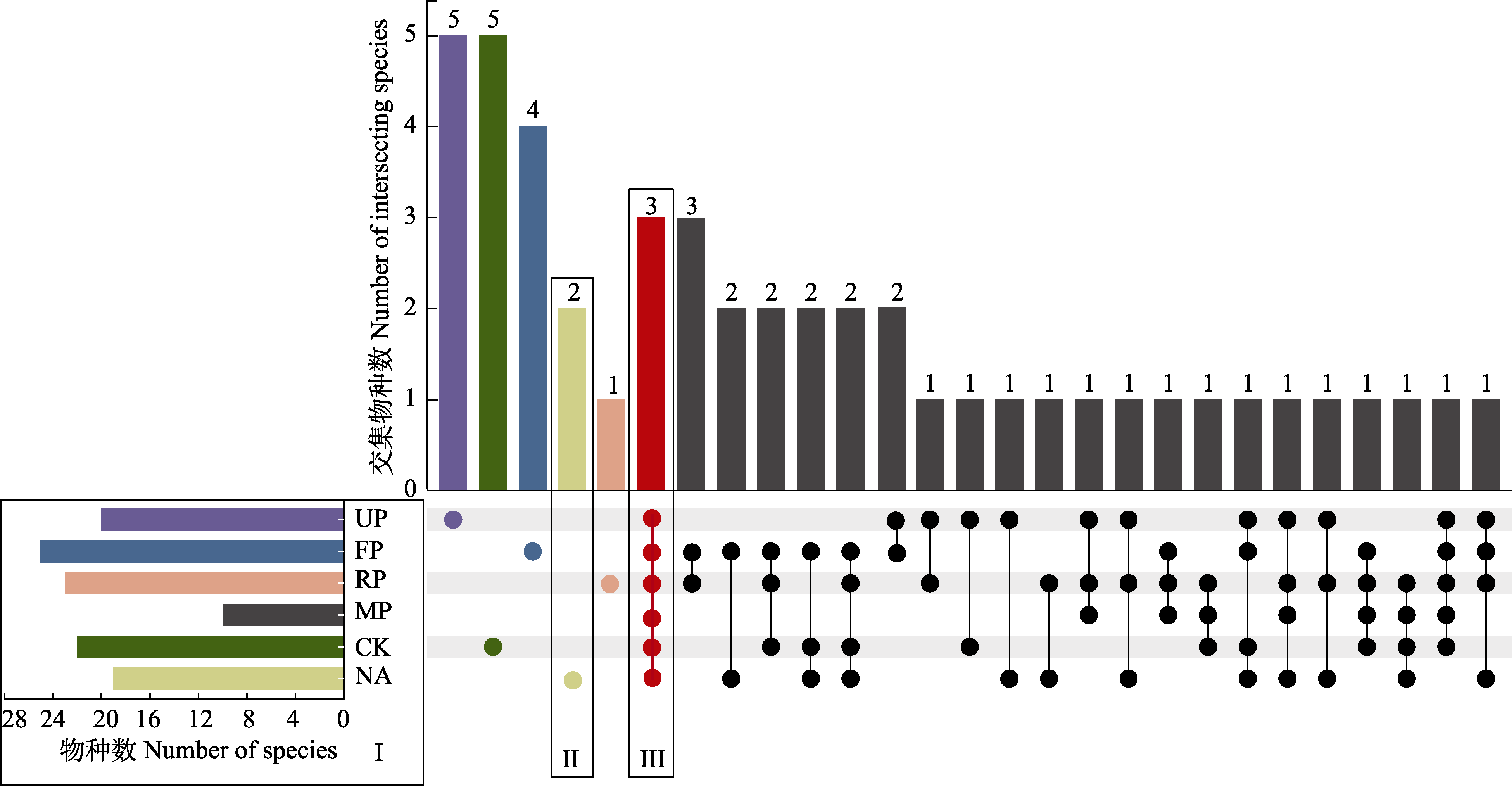
Fig. 8 Collection of plant species composition among non-subsided lands, naturally recovered subsidence areas and photovoltaic microhabitat units in the Yushenfu mining region. I, the collection of vegetation in all sample plots in the study area; II, the number of unique species of vegetation in coal mining subsidence areas with natural recovery is 2; III, the number of species intersection between vegetation indifferent sites of photovoltaic plant and coal mining subsidence areas with natural recovery. The dot color represents different plots, the line represents the intersection of the number of plant species in different plots (corresponding to the above histogram), and the columns with different color represent the number of unique plant species in the corresponding plots. CK, control area; FP, front eaves of the photovoltaic panel; MP, middle of the photovoltaic panel; NA, coal mining subsidence areas with natural recovery; RP, rear eaves of the photovoltaic panel; UP, underside of the photovoltaic panel.
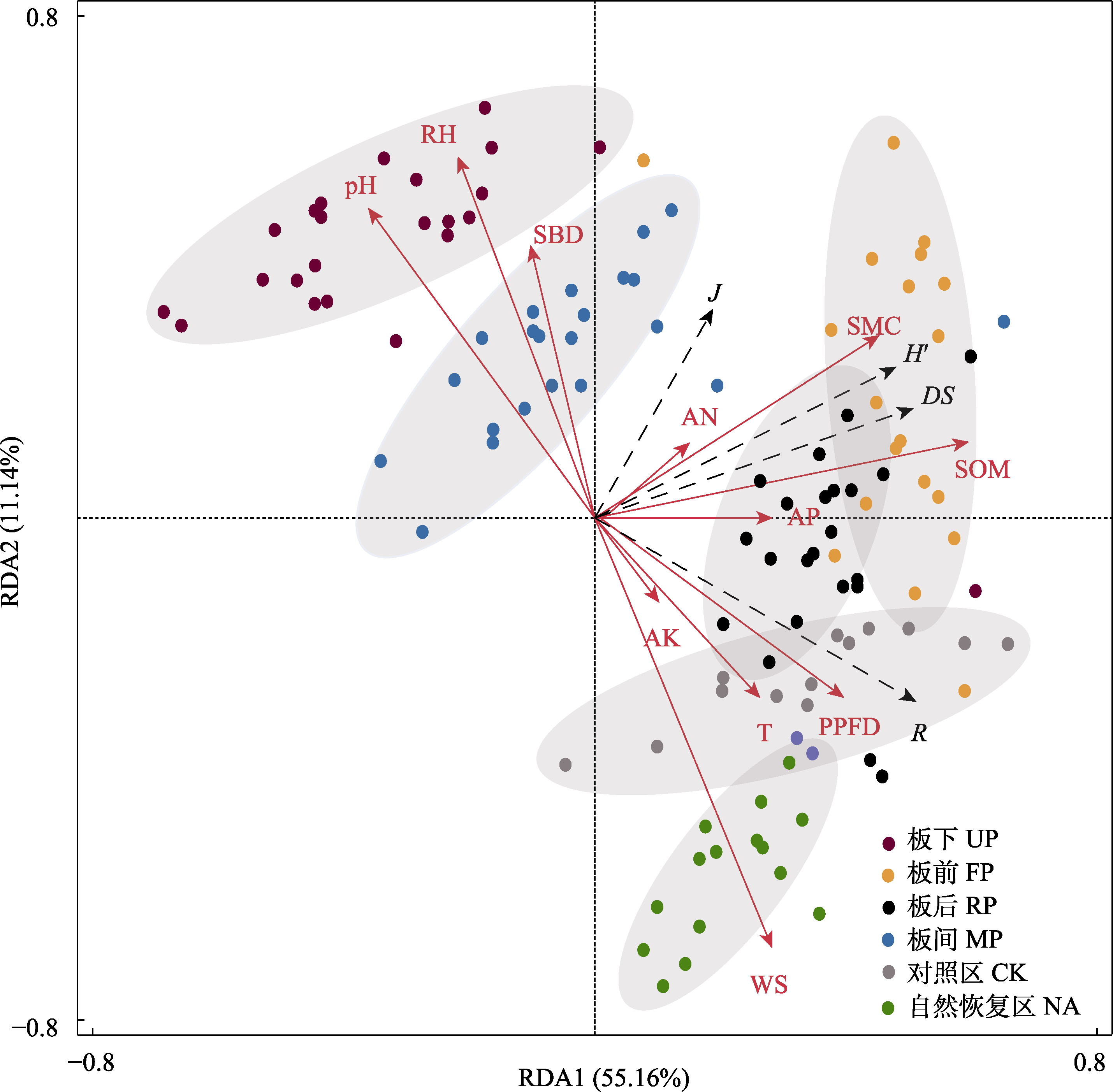
Fig. 9 Redundancy analysis (RDA) of environmental drivers of plant diversity among non-subsided lands, naturally recovered subsidence areas, and photovoltaic microhabitat units in the Yushenfu mining region. AK, effective potassium content; AN, effective nitrogen content; AP, effective phosphorus content; DS, Simpson index; H′, Shannon-Wiener diversity index; J, Pielou index; pH, soil pH; PPFD, light intensity; R, Margalef index; RH, air humidity; SBD, soil bulk density; SMC, soil moisture; SOM, soil organic matter content; T, surface temperature; WS, surface wind speed. CK, control area; FP, front eaves of the photovoltaic panel; MP, middle of the photovoltaic panel; NA, coal mining subsidence areas with natural recovery; RP, rear eaves of the photovoltaic panel; UP, underside of the photovoltaic panel.
| [1] | Barron-Gafford GA, Minor RL, Allen NA, Cronin AD, Brooks AE, Pavao-Zuckerman MA (2016). The photovoltaic heat island effect: larger solar power plants increase local temperatures. Scientific Reports, 6, 35070. DOI: 10.1038/srep35070. |
| [2] |
Baucom RS, Heath KD, Chambers SM (2020). Plant- environment interactions from the lens of plant stress, reproduction, and mutualisms. American Journal of Botany, 107, 175-178.
DOI URL |
| [3] |
Chesson P (2000). Mechanisms of maintenance of species diversity. Annual Review of Ecology and Systematics, 31, 343-366.
DOI URL |
| [4] | Cui Y, Chen ZH (2018). Research progresses of the impacts of photovoltaic power plants on local climate. Climate Change Research, 14, 593-601. |
| [崔杨, 陈正洪 (2018). 光伏电站对局地气候的影响研究进展. 气候变化研究进展, 14, 593-601.] | |
| [5] | Du HD, Cao YC, Nie WJ, Song SJ (2021). Evolution of soil properties under artificial and natural revegetation in loess gully coal mining subsidence area. Journal of China Coal Society, 46, 1641-1649. |
| [杜华栋, 曹祎晨, 聂文杰, 宋世杰 (2021). 黄土沟壑区采煤塌陷地人工与自然植被恢复下土壤性质演变特征. 煤炭学报, 46, 1641-1649.] | |
| [6] |
Du HD, Cao YC, Zhang YY, Ning BY (2021). Plant community development in a coal mining subsidence area: active versus passive revegetation. Écoscience, 28, 185-197.
DOI URL |
| [7] | Fan LM, Ma WC, Chang BF, Sun K, Miao YP, Lu B, Tian SB, Yang L (2023). Hydrochemical characteristics and formation mechanism of groundwater in Yushenfu Mining Area. Coal Science and Technology, 51(1), 383-394. |
| [范立民, 马万超, 常波峰, 孙魁, 苗彦平, 路波, 田水豹, 杨磊 (2023). 榆神府矿区地下水水化学特征及形成机理. 煤炭科学技术, 51(1), 383-394.] | |
| [8] | Fleisher KR, Hufford KM (2020). Assessing habitat heterogeneity and vegetation outcomes of geomorphic and traditional Linear-slope methods in post-mine reclamation. Journal of Environmental Management, 255, 109854. DOI: 10.1016/j.jenvman.2019.109854. |
| [9] | Guo Q (2022). Effects of Photovoltaic Panel Arrays on Plant Communities and Soil Characteristics in Degraded Grassland in the Songnen Plain. PhD dissertation, Northeast Normal University, Changchun. |
| [郭嫱 (2022). 光伏板阵列对松嫩退化草地植物群落和土壤特征的影响. 博士学位论文, 东北师范大学, 长春.] | |
| [10] | Guo YP, Schöb C, Ma WH, Mohammat A, Liu HY, Yu SL, Jiang YX, Schmid B, Tang ZY (2019). Increasing water availability and facilitation weaken biodiversity-biomass relationships in shrublands. Ecology, 100, e02624. DOI: 10.1002/ecy.2624. |
| [11] | Hao XZ, Yu H, Wu XY, Feng TJ, Wang C, Tian LH, Tan MD, Peng HW, Wang P (2025). Effects of typical photovoltaic power station construction on vegetation properties and soil properties in Tibetan Plateau desert region. Acta Ecologica Sinica, 45, 5510-5526. |
| [郝晓珍, 于航, 吴星叶, 冯天骄, 王成, 田丽慧, 谭梦迪, 彭怀午, 王平 (2025). 青藏高原荒漠区典型光伏电站建设对植被属性和土壤性质的影响. 生态学报, 45, 5510-5526.] | |
| [12] | Hou DJ, Li N, Qu XY, Dong SQ, Han BL, Guo K, Liu CC (2024). The spatial pattern and driving factors of Haloxylon ammodendron community in the arid region of northern Qinghai-Tibet Plateau. Acta Ecologica Sinica, 44, 11307-11316. |
| [侯东杰, 李楠, 曲孝云, 董少琼, 韩蓓蕾, 郭柯, 刘长成 (2024). 青藏高原北部干旱区梭梭群落特征空间分布格局及其驱动因子. 生态学报, 44, 11307-11316.] | |
| [13] | Jamal J, Mansur I, Rasid A, Mulyadi M, Dihyah Marwan M, Marwan M (2024). Evaluating the shading effect of photovoltaic panels to optimize the performance ratio of a solar power system. Results in Engineering, 21, 101878. DOI: 10.1016/j.rineng.2024.101878. |
| [14] |
James CS, Capon SJ, Quinn GP (2015). Nurse plant effects of a dominant shrub (Duma florulenta) on understorey vegetation in a large, semi-arid wetland in relation to flood frequency and drying. Journal of Vegetation Science, 26, 985-994.
DOI URL |
| [15] | Li BB, Li PP, Zhang WT, Ji JY, Liu GB, Xu MX (2021). Deep soil moisture limits the sustainable vegetation restoration in arid and semi-arid Loess Plateau. Geoderma, 399, 115122. DOI: 10.1016/j.geoderma.2021.115122. |
| [16] | Li H, Sun JS (2022). New model of waste mine treatment under the background of “double carbon” —Photovoltaic power station model. Nonferrous Metals (Mining Section), 74(6), 70-73. |
| [李昊, 孙金水 (2022). “双碳”背景下废弃矿山治理新模式研究——光伏发电站模式. 有色金属(矿山部分), 74(6), 70-73.] | |
| [17] | Li QS, Li L, Fang J, Guo JT, Li J, Xu ZH, Li XB (2024). Ecological protection coal mining technology system and engineering practice. Coal Science and Technology, 52(4), 28-37. |
| [李全生, 李淋, 方杰, 郭俊廷, 李军, 徐祝贺, 李晓斌 (2024). 生态保护型煤炭开采技术与实践. 煤炭科学技术, 52(4), 28-37.] | |
| [18] | Liu FF, Mao XS, Xu C, Li YY, Wu Q, Zhang JX (2020). “Covering effects” under diurnal temperature variations in arid and semiarid areas. Advances in Civil Engineering, 2020, 7496182. DOI: 10.1155/2020/7496182. |
| [19] | Liu Y, Zhang RQ, Ma XR, Wu GL (2020). Combined ecological and economic benefits of the solar photovoltaic industry in arid sandy ecosystems. Journal of Cleaner Production, 262, 121376. DOI: 10.1016/j.jclepro.2020.121376. |
| [20] |
Lu Y, Xiao X, Liang Y, Li JC, Guo CY, Xu LL, Liu QF, Xiao Y, Zhou SY (2024). Distribution and transformation of potentially toxic elements in cracks under coal mining disturbance in farmland. Environmental Geochemistry and Health, 46, 312. DOI: 10.1007/s10653-024-02107-y.
PMID |
| [21] | Luo DH, Li KR (2024). Difficulties, challenges and countermeasure suggestions faced by the comprehensive management of “photovoltaic + coal mining subsidence area”. China Power Enterprise Management, (19), 66-69. |
| [雒德宏, 李柯润 (2024). “光伏+采煤沉陷区综合治理”面临的困难、挑战与对策建议. 中国电力企业管理, (19), 66-69.] | |
| [22] |
Martínez-Blancas A, Martorell C (2020). Changes in niche differentiation and environmental filtering over a hydric stress gradient. Journal of Plant Ecology, 13, 185-194.
DOI |
| [23] | Shang HB (2010). Conventional Analysis Methods of Resources and Environment. Northwest A&F University Press, Yangling, Shaanxi. |
| [尚浩博 (2010). 资源环境常规分析方法. 西北农林科技大学出版社, 陕西杨凌.] | |
| [24] | Tao WH, Shao FF, Yan HK, Wang QJ (2024). Microbial organic fertilizer combined with magnetically treated water drip irrigation promoted the stability of desert soil aggregates and improved the yield and quality of jujubes. Plants, 13, 1930. DOI: 10.3390/plants13141930. |
| [25] | Tian ZQ, Zhang Y, Liu X, Chen SY, Liu BL, Wu JH (2024). Effects of photovoltaic power station construction on terrestrial environment: retrospect and prospect. Environmental Science, 45, 239-247. |
| [田政卿, 张勇, 刘向, 陈生云, 柳本立, 吴纪华 (2024). 光伏电站建设对陆地生态环境的影响: 研究进展与展望. 环境科学, 45, 239-247.] | |
| [26] | Tu HR, Nong JL, Zhu J, Zhao JJ, Yang WL, Zhu QQ, Xie YJ, Liu RH (2022). Interspecific associations of main species and community stability of Myrsine seguinii community in karst hills of Guilin, southwestern China. Acta Ecologica Sinica, 42, 3688-3705. |
| [涂洪润, 农娟丽, 朱军, 赵佳佳, 杨婉琳, 朱琪琪, 谢彦军, 刘润红 (2022). 桂林岩溶石山密花树群落主要物种的种间关联及群落稳定性. 生态学报, 42, 3688-3705.] | |
| [27] | Uldrijan D, Kováčiková M, Jakimiuk A, Vaverková MD, Winkler J (2021). Ecological effects of preferential vegetation composition developed on sites with photovoltaic power plants. Ecological Engineering, 168, 106274. DOI: 10.1016/j.ecoleng.2021.106274. |
| [28] | Vervloesem J, Marcheggiani E, Choudhury MAM, Muys B (2022). Effects of photovoltaic solar farms on microclimate and vegetation diversity. Sustainability, 14, 7493. DOI: 10.3390/su14127493. |
| [29] | Wang DL, Guo YY, Xie W, Qian XT, Guo JJ, Zhao XL, Lian Z, Du HD (2022). Community and soil seed bank characteristics of different vegetation restoration types in aeolian sandy loess dumps. Research of Soil and Water Conservation, 29(5), 171-177. |
| [王东丽, 郭莹莹, 谢伟, 钱晓彤, 郭建军, 赵晓亮, 连昭, 杜华栋 (2022). 风沙黄土区排土场不同恢复类型植物群落与土壤种子库特征. 水土保持研究, 29(5), 171-177.] | |
| [30] | Wu CD, Liu H, Yu Y, Zhao WZ, Liu JT, Yu HL, Yetemen O (2022). Ecohydrological effects of photovoltaic solar farms on soil microclimates and moisture regimes in arid Northwest China: a modeling study. Science of the Total Environment, 802, 149946. DOI: 10.1016/j.scitotenv.2021.149946. |
| [31] | Wu H, Dong SJ, Rao BQ (2022). Latitudinal trends in the structure, similarity and beta diversity of plant communities invaded by Alternanthera philoxeroides in heterogeneous habitats. Frontiers in Plant Science, 13, 1021337. DOI: 10.3389/fpls.2022.1021337. |
| [32] |
Wu ZQ, Luo ZX, Luo JF, Sui X, Wu SN, Luo XL (2023). Spatial differentiation of soil fertility in a photovoltaic power station in rocky desertification zone. Chinese Journal of Ecology, 42, 2597-2603.
DOI |
| [吴智泉, 罗忠新, 罗久富, 隋欣, 吴赛男, 罗小林 (2023). 石漠化光伏场区土壤肥力质量空间分异特征. 生态学杂志, 42, 2597-2603.] | |
| [33] | Yang RT, Niu QH, Qu JJ, Xie SB, Wang YK, Ma C (2022). Influence of fixed-stand photovoltaic array on wind field in Gonghe Basin, Qinghai, China. Journal of Desert Research, 42(5), 114-121. |
|
[杨若婷, 牛清河, 屈建军, 谢胜波, 王彦奎, 马超 (2022). 青海共和盆地固定支架式光伏阵列对阵内风场的影响. 中国沙漠, 42(5), 114-121.]
DOI |
|
| [34] | Yang YY, Su SL, Cao EZ, Li HY, Chi HM, Lin K, Wu XD, He WQ, Yang HT (2025). Impacts of large-scale desert photovoltaic power stations on the phenotype and biomass distribution characteristics of sand-fixing plants. Journal of Desert Research, 45(1), 162-172. |
|
[杨奕颖, 苏思霖, 曹恩志, 李红有, 迟洪明, 蔺凯, 吴旭东, 何文强, 杨昊天 (2025). 沙漠大型光伏电站对固沙植物表型及生物量分配的影响. 中国沙漠, 45(1), 162-172.]
DOI |
|
| [35] | Yue M, Wu ZH, Liu PL, Lu Y, Li ZH (2022). Flora of Shaanxi: Vol. 4. Science Press, Beijing. |
| [岳明, 吴振海, 刘培亮, 卢元, 李忠虎 (2022). 陕西植物志: 第四卷, 科学出版社, 北京.] | |
| [36] |
Yue SJ, Guo MJ, Zou PH, Wu W, Zhou XD (2021). Effects of photovoltaic panels on soil temperature and moisture in desert areas. Environmental Science and Pollution Research, 28, 17506-17518.
DOI |
| [37] | Zhai B, Gao Y, Dang XH, Chen X, Cheng B, Liu XJ, Zhang C (2018). Effects of photovoltaic panels on the characteristics and diversity of Leymus chinensis community. Chinese Journal of Ecology, 37, 2237-2243. |
| [翟波, 高永, 党晓宏, 陈曦, 程波, 刘湘杰, 张超 (2018). 光伏电板对羊草群落特征及多样性的影响. 生态学杂志, 37, 2237-2243.] | |
| [38] | Zhang J, Li ZX, Tao JY, Ge YD, Zhong YZ, Wang YB, Yan BB (2024). Observed impacts of ground-mounted photovoltaic systems on the microclimate and soil in an arid area of Gansu, China. Atmosphere, 15, 936. DOI: 10.3390/atmos15080936. |
| [39] | Zhang SQ, Gong JR, Zhang WY, Dong XD, Hu YX, Yang GS, Yan CY, Liu YY, Wang RJ, Zhang SP, Wang T (2024). Photovoltaic systems promote grassland restoration by coordinating water and nutrient uptake, transport and utilization. Journal of Cleaner Production, 447, 141437. DOI: 10.1016/j.jclepro.2024.141437. |
| [40] | Zhang ZJ, Wang QX, Liu ZG, Chen Q, Guo ZL, Zhang HR (2023). Renew mineral resource-based cities: assessment of PV potential in coal mining subsidence areas. Applied Energy, 329, 120296. DOI: 10.1016/j.apenergy.2022.120296. |
| [1] | ZHANG Jing, CHEN Jie, LI Yan-Peng, PAN Li-Jun, XU Han, LI Yi-De, HE Hai-Sheng. Comparison of plant biomass in conifer and broadleaf mixed artificial forests in south subtropical area and analyses of influential factors [J]. Chin J Plant Ecol, 2026, 50(2): 400-416. |
| [2] | LIU Qiang, MA Hong-Yuan, PENG Yun-Feng, LA Ben, YE De-Li, ZHANG Jia-Chen, LAI Jun-Hua. Influence of large-scale photovoltaic development on carbon storage in an alpine desert grassland ecosystem [J]. Chin J Plant Ecol, 2025, 49(11): 1791-1804. |
| [3] | FANG Kai, WANG Ying-Xin, HUANG Jian-Hui, DUAN Jun-Guang, ZHANG Qi, ZHANG Qian, GAN Hong-Hao, CHU Jian-Min. Deciphering the nutrient factors limiting vegetation restoration under different degradation stages in typical steppe of Nei Mongol, China [J]. Chin J Plant Ecol, 2025, 49(1): 7-18. |
| [4] | CHEN Xue-Ping, ZHAO Xue-Yong, ZHANG Jing, WANG Rui-Xiong, LU Jian-Nan. Variation of NDVI spatio-temporal characteristics and its driving factors based on geodetector model in Horqin Sandy Land, China [J]. Chin J Plant Ecol, 2023, 47(8): 1082-1093. |
| [5] | LUO Na-Na, SHENG Mao-Yin, WANG Lin-Jiao, SHI Qing-Long, HE Yu. Effects of long-term vegetation restoration on soil active organic carbon fractions content and enzyme activities in karst rocky desertification ecosystem of southwest China [J]. Chin J Plant Ecol, 2023, 47(6): 867-881. |
| [6] | CUI Guang-Shuai, LUO Tian-Xiang, LIANG Er-Yuan, ZHANG Lin. Advances in the study of shrubland facilitation on herbs in arid and semi-arid regions [J]. Chin J Plant Ecol, 2022, 46(11): 1321-1333. |
| [7] | DENG Meng-Da, YOU Jian-Rong, LI Jia-Xiang, LI Xiong, YANG Jing, DENG Chuang-Fa, LIU Ang, LIU Wen-Jian, DING Cong, XIE Yong, ZHOU Guo-Hui, YU Xun-Lin. Community characteristics of main vegetation types in the ecological “green-core” area of Changzhutan urban cluster [J]. Chin J Plant Ecol, 2020, 44(12): 1296-1304. |
| [8] | WANG Ming-Ming,LIU Xin-Ping,HE Yu-Hui,ZHANG Tong-Hui,WEI Jing,Chelmge ,SUN Shan-Shan. How enclosure influences restored plant community changes of different initial types in Horqin Sandy Land [J]. Chin J Plant Ecol, 2019, 43(8): 672-684. |
| [9] | CHEN Chan, ZHANG Shi-Ji, LI Lei-Da, LIU Zhao-Dan, CHEN Jin-Lei, GU Xiang, WANG Liu-Fang, FANG Xi. Carbon, nitrogen and phosphorus stoichiometry in leaf, litter and soil at different vegetation restoration stages in the mid-subtropical region of China [J]. Chin J Plant Ecol, 2019, 43(8): 658-671. |
| [10] | YU Xiao-Ya, LI Yu-Hui, YANG Guang-Rong. Fruit types and seed dispersal modes of plants in different communities in Shilin Geopark, Yunnan, China [J]. Chin J Plant Ecol, 2018, 42(6): 663-671. |
| [11] | GU Xiang, ZHANG Shi-Ji, LIU Zhao-Dan, LI Lei-Da, CHEN Jin-Lei, WANG Liu-Fang, FANG Xi. Effects of vegetation restoration on soil organic carbon concentration and density in the mid-subtropical region of China [J]. Chin J Plant Ecol, 2018, 42(5): 595-608. |
| [12] | GU Xiang, ZHANG Shi-Ji, LIU Zhao-Dan, LI Lei-Da, CHEN Jin-Lei, WANG Liu-Fang, FANG Xi. Effects of vegetation restoration on soil organic carbon mineralization in the east of Hunan, China [J]. Chin J Plant Ecol, 2018, 42(12): 1211-1224. |
| [13] | Hao ZHANG, Mao-Kui Lyu, Jin-Sheng XIE. Effect of Dicranopteris dichotoma on spectroscopic characteristic of dissolved organic matter in red soil erosion area [J]. Chin J Plant Ecol, 2017, 41(8): 862-871. |
| [14] | LIU Zhu,YANG Yu-Sheng,SI You-Tao,KANG Gen-Li,ZHENG Huai-Zhou. Effects of vegetation restoration on content and spectroscopic characteristics of dissolved organic matter in eroded red soil [J]. Chin J Plant Ecol, 2014, 38(11): 1174-1183. |
| [15] | WANG Xie,XIANG Cheng-Hua,LI Xian-Wei,WEN Dong-Ju. Effects of a winter wildfire on plant community structure and forage quality in subalpine grassland of western Sichuan, China [J]. Chin J Plant Ecol, 2013, 37(10): 922-932. |
| Viewed | ||||||
|
Full text |
|
|||||
|
Abstract |
|
|||||
Copyright © 2026 Chinese Journal of Plant Ecology
Tel: 010-62836134, 62836138, E-mail: apes@ibcas.ac.cn, cjpe@ibcas.ac.cn

