
Chin J Plant Ecol ›› 2025, Vol. 49 ›› Issue (9): 1448-1460.DOI: 10.17521/cjpe.2024.0240 cstr: 32100.14.cjpe.2024.0240
• Research Articles • Previous Articles Next Articles
JIA Zi-Xuan1,*, FANG Tao2,*, ZHANG Shu-Xin2, LIU Yi-Fan2, ZHAO Wei2, WANG Rong3, CHANG Hai-Chao2, ZHU Yao-Jun4,5, LUO Fang-Li2,6,**( ), GUO Yun-Qian1,**(), YU Fei-Hai7,8
Received:2024-07-22
Accepted:2025-03-21
Online:2025-09-20
Published:2025-03-21
Contact:
LUO Fang-Li, GUO Yun-Qian
About author:First author contact:Contributed equally to this work
Supported by:JIA Zi-Xuan, FANG Tao, ZHANG Shu-Xin, LIU Yi-Fan, ZHAO Wei, WANG Rong, CHANG Hai-Chao, ZHU Yao-Jun, LUO Fang-Li, GUO Yun-Qian, YU Fei-Hai. Responses of aboveground-belowground traits of Phragmites australis in different marsh wetlands to changes in soil moisture[J]. Chin J Plant Ecol, 2025, 49(9): 1448-1460.
Add to citation manager EndNote|Ris|BibTeX
URL: https://www.plant-ecology.com/EN/10.17521/cjpe.2024.0240
| 湿地 Wetland | 高土壤水分含量 High soil moisture (%) | 低土壤水分含量 Low soil moisture (%) |
|---|---|---|
| 岱海 Daihai | 56.76 | 30.86 |
| 科尔沁 Horqin | 54.48 | 24.52 |
| 青铜峡 Qingtongxia | 56.18 | 29.34 |
Table 1 Average moisture content of low and high soil in each wetland (n = 30)
| 湿地 Wetland | 高土壤水分含量 High soil moisture (%) | 低土壤水分含量 Low soil moisture (%) |
|---|---|---|
| 岱海 Daihai | 56.76 | 30.86 |
| 科尔沁 Horqin | 54.48 | 24.52 |
| 青铜峡 Qingtongxia | 56.18 | 29.34 |
| 性状 Trait | 湿地 Wetland | 水分 Moisture | 湿地×水分 Wetland × moisture | |||
|---|---|---|---|---|---|---|
| F | p | F | p | F | p | |
| 叶生物量 Leaf biomass | 6.29 | 0.006 | 5.57 | 0.027 | 4.04 | 0.031 |
| 茎生物量 Stem biomass | 6.47 | 0.006 | 31.19 | <0.001 | 2.57 | 0.097 |
| 地上生物量 Aboveground biomass | 7.33 | 0.003 | 25.04 | <0.001 | 4.10 | 0.029 |
| 比叶面积 Specific leaf area | 28.04 | <0.001 | 8.41 | 0.008 | 6.76 | 0.005 |
| 根冠比 Root to shoot ratio | 1.68 | 0.208 | 1.34 | 0.258 | 2.64 | 0.092 |
| 叶氮含量 Leaf N content | 8.17 | 0.002 | 2.77 | 0.109 | 28.22 | <0.001 |
| 叶磷含量 Leaf P content | 7.94 | 0.002 | 1.75 | 0.198 | 15.08 | <0.001 |
| 叶非结构性碳水化合物含量 Leaf NSC content | 7.67 | 0.003 | 139.16 | <0.001 | 36.44 | <0.001 |
| 茎氮含量 Stem N content | 2.23 | 0.129 | 7.54 | 0.011 | 8.56 | 0.002 |
| 茎磷含量 Stem P content | 5.68 | 0.010 | 4.79 | 0.039 | 2.85 | 0.077 |
| 茎非结构性碳水化合物含量 Stem NSC content | 10.90 | <0.001 | 1.89 | 0.181 | 33.31 | <0.001 |
| 根表面积 Root surface area | 1.32 | 0.275 | 39.91 | <0.001 | 1.79 | 0.176 |
| 根体积 Root volume | 5.99 | 0.004 | 30.64 | <0.001 | 2.84 | 0.067 |
| 根直径 Root diameter | 14.94 | <0.001 | 5.11 | 0.028 | 1.65 | 0.202 |
| 根生物量 Root biomass | 3.68 | 0.032 | 36.26 | <0.001 | 4.48 | 0.016 |
Table 2 Results of variance analyses of aboveground and belowground traits of P. australis under low and high soil moisture in different marsh wetlands (n = 90)
| 性状 Trait | 湿地 Wetland | 水分 Moisture | 湿地×水分 Wetland × moisture | |||
|---|---|---|---|---|---|---|
| F | p | F | p | F | p | |
| 叶生物量 Leaf biomass | 6.29 | 0.006 | 5.57 | 0.027 | 4.04 | 0.031 |
| 茎生物量 Stem biomass | 6.47 | 0.006 | 31.19 | <0.001 | 2.57 | 0.097 |
| 地上生物量 Aboveground biomass | 7.33 | 0.003 | 25.04 | <0.001 | 4.10 | 0.029 |
| 比叶面积 Specific leaf area | 28.04 | <0.001 | 8.41 | 0.008 | 6.76 | 0.005 |
| 根冠比 Root to shoot ratio | 1.68 | 0.208 | 1.34 | 0.258 | 2.64 | 0.092 |
| 叶氮含量 Leaf N content | 8.17 | 0.002 | 2.77 | 0.109 | 28.22 | <0.001 |
| 叶磷含量 Leaf P content | 7.94 | 0.002 | 1.75 | 0.198 | 15.08 | <0.001 |
| 叶非结构性碳水化合物含量 Leaf NSC content | 7.67 | 0.003 | 139.16 | <0.001 | 36.44 | <0.001 |
| 茎氮含量 Stem N content | 2.23 | 0.129 | 7.54 | 0.011 | 8.56 | 0.002 |
| 茎磷含量 Stem P content | 5.68 | 0.010 | 4.79 | 0.039 | 2.85 | 0.077 |
| 茎非结构性碳水化合物含量 Stem NSC content | 10.90 | <0.001 | 1.89 | 0.181 | 33.31 | <0.001 |
| 根表面积 Root surface area | 1.32 | 0.275 | 39.91 | <0.001 | 1.79 | 0.176 |
| 根体积 Root volume | 5.99 | 0.004 | 30.64 | <0.001 | 2.84 | 0.067 |
| 根直径 Root diameter | 14.94 | <0.001 | 5.11 | 0.028 | 1.65 | 0.202 |
| 根生物量 Root biomass | 3.68 | 0.032 | 36.26 | <0.001 | 4.48 | 0.016 |
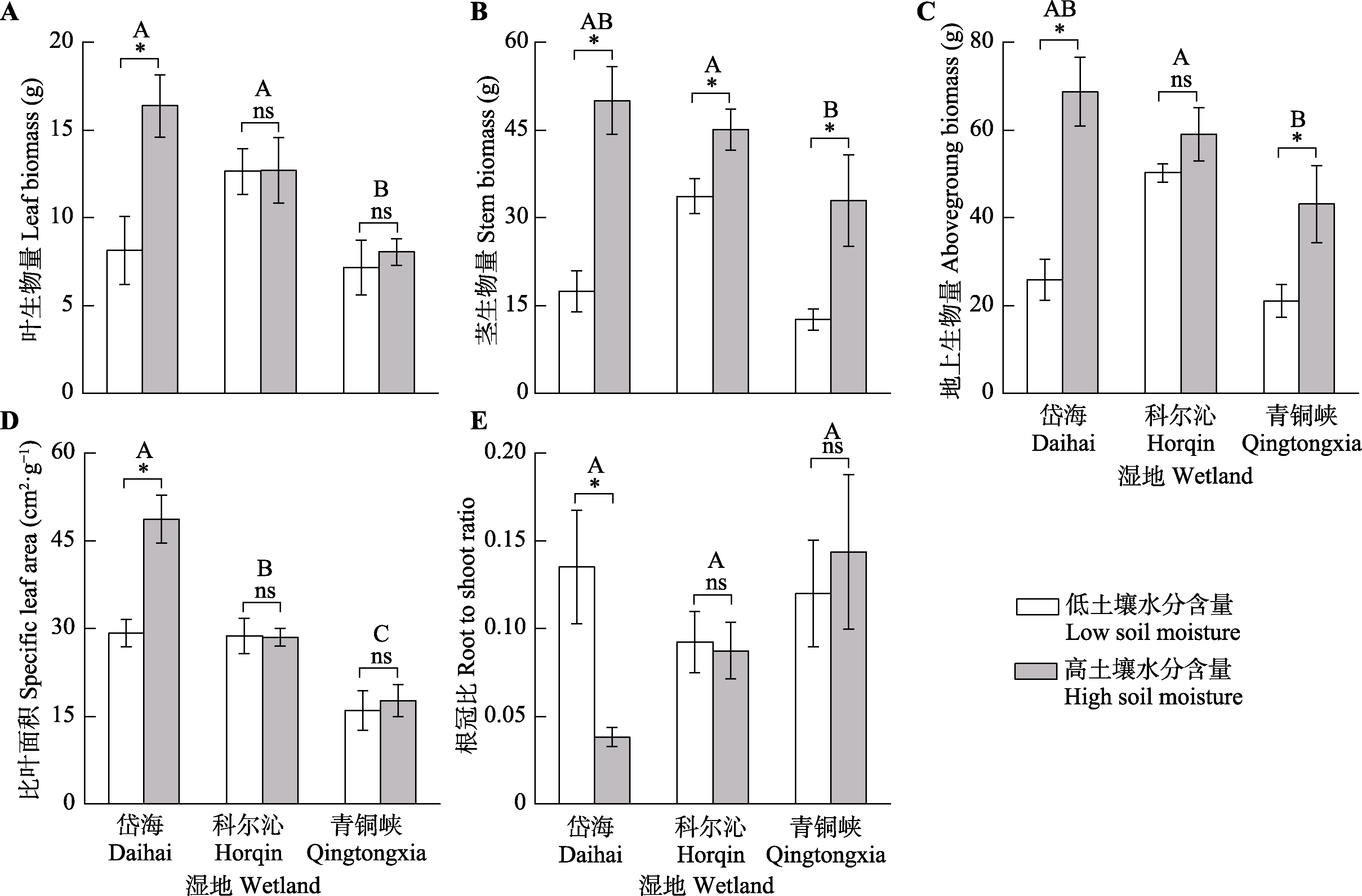
Fig. 1 Leaf biomass, stem biomass, aboveground biomass, specific leaf area and root to shoot ratio of Phragmites australis under low and high soil moisture conditions in different marsh wetlands (mean ± SE). Different uppercase letters indicate significant differences among different wetlands (p < 0.05); * indicates significant differences between low and high soil moisture conditions (p < 0.05), ns indicates no significant differences between low and high soil moisture conditions (p > 0.05).
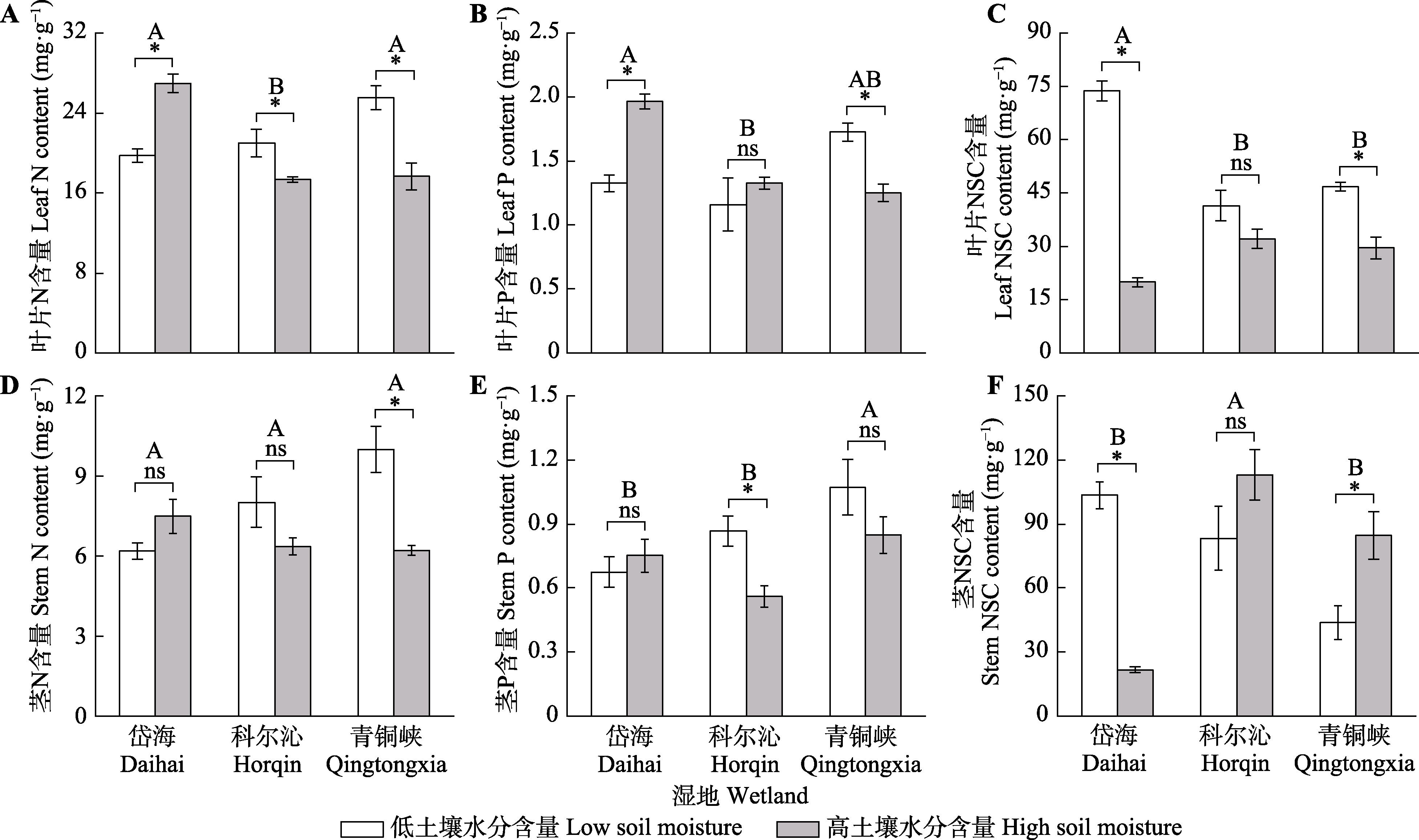
Fig. 2 Nitrogen (N), phosphorus (P) and non-structural carbohydrates (NSC) contents of Phragmites australis leaves and stems under low and high soil moisture conditions in different marsh wetlands (mean ± SE). Different uppercase letters indicate significant differences among different wetlands (p < 0.05); * indicates significant differences between low and high soil moisture conditions (p < 0.05), ns indicates no significant differences between low and high soil moisture conditions (p > 0.05).
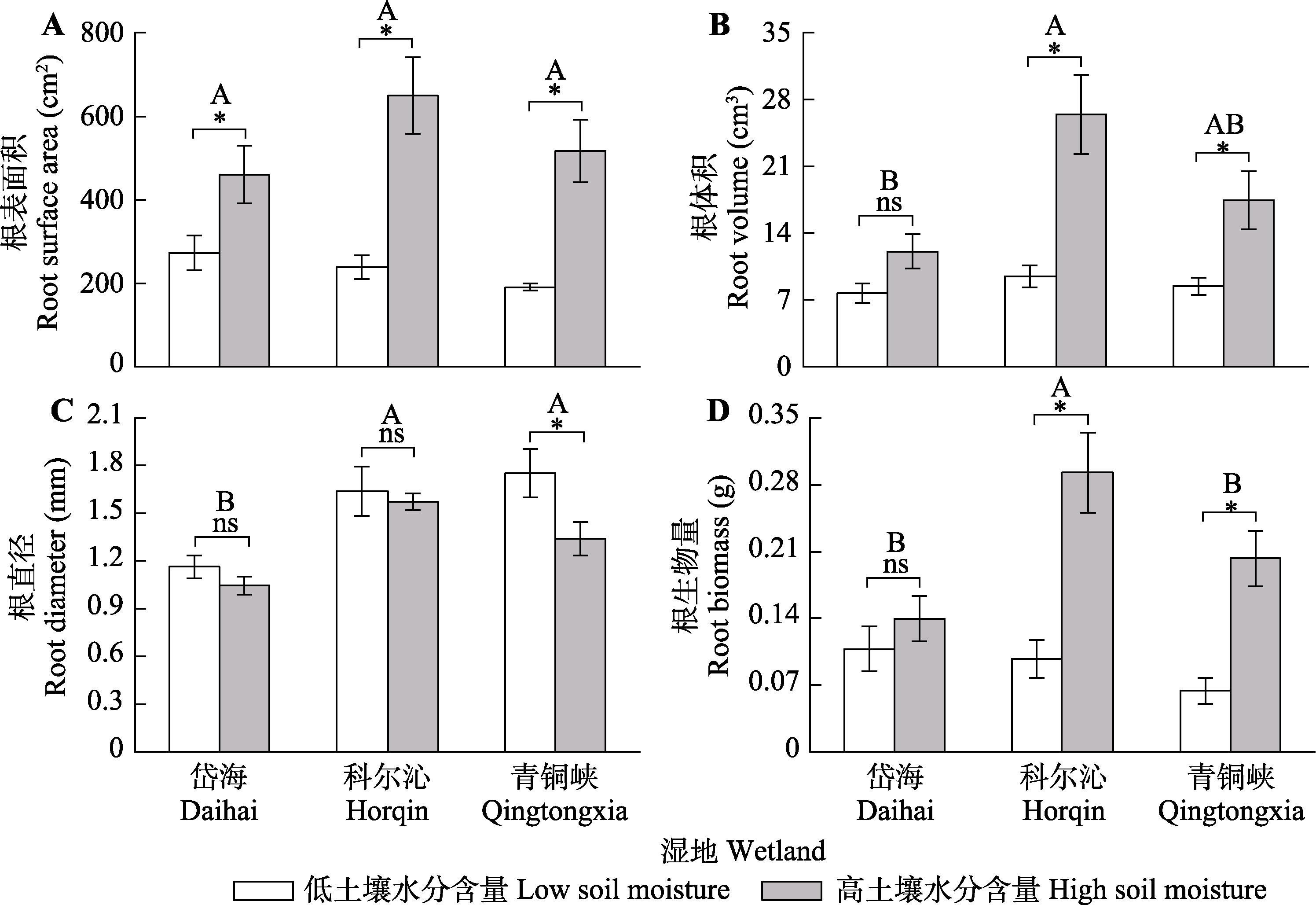
Fig. 3 Root diameter, surface area, volume and biomass of Phragmites australis under low and high soil moisture conditions in different marsh wetlands (mean ± SE). Different uppercase letters indicate significant differences among different wetlands (p < 0.05); * indicates significant differences between low and high soil moisture conditions (p < 0.05), ns indicates no significant differences between low and high soil moisture conditions (p > 0.05).
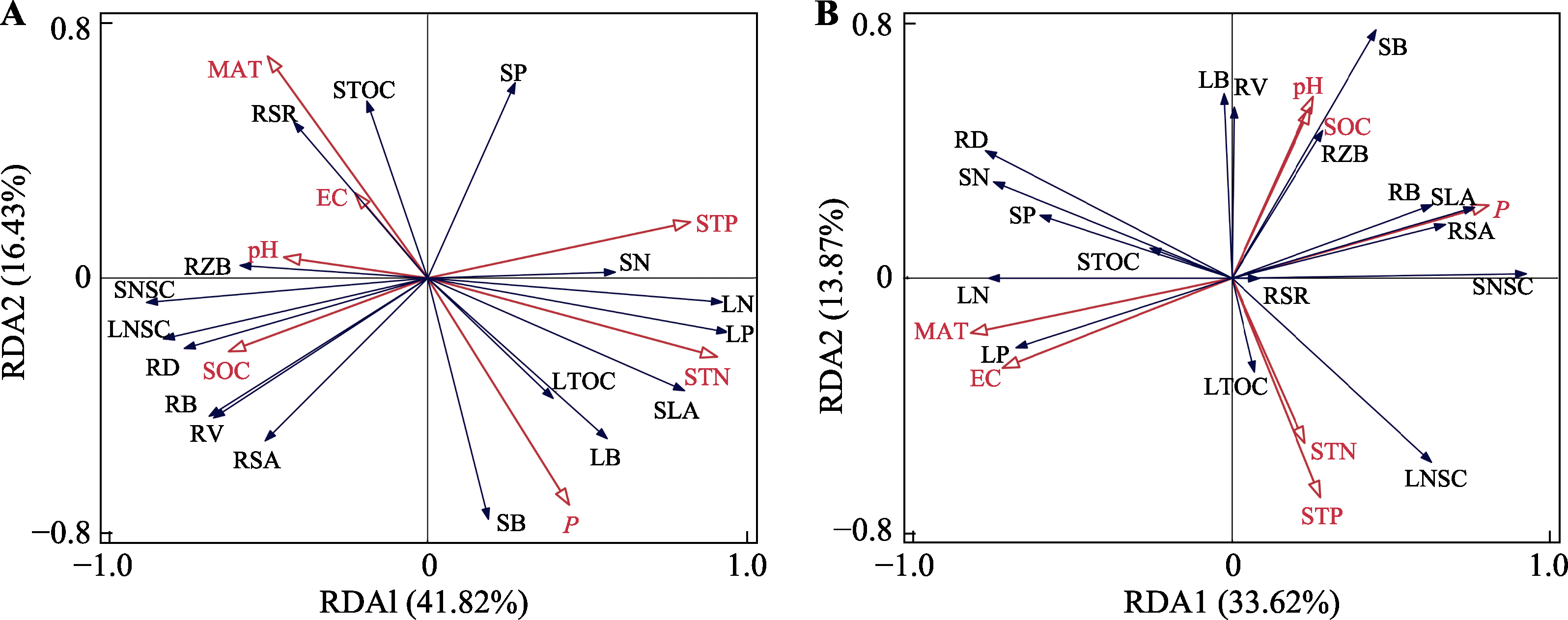
Fig. 4 Redundancy analysis (RDA) of environmental factors and aboveground traits and belowground traits of Phragmites australis under high (A) and low (B) soil moisture conditions. EC, electrical conductivity; LB, leaf biomass; LN, leaf nitrogen content; LNSC, leaf non-structural carbohydrates content; LP, leaf phosphorous content; LTOC, total organic carbon content of leaves; MAT, mean annual air temperature; P, precipitation; pH, soil pH; RB, root biomass; RD, root diameter; RSA, root surface area; RSR, root to shoot ratio; RV, root volume; RZB, rhizome biomass; SB, stem biomass; SLA, specific leaf area; SN, stem nitrogen content; SNSC, stem non-structural carbohydrates content; SOC, soil organic carbon content; SP, stem phosphorous content; STN, soil total nitrogen content; STOC, total organic carbon content of stems; STP, soil total phosphorus content.
| 水分 Moisture | 环境因子 Environmental factor | 解释变异量 Explain the amount of variation | 贡献率 Contribution (%) | 伪F统计量 Pseudo F statistic | p |
|---|---|---|---|---|---|
| 高土壤水分含量 High soil moisture | STN | 35.9 | 48.1 | 7.3 | 0.002 |
| STP | 9.8 | 13.1 | 2.2 | 0.024 | |
| MAT | 6.3 | 8.5 | 1.5 | 0.164 | |
| P | 6.8 | 9.1 | 1.6 | 0.124 | |
| EC | 7.4 | 9.9 | 2.0 | 0.056 | |
| pH | 4.2 | 5.7 | 1.1 | 0.322 | |
| SOC | 4.2 | 5.7 | 1.2 | 0.344 | |
| 低土壤水分含量 Low soil moisture | MAT | 24.7 | 34.8 | 4.3 | 0.002 |
| P | 12.7 | 17.9 | 2.4 | 0.008 | |
| pH | 7.5 | 10.6 | 1.5 | 0.134 | |
| STN | 7.5 | 10.6 | 1.6 | 0.140 | |
| STP | 8.6 | 12.1 | 2.0 | 0.068 | |
| EC | 5.3 | 7.5 | 1.3 | 0.296 | |
| SOC | 4.6 | 6.5 | 1.1 | 0.384 |
Table 3 Interpretation rate of environmental factors to aboveground traits and belowground traits of Phragmites australis in three wetlands under low and high soil moisture conditions and Mote Carlo test results
| 水分 Moisture | 环境因子 Environmental factor | 解释变异量 Explain the amount of variation | 贡献率 Contribution (%) | 伪F统计量 Pseudo F statistic | p |
|---|---|---|---|---|---|
| 高土壤水分含量 High soil moisture | STN | 35.9 | 48.1 | 7.3 | 0.002 |
| STP | 9.8 | 13.1 | 2.2 | 0.024 | |
| MAT | 6.3 | 8.5 | 1.5 | 0.164 | |
| P | 6.8 | 9.1 | 1.6 | 0.124 | |
| EC | 7.4 | 9.9 | 2.0 | 0.056 | |
| pH | 4.2 | 5.7 | 1.1 | 0.322 | |
| SOC | 4.2 | 5.7 | 1.2 | 0.344 | |
| 低土壤水分含量 Low soil moisture | MAT | 24.7 | 34.8 | 4.3 | 0.002 |
| P | 12.7 | 17.9 | 2.4 | 0.008 | |
| pH | 7.5 | 10.6 | 1.5 | 0.134 | |
| STN | 7.5 | 10.6 | 1.6 | 0.140 | |
| STP | 8.6 | 12.1 | 2.0 | 0.068 | |
| EC | 5.3 | 7.5 | 1.3 | 0.296 | |
| SOC | 4.6 | 6.5 | 1.1 | 0.384 |

Fig. 5 Pearsonʼs correlations between aboveground traits and belowground traits of Phragmites australis under high (A) and low (B) soil moisture conditions. LB, leaf biomass; LN, leaf nitrogen content; LNSC, leaf non-structural carbohydrates content; LP, leaf phosphorous content; LTOC, total organic carbon content of leaves; RB, root biomass; RD, root diameter; RSA, root surface area; RSR, root to shoot ratio; RV, root volume; RZB, rhizome biomass; SB, stem biomass; SLA, specific leaf area; SN, stem nitrogen content; SNSC, stem non-structural carbohydrates content; SP, stem phosphorous content; STOC, total organic carbon content of stems.*, p < 0.05; **, p < 0.01.
| 湿地 Wetland | 气温 Air temperature (℃) | 降水 Precipitation (mm) | 土壤pH Soil pH | 土壤电导率 Soil EC (dS·m-1) | 土壤有机碳含量 SOC content (g·kg-1) | 土壤总氮含量 Soil TN content (g·kg-1) | 土壤总磷含量 Soil TP content (g·kg-1) |
|---|---|---|---|---|---|---|---|
| 岱海 Daihai | 7.30 | 539.32 | 8.50 ± 0.03 | 2.65 ± 0.30 | 4.29 ± 0.65 | 1.16 ± 0.15 | 0.44 ± 0.02 |
| 科尔沁 Horqin | 7.90 | 383.00 | 8.85 ± 0.09 | 1.51 ± 0.16 | 10.79 ± 0.44 | 0.40 ± 0.05 | 0.13 ± 0.01 |
| 青铜峡 Qingtongxia | 9.20 | 175.90 | 8.58 ± 0.03 | 9.97 ± 1.42 | 5.33 ± 0.61 | 0.54 ± 0.03 | 0.28 ± 0.02 |
Supplement I Environmental factors of three northern marsh wetlands (mean ± SD)
| 湿地 Wetland | 气温 Air temperature (℃) | 降水 Precipitation (mm) | 土壤pH Soil pH | 土壤电导率 Soil EC (dS·m-1) | 土壤有机碳含量 SOC content (g·kg-1) | 土壤总氮含量 Soil TN content (g·kg-1) | 土壤总磷含量 Soil TP content (g·kg-1) |
|---|---|---|---|---|---|---|---|
| 岱海 Daihai | 7.30 | 539.32 | 8.50 ± 0.03 | 2.65 ± 0.30 | 4.29 ± 0.65 | 1.16 ± 0.15 | 0.44 ± 0.02 |
| 科尔沁 Horqin | 7.90 | 383.00 | 8.85 ± 0.09 | 1.51 ± 0.16 | 10.79 ± 0.44 | 0.40 ± 0.05 | 0.13 ± 0.01 |
| 青铜峡 Qingtongxia | 9.20 | 175.90 | 8.58 ± 0.03 | 9.97 ± 1.42 | 5.33 ± 0.61 | 0.54 ± 0.03 | 0.28 ± 0.02 |
| [1] |
Aranjuelo I, Molero G, Erice G, Avice JC, Nogués S (2011). Plant physiology and proteomics reveals the leaf response to drought in alfalfa (Medicago sativa L.). Journal of Experimental Botany, 62, 111-123.
DOI PMID |
| [2] |
Bai JS, Tang HR, Lou YJ (2021). Effects of water depth and nitrogen addition on functional traits of wetland plants: a review. Chinese Journal of Ecology, 40, 2987-2995.
DOI |
| [白江珊, 唐浩然, 娄彦景 (2021). 水深和氮添加对湿地植物功能性状的影响研究进展. 生态学杂志, 40, 2987-2995.] | |
| [3] | Belnap J (2011). Biological phosphorus cycling in dryland regions. Phosphorus in Action, 26, 371-406. |
| [4] | Bi JG, Hou DP, Zhang XX, Tan JS, Bi QY, Zhang KK, Liu Y, Wang FM, Zhang AN, Chen L, Liu GL, Liu ZC, Yu XQ, Luo LJ (2021). A novel water-saving and drought-resistance rice variety promotes phosphorus absorption through root secreting organic acid compounds to stabilize yield under water-saving condition. Journal of Cleaner Production, 315, 127992. DOI: 10.1016/j.jclepro.2021.127992. |
| [5] |
Colombi T, Keller T (2019). Developing strategies to recover crop productivity after soil compaction—A plant eco-physiological perspective. Soil and Tillage Research, 191, 156-161.
DOI URL |
| [6] |
Craine JM, Lee WG (2003). Covariation in leaf and root traits for native and non-native grasses along an altitudinal gradient in New Zealand. Oecologia, 134, 471-478.
PMID |
| [7] |
Craine JM, Lee WG, Bond WJ, Williams RJ, Johnson LC (2005). Environmental constraints on a global relationship among leaf and root traits of grasses. Ecology, 86, 12-19.
DOI URL |
| [8] | Cui MY, Du ZX, Li XY, Chen JZ (2022). Physiological and ecological characteristics and reproductive responses of Phragmites australis to dry-wet conditions in inland saline marshes of Northeast China. PeerJ, 10, e14269. DOI: 10.7717/peerj.14269. |
| [9] | Cui Y, Luo FL, Zhang MX, Yu FH (2023). Spectroscopic properties and driving factors of dissolved organic matter in the Yellow River Delta. Journal of Plant Ecology, 16, rtac037. DOI: 10.1093/jpe/rtac037. |
| [10] |
Cui YX, Fang LC, Deng L, Guo XB, Han F, Ju WL, Wang X, Chen HS, Tan WF, Zhang XC (2019). Patterns of soil microbial nutrient limitations and their roles in the variation of soil organic carbon across a precipitation gradient in an arid and semi-arid region. Science of the Total Environment, 658, 1440-1451.
DOI URL |
| [11] | Deng JM, Li T, Wang GX, Liu J, Yu ZL, Zhao CM, Ji MF, Zhang Q, Liu JQ (2008). Trade-offs between the metabolic rate and population density of plants. PLoS ONE, 3, e1799. DOI: 10.1371/journal.pone.0001799. |
| [12] |
Denoroy P (1996). The crop physiology of Helianthus tuberosus L.: a model oriented view. Biomass and Bioenergy, 11, 11-32.
DOI URL |
| [13] | Ding Y, Zhong QC, Zhang GL, Wang KY, Zheng SJ, Wang XL, He J, Li DZ (2022). Effects of experimental warming on the morphological and growth traits of fine roots in a Phragmites wetland of the Yangtze River Estuary. Acta Ecologica Sinica, 42, 3581-3595. |
| [丁一, 仲启铖, 张桂莲, 王开运, 郑思俊, 王小玲, 何晶, 李德志 (2022). 温度升高对长江口芦苇湿地细根形态和生长的影响. 生态学报, 42, 3581-3595.] | |
| [14] |
Ellsworth DS, Crous KY, de Kauwe MG, Verryckt LT, Goll D, Zaehle S, Bloomfield KJ, Ciais P, Cernusak LA, Domingues TF, Dusenge ME, Garcia S, Guerrieri R, Yoko Ishida F, Janssens IA, et al. (2022). Convergence in phosphorus constraints to photosynthesis in forests around the world. Nature Communications, 13, 5005. DOI: 10.1038/s41467-022-32545-0.
PMID |
| [15] |
Ge J, Xing F (2012). A review of adaptive strategies of clonal plants to interspecific competition. Chinese Journal of Plant Ecology, 36, 587-596.
DOI |
| [葛俊, 邢福 (2012). 克隆植物对种间竞争的适应策略. 植物生态学报, 36, 587-596.] | |
| [16] |
Guo X, Yu T, Li MY, Guo WH (2018). The effects of salt and rainfall pattern on morphological and photosynthetic characteristics of Phragmites australis (Poaceae)1. Journal of the Torrey Botanical Society, 145, 212-224.
DOI URL |
| [17] |
Hooper DU, Johnson L (1999). Nitrogen limitation in dryland ecosystems: responses to geographical and temporal variation in precipitation. Biogeochemistry, 46, 247-293.
DOI |
| [18] | Hou Y, Jin YL, Zhou BR, Hu J, Wang HY, Wu K, Xia J, Xia HJ, Li K, Ni J (2025). Plant leaf-fine root traits relationships and ecological strategy of adaptation on the northern margin of the Qinghai-Tibet Plateau. Acta Ecologica Sinica, 45, 866-876. |
| [侯颖, 金伊丽, 周伯睿, 胡景, 王皓言, 吴铠, 夏洁, 夏昊钧, 李凯, 倪健 (2025). 青藏高原北缘植物叶片与细根性状的关系及生态适应对策. 生态学报, 45, 866-876.] | |
| [19] | Huang GB, Zhang XH, Yang SL, Li JY, Xu CH, Rong ZY, Yang LY, Gong M (2012). Involvement of osmotic regulation in enhancement of drought resistance in tobacco (Nicotiana tabacum L.) plants through circular drought- hardening. Plant Physiology Journal, 48, 465-471. |
| [黄国宾, 张晓海, 杨双龙, 李军营, 徐超华, 荣智媛, 杨利云, 龚明 (2012). 渗透调节参与循环干旱锻炼提高烟草植株抗旱性的形成. 植物生理学报, 48, 465-471.] | |
| [20] | Huang HX, Cao Y, Xin KJ, Liang RH, Chen YT, Qi JJ (2022). Morphological and physiological changes in Artemisia selengensis under drought and after rehydration recovery. Frontiers in Plant Science, 13, 851942. DOI: 10.3389/fpls.2022.851942. |
| [21] | Jiao L, Zhou Y, Liu XR, Wang SJ, Li F (2020). Driving forces analysis of non-structural carbohydrates for Phragmites australis in different habitats of inland river wetland. Water, 12, 1700. DOI: 10.3390/w12061700. |
| [22] | Khan A, Yan L, Mahadi Hasan M, Wang W, Xu K, Zou GW, Liu XD, Fang XW (2022). Leaf traits and leaf nitrogen shift photosynthesis adaptive strategies among functional groups and diverse biomes. Ecological Indicators, 141, 109098. DOI: 10.1016/j.ecolind.2022.109098. |
| [23] | Li Q, Wen J, Zhao CZ, Zhao LC, Ke D (2022). The relationship between the main leaf traits and photosynthetic physiological characteristics of Phragmites australis under different habitats of a salt marsh in Qinwangchuan, China. AoB PLANTS, 14, plac054. DOI: 10.1093/aobpla/plac054. |
| [24] |
Li Q, Zhao CZ, Zhao LC, Wang JL, Zhang WT, Yao WX (2017). Empirical relationship between specific leaf area and thermal dissipation of Phragmites australis in salt marshes of Qinwangchuan. Chinese Journal of Plant Ecology, 41, 985-994.
DOI URL |
|
[李群, 赵成章, 赵连春, 王建良, 张伟涛, 姚文秀 (2017). 秦王川盐沼湿地芦苇比叶面积与叶片热耗散的关联性分析. 植物生态学报, 41, 985-994.]
DOI |
|
| [25] |
Li SW, Pezeshki SR, Goodwin S (2004). Effects of soil moisture regimes on photosynthesis and growth in cattail (Typha latifolia). Acta Oecologica, 25, 17-22.
DOI URL |
| [26] | Liu Y, He KN, Xu T, Wang H, Liu YJ (2016). Impact of water stress on leaf water potential, photosynthetic parameters and water use efficiency of Potentilla fruticosa. Science of Soil and Water Conservation, 14(1), 106-113. |
| [刘颖, 贺康宁, 徐特, 王辉, 刘玉娟 (2016). 水分胁迫对金露梅叶片水势、光合特性和水分利用效率的影响. 中国水土保持科学, 14(1), 106-113.] | |
| [27] | Liu YX, Wang LN, Wu JW, Li SM (2024). Non-structural carbohydrate and biomass characteristics of Pinus yunnanensis seedlings under continuous drought stress. Scientia Silvae Sinicae, 60(6), 71-85. |
| [刘元玺, 王丽娜, 吴俊文, 李世民 (2024). 云南松幼苗生物量和非结构性碳水化合物特征的干旱响应. 林业科学, 60(6), 71-85.] | |
| [28] | Liu ZY, Zhao YQ, Yu HY, Zhao Y, Guo HJ, Sun M (2024). Response of the functional traits of Schoenoplectus tabernaemontani to simulated warming in the Napahai wetland of northwestern Yunnan, China. Frontiers in Ecology and Evolution, 12, 1399584. DOI: 10.3389/fevo.2024.1399584. |
| [29] |
Lockart N, Kavetski D, Franks SW (2013). On the role of soil moisture in daytime evolution of temperatures. Hydrological Processes, 27, 3896-3904.
DOI URL |
| [30] |
Lozano YM, Aguilar-Trigueros CA, Flaig IC, Rillig MC (2020). Root trait responses to drought are more heterogeneous than leaf trait responses. Functional Ecology, 34, 2224-2235.
DOI URL |
| [31] |
Maguire AJ, Kobe RK (2015). Drought and shade deplete nonstructural carbohydrate reserves in seedlings of five temperate tree species. Ecology and Evolution, 5, 5711-5721.
DOI PMID |
| [32] | Mao PL, Lin QZ, Pang YX, Wang KX, Ni RQ, Han X, Cao BH (2023). Eco-physiological response mechanism of Tamarix chinensis to soil water changes in coastal wetlands of the Yellow River Delta. Frontiers in Marine Science, 10, 1231928. DOI: 10.3389/fmars.2023.1231928. |
| [33] | Meng TT, Ni J, Wang GH (2007). Plant functional traits, environments and ecosystem functioning. Journal of Plant Ecology (Chinese Version), 31, 150-165. |
|
[孟婷婷, 倪健, 王国宏 (2007). 植物功能性状与环境和生态系统功能. 植物生态学报, 31, 150-165.]
DOI |
|
| [34] |
Orthen B, Wehrmeyer A (2004). Seasonal dynamics of non-structural carbohydrates in bulbs and shoots of the geophyte Galanthus nivalis. Physiologia Plantarum, 120, 529-536.
DOI URL |
| [35] |
Poorter L, Kitajima K (2007). Carbohydrate storage and light requirements of tropical moist and dry forest tree species. Ecology, 88, 1000-1011.
PMID |
| [36] | Reich PB, Wright IJ, Cavender-Bares J, Craine JM, Oleksyn J, Westoby M, Walters MB (2003). The evolution of plant functional variation: traits, spectra, and strategies. International Journal of Plant Sciences, 164, S143-S164. |
| [37] |
Romanello GA, Chuchra-Zbytniuk KL, Vandermer JL, Touchette BW (2008). Morphological adjustments promote drought avoidance in the wetland plant Acorus americanus. Aquatic Botany, 89, 390-396.
DOI URL |
| [38] |
Ruiz-Lozano JM, Azcón R, Palma JM (1996). Superoxide dismutase activity in arbuscular mycorrhizal Lactuca sativa plants subjected to drought stress. New Phytologist, 134, 327-333.
DOI URL |
| [39] |
Sala AN, Woodruff DR, Meinzer FC (2012). Carbon dynamics in trees: feast or famine? Tree Physiology, 32, 764-775.
DOI PMID |
| [40] | Sharma A, Shahzad B, Rehman A, Bhardwaj R, Landi M, Zheng BS (2019). Response of phenylpropanoid pathway and the role of polyphenols in plants under abiotic stress. Molecules, 24, 2452. DOI: 10.3390/molecules24132452. |
| [41] |
Song FB, Han XY, Zhu XC, Herbert SJ (2012). Response to water stress of soil enzymes and root exudates from drought and non-drought tolerant corn hybrids at different growth stages. Canadian Journal of Soil Science, 92, 501-507.
DOI URL |
| [42] | Sun Y, Chen XL (2024). Differential responses of soil extracellular enzyme activity and stoichiometry to precipitation changes in a poplar plantation. Environmental Research, 241, 117565. DOI: 10.1016/j.envres.2023.117565. |
| [43] |
Tjoelker MG, Craine JM, Wedin D, Reich PB, Tilman D (2005). Linking leaf and root trait syndromes among 39 grassland and savannah species. New Phytologist, 167, 493-508.
PMID |
| [44] |
Wahl S, Ryser P (2000). Root tissue structure is linked to ecological strategies of grasses. New Phytologist, 148, 459-471.
DOI PMID |
| [45] | Wang GP, Zhang YX (2001). Ecological impact to Keerqin wetlands by Baiyuhua reservoir project. Acta Scientiarum Naturalium Universitatis Nei Mongol, 32, 449-452. |
| [王国平, 张玉霞 (2001). 白云花水库建设对科尔沁湿地生态环境的影响. 内蒙古大学学报(自然科学版), 32, 449-452.] | |
| [46] | Wang J, Song L, Gong X, Xu JF, Li MH (2020). Functions of jasmonic acid in plant regulation and response to abiotic stress. International Journal of Molecular Sciences, 21, 1446. DOI: 10.3390/ijms21041446. |
| [47] | Wang K, Pang YY, Lyu LY, Zhang DP, Jiao XL (2021). Changes of non-structural carbohydrates of Populus × xiaozhuanica cv. Zhangwu seedlings during process of natural drought. Chinese Journal of Ecology, 40, 1969-1978. |
| [王凯, 逄迎迎, 吕林有, 张大鹏, 焦向丽 (2021). 杨树幼苗自然干旱过程中非结构性碳水化合物变化. 生态学杂志, 40, 1969-1978.] | |
| [48] | Wang QH, Yu YP, Zhang ZQ, Tang X (2015). Research on river health evaluation indicators study in arid and semi-arid areas. Ecological Science, 34(6), 56-63. |
| [王勤花, 尉永平, 张志强, 唐霞 (2015). 干旱半干旱地区河流健康评价指标研究分析. 生态科学, 34(6), 56-63.] | |
| [49] | Wang RQ, Zhang ZM, Wang HY, Chen YL, Zhang MX (2023). Soil water deficit reduced root hydraulic conductivity of common reed (Phragmites australis). Plants, 12, 3543. DOI: 10.3390/plants12203543. |
| [50] | Wang T, Fang LZ, Wang CL, Liu CH, Yu D, Li HF (2022). Water depth rather than substrate heterogeneity affects the clonal performance of the stoloniferous submerged plant, Vallisneria spiralis L. Flora, 287, 151995. DOI: 10.1016/j.flora.2021.151995. |
| [51] | Wang X, Hou P, Yin LK, Feng DQ, Pan BR, Liu J (2000). Change of hormone of Tamarix under slow soil water stress. Journal of Xinjiang Agricultural University, 23(4), 41-43. |
| [王霞, 候平, 尹林克, 冯大千, 潘伯荣, 刘君 (2000). 土壤缓慢水分胁迫下柽柳植物内源激素的变化. 新疆农业大学学报, 23(4), 41-43.] | |
| [52] | Wang XP (2024). Effects of Nitrogen and Phosphorus Inputs on Leaf Functional Traits and Photosynthesis of Three Common Emergent Macrophytes in Baiyangdian Wetland. Master degree dissertation, Hebei University, Baoding, Hebei. |
| [王晓盼 (2024). 氮磷输入对白洋淀湿地三种常见挺水植物叶片功能性状及光合作用的影响. 硕士学位论文, 河北大学, 河北保定.] | |
| [53] | Wang YX, Shan LS, Xie TT, Ma J, Shi YT (2024). The effects of drought-rehydration on non-structural carbohydrates in Reaumuria soongorica seedlings. Chinese Journal of Ecology, 43, 383-394. |
| [王雲霞, 单立山, 解婷婷, 马静, 师亚婷 (2024). 干旱-复水对红砂幼苗各器官非结构性碳水化合物的影响. 生态学杂志, 43, 383-394.] | |
| [54] | Wang ZH, Tian L, Li YC, Cao N (2014). Comparative analysis of climate change in upper basin of Qingtongxia reservoir between impounding before and after. Ningxia Engineering Technology, 13, 241-245. |
| [王志红, 田磊, 李艳春, 曹宁 (2014). 青铜峡水库蓄水前后其上游流域气候变化对比分析. 宁夏工程技术, 13, 241-245.] | |
| [55] | Wen M (2021). Effects of Nitrogen and Phosphorus Addition on Stoichiometry and Homeostasis of Typical Carex Wetland in Poyang Lake. Master degree dissertation, Jiangxi Normal University, Nanchang. |
| [文旻 (2021). 氮、磷添加对鄱阳湖典型苔草湿地化学计量特征及内稳性的影响. 硕士学位论文, 江西师范大学, 南昌.] | |
| [56] |
Withington JM, Reich PB, Oleksyn J, Eissenstat DM (2006). Comparisons of structure and life span in roots and leaves among temperate trees. Ecological Monographs, 76, 381-397.
DOI URL |
| [57] |
Wright IJ, Reich PB, Cornelissen JHC, Falster DS, Groom PK, Hikosaka K, Lee W, Lusk CH, Niinemets Ü, Oleksyn J, Osada N, Poorter H, Warton DI, Westoby M (2005). Modulation of leaf economic traits and trait relationships by climate. Global Ecology and Biogeography, 14, 411-421.
DOI URL |
| [58] |
Wright IJ, Reich PB, Westoby M, Ackerly DD, Baruch Z, Bongers F, Cavender-Bares J, Chapin T, Cornelissen JHC, Diemer M, Flexas J, Garnier E, Groom PK, Gulias J, Hikosaka K, et al. (2004). The worldwide leaf economics spectrum. Nature, 428, 821-827.
DOI |
| [59] | Xin XY (2023). Character Variation and Ecological Adaptation Strategies of Phragmites australis in Lacustrine Wetlands of Inner Mongolia. Master degree dissertation, Inner Mongolia University, Hohhot. |
| [忻晓赟 (2023). 内蒙古湖泊湖滨湿地芦苇性状变异及生态适应策略. 硕士学位论文, 内蒙古大学, 呼和浩特.] | |
| [60] |
Xing W, Bao KS, Han DX, Wang GP (2019). Holocene wetland developing history and its response to climate change in northeast China. Journal of Lake Sciences, 31, 1391-1402.
DOI URL |
| [邢伟, 鲍锟山, 韩冬雪, 王国平 (2019). 全新世以来东北地区沼泽湿地发育过程及其对气候变化的响应. 湖泊科学, 31, 1391-1402.] | |
| [61] | Yu Z, Loisel J, Brosseau DP, Beilman DW, Hunt SJ (2010). Global peatland dynamics since the Last Glacial Maximum. Geophysical Research Letters, 37, 2010GL043584. DOI: 10.1029/2010GL043584. |
| [62] | Zhang J, Bao YL, Su L, Wang LP, Lu JW, Cao JJ (2019). Response of Phragmites australis leaf traits to soil moisture in Yangguan wetland, Dunhuang. Acta Ecologica Sinica, 39, 7670-7678. |
| [张剑, 包雅兰, 宿力, 王利平, 陆静雯, 曹建军 (2019). 敦煌阳关湿地芦苇叶性状对土壤水分的响应. 生态学报, 39, 7670-7678.] | |
| [63] | Zhang W (2024). Study on the Response of Rice Yield and Rice Quality to Flooding Stress. Master degree dissertation, Yangzhou University, Yangzhou, Jiangsu. |
| [张文 (2024). 水稻产量和稻米品质对分蘖期淹水胁迫的响应研究. 硕士学位论文, 扬州大学, 江苏扬州.] | |
| [64] | Zhang XL, Wu MD, Wu QT, Wang LD, Zhang SY, Li L, Han GX, Guan B (2022). Reviewing the adaptation strategies of clonal plants to heterogeneous habitats. Acta Ecologica Sinica, 42, 4255-4266. |
| [张晓龙, 吴梦迪, 吴秋堂, 王立冬, 张树岩, 黎磊, 韩广轩, 管博 (2022). 克隆植物对异质生境的适应对策研究进展. 生态学报, 42, 4255-4266.] | |
| [65] |
Zhang YZ, Li YP, Hassan MJ, Li Z, Peng Y (2020). Indole-3-acetic acid improves drought tolerance of white clover via activating auxin, abscisic acid and jasmonic acid related genes and inhibiting senescence genes. BMC Plant Biology, 20, 150. DOI: 10.1186/s12870-020-02354-y.
PMID |
| [66] | Zhang YZ, Zhang QY, Sun FF, Dong BD, Chen SL, Liu MY (2006). Effect of water and fertilizer interaction on photosynthetic characteristics of winter wheat. Agricultural Research in the Arid Areas, 24(2), 57-60. |
| [张依章, 张秋英, 孙菲菲, 董宝娣, 陈四龙, 刘孟雨 (2006). 水肥空间耦合对冬小麦光合特性的影响. 干旱地区农业研究, 24(2), 57-60.] | |
| [67] |
Zhang ZL, Qiao MF, Li DD, Zhao CZ, Li YJ, Yin HJ, Liu Q (2015). Effects of two root-secreted phenolic compounds from a subalpine coniferous species on soil enzyme activity and microbial biomass. Chemistry and Ecology, 31, 636-649.
DOI URL |
| [68] | Zhao GS, Liu M, Shi PL, Zong N, Zhang X, Zhang XZ (2020). Variation of leaf and root traits and ecological adaptive strategies along precipitation gradient on Changtang Plateau. Acta Ecologica Sinica, 40, 295-309. |
| [赵广帅, 刘珉, 石培礼, 宗宁, 张鑫, 张宪洲 (2020). 羌塘高原降水梯度植物叶片、根系性状变异和生态适应对策. 生态学报, 40, 295-309.] | |
| [69] |
Zhao WS, Sun YL, Liu XP (2016). Effects of drought- rewatering-drought on photosynthesis and growth of maize. Chinese Journal of Plant Ecology, 40, 594-603.
DOI URL |
|
[赵文赛, 孙永林, 刘西平 (2016). 干旱-复水-再干旱处理对玉米光合能力和生长的影响. 植物生态学报, 40, 594-603.]
DOI |
|
| [70] |
Zhou GY, Zhou XH, Nie YY, Bai SH, Zhou LY, Shao JJ, Cheng WS, Wang JW, Hu FQ, Fu YL (2018). Drought-induced changes in root biomass largely result from altered root morphological traits: evidence from a synthesis of global field trials. Plant, Cell & Environment, 41, 2589-2599.
DOI URL |
| [71] |
Zhou M, Wang J, Bai WM, Zhang YS, Zhang WH (2019). The response of root traits to precipitation change of herbaceous species in temperate steppes. Functional Ecology, 33, 2030-2041.
DOI URL |
| [72] | Zhou MD, Jin XL, Jiang M, Lü XG, Lou YJ (2023). Helophytes adapt to water and N-enrichment stresses by adjusting and coordinating stoichiometry characteristics in main organs. Science of the Total Environment, 898, 165538. DOI: 10.1016/j.scitotenv.2023.165538. |
| [73] | Zhou Y, Jiao L, Qin HJ, Li F (2021). Effect of environmental stress on the nutrient stoichiometry of the clonal plant Phragmites australis in inland riparian wetlands of Northwest China. Frontiers in Plant Science, 12, 705319. DOI: 10.3389/fpls.2021.705319. |
| [74] | Zhou Y, Jiao L, Qin HJ, Wu JJ, Che XC (2022). Responses of leaf functional traits of clonal plant Phragmites australis to heterogeneous environments. Chinese Journal of Applied Ecology, 33, 2171-2177. |
|
[周怡, 焦亮, 秦慧君, 吴晶晶, 车曦晨 (2022). 克隆植物芦苇叶片功能性状对异质环境的响应. 应用生态学报, 33, 2171-2177.]
DOI |
| [1] | Xiaoling Deng, Ai Ling, Xingzhou Huang, WU Fu-Zhong, Qiwen Xu Xu Qiwen, Zhu Jingjing, NI Xiang-Yin. Release rates and controlling factors of dissolved and hot-water extractable organic carbon during litter decomposition of 21 tree species in a subtropical forest [J]. , 2026, 50(化学计量与功能性状): 0-. |
| [2] | HAN Fei, WANG Ge, WU Shuai-Kai, LIN Mao, DONG Kuan-Hu, $\boxed{\hbox{WANG Chang-Hui}}$ , SU Yuan. Effects of extreme precipitation on soil gross nitrification rate, gross nitrogen mineralization rate and sensitivity of different types of grassland [J]. Chin J Plant Ecol, 2025, 49(5): 697-709. |
| [3] | HAN Yu-Qing, XIONG Wei, WU Bo, LU Qi, YANG Wen-Bin, LIU Ya-Li, ZHANG Jing-Bo, XIN Zhi-Ming, MA Ying-Bin, LIAN Hong-Lin, WANG Si-Han. Responses of stem sap flow of Haloxylon ammodendron to rainfall pulses in Ulan Buh Desert [J]. Chin J Plant Ecol, 2024, 48(9): 1172-1179. |
| [4] | LI Yi-Ding, SANG Qing-Tian, ZHANG Hao, LIU Long-Chang, PAN Qing-Min, WANG Yu, LIU Wei, YUAN Wen-Ping. Effects of air and soil humidification on the growth of young Pinus sylvestris var. mongolica trees in semi-arid area of Nei Mongol, China [J]. Chin J Plant Ecol, 2022, 46(9): 1077-1085. |
| [5] | LI Yao-Qi, WANG Zhi-Heng. Leaf morphological traits: ecological function, geographic distribution and drivers [J]. Chin J Plant Ecol, 2021, 45(10): 1154-1172. |
| [6] | CHEN Yu-Han, LUO Yi-Fu, SUN Xin-Sheng, WEI Guan-Wen, HUANG Wen-Jun, LUO Fang-Li, YU Fei-Hai. Effects of waterlogging and increased soil nutrients on growth and reproduction of Polygonum hydropiper in the hydro-fluctuation belt of the Three Gorges Reservoir Region [J]. Chin J Plant Ecol, 2020, 44(11): 1184-1194. |
| [7] | SONG Xiao-Yan, WANG Gen-Xu, RAN Fei, YANG Yan, ZHANG Li, XIAO Yao. Flowering phenology and growth of typical shrub grass plants in response to simulated warmer and drier climate in early succession Taiga forests in the Da Hinggan Ling of northeast China [J]. Chin J Plant Ecol, 2018, 42(5): 539-549. |
| [8] | LI Jin-Bo, YAO Nan, ZHAO Ying, FAN Ting, ZHANG Jian-Guo, LAN Zhi-Long, YI Jun, SI Bing-Cheng. Characteristics of soil water distribution and evaluation of recharge rate under different grazing history in the Xilin Gol Steppe [J]. Chin J Plant Ecol, 2018, 42(10): 1033-1042. |
| [9] | Dan-Dan LUO, Chuan-Kuan WANG, Ying JIN. Plant water-regulation strategies: Isohydric versus anisohydric behavior [J]. Chin J Plan Ecolo, 2017, 41(9): 1020-1032. |
| [10] | Ting XU, Cheng-Zhang ZHAO, Ling HAN, Wei FENG, Bei-Bei DUAN, Hui-Ling ZHENG. Correlation between vein density and water use efficiency of Salix matsudana in Zhangye Wetland, China [J]. Chin J Plan Ecolo, 2017, 41(7): 761-769. |
| [11] | Bo-Kai DOU, Yi-Dong WANG, Dong-Mei XUE, Zhong-Liang WANG. Research advancement in the processes and mechanisms of transporting methane by emerged herbaceous plants and hygrophytes [J]. Chin J Plan Ecolo, 2017, 41(11): 1208-1218. |
| [12] | Xiao-Gai GE, Ben-Zhi ZHOU, Wen-Fa XIAO, Xiao-Ming WANG, Yong-Hui CAO, Ming YE. Effects of biochar addition on dynamics of soil respiration and temperature sensitivity in a Phyllostachys edulis forest [J]. Chin J Plant Ecol, 2017, 41(11): 1177-1189. |
| [13] | Yang-Qing LUO, Mei-Sheng YU, Jing-Jing YU, Shi-Lu ZHENG, Jia-Jia LIU, Ming-Jian YU. Effects of plant traits and the relative abundance of common woody species on seedling herbivory in the Thousand Island Lake region [J]. Chin J Plant Ecol, 2017, 41(10): 1033-1040. |
| [14] | Qiang ZHANG, Jia-Xiang LI, Zong-Qiang XIE. Effects of nitrogen addition on soil respiration of Rhododendron simsii shrubland in the subtropical mountainous areas of China [J]. Chin J Plant Ecol, 2017, 41(1): 95-104. |
| [15] | Min-Ling CHEN, Bing-Wei ZHANG, Ting-Ting REN, Shan-Shan WANG, Shi-Ping CHEN. Responses of soil moisture to precipitation pattern change in semiarid grasslands in Nei Mongol, China [J]. Chin J Plant Ecol, 2016, 40(7): 658-668. |
| Viewed | ||||||
|
Full text |
|
|||||
|
Abstract |
|
|||||
Copyright © 2026 Chinese Journal of Plant Ecology
Tel: 010-62836134, 62836138, E-mail: apes@ibcas.ac.cn, cjpe@ibcas.ac.cn

