
Chin J Plant Ecol ›› 2026, Vol. 50 ›› Issue (2): 429-441.DOI: 10.17521/cjpe.2025.0063 cstr: 32100.14.cjpe.2025.0063
• Research Articles • Previous Articles Next Articles
JIA Hui-Li1,2,3( ), WANG Rui1,2,3, CHANG Yu-Liang1,2,3, LIN Mao1,2,3, LI Guo-Liang1,2,3, WU Shuai-Kai1,2,3, SU Yuan1,2,3, DONG Kuan-Hu1,2,3, $\boxed{\hbox{WANG Chang-Hui}}$1,2,3
Received:2025-02-24
Accepted:2025-06-09
Online:2026-02-28
Published:2026-04-01
About author:First author contact:*Contributed equally to this work
Supported by:JIA Hui-Li, WANG Rui, CHANG Yu-Liang, LIN Mao, LI Guo-Liang, WU Shuai-Kai, SU Yuan, DONG Kuan-Hu, $\boxed{\hbox{WANG Chang-Hui}}$. Stoichiometric characteristics of Leymus secalinus under different levels of nitrogen addition and its effects on photosynthesis[J]. Chin J Plant Ecol, 2026, 50(2): 429-441.
Add to citation manager EndNote|Ris|BibTeX
URL: https://www.plant-ecology.com/EN/10.17521/cjpe.2025.0063
| 叶片碳含量 LCC | 叶片氮含量 LNC | 叶片碳氮比 C:N | 单位叶面积碳含量 LCCarea | 单位叶面积氮含量 LNCarea | 单位叶面积碳氮比 LCCarea:LNCarea |
|---|---|---|---|---|---|
| 15.60 | 19.79 | 22.09 | 1.70 | 10.45 | 22.09 |
| p < 0.001 | p < 0.001 | p < 0.001 | p > 0.05 | p < 0.001 | p < 0.001 |
Table 1 One-way ANOVA (F value) of LCC and LNC under different nitrogen addition levels
| 叶片碳含量 LCC | 叶片氮含量 LNC | 叶片碳氮比 C:N | 单位叶面积碳含量 LCCarea | 单位叶面积氮含量 LNCarea | 单位叶面积碳氮比 LCCarea:LNCarea |
|---|---|---|---|---|---|
| 15.60 | 19.79 | 22.09 | 1.70 | 10.45 | 22.09 |
| p < 0.001 | p < 0.001 | p < 0.001 | p > 0.05 | p < 0.001 | p < 0.001 |
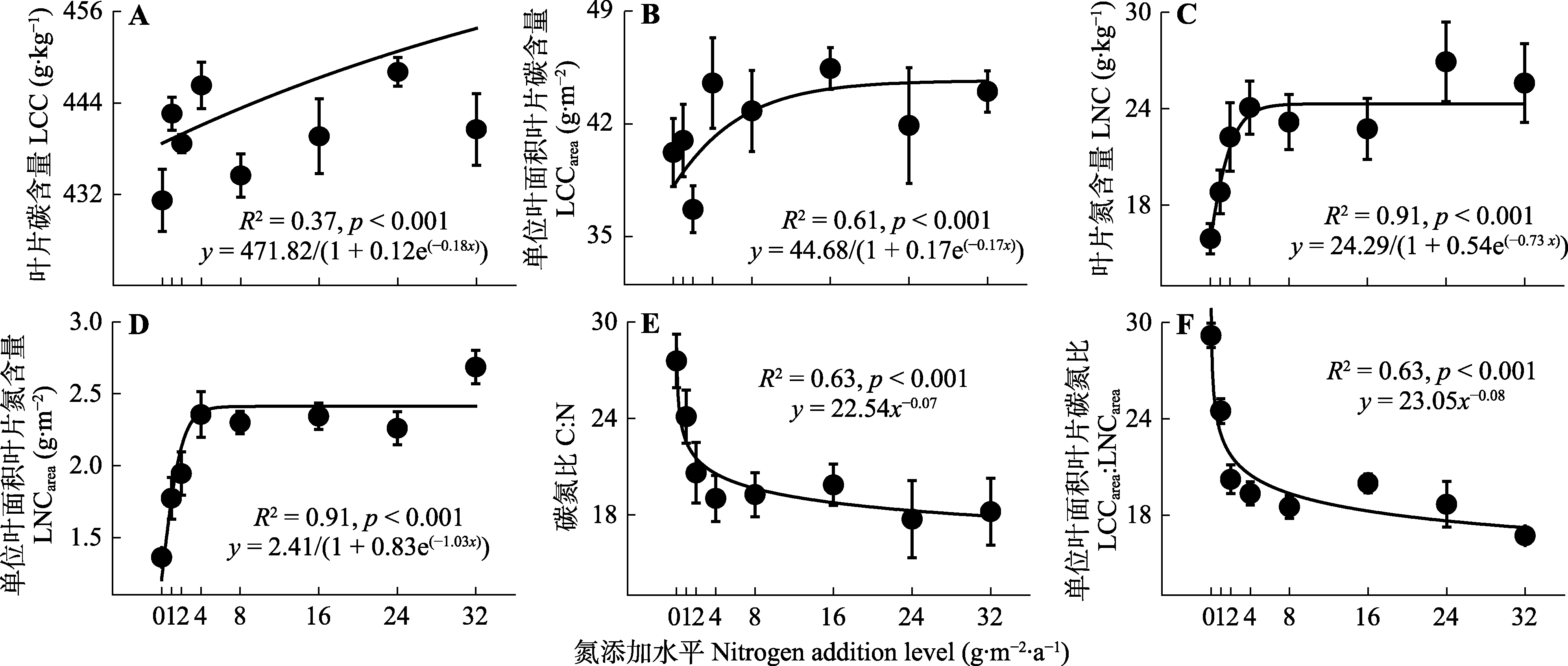
Fig. 1 Changes in leaf carbon content (LCC, A), leaf carbon content per leaf area (LCCarea, B), nitrogen content (LNC, C), leaf carbon content per leaf area (LNCarea, D), carbon-nitrogen ratio (C:N, E), and leaf carbon-nitrogen ratio per leaf area (LCCarea:LNCarea, F) under different levels of nitrogen addition. A-D are fitted by Logistic, and E-F are fitted by the Power function.
| 叶长 LL | 叶宽 LW | 叶厚 LT | 叶面积 LA | 叶绿素a 含量 Ca | 叶绿素b 含量 Cb | 总叶绿素 含量 Ca+b | 类胡萝卜素含量 Car | 净光合速率 Pn | 气孔限制值 Ls | 蒸腾速率 Tr | 水分利用效率 WUE |
|---|---|---|---|---|---|---|---|---|---|---|---|
| 9.58 | 3.50 | 8.31 | 25.59 | 3.36 | 3.61 | 3.68 | 0.95 | 2.26 | 3.22 | 5.71 | 5.24 |
| p < 0.001 | p < 0.001 | p < 0.001 | p < 0.01 | p < 0.01 | p < 0.001 | p < 0.001 | p > 0.05 | p < 0.01 | p < 0.01 | p < 0.001 | p < 0.001 |
Table 2 One-way ANOVA (F value) of photosynthetic characteristics under different nitrogen addition levels
| 叶长 LL | 叶宽 LW | 叶厚 LT | 叶面积 LA | 叶绿素a 含量 Ca | 叶绿素b 含量 Cb | 总叶绿素 含量 Ca+b | 类胡萝卜素含量 Car | 净光合速率 Pn | 气孔限制值 Ls | 蒸腾速率 Tr | 水分利用效率 WUE |
|---|---|---|---|---|---|---|---|---|---|---|---|
| 9.58 | 3.50 | 8.31 | 25.59 | 3.36 | 3.61 | 3.68 | 0.95 | 2.26 | 3.22 | 5.71 | 5.24 |
| p < 0.001 | p < 0.001 | p < 0.001 | p < 0.01 | p < 0.01 | p < 0.001 | p < 0.001 | p > 0.05 | p < 0.01 | p < 0.01 | p < 0.001 | p < 0.001 |
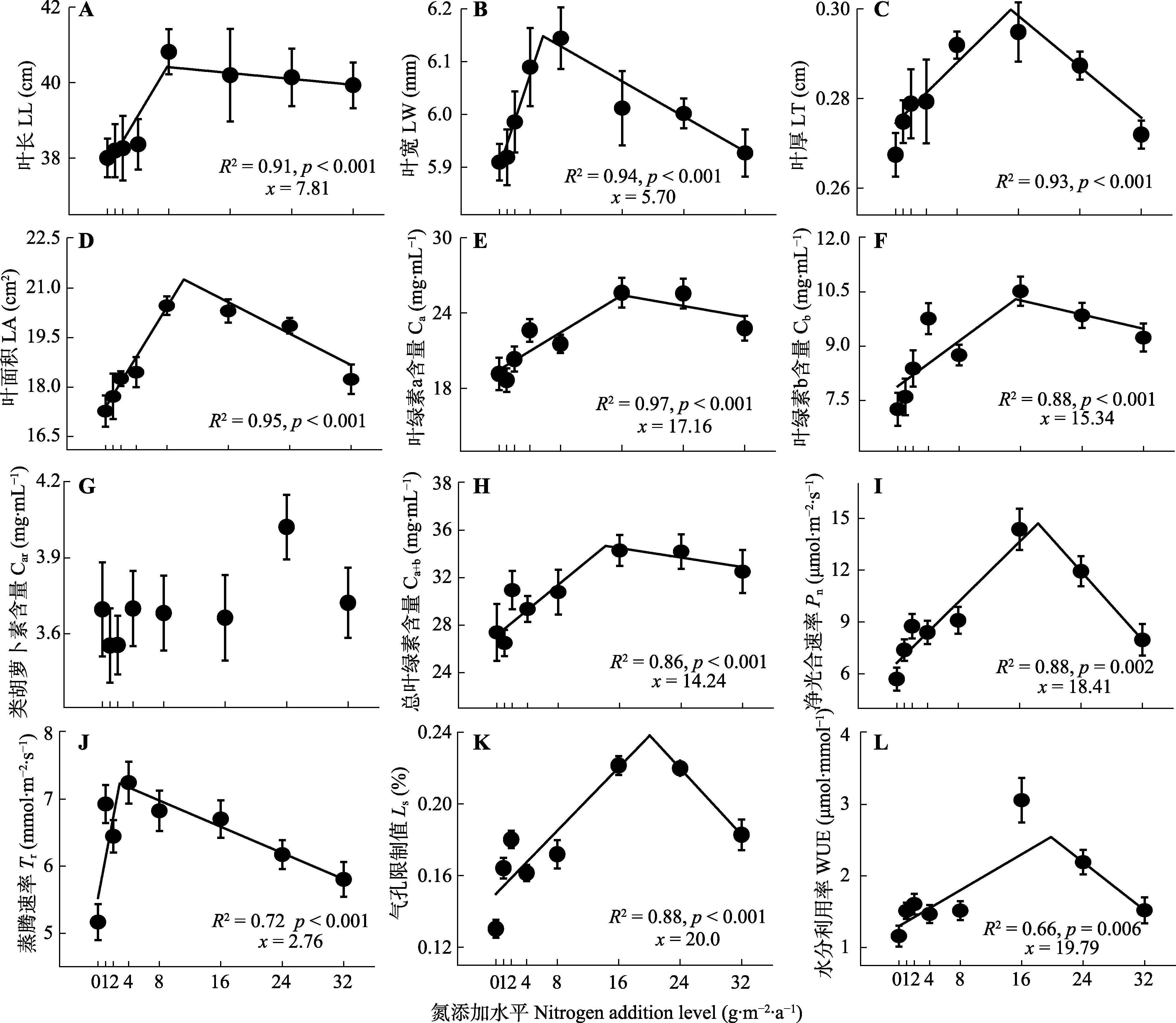
Fig. 2 Effects of different nitrogen addition levels on leaf morphology (A-D), pigment content (E-H) and photosynthetic characteristics (I-L). Ca, chlorophyll a content; Car, carotenoids content; Cb, chlorophyll b content; Ca+b, total chlorophyll content; Ls, stomatal limit value; LA, leaf area; LL, leaf length; LT, leaf thickness; LW, leaf width; Pn, net photosynthetic rate; Tr, transpiration rate; WUE, water use efficiency.
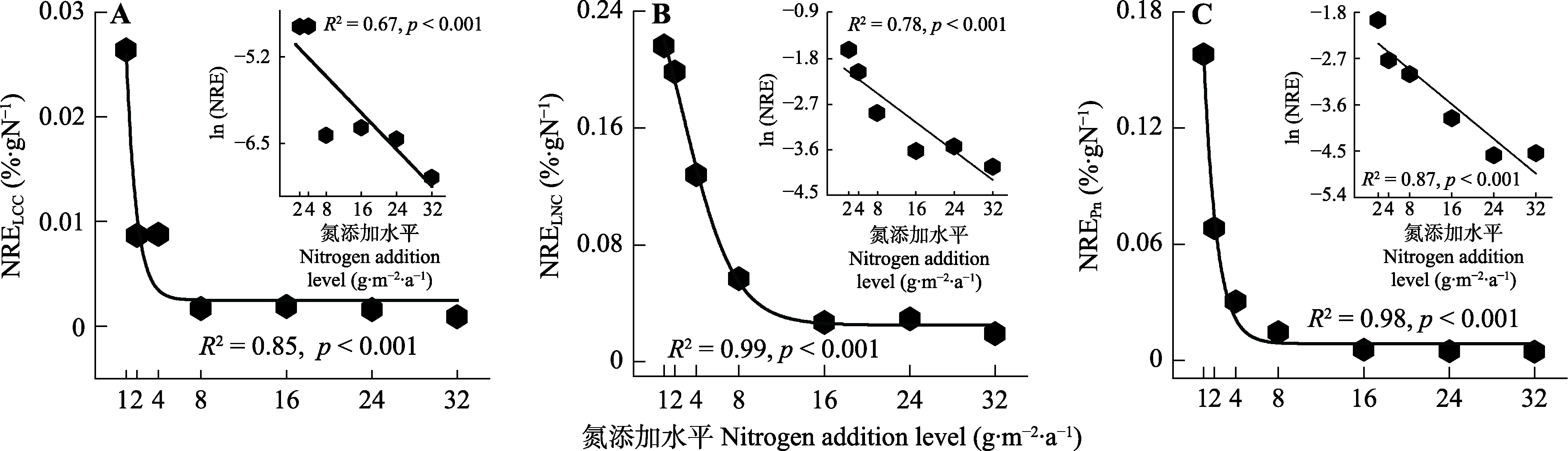
Fig. 3 Effects of nitrogen addition levels on the response efficiency of leaf carbon content (NRELCC, A), leaf nitrogen content (NRELNC, B), and leaf net photosynthetic rate (NREPn, C). The inset shows the effect of nitrogen addition levels on NRE after the nitrogen saturation threshold.
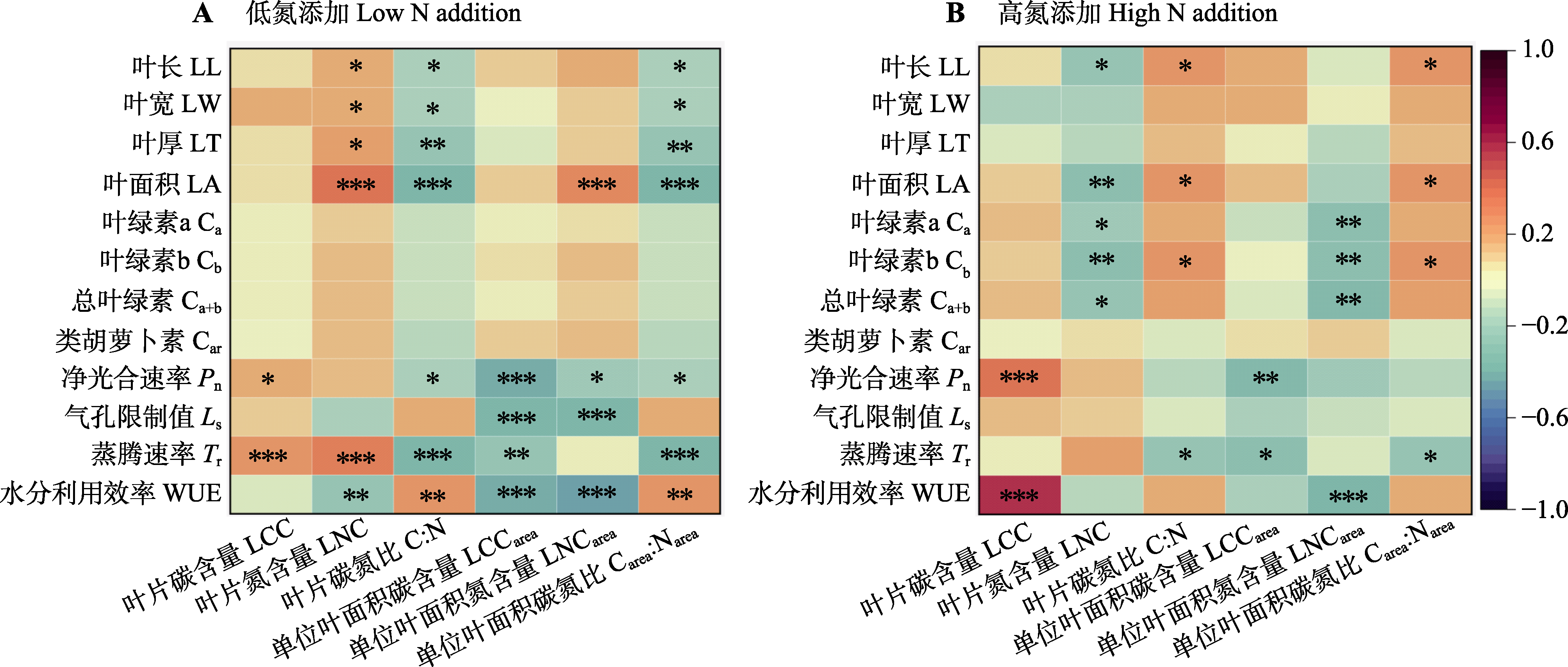
Fig. 4 Correlation analysis of stoichiometric characteristics and photosynthetic characteristics of leaves under low nitrogen (N) addition (A) and high nitrogen addition (B). C:N, leaf carbon-nitrogen rati; Carea:Narea, unit leaf area carbon-nitrogen ratio; Ca, chlorophyll a content; Car, carotenoids content; Cb, chlorophyll b content; Ca+b, total chlorophyll content; Ls, stomatal limit value; LA, leaf area; LCC, leaf carbon content; LCCarea, unit leaf area carbon content; LL, leaf length; LNC, leaf nitrogen content; LNCarea, unit leaf area nitrogen content; LT, leaf thickness; LW, leaf width; Pn, net photosynthetic rate; Tr, transpiration rate; WUE, water use efficiency. *, p < 0.05; **, p < 0.01; ***, p < 0.001.
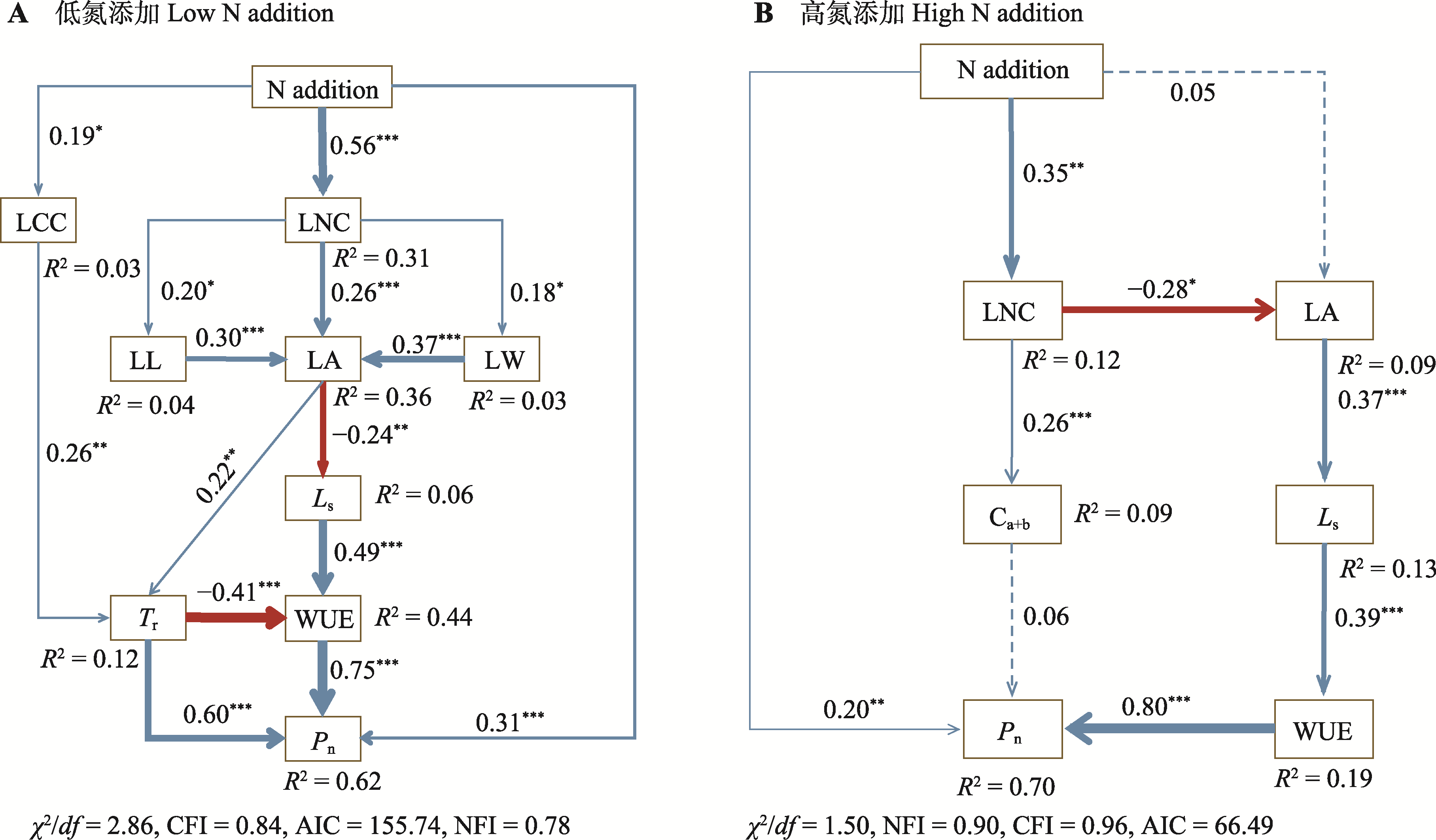
Fig. 5 Direct and indirect effects of low (A) and high (B) nitrogen (N) addition on leaf net photosynthetic rate based on structural equation models. The blue and red solid lines indicate positive and negative effects, respectively. The blue dotted line indicates no effect, the numbers represent the path coefficient, and the width of the arrow is proportional to the strength of the relationships. *, ** and *** represent significant difference at p < 0.05, p < 0.01 and p < 0.001. AIC, akaike information criterion; Ca+b, chlorophyll content; CFI, comparative fit index; Ls, stomatal limit value; LA, leaf area; LL, leaf length; LW, leaf width; NFI, normed fit index; Pn, net photosynthetic rate; Tr, transpiration rate; WUE, water use efficiency.
| [1] | Bao XY (2024). The impact of moisture adjustment and nitrogen phosphorus additions on typical karst shrubs soil-plant stoichiometric characteristics. Master degree dissertation, Central South University of Forestry and Technology, Changsha. |
| [包雪燕 (2024). 水分调节与氮磷添加对喀斯特典型灌丛土壤-植物化学计量特征的影响. 硕士学位论文, 中南林业科技大学, 长沙.] | |
| [2] |
Bin ZJ, Wang JJ, Zhang WP, Xu DH, Cheng XH, Li KJ, Cao DH (2014). Effects of N addition on ecological stoichiometric characteristics in six dominant plant species of alpine meadow on the Qinghai-Xizang Plateau, China. Chinese Journal of Plant Ecology, 38, 231-237.
DOI URL |
|
[宾振钧, 王静静, 张文鹏, 徐当会, 程雪寒, 李柯杰, 曹德昊 (2014). 氮肥添加对青藏高原高寒草甸6个群落优势种生态化学计量学特征的影响. 植物生态学报, 38, 231-237.]
DOI |
|
| [3] | Chen C, Riley WJ, Prentice IC, Keenan TF (2022). CO2 fertilization of terrestrial photosynthesis inferred from site to global scales. Proceedings of the National Academy of Sciences of the United States of America, 119, e2115627119. DOI: 10.1073/PNAS.2115627119. |
| [4] | Dong JJ, Gong JR, Zhai ZW, Zhang ZH, Shi JY, Zhang WY, Song LY, Li Y, Zhang SQ (2023). Response of the photosynthetic physiological characteristics to nitrogen addition of Stipa grandis leaves in a temperate grassland of the Inner Mongolia. Acta Ecologica Sinica, 43, 5994-6004. |
| [董姣姣, 龚吉蕊, 翟占伟, 张子荷, 矢佳昱, 张魏圆, 宋靓苑, 李颖, 张斯琦 (2023). 内蒙古温带草原大针茅叶片光合生理特性对氮添加的响应. 生态学报, 43, 5994-6004.] | |
| [5] |
Du YD, Yuan XY, Feng ZZ (2023). Effects of different nitrogen forms on photosynthesis characteristics and growth of Poplar. Chinese Journal of Plant Ecology, 47, 348-360.
DOI URL |
|
[杜英东, 袁相洋, 冯兆忠 (2023). 不同形态氮对杨树光合特性及生长的影响. 植物生态学报, 47, 348-360.]
DOI |
|
| [6] |
Elser JJ, Bracken MES, Cleland EE, Gruner DS, Harpole WS, Hillebrand H, Ngai JT, Seabloom EW, Shurin JB, Smith JE (2007). Global analysis of nitrogen and phosphorus limitation of primary producers in freshwater, marine and terrestrial ecosystems. Ecology Letters, 10, 1135-1142.
DOI PMID |
| [7] | Feng HH, Gao SQ, Gao JL, Du Y, Liu ZD, Chen N, Song YY (2025). Effect of nitrogen addition on leaf chlorophyll and nutrient content of typical plant species in peatland of the Great Hing’an Mountains. Chinese Journal of Ecology, 44, 1456-1464. |
| [冯欢欢, 高思齐, 高晋丽, 杜宇, 刘桢迪, 陈宁, 宋艳宇 (2025). 氮添加对大兴安岭泥炭地典型植物叶片叶绿素和养分含量的影响. 生态学杂志, 44, 1456-1464.] | |
| [8] |
Galloway JN, Townsend AR, Erisman JW, Bekunda M, Cai ZC, Freney JR, Martinelli LA, Seitzinger SP, Sutton MA (2008). Transformation of the nitrogen cycle: recent trends, questions, and potential solutions. Science, 320, 889-892.
DOI PMID |
| [9] | Gao SQ, Duan R, Wang HS, Li A, Shi Y, Jing HC, Fang JY (2021). Farming-pastoral ecotone of northern China plays important role in ensuring national food security. Bulletin of the Chinese Academy of Sciences, 36, 643-651. |
| [高树琴, 段瑞, 王竑晟, 李昂, 石岳, 景海春, 方精云 (2021). 北方农牧交错带在保障国家大粮食安全中发挥重要作用. 中国科学院院刊, 36, 643-651.] | |
| [10] |
Gong JR, Zhang ZH, Wang B, Shi JY, Zhang WY, Dong Q, Song LY, Li Y, Liu YY (2022). N addition rebalances the carbon and nitrogen metabolisms of Leymus chinensis through leaf N investment. Plant Physiology and Biochemistry, 185, 221-232.
DOI URL |
| [11] | Hu C, Li F, Xie YH, Deng ZM, Chen XS (2018). Soil carbon, nitrogen, and phosphorus stoichiometry of three dominant plant communities distributed along a small-scale elevation gradient in the East Dongting Lake. Physics and Chemistry of the Earth, 103, 28-34. |
| [12] | Hu MJ, Wan SQ (2024). Effects of burning and nitrogen addition on foliar stoichiometry and nutrient resorption in a subtropical-temperate ecotonal forest. Forest Ecology and Management, 572, 122284. DOI: 10.1016/j.foreco.2024.122284. |
| [13] | Kuang LH, Mou ZJ, Li Y, Lu XF, Kuang YW, Wang J, Wang FM, Cai XA, Zhang W, Fu SL, Hui DF, Lambers H, Sardans J, Peñuelas J, Ren H, Liu ZF (2023). Depth-driven responses of microbial residual carbon to nitrogen addition approaches in a tropical forest: canopy addition versus understory addition. Journal of Environmental Management, 340, 118009. DOI: 10.1016/J.Jenvman.2023.118009. |
| [14] | Lee H, Calvin K, Dasgupta D, Krinner G, Mukherji A, Thorne P, Park Y (2023). Climate change 2023:synthesis report// Contribution of Working Groups I, II and III to the Sixth Assessment Report of the Intergovernmental Panel on Climate Change. Cambridge University Press, Cambridge, UK. |
| [15] | Li X, Wang JZ, Ma WH, Yang Y, Li XY, Wang MC, Liu XL, Hu JX, Wang YH (2024). Interannual variations in the responses of plant functional traits to mowing and nitrogen addition in an Inner Mongolian typical steppe. Pratacultural Science, 41, 2389-2401. |
| [李旭, 王佳智, 马文红, 杨雨, 李翔宇, 王明臣, 刘新亮, 胡锦香, 王永慧 (2024). 内蒙古典型草原植物功能性状对刈割与氮添加响应的年际间差异性. 草业科学, 41, 2389-2401.] | |
| [16] | Liao MW, Qin SL, Xu CY, Zhang Q, Wang KX, Du LX (2024). Effects of exogenous brassinolide and duration of action on the photosynthetic properties of Leymus secalinus leaves. Acta Agrestia Sinica, 32, 3788-3796. |
|
[廖明旺, 秦士利, 许辰雨, 张倩, 王凯鑫, 杜利霞 (2024). 外源油菜素内酯及作用时间对赖草叶片光合特性的影响. 草地学报, 32, 3788-3796.]
DOI |
|
| [17] | Liu JH (2021). Studies on the Effects of Different Leaf Nitrogen Content on Photosynthesis Under Steady-state and Fluctuating Light Environments in Brassica napus L. PhD dissertation, Huazhong Agricultural University, Wuhan. |
| [刘佳欢 (2021). 稳定及波动光环境下油菜不同叶片氮含量对光合作用的影响及其机理. 博士学位论文, 华中农业大学, 武汉.] | |
| [18] |
Lu XF, Qin ZF, Lambers H, Tang SB, Kaal J, Hou EQ, Kuang YW (2022). Nitrogen addition increases aboveground silicon and phytolith concentrations in understory plants of a tropical forest. Plant and Soil, 477, 25-39.
DOI |
| [19] |
Lu Z, Li H, Sayer EJ, Liu ZF, Li LH, Chen Y, Qin GM, Li JT, Zhou JG, Huang XY, Zhang JF, Wu JT, Thapa P, Wang FM (2023). Enhanced abundance of generalist and litter saprotrophs explain increased tropical forest soil carbon with long-term nitrogen deposition. Functional Ecology, 37, 2282-2296.
DOI URL |
| [20] |
Men L, He YC, Li TT, Li PY, Hu J, Zhou QP (2023). Nonlinear responses and mechanisms of leaf chlorophyll in alpine plants to nitrogen addition gradient. Acta Agrestia Sinica, 31, 1622-1631.
DOI |
|
[门璐, 何奕成, 李婷婷, 黎鹏宇, 胡健, 周青平 (2023). 高寒草甸植物叶绿素对氮添加梯度的非线性响应. 草地学报, 31, 1622-1631.]
DOI |
|
| [21] |
Nordin A, Strengbom J, Witzell J, Näsholm T, Ericson L (2005). Nitrogen deposition and the biodiversity of boreal forests: implications for the nitrogen critical load. Ambio, 34, 20-24.
PMID |
| [22] | Qiu CC, Hu YT, Yan H, Li HJ, Yu HN, Zhao TT, Zhou XG (2024). Effect of nitrogen application rate on chlorophyll content and photosynthetic characteristics of Leymus chinensis. Hubei Agricultural Sciences, 63(11), 141-146. |
| [仇春辰, 胡雨彤, 严涵, 李会军, 俞浩楠, 赵婷婷, 周小国 (2024). 施氮量对羊草叶绿素含量和光合特性的影响. 湖北农业科学, 63(11), 141-146.] | |
| [23] |
Quan XQ, Wang YR, Li XY, Liang HY, Wang LD, Yan XL (2024). Effects of nitrogen addition level and NH+ 4-N to NO3--N ratio on photosynthetic characteristics and chlorophyll fluorescence parameters in Cunninghamia lanceolata seedling. Chinese Journal of Plant Ecology, 48, 1050-1064.
DOI URL |
|
[全小强, 王燕茹, 李小玉, 梁海燕, 王立冬, 闫小莉 (2024). 氮添加和铵硝态氮配比对杉木幼苗光合特性及叶绿素荧光参数的影响. 植物生态学报, 48, 1050-1064.]
DOI |
|
| [24] |
Sardans J, Rivas-Ubach A, Peñuelas J (2012). The C:N:P stoichiometry of organisms and ecosystems in a changing world: a review and perspectives. Perspectives in Plant Ecology, Evolution and Systematics, 14, 33-47.
DOI URL |
| [25] | Shi ZM, Tang JC, Cheng RM, Luo D, Liu SR (2015). A review of nitrogen allocation in leaves and factors in its effects. Acta Ecologica Sinica, 35, 5909-5919. |
| [史作民, 唐敬超, 程瑞梅, 罗达, 刘世荣 (2015). 植物叶片氮分配及其影响因子研究进展. 生态学报, 35, 5909-5919.] | |
| [26] | Su Y, He YX, Gao YY, Liang WJ, Wu SK, Hao J, Diao HJ, Wang CH, Dong KH (2024). Responses of the nutrients, carbon components and defensive compounds in the leaves of Leymus secalinus to increasing nitrogen input. Acta Agrestia Sinica, 32, 130-138. |
|
[苏原, 何雨欣, 高阳阳, 梁雯君, 武帅楷, 郝杰, 刁华杰, 王常慧, 董宽虎 (2024). 赖草草地叶片养分、碳组分和防御性化合物对氮添加的响应. 草地学报, 32, 130-138.]
DOI |
|
| [27] |
Sun Y, Wang CT, Chen HYH, Ruan HH (2020). Responses of C:N stoichiometry in plants, soil, and microorganisms to nitrogen addition. Plant and Soil, 456, 277-287.
DOI |
| [28] |
Tang SB, Zhang LL, Lambers H, Ren WD, Lu XF, Hou EQ, Fu SL, Kuang YW (2021). Addition of nitrogen to canopy versus understorey has different effects on leaf traits of understorey plants in a subtropical evergreen broad-leaved forest. Journal of Ecology, 109, 692-702.
DOI URL |
| [29] |
Tian D, Yan ZB, Niklas KJ, Han WX, Kattge J, Reich PB, Luo YK, Chen YH, Tang ZY, Hu HF, Wright LJ, Schmid B, Fang JY (2018). Global leaf nitrogen and phosphorus stoichiometry and their scaling exponent. National Science Review, 5, 728-739.
DOI URL |
| [30] | Tian DS, Wang H, Sun J, Niu SL (2016). Global evidence on nitrogen saturation of terrestrial ecosystem net primary productivity. Environmental Research Letters, 11, 024012. DOI: 10.1088/1748-9326/11/2/024012. |
| [31] | Tong RQ (2023). The Responses in Growth, Reproduction, and Physiological Metabolic Characteristics of Chloris virgata to Drought Stress and Nitrogen Addition in Songnen Grassland. PhD dissertation, Northeast Normal University, Changchun. |
| [仝如强 (2023). 松嫩草地虎尾草生长繁殖特性及其生理代谢特征对干旱胁迫与氮添加的响应. 博士学位论文, 东北师范大学, 长春.] | |
| [32] |
Tong YS, Zhang CP, Dong QM, Yu ZH, Yang ZZ, Zhang XF, Cao Q, Yu Y, Zhang ZS (2024). The effects of nitrogen forms on biomass allocation and photosynthetic characteristics of dominant species in alpine artificial grasslands. Chinese Journal of Ecology, 43, 1655-1663.
DOI |
| [童永尚, 张春平, 董全民, 于泽航, 杨增增, 张小芳, 曹铨, 俞旸, 张正社 (2024). 氮素形态对高寒人工草地植物群落生物量分配及优势种叶片光合特性的影响. 生态学杂志, 43, 1655-1663.] | |
| [33] | Wan XB, Wang QG, Yan GY, Xing YJ (2019). Response of ecological stoichiometric characteristics and photosynthetic characteristics of plant leaves to long-term N deposition in natural secondary forest. Botanical Research, 39, 407-420. |
|
[万雪冰, 王庆贵, 闫国永, 邢亚娟 (2019). 天然次生林植物叶片生态化学计量特征及光合特性对长期N沉降的响应. 植物研究, 39, 407-420.]
DOI |
|
| [34] |
Wang J, Gao YZ, Zhang YH, Yang JJ, Smith MD, Knapp AK, Eissenstat DM, Han XG (2019). Asymmetry in above- and belowground productivity responses to N addition in a semi-arid temperate steppe. Global Change Biology, 25, 2958-2969.
DOI PMID |
| [35] | Wang S, Zhang JR, Yao XD, Du YJ, Gao H, Chen M, Wang XH, Chen GS (2025). Response of root biomass and root morphology to long-term nitrogen application in subtropical evergreen broad-leaved forest. Chinese Journal of Tropical and Subtropical Botany, 33, 65-73. |
| [王硕, 张进如, 姚晓东, 杜英杰, 高红, 陈铭, 王晓红, 陈光水 (2025). 亚热带常绿阔叶林根系生物量和形态特征对长期施氮的响应. 热带亚热带植物学报, 33, 65-73.] | |
| [36] | Wang X, Luo WT, Yu Q, Yan CF, Xu ZW, Li MH, Jiang Y (2014). Effects of nutrient addition on nitrogen, phosphorus and non-structural carbohydrates concentrations in leaves of dominant plant species in a semiarid steppe. Chinese Journal of Ecology, 33, 1795-1802. |
| [王雪, 雒文涛, 庾强, 闫彩凤, 徐柱文, 李迈和, 姜勇 (2014). 半干旱典型草原养分添加对优势物种叶片氮磷及非结构性碳水化合物含量的影响. 生态学杂志, 33, 1795-1802.] | |
| [37] | Wang XY (2021). Effects of Nitrogen Addition, Warming and Precipitation Alteration on Community-wide Functional Traits in a Tibetan Alpine Meadow. Master degree dissertation, Nanjing Agricultural University, Nanjing. |
| [王小艺 (2021). 氮添加、增温及降水改变对青藏高原高寒草甸植物群落功能性状的影响. 硕士学位论文, 南京农业大学, 南京.] | |
| [38] |
Warren CR, Dreyer E, Adams MA (2003). Photosynthesis- Rubisco relationships in foliage of Pinus sylvestris in response to nitrogen supply and the proposed role of Rubisco and amino acids as nitrogen stores. Trees, 17, 359-366.
DOI |
| [39] |
Xia JY, Wan SQ (2008). Global response patterns of terrestrial plant species to nitrogen addition. New Phytologist, 179, 428-439.
DOI PMID |
| [40] |
Xiao CB, Sun DD, Liu BB, Fang XM, Li PC, Jiang Y, He MM, Li J, Luan S, He K (2022). Nitrate transporter NRT1. 1 and anion channel SLAH 3 form a functional unit to regulate nitrate-dependent alleviation of ammonium toxicity. Journal of Integrative Plant Biology, 64, 942-957.
DOI URL |
| [41] |
Xiao D, Wang XJ, Zhang K, He NP, Hou JH (2016). Effects of nitrogen addition on leaf traits of common species in natural Pinus tabuliformis forests in Taiyue Mountain, Shanxi Province, China. Chinese Journal of Plant Ecology, 40, 686-701.
DOI URL |
|
[肖迪, 王晓洁, 张凯, 何念鹏, 侯继华 (2016). 氮添加对山西太岳山天然油松林主要植物叶片性状的影响. 植物生态学报, 40, 686-701.]
DOI |
|
| [42] | Xiao H, Rong YP, Li PZ, Liu YL (2023). Response of carbon, nitrogen, and phosphorus stoichiometric characteristics in dominant plant functional groups of the Hulun Buir meadow steppe to nitrogen and phosphorus addition. Chinese Journal of Grassland, 45(10), 1-11. |
| [肖红, 戎郁萍, 李鹏珍, 刘玉玲 (2023). 呼伦贝尔草甸草原主要功能群植物碳、氮、磷化学计量特征对氮磷添加的响应. 中国草地学报, 45(10), 1-11.] | |
| [43] | Yan C (2020). Effects of Warming and Nitrogen Addition on Vegetation Production and Ecosystem Carbon, Nitrogen, and Phosphorus Characteristics in Temperate Grasslands in Northern China. PhD dissertation, Research Center of Soil and Water Conservation and Ecological Environment, Chinese Academy of Sciences and Ministry of Education, Yangling, Shanxi. |
| [鄢创 (2020). 增温和氮添加对中国北方温带草原植被生产力与生态系统碳氮磷特征的影响. 博士学位论文, 中国科学院教育部水土保持与生态环境研究中心, 陕西杨陵.] | |
| [44] | Yuan X, Qin WK, Xu H, Zhang ZH, Zhou HK, Zhu B (2020). Sensitivity of soil carbon dynamics to nitrogen and phosphorus enrichment in an alpine meadow. Soil Biology & Biochemistry, 150, 107984. DOI: 10.1016/j.soilbio.2020.107984. |
| [45] |
Zhan SX, Wang Y, Zhu ZC, Li WH, Bai YF (2017). Nitrogen enrichment alters plant N:P stoichiometry and intensifies phosphorus limitation in a steppe ecosystem. Environmental and Experimental Botany, 134, 21-32.
DOI URL |
| [46] | Zhang J, Li PK, Li L, Zhao MN, Yan PS, Liu Y, Li W, Ding SY, Zhao QH (2025). Soil respiration and carbon sequestration response to short-term fertilization in wheat-maize cropping system in the North China Plain. Soil and Tillage Research, 251, 106536. DOI: 10.1016/j.still.2025.106536. |
| [47] | Zhang LH, Zeng CS, Hu WF (2017). Reviews on effects of nitrogen addition on plant photosynthetic carbon fixation. Acta Ecologica Sinica, 37, 147-155. |
| [张林海, 曾从盛, 胡伟芳 (2017). 氮输入对植物光合固碳的影响研究进展. 生态学报, 37, 147-155.] | |
| [48] | Zhang QQ (2020). Effects of CO2 Concentrations and Temperature on Photosynthesis and Water Use Efficiency of Winter Wheat Under Different Water Conditions. Master degree dissertation, Hebei University of Engineering, Handan, Hebei. |
| [张茜茜 (2020). 不同水分条件下CO2浓度和温度对冬小麦光合性能及水分利用率的影响. 硕士学位论文, 河北工程大学, 河北邯郸.] | |
| [49] | Zhang WJ, Zhang YQ, She WW, Qin SG, Feng W (2016). Effects of nitrogen addition on foliar ecological stoichiometric characteristics of Artemisia ordosica community. Research of Environmental Sciences, 29, 52-58. |
| [张文瑾, 张宇清, 佘维维, 秦树高, 冯薇 (2016). 氮添加对油蒿群落植物叶片生态化学计量特征的影响. 环境科学研究, 29, 52-58.] | |
| [50] | Zhang WQ, Huang FF, Gan XH, Li YF, Tang CB, Qiu PJ (2021). Effects of fertilization on the growth and photosynthetic characteristics of Heritiera littoralis seedlings. Guihaia, 41, 862-871. |
| [张卫强, 黄芳芳, 甘先华, 李一凡, 唐成波, 丘鹏基 (2021). 施肥对银叶树幼苗生长及光合特性的影响. 广西植物, 41, 862-871.] | |
| [51] |
Zhao HX, Liu P, Shi MY, Xu MZ, Jia X, Tian Y, Zha TS (2025). Effect of leaf nitrogen allocation on maximum net photosynthetic rate of two common sand-fixing species, Artemisia ordosica and Levmus secalinus in Mau Us Sandy Land. Chinese Journal of Plant Ecology, 49, 460-474.
DOI URL |
|
[赵洪贤, 刘鹏, 史曼英, 徐铭泽, 贾昕, 田赟, 查天山 (2025). 毛乌素沙地典型固沙植物黑沙蒿和赖草叶片氮分配对最大净光合速率的影响. 植物生态学报, 49, 460-474.]
DOI |
|
| [52] | Zhuo H, Liu XY, Luo S, Ou XX, Rong XM, Yang L, Li Q, Han YL (2024). Physiological changes underlying increased photosynthetic-nitrogen use efficiency in response to low-nitrogen conditions in Brassica napus L. Industrial Crops and Products, 211, 118240. DOI: 10.1016/j.indcrop.2024.118240. |
| Viewed | ||||||
|
Full text |
|
|||||
|
Abstract |
|
|||||
Copyright © 2026 Chinese Journal of Plant Ecology
Tel: 010-62836134, 62836138, E-mail: apes@ibcas.ac.cn, cjpe@ibcas.ac.cn

