
Chin J Plant Ecol ›› 2026, Vol. 50 ›› Issue (6): 1448-1463.DOI: 10.17521/cjpe.2025.0197 cstr: 32100.14.cjpe.2025.0197
• Research Articles • Previous Articles Next Articles
FENG Shuang-Yi1, HE Zi-Qing2, WU Wen-Yu1, ZENG Shu-Cai1, ZHAO Qian1,*( )
)
Received:2025-06-04
Accepted:2025-08-25
Online:2026-06-28
Published:2026-08-26
Contact:
ZHAO Qian
Supported by:FENG Shuang-Yi, HE Zi-Qing, WU Wen-Yu, ZENG Shu-Cai, ZHAO Qian. Effects of mixed planting on photosynthetic characteristics and root growth of Cunninghamia lanceolata and Michelia macclurei seedlings[J]. Chin J Plant Ecol, 2026, 50(6): 1448-1463.
Add to citation manager EndNote|Ris|BibTeX
URL: https://www.plant-ecology.com/EN/10.17521/cjpe.2025.0197
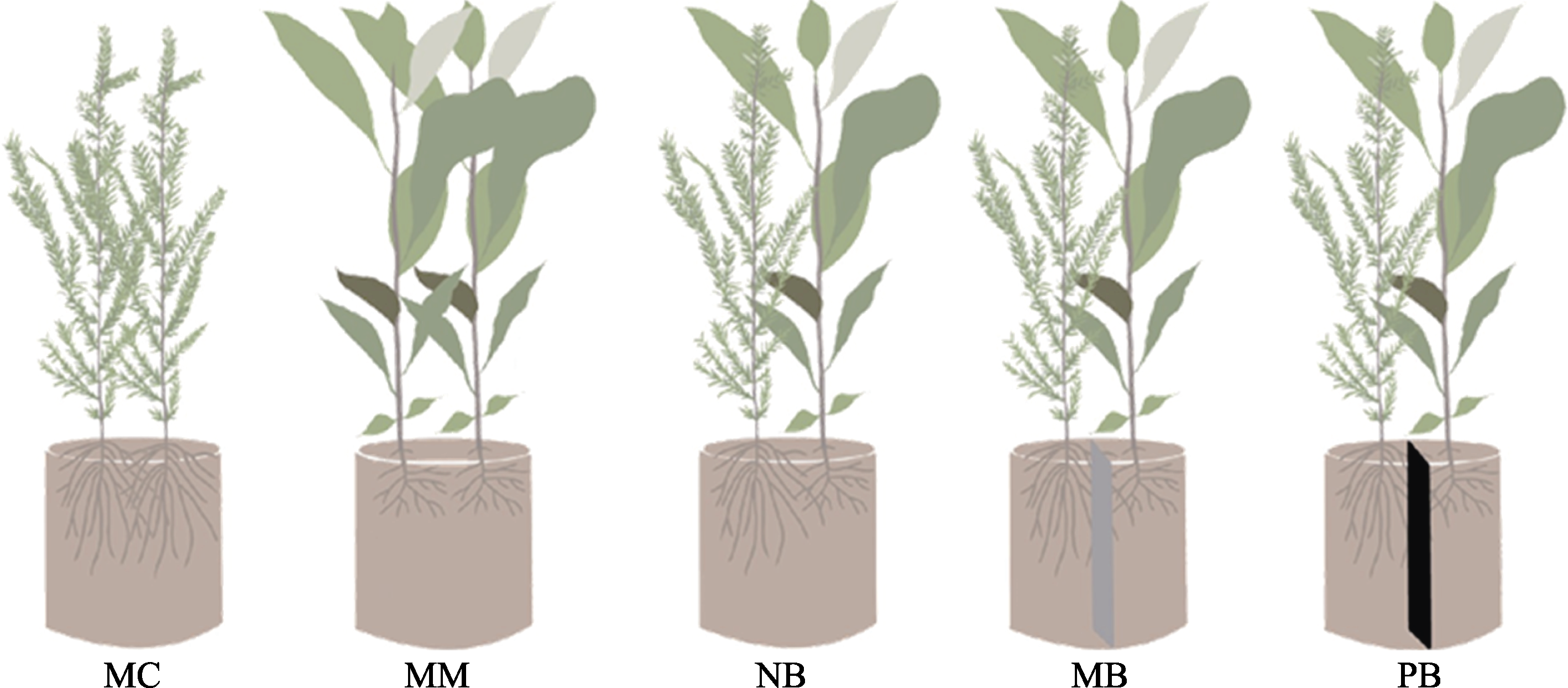
Fig. 1 Diagram of root separation modes. MC, Cunninghamia lanceolata monoculture; MM, Michelia macclurei monoculture; NB, mixed-planting of C. lanceolata and M. macclurei without root separation; MB, mixed-planting of C. lanceolata and M. macclurei with 30 μm nylon film; PB, mixed-planting of C. lanceolata and M. macclurei with plastic film.
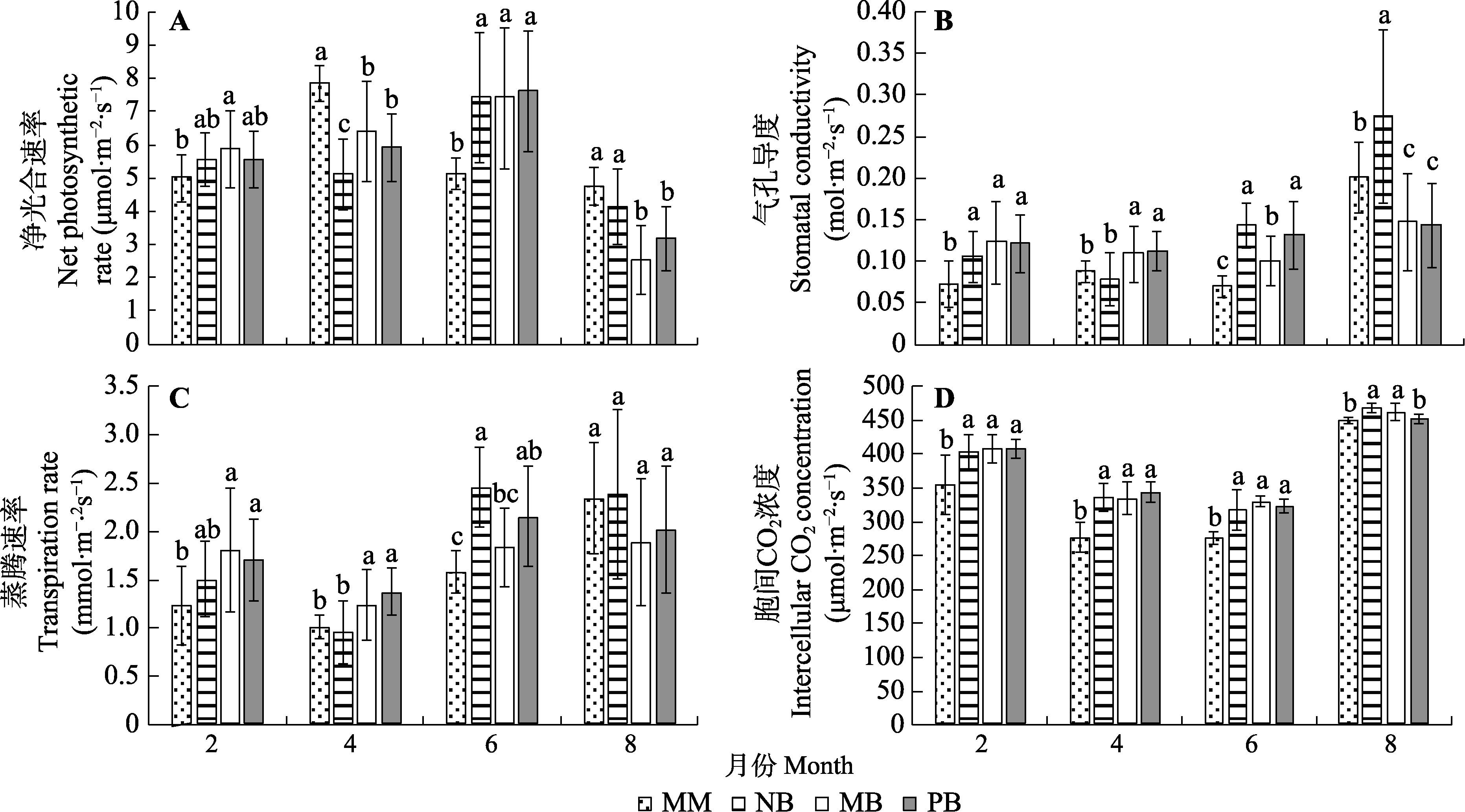
Fig. 2 Photosynthetic parameters of Michelia macclurei under different treatments in different seasons (mean ± SE, n = 5). Different lowercase letters indicated significant differences between different treatments (p < 0.05). MM, Michelia macclurei monoculture; NB, mixed-planting of Cunninghamia lanceolata and M. macclurei without root separation; MB, mixed-planting of C. lanceolata and M. macclurei with 30 μm nylon film; PB, mixed-planting of C. lanceolata and M. macclurei with plastic film.
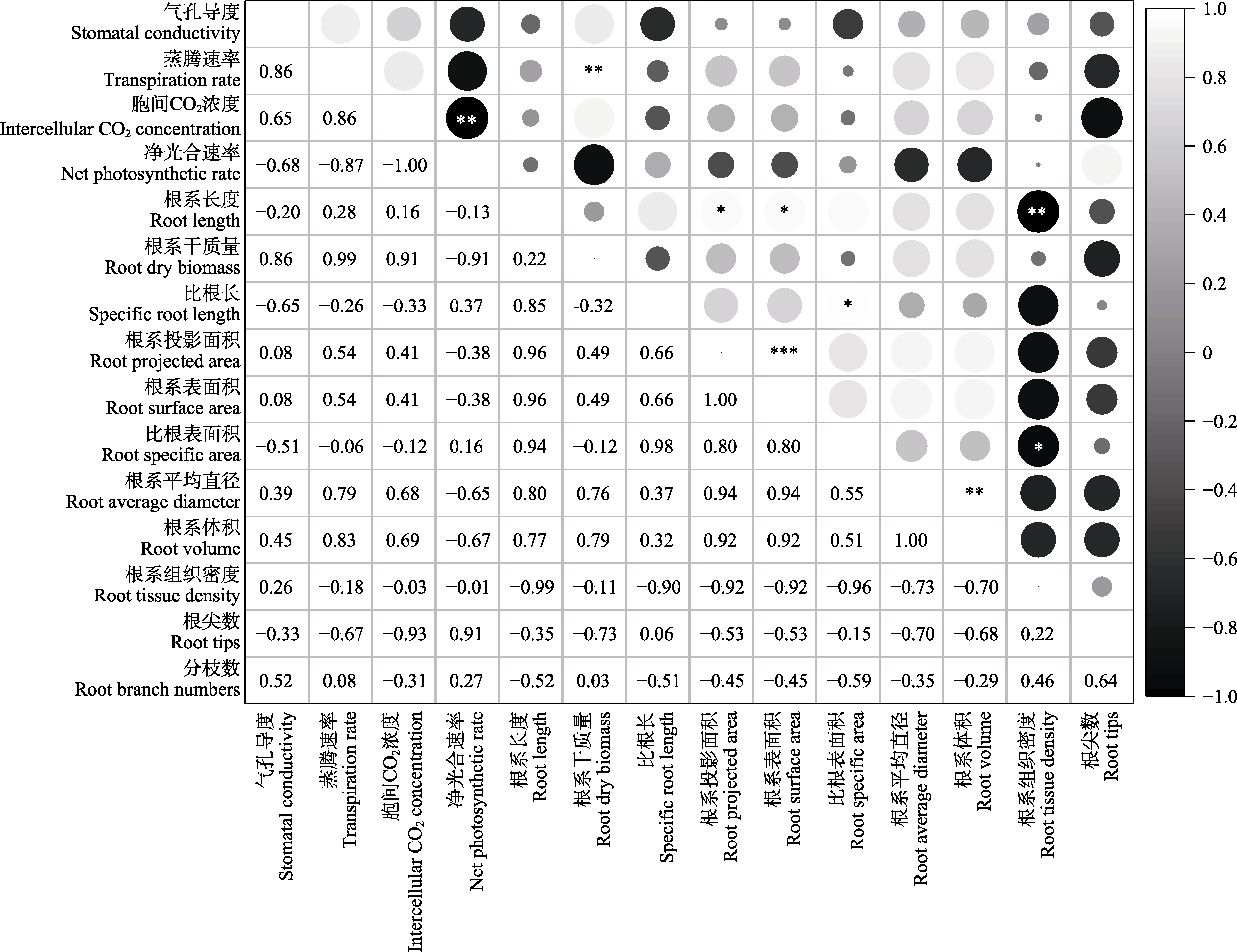
Fig. 3 Correlation analysis between photosynthetic parameters and root morphology in Michelia macclurei. *, p < 0.05; **, p < 0.01; ***, p < 0.001.
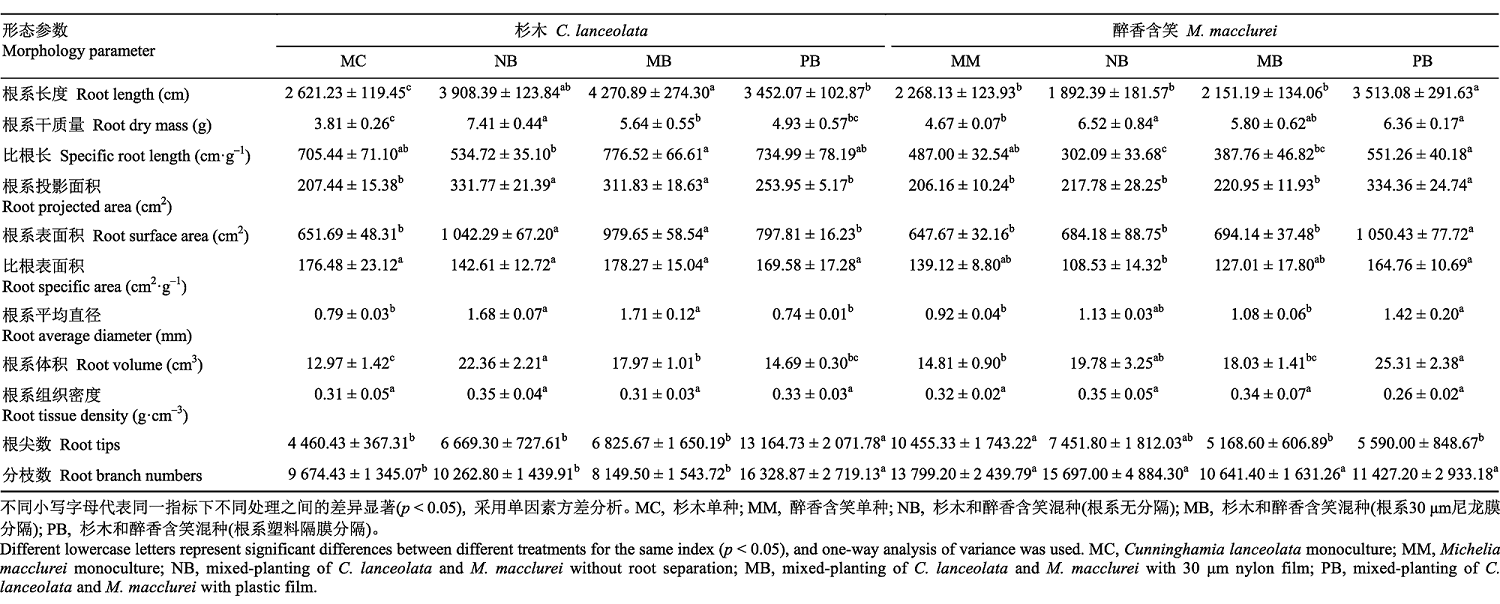 |
Table 1 Effects of different root separation modes on root morphology of Cunninghamia lanceolata and Michelia macclurei (mean ± SE, n = 5)
| |
 |
Table 2 Two-factor analysis of variance of root separation treatment and fine root type of fine root morphology of Cunninghamia lanceolata and Michelia macclurei
| |
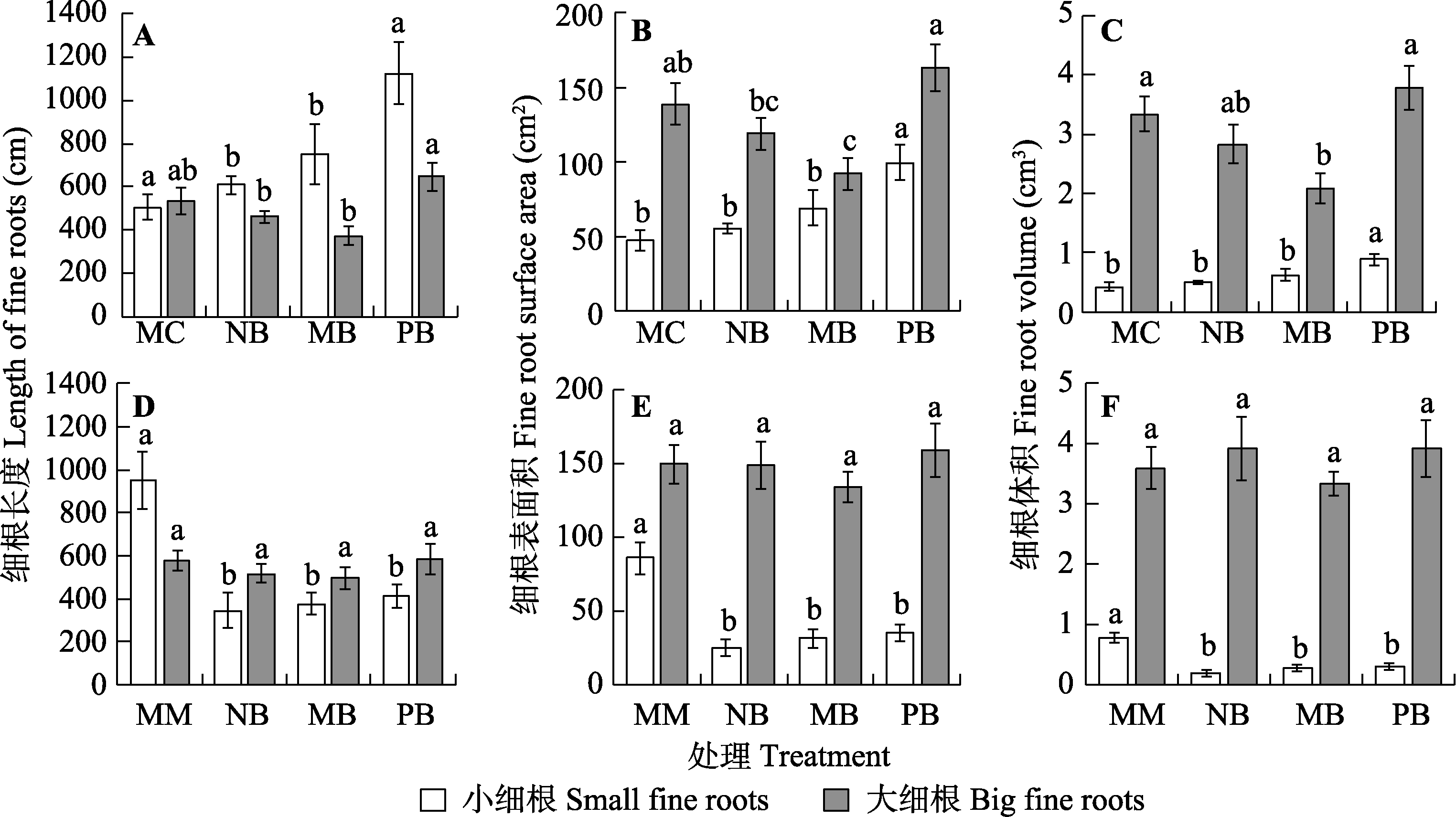
Fig. 4 Effects of different root separation modes on fine root morphology of Cunninghamia lanceolata (A-C) and Michelia macclurei (D-F) (mean ± SE, n = 5). Different lowercase letters indicated significant differences among treatments (p < 0.05). Very fine roots,0 < D ≤ 0.5 mm; fine root, 0.5 < D ≤ 2.0 mm; D is the root diameter. MM, Michelia macclurei monoculture; NB, mixed-planting of Cunninghamia lanceolata and M. macclurei without root separation; MB, mixed-planting of C. lanceolata and M. macclurei with 30 μm nylon film; MC, Cunninghamia lanceolata monoculture; PB, mixed-planting of C. lanceolata and M. macclurei with plastic film.
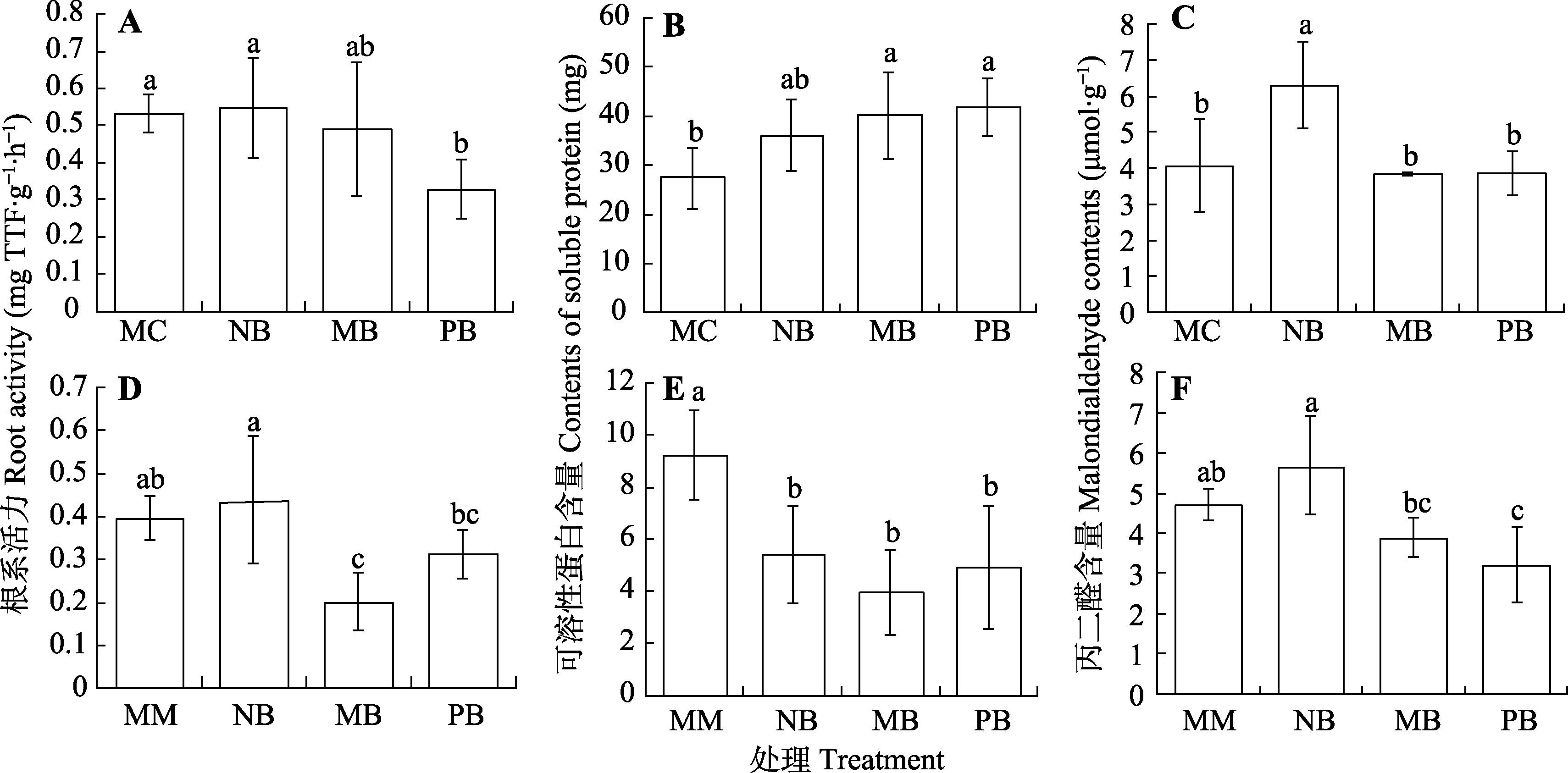
Fig. 5 Root activity, soluble protein and malondialdehyde content of Cunninghamia lanceolata (A-C) and Michelia macclurei (D-F) under different treatments (mean ± SE, n = 5). Different lowercase letters indicated significant differences among treatments (p < 0.05). MC, Cunninghamia lanceolata monoculture; MM, Michelia macclurei monoculture; NB, mixed-planting of C. lanceolata and M. macclurei without root separation; MB, mixed-planting of C. lanceolata and M. macclurei with 30 μm nylon film; PB, mixed-planting of C. lanceolata and M. macclurei with plastic film.
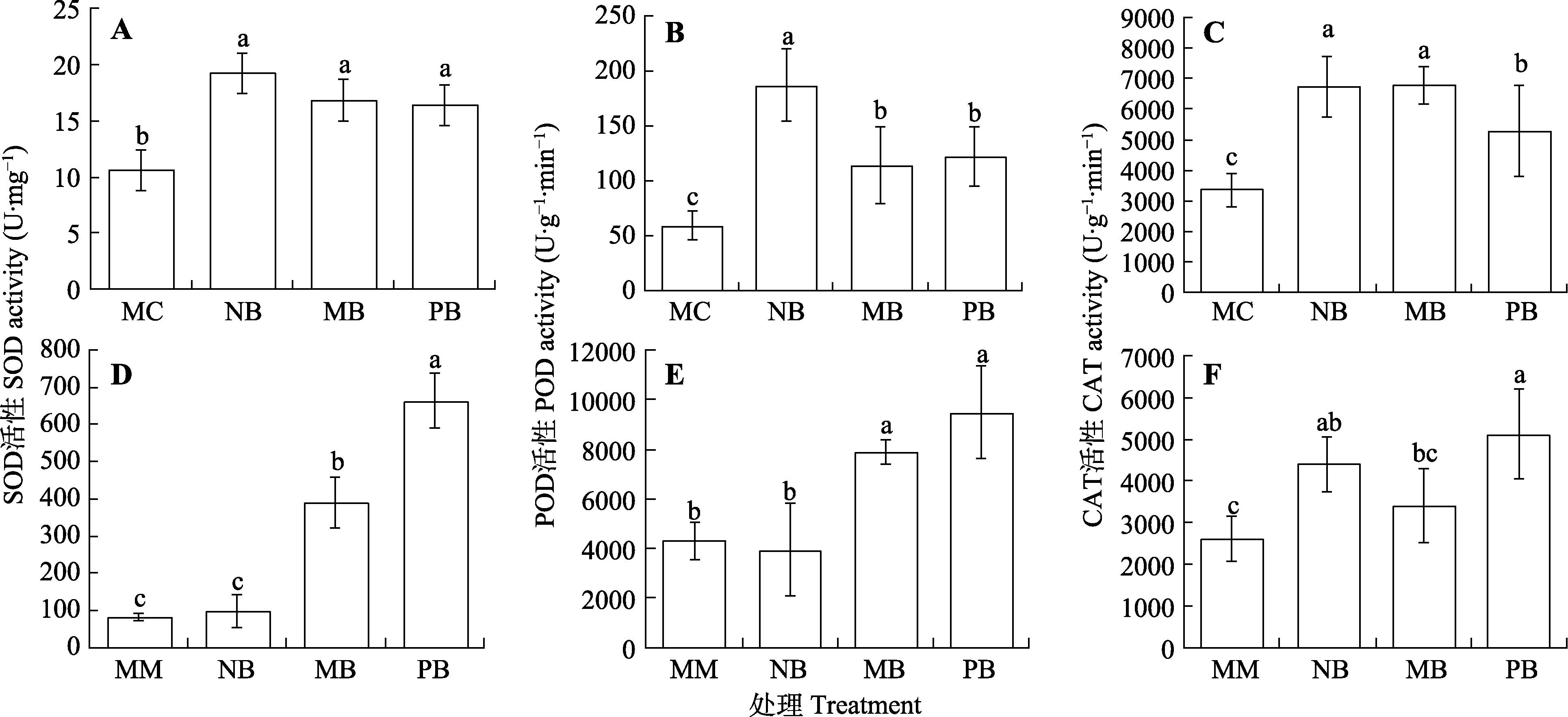
Fig. 6 Oxidase activity of roots in Cunninghamia lanceolata (A-C) and Michelia macclurei (D-F) under different treatments (mean ± SE, n = 5). Different lowercase letters indicated significant differences among treatments (p < 0.05). MC, Cunninghamia lanceolata monoculture; MM, Michelia macclurei monoculture; NB, mixed-planting of C. lanceolata and M. macclurei without root separation; MB, mixed-planting of C. lanceolata and M. macclurei with 30 μm nylon film; PB, mixed-planting of C. lanceolata and M. macclurei with plastic film. SOD, superoxide dismutase; POD, peroxidase; CAT, catalase.
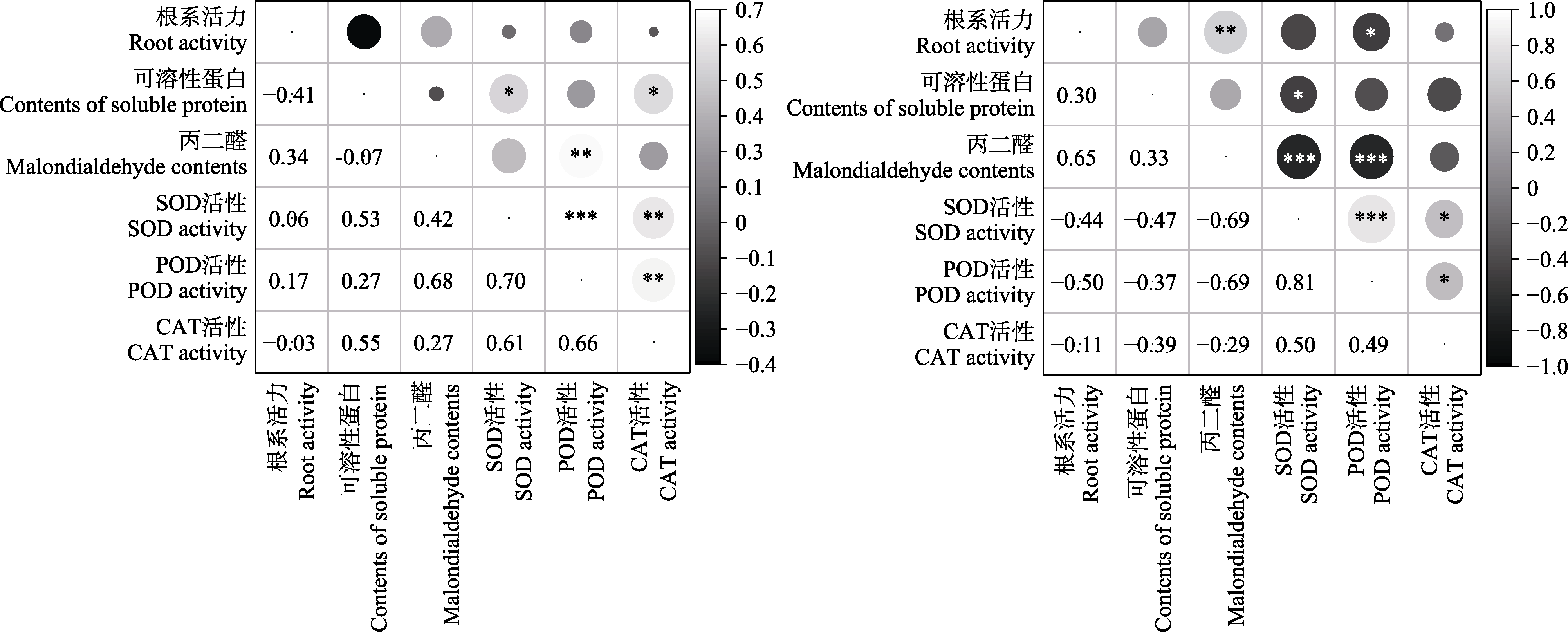
Fig. 7 Correlation analysis among root physiological indexes for Cunninghamia lanceolata (A) and Michelia macclurei (B). *, p < 0.05; **, p < 0.01; ***, p < 0.001. CAT, catalase; POD, peroxidase; SOD, superoxide dismutase.
| [1] |
Bradford MM (1976). A rapid and sensitive method for the quantitation of microgram quantities of protein utilizing the principle of protein-dye binding. Analytical Biochemistry, 72, 248-254.
DOI URL |
| [2] |
Chen C, Xiao WY, Chen HYH (2025). Meta-analysis reveals global variations in plant diversity effects on productivity. Nature, 638, 435-440.
DOI |
| [3] |
Chen L, Liu JX, Li SY, Chen N, Bao FX, Wang F, Qu SM, Liu GF (2024). Effects of saline-alkali tolerant rhizosphere growth-promoting bacteria on the growth and root physiological characteristics of alfalfa under saline-alkali stress. Acta Agrestia Sinica, 32, 2323-2329.
DOI |
|
[陈露, 刘佳欣, 李思宇, 陈宁, 包凤轩, 王凤, 曲善民, 刘国富 (2024). 耐盐碱根际促生细菌对盐碱胁迫下紫花苜蓿生长和根系生理特性的影响. 草地学报, 32, 2323-2329.]
DOI |
|
| [4] |
Chen SN, Chen ZSN, Zhang ZQ (2021). Canopy stomatal conductance characteristics of Pinus tabulaeformis and Acer truncatum and their responses to environmental factors in the mountain area of Beijing. Chinese Journal of Plant Ecology, 45, 1329-1340.
DOI URL |
|
[陈胜楠, 陈左司南, 张志强 (2021). 北京山区油松和元宝槭冠层气孔导度特征及其环境响应. 植物生态学报, 45, 1329-1340.]
DOI |
|
| [5] | Chen WD, Zhang YX, Cong BM, A MR, Tian YL, Zhang QX, Du XY (2021). Effects of potassium fertilizer on MDA, SP content and antioxidant system of alfalfa root neck. Acta Agrestia Sinica, 29, 717-723. |
|
[陈卫东, 张玉霞, 丛百明, 阿玛尔, 田永雷, 张庆昕, 杜晓艳 (2021). 钾肥对紫花苜蓿根颈丙二醛、可溶性蛋白含量与抗氧化系统的影响. 草地学报, 29, 717-723.]
DOI |
|
| [6] |
Chimento C, Amaducci S (2015). Characterization of fine root system and potential contribution to soil organic carbon of six perennial bioenergy crops. Biomass and Bioenergy, 83, 116-122.
DOI URL |
| [7] |
Davrinche A, Haider S (2024). Soil conditions modify species diversity effects on tree functional trait expression. Scientific Reports, 14, 17114. DOI: 10.1038/s41598-024-67512-w.
PMID |
| [8] |
Dong N, Tang MM, Cui WQ, Yue MY, Liu J, Huang YJ (2022). Growth of chestnut and tea seedlings under different root partitioning patterns. Chinese Journal of Plant Ecology, 46, 62-73.
DOI |
|
[董楠, 唐明明, 崔文倩, 岳梦瑶, 刘洁, 黄玉杰 (2022). 不同根系分隔方式对栗和茶幼苗生长的影响. 植物生态学报, 46, 62-73.]
DOI |
|
| [9] | Du WP, Zhao GQ, Chai JK, Yang L, Zhang JG, Shi YC, Zhang GL (2024). Effects of root separation on aboveground biomass, soil nutrient contents, and root characters of intercropped oat and pea. Acta Prataculturala Sinica, 33(8), 25-36. |
|
[杜文盼, 赵桂琴, 柴继宽, 杨莉, 张建贵, 史怡超, 张官禄 (2024). 根系分隔方式对燕麦/豌豆间作地上生物量、土壤养分及根系性状的影响. 草业学报, 33(8), 25-36.]
DOI |
|
| [10] | Fan RY, Ye SM, Zhang QC, He YQ, Deng JZ (2023). Characteristics of active organic carbon components in soil aggregates of pure plantation of C. lanceolata and its mixed forest. Journal of Northwest Forestry University, 38(6), 20-28. |
| [樊容源, 叶绍明, 张钱春, 何雅琴, 邓家珍 (2023). 杉木纯林及其混交林土壤团聚体活性有机碳组分特征. 西北林学院学报, 38(6), 20-28.] | |
| [11] |
Feng YH, Schmid B, Loreau M, Forrester DI, Fei SL, Zhu JX, Tang ZY, Zhu JL, Hong PB, Ji CJ, Shi Y, Su HJ, Xiong XY, Xiao J, Wang SP, et al. (2022). Multispecies forest plantations outyield monocultures across a broad range of conditions. Science, 376, 865-868.
DOI PMID |
| [12] | Forrester DI (2017). Ecological and physiological processes in mixed versus monospecific stands. Mixed-Species Forests: Ecology and Management, 11, 73-115. |
| [13] | Gamfeldt L, Snäll T, Bagchi R, Jonsson M, Gustafsson L, Kjellander P, Ruiz-Jaen MC, Fröberg M, Stendahl J, Philipson CD, Mikusiński G, Andersson E, Westerlund B, Andrén H, Moberg F, et al. (2013). Higher levels of multiple ecosystem services are found in forests with more tree species. Nature Communications, 4, 1340. DOI: 10.1038/ncomms2328. |
| [14] | Guo JH, Kneeshaw D, Peng CH, Wu YX, Feng L, Qu XJ, Wang WF, Pan C, Feng HL (2025). Positive effects of species mixing on biodiversity of understory plant communities and soil health in forest plantations. Proceedings of the National Academy of Sciences of the United States of America, 122, 11. DOI: 10.1073/pnas.2418090122. |
| [15] |
Guo JN, Zhao YP, Yang YZ, Guan QJ (2024). Roles of superoxide dismutase in plant response to drought, salinity and cold stress. Bulletin of Botanical Research, 44, 481-490.
DOI |
|
[郭迦南, 赵倚澎, 杨元植, 管清杰 (2024). 超氧化物歧化酶在植物响应干旱、盐碱和冷害中的作用. 植物研究, 44, 481-490.]
DOI |
|
| [16] | Guo Y, Yao JF, Dong Y, Yan J, Yang N, Feng YH, Wei X, Liang WJ (2023). Root distribution characteristics of monoculture and mixture of Pinus tabuliformis and Robinia pseudoacacia plantation. Chinese Journal of Applied Ecology, 34, 2881-2888. |
|
[郭钰, 姚佳峰, 董媛, 闫珏, 杨南, 冯泳翰, 魏曦, 梁文俊 (2023). 油松和刺槐纯林及混交林根系分布特征. 应用生态学报, 34, 2881-2888.]
DOI |
|
| [17] | Hu XH, He ZQ, Kang JJ, Zhao Q (2025). Effects of intercropping on seedlings biomass and non-structural carbohydrates in Cunninghamia lanceolata and Michelia macclurei. Journal of Forest and Environment, 45(1), 73-81. |
| [胡雪花, 贺梓晴, 康骏杰, 赵倩 (2025). 混种对杉木和火力楠幼苗生物量及非结构性碳水化合物的影响. 森林与环境学报, 45(1), 73-81.] | |
| [18] | Huang A, Ji L, He GX, Ni YL, Yang LL, Wang MK (2025). Ecological stoichiometric characteristics and rhizosphere effects of soil in mixed forests of Cunninghamia lanceolata and Phoebe bournei. Chinese Journal of Ecology, 44, 2268-2276. |
| [黄澳, 及利, 何功秀, 倪艳林, 杨丽丽, 王明坤 (2025). 杉木闽楠混交林根际土壤生态化学计量特征及其根际效应. 生态学杂志, 44, 2268-2276.] | |
| [19] |
Huang CY, Chen HYH, Chang SX, Cahill JF, Ma ZL (2023). Species mixtures increase fine root length to support greater stand productivity in a natural boreal forest. Journal of Ecology, 111, 1139-1150.
DOI URL |
| [20] |
Isbell FI, Polley HW, Wilsey BJ (2009). Biodiversity, productivity and the temporal stability of productivity: patterns and processes. Ecology Letters, 12, 443-451.
DOI PMID |
| [21] | Jia JX, Huang Y, Xu YY, Yang M (2025). Effects of interplanting Sarcandra glabra under Cunninghamia lanceolata plantation on volatile organic compounds in soil leachate, and on soil nutrients and enzyme activities. Journal of Southwest Forestry University (Natural Sciences), 45(2), 106-116. |
| [贾建相, 黄勇, 徐圆圆, 杨梅 (2025). 杉木林下套种草珊瑚对土壤浸提物挥发性有机物、土壤养分及酶活性的影响. 西南林业大学学报(自然科学), 45(2), 106-116.] | |
| [22] | Jing YL, Wang QK (2024). Mixed Cunninghamia lanceolata-Michelia macclurei plantation decreased soil bacterial residue accumulation in topsoils. Chinese Journal of Ecology, 43, 2650-2657. |
| [井艳丽, 王清奎 (2024). 杉木-火力楠混交林降低表层土壤细菌残体积累. 生态学杂志, 43, 2650-2657.] | |
| [23] |
Kircher S, Schopfer P (2023). Photosynthetic sucrose drives the lateral root clock in Arabidopsis seedlings. Current Biology, 33, 2201-2212.
DOI URL |
| [24] | Li GP, Zhan YW, Lan QY, Li JF, Yang ZQ, Hu Y (2024). Effects of three exogenous substances on physiological characteristics of Michelia macclurei seedlings under drought stress. Guangxi Forestry Science, 53, 594-602. |
| [李改萍, 詹瑜雯, 蓝秋玉, 李建凡, 杨章旗, 胡颖 (2024). 3种外源物质对干旱胁迫下火力楠幼苗生理特性的影响. 广西林业科学, 53, 594-602.] | |
| [25] | Li MQ, Zhao C, Luo H, Chen H, Liu B, Wang ZN (2023). Allelopathy of different litter water extracts on seed germination and early seedling growth of Cunninghamia lanceolata. Jiangsu Agricultural Sciences, 51(7), 138-146. |
| [李梦琪, 赵冲, 罗航, 陈杭, 刘博, 王正宁 (2023). 不同凋落物水浸提液对杉木种子萌发和幼苗早期生长的化感作用. 江苏农业科学, 51(7), 138-146.] | |
| [26] | Li TT, Wu SR, Wang LL, Lv FL, Lan ZP (2022). Progress in national and international research on mixed forest. World Forestry Research, 35(5), 42-48. |
| [李婷婷, 吴水荣, 王林龙, 吕馥龄, 兰再平 (2022). 国内外混交林研究进展. 世界林业研究, 35(5), 42-48.] | |
| [27] | Li ZG, Gong M (2008). Improvement of determination of plant peroxidase activity by guaiacol method. Plant Physiology Communications, 44, 323-324. |
| [李忠光, 龚明 (2008). 愈创木酚法测定植物过氧化物酶活性的改进. 植物生理学通讯, 44, 323-324.] | |
| [28] |
Liang XY, Zhang T, Lu XK, Ellsworth DS, BassiriRad H, You CM, Wang D, He PC, Deng Q, Liu H, Mo JM, Ye Q (2020). Global response patterns of plant photosynthesis to nitrogen addition: a meta-analysis. Global Change Biology, 26, 3585-3600.
DOI PMID |
| [29] | Liao YC, Duan HL, Shi XX, Meng QY, Liu WF, Shen FF, Fan HB, Zhu T (2021). The relationship between the stand growth and root biomass of Cunninghamia lanceolate plantations. Ecology and Environment Sciences, 30, 1121-1128. |
|
[廖迎春, 段洪浪, 施星星, 孟庆银, 刘文飞, 沈芳芳, 樊后保, 朱涛 (2021). 杉木(Cunninghamia lanceolate)人工林生长状况与根系生物量相关性研究. 生态环境学报, 30, 1121-1128.]
DOI |
|
| [30] | Lin DC, Lu JA, Li Q, Zou XH, Li M, Wu PF (2021). Effect of underground space crowding on endogenous organic acids in Chinese fir seedlings. Journal of Fujian Agriculture and Forestry University (Natural Science Edition), 50(1), 54-60. |
| [林德城, 卢佳奥, 李琦, 邹显花, 李明, 吴鹏飞 (2021). 地下空间拥挤程度对杉木幼苗根系内源有机酸的影响. 福建农林大学学报(自然科学版), 50(1), 54-60.] | |
| [31] |
Liu C, Xiang WH, Tian DL, Fang X, Peng CH (2011). Overyielding of fine root biomass as increasing plant species richness in subtropical forests in central Southern China. Chinese Journal of Plant Ecology, 35, 539-550.
DOI URL |
|
[刘聪, 项文化, 田大伦, 方晰, 彭长辉 (2011). 中亚热带森林植物多样性增加导致细根生物量“超产”. 植物生态学报, 35, 539-550.]
DOI |
|
| [32] | Liu SQ, Man XL, Zhang D, Xu ZP (2023). Dynamics of root decomposition and carbon and nitrogen release of four tree species with different diameter classes in the cold temperate zone. Journal of Beijing Forestry University, 45(7), 36-46. |
| [刘思琪, 满秀玲, 张頔, 徐志鹏 (2023). 寒温带4种乔木树种不同径级根系分解及碳氮释放动态. 北京林业大学学报, 45(7), 36-46.] | |
| [33] |
Liu X, Yin TT, Zhang Y, Huang DZ, Wu P, Wang N, Zheng PM, Wang H, Wang RQ (2022). Water use strategies of Robinia pseudoacacia and Quercus acutissima vary among seasons and planting methods. Plant and Soil, 483, 199-207.
DOI |
| [34] | Liu XL, Zhao N, Jia YY, Xiao WX (2020). The role of phenolic acids in plant-soil-environment system. Horticulture & Seed, 40(8), 56-58. |
| [刘晓丽, 赵娜, 贾钰莹, 肖万欣 (2020). 酚酸类物质在植物土壤环境中的作用. 园艺与种苗, 40(8), 56-58.] | |
| [35] | Logan BA, Grace SC, Adams WW, Demmig-Adams B (1998). Seasonal differences in xanthophyll cycle characteristics and antioxidants in Mahonia repens growing in different light environments. Oecologia, 116, 9-17. |
| [36] | Lu RF, Ge XG, Wang LL, Zhou BZ, Yang ZY, Wang XM (2020). Effect of biochar addition on root and soil microbial community of Pinus massoniana and Cunninghamia lanceolata. Ecology and Environment Sciences, 29, 2153-2162. |
|
[陆人方, 葛晓改, 王灵玲, 周本智, 杨振亚, 王小明 (2020). 生物质炭添加对马尾松和杉木根系及土壤微生物结构的影响. 生态环境学报, 29, 2153-2162.]
DOI |
|
| [37] | Luo SM (2022). Analysis on the growth effect of introduction and cultivation of Michelia macclurei. Journal of Green Science and Technology, 24(3), 132-134. |
| [罗盛懋 (2022). 火力楠引种栽培生长效果分析. 绿色科技, 24(3), 132-134.] | |
| [38] | Lü MY, Ren J, Zhang LM, Chen SY, Zhao JL, Lu JL, Kong C, Dai W, Jin GX (2025). Evaluation model for root growth and development of Corylus heterophylla × C. avellana cuttings based on photosynthetic indexes. Scientia Silvae Sinicae, 61(3), 100-107. |
| [吕梦燕, 任军, 张立民, 陈思羽, 赵佳丽, 鲁佳乐, 孔晨, 戴维, 金桂香 (2025). 基于光合指标的平欧杂种榛扦插苗根系生长发育评价模型. 林业科学, 61(3), 100-107.] | |
| [39] | Lwila AS (2024). Spatial and Temporal Fine Root Distribution Growth of European Beech, Norway Spruce, and Douglas-fir in Pure and Mixed Stands with Beech Under Different Site Conditions. PhD dissertation, University of Göttingen, Göttingen, Germany. |
| [40] | Ma JM, Dou M, Liu D, Yang XH, Yang Y, Nian FZ, Liu YT, Li YZ (2025). Effects of intercropping of flue-cured tobacco and maize on rhizosphere soil nutrients and crop growth. Crops, (1), 227-234. |
| [马俊美, 窦敏, 刘弟, 杨秀华, 杨勇, 年夫照, 刘雅婷, 李永忠 (2025). 烤烟与玉米间作种植对根际土壤养分及作物生长的影响. 作物杂志, (1), 227-234.] | |
| [41] |
McCormack ML, Dickie IA, Eissenstat DM, Fahey TJ, Fernandez CW, Guo DL, Helmisaari HS, Hobbie EA, Iversen CM, Jackson RB, Leppälammi-Kujansuu J, Norby RJ, Phillips RP, Pregitzer KS, Pritchard SG, et al. (2015). Redefining fine roots improves understanding of below-ground contributions to terrestrial biosphere processes. New Phytologist, 207, 505-518.
DOI PMID |
| [42] |
Metz J, Annighöfer P, Schall P, Zimmermann J, Kahl T, Schulze ED, Ammer C (2016). Site-adapted admixed tree species reduce drought susceptibility of mature European beech. Global Change Biology, 22, 903-920.
DOI URL |
| [43] | Morales M, Munné-Bosch S (2024). Malondialdehyde assays in higher plants//Corpas FJ, Palma JM. ROS Signaling in Plants: Methods and Protocols. Humana New York, New York. |
| [44] | Pregitzer KS, DeForest JL, Burton AJ, Allen MF, Ruess RW, Hendrick RL (2002). Fine root architecture of nine North American trees. Ecological Monographs, 72, 293. DOI: 10.2307/3100029. |
| [45] |
Pretzsch H, Schütze G (2021). Tree species mixing can increase stand productivity, density and growth efficiency and attenuate the trade-off between density and growth throughout the whole rotation. Annals of Botany, 128, 767-786.
DOI PMID |
| [46] |
Senaratna T, Touchell D, Bunn E, Dixon K (2000). Acetyl salicylic acid (Aspirin) and salicylic acid induce multiple stress tolerance in bean and tomato plants. Plant Growth Regulation, 30, 157-161.
DOI |
| [47] |
Sun JH, Shi HL, Chen KY, Ji BM, Zhang J (2023). Research advances on trade-off relationships of plant fine root functional traits. Chinese Journal of Plant Ecology, 47, 1055-1070.
DOI URL |
|
[孙佳慧, 史海兰, 陈科宇, 纪宝明, 张静 (2023). 植物细根功能性状的权衡关系研究进展. 植物生态学报, 47, 1055-1070.]
DOI |
|
| [48] |
Tcherkez G, Limami AM (2019). Net photosynthetic CO2 assimilation: more than just CO2 and O2 reduction cycles. New Phytologist, 223, 520-529.
DOI URL |
| [49] |
Viana WG, Scharwies JD, Dinneny JR (2022). Deconstructing the root system of grasses through an exploration of development, anatomy and function. Plant, Cell & Environment, 45, 602-619.
DOI URL |
| [50] | Wang BS, Chen HX, Dong Z, Zhu W, Qiu QY, Tang LN (2020). Impact of land use change on the water conservation service of ecosystems in the urban agglomeration of the Golden Triangle of Southern Fujian, China, in 2030. Acta Ecologica Sinica, 40, 484-498. |
| [王保盛, 陈华香, 董政, 祝薇, 邱全毅, 唐立娜 (2020). 2030年闽三角城市群土地利用变化对生态系统水源涵养服务的影响. 生态学报, 40, 484-498.] | |
| [51] | Wang D, Zhang YQ, Zhang M, Liang P, He JM, Yan FF, Wang HJ (2023). Influences of interaction between soil root-growing space and planting density on root distribution and yield of quinoa. Jiangsu Agricultural Sciences, 51(21), 79-86. |
| [王丹, 张永清, 张萌, 梁萍, 合佳敏, 严翻翻, 王慧娟 (2023). 根土空间与种植密度互作对藜麦根系分布及产量的影响. 江苏农业科学, 51(21), 79-86.] | |
| [52] | Wang JJ, Gao HH, Kang HZ (2018). A review on influencing factors of carbon storage in Chinese fir plantations. Journal of Northwest Forestry University, 33(3), 74-81. |
| [王姣娇, 高唤唤, 康宏樟 (2018). 杉木人工林碳储量影响因素研究进展. 西北林学院学报, 33(3), 74-81.] | |
| [53] | Wang JR (2021). Root Competition and Allelopathy of Cunninghamia lanceolata and Phoebe chekiangensis Under Simulated Nitrogen Deposition. Master degree dissertation, Zhejiang Agriculture and Forestry University, Hangzhou. |
| [王镜如 (2021). 模拟氮沉降背景下杉木和浙江楠根系竞争及其化感作用研究. 硕士学位论文, 浙江农林大学, 杭州.] | |
| [54] | Wang SQ, Tian JX, Dong LH (2025). Stoichiometric characteristics of carbon, nitrogen and phosphorus in mixed plantation of Larix olgensis-Fraxinus mandshurica under different mixed proportions. Journal of Southwest Forestry University (Natural Sciences), 45(2), 132-141. |
| [王思琪, 田佳歆, 董利虎 (2025). 不同比例长白落叶松-水曲柳混交林碳氮磷化学计量特征研究. 西南林业大学学报(自然科学), 45(2), 132-141.] | |
| [55] |
Wang X, Cheng LY, Xiong CY, Whalley WR, Miller AJ, Rengel Z, Zhang FS, Shen JB (2024). Understanding plant-soil interactions underpins enhanced sustainability of crop production. Trends in Plant Science, 29, 1181-1190.
DOI PMID |
| [56] | Wang XM, Wang SL, Zhu JH, Zuo LZ, Yang ZL, Li L (2022a). Response mechanisms of sugarcane seedlings to the allelopathic effects of root aqueous extracts from sugarcane ratoons of different ages. Frontiers in Plant Science, 13, 1020533. DOI: 10.3389/fpls.2022.1020533. |
| [57] | Wang XR, Wang ZQ, Han YZ, Gu JC, Guo DL, Mei L (2005). Variations of fine root diameter with root order in manchurian ash and dahurian larch plantations. Acta Phytoecologica Sinica, 29, 871-877. |
|
[王向荣, 王政权, 韩有志, 谷加存, 郭大立, 梅莉 (2005). 水曲柳和落叶松不同根序之间细根直径的变异研究. 植物生态学报, 29, 871-877.]
DOI |
|
| [58] | Wang Y, Wang YZ, Tang YH, Zhu XG (2022b). Stomata conductance as a goalkeeper for increased photosynthetic efficiency. Current Opinion in Plant Biology, 70, 102310. DOI: 10.1016/j.pbi.2022.102310. |
| [59] | Wang YZ, Jiang P, Liao CL, Fei JC, Zhang YP, Rong XM, Peng JW, Luo GW (2025). Understanding the increased maize productivity of intercropping systems from interactive scenarios of plant roots and arbuscular mycorrhizal fungi. Agriculture, Ecosystems & Environment, 381, 109450. DOI: 10.1016/j.agee.2024.109450. |
| [60] | Wu T, Lu YW, Xu YY, Zhong LX, Wei QL, Yang M (2024). Effects of phenolic acids in soil of Cunninghamia lanceolata plantations on growth and quality of Sarcandra glabra. Journal of Northwest A&F University (Natural Science Edition), 52(6), 49-61. |
| [吴桐, 陆艳武, 徐圆圆, 钟连香, 韦庆林, 杨梅 (2024). 杉木土壤酚酸物质对草珊瑚生长和品质的影响. 西北农林科技大学学报(自然科学版), 52(6), 49-61.] | |
| [61] |
Xia ZC, Kong CH, Chen LC Wang P, Wang SL (2016). A broadleaf species enhances an autotoxic conifers growth through belowground chemical interactions. Ecology, 97, 2283-2292.
DOI URL |
| [62] |
Xiang WH, Fan GW, Lei PF, Zeng YL, Tong J, Fang X, Deng XW, Peng CH (2015). Fine root interactions in subtropical mixed forests in China depend on tree species composition. Plant and Soil, 395, 335-349.
DOI URL |
| [63] | Xu CC, Zou Q, Cheng BS (1989). Stady on thiobarbiburic acid (TBA) method for determination of lipid peroxidation. Plant Physiology Communications, 25(6), 58-60. |
| [许长成, 邹琦, 程炳嵩 (1989). 硫代巴比妥酸(TBA)法检测脂质过氧化水平的探讨. 植物生理学通讯, 25(6), 58-60.] | |
| [64] | Xu YH, Liu TT, Liu GM, Cheng C, Yu JX, Yan XL (2025). Absorption and utilization of nitrogen and phosphorus nutrients by tree root systems in mixed forests and their competition strategies. World Forestry Research, 38(1), 38-44. |
| [徐云浩, 刘婷婷, 刘贵梅, 程聪, 余佳翔, 闫小莉 (2025). 混交林林木根系对氮磷养分的吸收利用及竞争策略. 世界林业研究, 38(1), 38-44.] | |
| [65] | Yan SB, Wang P (2020). Effects of alleolchemicals on morphological traits of roots: a meta-analysis. Chinese Journal of Applied Ecology, 31, 2168-2174. |
|
[鄢邵斌, 王朋 (2020). 化感物质对植物根系形态属性影响的meta分析. 应用生态学报, 31, 2168-2174.]
DOI |
|
| [66] | Yan SY (2020). Analysis of the soil bacterial community structure and its relationship with soil properties in different successive rotation Cunninghamia lanceolata plantations. Journal of Southwest Forestry University (Natural Sciences), 40(3), 19-27. |
| [严绍裕 (2020). 杉木连栽地土壤的细菌群落结构与其特性的关系研究. 西南林业大学学报(自然科学), 40(3), 19-27.] | |
| [67] | Yan XL, Lin ZY, Hu WJ, Ma XQ, Qu LP (2022). Root morphological characteristics of Cunninghamia lanceolata and its foraging strategies. World Forestry Research, 35(1), 26-31. |
| [闫小莉, 林智熠, 胡文佳, 马祥庆, 曲鲁平 (2022). 杉木根系形态特征及其觅养策略研究进展. 世界林业研究, 35(1), 26-31.] | |
| [68] | Yang LF, Pang J, Peng XL, Yan JJ (2009). Measurement of catalase activity in plants by ultraviolet spectrophotometry. Modern Agricultural Science and Technology, (20), 364-366. |
| [杨兰芳, 庞静, 彭小兰, 闫静静 (2009). 紫外分光光度法测定植物过氧化氢酶活性. 现代农业科技, (20), 364-366.] | |
| [69] | Yang LR, Yang GR, Ma HJ, Li JH, Lü CY, Wen QS (2021). Photosynthetic characteristics and its influential factors of tea cultivars in Yunnan Province. Southwest China Journal of Agritcultural Sciences, 34(1), 19-26. |
| [杨丽冉, 杨广容, 马会杰, 李家华, 吕才有, 文勤枢 (2021). 云南茶树品种光合特性及其影响因素的研究. 西南农业学报, 34(1), 19-26.] | |
| [70] | Yang LX, Na SH, Su JB (2010). Allelochemicals and Interspecific Effects of Juglans mandshurica-Larix gmelinii Mixed Forest. Northeast Forestry University Press, Harbin. |
| [杨立学, 那守海, 苏金豹 (2010). 胡桃楸-落叶松混交林地化感物质与种间效应. 东北林业大学出版社, 哈尔滨.] | |
| [71] | Yang SY, Wang JR, Zhu YY, Yi LT, Liu MH (2024). Effects of mixed plantation of Cunninghamia lanceolata and Phoebe chekiangensis on root exudates and community structure of arbuscular mycorrhizal fungi. Scientia Silvae Sinicae, 60(9), 59-68. |
| [杨淑雅, 王镜如, 朱滢滢, 伊力塔, 刘美华 (2024). 杉木与浙江楠混交对根系分泌物和丛枝菌根真菌群落结构的影响. 林业科学, 60(9), 59-68.] | |
| [72] | Yang Y, Yan XY (2023). Allelopathy of garden plants and its application in garden construction. Contemporary Horticulture, 46(14), 145-147. |
| [杨洋, 闫晓云 (2023). 园林植物化感作用及其在园林建设中的应用. 现代园艺, 46(14), 145-147.] | |
| [73] |
Yu RP, Lambers H, Callaway RM, Wright AJ, Li L (2021). Belowground facilitation and trait matching: two or three to tango? Trends in Plant Science, 26, 1227-1235.
DOI URL |
| [74] |
Yuan HY, Hao MH, He HJ, Zhang CY, Zhao XH (2024). Impact of species richness and composition on productivity and its changes with forest succession in Changbai Mountains, China. Chinese Journal of Plant Ecology, 48, 1602-1611.
DOI |
|
[袁鹤洋, 郝珉辉, 何怀江, 张春雨, 赵秀海 (2024). 长白山物种丰富度与物种组成对森林生产力的影响及其随演替的变化. 植物生态学报, 48, 1602-1611.]
DOI |
|
| [75] | Zha MJ, Zhou LJ, Cai CE, Dong A, He PM (2022). Adjustment mechanism of light intensity and temperature on photosynthesis of Ulva flexuosa. Acta Hydrobiologica Sinica, 46, 1357-1363. |
| [查敏俊, 周玲洁, 蔡春尔, 董傲, 何培民 (2022). 光强和温度变化对曲浒苔光合作用的调节机制. 水生生物学报, 46, 1357-1363.] | |
| [76] | Zhang DJ, Li JJ, Huang YM, Gao S, Zhang J (2022). Root-soil facilitation in mixed Eucalyptus grandis plantations including nitrogen-fixing species. Forest Ecology and Management, 516, 120215. DOI: 10.1016/j.foreco.2022.120215. |
| [77] |
Zhang Y, Cao JJ, Lu MZ, Kardol P, Wang JJ, Fan GQ, Kong DL (2024). The origin of bi-dimensionality in plant root traits. Trends in Ecology & Evolution, 39, 78-88.
DOI URL |
| [78] | Zhang YL, Liu YM, Liu YM, Jia PJ, Zhu YT (2025). Physiological responses and heat resistance of Torreya grandis varieties to high temperatures. Journal of Forest and Environment, 45(2), 192-202. |
| [张钰林, 刘亚敏, 刘玉民, 贾朋聚, 朱娅婷 (2025). 不同品种香榧对高温的生理响应及其耐热性评价. 森林与环境学报, 45(2), 192-202.] | |
| [79] | Zheng YY, Xu LJ, Feng HL, Fu Q, Zhou Y (2024). Impacts of simulated drought stress on growth and physiological characteristics of four fungi from Pinus tabulaeformis roots. Jiangsu Agricultural Sciences, 52(14), 236-243. |
| [郑妍妍, 徐玲洁, 冯花蕾, 付强, 周勇 (2024). 模拟干旱胁迫对4种油松根系真菌生长及生理特性的影响. 江苏农业科学, 52(14), 236-243.] | |
| [80] | Zheng ZY, Jiang Q, Jia LQ, Chen GS (2024). Plasticity response of fine root morphological traits to short-term nitrogen and phosphorus addition in subtropical Cunninghamia lanceolata and Castanopsis carleisii plantations. Journal of Tropical and Subtropical Botany, 32, 620-628. |
| [郑子艺, 姜琦, 贾林巧, 陈光水 (2024). 杉木和米槠人工林细根形态对短期氮和磷添加的可塑性响应. 热带亚热带植物学报, 32, 620-628.] | |
| [81] | Zhou DY, Sun YX, Su HJ, Li SX, Dong QQ, Zhang YC, Zhang H, Wang J, Wang XG, Yu HQ, Zhao XH (2025). The effect of root interaction intensity on potassium activation and uptake in maize/peanut intercropping systems. Journal of Shenyang Agricultural University, 56(2), 12-21. |
| [周东英, 孙悦馨, 苏慧杰, 李世贤, 董奇琦, 张元春, 张鹤, 王婧, 王晓光, 于海秋, 赵新华 (2025). 玉米/花生间作下根系互作强度对土壤钾素活化吸收的影响. 沈阳农业大学学报, 56(2), 12-21.] | |
| [82] | Zhou F, Gao X, Fu ZY, Gao YF, Zhou YD (2021). Drying characteristics and drying technology of large-diameter Michelia macclurei wood. Journal of Northwest Forestry University, 36(1), 215-220. |
| [周凡, 高鑫, 付宗营, 高玉发, 周永东 (2021). 大径级火力楠木材干燥特性和干燥工艺研究. 西北林学院学报, 36(1), 215-220.] | |
| [83] |
Zhu W, Zhou O, Sun YM, Yilihamu G, Wang YF, Yang HQ, Jia LM, Xi BY (2023). Dynamic niche partitioning in root water uptake of Populus tomentosa and Robinia pseudoacacia in mixed forest. Chinese Journal of Plant Ecology, 47, 389-403.
DOI URL |
|
[祝维, 周欧, 孙一鸣, 古丽米热·依力哈木, 王亚飞, 杨红青, 贾黎明, 席本野 (2023). 混交林内毛白杨和刺槐根系吸水的动态生态位划分. 植物生态学报, 47, 389-403.]
DOI |
|
| [84] | Zhu XY, Liang M, Ma Y (2020). A review report on the experiments for the determination of root activity by TTC method. Guangdong Chemical Industry, 47(6), 211-212. |
| [朱秀云, 梁梦, 马玉 (2020). 根系活力的测定(TTC法)实验综述报告. 广东化工, 47(6), 211-212.] | |
| [85] | Zou KZ (2019). Cunninghamia lanceolata, Eucalyptus and Castanopsis hystrix in mixed and pure plantations. Eucalypt Science & Technology, 36(2), 32-36. |
| [邹楷泽 (2019). 杉木与桉树、红锥混交生长效应分析. 桉树科技, 36(2), 32-36.] |
| [1] | ZHANG Jing, CHEN Jie, LI Yan-Peng, PAN Li-Jun, XU Han, LI Yi-De, HE Hai-Sheng. Comparison of plant biomass in conifer and broadleaf mixed artificial forests in south subtropical area and analyses of influential factors [J]. Chin J Plant Ecol, 2026, 50(2): 400-416. |
| [2] | ZHAO Kun, WANG Yun-Qi, LIANG Jun, ZHOU Xiao-Zhou, FENG Yin-Cheng, QI Zi-Han, LI Jun-Jie, CUI Xin-Rui, LIU Xuan-Wo, MAO Wei. Characteristics and influencing factors of energy fluxes in the coniferous and broadleaf forests in Jinyun Mountains at different temporal scales [J]. Chin J Plant Ecol, 2026, 50(1): 70-81. |
| [3] | QU Ze-Kun, ZHU Li-Qin, JIANG Qi, WANG Xiao-Hong, YAO Xiao-Dong, CAI Shi-Feng, LUO Su-Zhen, sCHEN Guang-Shui. Nutrient foraging strategies of arbuscular mycorrhizal tree species in a subtropical evergreen broadleaf forest and their relationship with fine root morphology [J]. Chin J Plant Ecol, 2024, 48(4): 416-427. |
| [4] | ZHU Wei, ZHOU Ou, SUN Yi-Ming, Gulimire YILIHAMU, WANG Ya-Fei, YANG Hong-Qing, JIA Li-Ming, XI Ben-Ye. Dynamic niche partitioning in root water uptake of Populus tomentosa and Robinia pseudoacacia in mixed forest [J]. Chin J Plant Ecol, 2023, 47(3): 389-403. |
| [5] | FENG Yin-Cheng, WANG Yun-Qi, WANG Yu-Jie, WANG Kai, WANG Song-Nian, WANG Jie-Shuai. Water vapor fluxes and their relationship with environmental factors in a conifer-broadleaf mixed forest ecosystem in Jinyun Mountain, Chongqing, China [J]. Chin J Plant Ecol, 2022, 46(8): 890-903. |
| [6] | QIN Jiang-Huan, ZHANG Chun-Yu, ZHAO Xiu-Hai. Testing Janzen-Connell hypothesis based on plant-soil feedbacks in a temperate coniferous and broadleaved mixed forest [J]. Chin J Plant Ecol, 2022, 46(6): 624-631. |
| [7] | HAO Jian-Feng, ZHOU Run-Hui, YAO Xiao-Lan, YU Jing, CHEN Cong-Lin, XIANG Lin, WANG Yao-Yao, SU Tian-Cheng, QI Jin-Qiu. Effects of the second generation wild boar grazing on species diversity and soil physicochemical properties of coniferous-broad-leaved mixed forest in Jiajin Mountain, China [J]. Chin J Plant Ecol, 2022, 46(2): 197-207. |
| [8] | MA Ju-Feng, XIN Min, XU Chen-Chao, ZHU Wan-Ying, MAO Chuan-Zao, CHEN Xin, CHENG Lei. Effects of arbuscular mycorrhizal fungi and nitrogen addition on nitrogen uptake of rice genotypes with different root morphologies [J]. Chin J Plant Ecol, 2021, 45(7): 728-737. |
| [9] | SUN Hao-Zhe, WANG Xiang-Ping, ZHANG Shu-Bin, WU Peng, YANG Lei. Abiotic and biotic modulators of litterfall production and its temporal stability during the succession of broad-leaf and Korean pine mixed forest [J]. Chin J Plant Ecol, 2021, 45(6): 594-605. |
| [10] | HE Lu-Yan, HOU Man-Fu, TANG Wei, LIU Yu-Ting, ZHAO Jun. Vegetation types and their characteristics in karst forests of Junzi Mountain in East Yunnan, China [J]. Chin J Plant Ecol, 2021, 45(12): 1380-1390. |
| [11] | WANG Jin, ZHU Jiang, AI Xun-Ru, YAO Lan, HUANG Xiao, WU Man-Ling, ZHU Qiang, HONG Jian- Feng. Effects of topography on leaf functional traits across plant life forms in Xingdou Mountain, Hubei, China [J]. Chin J Plant Ecol, 2019, 43(5): 447-457. |
| [12] | ZOU Xian-Hua, HU Ya-Nan, WEI Dan, CHEN Si-Tong, WU Peng-Fei, MA Xiang-Qing. Correlation between endogenous hormone and the adaptability of Chinese fir with high phosphorus-use efficiency to low phosphorus stress [J]. Chin J Plant Ecol, 2019, 43(2): 139-151. |
| [13] | GAO Si-Han, GE Yu-Xi, ZHOU Li-Yi, ZHU Bao-Lin, GE Xing-Yu, LI Kai, NI Jian. What is the optimal number of leaves when measuring leaf area of tree species in a forest community? [J]. Chin J Plant Ecol, 2018, 42(9): 917-925. |
| [14] | GU Xiang, ZHANG Shi-Ji, LIU Zhao-Dan, LI Lei-Da, CHEN Jin-Lei, WANG Liu-Fang, FANG Xi. Effects of vegetation restoration on soil organic carbon concentration and density in the mid-subtropical region of China [J]. Chin J Plant Ecol, 2018, 42(5): 595-608. |
| [15] | Ming-Zhe MA, Guo-Zhen SHEN, Gao-Ming XIONG, Chang-Ming ZHAO, Wen-Ting XU, You-Bing ZHOU, Zong-Qiang XIE. Characteristic and representativeness of the vertical vegetation zonation along the altitudinal gradient in Shennongjia Natural Heritage [J]. Chin J Plant Ecol, 2017, 41(11): 1127-1139. |
| Viewed | ||||||
|
Full text |
|
|||||
|
Abstract |
|
|||||
Copyright © 2026 Chinese Journal of Plant Ecology
Tel: 010-62836134, 62836138, E-mail: apes@ibcas.ac.cn, cjpe@ibcas.ac.cn

