
Chin J Plant Ecol ›› 2020, Vol. 44 ›› Issue (1): 33-43.DOI: 10.17521/cjpe.2019.0283 cstr: 32100.14.cjpe.2019.0283
Special Issue: 生态系统结构与功能; 植被生态学
• Research Articles • Previous Articles Next Articles
DING Wei1,WANG Yu-Bing2,3,XIANG Guan-Hai2,3,CHI Yong-Gang4,LU Shun-Bao1,*( ),ZHENG Shu-Xia2,*()
Received:2019-10-22
Revised:2020-01-14
Online:2020-01-20
Published:2020-03-26
Contact:
LU Shun-Bao,ZHENG Shu-Xia
Supported by:DING Wei,WANG Yu-Bing,XIANG Guan-Hai,CHI Yong-Gang,LU Shun-Bao,ZHENG Shu-Xia. Effects of Caragana microphylla encroachment on community structure and ecosystem function of a typical steppe[J]. Chin J Plant Ecol, 2020, 44(1): 33-43.
Add to citation manager EndNote|Ris|BibTeX
URL: https://www.plant-ecology.com/EN/10.17521/cjpe.2019.0283
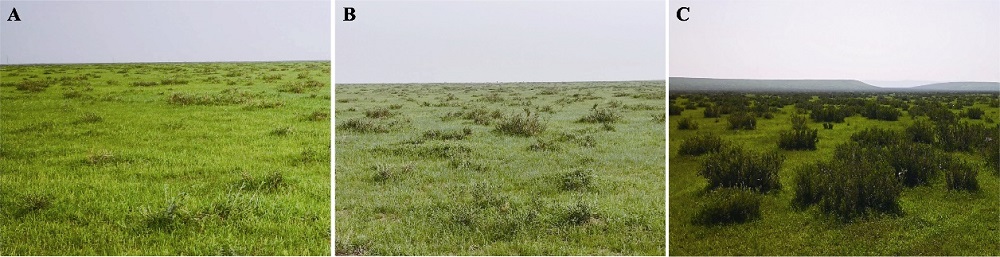
Fig. 1 Three grassland sites with light (A), moderate (B) and heavy (C) shrub encroachment by Caragana microphylla in Nei Mongol typical steppe.
| 灌丛特征 Shrub characteristic | 不同程度灌丛化 Degree of shrub encroachment | |||
|---|---|---|---|---|
| 轻度 Light | 中度 Moderate | 重度 Heavy | ||
| 数量 Number of bunches (No.·25 m-2) | 2 ± 0.5b (45) | 6 ± 0.6a (94) | 5 ± 0.9a (80) | |
| 高度 Height (cm) | 24.13 ± 1.45b (45) | 25.71 ± 0.91b (94) | 38.90 ± 2.23a (80) | |
| 冠幅 Crown (cm2) | 8 505.6 ± 1 453.0ab (45) | 6 907.3 ± 1 048.8b (94) | 13 083.9 ± 2 289.0a (80) | |
| 冠幅面积比 Crown area ratio (%) | 7.66 ± 1.81b (20) | 12.99 ± 2.47ab (20) | 20.93 ± 4.37a (20) | |
| 分蘖株数 Number of individuals (No.·25 m-2) | 25 ± 6b (504) | 32 ± 5ab (719) | 47 ± 8a (942) | |
Table 1 Shrub characteristics of Caragana microphylla at light, moderate and heavy encroachment sites in Nei Mongol typical steppe
| 灌丛特征 Shrub characteristic | 不同程度灌丛化 Degree of shrub encroachment | |||
|---|---|---|---|---|
| 轻度 Light | 中度 Moderate | 重度 Heavy | ||
| 数量 Number of bunches (No.·25 m-2) | 2 ± 0.5b (45) | 6 ± 0.6a (94) | 5 ± 0.9a (80) | |
| 高度 Height (cm) | 24.13 ± 1.45b (45) | 25.71 ± 0.91b (94) | 38.90 ± 2.23a (80) | |
| 冠幅 Crown (cm2) | 8 505.6 ± 1 453.0ab (45) | 6 907.3 ± 1 048.8b (94) | 13 083.9 ± 2 289.0a (80) | |
| 冠幅面积比 Crown area ratio (%) | 7.66 ± 1.81b (20) | 12.99 ± 2.47ab (20) | 20.93 ± 4.37a (20) | |
| 分蘖株数 Number of individuals (No.·25 m-2) | 25 ± 6b (504) | 32 ± 5ab (719) | 47 ± 8a (942) | |
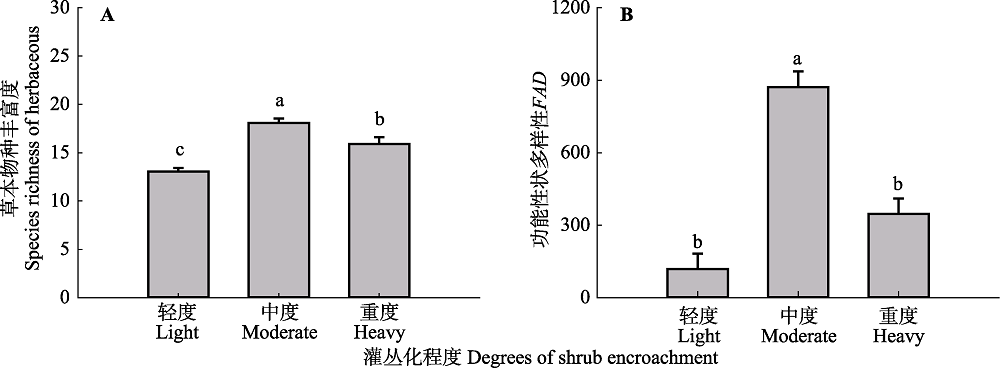
Fig. 2 Species richness and functional attribute diversity (FAD) at light, moderate and heavy encroachment sites in Nei Mongol typical steppe (mean + SE). FAD was calculated by plant height, plant biomass, stem:leaf biomass ratio and specific leaf area. Different lowercase letters indicate significant differences among sites (p < 0.05).
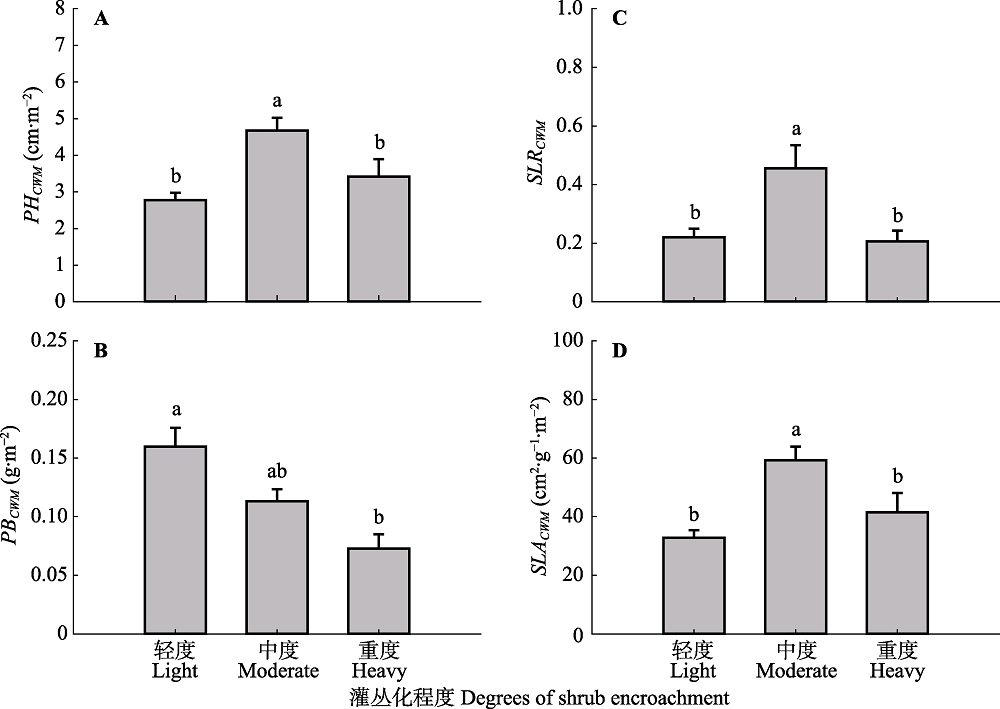
Fig. 3 Community-weighted mean traits (CWM) at light, moderate and heavy encroachment sites in Nei Mongol typical steppe (mean + SE). PBCWM, community-weighted plant biomass; PHCWM, community-weighted plant height; SLACWM, community-weighted specific leaf area; SLRCWM, community-weighted stem:leaf ratio. Different lowercase letters indicate significant differences among sites (p < 0.05).
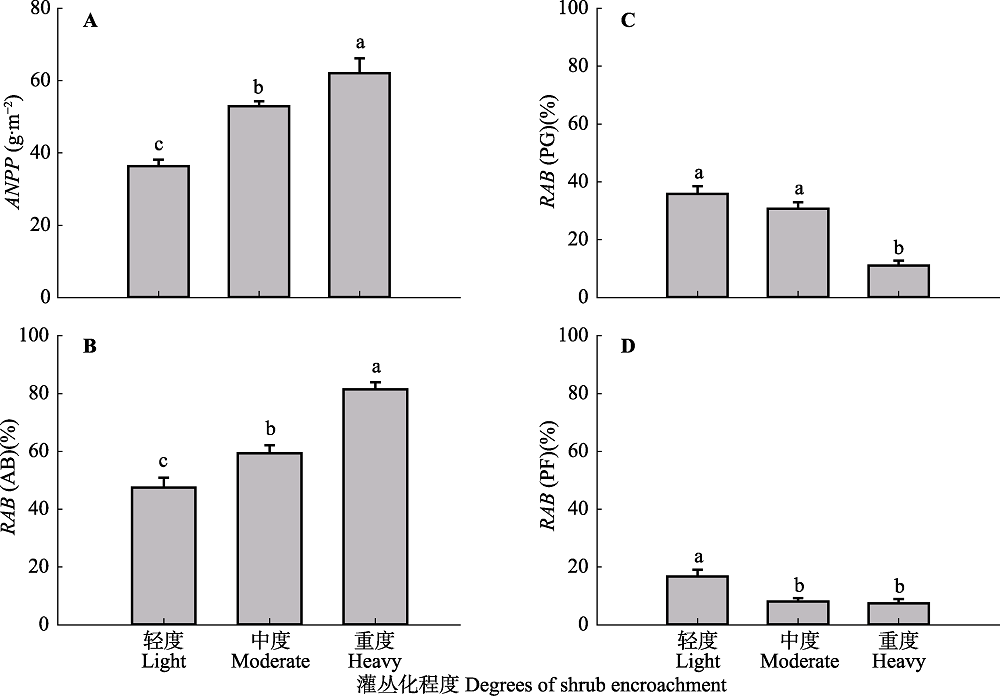
Fig. 4 Aboveground net primary productivity (ANPP) and relative biomass (RAB) of different functional groups at light, moderate and heavy encroachment sites in Nei Mongol typical steppe (mean + SE). AB, annuals and biennials; PF, perennial forbs; PG, perennial graminoids. Different lowercase letters indicate significant differences among sites (p < 0.05).
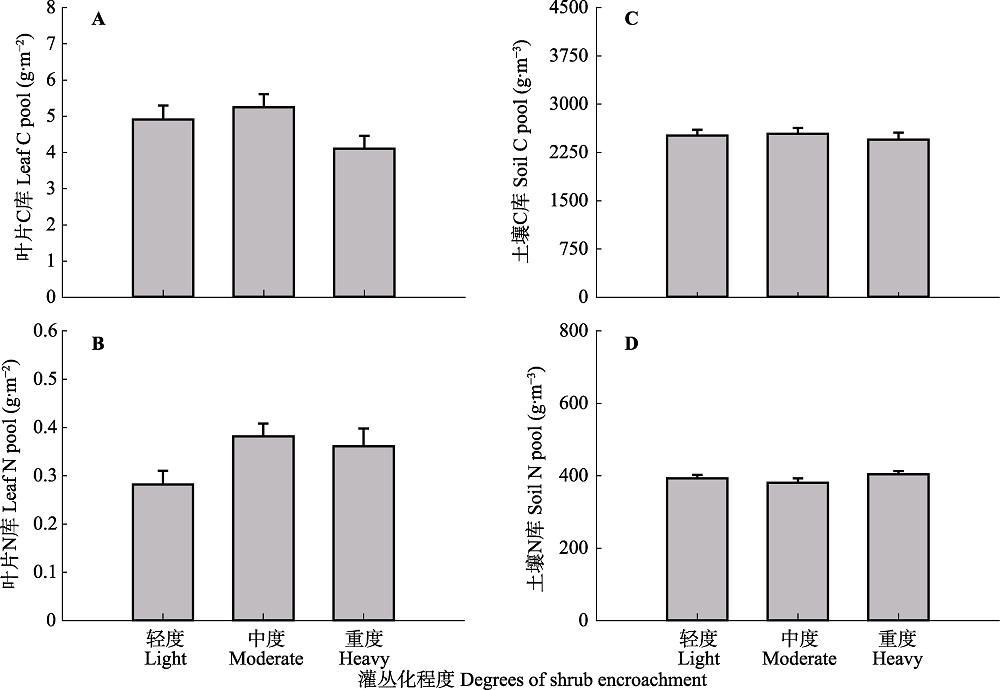
Fig. 5 Effects of shrub encroachment on C and N pools of vegetational leaf and soil in Nei Mongol typical steppe (mean + SE). No significant differences among sites (p > 0.05).
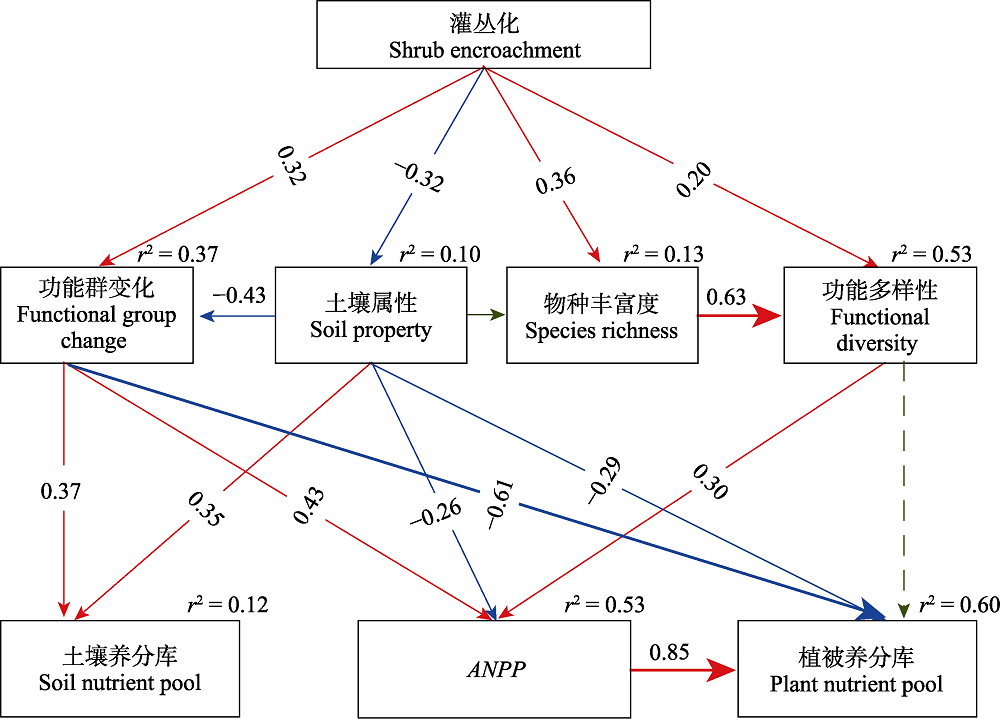
Fig. 6 Structural equation model (SEM) analyses of direct and indirect effects of shrub encroachment on grassland ecosystem function, including aboveground net primary productivity (ANPP), vegetation and soil nutrient pools (C and N). Values associated with solid arrows are standardized path coefficients, indicating positive or negative effects. r2 values associated with response variables indicate the proportion of variation explained by relationships with other variables.
| [1] | Archer SR, Andersen EM, Predick KI, Schwinning S, Steidl RJ, Woods SR (2017). Woody plant encroachment: Causes and consequences. In: Briske DD ed. Rangeland Systems. Springer, New York. 25-84. |
| [2] | Archer SR, Schimel DS, Holland EA (1995). Mechanisms of shrubland expansion: Land use, climate or CO2? Climatic Change, 29, 91-99. |
| [3] | Barger NN, Archer SR, Campbell JL, Huang CY, Morton JA, Knapp AK (2011). Woody plant proliferation in North American drylands: A synthesis of impacts on ecosystem carbon balance. Journal of Geophysical Research, 116, G00K07. DOI: 10.1029/2010JG001506. |
| [4] | Chen LY, Li H, Zhang PJ, Zhao X, Zhou LH, Liu TY, Hu HF, Bai YF, Shen HH, Fang JY (2015). Climate and native grassland vegetation as drivers of the community structures of shrub-encroached grasslands in Inner Mongolia, China. Landscape Ecology, 30, 1627-1641. |
| [5] |
Darrouzet-Nardi A, D’Antonio CM, Dawson TE (2006). Depth of water acquisition by invading shrubs and resident herbs in a Sierra Nevada meadow. Plant and Soil, 285, 31-43.
DOI URL |
| [6] |
Eldridge DJ, Bowker MA, Maestre FT, Roger E, Reynolds JF, Whitford WG (2011). Impacts of shrub encroachment on ecosystem structure and functioning: Towards a global synthesis. Ecology Letters, 14, 709-722.
DOI URL |
| [7] | Eldridge DJ, Soliveres S, Bowker MA, Val J (2013). Grazing dampens the positive effects of shrub encroachment on ecosystem functions in a semi-arid woodland. Journal of Applied Ecology, 50, 1028-1038. |
| [8] | Gao Q, Liu T (2015). Causes and consequences of shrub encroachment in arid and semiarid region: A disputable issue. Arid Land Geography, 38, 1202-1212. |
| [ 高琼, 刘婷 (2015). 干旱半干旱区草原灌丛化的原因及影响-争议与进展. 干旱区地理, 38, 1202-1212.] | |
| [9] | Gross N, Suding KN, Lavorel S, Roumet C (2007). Complementarity as a mechanism of coexistence between functional groups of grasses. Journal of Ecology, 95, 1296-1305. |
| [10] | Grover HD, Musick HB (1990). Shrubland encroachment in southern New Mexico, USA: An analysis of desertification processes in the American Southwest. Climatic Change, 17, 305-330. |
| [11] | Holzapfel C, Mahall BE (1999). Bidirectional facilitation and interference between shrubs and annuals in the Mojave Desert. Ecology, 80, 1747-1761. |
| [12] |
Huxman TE, Wilcox BP, Breshears DD, Scott RL, Snyder KA, Small EE, Hultine K, Pockman WT, Jackson RB (2005). Ecohydrological implications of woody plant encroachment. Ecology, 86, 308-319.
DOI URL |
| [13] | Jackson RB, Banner JL, Jobbágy EG, Pockman WT, Wall DH (2002). Ecosystem carbon loss with woody plant invasion of grasslands. Nature, 418, 623-626. |
| [14] | Knapp AK, Briggs JM, Collins SL, Archer SR, Bret-Harte MS, Ewers BE, Peters DP, Young DR, Shaver GR, Pendall E, Cleary MB (2008). Shrub encroachment in North American grasslands: Shifts in growth form dominance rapidly alters control of ecosystem carbon inputs. Global Change Biology, 14, 615-623. |
| [15] | Lan ZC, Bai YF (2012). Testing mechanisms of N-enrichment- induced species loss in a semiarid Inner Mongolia grassland: Critical thresholds and implications for long-term ecosystem responses. Philosophical Transactions of the Royal Society B: Biological Sciences, 367, 3125-3134. |
| [16] | Lavorel S, Grigulis K, McIntyre S, Williams NSG, Garden D, Dorrough J, Berman S, Quétier F, Thébault A, Bonis A (2008). Assessing functional diversity in the field— Methodology matters! Functional Ecology, 22, 134-147. |
| [17] |
Li XY, Zhang SY, Peng HY, Hu X, Ma YJ (2013). Soil water and temperature dynamics in shrub-encroached grasslands and climatic implications: Results from Inner Mongolia steppe ecosystem of north China. Agricultural and Forest Meteorology, 171-172, 20-30.
DOI URL |
| [18] | Maestre FT, Bowker MA, Puche MD, Belén Hinojosa M, Martínez I, García-Palacios P, Castillo AP, Soliveres S, Luzuriaga AL, Sánchez AM, Carreira JA, Gallardo A, Escudero A (2009). Shrub encroachment can reverse desertification in semi-arid Mediterranean grasslands. Ecology Letters, 12, 930-941. |
| [19] | Millennium Ecosystem Assessment (2005). Ecosystems and Human Well-being: Desertification Synthesis. World Resources Institute, Washington. |
| [20] | Morgan JA, Milchunas DG, LeCain DR, West M, Mosier AR (2007). Carbon dioxide enrichment alters plant community structure and accelerates shrub growth in the shortgrass steppe. Proceedings of the National Academy of Sciences of the United States of America, 104, 14724-14729. |
| [21] | Neilson RP (1986). High-resolution climatic analysis and southwest biogeography. Science, 232, 27-34. |
| [22] | Parizek B, Rostagno CM, Sottini R (2002). Soil erosion as affected by shrub encroachment in northeastern Patagonia. Journal of Range Management, 55, 43-48. |
| [23] | Peng HY, Li XY, Li GY, Zhang ZH, Zhang SY, Li L, Zhao GQ, Jiang ZY, Ma YJ (2013). Shrub encroachment with increasing anthropogenic disturbance in the semiarid Inner Mongolian grasslands of China. Catena, 109, 39-48. |
| [24] | Pugnaire FI, Armas C, Maestre FT (2011). Positive plant interactions in the Iberian Southeast: Mechanisms, environmental gradients, and ecosystem function. Journal of Arid Environments, 75, 1310-1320. |
| [25] | Ratajczak Z, DʼOdorico P, Nippert JB, Collins SL, Brunsell NA, Ravi S (2017). Changes in spatial variance during a grassland to shrubland state transition. Journal of Ecology, 105, 750-760. |
| [26] | Roscher C, Weigelt A, Proulx R, Marquard E, Schumacher J, Weisser WW, Schmid B (2011). Identifying population- and community-level mechanisms of diversity-stability relationships in experimental grasslands. Journal of Ecology, 99, 1460-1469. |
| [27] |
Seifan M, Kadmon R (2006). Indirect effects of cattle grazing on shrub spatial pattern in a mediterranean scrub community. Basic and Applied Ecology, 7, 496-506.
DOI URL |
| [28] |
Shackleton CM, Scholes RJ (2011). Above ground woody community attributes, biomass and carbon stocks along a rainfall gradient in the savannas of the central lowveld, South Africa. South African Journal of Botany, 77, 184-192.
DOI URL |
| [29] | Soliveres S, Eldridge DJ (2014). Do changes in grazing pressure and the degree of shrub encroachment alter the effects of individual shrubs on understorey plant communities and soil function? Functional Ecology, 28, 530-537. |
| [30] | Thompson WA, Eldridge DJ (2005). Plant cover and composition in relation to density of Callitris glaucophylla(white cypress pine) along a rainfall gradient in eastern Australia. Australian Journal of Botany, 53, 545. |
| [31] | Throop HL, Archer SR, Monger HC, Waltman S (2012). When bulk density methods matter: Implications for estimating soil organic carbon pools in rocky soils. Journal of Arid Environments, 77, 66-71. |
| [32] | van Auken OW (2009). Causes and consequences of woody plant encroachment into western North American grasslands. Journal of Environmental Management, 90, 2931-2942. |
| [33] | Walker B, Kinzig A, Langridge J (1999). Plant attribute diversity, resilience, and ecosystem function: The nature and significance of dominant and minor species. Ecosystems, 2, 95-113. |
| [34] | Wan HW, Pan QM, Bai YF (2013). China grassland biodiversity monitoring network: Indicators and implementation plan. Biodiversity Science, 21, 639-650. |
| [ 万宏伟, 潘庆民, 白永飞 (2013). 中国草地生物多样性监测网络的指标体系及实施方案. 生物多样性, 21, 639-650.] | |
| [35] | Xiong XG, Han XG (2006). Application of state and transition models to discussing the thicketization of steppe in Xilin River Basin, Inner Mongolia. Acta Prataculturae Sinica, 15(2), 9-13. |
| [ 熊小刚, 韩兴国 (2006). 运用状态与过渡模式讨论锡林河流域典型草原的灌丛化. 草业学报, 15(2), 9-13.] | |
| [36] |
Zarovali MP, Yiakoulaki MD, Papanastasis VP (2007). Effects of shrub encroachment on herbage production and nutritive value in semi-arid Mediterranean grasslands. Grass and Forage Science, 62, 355-363.
DOI URL |
| [37] | Zheng SX, Ren HY, Li WH, Lan ZC (2012). Scale-dependent effects of grazing on plant C:N:P stoichiometry and linkages to ecosystem functioning in the Inner Mongolia grassland. PLOS ONE, 7, e51750. DOI: 10.1371/journal.pone.0051750. |
| [38] | Zhou LH, Shen HH, Chen LY, Li H, Zhang PJ, Zhao X, Liu TY, Liu SS, Xing AJ, Hu HF, Fang JY (2019). Ecological consequences of shrub encroachment in the grasslands of northern China. Landscape Ecology, 34, 119-130. |
| [1] | XI Nian-Xun. The impact of multiple global change factors on traits of mycorrhizal plants [J]. , 2026, 50(预发表): 0-. |
| [2] | Qing He, Xudong Yuan, Boshen Ren, Zhiyang Feng, Mengzhen Lu, Qiaoling Lin, Qinghu Jiang, Linsen Yang, Huiliang Yu, Hui Yao, Jingyuan Yang, Feng Liu, Mingxi Jiang. Effects of Erigeron annuus invasion on plant community structure and diversity in subalpine peat wetlands [J]. Chin J Plant Ecol, 2026, 50(预发表): 0-. |
| [3] | ZHANG An-Ning, XIAO Ya-Ning, ZHAO Xia, ZHANG Miao, CUI Han Wen, Chen Shu-Yan, AN Li-Zhe. Interactions between shrub encroachment and nitrogen addition on nematode community and functional traits on Qinghai–Tibetan Plateau [J]. Chin J Plant Ecol, 2026, 50(预发表): 0-. |
| [4] | MA Jian-Hui, TONG Xin, ZHANG Si-Rong, MAO Zi-Kun, QIN Jun, MA Ke-Ping. Research advances and perspectives on physiological and ecological functions of mycorrhizal fungi [J]. Chin J Plant Ecol, 2026, 50(3): 498-514. |
| [5] | ZHENG Zi-Yi, CHEN Jiang-Hui, LIU Hui-Ying. Climate warming increases root exudation rates of dominant species in alpine meadow on the Qingzang Plateau [J]. Chin J Plant Ecol, 2025, 49(9): 1363-1373. |
| [6] | CUI Dong-Qing, TIAN Chen, SONG Hui-Min, LU Xiao-Ming, SA Qi-Ri, XU Guo-Qing, YANG Pei-Zhi, BAI Yong-Fei, TIAN Jian-Qing. Response mechanisms of rhizosphere bacterial community diversity and functional group composition of dominant plants in typical grasslands to long-term grazing [J]. Chin J Plant Ecol, 2025, 49(7): 1163-1176. |
| [7] | HUI Cheng-Yang, ZHANG Qiao-Yi, LIU Teng-Teng, LIU Wei-Yong, ZHOU Li-Na, JIN Xin-Jie, ZHANG Yong-Hua, LIU Jin-Liang. Main vegetation types and species composition of Daluo Mountain, Wenzhou, Zhejiang, China [J]. Chin J Plant Ecol, 2025, 49(6): 990-998. |
| [8] | DU Ying-Jie, FAN Ai-Lian, WANG Xue, YAN Xiao-Jun, CHEN Ting-Ting, JIA Lin-Qiao, JIANG Qi, CHEN Guang-Shui. Coordination and differences in root-leaf functional traits between tree species and understory shrub species in a subtropical natural evergreen broadleaf forest [J]. Chin J Plant Ecol, 2025, 49(4): 585-595. |
| [9] | WU Yan-Ning, HAO Min-Hui, HE Huai-Jiang, ZHANG Chun-Yu, ZHAO Xiu-Hai. Relationships between functional diversity and aboveground carbon sink functions and their changes with forest succession in Changbai Mountains, China [J]. Chin J Plant Ecol, 2025, 49(2): 232-243. |
| [10] | SONG Si-Yu, DU Piao, LIN Qin, QI Xiang, DU Ke-Yu, LI Cong, CHEN Ya-Mei, HUANG You-You, LIU Yang. Response characteristics of phenolic compounds in plant leaves and roots along an alpine shrub encroachment gradient [J]. Chin J Plant Ecol, 2025, 49(12): 2119-2136. |
| [11] | ZHANG Xiao-Ting, WANG Jun-Jie. Chlorophyll fluorescence characteristics of mangrove plants under salt and copper treatments and their relationship with leaf structure and biochemical components [J]. Chin J Plant Ecol, 2025, 49(11): 1944-1956. |
| [12] | TONG Jin-Lian, ZHANG Bo-Na, TANG Lu-Yao, YE Lin-Feng, LI Shu-Wen, XIE Jiang-Bo, LI Yan, WANG Zhong-Yuan. Regional differentiation of functional trait network of C4 plants Setaria viridis along precipitation gradient [J]. Chin J Plant Ecol, 2025, 49(11): 1817-1832. |
| [13] | MA Dong-Feng, JIA Cun-Zhi, WANG Xue-Peng, ZHAO Peng-Peng, HU Xiao-Wen. Effect of multi-species grouping on restoration of alpine degraded meadows in Gannan, China [J]. Chin J Plant Ecol, 2025, 49(1): 93-102. |
| [14] | ZHANG Meng-Di, XIANG Guan-Hai, WEN Yi-Yao, WANG Huan, Hugejile , BAI Yong-Fei, WANG Zhong-Wu, ZHENG Shu-Xia. Response of carbon exchange between shrub and grass patches to increased seasonal precipitation: a comparative analysis based on aboveground net primary productivity and leaf area index standardization [J]. Chin J Plant Ecol, 2024, 48(8): 1035-1049. |
| [15] | QIN Jia-Chen, WANG Huan, ZHU Jiang, WANG Yang, TIAN Chen, BAI Yong-Fei, YANG Pei-Zhi, ZHENG Shu-Xia. Grazing filtering effect based on intraspecific and interspecific trait variation and its scale effects [J]. Chin J Plant Ecol, 2024, 48(7): 858-871. |
| Viewed | ||||||
|
Full text |
|
|||||
|
Abstract |
|
|||||
Copyright © 2026 Chinese Journal of Plant Ecology
Tel: 010-62836134, 62836138, E-mail: apes@ibcas.ac.cn, cjpe@ibcas.ac.cn

