
植物生态学报 ›› 2009, Vol. 33 ›› Issue (1): 45-52.DOI: 10.3773/j.issn.1005-264x.2009.01.005 cstr: 32100.14.j.issn.1005-264x.2009.01.005
代巍( ), 张荣*(), 独占彪, 王璠
收稿日期:2008-04-21
接受日期:2008-09-21
出版日期:2009-04-21
发布日期:2009-01-30
作者简介:*E-mail: rongz@lzu.edu.cn基金资助:
DAI Wei(), ZHANG Rong*(), DU Zhan-Biao, WANG Fan
Received:2008-04-21
Accepted:2008-09-21
Online:2009-04-21
Published:2009-01-30
About author:*E-mail: rongz@lzu.edu.cnE-mail of the first author: daiwei06@yahoo.cn
摘要:
生物多样性与生态系统功能之间的关系及其形成的内在机制还存在很多争议。为了揭示植物群落生产力形成的生态学机制, 采用盆栽方法探讨了物种多样性、物种属性以及施肥水平与植物群落生产力之间的关系。研究结果显示: 在不施肥和每盆施5.0 g磷酸二铵的条件下, 随着物种多样性的增加, 地上生物量增加不显著; 在每盆施10.0 g磷酸二铵的条件下, 随着物种多样性的增加, 地上生物量显著增加。相对于中华羊茅(Festuca sinensis)而言, 垂穗披碱草(Elymus nutans)和垂穗鹅观草(Roegneria nutans)对群落生产力的贡献较大, 但在不同施肥水平和播种密度下, 其影响不完全相同。这表明物种多样性对群落生产力的影响随着土壤肥力的变化而变化; 并且植物群落生产力受组成群落的物种属性影响较大, 而物种属性又与特定时间和特定生境下资源的利用方式相联系。在高肥力水平下, 物种多样性之所以对群落生产力具有正效应, 可能是因为高肥力水平增加了可利用的生态位空间, 最终仍体现在物种组合上。因此, 植物群落的生产力与物种多样性之间没有必然的联系, 而与土壤肥力和土壤肥力决定的物种属性有关。
代巍, 张荣, 独占彪, 王璠. 土壤肥力和物种属性决定亚高寒草甸实验群落的生产力. 植物生态学报, 2009, 33(1): 45-52. DOI: 10.3773/j.issn.1005-264x.2009.01.005
DAI Wei, ZHANG Rong, DU Zhan-Biao, WANG Fan. SOIL FERTILITY AND SPECIES IDENTITY CONTROL COMMUNITY PRODUCTIVITY IN AN EXPERIMENTAL PLANT COMMUNITY IN AN AREA OF SUBALPINE MEADOW. Chinese Journal of Plant Ecology, 2009, 33(1): 45-52. DOI: 10.3773/j.issn.1005-264x.2009.01.005
| 单播 Monoculture | Z20 | Z40 | Z60 | P20 | P40 | P60 | E20 | E40 | E60 | |
|---|---|---|---|---|---|---|---|---|---|---|
| 混播 Polyculture | Z20P20 | Z20P40 | Z40P20 | P20E20 | P20E40 | P40E20 | E20Z20 | E20Z40 | E40Z20 | Z20P20E20 |
表1 单一肥力水平条件下不同播种处理
Table 1 Different sowing treatments at single fertility level
| 单播 Monoculture | Z20 | Z40 | Z60 | P20 | P40 | P60 | E20 | E40 | E60 | |
|---|---|---|---|---|---|---|---|---|---|---|
| 混播 Polyculture | Z20P20 | Z20P40 | Z40P20 | P20E20 | P20E40 | P40E20 | E20Z20 | E20Z40 | E40Z20 | Z20P20E20 |
| 变异来源 Source of variation | 自由度 Degree of freedom | 平方和 Sum of square | 方差 Mean square | F值 F value |
|---|---|---|---|---|
| 模型A Model A | ||||
| 物种多样性Species diversity (SD) | 3 | 119.431 | 39.810 | 3.924** |
| 肥力水平Fertility levels (FL) | 2 | 35 184.026 | 17 592.013 | 1 733.843*** |
| 物种多样性×肥力水平 (SD×FL) | 6 | 81.229 | 13.538 | 1.334 |
| 误差 Error | 259 | 2 627.880 | 10.146 | |
| 模型B Model B | ||||
| 肥力水平 Fertility levels (FL) | 2 | 35 184.508 | 17 592.254 | 1 989.159*** |
| Z10 | 1 | 17.751 | 17.751 | 2.007 |
| Z20 | 1 | 0.450 | 0.450 | 0.051 |
| Z30 | 1 | 3.766 | 3.766 | 0.426 |
| P10 | 1 | 4.522 | 4.522 | 0.551 |
| P20 | 1 | 186.348 | 186.348 | 21.070*** |
| P30 | 1 | 113.049 | 113.049 | 12.783*** |
| E10 | 1 | 6.695 | 6.695 | 0.757 |
| E20 | 1 | 24.445 | 24.445 | 2.764 |
| E30 | 1 | 127.174 | 127.174 | 14.380*** |
| 物种多样性 Species diversity (SD) | 3 | 70.931 | 23.644 | 2.673 |
| 误差 Error | 256 | 2 272.926 | 8.844 |
表2 两种Type I SS方差分析模型描述处理效应对地上生物量的影响
Table 2 Effects of two types of I SS ANOVA models for describing treatment effects on aboveground biomass
| 变异来源 Source of variation | 自由度 Degree of freedom | 平方和 Sum of square | 方差 Mean square | F值 F value |
|---|---|---|---|---|
| 模型A Model A | ||||
| 物种多样性Species diversity (SD) | 3 | 119.431 | 39.810 | 3.924** |
| 肥力水平Fertility levels (FL) | 2 | 35 184.026 | 17 592.013 | 1 733.843*** |
| 物种多样性×肥力水平 (SD×FL) | 6 | 81.229 | 13.538 | 1.334 |
| 误差 Error | 259 | 2 627.880 | 10.146 | |
| 模型B Model B | ||||
| 肥力水平 Fertility levels (FL) | 2 | 35 184.508 | 17 592.254 | 1 989.159*** |
| Z10 | 1 | 17.751 | 17.751 | 2.007 |
| Z20 | 1 | 0.450 | 0.450 | 0.051 |
| Z30 | 1 | 3.766 | 3.766 | 0.426 |
| P10 | 1 | 4.522 | 4.522 | 0.551 |
| P20 | 1 | 186.348 | 186.348 | 21.070*** |
| P30 | 1 | 113.049 | 113.049 | 12.783*** |
| E10 | 1 | 6.695 | 6.695 | 0.757 |
| E20 | 1 | 24.445 | 24.445 | 2.764 |
| E30 | 1 | 127.174 | 127.174 | 14.380*** |
| 物种多样性 Species diversity (SD) | 3 | 70.931 | 23.644 | 2.673 |
| 误差 Error | 256 | 2 272.926 | 8.844 |
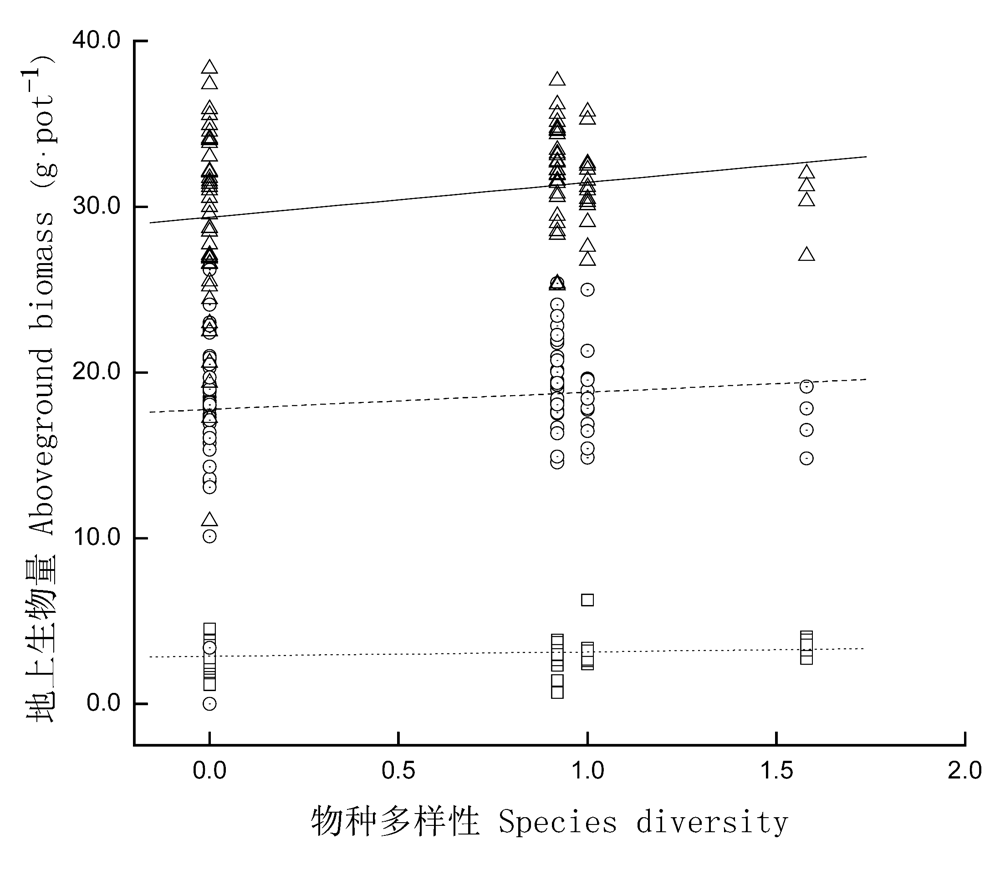
图1 不同肥力梯度下物种多样性与地上生物量之间的关系 □: 不施肥 No-fertilization ○: 每盆施5.0 g磷酸二铵 Fertilizing 5.0 g diammonium phosphate per pot △:每盆施10.0 g磷酸二铵 Fertilizing 10.0 g diammonium phosphate per pot
Fig. 1 Relationships between species diversity and aboveground biomass at different fertility levels
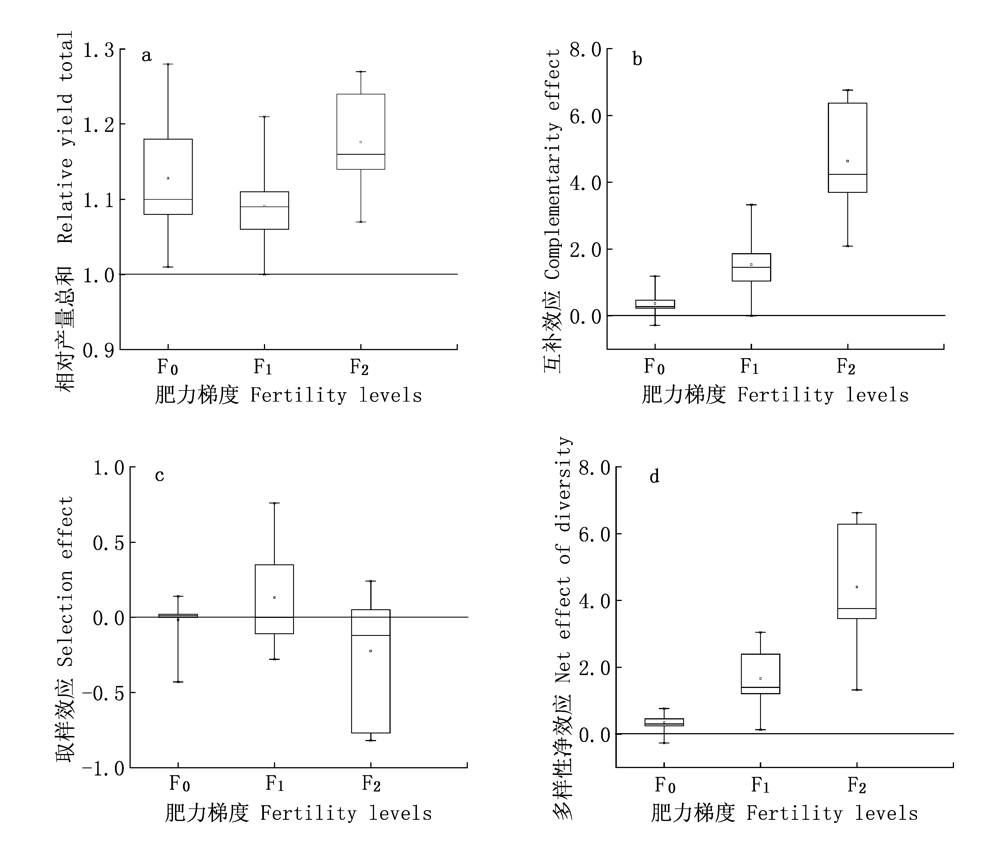
图2 不同肥力梯度下的相对产量总和、互补效应、取样效应和多样性净效应的大小 F0: 不施肥 No-fertilization F1: 每盆施5.0 g磷酸二铵 Fertilizing 5.0 g diammonium phosphate per pot F2: 每盆施10.0 g磷酸二铵 Fertilizing 10.0 g diammonium phosphate per pot
Fig. 2 Magnitude of relative yield total, complementarity effect, selection effect and net effect of diversity at different fertility levels
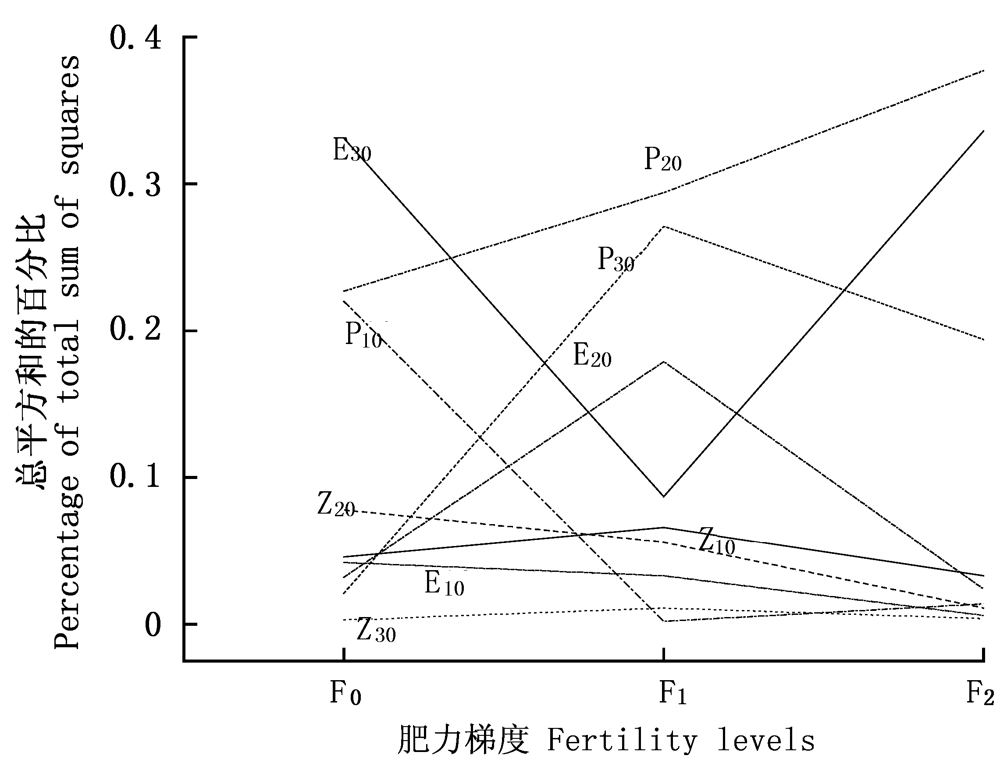
图3 不同肥力条件下特定物种出现或缺失对地上生物量的影响 10、20和30分别指该物种的个体数 10, 20 and 30 refer to the number of planting species, respectively F0、F1、F2: 见图2 See Fig. 2 Z、P、E: 见表2 See Table 2
Fig. 3 Effects of presence or absence of certain species on aboveground biomass at different fertility levels
| [1] | Aarssen LW (1997). High productivity in grassland ecosystems: effected by species diversity or productive species? Oikos, 80, 183-184. |
| [2] | Abrams PA (1995). Monotonic or unimodal diversity- productivity gradients: what does competition theory predict? Ecology, 76, 2019-2027. |
| [3] | Bedford BL, Walbridge MR, Aldous A (1999). Patterns in nutrient availability and plant diversity of temperate North American wetlands. Ecology, 80, 2151-2169. |
| [4] | Dimitrakopoulos PG, Schmid B (2004). Biodiversity effects increase linearly with biotope space. Ecology Letters, 7, 574-583. |
| [5] | Dukes JS (2001). Productivity and complementarity in grassland microcosms of varying diversity. Oikos, 94, 468-480. |
| [6] |
Fridley JD (2002). Resource availability dominates and alters the relationship between species diversity and ecosystem productivity in experimental plant communities. Oecologia, 132, 271-277.
URL PMID |
| [7] | Grime JP (1997). Biodiversity and ecosystem function: the debate deepens. Science, 277, 1260-1261. |
| [8] | He JS (贺金生), Fang JY (方精云), Ma KP (马克平), Huang JH (黄建辉) (2003). Biodiversity and ecosystem productivity: why is there a discrepancy in the relationship between experimental and natural ecosystems? Acta Phytoecologica Sinica (植物生态学报), 27, 835-843. (in Chinese with English abstract) |
| [9] | He JS, Bazzaz FA, Schmid B (2002). Interactive effects of diversity, nutrients and elevated CO2 on experimental plant communities. Oikos, 97, 337-348. |
| [10] |
Hector A, Schmid B, Beierkuhnlein C, Caldeira MC, Diemer M, Dimitrakopoulos PG, Finn JA, Freitas H, Giller PS, Good J, Harris R, Högberg P, Huss-Danell K, Joshi J, Jumpponen A, Körner C, Leadley PW, Loreau M, Minns A, Mulder CPH, O'Donovan G, Otway SJ, Pereira JS, Prinz A, Read DJ, Scherer-Lorenzen M, Schulze ED, Siamantziouras ASD, Spehn EM, Terry AC, Troumbis AY, Woodward FI, Yachi S, Lawton JH (1999). Plant diversity and productivity experiments in European grasslands. Science, 286, 1123-1127.
DOI URL PMID |
| [11] | Hooper DU (1998). The role of complementarity and competition in ecosystem responses to variation in plant diversity. Ecology, 79, 704-719. |
| [12] | Hooper DU, Chapin FS, Ewel JJ, Hector A, Inchausti P, Lavorel S, Lawton JH, Lodge DM, Loreau M, Naeem S, Schmid B, Setälä H, Symstad AJ, Vandermeer J, Wardle DA (2005). Effects of biodiversity on ecosystem functioning: a consensus of current knowledge. Ecological Monographs, 75, 3-35. |
| [13] | Hu JZ (胡建忠), Zheng JL (郑佳丽), Shen JY (沈晶玉) (2005). Discussion of root ecological niche and root distribution characteristics of artificial phyto-communities in rehabilitated fields. Acta Ecologica Sinica (生态学报), 25, 481-490. (in Chinese with English abstract) |
| [14] |
Huston MA (1997). Hidden treatments in ecological experiments: re-evaluating the ecosystem function of biodiversity. Oecologia, 110, 449-460.
DOI URL PMID |
| [15] | Huston MA, Aarssen LW, Austin MP, Cade BS, Fridley JD, Garnier E, Grime JP, Hodgson J, Lauenroth WK, Thompson K, Vandermeer JH, Wardle DA (2000). No consistent effect of plant diversity on productivity. Science, 289, 1255a. |
| [16] | Lawton JH, Naeem S, Thompson LJ, Hector A, Crawley MJ (1998). Biodiversity and ecosystem function: getting the Ecotron experiment in its correct context. Functional Ecology, 12, 848-852. |
| [17] | Loreau M (1998). Biodiversity and ecosystem functioning: a mechanistic model. Proceedings of the National Academy of Sciences of the United States of America, 95, 5632-5636. |
| [18] |
Loreau M, Hector A (2001). Partitioning selection and complementarity in biodiversity experiments. Nature, 412, 72-76.
DOI URL PMID |
| [19] |
Loreau M, Naeem S, Inchausti P, Bengtsson J, Grime JP, Hector A, Hooper DU, Huston MA, Raffaelli D, Schmid B, Tilman D, Wardle DA (2001). Biodiversity and ecosystem functioning: current knowledge and future challenges. Science, 294, 804-808.
URL PMID |
| [20] | MacArthur R (1955). Fluctuations of animal populations and a measure of community stability. Ecology, 36, 533-536. |
| [21] | Mittelbach GG, Steiner CF, Scheiner SM, Gross KL, Reynolds HL, Waide RB, Willig MR, Dodson SI, Gough L (2001). What is the observed relationship between species richness and productivity? Ecology, 82, 2381-2396 |
| [22] | Naeem S, Thompson LJ, Lawler SP, Lawton JH, Woodfin RM (1994). Declining biodiversity can alter the performance of ecosystems. Nature, 368, 734-737. |
| [23] | Qi XZ (齐相贞), Lin ZS (林振山), Wen T (温腾) (2007). Resistance of available resource fluctuation to alien species invasion. Acta Ecologica Sinica (生态学报), 27, 3835-3843. (in Chinese with English abstract) |
| [24] | Reich PB, Knops J, Tilman D, Craine J, Ellsworth D, Tjoelker M, Lee T, Wedin D, Naeem S, Bahauddin D, Hendrey G, Jose S, Wrage K, Goth J, Bengston W (2001). Plant diversity enhances ecosystem responses to elevated CO2 and nitrogen deposition. Nature, 410, 809-812. |
| [25] | Reich PB, Tilman D, Naeem S, Ellsworth DS, Knops J, Craine J, Wedin D, Trost J (2004). Species and functional group diversity independently influence biomass accumulation and its response to CO2 and N. Proceedings of the National Academy of Sciences of the United States of America, 101, 10101-10106. |
| [26] | Rubio A, Escudero A (2000). Small-scale spatial soil-plant relationship in semi-arid gypsum environments. Plant and Soil, 220, 139-150. |
| [27] |
Schwartz MW, Brigham CA, Hoeksema JD, Lyons KG, Mills MH, van Mantgem PJ (2000). Linking biodiversity to ecosystem function: implications for conservation ecology. Oecologia, 122, 297-305.
URL PMID |
| [28] | Sun RY (孙儒泳) (2001). Principles of Animal Ecology (动物生态学原理). Beijing Normal University Press, Beijing, 399. (in Chinese) |
| [29] | Tilman D (1996). Biodiversity: population versus ecosystem stability. Ecology, 77, 350-363. |
| [30] | Tilman D (1999). The ecological consequences of changes in biodiversity: a search for general principles. Ecology, 80, 1455-1474. |
| [31] |
Tilman D, Lehman CL, Thomson KT (1997). Plant diversity and ecosystem productivity: theoretical considerations. Proceedings of the National Academy of Sciences of the United States of America, 94, 1857-1861.
DOI URL PMID |
| [32] |
Tilman D, Reich PB, Knops J, Wedin D, Mielke T, Lehman C (2001). Diversity and productivity in a long-term grassland experiment. Science, 294, 843-845.
DOI URL PMID |
| [33] | Wang CT (王长庭), Long RJ (龙瑞军), Cao GM (曹广民), Wang QL (王启兰), Jing ZC (景增春), Shi JJ (施建军) (2008). The relationship between soil nutrients and diversity-productivity of different type grasslands in Alpine Meadow. Chinese Journal of Soil Science (土壤通报), 39, 1-8. (in Chinese with English abstract) |
| [34] | Wang YH (王玉辉), Zhou GS (周广胜)(2004). Responses of temporal dynamics of aboveground net primary productivity of Leymus chinensis community to precipitation fluctuation in Inner Mongolia. Acta Ecologica Sinica (生态学报), 24, 1140-1145. (in Chinese with English abstract) |
| [35] | Wardle DA (1999). Is “sampling effect” a problem for experiments investigating biodiversity-ecosystem function relationships? Oikos, 87, 403-407. |
| [36] | Welden CW, Slauson WL (1986). The intensity of competition versus its importance: an overlooked distinction and some implications. Quarterly Review of Biology, 61, 23-44. |
| [37] | Zhang QG (张全国), Zhang DY (张大勇)(2002). Biodiversity and ecosystem functioning: recent advances and controversies. Biodiversity Science (生物多样性), 10, 49-60. (in Chinese with English abstract) |
| [1] | 何青, 袁旭东, 任博申, 冯治洋, 鲁梦珍, 林巧玲, 姜庆虎, 杨林森, 余辉亮, 姚辉, 杨敬元, 刘峰, 江明喜. 一年蓬(Erigeron annuus)入侵对亚高山泥炭湿地植物群落结构与多样性的影响[J]. 植物生态学报, 2026, 50(预发表): 0-. |
| [2] | 惠城阳, 章巧依, 刘腾腾, 刘维勇, 周丽娜, 金鑫杰, 张永华, 刘金亮. 温州大罗山主要植被类型及物种组成特征[J]. 植物生态学报, 2025, 49(6): 990-998. |
| [3] | 郭欢敏, 沈小雪, 李瑞利. 深圳湾福田红树林自然保护区物种共存特征与物种分布概率[J]. 植物生态学报, 2025, 49(11): 1833-1843. |
| [4] | 徐嘉昕, 肖元明, 王小赟, 王雯莹, 马玉花, 李强峰, 周国英. 微生物菌肥与氮磷肥回补对退化高寒草甸土壤理化性质和酶活性的影响[J]. 植物生态学报, 2025, 49(1): 159-172. |
| [5] | 郝毅晴, 刘伟, 杨阳, 安冰儿, 范冰, 李超, 崔久辉, 程延彬, 孙佳美, 潘庆民. 有机肥和无机肥对退化草原羊草种群密度和个体生物量的影响[J]. 植物生态学报, 2025, 49(1): 148-158. |
| [6] | 马东峰, 贾存智, 王学朋, 赵鹏鹏, 胡小文. 甘南高寒退化草甸多物种组配的修复效果评估[J]. 植物生态学报, 2025, 49(1): 93-102. |
| [7] | 牛一迪, 蔡体久. 大兴安岭北部次生林演替过程中物种多样性的变化及其影响因子[J]. 植物生态学报, 2024, 48(3): 349-363. |
| [8] | 李娜, 唐士明, 郭建英, 田茹, 王姗, 胡冰, 罗永红, 徐柱文. 放牧对内蒙古草地植物群落特征影响的meta分析[J]. 植物生态学报, 2023, 47(9): 1256-1269. |
| [9] | 于笑, 纪若璇, 任天梦, 夏新莉, 尹伟伦, 刘超. 中国北方蒙古莸群落的分布、特征和分类[J]. 植物生态学报, 2023, 47(8): 1182-1192. |
| [10] | 杨鑫, 任明迅. 环南海区域红树物种多样性分布格局及其形成机制[J]. 植物生态学报, 2023, 47(8): 1105-1115. |
| [11] | 李伟, 张荣. 亚高寒草甸群落结构决定群落生产力实例验证[J]. 植物生态学报, 2023, 47(5): 713-723. |
| [12] | 朱华, 谭运洪. 中国热带雨林的群落特征、研究现状及问题[J]. 植物生态学报, 2023, 47(4): 447-468. |
| [13] | 杨元合, 张典业, 魏斌, 刘洋, 冯雪徽, 毛超, 徐玮婕, 贺美, 王璐, 郑志虎, 王媛媛, 陈蕾伊, 彭云峰. 草地群落多样性和生态系统碳氮循环对氮输入的非线性响应及其机制[J]. 植物生态学报, 2023, 47(1): 1-24. |
| [14] | 董六文, 任正炜, 张蕊, 谢晨笛, 周小龙. 功能多样性比物种多样性更好解释氮添加对高寒草地生物量的影响[J]. 植物生态学报, 2022, 46(8): 871-881. |
| [15] | 曾凯娜, 孙浩然, 申益春, 任明迅. 海南羊山湿地的传粉网络及其季节动态[J]. 植物生态学报, 2022, 46(7): 775-784. |
| 阅读次数 | ||||||
|
全文 |
|
|||||
|
摘要 |
|
|||||
Copyright © 2026 版权所有 《植物生态学报》编辑部
地址: 北京香山南辛村20号, 邮编: 100093
Tel.: 010-62836134, 62836138; Fax: 010-82599431; E-mail: apes@ibcas.ac.cn, cjpe@ibcas.ac.cn
备案号: 京ICP备16067583号-19

