
植物生态学报 ›› 2012, Vol. 36 ›› Issue (12): 1248-1255.DOI: 10.3724/SP.J.1258.2012.01248 cstr: 32100.14.SP.J.1258.2012.01248
所属专题: 青藏高原植物生态学:群落生态学; 生物多样性
袁自强, 魏盼盼, 高本强, 张荣*( )
)
收稿日期:2012-08-09
接受日期:2012-10-07
出版日期:2012-08-09
发布日期:2012-11-28
作者简介:(E-mail: rongz@lzu.edu.cn)
YUAN Zi-Qiang, WEI Pan-Pan, GAO Ben-Qiang, ZHANG Rong*()
Received:2012-08-09
Accepted:2012-10-07
Online:2012-08-09
Published:2012-11-28
摘要:
植物物种多样性与生产力之间的关系是群落生态学的一个热点问题, 目前仍存在着很多争议。为探究自然群落中二者之间的关系, 对青藏高原亚高寒草甸3个样地的自然植物群落分别进行了不同取样面积的抽样调查。结果显示, 取样样地和取样尺度均对物种丰富度有显著影响, 取样样地而非取样尺度对群落地上生物量有显著性影响。在某一时刻对某一样地进行取样, 其单位面积生产力并不因取样面积的增加而提高, 而是保持恒定的, 尽管物种数随取样面积的增加而有明显增多。物种多样性与生产力之间的回归关系因样地与取样尺度不同而不同, 有U型、单峰型、正线性相关和无相关性, 其中无相关性出现的最多。据此推测, 亚高寒草甸群落物种多样性与生产力之间不存在某种确定性关系, 或者说, 亚高寒草甸物种多样性和生产力之间不存在必然的因果联系。
袁自强, 魏盼盼, 高本强, 张荣. 取样尺度对亚高寒草甸物种多样性与生产力关系的影响. 植物生态学报, 2012, 36(12): 1248-1255. DOI: 10.3724/SP.J.1258.2012.01248
YUAN Zi-Qiang, WEI Pan-Pan, GAO Ben-Qiang, ZHANG Rong. Effect of sampling scale on the relationship between species diversity and productivity in subalpine meadows. Chinese Journal of Plant Ecology, 2012, 36(12): 1248-1255. DOI: 10.3724/SP.J.1258.2012.01248
| 变异来源 Source of variation | 自由度 df | 物种数 Number of species | 地上生物量 Aboveground biomass | |||||
|---|---|---|---|---|---|---|---|---|
| 方差 Mean square | F | p | 方差 Mean square | F | p | |||
| 样地 Sampling site (SS) | 2 | 766.386 | 116.170 | 0.000 | 25.535 | 209.714 | 0.000 | |
| 取样面积 Sampling area (SA) | 3 | 3 126.796 | 473.963 | 0.000 | 0.113 | 0.926 | 0.428 | |
| 样地×取样面积 (SS × SA) | 6 | 100.749 | 15.272 | 0.000 | 0.123 | 1.014 | 0.416 | |
| 误差 Error | 348 | 6.597 | 0.122 | |||||
表1 样地和取样面积对物种数和地上生物量影响的方差分析
Table 1 ANOVA for effects of sampling site and sampling area on number of species and aboveground biomass
| 变异来源 Source of variation | 自由度 df | 物种数 Number of species | 地上生物量 Aboveground biomass | |||||
|---|---|---|---|---|---|---|---|---|
| 方差 Mean square | F | p | 方差 Mean square | F | p | |||
| 样地 Sampling site (SS) | 2 | 766.386 | 116.170 | 0.000 | 25.535 | 209.714 | 0.000 | |
| 取样面积 Sampling area (SA) | 3 | 3 126.796 | 473.963 | 0.000 | 0.113 | 0.926 | 0.428 | |
| 样地×取样面积 (SS × SA) | 6 | 100.749 | 15.272 | 0.000 | 0.123 | 1.014 | 0.416 | |
| 误差 Error | 348 | 6.597 | 0.122 | |||||
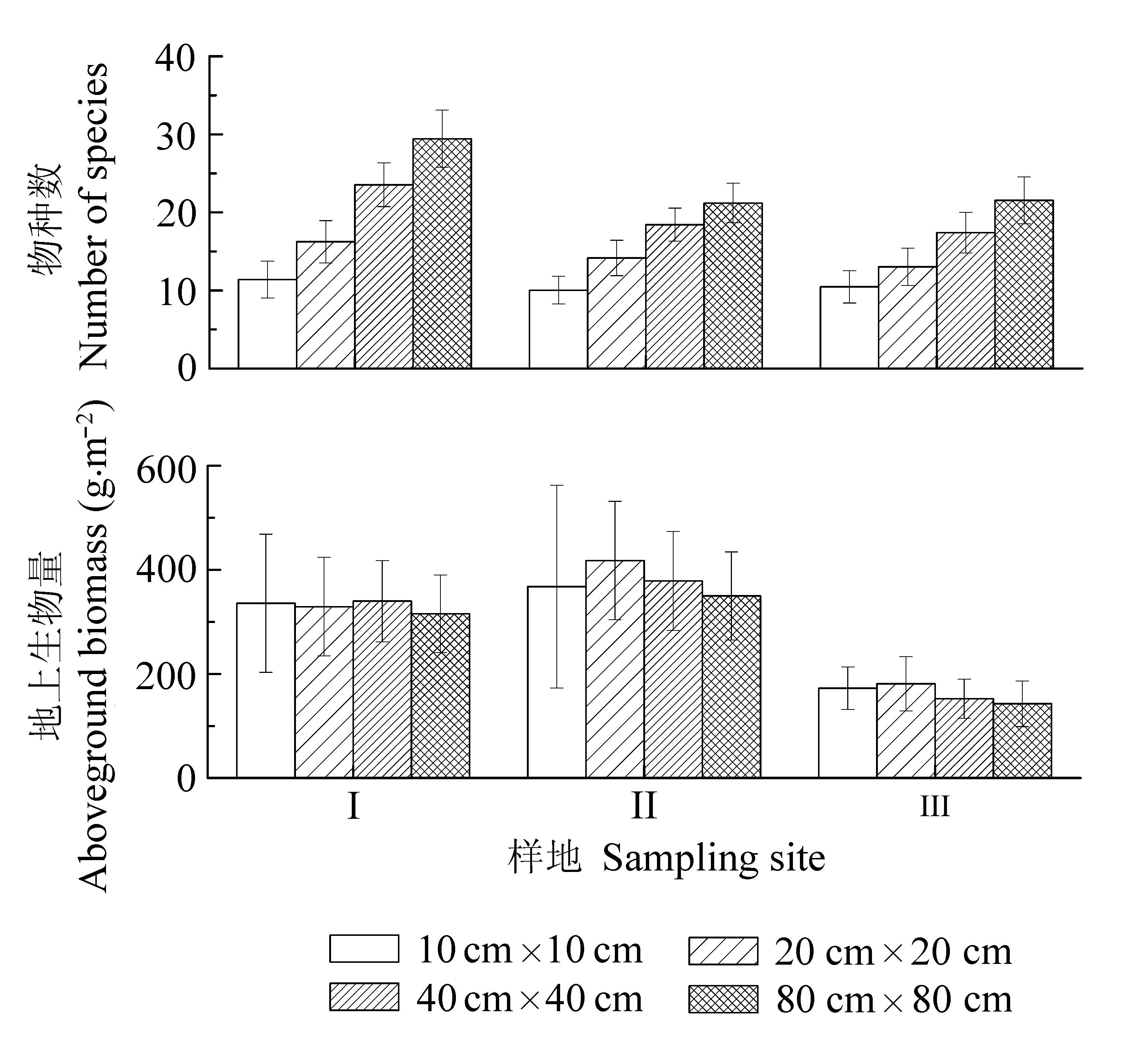
图1 不同样地和取样面积下物种数和地上生物量的变化(平均值±标准偏差)。
Fig. 1 Variations of number of species and aboveground biomass in different sampling sites and sampling areas (mean ± SD).
| 样地 Sampling site | 取样面积 Sampling area | N | 线性模型 Linear model | 二次模型 Quadratic model | 模式 Pattern | ||||
|---|---|---|---|---|---|---|---|---|---|
| R2 | p | R2 | p | ||||||
| I | 10 cm × 10 cm | 30 | 0.003 | 0.780 | 0.043 | 0.551 | ns ( | ||
| 20 cm × 20 cm | 30 | 0.039 | 0.294 | 0.046 | 0.527 | ns ( | |||
| 40 cm × 40 cm | 30 | 0.023 | 0.419 | 0.046 | 0.532 | ns ( | |||
| 80 cm × 80 cm | 30 | 0.013 | 0.556 | 0.078 | 0.328 | ns ( | |||
| II | 10 cm × 10 cm | 30 | 0.014 | 0.532 | 0.020 | 0.762 | ns ( | ||
| 20 cm × 20 cm | 30 | 0.043 | 0.271 | 0.043 | 0.551 | ns ( | |||
| 40 cm × 40 cm | 30 | 0.002 | 0.800 | 0.019 | 0.772 | ns ( | |||
| 80 cm × 80 cm | 30 | 0.043 | 0.272 | 0.074 | 0.355 | ns ( | |||
| III | 10 cm × 10 cm | 30 | 0.172 | 0.023 | 0.241 | 0.024 | 正线性和二次 Positive linear and quadratic ( | ||
| 20 cm × 20 cm | 30 | 0.064 | 0.177 | 0.091 | 0.246 | ns ( | |||
| 40 cm × 40 cm | 30 | 0.096 | 0.096 | 0.228 | 0.030 | 二次 ( | |||
| 80 cm × 80 cm | 30 | 0.003 | 0.785 | 0.003 | 0.959 | ns ( | |||
| IV | 10 cm × 10 cm | 120 | 0.012 | 0.306 | 0.015 | 0.359 | ns ( | ||
| 20 cm × 20 cm | 120 | 0.097 | 0.026 | 0.097 | 0.012 | 正线性和二次 Positive linear and quadratic ( | |||
| 40 cm × 40 cm | 120 | 0.132 | 0.000 | 0.159 | 0.001 | 正线性和二次 Positive linear and quadratic ( | |||
| 80 cm × 80 cm | 120 | 0.048 | 0.038 | 0.048 | 0.116 | 正线性 Positive linear ( | |||
表2 不同取样面积的物种数与地上生物量的线性和二次回归分析
Table 2 Linear and quadratic regression analysis between number of species and aboveground biomass in different sampling areas
| 样地 Sampling site | 取样面积 Sampling area | N | 线性模型 Linear model | 二次模型 Quadratic model | 模式 Pattern | ||||
|---|---|---|---|---|---|---|---|---|---|
| R2 | p | R2 | p | ||||||
| I | 10 cm × 10 cm | 30 | 0.003 | 0.780 | 0.043 | 0.551 | ns ( | ||
| 20 cm × 20 cm | 30 | 0.039 | 0.294 | 0.046 | 0.527 | ns ( | |||
| 40 cm × 40 cm | 30 | 0.023 | 0.419 | 0.046 | 0.532 | ns ( | |||
| 80 cm × 80 cm | 30 | 0.013 | 0.556 | 0.078 | 0.328 | ns ( | |||
| II | 10 cm × 10 cm | 30 | 0.014 | 0.532 | 0.020 | 0.762 | ns ( | ||
| 20 cm × 20 cm | 30 | 0.043 | 0.271 | 0.043 | 0.551 | ns ( | |||
| 40 cm × 40 cm | 30 | 0.002 | 0.800 | 0.019 | 0.772 | ns ( | |||
| 80 cm × 80 cm | 30 | 0.043 | 0.272 | 0.074 | 0.355 | ns ( | |||
| III | 10 cm × 10 cm | 30 | 0.172 | 0.023 | 0.241 | 0.024 | 正线性和二次 Positive linear and quadratic ( | ||
| 20 cm × 20 cm | 30 | 0.064 | 0.177 | 0.091 | 0.246 | ns ( | |||
| 40 cm × 40 cm | 30 | 0.096 | 0.096 | 0.228 | 0.030 | 二次 ( | |||
| 80 cm × 80 cm | 30 | 0.003 | 0.785 | 0.003 | 0.959 | ns ( | |||
| IV | 10 cm × 10 cm | 120 | 0.012 | 0.306 | 0.015 | 0.359 | ns ( | ||
| 20 cm × 20 cm | 120 | 0.097 | 0.026 | 0.097 | 0.012 | 正线性和二次 Positive linear and quadratic ( | |||
| 40 cm × 40 cm | 120 | 0.132 | 0.000 | 0.159 | 0.001 | 正线性和二次 Positive linear and quadratic ( | |||
| 80 cm × 80 cm | 120 | 0.048 | 0.038 | 0.048 | 0.116 | 正线性 Positive linear ( | |||
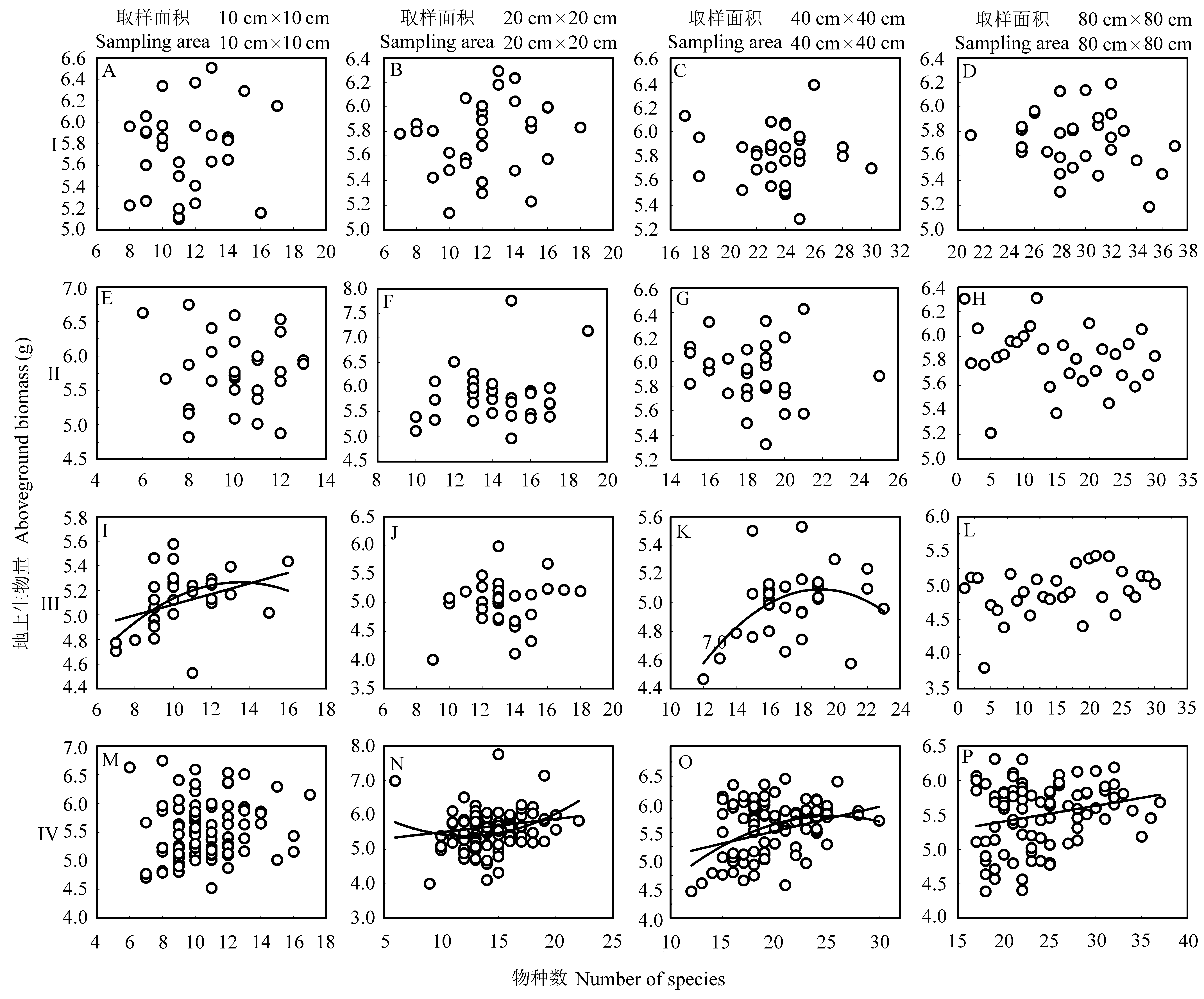
图2 物种数和地上生物量的线性和二次回归关系(A-L, n = 30; M-P, n = 120)。圆圈代表取样样方; 回归线表示物种数和地上生物量之间有显著的回归关系。I, II, III, 不同样地的样方数据; IV, 综合样地I、II和III同一取样面积的样方数据。
Fig. 2 Linear and quadratic regression relationships between number of species and aboveground biomass (A-L, n = 30; M-P, n = 120). Circles indicate sampling quadrates; regression lines indicate significant regression relationships between number of species and aboveground biomass. I, II, III, quadrat data at sites I, II and III; IV, quadrat data by summing-up the same sampling area at sites I, II and III.
| 1 | Aarssen LW ( 1997). High productivity in grassland ecosystems: effected by species diversity or productive species? Oikos, 80, 183-184. |
| 2 | Adler PB, Seabloom EW, Borer ET, Hillebrand H, Hautier Y, Hector A, Harpole WS, O’Halloran LR, Grace JB, Anderson TM, Bakker JD, Biederman LA, Brown CS, Buckley YM, Calabrese LB, Chu CJ, Cleland EE, Collins SL, Cottingham KL, Crawley MJ, Damschen EI, Davies KF, DeCrappeo NM, Fay PA, Firn J, Frater P, Gasarch EI, Gruner DS, Hagenah N, Lambers JHR, Humphries H, Jin VL, Kay AD, Kirkman KP, Klein JA, Knops JMH, Pierre KJA, Lambrinos JG, Li W, MacDougall AS, McCulley RL, Melbourne BA, Mitchell CE, Moore JL, Morgan JW, Mortensen B, Orrock JL, Prober SM, Pyke DA, Risch AC, Schuetz M, Smith MD, Stevens CJ, Sullivan LL, Wang G, Wragg PD, Wright JP, Yang LH ( 2011). Productivity is a poor predictor of plant species richness. Science, 333, 1750-1752. |
| 3 | Cardinale BJ ( 2011). Biodiversity improves water quality through niche partitioning. Nature, 42, 82-89. |
| 4 | Cardinale BJ, Srivastava DS, Duffy JE, Wright JP, Downing AL, Sankaran M, Jouseau C ( 2006). Effects of biodiversity on the functioning of trophic groups and ecosystems. Nature, 443, 989-992. |
| 5 | Cardinale BJ, Wrigh JP, Cadotte MW, Carroll IT, Hector A, Srivastava DS, Loreau M, Weis JJ ( 2007). Impacts of plant diversity on biomass production increase through time because of species complementarity. Proceedings of the National Academy of Sciences of the United States of America, 104, 18123-18128. |
| 6 | Chalcraft DR, Williams J, Smith MD, Willig MR ( 2004). Scale dependence in the species richness-productivity relationship: the role of species turnover. Ecology, 85, 2701-2708. |
| 7 | Dai W ( 代巍), Zhang R ( 张荣), Du ZB ( 独占彪), Wang F ( 王璠 ) ( 2009). Soil fertility and species identity control community productivity in an experimental plant community in an area of subalpine meadow. Chinese Journal of Plant Ecology (植物生态学报), 33, 45-52. (in Chinese with English abstract) |
| 8 |
Fridley JD ( 2002). Resource availability dominates and alters the relationship between species diversity and ecosystem productivity in experimental plant communities. Oecologia, 132, 271-277.
DOI URL |
| 9 |
Fridley JD ( 2003). Diversity effects on production in different light and fertility environments: an experiment with communities of annual plants. Journal of Ecology, 91, 396-406.
DOI URL |
| 10 | Gillman LN, Wright SD ( 2006). The influence of productivity on the species richness of plants: a critical assessment. Ecology, 87, 1234-1243. |
| 11 | Grace JB ( 1999). The factors controlling species density in herbaceous plant communities: an assessment. Perspectives in Plant Ecology, Evolution and Systematics, 2, 1-28. |
| 12 | Grace JB, Michael AT, Smith MD, Seabloom E, Andelman SJ, Meche G, Weiher E, Allain LK, Jutila H, Sankaran M, Knops J, Ritchie M, Willig MR ( 2007). Does species diversity limit productivity in natural grassland communities? Ecology Letters, 10, 680-689. |
| 13 | Grime JP ( 1973). Competitive exclusion in herbaceous vegetation. Nature, 242, 344-347. |
| 14 | Grime JP ( 1997). Biodiversity and ecosystem function: the debate deepens. Science, 277, 1260-1261. |
| 15 | Grime JP ( 2001). Plant Strategies, Vegetation Processes and Ecosystem Properties. John Wiley & Sons Ltd., Chichester. |
| 16 | Gross KL, Willig MR, Gough L, Inouye R, Cox SB ( 2000). Patterns of species density and productivity at different spatial scales in herbaceous plant communities. Oikos, 89, 417-427. |
| 17 | Hector A ( 2011). Diversity favours productivity. Nature, 472, 45-46. |
| 18 |
Hector A, Joshi J, Scherer-Lorenzen M, Schmid B, Spehn EM, Wacker L, Weilenmann M, Bazeley-White E, Beierkuhnlein C, Caldeira MC, Dimitrakopoulos PG, Finn JA, Huss-Danell K, Jumpponen A, Leadley PW, Loreau M, Mulder CPH, Nesshoover C, Palmborg C, Read DJ, Siamantziouras ASD, Terry AC, Troumbis AY ( 2007). Biodiversity and ecosystem functioning: reconciling the results of experimental and observational studies. Functional Ecology, 21, 998-1002.
DOI URL |
| 19 | Hector A, Schmid B, Beierkuhnlein C, Caldeira MC, Diemer M, Dimitrakopoulos PG, Finn JA, Freitas H, Giller PS, Good J, Harris R, Högberg P, Huss-Danell K, Joshi J, Jumpponen A, Körner C, Leadley PW, Loreau M, Minns A, Mulder CPH, O’Donovan G, Otway SJ, Pereira JS, Prinz A, Read DJ, Scherer-Lorenzen M, Schulze E-D, Siamantziouras A-S D, Spehn EM, Terry AC, Troumbis AY, Woodward FI, Yachi S, Lawton JH ( 1999). Plant diversity and productivity experiments in European grasslands. Science, 286, 1123-1127. |
| 20 | Hillebrand H, Cardinale BJ ( 2010). A critique for meta- analyses and the productivity-diversity relationship. Ecology, 91, 2545-2549. |
| 21 |
Hillebrand H, Matthiessen B ( 2009). Biodiversity in a complex world: consolidation and progress in functional biodiversity research. Ecology Letters, 12, 1405-1419.
DOI URL |
| 22 | Hooper DU ( 1998). The role of complementarity and competition in ecosystem responses to variation in plant diversity. Ecology, 79, 704-719. |
| 23 | Hooper DU, Chapin FS, Ewel JJ, Hector A, Inchausti P, Lavorel S, Lawton JH, Lodge DM, Loreau M, Naeem S, Schmid B, Setälä H, Symstad AJ, Vandermeer J, Wardle DA ( 2005). Effects of biodiversity on ecosystem functioning: a consensus of current knowledge. Ecological Monographs, 75, 3-35. |
| 24 | Hou FJ ( 侯扶江), Yang ZY ( 杨中艺 ) ( 2006). Effects of grazing of livestock on grassland. Acta Ecologica Sinica (生态学报), 26, 244-264. (in Chinese with English abstract) |
| 25 | Huston MA ( 1997). Hidden treatments in ecological experiments: re-evaluating the ecosystem function of biodiversity. Oecologia, 110, 449-460. |
| 26 | Kahmen A, Perner J, Buchmann N ( 2005). Diversity dependent productivity in semi-natural grasslands following climate perturbations. Functional Ecology, 19, 594-601. |
| 27 | Kulmatiski A, Beard KH, Heavilin J ( 2012). Plant-soil feedbacks provide an additional explanation for diversity-productivity relationships. Proceedings of the Royal of Society B, 279, 3020-3026. |
| 28 | Loreau M ( 2000). Biodiversity and ecosystem functioning: recent theoretical advances. Oikos, 91, 3-17. |
| 29 | Loreau M ( 1998). Separating sampling and other effects in biodiversity experiments. Oikos, 82, 600-602. |
| 30 | Loreau M, Hector A ( 2001). Partitioning selection and complementarity in biodiversity experiments. Nature, 412, 72-76. |
| 31 | Loreau M, Naeem S, Inchausti P, Bengtsson J, Grime JP, Hector A, Hooper DU, Huston MA, Raffaelli D, Schmid B, Tilman D, Wardle DA ( 2001). Biodiversity and ecosystem functioning: current knowledge and future challenges. Science, 294, 804-808. |
| 32 | Ma WH, He JS, Yang YH, Wang XP, Liang CZ, Anwar M, Zeng H, Fang JY, Schmid B ( 2010). Environmental factors covary with plant diversity-productivity relationships among Chinese grassland sites. Global Ecology and Biogeography, 19, 233-243. |
| 33 |
Mittelbach GG, Steiner CF, Scheiner SM, Gross KL, Reynolds HL, Waide RB, Willig MR, Dodson SI, Gough L ( 2001). What is the observed relationship between species richness and productivity? Ecology, 82, 2381-2396.
DOI URL |
| 34 | Purvis A, Hector A ( 2000). Getting the measure of biodiversity. Nature, 405, 212-219. |
| 35 | Schmid B ( 2002). The species richness-productivity controversy. Trends in Ecology and Evolution, 17, 113-114. |
| 36 | Schnitzer SA, Klironomos JN, Hillerrislambers J, Kinkel LL, Reich PB, Xiao K, Rillig MC, Sikes BA, Callaway RM, Mangan SA, van Nes EH, Scheffer M ( 2011). Soil microbes drive the classic plant diversity-productivity pattern. Ecology, 92, 296-303. |
| 37 | Thompson K, Askew AP, Grime JP, Dunnett NP, Willis AJ ( 2005). Biodiversity, ecosystem function and plant traits in mature and immature plant communities. Functional Ecology, 19, 355-358. |
| 38 | Tilman D, Lehman CL, Thomson KT ( 1997). Plant diversity and ecosystem productivity: theoretical considerations. Proceedings of the National Academy of Sciences of the United States of America, 94, 1857-1861. |
| 39 | Tilman D, Wedin D, Knops J ( 1996). Productivity and sustainability influenced by biodiversity in grassland ecosystems. Nature, 379, 718-720. |
| 40 | Wardle DA ( 1999). Is ‘sampling effect’ a problem for experiments investigating biodiversity-ecosystem function relationships? Oikos, 87, 403-407. |
| 41 | Wardle DA ( 2001). No observational evidence for diversity enhancing productivity in Mediterranean shrublands. Oecologia, 129, 620-621. |
| 42 | Zhou Z, Sun OJ, Huang J, Gao Y, Han X ( 2006). Land use affects the relationship between species diversity and productivity at the local scale in a semi-arid steppe ecosystem. Functional Ecology, 20, 753-762. |
| [1] | 何青, 袁旭东, 任博申, 冯治洋, 鲁梦珍, 林巧玲, 姜庆虎, 杨林森, 余辉亮, 姚辉, 杨敬元, 刘峰, 江明喜. 一年蓬(Erigeron annuus)入侵对亚高山泥炭湿地植物群落结构与多样性的影响[J]. 植物生态学报, 2026, 50(预发表): 0-. |
| [2] | 马建辉, 童鑫, 张思榕, 毛子昆, 秦俊, 马克平. 菌根真菌生理生态功能研究进展及展望[J]. 植物生态学报, 2026, 50(3): 498-514. |
| [3] | 惠城阳, 章巧依, 刘腾腾, 刘维勇, 周丽娜, 金鑫杰, 张永华, 刘金亮. 温州大罗山主要植被类型及物种组成特征[J]. 植物生态学报, 2025, 49(6): 990-998. |
| [4] | 郭欢敏, 沈小雪, 李瑞利. 深圳湾福田红树林自然保护区物种共存特征与物种分布概率[J]. 植物生态学报, 2025, 49(11): 1833-1843. |
| [5] | 郝毅晴, 刘伟, 杨阳, 安冰儿, 范冰, 李超, 崔久辉, 程延彬, 孙佳美, 潘庆民. 有机肥和无机肥对退化草原羊草种群密度和个体生物量的影响[J]. 植物生态学报, 2025, 49(1): 148-158. |
| [6] | 马东峰, 贾存智, 王学朋, 赵鹏鹏, 胡小文. 甘南高寒退化草甸多物种组配的修复效果评估[J]. 植物生态学报, 2025, 49(1): 93-102. |
| [7] | 牛一迪, 蔡体久. 大兴安岭北部次生林演替过程中物种多样性的变化及其影响因子[J]. 植物生态学报, 2024, 48(3): 349-363. |
| [8] | 王振宇, 黄志群. 亚热带27种木本植物叶片性状对植食作用的影响: 验证生长-防御权衡假说[J]. 植物生态学报, 2024, 48(11): 1501-1509. |
| [9] | 李娜, 唐士明, 郭建英, 田茹, 王姗, 胡冰, 罗永红, 徐柱文. 放牧对内蒙古草地植物群落特征影响的meta分析[J]. 植物生态学报, 2023, 47(9): 1256-1269. |
| [10] | 于笑, 纪若璇, 任天梦, 夏新莉, 尹伟伦, 刘超. 中国北方蒙古莸群落的分布、特征和分类[J]. 植物生态学报, 2023, 47(8): 1182-1192. |
| [11] | 杨鑫, 任明迅. 环南海区域红树物种多样性分布格局及其形成机制[J]. 植物生态学报, 2023, 47(8): 1105-1115. |
| [12] | 吕自立, 刘彬, 常凤, 马紫荆, 曹秋梅. 巴音布鲁克高寒草甸植物功能多样性与生态系统多功能性关系沿海拔梯度的变化[J]. 植物生态学报, 2023, 47(6): 822-832. |
| [13] | 李伟, 张荣. 亚高寒草甸群落结构决定群落生产力实例验证[J]. 植物生态学报, 2023, 47(5): 713-723. |
| [14] | 朱华, 谭运洪. 中国热带雨林的群落特征、研究现状及问题[J]. 植物生态学报, 2023, 47(4): 447-468. |
| [15] | 王晓悦, 许艺馨, 李春环, 余海龙, 黄菊莹. 长期降水量变化下荒漠草原植物生物量、多样性的变化及其影响因素[J]. 植物生态学报, 2023, 47(4): 479-490. |
| 阅读次数 | ||||||
|
全文 |
|
|||||
|
摘要 |
|
|||||
Copyright © 2026 版权所有 《植物生态学报》编辑部
地址: 北京香山南辛村20号, 邮编: 100093
Tel.: 010-62836134, 62836138; Fax: 010-82599431; E-mail: apes@ibcas.ac.cn, cjpe@ibcas.ac.cn
备案号: 京ICP备16067583号-19

