
植物生态学报 ›› 2019, Vol. 43 ›› Issue (10): 877-888.DOI: 10.17521/cjpe.2019.0178 cstr: 32100.14.cjpe.2019.0178
王焕炯( ),陶泽兴,葛全胜
收稿日期:2019-07-08
接受日期:2019-09-15
出版日期:2019-10-20
发布日期:2020-02-24
基金资助:
WANG Huan-Jiong(),TAO Ze-Xing,GE Quan-Sheng
Received:2019-07-08
Accepted:2019-09-15
Online:2019-10-20
Published:2020-02-24
Supported by:摘要:
过去几十年来暖春等异常气候事件发生的频次和强度显著增加, 使植物春季物候期发生了明显变化。但异常气候事件对植物春季物候积温需求的影响仍不清楚, 限制了对未来物候变化预测精度的提升。该研究利用西安植物园1963-2018年39种木本植物的展叶始期和相应气象数据, 首先根据3-4月平均气温划分了偏冷年、正常年和偏暖年, 对比了冷暖年相对于正常年的展叶始期变化。其次, 利用3种积温算法计算了各植物逐年的展叶始期积温需求, 比较了积温需求在冷暖年和正常年的差异。最后, 评估了传统积温模型在模拟偏冷或偏暖年展叶始期时的误差。结果表明, 所有植物的展叶始期在偏暖年比正常年平均早8.6天, 而在偏冷年平均晚8.2天。在偏暖年, 大多数物种展叶始期的积温需求(以5 ℃为阈值, 平均257.5度日)显著高于正常年(平均195.1度日); 在偏冷年的积温需求(平均168.0度日)低于正常年, 但在统计上差异不显著。就不同类群而言, 古老类群相对于年轻类群在偏冷年的推迟天数更多, 积温需求变化较小, 但在偏暖年无显著差异。不同生活型间物候与积温需求变化也无显著差异。造成偏暖年积温需求增加的可能原因是偏暖年冬季气温较高, 导致植物受到的冷激程度减轻, 从而抑制了后续的展叶。在正常年, 积温模型模拟木本植物展叶始期的平均误差仅为0.4-1.9天。在偏暖年和偏冷年, 模拟值分别比观测值平均早4.1天和晚3.0天。因此在预测未来物候变化时, 需要考虑气候波动条件下的积温需求变化。
王焕炯, 陶泽兴, 葛全胜. 气候波动对西安39种木本植物展叶始期及其积温需求的影响. 植物生态学报, 2019, 43(10): 877-888. DOI: 10.17521/cjpe.2019.0178
WANG Huan-Jiong, TAO Ze-Xing, GE Quan-Sheng. Effects of climate variation on the first leaf dates of 39 woody species and their thermal requirements in Xi’an, China. Chinese Journal of Plant Ecology, 2019, 43(10): 877-888. DOI: 10.17521/cjpe.2019.0178
| 编号 No. | 物种 Species | 生活型 Life form | 观测年数 N | 分化时间(百万年) Differentiation time (Ma) | 展叶始期(月-日) First leaf date (month-day) |
|---|---|---|---|---|---|
| 1 | 垂柳 Salix babylonica | 乔木 Tree | 42 | 32.4a | 03-15 |
| 2 | 牡丹 Paeonia suffruticosa | 灌木 Shrub | 42 | 115.3b | 03-18 |
| 3 | 木瓜 Chaenomeles sinensis | 灌木或小乔木 Shrub or small tree | 34 | 3.0a | 03-19 |
| 4 | 紫丁香 Syringa oblata | 灌木或小乔木 Shrub or small tree | 42 | 11.2a | 03-19 |
| 5 | 山桃 Amygdalus davidiana | 乔木 Tree | 41 | 82.2b | 03-22 |
| 6 | 杜梨 Pyrus betulifolia | 乔木 Tree | 32 | 3.0a | 03-24 |
| 7 | 连翘 Forsythia suspensa | 灌木 Shrub | 31 | 15.2a | 03-25 |
| 8 | 毛樱桃 Cerasus tomentosa | 灌木 Shrub | 32 | 41.1a | 03-25 |
| 9 | 迎春花 Jasminum nudiflorum | 灌木 Shrub | 38 | 15.2a | 03-25 |
| 10 | 枫杨 Pterocarya stenoptera | 乔木 Tree | 32 | 12.1a | 03-26 |
| 11 | 灯台树 Cornus controversa | 乔木 Tree | 32 | 105.6b | 03-29 |
| 12 | 榛 Corylus heterophylla | 灌木或小乔木 Shrub or small tree | 32 | 49.3a | 03-29 |
| 13 | 蜡梅 Chimonanthus praecox | 灌木 Shrub | 32 | 120.6b | 03-30 |
| 14 | 水杉 Metasequoia glyptostroboides | 乔木 Tree | 32 | 290.0c | 04-01 |
| 15 | 胡桃 Juglans regia | 乔木 Tree | 38 | 12.1a | 04-01 |
| 16 | 栾树 Koelreuteria paniculata | 乔木 Tree | 40 | 46.1a | 04-02 |
| 17 | 紫荆 Cercis chinensis | 灌木 Shrub | 42 | 69.2b | 04-02 |
| 18 | 日本樱花 Cerasus yedoensis | 乔木 Tree | 38 | 41.1a | 04-02 |
| 19 | 玉兰 Yulania denudate | 乔木 Tree | 41 | 120.6b | 04-03 |
| 20 | 银杏 Ginkgo biloba | 乔木 Tree | 32 | 290.0c | 04-04 |
| 21 | 色木槭 Acer pictum subsp. mono | 乔木 Tree | 42 | 46.1a | 04-04 |
| 22 | 枸橘 Poncirus trifoliata | 小乔木 Small tree | 34 | 49.9a | 04-05 |
| 23 | 悬铃木 Platanus orientalis | 乔木 Tree | 37 | 136.9b | 04-05 |
| 24 | 柿 Diospyros kaki | 乔木 Tree | 39 | 105.6b | 04-06 |
| 25 | 毛白杨 Populus tomentosa | 乔木 Tree | 39 | 32.4a | 04-07 |
| 26 | 女贞 Ligustrum lucidum | 乔木 Tree | 31 | 11.2a | 04-07 |
| 27 | 紫藤 Wisteria sinensis | 藤本 Liana | 40 | 36.1a | 04-07 |
| 28 | 刺槐 Robinia pseudoacacia | 乔木 Tree | 41 | 36.1a | 04-07 |
| 29 | 文冠果 Xanthoceras sorbifolium | 灌木或小乔木 Shrub or small tree | 30 | 46.7a | 04-08 |
| 30 | 桑 Morus alba | 乔木 Tree | 42 | 54.8a | 04-08 |
| 31 | 白蜡树 Fraxinus chinensis | 乔木 Tree | 34 | 21.7a | 04-09 |
| 32 | 构树 Broussonetia papyrifera | 乔木 Tree | 30 | 54.8a | 04-09 |
| 33 | 臭椿 Ailanthus altissima | 乔木 Tree | 42 | 49.9a | 04-09 |
| 34 | 槐 Sophora japonica | 乔木 Tree | 37 | 53.9a | 04-09 |
| 35 | 木槿 Hibiscus syriacus | 灌木 Shrub | 36 | 69.2b | 04-12 |
| 36 | 黄连木 Pistacia chinensis | 乔木 Tree | 31 | 70.9b | 04-14 |
| 37 | 紫薇 Lagerstroemia indica | 灌木或小乔木 Shrub or small tree | 40 | 111.7b | 04-14 |
| 38 | 乌桕 Sapium sebiferum | 乔木 Tree | 32 | 100.6b | 04-18 |
| 39 | 梧桐 Firmiana simplex | 乔木 Tree | 30 | 69.2b | 04-20 |
表1 西安39种木本植物及展叶始期
Table 1 Summary of 39 woody species investigated and their first leaf date in Xi’an
| 编号 No. | 物种 Species | 生活型 Life form | 观测年数 N | 分化时间(百万年) Differentiation time (Ma) | 展叶始期(月-日) First leaf date (month-day) |
|---|---|---|---|---|---|
| 1 | 垂柳 Salix babylonica | 乔木 Tree | 42 | 32.4a | 03-15 |
| 2 | 牡丹 Paeonia suffruticosa | 灌木 Shrub | 42 | 115.3b | 03-18 |
| 3 | 木瓜 Chaenomeles sinensis | 灌木或小乔木 Shrub or small tree | 34 | 3.0a | 03-19 |
| 4 | 紫丁香 Syringa oblata | 灌木或小乔木 Shrub or small tree | 42 | 11.2a | 03-19 |
| 5 | 山桃 Amygdalus davidiana | 乔木 Tree | 41 | 82.2b | 03-22 |
| 6 | 杜梨 Pyrus betulifolia | 乔木 Tree | 32 | 3.0a | 03-24 |
| 7 | 连翘 Forsythia suspensa | 灌木 Shrub | 31 | 15.2a | 03-25 |
| 8 | 毛樱桃 Cerasus tomentosa | 灌木 Shrub | 32 | 41.1a | 03-25 |
| 9 | 迎春花 Jasminum nudiflorum | 灌木 Shrub | 38 | 15.2a | 03-25 |
| 10 | 枫杨 Pterocarya stenoptera | 乔木 Tree | 32 | 12.1a | 03-26 |
| 11 | 灯台树 Cornus controversa | 乔木 Tree | 32 | 105.6b | 03-29 |
| 12 | 榛 Corylus heterophylla | 灌木或小乔木 Shrub or small tree | 32 | 49.3a | 03-29 |
| 13 | 蜡梅 Chimonanthus praecox | 灌木 Shrub | 32 | 120.6b | 03-30 |
| 14 | 水杉 Metasequoia glyptostroboides | 乔木 Tree | 32 | 290.0c | 04-01 |
| 15 | 胡桃 Juglans regia | 乔木 Tree | 38 | 12.1a | 04-01 |
| 16 | 栾树 Koelreuteria paniculata | 乔木 Tree | 40 | 46.1a | 04-02 |
| 17 | 紫荆 Cercis chinensis | 灌木 Shrub | 42 | 69.2b | 04-02 |
| 18 | 日本樱花 Cerasus yedoensis | 乔木 Tree | 38 | 41.1a | 04-02 |
| 19 | 玉兰 Yulania denudate | 乔木 Tree | 41 | 120.6b | 04-03 |
| 20 | 银杏 Ginkgo biloba | 乔木 Tree | 32 | 290.0c | 04-04 |
| 21 | 色木槭 Acer pictum subsp. mono | 乔木 Tree | 42 | 46.1a | 04-04 |
| 22 | 枸橘 Poncirus trifoliata | 小乔木 Small tree | 34 | 49.9a | 04-05 |
| 23 | 悬铃木 Platanus orientalis | 乔木 Tree | 37 | 136.9b | 04-05 |
| 24 | 柿 Diospyros kaki | 乔木 Tree | 39 | 105.6b | 04-06 |
| 25 | 毛白杨 Populus tomentosa | 乔木 Tree | 39 | 32.4a | 04-07 |
| 26 | 女贞 Ligustrum lucidum | 乔木 Tree | 31 | 11.2a | 04-07 |
| 27 | 紫藤 Wisteria sinensis | 藤本 Liana | 40 | 36.1a | 04-07 |
| 28 | 刺槐 Robinia pseudoacacia | 乔木 Tree | 41 | 36.1a | 04-07 |
| 29 | 文冠果 Xanthoceras sorbifolium | 灌木或小乔木 Shrub or small tree | 30 | 46.7a | 04-08 |
| 30 | 桑 Morus alba | 乔木 Tree | 42 | 54.8a | 04-08 |
| 31 | 白蜡树 Fraxinus chinensis | 乔木 Tree | 34 | 21.7a | 04-09 |
| 32 | 构树 Broussonetia papyrifera | 乔木 Tree | 30 | 54.8a | 04-09 |
| 33 | 臭椿 Ailanthus altissima | 乔木 Tree | 42 | 49.9a | 04-09 |
| 34 | 槐 Sophora japonica | 乔木 Tree | 37 | 53.9a | 04-09 |
| 35 | 木槿 Hibiscus syriacus | 灌木 Shrub | 36 | 69.2b | 04-12 |
| 36 | 黄连木 Pistacia chinensis | 乔木 Tree | 31 | 70.9b | 04-14 |
| 37 | 紫薇 Lagerstroemia indica | 灌木或小乔木 Shrub or small tree | 40 | 111.7b | 04-14 |
| 38 | 乌桕 Sapium sebiferum | 乔木 Tree | 32 | 100.6b | 04-18 |
| 39 | 梧桐 Firmiana simplex | 乔木 Tree | 30 | 69.2b | 04-20 |
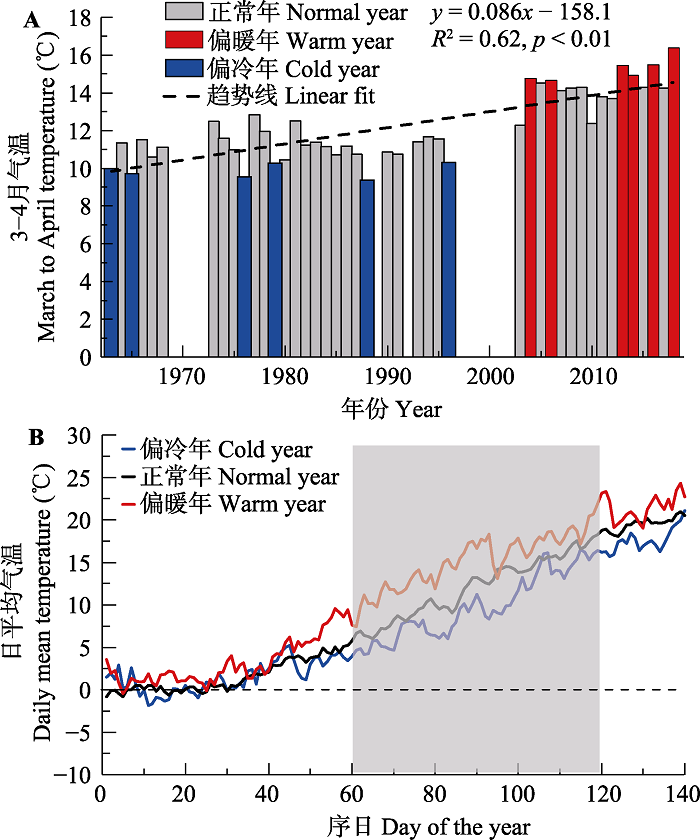
图1 西安地区偏冷年、偏暖年和气候正常年的划分。A, 1963-2018年3-4月平均气温逐年变化。B, 异常气候年和正常年的逐日平均气温对比。
Fig. 1 Division of the cold years, warm years, and normal years. A, The March to April average temperature from 1963 to 2018. B, The daily mean temperature in years with abnormal and normal climate.
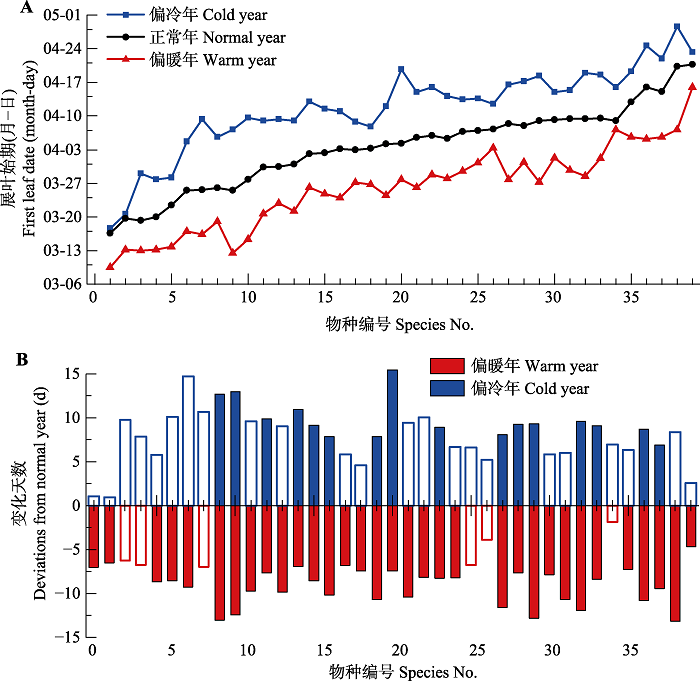
图2 西安地区异常气候年和正常年39种木本植物的展叶始期对比。A, 各物种在偏冷年、正常年和偏暖年的平均展叶始期。B, 异常气候年与正常年展叶始期的差异。实心柱代表差异显著(p < 0.05)。物种编号同表1。
Fig. 2 Difference in first leaf date (FLD) of 39 woody species between the years with abnormal and normal climate in Xi?an. A, The average FLD in cold years, normal years, and warm years for each species. B, The difference in FLD between the years with abnormal and normal climate. The solid bars represent that the difference is significant (p < 0.05). See Table 1 for species No.
| 变量 Variable | 类群 Group | 生活型 Life form | ||||
|---|---|---|---|---|---|---|
| 年轻 Young | 中间 Intermediate | 古老 Ancient | 乔木 Tree | 灌木或小乔木 Shrub or small tree | 藤本 Liana | |
| 物种数量 N | 24 | 13 | 2 | 25 | 13 | 1 |
| 偏冷年物候变化(天) PC in the cold year (day) | 8.6 ± 2.9a | 6.7 ± 2.6b | 13.2 ± 3.2a,b | 7.9 ± 3.0 | 8.8 ± 3.4 | 8.1 |
| 偏暖年物候变化(天) PC in the warm year (day) | -8.6 ± 2.7 | -8.8 ± 2.2 | -7.2 ± 0.4 | -8.5 ± 2.6 | -8.5 ± 2.3 | -11.6 |
| 偏冷年积温需求变化(度日) CTR in the cold year (degree day) | -26.2 ± 18.7 | -32.9 ± 16.4a | 0.7 ± 35.8a | -29.1 ± 21.5 | -23.2 ± 16.2 | -25.6 |
| 偏暖年积温需求变化(度日) CTR in the warm year (degree day) | 62.2 ± 31.8 | 61.5 ± 26.7 | 70.7 ± 6.1 | 67.7 ± 32.6 | 54.3 ± 18.8 | 36.4 |
表2 西安39种木本植物不同类群和生活型的展叶始期及其积温需求变化对比(平均值±标准偏差)
Table 2 Comparison of the change in the first leaf date and its thermal requirement of 39 woody species among different groups and life forms in Xi’an (mean ± SD)
| 变量 Variable | 类群 Group | 生活型 Life form | ||||
|---|---|---|---|---|---|---|
| 年轻 Young | 中间 Intermediate | 古老 Ancient | 乔木 Tree | 灌木或小乔木 Shrub or small tree | 藤本 Liana | |
| 物种数量 N | 24 | 13 | 2 | 25 | 13 | 1 |
| 偏冷年物候变化(天) PC in the cold year (day) | 8.6 ± 2.9a | 6.7 ± 2.6b | 13.2 ± 3.2a,b | 7.9 ± 3.0 | 8.8 ± 3.4 | 8.1 |
| 偏暖年物候变化(天) PC in the warm year (day) | -8.6 ± 2.7 | -8.8 ± 2.2 | -7.2 ± 0.4 | -8.5 ± 2.6 | -8.5 ± 2.3 | -11.6 |
| 偏冷年积温需求变化(度日) CTR in the cold year (degree day) | -26.2 ± 18.7 | -32.9 ± 16.4a | 0.7 ± 35.8a | -29.1 ± 21.5 | -23.2 ± 16.2 | -25.6 |
| 偏暖年积温需求变化(度日) CTR in the warm year (degree day) | 62.2 ± 31.8 | 61.5 ± 26.7 | 70.7 ± 6.1 | 67.7 ± 32.6 | 54.3 ± 18.8 | 36.4 |
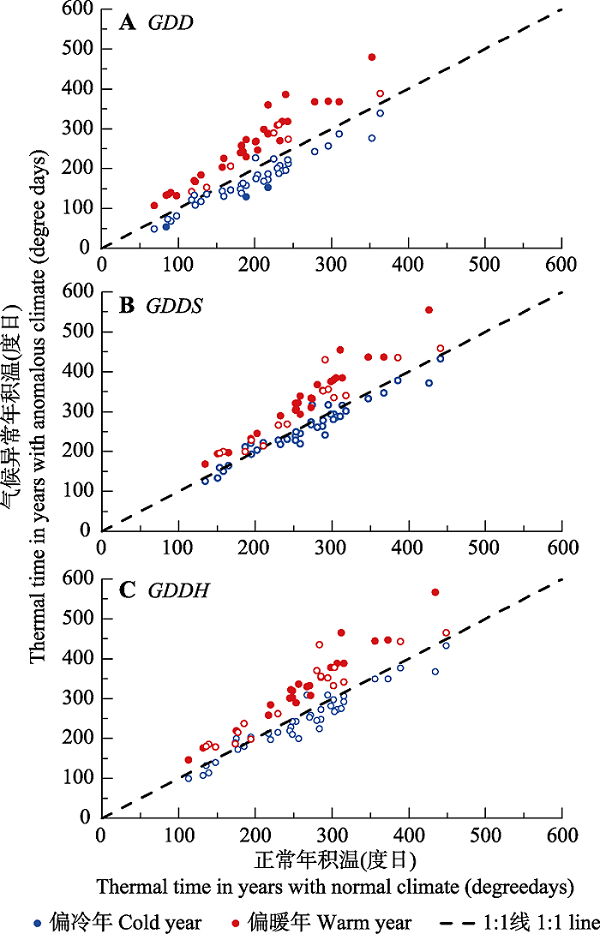
图3 西安地区气候异常年和正常年39种木本植物展叶始期的积温需求对比。A, 算法1结果。B, 算法2结果。C, 算法3结果。实心点代表异常气候年与正常年差异显著(p < 0.05)。
Fig. 3 Comparison of thermal requirements for the first leaf date (FLD) of 39 woody species between the years with abnormal and normal climate in Xi?an. A, The results of the first method. B, The results of the second method. C, The results of the third method. The solid circles represent that the difference is significant (p < 0.05).

图4 不同算法计算得到的西安39种木本植物展叶始期积温需求对比。A, 算法1与算法2。B, 算法1与算法3。黑点表示各物种在正常年的积温需求。算法同图3。
Fig. 4 Comparisons among different methods for calculating thermal requirements for the first leaf date (FLD) of 39 woody species in Xi?an. A, method 1 vs. method 2. B, method 1 vs. method 3. Black circles represent the mean thermal requirement in normal years for each species. See Fig. 3 for methods.
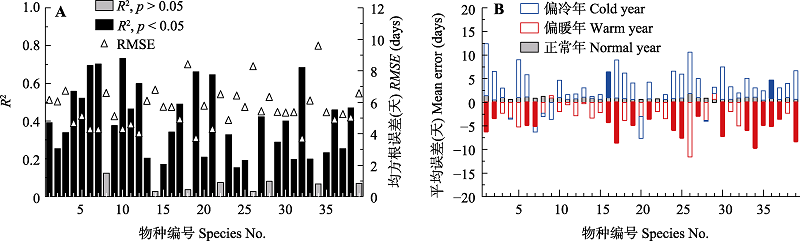
图5 西安39种木本植物展叶始期的积温模型模拟效果。A, 模型的拟合优度(R2)和均方根误差(RMSE)。B, 各物种在异常气候年和正常年的模拟误差。实心柱代表异常气候年的误差显著不为0 (p < 0.05)。物种编号同表1。
Fig. 5 Effect of growing degree day model for simulating the first leaf date (FLD) of 39 woody species in Xi?an. A, Goodness of fit (R2) and root mean square error (RMSE) of the models. B, Error of the model in simulating the FLD in the years with abnormal and normal climate. The solid bars represent that the mean error was significant from 0 (p < 0.05). See Table 1 for species No.
| [1] | . Anderson JL, Richardson EA, Kesner CD (1986). Validation of chill unit and flower bud phenology models for ‘Montmorency’ sour cherry. Acta Horticulturae, 184, 71-78. |
| [2] | . Anderson JV, Horvath DP, Chao WS, Foley ME (2010). Bud dormancy in perennial plants: A mechanism for survival. In: Lubzens E, Cerda JC, Clark M eds. Dormancy and Resistance in Harsh Environments. Springer, Berlin. 69-90. |
| [3] |
. Bai J, Ge QS, Dai JH, Wang Y (2010). Relationship between woody plants phenology and climate factors in Xiʼan, China. Chinese Journal of Plant Ecology, 34, 1274-1282.
DOI URL |
|
[ 白洁, 葛全胜, 戴君虎, 王英 (2010). 西安木本植物物候与气候要素的关系. 植物生态学报, 34, 1274-1282.]
DOI URL |
|
| [4] |
. Bolmgren K, Vanhoenacker D, Miller-Rushing AJ (2013). One man, 73 years, and 25 species. Evaluating phenological responses using a lifelong study of first flowering dates. International Journal of Biometeorology, 57, 367-375.
DOI URL |
| [5] |
. Cannell MGR, Smith RI (1983). Thermal time, chill days and prediction of budburst in Picea sitchensis. Journal of Applied Ecology, 20, 951-963.
DOI URL |
| [6] |
. Carter JM, Orive ME, Gerhart LM, Stern JH, Marchin RM, Nagel J, Ward JK (2017). Warmest extreme year in US history alters thermal requirements for tree phenology. Oecologia, 183, 1197-1210.
DOI URL PMID |
| [7] |
. Chen HP, Sun JQ (2015). Changes in climate extreme events in China associated with warming. International Journal of Climatology, 35, 2735-2751.
DOI URL |
| [8] | . Chmielewski FM, Götz KP (2017). Identification and timing of dormant and ontogenetic phase for sweet cherries in Northeast Germany for modelling purposes. Journal of Horticulture, 4, 1000205. DOI: 10.4172/2376-0354.1000205. |
| [9] |
. Chow DHC, Levermore GJ (2007). New algorithm for generating hourly temperature values using daily maximum, minimum and average values from climate models. Building Services Engineering Research & Technology, 28, 237-248.
DOI URL |
| [10] | . Chuine I, de Cortazar-Atauri IG, Kramer K, Hänninen H ( 2013). Plant development models. In: Schwartz MD ed. Phenology: An Integrative Environmental Science. 2nd edn. Springer, Dordrecht, Netherland. 275-293. |
| [11] |
. Clark JS, Salk C, Melillo J, Mohan J (2014). Tree phenology responses to winter chilling, spring warming, at north and south range limits. Functional Ecology, 28, 1344-1355.
DOI URL |
| [12] | . Cleland EE, Allen JM, Crimmins TM, Dunne JA, Pau S, Travers SE, Zavaleta ES, Wolkovich EM (2012). Phenological tracking enables positive species responses to climate change. Ecology, 93, 1765-1771. |
| [13] |
. Dai JH, Wang HJ, Ge QS (2014). The spatial pattern of leaf phenology and its response to climate change in China. International Journal of Biometeorology, 58, 521-528.
DOI URL |
| [14] |
. de los Milagros Skansi M, Brunet M, Sigró J, Aguilar E, Arevalo Groening JA, Bentancur OJ, Castellón Geier YR, Correa Amaya RL, Jácome H, Malheiros Ramos A, Oria Rojas C, Pasten AM, Sallons Mitro S, Villaroel Jiménez C, Martínez R, Alexander LV, Jones PD (2013). Warming and wetting signals emerging from analysis of changes in climate extreme indices over South America. Global and Planetary Change, 100, 295-307.
DOI URL |
| [15] |
. Ellwood ER, Temple SA, Primack RB, Bradley NL, Davis CC (2013). Record-breaking early flowering in the eastern United States. PLOS ONE, 8, e53788. DOI: 10.1371/ journal.pone.0053788.
DOI URL PMID |
| [16] |
. Fahey RT (2016). Variation in responsiveness of woody plant leaf out phenology to anomalous spring onset. Ecosphere, 7, e01209. DOI: 10.1002/ecs2.1209.
URL PMID |
| [17] |
. Frank D, Reichstein M, Bahn M, Thonicke K, Frank D, Mahecha MD, Smith P, van der Velde M, Vicca S, Babst F, Beer C, Buchmann N, Canadell JG, Ciais P, Cramer W, Ibrom A, Miglietta F, Poulter B, Rammig A, Seneviratne SI, Walz A, Wattenbach M, Zavala MA, Zscheischler J (2015). Effects of climate extremes on the terrestrial carbon cycle: Concepts, processes and potential future impacts. Global Change Biology, 21, 2861-2880.
DOI URL PMID |
| [18] |
. Friedl MA, Gray JM, Melaas EK, Richardson AD, Hufkens K, Keenan TF, Bailey A, OʼKeefe J (2014). A tale of two springs: Using recent climate anomalies to characterize the sensitivity of temperate forest phenology to climate change. Environmental Research Letters, 9, 054006. DOI: 10.1088/1748-9326/9/5/054006.
DOI URL |
| [19] |
. Ge QS, Wang HJ, Rutishauser T, Dai JH (2015). Phenological response to climate change in China: A meta-analysis. Global Change Biology, 21, 265-274.
DOI URL PMID |
| [20] |
. Gonsamo A, Chen JM, Wu CY (2013). Citizen science: Linking the recent rapid advances of plant flowering in Canada with climate variability. Scientific Reports, 3, 2239. DOI: 10.1038/srep02239.
DOI URL PMID |
| [21] | . Hänninen H (1990). Modelling bud dormancy release in trees from cool and temperate regions. Acta Forestalia Fennica, 213, 1-47. |
| [22] |
. Huang WJ, Ge QS, Dai JH, Wang HJ (2017). Sensitivity of first flowering dates to temperature change for typical woody plants in Guiyang City, China. Progress in Geography, 36, 1015-1024.
DOI URL |
|
[ 黄文婕, 葛全胜, 戴君虎, 王焕炯 (2017). 贵阳木本植物始花期对温度变化的敏感度. 地理科学进展, 36, 1015-1024.]
DOI URL |
|
| [23] |
. Hunter AF, Lechowicz MJ (1992). Predicting the timing of budburst in temperate trees. Journal of Applied Ecology, 29, 597-604.
DOI URL PMID |
| [24] | . IPCC ( 2013). Summary for policymakers. In: Stocker TF, Qin D, Plattner GK, Tignor M, Allen SK, Boschung J, Nauels A, Xia Y, Bex V, Midgley PM eds. Climate Change 2013: The Physical Science Basis. Cambridge University Press, Cambridge, UK. 3-29. |
| [25] |
. Jin JX, Wang Y, Zhang Z, Magliulo V, Jiang H, Cheng M (2017). Phenology plays an important role in the regulation of terrestrial ecosystem water-use efficiency in the northern hemisphere. Remote Sensing, 9, 664. DOI: 10.3390/rs9070664.
DOI URL |
| [26] | . Jin LN, Qu J, Zhai Y, Zhang H (2014). Comprehensive analysis of climate change characteristics in Xiʼan over recent 63 years. Journal of Shaanxi Meteorology, ( 3), 17-20. |
| [ 金丽娜, 曲静, 翟园, 张弘 (2014). 西安近63年气候变化特征综合分析. 陕西气象, ( 3), 17-20.] | |
| [27] |
. Jochner S, Sparks TH, Laube J, Menzel A (2016). Can we detect a nonlinear response to temperature in European plant phenology? International Journal of Biometeorology, 60, 1551-1561.
DOI URL PMID |
| [28] | . Lang GA, Early JD, Martin GC, Darnell RL (1987) Endo-, para-, and ecodormancy: Physiological terminology and classification for dormancy research. Hortscience, 22, 371-377. |
| [29] |
. Laube J, Sparks TH, Estrella N, Höfler J, Ankerst DP, Menzel A (2014). Chilling outweighs photoperiod in preventing precocious spring development. Global Change Biology, 20, 170-182.
DOI URL |
| [30] | . Liu YF, Tuan ZH, Kong W, Sun B, An B (2015). The changing trend of heat island intensity and main influencing factors during 1993-2012 in Xi’an City. Journal of Natural Resources, 30, 974-985. |
| [ 刘宇峰, 原志华, 孔伟, 孙铂, 安彬 (2015). 1993-2012年西安城区城市热岛效应强度变化趋势及影响因素分析. 自然资源学报, 30, 974-985.] | |
| [31] |
. Luedeling E, Zhang MH, McGranahan G, Leslie C (2009). Validation of winter chill models using historic records of walnut phenology. Agricultural and Forest Meteorology, 149, 1854-1864.
DOI URL |
| [32] |
. Menzel A, Helm R, Zang C (2015). Patterns of late spring frost leaf damage and recovery in a European beech ( Fagus sylvatica L.) stand in south-eastern Germany based on repeated digital photographs. Frontiers in Plant Science,6, 110. Doi: 10.3389/fpls.2015.00110.
DOI URL PMID |
| [33] | . Okie WR, Blackburn B (2011). Increasing chilling reduces heat requirement for floral budbreak in Peach. HortScience, 46, 245-252. |
| [34] |
. Richardson AD, Anderson RS, Arain MA, Barr AG, Bohrer G, Chen GS, Chen JM, Ciais P, Davis KJ, Desai AR, Dietze MC, Dragoni D, Garrity SR, Gough CM, Grant R, Hollinger DY, Margolis HA, Mccaughey H, Migliavacca M, Monson RK, Munger JW, Poulter B, Raczka BM, Ricciuto DM, Sahoo AK, Schaefer K, Tian H, Vargas R, Verbeeck H, Xiao J, Xue Y (2012). Terrestrial biosphere models need better representation of vegetation phenology: Results from the North American Carbon Program Site Synthesis. Global Change Biology, 18, 566-584.
DOI URL |
| [35] | . Sarvas R (1972). Investigations on the annual cycle of development on forest trees: Active period. Communicationes Instituti Forestalis Fenniae, 76, 1-110. |
| [36] |
. Smith MD (2011). An ecological perspective on extreme climatic events: A synthetic definition and framework to guide future research. Journal of Ecology, 99, 656-663.
DOI URL |
| [37] |
. Stott P (2016). How climate change affects extreme weather events. Science, 352, 1517-1518.
DOI URL PMID |
| [38] |
. Templ B, Templ M, Filzmoser P, Lehoczky A, Bakšienè E, Fleck S, Gregow H, Hodzic S, Kalvane G, Kubin E, Palm V, Romanovskaja D, Vŭcetić V, Žust A, Czúcz B, NS-Pheno Team (2017). Phenological patterns of flowering across biogeographical regions of Europe. International Journal of Biometeorology, 61, 1347-1358.
DOI URL PMID |
| [39] | . Wan MW, Liu XZ ( 1979). Chinese Phenological Observation Methods. Science Press, Beijing. |
| [ 宛敏谓, 刘秀珍 ( 1979). 中国物候观测方法. 科学出版社, 北京.] | |
| [40] |
. Wang HJ, Sun JQ, Chen HP, Zhu YL, Zhang Y, Jiang DB, Lang XM, Fan K, Yu ET, Yang S (2012). Extreme climate in China: Facts, simulation and projection. Meteorologische Zeitschrift, 21, 279-304.
DOI URL |
| [41] |
. Wang HJ, Zhong SY, Tao ZX, Dai JH, Ge QS (2019). Changes in flowering phenology of woody plants from 1963 to 2014 in North China. International Journal of Biometeorology, 63, 579-590.
DOI URL PMID |
| [42] |
. Way DA, Montgomery RA (2015). Photoperiod constraints on tree phenology, performance and migration in a warming world. Plant, Cell & Environment, 38, 1725-1736.
DOI URL PMID |
| [43] | . Wu ZY, Raven PH ( 2013). Flora of China. Science Press, Beijing. |
| [44] |
. Xia JY, Niu SL, Ciais P, Janssens IA, Chen JQ, Ammann C, Arain A, Blanken PD, Cescatti A, Bonal D, Buchmann N, Curtis PS, Chen SP, Dong J, Flanagan LB, Frankenberg C, Georgiadis T, Gough CM, Hui D, Kiely G, Li J, Lund M, Magliulo V, Marcolla B, Merbold L, Montagnani L, Moors EJ, Olesen JE, Piao S, Raschi A, Roupsard O, Suyker AE, Urbaniak M, Vaccari FP, Varlagin A, Vesala T, Wilkinson M, Weng E, Wohlfahrt G, Yan L, Luo Y (2015). Joint control of terrestrial gross primary productivity by plant phenology and physiology. Proceedings of the National Academy of Sciences of the United States of America, 112, 2788-2793.
DOI URL PMID |
| [45] | . Xu CC, Cui HX, Shi L, Xia F, Yin ZY, Zhang DS (2017). Response of flowering phenology of Viburnum to abnormal meteorological events. Chinese Bulletin of Botany, 52, 297-306. |
| [ 许聪聪, 崔洪霞, 石雷, 夏菲, 尹炤寅, 张德山 (2017). 荚蒾属植物花期物候对春季异常气象事件的响应. 植物学报, 52, 297-306.] | |
| [46] | . Xu YJ, Zhong SY, Dai JH, Tao ZX, Wang HJ (2017). Changes in flowering phenology of plants and their model simulation in Mudanjiang, China. Geographical Research, 36, 779-789. |
| [ 徐韵佳, 仲舒颖, 戴君虎, 陶泽兴, 王焕炯 (2017). 1978-2014年牡丹江地区植物花期变化及模型模拟. 地理研究, 36, 779-789.] | |
| [47] |
. Zanne AE, Tank DC, Cornwell WK, Eastman JM, Smith SA, Fitzjohn RG, McGlinn DJ, O’Meara BC, Moles AT, Reich PB, Royer DL, Soltis DE, Stevens PF, Westoby M, Wright IJ, Aarssen L, Bertin RI, Calaminus A, Govaerts R, Hemmings F, Leishman MR, Oleksyn J, Soltis PS, Swenson NG, Warman L, Beaulieu JM (2014). Three keys to the radiation of angiosperms into freezing environments. Nature, 506, 89-92.
DOI URL |
| [48] | . Zhang AY, Wang HJ, Dai JH, Ding DP (2014). Applicability analysis of phenological models in the flowering time prediction of ornamental plants in Beijing area. Journal of Applied Meteorological Science, 25, 483-492. |
| [ 张爱英, 王焕炯, 戴君虎, 丁德平 (2014). 物候模型在北京观赏植物开花期预测中的适用性. 应用气象学报, 25, 483-492.] | |
| [49] |
. Zhang HC, Liu SG, Regnier P, Yuan WP (2018). New insights on plant phenological response to temperature revealed from long-term widespread observations in China. Global Change Biology, 24, 2066-2078.
DOI URL PMID |
| [50] | . Zheng JY, Bian JJ (2012). Merge on daily temperature data by adjusting two series of adjacent meteorological stations with observation type alternation. Geographical Research, 31, 579-588. |
| [ 郑景云, 卞娟娟 (2012). 类型变更的相邻气象观测站的日气温资料整合. 地理研究, 31, 579-588.] | |
| [51] |
. Zhong SY, Ge QS, Dai JH, Wang HJ (2017). Development of phenological models for simulating past flowering phenology of typical ornamental plants in China. Resources Science, 39, 2116-2129.
DOI URL |
|
[ 仲舒颖, 葛全胜, 戴君虎, 王焕炯 (2017). 中国典型观赏植物花期模型建立及过去花期变化模拟. 资源科学, 39, 2116-2129.]
DOI URL |
|
| [52] |
. Zhou T, Cao RY, Wang SP, Chen J, Tang YH (2018). Responses of green-up dates of grasslands in China and woody plants in Europe to air temperature and precipitation: Empirical evidences based on survival analysis. Chinese Journal of Plant Ecology, 42, 526-538.
DOI URL |
|
[ 周彤, 曹入尹, 王少鹏, 陈晋, 唐艳鸿 (2018). 中国草地和欧洲木本植物返青期对气温和降水变化的响应: 基于生存分析的研究. 植物生态学报, 42, 526-538.]
DOI URL |
| [1] | 贾元, 张琳, 宋创业, 赵常明, 郭虓, 祝晓光, 吴冬秀. 基于深度学习目标检测的植物物候自动识别方法对比研究——以神农架粉白杜鹃为例[J]. 植物生态学报, 2026, 50(生态统计方法专题): 1-. |
| [2] | 张琳, 袁伟影, 宋创业, 吴冬秀. 1998-2010年中国典型生态系统长期监测样地环境要素、物种丰富度和生物量动态数据集[J]. 植物生态学报, 2025, 49(8): 1182-1190. |
| [3] | 范亚冉, 夏少攀, 于冰冰, 朱紫琪, 杨威, 范豫川, 刘晓雨, 张旭辉, 郑聚锋. 大气CO2浓度升高和增温对土壤有机碳库积累、分子组成和结构稳定性的影响[J]. 植物生态学报, 2025, 49(7): 1053-1069. |
| [4] | 严文秀, 赵诗晗, 郑春燕, 张萍, 沈海花, 常锦峰, 徐亢. 基于多物候指标的人工饲草长势监测及产量估测[J]. 植物生态学报, 2025, 49(7): 1096-1109. |
| [5] | 李思雨, 杨风亭, 王辉民, 戴晓琴, 孟盛旺. 杉木和木荷木质部形成季节动态及其对环境因子的响应[J]. 植物生态学报, 2025, 49(2): 295-307. |
| [6] | 王堃莹, 邱贵福, 刘子赫, 孟君, 刘宇轩, 贾国栋. 气候变化对不同退化程度小叶杨林分生长和内在水分利用效率的调节[J]. 植物生态学报, 2025, 49(2): 343-355. |
| [7] | 徐波, 杨子松, 李波, 石福孙. 海拔对暗紫贝母功能性状及鳞茎药用成分含量的影响[J]. 植物生态学报, 2025, 49(12): 2137-2148. |
| [8] | 黄美红, 牛梦秋, 杨鹏飞, 林洁, 廖周瑜, 陈建国, 向建英. 不同温度和埋藏深度对高山垫状植物山生福禄草种子出苗及幼苗生长的影响[J]. 植物生态学报, 2025, 49(12): 2092-2104. |
| [9] | 万冬梅, 杨智杰, 刘小飞, 熊德成, 胥超, 陈仕东, 杨玉盛. 基于固态激光雷达测高法的亚热带幼树生长物候及其对环境因子的响应[J]. 植物生态学报, 2025, 49(12): 2080-2091. |
| [10] | 贺艺, 周静, 陈宸, 房庭舟, 苏剑, 高浩杰, 曹嘉浩, 杨飞宇, 范淇博, 朱乐瑶, 陈薏名, 杨飞, 王毅腾, 冯雷, 刘飞, 梁爽, 蒋明凯, 陈军, 赵云鹏, 陈伟乐, 赵颖, 黄建国. 浙江海岛濒危树种的保护与恢复[J]. 植物生态学报, 2025, 49(10): 1583-1599. |
| [11] | 周鑫宇, 刘会良, 高贝, 卢妤婷, 陶玲庆, 文晓虎, 张岚, 张元明. 新疆特有濒危植物雪白睡莲繁殖生物学研究[J]. 植物生态学报, 2025, 49(10): 1643-1655. |
| [12] | 张鹏, 焦亮, 薛儒鸿, 魏梦圆, 杜达石, 吴璇, 王旭鸽, 李倩. 干旱强度影响祁连山西段不同海拔青海云杉的生长恢复[J]. 植物生态学报, 2024, 48(8): 977-987. |
| [13] | 史倩, 同小娟, 许玲玲, 孟平, 于裴洋, 李俊, 杨铭鑫. 油松早晚材径向生长对气候因子的响应[J]. 植物生态学报, 2024, 48(8): 988-1000. |
| [14] | 陈以恒, 玉素甫江•如素力, 阿卜杜热合曼•吾斯曼. 2001-2020年天山新疆段草地植被覆盖度时空变化及驱动因素分析[J]. 植物生态学报, 2024, 48(5): 561-576. |
| [15] | 张计深, 史新杰, 刘宇诺, 吴阳, 彭守璋. 气候变化下中国潜在自然植被生态系统碳储量动态[J]. 植物生态学报, 2024, 48(4): 428-444. |
| 阅读次数 | ||||||
|
全文 |
|
|||||
|
摘要 |
|
|||||
Copyright © 2026 版权所有 《植物生态学报》编辑部
地址: 北京香山南辛村20号, 邮编: 100093
Tel.: 010-62836134, 62836138; Fax: 010-82599431; E-mail: apes@ibcas.ac.cn, cjpe@ibcas.ac.cn
备案号: 京ICP备16067583号-19

