
植物生态学报 ›› 2022, Vol. 46 ›› Issue (12): 1448-1460.DOI: 10.17521/cjpe.2021.0428 cstr: 32100.14.cjpe.2021.0428
所属专题: 生态系统碳水能量通量; 草原与草业
• 中国典型生态脆弱区碳水通量过程研究专题论文 • 上一篇 下一篇
王彦兵, 游翠海, 谭星儒, 陈波宇, 许梦真, 陈世苹( )
)
收稿日期:2021-11-22
接受日期:2022-04-22
出版日期:2022-12-20
发布日期:2023-01-13
基金资助:
WANG Yan-Bing, YOU Cui-Hai, TAN Xing-Ru, CHEN Bo-Yu, XU Meng-Zhen, CHEN Shi-Ping()
Received:2021-11-22
Accepted:2022-04-22
Online:2022-12-20
Published:2023-01-13
Supported by:摘要:
能量平衡闭合状况是评估通量观测数据质量的重要参考指标, 为客观评价中国北方干旱半干旱涡度观测数据的质量, 确定数据分析方法和改进策略, 加深对能量闭合度与环境因子之间关系的理解, 该研究基于内蒙古3种不同草原类型(荒漠草原、典型草原和草甸草原) 6个涡度相关通量观测站点(四子王旗站、锡林浩特割草站、锡林浩特围封站、西乌珠穆沁旗站、多伦站和额尔古纳站)的56个站年的能量通量和气象因子测定数据集, 利用能量平衡比率(EBR)和最小二乘法线性回归(OLS)这两种常用的方法, 分析了北方干旱半干旱区不同站点和草原类型能量闭合的状况、季节和年际变异及主要影响因素。主要结果表明: 1) 6个站点多年EBR均值为0.89 ± 0.11, OLS斜率均值为0.96 ± 0.04, 能量闭合程度明显高于国际通量网和中国通量网站点的能量闭合状况。2)不同站点和草原类型间EBR存在明显差异, 表现为荒漠草原(1.01 ± 0.09)和典型草原(0.90 ± 0.11)都高于草甸草原(0.83 ± 0.05), 各站点EBR均存在明显的季节变异, 生长季基本都在1附近并且相对稳定, 非生长季低于1并且变化较大, 主要受气温(Ta)、饱和水汽压差(VPD)、土壤含水量(SWC)和反照率(Albedo)的影响, 其中较低的Ta和较高的Albedo是导致非生长季EBR较低的主要原因。3)不同站点和草原类型EBR存在显著年际变异, 主要受潜热分配(潜热通量/净辐射比值, LE/Rn)、年平均气温(MAT)和生长季Albedo显著影响, 其中LE/Rn的年际波动对EBR年际变异起主要的调控作用, 可解释EBR年际变异的44%。此外, 各站点EBR均表现出随年份逐渐降低的趋势, 植被盖度显著增大后引起Albedo降低可能是造成EBR下降的主要原因。综上所述, 为更加全面地评估能量闭合状况, EBR和OLS斜率两种方法建议结合起来使用。
王彦兵, 游翠海, 谭星儒, 陈波宇, 许梦真, 陈世苹. 中国北方干旱半干旱区草原生态系统能量平衡闭合的季节和年际变异. 植物生态学报, 2022, 46(12): 1448-1460. DOI: 10.17521/cjpe.2021.0428
WANG Yan-Bing, YOU Cui-Hai, TAN Xing-Ru, CHEN Bo-Yu, XU Meng-Zhen, CHEN Shi-Ping. Seasonal and interannual variations in energy balance closure over arid and semi-arid grasslands in northern China. Chinese Journal of Plant Ecology, 2022, 46(12): 1448-1460. DOI: 10.17521/cjpe.2021.0428
| 站点 Site | 地理位置 Geo-location | 海拔 Altitude (m) | 年平均气温 Mean annual air temperature (°C) | 年降水量 Mean annual precipitation (mm) | 土壤类型 Soil type | 草地类型 Grassland type | 优势种 Dominant species | 数据时段 Data period |
|---|---|---|---|---|---|---|---|---|
| 四子王旗站 Siziwangqi station (SZ) | 111.90° E 41.78° N | 1 438 | 3.4 | 310 | 栗钙土 Kastanozem | 荒漠草原 Desert steppe | 短花针茅 Stipa breviflora 冷蒿 Artemisia frigida | 2011-2018 |
| 锡林浩特割草站 Xilinhot grazed station (XL1) | 116.67° E 43.56° N | 1 250 | 2.0 | 350 | 栗钙土 Kastanozem | 典型草原 Typical steppe | 大针茅 Stipa grandis 羊草 Leymus chinensis 冷蒿 Artemisia frigida | 2006-2018 |
| 锡林浩特围封站 Xilinhot fenced station (XL2) | 116.67° E 43.55° N | 1 250 | 2.0 | 350 | 栗钙土 Kastanozem | 典型草原 Typical steppe | 大针茅 Stipa grandis 羊草 Leymus chinensis 羽茅 Achnatherum sibiricum | 2006-2018 |
| 西乌珠穆沁旗站 Xi Ujimqin Qi station (XW) | 117.58° E 44.36° N | 1 148 | 1.5 | 330 | 栗钙土 Kastanozem | 典型草原 Typical steppe | 大针茅 Stipa grandis 羊草 Leymus chinensis | 2012-2018 |
| 多伦站 Duolun station (DL) | 116.28° E 42.05° N | 1 350 | 1.6 | 385 | 栗钙土 Kastanozem | 典型草原 Typical steppe | 西北针茅 Stipa sareptana var. krylovii 冷蒿 Artemisia frigida | 2005-2018 |
| 额尔古纳站 Ergun station (EG) | 119.39 °E 50.19° N | 521 | -2.5 | 355 | 黑钙土 Chernozem | 草甸草原 Meadow steppe | 狼针草 Stipa baicalensis 寸草 Carex duriuscula | 2012-2018 |
表1 内蒙古草原生态系统不同站点基本信息概况
Table 1 Site information of different sites in Nei Mongol grasslands
| 站点 Site | 地理位置 Geo-location | 海拔 Altitude (m) | 年平均气温 Mean annual air temperature (°C) | 年降水量 Mean annual precipitation (mm) | 土壤类型 Soil type | 草地类型 Grassland type | 优势种 Dominant species | 数据时段 Data period |
|---|---|---|---|---|---|---|---|---|
| 四子王旗站 Siziwangqi station (SZ) | 111.90° E 41.78° N | 1 438 | 3.4 | 310 | 栗钙土 Kastanozem | 荒漠草原 Desert steppe | 短花针茅 Stipa breviflora 冷蒿 Artemisia frigida | 2011-2018 |
| 锡林浩特割草站 Xilinhot grazed station (XL1) | 116.67° E 43.56° N | 1 250 | 2.0 | 350 | 栗钙土 Kastanozem | 典型草原 Typical steppe | 大针茅 Stipa grandis 羊草 Leymus chinensis 冷蒿 Artemisia frigida | 2006-2018 |
| 锡林浩特围封站 Xilinhot fenced station (XL2) | 116.67° E 43.55° N | 1 250 | 2.0 | 350 | 栗钙土 Kastanozem | 典型草原 Typical steppe | 大针茅 Stipa grandis 羊草 Leymus chinensis 羽茅 Achnatherum sibiricum | 2006-2018 |
| 西乌珠穆沁旗站 Xi Ujimqin Qi station (XW) | 117.58° E 44.36° N | 1 148 | 1.5 | 330 | 栗钙土 Kastanozem | 典型草原 Typical steppe | 大针茅 Stipa grandis 羊草 Leymus chinensis | 2012-2018 |
| 多伦站 Duolun station (DL) | 116.28° E 42.05° N | 1 350 | 1.6 | 385 | 栗钙土 Kastanozem | 典型草原 Typical steppe | 西北针茅 Stipa sareptana var. krylovii 冷蒿 Artemisia frigida | 2005-2018 |
| 额尔古纳站 Ergun station (EG) | 119.39 °E 50.19° N | 521 | -2.5 | 355 | 黑钙土 Chernozem | 草甸草原 Meadow steppe | 狼针草 Stipa baicalensis 寸草 Carex duriuscula | 2012-2018 |
| 时间 Time | 站点 Station | 最小二乘法线性回归 Linear regression from the ordinary least squares | 能量平衡比率 Energy balance ratio | ||
|---|---|---|---|---|---|
| 斜率 Slope | 截距 Intercept | 决定系数 R2 | |||
| 全年 (1-12月) Whole year (January-December) | SZ | 0.97 ± 0.13 | 0.30 ± 0.41 | 0.90 ± 0.03 | 1.01 ± 0.07 |
| XL1 | 0.94 ± 0.10 | -0.05 ± 0.44 | 0.88 ± 0.02 | 0.92 ± 0.09 | |
| XL2 | 1.01 ± 0.07 | -1.15 ± 0.72 | 0.89 ± 0.04 | 0.86 ± 0.07 | |
| XW | 0.96 ± 0.05 | -1.08 ± 0.13 | 0.94 ± 0.01 | 0.78 ± 0.06 | |
| DL | 1.00 ± 0.07 | 0.09 ± 0.25 | 0.94 ± 0.02 | 1.02 ± 0.07 | |
| EG | 0.88 ± 0.04 | -0.69 ± 0.52 | 0.91 ± 0.04 | 0.74 ± 0.04 | |
| 平均值 Average | 0.96 ± 0.04 | -0.43 ± 0.57 | 0.91 ± 0.02 | 0.89 ± 0.11 | |
| 非生长季 (10-次年3月) Non-growing season (October-March of next year) | SZ | 0.88 ± 0.21 | 0.42 ± 0.64 | 0.78 ± 0.08 | 1.01 ± 0.13 |
| XL1 | 0.82 ± 0.14 | -0.02 ± 0.48 | 0.76 ± 0.10 | 0.80 ± 0.17 | |
| XL2 | 0.90 ± 0.12 | -0.98 ± 0.78 | 0.77 ± 0.10 | 0.68 ± 0.15 | |
| XW | 0.95 ± 0.09 | -1.10 ± 0.12 | 0.87 ± 0.04 | 0.58 ± 0.09 | |
| DL | 0.98 ± 0.06 | 0.17 ± 0.24 | 0.91 ± 0.02 | 1.04 ± 0.10 | |
| EG | 0.52 ± 0.21 | -0.69 ± 0.38 | 0.43 ± 0.22 | 0.35 ± 0.17 | |
| 平均值 Average | 0.84 ± 0.15 | -0.37 ± 0.58 | 0.75 ± 0.15 | 0.74 ± 0.24 | |
| 生长季 (4-9月) Growing season (April-September) | SZ | 0.94 ± 0.12 | 0.61 ± 1.11 | 0.76 ± 0.13 | 1.01 ± 0.09 |
| XL1 | 0.86 ± 0.08 | 0.92 ± 0.52 | 0.71 ± 0.07 | 0.96 ± 0.09 | |
| XL2 | 0.96 ± 0.07 | -0.13 ± 0.50 | 0.87 ± 0.06 | 0.95 ± 0.06 | |
| XW | 0.94 ± 0.06 | -0.79 ± 0.24 | 0.89 ± 0.05 | 0.86 ± 0.06 | |
| DL | 1.04 ± 0.08 | -0.26 ± 0.23 | 0.85 ± 0.03 | 1.01 ± 0.07 | |
| EG | 0.81 ± 0.05 | 0.13 ± 0.66 | 0.79 ± 0.12 | 0.83 ± 0.05 | |
| 平均值 Average | 0.93 ± 0.07 | 0.08 ± 0.56 | 0.81 ± 0.06 | 0.94 ± 0.07 | |
表2 内蒙古草原生态系统不同站点能量平衡闭合状况(平均值±标准差)
Table 2 Energy balance closure of the different sites in Nei Mongol grasslands (mean ± SD)
| 时间 Time | 站点 Station | 最小二乘法线性回归 Linear regression from the ordinary least squares | 能量平衡比率 Energy balance ratio | ||
|---|---|---|---|---|---|
| 斜率 Slope | 截距 Intercept | 决定系数 R2 | |||
| 全年 (1-12月) Whole year (January-December) | SZ | 0.97 ± 0.13 | 0.30 ± 0.41 | 0.90 ± 0.03 | 1.01 ± 0.07 |
| XL1 | 0.94 ± 0.10 | -0.05 ± 0.44 | 0.88 ± 0.02 | 0.92 ± 0.09 | |
| XL2 | 1.01 ± 0.07 | -1.15 ± 0.72 | 0.89 ± 0.04 | 0.86 ± 0.07 | |
| XW | 0.96 ± 0.05 | -1.08 ± 0.13 | 0.94 ± 0.01 | 0.78 ± 0.06 | |
| DL | 1.00 ± 0.07 | 0.09 ± 0.25 | 0.94 ± 0.02 | 1.02 ± 0.07 | |
| EG | 0.88 ± 0.04 | -0.69 ± 0.52 | 0.91 ± 0.04 | 0.74 ± 0.04 | |
| 平均值 Average | 0.96 ± 0.04 | -0.43 ± 0.57 | 0.91 ± 0.02 | 0.89 ± 0.11 | |
| 非生长季 (10-次年3月) Non-growing season (October-March of next year) | SZ | 0.88 ± 0.21 | 0.42 ± 0.64 | 0.78 ± 0.08 | 1.01 ± 0.13 |
| XL1 | 0.82 ± 0.14 | -0.02 ± 0.48 | 0.76 ± 0.10 | 0.80 ± 0.17 | |
| XL2 | 0.90 ± 0.12 | -0.98 ± 0.78 | 0.77 ± 0.10 | 0.68 ± 0.15 | |
| XW | 0.95 ± 0.09 | -1.10 ± 0.12 | 0.87 ± 0.04 | 0.58 ± 0.09 | |
| DL | 0.98 ± 0.06 | 0.17 ± 0.24 | 0.91 ± 0.02 | 1.04 ± 0.10 | |
| EG | 0.52 ± 0.21 | -0.69 ± 0.38 | 0.43 ± 0.22 | 0.35 ± 0.17 | |
| 平均值 Average | 0.84 ± 0.15 | -0.37 ± 0.58 | 0.75 ± 0.15 | 0.74 ± 0.24 | |
| 生长季 (4-9月) Growing season (April-September) | SZ | 0.94 ± 0.12 | 0.61 ± 1.11 | 0.76 ± 0.13 | 1.01 ± 0.09 |
| XL1 | 0.86 ± 0.08 | 0.92 ± 0.52 | 0.71 ± 0.07 | 0.96 ± 0.09 | |
| XL2 | 0.96 ± 0.07 | -0.13 ± 0.50 | 0.87 ± 0.06 | 0.95 ± 0.06 | |
| XW | 0.94 ± 0.06 | -0.79 ± 0.24 | 0.89 ± 0.05 | 0.86 ± 0.06 | |
| DL | 1.04 ± 0.08 | -0.26 ± 0.23 | 0.85 ± 0.03 | 1.01 ± 0.07 | |
| EG | 0.81 ± 0.05 | 0.13 ± 0.66 | 0.79 ± 0.12 | 0.83 ± 0.05 | |
| 平均值 Average | 0.93 ± 0.07 | 0.08 ± 0.56 | 0.81 ± 0.06 | 0.94 ± 0.07 | |
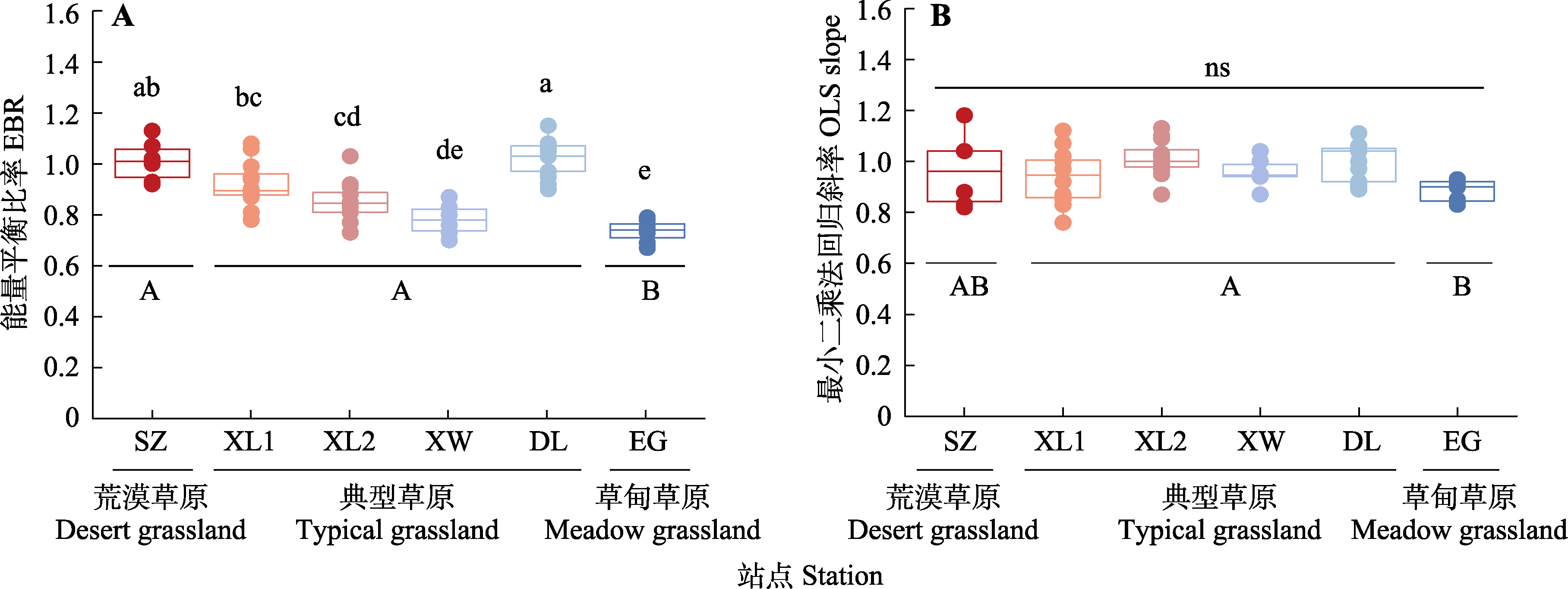
图1 内蒙古不同草原类型观测站点能量平衡闭合状况的比较。不同大、小写字母分别表示不同草原类型和不同站点间差异显著(p < 0.05); ns, p > 0.05。DL、EG、SZ、XL1、XL2和XW分别代表多伦站、额尔古纳站、四子王旗站、锡林浩特割草站、锡林浩特围封站和西乌珠穆沁旗站。
Fig. 1 Energy balance closure across different grassland types and sites in Nei Mongol based on energy balance ratio (EBR)(A) and ordinary least squares (OLS) slope (B) method. Different uppercase and lowercase letters indicate significant differences among different grassland types and sites, respectively (p < 0.05); ns, p > 0.05. DL, EG, SZ, XL1, XL2 and XW represent Duolun site, Ergun site, Siziwangqi site, Xilinhot mowed site, Xilinhot fenced site and Xi Ujimqin Qi site, respectively.
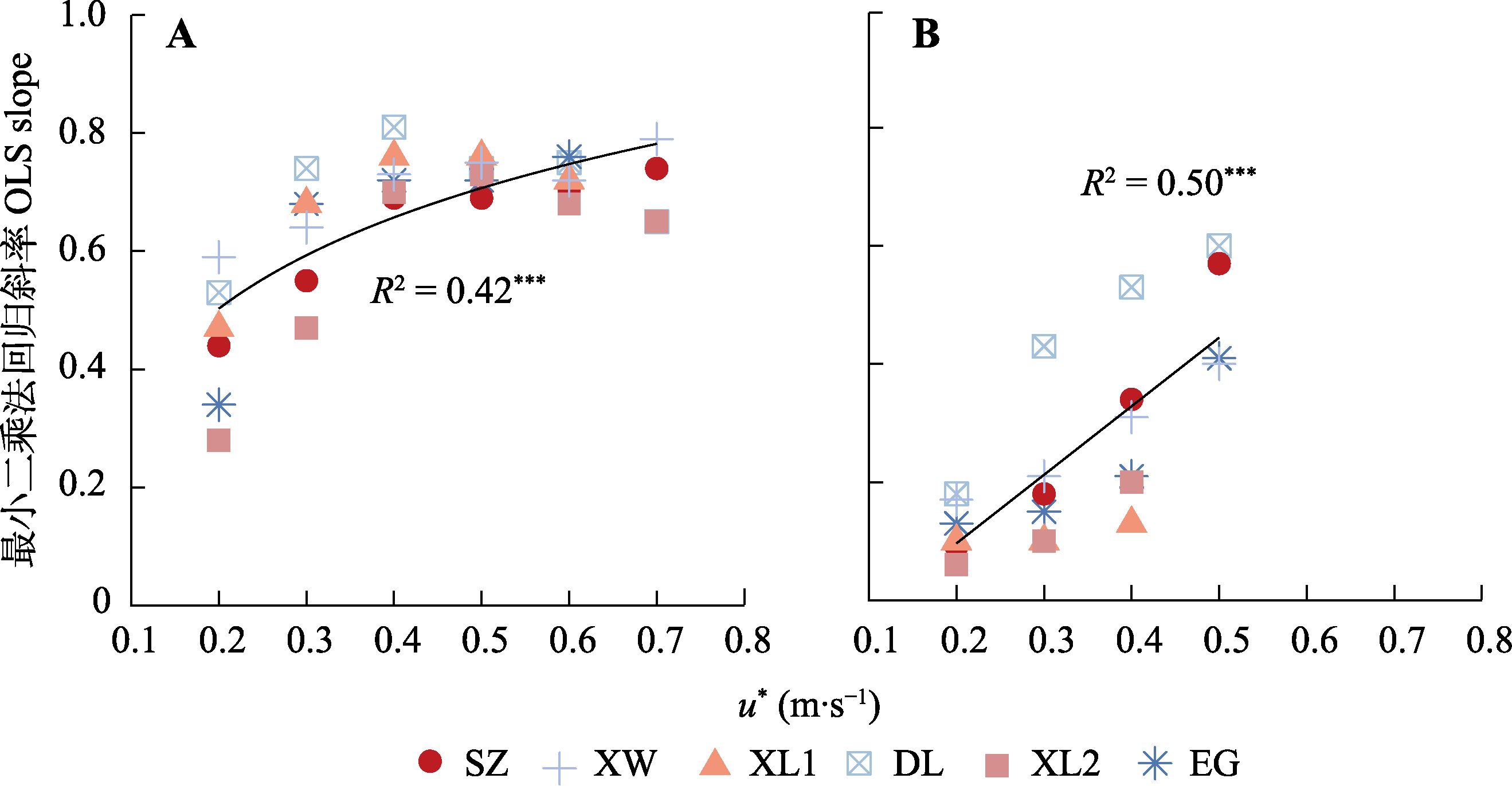
图2 内蒙古草原不同站点最小二乘法线性回归斜率与摩擦风速(u*)之间的关系。A, 白天。B, 夜间。DL、EG、SZ、XL1、XL2和XW分别代表多伦站、额尔古纳站、四子王旗站、锡林浩特割草站、锡林浩特围封站和西乌珠穆沁旗站。***, p < 0.001。
Fig. 2 Relationships between ordinary least squares (OLS) slope and friction velocity (u*) across different sites in Nei Mongol grasslands. A, Daytime. B, Nighttime. DL, EG, SZ, XL1, XL2 and XW represent Duolun site, Ergun site, Siziwangqi site, Xilinhot mowed site, Xilinhot fenced site and Xi Ujimqin Qi site, respectively. ***, p < 0.001.
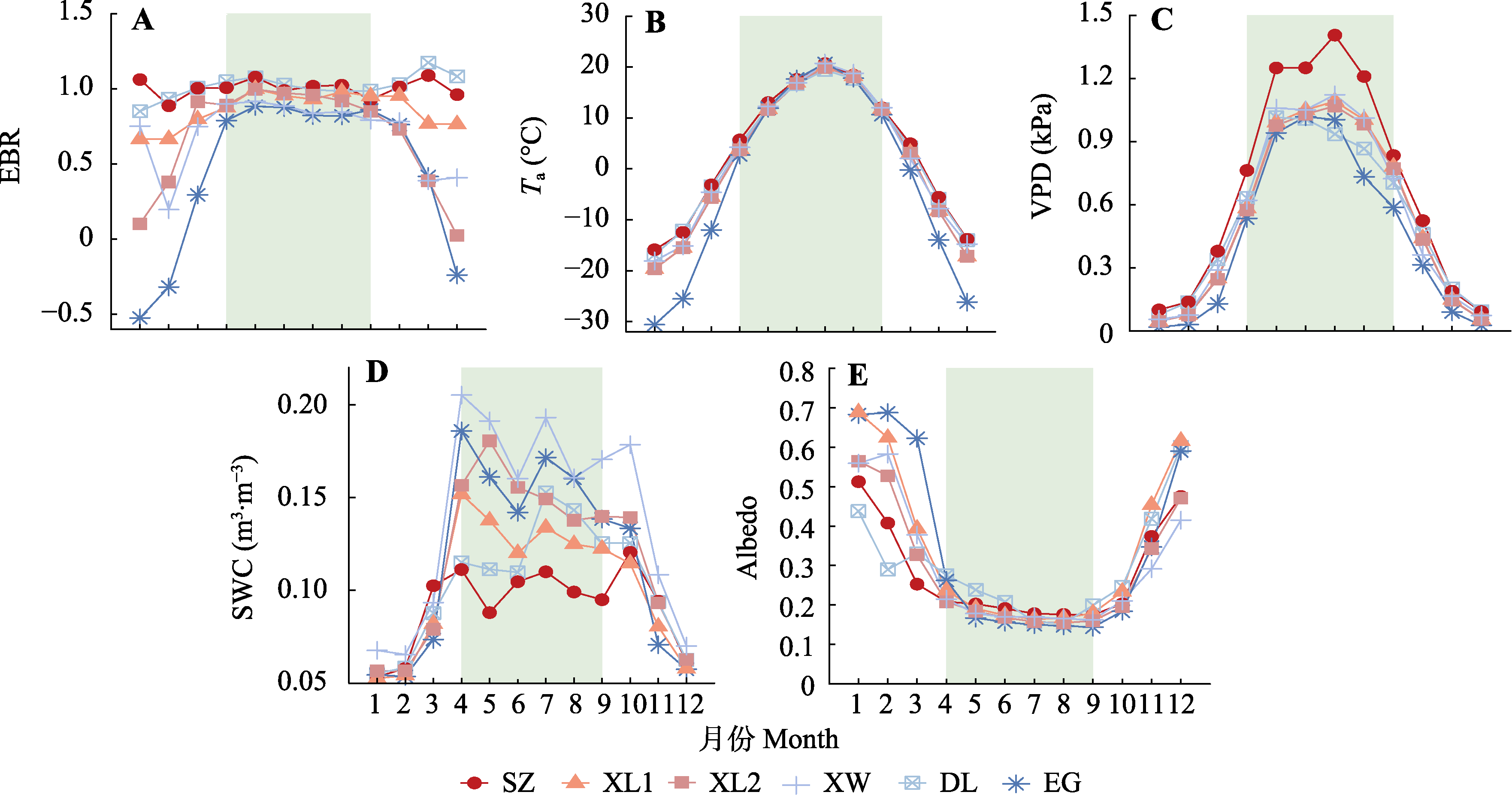
图3 内蒙古草原各站点能量闭合平衡比率(EBR)(A)、月平均气温(Ta)(B)、饱和水汽压差(VPD)(C)、土壤含水量(SWC)(D)和反照率(Albedo)(E)季节动态。图中浅绿色阴影表示生长季(4-9月)。DL、EG、SZ、XL1、XL2和XW分别代表多伦站、额尔古纳站、四子王旗站、锡林浩特割草站、锡林浩特围封站和西乌珠穆沁旗站。
Fig. 3 Seasonal variations in energy balance ratio (EBR)(A), mean month air temperature (Ta)(B), vapor press deficit (VPD)(C), soil water content (SWC)(D) at 0-10 cm soil depth and Albedo (E) across different sites in Nei Mongol grasslands. The shallow green shaded area in the graph represents the growing season period (April to September). DL, EG, SZ, XL1, XL2 and XW represent Duolun site, Ergun site, Siziwangqi site, Xilinhot mowed site, Xiwuqi fenced site and Xi Ujimqin Qi site, respectively.
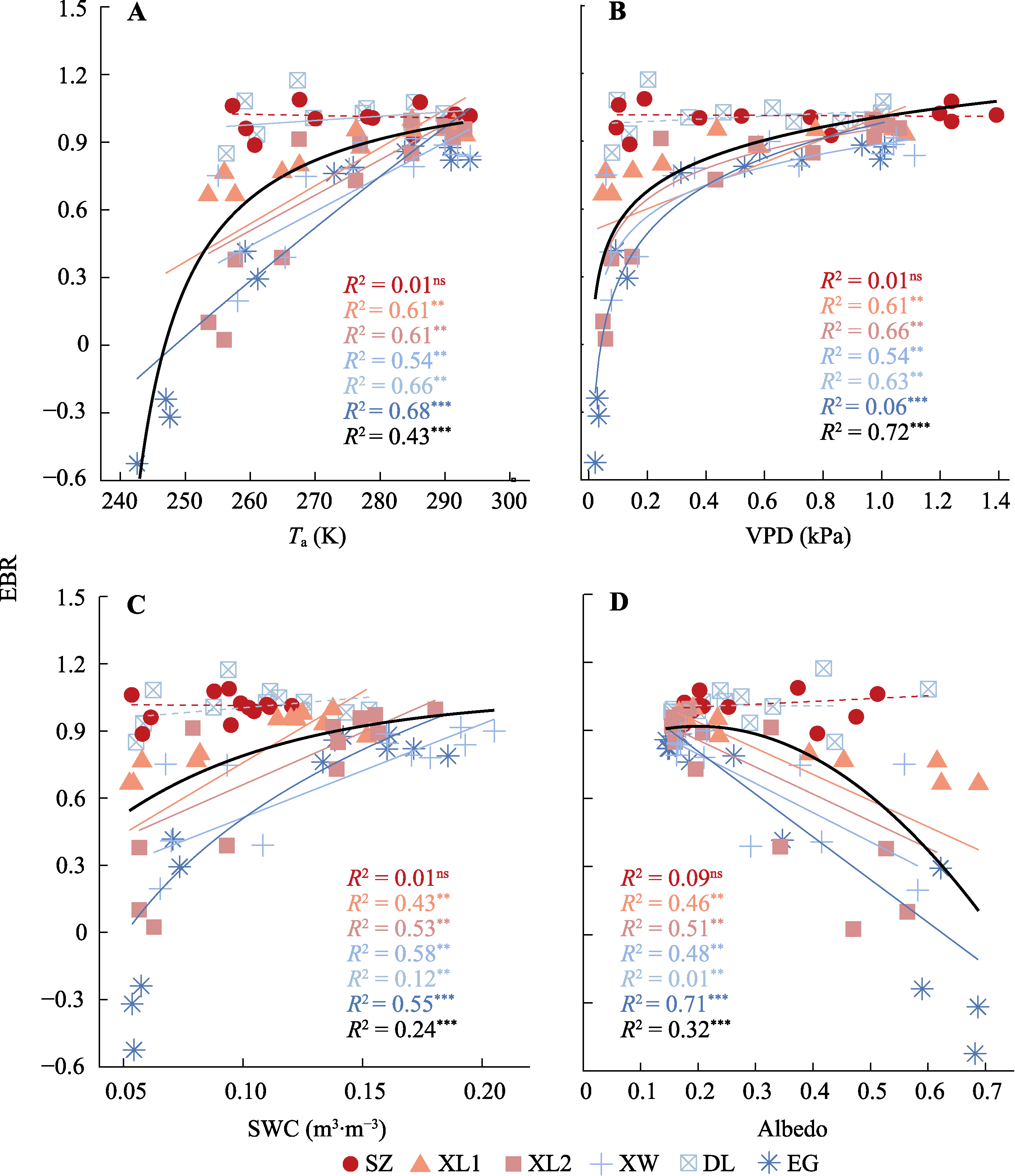
图4 内蒙古草原不同站点能量闭合平衡比率(EBR)季节变化与气温(Ta)(A)、饱和水汽压差(VPD)(B)、土壤含水量(SWC)(C)和反射率(Albedo)(D)的季节变化之间的关系。DL、EG、SZ、XL1、XL2和XW分别代表多伦站、额尔古纳站、四子王旗站、锡林浩特割草站、锡林浩特围封站和西乌珠穆沁旗站。图中每一个数据点是该站点研究期内所有年份的月平均值。彩色线为每个站点的回归拟合结果, 黑色加粗线是所有站点混合效应模型拟合结果。实线代表相关关系显著(p < 0.05), 虚线代表相关关系不显著(p > 0.05)。ns, p > 0.1; **, p < 0.01; ***, p < 0.001。
Fig. 4 Relationships among seasonal variations of energy balance ratio (EBR) with air temperature (Ta)(A), vapor pressure deficit (VPD)(B), soil water content (SWC)(C), and Albedo (D) across different sites in Nei Mongol grasslands. DL, EG, SZ, XL1, XL2 and XW represent Duolun site, Ergun site, Siziwangqi site, Xilinhot mowed site, Xilinhot fenced site and Xi Ujimqin Qi site, respectively. Each point represents the monthly mean value during observation multiple years in each site. The color lines represent the linear or nonlinear regression model results of each site, the thick black line represents the nonlinear mixed-effects model results for all sites when the site was considered as a random factor. The solid line represents significant relation (p < 0.05) and the dash line represents insignificant relation (p > 0.05). ns, p > 0.1; **, p < 0.01; ***, p < 0.001.
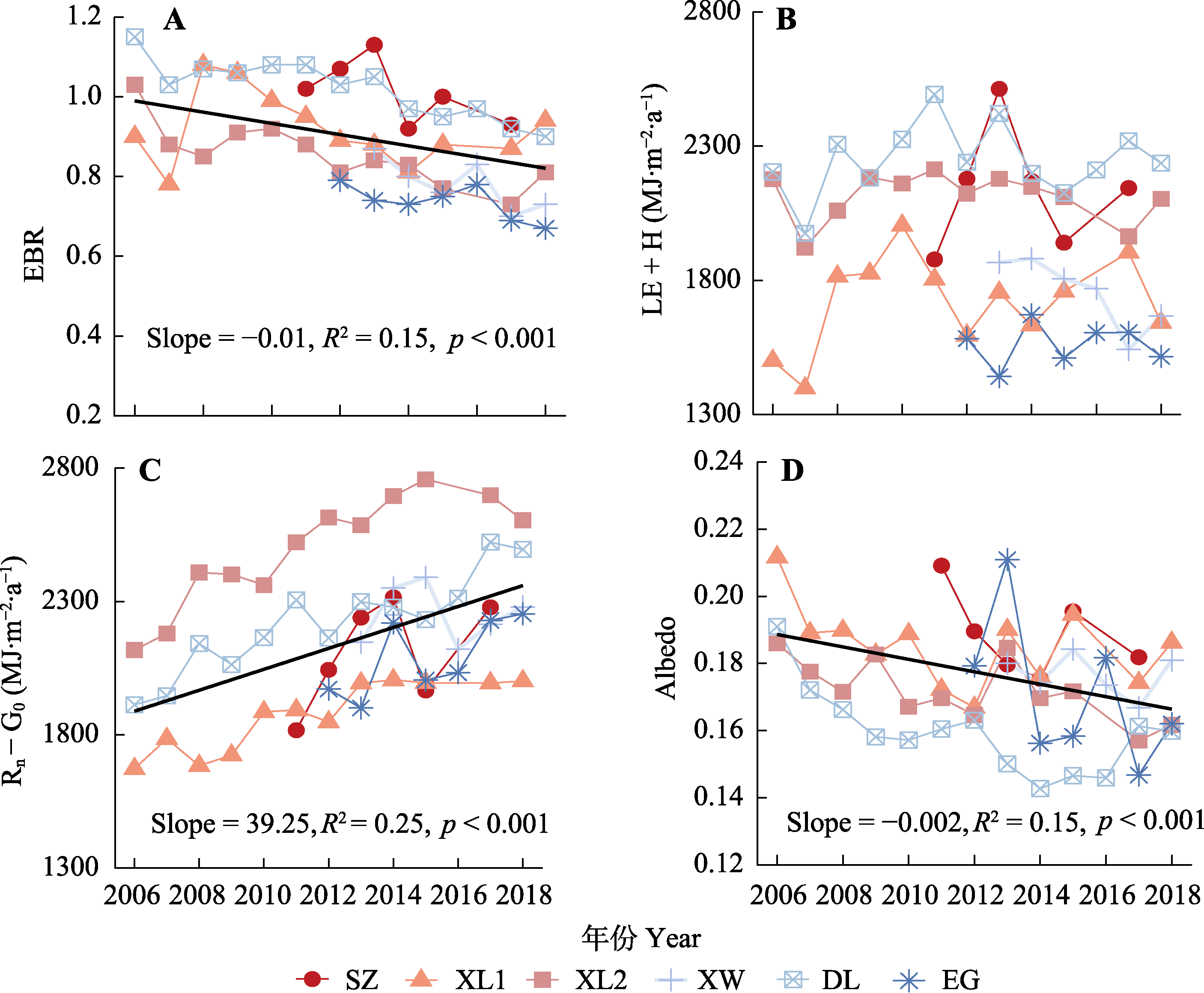
图5 内蒙古草原不同站点能量平衡比率(EBR)(A)、湍流能量(LE + H)(B)、可利用能量(Rn - G0)(C)和反照率(Albedo)(D)的年际变异。黑线是所有站点线性回归拟合结果。DL、EG、SZ、XL1、XL2和XW分别代表多伦站、额尔古纳站、四子王旗站、锡林浩特割草站、锡林浩特围封站和西乌珠穆沁旗站。Slope, 斜率。
Fig. 5 Interannual variations in energy balance ratio (EBR)(A), turbulent energy fluxes (LE + H)(B) available energy fluxes (Rn - G0)(C) and Albedo (D) across different sites in Nei Mongol grasslands. The black lines represent the linear regression model results for all sites. DL, EG, SZ, XL1, XL2 and XW represent Duolun site, Ergun site, Siziwangqi site, Xilinhot mowed site, Xilinhot fenced site and Xi Ujimqin Qi site, respectively.
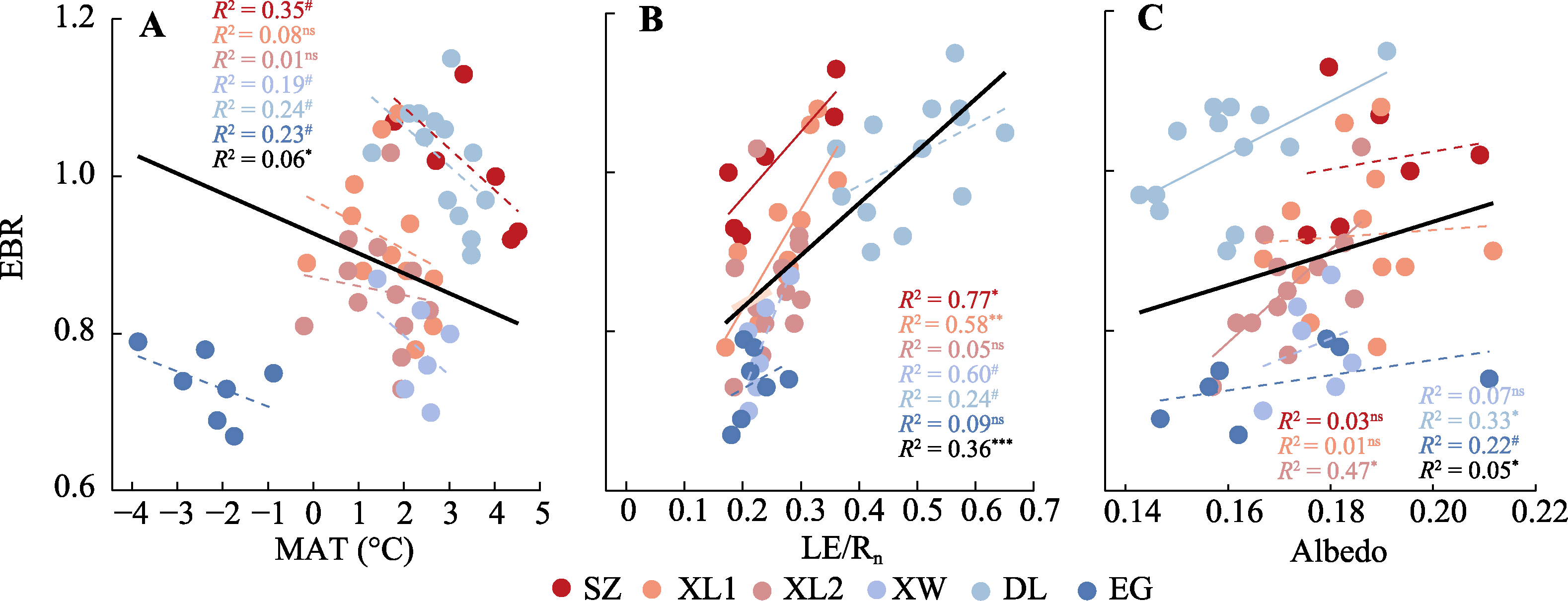
图6 内蒙古草原不同站点年平均气温(MAT)(A)、潜热分配(LE/Rn)(B)和生长季反照率(Albedo)(C)与能量闭合平衡比率(EBR)年际变异之间的关系。DL、EG、SZ、XL1、XL2和XW分别代表多伦站、额尔古纳站、四子王旗站、锡林浩特割草站、锡林浩特围封站和西乌珠穆沁旗站。彩色线为每个站点的线性回归拟合结果, 黑色加粗线是所有站点混合线型模型拟合结果。实线代表相关关系显著(p < 0.05), 虚线代表相关关系不显著(p > 0.05)。ns, p > 0.1; #, p < 0.1; *, p < 0.05; **, p < 0.01; ***, p < 0.001。
Fig. 6 Relationships among interannual variations of energy balance ration (EBR) with mean annual temperature (MAT)(A), latent heat fraction (LE/Rn)(B) and growing season Albedo (C) across different sites in Nei Mongol grasslands. DL, EG, SZ, XL1, XL2 and XW represent Duolun site, Ergun site, Siziwangqi site, Xilinhot mowed site, Xilinhot fenced site and Xi Ujimqin Qi site, respectively. The color lines represent the linear regression model results of each site, the thick black line represents the nonlinear mixed-effects model results for all sites when the site was considered as a random factor. The solid line represents significant relation (p < 0.05) and the dash line represents insignificant relation (p > 0.05). ns, p > 0.1; #, p < 0.1; *, p < 0.05; **, p < 0.01; ***, p < 0.001.
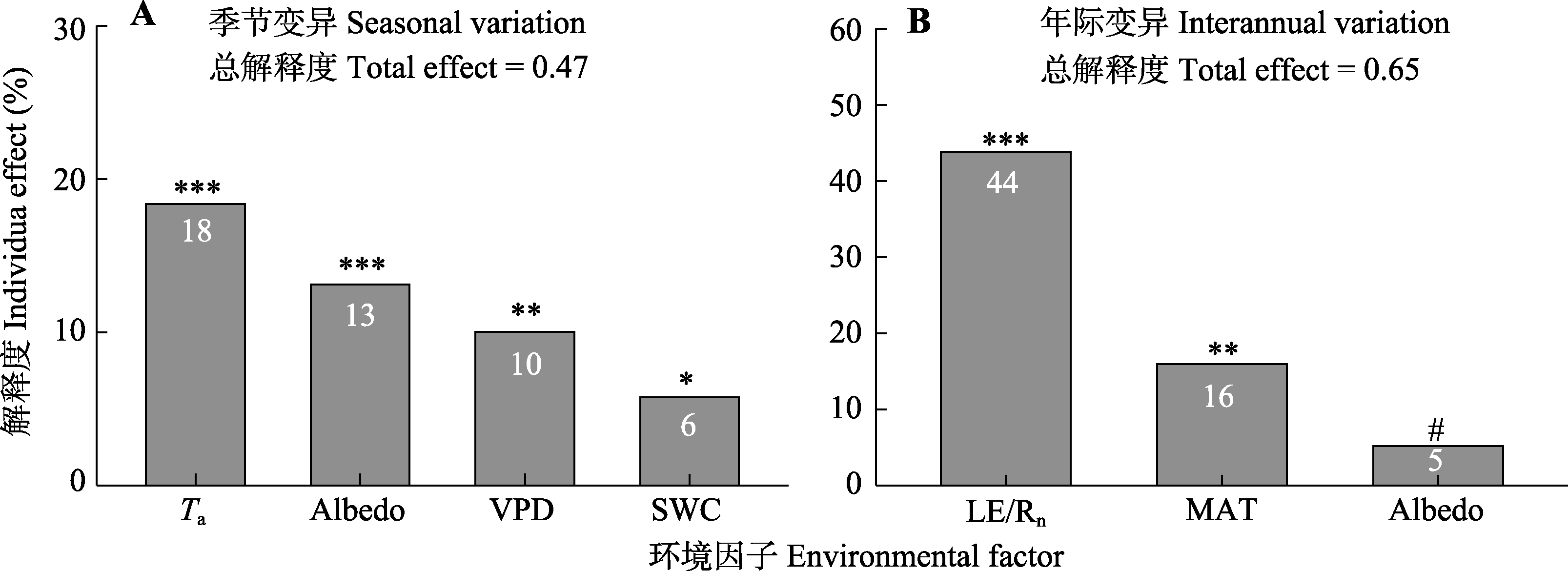
图7 内蒙古草原环境因子对能量闭合平衡比率(EBR)季节(A)和年际变异(B)解释度的重要性排序。#, p < 0.1; *, p < 0.05; **, p < 0.01; ***, p < 0.001。Albedo、MAT、LE、Rn、SWC、Ta、VPD分别表示生长季反照率、年平均气温、潜热通量、净辐射、土壤含水量、月平均气温和饱和水汽压差。
Fig. 7 Relative importance of individual environmental variable in explaining seasonal (A) and interannual (B) variations of energy balance ratio (EBR) in Nei Mongol grasslands. #, p < 0.1; *, p < 0.05; **, p < 0.01; ***, p < 0.001. Albedo, MAT, LE, Rn, SWC, Ta, VPD represent growing season albedo, mean annual temperature, latent heat flux, net radiation, soil water content, mean monthly air temperature and vapor pressure deficit.
| [1] | Aubinet M, Grelle A, Ibrom A, Rannik Ü, Moncrieff J, Foken T, Kowalski AS, Martin PH, Berbigier P, Bernhofer Ch, Clement R, Elbers J, Granier A, Grünwald T, Morgenstern K, et al. (2000). Estimates of the annual net carbon and water exchange of European forests: the EUROFLUX methodology. Advances in Ecological Research, 30, 114-175. |
| [2] |
Blanken PD, Black TA, Neumann HH, Den Hartog G, Yang PC, Nesic Z, Staebler R, Chen W, Novak MD (1998). Turbulent flux measurements above and below the overstory of a boreal aspen forest. Boundary-Layer Meteorology, 89, 109-140.
DOI URL |
| [3] |
Blonquist JM Jr, Tanner BD, Bugbee B (2009). Evaluation of measurement accuracy and comparison of two new and three traditional net radiometers. Agricultural and Forest Meteorology, 149, 1709-1721.
DOI URL |
| [4] | Burnham KP, Anderson DR (2002). Model Selection Multimodel Inference: a Practical Information-Theoretic Approach. 2nd ed. Springer, New York. |
| [5] |
Chen SP, Chen JQ, Lin GH, Zhang WL, Miao HX, Wei L, Huang JH, Han XG (2009). Energy balance and partition in Inner Mongolia steppe ecosystems with different land use types. Agricultural and Forest Meteorology, 149, 1800-1809.
DOI URL |
| [6] |
Chen SP, You CH, Hu ZM, Chen Z, Zhang LM, Wang QF (2020). Eddy covariance technique and its applications in flux observations of terrestrial ecosystems. Chinese Journal of Plant Ecology, 44, 291-304.
DOI URL |
|
[ 陈世苹, 游翠海, 胡中民, 陈智, 张雷明, 王秋凤 (2020). 涡度相关技术及其在陆地生态系统通量研究中的应用. 植物生态学报, 44, 291-304.]
DOI |
|
| [7] |
Cheng Y, Sayde C, Li Q, Basara J, Selker J, Tanner E, Gentine P (2017). Failure of Taylor’s hypothesis in the atmospheric surface layer and its correction for eddy-covariance measurements. Geophysical Research Letters, 44, 4287-4295.
DOI URL |
| [8] |
Cui WH, Chui TFM (2017). Subsurface lateral heat flux within the heterogeneous surface of a subtropical wetland and its potential contribution to energy imbalance. Journal of Hydrometeorology, 18, 3125-3144.
DOI URL |
| [9] |
Cui WH, Chui TFM (2019). Temporal and spatial variations of energy balance closure across FLUXNET research sites. Agricultural and Forest Meteorology, 271, 12-21.
DOI URL |
| [10] |
Duveiller G, Hooker J, Cescatti A (2018). The mark of vegetation change on Earth’s surface energy balance. Nature Communications, 9, 679. DOI: 10.1038/s41467-017-02810-8.
DOI PMID |
| [11] |
Falge E, Baldocchi D, Olson R, Anthoni P, Aubinet M, Bernhofer C, Burba G, Ceulemans R, Clement R, Dolman H, Granier A, Gross P, Grünwald T, Hollinger D, Jensen NO, et al. (2001). Gap filling strategies for defensible annual sums of net ecosystem exchange. Agricultural and Forest Meteorology, 107, 43-69.
DOI URL |
| [12] |
Foken T (2008). The energy balance closure problem: an overview. Ecological Applications, 18, 1351-1367.
DOI URL |
| [13] |
Foken T, Aubinet M, Finnigan JJ, Leclerc MY, Mauder M, Paw UKT (2011). Results of a panel discussion about the energy balance closure correction for trace gases. Bulletin of the American Meteorological Society, 92, ES13-ES18.
DOI URL |
| [14] |
Franssen HJH, Stockli R, Lehner I, Rotenberg E, Seneviratne SI (2010). Energy balance closure of eddy-covariance data: A multisite analysis for European FLUXNET stations. Agricultural and Forest Meteorology, 150, 1553-1567.
DOI URL |
| [15] |
Hasi M, Zhang XY, Niu GX, Wang YL, Geng QQ, Quan Q, Chen SP, Han XG, Huang JH (2021). Soil moisture, temperature and nitrogen availability interactively regulate carbon exchange in a meadow steppe ecosystem. Agricultural and Forest Meteorology, 304-305, 108389. DOI: 10.1016/j.agrformet.2021.108389.
DOI URL |
| [16] |
Kochendorfer J, Paw UKT (2011). Field estimates of scalar advection across a canopy edge. Agricultural and Forest Meteorology, 151, 585-594.
DOI URL |
| [17] |
Leuning R, van Gorsel E, Massman WJ, Isaac PR (2012). Reflections on the surface energy imbalance problem. Agricultural and Forest Meteorology, 156, 65-74.
DOI URL |
| [18] | Li ZQ, Yu GR, Wen XF, Zhang LM, Ren CY, Fu YL (2005). Energy balance closure at ChinaFLUX sites. Science in China Series D: Earth Sciences, 48(Supp. I),51-62. |
| [19] |
Liu B, Cui YL, Luo YF, Shi YZ, Liu M, Liu FP (2019). Energy partitioning and evapotranspiration over a rotated paddy field in Southern China. Agricultural and Forest Meteorology, 276-277, 107626. DOI: 10.1016/j.agrformet.2019.107626.
DOI URL |
| [20] |
Majozi NP, Mannaerts CM, Ramoelo A, Mathieu R, Nickless A, Verhoef W (2017). Analysing surface energy balance closure and partitioning over a semi-arid savanna FLUXNET site in Skukuza, Kruger National Park, South Africa. Hydrology and Earth System Sciences, 21, 3401-3415.
DOI URL |
| [21] |
McGloin R, Šigut L, Havránková K, Dušek J, Pavelka M, Sedlák P (2018). Energy balance closure at a variety of ecosystems in Central Europe with contrasting topographies. Agricultural and Forest Meteorology, 248, 418-431.
DOI URL |
| [22] |
Michel D, Philipona R, Ruckstuhl C, Vogt R, Vuilleumier L (2008). Performance and uncertainty of CNR1 net radiometers during a one-year field comparison. Journal of Atmospheric and Oceanic Technology, 25, 442-451.
DOI URL |
| [23] |
Oliphant AJ, Grimmond CSB, Zutter HN, Schmid HP, Su HB, Scott SL, Offerle B, Randolph JC, Ehman J (2004). Heat storage and energy balance fluxes for a temperate deciduous forest. Agricultural and Forest Meteorology, 126, 185-201.
DOI URL |
| [24] |
Oncley SP, Foken T, Vogt R, Kohsiek W, Debruin HAR, Bernhofer C, Christen A, van Gorsel E, Grantz D, Feigenwinter C, Lehner I, Liebethal C, Liu H, Mauder M, Pitacco A, Ribeiro L, Weidinger T (2007). The Energy Balance Experiment EBEX-2000. Part I: overview and energy balance. Boundary-Layer Meteorology, 123, 1-28.
DOI URL |
| [25] |
Reichstein M, Falge E, Baldocchi D, Papale D, Aubinet M, Berbigier P, Bernhofer C, Buchmann N, Gilmanov T, Granier A, Grünwald T, Havránková K, Ilvesniemi H, Janous D, Knohl A, et al. (2005). On the separation of net ecosystem exchange into assimilation and ecosystem respiration: review and improved algorithm. Global Change Biology, 11, 1424-1439.
DOI URL |
| [26] |
Shao CL, Chen JQ, Li LH, Xu WT, Chen SP, Gwen T, Xu JY, Zhang WL (2008). Spatial variability in soil heat flux at three Inner Mongolia steppe ecosystems. Agricultural and Forest Meteorology, 148, 1433-1443.
DOI URL |
| [27] |
Stoy PC, Mauder M, Foken T, Marcolla B, Boegh E, Ibrom A, Arain MA, Arneth A, Aurela M, Bernhofer C, Cescatti A, Dellwik E, Duce P, Gianelle D, van Gorsel E, et al. (2013). A data-driven analysis of energy balance closure across FLUXNET research sites: the role of landscape scale heterogeneity. Agricultural and Forest Meteorology, 171-172, 137-152.
DOI URL |
| [28] |
Teng DX, He XM, Qin L, Lv GH (2021). Energy balance closure in the Tugai forest in Ebinur Lake basin, northwest China. Forests, 12, 243. DOI: 10.3390/f1202043.
DOI URL |
| [29] |
Webb EK, Pearman GI, Leuning R (1980). Correction of flux measurements for density effects due to heat and water- vapour transfer. Quarterly Journal of the Royal Meteorological Society, 106, 85-100.
DOI URL |
| [30] |
Wilson K, Goldstein A, Falge E, Aubinet M, Baldocchi D, Berbigier P, Bernhofer C, Ceulemans R, Dolman H, Field C, Grelle A, Ibrom A, Law BE, Kowalski A, Meyers T, et al. (2002). Energy balance closure at FLUXNET sites. Agricultural and Forest Meteorology, 113, 223-243.
DOI URL |
| [31] |
Wu ZT, Dijkstra P, Koch GW, Peñuelas J, Hungate BA (2011). Responses of terrestrial ecosystems to temperature and precipitation change: a meta-analysis of experimental manipulation. Global Change Biology, 17, 927-942.
DOI URL |
| [32] |
Yue P, Zhang Q, Zhang L, Li HY, Yang Y, Zeng J, Wang S (2019). Long-term variations in energy partitioning and evapotranspiration in a semiarid grassland in the Loess Plateau of China. Agricultural and Forest Meteorology, 278, 107671. DOI: 10.1016/j.agrformet.2019.107671.
DOI URL |
| [33] | Yu GR, Sun XM (2017). Principles of Flux Measurement in Terrestrial Ecosystems. 2nd ed. Higher Education Press, Beijing. |
| [ 于贵瑞, 孙晓敏 (2017). 陆地生态系统通量观测的原理与方法. 2版. 高等教育出版社, 北京.] | |
| [34] | Zhang LM, Luo YW, Liu M, Chen Z, Su W, He HL, Zhu ZL, Sun XM, Wang YF, Zhou GY, Zhao XQ, Han SJ, Ouyang Z, Zhang XZ, Zhang YP, et al. (2019). Carbon and water fluxes observed by the Chinese Flux Observation and Research Network (2003-2005). China Scientific Data, 4, 18-34. |
| [ 张雷明, 罗艺伟, 刘敏, 陈智, 苏文, 何洪林, 朱治林, 孙晓敏, 王艳芬, 周国逸, 赵新全, 韩士杰, 欧阳竹, 张宪洲, 张一平, 等 (2019). 2003-2005年中国通量观测研究联盟(China FLUX)碳水通量观测数据集. 中国科学数据, 4, 18-34.] | |
| [35] | Zhang Y, Peng CH, Li WZ, Tian LX, Zhu QA, Chen H, Fang XQ, Zhang GL, Liu GB, Mu XM, Li ZB, Li SQ, Yang YZ, Wang J, Xiao XM (2016). Multiple afforestation programs accelerate the greenness in the “Three North” region of China from 1982 to 2013. Ecological Indicators, 61, 404-412. |
| [36] |
Zhang YS, Kadota T, Ohata T, Oyunbaatar D (2007). Environmental controls on evapotranspiration from sparse grassland in Mongolia. Hydrological Processes, 21, 2016-2027.
DOI URL |
| [37] | Zuo JQ, Wang JM, Huang JP, Li WJ, Wang GY, Ren HL (2010). Estimation of ground heat flux for a semi-arid grassland and its impacts on the surface energy budget. Plateau Meteorology, 29, 840-848. |
| [ 左金清, 王介民, 黄建平, 李维京, 王国印, 任宏利 (2010). 半干旱草地地表土壤热通量的计算及其对能量平衡的影响. 高原气象, 29, 840-848.] |
| [1] | 江康威, 吕程, 王亚菲, 李宏, 张芷晴, 王雨, 张青青, 吐尔逊娜依•热依木. 放牧干扰下丛枝菌根真菌群落对土壤多功能性的影响[J]. 植物生态学报, 2026, 50(3): 685-699. |
| [2] | 宋珊珊, 唐志尧. 河北塞罕坝草甸草原根际土壤真菌与植物地上生物量的关系[J]. 植物生态学报, 2025, 49(9): 1461-1471. |
| [3] | 曹毅, 张松林, 王旭峰, 杨安昌, 任敏慧, 杨浩, 韩超. 兰州市南北两山植物群落数据集[J]. 植物生态学报, 2025, 49(6): 975-989. |
| [4] | 马富龙, 王雨晴, 郝瑜, 段继超, 刘霏霏, 席琳乔, 韩路. 海拔梯度对昆仑山北坡中部草原植物与土壤微生物群落结构与多样性的影响[J]. 植物生态学报, 2025, 49(5): 732-747. |
| [5] | 韩菲, 王袼, 武帅楷, 林茂, 董宽虎, $\boxed{\hbox{王常慧}}$, 苏原. 极端降水对不同草原土壤总硝化及总氮矿化速率及其敏感性的影响[J]. 植物生态学报, 2025, 49(5): 697-709. |
| [6] | 王娟, 张登山, 肖元明, 裴全帮, 王博, 樊博, 周国英. 长期围封后高寒草原植物根系分泌物特征与环境因子关系[J]. 植物生态学报, 2025, 49(4): 596-609. |
| [7] | 竹万宽, 许宇星, 黄润霞, 杜阿朋, 王志超. 雷州半岛桉树人工林生态系统水分利用效率旱雨季差异及其控制因素[J]. 植物生态学报, 2025, 49(12): 2015-2029. |
| [8] | 刘强, 马鸿元, 彭云峰, 拉本, 叶得力, 张嘉宸, 赖俊华. 大规模光伏开发对高寒荒漠化草原生态系统碳储量的影响[J]. 植物生态学报, 2025, 49(11): 1791-1804. |
| [9] | 许宏, 苏华, 李永庚, 苏本营, 杨景成, 李玉强, 王正文. 畜禽草耦合模式探索——不同土地利用方式对中国北方草地羊草植物群落的影响[J]. 植物生态学报, 2025, 49(1): 211-220. |
| [10] | 孙佳美, 安冰儿, 刘伟, 王璟, 潘庆民. 草原植物繁殖体调控技术: “蘖芽岛”的培育与移植[J]. 植物生态学报, 2025, 49(1): 129-137. |
| [11] | 刘伟, 郝毅晴, 孙佳美, 王璟, 范冰, 郝建玺, 金那申, 潘庆民. 呼伦贝尔退化草原土壤养分调控的原理与技术[J]. 植物生态学报, 2025, 49(1): 138-147. |
| [12] | 房凯, 王迎新, 黄建辉, 段俊光, 张琦, 张倩, 甘红豪, 褚建民. 内蒙古典型草原不同退化阶段植被恢复的养分限制因子解析[J]. 植物生态学报, 2025, 49(1): 7-18. |
| [13] | 杜淑辉, 褚建民, 段俊光, 薛建国, 徐磊, 徐晓庆, 王其兵, 黄建辉, 张倩. 木质素酚类物质对内蒙古退化草地土壤有机碳的影响[J]. 植物生态学报, 2025, 49(1): 30-41. |
| [14] | 秦嘉晨, 王欢, 朱江, 王扬, 田晨, 白永飞, 杨培志, 郑淑霞. 基于种内与种间性状变异的放牧过滤作用及其尺度效应[J]. 植物生态学报, 2024, 48(7): 858-871. |
| [15] | 萨其拉, 张霞, 朱琳, 康萨如拉. 长期不同放牧强度下荒漠草原优势种无芒隐子草叶片解剖结构变化[J]. 植物生态学报, 2024, 48(3): 331-340. |
| 阅读次数 | ||||||
|
全文 |
|
|||||
|
摘要 |
|
|||||
Copyright © 2026 版权所有 《植物生态学报》编辑部
地址: 北京香山南辛村20号, 邮编: 100093
Tel.: 010-62836134, 62836138; Fax: 010-82599431; E-mail: apes@ibcas.ac.cn, cjpe@ibcas.ac.cn
备案号: 京ICP备16067583号-19

