
植物生态学报 ›› 2025, Vol. 49 ›› Issue (9): 1498-1514.DOI: 10.17521/cjpe.2024.0336 cstr: 32100.14.cjpe.2024.0336
邢强1( ), 赵斌2,*()(
 ), 胡永红1, 杨君1, 秦俊1, 刘何铭1, 王红兵3, 周鹏4
收稿日期:2024-09-29
接受日期:2025-02-07
出版日期:2025-09-20
发布日期:2025-02-08
通讯作者:
*赵斌: ORCID: 0000-0002-3530-2469 (zhaobin@fudan.edu.cn)基金资助:
XING Qiang1(), ZHAO Bin2,*()(), HU Yong-Hong1, YANG Jun1, QIN Jun1, LIU He-Ming1, WANG Hong-Bing3, ZHOU Peng4
Received:2024-09-29
Accepted:2025-02-07
Online:2025-09-20
Published:2025-02-08
Supported by:摘要: 植物生物量变化与根系构型的多维性特征研究对复合利用建筑空间来增加城市绿量、提升生态服务功能和提高建筑品质具有积极的影响, 是城市绿化建设合理性的重要理论依据。该研究选取中国华东地区城市景观中使用频率高、根系发达的两种藤本植物: 悬垂型花叶蔓长春(Vinca major ‘Variegata’)和攀爬型花叶络石(Trachelospermum jasminoides ‘Variegatum’), 种植于两种栽培基质中——一种是由复合纤维黏结形成的新型容器式基质, 另一种是传统混配基质。通过3年时间对比研究两种植物在相同根域体积下的根系构型和生物量的动态变化, 建立植物生长曲线模型, 预测不同基质中植物寿命。结果表明: 1)植物生物量和根系构型在传统混配基质中呈快速增长到衰亡的全生命周期单峰变化曲线, 而在新型基质中则呈线性缓慢增长趋势。2)不同介质类型中植物生物量和根系构型的主成分分析发现, 根长、根尖数、根分叉数及根表面积、根体积对于主轴的贡献率较高, 而且分析其与生物量的相关性, 均显示为显著相关, 因此, 可作为评估植物使用寿命的重要指标。其中, 根表面积和根体积是稳定的、系统性的评估参数, 而根长和根尖数量则是高灵敏度的评估参数。3)植物生长曲线模型预测结果表明, 两种植物在新型基质中达到生长高峰期的时间分别为6.99和10.77年, 显著长于在传统混配基质中的2-3年。新型基质适宜的紧实度和缓释的养分供给模式能够长时间保持较高的植物根系活力和周转速率, 从而在延长植物寿命的同时, 也维持了较高的生态效益。该研究通过揭示和量化城市绿化藤本植物根系的复杂结构, 以及对地上生长的影响, 有助于构建更加稳定高效的绿化植物群落, 提升城市生物多样性水平, 同时为绿色屋顶和垂直绿墙等特殊生境的绿化营建技术迭代提供实验理论支撑。
邢强, 赵斌, 胡永红, 杨君, 秦俊, 刘何铭, 王红兵, 周鹏. 华东地区两种典型立体绿化植物根系性状特征及对新型土壤基质的响应. 植物生态学报, 2025, 49(9): 1498-1514. DOI: 10.17521/cjpe.2024.0336
XING Qiang, ZHAO Bin, HU Yong-Hong, YANG Jun, QIN Jun, LIU He-Ming, WANG Hong-Bing, ZHOU Peng. Root trait variation in response to a novel soil substrate in two typical vertical greening plants from the East China. Chinese Journal of Plant Ecology, 2025, 49(9): 1498-1514. DOI: 10.17521/cjpe.2024.0336
| 土壤性状指标 Soil property indicator | 基质类型 Medium type | |
|---|---|---|
| 新型基质 NSM | 混配基质 TSFM | |
| 容重 Bulk density (g·cm-3) | 0.20 ± 0.06b | 0.85 ± 0.17a |
| 电导率 Conductivity cmol (+) (kg) | 61.80 ± 11.32a | 34.76 ± 5.31b |
| pH | 7.30 ± 0.60a | 7.20 ± 0.20a |
| 有机质含量 Organic matter content (g·kg-1) | 343.30 ± 56.91a | 308.40 ± 72.17a |
| 全氮含量 Total nitrogen content (g·kg-1) | 428.32 ± 21.39a | 311.14 ± 64.03b |
| 有效磷含量 Active phosphorus content (mg·kg-1) | 2.94 ± 0.78a | 0.87 ± 0.31b |
| 有效钾含量 Active potassium content (mg·kg-1) | 235.24 ± 27.64a | 24.74 ± 7.60b |
| 非毛管孔隙度 Non-capillary porosity (%) | 11.34 ± 0.92a | 1.18 ± 0.26b |
| 毛管孔隙度 Capillary porosity (%) | 44.08 ± 1.92a | 42.53 ± 6.37a |
| 总孔隙度 Total porosity (%) | 55.42 ± 6.49a | 43.72 ± 9.28a |
| 紧实度 Compactness (pounds per square inch, Psi) | 90.00 ± 13.28a | 18.50 ± 1.77b |
| 最大持水量 Maximum water holding capacity (g·kg-1) | 2 831.90 ± 137.64a | 639.13 ± 59.31b |
表1 中国华东地区用于绿墙植物种植的不同类型基质理化性质比较
Table 1 Comparison of physicochemical properties of different types of substrates used for green wall plant cultivation in East China
| 土壤性状指标 Soil property indicator | 基质类型 Medium type | |
|---|---|---|
| 新型基质 NSM | 混配基质 TSFM | |
| 容重 Bulk density (g·cm-3) | 0.20 ± 0.06b | 0.85 ± 0.17a |
| 电导率 Conductivity cmol (+) (kg) | 61.80 ± 11.32a | 34.76 ± 5.31b |
| pH | 7.30 ± 0.60a | 7.20 ± 0.20a |
| 有机质含量 Organic matter content (g·kg-1) | 343.30 ± 56.91a | 308.40 ± 72.17a |
| 全氮含量 Total nitrogen content (g·kg-1) | 428.32 ± 21.39a | 311.14 ± 64.03b |
| 有效磷含量 Active phosphorus content (mg·kg-1) | 2.94 ± 0.78a | 0.87 ± 0.31b |
| 有效钾含量 Active potassium content (mg·kg-1) | 235.24 ± 27.64a | 24.74 ± 7.60b |
| 非毛管孔隙度 Non-capillary porosity (%) | 11.34 ± 0.92a | 1.18 ± 0.26b |
| 毛管孔隙度 Capillary porosity (%) | 44.08 ± 1.92a | 42.53 ± 6.37a |
| 总孔隙度 Total porosity (%) | 55.42 ± 6.49a | 43.72 ± 9.28a |
| 紧实度 Compactness (pounds per square inch, Psi) | 90.00 ± 13.28a | 18.50 ± 1.77b |
| 最大持水量 Maximum water holding capacity (g·kg-1) | 2 831.90 ± 137.64a | 639.13 ± 59.31b |
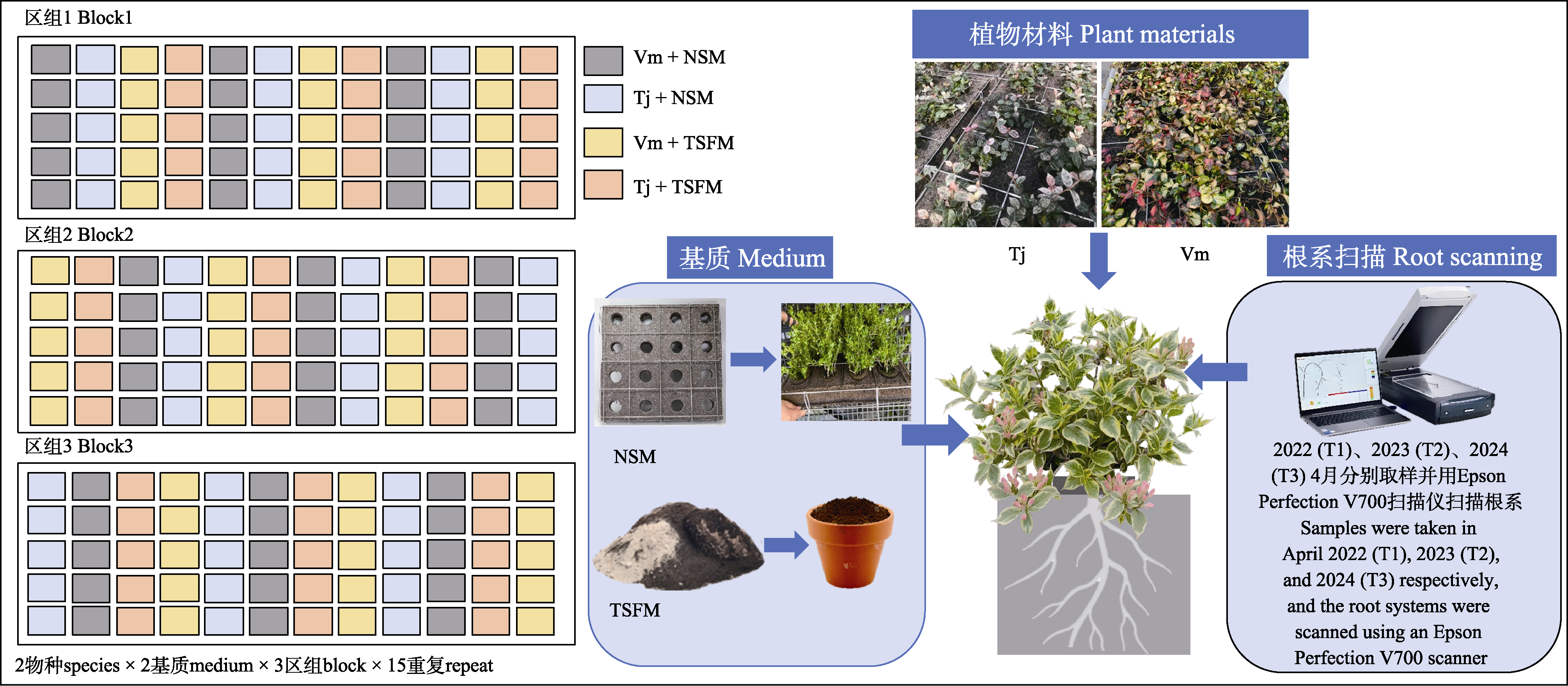
图1 实验绿墙植物花叶络石(Tj)和花叶蔓长春(Vm)的种植实验示意图。NSM, 新型基质; TSFM, 混配基质。
Fig. 1 Schematic diagram of the planting experiment of the experimental green wall plants Trachelospermum jasminoides ‘Variegatum’ (Tj) and Vinca major ‘Variegata’ (Vm). NSM, novel soil medium; TSFM, traditional soil formulation medium.
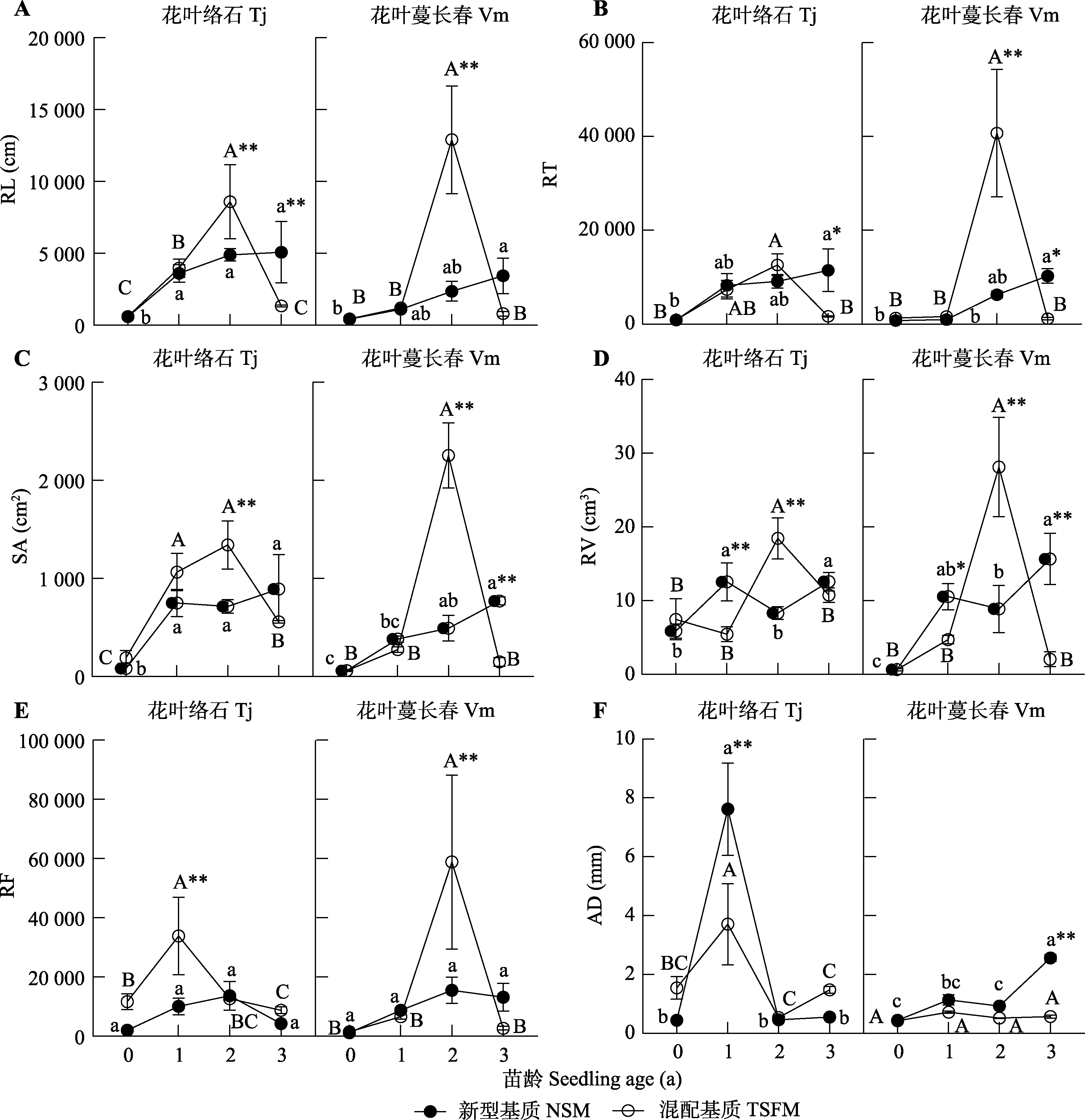
图2 绿墙的花叶络石和花叶蔓长春根系长度(RL)、根尖数(RT)、根表面积(SA)、根体积(RV)、根平均直径(AD)、根分叉数(RF)随苗龄的变化(平均值±标准差)。不同小写字母表示植物性状在新型基质中差异显著(p < 0.05), 不同大写字母表示植物性状在混配基质中差异显著(p < 0.05)。星号代表同一年两种基质下植物根系构型差异的显著性, *代表显著(p < 0.05), **代表极显著(p < 0.01)。
Fig. 2 Changes in root length (RL), number of root tips (RT), root surface area (SA), root volume (RV), average root diameter (AD), and root fork (RF) of Trachelospermum jasminoides ‘Variegatum’ (Tj) and Vinca major ‘Variegata’ (Vm) in the green wall with seedling age (mean ± SD). Different lowercase letters indicate significant differences in plant traits in the novel soil medium at 0.05 level, different uppercase letters indicate significant differences in plant traits in the traditional soil formulation medium at 0.05 level. The asterisks represent the significance of differences in plant root conformation between the two substrates in the same year, with * representing significant (p < 0.05), ** representing highly significant (p < 0.01), respectively. NSM, novel soil medium; TSFM, traditional soil formulation medium.
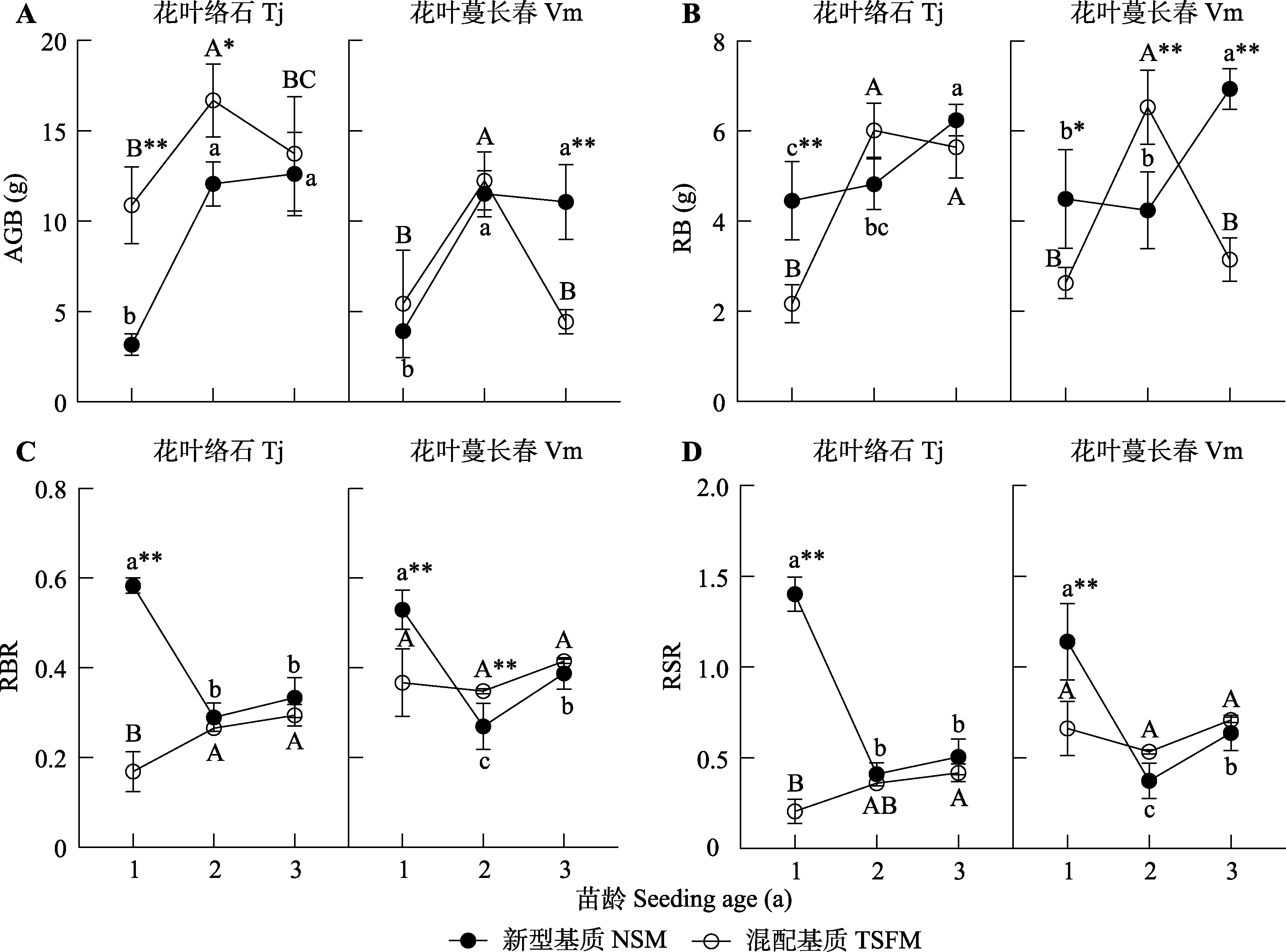
图3 绿墙的花叶络石和花叶蔓长春植物地上生物量(AGB)、根系生物量(RB)、根生物量比(RBR)、根冠比(RSR)随苗龄的变化(平均值±标准差)。不同小写字母表示植物性状在新型基质中差异显著(p < 0.05), 不同大写字母表示植物性状在混配基质中差异显著(p < 0.05)。星号代表同一年两种基质下植物根系构型差异的显著性, *代表显著(p < 0.05), **代表极显著(p < 0.01)。
Fig. 3 Changes in aboveground biomass (AGB), root biomass (RB), root biomass ratio (RBR), and root-shoot ratio (RSR) of Trachelospermum jasminoides ‘Variegatum’ (Tj) and Vinca major ‘Variegata’ (Vm) in the green wall with seedling age (mean ± SD). Different lowercase letters indicate significant differences in plant traits in the novel soil medium at 0.05 level, different uppercase letters indicate significant differences in plant traits in the traditional soil formulation medium at 0.05 level. The asterisks represent the significance of differences in plant root conformation between the two substrates in the same year, with * representing significant (p < 0.05), ** representing highly significant (p < 0.01), respectively. NSM, novel soil medium; TSFM, traditional soil formulation medium.
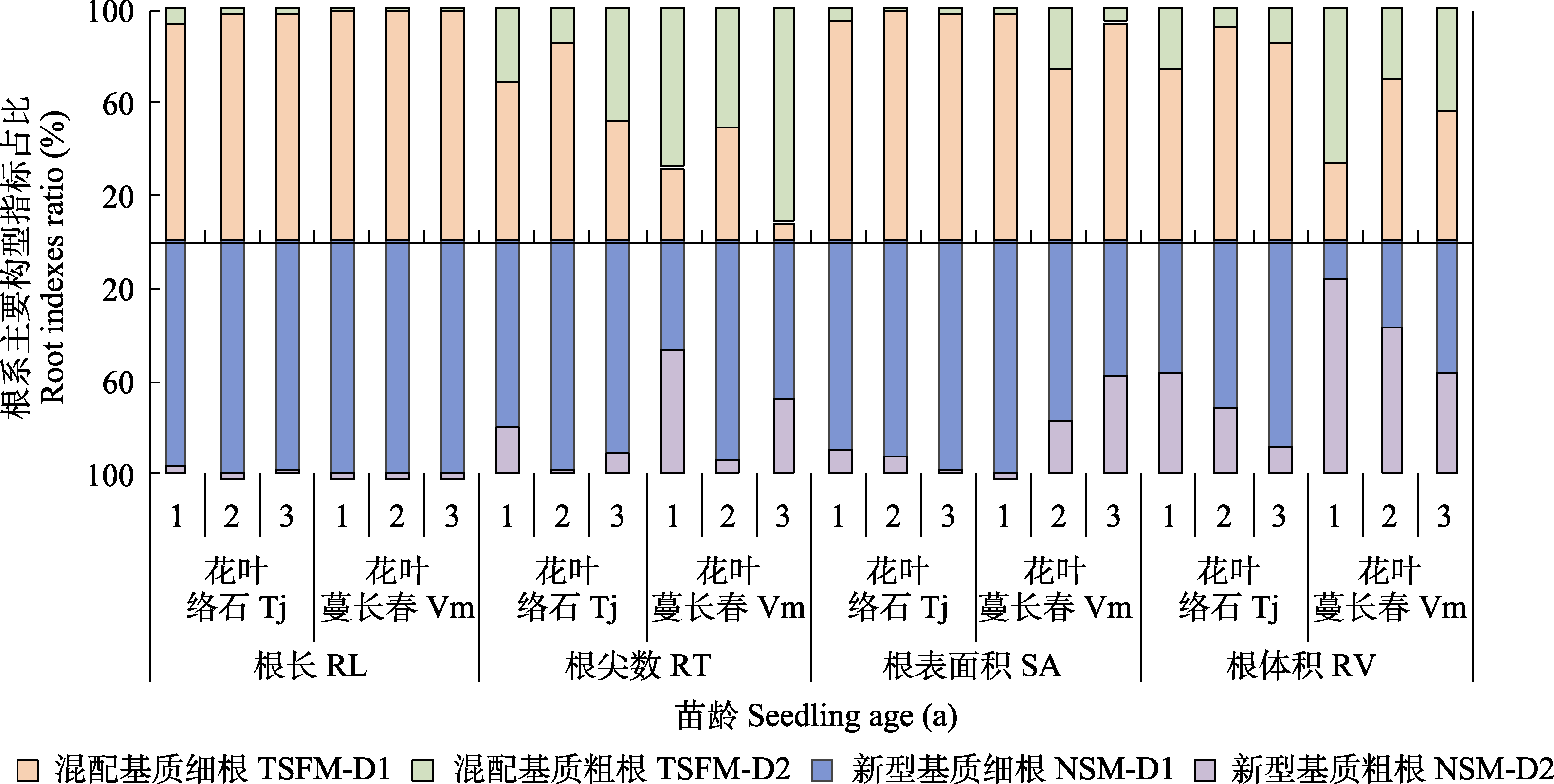
图4 不同基质中植物粗、细根的根长、根尖数、根表面积、根体积与总根系的比例随苗龄的变化情况。
Fig. 4 Changes in root length (RL), number of root tips (RT), root surface area (SA), and ratio of root volume (RV) to total root system of coarse (D2) and fine (D1) roots of plants in different media as a function of seedling age. Tj, Trachelospermum jasminoides ‘Variegatum’; Vm, Vinca major ‘Variegata’. NSM, novel soil medium; TSFM, traditional soil formulation medium.
| 数量特征 Quantitative character | 基质类型 Type of soil medium | 最小值 Minimum | 最大值 Maximum | 平均值 Mean | 标准误 Standard deviation | 变异率 Coefficient of variation (%) |
|---|---|---|---|---|---|---|
| 根长 Root length (cm) | 新型基质 NSM | 1 046.00 | 7 412.00 | 3 416.00 | 397.90 | 49.42 |
| 混配基质 TSFM | 672.20 | 16 426.00 | 4 803.00 | 1 153.00 | 101.80 | |
| 根表面积 Root surface area (cm2) | 新型基质 NSM | 351.30 | 1 281.00 | 666.10 | 53.57 | 34.12 |
| 混配基质 TSFM | 101.70 | 2 711.00 | 1 108.00 | 206.80 | 79.15 | |
| 根平均直径 Average root diameter (mm) | 新型基质 NSM | 0.46 | 9.39 | 2.21 | 0.62 | 119.50 |
| 混配基质 TSFM | 0.50 | 5.23 | 1.26 | 0.30 | 101.40 | |
| 根体积 Root volume (cm3) | 新型基质 NSM | 5.53 | 18.91 | 11.42 | 0.85 | 31.42 |
| 混配基质 TSFM | 1.43 | 36.20 | 13.53 | 2.65 | 83.09 | |
| 根尖数 Number of root tip | 新型基质 NSM | 642.00 | 16 456.00 | 7 735.00 | 950.30 | 52.12 |
| 混配基质 TSFM | 1 022.00 | 76 425.00 | 10 869.00 | 4 291.00 | 167.50 | |
| 根分叉数 Root forks | 新型基质 NSM | 4 047.00 | 20 073.00 | 10 936.00 | 1 142.00 | 44.32 |
| 混配基质 TSFM | 2 362.00 | 90 794.00 | 20 595.00 | 5 466.00 | 112.60 | |
| 地上生物量 Aboveground biomass (g) | 新型基质 NSM | 2.56 | 15.46 | 9.06 | 1.03 | 48.01 |
| 混配基质 TSFM | 2.01 | 26.96 | 11.13 | 1.47 | 56.17 | |
| 根生物量 Root biomass (g) | 新型基质 NSM | 3.59 | 7.38 | 5.09 | 0.29 | 24.27 |
| 混配基质 TSFM | 0.79 | 8.37 | 4.36 | 0.53 | 51.43 | |
| 根生物量比 Root biomass ration | 新型基质 NSM | 0.26 | 1.04 | 0.50 | 0.05 | 44.79 |
| 混配基质 TSFM | 0.14 | 0.47 | 0.31 | 0.02 | 29.32 | |
| 根冠比 Root to shoot ratio | 新型基质 NSM | 0.28 | 1.46 | 0.74 | 0.10 | 57.13 |
| 混配基质 TSFM | 0.16 | 0.90 | 0.46 | 0.05 | 42.13 |
表2 花叶蔓长春和花叶络石根系构型和生物量的数量性状变异特征
Table 2 Variation characteristics of quantitative characters in Trachelospermum jasminoides ‘Variegatum’ and Vinca major ‘Variegata’
| 数量特征 Quantitative character | 基质类型 Type of soil medium | 最小值 Minimum | 最大值 Maximum | 平均值 Mean | 标准误 Standard deviation | 变异率 Coefficient of variation (%) |
|---|---|---|---|---|---|---|
| 根长 Root length (cm) | 新型基质 NSM | 1 046.00 | 7 412.00 | 3 416.00 | 397.90 | 49.42 |
| 混配基质 TSFM | 672.20 | 16 426.00 | 4 803.00 | 1 153.00 | 101.80 | |
| 根表面积 Root surface area (cm2) | 新型基质 NSM | 351.30 | 1 281.00 | 666.10 | 53.57 | 34.12 |
| 混配基质 TSFM | 101.70 | 2 711.00 | 1 108.00 | 206.80 | 79.15 | |
| 根平均直径 Average root diameter (mm) | 新型基质 NSM | 0.46 | 9.39 | 2.21 | 0.62 | 119.50 |
| 混配基质 TSFM | 0.50 | 5.23 | 1.26 | 0.30 | 101.40 | |
| 根体积 Root volume (cm3) | 新型基质 NSM | 5.53 | 18.91 | 11.42 | 0.85 | 31.42 |
| 混配基质 TSFM | 1.43 | 36.20 | 13.53 | 2.65 | 83.09 | |
| 根尖数 Number of root tip | 新型基质 NSM | 642.00 | 16 456.00 | 7 735.00 | 950.30 | 52.12 |
| 混配基质 TSFM | 1 022.00 | 76 425.00 | 10 869.00 | 4 291.00 | 167.50 | |
| 根分叉数 Root forks | 新型基质 NSM | 4 047.00 | 20 073.00 | 10 936.00 | 1 142.00 | 44.32 |
| 混配基质 TSFM | 2 362.00 | 90 794.00 | 20 595.00 | 5 466.00 | 112.60 | |
| 地上生物量 Aboveground biomass (g) | 新型基质 NSM | 2.56 | 15.46 | 9.06 | 1.03 | 48.01 |
| 混配基质 TSFM | 2.01 | 26.96 | 11.13 | 1.47 | 56.17 | |
| 根生物量 Root biomass (g) | 新型基质 NSM | 3.59 | 7.38 | 5.09 | 0.29 | 24.27 |
| 混配基质 TSFM | 0.79 | 8.37 | 4.36 | 0.53 | 51.43 | |
| 根生物量比 Root biomass ration | 新型基质 NSM | 0.26 | 1.04 | 0.50 | 0.05 | 44.79 |
| 混配基质 TSFM | 0.14 | 0.47 | 0.31 | 0.02 | 29.32 | |
| 根冠比 Root to shoot ratio | 新型基质 NSM | 0.28 | 1.46 | 0.74 | 0.10 | 57.13 |
| 混配基质 TSFM | 0.16 | 0.90 | 0.46 | 0.05 | 42.13 |
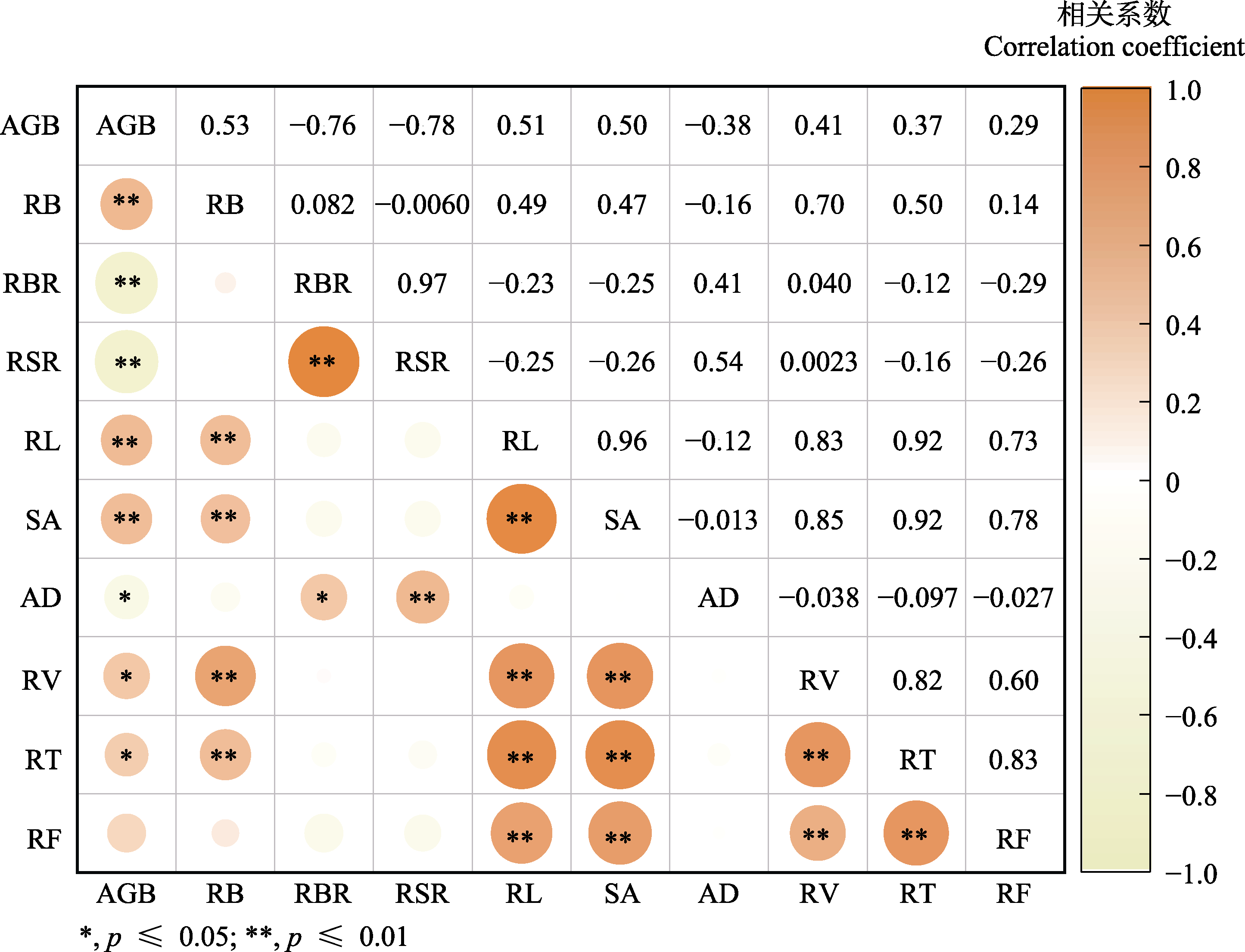
图5 花叶蔓长春和花叶络石地下根系结构性状特征和生物量的相关性。AD, 根平均直径; AGB, 地上生物量; RB, 根生物量; RBR, 根生物量比; RF, 根分叉数; RL, 根长; RSR, 根冠比; RV, 根体积; RT, 根尖数; SA, 根表面积。
Fig. 5 Correlation of morphological characteristics and biomass of underground root systems in Trachelospermum jasminoides ‘Variegatum’ and Vinca major ‘Variegata’. AD, average root diameter; AGB, aboveground biomass; RB, root biomass; RBR, root biomass ratio; RF, root fork number; RL, root length; RSR, root-to-shoot ratio; RT, root tip number; RV, root volume; SA, root surface area.
| 植物性状 Vegetative trait | 主成分1 PC1 | 主成分2 PC2 | 综合得分 Comprehensive score | 综合位次 Comprehensive ranking |
|---|---|---|---|---|
| 根长 Root length (cm) | 0.94 | 0.18 | 0.34 | 1 |
| 根尖数 Number of root tip | 0.85 | 0.27 | 0.34 | 2 |
| 根体积 Root volume (cm3) | 0.83 | 0.17 | 0.30 | 3 |
| 根表面积 Root surface area (cm2) | 0.81 | 0.14 | 0.29 | 4 |
| 根分叉数 Root forks | 0.78 | 0.20 | 0.29 | 5 |
| 根生物量 Root biomass (g) | 0.59 | -0.51 | 0.20 | 6 |
| 地上生物量 Aboveground biomass (g) | 0.44 | 0.22 | 0.10 | 7 |
| 根冠比 Root to shoot ratio | -0.39 | 0.76 | 0.01 | 8 |
| 根平均直径 Average root diameter (mm) | -0.37 | 0.90 | 0.04 | 9 |
| 根生物量比 Root biomass ration | -0.24 | 0.65 | 0.03 | 10 |
| 特征值 Eigenvalue | 4.48 | 2.29 | ||
| 贡献率 Contribution rate (%) | 44.79 | 22.89 | ||
| 累积贡献率 Cumulative contribution rate (%) | 44.79 | 67.68 |
表3 不同基质中花叶蔓长春和花叶络石地下根系构型特征和生物量各性状主成分分析
Table 3 Principal component (PC) analysis of traits between belowground root architecture characteristics and biomass of Trachelospermum jasminoides ‘Variegatum’ and Vinca major ‘Variegata’
| 植物性状 Vegetative trait | 主成分1 PC1 | 主成分2 PC2 | 综合得分 Comprehensive score | 综合位次 Comprehensive ranking |
|---|---|---|---|---|
| 根长 Root length (cm) | 0.94 | 0.18 | 0.34 | 1 |
| 根尖数 Number of root tip | 0.85 | 0.27 | 0.34 | 2 |
| 根体积 Root volume (cm3) | 0.83 | 0.17 | 0.30 | 3 |
| 根表面积 Root surface area (cm2) | 0.81 | 0.14 | 0.29 | 4 |
| 根分叉数 Root forks | 0.78 | 0.20 | 0.29 | 5 |
| 根生物量 Root biomass (g) | 0.59 | -0.51 | 0.20 | 6 |
| 地上生物量 Aboveground biomass (g) | 0.44 | 0.22 | 0.10 | 7 |
| 根冠比 Root to shoot ratio | -0.39 | 0.76 | 0.01 | 8 |
| 根平均直径 Average root diameter (mm) | -0.37 | 0.90 | 0.04 | 9 |
| 根生物量比 Root biomass ration | -0.24 | 0.65 | 0.03 | 10 |
| 特征值 Eigenvalue | 4.48 | 2.29 | ||
| 贡献率 Contribution rate (%) | 44.79 | 22.89 | ||
| 累积贡献率 Cumulative contribution rate (%) | 44.79 | 67.68 |
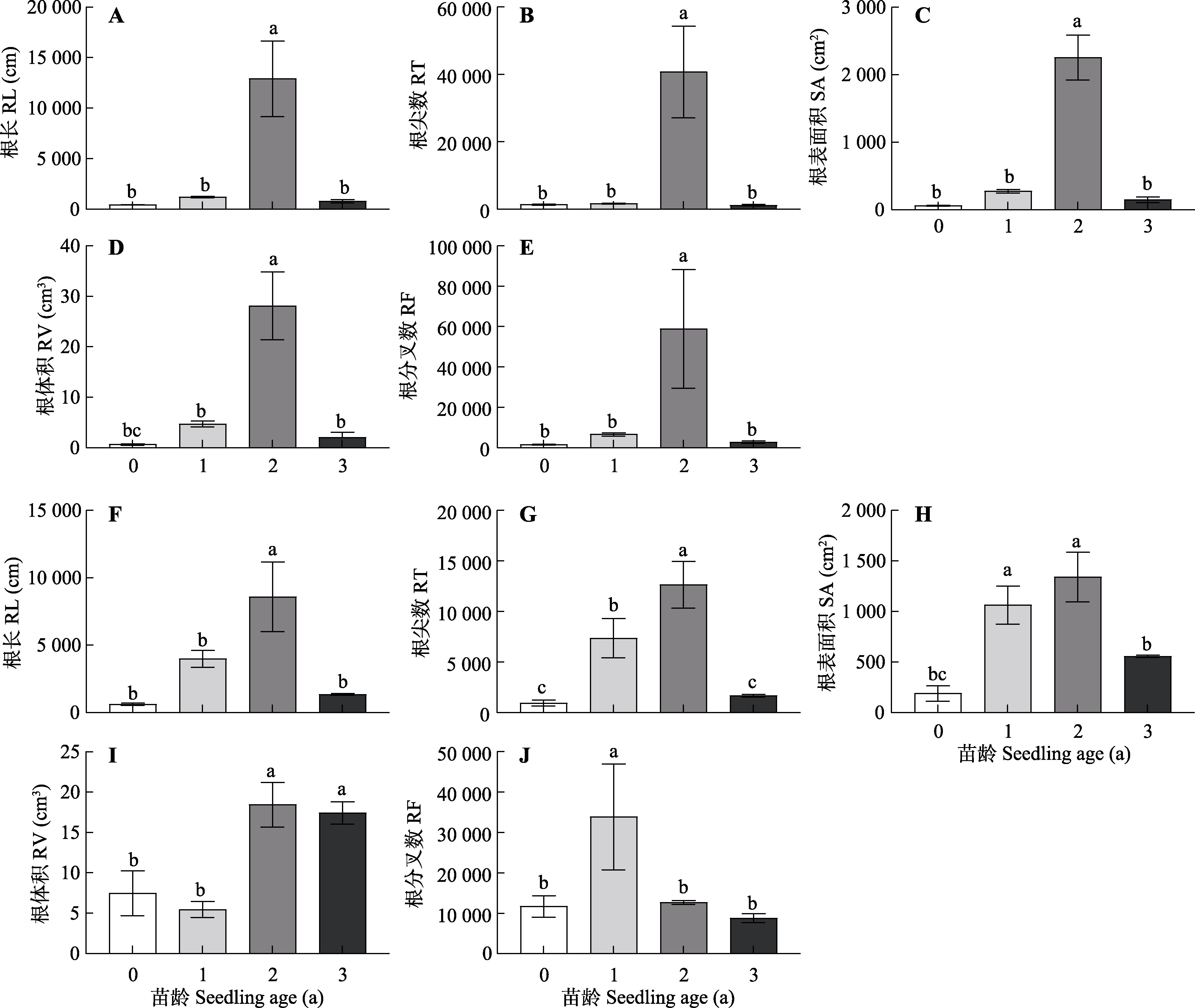
图6 绿墙的花叶蔓长春(A-E)和花叶络石(F-J)植物在混配基质中最大值方差分析(平均值±标准差)。不同小写字母表示不同基质的理化性质差异显著(p < 0.05)。
Fig. 6 Analysis of variance for maximum values of Vinca major ‘Variegata’ (A-E) and Trachelospermum jasminoides ‘Variegatum’ (F-J) in green wall in mixed media (mean ± SD). AD, average root diameter; AGB, aboveground biomass; RB, root biomass; RBR, root biomass ratio; RF, root fork number; RL, root length; RSR, root-to-shoot ratio; RT, root tip number; RV, root volume; SA, root surface area. Different lowercase letters indicate that the differences in the physicochemical properties of different substrates are significant (p < 0.05).
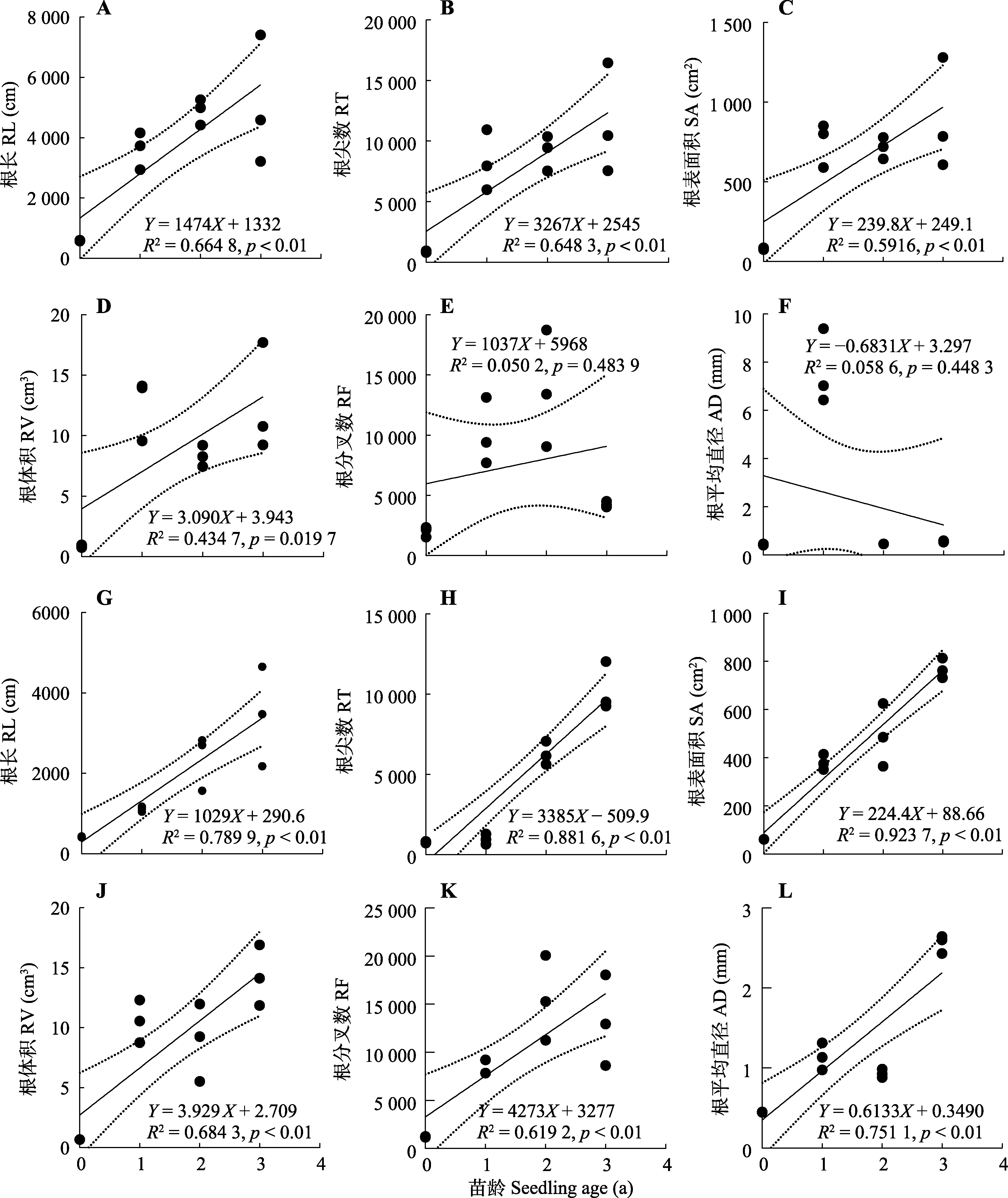
图7 绿墙的花叶络石(A-F)和花叶蔓长春(G-L)植物根系构型指标在新型基质中的变化趋势。虚线内表示根系构型随时间的变化拟合的趋势走向。
Fig. 7 Trends in root conformation indices of Trachelospermum jasminoides ‘Variegatum’ (A-F) and Vinca major ‘Variegata’ (F-L) in green wall in a novel medium. AD, average root diameter; AGB, aboveground biomass; RB, root biomass; RBR, root biomass ratio; RF, root fork number; RL, root length; RSR, root-to-shoot ratio; RT, root tip number; RV, root volume; SA, root surface area. The dotted line indicates the fitted trend of root architecture changing over time.
| 植物性状 Vegetative trait | 物种 Species | 拟合方程 Simultaneous equation | R2 | p | 峰值年限 Maximum number of years (a) |
|---|---|---|---|---|---|
| 根分叉数 Root forks | Vm | y = 4273x + 3277.00 | 0.62 | 0.002 | 13.00 |
| 根长 Root length (cm) | Vm | y = 1029x + 290.60 | 0.79 | 0.000 1 | 12.26 |
| 根尖数 Number of root tip | Vm | y = 3385x - 509.90 | 0.88 | <0.000 1 | 12.19 |
| 根表面积 Root surface area (cm2) | Vm | y = 224.4x + 88.66 | 0.92 | <0.000 1 | 9.65 |
| 根体积 Root volume (cm3) | Vm | y = 3.929x + 2.71 | 0.68 | 0.000 9 | 6.47 |
| 根平均直径 Average root diameter (mm) | Vm | y = 0.6133x + 0.35 | 0.75 | 0.000 3 | 0.61 |
| 根分叉数 Root forks | Tj | y = 1037x + 5968.00 | 0.05 | 0.483 | 26.91 |
| 根长 Root length (cm) | Tj | y = 1474x + 1332.00 | 0.66 | 0.001 2 | 4.92 |
| 根尖数 Number of root tip | Tj | y = 3267x + 2545.00 | 0.65 | 0.001 6 | 3.09 |
| 根表面积 Root surface area (cm2) | Tj | y = 239.8x + 249.10 | 0.59 | 0.003 5 | 4.55 |
| 根体积 Root volume (cm3) | Tj | y = 3.090x + 3.94 | 0.43 | 0.019 7 | 4.69 |
| 根平均直径 Average root diameter (mm) | Tj | y = -0.6831x + 3.30 | 0.06 | 0.448 3 | 0.60 |
表4 绿墙的花叶络石和花叶蔓长春根系构型指标在新型基质中达到峰值的年限预测
Table 4 Prediction of the number of years for Trachelospermum jasminoides ‘Variegatum’ (Tj) and Vinca major ‘Variegata’ (Vm) in green wall of root conformation indicators to peak in a novel medium
| 植物性状 Vegetative trait | 物种 Species | 拟合方程 Simultaneous equation | R2 | p | 峰值年限 Maximum number of years (a) |
|---|---|---|---|---|---|
| 根分叉数 Root forks | Vm | y = 4273x + 3277.00 | 0.62 | 0.002 | 13.00 |
| 根长 Root length (cm) | Vm | y = 1029x + 290.60 | 0.79 | 0.000 1 | 12.26 |
| 根尖数 Number of root tip | Vm | y = 3385x - 509.90 | 0.88 | <0.000 1 | 12.19 |
| 根表面积 Root surface area (cm2) | Vm | y = 224.4x + 88.66 | 0.92 | <0.000 1 | 9.65 |
| 根体积 Root volume (cm3) | Vm | y = 3.929x + 2.71 | 0.68 | 0.000 9 | 6.47 |
| 根平均直径 Average root diameter (mm) | Vm | y = 0.6133x + 0.35 | 0.75 | 0.000 3 | 0.61 |
| 根分叉数 Root forks | Tj | y = 1037x + 5968.00 | 0.05 | 0.483 | 26.91 |
| 根长 Root length (cm) | Tj | y = 1474x + 1332.00 | 0.66 | 0.001 2 | 4.92 |
| 根尖数 Number of root tip | Tj | y = 3267x + 2545.00 | 0.65 | 0.001 6 | 3.09 |
| 根表面积 Root surface area (cm2) | Tj | y = 239.8x + 249.10 | 0.59 | 0.003 5 | 4.55 |
| 根体积 Root volume (cm3) | Tj | y = 3.090x + 3.94 | 0.43 | 0.019 7 | 4.69 |
| 根平均直径 Average root diameter (mm) | Tj | y = -0.6831x + 3.30 | 0.06 | 0.448 3 | 0.60 |
| 物种 Species | 功能性状 Functional trait | 主成分得分 Principal component score | 达峰值年限 Maximum number of years | 归一化 Normalisation | 综合年限 Comprehensive years (a) |
|---|---|---|---|---|---|
| Tj | 根长 Root length (cm) | 0.34 | 4.92 | 1.07 | 6.99 |
| 根尖数 Number of root tip | 0.34 | 3.09 | 0.66 | ||
| 根体积 Root volume (cm3) | 0.30 | 4.69 | 0.91 | ||
| 根表面积 Root surface area (cm2) | 0.29 | 4.55 | 0.85 | ||
| 根分叉数 Root forks | 0.29 | 26.91 | 3.49 | ||
| Vm | 根长 Root length (cm) | 0.34 | 12.26 | 2.66 | 10.77 |
| 根尖数 Number of root tip | 0.34 | 12.19 | 2.61 | ||
| 根体积 Root volume (cm3) | 0.30 | 6.47 | 1.25 | ||
| 根表面积 Root surface area (cm2) | 0.29 | 9.65 | 1.81 | ||
| 根分叉数 Root forks | 0.29 | 13.00 | 2.44 |
表5 绿墙的花叶络石和花叶蔓长春主要指标在新型基质中达峰值的年限综合评测
Table 5 Prediction of the number of years for Trachelospermum jasminoides ‘Variegatum’ (Tj) and Vinca major ‘Variegata’ (Vm) in green wall of root conformation indicators to peak in a novel medium
| 物种 Species | 功能性状 Functional trait | 主成分得分 Principal component score | 达峰值年限 Maximum number of years | 归一化 Normalisation | 综合年限 Comprehensive years (a) |
|---|---|---|---|---|---|
| Tj | 根长 Root length (cm) | 0.34 | 4.92 | 1.07 | 6.99 |
| 根尖数 Number of root tip | 0.34 | 3.09 | 0.66 | ||
| 根体积 Root volume (cm3) | 0.30 | 4.69 | 0.91 | ||
| 根表面积 Root surface area (cm2) | 0.29 | 4.55 | 0.85 | ||
| 根分叉数 Root forks | 0.29 | 26.91 | 3.49 | ||
| Vm | 根长 Root length (cm) | 0.34 | 12.26 | 2.66 | 10.77 |
| 根尖数 Number of root tip | 0.34 | 12.19 | 2.61 | ||
| 根体积 Root volume (cm3) | 0.30 | 6.47 | 1.25 | ||
| 根表面积 Root surface area (cm2) | 0.29 | 9.65 | 1.81 | ||
| 根分叉数 Root forks | 0.29 | 13.00 | 2.44 |
| [1] | Andrade A, Cohen-Shacham E, Dalton J, Edwards S, Hessenberger D, Maginnis S, Maynard S, McElwee P, Murti R, Nelson C (2020). IUCN Global Standard for Nature-Based Solutions: a User-friendly Framework for the Verification, Design and Scaling Up of NbS. IUCN, International Union for Conservation of Nature, Gland, Switzerland. |
| [2] | Bao J, Jiang F, Ma JW, Xu Y, Ma YR, Chen CW, Ye ZQ, Liu D (2023). CiteSpace visualization analysis of urban green space soil research literature. Journal of Zhejiang A&F University, 40, 685-694. |
| [包婕, 江峰, 马嘉伟, 徐彦, 马瑗蕊, 陈楚文, 叶正钱, 柳丹 (2023). 城市绿地土壤研究文献的CiteSpace可视化分析. 浙江农林大学学报, 40, 685-694.] | |
| [3] |
Bardgett RD, Mommer L, de Vries FT (2014). Going underground: root traits as drivers of ecosystem processes. Trends in Ecology and Evolution, 29, 692-699.
DOI URL |
| [4] |
Besir AB, Cuce E (2018). Green roofs and facades: a comprehensive review. Renewable and Sustainable Energy Reviews, 82, 915-939.
DOI URL |
| [5] |
Cárdenas JP, Santiago A, Tarquis AM, Losada JC, Borondo F, Benito RM (2010). Soil porous system as heterogeneous complex network. Geoderma, 160, 13-21.
DOI URL |
| [6] | Chen X, Liu RF, Ma J (2022). The interaction between Sedum root traits and engineered media in green roofs. E3S Web of Conferences, 341, 01006. DOI: 10.1051/e3sconf/202234101006. |
| [7] |
Comas LH, Eissenstat DM (2009). Patterns in root trait variation among 25 co-existing North American forest species. New Phytologist, 182, 919-928.
DOI PMID |
| [8] | Cusack DF, Addo-Danso SD, Agee EA, Andersen KM, Arnaud M, Batterman SA, Brearley FQ, Ciochina MI, Cordeiro AL, Dallstream C, Diaz-Toribio MH, Dietterich LH, Fisher JB, Fleischer K, Fortune C, et al. (2021). Tradeoffs and synergies in tropical forest root traits and dynamics for nutrient and water acquisition: field and modeling advances. Frontiers in Forests and Global Change, 4, 704469. DOI: 10.3389/ffgc.2021.704469. |
| [9] | Dallstream C, Weemstra M, Soper FM (2023). A framework for fine-root trait syndromes: syndrome coexistence may support phosphorus partitioning in tropical forests. Oikos, 2023, e08908. DOI: 10.1111/oik.08908. |
| [10] |
Dexter AR (1987). Compression of soil around roots. Plant and Soil, 97, 401-406.
DOI URL |
| [11] |
Eissenstat DM, Wells CE, Yanai RD, Whitbeck JL (2000). Building roots in a changing environment: implications for root longevity. New Phytologist, 147, 33-42.
DOI URL |
| [12] | Freschet GT, Pagès L, Iversen CM, Comas LH, Rewald B, Roumet C, Klimešová J, Zadworny M, Poorter H, Postma JA, Adams TS, Bagniewska-Zadworna A, Bengough AG, Blancaflor EB, Brunner I, et al. (2021a). A starting guide to root ecology: strengthening ecological concepts and standardising root classification, sampling, processing and trait measurements. New Phytologist, 232, 973-1122. |
| [13] | Freschet GT, Roumet C, Comas LH, Weemstra M, Bengough AG, Rewald B, Bardgett RD, de Deyn GB, Johnson D, Klimešová J, Lukac M, McCormack ML, Meier IC, Pagès L, Poorter H, et al. (2021b). Root traits as drivers of plant and ecosystem functioning: current understanding, pitfalls and future research needs. New Phytologist, 232, 1123-1158. |
| [14] | Guan QF, Fang HL, Shen LY, Xu Z, Zhu ZQ, Chen D, Yin BR, Xi YW (2013). Gode for Quality Acceptance of Planting Soil in Landscape Engineering. DB31/T 769-2013. Shanghai Municipal Bureau of Quality and Technical Supervision, Shanghai. |
| [管群飞, 方海兰, 沈烈英, 徐忠, 朱振清, 陈动, 尹伯仁, 奚有为 (2013). 园林绿化工程种植土壤质量验收规范(DB31/T 769-2013). 上海市质量技术监督局, 上海.] | |
| [15] |
Guo C, Yan ER, Cornelissen JHC (2022). Size matters for linking traits to ecosystem multifunctionality. Trends in Ecology & Evolution, 37, 803-813.
DOI URL |
| [16] |
Han MG, Chen Y, Li R, Yu M, Fu LC, Li SF, Su JR, Zhu B (2022). Root phosphatase activity aligns with the collaboration gradient of the root economics space. New Phytologist, 234, 837-849.
DOI URL |
| [17] | Harris JR, Fanelli J, Niemiera A, Wright R (2000). 344 root pruning pin oak liners affects growth and root morphology. HortScience, 35, 451C-451. |
| [18] |
Isbell F, Calcagno V, Hector A, Connolly J, Harpole WS, Reich PB, Scherer-Lorenzen M, Schmid B, Tilman D, van Ruijven J, Weigelt A, Wilsey BJ, Zavaleta ES, Loreau M (2011). High plant diversity is needed to maintain ecosystem services. Nature, 477, 199-202.
DOI |
| [19] | Ishween A (2021). Grays to greens: a place where humans and nature coexist—A case study of Bosco Verticale, Milan, India. Descriptio, 3, 1-9. |
| [20] | Joswig JS, Wirth C, Schuman MC, Kattge J, Reu B, Wright IJ, Sippel SD, Rüger N, Richter R, Schaepman ME, van Bodegom PM, Cornelissen JHC, Díaz S, Hattingh WN, Kramer K, et al. (2022). Climatic and soil factors explain the two-dimensional spectrum of global plant trait variation. Nature Ecology & Evolution, 6, 36-50. |
| [21] |
Kramer-Walter KR, Bellingham PJ, Millar TR, Smissen RD, Richardson SJ, Laughlin DC (2016). Root traits are multidimensional: specific root length is independent from root tissue density and the plant economic spectrum. Journal of Ecology, 104, 1299-1310.
DOI URL |
| [22] |
Lambers H, Mougel C, Jaillard B, Hinsinger P (2009). Plant-microbe-soil interactions in the rhizosphere: an evolutionary perspective. Plant and Soil, 321, 83-115.
DOI URL |
| [23] |
Li B, Xu BS, Chen JK (2001). Perspectives on general trends of plant invasions with special reference to alien weed flora of Shanghai. Biodiversity Science, 9, 446-457.
DOI URL |
| [李博, 徐炳声, 陈家宽 (2001). 从上海外来杂草区系剖析植物入侵的一般特征. 生物多样性, 9, 446-457.] | |
| [24] |
Liang T, Bengough AG, Knappett JA, MuirWood D, Loades KW, Hallett PD, Boldrin D, Leung AK, Meijer GJ (2017). Scaling of the reinforcement of soil slopes by living plants in a geotechnical centrifuge. Ecological Engineering, 109, 207-227.
DOI URL |
| [25] | Liu MX, Li SY, Sun XY, Hao HR, Li YN, Tan QY, Wang Y, Li GD (2022). Screening of light substrate formulations of garden waste compost for roof greening. Chinese Journal of Environmental Engineering, 16, 2374-2380. |
| [刘梦欣, 李素艳, 孙向阳, 郝惠蓉, 李逸楠, 谭其言, 王颖, 李国栋 (2022). 园林废弃物堆肥用于屋顶绿化轻型基质的配方筛选. 环境工程学报, 16, 2374-2380.] | |
| [26] | Liu WB, Li SG, Qi ZY, Tang YH (2023). The application of prefabricated-greening in the construction municipal of green infrastructure: a case of Hangzhou Xiaoshan Airport Highway greening project. Urbanism and Architecture, 20(1), 119-122. |
| [刘伟彬, 李盛港, 戚智勇, 唐阳海 (2023). 装配式绿化在绿色市政基础设施建设中的运用——以杭州萧山机场公路绿化项目为例. 城市建筑, 20(1), 119-122.] | |
| [27] | Liu XS, Wang YF, Shi YF, Zhang FB, Wu MQ, Tang XY, Shen JB, Jin KM (2023). Construction and regulation of soil structure in root zone based on the theory of rhizobiont. Journal of Plant Nutrition and Fertilizers, 29, 972-979. |
| [刘学松, 王翼飞, 师嫄菲, 张方博, 伍梦起, 唐晓燕, 申建波, 金可默 (2023). 基于根际生命共同体理论的根区土壤结构构建与调控. 植物营养与肥料学报, 29, 972-979.] | |
| [28] | Manso M, Teotónio I, Silva CM, Cruz CO (2021). Green roof and green wall benefits and costs: a review of the quantitative evidence. Renewable and Sustainable Energy Reviews, 135, 110111. DOI: 10.1016/j.rser.2020.110111. |
| [29] |
Mao QZ, Ma KM, Wu JG, Tang RL, Zhang YX, Luo SH, Bao L, Cai XH (2013). An overview of advances in distributional pattern of urban biodiversity. Acta Ecologica Sinica, 33, 1051-1064.
DOI URL |
| [毛齐正, 马克明, 邬建国, 唐荣莉, 张育新, 罗上华, 宝乐, 蔡小虎 (2013). 城市生物多样性分布格局研究进展. 生态学报, 33, 1051-1064.] | |
| [30] | Mao Z, Roumet C, Rossi LMW, Merino-Martín L, Nespoulous J, Taugourdeau O, Boukcim H, Fourtier S, Del Rey-Granado M, Ramel M, Ji K, Zuo J, Fromin N, Stokes A, Fort F(2023). Intra- and inter-specific variation in root mechanical traits for twelve herbaceous plants and their link with the root economics space. Oikos, 2023, e09032. DOI: 10.1111/oik.09032. |
| [31] | Masi EB, Segoni S, Tofani V (2021). Root reinforcement in slope stability models: a review. Geosciences, 11, 212. DOI: 10.3390/geosciences11050212. |
| [32] |
Pandey BK, Huang G, Bhosale R, Hartman S, Sturrock CJ, Jose L, Martin OC, Karady M, Voesenek LA, Ljung K, Lynch JP, Brown KM, Whalley WR, Mooney SJ, Zhang D, Bennett MJ (2021). Plant roots sense soil compaction through restricted ethylene diffusion. Science, 371, 276-280.
DOI PMID |
| [33] | Perini K, Rosasco P (2016). Is greening the building envelope economically sustainable? An analysis to evaluate the advantages of economy of scope of vertical greening systems and green roofs. Urban Forestry & Urban Greening, 20, 328-337. |
| [34] |
Qi ZY (2023). Urban forest construction and vertical greening development under climate change. Landscape Architecture Frontiers, (1), 58-64.
DOI |
| [戚智勇 (2023). 气候变化背景下的城市森林构建与立体绿化发展. 景观设计学, (1), 58-64.] | |
| [35] | Qi ZY, Liu Y, He XM, Liu ZY (2017). A plastic fiber culture soil and its preparation method: China, CN 20151041781.7. 2016-03-02 [2024-12-16]. |
| [戚智勇, 刘瑜, 何旭明, 刘忠勇 (2017). 一种可塑性纤维培养土及其制备方法: 中国, CN201510641781.7. 2016-03-02 [2024-12-16]. https://pss-system.cponline.cnipa.gov.cn/documents/detail?prevPageTit=changgui.] | |
| [36] |
Reich PB (2014). The world-wide ‘fast-slow’ plant economics spectrum: a traits manifesto. Journal of Ecology, 102, 275-301.
DOI URL |
| [37] |
Reubens B, Poesen J, Danjon F, Geudens G, Muys B (2007). The role of fine and coarse roots in shallow slope stability and soil erosion control with a focus on root system architecture: a review. Trees, 21, 385-402.
DOI URL |
| [38] |
Robinson DA, Thomas A, Reinsch S, Lebron I, Feeney CJ, Maskell LC, Wood CM, Seaton FM, Emmett BA, Cosby BJ (2022). Analytical modelling of soil porosity and bulk density across the soil organic matter and land-use continuum. Scientific Reports, 12, 7085. DOI: 10.1038/s41598-022-11099-7.
PMID |
| [39] |
Rosasco P, Perini K (2018). Evaluating the economic sustainability of a vertical greening system: a Cost-Benefit Analysis of a pilot project in mediterranean area. Building and Environment, 142, 524-533.
DOI URL |
| [40] |
Roumet C, Birouste M, Picon-Cochard C, Ghestem M, Osman N, Vrignon-Brenas S, Cao KF, Stokes A (2016). Root structure-function relationships in 74 species: evidence of a root economics spectrum related to carbon economy. New Phytologist, 210, 815-826.
DOI PMID |
| [41] | Shi W, Wang ZQ, Liu JL, Gu JC, Guo DL (2008). Fine root morphology of twenty hardwood species in Maoershan natural secondary forest in northeastern China. Chinese Journal of Plant Ecology, 32, 1217-1226. |
|
[师伟, 王政权, 刘金梁, 谷加存, 郭大立 (2008). 帽儿山天然次生林20个阔叶树种细根形态. 植物生态学报, 32, 1217-1226.]
DOI |
|
| [42] | Singh TJ, Ibotombi S, Singh MP (2021). Influence of plant roots o slope stabilization: a geotechnical investigation. Environmental Science. DOI: 10.21203/rs.3.rs-623966/v1. |
| [43] | Tan XY, Shibata S (2022). Factors influencing street tree health in constrained planting spaces: evidence from Kyoto City, Japan. Urban Forestry & Urban Greening, 67, 127416. DOI: 10.1016/j.ufug.2021.127416. |
| [44] | Tang LZ, Huang BL, HAIBARA Kikuo, TODA Hiroto, (2008). Ecological adaptation mechanisms of roots to flooded soil and respiration characteristics of knee roots of Taxodium ascendens. Chinese Journal of Plant Ecology, 32, 1258-1267. |
|
[唐罗忠, 黄宝龙, 生原喜久雄, 户田浩人 (2008). 高水位条件下池杉根系的生态适应机制和膝根的呼吸特性. 植物生态学报, 32, 1258-1267.]
DOI |
|
| [45] | Vasishth A, Kaushal P, Kaushal AN, Dutt B (2007). Effect of root pruning and nitrogen application on post planting survival, growth and establishment of acacia catechu willd seedlings. Indian Forester, 133, 1027-1044. |
| [46] | Wang HB, Qin J, Hu YH (2017). Keeping potential of intermediate growth as an optimal strategy of greening on building exterior surface. Journal of Shanghai Normal University (Natural Sciences), 46, 702-706. |
| [王红兵, 秦俊, 胡永红 (2017). 保持中度生长势成为建筑外表面绿化的选择策略. 上海师范大学学报(自然科学版), 46, 702-706.] | |
| [47] |
Weigelt A, Mommer L, Andraczek K, Iversen CM, Bergmann J, Bruelheide H, Fan Y, Freschet GT, Guerrero-Ramírez NR, Kattge J, Kuyper TW, Laughlin DC, Meier IC, van der Plas F, Poorter H, et al. (2021). An integrated framework of plant form and function: the belowground perspective. New Phytologist, 232, 42-59.
DOI PMID |
| [48] |
Wolf D, Lundholm JT (2008). Water uptake in green roof microcosms: effects of plant species and water availability. Ecological Engineering, 33, 179-186.
DOI URL |
| [49] | Wu C, Wang ZQ, Fan ZQ (2004). Significance of senescence study on tree roots and its advances. Chinese Journal of Applied Ecology, 15, 1276-1280. |
| [吴楚, 王政权, 范志强 (2004). 树木根系衰老研究的意义与现状. 应用生态学报, 15, 1276-1280.] | |
| [50] | Yan HQ, Tian Q, Gan DM (2004). Primary discussion on the vertical green landscape construction of urban architecture. Inner Mongolia Environmental Protection, 16(2), 51-53. |
| [闫慧琴, 田琼, 干地玛 (2004). 城市建筑立体绿化建设初探. 内蒙古环境保护, 16(2), 51-53.] | |
| [51] | Yang HM, Ye SP, Zheng FH, Zhang JT, Ruan S (2019). Research on technology and application of light substrate in three-dimensional greening. Forestry and Environmental Science, 35(6), 98-104. |
| [杨红梅, 叶少萍, 郑富海, 张俊涛, 阮桑 (2019). 立体绿化轻型基质配方技术及应用研究. 林业与环境科学, 35(6), 98-104]. | |
| [52] |
Yang SS, Limpens J, Sterck FJ, Sass-Klaassen U, Cornelissen JHC, Hefting M, Goudzwaard L, Dam N, Dam M, Veerkamp MT, van den Berg B, Brouwer E, Chang CH, Poorter L (2021). Dead wood diversity promotes fungal diversity. Oikos, 130, 2202-2216.
DOI URL |
| [53] | Yang XL, Zhang XM, Li YL, Li SC, Sun HL (2008). Analysis of root architecture and root adaptive strategy in the Taklimakan desert area of China. Chinese Journal of Plant Ecology, 32, 1268-1276. |
|
[杨小林, 张希明, 李义玲, 李绍才, 孙海龙 (2008). 塔克拉玛干沙漠腹地3种植物根系构型及其生境适应策略. 植物生态学报, 32, 1268-1276.]
DOI |
|
| [54] |
Zhang Y, Cao JJ, Lu MZ, Kardol P, Wang JJ, Fan GQ, Kong DL (2024). The origin of bi-dimensionality in plant root traits. Trends in Ecology & Evolution, 39, 78-88.
DOI URL |
| [55] |
Zhang ZY, Fan BM, Song C, Zhang XX, Zhao QW, Ye B (2023). Advances in root system architecture: functionality, plasticity, and research methods. Journal of Resources and Ecology, 14, 15-24.
DOI |
| [56] | Zhao JB, Guo BL, Hou YS, Yang QP, Feng ZP, Zhao Y, Yang XT, Fan GQ, Kong DL (2024). Multi-dimensionality in plant root traits: progress and challenges. Journal of Plant Ecology, 17, rtae043. DOI: 10.1093/jpe/rtae043. |
| [57] | Zhu S, Cao JH, Yang H, Liang JH, Lao CL (2023). A review of the interaction mechanism and law between vegetation and rock geochemical background in karst areas. Rock and Mineral Analysis, 42(1), 59-71. |
| [朱帅, 曹建华, 杨慧, 梁建宏, 劳昌玲 (2023). 岩溶区植被与岩石地球化学背景间相互作用机制研究进展. 岩矿测试, 42(1), 59-71.] |
| [1] | 张静, 陈洁, 李艳朋, 盘李军, 许涵, 李意德, 何海生. 南亚热带针阔混交人工林植物生物量比较及其影响因子分析[J]. 植物生态学报, 2026, 50(2): 400-416. |
| [2] | 冯哲, 许格希, 刘顺, 陈健, 李非凡, 巩闪闪, 贾磊, 孙镇, 余美霓, 史作民, 周庆宏, 蒋冬梅. 生境因子和系统发育协同驱动云南金沙江干热河谷植物叶片化学计量特征[J]. 植物生态学报, 2026, 50(2): 352-361. |
| [3] | 徐恩相, 周蕾, 章晓炜, 张国萍, 仲杜伟, 黄智, 刘派, 迟永刚. 基于不同生育阶段冠层光谱和碳通量的水稻产量估算[J]. 植物生态学报, 2026, 50(1): 82-93. |
| [4] | 周雨婷, 肖江, 黄欣瑞, 龚定康, 刘镌垚, 刘雕, 雷泞菲, 王琦, 李玲娟, 李琪, 裴向军. 植物根系构型对花岗岩弃渣土壤有机碳组分的影响[J]. 植物生态学报, 2025, 49(9): 1485-1497. |
| [5] | 朱瑞德, 杨俊薇, 刘宵含, 陈冰瑞, 池秀莲, 田地, 杨光, 程蒙, 戴亚峰, 王诗文. 霍山石斛设施和林下栽培模式中养分对植物-微生物关联的调控[J]. 植物生态学报, 2025, 49(9): 1434-1447. |
| [6] | 宋珊珊, 唐志尧. 河北塞罕坝草甸草原根际土壤真菌与植物地上生物量的关系[J]. 植物生态学报, 2025, 49(9): 1461-1471. |
| [7] | 张法伟, 李红琴, 祝景彬, 樊博, 周华坤, 李英年, 梁乃申. 氮添加和降水改变对高寒草甸生态系统地上与地下碳储的影响[J]. 植物生态学报, 2025, 49(9): 1399-1409. |
| [8] | 樊月玲, 蒋正德, 叶佳舒, 郑立臣, 陈欣. 2005-2015年下辽河平原农田长期观测样地主要农作物收获期性状和产量数据集[J]. 植物生态学报, 2025, 49(8): 1271-1282. |
| [9] | 李家湘, 刘文倩, 蒋国平, 赵丽娟, 徐永福, 吴磊, 喻勋林. 植被科学画符号系统设计和标准化绘图范式——以森林群落剖面图为例[J]. 植物生态学报, 2025, 49(6): 897-910. |
| [10] | 刘新月, 王立平, 刘春和, 孙艳丽, 刘鹏, 田赟, 贾昕, 查天山, 钱多. 北京不同林龄人工林生物量空间格局及其影响因素[J]. 植物生态学报, 2025, 49(6): 939-951. |
| [11] | 马腾飞, 郝杰, 刁华杰, 宁亚楠, $\boxed{\hbox{王常慧}}$, 董宽虎. 晋北农牧交错带草地土壤无机氮含量的季节变化及其对放牧强度的响应[J]. 植物生态学报, 2025, 49(6): 965-974. |
| [12] | 陈文义, 王智勇, 周梦岩, 麻文俊, 王军辉, 罗志斌, 周婧. 幼龄楸树生物量分配规律与异速生长模型[J]. 植物生态学报, 2025, 49(2): 356-366. |
| [13] | 韩大勇, 李海燕, 张维, 杨允菲. 东北碱化草甸芦苇匍匐型分株超速生长过程及生理机制[J]. 植物生态学报, 2025, 49(2): 320-330. |
| [14] | 万嘉敏, 张彩彩, 邓云, 顾荣, 斯那取宗, 吴俊华, 娄启妍, 陈梅, 张志明, 林露湘. 云南香格里拉亚高山寒温性针叶林优势种空间分布格局及种内种间关联性[J]. 植物生态学报, 2025, 49(2): 268-281. |
| [15] | 贺艺, 周静, 陈宸, 房庭舟, 苏剑, 高浩杰, 曹嘉浩, 杨飞宇, 范淇博, 朱乐瑶, 陈薏名, 杨飞, 王毅腾, 冯雷, 刘飞, 梁爽, 蒋明凯, 陈军, 赵云鹏, 陈伟乐, 赵颖, 黄建国. 浙江海岛濒危树种的保护与恢复[J]. 植物生态学报, 2025, 49(10): 1583-1599. |
| 阅读次数 | ||||||
|
全文 |
|
|||||
|
摘要 |
|
|||||
Copyright © 2026 版权所有 《植物生态学报》编辑部
地址: 北京香山南辛村20号, 邮编: 100093
Tel.: 010-62836134, 62836138; Fax: 010-82599431; E-mail: apes@ibcas.ac.cn, cjpe@ibcas.ac.cn
备案号: 京ICP备16067583号-19

