
植物生态学报 ›› 2025, Vol. 49 ›› Issue (9): 1515-1526.DOI: 10.17521/cjpe.2024.0383 cstr: 32100.14.cjpe.2024.0383
陈刚刚1,3,4,5, 朱思洁1,3,4,5, 郭亮娜1,3,4,5, 付芳伟2, 刘昱灼1,3,4,5, 李江荣1,3,4,5,*( )
)
收稿日期:2024-10-26
接受日期:2025-03-21
出版日期:2025-09-20
发布日期:2025-03-21
通讯作者:
*李江荣 (ljrong06@xza.edu.cn)基金资助:
CHEN Gang-Gang1,3,4,5, ZHU Si-Jie1,3,4,5, GUO Liang-Na1,3,4,5, FU Fang-Wei2, LIU Yu-Zhuo1,3,4,5, LI Jiang-Rong1,3,4,5,*()
Received:2024-10-26
Accepted:2025-03-21
Online:2025-09-20
Published:2025-03-21
Supported by:摘要: 通过探究藏东南色季拉山高山树线优势树种方枝柏(Juniperus saltuaria)及雪层杜鹃(Rhododendron nivale)灌木在不同互作强度下的植物体地上-地下养分分配策略, 为该地区的生态保护及生态修复提供理论依据及支持。该研究以色季拉山高山树线方枝柏群落(乔木层盖度60%)、方枝柏优势的群落(乔木层盖度20%)、雪层杜鹃优势的群落(灌木层盖度56%)、雪层杜鹃群落(灌木层盖度75%)为研究对象, 于2022年8月采集4种植物群落中的优势种的叶、根及树冠范围内的土壤, 测定所得样品的养分元素含量, 通过生态化学计量及偏最小二乘法路径模型(PLS-PM)分析不同互作强度下的方枝柏、雪层杜鹃地上-地下养分及化学计量特征变化, 进而明确色季拉山高山树线地区两种优势乔灌植物在不同互作强度下的养分策略差异。结果显示: (1)方枝柏群落叶片碳(C)含量高于方枝柏优势群落, 氮(N)、磷(P)、钾(K)含量则相反; 方枝柏群落根系C含量低于方枝柏优势群落, N、P、K含量则相反。雪层杜鹃优势群落叶片C、K含量高于雪层杜鹃群落, N、P含量则相反; 雪层杜鹃优势群落根系C、N含量高于雪层杜鹃群落, P、K含量则相反; 4种植物群落叶片C、N、P、K含量远高于根系。(2)与方枝柏群落相比, 方枝柏优势群落更偏好将养分输送至叶片, 这种养分策略属激进类型; 与雪层杜鹃群落相比, 雪层杜鹃优势群落则将养分更多地输送至根系, 这种养分策略显得较为保守。研究区植物群落对土壤养分存在正向作用机制。
陈刚刚, 朱思洁, 郭亮娜, 付芳伟, 刘昱灼, 李江荣. 藏东南色季拉山高山树线乔灌地上-地下养分分配策略. 植物生态学报, 2025, 49(9): 1515-1526. DOI: 10.17521/cjpe.2024.0383
CHEN Gang-Gang, ZHU Si-Jie, GUO Liang-Na, FU Fang-Wei, LIU Yu-Zhuo, LI Jiang-Rong. Aboveground and belowground nutrient allocation strategies for trees and shrubs at alpine treeline in Sygera Mountains of the southeastern Qingzang Plateau. Chinese Journal of Plant Ecology, 2025, 49(9): 1515-1526. DOI: 10.17521/cjpe.2024.0383
| 植物群落 Plant community | 简写 Abbreviation | 海拔 Ailtitude (m) | 郁闭度/盖度 Canopy density or coverage (%) | 平均高度 Average height (m) | 植被类型 Vegetation type |
|---|---|---|---|---|---|
| 方枝柏群落 Juniperus saltuaria community | CF | 4 100 | 60 | 8.30 | EN |
| 方枝柏优势的群落 Community dominated by Juniperus saltuaria | JF | 4 350 | 20 | 1.84 | EN |
| 雪层杜鹃优势的群落 Community dominated by Rhododendron nivale | JDJ | 4 350 | 56 | 0.84 | EB |
| 雪层杜鹃群落 Rhododendron nivale community | DJ | 4 450 | 75 | 0.65 | EB |
表1 高山树线过渡带4种植物群落样地基本特征
Table 1 Basic characteristics of sample plots of four plant communities in the alpine treeline ecotone
| 植物群落 Plant community | 简写 Abbreviation | 海拔 Ailtitude (m) | 郁闭度/盖度 Canopy density or coverage (%) | 平均高度 Average height (m) | 植被类型 Vegetation type |
|---|---|---|---|---|---|
| 方枝柏群落 Juniperus saltuaria community | CF | 4 100 | 60 | 8.30 | EN |
| 方枝柏优势的群落 Community dominated by Juniperus saltuaria | JF | 4 350 | 20 | 1.84 | EN |
| 雪层杜鹃优势的群落 Community dominated by Rhododendron nivale | JDJ | 4 350 | 56 | 0.84 | EB |
| 雪层杜鹃群落 Rhododendron nivale community | DJ | 4 450 | 75 | 0.65 | EB |
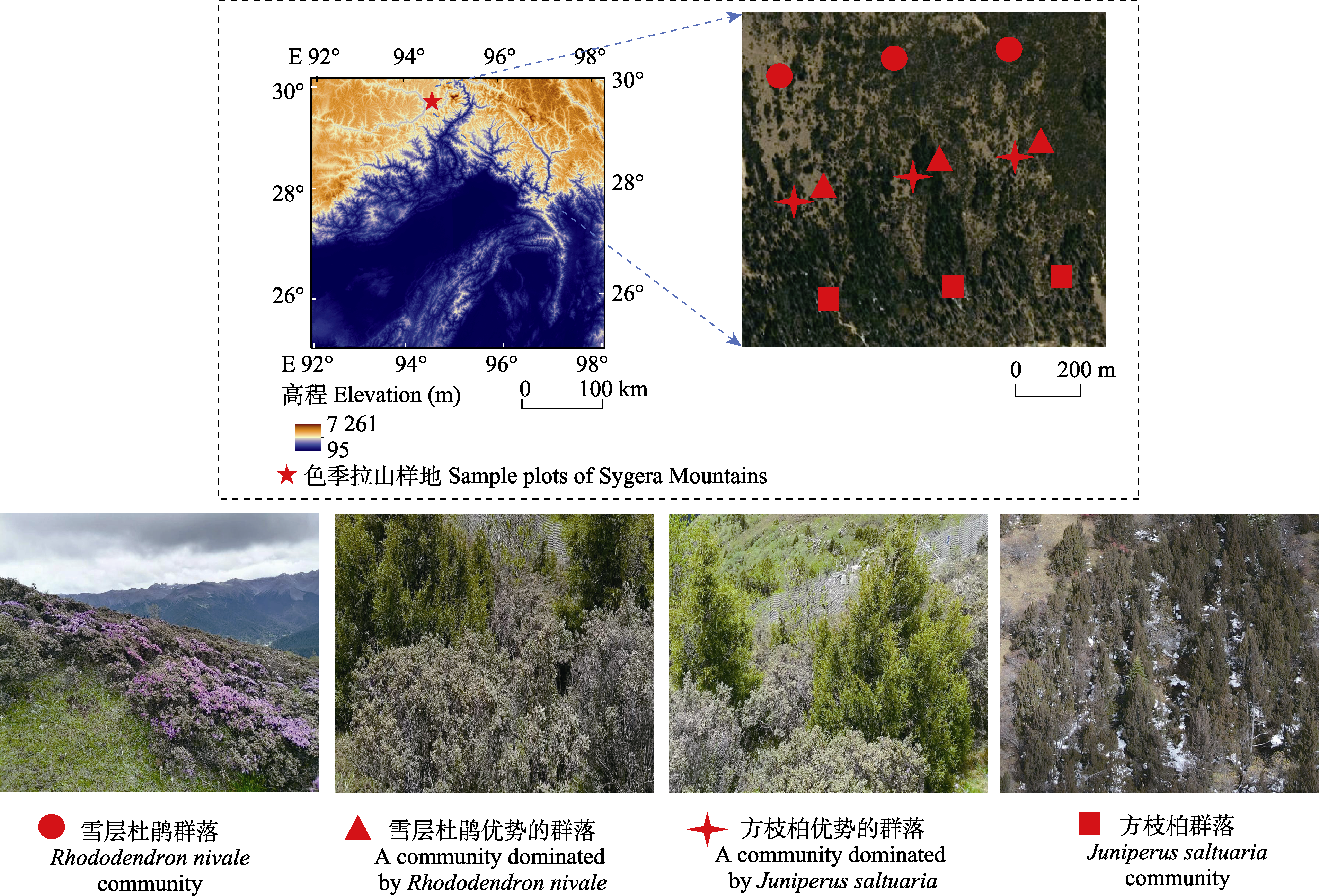
图1 藏东南色季拉山高山树线过渡带样地概况图。
Fig. 1 General situation map of sample plots in the alpine treeline ecotone of Sygera Mountains, southeast Xizang.
| 理化性质 Physical and chemical property | 方枝柏群落 CF | 方枝柏优势的群落 JF | 雪层杜鹃优势的群落 JDJ | 雪层杜鹃群落 DJ |
|---|---|---|---|---|
| 有机碳含量 Organic carbon content (g·kg-1) | 109.08 ± 15.04a | 75.44 ± 7.89b | 68.42 ± 5.25b | 53.90 ± 6.63b |
| 全氮含量 Total nitrogen content (g·kg-1) | 6.60 ± 0.86a | 4.40 ± 0.26b | 4.39 ± 0.29b | 3.60 ± 0.44b |
| 全磷含量 Total nitrogen content (g·kg-1) | 0.90 ± 0.03a | 0.82 ± 0.03b | 0.79 ± 0.02bc | 0.72 ± 0.02c |
| 全钾含量 Total potassium content (g·kg-1) | 6.49 ± 0.41a | 6.83 ± 0.20a | 7.43 ± 0.19a | 7.28 ± 0.46a |
| 速效氮含量 Available nitrogen content (g·kg-1) | 0.88 ± 0.11a | 0.62 ± 0.04b | 0.61 ± 0.04b | 0.48 ± 0.06b |
| 速效磷含量 Available phosphorus content (mg·kg-1) | 15.92 ± 2.30a | 15.57 ± 1.19a | 12.33 ± 1.15a | 13.51 ± 1.40a |
| 速效钾含量 Available potassium content (g·kg-1) | 0.17 ± 0.02a | 0.11 ± 0.01b | 0.11 ± 0.01b | 0.09 ± 0.01b |
| Margalef指数 Margalef index | 2.15 ± 0.06c | 3.92 ± 0.26a | 3.92 ± 0.26a | 3.00 ± 0.21b |
| pH | 5.33 ± 0.02b | 5.42 ± 0.07a | 5.57 ± 0.03a | 5.50 ± 0.04a |
表2 乔灌混交与非混交样地土壤理化性质及植物群落丰富度(平均值±标准误)
Table 2 Soil physicochemical properties and plant community richness (mean ± SE) of mixed coniferous and shrub plots versus non-mixed plots
| 理化性质 Physical and chemical property | 方枝柏群落 CF | 方枝柏优势的群落 JF | 雪层杜鹃优势的群落 JDJ | 雪层杜鹃群落 DJ |
|---|---|---|---|---|
| 有机碳含量 Organic carbon content (g·kg-1) | 109.08 ± 15.04a | 75.44 ± 7.89b | 68.42 ± 5.25b | 53.90 ± 6.63b |
| 全氮含量 Total nitrogen content (g·kg-1) | 6.60 ± 0.86a | 4.40 ± 0.26b | 4.39 ± 0.29b | 3.60 ± 0.44b |
| 全磷含量 Total nitrogen content (g·kg-1) | 0.90 ± 0.03a | 0.82 ± 0.03b | 0.79 ± 0.02bc | 0.72 ± 0.02c |
| 全钾含量 Total potassium content (g·kg-1) | 6.49 ± 0.41a | 6.83 ± 0.20a | 7.43 ± 0.19a | 7.28 ± 0.46a |
| 速效氮含量 Available nitrogen content (g·kg-1) | 0.88 ± 0.11a | 0.62 ± 0.04b | 0.61 ± 0.04b | 0.48 ± 0.06b |
| 速效磷含量 Available phosphorus content (mg·kg-1) | 15.92 ± 2.30a | 15.57 ± 1.19a | 12.33 ± 1.15a | 13.51 ± 1.40a |
| 速效钾含量 Available potassium content (g·kg-1) | 0.17 ± 0.02a | 0.11 ± 0.01b | 0.11 ± 0.01b | 0.09 ± 0.01b |
| Margalef指数 Margalef index | 2.15 ± 0.06c | 3.92 ± 0.26a | 3.92 ± 0.26a | 3.00 ± 0.21b |
| pH | 5.33 ± 0.02b | 5.42 ± 0.07a | 5.57 ± 0.03a | 5.50 ± 0.04a |
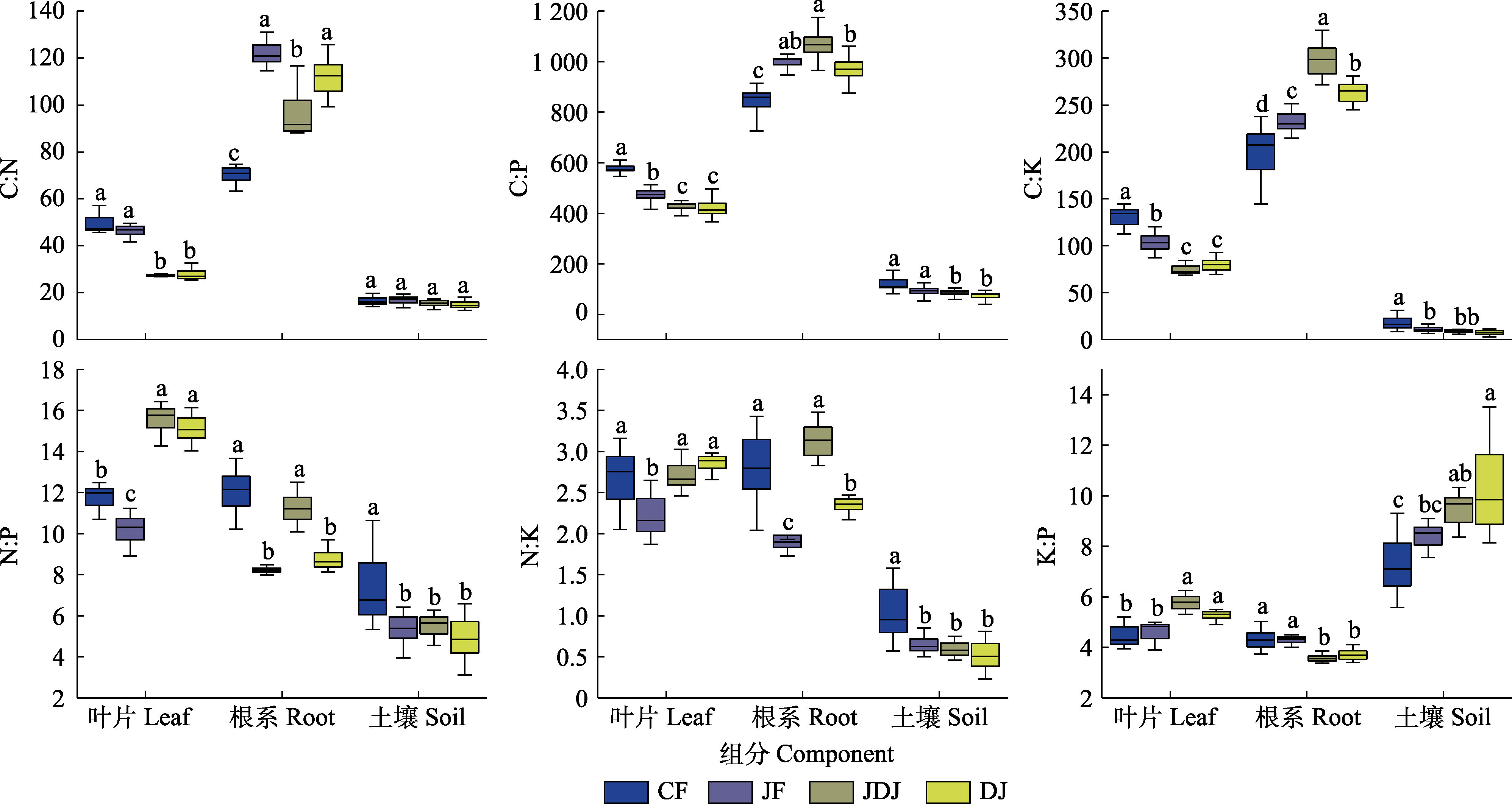
图2 乔灌植物叶片、根系、土壤碳(C)、氮(N)、磷(P)、钾(K)化学计量比及差异性。CF, 方枝柏群落; DJ, 雪层杜鹃群落; JDJ, 雪层杜鹃优势的群落; JF, 方枝柏优势的群落。不同小写字母表示植物叶片、根系及土壤化学计量比在不同群落间的差异显著(p < 0.05)。
Fig. 2 Stoichiometric ratios of carbon (C), nitrogen (N), phosphorus (P), and potassium (K) in the leaves, roots, and soil of arboreal and shrub plants, as well as their differences. CF, Juniperus saltuaria community; DJ, Rhododendron nivale community; JDJ, community dominated by Rhododendron nivale; JF, community dominated by Juniperus saltuaria. Different lowercase letters signify that the differences in the stoichiometric ratios of plant leaves, roots, and soil among various communities are statistically significant (p < 0.05).
| 植物群落 Plant community | 营养器官 Vegetative organ | 碳含量 Carbon content (g·kg-1) | 氮含量 Nitrogen content (g·kg-1) | 磷含量 Phosphorus content (g·kg-1) | 钾含量 Potassium content (g·kg-1) |
|---|---|---|---|---|---|
| 方枝柏群落 CF | 叶片 Leaf | 538.49 ± 1.53a | 11.01 ± 0.40b | 0.93 ± 0.02c | 4.16 ± 0.18c |
| 根 Root | 514.52 ± 3.84a | 7.31 ± 0.19a | 0.61 ± 0.02a | 2.63 ± 0.20a | |
| 方枝柏优势的群落 JF | 叶片 Leaf | 529.78 ± 1.71b | 11.39 ± 0.26b | 1.12 ± 0.04b | 5.18 ± 0.58b |
| 根 Root | 514.88 ± 2.40a | 4.23 ± 0.09c | 0.52 ± 0.01b | 2.21 ± 0.05b | |
| 雪层杜鹃优势的群落 JDJ | 叶片 Leaf | 529.18 ± 1.50b | 19.25 ± 0.15a | 1.23 ± 0.03a | 7.12 ± 0.21a |
| 根 Root | 505.94 ± 1.52b | 5.35 ± 0.22b | 0.48 ± 0.01b | 1.71 ± 0.05c | |
| 雪层杜鹃群落 DJ | 叶片 Leaf | 522.72 ± 1.77c | 19.91 ± 0.43a | 1.32 ± 0.04a | 7.00 ± 0.21a |
| 根 Root | 500.34 ± 2.93b | 4.51 ± 0.13c | 0.52 ± 0.01b | 1.91 ± 0.04bc |
表3 乔灌叶片、细根养分含量及差异性(平均值±标准误)
Table 3 Nutrient content in the leaves and fine roots of arboreal and shrub plants, along with their differences (mean ± SE)
| 植物群落 Plant community | 营养器官 Vegetative organ | 碳含量 Carbon content (g·kg-1) | 氮含量 Nitrogen content (g·kg-1) | 磷含量 Phosphorus content (g·kg-1) | 钾含量 Potassium content (g·kg-1) |
|---|---|---|---|---|---|
| 方枝柏群落 CF | 叶片 Leaf | 538.49 ± 1.53a | 11.01 ± 0.40b | 0.93 ± 0.02c | 4.16 ± 0.18c |
| 根 Root | 514.52 ± 3.84a | 7.31 ± 0.19a | 0.61 ± 0.02a | 2.63 ± 0.20a | |
| 方枝柏优势的群落 JF | 叶片 Leaf | 529.78 ± 1.71b | 11.39 ± 0.26b | 1.12 ± 0.04b | 5.18 ± 0.58b |
| 根 Root | 514.88 ± 2.40a | 4.23 ± 0.09c | 0.52 ± 0.01b | 2.21 ± 0.05b | |
| 雪层杜鹃优势的群落 JDJ | 叶片 Leaf | 529.18 ± 1.50b | 19.25 ± 0.15a | 1.23 ± 0.03a | 7.12 ± 0.21a |
| 根 Root | 505.94 ± 1.52b | 5.35 ± 0.22b | 0.48 ± 0.01b | 1.71 ± 0.05c | |
| 雪层杜鹃群落 DJ | 叶片 Leaf | 522.72 ± 1.77c | 19.91 ± 0.43a | 1.32 ± 0.04a | 7.00 ± 0.21a |
| 根 Root | 500.34 ± 2.93b | 4.51 ± 0.13c | 0.52 ± 0.01b | 1.91 ± 0.04bc |
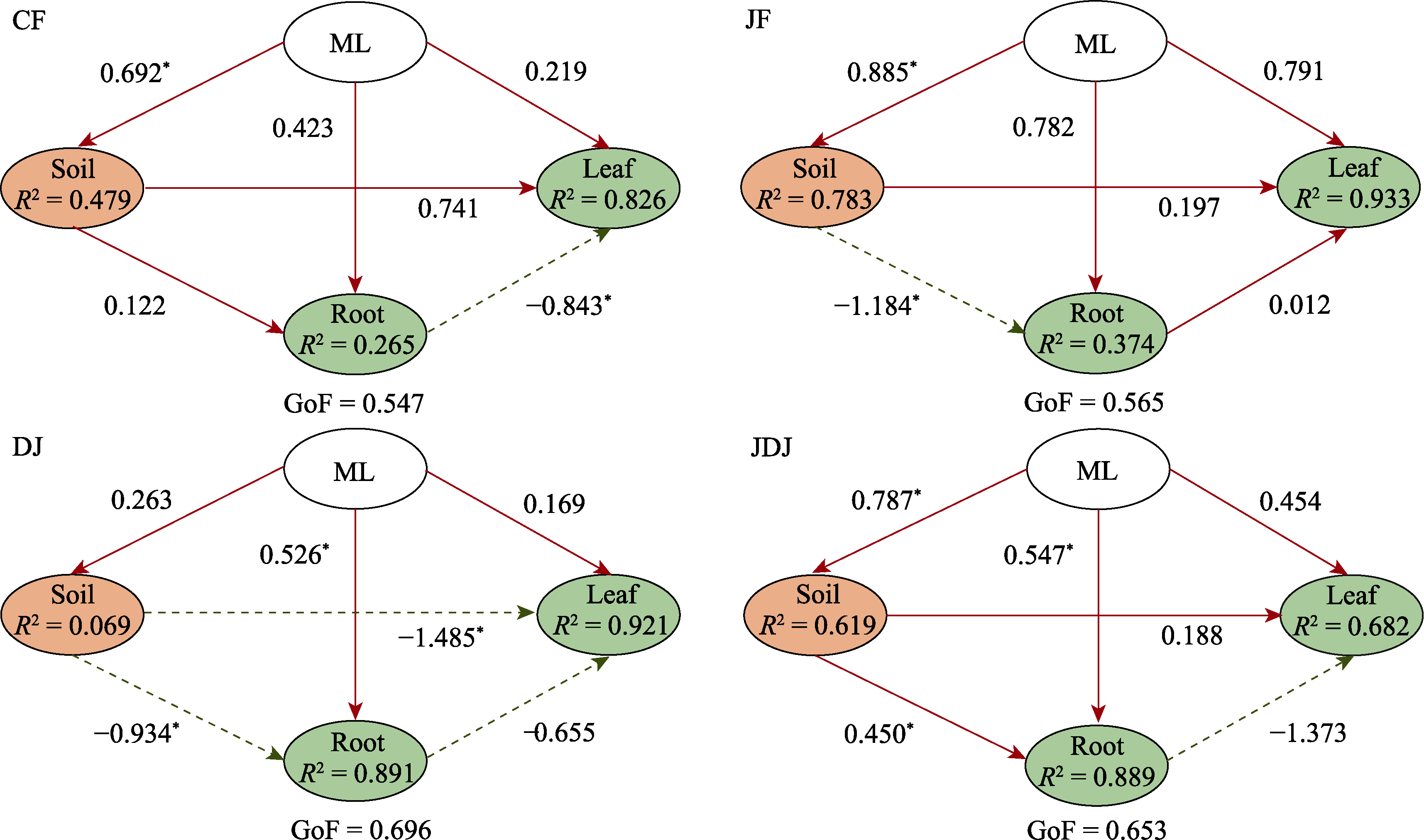
图3 4种植物群落植物器官、土壤养分及植物群落丰富度的路径分析。CF, 方枝柏群落; DJ, 雪层杜鹃群落; JDJ, 雪层杜鹃优势的群落; JF, 方枝柏优势的群落。Leaf, 叶片养分含量; ML, 植物群落丰富度; Root, 根系养分含量; Soil, 土壤养分含量。GoF, 模型拟合优度。*表示路径间显著相关(p < 0.05)。
Fig. 3 Path analysis of plant organs, soil nutrients, and plant community richness in four plant communities. CF, Juniperus saltuaria community; DJ, Rhododendron nivale community; JDJ, community dominated by Rhododendron nivale; JF, community dominated by Juniperus saltuaria. Leaf, leaf nutrient content; ML, plant community richness; Root, root nutrient content; Soil, soil nutrient content. GoF, goodness-of-fit of the model. * denotes a significant correlation between the paths (p < 0.05).
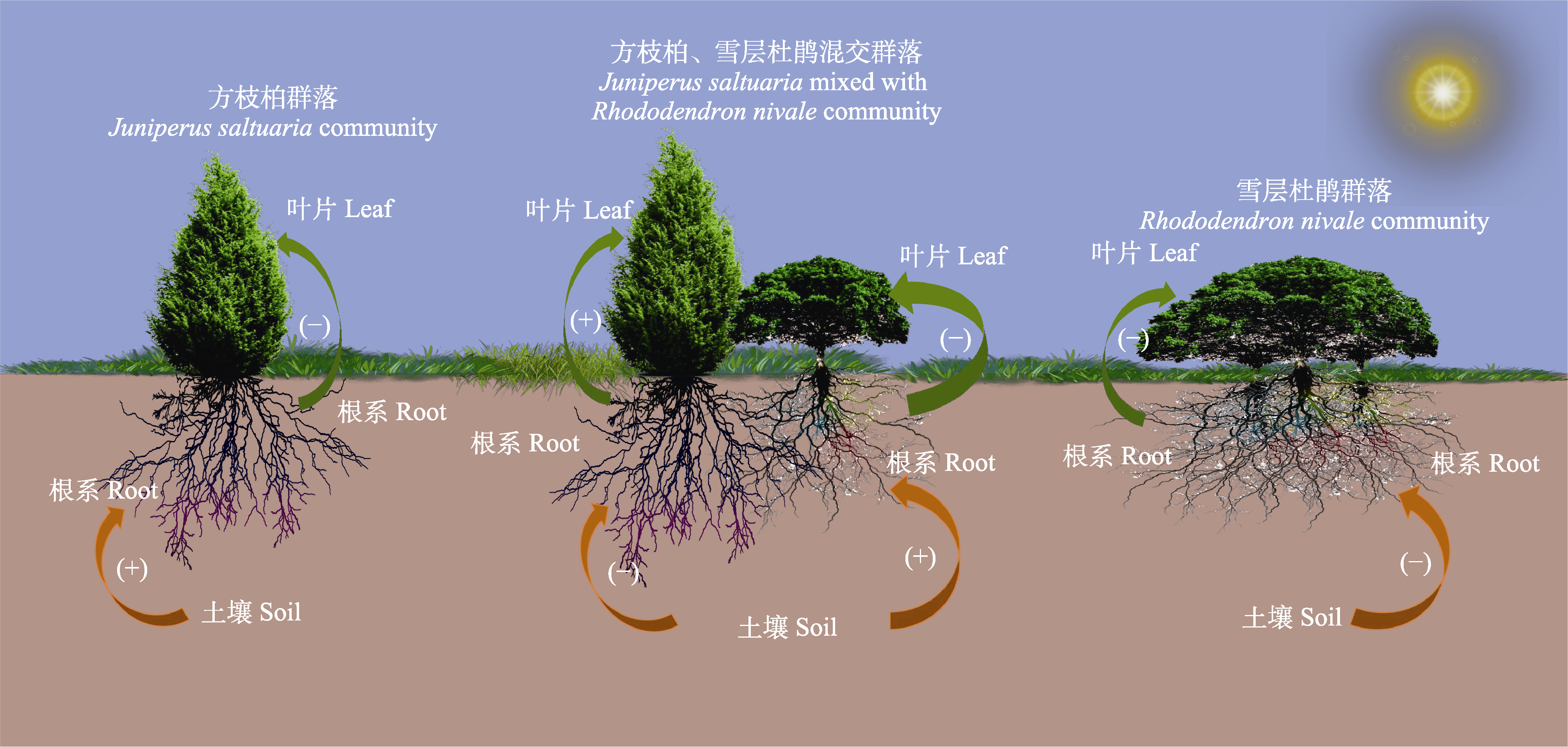
图4 色季拉山高山树线乔灌养分策略权衡示意图。(+)、(-), 正负相关关系; 箭头方向表示养分运输方向。
Fig. 4 Schematic diagram of nutrient strategy trade-offs at the alpine treeline in Sygera Mountains. (+), (-), positive and negative correlation relationships; the direction of the arrows indicates the direction of nutrient transport.
| [1] |
Agüero ML, Puntieri J, Mazzarino MJ, Grosfeld J, Barroetaveña C (2014). Seedling response of Nothofagus species to N and P: linking plant architecture to N/P ratio and resorption proficiency. Trees, 28, 1185-1195.
DOI URL |
| [2] |
Chang YN, Li BY, Zhong QL, Wang GB, Shen QS, Xu CB, Zhang SH (2022). Biomass allocation of three functional types of forest tree seedlings and their relationships with nutrients in fine roots and leaves. Chinese Journal of Ecology, 41, 2090-2097.
DOI |
| [常云妮, 李宝银, 钟全林, 汪国彬, 沈秋水, 徐朝斌, 张师赫 (2022). 四种功能型林木幼苗生物量分配及其与细根和叶片养分关系. 生态学杂志, 41, 2090-2097.] | |
| [3] | Chang YR, Shi JM, Xu DM (2024). Trade-off relationships between biomass and nutrient allocation in different natural populations of Agropyron mongolicum on the desert steppe. Chinese Journal of Pratacultural Science, 33(11), 186-197. |
|
[常怡然, 史佳梅, 许冬梅 (2024). 荒漠草原不同自然种群蒙古冰草生物量和养分权衡特征. 草业学报, 33(11), 186-197.]
DOI |
|
| [4] | Chen WS, Ding HH, Li JR, Chen K, Wang HJ (2022). Alpine treelines as ecological indicators of global climate change: Who has studied? What has been studied? Ecological Informatics, 70, 101691. DOI:10.1016/j.ecoinf.2022.101691. |
| [5] |
Chen WS, Ding HH, Li JR, Fu FW, Li YY, Xiao SY (2024). Microclimate characteristics of two treeline ecotones and their different habitats in Segera, southeast Tibet. Chinese Journal of Ecology, 43, 682-693.
DOI |
| [陈文盛, 丁慧慧, 李江荣, 付芳伟, 李月瑶, 肖思颖 (2024). 藏东南色季拉两种树线交错带及其不同生境的小气候特征. 生态学杂志, 43, 682-693.] | |
| [6] | Chen WS, Li JR, Camarero JJ, Ding HH, Fu FW, Li YY, Zheng XY, Li XX, Shen W, Sigdel SR, Leavitt SW, Liang EY (2024). Facilitation drives tree seedling survival at alpine treelines. Journal of Plant Ecology, 17, rtae033. DOI: 10.1093/jpe/rtae033. |
| [7] | Chen YM, Shan LS, Ma J, Wang HY, Xie TT, Yang J, Ma L (2024). Carbon, nitrogen and phosphorus stoichiometry in leaves and fine roots of desert plants in arid region of Northwest China. Acta Ecologica Sinica, 44, 3648-3659. |
| [陈壹铭, 单立山, 马静, 王红永, 解婷婷, 杨洁, 马丽 (2024). 西北干旱区荒漠植物叶片和细根碳、氮、磷化学计量特征. 生态学报, 44, 3648-3659.] | |
| [8] | Chen Z, Chen L, Lu R, Lou Z, Zhou F, Jin Y, Chen S (2025). A national soil organic carbon density dataset (2010-2024) in China. Scientific Data, 12, 1480. DOI: 10.1038/s41597-025-05863-3. |
| [9] |
Cheng H, Gong YB, Wu Q, Li Y, Liu Y, Zhu DW (2018). Content and ecological stoichiometry characteristics of organic carbon, nitrogen and phosphorus of typical soils in sub-alpine/alpine mountain of western Sichuan. Journal of Natural Resources, 33, 161-172.
DOI |
|
[程欢, 宫渊波, 吴强, 李瑶, 刘颖, 朱德雯 (2018). 川西亚高山/高山典型土壤类型有机碳、氮、磷含量及其生态化学计量特征. 自然资源学报, 33, 161-172.]
DOI |
|
| [10] | Cheng RM, Wang N, Xiao WF, Shen YF, Liu ZB (2018). Advances in studies of ecological stoichiometry of terrestrial ecosystems. Scientia Silve Sinicae, 54(7), 130-136. |
| [程瑞梅, 王娜, 肖文发, 沈雅飞, 刘泽彬 (2018). 陆地生态系统生态化学计量学研究进展. 林业科学, 54(7), 130-136.] | |
| [11] |
Elser JJ, Fagan WF, Denno RF, Dobberfuhl DR, Folarin A, Huberty A, Interlandi S, Kilham SS, McCauley E, Schulz KL, Siemann EH, Sterner RW (2000). Nutritional constraints in terrestrial and freshwater food webs. Nature, 408, 578-580.
DOI |
| [12] | Gao XM, Liu SR, Wang Y, Luan JW, Cai CJ, Ren LN (2021). Effects of throughfall reduction and nitrogen addition on stoichiometry of leaf and fine root in Phyllostachys edulis forests. Acta Ecologica Sinica, 41, 1440-1450. |
| [高小敏, 刘世荣, 王一, 栾军伟, 蔡春菊, 任立宁 (2021). 穿透雨减少和氮添加对毛竹叶片和细根化学计量学的影响. 生态学报, 41, 1440-1450.] | |
| [13] |
Hansson A, Dargusch P, Shulmeister J (2021). A review of modern treeline migration, the factors controlling it and the implications for carbon storage. Journal of Mountain Science, 18, 291-306.
DOI |
| [14] |
Hu ZH, Liu HY, Yang JJ, Hua B, Bahn M, Pang S, Li TT, Yang W, Wu HH, Han XG, Zhang XM (2024). Tradeoff between productivity and stability across above-and below-ground communities. Journal of Integrative Plant Biology, 66, 2321-2324.
DOI URL |
| [15] | Du Y, Song JY, Zhang YL, Chai XT, Zhang ZH, Islam W, Zeng FJ (2024). Effects of mowing on leaf lnternal stability and leaf and soil stoichiometric characteristics of legumes and non-legumes. Acta Agrestia Sinica, 32, 1513-1522. |
|
[杜艺, 宋佼阳, 张玉林, 柴旭田, 张志浩, ISLAM Waqar, 曾凡江 (2024). 刈割对豆科和非豆科植物叶片内稳性及叶片土壤化学计量特征的影响. 草地学报, 32, 1513-1521.]
DOI |
|
| [16] | Ji MJ, Zhang SC, Wang RH, Yan G, Ma ZL, Yang W, Zhang XJ (2025). Variation of soil nitrogen-fixing bacterial community structure and nitrogen fixation rate with altitude gradient in alpine forests in southeastern Xizang. Acta Ecologica Sinica, 45, 2074-2083. |
| [吉毛加, 张首超, 王瑞红, 闫刚, 马振林, 杨维, 张新军 (2025). 藏东南高寒森林土壤固氮菌群落结构与固氮速率随海拔梯度的变化规律. 生态学报, 45, 2074-2083.] | |
| [17] | Koerselman W, Meuleman AFM (1996). The vegetation N:P ratio: a new tool to detect the nature of nutrient limitation. Journal of Applied Ecology, 33, 1441. DOI: 10.2307/2404783. |
| [18] |
Körner C, Hoch G (2006). A test of treeline theory on a montane permafrost island. Arctic, Antarctic, and Alpine Research, 38, 113-119.
DOI URL |
| [19] |
Li XY, Zhang JJ, Zhou JY, Chen M, Li M, Zhang X, Zhao Y, Cao Y (2023). Ecological stoichiometry of leaf-litter-fine roots in mixed plantations in mountainous area of Southern Ningxia, China. Chinese Journal of Applied Ecology, 34, 2889-2897.
DOI |
|
[李欣阳, 张娟娟, 周建云, 陈萌, 李明, 张旭, 赵妍, 曹扬 (2023). 宁南山区人工混交林叶片-凋落物-细根生态化学计量特征. 应用生态学报, 34, 2889-2897.]
DOI |
|
| [20] | Li YY, Wang JX, Wang LQ (2024). Seasonal variations in C/N/P/K stoichiometric characteristics in different plant organs in the various forest types of Sygera Mountain. Frontiers in Plant Science, 15, 1293934. DOI: 10.3389/fpls.2024.1293934. |
| [21] |
Liang EY, Wang YF, Eckstein D, Luo TX (2011). Little change in the fir tree-line position on the southeastern Tibetan Plateau after 200 years of warming. New Phytologist, 190, 760-769.
DOI PMID |
| [22] | Liu Y, Gong YB, Li Y, Zhu DW, Liu H, Shuai W (2018). Soil stoichiometric characteristics of alpine shrub meadow at different elevations, western Sichuan. Journal of Sichuan Agricultural University, 36(2), 167-174. |
| [刘颖, 宫渊波, 李瑶, 朱德雯, 刘韩, 帅伟 (2018). 川西高寒灌丛草地不同海拔梯度土壤化学计量特征. 四川农业大学学报, 36(2), 167-174.] | |
| [23] |
Qin WK, Zhang QF, Ao GKL, Zhu B (2024). Responses and mechanisms of soil organic carbon dynamics to warming: a review. Chinese Journal of Plant Ecology, 48, 403-415.
DOI URL |
|
[秦文宽, 张秋芳, 敖古凯麟, 朱彪 (2024). 土壤有机碳动态对增温的响应及机制研究进展. 植物生态学报, 48, 403-415.]
DOI |
|
| [24] |
Qiu YT, Guan SC, Wen CJ, Li P, Gao Z, Chen X (2019). Auxin and cytokinin coordinate the dormancy and outgrowth of axillary bud in strawberry runner. BMC Plant Biology, 19, 528. DOI: 10.1186/s12870-019-2151-x.
PMID |
| [25] |
Shang GZ, Jing X, Wang H, Liu H, Gu H, He JS (2024). Plant biodiversity responds more strongly to climate warming and anthropogenic activities than microbial biodiversity in the Qinghai-Tibetan alpine grasslands. Journal of Ecology, 112, 110-125.
DOI URL |
| [26] | Shao HY, Wang Q, Gao CX, Zhao J (2024). Analysis of phytoplankton community characteristics and influencing factors in the Yangtze River Estuary. Journal of Dalian Ocean University, 39, 124-133. |
| [邵海燕, 王卿, 高春霞, 赵静 (2024). 长江口浮游植物群落特征及影响因素分析. 大连海洋大学学报, 39, 124-133.] | |
| [27] |
Sigdel SR, Zheng XY, Babst F, Camarero JJ, Gao S, Li XX, Lu XM, Pandey J, Dawadi B, Sun J, Zhu HF, Wang T, Liang EY, Peñuelas J (2024). Accelerated succession in Himalayan alpine treelines under climatic warming. Nature Plants, 10, 1909-1918.
DOI PMID |
| [28] |
Song ZP, Li ZL, Luo YQ, Liu YH (2022). Allocation strategies of carbon, nitrogen and phosphorus following a gradient of wildfire severities. Journal of Plant Ecology, 15, 347-358.
DOI |
| [29] | Su Y, Tang YF, Hu Y, Liu MY, Lu XY, Duan BL (2024). Exploring plant adaptation strategies to phosphorus limitation induced by nitrogen addition: foliar phosphorus allocation and root functional traits analysis in two dominant subalpine tree species. Journal of Plant Ecology, 17, rtae060. DOI: 10.1093/jpe/rtae060. |
| [30] | Tang ZY, Xu WT, Zhou GY, Bai YF, Li JX, Tang XL, Chen DM, Liu Q, Ma WH, Xiong GM, He HL, He NP, Guo YP, Guo Q, Zhu JL, et al. (2018). Patterns of plant carbon, nitrogen, and phosphorus concentration in relation to productivity in China’s terrestrial ecosystems. Proceedings of the National Academy of Sciences of the United States of America, 115, 4033-4038. |
| [31] |
Tian D, Yan ZB, Fang JY (2021). Review on characteristics and main hypotheses of plant ecological stoichiometry. Chinese Journal of Plant Ecology, 45, 682-713.
DOI |
|
[田地, 严正兵, 方精云 (2021). 植物生态化学计量特征及其主要假说. 植物生态学报, 45, 682-713.]
DOI |
|
| [32] | Wang HJ, Li JR, Zheng WL, Chen K, Chen WS, Ding HH (2022). Soil stoichiometric characteristics of the transition zone of Abies acuta forest line in Sejila Mountain. Western Forestry Science, 51(2), 161-168. |
| [汪汉驹, 李江荣, 郑维列, 陈康, 陈文盛, 丁慧慧 (2022). 色季拉山急尖长苞冷杉林线过渡带土壤化学计量特征. 西部林业科学, 51(2), 161-168.] | |
| [33] |
Wang Y, Pederson N, Ellison AM, Buckley HL, Case BS, Liang E, Julio Camarero J, (2016). Increased stem density and competition may diminish the positive effects of warming at alpine treeline. Ecology, 97, 1668-1679.
DOI PMID |
| [34] | Xiao SY, Fu FW, Li JR, Chen WS, Ding HH, Li YY (2023). Soil ecological stoichiometry characteristics of six typical forest types in the Sejila Mountain. Journal of Central South University of Forestry and Technology, 43(11), 120-130. |
| [肖思颖, 付芳伟, 李江荣, 陈文盛, 丁慧慧, 李月瑶 (2023). 色季拉山6种典型植物群落土壤生态化学计量特征. 中南林业科技大学学报, 43(11), 120-130.] | |
| [35] | Xu XY, Qin YY, Cao JJ (2019). Variation characteristics of Potentilla bifurca leaf stochiometry along the elevation gradient on the northeastern Qinghai-Tibetan Plateau. Acta Ecologica Sinica, 39, 9044-9051. |
| [许雪贇, 秦燕燕, 曹建军 (2019). 青藏高原东北部二裂委陵菜叶片生态化学计量随海拔变化的特征. 生态学报, 39, 9044-9051.] | |
| [36] |
Yan K, Duan CQ, Fu DG, Li J, Wong MHG, Qian L, Tian YX (2015). Leaf nitrogen and phosphorus stoichiometry of plant communities in geochemically phosphorus-enriched soils in a subtropical mountainous region, SW China. Environmental Earth Sciences, 74, 3867-3876.
DOI URL |
| [37] | Yang L, Cui GS, Zhao WL, Zhang ZM, Luo TX, Zhang L (2023). Sensitivity of radial growth of subalpine conifer trees to climate warming on the southeastern Tibetan Plateau. Global Ecology and Conservation, 43, e02470. DOI: 10.1016/j.gecco.2023.e02470. |
| [38] |
Yang X, Tang ZY, Ji CJ, Liu HY, Ma WH, Mohhamot A, Shi ZY, Sun W, Wang T, Wang XP, Wu X, Yu SL, Yue M, Zheng CY (2014). Scaling of nitrogen and phosphorus across plant organs in shrubland biomes across Northern China. Scientific Reports, 4, 5448. DOI: 10.1038/srep05448.
PMID |
| [39] | Yu GL, Ma ZJ, Lu ZZ, Liu B (2023). Altitude and plant community jointly regulate soil stoichiometry characteristics of natural grassland in the Baluntai area on the southern slope of the middle Tianshan Mountains, China. Journal of Pratacultural Science, 32(9), 68-78. |
|
[郁国梁, 马紫荆, 吕自立, 刘彬 (2023). 海拔和植物群落共同调节天山中段南坡巴伦台地区天然草场土壤化学计量特征. 草业学报, 32(9), 68-78.]
DOI |
|
| [40] | Yu JS, Song ZP, Hou JH (2023). Life form-dependent nitrogen-phosphorous allocation strategies of leaf and fine root in a temperate natural forest under long-term nitrogen addition. Journal of Plant Ecology, 16, rtad013. DOI: 10.1093/jpe/rtad013. |
| [41] |
Yuan ZY, Chen HYH, Reich PB (2011). Global-scale latitudinal patterns of plant fine-root nitrogen and phosphorus. Nature Communications, 2, 344-349.
DOI PMID |
| [42] |
Zhang Q, Feng K, Chang ZH, He SH, Xu WQ (2023). Effects of shrub encroachment on plant and soil microbial in the forest-grassland ecotone. Chinese Journal of Plant Ecology, 47, 770-781.
DOI |
|
[张琦, 冯可, 常智慧, 何双辉, 徐维启 (2023). 灌丛化对林草交错带植物和土壤微生物的影响. 植物生态学报, 47, 770-781.]
DOI |
|
| [43] | Zhang XR, Cui GS, Zuo ZJ, Wang Z, Yang L, Zhang L (2024). Stoichiometric characteristics of carbon, nitrogen, and phosphorus in Sophora moorcroftiana shrubs in the middle reaches of the Yarlung Zangbo River, Xizang, China. Pratacultural Science, 41, 1824-1833. |
| [张欣茹, 崔光帅, 左振君, 王忠, 杨柳, 张林 (2024). 西藏雅鲁藏布江流域中段砂生槐不同器官C、N、P化学计量特征. 草业科学, 41, 1824-1833.] | |
| [44] |
Zhang ZK, Li ZY, Yang BY, Sai BL, Yang AN, Zhang L, Mou L, Zhang JY, Jin LW, Zhao Z, Wang WS, Du YC, Yan ER (2023). Functional traits influence the growth and mortality of common woody plants in Dajinshan Island, Shanghai, China. Chinese Journal of Plant Ecology, 47, 1398-1406.
DOI URL |
|
[张增可, 李曾燕, 杨柏钰, 赛碧乐, 杨安娜, 张立, 牟凌, 郑俊勇, 金乐薇, 赵钊, 王万胜, 杜运才, 阎恩荣 (2023). 上海大金山岛常见木本植物功能性状对生长和死亡的影响. 植物生态学报, 47, 1398-1406.]
DOI |
|
| [45] | Zheng XY, Babst F, Camarero JJ, Li XX, Lu XM, Gao S, Sigdel SR, Wang YF, Zhu HF, Liang EY (2024). Density-dependent species interactions modulate alpine treeline shifts. Ecology Letters, 27, e14403. DOI: 10.1111/ele.14403. |
| [46] | Zhou W, Wang WJ, Zhang B, Xiao L, Lü HL, He XY (2017). Soil fertility evaluation for urban forests and green spaces in Changchun City. Acta Ecologica Sinica, 37, 1211-1220. |
| [周伟, 王文杰, 张波, 肖路, 吕海亮, 何兴元 (2017). 长春城市森林绿地土壤肥力评价. 生态学报, 37, 1211-1220.] |
| [1] | 侯霄帆, 马辰涵, 孙语倩, 高钰涵, 李品. 臭氧胁迫下叶片与细根凋落物分解的生态化学计量特征差异[J]. 植物生态学报, 2026, 50(2): 268-278. |
| [2] | 张竟文, 李晶, 王汝苗, 王贺年, 崔丽娟. 不同纬度滨海湿地植物根系与土壤生态化学计量特征及内稳性分析[J]. 植物生态学报, 2026, 50(2): 461-473. |
| [3] | 皮惠之, 张秋芳, 孙浩, 曾泉鑫, 彭园珍, 元晓春, 徐建国, 陈岳民. 微生物碳氮不平衡影响罗浮栲林土壤微生物氮利用效率对氮富集的响应[J]. 植物生态学报, 2026, 50(1): 34-44. |
| [4] | 沈会涛, 俞筱押, 秦彦杰, 武爱彬. 太行山东麓核桃林生态化学计量及碳储量随林龄变化特征[J]. 植物生态学报, 2025, 49(9): 1543-15555. |
| [5] | 张琳, 陈华阳, 黄振英. 2004-2010年鄂尔多斯沙地草地长期监测样地植物物种组成和群落特征数据集[J]. 植物生态学报, 2025, 49(8): 1263-1270. |
| [6] | 陈龙, 郭柯, 勾晓华, 赵秀海, 马泓若. 祁连圆柏林群落组成及特征[J]. 植物生态学报, 2025, 49(6): 852-864. |
| [7] | 王娟, 张登山, 肖元明, 裴全帮, 王博, 樊博, 周国英. 长期围封后高寒草原植物根系分泌物特征与环境因子关系[J]. 植物生态学报, 2025, 49(4): 596-609. |
| [8] | 杜华栋, 王梦雨, 聂文杰, 孙浩, 车旭曦, 唐勋. 半干旱矿区塌陷地光伏电站建设对植物群落特征的影响[J]. 植物生态学报, 2025, 49(11): 1778-1790. |
| [9] | 姚宝辉, 王蓉, 谈昭贤, 张妍, 王义弘, 王苏芹, 周华坤, 曲家鹏. 艾美耳球虫投放对高原鼠兔及高寒草地植物群落特征的影响[J]. 植物生态学报, 2025, 49(1): 199-210. |
| [10] | 李天琦, 曹继容, 柳小妮, 田思惠, 兰波兰, 邱颖, 薛建国, 张倩, 褚建民, 张淑敏, 黄建辉, 李凌浩, 王其兵. 内蒙古典型草原土壤酶化学计量与限制性养分对放牧的响应[J]. 植物生态学报, 2025, 49(1): 19-29. |
| [11] | 张辉, 赵赟鹏, 刘晓琛, 郭增鹏, 胡国瑞, 冯彦皓, 马妙君. 高寒草甸退化过程中土壤种子库的变化及其在植物群落更新中的潜在作用[J]. 植物生态学报, 2025, 49(1): 74-82. |
| [12] | 姚博, 陈云, 曹雯婕, 龚相文, 罗永清, 郑成卓, 王旭洋, 王正文, 李玉强. 呼伦贝尔退化沙地植被-土壤碳氮磷互馈关系及微生物驱动机制[J]. 植物生态学报, 2025, 49(1): 59-73. |
| [13] | 王燕, 张全智, 王传宽, 郭万桂, 蔺佳玮. 恢复方式对东北东部森林土壤碳氮磷计量特征的影响[J]. 植物生态学报, 2024, 48(7): 943-954. |
| [14] | 张文瑾, 佘维维, 秦树高, 乔艳桂, 张宇清. 氮和水分添加对黑沙蒿群落优势植物叶片氮磷化学计量特征的影响[J]. 植物生态学报, 2024, 48(5): 590-600. |
| [15] | 董劭琼, 侯东杰, 曲孝云, 郭柯. 柴达木盆地植物群落样方数据集[J]. 植物生态学报, 2024, 48(4): 534-540. |
| 阅读次数 | ||||||
|
全文 |
|
|||||
|
摘要 |
|
|||||
Copyright © 2026 版权所有 《植物生态学报》编辑部
地址: 北京香山南辛村20号, 邮编: 100093
Tel.: 010-62836134, 62836138; Fax: 010-82599431; E-mail: apes@ibcas.ac.cn, cjpe@ibcas.ac.cn
备案号: 京ICP备16067583号-19

