
植物生态学报 ›› 2026, Vol. 50 ›› Issue (1): 45-54.DOI: 10.17521/cjpe.2024.0292 cstr: 32100.14.cjpe.2024.0292
冉佳鑫1,2, 何舒婷1,2, 罗素萍1,2, 王云1,2, 毛超1,2,*( )
)
收稿日期:2024-08-27
接受日期:2025-01-14
出版日期:2026-01-20
发布日期:2025-01-15
通讯作者:
*毛超(maochao@fjnu.edu.cn)基金资助:
RAN Jia-Xin1,2, HE Shu-Ting1,2, LUO Su-Ping1,2, WANG Yun1,2, MAO Chao1,2,*()
Received:2024-08-27
Accepted:2025-01-14
Online:2026-01-20
Published:2025-01-15
Contact:
*MAO Chao (maochao@fjnu.edu.cn)Supported by:摘要:
土壤氮矿化、硝化和微生物氮固持是关键的土壤氮循环过程, 对土壤供氮能力具有重要影响。了解森林土壤氮转化速率特征有助于深入理解森林土壤氮动态及森林生态系统生产力。该研究通过整合分析78篇已发表论文中的685项观测数据, 探究了全球尺度上的森林土壤总氮矿化速率、总硝化速率及微生物氮固持速率特征及其关键影响因素。结果表明: (1)森林土壤总氮矿化速率、总硝化速率和微生物氮固持速率的平均值分别为(6.65 ± 0.61)、(1.99 ± 0.21)和(8.10 ± 1.45) mg N·kg-1·d-1。(2)土壤总氮矿化速率和微生物氮固持速率在不同森林类型间存在显著差异。热带森林和温带针叶林具有较高氮矿化速率, 而亚热带阔叶林和亚热带针叶林的氮矿化速率较低; 温带针阔混交林具有较高的微生物氮固持速率, 而亚热带阔叶林和亚热带针叶林的微生物氮固持速率较低。(3)土壤总硝化速率在不同森林类型间无显著差异。(4)热带/亚热带森林和温带森林土壤总氮转化速率空间变异的主要影响因素为土壤总氮含量和微生物生物量。总体而言, 森林土壤总氮转化速率在全球范围内变异较大, 其空间变异主要受土壤底物供应及微生物生物量调控。
冉佳鑫, 何舒婷, 罗素萍, 王云, 毛超. 森林土壤氮转化速率特征及其影响因素. 植物生态学报, 2026, 50(1): 45-54. DOI: 10.17521/cjpe.2024.0292
RAN Jia-Xin, HE Shu-Ting, LUO Su-Ping, WANG Yun, MAO Chao. Global patterns and drivers of soil gross nitrogen transformations of forest ecosystems. Chinese Journal of Plant Ecology, 2026, 50(1): 45-54. DOI: 10.17521/cjpe.2024.0292
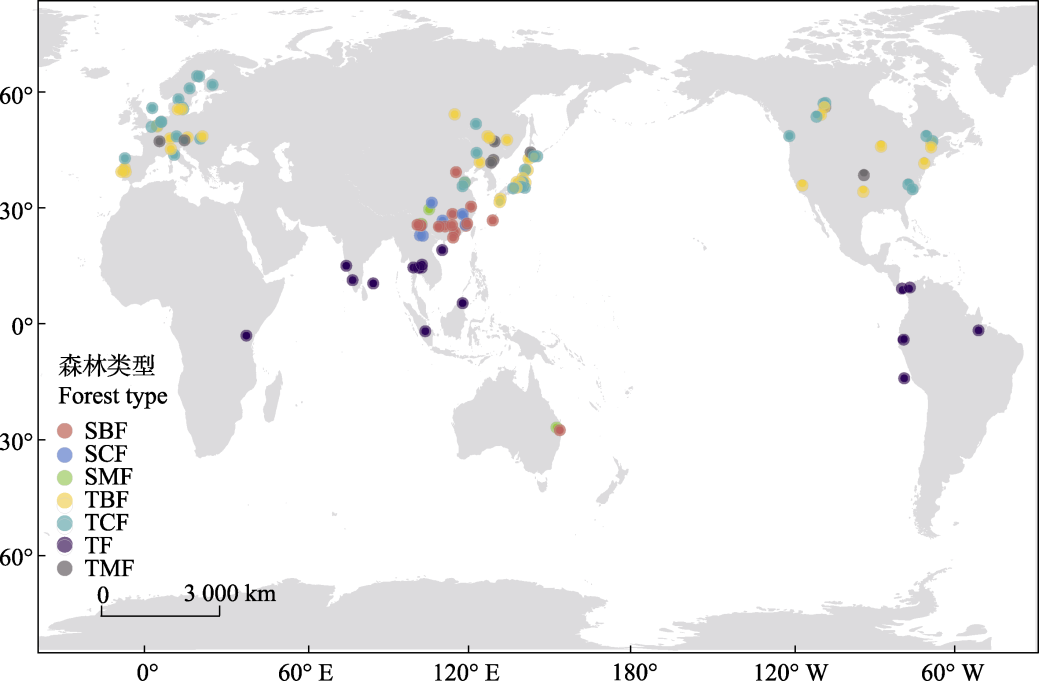
图1 森林土壤总氮转化速率研究地点的全球分布图。SBF, 亚热带阔叶林; SCF, 亚热带针叶林; SMF, 亚热带针阔混交林; TBF, 温带阔叶林; TCF, 温带针叶林; TMF, 温带针阔混交林; TF, 热带森林。
Fig. 1 Global distribution map of the forest soil gross nitrogen transformation rate research sites. SBF, subtropical broad-leaved forest; SCF, subtropical coniferous forest; SMF, subtropical coniferous and broad-leaved mixed forest; TBF, temperate broad-leaved forest; TCF, temperate coniferous forest; TMF, temperate coniferous and broad-leaved mixed forest; TF, tropical forest.
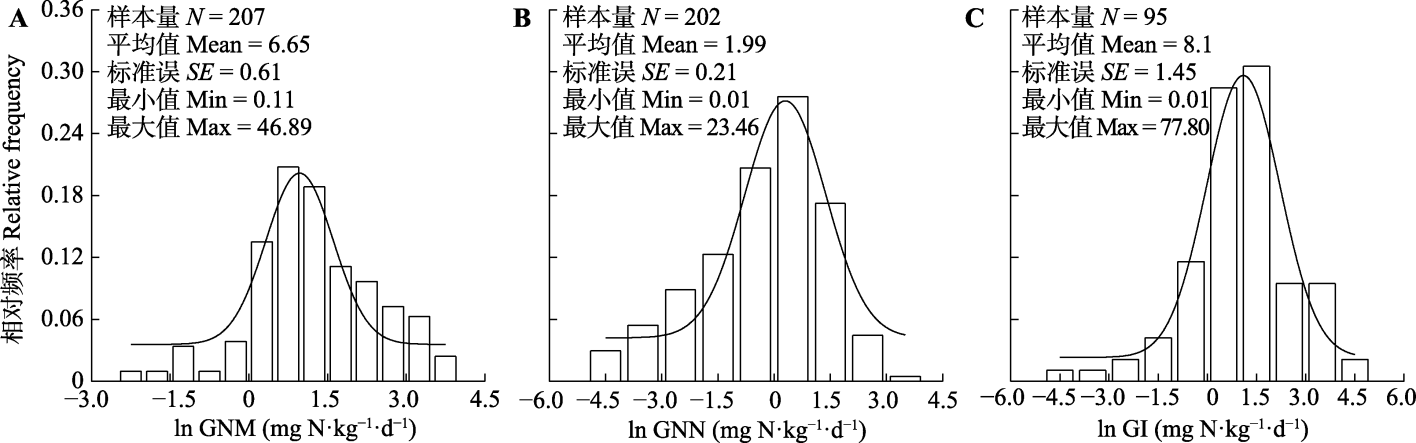
图2 全球森林土壤总氮矿化速率(GNM, A)、总硝化速率(GNN, B)和微生物氮固持速率(GI, C)的频率分布。
Fig. 2 Frequency distribution of soil gross nitrogen mineralization rates (GNM, A), gross nitrification rates (GNN, B) and microbial nitrogen immobilization rates (GI, C) among the global forests. N, sample number; SE, standard error.
| 森林类型 Forest type | 总氮矿化速率 GNM (mg N·kg-1·d-1) | 总硝化速率 GNN (mg N·kg-1·d-1) | 微生物氮固持速率 GI (mg N·kg-1·d-1) |
|---|---|---|---|
| 热带森林 Tropical forest | 8.43 ± 2.18ab (27) | 2.19 ± 0.52a (25) | 10.83 ± 4.94ab (9) |
| 亚热带阔叶林 Subtropical broad-leaved forest | 3.77 ± 0.57c (30) | 2.83 ± 0.70a (25) | 2.77 ± 0.55b (16) |
| 亚热带针叶林 Subtropical coniferous forest | 3.94 ± 1.52bc (20) | 2.03 ± 1.16a (20) | 3.86 ± 2.09b (17) |
| 亚热带针阔混交林 Subtropical mixed coniferous and broad-leaved forest | 3.37 ± 1.17c (5) | 2.68 ± 1.04a (5) | 4.34 ± 0.90b (4) |
| 温带阔叶林 Temperate broad-leaved forest | 7.15 ± 1.16abc (56) | 2.01 ± 0.38a (57) | 9.88 ± 2.88ab (24) |
| 温带针叶林 Temperate coniferous forest | 8.57 ± 1.33a (59) | 1.66 ± 0.28a (58) | 9.59 ± 3.98ab (13) |
| 温带针阔混交林 Temperate mixed coniferous and broad-leaved forest | 3.46 ± 1.06c (10) | 1.05 ± 0.40a (12) | 15.22 ± 7.29a (12) |
| 热带/亚热带森林 Tropical/subtropical forest | 5.32 ± 0.86 (82) | 2.39 ± 0.42 (75) | 4.88 ± 1.29 (46) |
| 温带森林 Temperate forest | 7.52 ± 0.82 (125) | 1.76 ± 0.21 (127) | 11.11 ± 2.47 (49) |
| 所有类型 Overall | 6.65 ± 0.61 (207) | 1.99 ± 0.21 (202) | 8.10 ± 1.45 (95) |
表1 不同森林类型间土壤总氮矿化速率、总硝化速率和微生物氮固持速率(平均值±标准误)
Table 1 Gross nitrogen (N) mineralization rates, gross nitrification rates and microbial N immobilization rates in various forest types (mean ± SE)
| 森林类型 Forest type | 总氮矿化速率 GNM (mg N·kg-1·d-1) | 总硝化速率 GNN (mg N·kg-1·d-1) | 微生物氮固持速率 GI (mg N·kg-1·d-1) |
|---|---|---|---|
| 热带森林 Tropical forest | 8.43 ± 2.18ab (27) | 2.19 ± 0.52a (25) | 10.83 ± 4.94ab (9) |
| 亚热带阔叶林 Subtropical broad-leaved forest | 3.77 ± 0.57c (30) | 2.83 ± 0.70a (25) | 2.77 ± 0.55b (16) |
| 亚热带针叶林 Subtropical coniferous forest | 3.94 ± 1.52bc (20) | 2.03 ± 1.16a (20) | 3.86 ± 2.09b (17) |
| 亚热带针阔混交林 Subtropical mixed coniferous and broad-leaved forest | 3.37 ± 1.17c (5) | 2.68 ± 1.04a (5) | 4.34 ± 0.90b (4) |
| 温带阔叶林 Temperate broad-leaved forest | 7.15 ± 1.16abc (56) | 2.01 ± 0.38a (57) | 9.88 ± 2.88ab (24) |
| 温带针叶林 Temperate coniferous forest | 8.57 ± 1.33a (59) | 1.66 ± 0.28a (58) | 9.59 ± 3.98ab (13) |
| 温带针阔混交林 Temperate mixed coniferous and broad-leaved forest | 3.46 ± 1.06c (10) | 1.05 ± 0.40a (12) | 15.22 ± 7.29a (12) |
| 热带/亚热带森林 Tropical/subtropical forest | 5.32 ± 0.86 (82) | 2.39 ± 0.42 (75) | 4.88 ± 1.29 (46) |
| 温带森林 Temperate forest | 7.52 ± 0.82 (125) | 1.76 ± 0.21 (127) | 11.11 ± 2.47 (49) |
| 所有类型 Overall | 6.65 ± 0.61 (207) | 1.99 ± 0.21 (202) | 8.10 ± 1.45 (95) |
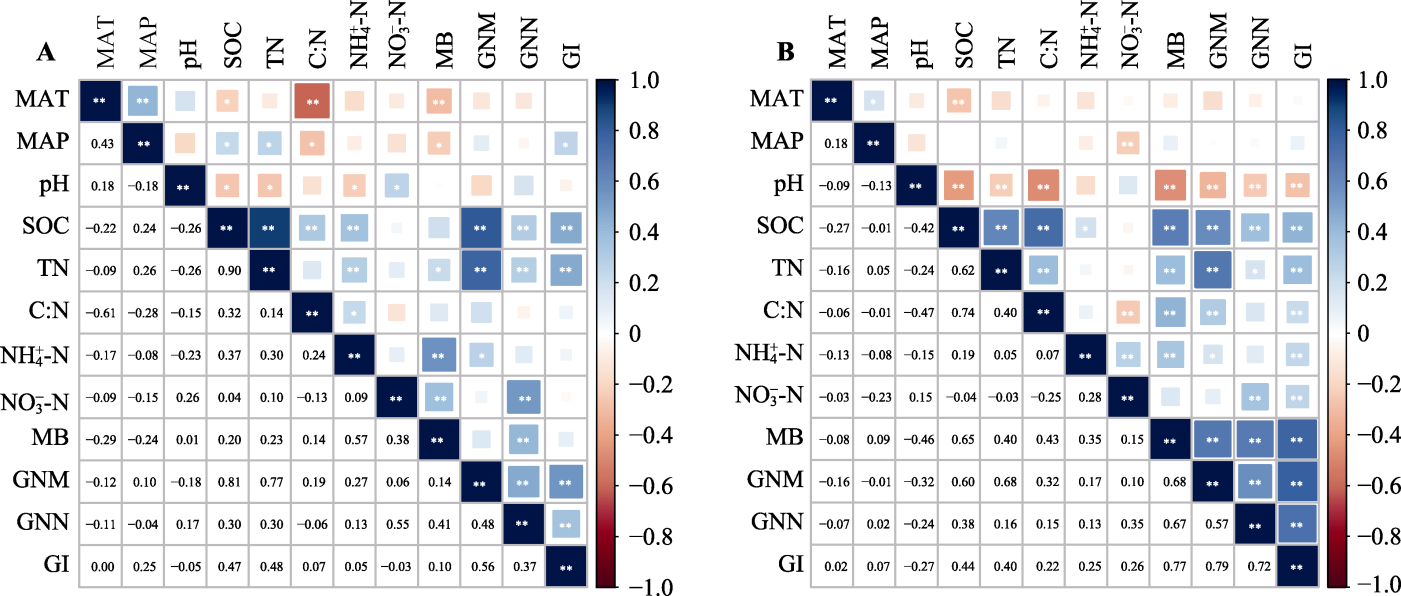
图3 热带/亚热带森林(A)和温带森林(B)土壤总氮转化速率与气候、土壤理化及微生物属性的相关关系。*, p < 0.05; **, p < 0.01。C:N, 土壤碳氮含量比; GI, 微生物氮固持速率; GNM, 总氮矿化速率; GNN, 总硝化速率; MAP, 年降水量; MAT, 年平均气温; MB, 微生物生物量含量; NH4+-N, 铵态氮含量; NO3--N, 硝态氮含量; TN, 土壤总氮含量。
Fig. 3 Relationships between soil gross nitrogen transformations and climate, soil physiochemical and microbial properties in tropical/subtropical forest (A) and temperate forest (B). *, p < 0.05; **, p < 0.01. C:N, soil carbon to nitrogen content ratio; GI, microbial nitrogen immobilization rates; GNM, gross nitrogen mineralization rates; GNN, gross nitrification rates; MAP, mean annual precipitation; MAT, mean annual air temperature; MB, microbial biomass content; NH4+-N, ammonium nitrogen content; NO3--N, nitrate nitrogen content; TN, soil total nitrogen content.
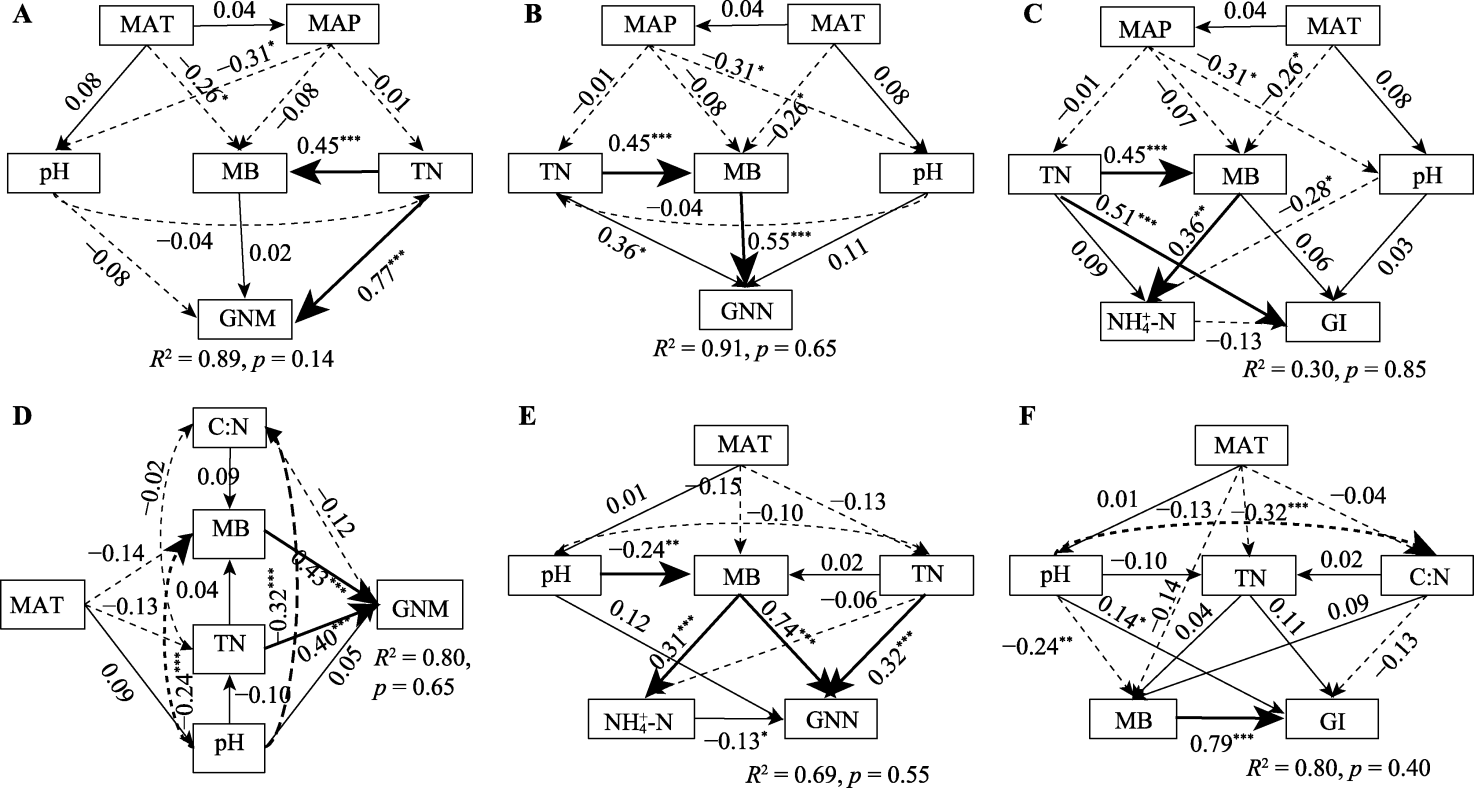
图4 气候因子、土壤理化性质和微生物属性调控土壤总氮转化速率的结构方程模型。A、B、C分别代表热带/亚热带森林土壤总氮矿化速率、总硝化速率和微生物氮固持速率。D、E、F分别代表温带森林土壤总氮矿化速率、总硝化速率和微生物氮固持速率。实线箭头表示正相关, 虚线箭头表示负相关, 线条的粗细表示变量之间影响的强度。C:N, 土壤碳氮含量比; GI, 微生物氮固持速率; GNM, 总氮矿化速率; GNN, 总硝化速率; MAP, 年降水量; MAT, 年平均气温; MB, 微生物生物量; NH4+-N, 铵态氮含量; NO3--N, 硝态氮含量; TN, 土壤总氮含量。*, p < 0.05; **, p < 0.01; ***, p < 0.001。
Fig. 4 Results of structural equation model analysis examining the effects of climatic, soil physiochemical and microbial properties on soil gross nitrogen transformations. A, B and C represent soil gross nitrogen mineralization rates, gross nitrification rates and microbial nitrogen immobilization rates in tropical/subtropical forest, respectively. D, E and F represent soil gross nitrogen mineralization rates, gross nitrification rates and microbial nitrogen immobilization rates in temperate forest, respectively. Solid arrows represent positive relationship, dashed arrows represent negative relationship, line thickness indicates the strength of the effects of variables on each other. C:N, soil carbon to nitrogen content ratio; GI, microbial nitrogen immobilization rates; GNM, gross nitrogen mineralization rates; GNN, gross nitrification rates; MAP, mean annual precipitation; MAT, mean annual temperature; MB, microbial biomass; NH4+-N, ammonium nitrogen content; NO3--N, nitrate nitrogen content; TN, soil total nitrogen content. *, p < 0.05; **, p < 0.01; ***, p < 0.001.
| [1] |
Ajwa HA, Dell CJ, Rice CW (1999). Changes in enzyme activities and microbial biomass of tallgrass prairie soil as related to burning and nitrogen fertilization. Soil Biology & Biochemistry, 31, 769-777.
DOI URL |
| [2] |
Anderson TH, Domsch KH (2010). Soil microbial biomass: the eco-physiological approach. Soil Biology & Biochemistry, 42, 2039-2043.
DOI URL |
| [3] |
Bai E, Li SL, Xu WH, Li W, Dai WW, Jiang P (2013). A meta-analysis of experimental warming effects on terrestrial nitrogen pools and dynamics. New Phytologist, 199, 441-451.
DOI URL |
| [4] |
Bargmann I, Martens R, Rillig MC, Kruse A, Kücke M (2014). Hydrochar amendment promotes microbial immobilization of mineral nitrogen. Journal of Plant Nutrition and Soil Science, 177, 59-67.
DOI URL |
| [5] |
Batjes NH (1996). Total carbon and nitrogen in the soils of the world. European Journal of Soil Science, 47, 151-163.
DOI URL |
| [6] |
Booth MS, Stark JM, Rastetter E (2005). Controls on nitrogen cycling in terrestrial ecosystems: a synthetic analysis of literature data. Ecological Monographs, 75, 139-157.
DOI URL |
| [7] | Cai FF, Luo PY, Yang JF, Irfan M, Zhang SY, An N, Dai J, Han XR (2021). Effect of long-term fertilization on ammonia-oxidizing microorganisms and nitrification in brown soil of northeast China. Frontiers in Microbiology, 11, 622454. DOI: 10.3389/fmicb.2020.622454. |
| [8] | Chapin III FS (2002). Principles of Terrestrial Ecosystem Ecology. Springer-Verlag, New York. 202-210. |
| [9] | Chen SD, Elrys AS, Yang WY, Du SW, He MQ, Cai ZC, Zhang JB, Müller C (2024). Soil recalcitrant but not labile organic nitrogen mineralization contributes to microbial nitrogen immobilization and plant nitrogen uptake. Global Change Biology, 30, e17290. DOI: 10.1111/gcb.17290. |
| [10] |
Chen ZM, Ding WX, Xu YH, Müller C, Rütting T, Yu HY, Fan JL, Zhang JB, Zhu TB (2015). Importance of heterotrophic nitrification and dissimilatory nitrate reduction to ammonium in a cropland soil: evidences from a 15N tracing study to literature synthesis. Soil Biology & Biochemistry, 91, 65-75.
DOI URL |
| [11] |
Cheng Y, Wang J, Mary B, Zhang JB, Cai ZC, Chang SX (2013). Soil pH has contrasting effects on gross and net nitrogen mineralizations in adjacent forest and grassland soils in central Alberta, Canada. Soil Biology & Biochemistry, 57, 848-857.
DOI URL |
| [12] |
Cheng Y, Wang J, Wang SQ, Zhang JB, Cai ZC (2014). Effects of soil moisture on gross N transformations and N2O emission in acid subtropical forest soils. Biology and Fertility of Soils, 50, 1099-1108.
DOI URL |
| [13] |
Corre MD, Beese FO, Brumme R (2003). Soil nitrogen cycle in high nitrogen deposition forest: changes under nitrogen saturation and liming. Ecological Applications, 13, 287-298.
DOI URL |
| [14] |
Corre MD, Veldkamp E, Arnold J, Wright SJ (2010). Impact of elevated N input on soil N cycling and losses in old-growth lowland and montane forests in Panama. Ecology, 91, 1715-1729.
PMID |
| [15] |
Dai ZM, Yu MJ, Chen HH, Zhao HC, Huang YL, Su WQ, Xia F, Chang SX, Brookes PC, Dahlgren RA, Xu JM (2020). Elevated temperature shifts soil N cycling from microbial immobilization to enhanced mineralization, nitrification and denitrification across global terrestrial ecosystems. Global Change Biology, 26, 5267-5276.
DOI URL |
| [16] |
Du EZ, Terrer C, Pellegrini AFA, Ahlström A, van Lissa CJ, Zhao X, Xia N, Wu XH, Jackson RB (2020). Global patterns of terrestrial nitrogen and phosphorus limitation. Nature Geoscience, 13, 221-226.
DOI |
| [17] |
Elrys AS, Ali A, Zhang HM, Cheng Y, Zhang JB, Cai ZC, Müller C, Chang SX (2021a). Patterns and drivers of global gross nitrogen mineralization in soils. Global Change Biology, 27, 5950-5962.
DOI URL |
| [18] |
Elrys AS, Wang J, Metwally MAS, Cheng Y, Zhang JB, Cai ZC, Chang SX, Müller C (2021b). Global gross nitrification rates are dominantly driven by soil carbon-to-nitrogen stoichiometry and total nitrogen. Global Change Biology, 27, 6512-6524.
DOI URL |
| [19] |
Elrys AS, Zhu QL, Jiang CL, Liu J, Sobhy HHH, Shen QL, Uwiragiye Y, Wu YZ, El-Tarabily KA, Meng L, Müller C, Zhang JB (2023). Global soil nitrogen cycle pattern and nitrogen enrichment effects: tropical versus subtropical forests. Global Change Biology, 29, 1905-1921.
DOI URL |
| [20] | Feyissa A, Yang F, Wu JJ, Chen Q, Zhang DD, Cheng XL (2021). Soil nitrogen dynamics at a regional scale along a precipitation gradient in secondary grassland of China. Science of the Total Environment, 781, 146736. DOI: 10.1016/j.scitotenv.2021.146736. |
| [21] |
Goyal S, Mishra MM, Dhankar SS, Kapoor KK, Batra R (1993). Microbial biomass turnover and enzyme-activities following the application of farmyard manure to filed soils with and without previous long-term applications. Biology and Fertility of Soils, 15, 60-64.
DOI URL |
| [22] |
Guntiñas ME, Leirós MC, Trasar-Cepeda C, Gil-Sotres F (2012). Effects of moisture and temperature on net soil nitrogen mineralization: a laboratory study. European Journal of Soil Biology, 48, 73-80.
DOI URL |
| [23] |
Gurmesa GA, Lu XK, Gundersen P, Mao QG, Zhou KJ, Fang YT, Mo JM (2016). High retention of 15N-labeled nitrogen deposition in a nitrogen saturated old-growth tropical forest. Global Change Biology, 22, 3608-3620.
DOI URL |
| [24] | He JH, Nie YX, Tan XP, Hu A, Li ZQ, Dai SP, Ye Q, Zhang GX, Shen WJ (2024). Latitudinal patterns and drivers of plant lignin and microbial necromass accumulation in forest soils: disentangling microbial and abiotic controls. Soil Biology & Biochemistry, 194, 109438. DOI: 10.1016/j.soilbio.2024.109438. |
| [25] |
Hirsch PR, Mauchline TH (2015). The importance of the microbial N cycle in soil for crop plant nutrition. Advances in Applied Microbiology, 93, 45-71.
DOI PMID |
| [26] |
Hu R, Wang XP, Pan YX, Zhang YF, Zhang H (2014). The response mechanisms of soil N mineralization under biological soil crusts to temperature and moisture in temperate desert regions. European Journal of Soil Biology, 62, 66-73.
DOI URL |
| [27] |
Ji YK, Ma N, Zhang H, Li CH, Ma YD, Wu QQ, Li Y (2024). Effect of seasonal distribution in precipitation on soil nitrogen mineralization in a subtropical forest. Chinese Journal of Applied Ecology, 35, 186-194.
DOI |
|
[纪永康, 马楠, 张慧, 李翠环, 马元丹, 武启骞, 李彦 (2024). 降水季节性分配对亚热带森林土壤氮矿化的影响. 应用生态学报, 35, 186-194.]
DOI |
|
| [28] |
Kaye JP, Binkley D, Rhoades C (2003). Stable soil nitrogen accumulation and flexible organic matter stoichiometry during primary floodplain succession. Biogeochemistry, 63, 1-22.
DOI |
| [29] |
Kemmitt SJ, Wright D, Goulding KWT, Jones DL (2006). pH regulation of carbon and nitrogen dynamics in two agricultural soils. Soil Biology & Biochemistry, 38, 898-911.
DOI URL |
| [30] | Kim DG, Kirschbaum MUF, Eichler-Löbermann B, Gifford RM, Liáng LL (2023). The effect of land-use change on soil C, N, P, and their stoichiometries: a global synthesis. Agriculture, Ecosystems & Environment, 348, 108402. DOI: 10.1016/j.agee.2023.108402. |
| [31] | Kou D, Peng YF, Wang GQ, Ding JZ, Chen YL, Yang GB, Fang K, Liu L, Zhang BB, Müller C, Zhang JB, Yang YH (2018). Diverse responses of belowground internal nitrogen cycling to increasing aridity. Soil Biology & Biochemistry, 116, 189-192. |
| [32] |
Lang M, Cai ZC, Mary B, Hao XY, Chang SX (2010). Land-use type and temperature affect gross nitrogen transformation rates in Chinese and Canadian soils. Plant and Soil, 334, 377-389.
DOI URL |
| [33] |
Lang M, Li P, Ti CP, Zhu SX, Yan XY, Chang SX (2019). Soil gross nitrogen transformations are related to land-uses in two agroforestry systems. Ecological Engineering, 127, 431-439.
DOI |
| [34] | Li GC, Han XG, Huang JH, Tang JW (2001). A review of affecting factors of soil nitrogen mineralization in forest ecosystems. Acta Ecologica Sinica, 21, 1187-1195. |
| [李贵才, 韩兴国, 黄建辉, 唐建维 (2001). 森林生态系统土壤氮矿化影响因素研究进展. 生态学报, 21, 1187-1195.] | |
| [35] |
Li ZL, Tian DS, Wang BX, Wang JS, Wang S, Chen HYH, Xu XF, Wang CH, He NP, Niu SL (2019). Microbes drive global soil nitrogen mineralization and availability. Global Change Biology, 25, 1078-1088.
DOI PMID |
| [36] |
Li ZL, Zeng ZQ, Song ZP, Wang FQ, Tian DS, Mi WH, Huang X, Wang JS, Song L, Yang ZK, Wang J, Feng HJ, Jiang LF, Chen Y, Luo YQ, Niu SL (2021). Vital roles of soil microbes in driving terrestrial nitrogen immobilization. Global Change Biology, 27, 1848-1858.
DOI PMID |
| [37] |
Li ZL, Zeng ZQ, Tian DS, Wang JS, Fu Z, Zhang FY, Zhang RY, Chen WN, Luo YQ, Niu SL (2020a). Global patterns and controlling factors of soil nitrification rate. Global Change Biology, 26, 4147-4157.
DOI URL |
| [38] | Li ZL, Zeng ZQ, Tian DS, Wang JS, Wang BX, Chen HYH, Quan Q, Chen WN, Yang JL, Meng C, Wang Y, Niu SL (2020b). Global variations and controlling factors of soil nitrogen turnover rate. Earth-Science Reviews, 207, 103250. DOI: 10.1016/j.earscirev.2020.103250. |
| [39] | Liu Q, Guo BY, Wu XY, Wang Y (2021). Carbon, nitrogen, and enzyme activity in saline-alkali soil on Songnen Plain as affected by land use. Fujian Journal of Agricultural Sciences, 36, 956-963. |
| [刘骞, 郭博雅, 伍秀瑜, 王悦 (2021). 松嫩平原盐碱土区不同土地利用方式对土壤碳、氮及酶活性的影响. 福建农业学报, 36, 956-963.] | |
| [40] |
Liu Y, Wang CH, He NP, Wen XF, Gao Y, Li SG, Niu SL, Butterbach-Bahl K, Luo YQ, Yu GR (2017). A global synthesis of the rate and temperature sensitivity of soil nitrogen mineralization: latitudinal patterns and mechanisms. Global Change Biology, 23, 455-464.
DOI PMID |
| [41] |
Lu L, Han WY, Zhang JB, Wu YC, Wang BZ, Lin XG, Zhu JG, Cai ZC, Jia ZJ (2012). Nitrification of archaeal ammonia oxidizers in acid soils is supported by hydrolysis of urea. The ISME Journal, 6, 1978-1984.
DOI URL |
| [42] |
Menyailo OV, Hungate BA, Zech W (2002). Tree species mediated soil chemical changes in a Siberian artificial afforestation experiment. Plant and Soil, 242, 171-182.
DOI |
| [43] | Risch AC, Zimmermann S, Ochoa-Hueso R, Schütz M, Frey B, Firn JL, Fay PA, Hagedorn F, Borer ET, Seabloom EW, Harpole WS, Knops JH, McCulley RL, Broadbent AD, Stevens CJ, et al. (2019). Soil net nitrogen mineralisation across global grasslands. Nature Communications, 10, 4981. DOI: 10.1038/s41467-019-12948-2. |
| [44] |
Stone MM, Weiss MS, Goodale CL, Adams MB, Fernandez IJ, German DP, Allison SD (2012). Temperature sensitivity of soil enzyme kinetics under N-fertilization in two temperate forests. Global Change Biology, 18, 1173-1184.
DOI URL |
| [45] |
Sun LF, Xia ZW, Sang CP, Wang X, Peng B, Wang C, Zhang JB, Müller C, Bai E (2019). Soil resource status affects the responses of nitrogen processes to changes in temperature and moisture. Biology and Fertility of Soils, 55, 629-641.
DOI |
| [46] |
Tong DL, Xu RK (2012). Effects of urea and (NH4)2SO4 on nitrification and acidification of ultisols from Southern China. Journal of Environmental Sciences, 24, 682-689.
DOI URL |
| [47] |
Wang CH, Wang NN, Zhu JX, Liu Y, Xu XF, Niu SL, Yu GR, Han XG, He NP (2018). Soil gross N ammonification and nitrification from tropical to temperate forests in Eastern China. Functional Ecology, 32, 83-94.
DOI URL |
| [48] | Wang GJ, Tian DL, Zhu F, Yan WD, Li SZ (2009). Net nitrogen mineralization in soils under four forest communities in Hunan Province. Acta Ecologica Sinica, 29, 1607-1615. |
| [王光军, 田大伦, 朱凡, 闫文德, 李树战 (2009). 湖南省4种森林群落土壤氮的矿化作用. 生态学报, 29, 1607-1615.] | |
| [49] | Wang NN, Li L, Dannenmann M, Luo YK, Xu XH, Zhang BW, Chen SP, Dong KH, Huang JH, Xu XF, Wang CH (2021). Seasonality of gross ammonification and nitrification altered by precipitation in a semi-arid grassland of Northern China. Soil Biology & Biochemistry, 154, 108146. DOI: 10.1016/j.soilbio.2021.108146. |
| [50] |
Xu L, He NP (2020). Nitrogen storage and allocation in China’s forest ecosystems. Science China Earth Sciences, 63, 1475-1484.
DOI |
| [徐丽, 何念鹏 (2020). 中国森林生态系统氮储量分配特征及其影响因素. 中国科学: 地球科学, 50, 1374-1385.] | |
| [51] | Xu S, Song XY, Zeng H, Wang JJ (2024). Soil microbial necromass carbon in forests: a global synthesis of patterns and controlling factors. Soil Ecology Letters, 6, 240237. DOI: 10.1007/s42832-024-0237-3. |
| [52] | Yang CD (2016). Decline of quantity and quality of soil organic matter is the key factor restricting the growth of plantation in China. Scientia Silvae Sinicae, 52(12), 1-12. |
| [杨承栋 (2016). 我国人工林土壤有机质的量和质下降是制约林木生长的关键因子. 林业科学, 52(12), 1-12.] | |
| [53] |
Zhang JB, Cheng Y, Cai ZC (2019). The mechanisms of soil regulating nitrogen dynamics. Advances in Earth Science, 34, 11-19.
DOI |
|
[张金波, 程谊, 蔡祖聪 (2019). 土壤调配氮素迁移转化的机理. 地球科学进展, 34, 11-19.]
DOI |
|
| [54] |
Zhao W, Zhang JB, Müller C, Cai ZC (2018). Effects of pH and mineralisation on nitrification in a subtropical acid forest soil. Soil Research, 56, 275-283.
DOI URL |
| [1] | 方迪, 马宁, 李胜功, 郑甲佳, 褚云馨, 杨锦昌, 杨赞明, 张龙宁, 孟盛旺, 高德才, 戴晓琴, 付晓莉, 王辉民, 寇亮. 菌根共生类型对森林养分内循环的调控作用[J]. 植物生态学报, 2026, 50(3): 552-565. |
| [2] | 张中扬, 宋希强, 任明迅, 张哲. 附生维管植物生境营建作用的生态学功能[J]. 植物生态学报, 2023, 47(7): 895-911. |
| [3] | 张尧, 陈岚, 王洁莹, 李益, 王俊, 郭垚鑫, 任成杰, 白红英, 孙昊田, 赵发珠. 太白山不同海拔森林根际土壤微生物碳利用效率差异性及其影响因素[J]. 植物生态学报, 2023, 47(2): 275-288. |
| [4] | 王嘉童, 牛春跃, 胡天宇, 李文楷, 刘玲莉, 郭庆华, 苏艳军. 三维辐射传输模型在森林生态系统研究中的应用与展望[J]. 植物生态学报, 2022, 46(10): 1200-1218. |
| [5] | 胡宗达, 刘世荣, 罗明霞, 胡璟, 刘兴良, 李亚非, 余昊, 欧定华. 川西亚高山不同演替阶段天然次生林土壤碳氮含量及酶活性特征[J]. 植物生态学报, 2020, 44(9): 973-985. |
| [6] | 杨文高, 字洪标, 陈科宇, 阿的鲁骥, 胡雷, 王鑫, 王根绪, 王长庭. 青海森林生态系统中灌木层和土壤生态化学计量特征[J]. 植物生态学报, 2019, 43(4): 352-364. |
| [7] | 冯婵莹, 郑成洋, 田地. 氮添加对森林植物磷含量的影响及其机制[J]. 植物生态学报, 2019, 43(3): 185-196. |
| [8] | 许浩, 胡朝臣, 许士麒, 孙新超, 刘学炎. 外来植物入侵对土壤氮有效性的影响[J]. 植物生态学报, 2018, 42(11): 1120-1130. |
| [9] | 王薪琪, 王传宽, 张泰东. 森林土壤碳氮循环过程的新视角: 丛枝与外生菌根树种的作用[J]. 植物生态学报, 2017, 41(10): 1113-1125. |
| [10] | 关晋宏, 杜盛, 程积民, 吴春荣, 李国庆, 邓磊, 张建国, 何秋月, 时伟宇. 甘肃省森林碳储量现状与固碳速率[J]. 植物生态学报, 2016, 40(4): 304-317. |
| [11] | 黄晓琼, 辛存林, 胡中民, 李钢铁, 张铜会, 赵玮, 杨浩, 张雷明, 郭群, 岳永杰, 高润宏, 乌志颜, 闫志刚, 刘新平, 李玉强, 李胜功. 内蒙古森林生态系统碳储量及其空间分布[J]. 植物生态学报, 2016, 40(4): 327-340. |
| [12] | 李银, 陈国科, 林敦梅, 陈彬, 高雷明, 简兴, 杨波, 徐武兵, 苏宏新, 赖江山, 王希华, 杨海波, 马克平. 浙江省森林生态系统碳储量及其分布特征[J]. 植物生态学报, 2016, 40(4): 354-363. |
| [13] | 黄宗胜, 喻理飞, 符裕红, 杨瑞. 茂兰退化喀斯特森林植被自然恢复中生态系统碳吸存特征[J]. 植物生态学报, 2015, 39(6): 554-564. |
| [14] | 崔高阳, 陈云明, 曹扬, 安淳淳. 陕西省森林生态系统碳储量分布格局分析[J]. 植物生态学报, 2015, 39(4): 333-342. |
| [15] | 崔高阳, 曹扬, 陈云明. 陕西省森林各生态系统组分氮磷化学计量特征[J]. 植物生态学报, 2015, 39(12): 1146-1155. |
| 阅读次数 | ||||||
|
全文 |
|
|||||
|
摘要 |
|
|||||
Copyright © 2026 版权所有 《植物生态学报》编辑部
地址: 北京香山南辛村20号, 邮编: 100093
Tel.: 010-62836134, 62836138; Fax: 010-82599431; E-mail: apes@ibcas.ac.cn, cjpe@ibcas.ac.cn
备案号: 京ICP备16067583号-19

