
植物生态学报 ›› 2025, Vol. 49 ›› Issue (11): 1817-1832.DOI: 10.17521/cjpe.2024.0388 cstr: 32100.14.cjpe.2024.0388
童金莲1, 张博纳1, 汤璐瑶1, 叶琳峰1, 李姝雯1, 谢江波1,2, 李彦1,2, 王忠媛1,2,*( )
)
收稿日期:2024-10-31
接受日期:2025-01-10
出版日期:2025-11-20
发布日期:2025-11-20
通讯作者:
*王忠媛(wangzhongyuan2014@163.com)基金资助:
TONG Jin-Lian1, ZHANG Bo-Na1, TANG Lu-Yao1, YE Lin-Feng1, LI Shu-Wen1, XIE Jiang-Bo1,2, LI Yan1,2, WANG Zhong-Yuan1,2,*()
Received:2024-10-31
Accepted:2025-01-10
Online:2025-11-20
Published:2025-11-20
Supported by:摘要: 揭示广布种功能性状及其适应策略的区域分异规律, 对预测植物在气候变化下的适应潜力具有重要意义。该研究以广布种狗尾草(Setaria viridis)为实验对象, 沿降水梯度带选取9个样点, 测量了狗尾草茎和叶器官水碳相关的18个功能性状, 采用性状网络与主成分分析等方法, 阐明其生境适应策略。结果表明: (1)狗尾草在湿润区具有最大的导管直径和比叶质量; 在半湿润/半干旱区具有最高的单位面积最大净光合速率、解剖学最大气孔导度和气孔面积分数; 在干旱区具有最大的导管厚度跨度比和单位质量最大净光合速率; 反映了狗尾草在不同区域的适应策略。(2)随着降水的减少, 性状之间的关联变少, 网络的连通性降低, 复杂性增加。性状间正相关关系占比在半湿润/半干旱区达到最大, 此时植物性状间表现出最佳的协作关系, 可能与此区域水、光资源配置达到平衡有关。(3) 9个样点性状网络的结果表明狗尾草沿降水梯度带的适应主要由气孔性状调控。该研究对预测气候变化背景下的植物/植被响应及其潜在适应机制具有重要意义。
童金莲, 张博纳, 汤璐瑶, 叶琳峰, 李姝雯, 谢江波, 李彦, 王忠媛. C4植物狗尾草功能性状网络沿降水梯度带的区域分异规律. 植物生态学报, 2025, 49(11): 1817-1832. DOI: 10.17521/cjpe.2024.0388
TONG Jin-Lian, ZHANG Bo-Na, TANG Lu-Yao, YE Lin-Feng, LI Shu-Wen, XIE Jiang-Bo, LI Yan, WANG Zhong-Yuan. Regional differentiation of functional trait network of C4 plants Setaria viridis along precipitation gradient. Chinese Journal of Plant Ecology, 2025, 49(11): 1817-1832. DOI: 10.17521/cjpe.2024.0388
| 区域 Region | 样点 Site | 缩写 Abbreviation | LON (° E) | LAT (° N) | MAP (mm) | GST (℃) | PAR (mol·m-2·d-1) | AI |
|---|---|---|---|---|---|---|---|---|
| 湿润区 Humid zone | 安徽宣城 Xuancheng, Anhui | AHXC | 118.78 | 30.34 | 1 394.61 | 25.31 | 38.41 | 1.12 |
| 安徽六安 Luan, Anhui | AHLA | 115.44 | 31.53 | 1 134.24 | 25.22 | 40.03 | 1.19 | |
| 河南信阳 Xinyang, Henan | HNXY | 113.85 | 32.07 | 1 082.29 | 24.74 | 40.16 | 1.92 | |
| 半湿润/半干旱区 Semiarid/semihumid zone | 河南三门峡 Sanmenxia, Henan | HNSMX | 110.54 | 34.49 | 555.64 | 23.81 | 41.09 | 3.78 |
| 陕西铜川 Tongchuan, Shaanxi | SXTC | 109.14 | 35.40 | 584.43 | 20.29 | 44.17 | 2.69 | |
| 宁夏吴忠 Wuzhong, Ningxia | NXWZ | 105.78 | 36.46 | 235.59 | 20.50 | 49.76 | 6.80 | |
| 干旱区 Arid zone | 甘肃张掖 Zhangye, Gansu | GSZY | 100.18 | 39.23 | 131.72 | 19.55 | 50.26 | 13.88 |
| 甘肃酒泉 Jiuquan, Gansu | GSJQ | 98.64 | 39.67 | 81.85 | 19.18 | 51.96 | 21.57 | |
| 新疆哈密 Hami, Xinjiang | XJHM | 93.45 | 42.62 | 44.17 | 23.37 | 54.47 | 40.88 |
表1 9个狗尾草研究样点地理概况及气候特征
Table 1 Environmental features and climatic characteristics of the nine study sites
| 区域 Region | 样点 Site | 缩写 Abbreviation | LON (° E) | LAT (° N) | MAP (mm) | GST (℃) | PAR (mol·m-2·d-1) | AI |
|---|---|---|---|---|---|---|---|---|
| 湿润区 Humid zone | 安徽宣城 Xuancheng, Anhui | AHXC | 118.78 | 30.34 | 1 394.61 | 25.31 | 38.41 | 1.12 |
| 安徽六安 Luan, Anhui | AHLA | 115.44 | 31.53 | 1 134.24 | 25.22 | 40.03 | 1.19 | |
| 河南信阳 Xinyang, Henan | HNXY | 113.85 | 32.07 | 1 082.29 | 24.74 | 40.16 | 1.92 | |
| 半湿润/半干旱区 Semiarid/semihumid zone | 河南三门峡 Sanmenxia, Henan | HNSMX | 110.54 | 34.49 | 555.64 | 23.81 | 41.09 | 3.78 |
| 陕西铜川 Tongchuan, Shaanxi | SXTC | 109.14 | 35.40 | 584.43 | 20.29 | 44.17 | 2.69 | |
| 宁夏吴忠 Wuzhong, Ningxia | NXWZ | 105.78 | 36.46 | 235.59 | 20.50 | 49.76 | 6.80 | |
| 干旱区 Arid zone | 甘肃张掖 Zhangye, Gansu | GSZY | 100.18 | 39.23 | 131.72 | 19.55 | 50.26 | 13.88 |
| 甘肃酒泉 Jiuquan, Gansu | GSJQ | 98.64 | 39.67 | 81.85 | 19.18 | 51.96 | 21.57 | |
| 新疆哈密 Hami, Xinjiang | XJHM | 93.45 | 42.62 | 44.17 | 23.37 | 54.47 | 40.88 |
| 性状 Trait | 缩写 Abbreviation | 单位 Unit |
|---|---|---|
| 最大净光合速率(光饱和CO2同化率) Maximum net photosynthetic rate | Pn | µmol·m-2·s-1 |
| 最大蒸腾速率 Maximum transpiration rate | Tr | mmol·m-2·s-1 |
| 最大可操作气孔导度 Maximized operational stomatal conductance | Gs | mol·m-2·s-1 |
| 水分利用效率 Water use efficiency | WUE | μmol·mmol−1 |
| 比叶质量 Leaf mass per unit area | LMA | g·m-2 |
| 单位质量最大净光合速率 Maximum net photosynthetic rate per unit leaf mass | Amass | µmol·g-1·s-1 |
| 叶脉密度 Vein density | Vd | mm·mm-2 |
| 气孔密度 Stomatal density | Sd | pore·mm-2 |
| 气孔大小 Stomatal size | Ss | μm2 |
| 气孔面积分数 Stomatal area fraction | Sf | % |
| 解剖学最大气孔导度 Anatomical maximum stomatal conductance | gsmax | mol·m-2·s-1 |
| 气孔打开比率 Stomatal opening ratio | gratio | % |
| 叶导管直径 Leaf vessel diameter | Dleaf | μm |
| 叶导管壁厚 Leaf thickness of vessel wall | TWleaf | μm |
| 叶导管厚度跨度比 Leaf thickness-to-span ratio | (t/b)leaf | μm·μm-1 |
| 茎导管直径 Stem vessel diameter | Dstem | μm |
| 茎导管壁厚 Stem thickness of vessel wall | TWstem | μm |
| 茎导管厚度跨度比 Stem thickness-to-span ratio | (t/b)stem | μm·μm-1 |
表2 本研究中所测量的功能性状
Table 2 List for traits related to this study
| 性状 Trait | 缩写 Abbreviation | 单位 Unit |
|---|---|---|
| 最大净光合速率(光饱和CO2同化率) Maximum net photosynthetic rate | Pn | µmol·m-2·s-1 |
| 最大蒸腾速率 Maximum transpiration rate | Tr | mmol·m-2·s-1 |
| 最大可操作气孔导度 Maximized operational stomatal conductance | Gs | mol·m-2·s-1 |
| 水分利用效率 Water use efficiency | WUE | μmol·mmol−1 |
| 比叶质量 Leaf mass per unit area | LMA | g·m-2 |
| 单位质量最大净光合速率 Maximum net photosynthetic rate per unit leaf mass | Amass | µmol·g-1·s-1 |
| 叶脉密度 Vein density | Vd | mm·mm-2 |
| 气孔密度 Stomatal density | Sd | pore·mm-2 |
| 气孔大小 Stomatal size | Ss | μm2 |
| 气孔面积分数 Stomatal area fraction | Sf | % |
| 解剖学最大气孔导度 Anatomical maximum stomatal conductance | gsmax | mol·m-2·s-1 |
| 气孔打开比率 Stomatal opening ratio | gratio | % |
| 叶导管直径 Leaf vessel diameter | Dleaf | μm |
| 叶导管壁厚 Leaf thickness of vessel wall | TWleaf | μm |
| 叶导管厚度跨度比 Leaf thickness-to-span ratio | (t/b)leaf | μm·μm-1 |
| 茎导管直径 Stem vessel diameter | Dstem | μm |
| 茎导管壁厚 Stem thickness of vessel wall | TWstem | μm |
| 茎导管厚度跨度比 Stem thickness-to-span ratio | (t/b)stem | μm·μm-1 |
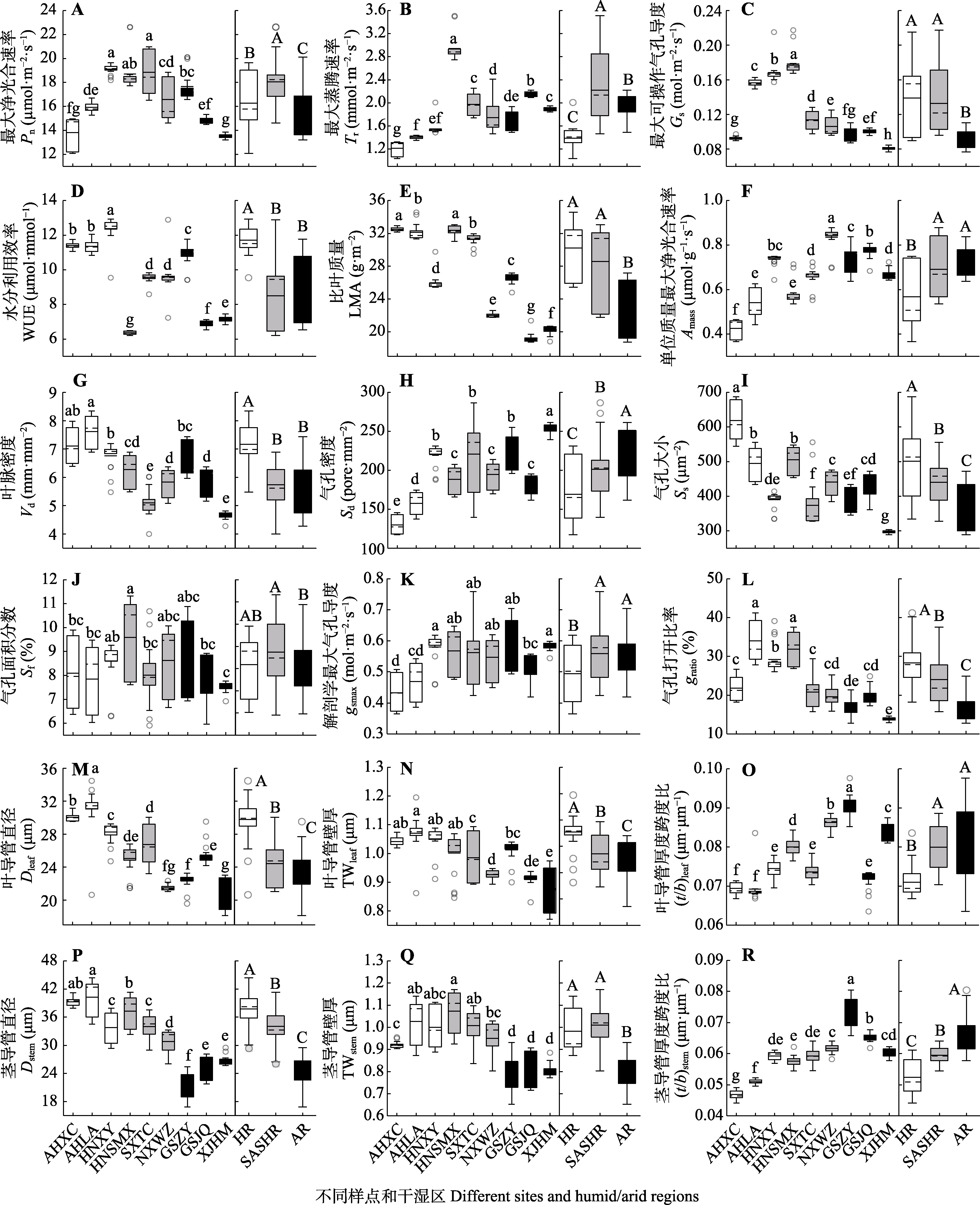
图1 狗尾草功能性状在不同样点和干湿区间的差异。不同小写字母表示样点间差异显著(p < 0.05), 不同大写字母表示干湿区间差异显著(p < 0.05)。实线为平均值, 虚线为中值。样点和功能性状缩写见表1和表2。AR, 干旱区; HR, 湿润区; SASHR, 半湿润/半干旱区。
Fig. 1 Difference in Setaria viridis functional traits among different study sites and regions. Different lowercase letters indicate significance difference among study sites (p < 0.05), and different uppercase letters indicate significant difference among regions (p < 0.05). The solid line is the mean and the dotted line is the median. Site names the full functional trait names can be found in Table 1 and Table 2. AR, arid region; HR, humid region; SASHR, semiarid/semihumid region.
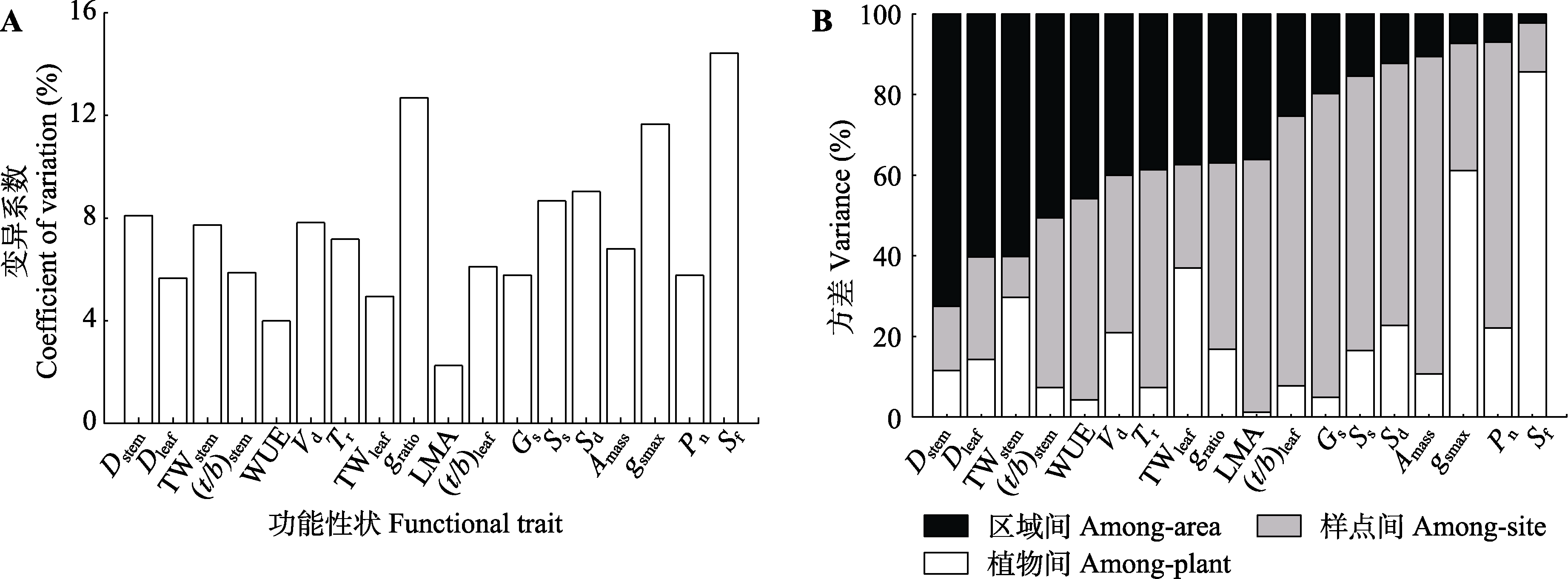
图2 狗尾草功能性状在9个样点间的平均变异系数(A)及嵌套方差分析(B)。功能性状缩写见表2。
Fig. 2 Coefficient of variation in Setaria viridis traits among the nine studied sites (A) and variance components of the studied traits based on nested ANOVAs (B). The full trait names can be found in Table 2.
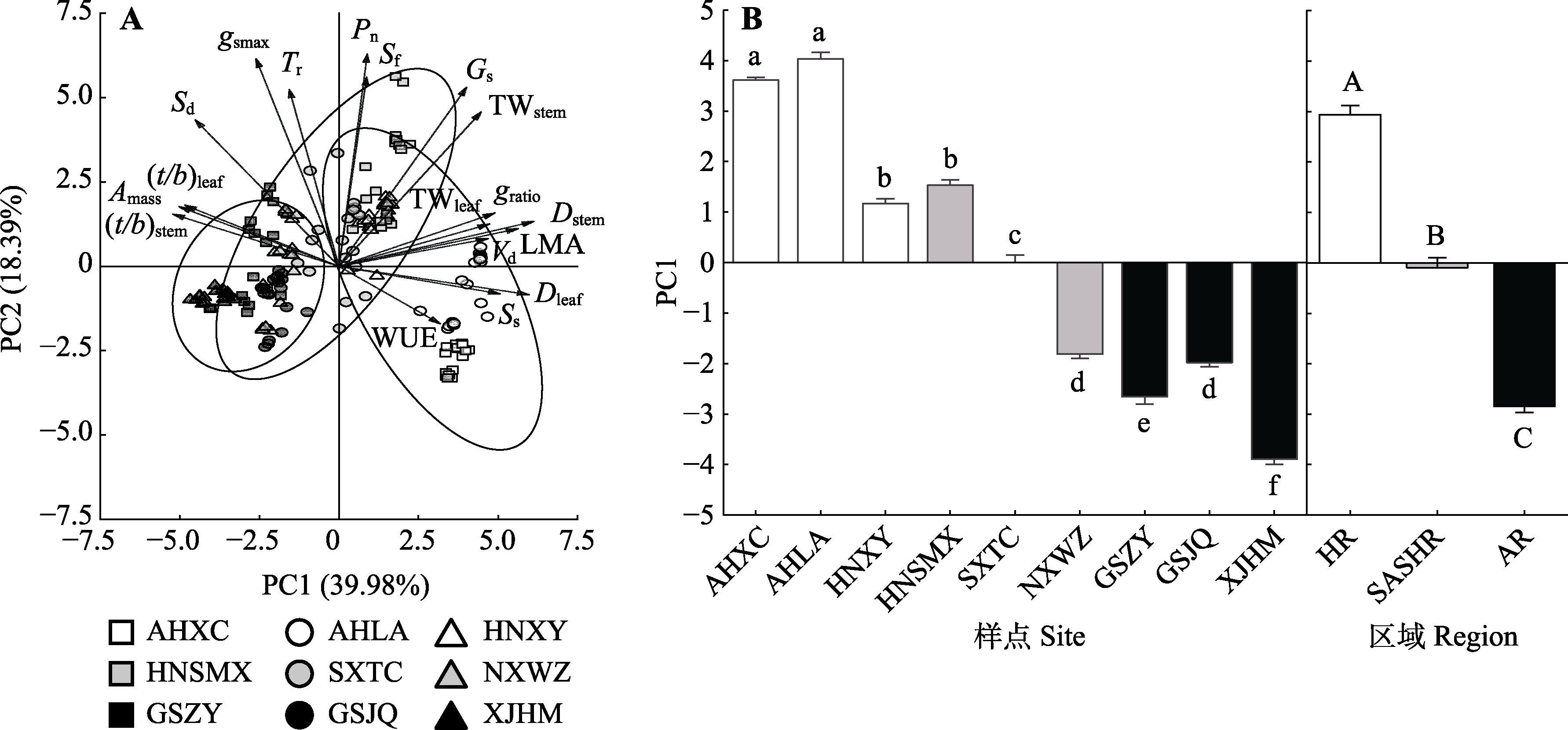
图3 狗尾草18个功能性状在主成分分析(PCA)前两轴的空间中的分布(A)及各样点和干湿区在第一轴得分上的差异(B, 平均值±标准误)。不同小写字母表示样点间差异显著(p < 0.05), 不同大写字母表示干湿区间差异显著(p < 0.05)。样点缩写见表1。功能性状缩写见表2。AR, 干旱区; HR, 湿润区; SASHR, 半湿润/半干旱区。
Fig. 3 The first two principal components analysis (PCA) axes of the 18 functional traits in Setaria viridis (A), and the scores of the first principal components analysis (PCA) axis among different study sites and regions (B, mean ± SE). Different lowercase letters indicate significance difference among study sites (p < 0.05), and different uppercase letters indicate significant difference among regions (p < 0.05). Full site names can be found in Table 1, and full functional trait names can be found in Table 2. AR, arid region; HR, humid region; SASHR, semiarid/semihumid region.
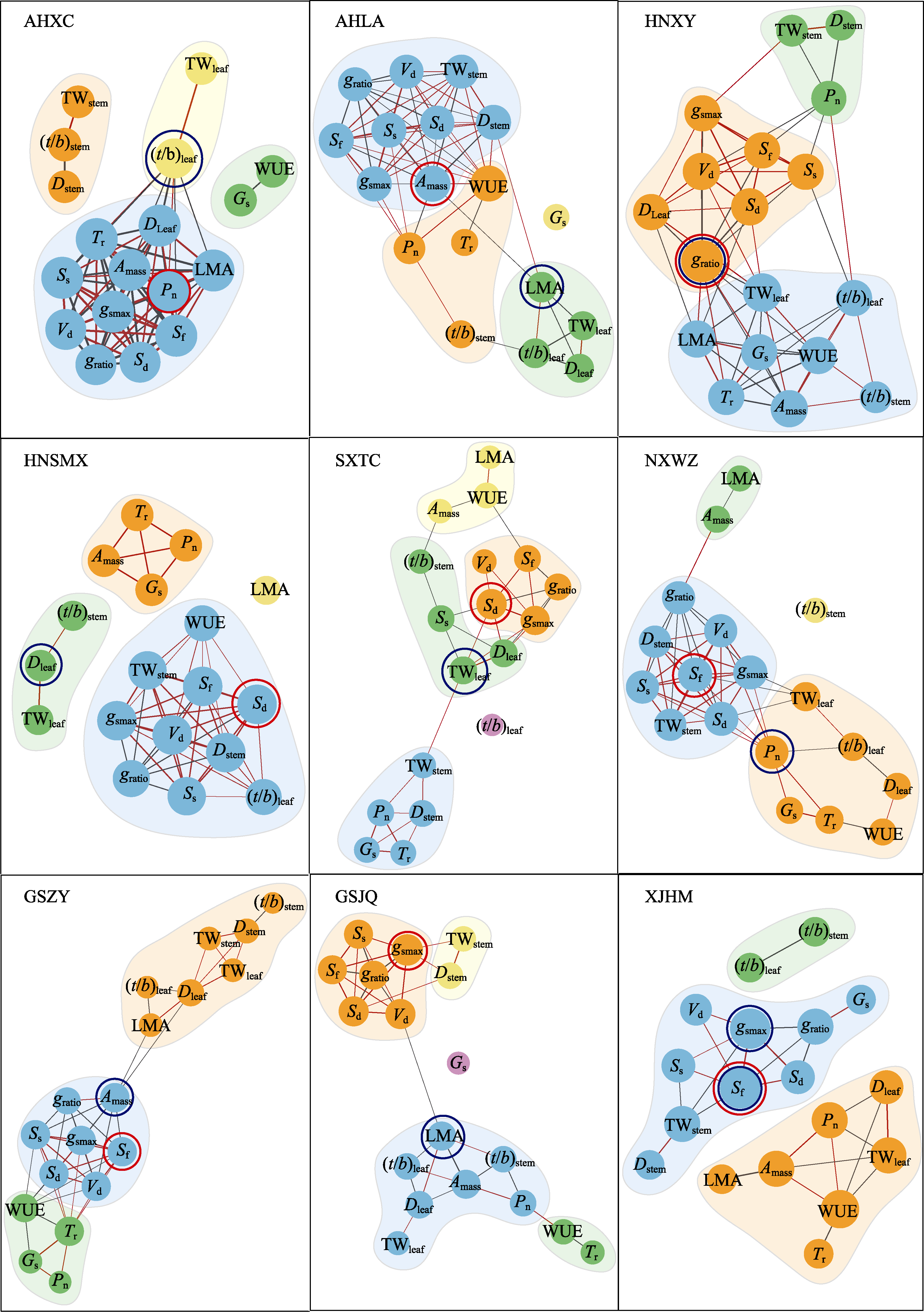
图4 狗尾草功能性状网络图。红圈标记为中心性状, 蓝圈标记为中介性状。边的长度代表性状间的距离, 红色和灰色连接线分别代表正相关关系和负相关关系, 线越粗则相关性越强。相同颜色的性状代表在同一模块。样点缩写见表1。功能性状缩写见表2。
Fig. 4 Trait network of Setaria viridis at each study site. The hub trait is labeled as red circles, and the intermediate trait is labeled as blue circles. The length of the edge represents the distance between the traits. Red and gray lines represent positive and negative correlations, respectively. Thicker lines indicate stronger correlations. The traits from the same module is represented in same color. Site names are shown in Table 1. Functional trait names are shown in Table 2.
| 样点 Site | 平均路径长度 Average path length | 边密度 Edge density | 模块度 Modularity | 边数量 Edge number | 权衡边比例 Trade-off edge ratio (%) |
|---|---|---|---|---|---|
| 安徽宣城 Xuancheng, Anhui | 1.22 | 0.44 | 0.09 | 67 | 52 |
| 安徽六安 Luan, Anhui | 1.84 | 0.40 | 0.22 | 61 | 39 |
| 河南信阳 Xinyang, Henan | 1.76 | 0.41 | 0.35 | 62 | 45 |
| 河南三门峡 Sanmenxia, Henan | 1.11 | 0.31 | 0.31 | 48 | 15 |
| 陕西铜川 Tongchuan, Shaanxi | 2.88 | 0.20 | 0.46 | 31 | 35 |
| 宁夏吴忠 Wuzhong, Ningxia | 2.23 | 0.30 | 0.23 | 46 | 30 |
| 甘肃张掖 Zhangye, Gansu | 2.40 | 0.31 | 0.36 | 48 | 46 |
| 甘肃酒泉 Jiuquan, Gansu | 2.85 | 0.22 | 0.46 | 33 | 39 |
| 新疆哈密 Hami, Xinjiang | 1.71 | 0.18 | 0.53 | 27 | 52 |
| 整体 Whole | 1.17 | 0.83 | 0.08 | 127 | 37 |
表3 9个样点狗尾草功能性状网络的差异
Table 3 Differences of functional trait networks of Setaria viridis in 9 study sites
| 样点 Site | 平均路径长度 Average path length | 边密度 Edge density | 模块度 Modularity | 边数量 Edge number | 权衡边比例 Trade-off edge ratio (%) |
|---|---|---|---|---|---|
| 安徽宣城 Xuancheng, Anhui | 1.22 | 0.44 | 0.09 | 67 | 52 |
| 安徽六安 Luan, Anhui | 1.84 | 0.40 | 0.22 | 61 | 39 |
| 河南信阳 Xinyang, Henan | 1.76 | 0.41 | 0.35 | 62 | 45 |
| 河南三门峡 Sanmenxia, Henan | 1.11 | 0.31 | 0.31 | 48 | 15 |
| 陕西铜川 Tongchuan, Shaanxi | 2.88 | 0.20 | 0.46 | 31 | 35 |
| 宁夏吴忠 Wuzhong, Ningxia | 2.23 | 0.30 | 0.23 | 46 | 30 |
| 甘肃张掖 Zhangye, Gansu | 2.40 | 0.31 | 0.36 | 48 | 46 |
| 甘肃酒泉 Jiuquan, Gansu | 2.85 | 0.22 | 0.46 | 33 | 39 |
| 新疆哈密 Hami, Xinjiang | 1.71 | 0.18 | 0.53 | 27 | 52 |
| 整体 Whole | 1.17 | 0.83 | 0.08 | 127 | 37 |
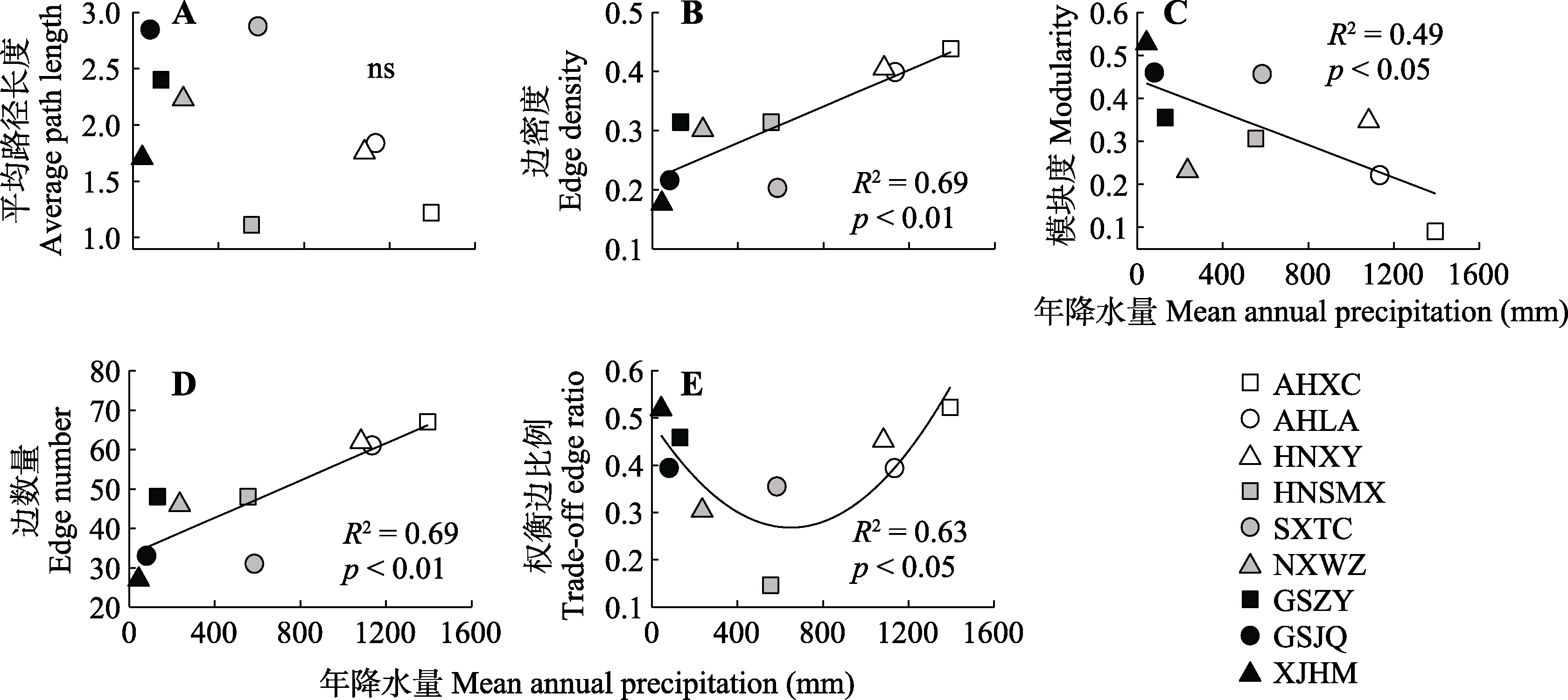
图5 年降水量与狗尾草功能性状网络平均路径长度(A)、边密度(B)、模块度(C)、边数量(D)和权衡边比例(E)的关系。ns, p > 0.05。样点名称见表1。
Fig. 5 Relationship of mean annual precipitation and average path length (A), edge density (B), modularity (C), edge number (D) and trade-off edge number (E) of trait coordination network of Setaria viridis. ns, p > 0.05.
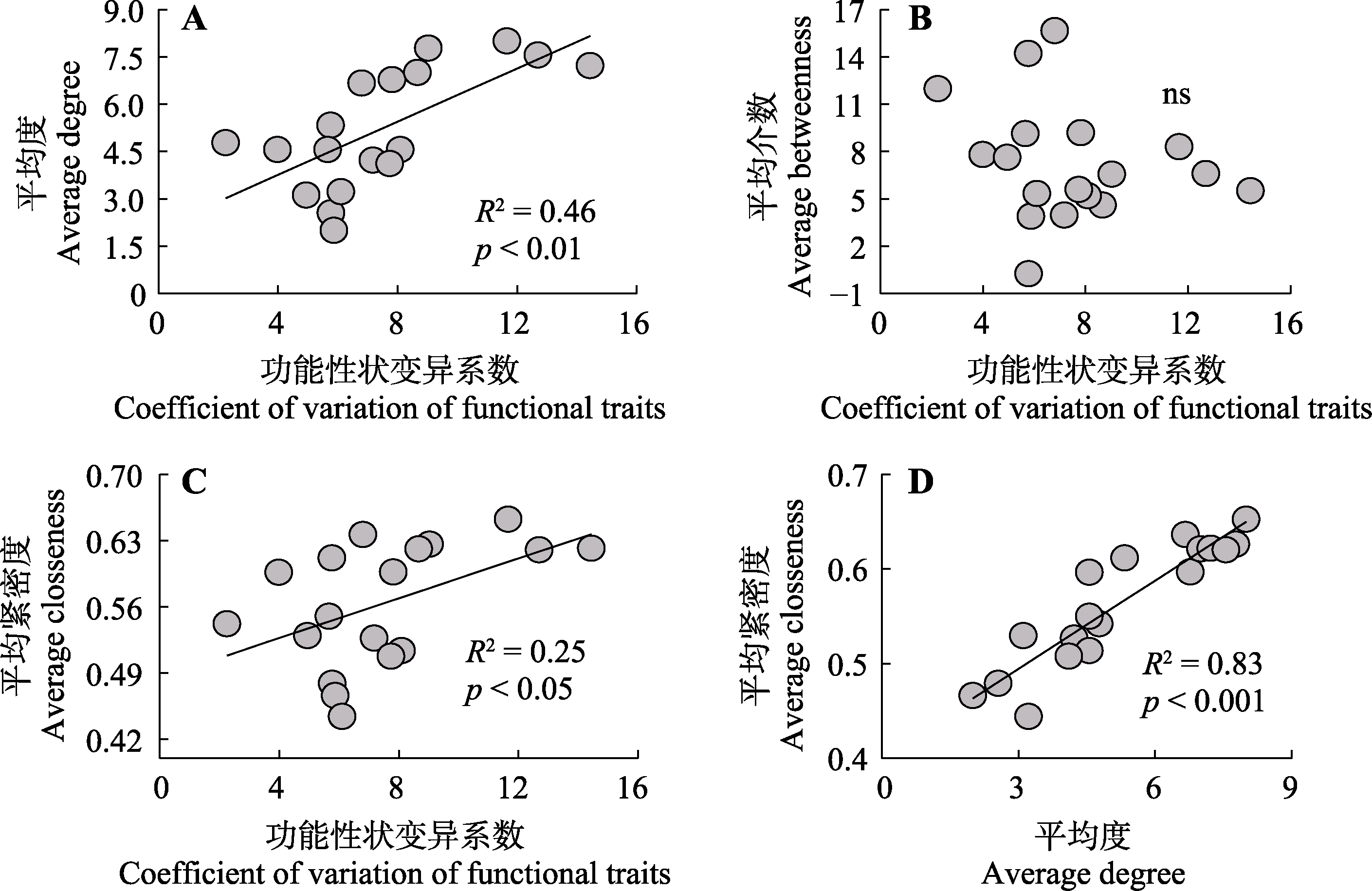
图6 狗尾草功能性状变异系数与平均度(A)、平均介数(B)、平均紧密度(C)的关系以及平均度与平均紧密度的关系(D)。ns, p > 0.05。
Fig. 6 Relationship of coefficient of variation of traits and average degree (A), average betweenness (B), average closeness (C), and the relationship between average degree and average closeness (D). ns, p > 0.05.
| [1] |
Ackerly D (2004). Functional strategies of chaparral shrubs in relation to seasonal water deficit and disturbance. Ecological Monographs, 74, 25-44.
DOI URL |
| [2] | Aggarwal PR, Pramitha L, Choudhary P, Singh RK, Shukla P, Prasad M, Muthamilarasan M (2022). Multi-omics intervention in Setaria to dissect climate-resilient traits: progress and prospects. Frontiers in Plant Science, 13, 892736. DOI: 10.3389/fpls.2022.892736. |
| [3] | Bonfanti J, Krogh PH, Hedde M, Cortet J (2023). Ecomorphosis in European Collembola: a review in the context of trait-based ecology. Applied Soil Ecology, 182, 104692. DOI: 10.1016/j.apsoil.2022.104692. |
| [4] |
Choat B, Medek DE, Stuart SA, Pasquet-Kok J, Egerton JJG, Salari H, Sack L, Ball MC (2011). Xylem traits mediate a trade-off between resistance to freeze-thaw-induced embolism and photosynthetic capacity in overwintering evergreens. New Phytologist, 191, 996-1005.
DOI PMID |
| [5] |
Cornwell WK, Bhaskar R, Sack L, Cordell S, Lunch CK (2007). Adjustment of structure and function of Hawaiian Metrosideros polymorpha at high vs. low precipitation. Functional Ecology, 21, 1063-1071.
DOI URL |
| [6] |
Craine JM, Lee WG, Bond WJ, Williams RJ, Johnson LC (2005). Environmental constraints on a global relationship among leaf and root traits of grasses. Ecology, 86, 12-19.
DOI URL |
| [7] |
Deans RM, Brodribb TJ, Busch FA, Farquhar GD (2020). Optimization can provide the fundamental link between leaf photosynthesis, gas exchange and water relations. Nature Plants, 6, 1116-1125.
DOI PMID |
| [8] |
Drake PL, Froend RH, Franks PJ (2013). Smaller, faster stomata: scaling of stomatal size, rate of response, and stomatal conductance. Journal of Experimental Botany, 64, 495-505.
DOI PMID |
| [9] | Du BM, Zhu YH, Kang HZ, Liu CJ (2021). Spatial variations in stomatal traits and their coordination with leaf traits in Quercus variabilis across Eastern Asia. Science of the Total Environment, 789, 147757. DOI: 10.1016/j.scitotenv.2021.147757. |
| [10] |
Flores-Moreno H, Fazayeli F, Banerjee A, Datta A, Kattge J, Butler EE, Atkin OK, Wythers K, Chen M, Anand M, Bahn M, Byun C, Cornelissen JHC, Craine J, Gonzalez-Melo A, et al. (2019). Robustness of trait connections across environmental gradients and growth forms. Global Ecology and Biogeography, 28, 1806-1826.
DOI |
| [11] |
Franks PJ, Beerling DJ (2009). Maximum leaf conductance driven by CO2 effects on stomatal size and density over geologic time. Proceedings of the National Academy of Sciences of the United States of America, 106, 10343-10347.
DOI PMID |
| [12] |
Franks PJ, Drake PL, Beerling DJ (2009). Plasticity in maximum stomatal conductance constrained by negative correlation between stomatal size and density: an analysis using Eucalyptus globulus. Plant, Cell & Environment, 32, 1737-1748.
DOI URL |
| [13] |
Gilarranz LJ, Rayfield B, Liñán-Cembrano G, Bascompte J, Gonzalez A (2017). Effects of network modularity on the spread of perturbation impact in experimental metapopulations. Science, 357, 199-201.
DOI PMID |
| [14] | Griffin-Nolan RJ, Sandel B (2023). Global intraspecific trait-climate relationships for grasses are linked to a species’ typical form and function. Ecography, 2023, e06586. DOI: 10.1111/ecog.06586. |
| [15] |
Hacke UG, Sperry JS (2001). Functional and ecological xylem anatomy. Perspectives in Plant Ecology, Evolution and Systematics, 4, 97-115.
DOI URL |
| [16] |
Hacke UG, Spicer R, Schreiber SG, Plavcová L (2017). An ecophysiological and developmental perspective on variation in vessel diameter. Plant, Cell & Environment, 40, 831-845.
DOI URL |
| [17] |
Haworth M, Marino G, Loreto F, Centritto M (2021). Integrating stomatal physiology and morphology: evolution of stomatal control and development of future crops. Oecologia, 197, 867-883.
DOI PMID |
| [18] | He JL, Wang JN, Zhou TY, Song YK, Cha L, Shi N, Wu Y (2021). Responses of stem and leaf traits of Rhododendron przewalskii to altitude in the southeastern Qinghai-Tibet Plateau. Acta Ecologica Sinica, 41, 2349-2358. |
| [何家莉, 王金牛, 周天阳, 宋怡珂, 查琳, 石凝, 吴彦 (2021). 青藏高原东南缘陇蜀杜鹃当年生小枝茎叶性状对海拔变化的响应. 生态学报, 41, 2349-2358.] | |
| [19] |
He NP, Li Y, Liu CC, Xu L, Li MX, Zhang JH, He JS, Tang ZY, Han XG, Ye Q, Xiao CW, Yu Q, Liu SR, Sun W, Niu SL, et al. (2020). Plant trait networks: improved resolution of the dimensionality of adaptation. Trends in Ecology & Evolution, 35, 908-918.
DOI URL |
| [20] |
Hetherington AM, Ian Woodward F (2003). The role of stomata in sensing and driving environmental change. Nature, 424, 901-908.
DOI |
| [21] | IPCC (2021). Climate Change 2021: The Physical Science Basis. Contribution of Working Group I to the Sixth Assessment Report of the Intergovernmental Panel on Climate Change. Cambridge University Press, Cambridge, UK. |
| [22] |
Kleyer M, Trinogga J, Cebrián-Piqueras MA, Trenkamp A, Fløjgaard C, Ejrnæs R, Bouma TJ, Minden V, Maier M, Mantilla-Contreras J, Albach DC, Blasius B (2019). Trait correlation network analysis identifies biomass allocation traits and stem specific length as hub traits in herbaceous perennial plants. Journal of Ecology, 107, 829-842.
DOI URL |
| [23] |
Kooyers NJ (2015). The evolution of drought escape and avoidance in natural herbaceous populations. Plant Science, 234, 155-162.
DOI PMID |
| [24] |
Lawson AM, Weir JT (2014). Latitudinal gradients in climatic-niche evolution accelerate trait evolution at high latitudes. Ecology Letters, 17, 1427-1436.
DOI PMID |
| [25] |
Lawson T, Matthews J (2020). Guard cell metabolism and stomatal function. Annual Review of Plant Biology, 71, 273-302.
DOI PMID |
| [26] |
Lens F, Sperry JS, Christman MA, Choat B, Rabaey D, Jansen S (2011). Testing hypotheses that link wood anatomy to cavitation resistance and hydraulic conductivity in the genus Acer. New Phytologist, 190, 709-723.
DOI URL |
| [27] | Li JW, Dong LB, Liu YL, Wu JZ, Wang J, Shangguan ZP, Deng L (2022a). Soil organic carbon variation determined by biogeographic patterns of microbial carbon and nutrient limitations across a 3 000-km humidity gradient in China. Catena, 209, 105849. DOI: 10.1016/j.catena.2021.105849. |
| [28] |
Li L, McCormack ML, Ma CG, Kong DL, Zhang Q, Chen XY, Zeng H, Niinemets Ü, Guo DL (2015). Leaf economics and hydraulic traits are decoupled in five species-rich tropical-subtropical forests. Ecology Letters, 18, 899-906.
DOI PMID |
| [29] | Li Y (2020). Variation of Leaf Trait Network Among Different Vegetation Types and Its Influencing Factors. PhD dissertation, Beijing Forestry University, Beijing. 69. |
| [李颖 (2020). 叶片性状网络在不同植被类型间的变异规律及其影响因素. 博士学位论文, 北京林业大学, 北京. 69.] | |
| [30] |
Li Y, Liu CC, Sack L, Xu L, Li MX, Zhang JH, He NP (2022b). Leaf trait network architecture shifts with species-richness and climate across forests at continental scale. Ecology Letters, 25, 1442-1457.
DOI URL |
| [31] | Li Y, Liu CC, Xu L, Li MX, Zhang JH, He NP (2021). Leaf trait networks based on global data: representing variation and adaptation in plants. Frontiers in Plant Science, 12, 710530. DOI: 10.3389/fpls.2021.710530. |
| [32] |
Liu CC, He NP, Zhang JH, Li Y, Wang QF, Sack L, Yu GR (2018). Variation of stomatal traits from cold temperate to tropical forests and association with water use efficiency. Functional Ecology, 32, 20-28.
DOI URL |
| [33] |
Liu GF, Freschet GT, Pan X, Cornelissen JHC, Li Y, Dong M (2010). Coordinated variation in leaf and root traits across multiple spatial scales in Chinese semi-arid and arid ecosystems. New Phytologist, 188, 543-553.
DOI PMID |
| [34] | Liu XJ, Ma KP (2015). Plant functional traits—Concepts, applications and future directions. Scientia Sinica (Vitae), 45, 325-339. |
| [刘晓娟, 马克平 (2015). 植物功能性状研究进展. 中国科学: 生命科学, 45, 325-339.] | |
| [35] | Lu H, Sun M, Ma Y, Si M, Xie J, Wang Z, Wu T, Li Y, Zhang H (2022). Contrasting patterns of variation in foliar pH between a woody species and an herbaceous species along a 3300 km water availability gradient in China. Catena, 216, 106408. DOI: 10.1016/j.catena.2022.106408. |
| [36] |
Matthews JSA, Vialet-Chabrand S, Lawson T (2020). Role of blue and red light in stomatal dynamic behaviour. Journal of Experimental Botany, 71, 2253-2269.
DOI PMID |
| [37] | McElwain JC, Yiotis C, Lawson T (2016). Using modern plant trait relationships between observed and theoretical maximum stomatal conductance and vein density to examine patterns of plant macroevolution. New Phytologist, 209, 94-103. |
| [38] |
Messier J, Lechowicz MJ, McGill BJ, Violle C, Enquist BJ (2017). Interspecific integration of trait dimensions at local scales: the plant phenotype as an integrated network. Journal of Ecology, 105, 1775-1790.
DOI URL |
| [39] |
Messier J, McGill BJ, Lechowicz MJ (2010). How do traits vary across ecological scales? A case for trait-based ecology. Ecology Letters, 13, 838-848.
DOI PMID |
| [40] |
Osnas JLD, Katabuchi M, Kitajima K, Wright SJ, Reich PB, Van Bael SA, Kraft NJB, Samaniego MJ, Pacala SW, Lichstein JW (2018). Divergent drivers of leaf trait variation within species, among species, and among functional groups. Proceedings of the National Academy of Sciences of the United States of America, 115, 5480-5485.
DOI PMID |
| [41] |
Pittermann J, Sperry JS (2003). Tracheid diameter is the key trait determining the extent of freezing-induced embolism in conifers. Tree Physiology, 23, 907-914.
PMID |
| [42] |
Pittermann J, Sperry JS (2006). Analysis of freeze-thaw embolism in conifers. The interaction between cavitation pressure and tracheid size. Plant Physiology, 140, 374-382.
PMID |
| [43] |
Poorter H, Lambers H, Evans JR (2014). Trait correlation networks: a whole-plant perspective on the recently criticized leaf economic spectrum. New Phytologist, 201, 378-382.
DOI PMID |
| [44] |
Rao QY, Chen JF, Chou QC, Ren WJ, Cao T, Zhang M, Xiao HQ, Liu ZG, Chen J, Su HJ, Xie P (2023). Linking trait network parameters with plant growth across light gradients and seasons. Functional Ecology, 37, 1732-1746.
DOI URL |
| [45] |
Rosas T, Mencuccini M, Barba J, Cochard H, Saura‐Mas S, Martínez-Vilalta J (2019). Adjustments and coordination of hydraulic, leaf and stem traits along a water availability gradient. New Phytologist, 223, 632-646.
DOI PMID |
| [46] |
Schleuning M, García D, Tobias JA (2023). Animal functional traits: towards a trait-based ecology for whole ecosystems. Functional Ecology, 37, 4-12.
DOI URL |
| [47] |
Sobral M (2021). All traits are functional: an evolutionary viewpoint. Trends in Plant Science, 26, 674-676.
DOI URL |
| [48] |
Tang LY, Fang J, Qian HR, Zhang BN, Shangguan FJ, Ye LF, Li SW, Tong JL, Xie JB (2023). Variation and coordination in functional traits along the tree height of Taxodium distichum and Taxodium distichum var.imbricatum.. Chinese Journal of Plant Ecology, 47, 1561-1575.
DOI URL |
|
[汤璐瑶, 方菁, 钱海蓉, 张博纳, 上官方京, 叶琳峰, 李姝雯, 童金莲, 谢江波 (2023). 落羽杉和池杉功能性状随高度的变异与协同. 植物生态学报, 47, 1561-1575.]
DOI |
|
| [49] |
Tilman D (1981). Tests of resource competition theory using four species of Lake Michigan algae. Ecology, 62, 802-815.
DOI URL |
| [50] |
Travassos-Lins J, de Oliveira Rocha CC, de Souza Rodrigues T, Alves-Ferreira M (2021). Evaluation of the molecular and physiological response to dehydration of two accessions of the model plant Setaria viridis. Plant Physiology and Biochemistry, 169, 211-223.
DOI PMID |
| [51] |
Tyree MT, Davis SD, Cochard H (1994). Biophysical perspectives of xylem evolution: Is there a tradeoff of hydraulic efficiency for vulnerability to dysfunction? IAWA Journal, 15, 335-360.
DOI URL |
| [52] |
Wall S, Vialet-Chabrand S, Davey P, Van Rie J, Galle A, Cockram J, Lawson T (2022). Stomata on the abaxial and adaxial leaf surfaces contribute differently to leaf gas exchange and photosynthesis in wheat. New Phytologist, 235, 1743-1756.
DOI URL |
| [53] | Wolf A, Anderegg WRL, Pacala SW (2016). Optimal stomatal behavior with competition for water and risk of hydraulic impairment. Proceedings of the National Academy of Sciences of the United States of America, 113, E7222-E7230. |
| [54] |
Wright IJ, Reich PB, Cornelissen JHC, Falster DS, Groom PK, Hikosaka K, Lee W, Lusk CH, Niinemets Ü, Oleksyn J, Osada N, Poorter H, Warton DI, Westoby M (2005). Modulation of leaf economic traits and trait relationships by climate. Global Ecology and Biogeography, 14, 411-421.
DOI URL |
| [55] |
Wright IJ, Reich PB, Westoby M, Ackerly DD, Baruch Z, Bongers F, Cavender-Bares J, Chapin T, Cornelissen JHC, Diemer M, Flexas J, Garnier E, Groom PK, Gulias J, Hikosaka K, et al. (2004). The worldwide leaf economics spectrum. Nature, 428, 821-827.
DOI |
| [56] |
Xie JB, Wang ZY, Li Y (2022). Stomatal opening ratio mediates trait coordinating network adaptation to environmental gradients. New Phytologist, 235, 907-922.
DOI PMID |
| [57] |
Xu HY, Wang H, Colin Prentice I, Harrison SP, Wright IJ (2021). Coordination of plant hydraulic and photosynthetic traits: confronting optimality theory with field measurements. New Phytologist, 232, 1286-1296.
DOI PMID |
| [58] |
Yu HY, Chen YT, Zhou GS, Xu ZZ (2022). Coordination of leaf functional traits under climatic warming in an arid ecosystem. BMC plant biology, 22, 439. DOI: 10.1186/s12870-022-03818-z.
PMID |
| [59] |
Yamauchi S, Mano S, Oikawa K, Hikino K, Teshima KM, Kimori Y, Nishimura M, Shimazaki KI, Takemiya A (2019). Autophagy controls reactive oxygen species homeostasis in guard cells that is essential for stomatal opening. Proceedings of the National Academy of Sciences of the United States of America, 116, 19187-19192.
DOI PMID |
| [60] | Yuan GX, Tan XY, Guo PQ, Xing K, Chen ZL, Li DB, Yu SZ, Peng H, Li W, Fu H, Jeppesen E (2023). Linking trait network to growth performance of submerged macrophytes in response to ammonium pulse. Water Research, 229, 119403. DOI: 10.1016/j.watres.2022.119403. |
| [61] | Zhang JH, Ren TT, Yang JJ, Xu L, Li MX, Zhang YH, Han XG, He NP (2021). Leaf multi-element network reveals the change of species dominance under nitrogen deposition. Frontiers in Plant Science, 12, 580340. DOI: 10.3389/fpls.2021.580340. |
| [62] |
Zhao WL, Chen YJ, Brodribb TJ, Cao KF (2016). Weak co-ordination between vein and stomatal densities in 105 angiosperm tree species along altitudinal gradients in Southwest China. Functional Plant Biology, 43, 1126-1133.
DOI URL |
| [63] | Zheng D, Yang QY, Wu SH (2015). General Introduction to Natural Geography of China. Science Press, Beijing. 79. |
| [郑度, 杨勤业, 吴绍洪 (2015). 中国自然地理总论. 科学出版社, 北京. 79.] | |
| [64] |
Zhong QL, Liu LB, Xu X, Yang Y, Guo YM, Xu HY, Cai XL, Ni J (2018). Variations of plant functional traits and adaptive strategy of woody species in a karst forest of central Guizhou Province, southwestern China. Chinese Journal of Plant Ecology, 42, 562-572.
DOI URL |
|
[钟巧连, 刘立斌, 许鑫, 杨勇, 郭银明, 许海洋, 蔡先立, 倪健 (2018). 黔中喀斯特木本植物功能性状变异及其适应策略. 植物生态学报, 42, 562-572.]
DOI |
|
| [65] | Zhu CM, Yang JN, Shyu C (2017). Setaria comes of age: meeting report on the second international Setaria genetics conference. Frontiers in Plant Science, 8, 1562. DOI: 10.3389/fpls.2017.01562. |
| [66] | Zhu TS, Jiang WX, Shen HL, Yuan JJ, Chen J, Gong Z, Wang LH, Zhang M, Rao QY (2023). Characteristics of plant trait network and its influencing factors in impounded lakes and channel rivers of South-to-North Water Transfer Project, China. Frontiers in Plant Science, 14, 1127209. DOI: 10.3389/fpls.2023.1127209. |
| [1] | 段建林, 孟晟, 陈仁利, 熊林峰, 卢春洋, 席念勋. 全球变化因子多样性对菌根植物性状的影响[J]. , 2026, 50(预发表): 0-. |
| [2] | 戴丽君, 向玲艺, 蹇陈, 王晓锋. 三峡回水扰动增强入库小流域河岸带典型草本植物功能性状的局域分化[J]. 植物生态学报, 2026, 50(2): 442-460. |
| [3] | 张永军, 李敬东, 安琦, 洪翎桂, 任正炜, 张蕊, 周小龙. 氮添加和增温对天山高寒草地群落性状的影响[J]. 植物生态学报, 2026, 50(2): 417-428. |
| [4] | 郑子仪, 陈江慧, 刘慧颖. 气候变暖提高青藏高原高寒草甸优势物种的根系分泌速率[J]. 植物生态学报, 2025, 49(9): 1363-1373. |
| [5] | 崔冬晴, 田晨, 宋慧敏, 鲁小名, 萨其日, 徐国庆, 杨培志, 白永飞, 田建卿. 典型草原优势植物根际细菌群落多样性和功能群组成对长期放牧的响应机制[J]. 植物生态学报, 2025, 49(7): 1163-1176. |
| [6] | 张箫荻, 王晓霞, 章毓文, 侯靖雨, 石骁鹏, 和璐璐, 刘亚栋, 薛柳, 何宝华, 段劼. 北京山区三种林下灌木水力结构、叶片功能性状及其环境适应策略[J]. 植物生态学报, 2025, 49(7): 1128-1143. |
| [7] | 杜英杰, 范爱连, 王雪, 闫晓俊, 陈廷廷, 贾林巧, 姜琦, 陈光水. 亚热带天然常绿阔叶林乔木树种与林下灌木树种根-叶功能性状协调性及差异[J]. 植物生态学报, 2025, 49(4): 585-595. |
| [8] | 李姝雯, 汤璐瑶, 张博纳, 叶琳峰, 童金莲, 谢江波, 李彦, 王忠媛. 降水梯度带榆树枝叶协作关系的区域分异规律[J]. 植物生态学报, 2025, 49(2): 282-294. |
| [9] | 宋思宇, 杜飘, 林琴, 齐祥, 杜柯芋, 李聪, 陈亚梅, 黄尤优, 刘洋. 高山灌木扩张梯度下植物叶片与根系酚类物质的响应特征[J]. 植物生态学报, 2025, 49(12): 2119-2136. |
| [10] | 张晓婷, 王俊杰. 盐和铜处理下红树植物叶绿素荧光特性变化与叶片结构及生化组分关系[J]. 植物生态学报, 2025, 49(11): 1944-1956. |
| [11] | 秦嘉晨, 王欢, 朱江, 王扬, 田晨, 白永飞, 杨培志, 郑淑霞. 基于种内与种间性状变异的放牧过滤作用及其尺度效应[J]. 植物生态学报, 2024, 48(7): 858-871. |
| [12] | 文佳, 张新娜, 王娟, 赵秀海, 张春雨. 性状调节幼苗存活率对邻体竞争和环境的响应[J]. 植物生态学报, 2024, 48(6): 719-729. |
| [13] | 付粱晨, 丁宗巨, 唐茂, 曾辉, 朱彪. 北京东灵山白桦和蒙古栎的根际效应及其季节动态[J]. 植物生态学报, 2024, 48(4): 508-522. |
| [14] | 徐铭泽, 赵洪贤, 李成, 李满乐, 田赟, 刘鹏, 查天山. 季节尺度毛乌素沙地黑沙蒿的叶片性状网络特征及驱动因素[J]. 植物生态学报, 2024, 48(12): 1650-1665. |
| [15] | 王思琦, 金光泽. 五角槭不同生活史阶段叶枝根性状的变异与权衡[J]. 植物生态学报, 2024, 48(11): 1510-1523. |
| 阅读次数 | ||||||
|
全文 |
|
|||||
|
摘要 |
|
|||||
Copyright © 2026 版权所有 《植物生态学报》编辑部
地址: 北京香山南辛村20号, 邮编: 100093
Tel.: 010-62836134, 62836138; Fax: 010-82599431; E-mail: apes@ibcas.ac.cn, cjpe@ibcas.ac.cn
备案号: 京ICP备16067583号-19

