
植物生态学报 ›› 2025, Vol. 49 ›› Issue (9): 1424-1433.DOI: 10.17521/cjpe.2025.0006 cstr: 32100.14.cjpe.2025.0006
吕卫东, 董全民, 孙彩彩, 刘文亭, 刘玉祯, 张振祥, 李梦棋, 杨晓霞*( )
)
收稿日期:2025-01-02
接受日期:2025-04-16
出版日期:2025-09-20
发布日期:2025-04-17
通讯作者:
*杨晓霞 (xxyang@qhu.edu.cn)基金资助:
LÜ Wei-Dong, DONG Quan-Min, SUN Cai-Cai, LIU Wen-Ting, LIU Yu-Zhen, ZHANG Zhen-Xiang, LI Meng-Qi, YANG Xiao-Xia*()
Received:2025-01-02
Accepted:2025-04-16
Online:2025-09-20
Published:2025-04-17
Supported by:摘要: 高寒草地作为全球生态系统的重要组成部分, 对气候变化和人类活动尤为敏感。植物和微生物碳、氮库是草地生态系统碳、氮库的重要组成部分。放牧作为高寒草地主要利用方式, 直接决定了植物与土壤微生物对碳、氮资源的分配、储存与利用。该研究在青海省海北州西海镇设置不同放牧方式试验, 即: 不放牧(CK), 单独牦牛放牧(YG), 单独藏羊放牧(SG), 牦牛藏羊分别以1:2、1:4、1:6的比例混合放牧。结果发现, 在碳库方面, 未放牧处理下高寒草地植物群落碳库和微生物生物量碳库含量分别是930.81和58.43 g·m-2。牦牛单独放牧显著降低了植物群落碳库, 却不影响微生物生物量碳库; 混合放牧同样降低植物群落碳库, 但显著增加了微生物生物量碳库。对氮库而言, 未放牧处理下高寒草地植物群落氮库和微生物生物量氮库含量分别是20.50和11.87 g·m-2。牦牛、藏羊单独放牧时植物群落氮库无变化, 微生物生物量氮库显著增加; 混合放牧则显著减少植物群落氮库, 而微生物生物量氮库不受影响。以上结果表明: 即使是中度放牧, 不同的放牧方式也会对植物群落碳、氮库和微生物生物量碳、氮库产生不同的效应。
吕卫东, 董全民, 孙彩彩, 刘文亭, 刘玉祯, 张振祥, 李梦棋, 杨晓霞. 牦牛和藏羊放牧对高寒草地植物和微生物碳氮库的影响. 植物生态学报, 2025, 49(9): 1424-1433. DOI: 10.17521/cjpe.2025.0006
LÜ Wei-Dong, DONG Quan-Min, SUN Cai-Cai, LIU Wen-Ting, LIU Yu-Zhen, ZHANG Zhen-Xiang, LI Meng-Qi, YANG Xiao-Xia. Effects of yak and Tibetan sheep grazing on plant and microbial carbon and nitrogen pools in alpine grassland. Chinese Journal of Plant Ecology, 2025, 49(9): 1424-1433. DOI: 10.17521/cjpe.2025.0006
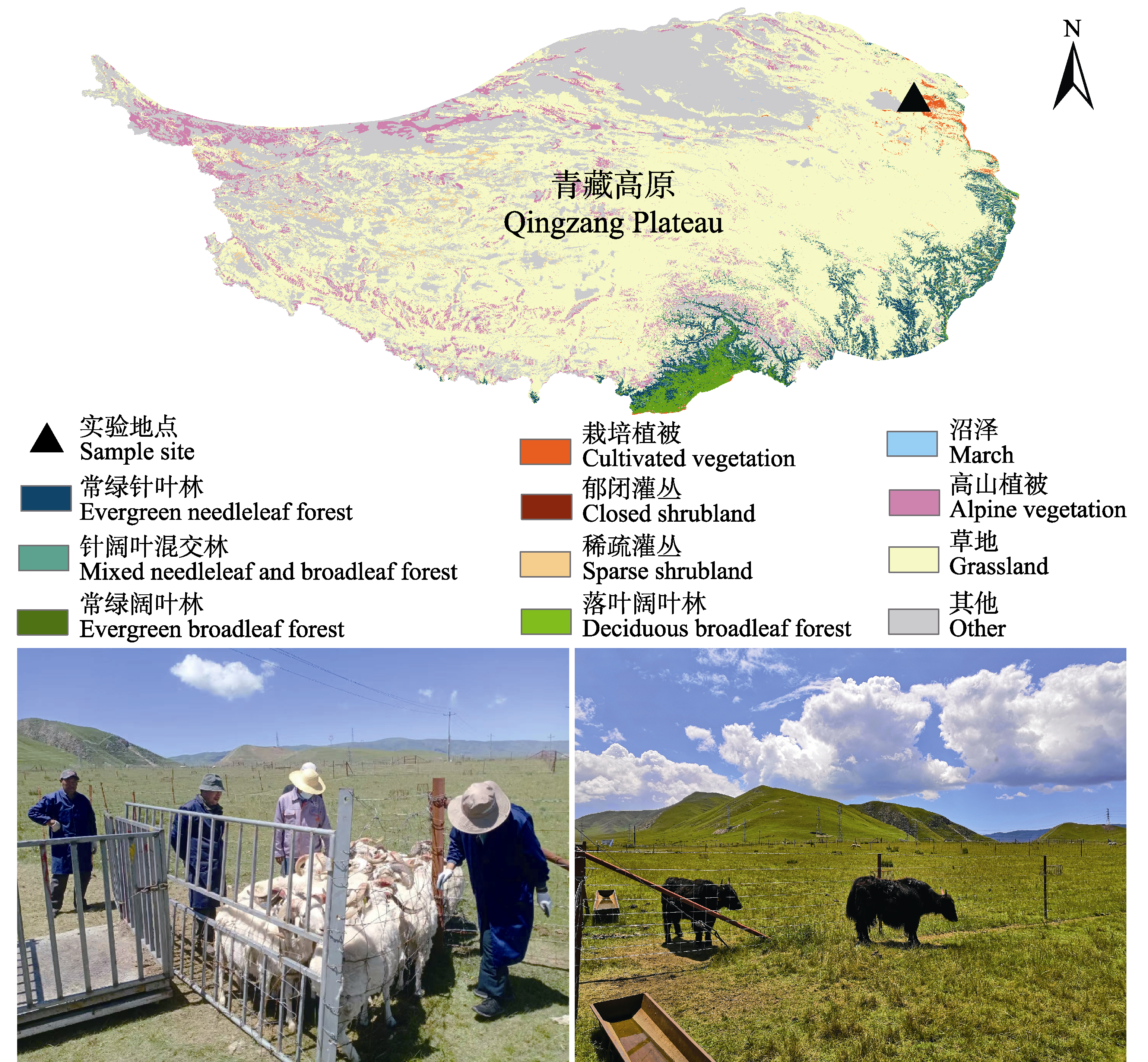
图1 环青海湖地区牦牛和藏羊放牧实验研究地点。
Fig. 1 Research site of grazing experiments on yaks and Tibetan sheep in the area around Qinghai Lake.
| 处理 Treatment | 牦牛数量(头) Number of yaks (head) | 藏羊数量(只) Number of Tibetan sheep (head) | 小区面积 Area of plot (hm2) | 小区重复个数 Number of plots |
|---|---|---|---|---|
| 不放牧 CK | 0 | 0 | 0.05 | 3 |
| 藏羊单牧 SG | 0 | 2 | 0.17 | 3 |
| 牦牛单牧 YG | 1 | 0 | 0.26 | 3 |
| 牦牛藏羊1:2混牧 MG1:2 | 1 | 2 | 0.43 | 3 |
| 牦牛藏羊1:4混牧 MG1:4 | 1 | 4 | 0.60 | 3 |
| 牦牛藏羊1:6混牧 MG1:6 | 1 | 6 | 0.76 | 3 |
表1 放牧实验设计
Table 1 Experimental design of grazing
| 处理 Treatment | 牦牛数量(头) Number of yaks (head) | 藏羊数量(只) Number of Tibetan sheep (head) | 小区面积 Area of plot (hm2) | 小区重复个数 Number of plots |
|---|---|---|---|---|
| 不放牧 CK | 0 | 0 | 0.05 | 3 |
| 藏羊单牧 SG | 0 | 2 | 0.17 | 3 |
| 牦牛单牧 YG | 1 | 0 | 0.26 | 3 |
| 牦牛藏羊1:2混牧 MG1:2 | 1 | 2 | 0.43 | 3 |
| 牦牛藏羊1:4混牧 MG1:4 | 1 | 4 | 0.60 | 3 |
| 牦牛藏羊1:6混牧 MG1:6 | 1 | 6 | 0.76 | 3 |
| CK | SG | YG | MG1:2 | MG1:4 | MG1:6 | |
|---|---|---|---|---|---|---|
| 生物量 Biomass (g·m-2) | ||||||
| 地上 Aboveground | 168.9 ± 15.29ab | 161.7 ± 8.14ab | 182.4 ± 14.88a | 114.5 ± 13.18c | 117.0 ± 6.85c | 141.1 ± 5.52bc |
| 根系 Root | 2 569.2 ± 292.6a | 2 344.7 ± 215.1a | 2 391.5 ± 237.7a | 1 321.9 ± 166.1b | 1 483.4 ± 129.3b | 1 648.1 ± 200.4b |
| 碳含量 Carbon content (g·kg-1) | ||||||
| 地上 Aboveground | 409.2 ± 0.60a | 372.4 ± 0.53e | 412.9 ± 1.96a | 379.7 ± 2.46d | 385.8 ± 2.28c | 397.4 ± 0.90b |
| 根系 Root | 335.2 ± 3.98b | 327.1 ± 2.47b | 255.1 ± 3.12d | 297.6 ± 9.10c | 355.4 ± 1.48a | 322.1 ± 1.34b |
| 氮含量 Nitrogen content (g·kg-1) | ||||||
| 地上 Aboveground | 14.1 ± 0.43c | 14.5 ± 0.12c | 18.7 ± 0.27a | 15.0 ± 0.45bc | 15.8 ± 0.18b | 14.7 ± 0.27c |
| 根系 Root | 7.1 ± 0.15d | 7.5 ± 0.08c | 6.7 ± 0.07e | 8.4 ± 0.09a | 7.9 ± 0.06b | 6.8 ± 0.05e |
| 碳氮比 C:N | ||||||
| 地上 Aboveground | 29.3 ± 0.93a | 25.6 ± 0.20bc | 22.1 ± 0.27d | 25.4 ± 061c | 24.4 ± 0.22c | 27.0 ± 0.55b |
| 根系 Root | 47.5 ± 1.47a | 43.7 ± 0.68b | 37.9 ± 0.57c | 35.6 ± 1.35c | 44.7 ± 0.46ab | 47.2 ± 0.50a |
| 容重 Bulk density (g·cm-3) | ||||||
| 1.1 ± 0.02ab | 1.0 ± 0.01b | 1.1 ± 0.01a | 1.0 ± 0.04ab | 1.0 ± 0.02ab | 0.9 ± 0.02b |
表2 不同放牧方式对植物群落生物量及碳、氮含量的影响(平均值±标准误)
Table 2 Effects of different grazing livestock on plant community biomass and carbon and nitrogen content (mean ± SE)
| CK | SG | YG | MG1:2 | MG1:4 | MG1:6 | |
|---|---|---|---|---|---|---|
| 生物量 Biomass (g·m-2) | ||||||
| 地上 Aboveground | 168.9 ± 15.29ab | 161.7 ± 8.14ab | 182.4 ± 14.88a | 114.5 ± 13.18c | 117.0 ± 6.85c | 141.1 ± 5.52bc |
| 根系 Root | 2 569.2 ± 292.6a | 2 344.7 ± 215.1a | 2 391.5 ± 237.7a | 1 321.9 ± 166.1b | 1 483.4 ± 129.3b | 1 648.1 ± 200.4b |
| 碳含量 Carbon content (g·kg-1) | ||||||
| 地上 Aboveground | 409.2 ± 0.60a | 372.4 ± 0.53e | 412.9 ± 1.96a | 379.7 ± 2.46d | 385.8 ± 2.28c | 397.4 ± 0.90b |
| 根系 Root | 335.2 ± 3.98b | 327.1 ± 2.47b | 255.1 ± 3.12d | 297.6 ± 9.10c | 355.4 ± 1.48a | 322.1 ± 1.34b |
| 氮含量 Nitrogen content (g·kg-1) | ||||||
| 地上 Aboveground | 14.1 ± 0.43c | 14.5 ± 0.12c | 18.7 ± 0.27a | 15.0 ± 0.45bc | 15.8 ± 0.18b | 14.7 ± 0.27c |
| 根系 Root | 7.1 ± 0.15d | 7.5 ± 0.08c | 6.7 ± 0.07e | 8.4 ± 0.09a | 7.9 ± 0.06b | 6.8 ± 0.05e |
| 碳氮比 C:N | ||||||
| 地上 Aboveground | 29.3 ± 0.93a | 25.6 ± 0.20bc | 22.1 ± 0.27d | 25.4 ± 061c | 24.4 ± 0.22c | 27.0 ± 0.55b |
| 根系 Root | 47.5 ± 1.47a | 43.7 ± 0.68b | 37.9 ± 0.57c | 35.6 ± 1.35c | 44.7 ± 0.46ab | 47.2 ± 0.50a |
| 容重 Bulk density (g·cm-3) | ||||||
| 1.1 ± 0.02ab | 1.0 ± 0.01b | 1.1 ± 0.01a | 1.0 ± 0.04ab | 1.0 ± 0.02ab | 0.9 ± 0.02b |
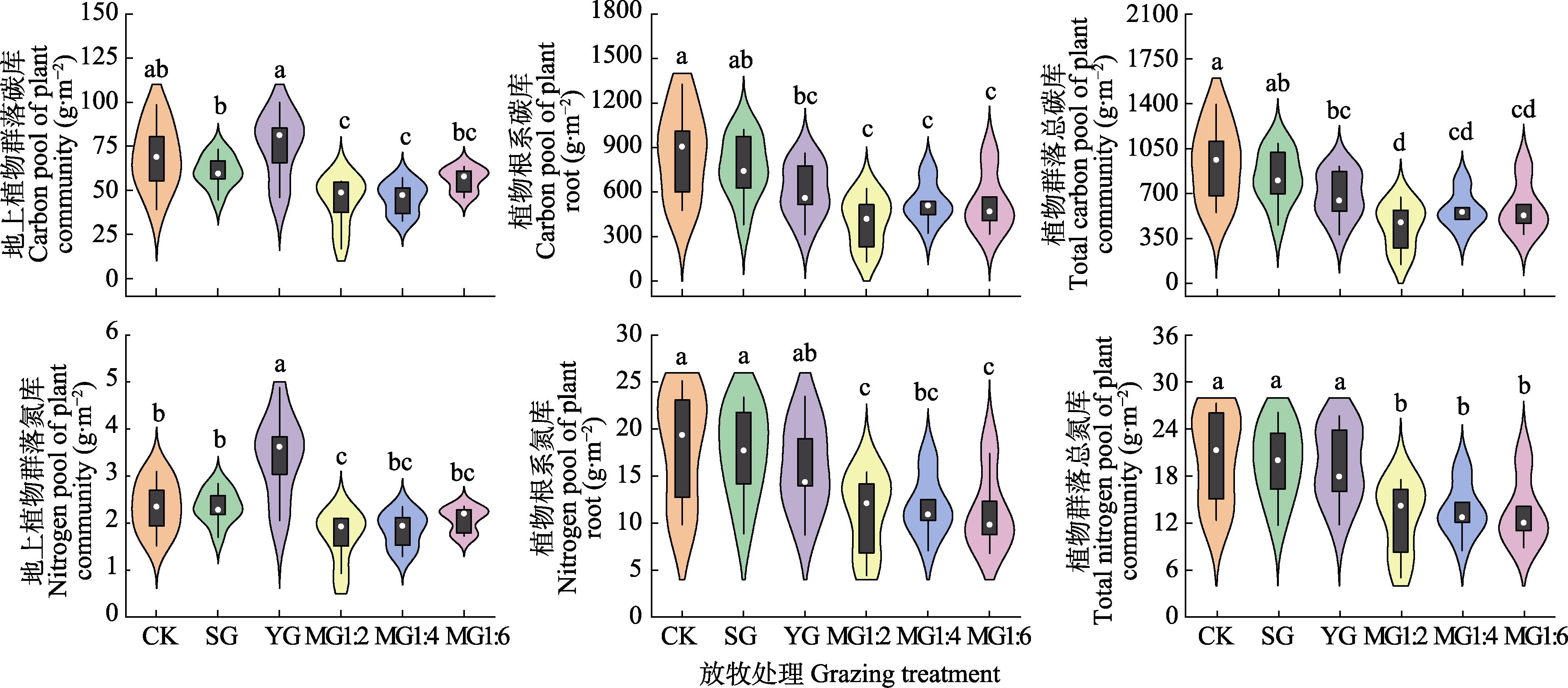
图2 不同放牧方式对植物群落碳、氮库的影响。不同小写字母表示同一指标在不同放牧处理间差异显著(p < 0.05)。CK, 未放牧; SG, 藏羊单独放牧; YG, 牦牛单独放牧。MG1:2, 牦牛藏羊1:2混合放牧; MG1:4, 牦牛藏羊1:4混合放牧; MG1:6, 牦牛藏羊1:6混合放牧。
Fig. 2 Effects of different grazing livestock on carbon and nitrogen pools in plant communities. Different lowercase letters represent significant differences in the same index between different grazing treatments (p < 0.05). CK, no grazing; SG, only Tibetan sheep grazing; YG, only yak grazing. MG1:2, mixed grazing with ratio of yak to Tibetan sheep as 1:2; MG1:4, mixed grazing with ratio of yak to Tibetan sheep as 1:4; MG1:6, mixed grazing with ratio of yak to Tibetan sheep as 1:6.

图3 不同放牧方式对土壤微生物生物量碳氮含量及其碳氮库的影响。不同小写字母表示同一指标在不同放牧处理间差异显著(p < 0.05)。CK, 未放牧; SG, 藏羊单独放牧; YG, 牦牛单独放牧。MG1:2, 牦牛藏羊1:2混合放牧; MG1:4, 牦牛藏羊1:4混合放牧; MG1:6, 牦牛藏羊1:6混合放牧。
Fig. 3 Effects of different grazing livestock on the contents of soil microbial biomass carbon and nitrogen as well as carbon and nitrogen pools. Different lowercase letters represent significant differences in the same index between different grazing treatments (p < 0.05). CK, no grazing; SG, only Tibetan sheep grazing; YG, only yak grazing. MG1:2, mixed grazing with ratio of yak to Tibetan sheep as 1:2; MG1:4, mixed grazing with ratio of yak to Tibetan sheep as 1:4; MG1:6, mixed grazing with ratio of yak to Tibetan sheep as 1:6.
| [1] |
Bai YF, Wu JG, Clark CM, Pan QM, Zhang LX, Chen SP, Wang QB, Han XG (2012). Grazing alters ecosystem functioning and C:N:P stoichiometry of grasslands along a regional precipitation gradient. Journal of Applied Ecology, 49, 1204-1215.
DOI URL |
| [2] | Bao SD (2000). Analysis of Soil Agriculture and Chemistry. 3rd ed. China Agriculture Press, Beijing. 39-58. |
| [鲍士旦 (2000). 土壤农化分析. 3版. 中国农业出版社, 北京. 39-58.] | |
| [3] |
Bardgett RD, Bullock JM, Lavorel S, Manning P, Schaffner U, Ostle N, Chomel M, Durigan G, Fry EL, Johnson D, Lavallee JM, Provost GL, Luo S, Png K, Sankaran M, et al. (2021). Combatting global grassland degradation. Nature Reviews Earth and Environment, 2, 720-735.
DOI |
| [4] |
Chang Q, Wang L, Ding SW, Xu TT, Li ZQ, Song XX, Zhao X, Wang DL, Pan DF (2018). Grazer effects on soil carbon storage vary by herbivore assemblage in a semi-arid grassland. Journal of Applied Ecology, 55, 2517-2526.
DOI URL |
| [5] |
Cuchillo-Hilario M, Wrage-Mönnig N, Isselstein J (2018). Forage selectivity by cattle and sheep co-grazing swards differing in plant species diversity. Grass and Forage Science, 73, 320-329.
DOI URL |
| [6] |
Dong SK, Gao HW, Xu GC, Hou XY, Long RJ, Kang MY, Lassoie JP (2007). Farmer and professional attitudes to the large-scale ban on livestock grazing of grasslands in China. Environmental Conservation, 34, 246-254.
DOI URL |
| [7] |
du Toit JT (2011). Coexisting with cattle. Science, 333, 1710-1711.
DOI URL |
| [8] | Fan YJ, Hou XY, Shi HX, Shi SL (2012). The response of carbon reserves of plants and soils to different grassland managements on alpine meadow of three headwater source regions. Grassland and Turf, 32(5), 41-46. |
| [范月君, 侯向阳, 石红霄, 师尚礼 (2012). 封育与放牧对三江源区高寒草甸植物和土壤碳储量的影响. 草原与草坪, 32(5), 41-46.] | |
| [9] | Fang JY, Guo ZD, Piao SL, Chen AP (2007). Terrestrial vegetation carbon sinks in China, 1981-2000. Science in China Series D: Earth Sciences, 50, 1341-1350. |
| [10] |
Feng B, Yang XX, Liu WT, Dong QM, Zhang CP, Liu YZ, Sun CC, Li CD, Shi G, Yang ZZ, Zhang XF, Wei LN (2022). Effects of different livestock assembly on the stoichiometry of alpine grassland functional groups. Acta Agrestia Sinica, 30, 1063-1070.
DOI |
|
[冯斌, 杨晓霞, 刘文亭, 董全民, 张春平, 刘玉祯, 孙彩彩, 李彩弟, 时光, 杨增增, 张小芳, 魏琳娜 (2022). 不同放牧方式对高寒草地功能群生态化学计量特征的影响. 草地学报, 30, 1063-1070.]
DOI |
|
| [11] | Fraser MD, Fleming HR, Moorby JM (2014). Traditional vs modern: role of breed type in determining enteric methane emissions from cattle grazing as part of contrasting grassland-based systems. PLoS ONE, 9, e107861. DOI: 10.1371/journal.pone.0107861. |
| [12] |
Fu G, Shen ZX, Zhang XZ, Zhou YT, Zhang YJ (2012). Response of microbial biomass to grazing in an alpine meadow along an elevation gradient on the Tibetan Plateau. European Journal of Soil Biology, 52, 27-29.
DOI URL |
| [13] | Gao XF, Wu CY, Han GD (2010). Steppe soil microorganisms is impacted by the grazing and their seasonal changes. Microbiology China Tongbao, 37, 1117-1122. |
| [高雪峰, 武春燕, 韩国栋 (2010). 草原土壤微生物受放牧的影响及其季节变化. 微生物学通报, 37, 1117-1122.] | |
| [14] |
Guo LB, Gifford RM (2002). Soil carbon stocks and land use change: a meta analysis. Global Change Biology, 8, 345-360.
DOI URL |
| [15] | Guo YJ, Li HP, Zhang QB, Bai L, Zhang W, Chen BL, Sang JH, Li Y, Shen YY (2024). Responses of soil available nitrogen mineralization ability to temperature and organic fertilizer addition in alpine grasslands of the Qinghai-Tibet Plateau. Pratacultural Science, 41, 1048-1056. |
| [郭雅婧, 李辉鹏, 张其斌, 白璐, 张伟, 陈宝林, 桑建辉, 李渊, 沈禹颖 (2024). 青藏高原高寒草地土壤速效氮矿化能力对温度和有机肥添加的响应. 草业科学, 41, 1048-1056.] | |
| [16] | Jia LX, Zhang F, Qiao JR, Yang Y, Zhao TQ, Zheng JH, Li MR, Zhang H, Zhao ML (2019). Effect of cutting regime on yield and nutritional value of Stipa grandis steppe. Chinese Journal of Grassland, 41(1), 9-16. |
| [贾丽欣, 张峰, 乔荠蓉, 杨阳, 赵天启, 郑佳华, 李梦然, 张昊, 赵萌莉 (2019). 放牧强度对荒漠草原无芒隐子草斑块碳氮化学计量特征的影响. 中国草地学报, 41(1), 9-16.] | |
| [17] | Li SQ, Wang XZ, Guo ZG, Zhou J, Xue R, Shen YY (2013). Effects of short-term grazing on C and N content in soil and soil microbe in alpine meadow in the north-eastern edge of the Qinghai Tibetan-Plateau. Chinese Journal of Grassland, 35(1), 55-60. |
| [李世卿, 王先之, 郭正刚, 周杰, 薛冉, 沈禹颖 (2013). 短期放牧对青藏高原东北边缘高寒草甸土壤及微生物碳氮含量的影响. 中国草地学报, 35(1), 55-60.] | |
| [18] | Liu B (2018). Effects and Regulatory Mechanisms of Different Herbivore Assemblages on Soil N Mineralization Rate. Master degree dissertation, Northeast Normal University, Changchun. |
| [刘柏 (2018). 不同放牧方式对草地土壤氮矿化速率的作用及调控机制. 硕士学位论文, 东北师范大学, 长春.] | |
| [19] |
Loucougaray G, Bonis A, Bouzillé JB (2004). Effects of grazing by horses and/or cattle on the diversity of coastal grasslands in western France. Biological Conservation, 116, 59-71.
DOI URL |
| [20] | Lv WD, Dong QM, Sun CC, Liu WT, Feng B, Liu YZ, Zhang ZX, Yang XX (2024). Effects of yak and tibetan sheep grazing on nitrogen pool of plant communities of alpine grassland in the Qinghai Tibet Plateau. Acta Agrestia Sinica, 32, 1420-1428. |
|
[吕卫东, 董全民, 孙彩彩, 刘文亭, 冯斌, 刘玉祯, 张振祥, 杨晓霞 (2024). 牦牛和藏羊放牧对青藏高原高寒草地植物群落氮库的影响. 草地学报, 32, 1420-1428.]
DOI |
|
| [21] | Mao C, Kou D, Peng YF, Qin SQ, Zhang QW, Yang YH (2021). Soil nitrogen transformations respond diversely to multiple levels of nitrogen addition in a Tibetan alpine steppe. Journal of Geophysical Research: Biogeosciences, 126, e2020JG006211. DOI: 10.1029/2020JG006211. |
| [22] |
Niu KC, He JS, Zhang ST, Lechowicz MJ (2016). Tradeoffs between forage quality and soil fertility: lessons from Himalayan rangelands. Agriculture, Ecosystems and Environment, 234, 31-39.
DOI URL |
| [23] | Wang GX, Cheng GD, Shen YP (2002). Soil organic carbon pool of grasslands on the Tibetan Plateau and its global implication. Journal of Glaciology and Geocryolog, 24, 693-700. |
| [王根绪, 程国栋, 沈永平 (2002). 青藏高原草地土壤有机碳库及其全球意义. 冰川冻土, 24, 693-700.] | |
| [24] |
Wang L, Wang DL, Bai YG, Jiang GT, Liu JS, Huang Y, Li YX (2010). Spatial distributions of multiple plant species affect herbivore foraging selectivity. Oikos, 119, 401-408.
DOI URL |
| [25] | Wang L, Zhang MN, Xu M, Wang DL (2021). A scientific basis for promoting grassland ecosystem multifunctionality by diversifying grazing livestock: a review. Chinese Science Bulletin, 66, 3791-3798. |
| [王岭, 张敏娜, 徐曼, 王德利 (2021). 草地多功能提升的多样化家畜放牧理论及应用. 科学通报, 66, 3791-3798.] | |
| [26] | Wang Z (2021). Effects of Different Grazing Types on Functional Traits of Dominant Species in Typical Steppe of Inner Mongolia. Master degree dissertation, Inner Mongolia University, Hohhot. |
| [王铮 (2021). 不同放牧方式对内蒙古典型草原优势种植物功能性状的影响. 硕士学位论文, 内蒙古大学, 呼和浩特.] | |
| [27] |
Winding A, Hund-Rinke K, Rutgers M (2005). The use of microorganisms in ecological soil classification and assessment concepts. Ecotoxicology and Environmental Safety, 62, 230-248.
PMID |
| [28] | Wu JH, Wang LX, Zhang JH, Zhuo Y, Wu SN, Wang FG, Xu ZC, Qi Y, Wen L (2018). Response of soil properties and microbial biomass to different grazing intensities in temperate typical steppe. Acta Agrestia Sinica, 26, 832-840. |
|
[邬嘉华, 王立新, 张景慧, 卓义, 武胜男, 王凤歌, 徐智超, 祁瑜, 温璐 (2018). 温带典型草原土壤理化性质及微生物量对放牧强度的响应. 草地学报, 26, 832-840.]
DOI |
|
| [29] | Xiong K, Jin ML, Yu T, Cui YZ (2015). Stoichiometry characteristics of CNP in typical steppe plant at different grazing gradient. Journal of Green Science and Technology, (7), 4-7. |
| [熊坤, 金美伶, 于婷, 崔艳智 (2015). 不同放牧梯度上典型草原植物碳氮磷化学计量特征. 绿色科技, (7), 4-7.] | |
| [30] | Yan ZQ, Qi YC, Dong YS, Peng Q, Sun LJ, Jia JQ, Cao CC, Guo SF, He YL (2014). Nitrogen cycling in grassland ecosystem in response to climate change and human activities. Acta Prataculturae Sinica, 23, 279-292. |
|
[闫钟清, 齐玉春, 董云社, 彭琴, 孙良杰, 贾军强, 曹丛丛, 郭树芳, 贺云龙 (2014). 草地生态系统氮循环关键过程对全球变化及人类活动的响应与机制. 草业学报, 23, 279-292.]
DOI |
|
| [31] | Yang XX, Dong QM, Chu H, Ding CX, YU Y, Zhang CP, Zhang YF, Yang ZZ (2019). Different responses of soil element contents and their stoichiometry (C:N:P) to yak grazing and Tibetan sheep grazing in an alpine grassland on the eastern Qinghai-Tibetan Plateau. Agriculture Ecosystems and Environment, 285, 106628. DOI: 10.1016/j.agee.2019.106628. |
| [32] |
Zhang YF, Yang XX, Dong QM, Zhang CP, Yu Y, Yang ZZ, Feng B, Chu H, Wei LN, Zhang XF (2019). Effects of mixed of yak and tibetan sheep on feed intake of grazing livestock and plant compensation growth. Acta Agrestia Sinica, 27, 1607-1614.
DOI |
|
[张艳芬, 杨晓霞, 董全民, 张春平, 俞旸, 杨增增, 冯斌, 褚晖, 魏琳娜, 张小芳 (2019). 牦牛和藏羊混合放牧对放牧家畜采食量和植物补偿性生长的影响. 草地学报, 27, 1607-1614.]
DOI |
|
| [33] |
Zhang YJ, Zhu JT, Shen RN, Wang L (2020). Research progress on the effects of grazing on grassland ecosystem. Chinese Journal of Plant Ecology, 44, 553-564.
DOI URL |
|
[张扬建, 朱军涛, 沈若楠, 王荔 (2020). 放牧对草地生态系统影响的研究进展. 植物生态学报, 44, 553-564.]
DOI |
| [1] | 肖治术, 范宗骥, 于桂清, 范明亮. 油麻藤属(Mucuna)植物的传粉和种子传播研究进展: 现状与展望[J]. , 2027, 51(动植物互作): 0-. |
| [2] | 刘志祥, 黎凤兰, 黄晓磊. 昆虫虫瘿生态系统的复杂性及成瘿机制研究进展[J]. , 2027, 51(动植物互作): 0-. |
| [3] | 曹伊菲, 苏涛, 曹敏, 汪海燕, 杨洁. 新生代被子植物叶脉密度演化的驱动因素研究:气候适应与植食压力[J]. , 2027, 51(动植物互作): 0-. |
| [4] | 赵掷艺, 黄伟权, 胡婧妍, 王义越, 虞梦婕, 吴玉环. 泥炭沼泽湿地植物残体分解及微生物作用机理研究进展[J]. , 2026, 50(预发表): 0-. |
| [5] | 柯嘉雯, 程张浩, 高雪夷, 徐云剑, 王毅. 镉污染下的植物响应:从吸收、转运到应答与缓解机制[J]. 植物生态学报, 2026, 50(预发表): 1-. |
| [6] | 陈欣蕊, 宋维峰, 王燚, 王浩, 孙诗瑶, 王彩江, 蔡世鹏, 任红, 何玉陶, 潘珉, 曹光秀, 严毅, 谢志勇, 王行. 滇池湖滨带典型挺水植物氮磷重吸收特征及其适应策略[J]. , 2026, 50(预发表): 0-. |
| [7] | 何青, 袁旭东, 任博申, 冯治洋, 鲁梦珍, 林巧玲, 姜庆虎, 杨林森, 余辉亮, 姚辉, 杨敬元, 刘峰, 江明喜. 一年蓬(Erigeron annuus)入侵对亚高山泥炭湿地植物群落结构与多样性的影响[J]. 植物生态学报, 2026, 50(预发表): 0-. |
| [8] | 胡光明, 欧旭, 龙文兴. 热带云雾林宿主树皮粗糙度对附生维管植物多样性与孢子定殖的影响[J]. 植物生态学报, 2026, 50(预发表): 1-. |
| [9] | 段建林, 孟晟, 陈仁利, 熊林峰, 卢春洋, 席念勋. 全球变化因子多样性对菌根植物性状的影响[J]. , 2026, 50(预发表): 0-. |
| [10] | 杨梅花, 张子嘉, 乔栋, 冯俊娜, 庞子杰, 钱龙, 刘志晖, 蔡娜娜, 胡中民, 杨国姣. 海南热带森林乔木群落调查和多样性数据集[J]. 植物生态学报, 2026, 50(预发表): 0-. |
| [11] | 饶朝康, 唐亮. 不同潮位红树植物叶际微生物群落特征及其影响因素[J]. 植物生态学报, 2026, 50(预发表): 1-. |
| [12] | 封逸凡, 朱时应, 周淑荣, 江乐乐, 陈隆, 王苗, 邓国芳, 刘兰. 热带次生林恢复中土壤微生物对菌根化树苗存活和生长性状的影响[J]. 植物生态学报, 2026, 50(预发表): 1-. |
| [13] | 任曦彤, 李颖, 张雨, 熊胡安赫, 张蕊科, 祁珊珊, 戴志聪, 杜道林. 丛枝菌根真菌与凋落物互作有助于加拿大一枝黄花应对营养胁迫[J]. 植物生态学报, 2026, 50(3): 710-721. |
| [14] | 刘润洪, 阳柳蓉, 梁慧婷, 申卫军. 丛枝菌根和外生菌根植物磷获取与利用策略研究进展与展望[J]. 植物生态学报, 2026, 50(3): 566-583. |
| [15] | 江康威, 吕程, 王亚菲, 李宏, 张芷晴, 王雨, 张青青, 吐尔逊娜依•热依木. 放牧干扰下丛枝菌根真菌群落对土壤多功能性的影响[J]. 植物生态学报, 2026, 50(3): 685-699. |
| 阅读次数 | ||||||
|
全文 |
|
|||||
|
摘要 |
|
|||||
Copyright © 2026 版权所有 《植物生态学报》编辑部
地址: 北京香山南辛村20号, 邮编: 100093
Tel.: 010-62836134, 62836138; Fax: 010-82599431; E-mail: apes@ibcas.ac.cn, cjpe@ibcas.ac.cn
备案号: 京ICP备16067583号-19

