
Chin J Plant Ecol ›› 2025, Vol. 49 ›› Issue (9): 1461-1471.DOI: 10.17521/cjpe.2024.0458 cstr: 32100.14.cjpe.2024.0458
• Research Articles • Previous Articles Next Articles
SONG Shan-Shan, TANG Zhi-Yao*( )(
)( )
)
Received:2024-12-16
Accepted:2025-04-08
Online:2025-09-20
Published:2025-04-09
Contact:
TANG Zhi-Yao
Supported by:SONG Shan-Shan, TANG Zhi-Yao. Relationship between rhizosphere soil fungi and plant aboveground biomass in the meadow steppe of Saihanba, Hebei, China[J]. Chin J Plant Ecol, 2025, 49(9): 1461-1471.
Add to citation manager EndNote|Ris|BibTeX
URL: https://www.plant-ecology.com/EN/10.17521/cjpe.2024.0458
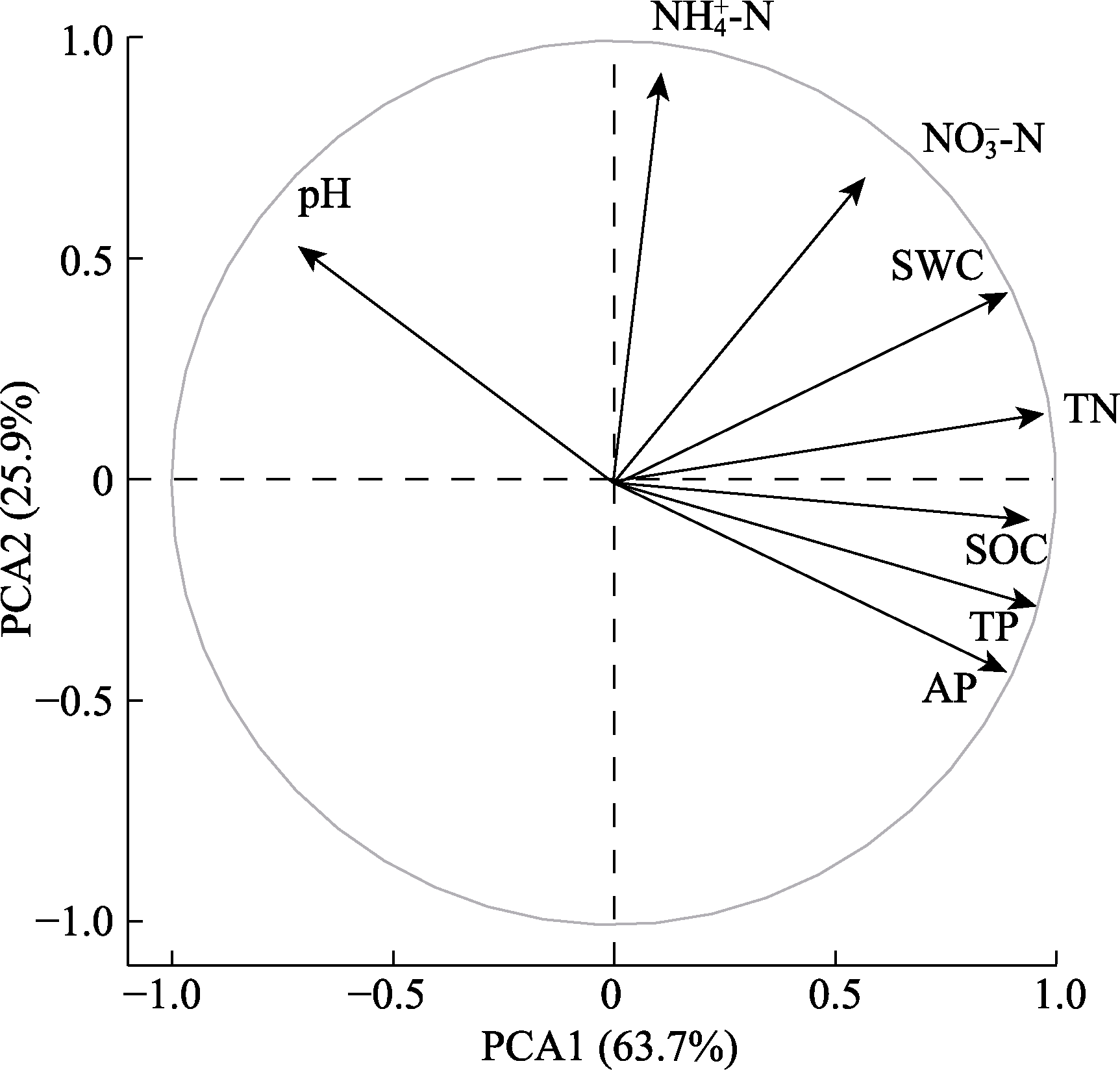
Fig. 1 Principal component analysis (PCA) of soil properties. AP, available phosphorus content; NH4+-N, ammonium nitrogen content; NO3--N, nitrate nitrogen content; SOC, soil organic carbon content; SWC, soil water content; TN, total nitrogen content; TP, total phosphorus content.
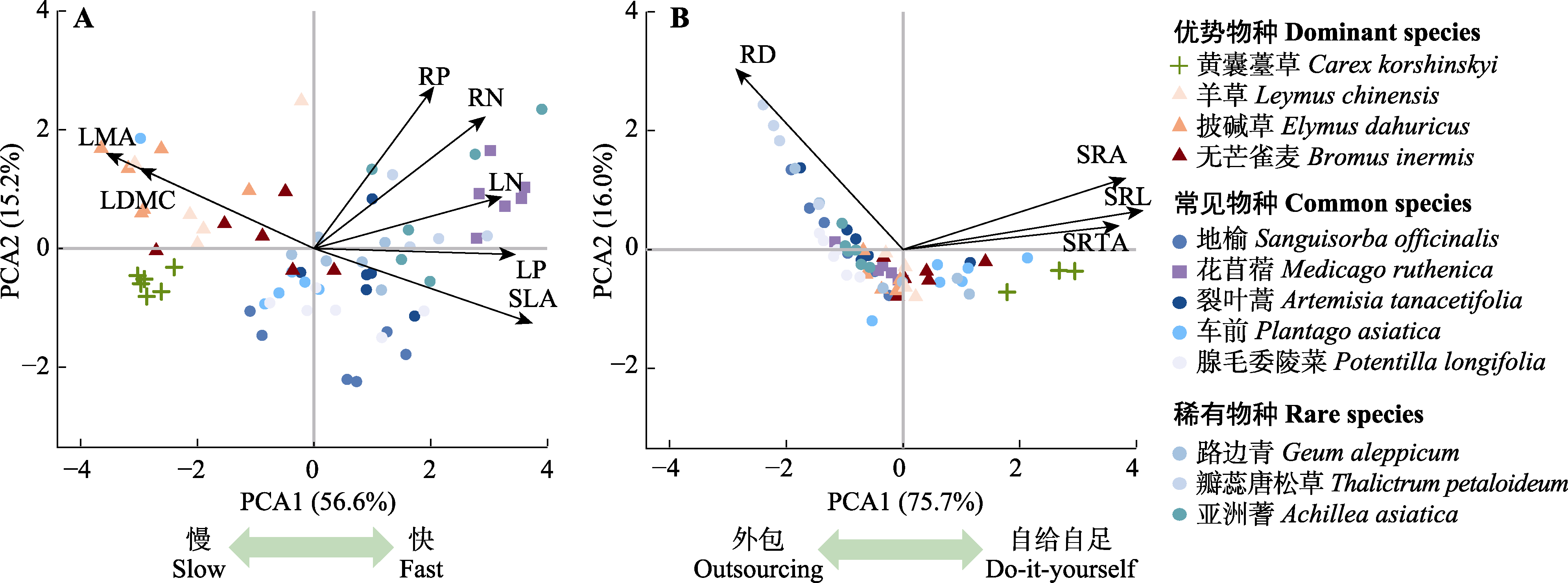
Fig. 2 Principal component analysis (PCA) of traits related to the “fast-slow” economic spectrum (A) and the collaboration dimension (B). LDMC, leaf dry matter content; LMA, specific leaf mass; LN, leaf nitrogen content; LP, leaf phosphorus content; RD, root diameter; RN, root nitrogen content; RP, root phosphorus content; SLA, specific leaf area; SRA, specific root area; SRL, specific root length; SRTA, specific root tip abundance.
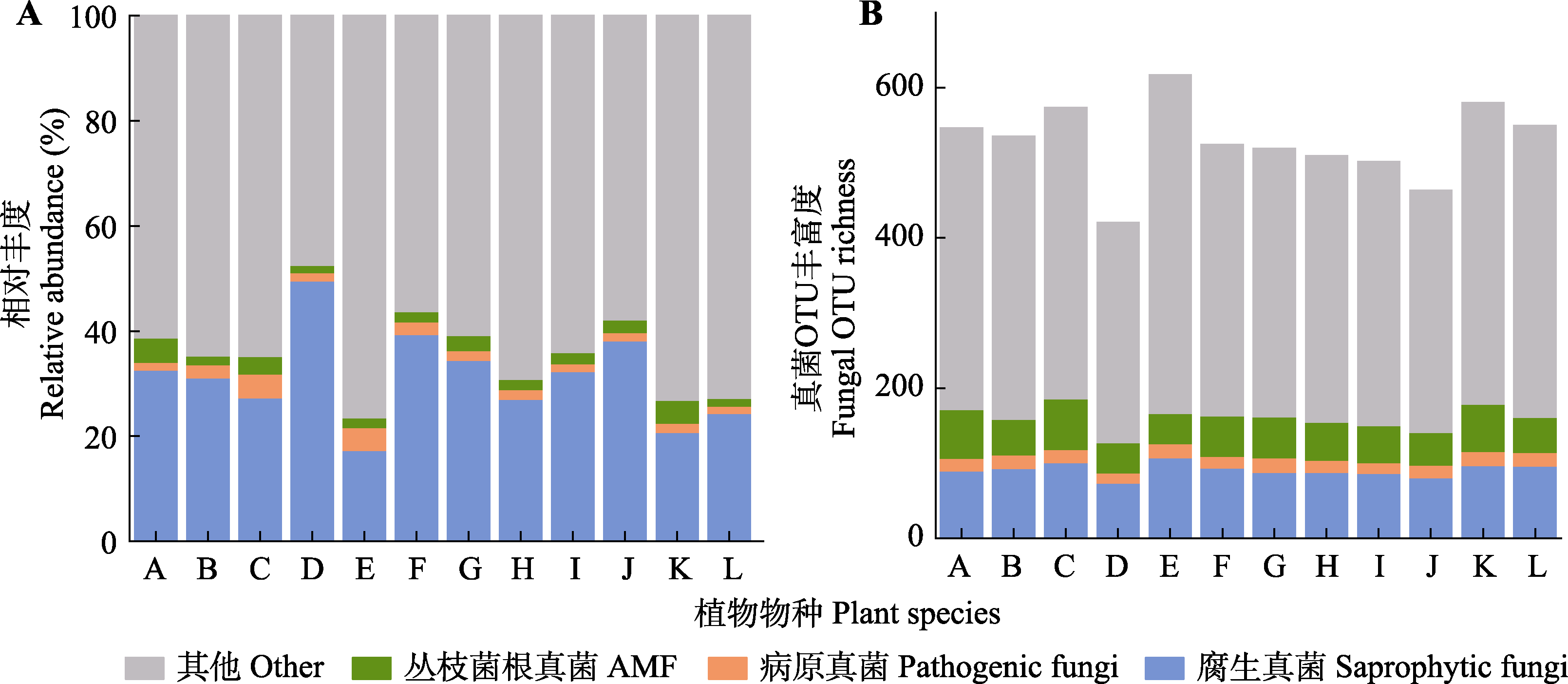
Fig. 3 Community composition (A) and diversity (B) of plant rhizosphere soil fungi. A, Bromus inermis; B, Elymus dahuricus; C, Leymus chinensis; D, Medicago ruthenica; E, Carex korshinskyi; F, Artemisia tanacetifolia; G, Plantago asiatica; H, Sanguisorba officinalis; I, Geum aleppicum; J, Thalictrum petaloideum; K, Potentilla longifolia; L, Achillea asiatica. OTU, operational taxonomic unit.
| 因子 Factor | df | FungiTotal | FungiSap | FungiPath | FungiAMF | 生物量 Biomass | ||||||
|---|---|---|---|---|---|---|---|---|---|---|---|---|
| Est. | SE | Est. | SE | Est. | SE | Est. | SE | Est. | SE | |||
| SLA | 62 | -24.16† | 12.26 | -4.61* | 2.21 | -0.72 | 0.52 | -2.60 | 2.51 | -14.36*** | 2.94 | |
| LN | 62 | -23.64† | 12.22 | -3.72 | 2.23 | -0.95† | 0.51 | -1.30 | 2.50 | -8.18* | 3.27 | |
| LP | 62 | -8.63 | 12.59 | -0.99 | 2.30 | -0.15 | 0.53 | -1.14 | 2.54 | -11.41*** | 3.12 | |
| LDMC | 62 | 12.06 | 12.53 | 1.49 | 2.29 | 0.52 | 0.52 | 1.68 | 2.54 | 13.27*** | 3.01 | |
| LMA | 62 | 19.31 | 12.41 | 4.03 | 2.23 | 0.68 | 0.52 | 1.27 | 2.52 | 16.02*** | 2.81 | |
| RN | 62 | -37.90** | 11.64 | -5.64* | 2.16 | -0.90† | 0.51 | -4.01 | 2.47 | -9.26** | 3.23 | |
| RP | 62 | -17.05 | 12.47 | -1.79 | 2.29 | -0.53 | 0.52 | -2.95 | 2.53 | -9.08** | 3.24 | |
| RD | 62 | -22.42 | 12.28 | -3.55 | 2.25 | -0.69 | 0.52 | -0.43 | 2.55 | -9.33** | 3.23 | |
| SRA | 62 | 25.08* | 12.22 | 4.10 | 2.23 | 1.08* | 0.51 | 2.70 | 2.52 | 7.80* | 3.29 | |
| SRL | 62 | 28.00* | 12.09 | 4.82* | 2.20 | 1.16* | 0.50 | 0.74 | 2.52 | 10.41** | 3.18 | |
| SRTA | 62 | 32.52** | 11.86 | 5.74** | 2.15 | 0.98† | 0.51 | -2.17 | 2.49 | 15.81*** | 2.82 | |
| SWC | 67 | -17.90 | 12.48 | -1.50 | 2.36 | -0.22 | 0.53 | -6.83* | 2.60 | -0.33 | 3.42 | |
| pH | 67 | 12.970 | 12.57 | 3.78 | 2.33 | 0.01 | 0.54 | -2.74 | 2.71 | -1.97 | 3.41 | |
| TN | 67 | -23.24† | 12.35 | -3.14 | 2.34 | -0.52 | 0.53 | -5.08† | 2.66 | -0.28 | 3.42 | |
| NH4+-N | 67 | 7.33 | 12.64 | 5.49* | 2.27 | 0.57 | 0.53 | -9.53*** | 2.47 | 0.34 | 3.42 | |
| NO3--N | 67 | -5.03 | 12.65 | 1.49 | 2.36 | 0.62 | 0.53 | -7.87** | 2.55 | 1.83 | 3.41 | |
| TP | 67 | -24.11† | 12.32 | -4.94* | 2.29 | -0.66 | 0.53 | -0.74 | 2.73 | -0.28 | 3.42 | |
| AP | 67 | -21.66† | 12.39 | -5.12* | 2.28 | -0.67 | 0.53 | 1.17 | 2.73 | -0.64 | 3.42 | |
| SOC | 67 | -28.70* | 12.17 | -5.36* | 2.28 | -0.90† | 0.52 | -2.60 | 2.71 | -0.65 | 3.42 | |
Table 1 Effect of plant functional traits (PFT) and soil properties on rhizosphere soil fungal diversity and aboveground biomass
| 因子 Factor | df | FungiTotal | FungiSap | FungiPath | FungiAMF | 生物量 Biomass | ||||||
|---|---|---|---|---|---|---|---|---|---|---|---|---|
| Est. | SE | Est. | SE | Est. | SE | Est. | SE | Est. | SE | |||
| SLA | 62 | -24.16† | 12.26 | -4.61* | 2.21 | -0.72 | 0.52 | -2.60 | 2.51 | -14.36*** | 2.94 | |
| LN | 62 | -23.64† | 12.22 | -3.72 | 2.23 | -0.95† | 0.51 | -1.30 | 2.50 | -8.18* | 3.27 | |
| LP | 62 | -8.63 | 12.59 | -0.99 | 2.30 | -0.15 | 0.53 | -1.14 | 2.54 | -11.41*** | 3.12 | |
| LDMC | 62 | 12.06 | 12.53 | 1.49 | 2.29 | 0.52 | 0.52 | 1.68 | 2.54 | 13.27*** | 3.01 | |
| LMA | 62 | 19.31 | 12.41 | 4.03 | 2.23 | 0.68 | 0.52 | 1.27 | 2.52 | 16.02*** | 2.81 | |
| RN | 62 | -37.90** | 11.64 | -5.64* | 2.16 | -0.90† | 0.51 | -4.01 | 2.47 | -9.26** | 3.23 | |
| RP | 62 | -17.05 | 12.47 | -1.79 | 2.29 | -0.53 | 0.52 | -2.95 | 2.53 | -9.08** | 3.24 | |
| RD | 62 | -22.42 | 12.28 | -3.55 | 2.25 | -0.69 | 0.52 | -0.43 | 2.55 | -9.33** | 3.23 | |
| SRA | 62 | 25.08* | 12.22 | 4.10 | 2.23 | 1.08* | 0.51 | 2.70 | 2.52 | 7.80* | 3.29 | |
| SRL | 62 | 28.00* | 12.09 | 4.82* | 2.20 | 1.16* | 0.50 | 0.74 | 2.52 | 10.41** | 3.18 | |
| SRTA | 62 | 32.52** | 11.86 | 5.74** | 2.15 | 0.98† | 0.51 | -2.17 | 2.49 | 15.81*** | 2.82 | |
| SWC | 67 | -17.90 | 12.48 | -1.50 | 2.36 | -0.22 | 0.53 | -6.83* | 2.60 | -0.33 | 3.42 | |
| pH | 67 | 12.970 | 12.57 | 3.78 | 2.33 | 0.01 | 0.54 | -2.74 | 2.71 | -1.97 | 3.41 | |
| TN | 67 | -23.24† | 12.35 | -3.14 | 2.34 | -0.52 | 0.53 | -5.08† | 2.66 | -0.28 | 3.42 | |
| NH4+-N | 67 | 7.33 | 12.64 | 5.49* | 2.27 | 0.57 | 0.53 | -9.53*** | 2.47 | 0.34 | 3.42 | |
| NO3--N | 67 | -5.03 | 12.65 | 1.49 | 2.36 | 0.62 | 0.53 | -7.87** | 2.55 | 1.83 | 3.41 | |
| TP | 67 | -24.11† | 12.32 | -4.94* | 2.29 | -0.66 | 0.53 | -0.74 | 2.73 | -0.28 | 3.42 | |
| AP | 67 | -21.66† | 12.39 | -5.12* | 2.28 | -0.67 | 0.53 | 1.17 | 2.73 | -0.64 | 3.42 | |
| SOC | 67 | -28.70* | 12.17 | -5.36* | 2.28 | -0.90† | 0.52 | -2.60 | 2.71 | -0.65 | 3.42 | |
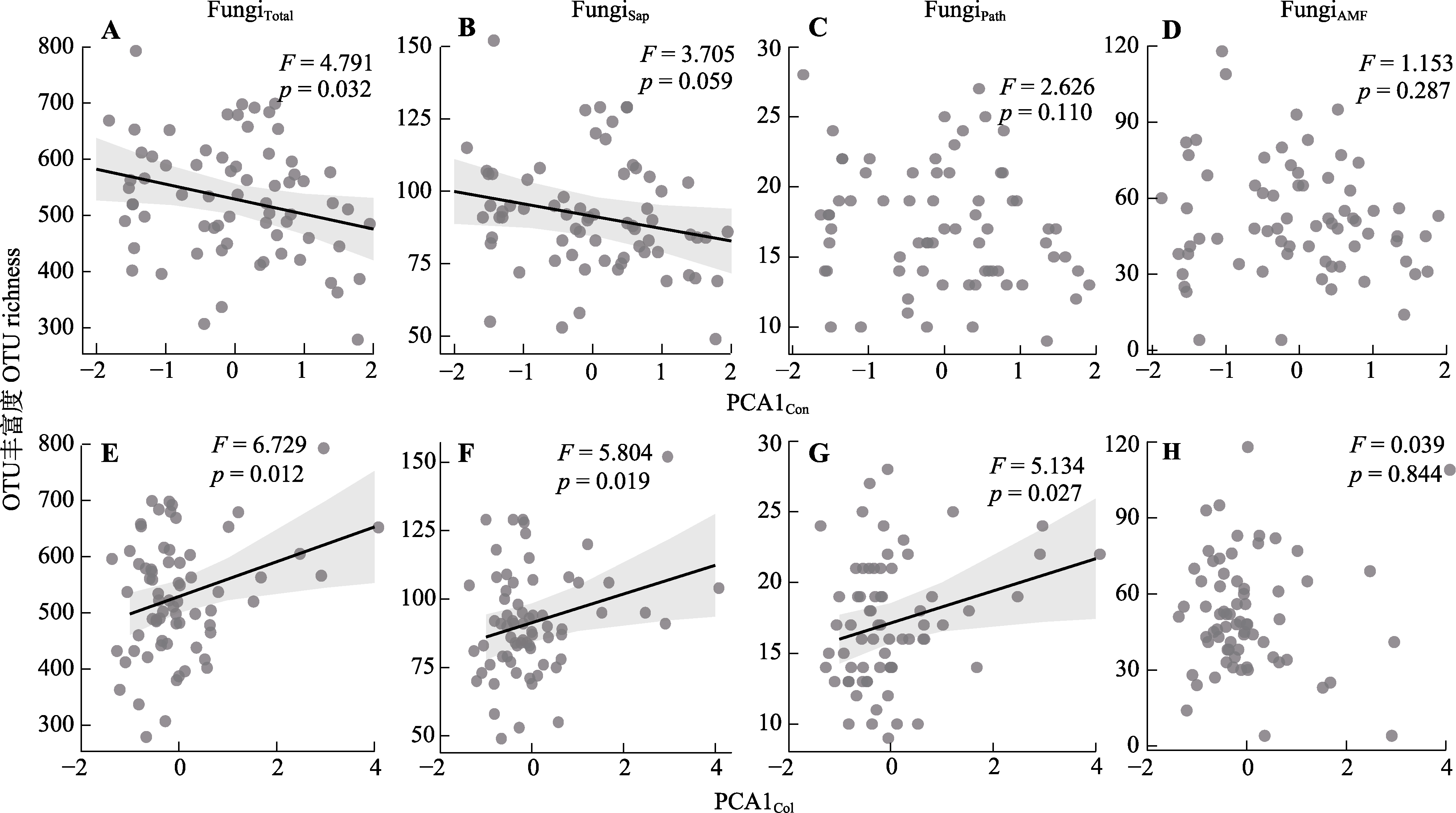
Fig. 4 Linear mixed-effects modelling of the effect of plant resource acquisition strategies on operational taxonomic units (OTU) richness of rhizosphere soil fungi. FungiTotal, OTU richness of overall fungi; FungiSap, OTU richness of saprophytic fungi; FungiPath, OTU richness of pathogenic fungi; FungiAMF, OTU richness of arbuscular mycorrhizal fungi. PCA1Col, scores on the first axis of principal component analysis for traits related to the collaboration dimension; PCA1Con, scores on the first axis of principal component analysis for traits related to the “fast-slow” economic spectrum. The solid line represents the significant slope value (p < 0.05 or p ≈ 0.05) for the linear mixed-effects model, and the corresponding shaded area represents the fitted 95% confidence interval.
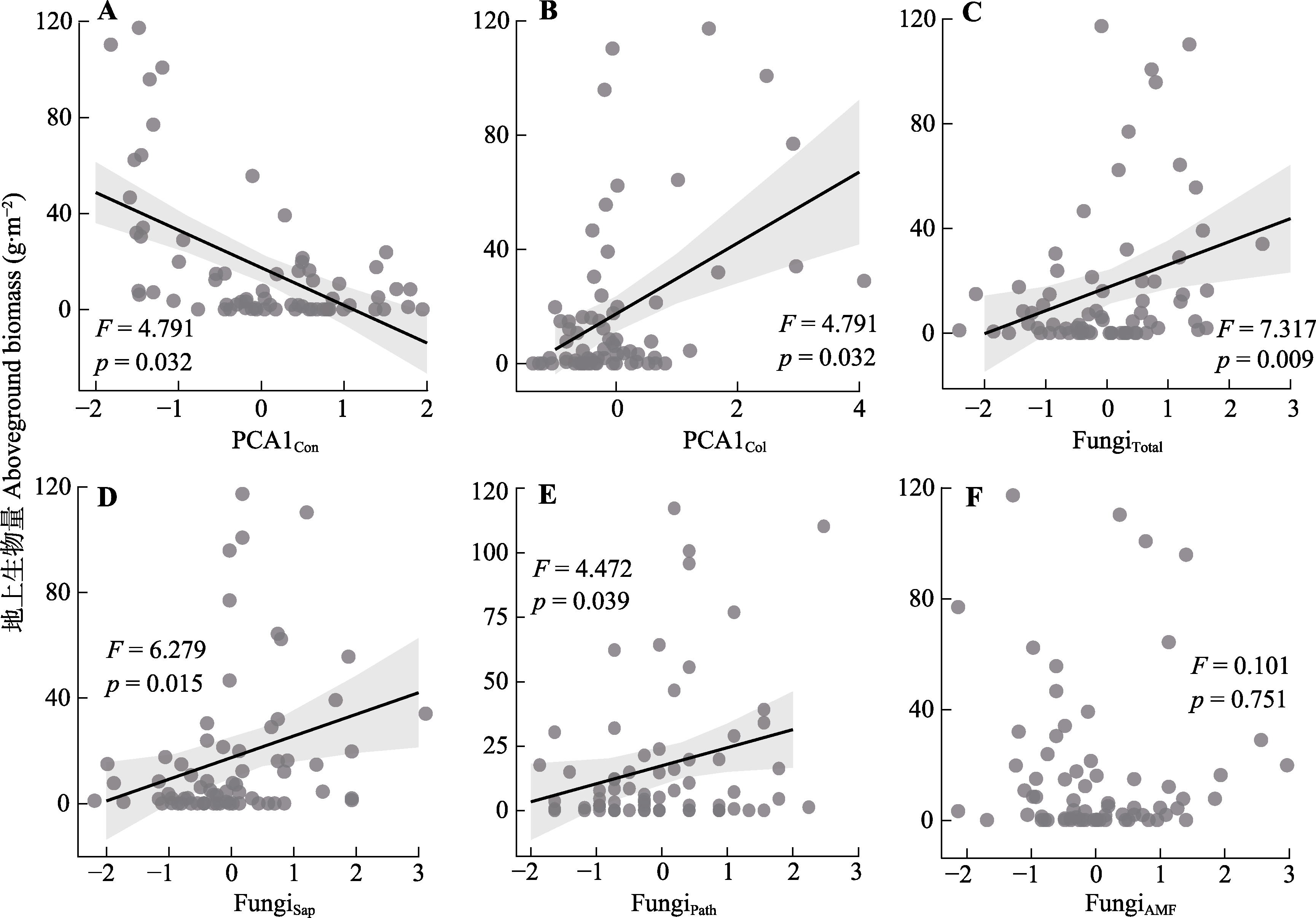
Fig. 5 Linear mixed-effects modelling of the effect of plant resource acquisition strategies and rhizosphere soil fungal diversity on aboveground biomass. FungiTotal, operational taxonomic units (OTU) richness of overall fungi; FungiSap, OTU richness of saprophytic fungi; FungiPath, OTU richness of pathogenic fungi; FungiAMF, OTU richness of arbuscular mycorrhizal fungi. PCA1Col, scores on the first axis of principal component analysis for traits related to the collaboration dimension; PCA1Con, scores on the first axis of principal component analysis for traits related to the “fast-slow” economic spectrum.
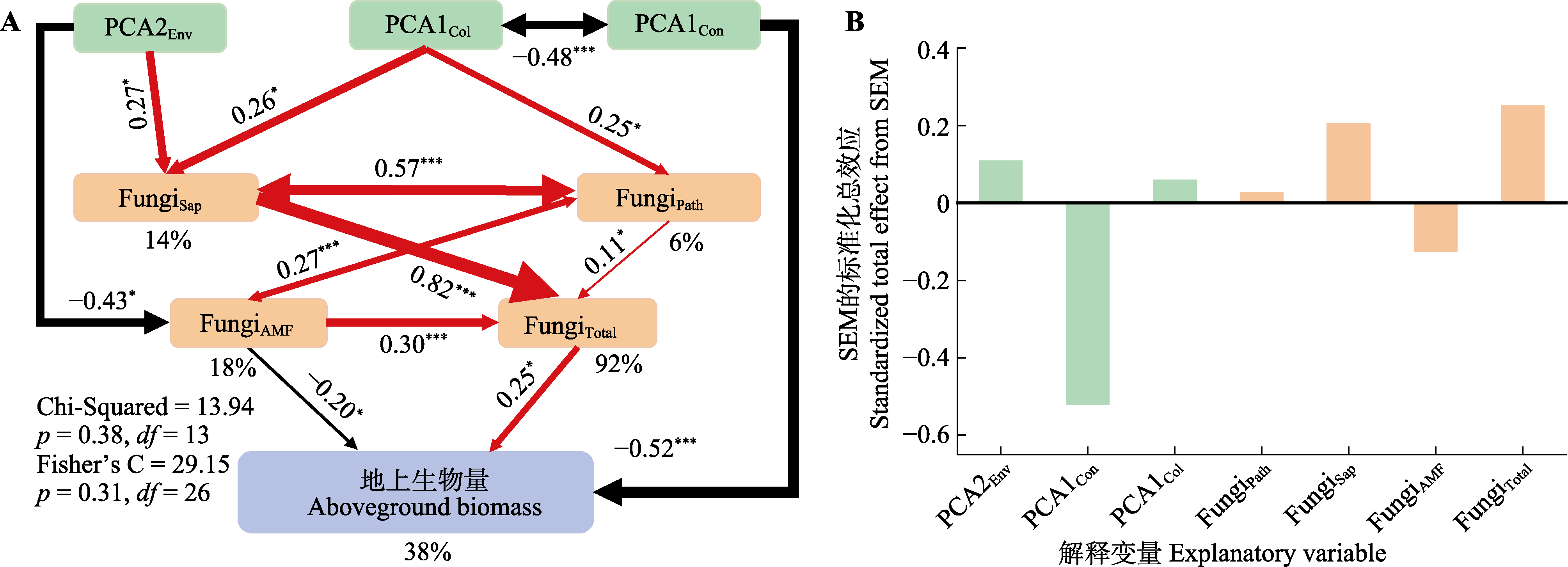
Fig. 6 Structural equation modelling (SEM) of the direct and indirect effect of plant resource acquisition strategies and rhizosphere soil fungal diversity on aboveground biomass. Red and black arrows represent positive and negative effects, respectively, and the numbers on the arrows represent standardized path coefficients. The arrow thickness is proportional to the magnitude of these path coefficients. FungiTotal, operational taxonomic units (OTU) richness of overall fungi; FungiSap, OTU richness of saprophytic fungi; FungiPath, OTU richness of pathogenic fungi; FungiAMF, OTU richness of arbuscular mycorrhizal fungi; PCA1Col, scores on the first axis of principal component analysis for traits related to the collaboration dimension; PCA1Con, scores on the first axis of principal component analysis for traits related to the “fast-slow” economic spectrum; PCA2Env, scores on the second axis of principal component analysis for soil properties. The significance levels are denoted as follows: †, p ≈ 0.05; *, p < 0.05; **, p < 0.01; ***, p < 0.001. Two-way arrows indicate significant correlations between variables. The R2 of each dependent variable in the model are expressed as percentages.
| [1] |
Berendsen RL, Pieterse CMJ, Bakker PAHM (2012). The rhizosphere microbiome and plant health. Trends in Plant Science, 17, 478-486.
DOI PMID |
| [2] | Bergmann J, Weigelt A, van der Plas F, Laughlin DC, Kuyper TW, Guerrero-Ramirez N, Valverde-Barrantes OJ, Bruelheide H, Freschet GT, Iversen CM, Kattge J, McCormack ML, Meier IC, Rillig MC, Roumet C, et al. (2020). The fungal collaboration gradient dominates the root economics space in plants. Science Advances, 6, eaba3756. DOI: 10.1126/sciadv.aba3756. |
| [3] |
Campos ML, Yoshida Y, Major IT, de Oliveira Ferreira D, Weraduwage SM, Froehlich JE, Johnson BF, Kramer DM, Jander G, Sharkey TD, Howe GA (2016). Rewiring of jasmonate and phytochrome B signalling uncouples plant growth-defense tradeoffs. Nature Communications, 7, 12570. DOI: 10.1038/ncomms12570.
PMID |
| [4] |
Chen L, Swenson NG, Ji NN, Mi XC, Ren HB, Guo LD, Ma KP (2019). Differential soil fungus accumulation and density dependence of trees in a subtropical forest. Science, 366, 124-128.
DOI PMID |
| [5] | Cortois R, Schröder-Georgi T, Weigelt A, van der Putten WH, de Deyn GB (2016). Plant-soil feedbacks: role of plant functional group and plant traits. Journal of Ecology, 104, 1608-1617. |
| [6] |
Crawford KM, Bauer JT, Comita LS, Eppinga MB, Johnson DJ, Mangan SA, Queenborough SA, Strand AE, Suding KN, Umbanhowar J, Bever JD (2019). When and where plant-soil feedback may promote plant coexistence: a meta-analysis. Ecology Letters, 22, 1274-1284.
DOI PMID |
| [7] |
Delory BM, Callaway RM, Semchenko M (2024). A trait-based framework linking the soil metabolome to plant-soil feedbacks. New Phytologist, 241, 1910-1921.
DOI PMID |
| [8] | Freschet GT, Pagès L, Iversen CM, Comas LH, Rewald B, Roumet C, Klimešová J, Zadworny M, Poorter H, Postma JA, Adams TS, Bagniewska-Zadworna A, Bengough AG, Blancaflor EB, Brunner I, et al. (2021). A starting guide to root ecology: strengthening ecological concepts and standardising root classification, sampling, processing and trait measurements. New Phytologist, 232, 973-1122. |
| [9] |
Gundale MJ, Kardol P (2021). Multi-dimensionality as a path forward in plant-soil feedback research. Journal of Ecology, 109, 3446-3465.
DOI URL |
| [10] |
Han MG, Chen Y, Sun LJ, Yu M, Li R, Li SF, Su JR, Zhu B (2023). Linking rhizosphere soil microbial activity and plant resource acquisition strategy. Journal of Ecology, 111, 875-888.
DOI URL |
| [11] |
Hennecke J, Bassi L, Mommer L, Albracht C, Bergmann J, Eisenhauer N, Guerra CA, Heintz-Buschart A, Kuyper TW, Lange M, Solbach MD, Weigelt A (2023). Responses of rhizosphere fungi to the root economics space in grassland monocultures of different age. New Phytologist, 240, 2035-2049.
DOI URL |
| [12] |
Hiiesalu I, Pärtel M, Davison J, Gerhold P, Metsis M, Moora M, Öpik M, Vasar M, Zobel M, Wilson SD (2014). Species richness of arbuscular mycorrhizal fungi: associations with grassland plant richness and biomass. New Phytologist, 203, 233-244.
DOI PMID |
| [13] |
Jani AD, Grossman JM, Smyth TJ, Hu SJ (2015). Influence of soil inorganic nitrogen and root diameter size on legume cover crop root decomposition and nitrogen release. Plant and Soil, 393, 57-68.
DOI URL |
| [14] |
Lefcheck JS (2016). piecewiseSEM: piecewise structural equation modelling in R for ecology, evolution, and systematics. Methods in Ecology and Evolution, 7, 573-579.
DOI URL |
| [15] |
Ma ZY, Liu HY, Mi ZR, Zhang ZH, Wang YH, Xu W, Jiang L, He JS (2017). Climate warming reduces the temporal stability of plant community biomass production. Nature Communications, 8, 15378. DOI: 10.1038/ncomms15378.
PMID |
| [16] |
Mangan SA, Schnitzer SA, Herre EA, Mack KML, Valencia MC, Sanchez EI, Bever JD (2010). Negative plant-soil feedback predicts tree-species relative abundance in a tropical forest. Nature, 466, 752-755.
DOI |
| [17] | Martínez-García LB, Korthals GW, Brussaard L, Mainardi G, de Deyn GB (2021). Litter quality drives nitrogen release, and agricultural management (organic vs. conventional) drives carbon loss during litter decomposition in agro-ecosystems. Soil Biology & Biochemistry, 153, 108115. DOI: 10.1016/j.soilbio.2020.108115. |
| [18] | Põlme S, Abarenkov K, Henrik Nilsson R, Lindahl BD, Clemmensen KE, Kauserud H, Nguyen N, Kjøller R, Bates ST, Baldrian P, Frøslev TG, Adojaan K, Vizzini A, Suija A, Pfister D, et al. (2020). FungalTraits: a user-friendly traits database of fungi and fungus-like stramenopiles. Fungal Diversity, 105, 1-16. |
| [19] |
Prieto I, Stokes A, Roumet C (2016). Root functional parameters predict fine root decomposability at the community level. Journal of Ecology, 104, 725-733.
DOI URL |
| [20] |
Reich PB (2014). The world-wide ‘fast-slow’ plant economics spectrum: a traits manifesto. Journal of Ecology, 102, 275-301.
DOI URL |
| [21] | Semchenko M, Leff JW, Lozano YM, Saar S, Davison J, Wilkinson A, Jackson BG, Pritchard WJ, de Long JR, Oakley S, Mason KE, Ostle NJ, Baggs EM, Johnson D, Fierer N, Bardgett RD (2018). Fungal diversity regulates plant-soil feedbacks in temperate grassland. Science Advances, 4, eaau4578. DOI: 10.1126/sciadv.aau457. |
| [22] |
van der Wal A, Geydan TD, Kuyper TW, de Boer W (2013). A thready affair: linking fungal diversity and community dynamics to terrestrial decomposition processes. FEMS Microbiology Reviews, 37, 477-494.
DOI PMID |
| [23] |
van Ruijven J, Ampt E, Francioli D, Mommer L (2020). Do soil-borne fungal pathogens mediate plant diversity-productivity relationships? Evidence and future opportunities. Journal of Ecology, 108, 1810-1821.
DOI URL |
| [24] |
Wang FP, Shi GX, Nicholas O, Yao BQ, Ji MF, Wang WY, Ma Z, Zhou HK, Zhao XQ (2018). Ecosystem nitrogen retention is regulated by plant community trait interactions with nutrient status in an alpine meadow. Journal of Ecology, 106, 1570-1581.
DOI URL |
| [25] |
Wang MX, Ge AH, Ma XZ, Wang XL, Xie QJ, Wang LK, Song XW, Jiang MC, Yang WB, Murray JD, Wang YY, Liu H, Cao XF, Wang ET (2024). Dynamic root microbiome sustains soybean productivity under unbalanced fertilization. Nature Communications, 15, 1668. DOI: 10.1038/s41467-024-45925-5.
PMID |
| [26] |
Weigelt A, Mommer L, Andraczek K, Iversen CM, Bergmann J, Bruelheide H, Fan Y, Freschet GT, Guerrero-Ramírez NR, Kattge J, Kuyper TW, Laughlin DC, Meier IC, van der Plas F, Poorter H, et al. (2021). An integrated framework of plant form and function: the belowground perspective. New Phytologist, 232, 42-59.
DOI PMID |
| [27] |
Williams A, Langridge H, Straathof AL, Muhamadali H, Hollywood KA, Goodacre R, de Vries FT (2022). Root functional traits explain root exudation rate and composition across a range of grassland species. Journal of Ecology, 110, 21-33.
DOI URL |
| [28] |
Wolters H, Jürgens G (2009). Survival of the flexible: hormonal growth control and adaptation in plant development. Nature Reviews Genetics, 10, 305-317.
DOI PMID |
| [29] |
Wright IJ, Reich PB, Cornelissen JHC, Falster DS, Garnier E, Hikosaka K, Lamont BB, Lee W, Oleksyn J, Osada N, Poorter H, Villar R, Warton DI, Westoby M (2005). Assessing the generality of global leaf trait relationships. New Phytologist, 166, 485-496.
DOI PMID |
| [30] |
Xi NX, Adler PB, Chen DX, Wu HY, Catford JA, van Bodegom PM, Bahn M, Crawford KM, Chu CJ (2021). Relationships between plant-soil feedbacks and functional traits. Journal of Ecology, 109, 3411-3423.
DOI URL |
| [31] |
Zhang L, Liu J, Xi JZ, Pang R, Gunina A, Zhou SR (2024). Competition for nitrogen between plants and microorganisms in grasslands: effect of nitrogen application rate and plant acquisition strategy. Biology and Fertility of Soils, 60, 227-236.
DOI |
| [32] |
Zhang L, Xu MG, Liu Y, Zhang FS, Hodge A, Feng G (2016). Carbon and phosphorus exchange may enable cooperation between an arbuscular mycorrhizal fungus and a phosphate-solubilizing bacterium. New Phytologist, 210, 1022-1032.
DOI PMID |
| [33] | Zhao N, Li SN, Lu SW, Wang XJ, Chen ZT, Xu XT (2023). High resistance to spring drought of grasslands under different degradation levels on a Leymus chinensis steppe. Global Ecology and Conservation, 43, e02471. DOI: 10.1016/j.gecco.2023.e02471. |
| [34] |
Zhou M, Guo YM, Sheng J, Yuan YJ, Zhang WH, Bai WM (2022). Using anatomical traits to understand root functions across root orders of herbaceous species in a temperate steppe. New Phytologist, 234, 422-434.
DOI PMID |
| [1] | JIANG Kang-Wei, LÜ Cheng, WANG Ya-Fei, LI Hong, ZHANG Zhi-Qing, WANG Yu, ZHANG Qing-Qing, Tuerxunnayi REYIMU. Effects of soil arbuscular mycorrhizal fungal communities on soil multifunctionality under grazing disturbance [J]. Chin J Plant Ecol, 2026, 50(3): 685-699. |
| [2] | XU En-Xiang, ZHOU Lei, ZHANG Xiao-Wei, ZHANG Guo-Ping, ZHONG Du-Wei, HUANG Zhi, LIU Pai, CHI Yong-Gang. Estimation of rice yield based on canopy reflectance spectra and carbon flux in diverse growth phases [J]. Chin J Plant Ecol, 2026, 50(1): 82-93. |
| [3] | LIU Wei, HAO Yi-Qing, SUN Jia-Mei, WANG Jing, FAN Bing, HAO Jian-Xi, JIN Na-Shen, PAN Qing-Min. Theory and application of soil nutrient regulation for degraded steppe in Hulun Buir, China [J]. Chin J Plant Ecol, 2025, 49(1): 138-147. |
| [4] | HUANG Ling, WANG Zhen, MA Ze, YANG Fa-Lin, LI Lan, SEREKPAYEV Nurlan, NOGAYEV Adilbek, HOU Fu-Jiang. Effects of long-term grazing and nitrogen addition on the growth of Stipa bungeana population in typical steppe of Loess Plateau [J]. Chin J Plant Ecol, 2024, 48(3): 317-330. |
| [5] | YUAN He-Yang, HAO Min-Hui, HE Huai-Jiang, ZHANG Chun-Yu, ZHAO Xiu-Hai. Impact of species richness and composition on productivity and its changes with forest succession in Changbai Mountains, China [J]. Chin J Plant Ecol, 2024, 48(12): 1602-1611. |
| [6] | LIU Wei-Hui, SONG Xiao-Yan, CAIRENDUOJIE , DING Lu-Ming, WANG Chang-Ting. Effects of degradation degree on the root morphological traits and biomass of dominant plant species in alpine meadows [J]. Chin J Plant Ecol, 2024, 48(12): 1666-1682. |
| [7] | ZHAO Yan-Chao, CHEN Li-Tong. Soil nutrients modulate response of aboveground biomass to warming in alpine grassland on the Qingzang Plateau [J]. Chin J Plant Ecol, 2023, 47(8): 1071-1081. |
| [8] | GE Ping, LI Ang, WANG Yin-Liu, JIANG Liang-Chao, NIU Guo-Xiang, HASI Muqi’er, WANG Yan-Bing, XUE Jian-Guo, ZHAO Wei, HUANG Jian-Hui. Nonlinear response of greenhouse gases emission to nitrogen addition in a meadow steppe [J]. Chin J Plant Ecol, 2023, 47(11): 1483-1492. |
| [9] | HAO Qing, HUANG Chang. A review of forest aboveground biomass estimation based on remote sensing data [J]. Chin J Plant Ecol, 2023, 47(10): 1356-1374. |
| [10] | DONG Liu-Wen, REN Zheng-Wei, ZHANG Rui, XIE Chen-Di, ZHOU Xiao-Long. Functional diversity rather than species diversity can explain community biomass variation following short-term nitrogen addition in an alpine grassland [J]. Chin J Plant Ecol, 2022, 46(8): 871-881. |
| [11] | HUANG Kuai-Kuai, HU Gang, PANG Qing-Ling, ZHANG Bei, HE Ye-Yong, HU Cong, XU Chao-Hao, ZHANG Zhong-Hua. Effects of grazing on species composition and community structure of shrub tussock in subtropical karst mountains, southwest China [J]. Chin J Plant Ecol, 2022, 46(11): 1350-1363. |
| [12] | CHEN Zhe, WANG Hao, WANG Jin-Zhou, SHI Hui-Jin, LIU Hui-Ying, HE Jin-Sheng. Estimation on seasonal dynamics of alpine grassland aboveground biomass using phenology camera-derived NDVI [J]. Chin J Plant Ecol, 2021, 45(5): 487-495. |
| [13] | MIAO Bai-Ling, LIANG Cun-Zhu, SHI Ya-Bo, LIANG Mao-Wei, LIU Zhong-Ling. Temporal changes in precipitation altered aboveground biomass in a typical steppe in Nei Mongol, China [J]. Chin J Plant Ecol, 2019, 43(7): 557-565. |
| [14] | ZHAO Dan-Dan, MA Hong-Yuan, LI Yang, WEI Ji-Ping, WANG Zhi-Chun. Effects of water and nutrient additions on functional traits and aboveground biomass of Leymus chinensis [J]. Chin J Plant Ecol, 2019, 43(6): 501-511. |
| [15] | LI Yang, XU Xiao-Hui, SUN Wei, SHEN Yan, REN Ting-Ting, HUANG Jian-Hui, WANG Chang-Hui. Effects of different forms and levels of N additions on soil potential net N mineralization rate in meadow steppe, Nei Mongol, China [J]. Chin J Plant Ecol, 2019, 43(2): 174-184. |
| Viewed | ||||||
|
Full text |
|
|||||
|
Abstract |
|
|||||
Copyright © 2026 Chinese Journal of Plant Ecology
Tel: 010-62836134, 62836138, E-mail: apes@ibcas.ac.cn, cjpe@ibcas.ac.cn

