
Chin J Plant Ecol ›› 2026, Vol. 50 ›› Issue (1): 55-69.DOI: 10.17521/cjpe.2024.0417 cstr: 32100.14.cjpe.2024.0417
• Research Articles • Previous Articles Next Articles
DAI Yun-Ze1,2, YAO Liang-Jin3, CHEN Miao4, XU Xiao-Niu2,*( )
)
Received:2024-11-22
Accepted:2025-02-26
Online:2026-01-20
Published:2026-02-13
Contact:
XU Xiao-Niu
Supported by:DAI Yun-Ze, YAO Liang-Jin, CHEN Miao, XU Xiao-Niu. Effects of nitrogen and phosphorus additions on the stability of soil aggregates and their carbon and nitrogen contents in evergreen broadleaf forests[J]. Chin J Plant Ecol, 2026, 50(1): 55-69.
Add to citation manager EndNote|Ris|BibTeX
URL: https://www.plant-ecology.com/EN/10.17521/cjpe.2024.0417
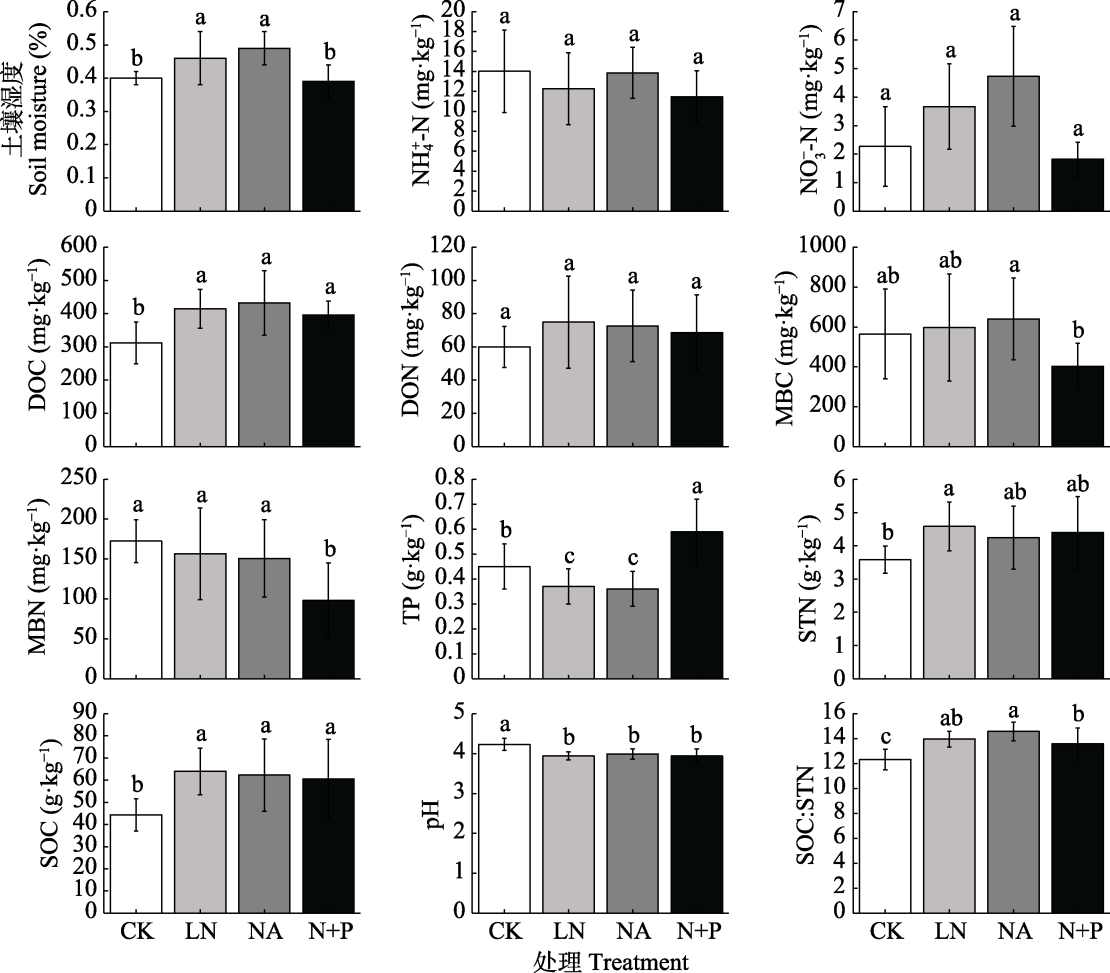
Fig. 1 Soil physicochemical properties under nitrogen and phosphorus addition (mean ± SD). Different lowercase letters indicate significant differences between treatments (p < 0.05). CK, control check; LN, low nitrogen addition; NA, nitrogen addition; N+P, nitrogen and phosphorus addition. DOC, dissolved organic carbon content; DON, dissolved organic nitrogen content; MBC, soil microbial biomass carbon content; MBN, soil microbial biomass nitrogen content; SOC, soil organic carbon content; STN, soil total nitrogen content; TP, soil total phosphorus content.
| 指标 Index | LN | NA | N+P | |||
|---|---|---|---|---|---|---|
| F | p | F | p | F | p | |
| 大团聚体质量百分比 Macroaggregate mass percentage | 1.29 | 0.27 | 0.21 | 0.65 | 0.33 | 0.57 |
| 微团聚体质量百分比 Microaggregate mass percentage | 1.04 | 0.32 | 0.11 | 0.75 | 0.02 | 0.89 |
| 粉黏粒质量百分比 Silt + clay mass percentage | 1.24 | 0.28 | 0.40 | 0.54 | 0.91 | 0.36 |
| MWD | 1.30 | 0.27 | 0.21 | 0.65 | 0.34 | 0.57 |
| GMD | 0.98 | 0.34 | 0.22 | 0.65 | 0.52 | 0.48 |
| 大团聚体碳(C)浓度 Macroaggregate carbon concentration | 18.95 | <0.01** | 10.12 | <0.01** | 4.28 | 0.06 |
| 微团聚体C浓度 Microaggregate carbon concentration | 19.24 | <0.01** | 16.34 | <0.01** | 4.43 | 0.05 |
| 粉黏粒C浓度 Silt + clay carbon concentration | 12.12 | <0.01** | 6.07 | 0.03* | 5.21 | 0.04* |
| 大团聚体氮(N)浓度 Macroaggregate nitrogen concentration | 10.15 | <0.01** | 4.70 | 0.04* | 2.37 | 0.14 |
| 微团聚体N浓度 Microaggregate nitrogen concentration | 13.71 | <0.01** | 5.33 | 0.03* | 2.69 | 0.12 |
| 粉黏粒N浓度 Silt + clay nitrogen concentration | 7.60 | 0.01* | 1.78 | 0.20 | 3.79 | 0.07 |
| 大团聚体SOC:STN Macroaggregate SOC:STN | 9.42 | <0.01** | 31.80 | <0.01** | 6.59 | 0.02* |
| 微团聚体SOC:STN Microaggregate SOC:STN | 0.72 | 0.41 | 7.20 | 0.02* | 2.48 | 0.14 |
| 粉黏粒SOC:STN Silt + clay SOC:STN | 0 | 0.99 | 2.40 | 0.14 | 0.69 | 0.42 |
| 大团聚体C含量 Macroaggregate carbon content | 21.48 | <0.01** | 13.84 | <0.01** | 4.05 | 0.06 |
| 微团聚体C含量 Microaggregate carbon content | 2.02 | 0.17 | 3.74 | 0.07 | 2.94 | 0.11 |
| 粉黏粒C含量 Silt + clay carbon content | 1.59 | 0.23 | 4.34 | 0.05 | 3.80 | 0.07 |
| 大团聚体N含量 Macroaggregate nitrogen content | 11.82 | <0.01** | 5.93 | 0.03 | 1.96 | 0.18 |
| 微团聚体N含量 Microaggregate nitrogen content | 1.28 | 0.28 | 2.02 | 0.18 | 1.92 | 0.19 |
| 粉黏粒N含量 Silt + clay nitrogen content | 1.10 | 0.31 | 2.66 | 0.12 | 3.53 | 0.08 |
| 大团聚体δ13C Macroaggregate δ13C | 1.98 | 0.14 | 1.98 | 0.14 | 1.98 | 0.14 |
| 微团聚体δ13C Microaggregate δ13C | 6.84 | <0.01** | 6.84 | <0.01** | 6.84 | <0.01** |
| 粉黏粒δ13C Silt + clay δ13C | 2.92 | 0.04* | 2.92 | 0.04* | 2.92 | 0.04* |
| 大团聚体δ15N Macroaggregate δ15N | 13.89 | <0.01** | 13.89 | <0.01** | 13.89 | <0.01** |
| 微团聚体δ15N Microaggregate δ15N | 1.70 | 0.19 | 1.70 | 0.19 | 1.70 | 0.19 |
| 粉黏粒δ15N Silt + clay δ15N | 4.72 | <0.01** | 4.72 | <0.01** | 4.72 | <0.01** |
Table 1 ANOVA of soil aggregate fractions
| 指标 Index | LN | NA | N+P | |||
|---|---|---|---|---|---|---|
| F | p | F | p | F | p | |
| 大团聚体质量百分比 Macroaggregate mass percentage | 1.29 | 0.27 | 0.21 | 0.65 | 0.33 | 0.57 |
| 微团聚体质量百分比 Microaggregate mass percentage | 1.04 | 0.32 | 0.11 | 0.75 | 0.02 | 0.89 |
| 粉黏粒质量百分比 Silt + clay mass percentage | 1.24 | 0.28 | 0.40 | 0.54 | 0.91 | 0.36 |
| MWD | 1.30 | 0.27 | 0.21 | 0.65 | 0.34 | 0.57 |
| GMD | 0.98 | 0.34 | 0.22 | 0.65 | 0.52 | 0.48 |
| 大团聚体碳(C)浓度 Macroaggregate carbon concentration | 18.95 | <0.01** | 10.12 | <0.01** | 4.28 | 0.06 |
| 微团聚体C浓度 Microaggregate carbon concentration | 19.24 | <0.01** | 16.34 | <0.01** | 4.43 | 0.05 |
| 粉黏粒C浓度 Silt + clay carbon concentration | 12.12 | <0.01** | 6.07 | 0.03* | 5.21 | 0.04* |
| 大团聚体氮(N)浓度 Macroaggregate nitrogen concentration | 10.15 | <0.01** | 4.70 | 0.04* | 2.37 | 0.14 |
| 微团聚体N浓度 Microaggregate nitrogen concentration | 13.71 | <0.01** | 5.33 | 0.03* | 2.69 | 0.12 |
| 粉黏粒N浓度 Silt + clay nitrogen concentration | 7.60 | 0.01* | 1.78 | 0.20 | 3.79 | 0.07 |
| 大团聚体SOC:STN Macroaggregate SOC:STN | 9.42 | <0.01** | 31.80 | <0.01** | 6.59 | 0.02* |
| 微团聚体SOC:STN Microaggregate SOC:STN | 0.72 | 0.41 | 7.20 | 0.02* | 2.48 | 0.14 |
| 粉黏粒SOC:STN Silt + clay SOC:STN | 0 | 0.99 | 2.40 | 0.14 | 0.69 | 0.42 |
| 大团聚体C含量 Macroaggregate carbon content | 21.48 | <0.01** | 13.84 | <0.01** | 4.05 | 0.06 |
| 微团聚体C含量 Microaggregate carbon content | 2.02 | 0.17 | 3.74 | 0.07 | 2.94 | 0.11 |
| 粉黏粒C含量 Silt + clay carbon content | 1.59 | 0.23 | 4.34 | 0.05 | 3.80 | 0.07 |
| 大团聚体N含量 Macroaggregate nitrogen content | 11.82 | <0.01** | 5.93 | 0.03 | 1.96 | 0.18 |
| 微团聚体N含量 Microaggregate nitrogen content | 1.28 | 0.28 | 2.02 | 0.18 | 1.92 | 0.19 |
| 粉黏粒N含量 Silt + clay nitrogen content | 1.10 | 0.31 | 2.66 | 0.12 | 3.53 | 0.08 |
| 大团聚体δ13C Macroaggregate δ13C | 1.98 | 0.14 | 1.98 | 0.14 | 1.98 | 0.14 |
| 微团聚体δ13C Microaggregate δ13C | 6.84 | <0.01** | 6.84 | <0.01** | 6.84 | <0.01** |
| 粉黏粒δ13C Silt + clay δ13C | 2.92 | 0.04* | 2.92 | 0.04* | 2.92 | 0.04* |
| 大团聚体δ15N Macroaggregate δ15N | 13.89 | <0.01** | 13.89 | <0.01** | 13.89 | <0.01** |
| 微团聚体δ15N Microaggregate δ15N | 1.70 | 0.19 | 1.70 | 0.19 | 1.70 | 0.19 |
| 粉黏粒δ15N Silt + clay δ15N | 4.72 | <0.01** | 4.72 | <0.01** | 4.72 | <0.01** |
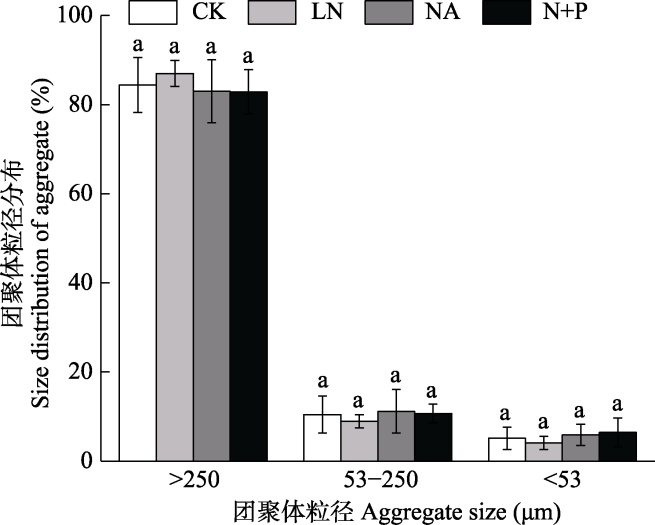
Fig. 2 Changes in the distribution of soil aggregates under nitrogen and phosphorus addition (mean ± SD). CK, control check; LN, low nitrogen addition; NA, nitrogen addition; N+P, nitrogen and phosphorus addition. Different lowercase letters indicate significant differences between treatments (p < 0.05).
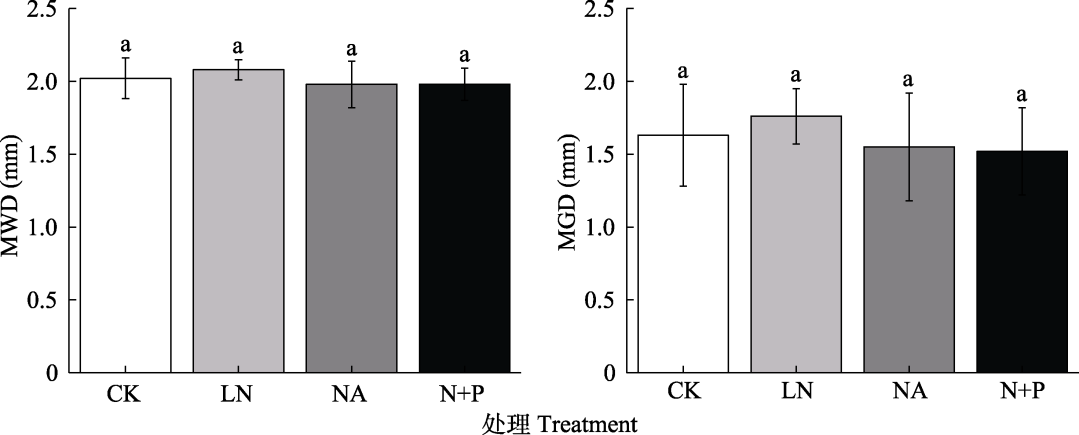
Fig. 3 Effect of nitrogen and phosphorus addition on mean weight diameter (MWD) and geometric mean diameter (GMD) of soil aggregates (mean ± SD). CK, control check; LN, low nitrogen addition; NA, nitrogen addition; N+P, nitrogen and phosphorus addition. Different lowercase letters indicate significant differences between treatments (p < 0.05).
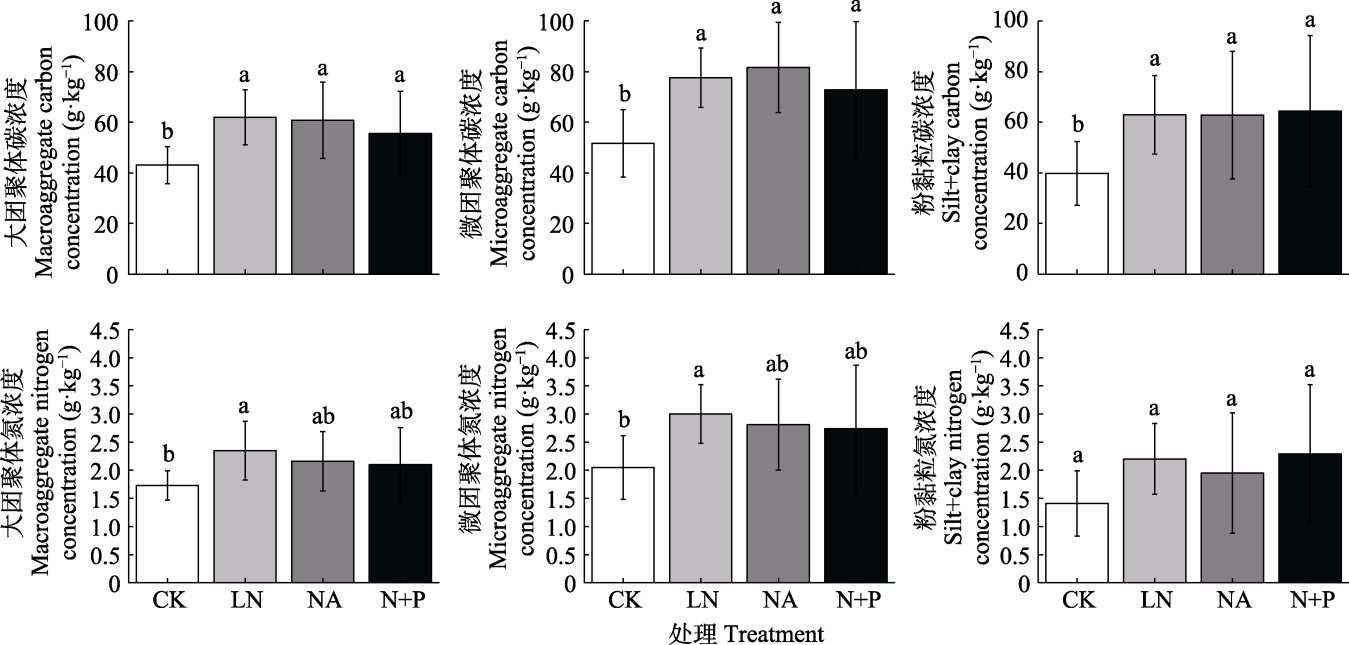
Fig. 4 Changes in carbon and nitrogen concentrations in soil aggregates under nitrogen and phosphorus addition (mean ± SD). CK, control check; LN, low nitrogen addition; NA, nitrogen addition; N+P, nitrogen and phosphorus addition. Different lowercase letters indicate significant differences between treatments (p < 0.05).
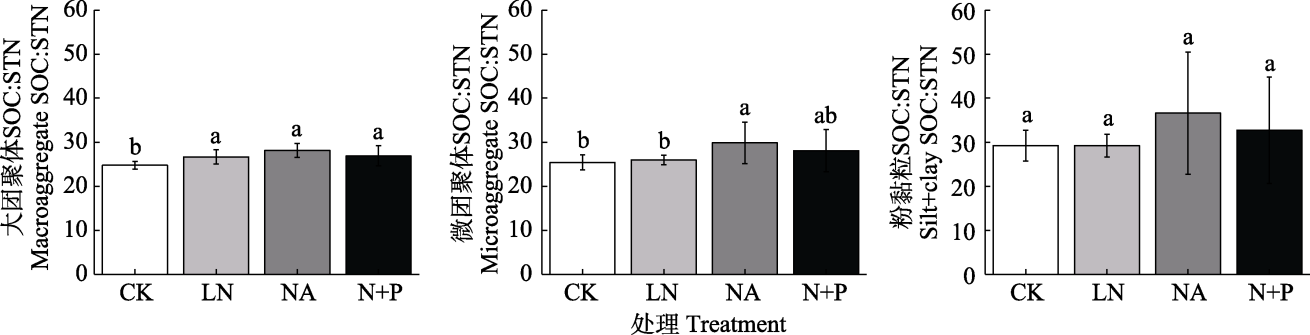
Fig. 5 Changes in carbon to nitrogen ratio of soil aggregates under nitrogen and phosphorus addition (mean ± SD). CK, control check; LN, low nitrogen addition; NA, nitrogen addition; N+P, nitrogen and phosphorus addition. SOC, soil organic carbon content; STN, soil total nitrogen content. Different lowercase letters indicate significant differences between treatments (p < 0.05).
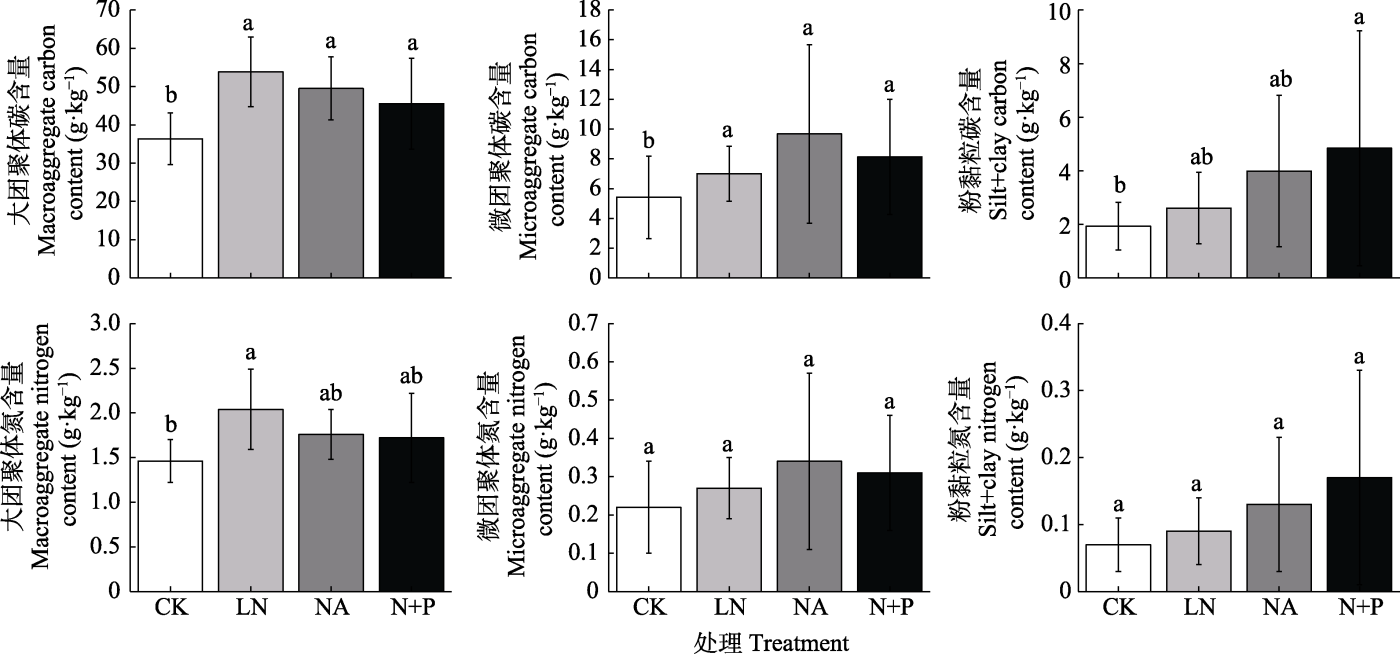
Fig. 6 Changes in carbon and nitrogen content of soil aggregates under nitrogen and phosphorus addition (mean ± SD). CK, control check; LN, low nitrogen addition; NA, nitrogen addition; N+P, nitrogen and phosphorus addition. Different lowercase letters indicate significant differences between treatments (p < 0.05).
| 处理 Treatment | 大团聚体δ13C Macroaggregate δ13C | 微团聚体δ13C Microaggregate δ13C | 粉黏粒δ13C Silt + clay δ13C | 大团聚体δ15N Macroaggregate δ15N | 微团聚体δ15N Microaggregate δ15N | 粉黏粒δ15N Silt + clay δ15N |
|---|---|---|---|---|---|---|
| CK | -27.71 ± 1.92b | -27.85 ± 0.04a | -30.80 ± 4.47a | -24.65 ± 10.18a | -10.96 ± 4.84a | -5.19 ± 0.86a |
| LN | -26.27 ± 0.46a | -31.11 ± 1.68b | -34.16 ± 6.37a | -47.04 ± 5.67c | -11.33 ± 5.55a | -5.73 ± 0.64b |
| NA | -26.88 ± 1.80ab | -29.65 ± 1.37b | -54.83 ± 37.96b | -33.55 ± 9.85b | -8.88 ± 1.15a | -4.67 ± 0.43a |
| N+P | -26.46 ± 0.52ab | -30.85 ± 2.63b | -33.65 ± 3.82a | -41.03 ± 3.13c | -7.79 ± 2.12a | -5.19 ± 0.30ab |
Table 2 Isotopic changes in soil aggregates under nitrogen and phosphorus addition (mean ± SD, ‰)
| 处理 Treatment | 大团聚体δ13C Macroaggregate δ13C | 微团聚体δ13C Microaggregate δ13C | 粉黏粒δ13C Silt + clay δ13C | 大团聚体δ15N Macroaggregate δ15N | 微团聚体δ15N Microaggregate δ15N | 粉黏粒δ15N Silt + clay δ15N |
|---|---|---|---|---|---|---|
| CK | -27.71 ± 1.92b | -27.85 ± 0.04a | -30.80 ± 4.47a | -24.65 ± 10.18a | -10.96 ± 4.84a | -5.19 ± 0.86a |
| LN | -26.27 ± 0.46a | -31.11 ± 1.68b | -34.16 ± 6.37a | -47.04 ± 5.67c | -11.33 ± 5.55a | -5.73 ± 0.64b |
| NA | -26.88 ± 1.80ab | -29.65 ± 1.37b | -54.83 ± 37.96b | -33.55 ± 9.85b | -8.88 ± 1.15a | -4.67 ± 0.43a |
| N+P | -26.46 ± 0.52ab | -30.85 ± 2.63b | -33.65 ± 3.82a | -41.03 ± 3.13c | -7.79 ± 2.12a | -5.19 ± 0.30ab |
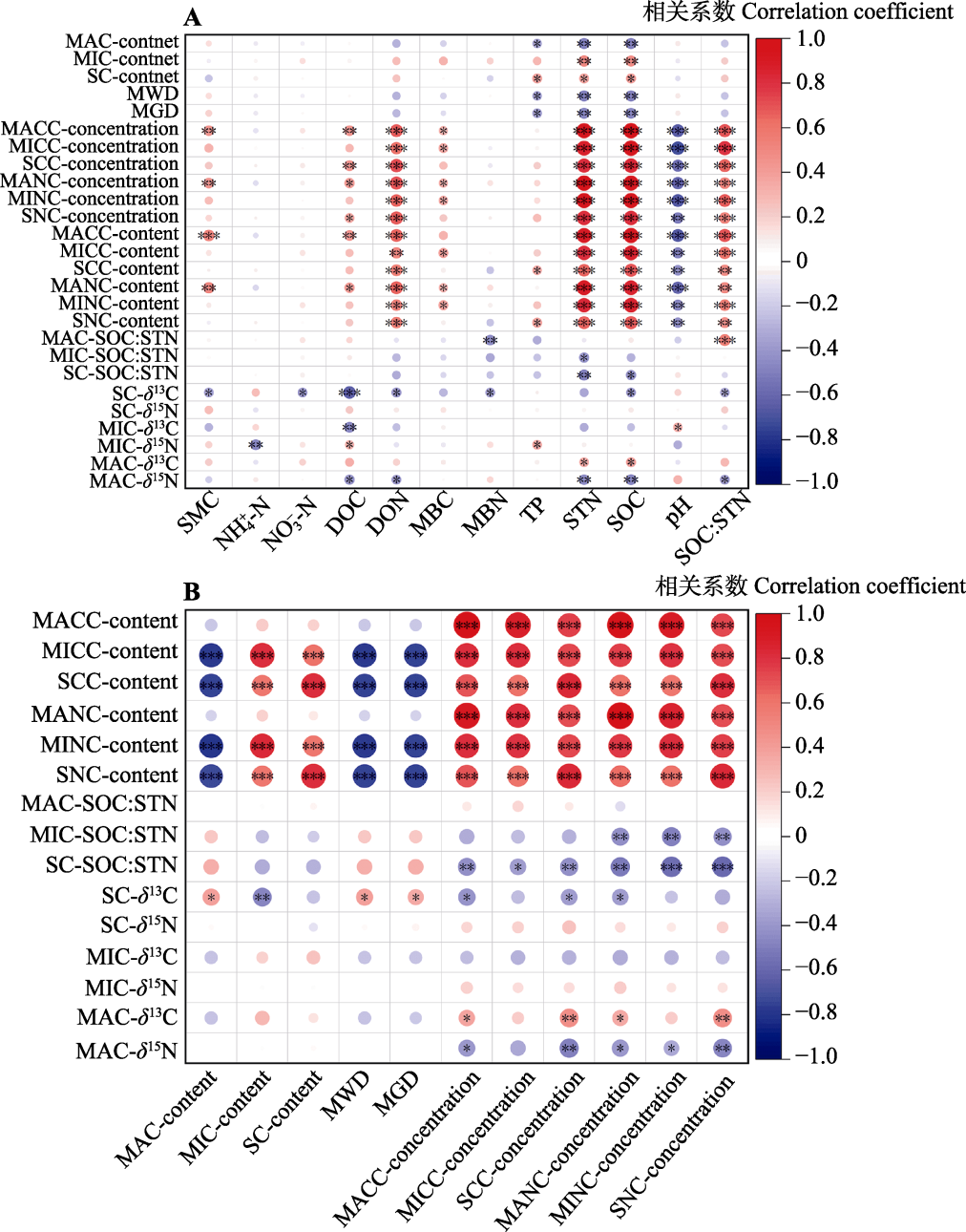
Fig. 7 Correlation analysis between soil aggregate fractions and environmental factors (A), and effect of soil aggregate distribution and its carbon, nitrogen concentration changes on soil carbon and nitrogen stability (B). DOC, dissolved organic carbon content; DON, dissolved organic nitrogen content; GMD, geometric mean diameter; MBC, soil microbial biomass carbon content; MBN, soil microbial biomass nitrogen content; MAC-δ13C, macroaggregate 13C isotope ratio (δ13C); MAC-δ15N, macroaggregate 15N isotope ratio (δ15N); MAC-content, macroaggregate content; MAC-SOC:STN, macroaggregate SOC:STN; MACC-concentration, macroaggregate carbon concentration; MACC-content, macroaggregate carbon content; MANC-concentration, macroaggregate nitrogen concentration; MANC-content, macroaggregate nitrogen content; MIC-δ13C, microaggregate δ13C; MIC-δ15N, microaggregate δ15N; MIC-content, microaggregate content; MIC-SOC:STN, microaggregate SOC:STN; MICC-concentration, microaggregate carbon concentration; MICC-content, microaggregate carbon content; MINC-concentration, microaggregate nitrogen concentration; MINC-content, microaggregate nitrogen content; MWD, mean weight diameter; SC-δ13C, silt + clay δ13C; SC-δ15N, silt + clay δ15N; SC-content, silt + clay content; SC-SOC:STN, silt + clay SOC:STN; SCC-concentration, silt + clay carbon concentration; SCC-content, silt + clay carbon content; SMC, soil moisture content; SNC-concentration, silt + clay nitrogen concentration; SNC-content, silt + clay nitrogen content; SOC, soil organic carbon content; STN, soil total nitrogen content; TP, soil total phosphorus content. *, p < 0.05; **, p < 0.01; ***, p < 0.001.
| [1] |
Bronick CJ, Lal R (2005). Soil structure and management: a review. Geoderma, 124, 3-22.
DOI URL |
| [2] |
Cadisch G, Imhof H, Urquiaga S, Boddey RM, Giller KE (1996). Carbon turnover (δ13C) and nitrogen mineralization potential of particulate light soil organic matter after rainforest clearing. Soil Biology & Biochemistry, 28, 1555-1567.
DOI URL |
| [3] |
Cambardella CA, Elliott ET (1993). Carbon and nitrogen distribution in aggregates from cultivated and native grassland soils. Soil Science Society of America Journal, 57, 1071-1076.
DOI URL |
| [4] |
Chang RY, Zhou WJ, Fang YT, Bing HJ, Sun XY, Wang GX (2019). Anthropogenic nitrogen deposition increases soil carbon by enhancing new carbon of the soil aggregate formation. Journal of Geophysical Research: Biogeosciences, 124, 572-584.
DOI URL |
| [5] |
Chaplot V, Cooper M (2015). Soil aggregate stability to predict organic carbon outputs from soils. Geoderma, 243-244, 205-213.
DOI URL |
| [6] |
Chen H, Li D, Feng W, Niu S, Plante A, Luo Y, Wang K (2018). Different responses of soil organic carbon fractions to additions of nitrogen. European Journal of Soil Science, 69, 1098-1104.
DOI URL |
| [7] |
Chen ZJ, Geng SC, Zhang JH, Setälä H, Gu Y, Wang F, Zhang X, Wang XX, Han SJ (2017). Addition of nitrogen enhances stability of soil organic matter in a temperate forest. European Journal of Soil Science, 68, 189-199.
DOI URL |
| [8] |
Chen ZJ, Zhou XY, Geng SC, Miao Y, Cao YH, Chen Z, Zhang JH, Han SJ (2019). Interactive effect of nitrogen addition and throughfall reduction decreases soil aggregate stability through reducing biological binding agents. Forest Ecology and Management, 445, 13-19.
DOI URL |
| [9] |
Cheng SL, Fang HJ, Yu GR (2018). Threshold responses of soil organic carbon concentration and composition to multi-level nitrogen addition in a temperate needle-broadleaved forest. Biogeochemistry, 137, 219-233.
DOI |
| [10] | Du JX, Liu KL, Huang J, Han TF, Zhang L, Anthonio CK, Shah A, Khan MN, Qaswar M, Abbas M, Huang QH, Xu YM, Zhang HM (2022). Organic carbon distribution and soil aggregate stability in response to long-term phosphorus addition in different land-use types. Soil and Tillage Research, 215, 105195. DOI: 10.1016/j.still.2021.105195. |
| [11] | Duan Y, Chen L, Zhang JB, Li DM, Han XR, Zhu B, Li Y, Zhao BJ, Huang P (2021). Long-term fertilisation reveals close associations between soil organic carbon composition and microbial traits at aggregate scales. Agriculture Ecosystems & Environment, 306, 107169. DOI: 10.1016/j.agee.2020.107169. |
| [12] |
Fang HJ, Yu GR, Cheng SL, Mo JM, Yan JH, Li SG (2009). 13C abundance, water-soluble and microbial biomass carbon as potential indicators of soil organic carbon dynamics in subtropical forests at different successional stages and subject to different nitrogen loads. Plant and Soil, 320, 243-254.
DOI URL |
| [13] |
Fang XM, Zhang XL, Chen FS, Zong YY, Bu WS, Wan SZ, Luo YQ, Wang HM (2019). Phosphorus addition alters the response of soil organic carbon decomposition to nitrogen deposition in a subtropical forest. Soil Biology & Biochemistry, 133, 119-128.
DOI URL |
| [14] |
Gao Y, Jia YL, Yu GR, He NP, Zhang L, Zhu B, Wang YF (2019). Anthropogenic reactive nitrogen deposition and associated nutrient limitation effect on gross primary productivity in inland water of China. Journal of Cleaner Production, 208, 530-540.
DOI URL |
| [15] | IPCC (Intergovernmental Panel on Climate Change) (2013). Climate change 2013:the physical science basis//Stocker TF, Qin D, Plattner GK, Tignor M, Allen SK, Boschung J, Nauels A, Xia Y, Bex V, Midgley PM. Contribution of Working Group I to the Fifth Assessment Report of the Intergovernmental Panel on Climate Change. Cambridge University Press, Cambridge, UK. |
| [16] |
Leifheit EF, Veresoglou SD, Lehmann A, Morris EK, Rillig MC (2014). Multiple factors influence the role of arbuscular mycorrhizal fungi in soil aggregation—A meta-analysis. Plant and Soil, 374, 523-537.
DOI URL |
| [17] |
Lu XF, Hou EQ, Guo JY, Gilliam FS, Li JL, Tang SB, Kuang YW (2021). Nitrogen addition stimulates soil aggregation and enhances carbon storage in terrestrial ecosystems of China: a meta-analysis. Global Change Biology, 27, 2780-2792.
DOI PMID |
| [18] |
Ma HL, Tecimen HB, Wu Y, Gao R, Yin YF (2024). Influence of litter and nitrogen addition on carbon and nitrogen levels in soil aggregates under a subtropical forest. Journal of Soil Science and Plant Nutrition, 24, 5029-5042.
DOI |
| [19] | Mao L, Tang LL, Ye SM, Wang SQ (2021). Soil organic C and total N as well as microbial biomass C and N affect aggregate stability in a chronosequence of Chinese fir plantations. European Journal of Soil Biology, 106, 103347. DOI: 10.1016/j.ejsobi.2021.103347. |
| [20] | Márquez CO, Garcia VJ, Cambardella CA, Schultz RC, Isenhart TM (2004). Aggregate-size stability distribution and soil stability. Soil Science Society of America Journal, 68, 725-735. |
| [21] |
Ngaba MJY, Bol R, Hu YL (2021). Stable isotopic signatures of carbon and nitrogen in soil aggregates following the conversion of natural forests to managed plantations in Eastern China. Plant and Soil, 459, 371-385.
DOI |
| [22] |
Nguetnkam JP, Dultz S (2011). Soil degradation in Central North Cameroon: water-dispersible clay in relation to surface charge in Oxisol A and B horizons. Soil and Tillage Research, 113, 38-47.
DOI URL |
| [23] | Niu GX, Yin GG, Mo XH, Mao QG, Mo JM, Wang JJ, Lu XK (2022). Do long-term high nitrogen inputs change the composition of soil dissolved organic matter in a primary tropical forest? Environmental Research Letters, 17, 095015. DOI: 10.1088/1748-9326/ac8e87. |
| [24] | Oksanen AJ, Blanchet FG, Friendly M, Kindt R, Legendre P, Mcglinn D (2018). Vegan: community ecology package. Agricultural Sciences, 9, 631-637. |
| [25] |
Pan YD, Birdsey RA, Fang JY, Houghton R, Kauppi PE, Kurz WA, Phillips OL, Shvidenko A, Lewis SL, Canadell JG, Ciais P, Jackson RB, Pacala SW, McGuire AD, Piao SL, et al. (2011). A large and persistent carbon sink in the world’s forests. Science, 333, 988-993.
DOI URL |
| [26] |
Peñuelas J, Janssens IA, Ciais P, Obersteiner M, Sardans J (2020). Anthropogenic global shifts in biospheric N and P concentrations and ratios and their impacts on biodiversity, ecosystem productivity, food security, and human health. Global Change Biology, 26, 1962-1985.
DOI URL |
| [27] | Peñuelas J, Poulter B, Sardans J, Ciais P, van der Velde M, Bopp L, Boucher O, Godderis Y, Hinsinger P, Llusia J, Nardin E, Vicca S, Obersteiner M, Janssens IA (2013). Human-induced nitrogen-phosphorus imbalances alter natural and managed ecosystems across the globe. Nature Communications, 4, 2934. DOI: 10.1038/ncomms3934. |
| [28] |
Pugh TAM, Lindeskog M, Smith B, Poulter B, Arneth A, Haverd V, Calle L (2019). Role of forest regrowth in global carbon sink dynamics. Proceedings of the National Academy of Sciences of the United States of America, 116, 4382-4387.
DOI PMID |
| [29] |
Riggs CE, Hobbie SE, Bach EM, Hofmockel KS, Kazanski CE (2015). Nitrogen addition changes grassland soil organic matter decomposition. Biogeochemistry, 125, 203-219.
DOI URL |
| [30] |
Six J, Paustian K, Elliott ET, Combrink C (2000). Soil structure and organic matter: I. Distribution of aggregate-size classes and aggregate-associated carbon. Soil Science Society of America Journal, 64, 681-689.
DOI URL |
| [31] |
Smil V (2000). Phosphorus in the environment: natural flows and human interferences. Annual Review of Energy and the Environment, 25, 53-88.
DOI URL |
| [32] | Su FL, Xu S, Sayer EJ, Chen WB, Du Y, Lu XK (2021). Distinct storage mechanisms of soil organic carbon in coniferous forest and evergreen broadleaf forest in tropical China. Journal of Environmental Management, 295, 113142. DOI: 10.1016/j.jenvman.2021.113142. |
| [33] |
Tan WB, Wang GA, Huang CH, Gao RT, Xi BD, Zhu B (2017). Physico-chemical protection, rather than biochemical composition, governs the responses of soil organic carbon decomposition to nitrogen addition in a temperate agroecosystem. Science of the Total Environment, 598, 282-288.
DOI URL |
| [34] | Tang XL, Zhao X, Bai YF, Tang ZY, Wang WT, Zhao YC, Wan HW, Xie ZQ, Shi XZ, Wu BF, Wang GX, Yan JH, Ma KP, Du S, Li SG, et al. (2018). Carbon pools in China’s terrestrial ecosystems: new estimates based on an intensive field survey. Proceedings of the National Academy of Sciences of the United States of America, 115, 4021-4026. |
| [35] |
Tian J, Dungait JAJ, Lu XK, Yang YF, Hartley IP, Zhang W, Mo JM, Yu GR, Zhou JZ, Kuzyakov Y (2019). Long-term nitrogen addition modifies microbial composition and functions for slow carbon cycling and increased sequestration in tropical forest soil. Global Change Biology, 25, 3267-3281.
DOI PMID |
| [36] |
Wang RZ, Wu H, Sardans J, Li TP, Liu HY, Peñuelas J, Dijkstra FA, Jiang Y (2020). Carbon storage and plant-soil linkages among soil aggregates as affected by nitrogen enrichment and mowing management in a meadow grassland. Plant and Soil, 457, 407-420.
DOI |
| [37] |
Weng LP, Vega FA, van Riemsdijk WH (2011). Competitive and synergistic effects in pH dependent phosphate adsorption in soils: LCD modeling. Environmental Science & Technology, 45, 8420-8428.
DOI URL |
| [38] | Xiao JN, Dong SK, Zhao ZZ, Han YH, Li S, Shen H, Ding CX (2021). Stabilization of soil organic carbon in the alpine meadow is dependent on the nitrogen deposition level on the Qinghai-Tibetan Plateau. Ecological Engineering, 170, 106348. DOI: 10.1016/j.ecoleng.2021.106348. |
| [39] | Yang YH, Shi Y, Sun WJ, Chang JF, Zhu JX, Chen LY, Wang X, Guo YP, Zhang HT, Yu LF, Zhao SQ, Xu K, Zhu JL, Shen HH, Wang YY, et al. (2022). Terrestrial carbon sinks in China and around the world and their contribution to carbon neutrality. Scientia Sinica (Vitae), 52, 534-574. |
| [杨元合, 石岳, 孙文娟, 常锦峰, 朱剑霄, 陈蕾伊, 王欣, 郭焱培, 张宏图, 于凌飞, 赵淑清, 徐亢, 朱江玲, 沈海花, 王媛媛, 等(2022). 中国及全球陆地生态系统碳源汇特征及其对碳中和的贡献. 中国科学: 生命科学, 52, 534-574.] | |
| [40] |
Ye CL, Chen DM, Hall SJ, Pan S, Yan XB, Bai TS, Guo H, Zhang Y, Bai YF, Hu SJ (2018). Reconciling multiple impacts of nitrogen enrichment on soil carbon: plant, microbial and geochemical controls. Ecology Letters, 21, 1162-1173.
DOI PMID |
| [41] |
Yu GR, Chen Z, Piao SL, Peng CH, Ciais P, Wang QF, Li XR, Zhu XJ (2014). High carbon dioxide uptake by subtropical forest ecosystems in the East Asian monsoon region. Proceedings of the National Academy of Sciences of the United States of America, 111, 4910-4915.
DOI PMID |
| [42] |
Yuan Y, Li Y, Mou ZJ, Kuang LH, Wu WJ, Zhang J, Wang FM, Hui DF, Peñuelas J, Sardans J, Lambers H, Wang J, Kuang YW, Li ZA, Liu ZF (2021). Phosphorus addition decreases microbial residual contribution to soil organic carbon pool in a tropical coastal forest. Global Change Biology, 27, 454-466.
DOI PMID |
| [43] | Zang Y, Xiang YX, Liu J, Jiang PK, Wu JS, Li YF (2024). Effects of nitrogen and phosphorus addition on soil water-stable aggregates and organic carbon distribution in moso bamboo forests in subtropical China. Scientia Silvae Sinicae, 60(7), 8-16. |
| [臧艳, 向宇轩, 刘娟, 姜培坤, 吴家森, 李永夫 (2024). 氮、磷添加对亚热带毛竹林土壤水稳性团聚体及有机碳分布的影响. 林业科学, 60(7), 8-16.] | |
| [44] |
Zhang LQ, Wei XR, Hao MD, Zhang M (2015). Changes in aggregate-associated organic carbon and nitrogen after 27 years of fertilization in a dryland alfalfa grassland on the Loess Plateau of China. Journal of Arid Land, 7, 429-437.
DOI |
| [45] | Zhang Y, Ge NN, Liao XL, Wang Z, Wei XR, Jia XX (2021). Long-term afforestation accelerated soil organic carbon accumulation but decreased its mineralization loss and temperature sensitivity in the bulk soils and aggregates. Catena, 204, 105405. DOI: 10.1016/j.catena.2021.105405. |
| [46] |
Zhong XL, Li JT, Li XJ, Ye YC, Liu SS, Hallett PD, Ogden MR, Naveed M (2017). Physical protection by soil aggregates stabilizes soil organic carbon under simulated N deposition in a subtropical forest of China. Geoderma, 285, 323-332.
DOI URL |
| [47] | Zhong ZK, Wu SJ, Lu XQ, Ren ZX, Wu QM, Xu MP, Ren CJ, Yang GH, Han XH (2021). Organic carbon, nitrogen accumulation, and soil aggregate dynamics as affected by vegetation restoration patterns in the Loess Plateau of China. Catena, 196, 104867. DOI: 10.1016/j.catena.2020.104867. |
| Viewed | ||||||
|
Full text |
|
|||||
|
Abstract |
|
|||||
Copyright © 2026 Chinese Journal of Plant Ecology
Tel: 010-62836134, 62836138, E-mail: apes@ibcas.ac.cn, cjpe@ibcas.ac.cn

