
植物生态学报 ›› 2022, Vol. 46 ›› Issue (1): 51-61.DOI: 10.17521/cjpe.2020.0239 cstr: 32100.14.cjpe.2020.0239
范敏, 卢奕曈, 王照华, 黄颖琪, 彭羽( ), 尚佳欣, 张杨
收稿日期:2020-07-17
接受日期:2021-05-08
出版日期:2022-01-20
发布日期:2022-04-13
作者简介:*(yuupeng@163.com)基金资助:
Min FAN, Yi-Tong LU, Zhao-Hua WANG, Ying-Qi HUANG, Yu PENG(), Jia-Xin SHANG, Yang ZHANG
Received:2020-07-17
Accepted:2021-05-08
Online:2022-01-20
Published:2022-04-13
摘要:
景观格局与植物多样性之间的关系已被广泛研究, 然而, 斑块格局如何影响植物多样性, 以及这些影响的边缘类型差异尚不清楚。为从植物功能性状角度揭示斑块格局影响植物多样性的机制, 该研究采用不同边缘类型的斑块, 利用两年调查的705个样方数据, 结合遥感卫星图像解译和空间信息分析, 根据植物群落的空间位置和斑块格局, 按照向内、向外、向内成核和向外成核4种边缘类型将浑善达克沙地中部的斑块进行分类, 采用Duncan新复极差法比较了4种边缘类型斑块格局与植物功能性状多样性关系的差异, 应用Pearson相关系数和冗余分析(RDA)法量化了斑块格局对植物多样性的影响。结果发现, 植物丰富度和多样性指数与斑块格局密切相关, 这些关系存在着边缘类型的显著差异, 表现出不同的功能性状。对于向内边缘, 边缘指数与丰富度负相关, 和C4植物比例正相关; 对于向外边缘, 边缘指数与C4植物比例正相关; 对于向内成核边缘, 边缘密度与多年生植物和虫媒植物比例正相关; 对于向外成核边缘, 边缘角度和指数与物种Shannon-Wiener指数和Simpson指数正相关, 与Pielou指数、丰富度和动物传播植物比例负相关。这些发现表明, 斑块格局通过边缘效应影响植物多样性, 这种影响可以通过植物功能性状进行一定的解释。在景观管理、植被恢复和生物多样性保护方面需要考虑这些因素。
范敏, 卢奕曈, 王照华, 黄颖琪, 彭羽, 尚佳欣, 张杨. 浑善达克沙地中部斑块格局影响植物多样性及功能性状. 植物生态学报, 2022, 46(1): 51-61. DOI: 10.17521/cjpe.2020.0239
Min FAN, Yi-Tong LU, Zhao-Hua WANG, Ying-Qi HUANG, Yu PENG, Jia-Xin SHANG, Yang ZHANG. Effects of patch pattern on plant diversity and functional traits in center Hunshandak Sandland. Chinese Journal of Plant Ecology, 2022, 46(1): 51-61. DOI: 10.17521/cjpe.2020.0239
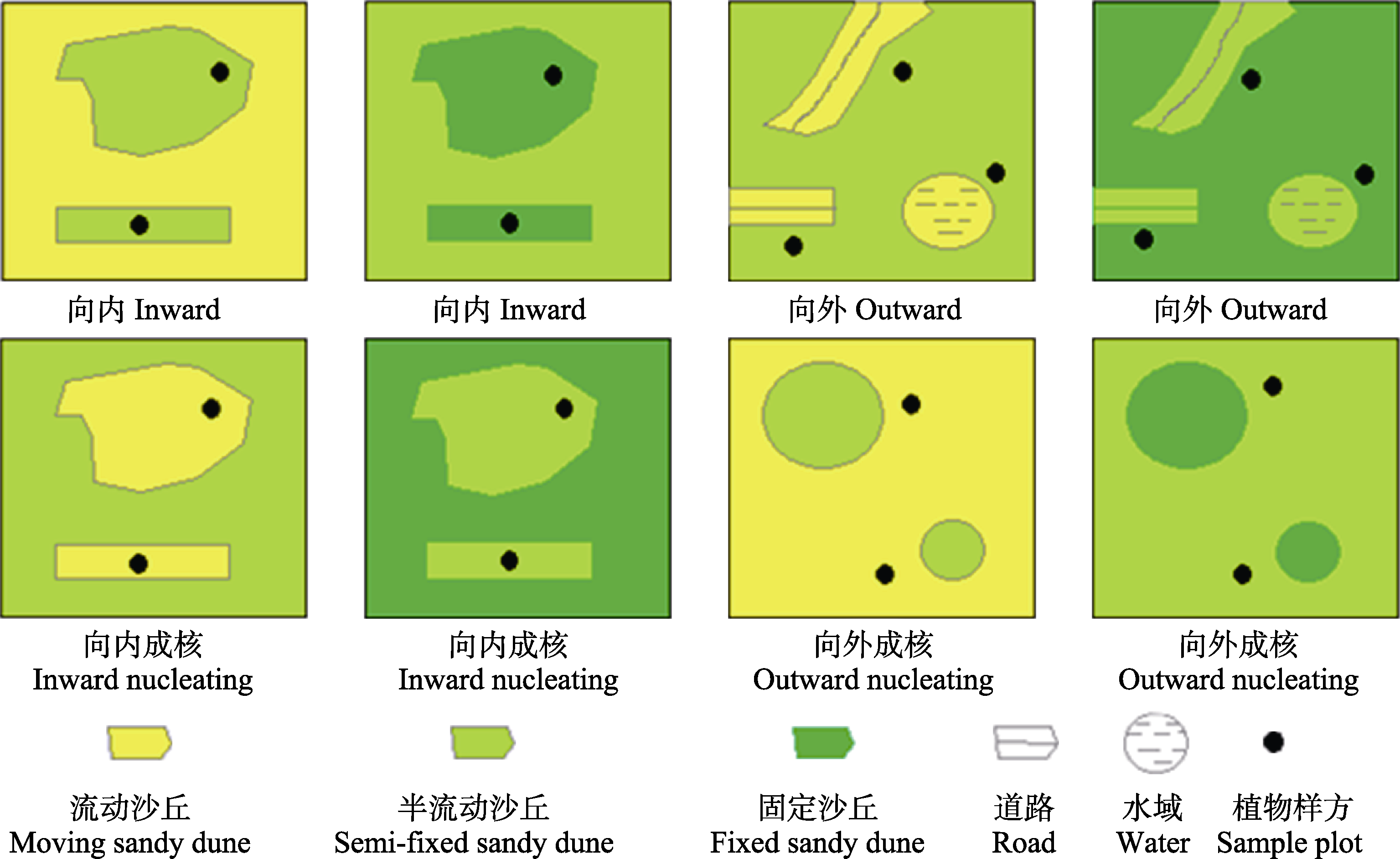
图1 浑善达克沙地中部斑块4种边缘类型划分示意图(基于Porensky和Young (2013)标准)。
Fig. 1 Diagrams point out four types of patches with dissimilar probable edge effects: inward, outward, inward nucleating and outward nucleating in center Hunshandak Sandland (based on the criterion of Porensky & Young (2013)).
| 边缘类型 Edge type | 优势物种 Dominant plant | 重要值 IV |
|---|---|---|
| 向内 Inward | 百里香 Thymus mongolicus | 0.96 ± 0.09 |
| 鹤虱 Lappula myosotis | 0.66 ± 0.13 | |
| 柠条锦鸡儿 Caragana korshinskii | 0.61 ± 0.15 | |
| 向外 Outward | 披碱草 Elymus dahuricus | 0.67 ± 0.13 |
| 寸草 Carex duriuscula | 0.59 ± 0.09 | |
| 沙芦草 Agropyron mongolicum | 0.53 ± 0.11 | |
| 向内成核 Inward nucleating | 猪毛菜 Salsola collina | 0.79 ± 0.25 |
| 黑沙蒿 Artemisia ordosica | 0.72 ± 0.18 | |
| 沙芦草 Agropyron mongolicum | 0.55 ± 0.09 | |
| 向外成核 Outward nucleating | 硬阿魏 Ferula bungeana | 0.83 ± 0.20 |
| 黑沙蒿 Artemisia ordosica | 0.72 ± 0.21 | |
| 榆树(幼苗) Ulmus pumila (seedling) | 0.61 ± 0.15 |
表1 4种边缘类型斑块内的优势植物物种(平均值±标准差)
Table 1 Dominant species in the patches of four edge types (mean ± SD)
| 边缘类型 Edge type | 优势物种 Dominant plant | 重要值 IV |
|---|---|---|
| 向内 Inward | 百里香 Thymus mongolicus | 0.96 ± 0.09 |
| 鹤虱 Lappula myosotis | 0.66 ± 0.13 | |
| 柠条锦鸡儿 Caragana korshinskii | 0.61 ± 0.15 | |
| 向外 Outward | 披碱草 Elymus dahuricus | 0.67 ± 0.13 |
| 寸草 Carex duriuscula | 0.59 ± 0.09 | |
| 沙芦草 Agropyron mongolicum | 0.53 ± 0.11 | |
| 向内成核 Inward nucleating | 猪毛菜 Salsola collina | 0.79 ± 0.25 |
| 黑沙蒿 Artemisia ordosica | 0.72 ± 0.18 | |
| 沙芦草 Agropyron mongolicum | 0.55 ± 0.09 | |
| 向外成核 Outward nucleating | 硬阿魏 Ferula bungeana | 0.83 ± 0.20 |
| 黑沙蒿 Artemisia ordosica | 0.72 ± 0.21 | |
| 榆树(幼苗) Ulmus pumila (seedling) | 0.61 ± 0.15 |
| 边缘类型 Edge type | 向内 Inward | 向外 Outward | 向内成核 Inward nucleating | 向外成核 Outward nucleating |
|---|---|---|---|---|
| Shannon-Wiener指数 Shannon-Wiener index (H′) | 1.69 ± 0.36Ba | 1.89 ± 0.49ABa | 2.07 ± 0.53Aa | 2.10 ± 0.45Aa |
| Simpson指数 Simpson index (D) | 0.71 ± 0.10Aa | 0.64 ± 0.07Aa | 0.66 ± 0.08Aa | 0.68 ± 0.07Aa |
| Pielou指数 Pielou index (J′) | 0.68 ± 0.10Ba | 0.70 ± 0.11Ba | 0.77 ± 0.07Aa | 0.78 ± 0.06Aa |
| β多样性指数 β diversity index (βw) | 2.39 ± 1.01Ba | 3.81 ± 1.20Aa | 3.81 ± 1.39Aa | 4.15 ± 2.23Aa |
| 物种丰富度 Species richness | 12.25 ± 5.40Ba | 18.30 ± 7.53Aa | 20.00 ± 8.03Aa | 18.08 ± 6.20Aa |
| 盖度 Coverage (%) | 18.68 ± 9.76Aa | 23.09 ± 10.76Aa | 21.42 ± 10.34Aa | 24.20 ± 9.88Aa |
| 一年生植物比例 Annual proportion (%) | 28.57 ± 2.21Aa | 8.78 ± 1.34Ba | 20.21 ± 2.22ABa | 17.47 ± 1.47ABa |
| 两年生植物比例 Biennial proportion (%). | 5.24 ± 9.52Ba | 1.78 ± 2.77ABa | 3.14 ± 5.47Aa | 9.81 ± 1.46ABa |
| 多年生植物比例 Perennial proportion (%) | 5.67 ± 1.98Aa | 6.52 ± 2.17Aa | 6.17 ± 2.65Aa | 5.78 ± 2.24Aa |
| 灌木植物比例 Shrub proportion (%) | 1.33 ± 1.02Aa | 2.17 ± 1.94Aa | 1.57 ± 1.62Aa | 1.88 ± 1.29Aa |
| 乔木植物比例 Tree proportion (%) | 0.06 ± 0.14Aa | 0.07 ± 0.18Aa | 0.13 ± 0.37Aa | 0.22 ± 0.41Aa |
| CAM植物比例 CAM plant proportion (%) | 3.12 ± 4.33Aa | 1.24 ± 2.76ABa | 0.85 ± 1.61ABa | 0.15 ± 0.42Ba |
| C3植物比例 C3 plant proportion (%) | 3.67 ± 2.03Ba | 4.57 ± 2.73ABa | 5.60 ± 2.17Aa | 5.14 ± 1.37ABa |
| C4植物比例 C4 plant proportion (%) | 54.28 ± 27.22Aa | 51.35 ± 28.47Aa | 43.19 ± 21.88Aa | 48.05 ± 13.46Aa |
| 风传种植物比例 Wind-dispersed proportion (%) | 1.33 ± 9.61Ba | 2.48 ± 1.87ABa | 2.44 ± 1.65ABa | 2.84 ± 1.78Aa |
| 自动传种植物比例 Auto-dispersed proportion (%) | 3.20 ± 2.01Aa | 1.60 ± 1.58Bab | 1.38 ± 8.63Bb | 1.35 ± 1.23Bb |
| 重力传种植物比例 Gravity-dispersed proportion (%) | 4.34 ± 1.90Aa | 3.21 ± 2.09Aa | 4.40 ± 1.85Aa | 4.29 ± 1.85Aa |
| 动物传种植物比例 Animal dispersion proportion (%) | 12.78 ± 17.58Aa | 21.63 ± 17.69Aa | 12.61 ± 13.43Aa | 14.02 ± 14.77Aa |
| 风媒花植物比例 Wind-pollinated proportion (%) | 6.71 ± 2.55Aa | 3.72 ± 2.20Bb | 5.34 ± 1.88ABab | 5.41 ± 1.81ABab |
| 虫媒花植物比例 Insect-pollinated proportion (%) | 3.21 ± 2.55Ba | 6.29 ± 2.33Ab | 4.39 ± 1.74ABa | 4.44 ± 1.92ABa |
| 非固氮植物比例 Non nitrogen-fixing proportion (%) | 72.81 ± 25.62ABa | 60.06 ± 19.98Ba | 76.50 ± 16.05ABa | 80.08 ± 16.06Aa |
| 固氮植物比例 Nitrogen-fixing proportion (%) | 21.64 ± 22.84Ba | 39.88 ± 20.02Aa | 26.27 ± 19.02ABa | 20.02 ± 16.00Ba |
表2 浑善达克沙地中部4种边缘类型植物多样性指数、盖度和功能性状的差异(平均值±标准差)
Table 2 Differences of plant diversity indices, coverage and functional traits across four edge types in center Hunshandak Sandland (mean ± SD)
| 边缘类型 Edge type | 向内 Inward | 向外 Outward | 向内成核 Inward nucleating | 向外成核 Outward nucleating |
|---|---|---|---|---|
| Shannon-Wiener指数 Shannon-Wiener index (H′) | 1.69 ± 0.36Ba | 1.89 ± 0.49ABa | 2.07 ± 0.53Aa | 2.10 ± 0.45Aa |
| Simpson指数 Simpson index (D) | 0.71 ± 0.10Aa | 0.64 ± 0.07Aa | 0.66 ± 0.08Aa | 0.68 ± 0.07Aa |
| Pielou指数 Pielou index (J′) | 0.68 ± 0.10Ba | 0.70 ± 0.11Ba | 0.77 ± 0.07Aa | 0.78 ± 0.06Aa |
| β多样性指数 β diversity index (βw) | 2.39 ± 1.01Ba | 3.81 ± 1.20Aa | 3.81 ± 1.39Aa | 4.15 ± 2.23Aa |
| 物种丰富度 Species richness | 12.25 ± 5.40Ba | 18.30 ± 7.53Aa | 20.00 ± 8.03Aa | 18.08 ± 6.20Aa |
| 盖度 Coverage (%) | 18.68 ± 9.76Aa | 23.09 ± 10.76Aa | 21.42 ± 10.34Aa | 24.20 ± 9.88Aa |
| 一年生植物比例 Annual proportion (%) | 28.57 ± 2.21Aa | 8.78 ± 1.34Ba | 20.21 ± 2.22ABa | 17.47 ± 1.47ABa |
| 两年生植物比例 Biennial proportion (%). | 5.24 ± 9.52Ba | 1.78 ± 2.77ABa | 3.14 ± 5.47Aa | 9.81 ± 1.46ABa |
| 多年生植物比例 Perennial proportion (%) | 5.67 ± 1.98Aa | 6.52 ± 2.17Aa | 6.17 ± 2.65Aa | 5.78 ± 2.24Aa |
| 灌木植物比例 Shrub proportion (%) | 1.33 ± 1.02Aa | 2.17 ± 1.94Aa | 1.57 ± 1.62Aa | 1.88 ± 1.29Aa |
| 乔木植物比例 Tree proportion (%) | 0.06 ± 0.14Aa | 0.07 ± 0.18Aa | 0.13 ± 0.37Aa | 0.22 ± 0.41Aa |
| CAM植物比例 CAM plant proportion (%) | 3.12 ± 4.33Aa | 1.24 ± 2.76ABa | 0.85 ± 1.61ABa | 0.15 ± 0.42Ba |
| C3植物比例 C3 plant proportion (%) | 3.67 ± 2.03Ba | 4.57 ± 2.73ABa | 5.60 ± 2.17Aa | 5.14 ± 1.37ABa |
| C4植物比例 C4 plant proportion (%) | 54.28 ± 27.22Aa | 51.35 ± 28.47Aa | 43.19 ± 21.88Aa | 48.05 ± 13.46Aa |
| 风传种植物比例 Wind-dispersed proportion (%) | 1.33 ± 9.61Ba | 2.48 ± 1.87ABa | 2.44 ± 1.65ABa | 2.84 ± 1.78Aa |
| 自动传种植物比例 Auto-dispersed proportion (%) | 3.20 ± 2.01Aa | 1.60 ± 1.58Bab | 1.38 ± 8.63Bb | 1.35 ± 1.23Bb |
| 重力传种植物比例 Gravity-dispersed proportion (%) | 4.34 ± 1.90Aa | 3.21 ± 2.09Aa | 4.40 ± 1.85Aa | 4.29 ± 1.85Aa |
| 动物传种植物比例 Animal dispersion proportion (%) | 12.78 ± 17.58Aa | 21.63 ± 17.69Aa | 12.61 ± 13.43Aa | 14.02 ± 14.77Aa |
| 风媒花植物比例 Wind-pollinated proportion (%) | 6.71 ± 2.55Aa | 3.72 ± 2.20Bb | 5.34 ± 1.88ABab | 5.41 ± 1.81ABab |
| 虫媒花植物比例 Insect-pollinated proportion (%) | 3.21 ± 2.55Ba | 6.29 ± 2.33Ab | 4.39 ± 1.74ABa | 4.44 ± 1.92ABa |
| 非固氮植物比例 Non nitrogen-fixing proportion (%) | 72.81 ± 25.62ABa | 60.06 ± 19.98Ba | 76.50 ± 16.05ABa | 80.08 ± 16.06Aa |
| 固氮植物比例 Nitrogen-fixing proportion (%) | 21.64 ± 22.84Ba | 39.88 ± 20.02Aa | 26.27 ± 19.02ABa | 20.02 ± 16.00Ba |
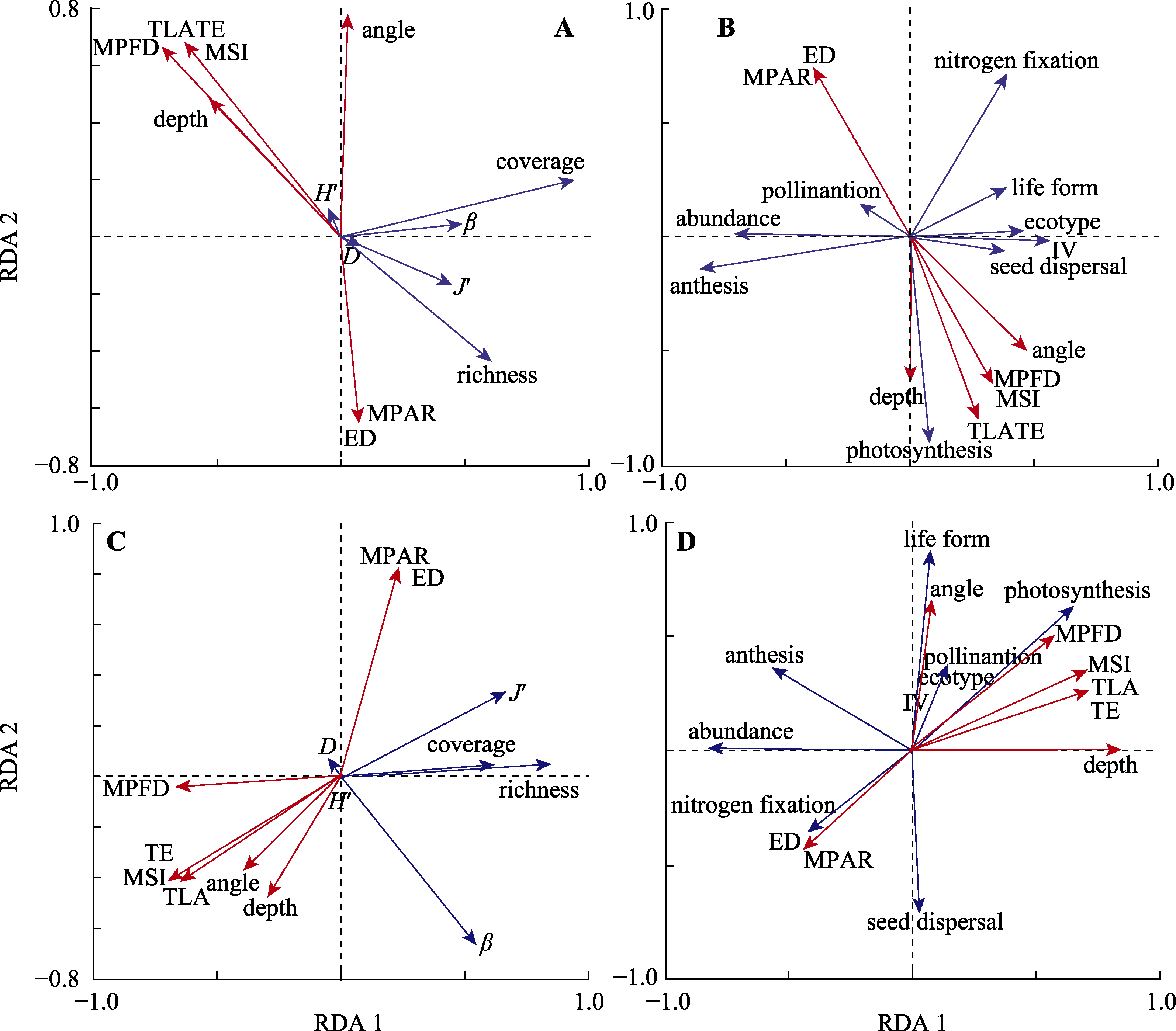
图2 浑善达克沙地中部向内边缘(A、B)和向外边缘(C、D)斑块格局指数与植物多样性指数(A、C)和功能性状(B、D)的冗余分析(RDA)。angle, 样方所处角度; depth, 样方距离边缘深度; ED, 边缘密度; MPAR,平均周长-面积比; MPFD, 平均斑块分形维数; MSI, 平均形状指数; TE, 总边缘长度; TLA, 景观面积。βw, β多样性指数; D, Simpson多样性指数; H′, Shannon-Wiener多样性指数; J′, Pielou多样性指数。abundance, 多度; anthesis, 开花时间; coverage, 盖度; ecotype, 生态型; IV, 重要值; life form, 生活型; nitrogen fixation, 固氮类型; pollination, 传粉途径; photosynthesis, 光合途径; richness, 丰富度; seed dispersal, 种子传播方式。
Fig. 2 Redundancy analysis (RDA) indicates the relationships between patch metrics and plant diversity indices (A, C), and functional traits (B, D) for inward edge (A, B) and outward edge (C, D) in center Hunshandak Sandland. angle, angle of sample location; depth, distance to edge; ED, edge density; MPAR, mean perimeter-area ratio; MPFD, mean patch fractal dimension; MSI, mean shape index; TE, total edge; TLA, landscape area. βw, β diversity index; D, Simpson index; H′, Shannon-Wiener index; J′, Pielou index. IV, important value.
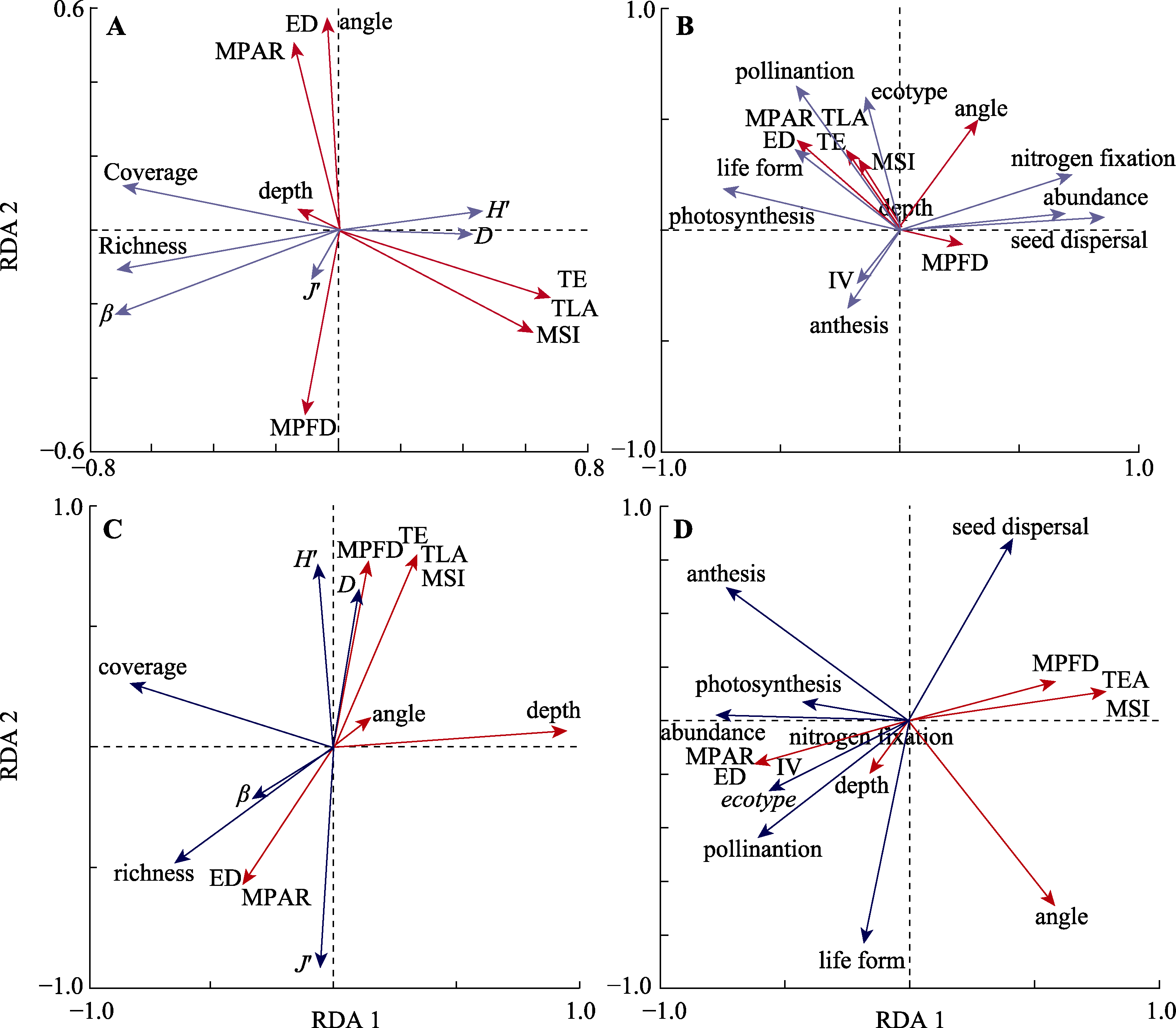
图3 浑善达克沙地中部向内成核边缘(A、B)和向外成核边缘(C、D)斑块格局指数与植物多样性指数(A、C)和功能性状(B、D)的冗余分析(RDA)。angle, 样方所处角度; depth, 样方距离边缘深度; ED, 边缘密度; MPAR,平均周长-面积比; MPFD, 平均斑块分形维数; MSI, 平均形状指数; TE, 总边缘长度; TLA, 景观面积。βw, β多样性指数; D, Simpson多样性指数; H′, Shannon- Wiener多样性指数; J′, Pielou多样性指数。abundance, 多度; anthesis, 开花时间; coverage, 盖度; ecotype, 生态型; IV, 重要值; life form, 生活型; nitrogen fixation, 固氮类型; pollination, 传粉途径; photosynthesis, 光合途径; richness, 丰富度; seed dispersal, 种子传播方式。
Fig. 3 Redundancy analysis (RDA) indicate the relationships between patch metrics and plant diversity indices (A, C), and functional traits (B, D) for Inward nucleating edge (A, B) and outward nucleating edge (C, D) in enter Hunshandak Sandland. angle, angle of sample location; depth, distance to edge; ED, edge density; MPAR, mean perimeter-area ratio; MPFD, mean patch fractal dimension; MSI, mean shape index; TE, total edge; TLA, landscape area. βw, β diversity index; D, Simpson index; H′, Shannon-Wiener index; J′, Pielou index; IV, important value.
| [1] |
Alverson WS, Waller DM, Solheim SL (1988). Forests too deer: edge effects in Northern Wisconsin. Conservation Biology, 2, 348-358.
DOI URL |
| [2] |
Amici V, Rocchini D, Filibeck G, Bacaro G, Santi E, Geri F, Landi S, Scoppola A, Chiarucci A (2015). Landscape structure effects on forest plant diversity at local scale: exploring the role of spatial extent. Ecological Complexity, 21, 44-52.
DOI URL |
| [3] |
Andrén H, Delin A, Seiler A (1997). Population response to landscape changes depends on specialization to different landscape elements. Oikos, 80, 193-196.
DOI URL |
| [4] |
Cadenasso ML, Pickett STA, Weathers KC, Jones CG (2003). A framework for a theory of ecological boundaries. BioScience, 53, 750-758.
DOI URL |
| [5] |
Chi Y, Sun JK, Fu ZY, Xie ZL (2019). Spatial pattern of plant diversity in a group of uninhabited islands from the perspectives of island and site scales. Science of the Total Environment, 664, 334-346.
DOI URL |
| [6] |
Collins CD, Banks-Leite C, Brudvig LA, Foster BL, Cook WM, Damschen EI, Andrade A, Austin M, Camargo JL, Driscoll DA, Holt RD, Laurance WF, Nicholls AO, Orrock JL (2017). Fragmentation affects plant community composition over time. Ecography, 40, 119-130.
DOI URL |
| [7] |
Deans RA, Chalcraft DR (2017). Matrix context and patch quality jointly determine diversity in a landscape-scale experiment. Oikos, 126, 874-887.
DOI URL |
| [8] |
Diamond JM (1975). The island dilemma: lessons of modern biogeographic studies for the design of natural reserves. Biological Conservation, 7, 129-146.
DOI URL |
| [9] |
Evju M, Blumentrath S, Skarpaas O, Stabbetorp OE,Sverdrup- Thygeson A (2015). Plant species occurrence in a fragmented grassland landscape: the importance of species traits. Biodiversity and Conservation, 24, 547-561.
DOI URL |
| [10] |
Ewers RM, Didham RK (2006). Confounding factors in the detection of species responses to habitat fragmentation. Biological Reviews, 81, 117-142.
DOI URL |
| [11] |
Fan M, Wang QH, Mi K, Peng Y (2017). Scale-dependent effects of landscape pattern on plant diversity in Hunshandak Sandland. Biodiversity and Conservation, 26, 2169- 2185.
DOI URL |
| [12] |
Field R, Hawkins BA, Cornell HV, Currie DJ, Diniz-Filho JAF, Guégan JF, Kaufman DM, Kerr JT, Mittelbach GG, Oberdorff T, O’Brien EM, Turner JRG (2009). Spatial species-richness gradients across scales, a meta-analysis. Journal of Biogeography, 36, 132-147.
DOI URL |
| [13] | Foley JA, DeFries R, Asner GP, Barford C, Bonan G, Carpenter SR, Chapin FS, Coe MT, Daily GC, Gibbs HK, Helkowski JH, Holloway T, Howard EA, Kucharik CJ, Monfreda C, et al. (2005). Global consequences of land use. Science, 309, 570-574. |
| [14] |
Forman RTT, Alexander LE (1998). Roads and their major ecological effects. Annual Review of Ecology and Systematics, 29, 207-231.
DOI URL |
| [15] |
Gharehaghaji M, Minor ES, Ashley MV, Abraham ST, Koenig WD (2017). Effects of landscape features on gene flow of valley oaks Quercus lobata. Plant Ecology, 218, 487-499.
DOI URL |
| [16] |
Hadded NM, Brudvig LA, Clobert J, Davies KF, Gonzalez A, Holt RD, Lovejoy TE, Sexton JO, Austin MP, Collins CD, Cook WM, Damschen EI, Ewers RM, Foster BL, Jenkins CN, et al. (2015). Habitat fragmentation and its lasting impact on Earth’s ecosystems. Science Advance, 12, e1500052. DOI: 10.1126/sciadv.1500052.
DOI |
| [17] |
Harper KA, MacDonald SE, Burton PJ, Chen J, Brosofske KD, Saunders SC, Euskirchen ES, Roberts D, Jaiteh MS, Esseen PA (2005). Edge influence on forest structure and composition in fragmented landscapes. Conservation Biology, 19, 768-782.
DOI URL |
| [18] | Helm A, Hanski I, Pärtel M (2006). Slow response of plant species richness to habitat loss and fragmentation. Ecology Letters, 9, 72-77. |
| [19] | Henle K, Davies KF, Kleyer M, Margules C, Settele J (2004). Predictors of species sensitivity to fragmentation. Biodiversity & Conservation, 13, 207-251. |
| [20] |
Higgins SI, Lavorel S, Revilla E (2003). Estimating plant migration rates under habitat loss and fragmentation. Oikos, 101, 354-366.
DOI URL |
| [21] |
Huang YY, Han H, Tang C, Liu SJ (2017). Plant community composition and interspecific relationships among dominant species on a post-seismic landslide in Hongchun Gully, China. Journal of Mountain Science, 14, 1985-1994.
DOI URL |
| [22] |
Jones NT, Germain RM, Grainger TN, Hall AM, Baldwin L, Gilbert B (2015). Dispersal mode mediates the effect of patch size and patch connectivity on metacommunity diversity. Journal of Ecology, 103, 935-944.
DOI URL |
| [23] |
Krauss J, Bommarco R, Guardiola M, Heikkinen RK, Helm A, Kuussaari M, Lindborg R, Ockinger E, Pärtel M, Pino J, Pöyry J, Raatikainen KM, Sang A, Stefanescu C, Teder T, Zobel M, Steffan-Dewenter I (2010). Habitat fragmentation causes immediate and time-delayed biodiversity loss at different trophic levels, immediate and time-delayed biodiversity loss. Ecology Letters, 13, 597-605.
DOI URL |
| [24] | Krauss J, Klein AM, Steffan-Dewenter I, Tscharntke T (2004). Effects of habitat area, isolation, and landscape diversity on plant species richness of calcareous grasslands. Biodiversity & Conservation, 13, 1427-1439. |
| [25] |
Labadessa R, Alignier A, Cassano S, Forte L, Mairota P (2017). Quantifying edge influence on plant community structure and composition in semi-natural dry grasslands. Applied Vegetation Science, 20, 572-581.
DOI URL |
| [26] |
Laurance WF, Ferreira LV, Rankin-de Merona JM, Laurance SG (1998). Rain forest fragmentation and the dynamics of Amazonian tree communities. Ecology, 79, 2032-2040.
DOI URL |
| [27] |
Laurance WF, Laurance SG, Ferreira LV, Rankin-de Merona JM, Gascon C, Lovejoy TE (1997). Biomass collapse in Amazonian forest fragments. Science, 278, 1117-1118.
DOI URL |
| [28] |
Laurance WF, Lovejoy TE, Vasconcelos HL, Bruna EM, Didham RK, Stouffer PC, Gascon C, Bierregaard RO, Laurance SG, Sampaio E (2002). Ecosystem decay of Amazonian forest fragments: a 22-year investigation. Conservation Biology, 16, 605-618.
DOI URL |
| [29] |
Laurance WF, Yensen E (1991). Predicting the impacts of edge effects in fragmented habitats. Biological Conservation, 55, 77-92.
DOI URL |
| [30] |
Lima PB, Lima LF, Santos BA, Tabarelli M, Zickel CS (2015). Altered herb assemblages in fragments of the Brazilian Atlantic forest. Biological Conservation, 191, 588-595.
DOI URL |
| [31] |
Lindborg R, Helm A, Bommarco R, Heikkinen RK, Kühn I, Pykälä J, Pärtel M (2012). Effect of habitat area and isolation on plant trait distribution in European forests and grasslands. Ecography, 35, 356-363.
DOI URL |
| [32] |
Ma M, Herzon I (2014). Plant functional diversity in agricultural margins and fallow fields varies with landscape complexity level: conservation implication. Journal of Nature Conservation, 22, 525-531.
DOI URL |
| [33] | Magurran AE (2004). Measuring Biological Diversity. Blackwell Publishing, Oxford. |
| [34] |
Malavasi M, Conti L, Carboni M, Cutini M, Acosta ATR (2016). Multifaceted analysis of patch-level plant diversity in response to landscape spatial pattern and history on Mediterranean dunes. Ecosystems, 19, 850-864.
DOI URL |
| [35] | McGarigal K, Cushman SA, Ene E (2012). FRAGSTATS v4: spatial pattern analysis program for categorical and continuous maps. Computer software program produced by the authors at the University of Massachusetts, Amherst.2020-03-10]. http://www.umass.edu/landeco/research/fragstats/fragstats.html. |
| [36] |
Michels KK, Hotchkiss SC, Jonaitis E, Thurman AL (2017). A new application of change point analysis reveals extensive edge effects on a temperate mixed forest. Applied Vegetation Science, 20, 651-661.
DOI URL |
| [37] |
Murcia C (1995). Edge effects in fragmented forests, implications for conservation. Trends in Ecology & Evolution, 10, 58-62.
DOI URL |
| [38] |
Peng Y, Jiang G, Liu M, Niu S, Yu S, Biswas DK, Zhang Q, Shi X, Yang Q (2005). Potentials for combating desertification in Hunshandak Sandland through nature reserve. Environmental Management, 35, 453-460.
PMID |
| [39] |
Porensky LM, Young TP (2013). Edge-effect interactions in fragmented and patchy landscapes. Conservation Biology, 27, 509-519.
DOI PMID |
| [40] |
Qiu Q, Pan X, Li JY, Wang JH, Ma JW, Du K (2014). Morphological traits and physiological characteristics in drought tolerance in 20 shrub species on the Qinghai-Xizang Plateau. Chinese Journal of Plant Ecology, 38, 562-575.
DOI URL |
|
[ 邱权, 潘昕, 李吉跃, 王军辉, 马建伟, 杜坤 (2014). 青藏高原20种灌木抗旱形态和生理特征. 植物生态学报, 38, 562- 575.]
DOI |
|
| [41] |
Rockström J, Steffen W, Noone K, Persson Å, Chapin III FS, Lambin EF, Lenton TM, Scheffer M, Folke C, Schellnhuber HJ, Nykvist B, de Wit CA, Hughes T, van der Leeuw S, Rodhe H, et al. (2009). A safe operating space for humanity. Nature, 461, 472-475.
DOI URL |
| [42] |
Saar L, de Bello F, Pärtel M, Helm A (2017). Trait assembly in grasslands depends on habitat history and spatial scale. Oecologia, 184, 1-12.
DOI URL |
| [43] |
Saavedra F, Hensen I, Quevedo AA, Neuschulz EL, Schleuning M (2017). Seed-deposition and recruitment patterns of Clusia species in a disturbed tropical montane forest in Bolivia. Acta Oecologica, 85, 85-92.
DOI URL |
| [44] |
Saunders DA, Hobbs RJ, Margules CR (1991). Biological consequences of ecosystem fragmentation, a review. Conservation Biology, 5, 18-32.
DOI URL |
| [45] |
Schindler S, von Wehrden H, Poirazidis K, Wrbka T, Kati V (2013). Multiscale performance of landscape metrics as indicators of species richness of plants, insects and vertebrates. Ecological Indicators, 31, 41-48.
DOI URL |
| [46] |
Seahra SE, Yurkonis KA, Newman JA (2016). Species patch size at seeding affects diversity and productivity responses in establishing grasslands. Journal of Ecology, 104, 479- 486.
DOI URL |
| [47] | Šmilauer P, Lepš J (2003). Multivariate Analysis of Ecological Data Using CANOCO 5. Cambridge University Press, Cambridge, UK. |
| [48] |
Sun SL, Wang GJ, Huang J, Mu MY, Yan GX, Liu CW, Gao CJ, Li X, Yin YX, Zhang FM, Zhu SG, Hua WJ (2017). Spatial pattern of reference evapotranspiration change and its temporal evolution over Southwest China. Theoretical and Applied Climatology, 130, 979-992.
DOI URL |
| [49] |
Torras O, Gil-Tena A, Saura S (2008). How does forest landscape structure explain tree species richness in a Mediterranean context? Biodiversity and Conservation, 17, 1227- 1240.
DOI URL |
| [50] | Varela E, Verheyen K, Valdés A, Soliño M, Jacobsen JB, De Smedt P, Ehrmann S, Gärtner S, Górriz E, Decocq G (2018). Promoting biodiversity values of small forest patches in agricultural landscapes: ecological drivers and social demand. Science of the Total Environment, 619- 620, 1319-1329. |
| [51] |
Veselkin DV, Shavnin SA, Vorobeichik EL, Galako VA, Vlasenko VE (2017). Edge effects on pine stands in a large city. Russian Journal of Ecology, 48, 499-506.
DOI URL |
| [52] |
Xu H, Su H, Su B, Han X, Biswas DK, Li Y (2014). Restoring the degraded grassland and improving sustainability of grassland ecosystem through chicken farming: a case study in northern China. Agriculture, Ecosystem & Environment, 186, 115-123.
DOI URL |
| [53] | Zha T, Qian D, Jia X, Bai Y, Tian Y, Bourque CPA, Ma J, Feng W, Wu B, Peltola H (2017). Soil moisture control of sap-flow response to biophysical factors in a desert-shrub species, Artemisia ordosica. Biogeosciences, 14, 4533-4544. |
| [54] |
Zhang HC, Liu SG, Regnier P, Yuan WP (2018). New insights on plant phenological response to temperature revealed from long-term widespread observations in China. Global Change Biology, 24, 2066-2078.
DOI URL |
| [55] |
Zuo X, Zhang J, Lv P, Zhou X, Li Y, Luo YY, Luo Y, Lian J, Yue X (2016). Plant functional diversity mediates the effects of vegetation and soil properties on community-level plant nitrogen use in the restoration of semiarid sandy grassland. Ecological Indicators, 64, 272-280.
DOI URL |
| [1] | 封逸凡, 朱时应, 周淑荣, 江乐乐, 陈隆, 王苗, 邓国芳, 刘兰. 热带次生林恢复中土壤微生物对菌根化树苗存活和生长性状的影响[J]. 植物生态学报, 2026, 50(预发表): 1-. |
| [2] | 饶朝康, 唐亮. 不同潮位红树植物叶际微生物群落特征及其影响因素[J]. 植物生态学报, 2026, 50(预发表): 1-. |
| [3] | 林琳琳, 肖劲祥, 黄深深, 赵杨梅, 张德旭, 程毅康, 龙文兴. 磷添加对热带云雾林幼苗及幼树功能性状的影响[J]. , 2026, 50(预发表): 0-. |
| [4] | 杨梅花, 张子嘉, 乔栋, 冯俊娜, 庞子杰, 钱龙, 刘志晖, 蔡娜娜, 胡中民, 杨国姣. 海南热带森林乔木群落调查和多样性数据集[J]. 植物生态学报, 2026, 50(预发表): 0-. |
| [5] | 段建林, 孟晟, 陈仁利, 熊林峰, 卢春洋, 席念勋. 全球变化因子多样性对菌根植物性状的影响[J]. , 2026, 50(预发表): 0-. |
| [6] | 张安宁, 肖亚宁, 赵霞, 张淼, 崔瀚文, 陈书燕, 安黎哲. 青藏高原灌木化与氮添加对土壤线虫及功能性状的交互作用[J]. 植物生态学报, 2026, 50(预发表): 0-. |
| [7] | 张永军, 李敬东, 安琦, 洪翎桂, 任正炜, 张蕊, 周小龙. 氮添加和增温对天山高寒草地群落性状的影响[J]. 植物生态学报, 2026, 50(2): 417-428. |
| [8] | 张静, 陈洁, 李艳朋, 盘李军, 许涵, 李意德, 何海生. 南亚热带针阔混交人工林植物生物量比较及其影响因子分析[J]. 植物生态学报, 2026, 50(2): 400-416. |
| [9] | 戴丽君, 向玲艺, 蹇陈, 王晓锋. 三峡回水扰动增强入库小流域河岸带典型草本植物功能性状的局域分化[J]. 植物生态学报, 2026, 50(2): 442-460. |
| [10] | 王爽, 陈雅轩, 陈艳梅, 王佳乐, 刘倩愿. 太行山典型区不同生境酸枣根系资源获取策略[J]. 植物生态学报, 2026, 50(2): 374-387. |
| [11] | 陈雅轩, 韩雨音, 陈艳梅, 刘倩愿. 华北不同林龄人工林植物功能性状与碳氮化学计量[J]. 植物生态学报, 2026, 50(2): 318-333. |
| [12] | 梁天豪, 吴帆, 黄锦学, 景陈鸿, 傅贺菁, 杨智杰, 熊德成. 增温对中亚热带格氏栲天然林细根生长量及形态特征的影响[J]. 植物生态学报, 2026, 50(1): 94-106. |
| [13] | 郑子仪, 陈江慧, 刘慧颖. 气候变暖提高青藏高原高寒草甸优势物种的根系分泌速率[J]. 植物生态学报, 2025, 49(9): 1363-1373. |
| [14] | 陈凯, 杨艳, 徐玲, 蒋忠华. 滇西南山地球花报春种子形态与萌发沿海拔梯度的变异[J]. 植物生态学报, 2025, 49(7): 1119-1127. |
| [15] | 崔冬晴, 田晨, 宋慧敏, 鲁小名, 萨其日, 徐国庆, 杨培志, 白永飞, 田建卿. 典型草原优势植物根际细菌群落多样性和功能群组成对长期放牧的响应机制[J]. 植物生态学报, 2025, 49(7): 1163-1176. |
| 阅读次数 | ||||||
|
全文 |
|
|||||
|
摘要 |
|
|||||
Copyright © 2026 版权所有 《植物生态学报》编辑部
地址: 北京香山南辛村20号, 邮编: 100093
Tel.: 010-62836134, 62836138; Fax: 010-82599431; E-mail: apes@ibcas.ac.cn, cjpe@ibcas.ac.cn
备案号: 京ICP备16067583号-19

