
植物生态学报 ›› 2022, Vol. 46 ›› Issue (12): 1486-1496.DOI: 10.17521/cjpe.2021.0187 cstr: 32100.14.cjpe.2021.0187
所属专题: 青藏高原植物生态学:遥感生态学; 生态系统碳水能量通量
• 中国典型生态脆弱区碳水通量过程研究专题论文 • 上一篇 下一篇
郑周涛1,*( ), 张扬建1,2,3
收稿日期:2021-05-17
接受日期:2021-12-15
出版日期:2022-12-20
发布日期:2023-01-13
基金资助:
ZHENG Zhou-Tao1,*(), ZHANG Yang-Jian1,2,3
Received:2021-05-17
Accepted:2021-12-15
Online:2022-12-20
Published:2023-01-13
Supported by:摘要:
水分利用效率(WUE)是衡量地表生态系统碳水耦合的重要指标。青藏高原是我国重要的生态屏障, 其生态系统对全球变化响应敏感, 开展青藏高原WUE研究有利于深入理解高寒生态系统碳水循环的过程和机制, 对指导植被生态建设具有重要意义。该研究基于GLASS遥感数据、气象数据和植被类型数据, 对1982-2018年期间青藏高原WUE的时空变化格局及其对温度、降水量、太阳辐射、饱和水汽压差、CO2浓度以及叶面积指数的响应进行了分析, 并进一步揭示了植被类型间的差异。结果表明: (1)青藏高原WUE总体呈现由东南向西北递减的空间分布格局, 多年平均值约为1.64 g C·kg-1。WUE在不同植被类型间差异明显, 森林最高, 高寒荒漠最低, 高寒草甸高于高寒草原。(2)青藏高原WUE主要呈现增加趋势, 除森林和栽培植被外, 其他植被类型WUE均显著增加, 总初级生产力主导了研究区77.84%面积的WUE变化。(3)叶面积指数和CO2浓度主导了青藏高原WUE的变化, 且均为正向效应。而饱和水汽压差的升高对高寒草原、高山植被、栽培植被以及高寒荒漠的WUE有抑制作用。
郑周涛, 张扬建. 1982-2018年青藏高原水分利用效率变化及归因分析. 植物生态学报, 2022, 46(12): 1486-1496. DOI: 10.17521/cjpe.2021.0187
ZHENG Zhou-Tao, ZHANG Yang-Jian. Variation in ecosystem water use efficiency and its attribution analysis during 1982-2018 in Qingzang Plateau. Chinese Journal of Plant Ecology, 2022, 46(12): 1486-1496. DOI: 10.17521/cjpe.2021.0187
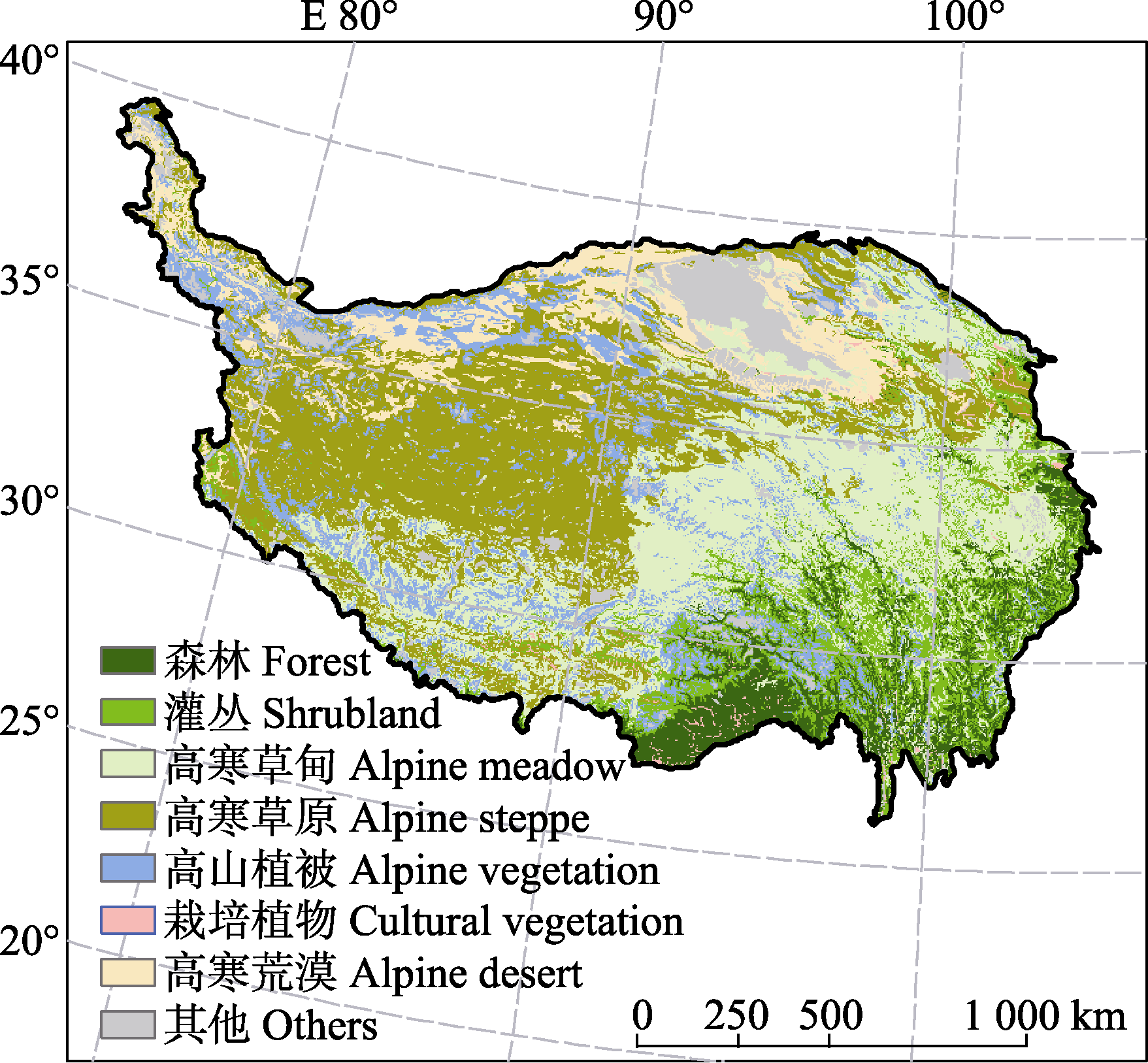
图1 青藏高原植被类型空间分布。
Fig. 1 Spatial distribution of vegetation types in Qingzang Plateau.
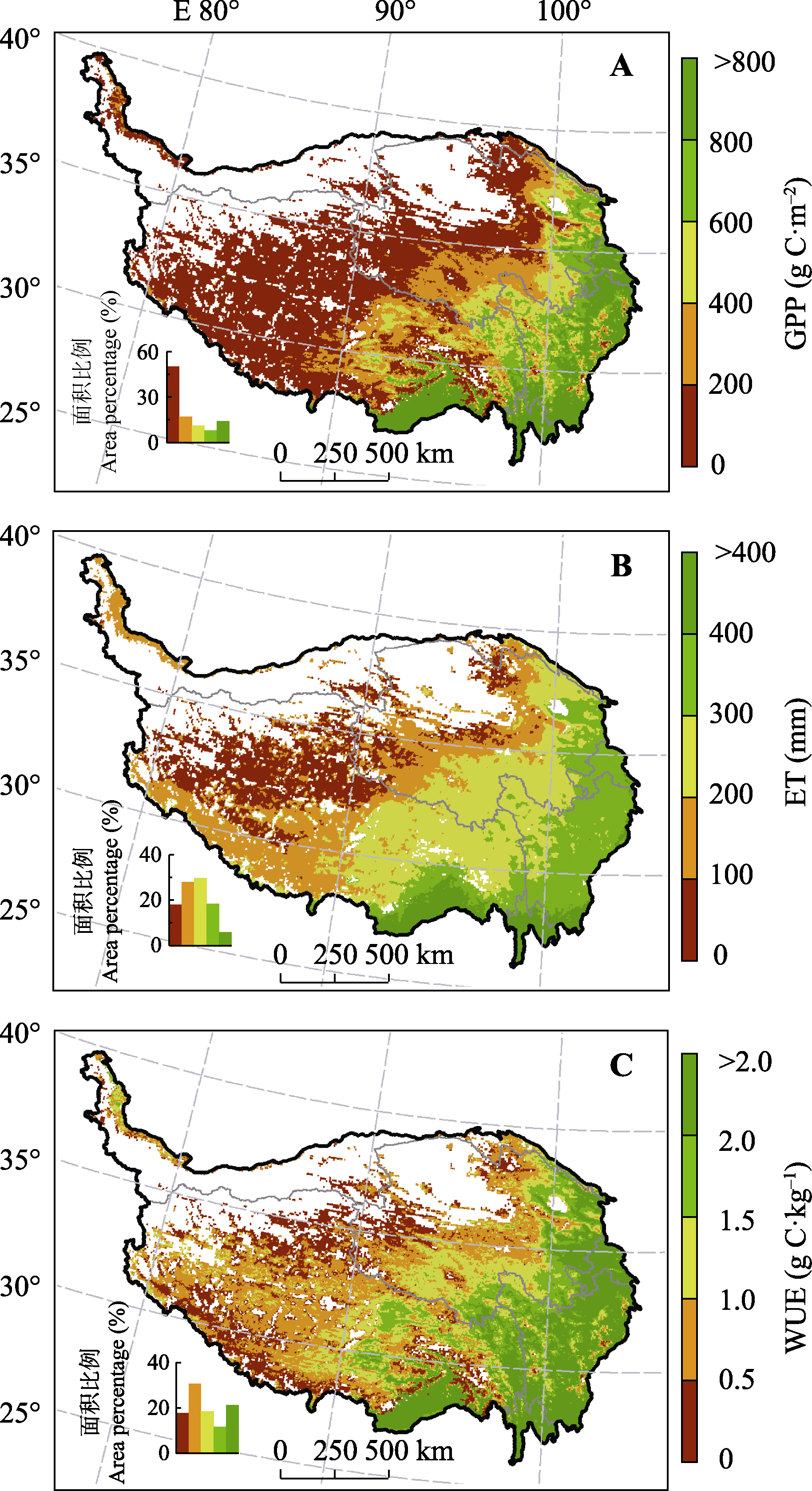
图2 青藏高原总初级生产力(GPP)(A)、蒸散发(ET)(B)和水分利用效率(WUE)(C)多年平均值的空间分布格局。
Fig. 2 Spatial distributions of the annual mean values for gross primary productivity (GPP)(A), evapotranspiration (ET)(B) and water use efficiency (WUE)(C) in Qingzang Plateau.
| 植被类型 Vegetation type | GPP (g C·m-2) | GPP变化趋势 Trend in GPP (g C·m-2·a-1) | ET (mm) | ET变化趋势 Trend in ET (mm·a-1) | WUE (g C·kg-1) | WUE变化趋势 Trend in WUE (10-2 g C·kg-1·a-1) |
|---|---|---|---|---|---|---|
| 森林 Forest | 1 034.34 | 1.30 | 385.20 | 0.17 | 2.69 | 0.24 |
| 灌丛 Shrubland | 585.69 | 4.27*** | 303.49 | 0.59*** | 1.93 | 1.05*** |
| 高寒草甸 Alpine meadow | 328.76 | 4.45*** | 222.48 | 0.84*** | 1.48 | 1.46*** |
| 高寒草原 Alpine steppe | 100.31 | 1.58*** | 121.64 | 0.69*** | 0.82 | 0.84*** |
| 高山植被 Alpine vegetation | 156.39 | 2.60*** | 179.60 | 0.41*** | 0.87 | 1.26*** |
| 栽培植被 Cultural vegetation | 834.41 | 2.18*** | 370.99 | 0.73*** | 2.25 | 0.16 |
| 高寒荒漠 Alpine desert | 86.00 | 1.60*** | 130.12 | 1.36*** | 0.66 | 0.54*** |
表1 青藏高原不同植被类型1982-2018年总初级生产力(GPP)、蒸散发(ET)和水分利用效率(WUE)的平均值以及变化趋势
Table 1 Annual mean values and change trends for gross primary productivity (GPP), evapotranspiration (ET) and water use efficiency (WUE) during 1982-2018 in different vegetation types in Qingzang Plateau
| 植被类型 Vegetation type | GPP (g C·m-2) | GPP变化趋势 Trend in GPP (g C·m-2·a-1) | ET (mm) | ET变化趋势 Trend in ET (mm·a-1) | WUE (g C·kg-1) | WUE变化趋势 Trend in WUE (10-2 g C·kg-1·a-1) |
|---|---|---|---|---|---|---|
| 森林 Forest | 1 034.34 | 1.30 | 385.20 | 0.17 | 2.69 | 0.24 |
| 灌丛 Shrubland | 585.69 | 4.27*** | 303.49 | 0.59*** | 1.93 | 1.05*** |
| 高寒草甸 Alpine meadow | 328.76 | 4.45*** | 222.48 | 0.84*** | 1.48 | 1.46*** |
| 高寒草原 Alpine steppe | 100.31 | 1.58*** | 121.64 | 0.69*** | 0.82 | 0.84*** |
| 高山植被 Alpine vegetation | 156.39 | 2.60*** | 179.60 | 0.41*** | 0.87 | 1.26*** |
| 栽培植被 Cultural vegetation | 834.41 | 2.18*** | 370.99 | 0.73*** | 2.25 | 0.16 |
| 高寒荒漠 Alpine desert | 86.00 | 1.60*** | 130.12 | 1.36*** | 0.66 | 0.54*** |
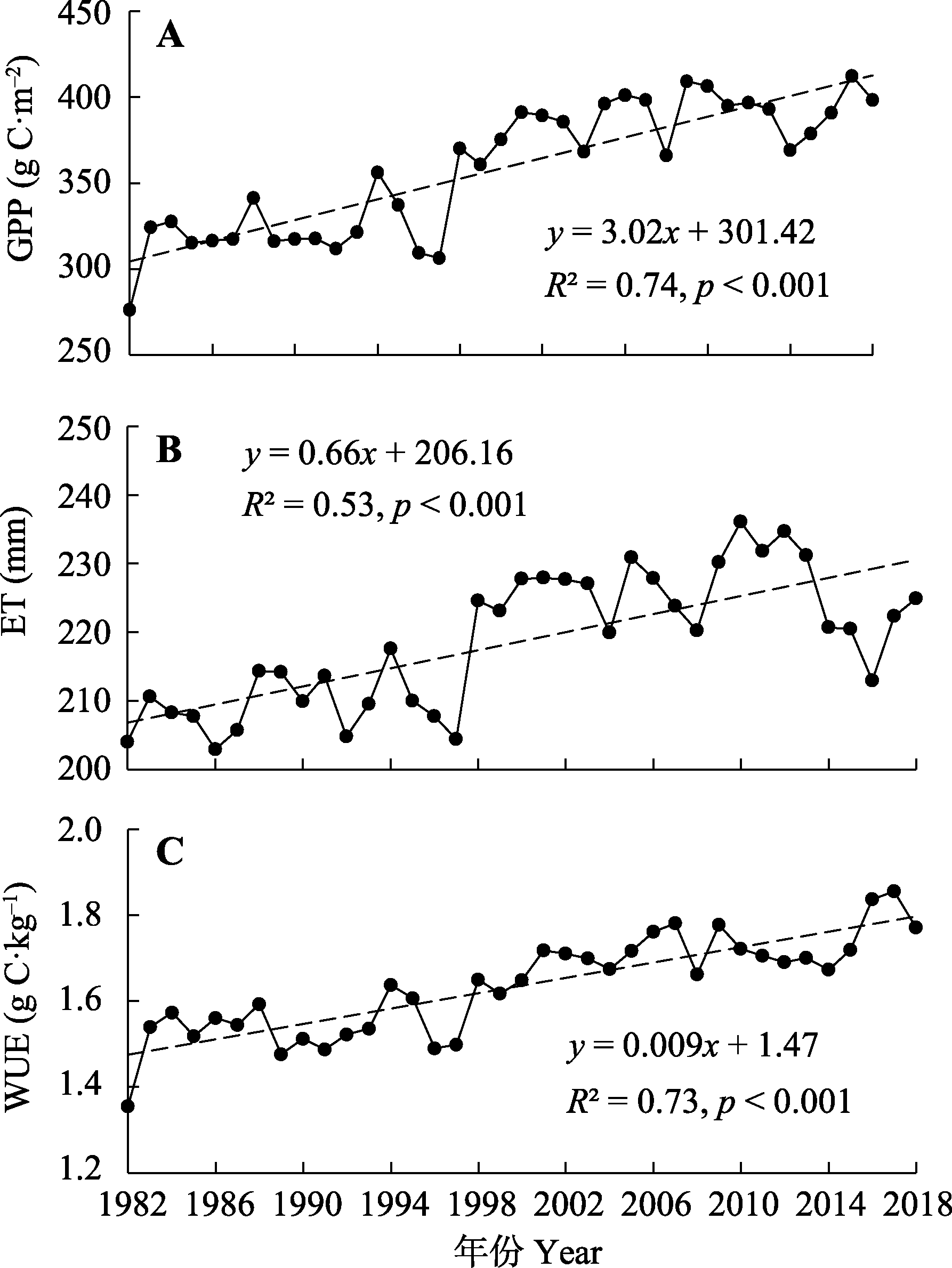
图3 青藏高原总初级生产力(GPP)(A)、蒸散发(ET)(B)和水分利用效率(WUE)(C)的时间变化。
Fig. 3 Temporal variations in gross primary productivity (GPP) (A), evapotranspiration (ET)(B) and water use efficiency (WUE) (C) in Qingzang Plateau.
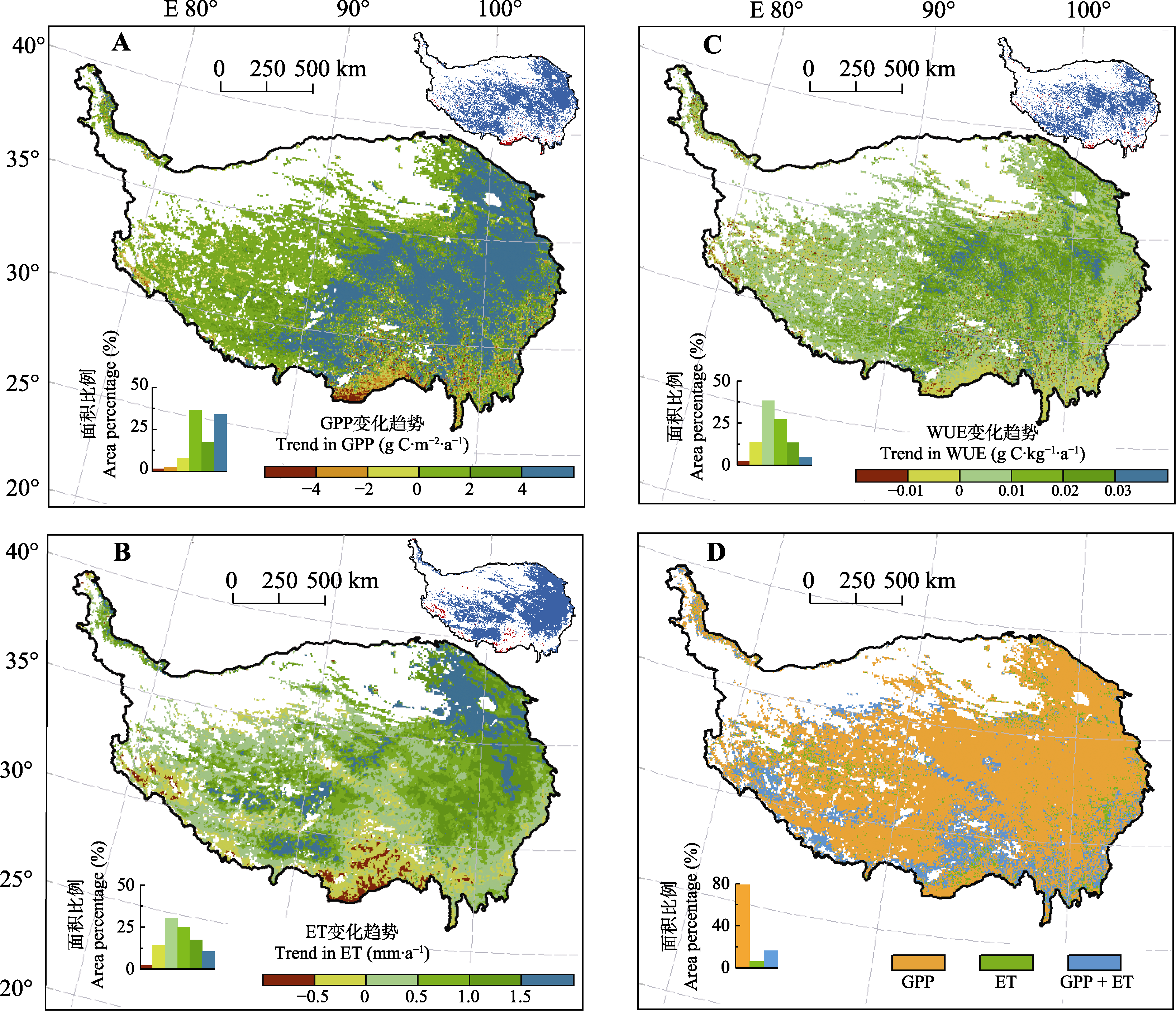
图4 青藏高原总初级生产力(GPP)(A)、蒸散发(ET)(B)和水分利用效率(WUE)(C)时间变化趋势以及WUE变化主导因子(D)的空间分布。A-C中子图显示的是显著(p < 0.05)变化区域, 蓝色表示显著增加, 红色表示显著减少。
Fig. 4 Spatial distributions of the temporal trends in gross primary productivity (GPP)(A), evapotranspiration (ET)(B), water use efficiency (WUE)(C), and spatial distribution of the dominant factors controlling WUE change (D) in Qingzang Plateau. Insets in A-C showed the areas with significant (p < 0.05) change trends, with blue and red colors indicating significantly increasing and decreasing trends, respectively.
| WUE变化主导因子 Dominant factors controlling WUE change | 判定标准 Criterions | ||
|---|---|---|---|
| GPP变化趋势 Trend in GPP | ET变化趋势 Trend in ET | WUE变化趋势 Trend in WUE | |
| 总初级生产力 GPP | + | + | + |
| - | - | - | |
| 蒸散发 ET | + | + | - |
| - | - | + | |
| 总初级生产力和蒸散发 GPP + ET | + | - | + |
| - | + | - | |
表2 青藏高原水分利用效率(WUE)变化主导因子的判定标准
Table 2 Criteria for the dominant factors controlling water use efficiency (WUE) change in Qingzang Plateau
| WUE变化主导因子 Dominant factors controlling WUE change | 判定标准 Criterions | ||
|---|---|---|---|
| GPP变化趋势 Trend in GPP | ET变化趋势 Trend in ET | WUE变化趋势 Trend in WUE | |
| 总初级生产力 GPP | + | + | + |
| - | - | - | |
| 蒸散发 ET | + | + | - |
| - | - | + | |
| 总初级生产力和蒸散发 GPP + ET | + | - | + |
| - | + | - | |
| 植被类型 Vegetation type | 温度 Temperature | 降水量 Precipitation | 太阳辐射 Solar radiation | 饱和水汽压差 Vapor pressure deficit | CO2浓度 CO2 concentration | 叶面积指数 Leaf area index |
|---|---|---|---|---|---|---|
| 所有植被 All vegetation | 0.20 | 0.23 | 0.30 | -0.24 | 0.55 | 0.72 |
| 森林 Forest | - | -0.54 | - | - | - | 0.59 |
| 灌丛 Shrubland | - | 0.26 | - | - | 0.50 | 0.76 |
| 高寒草甸 Alpine meadow | 0.16 | 0.09 | 0.25 | - | 0.81 | 0.74 |
| 高寒草原 Alpine steppe | - | 0.16 | 0.13 | -0.25 | 0.75 | 0.62 |
| 高山植被 Alpine vegetation | 0.22 | 0.33 | 0.47 | -0.23 | 0.71 | 0.79 |
| 栽培植被 Cultural vegetation | - | -0.43 | - | -0.55 | 0.50 | 0.60 |
| 高寒荒漠 Alpine desert | - | -0.23 | 0.21 | -0.15 | 1.03 | 0.80 |
表3 青藏高原不同植被类型中环境因子对水分利用效率的总效应
Table 3 Total effects of environmental factors on the water use efficiency for different vegetation types on Qingzang Plateau
| 植被类型 Vegetation type | 温度 Temperature | 降水量 Precipitation | 太阳辐射 Solar radiation | 饱和水汽压差 Vapor pressure deficit | CO2浓度 CO2 concentration | 叶面积指数 Leaf area index |
|---|---|---|---|---|---|---|
| 所有植被 All vegetation | 0.20 | 0.23 | 0.30 | -0.24 | 0.55 | 0.72 |
| 森林 Forest | - | -0.54 | - | - | - | 0.59 |
| 灌丛 Shrubland | - | 0.26 | - | - | 0.50 | 0.76 |
| 高寒草甸 Alpine meadow | 0.16 | 0.09 | 0.25 | - | 0.81 | 0.74 |
| 高寒草原 Alpine steppe | - | 0.16 | 0.13 | -0.25 | 0.75 | 0.62 |
| 高山植被 Alpine vegetation | 0.22 | 0.33 | 0.47 | -0.23 | 0.71 | 0.79 |
| 栽培植被 Cultural vegetation | - | -0.43 | - | -0.55 | 0.50 | 0.60 |
| 高寒荒漠 Alpine desert | - | -0.23 | 0.21 | -0.15 | 1.03 | 0.80 |
| [1] |
Bai Y, Zha T, Bourque CPA, Jia X, Ma J, Liu P, Yang R, Li C, Du T, Wu Y (2020). Variation in ecosystem water use efficiency along a southwest-to-northeast aridity gradient in China. Ecological Indicators, 110, 105932. DOI: 10.1016/j.ecolind.2019.105932.
DOI URL |
| [2] |
Ballantyne AP, Alden CB, Miller JB, Tans PP, White JWC (2012). Increase in observed net carbon dioxide uptake by land and oceans during the past 50 years. Nature, 488, 70-72.
DOI |
| [3] |
Cramer W, Bondeau A, Woodward FI, Prentice IC, Betts RA, Brovkin V, Cox PM, Fisher V, Foley JA, Friend AD, Kucharik C, Lomas MR, Ramankutty N, Sitch S, Smith B, White A, Young-Molling C (2001). Global response of terrestrial ecosystem structure and function to CO2 and climate change: results from six dynamic global vegetation models. Global Change Biology, 7, 357-373.
DOI URL |
| [4] | Di YP, Zhang YJ, Zeng H, Tang Z (2019). Effects of changed Asian water tower on Tibetan Plateau ecosystem: a review. Bulletin of Chinese Academy of Sciences, 34, 1322-1331. |
| [ 底阳平, 张扬建, 曾辉, 唐泽 (2019). “亚洲水塔”变化对青藏高原生态系统的影响. 中国科学院院刊, 34, 1322-1331.] | |
| [5] | Editorial Committee of Vegetation Map of China, Chinese of Academy of Sciences(2001). 1:1000000 Vegetation Atlas of China. Science Press, Beijing. |
| [中国科学院中国植被图编辑委员会(2001). 1:1000000 中国植被图集. 科学出版社, 北京.] | |
| [6] |
Feng X, Fu B, Piao S, Wang S, Ciais P, Zeng Z, Lü Y, Zeng Y, Li Y, Jiang X, Wu B (2016). Revegetation in China’s Loess Plateau is approaching sustainable water resource limits. Nature Climate Change, 6, 1019-1022.
DOI |
| [7] |
Feng ZZ, Li P, Zhang GY, Li ZZ, Ping Q, Peng JL, Liu S (2020). Impacts of elevated carbon dioxide concentration on terrestrial ecosystems: problems and prospective. Chinese Journal of Plant Ecology, 44, 461-474.
DOI URL |
|
[ 冯兆忠, 李品, 张国友, 李征珍, 平琴, 彭金龙, 刘硕 (2020). 二氧化碳浓度升高对陆地生态系统的影响: 问题与展望. 植物生态学报, 44, 461-474.]
DOI |
|
| [8] |
Gao QZ, Li Y, Wan YF, Qin XB, Jiangcun WZ, Liu YH (2009). Dynamics of alpine grassland NPP and its response to climate change in Northern Tibet. Climatic Change, 97, 515-528.
DOI URL |
| [9] |
Guo LM, Sun FB, Liu WB, Zhang YG, Wang H, Cui HJ, Wang HQ, Zhang J, Du BX (2019). Response of ecosystem water use efficiency to drought over China during 1982-2015: spatiotemporal variability and resilience. Forests, 10, 598. DOI: 10.3390/f10070598.
DOI URL |
| [10] |
Han JY, Guo CY, Ye S, Zhang LM, Li SG, Wang HM, Yu GR (2020). Effects of diffuse photosynthetically active radiation on gross primary productivity in a subtropical coniferous plantation vary in different timescales. Ecological Indicators, 115, 106403. DOI: 10.1016/j.ecolind.2020.106403.
DOI URL |
| [11] |
Hu ZM, Yu GR, Fu YL, Sun XM, Li YN, Shi PL, Wang YF, Zheng ZM (2008). Effects of vegetation control on ecosystem water use efficiency within and among four grassland ecosystems in China. Global Change Biology, 14, 1609-1619.
DOI URL |
| [12] |
Huang MT, Piao SL, Sun Y, Ciais P, Cheng L, Mao JF, Poulter B, Shi XY, Zeng ZZ, Wang YP (2015). Change in terrestrial ecosystem water-use efficiency over the last three decades. Global Change Biology, 21, 2366-2378.
DOI PMID |
| [13] |
Huang MT, Piao SL, Zeng ZZ, Peng SS, Ciais P, Cheng L, Mao JF, Poulter B, Shi XY, Yao YT, Yang H, Wang YP (2016). Seasonal responses of terrestrial ecosystem water-use efficiency to climate change. Global Change Biology, 22, 2165-2177.
DOI PMID |
| [14] |
Keenan TF, Hollinger DY, Bohrer G, Dragoni D, Munger JW, Schmid HP, Richardson AD (2013). Increase in forest water-use efficiency as atmospheric carbon dioxide concentrations rise. Nature, 499, 324-327.
DOI |
| [15] |
Li HQ, Zhu JB, Zhang FW, He HD, Yang YS, Li YN, Cao GM, Zhou HK (2019). Growth stage-dependant variability in water vapor and CO2 exchanges over a humid alpine shrubland on the northeastern Qinghai-Tibetan Plateau. Agricultural and Forest Meteorology, 268, 55-62.
DOI URL |
| [16] |
Li Y, Shi H, Zhou L, Eamus D, Huete A, Li L, Cleverly J, Hu Z, Harahap M, Yu Q, He L, Wang S (2018). Disentangling climate and LAI effects on seasonal variability in water use efficiency across terrestrial ecosystems in China. Journal of Geophysical Research: Biogeosciences, 123, 2429-2443.
DOI URL |
| [17] |
Lin S, Wang GX, Hu ZY, Huang KW, Sun JY, Sun XY (2020). Spatiotemporal variability and driving factors of Tibetan Plateau water use efficiency. Journal of Geophysical Research: Atmospheres, 125, e2020JD032642. DOI: 10.1029/2020JD032642.
DOI |
| [18] |
Liu XF, Feng XM, Fu BJ (2020). Changes in global terrestrial ecosystem water use efficiency are closely related to soil moisture. Science of the Total Environment, 698, 134165. DOI: 10.1016/j.scitotenv.2019.134165.
DOI URL |
| [19] |
Liu YB, Xiao JF, Ju WM, Zhou YL, Wang SQ, Wu XC (2015). Water use efficiency of Chinaʼs terrestrial ecosystems and responses to drought. Scientific Reports, 5, 13799. DOI: 10.1038/srep13799.
DOI |
| [20] |
Mi ZR, Chen LT, Zhang ZH, He JS (2015). Alpine grassland water use efficiency based on annual precipitation, growing season precipitation and growing season evapotranspiration. Chinese Journal of Plant Ecology, 39, 649-660.
DOI URL |
|
[ 米兆荣, 陈立同, 张振华, 贺金生 (2015). 基于年降水、生长季降水和生长季蒸散的高寒草地水分利用效率. 植物生态学报, 39, 649-660.]
DOI |
|
| [21] |
Niu SL, Xing XR, Zhang Z, Xia JY, Zhou XH, Song B, Li LH, Wan SQ (2011). Water-use efficiency in response to climate change: from leaf to ecosystem in a temperate steppe. Global Change Biology, 17, 1073-1082.
DOI URL |
| [22] | Pan S, Tian H, Dangal SRS, Yang Q, Yang J, Lu C, Tao B, Ren W, Ouyang Z (2015). Responses of global terrestrial evapotranspiration to climate change and increasing atmospheric CO2 in the 21st century. Earthʼs Future, 3, 15-35. |
| [23] |
Peng SZ, Ding YX, Liu WZ, Li Z (2019). 1 km monthly temperature and precipitation dataset for China from 1901 to 2017. Earth System Science Data, 11, 1931-1946.
DOI URL |
| [24] |
Piao S, Mohammat A, Fang J, Cai Q, Feng J (2006). NDVI- based increase in growth of temperate grasslands and its responses to climate changes in China. Global Environmental Change, 16, 340-348.
DOI URL |
| [25] | Piao SL, Zhang XZ, Wang T, Liang EY, Wang SP, Zhu JT, Niu B (2019). Responses and feedback of the Tibetan Plateau’s alpine ecosystem to climate change. Chinese Science Bulletin, 64, 2842-2855. |
| [ 朴世龙, 张宪洲, 汪涛, 梁尔源, 汪诗平, 朱军涛, 牛犇 (2019). 青藏高原生态系统对气候变化的响应及其反馈. 科学通报, 64, 2842-2855.] | |
| [26] |
Richardson AD, Keenan TF, Migliavacca M, Ryu Y, Sonnentag O, Toomey M (2013). Climate change, phenology, and phenological control of vegetation feedbacks to the climate system. Agricultural and Forest Meteorology, 169, 156-173.
DOI URL |
| [27] |
Sun SB, Song ZL, Wu XC, Wang TJ, Wu YT, Du WL, Che T, Huang CL, Zhang XJ, Ping B, Lin XF, Li P, Yang YX, Chen BZ (2018). Spatio-temporal variations in water use efficiency and its drivers in China over the last three decades. Ecological indicators, 94, 292-304.
DOI URL |
| [28] |
Wang LM, Li MY, Wang JX, Li XG, Wang LC (2020a). An analytical reductionist framework to separate the effects of climate change and human activities on variation in water use efficiency. Science of the Total Environment, 727, 138306. DOI: 10.1016/j.scitotenv.2020.138306.
DOI URL |
| [29] |
Wang LX, Good SP, Caylor KK (2014). Global synthesis of vegetation control on evapotranspiration partitioning. Geophysical Research Letters, 41, 6753-6757.
DOI URL |
| [30] |
Wang S, Zhang Y, Ju W, Chen JM, Ciais P, Cescatti A, Sardans J, Janssens IA, Wu M, Berry JA, Campbell E, Fernández- Martínez M, Alkama R, Sitch S, Friedlingstein P, et al. (2020b). Recent global decline of CO2 fertilization effects on vegetation photosynthesis. Science, 370, 1295-1300.
DOI URL |
| [31] |
Wang Y, Zhou L, Ping XY, Jia QY, Li RP (2018). Ten-year variability and environmental controls of ecosystem water use efficiency in a rainfed maize cropland in Northeast China. Field Crops Research, 226, 48-55.
DOI URL |
| [32] |
Wang ZP, Wu JS, Niu B, He YT, Zu JX, Li M, Zhang XZ (2020c). Vegetation expansion on the Tibetan Plateau and its relationship with climate change. Remote Sensing, 12, 4150. DOI: 10.3390/rs12244150.
DOI URL |
| [33] |
Wu JS, Zhang XZ, Shen ZX, Shi PL, Xu XL, Li XJ (2013). Grazing-exclusion effects on aboveground biomass and water-use efficiency of alpine grasslands on the northern Tibetan Plateau. Rangeland Ecology & Management, 66, 454-461.
DOI URL |
| [34] | Wu XC, Li XY, Chen YH, Bai Y, Tong YQ, Wang P, Liu HY, Wang MJ, Shi FZ, Zhang CC, Huang YM, Ma YJ, Hu X, Shi CM (2019). Atmospheric water demand dominates daily variations in water use efficiency in alpine meadows, northeastern Tibetan Plateau. Journal of Geophysical Research, 124, 2174-2185. |
| [35] |
Xiao J, Sun G, Chen J, Chen H, Chen S, Dong G, Gao S, Guo HQ, Guo J, Han S, Kato T, Li Y, Lin G, Lu W, Ma M, et al. (2013). Carbon fluxes, evapotranspiration, and water use efficiency of terrestrial ecosystems in China. Agricultural and Forest Meteorology, 182-183, 76-90.
DOI URL |
| [36] |
Xiao ZQ, Liang SL, Wang JD, Xiang Y, Zhao X, Song JL (2016). Long-time-series global land surface satellite leaf area index product derived from MODIS and AVHRR surface reflectance. IEEE Transactions on Geoscience and Remote Sensing, 54, 5301-5318.
DOI URL |
| [37] |
Xu HJ, Zhao CY, Wang XP (2019). Spatiotemporal differentiation of the terrestrial gross primary production response to climate constraints in a dryland mountain ecosystem of northwestern China. Agricultural and Forest Meteorology, 276-277, 107628. DOI: 10.1016/j.agrformet.2019.107628.
DOI URL |
| [38] |
Xue BL, Guo QH, Otto A, Xiao JF, Tao SL, Li L (2015). Global patterns, trends, and drivers of water use efficiency from 2000 to 2013. Ecosphere, 6, 174. DOI: 10.1890/ES14-00416.1.sm.
DOI |
| [39] | Yao TD, Wu GJ, Xu BQ, Wang WC, Gao J, An BS (2019). Asian water tower change and its impacts. Bulletin of Chinese Academy of Sciences, 34, 1203-1209. |
| [ 姚檀栋, 邬光剑, 徐柏青, 王伟财, 高晶, 安宝晟 (2019). “亚洲水塔”变化与影响. 中国科学院院刊, 34, 1203-1209.] | |
| [40] | Yao Y, Liang S, Li X, Hong Y, Fisher JB, Zhang N, Chen J, Cheng J, Zhao S, Zhang X, Jiang B, Sun L, Jia K, Wang K, Chen Y, Mu Q, Feng F (2014). Bayesian multimodel estimation of global terrestrial latent heat flux from eddy covariance, meteorological, and satellite observations. Journal of Geophysical Research, 119, 4521-4545. |
| [41] |
Yu BH, Lv CH (2011). Assessment of ecological vulnerability on the Tibetan Plateau. Geographical Research, 30, 2289-2295.
DOI |
| [ 于伯华, 吕昌河 (2011). 青藏高原高寒区生态脆弱性评价. 地理研究, 30, 2289-2295.] | |
| [42] |
Yu GR, Song X, Wang QF, Liu YF, Guan DX, Yan JH, Sun XM, Zhang LM, Wen XF (2008). Water-use efficiency of forest ecosystems in eastern China and its relations to climatic variables. New Phytologist, 177, 927-937.
DOI PMID |
| [43] |
Yuan W, Zheng Y, Piao S, Ciais P, Lombardozzi D, Wang Y, Ryu Y, Chen G, Dong W, Hu Z, Jain AK, Jiang C, Kato E, Li S, Lienert S, et al. (2019). Increased atmospheric vapor pressure deficit reduces global vegetation growth. Science Advances, 5, eaax1396. DOI: 10.1126/sciadv.aax1396.
DOI URL |
| [44] |
Zhang FM, Ju WM, Shen SH, Wang SQ, Yu GR, Han SJ (2014). How recent climate change influences water use efficiency in East Asia. Theoretical and Applied Climatology, 116, 359-370.
DOI URL |
| [45] | Zhang JY, Liu JF, Jin JL, Ma T, Wang GQ, Liu HW, Min X, Wang H, Lin J, Bao ZX, Liu CS (2019). Evolution and trend of water resources in Qinghai-Tibet Plateau. Bulletin of Chinese Academy of Sciences, 34, 1264-1273. |
| [ 张建云, 刘九夫, 金君良, 马涛, 王国庆, 刘宏伟, 闵星, 王欢, 林锦, 鲍振鑫, 刘翠善 (2019). 青藏高原水资源演变与趋势分析. 中国科学院院刊, 34, 1264-1273.] | |
| [46] |
Zhang YJ, Zhu YX, Li JX, Chen Y (2019). Current status and future directions of the Tibetan Plateau ecosystem research. Science Bulletin, 64, 428-430.
DOI PMID |
| [47] |
Zhang YL, Li BY, Zheng D (2002). A discussion on the boundary and area of the Tibetan Plateau in China. Geographical Research, 21, 1-8.
DOI |
| [ 张镱锂, 李炳元, 郑度 (2002). 论青藏高原范围与面积. 地理研究, 21, 1-8.] | |
| [48] |
Zhao JX, Feng HZ, Xu TR, Xiao JF, Guerrieri R, Liu SM, Wu XC, He XL, He XP (2021). Physiological and environmental control on ecosystem water use efficiency in response to drought across the northern hemisphere. Science of the Total Environment, 758, 143599. DOI: 10.1016/j.scitotenv.2020.143599.
DOI URL |
| [49] |
Zheng H, Lin H, Zhou WJ, Bao H, Zhu XJ, Jin Z, Song Y, Wang YQ, Liu WZ, Tang YK (2019). Revegetation has increased ecosystem water-use efficiency during 2000- 2014 in the Chinese Loess Plateau: evidence from satellite data. Ecological Indicators, 102, 507-518.
DOI |
| [50] |
Zheng Y, Shen RQ, Wang YW, Li XQ, Liu SG, Liang SL, Chen JM, Ju WM, Zhang L, Yuan WP (2020a). Improved estimate of global gross primary production for reproducing its long-term variation, 1982-2017. Earth System Science Data, 12, 2725-2746.
DOI URL |
| [51] |
Zheng ZT, Zhu WQ, Chen GS, Jiang N, Fan DQ, Zhang DH (2016). Continuous but diverse advancement of spring- summer phenology in response to climate warming across the Qinghai-Tibetan Plateau. Agricultural and Forest Meteorology, 223, 194-202.
DOI URL |
| [52] |
Zheng ZT, Zhu WQ, Zhang YJ (2020b). Seasonally and spatially varied controls of climatic factors on net primary productivity in alpine grasslands on the Tibetan Plateau. Global Ecology and Conservation, 21, e00814. DOI: 10.1016/j.gecco.2019.e00814.
DOI URL |
| [53] |
Zhou X, Sun PS, Zhang MF, Liu SR (2020). Spatio-temporal characteristics of vegetation water use efficiency and their relationships with climatic factors in alpine and subalpine area of southwestern China. Chinese Journal of Plant Ecology, 44, 628-641.
DOI URL |
|
[ 周雄, 孙鹏森, 张明芳, 刘世荣 (2020). 西南高山亚高山区植被水分利用效率时空特征及其与气候因子的关系. 植物生态学报, 44, 628-641.]
DOI |
|
| [54] |
Zhu XJ, Yu GR, Wang QF, Hu ZM, Zheng H, Li SG, Sun XM, Zhang YP, Yan JH, Wang HM, Zhao FH, Zhang JH, Shi PL, Li YN, Zhao L, Zhang FW, Hao YB (2015). Spatial variability of water use efficiency in Chinaʼs terrestrial ecosystems. Global and Planetary Change, 129, 37-44.
DOI URL |
| [1] | 张安宁, 肖亚宁, 赵霞, 张淼, 崔瀚文, 陈书燕, 安黎哲. 青藏高原灌木化与氮添加对土壤线虫及功能性状的交互作用[J]. 植物生态学报, 2026, 50(预发表): 0-. |
| [2] | 吴光进, 郭垚鑫, 任成杰, 王俊, 岳明, 赵发珠. 秦岭北麓不同植被类型土壤有机碳含量分布及其影响因素[J]. 植物生态学报, 2026, 50(预发表): 1-. |
| [3] | 张琳, 袁伟影, 宋创业, 吴冬秀. 1998-2010年中国典型生态系统长期监测样地环境要素、物种丰富度和生物量动态数据集[J]. 植物生态学报, 2025, 49(8): 1182-1190. |
| [4] | 曹毅, 张松林, 王旭峰, 杨安昌, 任敏慧, 杨浩, 韩超. 兰州市南北两山植物群落数据集[J]. 植物生态学报, 2025, 49(6): 975-989. |
| [5] | 惠城阳, 章巧依, 刘腾腾, 刘维勇, 周丽娜, 金鑫杰, 张永华, 刘金亮. 温州大罗山主要植被类型及物种组成特征[J]. 植物生态学报, 2025, 49(6): 990-998. |
| [6] | 陈龙, 郭柯, 勾晓华, 赵秀海, 马泓若. 祁连圆柏林群落组成及特征[J]. 植物生态学报, 2025, 49(6): 852-864. |
| [7] | 王世松, 曲孝云, 董劭琼, 李佳鸿, 杨琦, 侯满福, 赵利清, 郭柯, 刘长成, 胥晓. 西藏札达典型荒漠植被类型及群落特征[J]. 植物生态学报, 2025, 49(5): 801-812. |
| [8] | 王娟, 张登山, 肖元明, 裴全帮, 王博, 樊博, 周国英. 长期围封后高寒草原植物根系分泌物特征与环境因子关系[J]. 植物生态学报, 2025, 49(4): 596-609. |
| [9] | 竹万宽, 许宇星, 黄润霞, 杜阿朋, 王志超. 雷州半岛桉树人工林生态系统水分利用效率旱雨季差异及其控制因素[J]. 植物生态学报, 2025, 49(12): 2015-2029. |
| [10] | 陈诚智, 高钰森, 罗力嘉, 王东. 川西高寒窄叶鲜卑花灌丛凋落枝和凋落叶生产与分解[J]. 植物生态学报, 2025, 49(10): 1733-1743. |
| [11] | 王麟, 李雪, 王愉, 王新, 胡小文, 杨梅, 朱剑霄. 不同配方种衣剂对高寒草地乡土草种种子生长与建植的影响[J]. 植物生态学报, 2025, 49(1): 118-128. |
| [12] | 王雯莹, 肖元明, 王小赟, 徐嘉昕, 马玉花, 李强峰, 周国英. 多功能群物种配置模式下退化高寒草甸植物多样性与生态系统多功能性的关联[J]. 植物生态学报, 2025, 49(1): 103-117. |
| [13] | 张辉, 赵赟鹏, 刘晓琛, 郭增鹏, 胡国瑞, 冯彦皓, 马妙君. 高寒草甸退化过程中土壤种子库的变化及其在植物群落更新中的潜在作用[J]. 植物生态学报, 2025, 49(1): 74-82. |
| [14] | 吴风燕, 吴永胜, 陈晓涵, 冯骥, 卢丽媛, 查斯娜, 王超宇, 孟元发, 尹强. 鄂尔多斯高原3种固沙灌木水分利用效率的时空变化特征[J]. 植物生态学报, 2024, 48(9): 1180-1191. |
| [15] | 王音, 同小娟, 张劲松, 李俊, 孟平, 刘沛荣, 张静茹. 干旱对栓皮栎人工林碳水通量及其耦合的影响[J]. 植物生态学报, 2024, 48(9): 1157-1171. |
| 阅读次数 | ||||||
|
全文 |
|
|||||
|
摘要 |
|
|||||
Copyright © 2026 版权所有 《植物生态学报》编辑部
地址: 北京香山南辛村20号, 邮编: 100093
Tel.: 010-62836134, 62836138; Fax: 010-82599431; E-mail: apes@ibcas.ac.cn, cjpe@ibcas.ac.cn
备案号: 京ICP备16067583号-19

