
植物生态学报 ›› 2026, Vol. 50 ›› Issue (3): 731-741.DOI: 10.17521/cjpe.2025.0252 cstr: 32100.14.cjpe.2025.0252
陈淼1,2,3,4, 陈健1,2, 刘顺1,2, 许格希1,2, 冯秋红3,4, 史作民1,2,5,*( )
)
收稿日期:2025-07-02
接受日期:2025-12-13
出版日期:2026-03-20
发布日期:2026-04-03
通讯作者:
*史作民(shizm@caf.ac.cn)基金资助:
CHEN Miao1,2,3,4, CHEN Jian1,2, LIU Shun1,2, XU Ge-Xi1,2, FENG Qiu-Hong3,4, SHI Zuo-Min1,2,5,*()
Received:2025-07-02
Accepted:2025-12-13
Online:2026-03-20
Published:2026-04-03
Contact:
*SHI Zuo-Min(shizm@caf.ac.cn)
Supported by:摘要:
外生菌根树木既通过细根直接吸收土壤中的氮(根途径), 也通过外生菌根真菌菌丝吸收土壤氮(菌丝途径)后转移到细根中。然而, 目前对于菌丝途径对外生菌根树木氮获取的相对贡献(ffungi)的量化估算仍具有较大的不确定性, 其关键影响因素亦不甚明确。该研究以青藏高原东缘岷江冷杉(Abies fargesii var. faxoniana)和糙皮桦(Betula utilis)为对象, 采用15N自然丰度法量化了菌丝途径对其氮获取的相对贡献, 并进一步分析了ffungi的关键影响因素。研究发现, 岷江冷杉和糙皮桦通过菌丝途径获取的氮在总氮吸收中的贡献与根途径相当, 菌丝途径对岷江冷杉总氮吸收的贡献率为33.6%-71.8%, 对糙皮桦的贡献率为41.6%-63.0%。此外, 土壤碳氮比、年平均温度及土壤pH是ffungi的关键影响因素。该研究为深入理解自然生态系统中外生菌根树木氮获取策略及其影响因素提供了新的思路和见解。
陈淼, 陈健, 刘顺, 许格希, 冯秋红, 史作民. 外生菌根真菌对青藏高原东缘岷江冷杉和糙皮桦氮获取的贡献及其影响因素. 植物生态学报, 2026, 50(3): 731-741. DOI: 10.17521/cjpe.2025.0252
CHEN Miao, CHEN Jian, LIU Shun, XU Ge-Xi, FENG Qiu-Hong, SHI Zuo-Min. Contribution and influencing factors of ectomycorrhizal fungi to nitrogen acquisition for Abies fargesii var. faxoniana and Betula utilis on the eastern Qingzang Plateau. Chinese Journal of Plant Ecology, 2026, 50(3): 731-741. DOI: 10.17521/cjpe.2025.0252
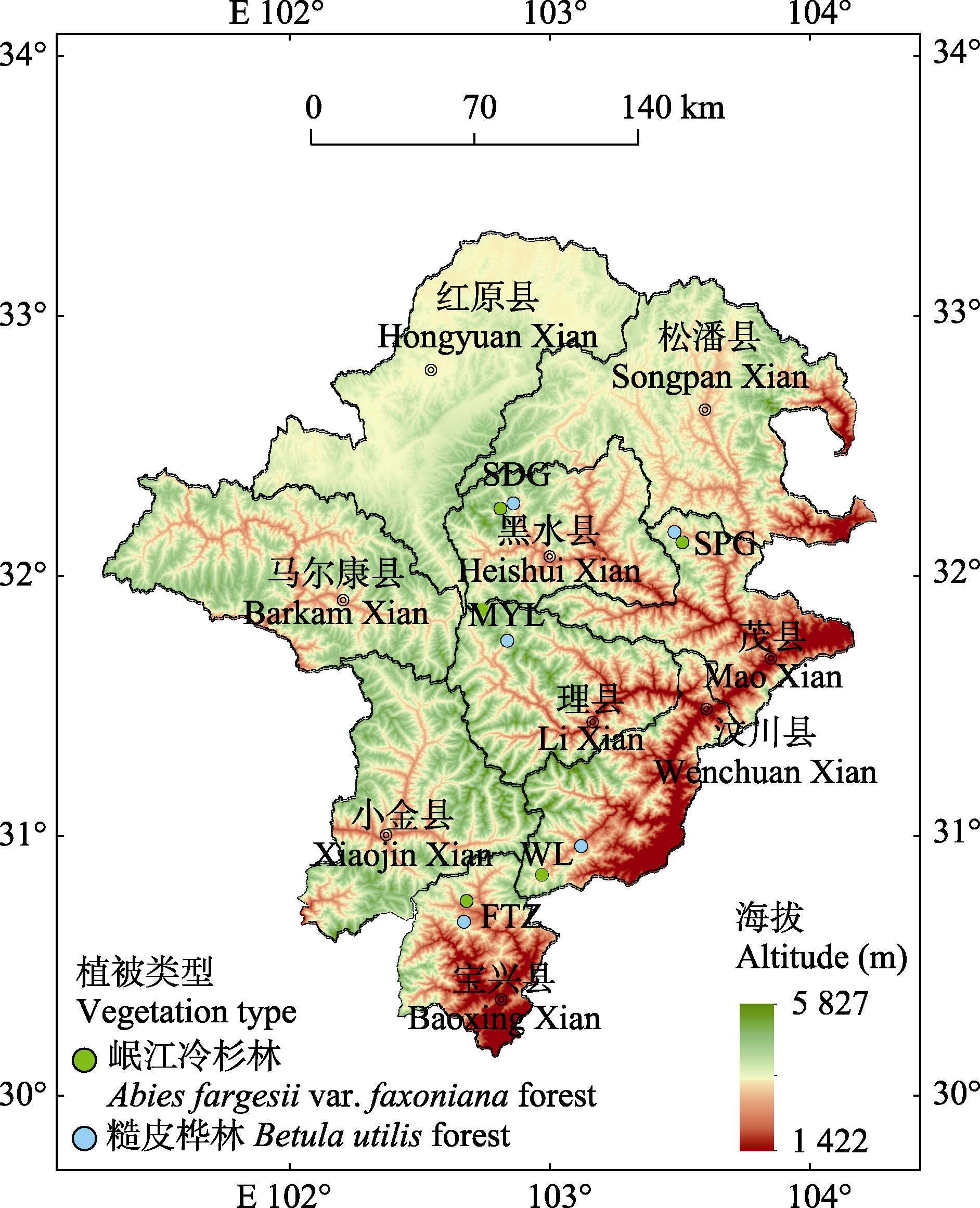
图1 研究区样点分布图。FTZ, 蜂桶寨; MYL, 米亚罗; SDG, 三达古; SPG, 松坪沟; WL, 卧龙。
Fig. 1 Location of the sampling sites in the study area. FTZ, Fengtongzhai; MYL, Miyaluo; SDG, Sandagu; SPG, Songpinggou; WL, Wolong.
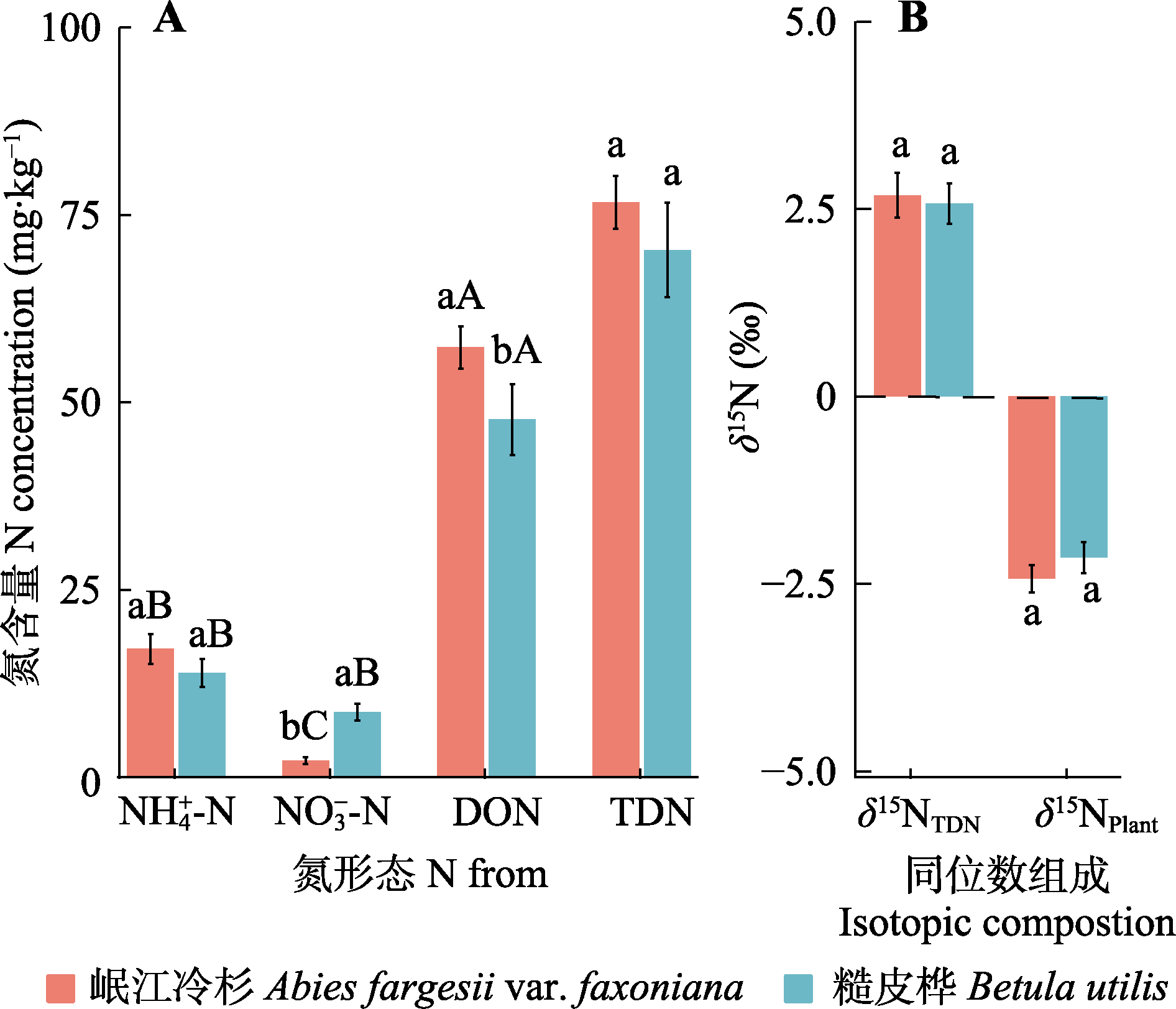
图2 不同森林类型土壤氮浓度和同位素特征以及植物氮同位素特征(平均值±标准误)。DON, 可溶性有机氮含量; TDN, 土壤总溶解氮含量。δ15NTDN, 土壤总溶解的氮稳定同位素组成; δ15Nplant, 全株植物的氮稳定同位素组成。不同小写字母表示不同林型间在p < 0.05水平下存在显著差异。不同大写字母表示同一林型内不同形态氮含量在p < 0.05水平下存在显著差异。
Fig. 2 Soil nitrogen (N) concentration and isotopic characteristics and plant nitrogen isotopic characteristics in different forest types (mean ± SE). DON, dissolved organic nitrogen content; TDN, total dissolved nitrogen content. δ15NTDN, the stable nitrogen isotope value of soil total dissolved nitrogen; δ15Nplant, the stable nitrogen isotope value of whole-plant. Different lowercase letters denote significant differences between different forest types at p < 0.05. Different uppercase letters denote significant differences among different forms of N at p < 0.05.
| 森林类型 Forest type | 地点 Site | 不同形态氮含量 Different forms of nitrogen content (mg·kg-1) | 氮同位素特征 Nitrogen isotope characteristics (‰) | ||||
|---|---|---|---|---|---|---|---|
| NH4+-N | NO3--N | DON | TDN | δ15NTDN | δ15Nplant | ||
| 岷江冷杉林 Abies fargesii var. faxoniana forest | WL | 13.79 ± 2.79aB | 4.89 ± 0.79aA | 49.27 ± 3.12aA | 67.93 ± 4.83aB | 2.72 ± 0.64aA | -2.51 ± 0.35aABC |
| MYL | 27.70 ± 1.50aA | 0.75 ± 0.10bA | 53.95 ± 5.44aA | 82.39 ± 4.17aAB | 3.14 ± 0.62aA | -2.71 ± 0.37aBC | |
| FTZ | 24.94 ± 2.62aA | 1.25 ± 0.40bA | 67.71 ± 7.45aA | 93.90 ± 8.55aA | 3.48 ± 0.38aA | -1.59 ± 0.24aA | |
| SDG | 12.48 ± 0.41aB | 0.80 ± 0.17bA | 63.28 ± 8.13aA | 76.54 ± 7.93aAB | 0.93 ± 0.38bB | -2.07 ± 0.04bAB | |
| SPG | 6.72 ± 1.01aC | 3.35 ± 0.97aA | 52.54 ± 3.58aA | 62.60 ± 4.05aB | 3.16 ± 0.59aA | -3.27 ± 0.45aC | |
| 糙皮桦林 Betula utilis forest | WL | 9.09 ± 2.63aBC | 8.20 ± 1.79aB | 32.82 ± 6.16bC | 50.10 ± 7.95bB | 2.37 ± 0.14aAB | -1.35 ± 0.60aA |
| MYL | 27.42 ± 1.30aA | 5.51 ± 0.79aB | 55.28 ± 4.23aAB | 88.20 ± 3.16aA | 1.53 ± 0.60aB | -2.52 ± 0.22aBC | |
| FTZ | 14.18 ± 1.52bB | 10.73 ± 3.15aAB | 72.56 ± 8.35aA | 97.47 ± 5.70aA | 3.01 ± 0.61aAB | -1.90 ± 0.43aAB | |
| SDG | 13.97 ± 2.64aB | 13.63 ± 2.59aA | 51.76 ± 9.51aB | 79.35 ± 14.57aA | 2.42 ± 0.42aAB | -3.21 ± 0.16aC | |
| SPG | 4.93 ± 0.71aC | 5.49 ± 1.33aB | 26.17 ± 5.96bC | 36.58 ± 6.75bB | 3.53 ± 0.77aA | -1.75 ± 0.20bAB | |
表1 不同地点不同形态氮含量及氮同位素特征(平均值±标准误, n=4)
Table 1 Different forms of nitrogen content and nitrogen isotope characteristics in different sites (mean ± SE, n = 4)
| 森林类型 Forest type | 地点 Site | 不同形态氮含量 Different forms of nitrogen content (mg·kg-1) | 氮同位素特征 Nitrogen isotope characteristics (‰) | ||||
|---|---|---|---|---|---|---|---|
| NH4+-N | NO3--N | DON | TDN | δ15NTDN | δ15Nplant | ||
| 岷江冷杉林 Abies fargesii var. faxoniana forest | WL | 13.79 ± 2.79aB | 4.89 ± 0.79aA | 49.27 ± 3.12aA | 67.93 ± 4.83aB | 2.72 ± 0.64aA | -2.51 ± 0.35aABC |
| MYL | 27.70 ± 1.50aA | 0.75 ± 0.10bA | 53.95 ± 5.44aA | 82.39 ± 4.17aAB | 3.14 ± 0.62aA | -2.71 ± 0.37aBC | |
| FTZ | 24.94 ± 2.62aA | 1.25 ± 0.40bA | 67.71 ± 7.45aA | 93.90 ± 8.55aA | 3.48 ± 0.38aA | -1.59 ± 0.24aA | |
| SDG | 12.48 ± 0.41aB | 0.80 ± 0.17bA | 63.28 ± 8.13aA | 76.54 ± 7.93aAB | 0.93 ± 0.38bB | -2.07 ± 0.04bAB | |
| SPG | 6.72 ± 1.01aC | 3.35 ± 0.97aA | 52.54 ± 3.58aA | 62.60 ± 4.05aB | 3.16 ± 0.59aA | -3.27 ± 0.45aC | |
| 糙皮桦林 Betula utilis forest | WL | 9.09 ± 2.63aBC | 8.20 ± 1.79aB | 32.82 ± 6.16bC | 50.10 ± 7.95bB | 2.37 ± 0.14aAB | -1.35 ± 0.60aA |
| MYL | 27.42 ± 1.30aA | 5.51 ± 0.79aB | 55.28 ± 4.23aAB | 88.20 ± 3.16aA | 1.53 ± 0.60aB | -2.52 ± 0.22aBC | |
| FTZ | 14.18 ± 1.52bB | 10.73 ± 3.15aAB | 72.56 ± 8.35aA | 97.47 ± 5.70aA | 3.01 ± 0.61aAB | -1.90 ± 0.43aAB | |
| SDG | 13.97 ± 2.64aB | 13.63 ± 2.59aA | 51.76 ± 9.51aB | 79.35 ± 14.57aA | 2.42 ± 0.42aAB | -3.21 ± 0.16aC | |
| SPG | 4.93 ± 0.71aC | 5.49 ± 1.33aB | 26.17 ± 5.96bC | 36.58 ± 6.75bB | 3.53 ± 0.77aA | -1.75 ± 0.20bAB | |
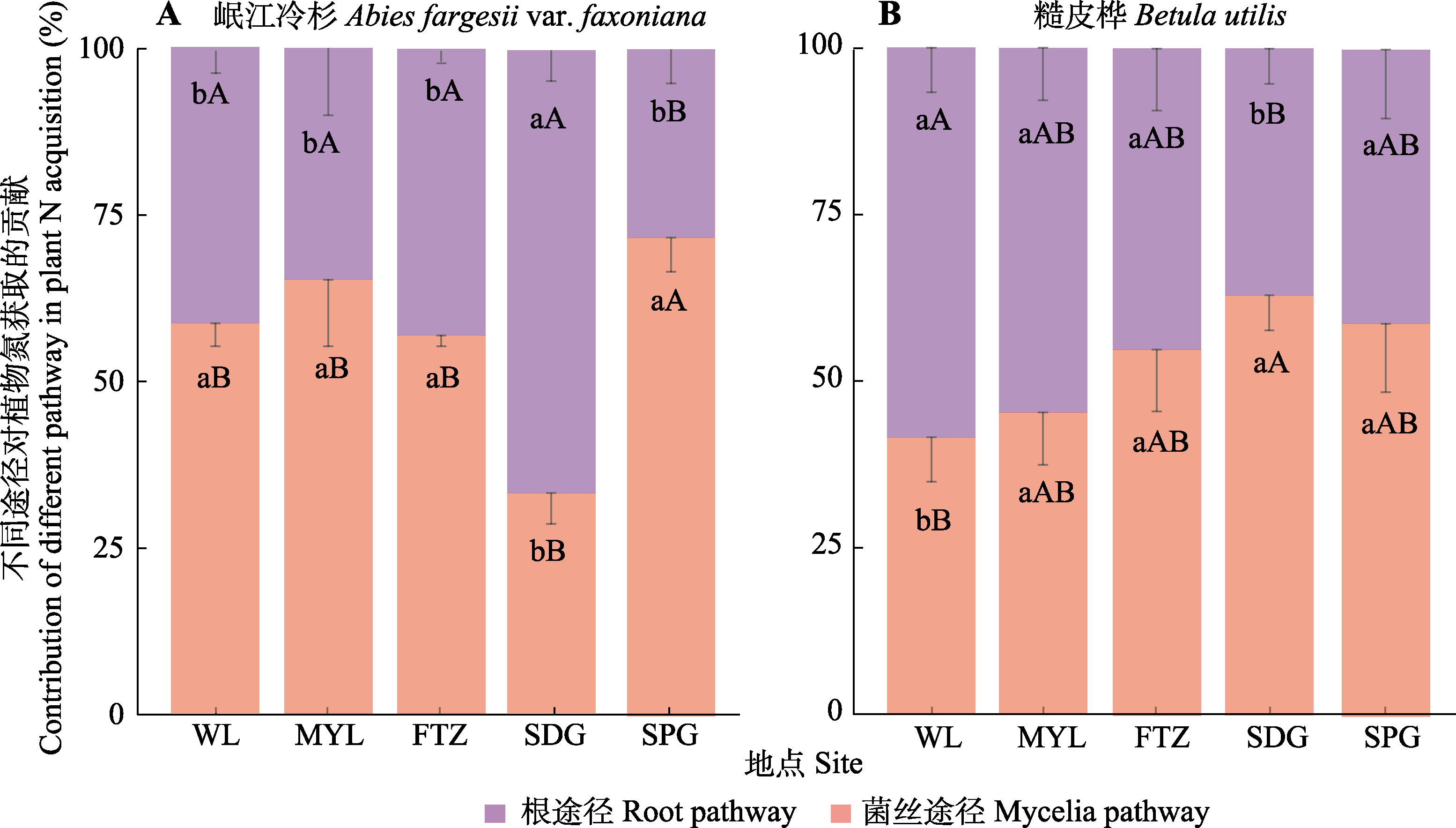
图3 根途径和菌丝途径对岷江冷杉和糙皮桦氮获取的贡献(平均值±标准误)。FTZ, 蜂桶寨; MYL, 米亚罗; SDG, 三达古; SPG, 松坪沟; WL, 卧龙。不同小写字母表示在给定地点的不同氮吸收途径之间的显著差异(p < 0.05)。不同大写字母表示在给定森林类型的不同地点之间的显著差异(p < 0.05)。
Fig. 3 Contributions of root pathway and mycelia pathway to Abies fargesii var. faxonian and Betula utilis nitrogen acquisition (mean ± SE). FTZ, Fengtongzhai; MYL, Miyaluo; SDG, Sandagu; SPG, Songpinggou; WL, Wolong. Different lowercase letters denote significant differences between different nitrogen (N) uptake pathways in a given site at p < 0.05. Different uppercase letters denote significant differences among different sites in a given forest type at p < 0.05.
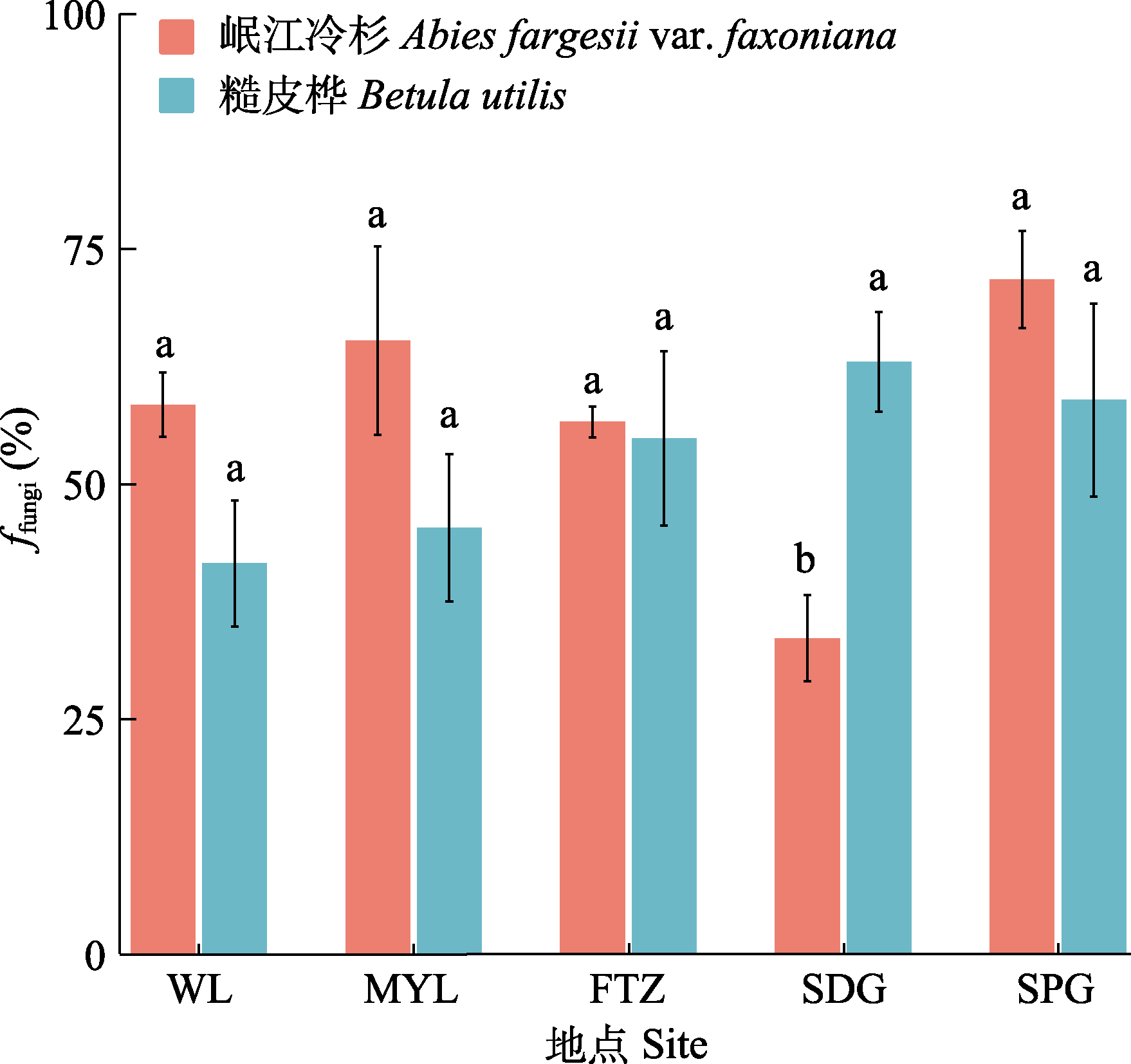
图4 同一地点岷江冷杉和糙皮桦的ffungi差异(平均值±标准误)。ffungi, 菌根真菌对树木氮获取的贡献率。FTZ, 蜂桶寨; MYL, 米亚罗; SDG, 三达古; SPG, 松坪沟; WL, 卧龙。不同小写字母表示存在显著差异(p < 0.05)。
Fig. 4 Difference in ffungi between Abies fargesii var. faxoniana and Betula utilis at the same site (mean ± SE). ffungi, the contribution rate of the mycelia pathway to tree nitrogen acquisition. FTZ, Fengtongzhai; MYL, Miyaluo; SDG, Sandagu; SPG, Songpinggou; WL, Wolong. Different lowercase letters denote significant differences at p < 0.05.
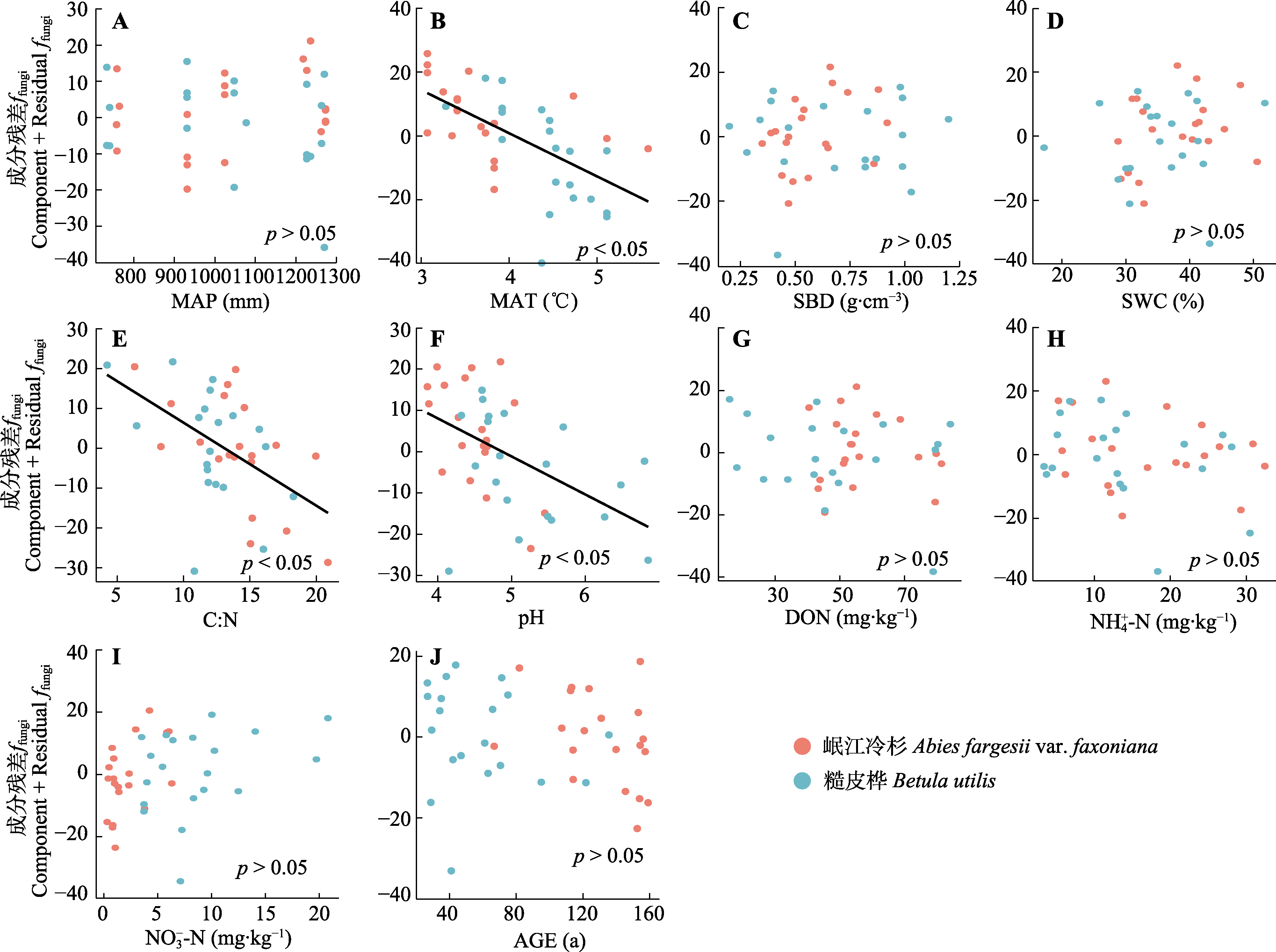
图5 ffungi与气候因子、土壤特性、树木年龄之间的关系。AGE, 树木年龄; C:N, 土壤碳氮比; DON, 可溶性有机氮含量; ffungi, 菌根真菌对树木氮获取的贡献率; MAP, 年降水量; MAT, 年平均气温; SBD, 土壤容重; SWC, 土壤含水量。
Fig. 5 Relationship between ffungi and climate factors, soil characteristics, and tree age. AGE, tree age; C:N, soil carbon to nitrogen ratio; DON, dissolved organic nitrogen content; ffungi, the contribution rate of the mycelia pathway to tree nitrogen acquisition; MAP, mean annual precipitation; MAT, mean annual air temperature; SBD, soil bulk density; SWC, soil water content.
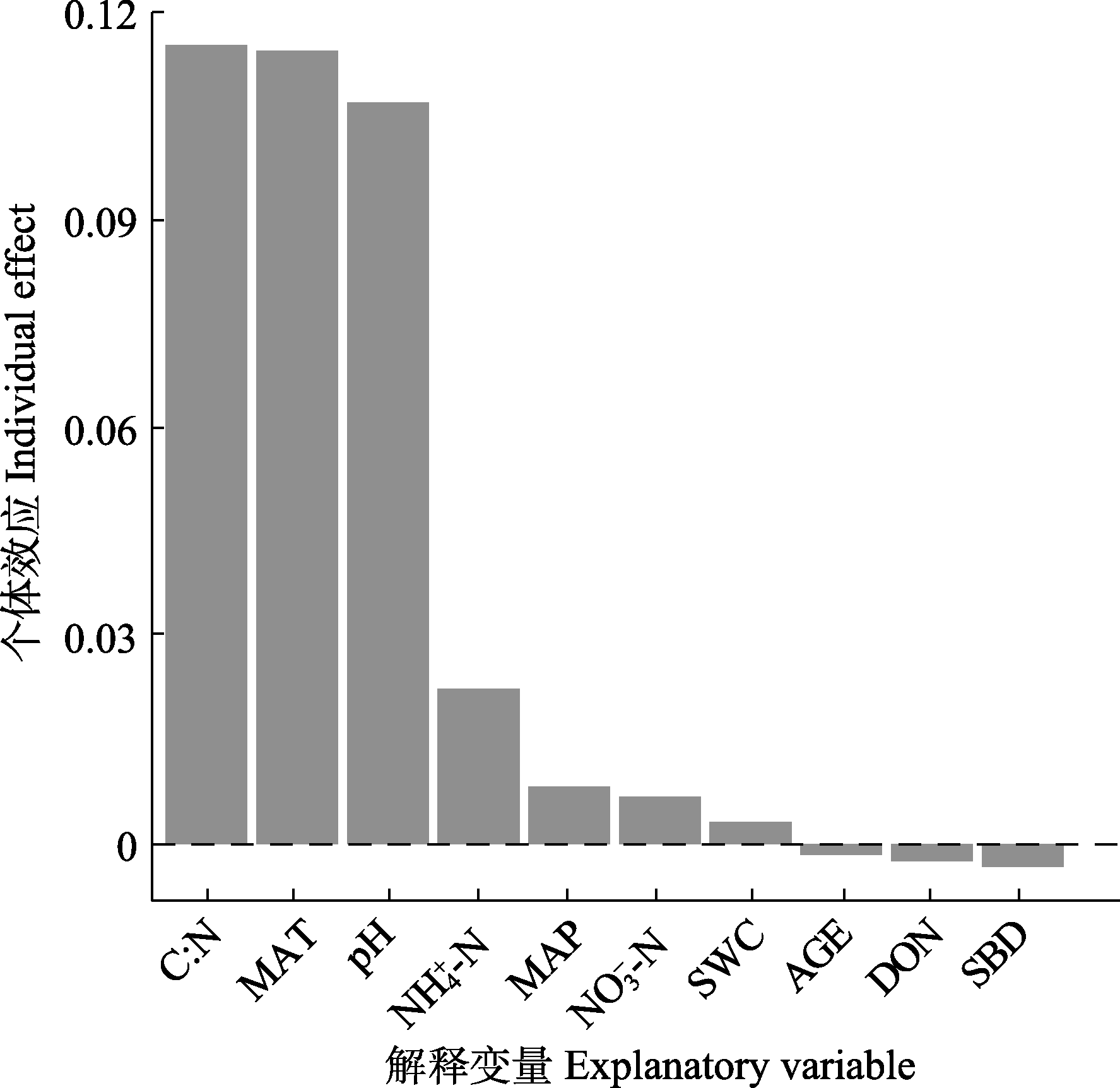
图6 解释变量对ffungi变异的相对重要性。AGE, 树木年龄; C:N, 土壤碳氮比; DON, 可溶性有机氮含量; ffungi, 菌根真菌对树木氮获取的贡献率; MAP, 年降水量; MAT, 年平均气温; SBD, 土壤容重; SWC, 土壤含水量。
Fig. 6 Relative importance of explanatory variables to ffungi. AGE, tree age; C:N, soil carbon to nitrogen ratio; DON, dissolved organic nitrogen content; ffungi, the contribution rate of the mycelia pathway to tree nitrogen acquisition; MAP, mean annual precipitation; MAT, mean annual air temperature; SBD, soil bulk density; SWC, soil water content.
| [1] |
Averill C, Bhatnagar JM, Dietze MC, Pearse WD, Kivlin SN (2019). Global imprint of mycorrhizal fungi on whole-plant nutrient economics. Proceedings of the National Academy of Sciences of the United States of America, 116, 23163-23168.
DOI PMID |
| [2] |
Bai TS, Wang P, Qiu YP, Zhang Y, Hu SJ (2023). Nitrogen availability mediates soil carbon cycling response to climate warming: a meta-analysis. Global Change Biology, 29, 2608-2626.
DOI PMID |
| [3] | Callesen I, Raulund-Rasmussen K, Westman CJ, Tau-Strand L (2007). Nitrogen pools and C:N ratios in well-drained Nordic forest soils related to climate and soil texture. Boreal Environment Research, 12, 681-692. |
| [4] |
Casciotti KL, Sigman DM, Hastings MG, Böhlke JK, Hilkert A (2002). Measurement of the oxygen isotopic composition of nitrate in seawater and freshwater using the denitrifier method. Analytical Chemistry, 74, 4905-4912.
PMID |
| [5] | Chapin III FS, Matson PA, Vitousek PM (2011). Principles of Terrestrial Ecosystem Ecology. Springer, New York. |
| [6] |
Chen M, Liu S, Xu GX, Chen J, Xing HS, Li FF, Zhang MM, Cao XW, Shi ZM (2024). Differences and drivers of leaf stable carbon and nitrogen isotope in herbs under different vegetation types on the eastern Qinghai-Tibet Plateau. Chinese Journal of Applied Ecology, 35, 877-885.
DOI |
|
[陈淼, 刘顺, 许格希, 陈健, 邢红爽, 李非凡, 张淼淼, 曹向文, 史作民 (2024). 青藏高原东缘不同植被类型下草本植物叶片碳氮稳定同位素差异及其驱动因素. 应用生态学报, 35, 877-885.]
DOI |
|
| [7] | Craine JM, Elmore AJ, Aidar MPM, Bustamante M, Dawson TE, Hobbie EA, Kahmen A, Mack MC, McLauchlan KK, Michelsen A, Nardoto GB, Pardo LH, Peñuelas J, Reich PB, Schuur EAG, et al. (2009). Global patterns of foliar nitrogen isotopes and their relationships with climate, mycorrhizal fungi, foliar nutrient concentrations, and nitrogen availability. New Phytologist, 183, 980-992. |
| [8] | Craine JM, Elmore AJ, Wang L, Aranibar J, Bauters M, Boeckx P, Crowley BE, Dawes MA, Delzon S, Fajardo A, Fang YT, Fujiyoshi L, Gray A, Guerrieri R, Gundale MJ, et al. (2018). Isotopic evidence for oligotrophication of terrestrial ecosystems. Nature Ecology & Evolution, 2, 1735-1744. |
| [9] | Cui XY (2007). Organic nitrogen use by plants and its significance in some natural ecosystems. Acta Ecologica Sinica, 27, 3500-3512. |
| [崔晓阳 (2007). 植物对有机氮源的利用及其在自然生态系统中的意义. 生态学报, 27, 3500-3512.] | |
| [10] |
Dawson TE, Mambelli S, Plamboeck AH, Templer PH, Tu KP (2002). Stable isotopes in plant ecology. Annual Review of Ecology and Systematics, 33, 507-559.
DOI URL |
| [11] |
Dynarski KA, Houlton BZ (2020). Isotopic constraints on plant nitrogen acquisition strategies during ecosystem retrogression. Oecologia, 192, 603-614.
DOI PMID |
| [12] |
Fang YT, Liu DW, Zhu FF, Tu Y, Li SL, Huang SN, Quan Z, Wang A (2020). Applications of nitrogen stable isotope techniques in the study of nitrogen cycling in terrestrial ecosystems. Chinese Journal of Plant Ecology, 44, 373-383.
DOI URL |
|
[方运霆, 刘冬伟, 朱飞飞, 图影, 李善龙, 黄韶楠, 全智, 王盎 (2020). 氮稳定同位素技术在陆地生态系统氮循环研究中的应用. 植物生态学报, 44, 373-383.]
DOI |
|
| [13] |
Fraterrigo JM, Strickland MS, Keiser AD, Bradford MA (2011). Nitrogen uptake and preference in a forest understory following invasion by an exotic grass. Oecologia, 167, 781-791.
DOI PMID |
| [14] |
Griffiths RP, Baham JE, Caldwell BA (1994). Soil solution chemistry of ectomycorrhizal mats in forest soil. Soil Biology & Biochemistry, 26, 331-337.
DOI URL |
| [15] |
Gundersen P, Callesen I, de Vries W (1998). Nitrate leaching in forest ecosystems is related to forest floor C/N ratios. Environmental Pollution, 102, 403-407.
DOI URL |
| [16] |
Harrison KA, Bol R, Bardgett RD (2007). Preferences for different nitrogen forms by coexisting plant species and soil microbes. Ecology, 88, 989-999.
PMID |
| [17] |
Hawkins BJ, Robbins S (2010). pH affects ammonium, nitrate and proton fluxes in the apical region of conifer and soybean roots. Physiologia Plantarum, 138, 238-247.
DOI URL |
| [18] | Hill PW, Quilliam RS, DeLuca TH, Farrar J, Farrell M, Roberts P, Newsham KK, Hopkins DW, Bardgett RD, Jones DL (2011). Acquisition and assimilation of nitrogen as peptide-bound and D-enantiomers of amino acids by wheat. PLoS ONE, 6, e19220. DOI: 10.1371/journal.pone.0019220. |
| [19] |
Hobbie EA, Chen J, Hasselquist NJ (2019). Fertilization alters nitrogen isotopes and concentrations in ectomycorrhizal fungi and soil in pine forests. Fungal Ecology, 39, 267-275.
DOI |
| [20] |
Hobbie EA, Colpaert JV (2003). Nitrogen availability and colonization by mycorrhizal fungi correlate with nitrogen isotope patterns in plants. New Phytologist, 157, 115-126.
DOI PMID |
| [21] |
Hobbie EA, Hobbie JE (2008). Natural abundance of 15N in nitrogen-limited forests and tundra can estimate nitrogen cycling through mycorrhizal fungi: a review. Ecosystems, 11, 815-830.
DOI URL |
| [22] |
Hobbie EA, Högberg P (2012). Nitrogen isotopes link mycorrhizal fungi and plants to nitrogen dynamics. New Phytologist, 196, 367-382.
DOI PMID |
| [23] |
Hobbie JE, Hobbie EA (2006). 15N in symbiotic fungi and plants estimates nitrogen and carbon flux rates in arctic tundra. Ecology, 87, 816-822.
PMID |
| [24] |
Houlton BZ, Sigman DM, Hedin LO (2006). Isotopic evidence for large gaseous nitrogen losses from tropical rainforests. Proceedings of the National Academy of Sciences of the United States of America, 103, 8745-8750.
DOI PMID |
| [25] |
Hu CC, Lei YB, Tan YH, Sun XC, Xu H, Liu CQ, Liu XY (2019). Plant nitrogen and phosphorus utilization under invasive pressure in a montane ecosystem of tropical China. Journal of Ecology, 107, 372-386.
DOI URL |
| [26] | Hu CC, Liu XY, Driscoll AW, Kuang YW, Brookshire ENJ, Lü XT, Chen CJ, Song W, Mao R, Liu CQ, Houlton BZ (2024). Global distribution and drivers of relative contributions among soil nitrogen sources to terrestrial plants. Nature Communications, 15, 6407. DOI: 10.1038/s41467-024-50674-6. |
| [27] |
Jiang J, Moore JAM, Priyadarshi A, Classen AT (2017). Plant-mycorrhizal interactions mediate plant community coexistence by altering resource demand. Ecology, 98, 187-197.
DOI PMID |
| [28] |
Lai JS, Zou Y, Zhang S, Zhang XG, Mao LF (2022). Glmm.hp: an R package for computing individual effect of predictors in generalized linear mixed models. Journal of Plant Ecology, 15, 1302-1307.
DOI |
| [29] | Li ZW, Wang SL, Nie XD, Sun YZ, Ran FW (2022). The application and potential non-conservatism of stable isotopes in organic matter source tracing. Science of the Total Environment, 838, 155946. DOI: 10.1016/j.scitotenv.2022.155946. |
| [30] | Liu DW, Tu Y, Fang YT (2017). Isotope analysis of ammonium and nitrate: a review on measured methods and their application. Chinese Journal of Applied Ecology, 28, 2353-2360. |
|
[刘冬伟, 图影, 方运霆 (2017). 铵盐和硝酸盐稳定同位素丰度测定方法及其应用案例. 应用生态学报, 28, 2353-2360.]
DOI |
|
| [31] |
Liu XY, Koba K, Makabe A, Li XD, Yoh M, Liu CQ (2013). Ammonium first: natural mosses prefer atmospheric ammonium but vary utilization of dissolved organic nitrogen depending on habitat and nitrogen deposition. New Phytologist, 199, 407-419.
DOI URL |
| [32] | Liu YJ, Li XZ, Kou YP, Liu YJ, Li XZ, Kou YP (2020). Ectomycorrhizal fungi: participation in nutrient turnover and community assembly pattern in forest ecosystems. Forests, 11, 453. DOI: 10.3390/f11040453. |
| [33] |
Makarov MI (2019). The role of mycorrhiza in transformation of nitrogen compounds in soil and nitrogen nutrition of plants: a review. Eurasian Soil Science, 52, 193-205.
DOI |
| [34] |
Makarov MI, Buzin IS, Tiunov AV, Malysheva TI, Kadulin MS, Koroleva NE (2019). Nitrogen isotopes in soils and plants of tundra ecosystems in the Khibiny Mountains. Eurasian Soil Science, 52, 1195-1206.
DOI |
| [35] |
Marty C, Houle D, Courchesne F, Gagnon C (2019). Soil C: N ratio is the main driver of soil δ15N in cold and N-limited eastern Canadian forests. Catena, 172, 285-294.
DOI |
| [36] | Mason RE, Craine JM, Lany NK, Jonard M, Ollinger SV, Groffman PM, Fulweiler RW, Angerer J, Read QD, Reich PB, Templer PH, Elmore AJ (2022). Evidence, causes, and consequences of declining nitrogen availability in terrestrial ecosystems. Science, 376, eabh3767. DOI: 10.1126/science.abh3767. |
| [37] |
Mayor J, Bahram M, Henkel T, Buegger F, Pritsch K, Tedersoo L (2014). Ectomycorrhizal impacts on plant nitrogen nutrition: emerging isotopic patterns, latitudinal variation and hidden mechanisms. Ecology Letters, 18, 96-107.
DOI URL |
| [38] |
Moreau D, Bardgett RD, Finlay RD, Jones DL, Philippot L (2019). A plant perspective on nitrogen cycling in the rhizosphere. Functional Ecology, 33, 540-552.
DOI |
| [39] |
Näsholm T, Ekblad A, Nordin A, Giesler R, Högberg M, Högberg P (1998). Boreal forest plants take up organic nitrogen. Nature, 392, 914-916.
DOI |
| [40] |
Näsholm T, Kielland K, Ganeteg U (2009). Uptake of organic nitrogen by plants. New Phytologist, 182, 31-48.
DOI PMID |
| [41] | Norby RJ, Warren JM, Iversen CM, Garten CT, Mcmurtrie RE (2010). CO2 enhancement of forest productivity constrained by limited nitrogen availability. Proceedings of the National Academy of Sciences of the United States of America, 107, 19368-19373. |
| [42] |
Peuke AD, Tischner R (1991). Nitrate uptake and reduction of aseptically cultivated spruce seedlings, Picea abies (L.) Karst. Journal of Experimental Botany, 42, 723-728.
DOI URL |
| [43] |
Read DJ, Perez-Moreno J (2003). Mycorrhizas and nutrient cycling in ecosystems—A journey towards relevance? New Phytologist, 157, 475-492.
DOI URL |
| [44] |
Ren HY, Xu ZW, Isbell F, Huang JH, Han XG, Wan SQ, Chen SP, Wang RZ, Zeng DH, Jiang Y, Fang YT (2017). Exacerbated nitrogen limitation ends transient stimulation of grassland productivity by increased precipitation. Ecological Monographs, 87, 457-469.
DOI URL |
| [45] |
Ren Y, Gao GL, Ding GD, Zhang Y, Zhao PS, Liu Y (2023). Species composition and driving factors of the ectomycorrhizal fungal community associated with Pinus sylvestris var. mongolica at different growth periods. Chinese Journal of Plant Ecology, 47, 1298-1309.
DOI URL |
|
[任悦, 高广磊, 丁国栋, 张英, 赵珮杉, 柳叶 (2023). 不同生长期樟子松外生菌根真菌群落物种组成及其驱动因素. 植物生态学报, 47, 1298-1309.]
DOI |
|
| [46] |
Schoenholtz SH, Miegroet HV, Burger JA (2000). A review of chemical and physical properties as indicators of forest soil quality: challenges and opportunities. Forest Ecology and Management, 138, 335-356.
DOI URL |
| [47] | Schweingruber FH (1993). Trees and Wood in Dendrochronology Morphological, Anatomical, and Tree-ring Analytical Characteristics of Trees Frequently Used in Dendrochronology. Springer-Verlag, Berlin, Germany. |
| [48] |
Shankar N, Garg SK, Srivastava HS (2000). The influence of low nutrient pH on nitrate assimilation and nitrate reductase activity in maize seedlings. Journal of Plant Physiology, 156, 678-683.
DOI URL |
| [49] |
Tedersoo L, Bahram M (2019). Mycorrhizal types differ in ecophysiology and alter plant nutrition and soil processes. Biological Reviews, 94, 1857-1880.
DOI |
| [50] |
Weiss M, Pick U (1996). Primary structure and effect of pH on the expression of the plasma membrane H+-ATPase from Dunaliella acidophila and Dunaliella salina. Plant Physiology, 112, 1693-1702.
PMID |
| [51] | Xu SQ, Liu XY, Sun ZC, Hu CC, Wanek W, Koba K (2021). Isotopic elucidation of microbial nitrogen transformations in forest soils. Global Biogeochemical Cycles, 35, e2021GB007070. DOI: 10.1038/s41598-025-94920-3. |
| [52] |
Yan F, Feuerle R, Schaffer S, Fortmeier H, Schubert S (1998). Adaptation of active proton pumping and plasmalemma ATPase activity of corn roots to low root medium pH. Plant Physiology, 117, 311-319.
DOI PMID |
| [53] | Yin HJ, Adamczyk B, Wang QT, Zhu B, Guo WJ, Zhu XM, Liu Q, Zhang ZL (2022). How do nitrogen-limited alpine coniferous forests acquire nitrogen? A rhizosphere perspective. Forest Ecosystems, 9, 100071. DOI: 10.1016/j.fecs.2022.100071. |
| [54] |
Zhang ZL, Li N, Xiao J, Zhao CZ, Zou TT, Li DD, Liu Q, Yin HJ (2018). Changes in plant nitrogen acquisition strategies during the restoration of spruce plantations on the eastern Tibetan Plateau, China. Soil Biology & Biochemistry, 119, 50-58.
DOI URL |
| [55] | Zhang ZL, Yuan YS, Liu Q, Yin HJ (2019). Plant nitrogen acquisition from inorganic and organic sources via root and mycelia pathways in ectomycorrhizal alpine forests. Soil Biology & Biochemistry, 136, 107517. DOI: 10.1016/j.soilbio.2019.06.013. |
| [56] |
Zhang ZL, Yuan YS, Zhao WQ, He HL, Li DD, He W, Liu Q, Yin HJ (2017). Seasonal variations in the soil amino acid pool and flux following the conversion of a natural forest to a pine plantation on the eastern Tibetan Plateau, China. Soil Biology & Biochemistry, 105, 1-11.
DOI URL |
| [57] |
Zhou XL, Wang A, Hobbie EA, Zhu FF, Qu YY, Dai LM, Li DJ, Liu XY, Zhu WX, Koba K, Li YH, Fang YT (2021). Mature conifers assimilate nitrate as efficiently as ammonium from soils in four forest plantations. New Phytologist, 229, 3184-3194.
DOI PMID |
| [58] | Zhu FF, Dai LM, Hobbie EA, Koba K, Liu XY, Gurmesa GA, Huang SN, Li SL, Li YH, Han SJ, Fang YT (2019). Uptake patterns of Glycine, ammonium, and nitrate differ among four common tree species of Northeast China. Frontiers in Plant Science, 10, 799. DOI: 10.3389/fpls.2019.00799. |
| [59] |
Zhu YY, Di TJ, Xu GH, Chen X, Zeng HQ, Yan F, Shen QR (2009). Adaptation of plasma membrane H+-ATPase of rice roots to low pH as related to ammonium nutrition. Plant, Cell & Environment, 32, 1428-1440.
DOI URL |
| [1] | 魏莉, 王鹏森, 刘珊, 樊锐, 黄楠, 张建国, 其美拉姆, 苟扬, 刘沫含, 黄婷, 周冀琼. 丛枝菌根真菌对豆禾混播植物垂直生态位养分吸收的影响[J]. 植物生态学报, 2026, 50(3): 760-773. |
| [2] | 苗春, 刘靓, 朱冠男, 白宇轩, 佘维维, 秦树高, 郭焱培, 张宇清. 毛乌素沙地黑沙蒿对邻近草本植物氮吸收速率及比例的影响[J]. 植物生态学报, 2025, 49(3): 446-459. |
| [3] | 黄雯澜, 刘谣, 简毅, 张琳慧, 陈素, 黄路路, 俞丽云, 李晗, 王丽霞, 谭波, 张丽. 不同雪被处理对川西亚高山森林土壤腐殖质含量的影响[J]. 植物生态学报, 2024, 48(11): 1445-1458. |
| [4] | 刘倩愿, 俞振东, 张微微. 河北坝上乔灌木植物根系无机和有机氮吸收速率及其偏好[J]. 植物生态学报, 2024, 48(10): 1361-1373. |
| [5] | 姚萌, 康荣华, 王盎, 马方园, 李靳, 台子晗, 方运霆. 利用15N示踪技术研究木荷与马尾松幼苗叶片对NO2的吸收与分配[J]. 植物生态学报, 2023, 47(1): 114-122. |
| [6] | 刘谣, 焦泽彬, 谭波, 李晗, 王丽霞, 刘思凝, 游成铭, 徐振锋, 张丽. 川西亚高山森林凋落物去除对土壤腐殖质动态的影响[J]. 植物生态学报, 2022, 46(3): 330-339. |
| [7] | 马炬峰, 辛敏, 徐陈超, 祝琬莹, 毛传澡, 陈欣, 程磊. 丛枝菌根真菌与氮添加对不同根形态基因型水稻氮吸收的影响[J]. 植物生态学报, 2021, 45(7): 728-737. |
| [8] | 侯宝林, 庄伟伟. 古尔班通古特沙漠一年生植物的氮吸收策略[J]. 植物生态学报, 2021, 45(7): 760-770. |
| [9] | 方运霆, 刘冬伟, 朱飞飞, 图影, 李善龙, 黄韶楠, 全智, 王盎. 氮稳定同位素技术在陆地生态系统氮循环研究中的应用[J]. 植物生态学报, 2020, 44(4): 373-383. |
| [10] | 郭彩虹, 杨万勤, 吴福忠, 徐振锋, 岳楷, 倪祥银, 袁吉, 杨帆, 谭波. 川西亚高山森林林窗对凋落枝早期分解的影响[J]. 植物生态学报, 2018, 42(1): 28-37. |
| [11] | 杨开军, 杨万勤, 谭羽, 贺若阳, 庄丽燕, 李志杰, 谭波, 徐振锋. 川西亚高山云杉林冬季土壤呼吸对雪被去除的短期响应[J]. 植物生态学报, 2017, 41(9): 964-971. |
| [12] | 李晗, 吴福忠, 杨万勤, 徐李亚, 倪祥银, 何洁, 胡义. 亚高山森林林窗对凋落物分解过程中半纤维素动态的影响[J]. 植物生态学报, 2015, 39(3): 229-238. |
| [13] | 何洁,杨万勤,倪祥银,李晗,徐李亚,吴福忠. 雪被斑块对川西亚高山森林凋落物冬季分解过程中钾和钠动态的影响[J]. 植物生态学报, 2014, 38(6): 550-561. |
| 阅读次数 | ||||||
|
全文 |
|
|||||
|
摘要 |
|
|||||
Copyright © 2026 版权所有 《植物生态学报》编辑部
地址: 北京香山南辛村20号, 邮编: 100093
Tel.: 010-62836134, 62836138; Fax: 010-82599431; E-mail: apes@ibcas.ac.cn, cjpe@ibcas.ac.cn
备案号: 京ICP备16067583号-19

