
植物生态学报 ›› 2026, Vol. 50 ›› Issue (4): 833-845.DOI: 10.17521/cjpe.2025.0365 cstr: 32100.14.cjpe.2025.0365
王子平1,2,3, 毛子昆1,2, 贺涵1,2,3, 姜鹏程1,2,3, 闫瑞环1,2,3, 王绪高1,2,*( )
)
收稿日期:2025-10-11
接受日期:2026-01-21
出版日期:2026-04-20
发布日期:2026-07-15
通讯作者:
*王绪高(wangxg@iae.ac.cn)基金资助:
WANG Zi-Ping1,2,3, MAO Zi-Kun1,2, HE Han1,2,3, JIANG Peng-Cheng1,2,3, YAN Rui-Huan1,2,3, WANG Xu-Gao1,2,*()
Received:2025-10-11
Accepted:2026-01-21
Online:2026-04-20
Published:2026-07-15
Contact:
*WANG Xu-Gao(wangxg@iae.ac.cn)Supported by:摘要: 阔叶红松(Pinus koraiensis)林是东北东部地区地带性顶极植物类型, 长期以来受到人类活动的强烈干扰, 大面积原生阔叶红松林退化为次生杨桦林, 但目前相关的系统对比研究仍然不足, 限制了对阔叶红松林自然恢复过程的深入理解。该研究基于长白山24 hm2固定森林监测样地, 利用成对相关函数g(r)和异质性泊松分布零模型, 对比分析了样地北部次生杨桦林(演替前期, 15.6 hm2)与南部阔叶红松林(演替后期, 8.4 hm2)的树种分布和空间关联格局。结果发现: (1)两种林型中大多数树种的空间分布具有尺度依赖性, 即在小尺度(0-10 m)上呈聚集分布, 在较大尺度(>20 m)趋于随机分布, 胸径(DBH) < 10 cm的小径级个体和中径级个体(10 cm ≤ DBH < 30 cm)的聚集程度均高于大径级个体(DBH ≥ 30 cm); 次生杨桦林的大径级个体普遍呈随机分布, 而阔叶红松林的大径级个体在0-10 m仍以聚集分布为主。(2)两种林型中树种空间关联以不相关为主; 大径级个体的空间负关联比例均高于小径级个体, 大径级个体对中径级个体存在明显抑制作用, 而其对小径级个体的作用具有较大变异性。(3)作为核心建群种的红松, 在两种林型中均呈现出聚集分布, 红松大树在阔叶红松林的聚集程度较低, 且与白桦(Betula platyphylla)、山杨(Populus davidiana)等先锋树种的种间关系表现为负关联, 而红松小树与白桦、山杨等显著正关联, 表明这些先锋树种对红松小树具有促进作用, 但是随着森林演替先锋树种逐渐受到抑制并退出群落。综上, 阔叶红松林和次生杨桦林的树种分布与空间关联格局大体一致, 但关键建群种存在明显差异。
王子平, 毛子昆, 贺涵, 姜鹏程, 闫瑞环, 王绪高. 东北阔叶红松林不同演替阶段树种分布与空间关联格局. 植物生态学报, 2026, 50(4): 833-845. DOI: 10.17521/cjpe.2025.0365
WANG Zi-Ping, MAO Zi-Kun, HE Han, JIANG Peng-Cheng, YAN Rui-Huan, WANG Xu-Gao. Spatial distribution and association patterns of tree species across successional stages in broadleaf Korean pine forests of Northeast China. Chinese Journal of Plant Ecology, 2026, 50(4): 833-845. DOI: 10.17521/cjpe.2025.0365
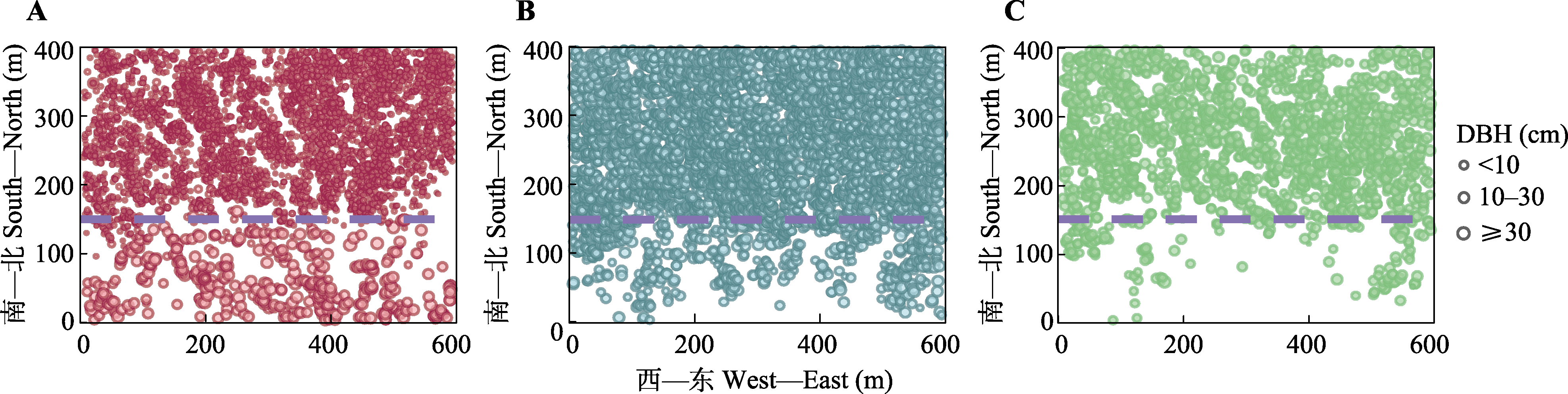
图1 东北阔叶红松林样地内主要树种的空间分布。A, 红松。B, 白桦。C, 山杨。图中虚线为两种林型的分界线。点的大小表示树木径级: 分别为胸径(DBH) < 10 cm, 10 cm ≤ DBH < 30 cm, DBH ≥ 30 cm。
Fig. 1 Spatial distribution of major tree species within the plot in broadleaf Korean pine forests of Northeastern China. A, Pinus koraiensis. B, Betula platyphylla. C, Populus davidiana. The dashed lines in the figure represent the boundary between the two forest types. The size of the dots indicates tree diameter classes: diameter at breast height (DBH) < 10 cm, 10 cm ≤ DBH < 30 cm, and DBH ≥ 30 cm.
| 物种 Species | 次生杨桦林 Secondary poplar-birch forests | 阔叶红松林 Broadleaf Korean pine forests |
|---|---|---|
| 暴马丁香 Syringa reticulata | 1-26 (+) | 1-18 (+) |
| 稠李 Prunus padus | 1-10 (+), 17-30 (-) | 1-17 (+), 21-30 (-) |
| 簇毛槭 Acer barbinerve | 1-17 (+) | 1-20 (+), 22 (+) |
| 春榆 Ulmus japonica | 1-16 (+), 21 (-), 28-29 (-) | 1-22 (+) |
| 东北山梅花 Philadelphus schrenkii | 1-17 (+), 21-24 (+), 28-29 (+) | 1-17 (+) |
| 怀槐 Maackia amurensis | 1-13 (+), 15-16 (+) | 1-8 (+), 19-23 (+) |
| 红松 Pinus koraiensis | 1-20 (+) | 1-11 (+), 18-21 (+) |
| 假色槭 Acer pseudo-sieboldianum | 1-15 (+), 20-21 (-), 25-28 (-) | 1-20 (+), 27-30 (-) |
| 瘤枝卫矛 Euonymus verrucosus | 1-6 (+) | 1-4 (+) |
| 蒙古栎 Quercus mongolica | 1-11 (+) | 1-19 (+), 22-24 (+) |
| 毛榛 Corylus mandshurica | 1-19 (+) | 1-22 (+) |
| 拧筋槭 Acer triflorum | 1-6 (+) | 1-7 (+) |
| 青楷槭 Acer tegmentosum | 1-5 (+) | 1-5 (+) |
| 山丁子 Malus baccata | 1-11 (+), 20-27 (+) | 1-13 (+), 20-21 (-) |
| 色木槭 Populus davidiana | 1-14 (+), 16-17 (+), 19-28 (+), 30 (+) | 1-12 (+), 18-19 (+) |
| 水曲柳 Fraxinus mandshurica | 1-14 (+), 24 (-), 26-30 (-) | 1-5 (+), 8-10 (+), 12-13 (+) |
| 紫椴 Tilia amurensis | 1-14 (+), 28 (-) | 1-15 (+), 22-23 (-) |
| 黄檗 Phellodendron amurense | 随机分布 Random distribution | |
| 糠椴 Tilia mandshurica | 1-21 (+) |
表1 东北阔叶红松林不同演替阶段样地小树的空间格局分析
Table 1 Spatial pattern analysis of small trees across different succession stages in broadleaf Korean pine forests of Northeastern China
| 物种 Species | 次生杨桦林 Secondary poplar-birch forests | 阔叶红松林 Broadleaf Korean pine forests |
|---|---|---|
| 暴马丁香 Syringa reticulata | 1-26 (+) | 1-18 (+) |
| 稠李 Prunus padus | 1-10 (+), 17-30 (-) | 1-17 (+), 21-30 (-) |
| 簇毛槭 Acer barbinerve | 1-17 (+) | 1-20 (+), 22 (+) |
| 春榆 Ulmus japonica | 1-16 (+), 21 (-), 28-29 (-) | 1-22 (+) |
| 东北山梅花 Philadelphus schrenkii | 1-17 (+), 21-24 (+), 28-29 (+) | 1-17 (+) |
| 怀槐 Maackia amurensis | 1-13 (+), 15-16 (+) | 1-8 (+), 19-23 (+) |
| 红松 Pinus koraiensis | 1-20 (+) | 1-11 (+), 18-21 (+) |
| 假色槭 Acer pseudo-sieboldianum | 1-15 (+), 20-21 (-), 25-28 (-) | 1-20 (+), 27-30 (-) |
| 瘤枝卫矛 Euonymus verrucosus | 1-6 (+) | 1-4 (+) |
| 蒙古栎 Quercus mongolica | 1-11 (+) | 1-19 (+), 22-24 (+) |
| 毛榛 Corylus mandshurica | 1-19 (+) | 1-22 (+) |
| 拧筋槭 Acer triflorum | 1-6 (+) | 1-7 (+) |
| 青楷槭 Acer tegmentosum | 1-5 (+) | 1-5 (+) |
| 山丁子 Malus baccata | 1-11 (+), 20-27 (+) | 1-13 (+), 20-21 (-) |
| 色木槭 Populus davidiana | 1-14 (+), 16-17 (+), 19-28 (+), 30 (+) | 1-12 (+), 18-19 (+) |
| 水曲柳 Fraxinus mandshurica | 1-14 (+), 24 (-), 26-30 (-) | 1-5 (+), 8-10 (+), 12-13 (+) |
| 紫椴 Tilia amurensis | 1-14 (+), 28 (-) | 1-15 (+), 22-23 (-) |
| 黄檗 Phellodendron amurense | 随机分布 Random distribution | |
| 糠椴 Tilia mandshurica | 1-21 (+) |
| 物种 Species | 次生杨桦林 Secondary poplar-birch forests | 阔叶红松林 Broadleaf Korean pine forests |
|---|---|---|
| 白桦 Betula platyphylla | 1-12 (+), 18 (+), 21 (+) | 1-26 (+) |
| 春榆 Ulmus japonica | 1-2 (+), 4-8 (+), 18-19 (+) | 1-11 (+), 14-15 (+), 28-30 (-) |
| 怀槐 Maackia amurensis | 3-24 (+) | 7 (+), 11 (+) |
| 蒙古栎 Quercus mongolica | 1-15 (+) | 1-12 (+) |
| 山丁子 Malus baccata | 1-10 (+) | 1-4 (+) |
| 色木槭 Populus davidiana | 1 (+), 5-8 (+), 10-13 (+) | 随机分布 Random distribution |
| 水曲柳 Fraxinus mandshurica | 1-13 (+), 24-30 (-) | 1-10 (+) |
| 山杨 Populus davidiana | 1-11 (+) | 1-7 (+), 17-19 (+), 26-28 (+) |
| 紫椴 Tilia amurensis | 1-13 (+) | 1-13 (+), 24 (-), 29-30 (-) |
| 黄檗 Phellodendron amurense | 1-6 (+) | |
| 红松 Pinus koraiensis | 1-5 (+), 20-21 (-) | |
| 糠椴 Tilia mandshurica | 1-11 (+) | |
| 拧筋槭 Acer triflorum | 11-14 (+) |
表2 东北阔叶红松林不同演替阶段样地中树的空间格局分析
Table 2 Spatial pattern analysis of medium-sized trees across different succession stages in broadleaf Korean pine forests of Northeastern China
| 物种 Species | 次生杨桦林 Secondary poplar-birch forests | 阔叶红松林 Broadleaf Korean pine forests |
|---|---|---|
| 白桦 Betula platyphylla | 1-12 (+), 18 (+), 21 (+) | 1-26 (+) |
| 春榆 Ulmus japonica | 1-2 (+), 4-8 (+), 18-19 (+) | 1-11 (+), 14-15 (+), 28-30 (-) |
| 怀槐 Maackia amurensis | 3-24 (+) | 7 (+), 11 (+) |
| 蒙古栎 Quercus mongolica | 1-15 (+) | 1-12 (+) |
| 山丁子 Malus baccata | 1-10 (+) | 1-4 (+) |
| 色木槭 Populus davidiana | 1 (+), 5-8 (+), 10-13 (+) | 随机分布 Random distribution |
| 水曲柳 Fraxinus mandshurica | 1-13 (+), 24-30 (-) | 1-10 (+) |
| 山杨 Populus davidiana | 1-11 (+) | 1-7 (+), 17-19 (+), 26-28 (+) |
| 紫椴 Tilia amurensis | 1-13 (+) | 1-13 (+), 24 (-), 29-30 (-) |
| 黄檗 Phellodendron amurense | 1-6 (+) | |
| 红松 Pinus koraiensis | 1-5 (+), 20-21 (-) | |
| 糠椴 Tilia mandshurica | 1-11 (+) | |
| 拧筋槭 Acer triflorum | 11-14 (+) |
| 物种 Species | 次生杨桦林 Secondary poplar-birch forests | 阔叶红松林 Broadleaf Korean pine forests |
|---|---|---|
| 白桦 Betula platyphylla | 随机分布 Random distribution | 1-11 (+) |
| 蒙古栎 Quercus mongolica | 1-4 (+) | 3-12 (+) |
| 水曲柳 Fraxinus mandshurica | 随机分布 Random distribution | 12-18 (+), 26 (-) |
| 山杨 Populus davidiana | 1-5 (+), 9-11 (+), 15-16 (-), 29 (-) | 1-3 (+), 7-14 (+) |
| 紫椴 Tilia amurensis | 5-10 (+) | |
| 红松 Pinus koraiensis | 1-15 (+), 17 (+) |
表3 东北阔叶红松林不同演替阶段样地大树的空间格局分析
Table 3 Spatial pattern analysis of big trees across different succession stages in broadleaf Korean pine forests of Northeastern China
| 物种 Species | 次生杨桦林 Secondary poplar-birch forests | 阔叶红松林 Broadleaf Korean pine forests |
|---|---|---|
| 白桦 Betula platyphylla | 随机分布 Random distribution | 1-11 (+) |
| 蒙古栎 Quercus mongolica | 1-4 (+) | 3-12 (+) |
| 水曲柳 Fraxinus mandshurica | 随机分布 Random distribution | 12-18 (+), 26 (-) |
| 山杨 Populus davidiana | 1-5 (+), 9-11 (+), 15-16 (-), 29 (-) | 1-3 (+), 7-14 (+) |
| 紫椴 Tilia amurensis | 5-10 (+) | |
| 红松 Pinus koraiensis | 1-15 (+), 17 (+) |
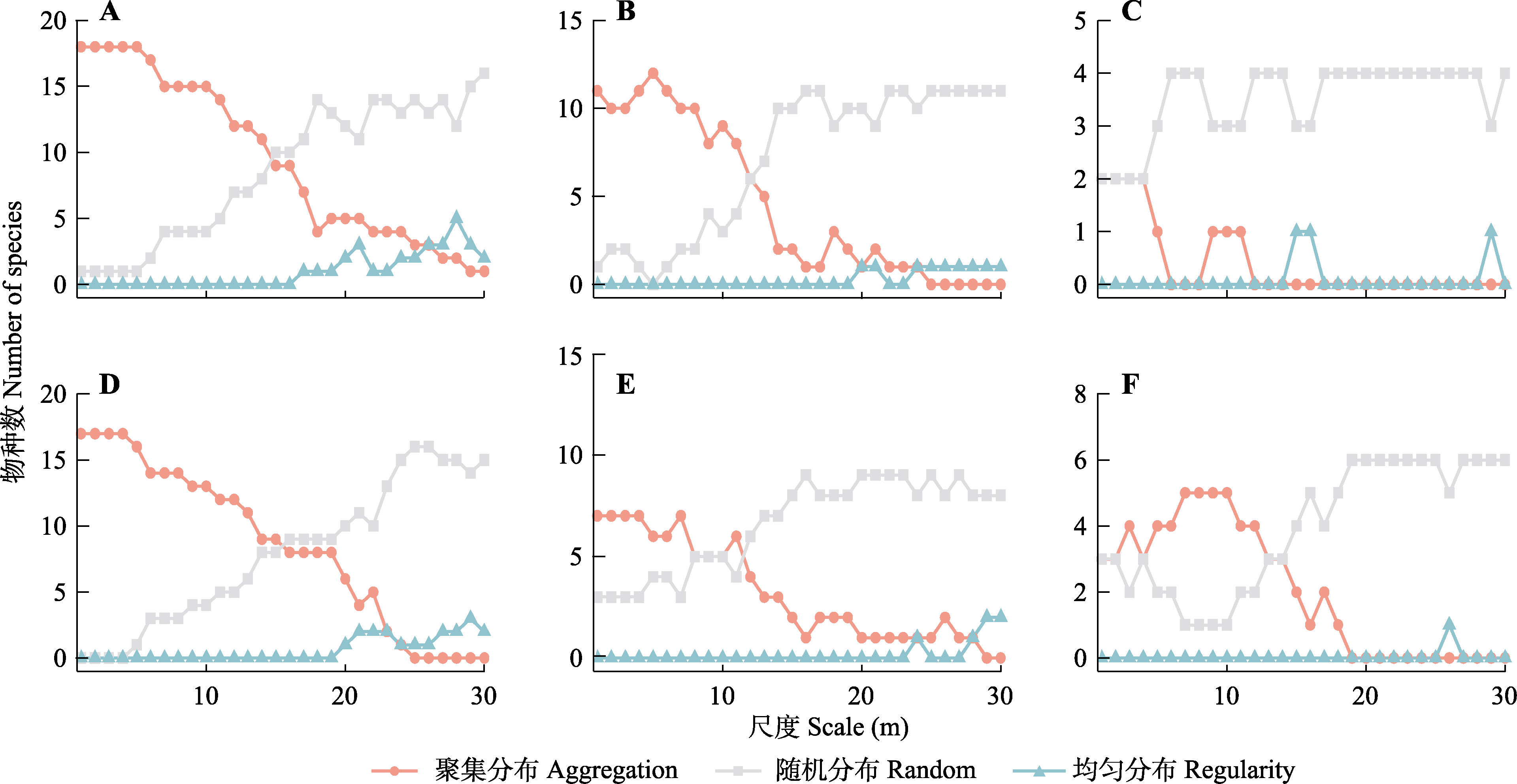
图2 东北阔叶红松林不同空间分布类型的物种数随尺度的变化。A, 次生杨桦林小树。B, 次生杨桦林中树。C, 次生杨桦林大树。D, 阔叶红松林小树。E, 阔叶红松林中树。F, 阔叶红松林大树。
Fig. 2 Scale-dependent univariate intraspecific patterns in broadleaf Korean pine forests of Northeastern China. A, Small trees in secondary poplar-birch forests. B, Medium-sized trees in secondary poplar-birch forests. C, Large trees in secondary poplar-birch forests. D, Small trees in broadleaf Korean pine forests. E, Medium-sized trees in broadleaf Korean pine forests. F, Large trees in broadleaf Korean pine forests.
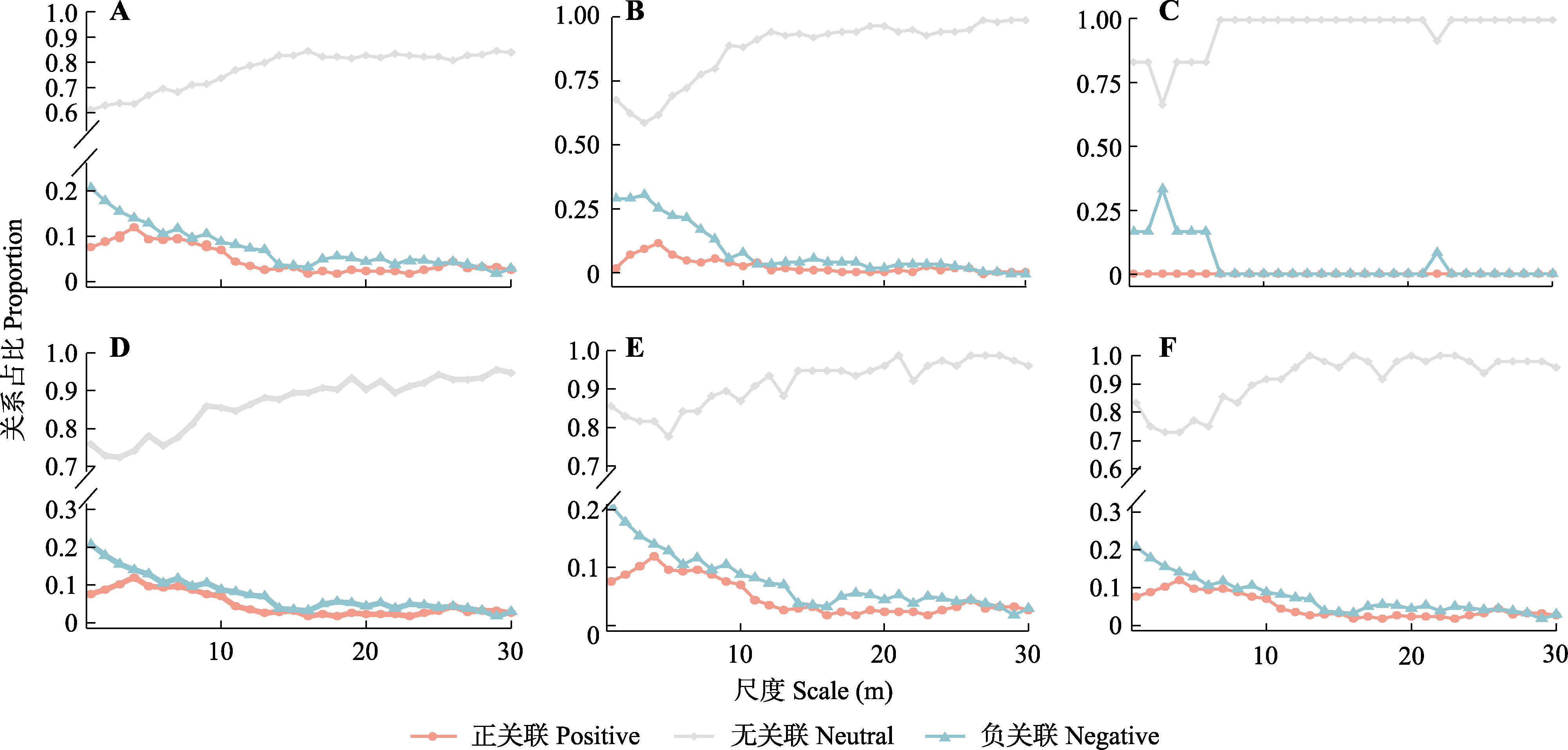
图3 次生杨桦林种间关联随尺度的变化。A, 小树空间关联。B, 中树空间关联。C, 大树空间关联。D, 中树对小树空间关联。E, 大树对小树空间关联。F, 大树对中树空间关联。
Fig. 3 Scale-dependent interspecific association patterns in secondary poplar-birch forests. A, Spatial associations among small trees. B, Spatial associations among medium-sized trees. C, Spatial associations among large trees. D, Spatial associations between medium-sized trees and small trees. E, Spatial associations between large trees and small trees. F, Spatial associations between large trees and medium-sized trees.
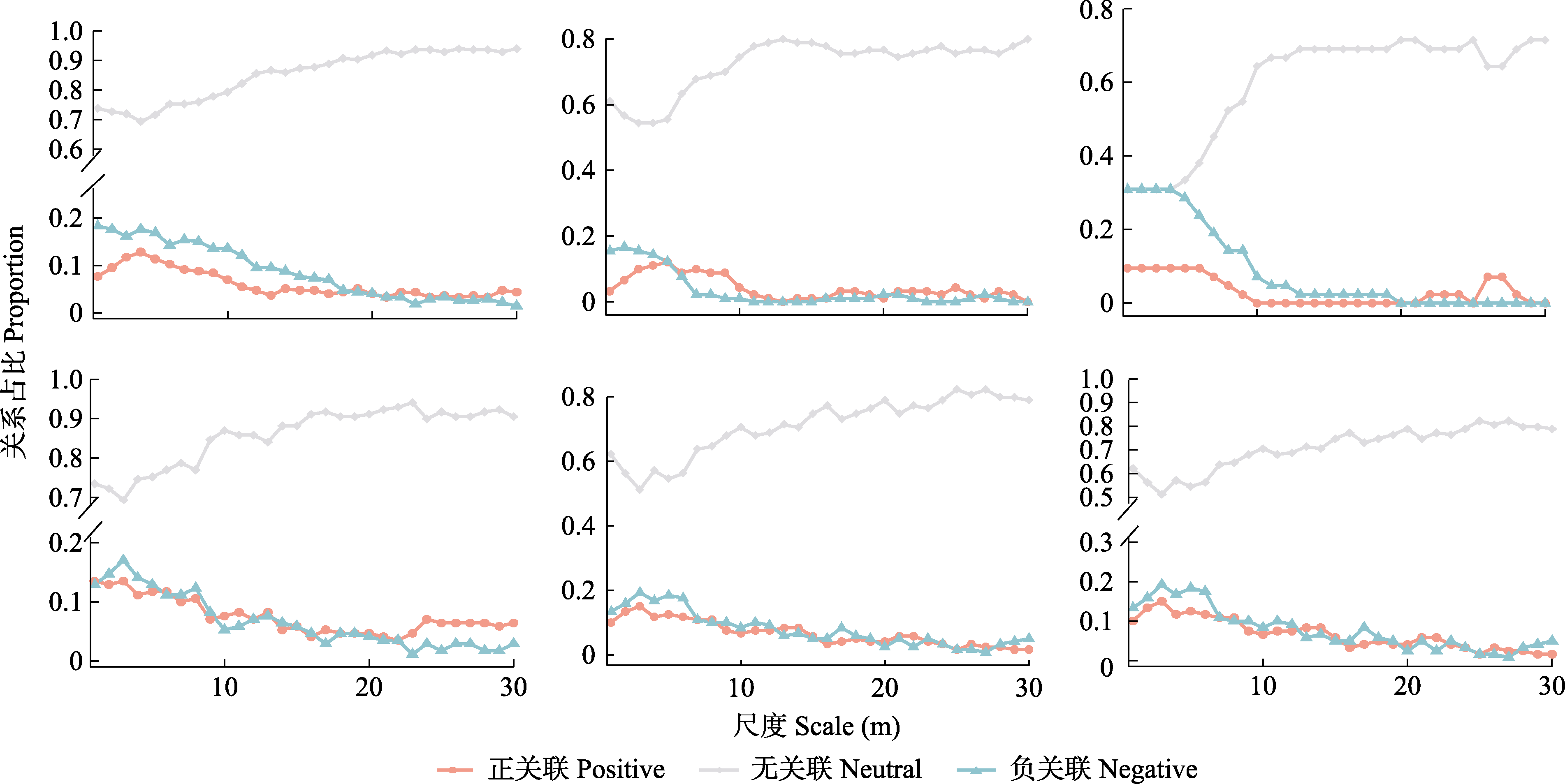
图4 阔叶红松林种间关联随尺度的变化。A, 小树空间关联。B, 中树空间关联。C, 大树空间关联。D, 中树对小树空间关联。E, 大树对小树空间关联。F, 大树对中树空间关联。
Fig. 4 Scale-dependent interspecific association patterns in broadleaf Korean pine forests. A, Spatial associations among small trees. B, Spatial associations among medium-sized trees. C, Spatial associations among large trees. D, Spatial associations between medium-sized trees and small trees. E, Spatial associations between large trees and small trees. F, Spatial associations between large trees and medium-sized trees.
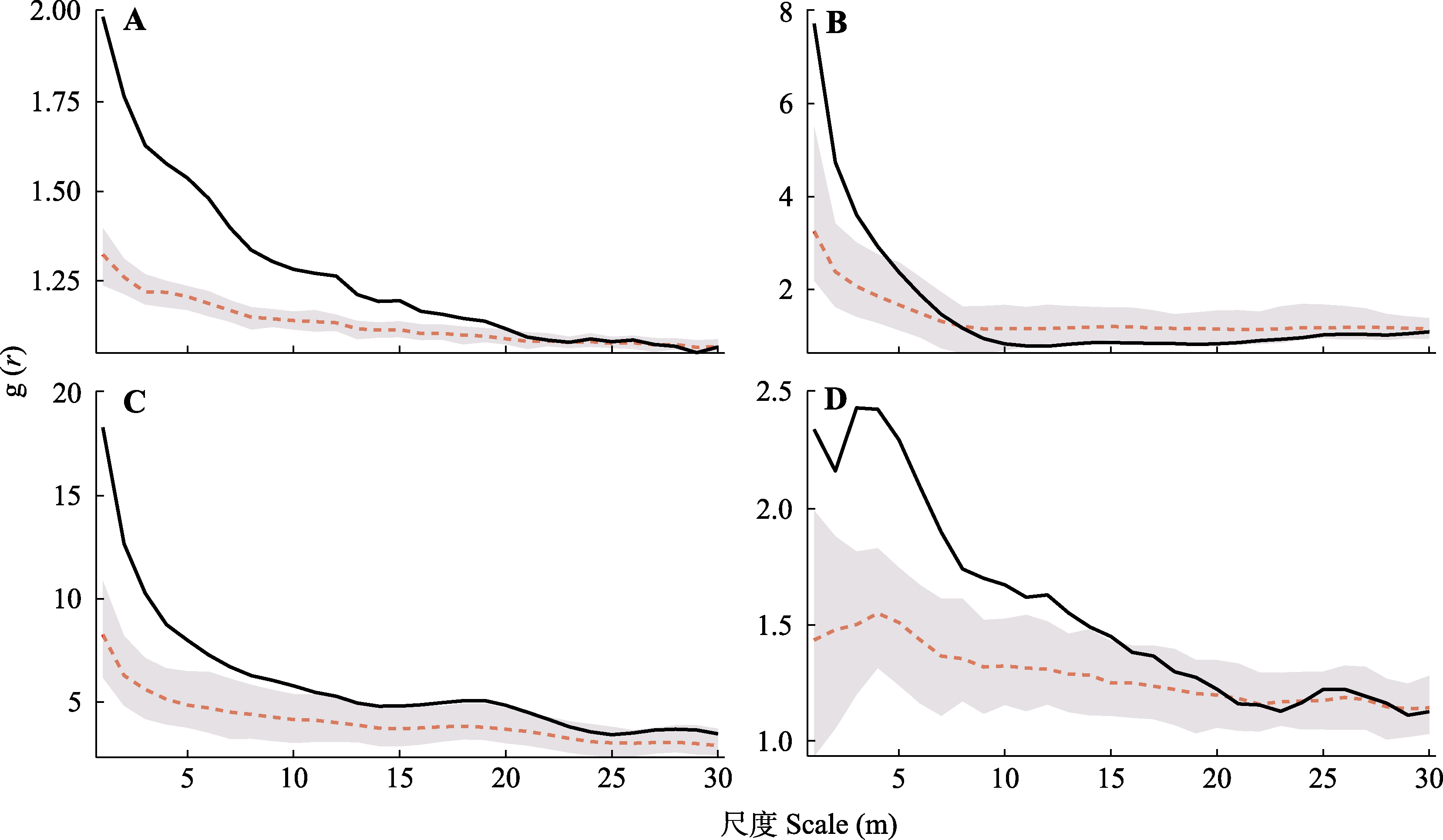
图5 不同径级红松的空间分布格局。A, 次生杨桦林红松小树。B, 次生杨桦林红松中树。C, 阔叶红松林红松小树。D, 阔叶红松林红松大树。实线表示单变量成对相关函数g(r)的函数值, 虚线表示单变量成对相关函数g(r)的期望值, 灰色阴影部分表示95%的置信区间。
Fig. 5 Spatial distribution pattern of Pinus koraiensis at different diameter classes. A, Small Pinus koraiensis trees in secondary birch-poplar forest. B, Medium-sized Pinus koraiensis trees in secondary birch-poplar forest. C, Small Pinus koraiensis trees in broadleaf Korean pine forest. D, Large Pinus koraiensis trees in broadleaf Korean pine forest. The solid line indicates the value of the univariate pairwise correlation function g(r), the dashed line indicates the expected value of the univariate pairwise correlation function g(r), and the gray shaded area indicates the 95% confidence interval.
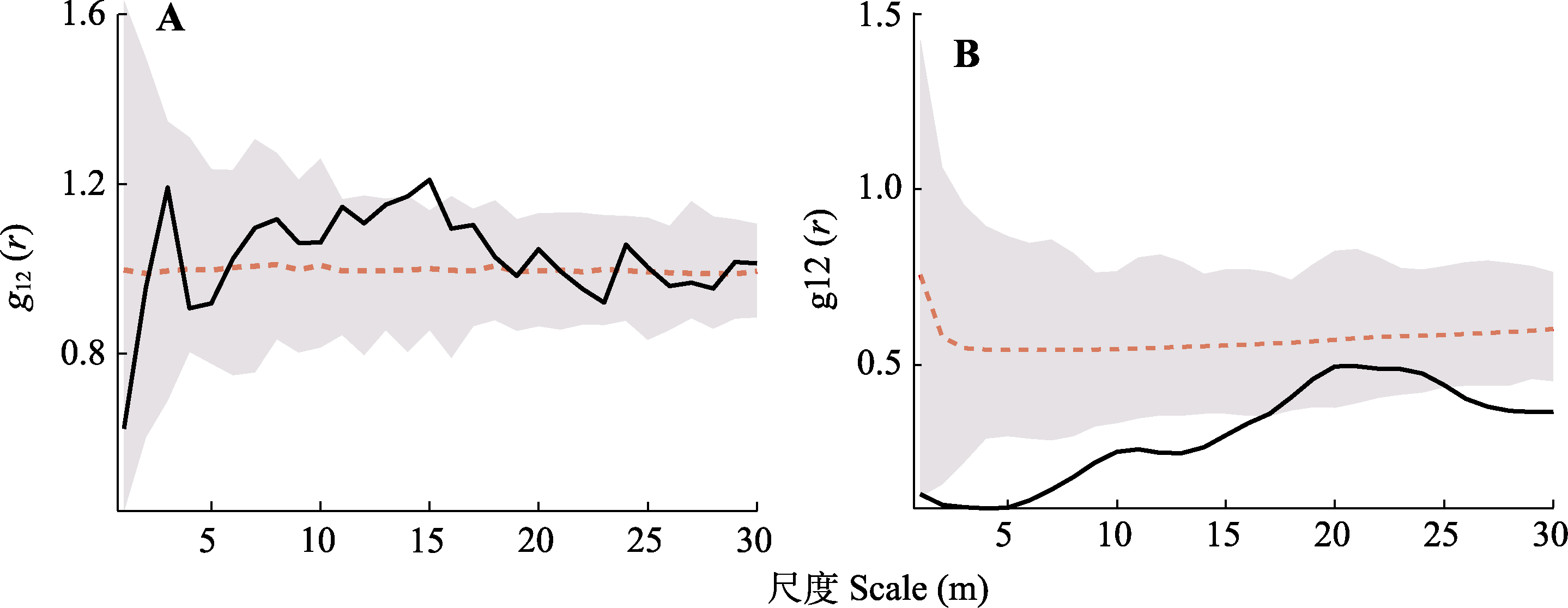
图6 不同径级红松的种内关联。A, 次生杨桦林。B, 阔叶红松林。实线表示双变量成对相关函数g12(r)的函数值, 虚线表示双变量成对相关函数g12(r)的期望值, 灰色阴影部分表示95%的置信区间。
Fig. 6 Intraspecific associations between different diameter classes in Pinus koraiensis. A, Secondary poplar-birch forests. B, Broadleaf Korean pine mixed forests. The solid line indicates the function value of the bivariate pairwise correlation function g12(r), the dashed line indicates the expected value of the bivariate pairwise correlation function g12(r), and the gray shaded area indicates the 95% confidence interval.
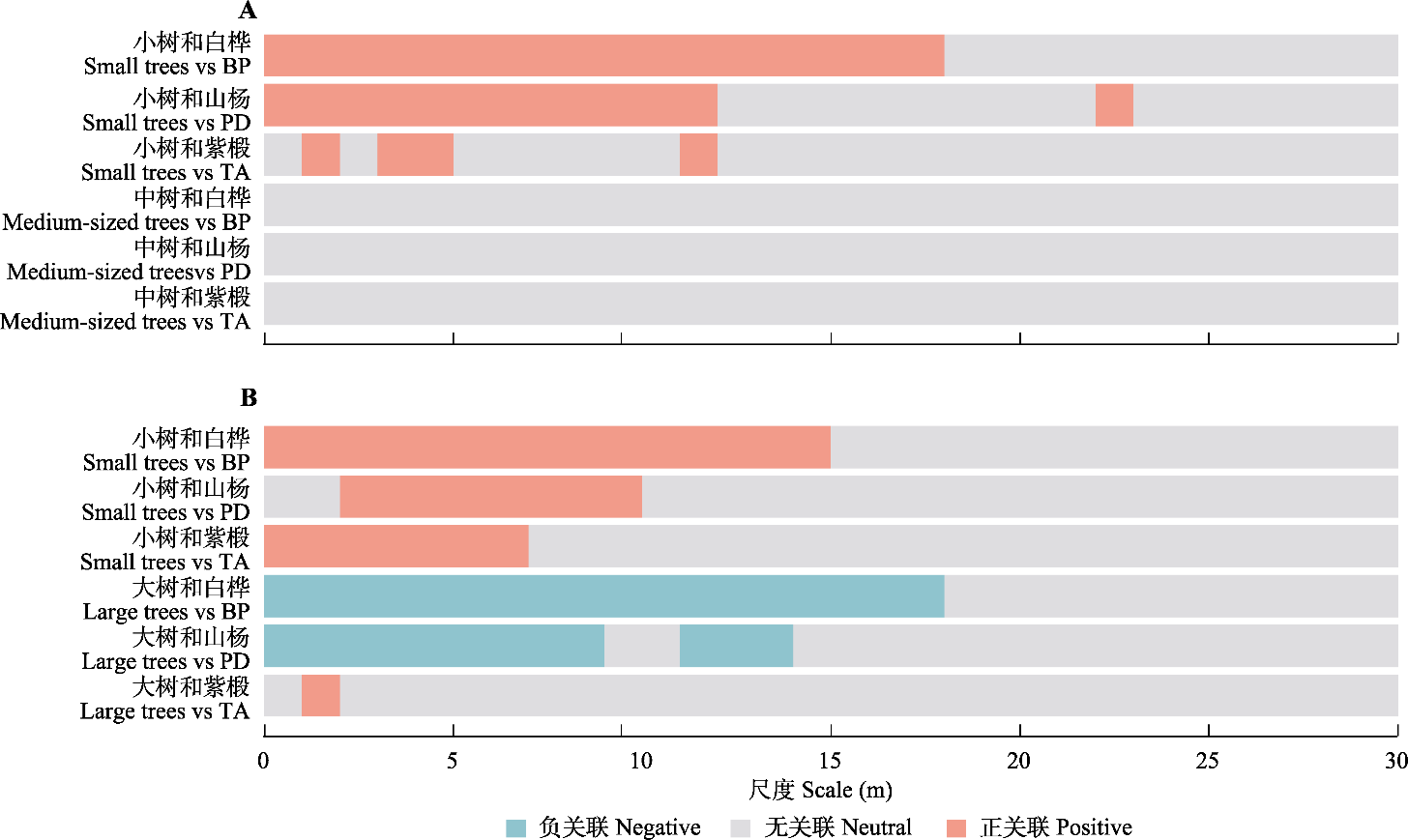
图7 不同径级红松与其他优势种的种间关联。A, 次生杨桦林。B, 阔叶红松林。
Fig. 7 Interspecific associations between Pinus koraiensis and other dominant species at different diameter classes. A, Secondary poplar-birch forests. B, Broadleaf Korean pine mixed forests. BP, Betula platyphylla; PD, Populus davidiana; TA, Tilia amurensis.
| [1] | An L, Wu ZF, Fan CY, Zhang CY, Zhao XH (2021). Spatial point patterns and effects of density dependence in secondary poplar-birch forest, Changbai Mountains, China. Acta Ecologica Sinica, 41, 1461-1471. |
| [安璐, 吴兆飞, 范春雨, 张春雨, 赵秀海 (2021). 长白山次生杨桦林种群空间点格局及密度制约效应. 生态学报, 41, 1461-1471.] | |
| [2] | Anderson-Teixeira KJ, Davies SJ, Bennett AC, Gonzalez-Akre EB, Muller-Landau HC, Wright SJ, Abu Salim K, Almeyda Zambrano AM, Alonso A, Baltzer JL, Basset Y, Bourg NA, Broadbent EN, Brockelman WY, Bunyavejchewin S, et al. (2015). CTFS-ForestGEO: a worldwide network monitoring forests in an era of global change. Global Change Biology, 21, 528-549. |
| [3] |
Chu CJ, Wang YS, Liu Y, Jiang L, He FL (2017). Advances in species coexistence theory. Biodiversity Science, 25, 345-354.
DOI |
|
[储诚进, 王酉石, 刘宇, 蒋林, 何芳良 (2017). 物种共存理论研究进展. 生物多样性, 25, 345-354.]
DOI |
|
| [4] |
Dai LM, Li SL, Zhou WM, Qi L, Zhou L, Wei YW, Li JQ, Shao GF, Yu DP (2018). Opportunities and challenges for the protection and ecological functions promotion of natural forests in China. Forest Ecology and Management, 410, 187-192.
DOI URL |
| [5] | Gu R, Zhang CC, He ZH, Yang R, Chen Y, Feng P, Sina QZ, Zhao DL, Yixi YC, Wu JH, Lin LX (2021). Population spatial distribution pattern and association of Abies georgei in Shangri-La Potatso National Park. Chinese Journal of Ecology, 40, 3860-3869. |
| [顾荣, 张彩彩, 和正华, 杨荣, 陈瑶, 冯萍, 斯那取宗, 赵冬莲, 益西央初, 吴俊华, 林露湘 (2021). 香格里拉普达措国家公园长苞冷杉种群空间分布格局及关联性. 生态学杂志, 40, 3860-3869.] | |
| [6] | Hao MH, Dai Y, Yue QM, Fan CY, Zhang CY (2022). Relationship between functional diversity of broadleaved Korean pine forest and forest carbon sink function. Journal of Beijing Forestry University, 44(10), 68-76. |
| [郝珉辉, 代莹, 岳庆敏, 范春雨, 张春雨 (2022). 阔叶红松林功能多样性与森林碳汇功能关系. 北京林业大学学报, 44(10), 68-76.] | |
| [7] | Hao ZQ, Guo SL, Cao T (2002). Plant Diversity and Patterns in Changbai Mountain. Liaoning Science and Technology Press, Shenyang. |
| [郝占庆, 郭水良, 曹同 (2002). 长白山植物多样性及其格局. 辽宁科学技术出版社, 沈阳.] | |
| [8] | Hao ZQ, Li BH, Zhang J, Wang XG, Ye J, Yao XL (2008a). Broad-leaved Korean pine (Pinus koraiensis) mixed forest plot in Changbaishan (CBS) of China: community composition and structure. Journal of Plant Ecology (Chinese Version), 32, 238-250. |
| [郝占庆, 李步杭, 张健, 王绪高, 叶吉, 姚晓琳 (2008a). 长白山阔叶红松林样地(CBS): 群落组成与结构. 植物生态学报, 32, 238-250.] | |
| [9] | Hao ZQ, Zhang J, Li BH, Ye J, Wang XG, Yao XL (2008b). Natural secondary poplar-birch forest in Changbai Mountain: species composition and community structure. Journal of Plant Ecology (Chinese Version), 32, 251-261. |
| [郝占庆, 张健, 李步杭, 叶吉, 王绪高, 姚晓琳 (2008b). 长白山次生杨桦林样地: 物种组成与群落结构. 植物生态学报, 32, 251-261.] | |
| [10] | He Y, Zhang Q, Zhang MT, Xu G, Yang YJ (2015). Spatial distribution patterns of polar-birch secondary forest in different succession process stages in Changbai Mountain. Journal of Northwest Forestry University, 30(1), 8-13. |
| [贺燕, 张青, 张梦弢, 徐光, 杨英军 (2015). 长白山杨桦次生林不同演替阶段林木空间分布格局研究. 西北林学院学报, 30(1), 8-13.] | |
| [11] |
Hubbell SP, Borda-de-Água L (2004). The unified neutral theory of biodiversity and biogeography: reply. Ecology, 85, 3175-3178.
DOI URL |
| [12] | Lan HY, Duan WB, Chen LX, Qu MX, Wang YF, Yang XF, Meng SJ, Chen J (2020). Composition and fractal features of soil micro-aggregates in microsites of different types of treefall gaps. Chinese Journal of Applied Ecology, 31, 1097-1105. |
|
[兰航宇, 段文标, 陈立新, 曲美学, 王亚飞, 杨习锋, 孟思静, 陈佳 (2020). 不同林型树倒林隙内微立地类型的土壤微团聚体组成及其分形特征. 应用生态学报, 31, 1097-1105.]
DOI |
|
| [13] |
Leibold MA, Govaert L, Loeuille N, de Meester L, Urban MC (2022). Evolution and community assembly across spatial scales. Annual Review of Ecology, Evolution, and Systematics, 53, 299-326.
DOI URL |
| [14] | Li BH, Wang XG, Zhang J, Bai XJ, Ye J, Hao ZQ (2010). Changbaishan Temperate Forest Dynamic Plots Broad-leaved Korean Pine Mixed Forest and Secondary Poplar-birch Forest Species Composition and Their Spatial Patterns. China Forestry Publishing House, Beijing. |
| [李步杭, 王绪高, 张健, 白雪娇, 叶吉, 郝占庆 (2010). 长白山温带森林——阔叶红松林及其次生杨桦林的物种组成与分布格局. 中国林业出版社, 北京.] | |
| [15] | Li JQ, Li JW (2003). Regeneration and restoration of broad-leaved Korean pine forests in Lesser Xing’an Mountains of Northeast China. Acta Ecologica Sinica, 23, 1268-1277. |
| [李俊清, 李景文 (2003). 中国东北小兴安岭阔叶红松林更新及其恢复研究. 生态学报, 23, 1268-1277.] | |
| [16] |
Liao T, Zhu LH, Zheng CL, Huang PL, Hou ZQ, Yin LD, Song QN, Liu J, Yang QP (2025). Relationship between tree growth and stand structure in evergreen broad-leaved forests. Acta Agriculturae Universitatis Jiangxiensis (Natural Sciences Edition), 47, 426-437.
DOI URL |
| [廖婷, 朱立辉, 郑崇龙, 黄彭玲, 侯志琪, 尹利栋, 宋庆妮, 刘骏, 杨清培 (2025). 常绿阔叶林树木生长与林元结构的关系. 江西农业大学学报, 47, 426-437.] | |
| [17] | Liu PC, Wang WD, Bai ZQ, Guo ZJ, Ren W, Huang JH, Xu Y, Yao J, Ding Y, Zang RG (2020). Competition and facilitation co-regulate the spatial patterns of boreal tree species in Kanas of Xinjiang, northwest China. Forest Ecology and Management, 467, 118167. DOI: 10.1016/j.foreco.2020.118167. |
| [18] | Lu DL, Zhu JJ, Zhang GQ, Sun Y, Sun YR, Hu LL, Wang GG (2023). Disentangling regeneration by vertical stratification: a 17-year gap-filling process in a temperate secondary forest. Forest Ecology and Management, 539, 120994. DOI: 10.1016/j.foreco.2023.120994. |
| [19] |
Luo WQ, Lan RX, Chen DX, Zhang BW, Xi NX, Li YZ, Fang SQ, Valverde-Barrantes OJ, Eissenstat DM, Chu CJ, Wang YS (2021). Limiting similarity shapes the functional and phylogenetic structure of root neighborhoods in a subtropical forest. New Phytologist, 229, 1078-1090.
DOI URL |
| [20] | Ma KP, Xu XH (2020). Chinese Forest Biodiversity Monitoring Network well developed for community assembly studies Scientia Sinica (Vitae), 50, 359-361. (in Chinese). |
| [马克平, 徐学红 (2020). 中国森林生物多样性监测网络有力支撑生物群落维持机制研究. 中国科学: 生命科学, 50, 359-361.] | |
| [21] | Mao ZK, Hao ZQ, Yuan ZQ, Lin F, Ye J, Kuang X, Wang XG (2020). Abundance-asymmetry in conspecific aggregation and interspecific interaction. Scientia Sinica (Vitae), 50, 381-390. |
| [毛子昆, 郝占庆, 原作强, 蔺菲, 叶吉, 匡旭, 王绪高 (2020). 物种聚集分布与种间关系的多度不对称性. 中国科学: 生命科学, 50, 381-390.] | |
| [22] | Mao ZK, Wiegand T, Corrales A, Fang S, Hao ZQ, Lin F, Ye J, Yuan ZQ, Wang XG (2024). Mycorrhizal types regulate tree spatial associations in temperate forests: ectomycorrhizal trees might favour species coexistence. Ecology Letters, 27, e70005. DOI: 10.1111/ele.70005. |
| [23] |
Niu KC, Liu YN, Shen ZH, He FL, Fang JY (2009). Community assembly: the relative importance of neutral theory and niche theory. Biodiversity Science, 17, 579-593.
DOI |
|
[牛克昌, 刘怿宁, 沈泽昊, 何芳良, 方精云 (2009). 群落构建的中性理论和生态位理论. 生物多样性, 17, 579-593.]
DOI |
|
| [24] | Ponisio LC, Valdovinos FS, Allhoff KT, Gaiarsa MP, Barner A, Guimarães PR Jr, Hembry DH, Morrison B, Gillespie R (2019). A network perspective for community assembly. Frontiers in Ecology and Evolution, 7, 103. DOI: 10.3389/fevo.2019.00103. |
| [25] |
Rahbek C (2005). The role of spatial scale and the perception of large-scale species-richness patterns. Ecology Letters, 8, 224-239.
DOI URL |
| [26] |
Sun YR, Zhu JJ, Sun OJ, Yan QL (2016). Photosynthetic and growth responses of Pinus koraiensis seedlings to canopy openness: implications for the restoration of mixed-broadleaved Korean pine forests. Environmental and Experimental Botany, 129, 118-126.
DOI URL |
| [27] |
Tang Y, Tong YW, Han YG, Zhou WM, Zhou L, Dai LM, Yu DP (2019). Effect of neighborhood competition on key tree species growth in broadleaved-Korean pine mixed forest in Changbai Mountain, China. Chinese Journal of Applied Ecology, 30, 1479-1486.
DOI |
|
[唐杨, 童跃伟, 韩艳刚, 周旺明, 周莉, 代力民, 于大炮 (2019). 邻域竞争对长白山阔叶红松林关键树种生长的影响. 应用生态学报, 30, 1479-1486.]
DOI |
|
| [28] | Tian Z, Wang YF, Duan WB, Wang ZZ, Yang W, Chen LX (2024). Study on spatial structure characteristics of broad-leaved Pinus koraiensis forest at different succession stages in the Xiaoxing’an Mountains. Journal of Southwest Forestry University (Natural Sciences), 44(3), 130-137. |
| [田珍, 王亚飞, 段文标, 王郅臻, 杨文, 陈立新 (2024). 小兴安岭阔叶红松林次生演替不同阶段空间结构特征研究. 西南林业大学学报(自然科学), 44(3), 130-137.] | |
| [29] | Velázquez E, Wiegand T (2020). Competition for light and persistence of rare light-demanding species within tree-fall gaps in a moist tropical forest. Ecology, 101, e03034. DOI: 10.1002/ecy.3034. |
| [30] |
Wan JM, Zhang CC, Deng Y, Gu R, Sina QZ, Wu JH, Lou QY, Chen M, Zhang ZM, Lin LX (2025). Spatial distribution patterns and intraspecific and interspecific associations of dominant species in subalpine cold-temperate coniferous forests of Shangri-La, Yunnan, China. Chinese Journal of Plant Ecology, 49, 268-281.
DOI URL |
|
[万嘉敏, 张彩彩, 邓云, 顾荣, 斯那取宗, 吴俊华, 娄启妍, 陈梅, 张志明, 林露湘 (2025). 云南香格里拉亚高山寒温性针叶林优势种空间分布格局及种内种间关联性. 植物生态学报, 49, 268-281.]
DOI |
|
| [31] |
Wang LP, Wu JJ, Chai Y, Li JH, Yang CJ, Zhao SJ (2024). Spatial patterns and associations of dominant species in a subtropical mid-mountain moist evergreen broadleaf forest in Gaoligong Mountains, Southwest China. Chinese Journal of Plant Ecology, 48, 180-191.
DOI |
|
[王丽萍, 乌俊杰, 柴勇, 李家华, 杨昌级, 赵士杰 (2024). 高黎贡山中山湿性常绿阔叶林优势种空间分布格局及其关联性. 植物生态学报, 48, 180-191.]
DOI |
|
| [32] |
Wang XG, Wiegand T, Hao ZQ, Li BH, Ye J, Lin F (2010a). Species associations in an old-growth temperate forest in north-eastern China. Journal of Ecology, 98, 674-686.
DOI URL |
| [33] |
Wang XG, Wiegand T, Swenson NG, Wolf AT, Howe RW, Hao ZQ, Lin F, Ye J, Yuan ZQ (2015). Mechanisms underlying local functional and phylogenetic beta diversity in two temperate forests. Ecology, 96, 1062-1073.
PMID |
| [34] |
Wang XG, Ye Ji, Li BH, Zhang J, Lin F, Hao ZQ (2010b). Spatial distributions of species in an old-growth temperate forest, northeastern China. Canadian Journal of Forest Research, 40, 1011-1019.
DOI URL |
| [35] | Wiegand T, Gunatilleke S, Gunatilleke N (2007). Species associations in a heterogeneous Sri Lankan Dipterocarp forest. The American Naturalist, 170, E77-E95. |
| [36] |
Wiegand T, Moloney KA (2004). Rings, circles, and null-models for point pattern analysis in ecology. Oikos, 104, 209-229.
DOI URL |
| [37] |
Wiegand T, Wang XG, Fischer SM, Kraft NJB, Bourg NA, Brockelman WY, Cao GH, Cao M, Chanthorn W, Chu CJ, Davies S, Ediriweera S, Gunatilleke CVS, Gunatilleke IAUN, Hao ZQ, et al. (2025). Latitudinal scaling of aggregation with abundance and coexistence in forests. Nature, 640, 967-973.
DOI |
| [38] | Xu FZ, Sun HL, Shi JN, He DN, Wang FZ, Xiang W (2024). Spatial pattern analysis of dominant tree species saplings in spruce-fir coniferous and broadleaved mixed forests based on Ripley L function. Journal of Beijing Forestry University, 46(10), 1-10. |
| [许芳泽, 孙海龙, 史景宁, 贺丹妮, 王福增, 向玮 (2024). 基于Ripley L函数的云冷杉针阔混交林优势树种幼树的空间格局分析. 北京林业大学学报, 46(10), 1-10.] | |
| [39] | Xu HC (2001). Natural Forests of Pinus koraiensis in China. China Forestry Publishing House, Beijing. |
| [徐化成 (2001). 中国红松天然林. 中国林业出版社, 北京.] | |
| [40] | Yang L, Johnson DJ, Yang ZC, Yang XC, Yin QL, Luo Y, Hao ZQ, Jia SH (2023). Trees species’ dispersal mode and habitat heterogeneity shape negative density dependence in a temperate forest. Forest Ecosystems, 10, 100139. DOI: 10.1016/j.fecs.2023.100139. |
| [41] | Yao J, Zhang CY, Zhao XH (2018). Species spatial distribution patterns and species associations in a broad-leaved Korean pine forest in Jiaohe, Jilin Province. Scientia Silvae Sinicae, 54(8), 23-31. |
| [姚杰, 张春雨, 赵秀海 (2018). 吉林蛟河阔叶红松林树种空间分布格局及其种间关联性. 林业科学, 54(8), 23-31.] | |
| [42] | Yin Z, Fan XH (2020). Effects of herbs on tree seedlings in different succession stages of temperate forests in Changbai Mountain, China. Acta Ecologica Sinica, 40, 2194-2204. |
| [殷正, 范秀华 (2020). 长白山不同演替阶段温带森林林下草本植物对乔木幼苗的影响. 生态学报, 40, 2194-2204.] | |
| [43] | Zhang JT (1998). Analysis spatial point pattern for plant species. Acta Phytoecologica Sinica, 22, 344-349. |
| [张金屯 (1998). 植物种群空间分布的点格局分析. 植物生态学报, 22, 344-349.] | |
| [44] |
Zhao CX, Zhao WJ, Zhang XL, Liu SM, Mou WB, Liu JR (2022). Analyses of intraspecific competition and facilitation of Picea crassifolia in Pailugou Watershed of Qilian Mountains, China. Chinese Journal of Plant Ecology, 46, 1027-1037.
DOI URL |
|
[赵长兴, 赵维俊, 张兴林, 刘思敏, 牟文博, 刘金荣 (2022). 祁连山排露沟流域青海云杉种群种内竞争与促进作用分析. 植物生态学报, 46, 1027-1037.]
DOI |
|
| [45] | Zhao HC, Gao F, Li SW, Gao L, Wang MZ, Cui XY (2019). Co-accumulation characters of soil organic carbon and nitrogen under broadleaved Korean pine and Betula platyphylla secondary forests in Changbai Mountain, China. Chinese Journal of Applied Ecology, 30, 1615-1624. |
|
[赵华晨, 高菲, 李斯雯, 高雷, 王明哲, 崔晓阳 (2019). 长白山阔叶红松林和杨桦次生林土壤有机碳氮的协同积累特征. 应用生态学报, 30, 1615-1624.]
DOI |
|
| [46] | Zhao JD, Liu X, Wang L, Feng QH, Gou C, Bai JH, Yang XH (2025). Spatial distribution patterns of dominant tree species and their associations with soil factors in subalpine secondary forests of western Sichuan. Plants, 14, 3424. DOI: 10.3390/plants14223424. |
| [47] | Zhu KY, Wang QC, Zhang Y, Zarif N, Ma SJ, Xu LQ (2022). Variation in soil bacterial and fungal community composition at different successional stages of a broad-leaved Korean pine forest in the lesser Hinggan Mountains. Forests, 13, 625. DOI: 10.3390/f13040625. |
| [48] |
Zhu Y, Mi XC, Ren HB, Ma KP (2010). Density dependence is prevalent in a heterogeneous subtropical forest. Oikos, 119, 109-119.
DOI URL |
| [1] | 杨梅花, 张子嘉, 乔栋, 冯俊娜, 庞子杰, 钱龙, 刘志晖, 蔡娜娜, 胡中民, 杨国姣. 海南热带森林乔木树种每木清查和多样性数据集[J]. 植物生态学报, 2026, 50(4): 1016-1022. |
| [2] | 吴光进, 郭垚鑫, 任成杰, 王俊, 岳明, 赵发珠. 秦岭北麓不同植被类型土壤有机碳含量分布及其影响因素[J]. 植物生态学报, 2026, 50(4): 1003-1015. |
| [3] | 王林旭, 钱尼澎, 李港墩, 刘琪璟. 红松和蒙古栎径向生长季节动态及其对非结构性碳水化合物的响应[J]. 植物生态学报, 2026, 50(4): 947-958. |
| [4] | 蔡榕榕, 沈历都, 刘雅各, 费雯丽, 戴冠华. 2005-2010年长白山阔叶红松林长期监测样地植物物种组成和群落特征数据集[J]. 植物生态学报, 2025, 49(8): 1236-1245. |
| [5] | 万嘉敏, 张彩彩, 邓云, 顾荣, 斯那取宗, 吴俊华, 娄启妍, 陈梅, 张志明, 林露湘. 云南香格里拉亚高山寒温性针叶林优势种空间分布格局及种内种间关联性[J]. 植物生态学报, 2025, 49(2): 268-281. |
| [6] | 王丽萍, 乌俊杰, 柴勇, 李家华, 杨昌级, 赵士杰. 高黎贡山中山湿性常绿阔叶林优势种空间分布格局及其关联性[J]. 植物生态学报, 2024, 48(2): 180-191. |
| [7] | 李晓田, 王铁娟, 韩文娟, 张丽, 张慧, 刘晓婷, 刘雅洁. 东阿拉善珍稀濒危植物绵刺种群结构与点格局分析[J]. 植物生态学报, 2023, 47(4): 506-514. |
| [8] | 樊凡, 赵联军, 马添翼, 熊心雨, 张远彬, 申小莉, 李晟. 川西王朗亚高山暗针叶林25.2 hm2动态监测样地物种组成与群落结构特征[J]. 植物生态学报, 2022, 46(9): 1005-1017. |
| [9] | 赵长兴, 赵维俊, 张兴林, 刘思敏, 牟文博, 刘金荣. 祁连山排露沟流域青海云杉种群种内竞争与促进作用分析[J]. 植物生态学报, 2022, 46(9): 1027-1037. |
| [10] | 魏龙鑫, 耿燕, 崔可达, 乔雪涛, 岳庆敏, 范春雨, 张春雨, 赵秀海. 阔叶红松林不同林层和生长阶段树木生长对采伐强度的响应[J]. 植物生态学报, 2022, 46(6): 642-655. |
| [11] | 宋语涵, 张鹏, 金光泽. 阔叶红松林不同演替阶段灌木叶片碳氮磷化学计量特征及其影响因素[J]. 植物生态学报, 2021, 45(9): 952-960. |
| [12] | 孙浩哲, 王襄平, 张树斌, 吴鹏, 杨蕾. 阔叶红松林不同演替阶段凋落物产量及其稳定性的影响因素[J]. 植物生态学报, 2021, 45(6): 594-605. |
| [13] | 哈努拉•塔斯肯, 蔡慧颖, 金光泽. 树冠结构对典型阔叶红松林生产力的影响[J]. 植物生态学报, 2021, 45(1): 38-50. |
| [14] | 拓锋, 刘贤德, 刘润红, 赵维俊, 敬文茂, 马剑, 武秀荣, 赵晶忠, 马雪娥. 祁连山大野口流域青海云杉种群空间格局及其关联性[J]. 植物生态学报, 2020, 44(11): 1172-1183. |
| [15] | 吴盼, 彭希强, 杨树仁, 高亚男, 白丰桦, 衣世杰, 杜宁, 郭卫华. 山东省滨海湿地柽柳种群的空间分布格局及其关联性[J]. 植物生态学报, 2019, 43(9): 817-824. |
| 阅读次数 | ||||||
|
全文 |
|
|||||
|
摘要 |
|
|||||
Copyright © 2026 版权所有 《植物生态学报》编辑部
地址: 北京香山南辛村20号, 邮编: 100093
Tel.: 010-62836134, 62836138; Fax: 010-82599431; E-mail: apes@ibcas.ac.cn, cjpe@ibcas.ac.cn
备案号: 京ICP备16067583号-19

