
植物生态学报 ›› 2026, Vol. 50 ›› Issue (4): 1003-1015.DOI: 10.17521/cjpe.2025.0032 cstr: 32100.14.cjpe.2025.0032
吴光进1, 郭垚鑫2, 任成杰3, 王俊1, 岳明2,4, 赵发珠1,*( )
)
收稿日期:2025-01-21
接受日期:2025-04-08
出版日期:2026-04-20
发布日期:2025-04-09
通讯作者:
*赵发珠(zhaofazhu@nwu.edu.cn)基金资助:
WU Guang-Jin1, GUO Yao-Xin2, REN Cheng-Jie3, WANG Jun1, YUE Ming2,4, ZHAO Fa-Zhu1,*()
Received:2025-01-21
Accepted:2025-04-08
Online:2026-04-20
Published:2025-04-09
Contact:
*ZHAO Fa-Zhu(zhaofazhu@nwu.edu.cn)Supported by:摘要: 探究秦岭北麓不同植被类型土壤有机碳含量的高精度分布及其影响因素, 对秦岭土壤碳库准确评价及生态服务功能评估具有重要意义。以秦岭北麓生态保护区典型植被类型——阔叶林、针叶林、灌丛、草地、耕地为对象, 基于431个样点所获得的大量土壤有机碳数据, 通过克里金插值法, 评估了这5种植被类型0-100 cm土壤剖面上有机碳的分布规律, 并结合路径分析研究5种植被类型土壤有机碳库的主要影响因素。结果显示: 在秦岭北麓地区, 土壤表层0-10 cm有机碳含量达到峰值, 其中阔叶林的平均有机碳含量最高为19.45 g·kg-1, 相比之下, 灌丛平均有机碳含量最低仅为14.50 g·kg-1, 约为阔叶林的74.6%; 在整个0-100 cm土壤剖面中, 阔叶林、针叶林、灌丛、草地、耕地的土壤有机碳含量变化范围分别为2.60-37.27、3.02-14.01、4.41-13.38、4.00-10.83、3.05-14.31 g·kg-1, 平均有机碳含量分别为7.32、6.44、6.95、6.03、5.90 g·kg-1, 耕地平均有机碳含量最低, 约为阔叶林的80.6%; 在不同植被类型中, 不同因子对土壤有机碳含量的影响程度不同, 地形(海拔、坡度、坡向)、植被覆盖状况、气候(年平均气温、年降水量)、土壤理化性质(pH、总氮、总磷、总钾含量)、土壤质地(砂粒、粉粒、黏粒含量)等因子对阔叶林、针叶林、灌丛、草地、耕地土壤有机碳含量空间变异的解释度分别为25%、30%、38%、59%和16%, 气候因子和土壤理化性质影响程度最大, 其中年平均气温、总氮含量是影响0-100 cm土壤有机碳含量分布的主要因素。
吴光进, 郭垚鑫, 任成杰, 王俊, 岳明, 赵发珠. 秦岭北麓不同植被类型土壤有机碳含量分布及其影响因素. 植物生态学报, 2026, 50(4): 1003-1015. DOI: 10.17521/cjpe.2025.0032
WU Guang-Jin, GUO Yao-Xin, REN Cheng-Jie, WANG Jun, YUE Ming, ZHAO Fa-Zhu. Distribution of soil organic carbon content and its influencing factors in different vegetation type on northern foot of Qinling Mountains. Chinese Journal of Plant Ecology, 2026, 50(4): 1003-1015. DOI: 10.17521/cjpe.2025.0032
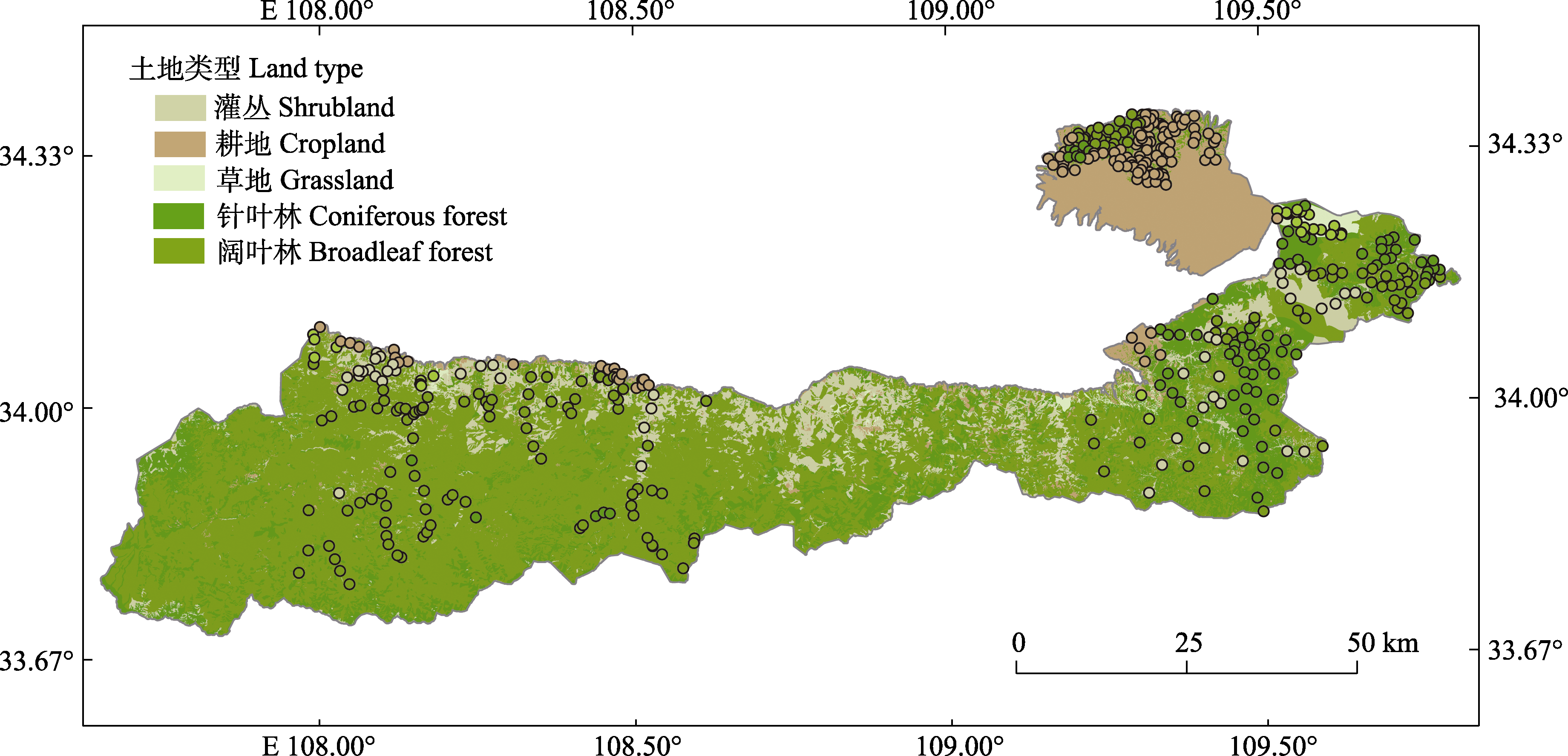
图1 秦岭北麓研究区及样点分布。
Fig. 1 Study area and sampling sites on the northern foot of Qinling Mountains.
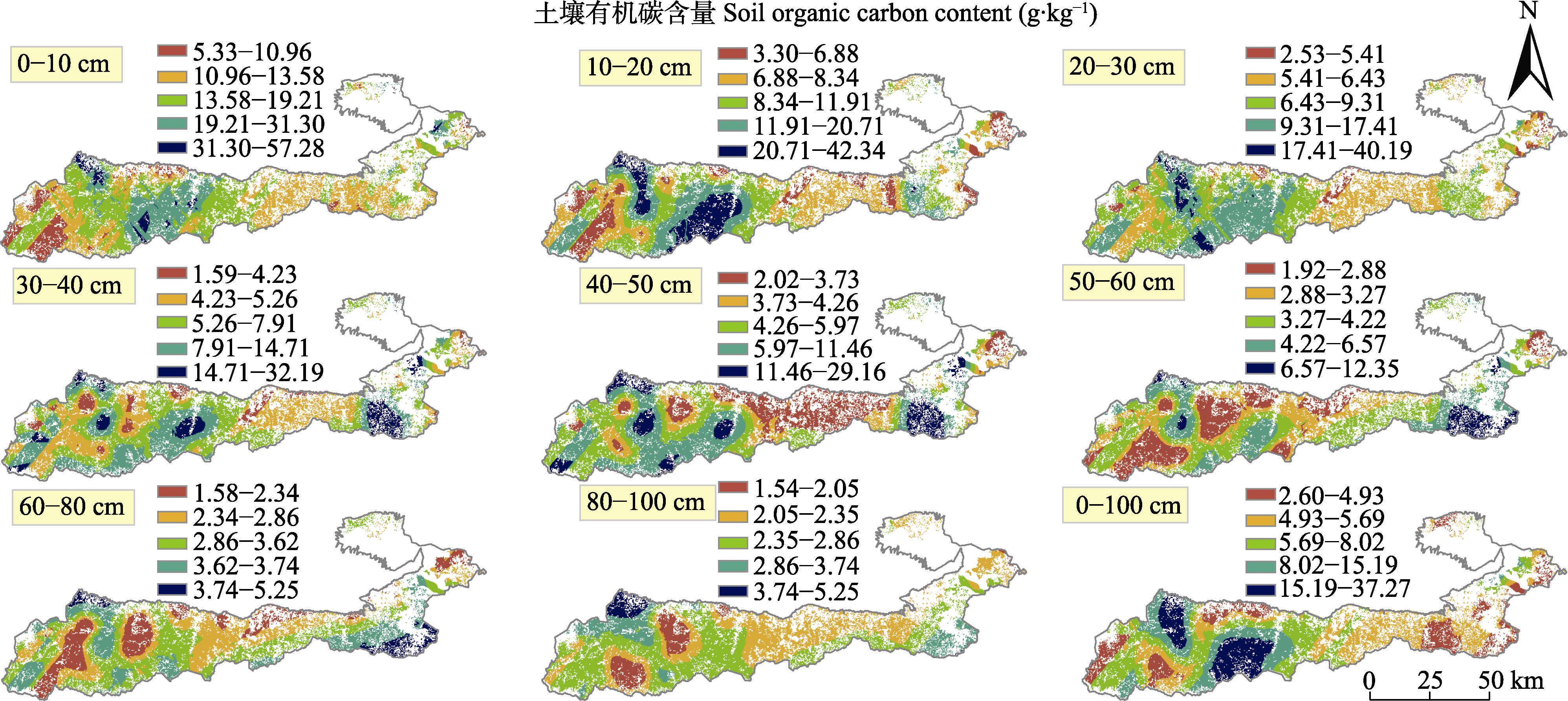
图2 秦岭北麓阔叶林土壤有机碳含量空间分布。
Fig. 2 Spatial distribution of organic carbon content in broadleaf forest soil on the northern foot of Qinling Mountains.
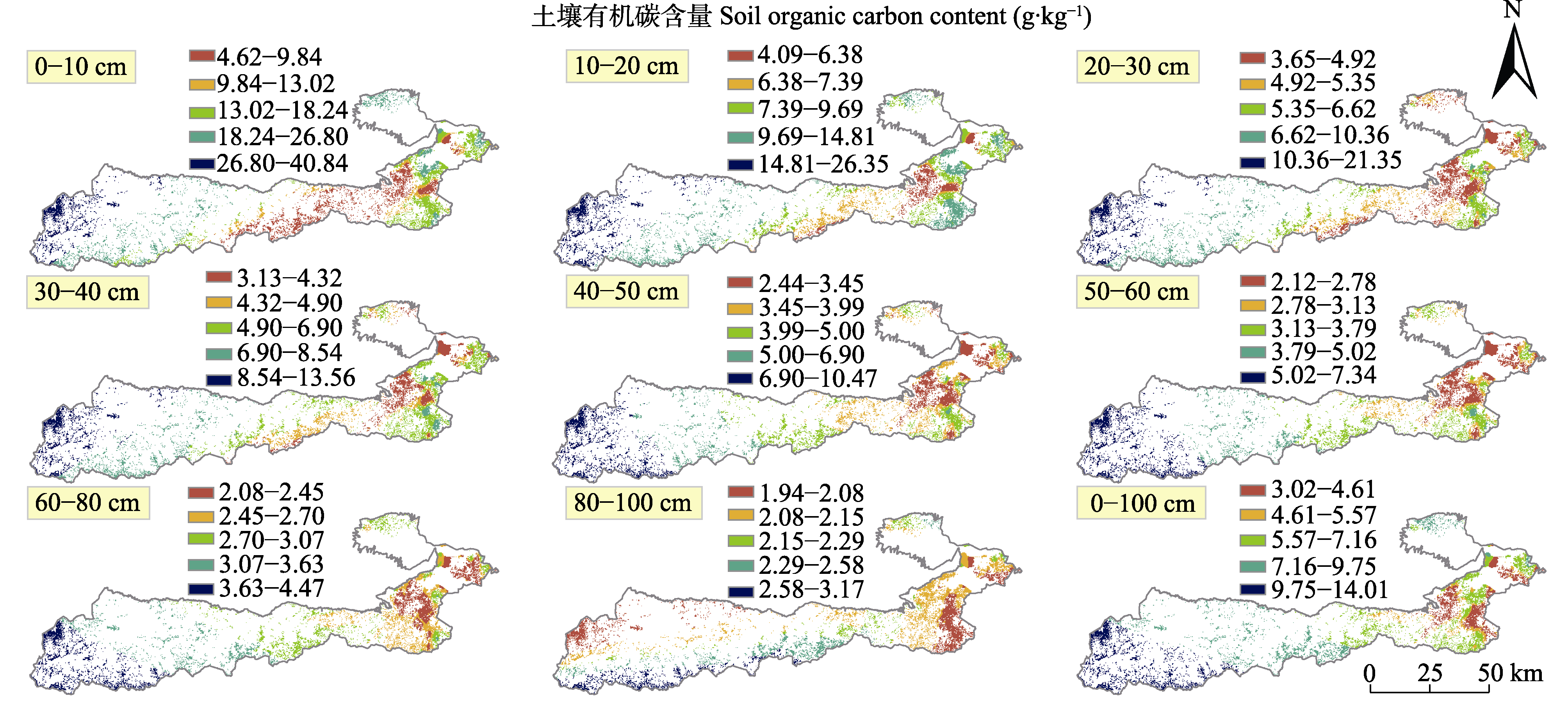
图3 秦岭北麓针叶林土壤有机碳含量空间分布。
Fig. 3 Spatial distribution of organic carbon content in coniferous forest soil on the northern foot of Qinling Mountains.
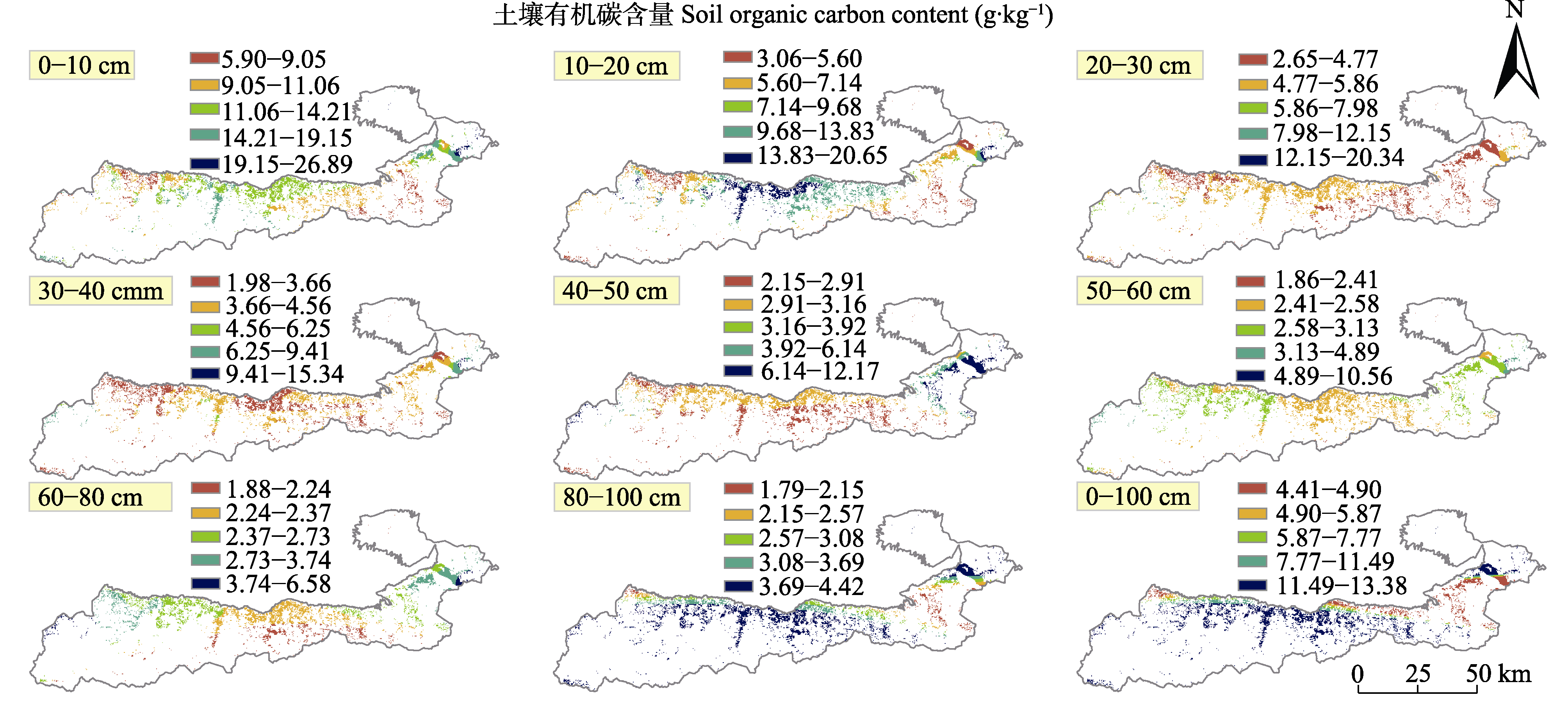
图4 秦岭北麓灌丛土壤有机碳含量空间分布。
Fig. 4 Spatial distribution of organic carbon content in shrubland soil on the northern foot of Qinling Mountains.
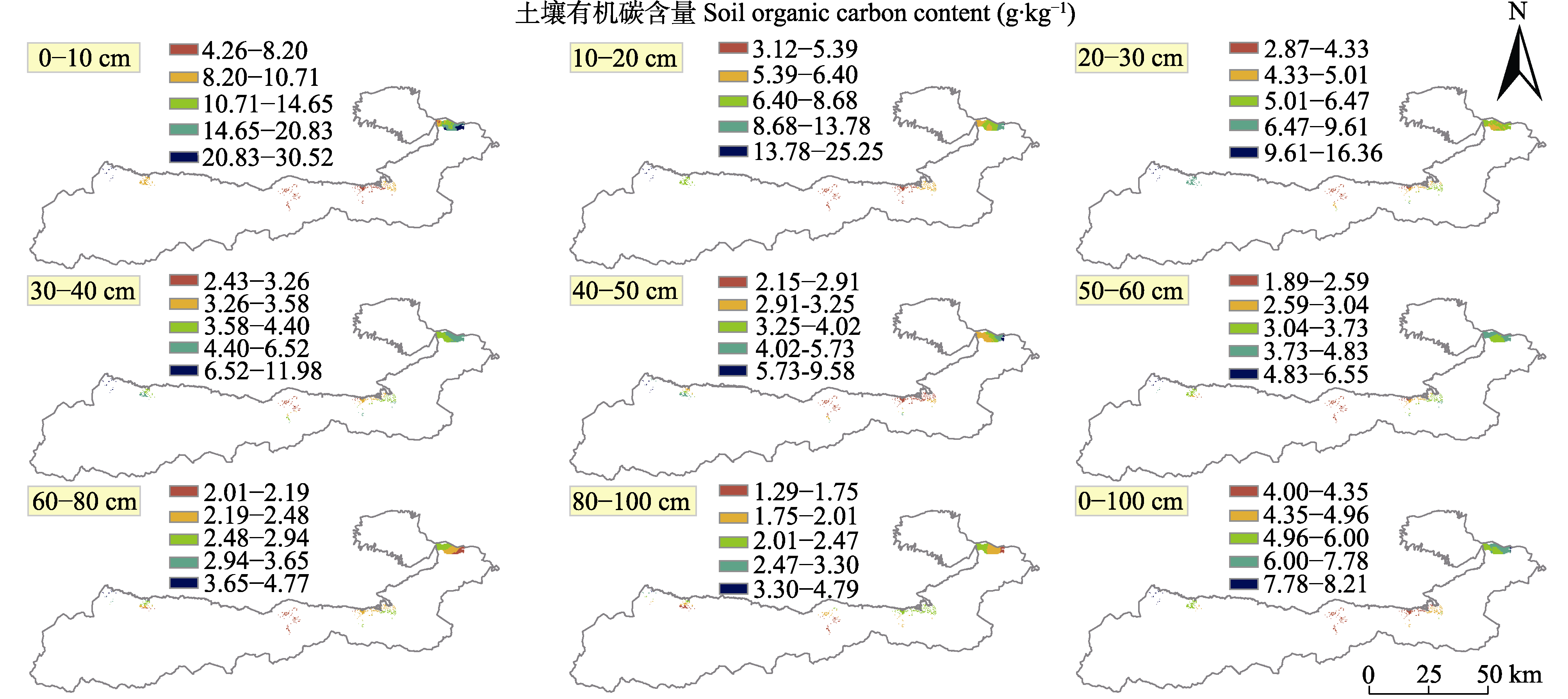
图5 秦岭北麓草地土壤有机碳含量空间分布。
Fig. 5 Spatial distribution of organic carbon content in grassland soil on the northern foot of Qinling Mountains.
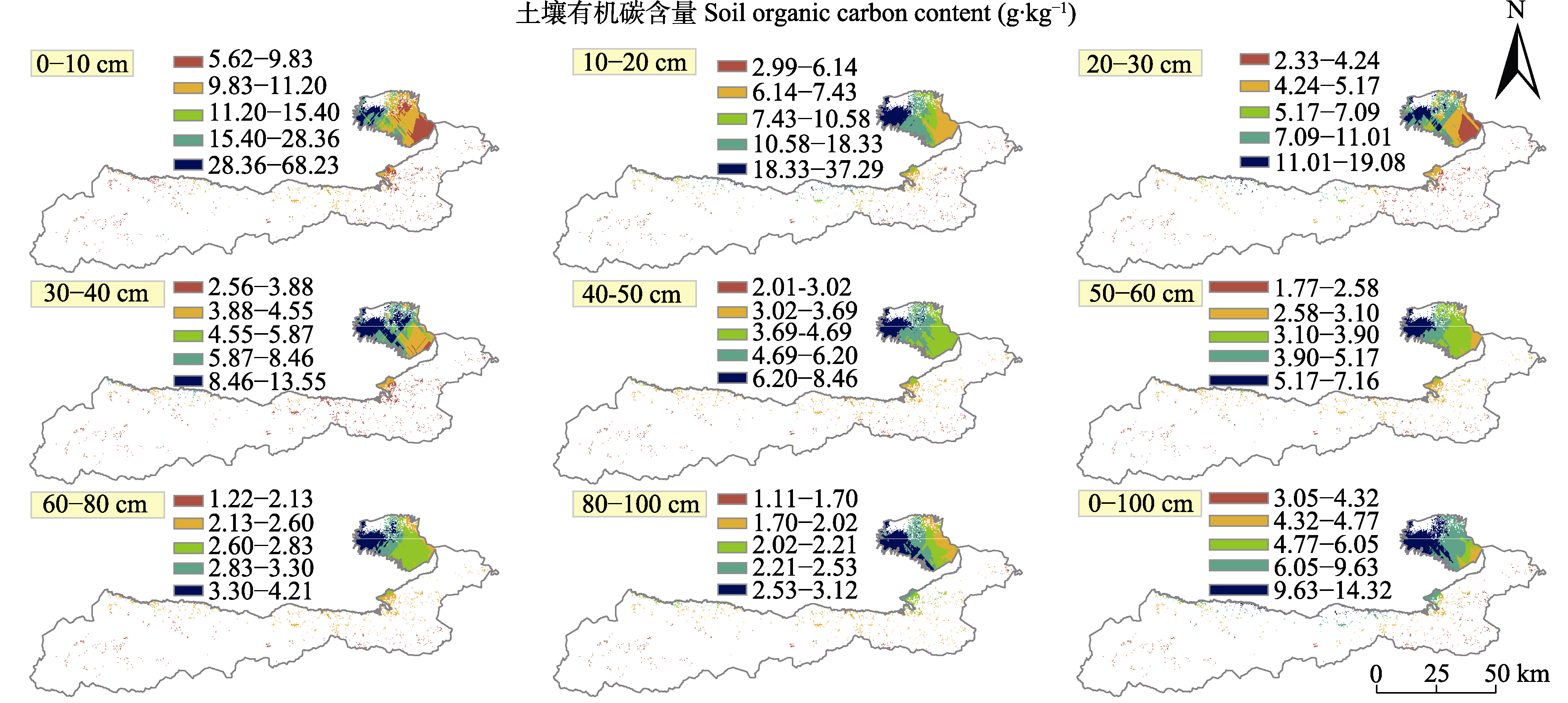
图6 秦岭北麓耕地土壤有机碳含量空间分布。
Fig. 6 Spatial distribution of organic carbon content in cropland soil on the northern foot of Qinling Mountains.
| 植被类型 Vegetation type | 土层深度 Soil layer (cm) | ||||||||
|---|---|---|---|---|---|---|---|---|---|
| 0-10 | 10-20 | 20-30 | 30-40 | 40-50 | 50-60 | 60-80 | 80-100 | 0-100 | |
| 草地 Grassland | 14.95 ± 1.29Abc | 8.50 ± 0.92Bbc | 6.33 ± 0.72Cab | 4.99 ± 0.50Db | 4.02 ± 0.30Eb | 3.29 ± 0.22Fb | 2.94 ± 0.15FGab | 2.42 ± 0.19Hab | 6.03 ± 0.47ab |
| 灌丛 Shrubland | 14.50 ± 0.86Abc | 9.46 ± 0.62Bab | 8.12 ± 0.69Ca | 5.95 ± 0.56Dab | 4.77 ± 0.49Eab | 3.71 ± 0.34EFb | 3.11 ± 0.32FGa | 2.65 ± 0.17GHa | 6.95 ± 0.73ab |
| 针叶林 Coniferous forest | 17.27 ± 0.90Aab | 9.63 ± 0.46Ba | 7.21 ± 0.38Ca | 6.01 ± 0.28Da | 4.94 ± 0.20Ea | 3.96 ± 0.15Fa | 3.03 ± 0.07Ga | 2.33 ± 0.04Ha | 6.44 ± 0.32ab |
| 阔叶林 Broadleaf forest | 19.45 ± 0.80Aa | 11.44 ± 0.54Ba | 8.41 ± 0.43Ca | 6.23 ± 0.32Da | 5.13 ± 0.29Ea | 3.80 ± 0.16Fab | 2.95 ± 0.09Gab | 2.45 ± 0.07Ha | 7.32 ± 0.38a |
| 耕地 Cropland | 15.27 ± 0.84Ac | 8.56 ± 0.44Bbc | 6.29 ± 0.23Cbc | 5.30 ± 0.16Db | 4.29 ± 0.11Eb | 3.46 ± 0.09Fb | 2.76 ± 0.05Gb | 2.18 ± 0.04Hb | 5.90 ± 0.18bc |
表1 不同植被类型土壤有机碳含量垂直分布格局(平均值±标准误)
Table 1 Differences in vertical distribution of soil organic carbon content in different vegetation types (mean ± SE)
| 植被类型 Vegetation type | 土层深度 Soil layer (cm) | ||||||||
|---|---|---|---|---|---|---|---|---|---|
| 0-10 | 10-20 | 20-30 | 30-40 | 40-50 | 50-60 | 60-80 | 80-100 | 0-100 | |
| 草地 Grassland | 14.95 ± 1.29Abc | 8.50 ± 0.92Bbc | 6.33 ± 0.72Cab | 4.99 ± 0.50Db | 4.02 ± 0.30Eb | 3.29 ± 0.22Fb | 2.94 ± 0.15FGab | 2.42 ± 0.19Hab | 6.03 ± 0.47ab |
| 灌丛 Shrubland | 14.50 ± 0.86Abc | 9.46 ± 0.62Bab | 8.12 ± 0.69Ca | 5.95 ± 0.56Dab | 4.77 ± 0.49Eab | 3.71 ± 0.34EFb | 3.11 ± 0.32FGa | 2.65 ± 0.17GHa | 6.95 ± 0.73ab |
| 针叶林 Coniferous forest | 17.27 ± 0.90Aab | 9.63 ± 0.46Ba | 7.21 ± 0.38Ca | 6.01 ± 0.28Da | 4.94 ± 0.20Ea | 3.96 ± 0.15Fa | 3.03 ± 0.07Ga | 2.33 ± 0.04Ha | 6.44 ± 0.32ab |
| 阔叶林 Broadleaf forest | 19.45 ± 0.80Aa | 11.44 ± 0.54Ba | 8.41 ± 0.43Ca | 6.23 ± 0.32Da | 5.13 ± 0.29Ea | 3.80 ± 0.16Fab | 2.95 ± 0.09Gab | 2.45 ± 0.07Ha | 7.32 ± 0.38a |
| 耕地 Cropland | 15.27 ± 0.84Ac | 8.56 ± 0.44Bbc | 6.29 ± 0.23Cbc | 5.30 ± 0.16Db | 4.29 ± 0.11Eb | 3.46 ± 0.09Fb | 2.76 ± 0.05Gb | 2.18 ± 0.04Hb | 5.90 ± 0.18bc |
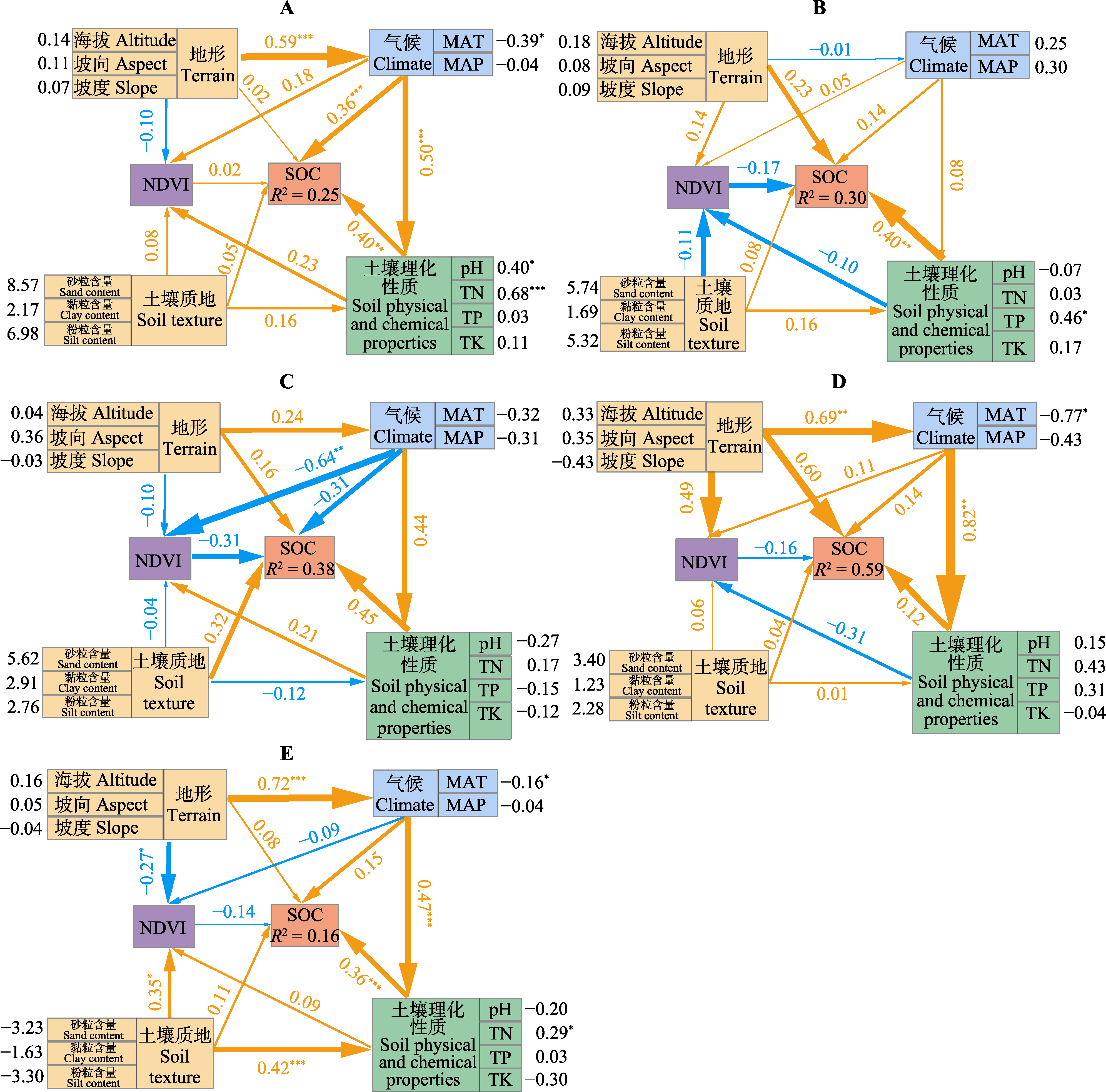
图7 秦岭北麓不同植被类型土壤有机碳含量影响因子相关性及路径分析。A, 阔叶林。B, 针叶林。C, 灌丛。D, 草地。E, 耕地。MAT, 年平均气温; MAP, 年降水量; NDVI, 归一化植被指数; SOC, 土壤有机碳含量; TN, 土壤总氮含量; TP, 土壤总磷含量; TK, 土壤总钾含量。橙色线条代表正路径系数, 蓝色线条代表负路径系数。线的粗细表示路径系数相对大小; R2表示变量被解释比例。*, p < 0.05; **, p < 0.01; ***, p < 0.001。
Fig. 7 Path analysis and correlation of factors affecting soil organic carbon content in different vegetation types in the northern foot of Qinling Mountains. A, Broadleaf forest. B, Coniferous forest. C, Shrubland. D, Grassland. E, Cropland. MAT, mean annual air temperature; MAP, mean annual precipitation; NDVI, normalized difference vegetation index; SOC, soil organic carbon content; TN, total nitrogen content in soil; TP, total phosphorus content in soil; TK, total potassium content in soil. Positive path coefficients are represented by the orange lines while negative ones are represented by the blue lines. The thickness of the line represents the relative magnitude of the path coefficient; R2 represents the proportion of variance explained by the variable. *, p < 0.05; **, p < 0.01; ***, p < 0.001.
| [1] | Bai YX, Zhou YC (2020). The main factors controlling spatial variability of soil organic carbon in a small karst watershed, Guizhou Province, China. Geoderma, 357, 113938. DOI: 10.1016/j.geoderma.2019.113938. |
| [2] | Chen X, Zhang YJ, Zou JL, Dang W, Ju XL, Yu Y (2022). Distribution characteristics of forest surface soil organic carbon in Taibai Mountains of Qinling. Journal of Forest and Environment, 42(3), 244-252. |
| [陈曦, 张彦军, 邹俊亮, 党维, 鞠学良, 于媛 (2022). 秦岭太白山森林表层土壤有机碳分布特征. 森林与环境学报, 42(3), 244-252.] | |
| [3] |
Dai W, Zhao KL, Fu WJ, Jiang PK, Li YF, Zhang CS, Gielen G, Gong X, Li YH, Wang HL, Wu JS (2018). Spatial variation of organic carbon density in topsoils of a typical subtropical forest, southeastern China. Catena, 167, 181-189.
DOI URL |
| [4] | Dong JW, Zhou Y, You NS, Cheng C (2021). A 30-m annual maximum NDVI dataset in China from 2000 to 2022. National Ecosystem Science Data Center. DOI: 10.12199/nesdc.ecodb.rs.2021.012. |
| [董金玮, 周岩, 尤南山, 程曹 (2021). 2000-2022年中国30米年最大NDVI数据集. 国家生态科学数据中心. DOI: 10.12199/nesdc.ecodb.rs.2021.012.] | |
| [5] | Li AW, Ran M, Song LY, Xue JL, Zhang YY, Li CJ, Deng Q, Fang HY, Dai TF, Li QQ (2023). Spatial distribution characteristics and influencing factors of cropland topsoil organic carbon content in the Sichuan Basin. Resources and Environment in the Yangtze Basin, 32, 1102-1112. |
| [李艾雯, 冉敏, 宋靓颖, 薛晶玲, 张元媛, 李呈吉, 邓茜, 方红艳, 代天飞, 李启权 (2023). 四川盆地耕地表层土壤有机碳含量空间分布特征及其影响因素. 长江流域资源与环境, 32, 1102-1112.] | |
| [6] | Li H, Yuan H, Song HF, Zhang L, Duan LX, Sheng H (2020). Research advance in soil organic carbon and its components by different utilization modes. Acta Agriculturae Jiangxi, 32(8), 57-63. |
| [李菡, 袁红, 宋洪福, 张亮, 段良霞, 盛浩 (2020). 不同利用方式土壤有机碳及其组分研究进展. 江西农业学报, 32(8), 57-63.] | |
| [7] | Li MY, Shangguan ZP, Deng L (2021). Spatial distribution of carbon storages in the terrestrial ecosystems and its influencing factors on the Loess Plateau. Acta Ecologica Sinica, 41, 6786-6799. |
| [李妙宇, 上官周平, 邓蕾 (2021). 黄土高原地区生态系统碳储量空间分布及其影响因素. 生态学报, 41, 6786-6799.] | |
| [8] | Li QQ, Li AW, Yu XL, Dai TF, Peng YY, Yuan DG, Zhao B, Tao Q, Wang CQ, Li B, Gao XS, Li YD, Wu DY, Xu Q (2020). Soil acidification of the soil profile across Chengdu Plain of China from the 1980s to 2010s. Science of the Total Environment, 698, 134320. DOI: 10.1016/j.scitotenv.2019.134320. |
| [9] |
Li QQ, Li S, Xiao Y, Zhao B, Wang CQ, Li B, Gao XS, Li YD, Bai GC, Wang YD, Yuan DG (2019). Soil acidification and its influencing factors in the purple hilly area of southwest China from 1981 to 2012. Catena, 175, 278-285.
DOI URL |
| [10] |
Li QQ, Wang CQ, Dai TF, Shi WJ, Zhang X, Xiao Y, Song WP, Li B, Wang YD (2017). Prediction of soil cadmium distribution across a typical area of Chengdu Plain, China. Scientific Reports, 7, 7115. DOI: 10.1038/s41598-017-07690-y.
PMID |
| [11] | Li QQ, Wang CQ, Zhang WJ, Yu Y, Li B, Yang J, Bai GC, Cai Y (2013). Prediction of soil nutrients spatial distribution based on neural network model combined with goestatistics. Chinese Journal of Applied Ecology, 24, 459-466. |
| [李启权, 王昌全, 张文江, 余勇, 李冰, 杨娟, 白根川, 蔡艳 (2013). 基于神经网络模型和地统计学方法的土壤养分空间分布预测. 应用生态学报, 24, 459-466.] | |
| [12] | Li S, Li QQ, Wang CQ, Shi WJ, Yuan DG, Li B, Gao XS (2015). Spatio-temporal variation of soil organic carbon and significant changes in its impact factors—A case study in Yanyuan County, Southwest Sichuan. Chinese Journal of Soil Science, 46, 1063-1070. |
| [李珊, 李启权, 王昌全, 史文娇, 袁大刚, 李冰, 高雪松 (2015). 盐源县耕层土壤有机碳时空变化及影响因素显著性变化分析. 土壤通报, 46, 1063-1070.] | |
| [13] | Li XM, Yang J, Li XW, Zhou L, Huang WG, Yang JL (2024). Distribution pattern and driving factors of soil organic carbon of natural grassland in Ningxia. Grassland and Turf, 44(4), 1-8. |
| [李旭梅, 杨钧, 李小伟, 周亮, 黄文广, 杨君珑 (2024). 宁夏天然草地土壤有机碳分布格局及驱动因素. 草原与草坪, 44(4), 1-8.] | |
| [14] | Liu F, Zhang GL (2021). Basic soil property dataset of high-resolution China Soil Information Grids (2010-2018). National Tibetan Plateau/Third Pole Environment Data Center. DOI: 10.11666/00073.ver1.db. |
| [刘峰, 张甘霖 (2021). 中国高分辨率国家土壤信息网格基本属性数据集(2010-2018). 国家青藏高原科学数据中心. DOI: 10.11666/00073.ver1.db.] | |
| [15] | Liu YH, Wei WD, Wen XC, Li JL (2015). Characteristics of soil organic carbon fractions in alpine meadow with different degradation. Acta Agriculturae Boreali- occidentalis Sinica, 24(2), 168-174. |
| [刘育红, 魏卫东, 温小成, 李积兰 (2015). 退化高寒草甸土壤有机碳组分特征. 西北农业学报, 24(2), 168-174.] | |
| [16] |
Lugato E, Lavallee JM, Haddix ML, Panagos P, Cotrufo MF (2021). Different climate sensitivity of particulate and mineral-associated soil organic matter. Nature Geoscience, 14, 295-300.
DOI |
| [17] | Luo YL, Li QQ, Wang CQ, Zhang X, Zhang W, Jia L, Yuan DG, Wu DY (2015). Spatial variability of soil organic carbon and related controlling factors in Renshou County, Sichuan Province. Chinese Journal of Eco-Agriculture, 23(1), 34-42. |
| [罗由林, 李启权, 王昌全, 张新, 张维, 贾荔, 袁大刚, 吴德勇 (2015). 四川省仁寿县土壤有机碳空间分布特征及其主控因素. 中国生态农业学报, 23(1), 34-42.] | |
| [18] | Ma NF, Gao XD, Zhao XN, Zhao LH, Liu HQ, Yang MH (2022). Distribution characteristics of soil organic carbon and the effect of topographic and vegetation on small watershed of returned farmland in the Loess Hilly Region. Acta Ecologica Sinica, 42, 5838-5846. |
| [马南方, 高晓东, 赵西宁, 赵连豪, 刘华清, 杨孟豪 (2022). 黄土丘陵区退耕小流域土壤有机碳分布特征及地形植被对其的影响. 生态学报, 42, 5838-5846.] | |
| [19] | Meng XT, Bao YL, Wang YA, Zhang XL, Liu HJ (2022). An advanced soil organic carbon content prediction model via fused temporal-spatial-spectral (TSS) information based on machine learning and deep learning algorithms. Remote Sensing of Environment, 280, 113166. DOI: 10.1016/j.rse.2022.113166. |
| [20] |
Nie XQ, Yang LC, Li F, Xiong F, Li CB, Zhou GY (2019). Storage, patterns and controls of soil organic carbon in the alpine shrubland in the Three Rivers Source Region on the Qinghai-Tibetan Plateau. Catena, 178, 154-162.
DOI URL |
| [21] |
Ou Y, Rousseau AN, Wang LX, Yan BX (2017). Spatio-temporal patterns of soil organic carbon and pH in relation to environmental factors—A case study of the Black Soil Region of Northeastern China. Agriculture, Ecosystems & Environment, 245, 22-31.
DOI URL |
| [22] | Peng Y, Zhao KF, Zhang L, Zhang HS, Li XM (2024). The observation and study on the turbulent flux and transport of CO2 and H2O over suburban areas at the northern part of Qinling Mountains of China. China Environmental Science, 44, 2407-2417. |
| [彭艳, 赵奎锋, 张璐, 张宏昇, 李星敏 (2024). 秦岭北麓地区CO2和水汽湍流输送实验研究. 中国环境科学, 44, 2407-2417.] | |
| [23] | Ran M, Song LY, Xue JL, Zhang YY, Zhang H, Wu DY, Li QQ (2024). Effects of soil parent material and farmland utilization on nitrogen distribution in soil profile in Chengdu Plain. Journal of Ecology and Rural Environment, 40, 398-407. |
| [冉敏, 宋靓颖, 薛晶玲, 张元媛, 张浩, 吴德勇, 李启权 (2024). 成都平原成土母质和农地利用方式对土壤剖面氮素分布的影响. 生态与农村环境学报, 40, 398-407.] | |
| [24] | Ren LN, Wang HY, Ding GD, Gao GL, Liu L (2012). Effects of Larix principis-rupprechtii plantation density control on soil organic carbon and nutrients characteristics. Journal of Arid Land Resources and Environment, 26(4), 138-143. |
| [任丽娜, 王海燕, 丁国栋, 高广磊, 刘玲 (2012). 密度调控对华北落叶松人工林土壤有机碳及养分特征的影响. 干旱区资源与环境, 26(4), 138-143.] | |
| [25] | Singh PD, Klamerus-Iwan A, Pietrzykowski M (2023). Water retention potential in novel terrestrial ecosystems restored on post-mine sites: a review. Forests, 14, 18. DOI: 10.3390/f14010018. |
| [26] |
Six J, Frey SD, Thiet RK, Batten KM (2006). Bacterial and fungal contributions to carbon sequestration in agroecosystems. Soil Science Society of America Journal, 70, 555-569.
DOI URL |
| [27] |
Song Y, Zhao XZ, Mao ZJ, Sun T, Hou LL (2013). SOC decomposition of four typical broad-leaved Korean pine communities in Xiaoxing’an Mountain. Acta Ecologica Sinica, 33, 443-453.
DOI URL |
| [宋媛, 赵溪竹, 毛子军, 孙涛, 侯玲玲 (2013). 小兴安岭4种典型阔叶红松林土壤有机碳分解特性. 生态学报, 33, 443-453.] | |
| [28] |
Streit K, Hagedorn F, Hiltbrunner D, Portmann M, Saurer M, Buchmann N, Wild B, Richter A, Wipf S, Siegwolf RTW (2014). Soil warming alters microbial substrate use in alpine soils. Global Change Biology, 20, 1327-1338.
DOI PMID |
| [29] |
Sun WY, Zhu HH, Guo SL (2015). Soil organic carbon as a function of land use and topography on the Loess Plateau of China. Ecological Engineering, 83, 249-257.
DOI URL |
| [30] | Tang PH, Dang KL, Wang LH, Ma J (2016). Factors affecting soil organic carbon density in Betula albo-sinensis forests on the southern slope of the Qinling Mountains. Acta Ecologica Sinica, 36, 1030-1039. |
| [唐朋辉, 党坤良, 王连贺, 马俊 (2016). 秦岭南坡红桦林土壤有机碳密度影响因素. 生态学报, 36, 1030-1039.] | |
| [31] |
Tian K, Zhao YC, Xu XH, Hai N, Huang B, Deng WJ (2015). Effects of long-term fertilization and residue management on soil organic carbon changes in paddy soils of China: a meta-analysis. Agriculture Ecosystems & Environment, 204, 40-50.
DOI URL |
| [32] |
Vos C, Jaconi A, Jacobs A, Don A (2018). Hot regions of labile and stable soil organic carbon in Germany—Spatial variability and driving factors. Soil, 4, 153-167.
DOI URL |
| [33] | Wang CY, He NP, Lü YL (2016). Latitudinal patterns and factors affecting different soil organic carbon fractions in the eastern forests of China. Acta Ecologica Sinica, 36, 3176-3188. |
| [王春燕, 何念鹏, 吕瑜良 (2016). 中国东部森林土壤有机碳组分的纬度格局及其影响因子. 生态学报, 36, 3176-3188.] | |
| [34] | Wang D, Geng ZC, She D, He WX, Hou L (2015). Soil organic carbon storage and vertical distribution of carbon and nitrogen across different forest types in the Qinling Mountains. Acta Ecologica Sinica, 35, 5421-5429. |
| [王棣, 耿增超, 佘雕, 和文祥, 侯琳 (2015). 秦岭典型林分土壤有机碳储量及碳氮垂直分布. 生态学报, 35, 5421-5429.] | |
| [35] | Wang SP, Zhou GS, Lü YC, Zou JJ (2002). Distribution of soil carbon, nitrogen and phosphorus along Northeast China Transect (NECT) and their relationships with climatic factors. Acta Phytoecologica Sinica, 26, 513-517. |
| [王淑平, 周广胜, 吕育财, 邹建军 (2002). 中国东北样带(NECT)土壤碳、氮、磷的梯度分布及其与气候因子的关系. 植物生态学报, 26, 513-517.] | |
| [36] | Wang WJ, Wang BT, Lv Z, Ren BC, Wang N, Nie S, Cao YB (2013). Soil organic carbon reserve of different forests in Taiyue mountain. Journal of Arid Land Resources and Environment, 27(1), 81-85. |
| [王文静, 王百田, 吕钊, 仁本超, 王宁, 聂森, 曹远博 (2013). 山西太岳山不同林分土壤有机碳储量研究. 干旱区资源与环境, 27(1), 81-85.] | |
| [37] | Wei W, Dang KL (2019). Spatial variation of the density of soil organic carbon in forest land on the southern slope of Qinling Mountains. Scientia Silvae Sinicae, 55(5), 11-19. |
| [卫玮, 党坤良 (2019). 秦岭南坡林地土壤有机碳密度空间分异特征. 林业科学, 55(5), 11-19.] | |
| [38] | Wu F, Sun HL, Tian ZP, Ye M, Liu TY, Yang H, Jin XL (2024). Vertical distribution patterns of soil organic carbon along elevational gradients and its environmental drivers in the montane forests of the Western Tianshan Mountains, China. Applied and Environmental Biology, 30, 715-725. |
| [吴芳, 孙慧兰, 田中平, 叶茂, 刘天弋, 杨涵, 金晓亮 (2024). 天山西部山地森林土壤有机碳沿海拔的分布格局及环境驱动因素. 应用与环境生物学报, 30, 715-725.] | |
| [39] | Yang JL, Li XW (2017). The characteristic of soil organic carbon fraction in different grassland types in Ningxia. Ecology and Environmental Sciences, 26(1), 55-61. |
| [杨君珑, 李小伟 (2017). 宁夏不同草地类型土壤有机碳组分特征. 生态环境学报, 26(1), 55-61.] | |
| [40] | Yang JS, Yu JB, Liu JS, Wang JD (2006). Humus distribution and fraction of typical marsh soil depth profiles in the Sanjiang Plain. Chinese Journal of Soil Science, 37, 865-868. |
| [杨继松, 于君宝, 刘景双, 王金达 (2006). 三江平原典型湿地土壤腐殖质的剖面分布及其组成特征. 土壤通报, 37, 865-868.] | |
| [41] | Zhang SH, Zhou XB, Chen YS, Du F, Zhu B (2024). Soil organic carbon fractions in China: spatial distribution, drivers, and future changes. Science of the Total Environment, 919, 170890. DOI: 10.1016/j.scitotenv.2024.170890. |
| [42] | Zhang XS (2007). egetation Map of the People’s Republic of China (1:1 000 000). Geology Press, Beijing. |
| [张新时 (2007). 中华人民共和国植被图(1: 1 000 000). 地质出版社, 北京.] | |
| [43] | Zhang YJ, Yu YC, Niu JJ, Gong LL (2020). The elevational patterns of soil organic carbon storage on the northern slope of Taibai Mountain of Qinling. Acta Ecologica Sinica, 40, 629-639. |
| [张彦军, 郁耀闯, 牛俊杰, 龚兰兰 (2020). 秦岭太白山北坡土壤有机碳储量的海拔梯度格局. 生态学报, 40, 629-639.] | |
| [44] | Zhao HH, Liu JC, Guo YJ, Wang HM, Gong Z (2024). Assessing the ecological sensitivity of the northern foothills of Qinling Mountains using DPSIRM and PLUS models. Transactions of the Chinese Society of Agricultural Engineering, 40(13), 244-252. |
| [赵欢欢, 刘金成, 郭义军, 王海明, 龚正 (2024). 基于DPSIRM和PLUS模型的秦岭北麓生态敏感性评估. 农业工程学报, 40(13), 244-252.] | |
| [45] |
Zhao YC, Wang MY, Hu SJ, Zhang XD, Ouyang Z, Zhang GL, Huang B, Zhao SW, Wu JS, Xie DT, Zhu B, Yu DS, Pan XZ, Xu SX, Shi XZ (2018). Economics- and policy-driven organic carbon input enhancement dominates soil organic carbon accumulation in Chinese croplands. Proceedings of the National Academy of Sciences of the United States of America, 115, 4045-4050.
DOI PMID |
| [46] | Zhao YC, Xu SX, Wang MY, Shi XZ (2018). Carbon sequestration potential in Chinese cropland soils: review, challenge, and research suggestions. Bulletin of Chinese Academy of Sciences, 33(2), 191-197. |
| [赵永存, 徐胜祥, 王美艳, 史学正 (2018). 中国农田土壤固碳潜力与速率: 认识、挑战与研究建议. 中国科学院院刊, 33(2), 191-197.] | |
| [47] | Zhou JJ, Xue DX, Lei L, Wang LY, Zhong GS, Liu CF, Xiang J, Huang MH, Feng W, Li QQ, Zhao YR, Zhu GF (2019). Impacts of climate and land cover on soil organic carbon in the Eastern Qilian Mountains, China. Sustainability, 11, 5790. DOI: 10.3390/su11205790. |
| [48] | Zhou ZP, Tian BG, Chen WH, Wang ZY, Yuan W, Liu SP (2021). Effects of different tillage methods and straw returning on soil nutrients and wheat yield and quality. Crops, (3), 78-83. |
| [周正萍, 田宝庚, 陈婉华, 王子阳, 袁伟, 刘世平 (2021). 不同耕作方式与秸秆还田对土壤养分及小麦产量和品质的影响. 作物杂志, (3), 78-83.] |
| [1] | 郭鑫炜, 王关泽, 孙瑞, 徐文娴, 吴志祥. 橡胶树不同叶片物候期树干液流变化及其驱动机制[J]. 植物生态学报, 2026, 50(预发表): 0-. |
| [2] | 杨梅花, 张子嘉, 乔栋, 冯俊娜, 庞子杰, 钱龙, 刘志晖, 蔡娜娜, 胡中民, 杨国姣. 海南热带森林乔木树种每木清查和多样性数据集[J]. 植物生态学报, 2026, 50(4): 1016-1022. |
| [3] | 王子平, 毛子昆, 贺涵, 姜鹏程, 闫瑞环, 王绪高. 东北阔叶红松林不同演替阶段树种分布与空间关联格局[J]. 植物生态学报, 2026, 50(4): 833-845. |
| [4] | 田地, 迟小龙, 石亮, 刘宵含, 赵常提, 吴梅, 张玉忠, 高永亮. 塞罕坝地区优势造林树种叶片化学计量特征及其环境驱动[J]. 植物生态学报, 2026, 50(2): 362-373. |
| [5] | 韦鑫, 江蓝, 郑晨成, 朱静, 陈博, 李文周, 赖淑瑜, 刘金福, 何中声. 戴云山南坡海拔梯度上木本植物性系统分布特征及其影响因素[J]. 植物生态学报, 2026, 50(1): 150-159. |
| [6] | 张琳, 袁伟影, 宋创业, 吴冬秀. 1998-2010年中国典型生态系统长期监测样地环境要素、物种丰富度和生物量动态数据集[J]. 植物生态学报, 2025, 49(8): 1182-1190. |
| [7] | 曹毅, 张松林, 王旭峰, 杨安昌, 任敏慧, 杨浩, 韩超. 兰州市南北两山植物群落数据集[J]. 植物生态学报, 2025, 49(6): 975-989. |
| [8] | 惠城阳, 章巧依, 刘腾腾, 刘维勇, 周丽娜, 金鑫杰, 张永华, 刘金亮. 温州大罗山主要植被类型及物种组成特征[J]. 植物生态学报, 2025, 49(6): 990-998. |
| [9] | 黄美红, 牛梦秋, 杨鹏飞, 林洁, 廖周瑜, 陈建国, 向建英. 不同温度和埋藏深度对高山垫状植物山生福禄草种子出苗及幼苗生长的影响[J]. 植物生态学报, 2025, 49(12): 2092-2104. |
| [10] | 竹万宽, 许宇星, 黄润霞, 杜阿朋, 王志超. 雷州半岛桉树人工林生态系统水分利用效率旱雨季差异及其控制因素[J]. 植物生态学报, 2025, 49(12): 2015-2029. |
| [11] | 付照琦, 胡旭, 田沁瑞, 葛艳灵, 周红娟, 吴小云, 陈立欣. 晋西黄土区2种典型森林树种夜间液流特征及对环境因子的响应[J]. 植物生态学报, 2024, 48(9): 1128-1142. |
| [12] | 盘远方, 潘良浩, 邱思婷, 邱广龙, 苏治南, 史小芳, 范航清. 中国沿海红树林树高变异与环境适应机制[J]. 植物生态学报, 2024, 48(4): 483-495. |
| [13] | 王丽萍, 乌俊杰, 柴勇, 李家华, 杨昌级, 赵士杰. 高黎贡山中山湿性常绿阔叶林优势种空间分布格局及其关联性[J]. 植物生态学报, 2024, 48(2): 180-191. |
| [14] | 邓文婕, 吴华征, 李添翔, 周丽娜, 胡仁勇, 金鑫杰, 张永普, 张永华, 刘金亮. 洞头国家级海洋公园主要植被类型及其特征[J]. 植物生态学报, 2024, 48(2): 254-268. |
| [15] | 王丽丽, 宋晓彤, 谷际岐, 邵小明. 西藏尖叶对齿藓形态特征与环境变化的关系及响应策略[J]. 植物生态学报, 2024, 48(10): 1351-1360. |
| 阅读次数 | ||||||
|
全文 |
|
|||||
|
摘要 |
|
|||||
Copyright © 2026 版权所有 《植物生态学报》编辑部
地址: 北京香山南辛村20号, 邮编: 100093
Tel.: 010-62836134, 62836138; Fax: 010-82599431; E-mail: apes@ibcas.ac.cn, cjpe@ibcas.ac.cn
备案号: 京ICP备16067583号-19

