
植物生态学报 ›› 2012, Vol. 36 ›› Issue (8): 774-780.DOI: 10.3724/SP.J.1258.2012.00774 cstr: 32100.14.SP.J.1258.2012.00774
王彦荣*( ), 杨磊, 胡小文
收稿日期:2012-03-31
接受日期:2012-05-30
出版日期:2012-03-31
发布日期:2012-08-21
作者简介:* E-mail: yrwang@lzu.edu.cn
WANG Yan-Rong*(), YANG Lei, HU Xiao-Wen
Received:2012-03-31
Accepted:2012-05-30
Online:2012-03-31
Published:2012-08-21
摘要:
对种子休眠的自然释放及其作用因素的研究, 是了解种子休眠生态学、种群适应机制的重要途径。以内蒙古阿拉善干旱荒漠区的3种主要植物牛枝子(Lespedeza potaninii)、唐古特白刺(Nitraria tangutorum)和骆驼蒿(Peganum nigellastrum)为材料, 研究了种子在野外埋藏18个月期间和4个埋深条件下的休眠释放特性和土壤种子库。3种植物种子在野外埋藏时(采收后5 ℃冷藏6个月)的休眠率分别为98%、95%和3%。结果显示, 埋藏过程中, 3种植物种子的休眠释放表现出不同的变化特性。对牛枝子而言, 置于地表(0 cm)的种子比埋藏于土中的种子的休眠释放快, 埋藏期末, 埋深0、2、5和10 cm的种子的休眠率分别为64%、87%、86%和82%。唐古特白刺种子埋藏6个月后, 各埋深的休眠已完全释放, 释放速率随埋深增加而加快。骆驼蒿种子具有典型的季节性休眠循环特性, 休眠率各年度最高点出现在10月份, 释放速率随埋深增加呈减慢趋势。埋藏期末不同埋深条件下, 牛枝子、唐古特白刺和骆驼蒿种子的平均田间萌发率分别为11%、12%和8%; 平均室内萌发率分别为3%、74%和42%; 而平均死种子率分别为3%、15%和10%。根据Thompson和Grime (1979)的土壤种子库分类体系, 供试的3种植物都属于持久土壤种子库类型。
王彦荣, 杨磊, 胡小文. 埋藏条件下3种干旱荒漠植物的种子休眠释放和土壤种子库. 植物生态学报, 2012, 36(8): 774-780. DOI: 10.3724/SP.J.1258.2012.00774
WANG Yan-Rong, YANG Lei, HU Xiao-Wen. Seed dormancy release and soil seed bank of three arid desert plants under burial conditions. Chinese Journal of Plant Ecology, 2012, 36(8): 774-780. DOI: 10.3724/SP.J.1258.2012.00774
| 植物 Plant | 温度 Temperature (℃) | 发芽天数 Germination days (d) | 方法来源 Reference |
|---|---|---|---|
| 牛枝子 Lespedeza potaninii | 25 | 14 | |
| 唐古特白刺 Nitraria tangutorum | 25/35 (16 h/8 h) | 28 | |
| 骆驼蒿 Peganum nigellastrum | 25/35 (16 h/8 h) | 14 |
表1 3种植物种子的发芽测定方法
Table 1 Germination test method of three plant seeds
| 植物 Plant | 温度 Temperature (℃) | 发芽天数 Germination days (d) | 方法来源 Reference |
|---|---|---|---|
| 牛枝子 Lespedeza potaninii | 25 | 14 | |
| 唐古特白刺 Nitraria tangutorum | 25/35 (16 h/8 h) | 28 | |
| 骆驼蒿 Peganum nigellastrum | 25/35 (16 h/8 h) | 14 |
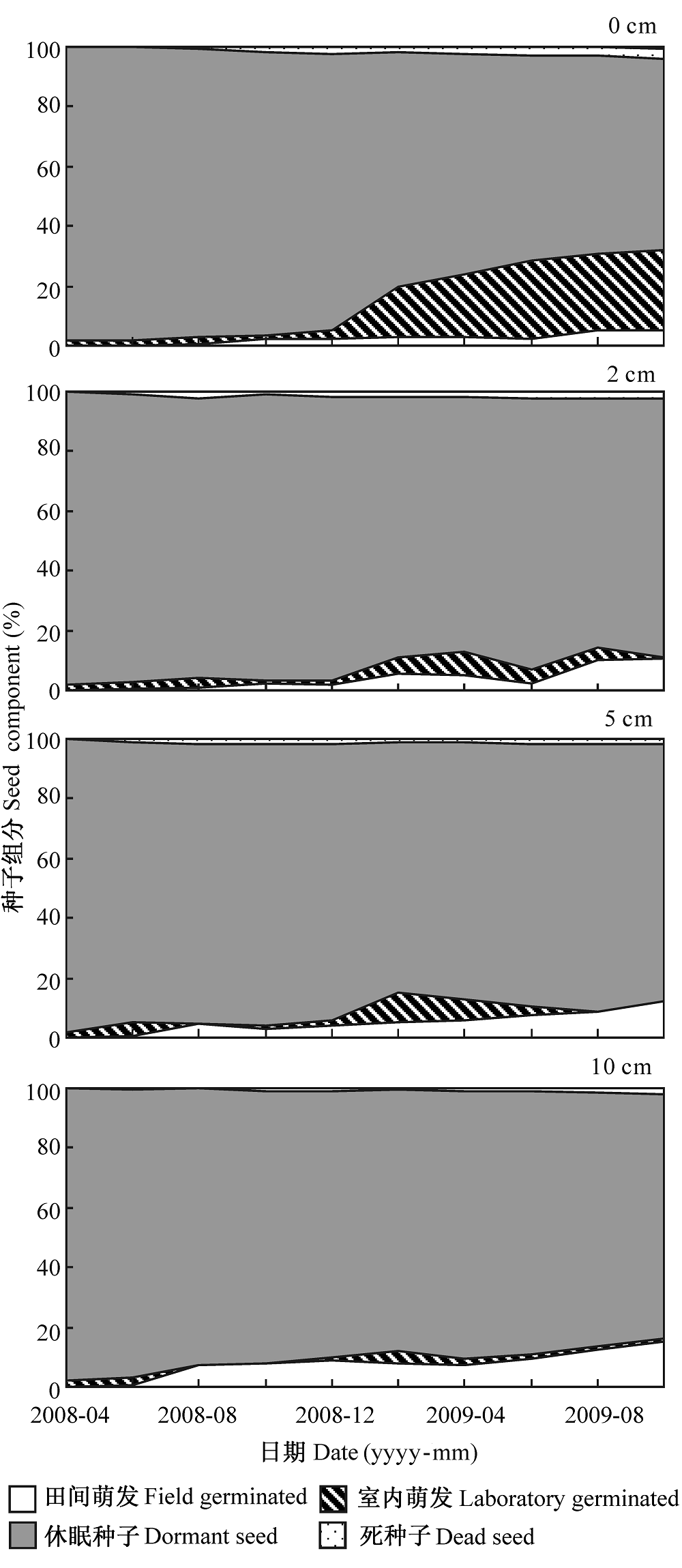
图1 不同埋深和埋藏时间对牛枝子种子组分的影响。
Fig. 1 Effects of burial depth and burial time on seed components of Lespedeza potaninii.
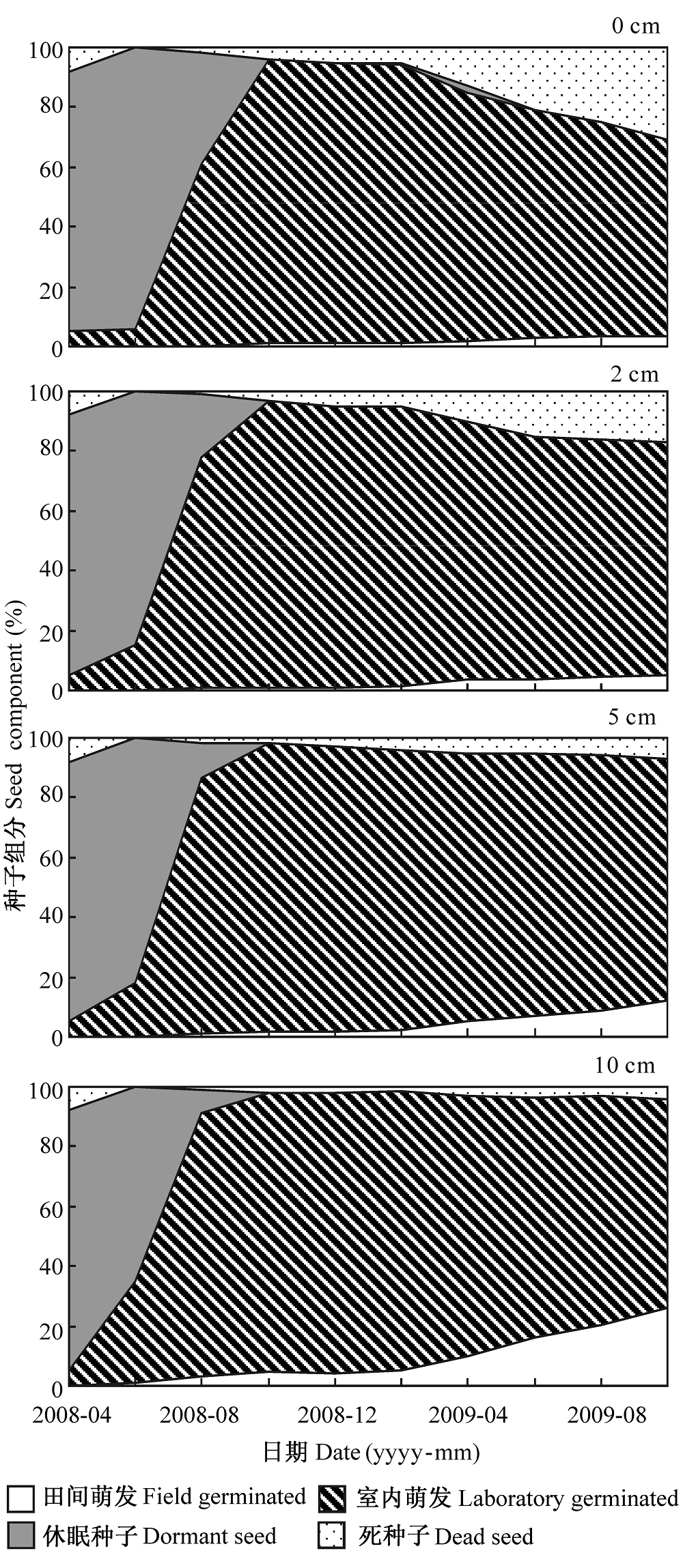
图2 不同埋深和埋藏时间对唐古特白刺种子组分的影响。
Fig. 2 Effects of burial depth and burial time on seed components of Nitraria tangutorum.
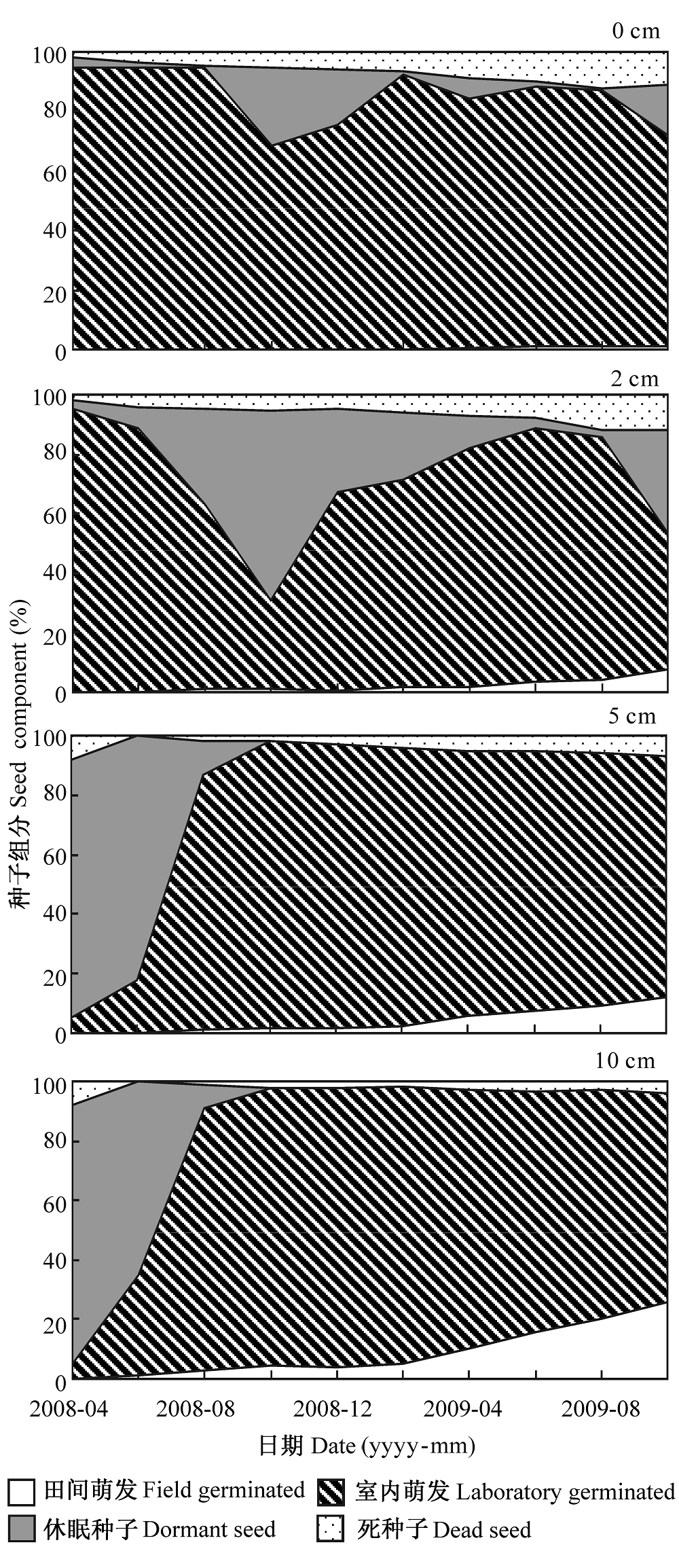
图3 不同埋深和埋藏时间对骆驼蒿种子组分的影响。
Fig. 3 Effects of burial depth and burial time on seed components of Peganum nigellastrum.
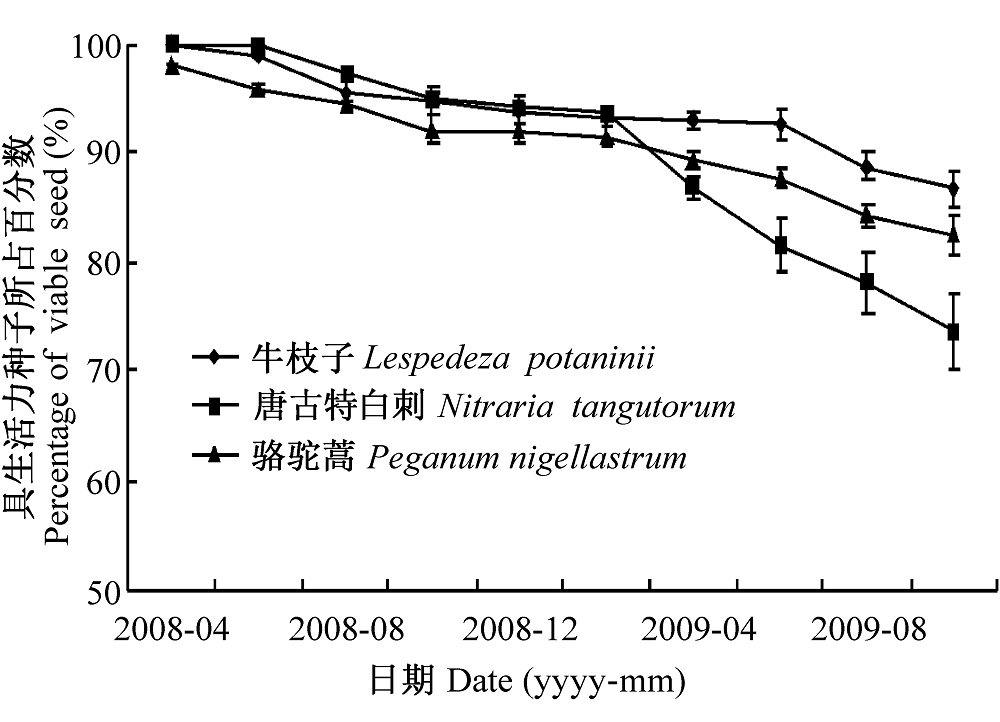
图4 3种荒漠植物土壤种子库动态(平均值±标准偏差)。
Fig. 4 Dynamics of soil seed bank of three desert plants (mean ± SD).
| [1] |
Baker KS, Steadman KJ, Plummer JA, Merritt DJ, Dixon KW (2005). The changing window of conditions that promotes germination of two fire ephemerals, Actinotus leucocephalus (Apiaceae) and Tersonia cyathiflora (Gyrostemonaceae). Annals of Botany, 96, 1225-1236.
DOI URL |
| [2] | Baskin CC, Baskin JM (1998). Seeds: Ecology, Biogeography and Evolution of Dormancy, and Germination. Academic Press, San Diego. |
| [3] | Baskin JM, Baskin CC (2004). A classification system for seed dormancy. Seed Science Research, 14, 1-16. |
| [4] | Bouwmeester HJ, Karssen CM (1992). The dual role of temperature in the regulation of the seasonal changes in dormancy and germination of seeds of Polygonum persicaria L. Oecologia, 90, 88-94. |
| [5] | China National Bureau of Quanlity and Technical Supervision (国家质量技术监督局) (2001) Rules for Forage Seed Testing―Germination Test (牧草种子检验规程发芽试验). GB/T2930. 4-2001. China Standard Press, Beijing. 33-50. (in Chinese) |
| [6] | Fenner M (1995). Ecology of seed banks. In: Kigel J, Galili G eds. Seed Development and Germination. Marcel Dekker, New York. 507-528. |
| [7] | Holmes PM, Newton RJ (2004). Patterns of seed persistence in South African fynbos. Plant Ecology, 172, 143-158. |
| [8] | Hu XW, Wu YP, Wang YR (2009). Different requirements for physical dormancy release in two populations of Sophora alopecuroides relation to burial depth. Ecological Research, 24, 1051-1056. |
| [9] | Huang ZY (黄振英) (2003). Adaptation strategies of seed dormancy and germination of Psammochloa villosa, a sand dune grass inhabiting Ordos Plateau, China. Acta Botanica Boreali-Occidentalia Sinica (西北植物学报), 23, 1128-1133. (in Chinese with English abstract) |
| [10] | Jansen PI, Ison RL (1994). Temperature effects on germination of Trifolium balansae and Trifolium resupinaturn with special reference to high-temperature dormancy. Australian Journal of Agricultural Research, 45, 689-701. |
| [11] | Leishman MR, Westoby M (1998). Seed size and shape are not related to persistence in soil in Australia in the same way as in Britain. Functional Ecology, 12, 480-485. |
| [12] | Li QY (李秋艳), Zhao WZ (赵文智) (2005). Advances in the soil seed bank of arid regions. Advance in Earth Sciences (地球科学进展), 20, 350-358. (in Chinese with English abstract) |
| [13] | Lloyd DL, Taylor GB, Johnson B, Teasdale KC (1997). Patterns of seed softening and seedling emergence of nineteen annual medics during three years after a single seed crop in southern Queensland. Australian Journal of Experimental Agriculture, 37, 767-778. |
| [14] | Louda SV (1989). Predation in the dynamics of seed regeneration. In: Leck MA, Parker VT, Simpson RL eds. Ecology of Soil Seed Banks. Academic Press, San Diego. 25-52. |
| [15] | Morrison DA, McClay K, Porter C, Rish S (1998). The role of the lens in controlling heat-induced breakdown of testa- imposed dormancy in native Australian legumes. Annals of Botany, 82, 35-40. |
| [16] | Taylor GB, Ewing MA (1988). Effect of depth of burial on the longevity of hard seeds of subterranean clover and annual medics. Australian Journal of Experimental Agriculture, 28, 77-81. |
| [17] | Taylorson RB (1970). Changes in dormancy and viability of weed seeds in soils. Weed Science, 18, 265-269. |
| [18] | Thompson K, Ceriani RM, Bakker JP, Bekker RM (2003). Are seed dormancy and persistence in soil related? Seed Science Research, 13, 97-100. |
| [19] | Thompson K, Grime JP (1979). Seasonal variation in the seed banks of herbaceous species in ten contrasting habitats. Journal of Ecology, 67, 893-921. |
| [20] | Yang L (杨磊) (2010). Natural Release Patterns and Artificial Breaking of Seed Dormancy in 3 Desert Plant Species (三种干旱荒漠植物种子休眠的自然释放及人工破除研究). Master degree dissertation, College of Pastoral and Agricultural Science and Technology, Lanzhou University, Lanzhou. (in Chinese with English abstract) |
| [21] | Yu SL (于顺利), Jiang GM (蒋高明) (2003). The research development of soil seed bank and several hot topics. Acta Phytoecologica Sinica (植物生态学报), 27, 552-560. (in Chinese with English abstract) |
| [22] | Zeng YJ, Wang YR (2009). Methods of topographical tetrazolium testing for seed viability of Nitraria tangutorum Bobr. and N. sibirica Pall. Seed Science and Technology, 37, 691-698. |
| [23] | Zeng YJ, Wang YR, Zhang J, Li ZB (2010). Germination responses to temperature and dormancy breaking treatments in Nitraria tangutorum Bobr. and Nitraria sibirica Pall. Seed Science and Technology, 38, 537-550. |
| [1] | 黄美红, 牛梦秋, 杨鹏飞, 林洁, 廖周瑜, 陈建国, 向建英. 不同温度和埋藏深度对高山垫状植物山生福禄草种子出苗及幼苗生长的影响[J]. 植物生态学报, 2025, 49(12): 2092-2104. |
| [2] | 张旭东, 刘波, 张丹, 武海涛, 潘媛, 郑皓文, 李蕊, 严硕, 申敏琰, 赖明子. 湿地植物对土壤水分变化与凋落物覆盖的差异化响应[J]. 植物生态学报, 2025, 49(12): 2069-2079. |
| [3] | 周鑫宇, 刘会良, 高贝, 卢妤婷, 陶玲庆, 文晓虎, 张岚, 张元明. 新疆特有濒危植物雪白睡莲繁殖生物学研究[J]. 植物生态学报, 2025, 49(10): 1643-1655. |
| [4] | 张辉, 赵赟鹏, 刘晓琛, 郭增鹏, 胡国瑞, 冯彦皓, 马妙君. 高寒草甸退化过程中土壤种子库的变化及其在植物群落更新中的潜在作用[J]. 植物生态学报, 2025, 49(1): 74-82. |
| [5] | 孙龙, 李文博, 娄虎, 于澄, 韩宇, 胡同欣. 火干扰对兴安落叶松种子萌发的影响[J]. 植物生态学报, 2024, 48(6): 770-779. |
| [6] | 袁涵, 钟爱文, 刘送平, 彭焱松, 徐磊. 水毛花种子萌发特性的差异及休眠解除方法[J]. 植物生态学报, 2024, 48(5): 638-650. |
| [7] | 马斌, 佘维维, 秦欢, 宣瑞智, 宋春阳, 袁新月, 苗春, 刘靓, 冯薇, 秦树高, 张宇清. 氮水添加对黑沙蒿种子功能性状的影响[J]. 植物生态学报, 2024, 48(12): 1637-1649. |
| [8] | 杜忠毓, 王佳, 陈光才. 土壤种子库特征对全球变化和人类活动的响应: 研究进展与展望[J]. 植物生态学报, 2024, 48(12): 1561-1575. |
| [9] | 迪力夏旦木·塔什买买提, 刘会良. 荒漠一年生植物异时萌发研究进展[J]. 植物生态学报, 2023, 47(12): 1611-1628. |
| [10] | 吴铠, 李凯, 贾伟瀚, 廖梦娜, 倪健. 湖泊沉积植物古DNA的现代过程[J]. 植物生态学报, 2022, 46(7): 735-752. |
| [11] | 张敏, 朱教君. 光温条件对不同种源红松种子萌发的影响[J]. 植物生态学报, 2022, 46(6): 613-623. |
| [12] | 韩广轩, 王法明, 马俊, 肖雷雷, 初小静, 赵明亮. 滨海盐沼湿地蓝色碳汇功能、形成机制及其增汇潜力[J]. 植物生态学报, 2022, 46(4): 373-382. |
| [13] | 李绍阳, 马红媛, 赵丹丹, 马梦谣, 亓雯雯. 火烧信号对种子萌发影响的研究进展[J]. 植物生态学报, 2021, 45(11): 1177-1190. |
| [14] | 艾沙江•阿不都沙拉木, 迪丽娜尔•阿布拉, 张凯, 买热也木古•吐尔逊, 卡迪尔•阿布都热西提, 李玲. 喀什霸王的结实和种子萌发特性[J]. 植物生态学报, 2019, 43(5): 437-446. |
| [15] | 范紫腾, 毋钰灵, 王新菊, 李太强, 高江云. 共生真菌对兰科植物种间杂交后代种子萌发的效应[J]. 植物生态学报, 2019, 43(4): 374-382. |
| 阅读次数 | ||||||
|
全文 |
|
|||||
|
摘要 |
|
|||||
Copyright © 2026 版权所有 《植物生态学报》编辑部
地址: 北京香山南辛村20号, 邮编: 100093
Tel.: 010-62836134, 62836138; Fax: 010-82599431; E-mail: apes@ibcas.ac.cn, cjpe@ibcas.ac.cn
备案号: 京ICP备16067583号-19

