
植物生态学报 ›› 2021, Vol. 45 ›› Issue (7): 790-798.DOI: 10.17521/cjpe.2021.0044 cstr: 32100.14.cjpe.2021.0044
所属专题: 全球变化与生态系统; 生态化学计量; 草原与草业
武运涛1,2, 杨森1,2, 王欣1, 黄俊胜1, 王斌1,2, 刘卫星1, 刘玲莉1,2,*( )
)
收稿日期:2021-02-03
接受日期:2021-03-30
出版日期:2021-07-20
发布日期:2021-10-22
作者简介:* 刘玲莉: ORCID: 0000-0002-5696-3151, lingli.liu@ibcas.ac.cn基金资助:
WU Yun-Tao1,2, YANG Sen1,2, WANG Xin1, HUANG Jun-Sheng1, WANG Bin1,2, LIU Wei-Xing1, LIU Ling-Li1,2,*()
Received:2021-02-03
Accepted:2021-03-30
Online:2021-07-20
Published:2021-10-22
Supported by:摘要:
土壤氮库对生态系统的养分循环至关重要。目前多数研究主要关注氮沉降对土壤总氮的影响, 而对土壤不同有机质组分的氮库对氮沉降响应的研究较为缺乏。该研究基于内蒙古典型草地的长期多水平施氮(0、8、32、64 g·m-2·a-1)实验平台, 利用土壤密度分级方法, 探究氮添加处理13年后典型草地中两种土壤有机质组分(颗粒态有机质(POM), 矿质结合态有机质(MAOM))氮含量的变化及调控机制。结果显示: 土壤总碳含量、POM和MAOM的碳含量在施氮处理间均没有显著差异。土壤总氮含量则随着施氮水平增加呈显著增加的趋势, 同时施氮处理下POM的氮含量显著上升, 而MAOM的氮含量没有变化。进一步分析发现, 施氮促进植物地上生物量积累, 增加了凋落物量及其氮含量, 从而导致POM的氮含量增加。由于MAOM主要通过黏土矿物等吸附土壤中小分子有机质形成, 其氮含量受土壤中黏粒与粉粒含量影响, 而与氮添加水平无显著相关关系。该研究结果表明长期氮添加促进土壤氮库积累, 但增加的氮主要分布在稳定性较低的POM中, 受干扰后容易从生态系统中流失。为了更准确地评估和预测氮沉降对陆地生态系统的氮循环过程的影响, 应考虑土壤中不同有机质组分的差异响应。
武运涛, 杨森, 王欣, 黄俊胜, 王斌, 刘卫星, 刘玲莉. 草地土壤有机质不同组分氮库对长期氮添加的响应. 植物生态学报, 2021, 45(7): 790-798. DOI: 10.17521/cjpe.2021.0044
WU Yun-Tao, YANG Sen, WANG Xin, HUANG Jun-Sheng, WANG Bin, LIU Wei-Xing, LIU Ling-Li. Responses of soil nitrogen in different soil organic matter fractions to long-term nitrogen addition in a semi-arid grassland. Chinese Journal of Plant Ecology, 2021, 45(7): 790-798. DOI: 10.17521/cjpe.2021.0044
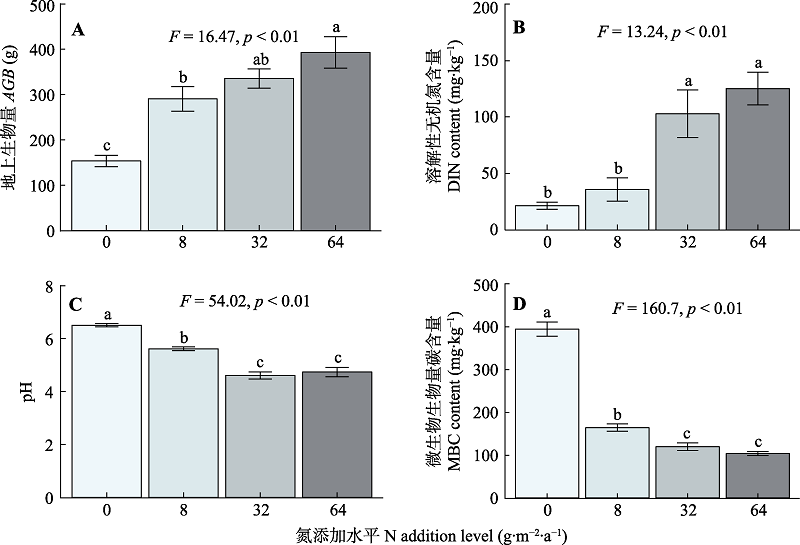
图1 氮添加对地上生物量(A), 溶解性无机氮含量(B), 土壤pH (C)和微生物生物量碳含量(D)的影响(平均值±标准误)。F和p为方差分析的结果, 不同小写字母表示不同氮添加水平间存在显著差异(p < 0.05)。
Fig. 1 Effects of nitrogen (N) addition on aboveground biomass (AGB)(A), dissolved inorganic nitrogen (DIN) content (B), soil pH (C) and microbial biomass carbon (MBC) content (D)(mean ± SE). F and p are the results of one-way ANOVA. Different lowercase letters indicate significant difference among N addition levels (p < 0.05).
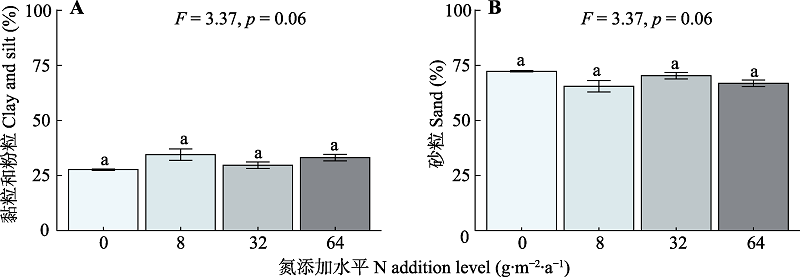
图2 氮添加对土壤黏粒与粉粒含量(A)和砂粒含量(B)的影响(平均值±标准误)。F和p为方差分析的结果, 不同小写字母表示不同氮添加水平间存在显著差异(p < 0.05)。
Fig. 2 Effects of nitrogen (N) addition on soil clay and silt (A) and sand (B) content (mean ± SE). F and p are the results of one-way ANOVA. Different lowercase letters indicate significant difference (p < 0.05) among different N addition levels.
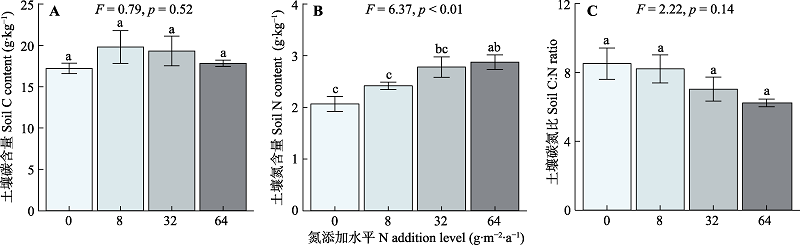
图3 氮添加对土壤碳含量(A)、氮含量(B)和碳氮比(C)的影响(平均值±标准误)。F和p为方差分析的结果, 不同小写字母表示不同氮添加水平间存在显著差异(p < 0.05)。
Fig. 3 Effects of nitrogen (N) addition on soil carbon (C) content (A), soil N content (B) and soil C:N (C)(mean ± SE). F and p are the results of one-way ANOVA. Different lowercase letters indicate significant difference (p < 0.05) among different N addition levels.
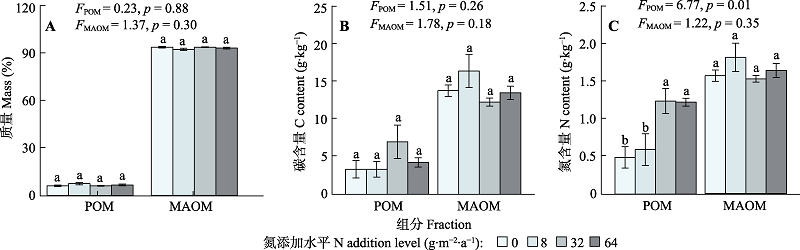
图4 氮添加对土壤中颗粒态有机质(POM)和矿质结合态有机质(MAOM)的相对含量(A)、碳含量(B)和氮含量(C)的影响(平均值±标准误)。F和p为方差分析的结果, 不同字母表示不同氮添加水平间存在显著差异(p < 0.05)。
Fig. 4 Effect of nitrogen (N) addition on the relative mass (A), carbon (C) content (B) and N content (C) of particulate organic matter (POM) and mineral associated organic matter (MAOM)(mean ± SE). F and p are the results of one-way ANOVA. Different lowercase letters indicate significant difference (p < 0.05) among different N addition levels.
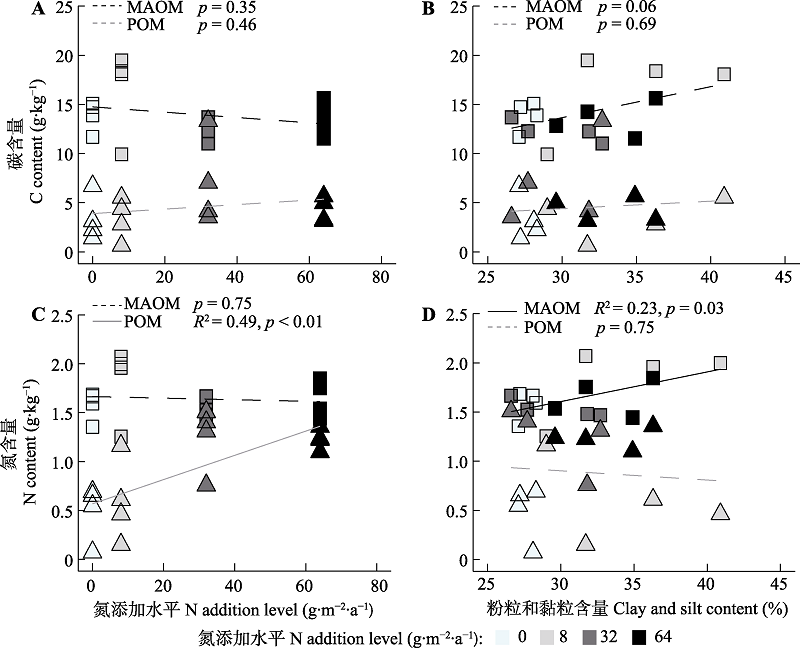
图5 土壤中不同有机质组分的碳氮含量与氮添加水平(A, C)和土壤黏粒与粉粒含量(B, D)的关系。实线表示相关性显著(p < 0.05), 虚线表示相关性不显著。□, 矿质结合态有机质(MAOM); △, 颗粒态有机质(POM)。
Fig. 5 Relationships between the soil carbon (C) in different SOM fractions and nitrogen (N) addition rates (A), and soil clay and silt content (B); and relationships between the soil N in different SOM fractions and N addition rates (C), and soil clay and silt content (D). Solid and dashed lines represent significant (p < 0.05) and insignificant (p > 0.05) relationships, respectively. □, mineral associated organic matter (MAOM); △, particulate organic matter (POM).
| 响应变量 Response variable | 变量 Variable | 相关系数 Correlation coefficient | 标准误 Standard error | t | p |
|---|---|---|---|---|---|
| POM碳含量 C content in POM | 氮添加水平 N addition (g·m-2·a-1) | 0.022 | 0.028 | 0.793 | 0.446 |
| 黏粒与粉粒含量 Silt and sand clay content (%) | 0.013 | 0.187 | -0.068 | 0.947 | |
| MAOM碳含量 C content in MAOM | 氮添加水平 N addition (g·m-2·a-1) | -0.043 | 0.019 | -2.287 | 0.045 |
| 黏粒与粉粒含量 Silt and sand clay content (%) | 0.396 | 0.126 | 3.145 | 0.010 | |
| POM氮含量 N content in POM | 氮添加水平 N addition (g·m-2·a-1) | 0.014 | 0.003 | 4.045 | 0.002 |
| 黏粒与粉粒含量 Silt and sand clay content (%) | -0.030 | 0.021 | -2.086 | 0.182 | |
| MAOM氮含量 N content in MAOM | 氮添加水平 N addition (g·m-2·a-1) | -0.002 | 0.001 | -1.408 | 0.162 |
| 黏粒与粉粒含量 Silt and sand clay content (%) | 0.035 | 0.010 | 3.586 | 0.005 |
表1 氮添加和土壤粉粒与黏粒含量对土壤颗粒态有机质(POM)和矿质结合态有机质(MAOM)碳、氮含量影响的广义线性混合模型(GLMM)分析结果
Table 1 Summary of the generalized linear mixed model (GLMM) for the effects of nitrogen (N) addition and silt and clay content on the carbon (C) and N content in particulate organic matter (POM) and mineral associated organic matter (MAOM)
| 响应变量 Response variable | 变量 Variable | 相关系数 Correlation coefficient | 标准误 Standard error | t | p |
|---|---|---|---|---|---|
| POM碳含量 C content in POM | 氮添加水平 N addition (g·m-2·a-1) | 0.022 | 0.028 | 0.793 | 0.446 |
| 黏粒与粉粒含量 Silt and sand clay content (%) | 0.013 | 0.187 | -0.068 | 0.947 | |
| MAOM碳含量 C content in MAOM | 氮添加水平 N addition (g·m-2·a-1) | -0.043 | 0.019 | -2.287 | 0.045 |
| 黏粒与粉粒含量 Silt and sand clay content (%) | 0.396 | 0.126 | 3.145 | 0.010 | |
| POM氮含量 N content in POM | 氮添加水平 N addition (g·m-2·a-1) | 0.014 | 0.003 | 4.045 | 0.002 |
| 黏粒与粉粒含量 Silt and sand clay content (%) | -0.030 | 0.021 | -2.086 | 0.182 | |
| MAOM氮含量 N content in MAOM | 氮添加水平 N addition (g·m-2·a-1) | -0.002 | 0.001 | -1.408 | 0.162 |
| 黏粒与粉粒含量 Silt and sand clay content (%) | 0.035 | 0.010 | 3.586 | 0.005 |
| 响应变量 Response variable | 因子 Factor | 模型Model | |||
|---|---|---|---|---|---|
| 1 | 2 | 3 | 4 | ||
| POM氮含量 N content in POM | 常数项 Constant term | 1.770 | 1.697 | 0.090 | - |
| 地上生物量 Aboveground biomass | 0.003 | 0.002 | 0.003 | - | |
| 微生物生物量碳含量 Microbial biomass carbon content | 0.002 | - | - | - | |
| C:N | -1.111 | -0.067 | - | - | |
| 赤池信息准则 Akaike information criterion | 24.90 | 21.95 | 17.66 | - | |
| MAOM氮含量 N content in MAOM | 常数项 Constant term | 1.202 | 1.451 | 0.762 | 0.702 |
| 黏粒与粉粒含量 Silt and clay content | 0.031 | 0.029 | 0.036 | 0.030 | |
| 微生物生物量碳含量 Microbial biomass carbon content | -0.002 | -0.001 | - | - | |
| 异养呼吸速率 Heterotrophic respiration rate | 0.375 | - | - | - | |
| 地上生物量 Aboveground biomass | -0.002 | -0.002 | -0.001 | - | |
| 赤池信息准则 Akaike information criterion | 5.92 | 5.17 | 3.01 | 2.30 | |
表2 颗粒态有机质(POM)和矿质结合态有机质(MAOM)的氮(N)含量影响因子的基于赤池信息推测的最优模型筛选
Table 2 Summary of the best corrected Akaike Information Criterion (AICc)-selected models for the nitrogen (N) content in particulate organic matter (POM) and mineral associated organic matter (MAOM)
| 响应变量 Response variable | 因子 Factor | 模型Model | |||
|---|---|---|---|---|---|
| 1 | 2 | 3 | 4 | ||
| POM氮含量 N content in POM | 常数项 Constant term | 1.770 | 1.697 | 0.090 | - |
| 地上生物量 Aboveground biomass | 0.003 | 0.002 | 0.003 | - | |
| 微生物生物量碳含量 Microbial biomass carbon content | 0.002 | - | - | - | |
| C:N | -1.111 | -0.067 | - | - | |
| 赤池信息准则 Akaike information criterion | 24.90 | 21.95 | 17.66 | - | |
| MAOM氮含量 N content in MAOM | 常数项 Constant term | 1.202 | 1.451 | 0.762 | 0.702 |
| 黏粒与粉粒含量 Silt and clay content | 0.031 | 0.029 | 0.036 | 0.030 | |
| 微生物生物量碳含量 Microbial biomass carbon content | -0.002 | -0.001 | - | - | |
| 异养呼吸速率 Heterotrophic respiration rate | 0.375 | - | - | - | |
| 地上生物量 Aboveground biomass | -0.002 | -0.002 | -0.001 | - | |
| 赤池信息准则 Akaike information criterion | 5.92 | 5.17 | 3.01 | 2.30 | |
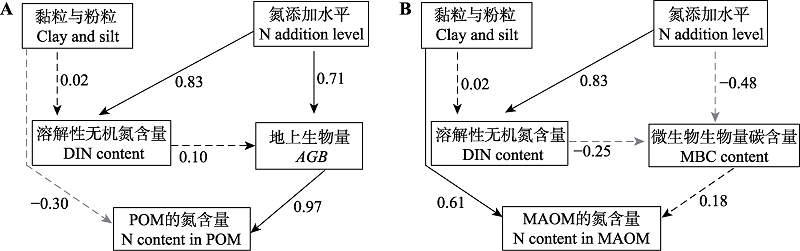
图6 氮添加对颗粒态有机质(POM)(A)和矿质结合态有机质(MAOM)(B)的氮含量影响途径的结构方程模型(SEM)分析结果。模型拟合的结果: POMN, χ2 = 0.480, p = 0.787, 相对拟合指数(CFI) = 1.000, 近似误差平方根(RMSEA) < 0.001; MAOMN, X2 = 2.856, p = 0.414, CFI = 1.000, RMSER < 0.001。实线箭头代表显著的效应(p < 0.05), 虚线箭头代表没有显著的效应(p > 0.05), 箭头附近的数字代表标准化的路径系数。
Fig. 6 A schematic representation of the structural equation modeling (SEM) analysis used to identify the controls of soil nitrogen (N) content in particulate organic matter (POM)(A) and mineral associated organic matter (MAOM)(B) under N addition. Results of the model fitting were: POMN, X2 = 0.480, p = 0.787, comparative fit index (CFI) = 1.000, root-mean-square (RMSEA) < 0.001; MAOMN, X2 = 2.856, p = 0.414, CFI = 1.000, RMSEA < 0.001. Solid and dashed arrows represent significant effect (p < 0.05) and insignificant effect (p > 0.05), respectively. Number adjacent to the arrows refer to the standardized path coefficients. AGB, aboveground biomass; DIN, dissolved inorganic nitrogen; MBC, microbial biomass carbon.
| [1] |
Beck T, Joergensen RG, Kandeler E, Makeschin F, Nuss E, Oberholzer HR, Scheu S (1997). An inter-laboratory comparison of ten different ways of measuring soil microbial biomass C. Soil Biology & Biochemistry, 29, 1023-1032.
DOI URL |
| [2] |
Brookes PC, Landman A, Pruden G, Jenkinson DS (1985). Chloroform fumigation and the release of soil-nitrogen-A rapid direct extraction method to measure microbial biomass nitrogen in soil. Soil Biology & Biochemistry, 17, 837-842.
DOI URL |
| [3] |
Castellano MJ, Mueller KE, Olk DC, Sawyer JE, Six J (2015). Integrating plant litter quality, soil organic matter stabilization, and the carbon saturation concept. Global Change Biology, 21, 3200-3209.
DOI PMID |
| [4] |
Christensen BT (2001). Physical fractionation of soil and structural and functional complexity in organic matter turnover. European Journal of Soil Science, 52, 345-353.
DOI URL |
| [5] |
Diao LW, Li P, Liu WX, Xu S, Qiao CL, Zeng H, Liu LL (2018). Response of plant biomass to nitrogen addition and precipitation increasing under different climate conditions and time scales in grassland. Chinese Journal of Plant Ecology, 42, 818-830.
DOI |
|
[ 刁励玮, 李平, 刘卫星, 徐姗, 乔春连, 曾辉, 刘玲莉 (2018). 草地生态系统生物量在不同气候及多时间尺度上对氮添加和增雨处理的响应. 植物生态学报, 42, 818-830.]
DOI |
|
| [6] |
Dungait JAJ, Hopkins DW, Gregory AS, Whitmore AP (2012). Soil organic matter turnover is governed by accessibility not recalcitrance. Global Change Biology, 18, 1781-1796.
DOI URL |
| [7] |
Forthofer RN, Lee ES (1996). Introduction to biostatistics: a guide to design, analysis, and discovery. Biometrics, 52, 378. DOI: 10.2307/2533181.
DOI |
| [8] |
Francesca Cotrufo M, Ranalli MG, Haddix ML, Six J, Lugato E (2019). Soil carbon storage informed by particulate and mineral-associated organic matter. Nature Geoscience, 12, 989-994.
DOI |
| [9] |
Francesca Cotrufo M, Soong JL, Horton AJ, Campbell EE, Haddix ML, Wall DH, Parton WJ (2015). Formation of soil organic matter via biochemical and physical pathways of litter mass loss. Nature Geoscience, 8, 776-779.
DOI |
| [10] |
Frey SD, Ollinger S, Nadelhoffer K, Bowden R, Brzostek E, Burton A, Caldwell BA, Crow S, Goodale CL, Grandy AS, Finzi A, Kramer MG, Lajtha K, LeMoine J, Martin M, McDowell WH, Minocha R, Sadowsky JJ, Templer PH, Wickings K (2014). Chronic nitrogen additions suppress decomposition and sequester soil carbon in temperate forests. Biogeochemistry, 121, 305-316.
DOI URL |
| [11] |
Galloway JN, Townsend AR, Erisman JW, Bekunda M, Cai Z, Freney JR, Martinelli LA, Seitzinger SP, Sutton MA (2008). Transformation of the nitrogen cycle: recent trends, questions, and potential solutions. Science, 320, 889-892.
DOI PMID |
| [12] |
Hassink J (1997). The capacity of soils to preserve organic C and N by their association with clay and silt particles. Plant and Soil, 191, 77-87.
DOI URL |
| [13] | Kleber M, Eusterhues K, Keiluweit M, Mikutta C, Mikutta R, Nico PS (2015). Mineral-organic associations: formation, properties, and relevance in soil environments. Advances in Agronomy, 130, 1-140. |
| [14] |
Kuzyakov Y, Xu XL (2013). Competition between roots and microorganisms for nitrogen: mechanisms and ecological relevance. New Phytologist, 198, 656-669.
DOI PMID |
| [15] |
Lavallee JM, Soong JL, Cotrufo MF (2020). Conceptualizing soil organic matter into particulate and mineral-associated forms to address global change in the 21st century. Global Change Biology, 26, 261-273.
DOI PMID |
| [16] |
Liu LL, Greaver TL (2010). A global perspective on belowground carbon dynamics under nitrogen enrichment. Ecology Letters, 13, 819-828.
DOI URL |
| [17] | Liu MQ, Hu F, Chen XY (2007). A review on mechanisms of soil organic carbon stabilization. Acta Ecologica Sinica, 27, 2642-2650. |
| [ 刘满强, 胡锋, 陈小云 (2007). 土壤有机碳稳定机制研究进展. 生态学报, 27, 2642-2650.] | |
| [18] |
Liu WX, Qiao CL, Yang S, Bai WM, Liu LL (2018). Microbial carbon use efficiency and priming effect regulate soil carbon storage under nitrogen deposition by slowing soil organic matter decomposition. Geoderma, 332, 37-44.
DOI URL |
| [19] |
Lu M, Yang YH, Luo YQ, Fang CM, Zhou XH, Chen JK, Yang X, Li B (2011). Responses of ecosystem nitrogen cycle to nitrogen addition: a meta-analysis. New Phytologist, 189, 1040-1050.
DOI URL |
| [20] |
Meyer S, Leifeld J, Bahn M, Fuhrer J (2012). Free and protected soil organic carbon dynamics respond differently to abandonment of mountain grassland. Biogeosciences, 9, 853-865.
DOI URL |
| [21] |
Mikutta R, Kaiser K (2011). Organic matter bound to mineral surfaces: resistance to chemical and biological oxidation. Soil Biology & Biochemistry, 43, 1738-1741.
DOI URL |
| [22] |
Mikutta R, Turner S, Schippers A, Gentsch N, Meyer-Stüve S, Condron LM, Peltzer DA, Richardson SJ, Eger A, Hempel G, Kaiser K, Klotzbücher T, Guggenberger G (2019). Microbial and abiotic controls on mineral-associated organic matter in soil profiles along an ecosystem gradient. Scientific Reports, 9, 10294. DOI: 10.1038/s41598-019-46501-4.
DOI PMID |
| [23] |
Näsholm T, Kielland K, Ganeteg U (2009). Uptake of organic nitrogen by plants. New Phytologist, 182, 31-48.
DOI PMID |
| [24] |
Niu SL, Classen AT, Dukes JS, Kardol P, Liu LL, Luo YQ, Rustad L, Sun J, Tang JW, Templer PH, Thomas RQ, Tian DS, Vicca S, Wang YP, Xia JY, Zaehle S (2016). Global patterns and substrate-based mechanisms of the terrestrial nitrogen cycle. Ecology Letters, 19, 697-709.
DOI URL |
| [25] |
Pribyl DW (2010). A critical review of the conventional SOC to SOM conversion factor. Geoderma, 156, 75-83.
DOI URL |
| [26] |
Riggs CE, Hobbie SE, Bach EM, Hofmockel KS, Kazanski CE (2015). Nitrogen addition changes grassland soil organic matter decomposition. Biogeochemistry, 125, 203-219.
DOI URL |
| [27] |
Schmidt MWI, Torn MS, Abiven S, Dittmar T, Guggenberger G, Janssens IA, Kleber M, Kögel-Knabner I, Lehmann J, Manning DAC, Nannipieri P, Rasse DP, Weiner S, Trumbore SE (2011). Persistence of soil organic matter as an ecosystem property. Nature, 478, 49-56.
DOI URL |
| [28] |
Six J, Callewaert P, Lenders S, de Gryze S, Morris SJ, Gregorich EG, Paul EA, Paustian K (2002). Measuring and understanding carbon storage in afforested soils by physical fractionation. Soil Science Society of America Journal, 66, 1981-1987.
DOI URL |
| [29] |
Sollins P, Kramer MG, Swanston C, Lajtha K, Filley T, Aufdenkampe AK, Wagai R, Bowden RD (2009). Sequential density fractionation across soils of contrasting mineralogy: evidence for both microbial- and mineral-controlled soil organic matter stabilization. Biogeochemistry, 96, 209-231.
DOI URL |
| [30] |
Vance ED, Brookes PC, Jenkinson DS (1987). An extraction method for measuring soil microbial biomass C. Soil Biology & Biochemistry, 19, 703-707.
DOI URL |
| [31] |
von Lützow M, Kögel-Knabner I, Ekschmitt K, Flessa H, Guggenberger G, Matzner E, Marschner B (2007). SOM fractionation methods: relevance to functional pools and to stabilization mechanisms. Soil Biology & Biochemistry, 39, 2183-2207.
DOI URL |
| [32] |
Wei C, Yu Q, Bai E, Lü X, Li Q, Xia J, Kardol P, Liang W, Wang Z, Han X (2013). Nitrogen deposition weakens plant-microbe interactions in grassland ecosystems. Global Change Biology, 19, 3688-3697.
DOI URL |
| [33] |
Wiesmeier M, Munro S, Barthold F, Steffens M, Schad P, Kögel-Knabner I (2015). Carbon storage capacity of semi-arid grassland soils and sequestration potentials in Northern China. Global Change Biology, 21, 3836-3845.
DOI PMID |
| [34] |
Yang S, Liu WX, Qiao CL, Wang J, Deng MF, Zhang BB, Liu LL (2019). The decline in plant biodiversity slows down soil carbon turnover under increasing nitrogen deposition in a temperate steppe. Functional Ecology, 33, 1362-1372.
DOI |
| [35] |
Yu GR, Jia YL, He NP, Zhu JX, Chen Z, Wang QF, Piao SL, Liu XJ, He HL, Guo XB, Wen Z, Li P, Ding GA, Goulding K (2019). Stabilization of atmospheric nitrogen deposition in China over the past decade. Nature Geoscience, 12, 424-429.
DOI URL |
| [36] |
Zhang TA, Chen HYH, Ruan HH (2018). Global negative effects of nitrogen deposition on soil microbes. The ISME Journal, 12, 1817-1825.
DOI URL |
| [37] |
Zhang Y, Zheng LX, Liu XJ, Jickells T, Neil Cape J, Goulding K, Fangmeier A, Zhang FS (2008). Evidence for organic N deposition and its anthropogenic sources in China. Atmospheric Environment, 42, 1035-1041.
DOI URL |
| [1] | 李燚, 黄欢, 赵艳超, 陈立同. 养分添加对不同海拔高寒草甸群落多样性及组成的影响[J]. 植物生态学报, 2026, 50(预发表): 0-. |
| [2] | 张安宁, 肖亚宁, 赵霞, 张淼, 崔瀚文, 陈书燕, 安黎哲. 青藏高原灌木化与氮添加对土壤线虫及功能性状的交互作用[J]. 植物生态学报, 2026, 50(预发表): 0-. |
| [3] | 贾会丽, 王睿, 常玉良, 林茂, 栗国梁, 武帅楷, 苏原, 董宽虎, $\boxed{\hbox{王常慧}}$. 不同水平氮添加下晋北赖草叶片化学计量特征及其对光合的影响[J]. 植物生态学报, 2026, 50(2): 429-441. |
| [4] | 戴允泽, 姚良锦, 陈淼, 徐小牛. 氮磷添加对常绿阔叶林土壤团聚体稳定性及其碳氮含量的影响[J]. 植物生态学报, 2026, 50(1): 55-69. |
| [5] | 皮惠之, 张秋芳, 孙浩, 曾泉鑫, 彭园珍, 元晓春, 徐建国, 陈岳民. 微生物碳氮不平衡影响罗浮栲林土壤微生物氮利用效率对氮富集的响应[J]. 植物生态学报, 2026, 50(1): 34-44. |
| [6] | 刘影, 李疆枫, 吴佳琪, 王艺帆, 尹清琳, 王静. 干旱下草地植物糙隐子草根系和菌根真菌对土壤碳氮的影响[J]. 植物生态学报, 2025, 49(9): 1388-1398. |
| [7] | 冯梅, 欧阳胜男, 李迈和, 周晓倩, 铁烈华, 申卫军, 段洪浪. 前期氮添加对无梗花栎幼苗干旱响应中地上-地下碳氮分配动态的影响[J]. 植物生态学报, 2025, 49(9): 1527-1542. |
| [8] | 张法伟, 李红琴, 祝景彬, 樊博, 周华坤, 李英年, 梁乃申. 氮添加和降水改变对高寒草甸生态系统地上与地下碳储的影响[J]. 植物生态学报, 2025, 49(9): 1399-1409. |
| [9] | 郝杰, 刁华杰, 苏原, 武帅楷, 高阳阳, 梁雯君, 牛慧敏, 杨倩雯, 常婕, 王袼, 许雯丽, 马腾飞, 董宽虎, $\boxed{\hbox{王常慧}}$. 降水调控农牧交错带盐渍化草地净初级生产力对氮添加及刈割的响应[J]. 植物生态学报, 2025, 49(5): 710-719. |
| [10] | 唐远翔, 熊仕臣, 朱洪锋, 张新生, 游成铭, 刘思凝, 谭波, 徐振锋. 长期氮添加对四川盆地西缘常绿阔叶林优势树种凋落叶产量及碳氮磷归还的影响[J]. 植物生态学报, 2025, 49(5): 720-731. |
| [11] | 闫小莉, 刘贵梅, 李小玉, 江宇翔, 全小强, 王燕茹, 曲鲁平, 汤行昊. 不同氮添加水平和铵硝态氮配比环境下木荷幼苗光合及叶绿素荧光特性[J]. 植物生态学报, 2025, 49(4): 624-637. |
| [12] | 田彤彤, 尚博, 徐彦森, 袁相洋, 刘硕, 冯兆忠. 臭氧浓度升高和氮添加对杨树不同叶位和生长时期光合特性的影响[J]. 植物生态学报, 2025, 49(11): 1919-1933. |
| [13] | 冉佳鑫, 张宇辉, 王云, 杨智杰, 毛超. 增温和氮磷添加对亚热带森林凋落物溶解有机碳生物可降解性的影响[J]. 植物生态学报, 2024, 48(9): 1232-1242. |
| [14] | 全小强, 王燕茹, 李小玉, 梁海燕, 王立冬, 闫小莉. 氮添加和铵硝态氮配比对杉木幼苗光合特性及叶绿素荧光参数的影响[J]. 植物生态学报, 2024, 48(8): 1050-1064. |
| [15] | 焦荟颖, 刘立强, 杨佳鑫, 秦伟, 王睿哲. 新疆野苹果自然种群根际固氮菌、解磷菌及解钾菌对叶片养分和生理指标的影响[J]. 植物生态学报, 2024, 48(7): 930-942. |
| 阅读次数 | ||||||
|
全文 |
|
|||||
|
摘要 |
|
|||||
Copyright © 2026 版权所有 《植物生态学报》编辑部
地址: 北京香山南辛村20号, 邮编: 100093
Tel.: 010-62836134, 62836138; Fax: 010-82599431; E-mail: apes@ibcas.ac.cn, cjpe@ibcas.ac.cn
备案号: 京ICP备16067583号-19

