
植物生态学报 ›› 2025, Vol. 49 ›› Issue (10): 1733-1743.DOI: 10.17521/cjpe.2024.0306 cstr: 32100.14.cjpe.2024.0306
陈诚智1, 高钰森1, 罗力嘉1, 王东1,2,*( )
)
收稿日期:2024-09-11
接受日期:2025-01-27
出版日期:2025-10-20
发布日期:2025-01-27
通讯作者:
*王东(dongwang1108@163.com)基金资助:
CHEN Cheng-Zhi1, GAO Yu-Sen1, LUO Li-Jia1, WANG Dong1,2,*()
Received:2024-09-11
Accepted:2025-01-27
Online:2025-10-20
Published:2025-01-27
Supported by:摘要: 高寒灌丛因其较高的土壤碳储量及对全球变化的敏感性, 已成为全球碳循环研究的热点区域。凋落枝和凋落叶在陆地生态系统物质循环中起着重要作用, 但有关二者生产与分解的对比研究还十分缺乏, 难以准确评估其对土壤碳和养分循环的影响差异。基于此, 该研究以青藏高原东部的优势灌丛——窄叶鲜卑花(Sibiraea angustata)为研究对象, 连续4年(2012-2015)监测了凋落枝和凋落叶的生产与分解, 并量化其碳氮残留量。结果表明: (1)凋落叶具有较高的生产量, 其年产量平均为凋落枝的4.41倍, 分别为138.94和31.48 g∙m-2∙a-1; (2)凋落枝的分解速率显著低于凋落叶, 二者的分解常数分别为0.356·a-1和0.522·a-1, 且凋落枝分解的最终残留比例(0.287)为凋落叶(0.059)的4.86倍; (3)在4年的分解过程中, 凋落叶中的氮动态表现为净释放模式, 而凋落枝则为“富集—稳定—释放”模式; (4)凋落枝和凋落叶的碳残留量较为接近(3.85和3.72 g∙m-2∙a-1), 但凋落叶的氮残留量更高(0.06和0.11 g∙m-2∙a-1)。该研究明确了凋落枝慢速分解在高寒灌丛碳储量累积中的关键作用, 以及凋落叶快速氮释放和高效氮归还对缓解土壤氮限制的重要性, 为准确评估凋落枝和凋落叶对土壤碳氮循环的贡献提供了重要依据。
陈诚智, 高钰森, 罗力嘉, 王东. 川西高寒窄叶鲜卑花灌丛凋落枝和凋落叶生产与分解. 植物生态学报, 2025, 49(10): 1733-1743. DOI: 10.17521/cjpe.2024.0306
CHEN Cheng-Zhi, GAO Yu-Sen, LUO Li-Jia, WANG Dong. Twig and leaf litter production and decomposition in an alpine Sibiraea angustata shrubland of western Sichuan, China. Chinese Journal of Plant Ecology, 2025, 49(10): 1733-1743. DOI: 10.17521/cjpe.2024.0306
| 凋落物 Litter | 碳含量 Carbon (C) content (%) | 氮含量 Nitrogen (N) content (%) | 碳:氮 C:N | 木质素含量 Lignin content (%) | 木质素:N Lignin:N |
|---|---|---|---|---|---|
| 凋落枝 Twig litter | 48.23 ± 0.38** | 0.73 ± 0.04 | 66.09 ± 3.40** | 59.50 ± 2.21** | 81.75 ± 6.37** |
| 凋落叶 Leaf litter | 40.43 ± 0.71 | 1.46 ± 0.11* | 27.94 ± 1.60 | 11.04 ± 1.95 | 7.66 ± 1.02 |
表1 川西高寒窄叶鲜卑花灌丛凋落枝和凋落叶的初始化学属性(平均值±标准误, n = 3)
Table 1 Initial chemical properties of twig litter and leaf litter in an alpine Sibiraea angustata shrubland of western Sichuan, China (mean ± SE, n = 3)
| 凋落物 Litter | 碳含量 Carbon (C) content (%) | 氮含量 Nitrogen (N) content (%) | 碳:氮 C:N | 木质素含量 Lignin content (%) | 木质素:N Lignin:N |
|---|---|---|---|---|---|
| 凋落枝 Twig litter | 48.23 ± 0.38** | 0.73 ± 0.04 | 66.09 ± 3.40** | 59.50 ± 2.21** | 81.75 ± 6.37** |
| 凋落叶 Leaf litter | 40.43 ± 0.71 | 1.46 ± 0.11* | 27.94 ± 1.60 | 11.04 ± 1.95 | 7.66 ± 1.02 |
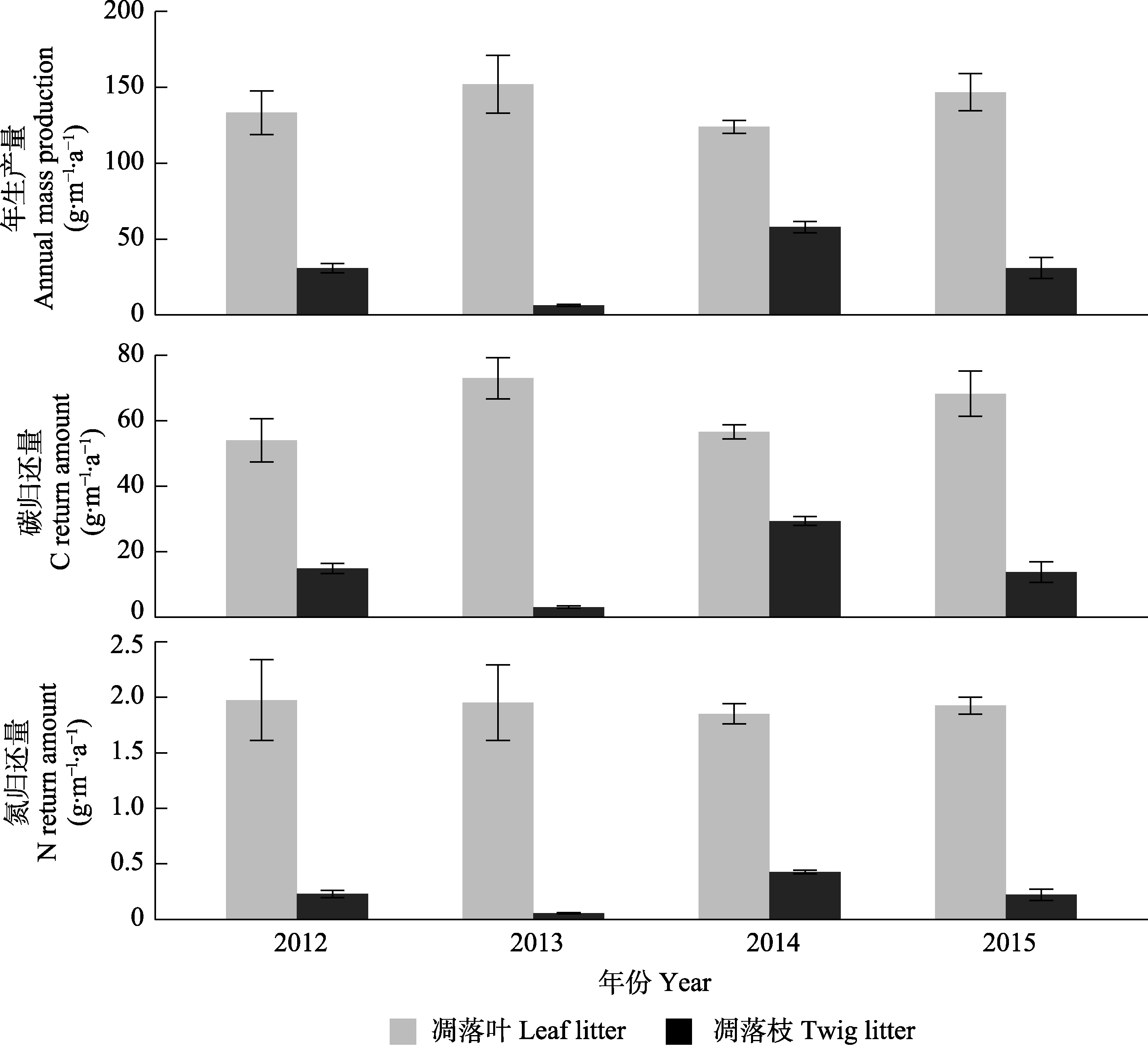
图1 川西高寒窄叶鲜卑花灌丛凋落枝和凋落叶的年产量和碳氮归还量(平均值±标准误, n = 3)。
Fig. 1 Annual production of mass and carbon (C) and nitrogen (N) from twig and leaf litter in an alpine Sibiraea angustata shrubland of western Sichuan, China (mean ± SE, n = 3).
| 变量 Variable | 变异 Variance | 自由度 Degrees of freedom (df) | 方差 Sum of squares (SS) | 均方差 Mean square (MS) | F | p |
|---|---|---|---|---|---|---|
| 生产量 Mass production | LT | 1,16 | 69 287 | 69 287 | 229.00 | <0.001** |
| ST | 3,16 | 559 | 186 | 0.62 | 0.615 | |
| LT × ST | 3,16 | 4 892 | 1 631 | 5.38 | 0.009** | |
| 碳归还量 Carbon production | LT | 1,16 | 13 676 | 13 676 | 241.00 | <0.001** |
| ST | 3,16 | 250 | 83.50 | 1.47 | 0.261 | |
| LT × ST | 3,16 | 1 548 | 515.8 | 9.07 | <0.001** | |
| 氮归还量 Nitrogen production | LT | 1,16 | 17.18 | 17.18 | 171.00 | <0.001** |
| ST | 3,16 | 0.06 | 0.02 | 0.20 | 0.897 | |
| LT × ST | 3,16 | 0.18 | 0.06 | 0.58 | 0.636 |
表2 凋落物类型(LT)和采样时间(ST)及二者的交互作用(LT × ST)对川西高寒窄叶鲜卑花灌丛凋落物的年生产量和碳氮归还量的影响
Table 2 Effects of litter types (LT) and sampling time (ST) and their interaction (LT × ST) on annual production of mass, carbon and nitrogen from litter in an alpine Sibiraea angustata shrubland of western Sichuan, China
| 变量 Variable | 变异 Variance | 自由度 Degrees of freedom (df) | 方差 Sum of squares (SS) | 均方差 Mean square (MS) | F | p |
|---|---|---|---|---|---|---|
| 生产量 Mass production | LT | 1,16 | 69 287 | 69 287 | 229.00 | <0.001** |
| ST | 3,16 | 559 | 186 | 0.62 | 0.615 | |
| LT × ST | 3,16 | 4 892 | 1 631 | 5.38 | 0.009** | |
| 碳归还量 Carbon production | LT | 1,16 | 13 676 | 13 676 | 241.00 | <0.001** |
| ST | 3,16 | 250 | 83.50 | 1.47 | 0.261 | |
| LT × ST | 3,16 | 1 548 | 515.8 | 9.07 | <0.001** | |
| 氮归还量 Nitrogen production | LT | 1,16 | 17.18 | 17.18 | 171.00 | <0.001** |
| ST | 3,16 | 0.06 | 0.02 | 0.20 | 0.897 | |
| LT × ST | 3,16 | 0.18 | 0.06 | 0.58 | 0.636 |
| 凋落物 Litter | 模型名称 Model name | 模型方程 Model equation | R2 | 赤池信息准则 AIC | 95%分解期 Time for 95% mass loss (a) |
|---|---|---|---|---|---|
| 凋落枝 Twig litter | 渐近线 Asymptote model | Y = 0.287 + 0.713e-0.727t | 0.975 | -42.41 | |
| 单指数 Single exponential model | Y = e-0.356t | 0.928 | -59.33 | 8.41 | |
| 凋落叶 Leaf litter | 渐近线 Asymptote model | Y = 0.059 + 0.941e-0.594t | 0.978 | -54.89 | |
| 单指数 Single exponential model | Y = e-0.522t | 0.977 | -54.22 | 5.74 |
表3 川西高寒窄叶鲜卑花灌丛凋落枝和凋落叶分解模型的比较
Table 3 Comparison of decomposition models between twig litter and leaf litter in an alpine Sibiraea angustata shrubland of western Sichuan
| 凋落物 Litter | 模型名称 Model name | 模型方程 Model equation | R2 | 赤池信息准则 AIC | 95%分解期 Time for 95% mass loss (a) |
|---|---|---|---|---|---|
| 凋落枝 Twig litter | 渐近线 Asymptote model | Y = 0.287 + 0.713e-0.727t | 0.975 | -42.41 | |
| 单指数 Single exponential model | Y = e-0.356t | 0.928 | -59.33 | 8.41 | |
| 凋落叶 Leaf litter | 渐近线 Asymptote model | Y = 0.059 + 0.941e-0.594t | 0.978 | -54.89 | |
| 单指数 Single exponential model | Y = e-0.522t | 0.977 | -54.22 | 5.74 |
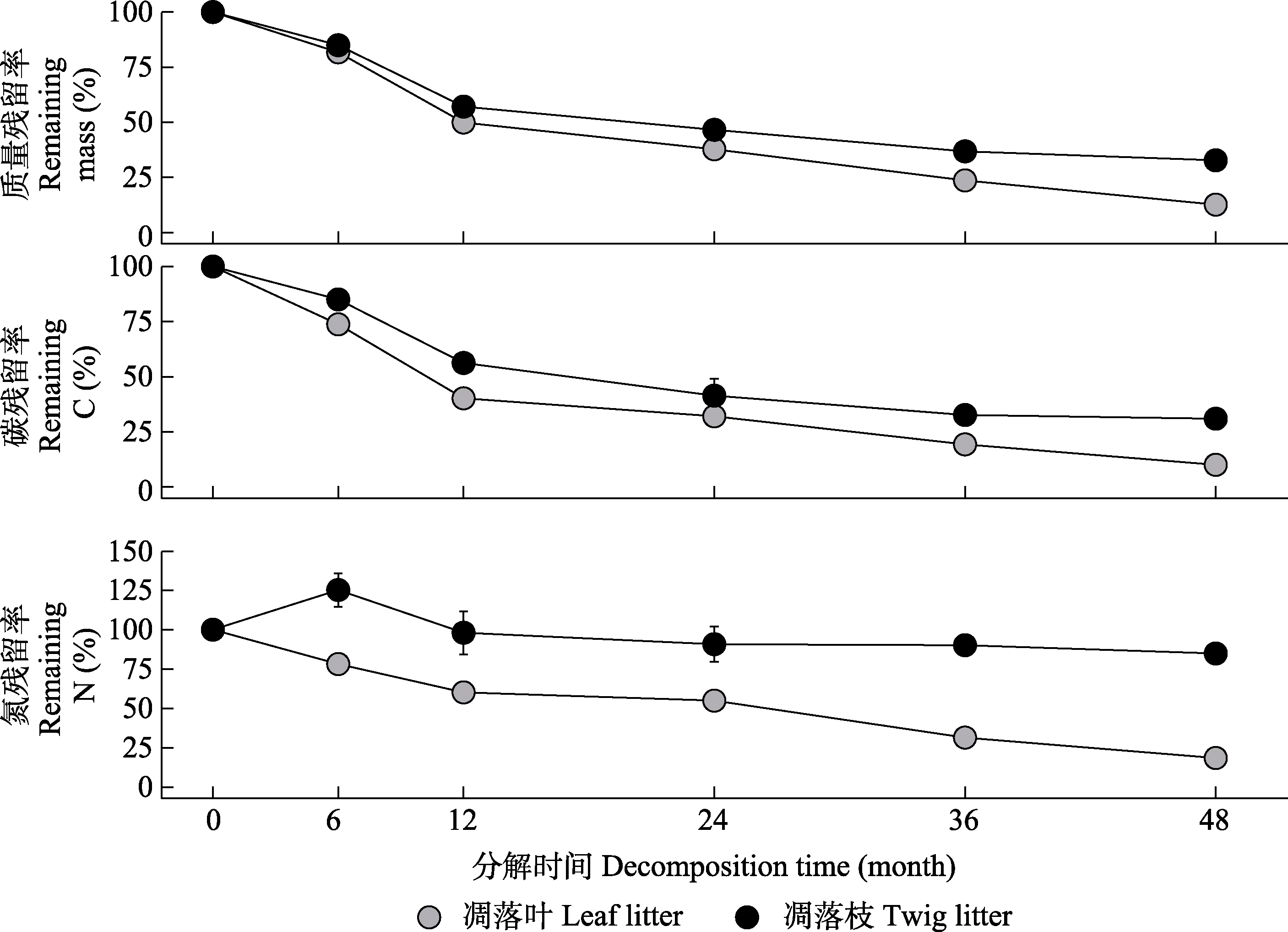
图2 川西高寒窄叶鲜卑花灌丛凋落枝和凋落叶分解过程中的质量残留率和碳氮残留率(平均值±标准误, n = 3)。
Fig. 2 Remaining mass and carbon (C) and nitrogen (N) (% of initial) of leaf and twig litter during four years of decomposition in an alpine Sibiraea angustata shrubland of western Sichuan, China (mean ± SE, n = 3).
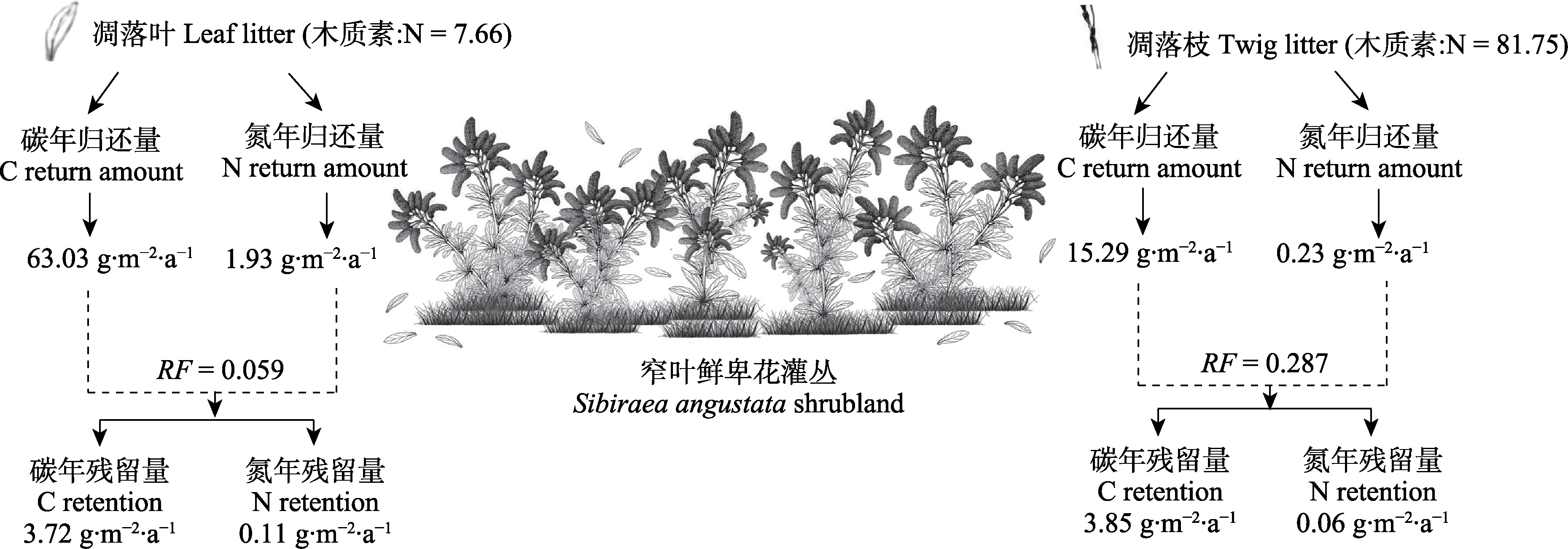
图3 川西高寒窄叶鲜卑花灌丛凋落叶和凋落枝的碳氮归还量及残留量。窄叶鲜卑花图案改自《中国植物志》第36卷 (中国科学院中国植物志编辑委员会, 1990)。RF为凋落物渐近线模型中的“渐进值”。
Fig. 3 Annual return amount and retention of carbon (C) and nitrogen (N) in leaf and twig litter of S. angustata alpine shrubland. The images of S. angustata was modified from Flora of China (Flora of China Editorial Committee of Chinese Academy of Sciences, 1990). RF represents recalcitrant fraction of litter during decomposition.
| [1] |
Allen AP, Gillooly JF (2009). Towards an integration of ecological stoichiometry and the metabolic theory of ecology to better understand nutrient cycling. Ecology Letters, 12, 369-384.
DOI PMID |
| [2] | Bates D, Mächler M, Bolker B, Walker S (2015). Fitting linear mixed-effects models using lme4. Journal of Statistical Software, 67(1), 1-48. |
| [3] | Beier C, Emmett BA, Tietema A, Schmidt IK, Peñuelas J, Láng EK, Duce P, de Angelis P, Gorissen A, Estiarte M, de Dato GD, Sowerby A, Kröel-Dulay G, Lellei-Kovács E, Kull O, et al. (2009). Carbon and nitrogen balances for six shrublands across Europe. Global Biogeochemical Cycles, 23, GB4008. DOI: 10.1029/2008GB003381. |
| [4] |
Berg B (2000). Litter decomposition and organic matter turnover in northern forest soils. Forest Ecology and Management, 133, 13-22.
DOI URL |
| [5] |
Berg B, Davey MP, de Marco A, Emmett B, Faituri M, Hobbie SE, Johansson MB, Liu C, McClaugherty C, Norell L, Rutigliano FA, Vesterdal L,Virzo de Santo A (2010). Factors influencing limit values for pine needle litter decomposition: a synthesis for boreal and temperate pine forest systems. Biogeochemistry, 100, 57-73.
DOI URL |
| [6] | Berg B, Ekbohm G, Söderström B, Staaf H (1991). Reduction of decomposition rates of scots pine needle litter due to heavy-metal pollution. Water, Air, and Soil Pollution, 59, 165-177. |
| [7] |
Berg B, Hannus K, Popoff T, Theander O (1982). Changes in organic chemical components of needle litter during decomposition. Long-term decomposition in a scots pine forest. I. Canadian Journal of Botany, 60, 1310-1319.
DOI URL |
| [8] | Berg B, McClaugherty C (2014). Plant Litter: Models that Describe Litter Decomposition. Springer, Berlin. |
| [9] |
Blok D, Elberling B, Michelsen A (2016). Initial stages of tundra shrub litter decomposition may be accelerated by deeper winter snow but slowed down by spring warming. Ecosystems, 19, 155-169.
DOI URL |
| [10] |
Bloom AJ, Chapin III FS, Mooney HA (1985). Resource limitation in plants—An economic analogy. Annual Review of Ecology and Systematics, 16, 363-392.
DOI URL |
| [11] |
Canessa R, van den Brink L, Saldaña A, Rios RS, Hättenschwiler S, Mueller CW, Prater I, Tielbörger K, Bader MY (2021). Relative effects of climate and litter traits on decomposition change with time, climate and trait variability. Journal of Ecology, 109, 447-458.
DOI URL |
| [12] | Cao TT, Zhang Q, Chen YR, Li Q, Fang Y, Luo YC, Duan CJ, Chen Q, Song XZ, Tian XJ (2024). Enlarging interface reverses the dominance of fungi over bacteria in litter decomposition. Soil Biology & Biochemistry, 198, 109543. DOI: 10.1016/j.soilbio.2024.109543. |
| [13] |
Chapin III FS, Bloom AJ, Field CB, Waring RH (1987). Plant responses to multiple environmental factors physiological ecology provides tools for studying how interacting environmental resources control plant growth. BioScience, 37, 49-57.
DOI URL |
| [14] |
Cornwell WK, Cornelissen JHC, Amatangelo K, Dorrepaal E, Eviner VT, Godoy O, Hobbie SE, Hoorens B, Kurokawa H, Pérez-Harguindeguy N, Quested HM, Santiago LS, Wardle DA, Wright IJ, Aerts R, et al. (2008). Plant species traits are the predominant control on litter decomposition rates within biomes worldwide. Ecology Letters, 11, 1065-1071.
DOI PMID |
| [15] |
Cotrufo MF, Soong JL, Horton AJ, Campbell EE, Haddix ML, Wall DH, Parton WJ (2015). Formation of soil organic matter via biochemical and physical pathways of litter mass loss. Nature Geoscience, 8, 776-779.
DOI |
| [16] |
de Vries W, Reinds GJ, Gundersen P, Sterba H (2006). The impact of nitrogen deposition on carbon sequestration in European forests and forest soils. Global Change Biology, 12, 1151-1173.
DOI URL |
| [17] |
Du EZ, Fenn ME, de Vries W, Ok YS (2019). Atmospheric nitrogen deposition to global forests: status, impacts and management options. Environmental Pollution, 250, 1044-1048.
DOI PMID |
| [18] |
Ferreira ML, Silva JL, Pereira EE,do Nascimento Lamano-Ferreira AP (2014). Litter fall production and decomposition in a fragment of secondary Atlantic Forest of São Paulo, sp, southeastern Brazil. Revista Árvore, 38, 591-600.
DOI URL |
| [19] |
Fioretto A, Papa S, Fuggi A (2003). Litter-fall and litter decomposition in a low Mediterranean shrubland. Biology and Fertility of Soils, 39, 37-44.
DOI URL |
| [20] | Flora of China Editorial Committee of Chinese Academy of Sciences (1990). The Flora of China: Vol. 36. Science Press, Beijing. 70. |
| [中国科学院中国植物志编辑委员会 (1990). 中国植物志: 第36卷. 科学出版社, 北京. 70.] | |
| [21] |
Gao Q, Yang XC, Yin CY, Liu Q (2014). Estimation of biomass allocation and carbon density in alpine dwarf shrubs in Garzê Zangzu Autonomous Prefecture of Sichuan Province, China. Chinese Journal of Plant Ecology, 38, 355-365.
DOI URL |
|
[高巧, 阳小成, 尹春英, 刘庆 (2014). 四川省甘孜藏族自治州高寒矮灌丛生物量分配及其碳密度的估算. 植物生态学报, 38, 355-365.]
DOI |
|
| [22] |
Hobbie SE, Reich PB, Oleksyn J, Ogdahl M, Zytkowiak R, Hale C, Karolewski P (2006). Tree species effects on decomposition and forest floor dynamics in a common garden. Ecology, 87, 2288-2297.
DOI PMID |
| [23] |
Howard PJA, Howard DM (1974). Microbial decomposition of tree and shrub leaf litter. 1. Weight loss and chemical composition of decomposing litter. Oikos, 25, 341-352.
DOI URL |
| [24] | IUSS Working Group WRB (2014). World reference base for soil resources 2014. International Soil Classification System for Naming Soils and Creating Legends for Soil Maps. Food and Agriculture Organization, Rome. |
| [25] | Jenny H, Gessel SP, Bingham FT (2006). Comparative study of decomposition rates of organic matter in temperate and tropical regions. Soil Science, 171, S116-S129. |
| [26] | Li J, Yin CY, Zhou XB, Wei YH, Gao Q, Liu Q (2014). Effects of nitrogen addition on soil respiration of Sibiraea angustata shrub in the eastern margin of Qinghai-Tibetan Plateau. Acta Ecologica Sinica, 34, 5558-5569. |
| [李娇, 尹春英, 周晓波, 魏宇航, 高巧, 刘庆 (2014). 施氮对青藏高原东缘窄叶鲜卑花灌丛土壤呼吸的影响. 生态学报, 34, 5558-5569.] | |
| [27] | Liu WD, Tao JP, Zhang TD, Qian F, Chai J, Liu HW (2014). Decomposition of above and belowground organ litters of mid-subtropical woody plants. Acta Ecologica Sinica, 34, 4850-4858. |
| [刘文丹, 陶建平, 张腾达, 钱凤, 柴捷, 刘宏伟 (2014). 中亚热带木本植物各器官凋落物分解特性. 生态学报, 34, 4850-4858.] | |
| [28] |
Liu YL, Zhang AL, Li XY, Kuang WN, Islam W (2024). Litter decomposition rate response to multiple global change factors: a meta-analysis. Soil Biology & Biochemistry, 195, 109474.
DOI URL |
| [29] |
McCarthy MC, Enquist BJ (2007). Consistency between an allometric approach and optimal partitioning theory in global patterns of plant biomass allocation. Functional Ecology, 21, 713-720.
DOI URL |
| [30] |
Murphy DV, MacDonald AJ, Stockdale EA, Goulding KWT, Fortune S, Gaunt JL, Poulton PR, Wakefield JA, Webster CP, Wilmer WS (2000). Soluble organic nitrogen in agricultural soils. Biology and Fertility of Soils, 30, 374-387.
DOI URL |
| [31] |
Niklas KJ (2006). A phyletic perspective on the allometry of plant biomass-partitioning patterns and functionally equivalent organ-categories. New Phytologist, 171, 27-40.
PMID |
| [32] |
Olson JS (1963). Energy storage and the balance of producers and decomposers in ecological systems. Ecology, 44, 322-331.
DOI URL |
| [33] |
Parnas H (1975). Model for decomposition of organic material by microorganisms. Soil Biology & Biochemistry, 7, 161-169.
DOI URL |
| [34] |
Parton W, Silver WL, Burke IC, Grassens L, Harmon ME, Currie WS, King JY, Carol Adair E, Brandt LA, Hart SC, Fasth B (2007). Global-scale similarities in nitrogen release patterns during long-term decomposition. Science, 315, 361-364.
DOI PMID |
| [35] |
Patricio MS, Nunes LF, Pereira EL (2012). Litterfall and litter decomposition in chestnut high forest stands in northern Portugal. Forest Systems, 21, 259-271.
DOI URL |
| [36] |
Paulus R, Römbke J, Ruf A, Beck L (1999). A comparison of the litterbag-, minicontainer- and bait-lamina-methods in an ecotoxicological field experiment with diflubenzuron and btk. Pedobiologia, 43, 120-133.
DOI URL |
| [37] |
Pereira LC, Balbinot L, Lima MT, Bramorski J, Tonello KC (2022). Aspects of forest restoration and hydrology: the hydrological function of litter. Journal of Forestry Research, 33, 543-552.
DOI |
| [38] | Pu JL, Liu L (2019). Hydrology functions and decomposition characteristics of litter in subtropical forest. Research of Soil and Water Conservation, 26(6), 165-170. |
| [蒲嘉霖, 刘亮 (2019). 亚热带森林凋落物分解特征及水文效应. 水土保持研究, 26(6), 165-170.] | |
| [39] |
Sayer EJ (2006). Using experimental manipulation to assess the roles of leaf litter in the functioning of forest ecosystems. Biological Reviews of the Cambridge Philosophical Society, 81, 1-31.
DOI URL |
| [40] | Swift MJ, Heal OW, Anderson JM (1979). Decomposition in terrestrial ecosystems. Studies in Ecology, 5, 2772-2774. |
| [41] | van Soest PJ, Wine RH (1968). Determination of lignin and cellulose in acid-detergent fiber with permanganate. Journal of Association of Official Analytical Chemists, 51, 780-785. |
| [42] |
Vitousek P (1982). Nutrient cycling and nutrient use efficiency. The American Naturalist, 119, 553-572.
DOI URL |
| [43] | Wang CG, Zheng XB, Wang AZ, Dai GH, Zhu BK, Zhao YM, Dong SJ, Zu WZ, Wang W, Zheng YG, Li JG, Li MH (2021). Temperature and precipitation diversely control seasonal and annual dynamics of litterfall in a temperate mixed mature forest, revealed by long-term data analysis. Journal of Geophysical Research: Biogeosciences, 126, e2020JG006204. DOI: 10.1029/2020JG006204. |
| [44] |
Wang D, He HL, Gao Q, Zhao CZ, Zhao WQ, Yin CY, Chen XL, Ma ZL, Li DD, Sun DD, Cheng XY, Liu Q (2017). Effects of short-term N addition on plant biomass allocation and C and N pools of the Sibiraea angustata scrub ecosystem. European Journal of Soil Science, 68, 212-220.
DOI URL |
| [45] | Wang D, Olusanya Abiodun O, Xiao JL, Zhao WQ (2023). Contrasting responses of microbial diversity and community structure in decaying root bark and xylem to N addition in an alpine shrubland. Soil Biology & Biochemistry, 178, 108937. DOI: 10.1016/j.soilbio. 2022.108937. |
| [46] |
Wang GX, Qian J, Cheng GD, Lai YM (2002). Soil organic carbon pool of grassland soils on the Qinghai-Tibetan Plateau and its global implication. Science of the Total Environment, 291, 207-217.
PMID |
| [47] |
Weiner J (2004). Allocation, plasticity and allometry in plants. Perspectives in Plant Ecology, Evolution and Systematics, 6, 207-215.
DOI URL |
| [48] | Weisberg S, Fox J (2010). An R Companion to Applied Regression. 2nd ed. Sage, Thousand Oaks, USA. |
| [49] | Wider RK, Lang GE (1982). A critique of the analytical methods used in examining decomposition data obtained from litter bags. Ecology, 63, 1636. DOI: 10.2307/ 1940104. |
| [50] | Wu N (1998). The community types and biomass of Sibiraea angustata scrub and their relationship with environmental factors in northwestern Sichuan. Acta Botanica Sinica, 40, 860-870. |
| [吴宁 (1998). 川西北窄叶鲜卑花灌丛的类型和生物量及其与环境因子的关系. 植物学报, 40, 860-870.] | |
| [51] |
Xu B, Zhu ZF, Li JY, Wu Y, Deng GP, Wu N, Shi FS (2016). Leaf decomposition and nutrient release of dominant species in the forest and lake in the Jiuzhaigou National Nature Reserve, China. Chinese Journal of Plant Ecology, 40, 883-892.
DOI |
|
[徐波, 朱忠福, 李金洋, 吴彦, 邓贵平, 吴宁, 石福孙 (2016). 九寨沟国家自然保护区4个典型树种叶片凋落物在林下及高山湖泊中的分解及养分释放特征. 植物生态学报, 40, 883-892.]
DOI |
|
| [52] | Yang LC, Li CB, Ning Y, Nie XQ, Xu WH, Zhou GY (2017). Carbon density and its spatial distribution in the Potentilla fruticosa dominated alpine shrub in Qinghai, China. Chinese Journal of Plant Ecology, 41, 62-70. |
|
[杨路存, 李长斌, 宁祎, 聂秀青, 徐文华, 周国英 (2017). 青海高寒金露梅灌丛碳密度及其分配格局. 植物生态学报, 41, 62-70.]
DOI |
|
| [53] |
Yang X, Guo YP, Liu HY, Ma WH, Yu SL, Tang ZY (2017). Distribution of biomass in relation to environments in shrublands of temperate China. Chinese Journal of Plant Ecology, 41, 22-30.
DOI |
|
[杨弦, 郭焱培, 刘鸿雁, 马文红, 于顺利, 唐志尧 (2017). 中国北方温带灌丛生物量的分布及其与环境的关系. 植物生态学报, 41, 22-30.]
DOI |
|
| [54] |
Zechmeister-Boltenstern S, Keiblinger KM, Mooshammer M, Peñuelas J, Richter A, Sardans J, Wanek W (2015). The application of ecological stoichiometry to plant-microbial-soil organic matter transformations. Ecological Monographs, 85, 133-155.
DOI URL |
| [55] |
Zhang DQ, Hui DF, Luo YQ, Zhou GY (2008). Rates of litter decomposition in terrestrial ecosystems: global patterns and controlling factors. Journal of Plant Ecology, 1, 85-93.
DOI |
| [56] | Zhang JH, Tang ZY, Shen HH, Fang JY (2017). Responses of growth and litterfall production to nitrogen addition treatments from common shrublands in Mt. Dongling, Beijing, China. Chinese Journal of Plant Ecology, 41, 71-80. |
|
[张建华, 唐志尧, 沈海花, 方精云 (2017). 北京东灵山地区常见灌丛生长及凋落物生产对氮添加的响应. 植物生态学报, 41, 71-80.]
DOI |
|
| [57] |
Zhao L, Li YN, Xu SX, Zhou HK, Gu S, Yu GR, Zhao XQ (2006). Diurnal, seasonal and annual variation in net ecosystem CO2 exchange of an alpine shrubland on Qinghai-Tibetan Plateau. Global Change Biology, 12, 1940-1953.
DOI URL |
| [58] |
Zuo J, Hefting MM, Berg MP, van Hal J, Goudzwaard L, Liu JC, Sass-Klaassen U, Sterck FJ, Poorter L, Cornelissen JHC (2018). Is there a tree economics spectrum of decomposability? Soil Biology & Biochemistry, 119, 135-142.
DOI URL |
| [1] | 张安宁, 肖亚宁, 赵霞, 张淼, 崔瀚文, 陈书燕, 安黎哲. 青藏高原灌木化与氮添加对土壤线虫及功能性状的交互作用[J]. 植物生态学报, 2026, 50(预发表): 0-. |
| [2] | 侯霄帆, 马辰涵, 孙语倩, 高钰涵, 李品. 臭氧胁迫下叶片与细根凋落物分解的生态化学计量特征差异[J]. 植物生态学报, 2026, 50(2): 268-278. |
| [3] | 陈龙, 郭柯, 勾晓华, 赵秀海, 马泓若. 祁连圆柏林群落组成及特征[J]. 植物生态学报, 2025, 49(6): 852-864. |
| [4] | 王世松, 曲孝云, 董劭琼, 李佳鸿, 杨琦, 侯满福, 赵利清, 郭柯, 刘长成, 胥晓. 西藏札达典型荒漠植被类型及群落特征[J]. 植物生态学报, 2025, 49(5): 801-812. |
| [5] | 王娟, 张登山, 肖元明, 裴全帮, 王博, 樊博, 周国英. 长期围封后高寒草原植物根系分泌物特征与环境因子关系[J]. 植物生态学报, 2025, 49(4): 596-609. |
| [6] | 周思琪, 艾灵, 倪祥银, 吴福忠, 吴秋霞, 朱晶晶, 张欣影. 全球植物凋落物纤维素分解速率的变化特征及其影响因子[J]. 植物生态学报, 2025, 49(3): 393-403. |
| [7] | 王麟, 李雪, 王愉, 王新, 胡小文, 杨梅, 朱剑霄. 不同配方种衣剂对高寒草地乡土草种种子生长与建植的影响[J]. 植物生态学报, 2025, 49(1): 118-128. |
| [8] | 王雯莹, 肖元明, 王小赟, 徐嘉昕, 马玉花, 李强峰, 周国英. 多功能群物种配置模式下退化高寒草甸植物多样性与生态系统多功能性的关联[J]. 植物生态学报, 2025, 49(1): 103-117. |
| [9] | 张辉, 赵赟鹏, 刘晓琛, 郭增鹏, 胡国瑞, 冯彦皓, 马妙君. 高寒草甸退化过程中土壤种子库的变化及其在植物群落更新中的潜在作用[J]. 植物生态学报, 2025, 49(1): 74-82. |
| [10] | 李昀奕, 郑矜, 严晓艳, 李霜, 罗林, 童晋, 赵春章. 云杉和华西箭竹叶际与根际细菌群落对增温的响应[J]. 植物生态学报, 2024, 48(12): 1692-1707. |
| [11] | 张玉, 杜婷, 陈玉莲, 朱和萌, 谭波, 游成铭, 张丽, 徐振锋, 李晗. 冻融作用对亚高山森林土壤有机碳组分中不同凋落物源碳贡献的影响[J]. 植物生态学报, 2024, 48(11): 1422-1433. |
| [12] | 赵艳超, 陈立同. 土壤养分对青藏高原高寒草地生物量响应增温的调节作用[J]. 植物生态学报, 2023, 47(8): 1071-1081. |
| [13] | 李慧璇, 马红亮, 尹云锋, 高人. 亚热带天然阔叶林凋落物分解过程中活性、惰性碳氮的动态特征[J]. 植物生态学报, 2023, 47(5): 618-628. |
| [14] | 赵小祥, 朱彬彬, 田秋香, 林巧玲, 陈龙, 刘峰. 叶片凋落物分解的主场优势研究进展[J]. 植物生态学报, 2023, 47(5): 597-607. |
| [15] | 师生波, 周党卫, 李天才, 德科加, 杲秀珍, 马家麟, 孙涛, 王方琳. 青藏高原高山嵩草光合功能对模拟夜间低温的响应[J]. 植物生态学报, 2023, 47(3): 361-373. |
| 阅读次数 | ||||||
|
全文 |
|
|||||
|
摘要 |
|
|||||
Copyright © 2026 版权所有 《植物生态学报》编辑部
地址: 北京香山南辛村20号, 邮编: 100093
Tel.: 010-62836134, 62836138; Fax: 010-82599431; E-mail: apes@ibcas.ac.cn, cjpe@ibcas.ac.cn
备案号: 京ICP备16067583号-19

