
Chin J Plant Ecol ›› 2025, Vol. 49 ›› Issue (8): 1312-1320.DOI: 10.17521/cjpe.2024.0290 cstr: 32100.14.cjpe.2024.0290
Special Issue: 数据论文
• Data Papers • Previous Articles Next Articles
ZHU Xi1,2, HE Zhi-Bin1,2,*( ), DU Ming-Wu1,2, ZHAO Li-Wen1,2, WU Dan-Dan3
Received:2024-08-27
Accepted:2025-01-10
Online:2025-08-20
Published:2025-03-26
Contact:
HE Zhi-Bin
Supported by:ZHU Xi, HE Zhi-Bin, DU Ming-Wu, ZHAO Li-Wen, WU Dan-Dan. Dataset of crop harvest traits and yields from long-term observation plots of oasis farmland ecosystems in the middle part of Hexi Corridor from 2004 to 2010[J]. Chin J Plant Ecol, 2025, 49(8): 1312-1320.
Add to citation manager EndNote|Ris|BibTeX
URL: https://www.plant-ecology.com/EN/10.17521/cjpe.2024.0290
| 序号 No. | 样地代码 Plot code | 样地名称 Plot name | 样地类别 Plot type | 作物 Crop | 地理位置 Location | 海拔 Altitude (m) | 面积 Area (m × m) | 建立时间和设计使用年限 Establishment time and designed service time |
|---|---|---|---|---|---|---|---|---|
| 1 | LZDZH01ABC_01 | 荒漠绿洲农田生态系统综合观测场 Comprehensive observation plot of desert oasis farmland ecosystem | 综合观测场 Comprehensive observation plot | 春小麦、春玉米 Spring wheat、spring maize | 100.13° E, 39.35° N | 1 382 | 38 × 58 | 2004, 100 a |
| 2 | LZDFZ01AB0_01 | 荒漠绿洲农田生态系统辅助观测场 Auxiliary observation plot of desert oasis farmland ecosystem | 辅助观测场 Auxiliary observation plot | 春玉米、春小麦、苜蓿 Spring maize、spring wheat、alfalfa | 100.13° E, 39.35° N | 1 382 | 36 × 57 | 2004, 100 a |
| 3 | LZDZQ01AB0_01 | 新绿洲农田调查点 Survey plot in new oasis farmland | 站区调查点 Survey plot | 制种玉米 Maize for seed | 100.14° E, 39.34° N | 1 382 | 30 × 60 | 2004, 100 a |
| 4 | LZDZQ02AB0_01 | 老绿洲农田调查点 Survey plot in old oasis farmland | 站区调查点 Survey plot | 制种玉米 Maize for seed | 100.13° E, 39.32° N | 1 399 | 40 × 70 | 2004, 100 a |
Table 1 List of long-term farmland biological observation sample sites at Linze Station (cited from Zhang & Wu, 2023)
| 序号 No. | 样地代码 Plot code | 样地名称 Plot name | 样地类别 Plot type | 作物 Crop | 地理位置 Location | 海拔 Altitude (m) | 面积 Area (m × m) | 建立时间和设计使用年限 Establishment time and designed service time |
|---|---|---|---|---|---|---|---|---|
| 1 | LZDZH01ABC_01 | 荒漠绿洲农田生态系统综合观测场 Comprehensive observation plot of desert oasis farmland ecosystem | 综合观测场 Comprehensive observation plot | 春小麦、春玉米 Spring wheat、spring maize | 100.13° E, 39.35° N | 1 382 | 38 × 58 | 2004, 100 a |
| 2 | LZDFZ01AB0_01 | 荒漠绿洲农田生态系统辅助观测场 Auxiliary observation plot of desert oasis farmland ecosystem | 辅助观测场 Auxiliary observation plot | 春玉米、春小麦、苜蓿 Spring maize、spring wheat、alfalfa | 100.13° E, 39.35° N | 1 382 | 36 × 57 | 2004, 100 a |
| 3 | LZDZQ01AB0_01 | 新绿洲农田调查点 Survey plot in new oasis farmland | 站区调查点 Survey plot | 制种玉米 Maize for seed | 100.14° E, 39.34° N | 1 382 | 30 × 60 | 2004, 100 a |
| 4 | LZDZQ02AB0_01 | 老绿洲农田调查点 Survey plot in old oasis farmland | 站区调查点 Survey plot | 制种玉米 Maize for seed | 100.13° E, 39.32° N | 1 399 | 40 × 70 | 2004, 100 a |
| 序号 No. | 生态站代码 Site code | 年 Year | 样地代码 Plot code | 样地名称 Plot name | 样地类别 Plot type | 农田类型 Farmland type | 复种指数 Multiple cropping index (%) | 轮作体系 Rotation system | 当年作物 Crop in the current year |
|---|---|---|---|---|---|---|---|---|---|
| 24 | LZD | 2010 | LZDZH01ABC_01 | 荒漠绿洲农田生态系统综合观测场 Comprehensive observation plot of desert oasis farmland ecosystem | 综合观测场 Comprehensive observation plot | 水浇地 Irrigable land | 100.0 | 春玉米→春小麦 Spring maize→spring wheat | 春玉米 Spring maize |
Table 2 Example data of multiple cropping index and crop rotation system in typical cropland at Linze Station
| 序号 No. | 生态站代码 Site code | 年 Year | 样地代码 Plot code | 样地名称 Plot name | 样地类别 Plot type | 农田类型 Farmland type | 复种指数 Multiple cropping index (%) | 轮作体系 Rotation system | 当年作物 Crop in the current year |
|---|---|---|---|---|---|---|---|---|---|
| 24 | LZD | 2010 | LZDZH01ABC_01 | 荒漠绿洲农田生态系统综合观测场 Comprehensive observation plot of desert oasis farmland ecosystem | 综合观测场 Comprehensive observation plot | 水浇地 Irrigable land | 100.0 | 春玉米→春小麦 Spring maize→spring wheat | 春玉米 Spring maize |
 |
Table 3 Example table of fertilizer application situation in the main crops in farmland fields at Linze Station
|
 |
Table 4 Example table of irrigation situation in the main crops at Linze Station
|
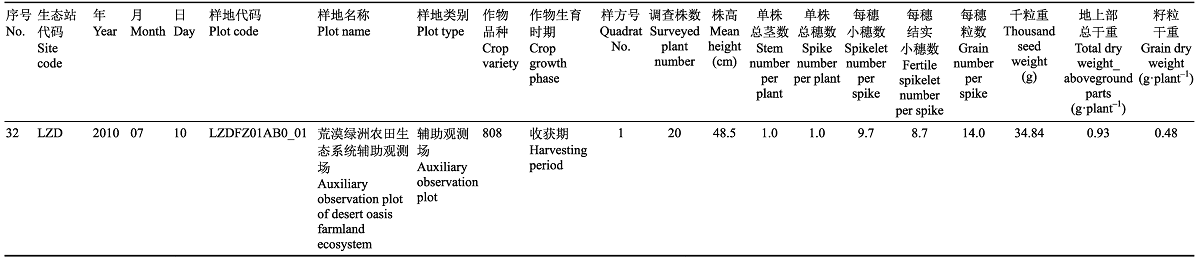 |
Table 5 Example table of plant traits of wheat at harvest time at Linze Station
|
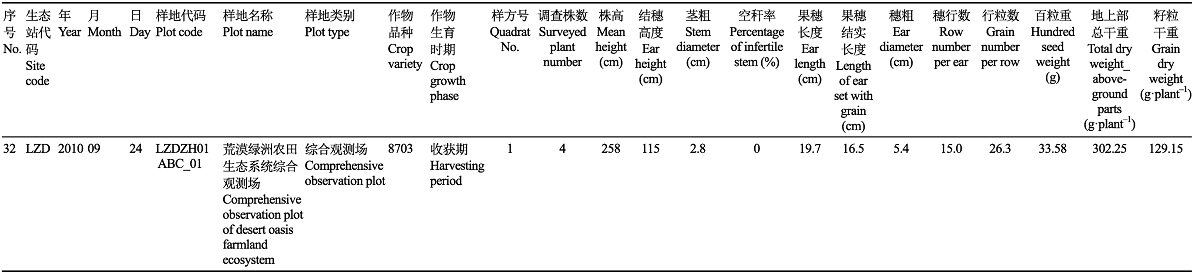 |
Table 6 Example table of plant traits of maize at harvest time at Linze Station
|
 |
Table 7 Example table of observation of crop yield at harvest time at Linze Station
|
| [1] | Beroya-Eitner MA (2016). Ecological vulnerability indicators. Ecological Indicators, 60, 329-334. |
| [2] | Chen YN, Chen YP, Zhu CG, Li WH (2019). The concept and mode of ecosystem sustainable management in arid desert areas in northwest China. Acta Ecologica Sinica, 39, 7410-7417. |
| [陈亚宁, 陈亚鹏, 朱成刚, 李卫红 (2019). 西北干旱荒漠区生态系统可持续管理理念与模式. 生态学报, 39, 7410-7417.] | |
| [3] |
Chen YN, Li BF, Li Z, Li WH (2016). Water resource formation and conversion and water security in arid region of Northwest China. Journal of Geographical Sciences, 26, 939-952.
DOI |
| [4] | Chu PC, Lu SH, Chen YC (2005). A numerical modeling study on desert oasis self-supporting mechanisms. Journal of Hydrology, 312, 256-276. |
| [5] | He CC, Wang ZT, Zhang CL (2024). Functional stability assessment of typical blown-sand prevention systems in the periphery of Hexi Corridor oases. Journal of Fujian Agriculture and Forestry University (Natural Science Edition), 53, 549-555. |
| [何晨晨, 王振亭, 张春来 (2024). 河西走廊绿洲外缘典型风沙防护体系的功能稳定性评估. 福建农林大学学报(自然科学版), 53, 549-555.] | |
| [6] |
Wang XY, Liu SZ, Chen XS, Wang XJ, Wang B, Wan X (2019). Dynamic changes and driving factors of oasis in Hexi Corridor. Journal of Desert Research, 39(4), 212-219.
DOI |
|
[王新源, 刘世增, 陈翔舜, 王小军, 王彬, 万翔 (2019). 河西走廊绿洲面积动态及其驱动因素. 中国沙漠, 39(4), 212-219.]
DOI |
|
| [7] | Wu DX, Zhang L, Song CY, Zhang SM (2019). Protocols for Standard Biological Observation and Measurement in Terrestrial Ecosystems. China Environment Publishing Group, Beijing. |
| [吴冬秀, 张琳, 宋创业, 张淑敏 (2019). 陆地生态系统生物观测指标与规范. 中国环境出版集团, 北京.] | |
| [8] | Zhang L, Wu DX (2023). Background Information and Vegetation Classification Characteristics of Long-term Ecological Plots in CERN. China Environment Publishing Group, Beijing. |
| [张琳, 吴冬秀 (2023). 生物长期监测样地本底与植被特征. 中国环境出版集团, 北京.] | |
| [9] | Zhao HL, Zhao XY, Zhang TH, Zhang XY, Li YL, Liu LC (2011). Desertification process and its spatial differentiation in arid areas of northwest China. Journal of Desert Research, 31(1), 1-8. |
| [赵哈林, 赵学勇, 张铜会, 张小由, 李玉霖, 刘立超 (2011). 我国西北干旱区的荒漠化过程及其空间分异规律. 中国沙漠, 31(1), 1-8.] | |
| [10] | Zhao WZ, Ren H, Du J, Yang R, Yang QY, Liu H (2023). Thoughts and suggestions on oasis ecological construction and agricultural development in Hexi Corridor. Bulletin of Chinese Academy of Sciences, 38, 424-434. |
| [赵文智, 任珩, 杜军, 杨荣, 杨淇越, 刘鹄 (2023). 河西走廊绿洲生态建设和农业发展的若干思考与建议. 中国科学院院刊, 38, 424-434.] | |
| [11] |
Zhao WZ, Yang R, Liu B, Yang QY, Li F (2016). Oasification of northwestern China: a review. Journal of Desert Research, 36(1), 1-5.
DOI |
|
[赵文智, 杨荣, 刘冰, 杨淇越, 李芳 (2016). 中国绿洲化及其研究进展. 中国沙漠, 36(1), 1-5.]
DOI |
| [1] | LI Yue-Qi, MA Zhong-Hua, LIU Wei-Fan, SU Ming, WAN Meng-Hu, LI Qing-Yun, ZHANG Dan, LIU Ji-Li, WU Na. Effects of vertical deep rotary tillage with organic fertilizer on leaf senescence characteristics and yield of maize in saline soil [J]. Chin J Plant Ecol, 2026, 50(1): 222-236. |
| [2] | LI Shao-Wei, HE Yong-Tao, SUN Wei, DAI Er-Fu. Dataset of crop harvest traits and yield at long-term observation farmlands in Lhasa River Valley from 2016 to 2020 [J]. Chin J Plant Ecol, 2025, 49(8): 1321-1328. |
| [3] | FAN Yue-Ling, JIANG Zheng-De, YE Jia-Shu, ZHENG Li-Chen, CHEN Xin. Dataset on harvest traits and yield of major crops in long-term farmland observation plots in the Lower Liaohe Plain from 2005 to 2015 [J]. Chin J Plant Ecol, 2025, 49(8): 1271-1282. |
| [4] | WANG Li-Long, FENG Jing, SU Na, LIU Xin-Ping, PAN Cheng-Chen, LI Yu-Qiang. Dataset of maize harvest traits and yields from long-term observation plots in typical farmland ecosystems of the Horqin Sandy Land from 2005 to 2015 [J]. Chin J Plant Ecol, 2025, 49(8): 1293-1300. |
| [5] | WANG Zhi-Bo, LIU Wen-Sheng, WU Rui-Jun, WANG Guo-Liang. Dataset of crop harvest traits and yields from long-term observation farmland plots on fluvial terraces in the hilly and gully region of the Loess Plateau from 2018 to 2023 [J]. Chin J Plant Ecol, 2025, 49(8): 1301-1311. |
| [6] | WANG Shu-Wei, LIN Jing-Hui, ZHOU Wei, SHAN Jun, ZHAO Xu, YAN Xiao-Yuan. Long-term observation dataset of crop harvest traits and yield of typical farmland ecosystems in the Taihu Plain from 2004 to 2020 [J]. Chin J Plant Ecol, 2025, 49(8): 1283-1292. |
| [7] | WANG Peng, LI Xiang-Yi, GAO Yan-Ju, SHABITI Repkat, ZENG Fan-Jiang. Dataset of cotton harvest traits and yield in the oasis farmland ecosystems on the southern margin of Taklimakan Desert from 2005 to 2010 [J]. Chin J Plant Ecol, 2025, 49(8): 1329-1338. |
| [8] | CHENG Ke-Xin, DU Yao, LI Kai-Hang, WANG Hao-Chen, YANG Yan, JIN Yi, HE Xiao-Qing. Genetic mechanism of interaction between maize and phyllospheric microbiome [J]. Chin J Plant Ecol, 2024, 48(2): 215-228. |
| [9] | Jing-Xin XU, You-Fei ZHENG, Bo-Ru MAI, Hui ZHAO, Zhong-Fang CHU, Ji-Qing HUANG, Yue YUAN. Characteristics and partitioning of ozone dry deposition measured by eddy-covariance technology in a winter wheat field [J]. Chin J Plant Ecol, 2017, 41(6): 670-682. |
| [10] | Rui GUO, Ji ZHOU, Fan YANG, Feng LI. Metabolic responses of wheat roots to alkaline stress [J]. Chin J Plant Ecol, 2017, 41(6): 683-692. |
| [11] | GAO Lin, WANG Xiao-Fei, GU Xing-Fa, TIAN Qing-Jiu, JIAO Jun-Nan, WANG Pei-Yan, LI Dan. Exploring the influence of soil types underneath the canopy in winter wheat leaf area index remote estimating [J]. Chin J Plant Ecol, 2017, 41(12): 1273-1288. |
| [12] | Li Yi-Bo, SONG He, ZHOU Li, XU Zhen-Zhu, ZHOU Guang-Sheng. Modeling study on photosynthetic-light response curves of a C4 plant, maize [J]. Chin J Plant Ecol, 2017, 41(12): 1289-1300. |
| [13] | Cheng-Yan ZHENG, Ai-Xing DENG, Hojatollah LATIFMANESH, Zhen-Wei SONG, Jun ZHANG, Li WANG, Wei-Jian ZHANG. Warming impacts on the dry matter accumulation, and translocation and nitrogen uptake and utilization of winter wheat on the Qinghai-Xizang Plateau [J]. Chin J Plant Ecol, 2017, 41(10): 1060-1068. |
| [14] | Rui GUO, Ji ZHOU, Fan YANG, Feng LI, Hao-Ru LI, Xu XIA, Qi LIU. Growth metabolism of wheat under drought stress at the jointing-booting stage [J]. Chin J Plan Ecolo, 2016, 40(12): 1319-1327. |
| [15] | XIONG Shu-Ping, WANG Jing, WANG Xiao-Chun, DING Shi-Jie, MA Xin-Ming. Effects of tillage and nitrogen addition rate on nitrogen metabolism, grain yield and protein content in wheat in lime concretion black soil region [J]. Chin J Plant Ecol, 2014, 38(7): 767-775. |
| Viewed | ||||||
|
Full text |
|
|||||
|
Abstract |
|
|||||
Copyright © 2026 Chinese Journal of Plant Ecology
Tel: 010-62836134, 62836138, E-mail: apes@ibcas.ac.cn, cjpe@ibcas.ac.cn

