
植物生态学报 ›› 2006, Vol. 30 ›› Issue (3): 487-495.DOI: 10.17521/cjpe.2006.0065
陈开宁1,2( ), 兰策介1, 史龙新3, 陈伟民1, 许海1, 包先明1,2
收稿日期:2005-04-11
接受日期:2005-09-21
出版日期:2006-04-11
发布日期:2006-05-30
作者简介:E-mail: knchen@niglas.ac.cn
基金资助:
CHEN Kai-Ning1,2(), LAN Ce-Jie1, SHI Long-Xin3, CHEN Wei-Min1, XU Hai1, BAO Xian-Ming1,2
Received:2005-04-11
Accepted:2005-09-21
Online:2006-04-11
Published:2006-05-30
摘要:
通过太湖野外调查、室内培养、种子与块茎萌发及幼苗生长试验,对太湖苦草(Vallisneria natans)种群的繁殖生态特征进行了研究。结果显示:1)苦草分配于有性繁殖部分的生物量较无性的大,分别占总生物量的25.0%±13.8%和10.1%±7.0%。雌花数与座果率平均分别为22.9±13.8朵·株-1和73.3%±17.9%。雄株可以产生11~33个佛焰苞,每个佛焰苞内平均含有364±38朵雄花,每个雄花产生的花粉为128~184粒。每个果实内种子丰富,多达150~360粒,估算太湖苦草种群立地种子量可达1.68×10⁴~1.01×10⁶个·m-2。但每年种群主要来自地下块茎和匍匐茎,水深、风浪等可能是种子苗难以在湖泊中定植成功的主要因素。2)苦草的块茎数量较大,平均90~226个·m-2,是种群发展的强大物质基础。3)温度、光照、基质及种子保存方式与时间长短对种子发芽率均有较大影响。10 ℃时种子发芽率较低,仅8.35%±1.89%;20 ℃时发芽率较高,为56.73%±6.42%;30 ℃时发芽率有所降低,为43.55%±4.34%。种子发芽对光照有一定要求,20 ℃、无光条件下,种子发芽率下降63.6%。在没有湖泥为基质的情况下,发芽率下降36.5%。此外,随干燥保存时间增加,种子发芽率下降。4)块茎发芽对光照需求不大,但温度对块茎的发芽率有较大影响,10 ℃时发芽率为20.3%±5.7%,20 ℃时较高,达90.2%±12.6%,30 ℃时发芽率降低至60.4%±7.6%。5)光照对幼苗生长有一定影响。有光照的幼苗伸长生长比无光条件下慢,但生物量积累较大,有光的苗生长速度平均为0.56~0.70 cm·d-1,无光的为0.86~0.96 cm·d-1。试验结果还显示,苦草的块茎苗初期的伸长生长主要依赖于基部的根茎生长。6)根据研究结果认为,在湖泊中恢复苦草种群应主要利用地下块茎,种子只适用于相对静止的浅水池塘种植。
陈开宁, 兰策介, 史龙新, 陈伟民, 许海, 包先明. 苦草繁殖生态学研究. 植物生态学报, 2006, 30(3): 487-495. DOI: 10.17521/cjpe.2006.0065
CHEN Kai-Ning, LAN Ce-Jie, SHI Long-Xin, CHEN Wei-Min, XU Hai, BAO Xian-Ming. REPRODUCTIVE ECOLOGY OF VALLISNERIA NATANS. Chinese Journal of Plant Ecology, 2006, 30(3): 487-495. DOI: 10.17521/cjpe.2006.0065
| 样号 Sample no. | 花苞数 Spathe number | 雄花数/株 Male flower number/Ind. (×104) | 花粉粒数 Microspore number (×106) | 有性繁殖生物量 Biomass in sexual propagation (g) | 植株总生物量 Total biomass (g) | 繁殖部分/总生物量 Biomass in propagation/Total biomass (%) | ||||||
|---|---|---|---|---|---|---|---|---|---|---|---|---|
| 1 | 33 | 1.20 | 1.89 | 0.18 | 1.30 | 13.8 | ||||||
| 2 | 11 | 0.40 | 0.63 | 0.06 | 0.92 | 6.5 | ||||||
| 3 | 19 | 0.69 | 1.09 | 0.13 | 1.62 | 8.0 | ||||||
| 4 | 31 | 1.13 | 1.77 | 0.17 | 1.11 | 15.3 | ||||||
| 5 | 26 | 0.95 | 1.49 | 0.15 | 1.01 | 14.9 | ||||||
| 6 | 22 | 0.80 | 1.26 | 0.13 | 1.85 | 7.0 | ||||||
| 平均值Mean | 24 | 0.86 | 1.35 | 0.14 | 1.30 | 10.9 | ||||||
表1 苦草雄性植株繁殖生态特征统计
Table 1 Statistical comparison in propagation characteristic of male plants of Vallisneria natans
| 样号 Sample no. | 花苞数 Spathe number | 雄花数/株 Male flower number/Ind. (×104) | 花粉粒数 Microspore number (×106) | 有性繁殖生物量 Biomass in sexual propagation (g) | 植株总生物量 Total biomass (g) | 繁殖部分/总生物量 Biomass in propagation/Total biomass (%) | ||||||
|---|---|---|---|---|---|---|---|---|---|---|---|---|
| 1 | 33 | 1.20 | 1.89 | 0.18 | 1.30 | 13.8 | ||||||
| 2 | 11 | 0.40 | 0.63 | 0.06 | 0.92 | 6.5 | ||||||
| 3 | 19 | 0.69 | 1.09 | 0.13 | 1.62 | 8.0 | ||||||
| 4 | 31 | 1.13 | 1.77 | 0.17 | 1.11 | 15.3 | ||||||
| 5 | 26 | 0.95 | 1.49 | 0.15 | 1.01 | 14.9 | ||||||
| 6 | 22 | 0.80 | 1.26 | 0.13 | 1.85 | 7.0 | ||||||
| 平均值Mean | 24 | 0.86 | 1.35 | 0.14 | 1.30 | 10.9 | ||||||
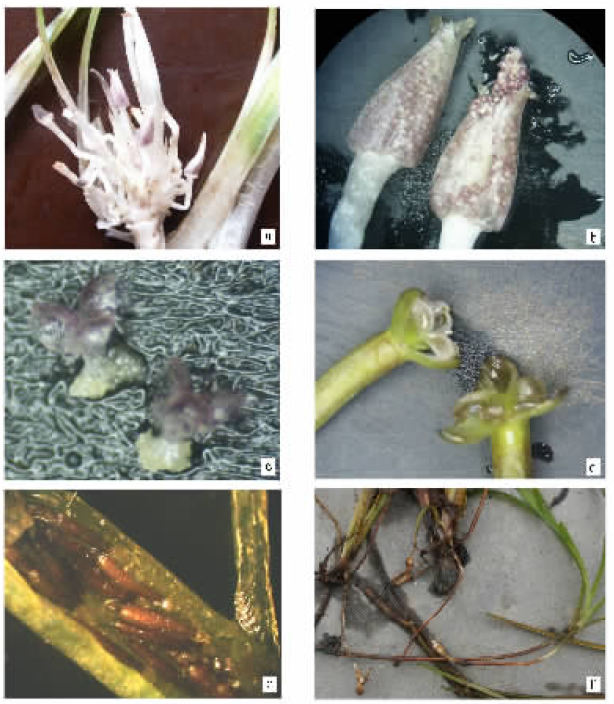
图1 苦草的有性与无性繁殖部分 a. 生长于基部的雄花 Male flowers b. 雄花苞 Spathe c. 雄花和花粉粒 Male flowers and Microspore d. 雌花 Female flowers e. 种子 Seeds f. 匍匐茎与块茎 Stolon and tubers
Fig.1 Sexual propagule and asexual propagule of Vallisneria natans
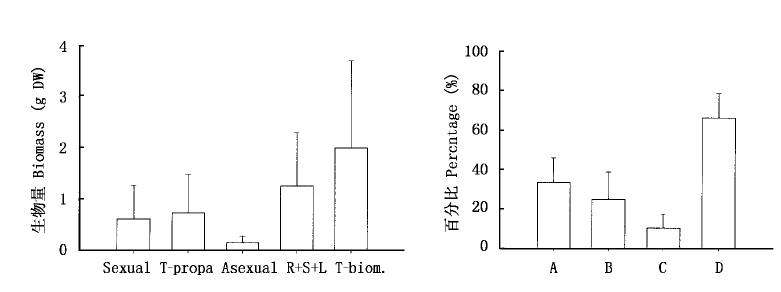
图2 苦草生物量在各部分分配 Sexual、T-propa、Asexual、R+S+L、T-biom分别代表有性繁殖部分、总繁殖部分、无性繁殖部分、根茎叶部分及总生物量 Sexual, T-propa, Asexual and R+S+L show the biomass in part of sexual propagation, asexual propagation, root+shoot+leaf and total biomass, respectively A:(繁殖部分/总生物量)×100% (Part of propagation/Total biomass) ×100% B:(有性部分/总生物量)×100% (Biomass of sexual propagation /Total biomass)×100% C:(无性部分/总生物量)×100% (Biomass of asexual propagation/Total biomass)×100% D:(根茎叶部分/总生物量)×100% (Biomass of Root+shoot+leaf/Total biomass)×100%
Fig.2 Proportion of total propagation, sexual and asexual propagation in biomass of Vallisneria natans
| 样品序号 Sample no. | 开花数 Flowers number | 座果数 Seedset number | 座果率% Seedset rate | 样品序号 Sample no. | 开花数 Flowers number | 座果数 Seedset number | 座果率% Seedset rate |
|---|---|---|---|---|---|---|---|
| 1 | 22 | 16 | 72.73 | ||||
| 2 | 27 | 19 | 70.37 | 19 | 8 | 5 | 62.50 |
| 3 | 5 | 4 | 80.00 | 20 | 17 | 14 | 82.35 |
| 4 | 7 | 6 | 85.71 | 21 | 16 | 11 | 68.75 |
| 5 | 36 | 27 | 75.00 | 22 | 14 | 10 | 71.43 |
| 6 | 2 | 2 | 100.00 | 23 | 22 | 16 | 72.73 |
| 7 | 9 | 8 | 88.89 | 24 | 7 | 5 | 71.43 |
| 8 | 27 | 27 | 100.00 | 25 | 14 | 8 | 57.14 |
| 9 | 9 | 6 | 66.67 | 26 | 26 | 16 | 61.54 |
| 10 | - | - | - | 27 | 20 | 15 | 75.00 |
| 11 | 30 | 11 | 36.67 | 28 | 6 | 5 | 83.33 |
| 12 | 54 | 43 | 79.63 | 29 | 5 | 5 | 100.00 |
| 13 | 24 | 10 | 41.67 | 30 | 31 | 20 | 64.52 |
| 14 | 25 | 16 | 64.00 | 31 | 16 | 11 | 68.75 |
| 15 | 14 | 9 | 64.29 | 32 | 13 | 6 | 46.15 |
| 16 | 30 | 26 | 86.67 | 33 | 22 | 14 | 63.64 |
| 17 | 36 | 22 | 61.11 | 平均值Mean | 18.91 | 13.09 | 71.16 |
| 18 | 11 | 6 | 54.55 | SD | 11.52 | 8.83 | 15.43 |
表2 苦草雌性植株开花数及座果率
Table 2 Number of female flowers and seedset rate of Vallisneria natans
| 样品序号 Sample no. | 开花数 Flowers number | 座果数 Seedset number | 座果率% Seedset rate | 样品序号 Sample no. | 开花数 Flowers number | 座果数 Seedset number | 座果率% Seedset rate |
|---|---|---|---|---|---|---|---|
| 1 | 22 | 16 | 72.73 | ||||
| 2 | 27 | 19 | 70.37 | 19 | 8 | 5 | 62.50 |
| 3 | 5 | 4 | 80.00 | 20 | 17 | 14 | 82.35 |
| 4 | 7 | 6 | 85.71 | 21 | 16 | 11 | 68.75 |
| 5 | 36 | 27 | 75.00 | 22 | 14 | 10 | 71.43 |
| 6 | 2 | 2 | 100.00 | 23 | 22 | 16 | 72.73 |
| 7 | 9 | 8 | 88.89 | 24 | 7 | 5 | 71.43 |
| 8 | 27 | 27 | 100.00 | 25 | 14 | 8 | 57.14 |
| 9 | 9 | 6 | 66.67 | 26 | 26 | 16 | 61.54 |
| 10 | - | - | - | 27 | 20 | 15 | 75.00 |
| 11 | 30 | 11 | 36.67 | 28 | 6 | 5 | 83.33 |
| 12 | 54 | 43 | 79.63 | 29 | 5 | 5 | 100.00 |
| 13 | 24 | 10 | 41.67 | 30 | 31 | 20 | 64.52 |
| 14 | 25 | 16 | 64.00 | 31 | 16 | 11 | 68.75 |
| 15 | 14 | 9 | 64.29 | 32 | 13 | 6 | 46.15 |
| 16 | 30 | 26 | 86.67 | 33 | 22 | 14 | 63.64 |
| 17 | 36 | 22 | 61.11 | 平均值Mean | 18.91 | 13.09 | 71.16 |
| 18 | 11 | 6 | 54.55 | SD | 11.52 | 8.83 | 15.43 |
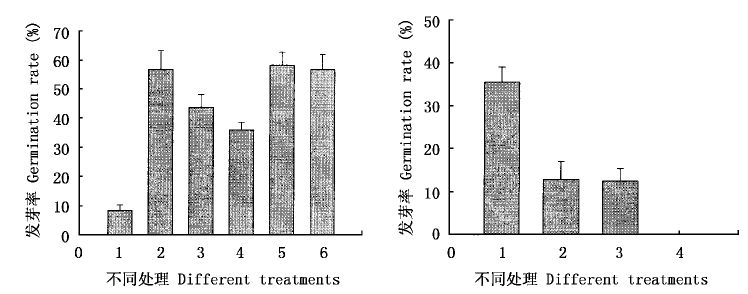
图3 不同处理组的苦草种子发芽率 左图为当年种子的发芽率,图中1、2、3分别代表10、20、30 ℃条件下的发芽率,4代表无湖泥的20 ℃条件下的发芽率,5和6分别代表有湖泥的30/10和20/10 ℃变温条件下的发芽率;右图为有湖泥、20 ℃条件下的发芽率,其中1代表干燥保存1年的种子在有光下的发芽率,2代表干燥保存1年的种子在无光下的发芽率,3和4分别代表干燥保存2和4年的种子在有光下的发芽率
Fig.3 Germination rate in seeds of different treatments of Vallisneria natans Left figure indicates germination rate of 4 months conserved seeds. 1-3 show germination rates of seeds at 10, 20, 30 ℃ with lake sediment, respectively. 4 shows germination rate of seeds at 20 ℃ without lake sediment. 5 and 6 show germination rates of seeds under conditions of 30/10、20/10 ℃. Right figure indicates germination rate at 20 ℃ with lake sediment. 1 shows germination rate of 1-year conserved seeds at 20 ℃ with natural light. 2 shows germination rate of 1-year conserved seeds at 20 ℃ without natural light. 3 and 4 show germination rates of 2-year conserved seeds and 4-year conserved at 20 ℃ with natural light
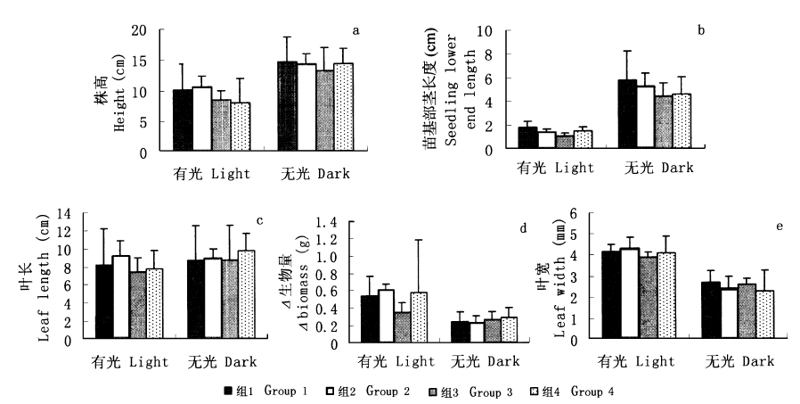
图4 在有光和无光条件下苦草块茎苗生长的差异
Fig.4 Impact of light on seedlings reproduced from root tuber of Vallisneria natans
| [1] |
Brenchley JL, Probert RJ (1998). Seed germination responses to some environmental factors in the seagrass Zostera capricorni from eastern Australia . Aquatic Botany, 62,177-188.
DOI URL |
| [2] |
Donnermeyer GN, Smart MM (1985). The biomass and nutritive potential of Vallisneria americana Michx. in navigation pool 9 of the Upper Mississippi River . Aquatic Botany, 22,33-44.
DOI URL |
| [3] |
Grime JP, Mason G, Curtis AV, Rodman J, Band SR, Mowforth MAG, Neal AM, Shaw S (1981). A comparative study of germination characteristics in a local flora. Journal of Ecology, 69,1017-1059.
DOI URL |
| [4] | Gu LD (顾林娣), Chen J (陈坚), Zhang ZS (章宗涉) (1994). Effect of cutting on growth on Vallisneris spiralis. Plant Physiology Communications (植物生理学通讯), 30,105-107. (in Chinese) |
| [5] | Li YD (李亚东), Cui YQ (崔艳秋) (2000). Germination experiment on seeds and stem tubers of Vallisneria natans in Lake Donghu of Wuhan . Acta Hydrobiologica Sinica (水生生物学报), 24,298-300. (in Chinese with English abstract) |
| [6] | Li WC (李文朝), Lian GH (连文华) (1995). Light demand for brood-bud germination of submerged plant. Journal of Lake Sciences (湖泊科学), 7(Suppl.),25-27. (in Chinese with English abstract) |
| [7] | Lombardi T, Fochetti T, Bertacchi A, Onnis A (1997). Germination requirements in a population of Typha latifolia. Aquatic Botany, 56,1-10. |
| [8] | Smolders AJP, den Hartog C, Roelofs JGM (1995). Germination and seedling development in Stratiotes aloides L. . Aquatic Botany, 51,269-279. |
| [9] | Song F (宋福), Chen YQ (陈艳卿), Qiao JR (乔建荣), Ren JC (任久长) (1997). Study on the removal rate to total nitrogen in Caohai Lake (including sediments) by common submerged macrophytes. Research of Environmental Sciences (环境科学研究), 10(4),47-50. (in Chinese with English abstract) |
| [10] | Sun XZ (孙祥钟) (1992). Flora (Tomus 8) (中国植物志, 第8卷). Science Press, Beijing, 177-179. (in Chinese) |
| [11] | Thompson K, Grime JP (1983). A comparative study of germination responses to diurnally-fluctuating temperatures. Journal of Applied Ecology, 20,141-156. |
| [12] | Xiong BH (熊秉红), Li W (李伟) (2000). Ecological studies on Vallisneria L. in China . Journal of Wuhan Botanical Research (武汉植物学研究), 18,500-508. (in Chinese with English abstract) |
| [13] | Yan SZ (颜素珠) (1983). Illustrated Handbook in Chinese Aquatic Macrophytes (中国水生高等植物图说). Science Press, Beijing,237-239. (in Chinese) |
| [14] | You WH (由文辉), Song YC (宋永昌) (1995). Seed germination ecology of three submerged macrophytes in Dianshan Lake. Chinese Journal of Applied Ecology (应用生态学报), 6,196-200. (in Chinese with English abstract) |
| [15] | Zhu HH (朱海虹), Zhang B (张本) (1997). Poyang Lake (鄱阳湖). University of Science and Technology of China Press, Hefei,205-206. (in Chinese) |
| [1] | 李文博 孙龙 娄虎 于澄 韩宇 胡同欣. 火干扰对兴安落叶松种子萌发的影响[J]. 植物生态学报, 2024, 48(预发表): 0-0. |
| [2] | 蔡慧颖 李兰慧 林阳 梁亚涛 杨光 孙龙. 白桦叶片和细根非结构性碳水化合物对火后时间的响应[J]. 植物生态学报, 2024, 48(预发表): 0-0. |
| [3] | 袁涵 钟爱文 刘送平 徐磊 彭焱松. 水毛花种子萌发特性的差异及休眠解除方法[J]. 植物生态学报, 2024, 48(5): 638-650. |
| [4] | 陈雪萍, 赵学勇, 张晶, 王瑞雄, 卢建男. 基于地理探测器的科尔沁沙地植被NDVI时空变化特征及其驱动因素[J]. 植物生态学报, 2023, 47(8): 1082-1093. |
| [5] | 罗娜娜, 盛茂银, 王霖娇, 石庆龙, 何宇. 长期植被恢复对中国西南喀斯特石漠化土壤活性有机碳组分含量和酶活性的影响[J]. 植物生态学报, 2023, 47(6): 867-881. |
| [6] | 张雪, 韩凤朋, 肖波, 沈思铭. 黄土高原生物结皮对地表粗糙度和灌草植物种子二次扩散的影响[J]. 植物生态学报, 2023, 47(12): 1668-1683. |
| [7] | 赵榕江, 陈焘, 董丽佳, 郭辉, 马海鲲, 宋旭, 王明刚, 薛伟, 杨强. 植物-土壤反馈及其在生态学中的研究进展[J]. 植物生态学报, 2023, 47(10): 1333-1355. |
| [8] | 董全民, 赵新全, 刘玉祯, 冯斌, 俞旸, 杨晓霞, 张春平, 曹铨, 刘文亭. 放牧方式影响高寒草地矮生嵩草种子大小与数量的关系[J]. 植物生态学报, 2022, 46(9): 1018-1026. |
| [9] | 魏龙鑫, 耿燕, 崔可达, 乔雪涛, 岳庆敏, 范春雨, 张春雨, 赵秀海. 阔叶红松林不同林层和生长阶段树木生长对采伐强度的响应[J]. 植物生态学报, 2022, 46(6): 642-655. |
| [10] | 张敏, 朱教君. 光温条件对不同种源红松种子萌发的影响[J]. 植物生态学报, 2022, 46(6): 613-623. |
| [11] | 崔光帅, 罗天祥, 梁尔源, 张林. 干旱半干旱区灌丛对草本植物的促进作用研究进展[J]. 植物生态学报, 2022, 46(11): 1321-1333. |
| [12] | 薛金儒, 吕肖良. 黄土高原生态工程实施下基于日光诱导叶绿素荧光的植被恢复生产力效益评价[J]. 植物生态学报, 2022, 46(10): 1289-1304. |
| [13] | 吕亚香, 戚智彦, 刘伟, 孙佳美, 潘庆民. 早春和夏季氮磷添加对内蒙古典型草原退化群落碳交换的影响[J]. 植物生态学报, 2021, 45(4): 334-344. |
| [14] | 钟雨辰, 王斌, 方中平, 徐小忠, 于明坚. 片段化景观中壳斗科植物种子捕食和扩散模式[J]. 植物生态学报, 2021, 45(2): 154-162. |
| [15] | 李绍阳, 马红媛, 赵丹丹, 马梦谣, 亓雯雯. 火烧信号对种子萌发影响的研究进展[J]. 植物生态学报, 2021, 45(11): 1177-1190. |
| 阅读次数 | ||||||
|
全文 |
|
|||||
|
摘要 |
|
|||||
Copyright © 2022 版权所有 《植物生态学报》编辑部
地址: 北京香山南辛村20号, 邮编: 100093
Tel.: 010-62836134, 62836138; Fax: 010-82599431; E-mail: apes@ibcas.ac.cn, cjpe@ibcas.ac.cn
备案号: 京ICP备16067583号-19
