
植物生态学报 ›› 2026, Vol. 50 ›› Issue (4): 801-813.DOI: 10.17521/cjpe.2025.0066 cstr: 32100.14.cjpe.2025.0066
赵掷艺( ), 黄伟权, 胡婧妍, 王义越, 虞梦婕*(
 ), 吴玉环
收稿日期:2025-02-24
接受日期:2025-07-09
出版日期:2026-04-20
发布日期:2026-06-29
通讯作者:
*虞梦婕(mengjie.yu@hznu.edu.cn)基金资助:
ZHAO Zhi-Yi(), HUANG Wei-Quan, HU Jing-Yan, WANG Yi-Yue, YU Meng-Jie*(), WU Yu-Huan
Received:2025-02-24
Accepted:2025-07-09
Online:2026-04-20
Published:2026-06-29
Contact:
*YU Meng-Jie(mengjie.yu@hznu.edu.cn)Supported by:摘要:
泥炭沼泽湿地植物残体分解是生态系统碳循环的关键过程, 其分解速率和潜在机制对湿地生物地球化学循环具有重要影响。植物残体分解是多种因素相互作用的复杂过程, 越来越多的研究关注生物与非生物因素对泥炭沼泽湿地植物残体分解的影响。微生物作为土壤有机质的主要分解者, 在植物残体分解过程中发挥重要作用, 通过功能基因编码关键酶影响有机质分解, 泥炭藓(Sphagnum)代谢产物能够与微生物共同影响泥炭沼泽湿地植物残体分解过程。“酶锁”机制是理解土壤有机质分解的重要学说, 但是目前的研究表明“酶锁”机制有其适用的条件与框架。除此之外, 植物残体质量、植物群落组成、土壤动物等生物因素, 温度、水分、光照等非生物因素对植物残体分解与微生物群落结构有显著影响, 直接或间接作用于植物残体分解过程, 但是当前研究多聚焦于单一因素的独立作用, 缺乏对生物与非生物因素双向反馈机制的深入解析。该文系统阐述了泥炭沼泽湿地植物残体分解过程、微生物及土壤酶在其中的作用机制、其他生物与非生物因素的共同作用对泥炭沼泽湿地植物残体分解及微生物群落组成的调控机制, 以期为揭示泥炭沼泽湿地碳循环提供理论依据。未来需进一步综合宏基因组学、宏代谢组学、同位素示踪等新技术联系地上和地下部分系统, 探究植物、微生物、土壤环境三者之间的关系, 以更好地理解和保护泥炭沼泽湿地生态系统。
赵掷艺, 黄伟权, 胡婧妍, 王义越, 虞梦婕, 吴玉环. 泥炭沼泽湿地植物残体分解及微生物作用机理研究进展. 植物生态学报, 2026, 50(4): 801-813. DOI: 10.17521/cjpe.2025.0066
ZHAO Zhi-Yi, HUANG Wei-Quan, HU Jing-Yan, WANG Yi-Yue, YU Meng-Jie, WU Yu-Huan. Advances of plant litter decomposition and its microbial mechanisms in peatland. Chinese Journal of Plant Ecology, 2026, 50(4): 801-813. DOI: 10.17521/cjpe.2025.0066
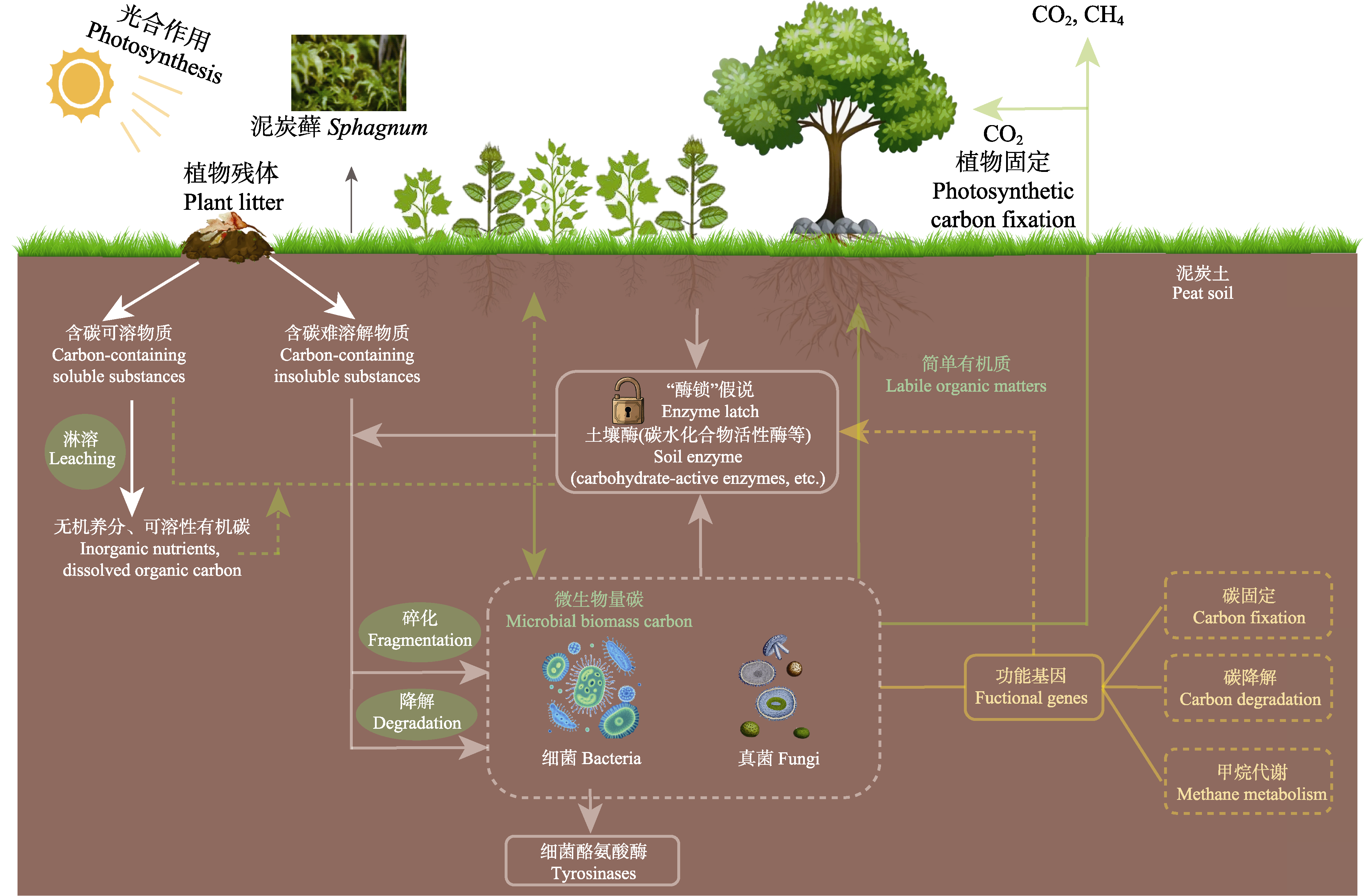
图1 泥炭沼泽湿地植物残体分解过程及微生物作用机制图。
Fig. 1 Schematic diagram of the plant litter decomposition and its microbial mechanisms in peatland.
| [1] |
Armstrong A, Waldron S, Ostle NJ, Richardson H, Whitaker J (2015). Biotic and abiotic factors interact to regulate northern peatland carbon cycling. Ecosystems, 18, 1395-1409.
DOI URL |
| [2] |
Bastida F, Eldridge DJ, García C, Kenny Png G, Bardgett RD, Delgado-Baquerizo M (2021). Soil microbial diversity-biomass relationships are driven by soil carbon content across global biomes. The ISME Journal, 15, 2081-2091.
DOI URL |
| [3] |
Binet P, Rouifed S, Jassey VEJ, Toussaint ML, Chiapusio G (2017). Experimental climate warming alters the relationship between fungal root symbiosis and Sphagnum litter phenolics in two peatland microhabitats. Soil Biology & Biochemistry, 105, 153-161.
DOI URL |
| [4] |
Blagodatskaya E, Khomyakov N, Myachina O, Bogomolova I, Blagodatsky S, Kuzyakov Y (2014). Microbial interactions affect sources of priming induced by cellulose. Soil Biology & Biochemistry, 74, 39-49.
DOI URL |
| [5] |
Bradford MA, Berg B, Maynard DS, Wieder WR, Wood SA (2016). Understanding the dominant controls on litter decomposition. Journal of Ecology, 104, 229-238.
DOI URL |
| [6] |
Bragazza L, Buttler A, Habermacher J, Brancaleoni L, Gerdol R, Fritze H, Hanajík P, Laiho R, Johnson D (2012). High nitrogen deposition alters the decomposition of bog plant litter and reduces carbon accumulation. Global Change Biology, 18, 1163-1172.
DOI URL |
| [7] |
Bragazza L, Siffi C, Iacumin P, Gerdol R (2007). Mass loss and nutrient release during litter decay in peatland: the role of microbial adaptability to litter chemistry. Soil Biology & Biochemistry, 39, 257-267.
DOI URL |
| [8] | Chen H, Wu N, Wang YF, Yang G, Ju PJ, Zhu D, He YX, Zhu QA, Gao YH, Liu XW (2021). A historical overview about basic issues and studies of mires. Scientia Sinica (Terrae), 51, 15-26. |
| [陈槐, 吴宁, 王艳芬, 杨刚, 鞠佩君, 朱单, 何奕忻, 朱求安, 高永恒, 刘欣蔚 (2021). 泥炭沼泽湿地研究的若干基本问题与研究简史. 中国科学: 地球科学, 51, 15-26.] | |
| [9] |
Cornwell WK, Cornelissen JHC, Amatangelo K, Dorrepaal E, Eviner VT, Godoy O, Hobbie SE, Hoorens B, Kurokawa H, Pérez-Harguindeguy N, Quested HM, Santiago LS, Wardle DA, Wright IJ, Aerts R, et al. (2008). Plant species traits are the predominant control on litter decomposition rates within biomes worldwide. Ecology Letters, 11, 1065-1071.
DOI PMID |
| [10] |
Creamer CA, de Menezes AB, Krull ES, Sanderman J, Newton-Walters R, Farrell M (2015). Microbial community structure mediates response of soil C decomposition to litter addition and warming. Soil Biology & Biochemistry, 80, 175-188.
DOI URL |
| [11] |
Dieleman CM, Branfireun BA, McLaughlin JW, Lindo Z (2015). Climate change drives a shift in peatland ecosystem plant community: implications for ecosystem function and stability. Global Change Biology, 21, 388-395.
DOI PMID |
| [12] | Freeman C, Ostle N, Kang H (2001). An enzymic ‘latch’ on a global carbon store. Nature, 409, 149. DOI: 10.1038/35051650. |
| [13] |
Freeman C, Ostle NJ, Fenner N, Kang H (2004). A regulatory role for phenol oxidase during decomposition in peatlands. Soil Biology & Biochemistry, 36, 1663-1667.
DOI URL |
| [14] | Fudyma JD, Lyon J, AminiTabrizi R, Gieschen H, Chu RK, Hoyt DW, Kyle JE, Toyoda J, Tolic N, Heyman HM, Hess NJ, Metz TO, Tfaily MM (2019). Untargeted metabolomic profiling of Sphagnum fallax reveals novel antimicrobial metabolites. Plant Direct, 3, e00179. DOI: 10.1002/pld3.179. |
| [15] | Gao SQ, Song YY, Song CC, Ma XY, Jiang L (2020). Effects of warming and exogenous carbon input on the abundance of key microbial functional genes of carbon-nitrogen cycle in peatland soil. Acta Ecologica Sinica, 40, 4617-4627. |
| [高思齐, 宋艳宇, 宋长春, 马秀艳, 蒋磊 (2020). 增温和外源碳输入对泥炭地土壤碳氮循环关键微生物功能基因丰度的影响. 生态学报, 40, 4617-4627.] | |
| [16] |
Gao Y, Li ZF, Liu Y, Wang GJ, Xie J, Guo ZL (2022). Biodegradation of aquatic plant residues in macrophytic lake: a review. Chinese Agricultural Science Bulletin, 38(15), 53-59.
DOI |
|
[高岩, 李志斐, 刘阳, 王广军, 谢骏, 郭照良 (2022). 草型湖泊水生植物残体的生物降解研究进展. 中国农学通报, 38(15), 53-59.]
DOI |
|
| [17] | Górecki K, Rastogi A, Stróżecki M, Gąbka M, Lamentowicz M, Łuców D, Kayzer D, Juszczak R (2021). Water table depth, experimental warming, and reduced precipitation impact on litter decomposition in a temperate Sphagnum-peatland. Science of the Total Environment, 771, 145452. DOI: 10.1016/j.scitotenv.2021.145452. |
| [18] |
Gorham E (1991). Northern peatlands: role in the carbon cycle and probable responses to climatic warming. Ecological Applications, 1, 182-195.
DOI PMID |
| [19] | Hamard S, Robroek BJM, Allard PM, Signarbieux C, Zhou SZ, Saesong T, de Baaker F, Buttler A, Chiapusio G, Wolfender JL, Bragazza L, Jassey VEJ (2019). Effects of Sphagnum leachate on competitive Sphagnum microbiome depend on species and time. Frontiers in Microbiology, 10, 2042. DOI: 10.3389/fmicb.2019.02042. |
| [20] |
Harris LI, Moore TR, Roulet NT, Pinsonneault AJ (2020). Limited effect of drainage on peat properties, porewater chemistry, and peat decomposition proxies in a boreal peatland. Biogeochemistry, 151, 43-62.
DOI |
| [21] | He XJ, Abs E, Allison SD, Tao F, Huang YY, Manzoni S, Abramoff R, Bruni E, Bowring SPK, Chakrawal A, Ciais P, Elsgaard L, Friedlingstein P, Georgiou K, Hugelius G, et al. (2024). Emerging multiscale insights on microbial carbon use efficiency in the land carbon cycle. Nature Communications, 15, 8010. DOI: 10.1038/s41467-024-52160-5. |
| [22] |
Hiscox J, Savoury M, Müller CT, Lindahl BD, Rogers HJ, Boddy L (2015). Priority effects during fungal community establishment in beech wood. The ISME Journal, 9, 2246-2260.
DOI URL |
| [23] | Hodgkins SB, Richardson CJ, Dommain R, Wang HJ, Glaser PH, Verbeke B, Winkler BR, Cobb AR, Rich VI, Missilmani M, Flanagan N, Ho M, Hoyt AM, Harvey CF, Vining SR, et al. (2018). Tropical peatland carbon storage linked to global latitudinal trends in peat recalcitrance. Nature Communications, 9, 3640. DOI: 10.1038/s41467-018-06050-2. |
| [24] | Hu YL, Bai YP, Dong FQ, Chen H, Huang J, Liu MX, Yang G (2018). Carbon dioxide and methane emission from subsurface peatlands and its controlling factors. Chinese Journal of Applied and Environmental Biology, 24, 395-400. |
| [胡云龙, 白银萍, 董发勤, 陈槐, 黄晶, 刘明学, 杨刚 (2018). 泥炭地亚表层含碳温室气体排放及其影响因素. 应用与环境生物学报, 24, 395-400.] | |
| [25] |
Hu ZH, Xu CG, McDowell NG, Johnson DJ, Wang MH, Luo YQ, Zhou XH, Huang ZQ (2017). Linking microbial community composition to C loss rates during wood decomposition. Soil Biology & Biochemistry, 104, 108-116.
DOI URL |
| [26] |
Jia BR (2019). Litter decomposition and its underlying mechanisms. Chinese Journal of Plant Ecology, 43, 648-657.
DOI URL |
|
[贾丙瑞 (2019). 凋落物分解及其影响机制. 植物生态学报, 43, 648-657.]
DOI |
|
| [27] | Joly FX, Coq S, Subke JA (2023). Soil fauna precipitate the convergence of organic matter quality during decomposition. Oikos, 2023, e09497. DOI: 10.1111/oik.09497. |
| [28] |
Jones MC, Harden J, O’Donnell J, Manies K, Jorgenson T, Treat C, Ewing S (2017). Rapid carbon loss and slow recovery following permafrost thaw in boreal peatlands. Global Change Biology, 23, 1109-1127.
DOI PMID |
| [29] | Kim J, Rochefort L, Hogue-Hugron S, Alqulaiti Z, Dunn C, Pouliot R, Jones TG, Freeman C, Kang H (2021). Water table fluctuation in peatlands facilitates fungal proliferation, impedes Sphagnum growth and accelerates decomposition. Frontiers in Earth Science, 8, 579329. DOI: 10.3389/feart.2020.579329. |
| [30] |
König R, Hepp LU, Santos S (2014). Colonisation of low- and high-quality detritus by benthic macroinvertebrates during leaf breakdown in a subtropical stream. Limnologica, 45, 61-68.
DOI URL |
| [31] |
Laiho R (2006). Decomposition in peatlands: reconciling seemingly contrasting results on the impacts of lowered water levels. Soil Biology & Biochemistry, 38, 2011-2024.
DOI URL |
| [32] |
Lamit LJ, Romanowicz KJ, Potvin LR, Lennon JT, Tringe SG, Chimner RA, Kolka RK, Kane ES, Lilleskov EA (2021). Peatland microbial community responses to plant functional group and drought are depth-dependent. Molecular Ecology, 30, 5119-5136.
DOI PMID |
| [33] | Leifeld J, Menichetti L (2018). The underappreciated potential of peatlands in global climate change mitigation strategies. Nature Communications, 9, 1071. DOI: 10.1038/s41467-018-03406-6. |
| [34] | Li JW, Li M, Zhao LY, Sun XQ, Gao MH, Sheng LX, Bian HF (2022). Characteristics of soil carbon emissions and bacterial community composition in peatlands at different stages of vegetation succession. Science of the Total Environment, 839, 156242. DOI: 10.1016/j.scitotenv.2022.156242. |
| [35] | Li T, Ge LM, Huang JJ, Yuan X, Peng CH, Wang SZ, Bu ZJ, Zhu QA, Wang ZC, Liu WG, Wang M (2020). Contrasting responses of soil exoenzymatic interactions and the dissociated carbon transformation to short- and long-term drainage in a minerotrophic peatland. Geoderma, 377, 114585. DOI: 10.1016/j.geoderma.2020.114585. |
| [36] | Liang XF, Lin W, Qi ZY, Zhou WL, Yang R, Zhang DD, Wang H (2023). Research progress on composition structure and substrate utilization of Sphagnum. Journal of Anhui Agricultural Sciences, 51(16), 11-17. |
| [梁晓烽, 林伟, 戚智勇, 周晚来, 杨睿, 张冬冬, 王虹 (2023). 泥炭藓组成结构及基质化利用研究进展. 安徽农业科学, 51(16), 11-17.] | |
| [37] |
Liao CZ, Luo YQ, Fang CM, Chen JK, Li B (2008). Litter pool sizes, decomposition, and nitrogen dynamics in Spartina alterniflora-invaded and native coastal marshlands of the Yangtze Estuary. Oecologia, 156, 589-600.
DOI URL |
| [38] |
Limpens J, Berendse F, Blodau C, Canadell JG, Freeman C, Holden J, Roulet N, Rydin H, Schaepman-Strub G (2008). Peatlands and the carbon cycle: from local processes to global implications—A synthesis. Biogeosciences, 5, 1475-1491.
DOI URL |
| [39] | Lin CF, Peng JQ, Hong HB, Yang ZJ, Yang YS (2017). Effect of nitrogen and phosphorus availability on forest litter decomposition. Acta Ecologica Sinica, 37, 54-62. |
| [林成芳, 彭建勤, 洪慧滨, 杨智杰, 杨玉盛 (2017). 氮、磷养分有效性对森林凋落物分解的影响研究进展. 生态学报, 37, 54-62.] | |
| [40] | Liu JX, Sun P, Chen YY, Guo JM, Liu LC, Zhao XY, Xin J, Liu XL (2024). The regulation pathways of biochar and microorganism in soil-plant system by multiple statistical methods: the forms of carbon participation in coastal wetlands. Chemosphere, 362, 142918. DOI: 10.1016/j.chemosphere.2024.142918. |
| [41] |
Liu LF, Chen H, Zhu QA, Yang G, Zhu EX, Hu J, Peng CH, Jiang L, Zhan W, Ma TL, He YX, Zhu D (2016). Responses of peat carbon at different depths to simulated warming and oxidizing. Science of the Total Environment, 548-549, 429-440.
DOI URL |
| [42] | Liu YY, Wang S, Li SZ, Deng Y (2017). Advances in molecular ecology on microbial functional genes of carbon cycle. Microbiology China, 44, 1676-1689. |
| [刘洋荧, 王尚, 厉舒祯, 邓晔 (2017). 基于功能基因的微生物碳循环分子生态学研究进展. 微生物学通报, 44, 1676-1689.] | |
| [43] | Lladó S, López-Mondéjar R, Baldrian P (2017). Forest soil bacteria: diversity, involvement in ecosystem processes, and response to global change. Microbiology and Molecular Biology Reviews, 81, e00063-16. DOI: 10.1128/mmbr.00063-16. |
| [44] | López-Mondéjar R, Tláskal V, Větrovský T, Štursová M, Toscan R, Nunes da Rocha U, Baldrian P (2020). Metagenomics and stable isotope probing reveal the complementary contribution of fungal and bacterial communities in the recycling of dead biomass in forest soil. Soil Biology & Biochemistry, 148, 107875. DOI: 10.1016/j.chemosphere.2024.142918. |
| [45] |
Lu M, Ren YL, Wang SJ, Tian K, Sun XY, Peng SX (2019). Contribution of soil variables to bacterial community composition following land use change in Napahai plateau wetlands. Journal of Environmental Management, 246, 77-84.
DOI PMID |
| [46] | Ma L, Zhu GF, Chen BL, Zhang K, Niu SL, Wang JS, Ciais P, Zuo HC (2022a). A globally robust relationship between water table decline, subsidence rate, and carbon release from peatlands. Communications Earth & Environment, 3, 254. DOI: 10.1038/s43247-022-00590-8. |
| [47] | Ma WW, Li G, Wang L, Zhao JM, Chen GP, Zhu HD (2018). Effects of vegetation degradation on litter decomposition in Gahai wetland. Bulletin of Soil and Water Conservation, 38, 29-35. |
| [马维伟, 李广, 王立, 赵锦梅, 陈国鹏, 朱海栋 (2018). 植被退化对尕海湿地枯落物分解的影响. 水土保持通报, 38, 29-35.] | |
| [48] | Ma XY, Song YY, Song CC, Wang XW, Wang NN, Gao SQ, Cheng XF, Liu ZD, Gao JL, Du Y (2021). Effect of nitrogen addition on soil microbial functional gene abundance and community diversity in permafrost peatland. Microorganisms, 9, 2498. DOI: 10.3390/microorganisms9122498. |
| [49] |
Ma XY, Xu H, Cao ZY, Shu L, Zhu RL (2022b). Will climate change cause the global peatland to expand or contract? Evidence from the habitat shift pattern of Sphagnum mosses. Global Change Biology, 28, 6419-6432.
DOI URL |
| [50] | McGivern BB, Tfaily MM, Borton MA, Kosina SM, Daly RA, Nicora CD, Purvine SO, Wong AR, Lipton MS, Hoyt DW, Northen TR, Hagerman AE, Wrighton KC (2021). Decrypting bacterial polyphenol metabolism in an anoxic wetland soil. Nature Communications, 12, 2466. DOI: 10.1038/s41467-021-22765-1. |
| [51] |
Panis F, Rompel A (2022). The novel role of tyrosinase enzymes in the storage of globally significant amounts of carbon in wetland ecosystems. Environmental Science & Technology, 56, 11952-11968.
DOI URL |
| [52] |
Panis F, Rompel A (2023). Biochemical investigations of five recombinantly expressed tyrosinases reveal two novel mechanisms impacting carbon storage in wetland ecosystems. Environmental Science & Technology, 57, 13863-13873.
DOI URL |
| [53] | Ren YJ, Qi YL, Wang X, Duan XY, Ye XX (2024). Effects of microplastics on litter decomposition in wetland soil. Environmental Pollution, 343, 123145. DOI: 10.1016/j.envpol.2023.123145. |
| [54] | Ren ZJ, Jiang W, Han JG, Zhang XH (2023). Standing litter decomposition and the role of dew and solar radiation in a freshwater wetland. Wetlands, 43, 76. DOI: 10.1007/s13157-023-01727-x. |
| [55] |
Reuter J, Reuter H, Zak D (2024). Decomposition of lignin and carbohydrates in a rewetted peatland: a comparative analysis of surface water and anaerobic soil layers. Biogeochemistry, 167, 545-561.
DOI |
| [56] | Ridgeway JR, Morrissey EM, Brzostek ER (2022). Plant litter traits control microbial decomposition and drive soil carbon stabilization. Soil Biology & Biochemistry, 175, 108857. DOI: 10.1016/j.soilbio.2022.108857. |
| [57] |
Romanowicz KJ, Kane ES, Potvin LR, Daniels AL, Kolka RK, Lilleskov EA (2015). Understanding drivers of peatland extracellular enzyme activity in the PEATcosm experiment: mixed evidence for enzymic latch hypothesis. Plant and Soil, 397, 371-386.
DOI URL |
| [58] | Roth SW, Griffiths NA, Kolka RK, Oleheiser KC, Carrell AA, Klingeman DM, Seibert A, Chanton JP, Hanson PJ, Schadt CW (2023). Elevated temperature alters microbial communities, but not decomposition rates, during 3 years of in situ peat decomposition. mSystems, 8, e0033723. DOI: 10.1128/msystems.00337-23. |
| [59] | Sahar NE, Robroek BJM, Mills RTE, Dumont MG, Barel JM (2022). Peatland plant functional type effects on early decomposition indicators are non-pervasive, but microhabitat dependent. Wetlands, 42, 98. DOI: 10.1007/s13157-022-01626-7. |
| [60] |
Schimel JP, Schaeffer SM (2012). Microbial control over carbon cycling in soil. Frontiers in Microbiology, 3, 348. DOI: 10.3389/fmicb.2012.00348.
PMID |
| [61] | Song AL, Zhang JY, Xu DY, Wang EZ, Bi JJ, Asante-Badu B, Njyenawe MC, Sun MM, Xue P, Wang S, Fan FL (2022). Keystone microbial taxa drive the accelerated decompositions of cellulose and lignin by long-term resource enrichments. Science of the Total Environment, 842, 156814. DOI: 10.1016/j.scitotenv.2022.156814. |
| [62] | Song CC, Song YY, Wang XW, Guo YD, Sun L, Zhang XH (2018). Advance in researches on carbon and nitrogen cycles in wetland ecosystems under climate change. Wetland Science, 16, 424-431. |
| [宋长春, 宋艳宇, 王宪伟, 郭跃东, 孙丽, 张新厚 (2018). 气候变化下湿地生态系统碳、氮循环研究进展. 湿地科学, 16, 424-431.] | |
| [63] | Song N, Jiang HL (2020). Coordinated photodegradation and biodegradation of organic matter from macrophyte litter in shallow lake water: dual role of solar irradiation. Water Research, 172, 115516. DOI: 10.1016/j.watres.2020.115516. |
| [64] |
Song YY, Song CC, Meng HN, Swarzenski CM, Wang XW, Tan WW (2017). Nitrogen additions affect litter quality and soil biochemical properties in a peatland of Northeast China. Ecological Engineering, 100, 175-185.
DOI URL |
| [65] | Sun ZG, Liu JS (2007). Development in study of wetland litter decomposition and its responses to global change. Acta Ecologica Sinica, 27, 1606-1618. |
| [孙志高, 刘景双 (2007). 湿地枯落物分解及其对全球变化的响应. 生态学报, 27, 1606-1618.] | |
| [66] |
Sytiuk A, Hamard S, Céréghino R, Dorrepaal E, Geissel H, Küttim M, Lamentowicz M, Tuittila ES, Jassey VEJ (2023). Linkages between Sphagnum metabolites and peatland CO2 uptake are sensitive to seasonality in warming trends. New Phytologist, 237, 1164-1178.
DOI URL |
| [67] |
Turetsky MR, Benscoter B, Page S, Rein G, van der Werf GR, Watts A (2015). Global vulnerability of peatlands to fire and carbon loss. Nature Geoscience, 8, 11-14.
DOI |
| [68] |
Vellend M, Baeten L, Myers-Smith IH, Elmendorf SC, Beauséjour R, Brown CD, de Frenne P, Verheyen K, Wipf S (2013). Global meta-analysis reveals no net change in local-scale plant biodiversity over time. Proceedings of the National Academy of Sciences of the United States of America, 110, 19456-19459.
DOI PMID |
| [69] |
Voigt C, Marushchak ME, Mastepanov M, Lamprecht RE, Christensen TR, Dorodnikov M, Jackowicz-Korczyński M, Lindgren A, Lohila A, Nykänen H, Oinonen M, Oksanen T, Palonen V, Treat CC, Martikainen PJ, et al. (2019). Ecosystem carbon response of an Arctic peatland to simulated permafrost thaw. Global Change Biology, 25, 1746-1764.
DOI PMID |
| [70] | Wang CL, Guo JP, Liu ZH, Chen YP, Zhang X, Zhao HM, Wang GP (2017). Advance in researches on plant macrofossil in peatlands. Wetland Science, 15, 287-292. |
| [王春玲, 郭晋平, 刘中华, 陈玉鹏, 张鑫, 赵红梅, 王国平 (2017). 泥炭地植物残体研究进展. 湿地科学, 15, 287-292.] | |
| [71] | Wang HJ, Tian JQ, Chen H, Ho MC, Vilgalys R, Bu ZJ, Liu XZ, Richardson CJ (2021). Vegetation and microbes interact to preserve carbon in many wooded peatlands. Communications Earth & Environment, 2, 67. DOI: 10.1038/s43247-021-00136-4. |
| [72] | Wang YY, Wang H, He JS, Feng XJ (2017). Iron-mediated soil carbon response to water-table decline in an alpine wetland. Nature Communications, 8, 15972. DOI: 10.1038/ncomms15972. |
| [73] | Wang ZT, Liu TX, Tong X, Duan LM, Li DF, Liu XY (2023). Changes in vegetation characteristics and soil enzyme activities under different treatments in semi-arid meadow grassland. Acta Prataculturae Sinica, 32(3), 41-55. |
|
[王志婷, 刘廷玺, 童新, 段利民, 李东方, 刘小勇 (2023). 半干旱草甸草地不同处理下植被特征与土壤酶活性的变化. 草业学报, 32(3), 41-55.]
DOI |
|
| [74] | Wang ZX, Lei Y, Xiong KC, Li TT, Wang Q (2013). Integrated Scientific Investigation and Research on Sphagnum Wetlands in Qizimei Mountain Nature Reserve, Hubei Province. China Forestry Publishing House, Beijing. |
| [汪正祥, 雷耘, 熊坤赤, 李亭亭, 王庆 (2013). 湖北七姊妹山自然保护区泥炭藓湿地综合科学考察与研究. 中国林业出版社, 北京.] | |
| [75] |
Wild B, Schnecker J, Alves RJE, Barsukov P, Bárta J, Čapek P, Gentsch N, Gittel A, Guggenberger G, Lashchinskiy N, Mikutta R, Rusalimova O, Šantrůčková H, Shibistova O, Urich T, et al. (2014). Input of easily available organic C and N stimulates microbial decomposition of soil organic matter in Arctic permafrost soil. Soil Biology & Biochemistry, 75, 143-151.
DOI URL |
| [76] | Wilson RM, Hough MA, Verbeke BA, Hodgkins SB, Chanton JP, Saleska SD, Rich VI, Tfaily MM (2022). Plant organic matter inputs exert a strong control on soil organic matter decomposition in a thawing permafrost peatland. Science of the Total Environment, 820, 152757. DOI: 10.1016/j.scitotenv.2021.152757. |
| [77] |
Wright EL, Black CR, Cheesman AW, Turner BL, Sjögersten S (2013). Impact of simulated changes in water table depth on ex situ decomposition of leaf litter from a neotropical peatland. Wetlands, 33, 217-226.
DOI URL |
| [78] | Xie P, Liu GD, Sun JF, Guo C, Zhu KX, Zhang XW, Wang LL (2023). Effects of simulated warming on litter decomposition and bacterial communities of wetland plants. Acta Ecologica Sinica, 43, 10308-10319. |
| [谢鹏, 刘国栋, 孙晋芳, 郭超, 朱开翔, 张晓薇, 王丽丽 (2023). 模拟增温对湿地植物凋落物分解及细菌群落的影响. 生态学报, 43, 10308-10319.] | |
| [79] | Xiong MY, Jiang W, Zou SZ, Kang D, Yan XC (2023). Microbial carbohydrate-active enzymes influence soil carbon by regulating the of plant- and fungal-derived biomass decomposition in plateau peat wetlands under differing water conditions. Frontiers in Microbiology, 14, 1266016. DOI: 10.3389/fmicb.2023.1266016. |
| [80] |
Xu C, Zhao W, Yu XB (2020). Decomposition of wetland plant residue and its influencing factors: a review. Chinese Journal of Ecology, 39, 3865-3872.
DOI |
| [许策, 赵玮, 于秀波 (2020). 湿地植物残体分解及其影响因素研究进展. 生态学杂志, 39, 3865-3872.] | |
| [81] |
Xu YH, Fan JL, Ding WX, Bol R, Chen ZM, Luo JF, Bolan N (2016). Stage-specific response of litter decomposition to N and S amendments in a subtropical forest soil. Biology and Fertility of Soils, 52, 711-724.
DOI URL |
| [82] |
Xu ZW, Wang SZ, Wang ZC, Dong YM, Zhang YP, Liu SN, Li J (2021). Effect of drainage on microbial enzyme activities and communities dependent on depth in peatland soil. Biogeochemistry, 155, 323-341.
DOI |
| [83] | Yan ZQ, Kang EZ, Zhang KR, Hao YB, Wang XD, Li Y, Li M, Wu HD, Zhang XD, Yan L, Zhang WT, Li J, Yang A, Niu YC, Kang XM (2022). Asynchronous responses of microbial CAZymes genes and the net CO2 exchange in alpine peatland following 5 years of continuous extreme drought events. ISME Communications, 2, 115. DOI: 10.1038/s43705-022-00200-w. |
| [84] | Yu JL (2022). The Distribution of Microbial Community Composition and Functional Genes for Regulating C, N and P Cycling in Zoige Peatland Soils. Master degree dissertation, Sichuan Agricultural University, Chengdu. |
| [于鉴兰 (2022). 若尔盖泥炭地土壤微生物群落结构及碳氮磷循环功能基因分布特征. 硕士学位论文, 四川农业大学, 成都.] | |
| [85] |
Yu MJ, Yue XR, Wang T, Shen QL, Wang XT, Wu YH (2024). Different vegetation communities did not amplify spatial heterogeneity of soil microbial diversity and community in a subtropical Sphagnum-dominated peatland. Plant and Soil, 495, 271-285.
DOI |
| [86] | Zhang LH, Zeng CS, Zhang WJ, Wang TE, Tong C (2012). Litter decomposition and its main affecting factors in tidal marshes of Minjiang River estuary, East China. Chinese Journal of Applied Ecology, 23, 2404-2410. |
| [张林海, 曾从盛, 张文娟, 王天鹅, 仝川 (2012). 闽江河口湿地枯落物分解及主要影响因子. 应用生态学报, 23, 2404-2410.] | |
| [87] | Zhang PT, Yang JH, Cui HJ, Song WF, Liu YY, Shi XX, Bi XT, Yuan SY (2024). Drainage and afforestation more strongly affect soil microbial composition in fens than bogs of subtropical moss peatlands. Sustainability, 16, 8621. DOI: 10.3390/su16198621. |
| [88] |
Zhang QJ, Zhang GS, Yu XB, Liu Y, Xia SX (2021). The impact of dry and flood seasons shifts on Carex cinerascens Kükenth litter decomposition and the release of C, N, P in Lake Poyang wetland. Journal of Lake Sciences, 33, 1508-1519.
DOI URL |
| [张全军, 张广帅, 于秀波, 刘宇, 夏少霞 (2021). 鄱阳湖湿地枯丰水期转换对灰化薹草(Carex cinerascens Kükenth)枯落物分解及碳、氮、磷释放的影响. 湖泊科学, 33, 1508-1519.] | |
| [89] |
Zhang WW, Yang K, Lyu ZT, Zhu JJ (2019). Microbial groups and their functions control the decomposition of coniferous litter: a comparison with broadleaved tree litters. Soil Biology & Biochemistry, 133, 196-207.
DOI URL |
| [90] | Zhang XH, Gong C (2013). Research advances in standing litter decomposition of emergent macrophyte in wetlands. Ecology and Environmental Sciences, 22, 712-717. |
| [张新厚, 宫超 (2013). 湿地挺水植物凋落物立枯分解研究进展. 生态环境学报, 22, 712-717.] | |
| [91] | Zhao BY, Xing P, Wu QL (2017). Microbes participated in macrophyte leaf litters decomposition in freshwater habitat. FEMS Microbiology Ecology, 93, fix108. DOI: 10.1093/femsec/fix108. |
| [92] |
Zhao YP, Liu CZ, Kang EZ, Li XQ, Deng Y, Feng XJ (2024). Plant-microbe interactions underpin contrasting enzymatic responses to wetland drainage. Nature Climate Change, 14, 1078-1086.
DOI |
| [93] | Zhong YH, Jiang M, Middleton BA (2020). Effects of water level alteration on carbon cycling in peatlands. Ecosystem Health and Sustainability, 6, 1806113. DOI: 10.1080/20964129.2020.1806113. |
| [94] | Zhu RL (2022). Peat mosses (Sphagnum): ecologically, economically, and scientifically important group of carbon sequestration plants. Chinese Bulletin of Botany, 57, 559-578. |
|
[朱瑞良 (2022). 泥炭藓: 一类具有重要生态、经济和科学价值的碳封存植物. 植物学报, 57, 559-578.]
DOI |
| [1] | 芦海佳, 李冰, 王晓悦, 余海龙, 黄菊莹. 降水降尘混合沉降下盐碱荒漠煤矿区土壤酶生态化学计量特征[J]. 植物生态学报, 2026, 50(5): 1240-1253. |
| [2] | 饶朝康, 唐亮. 不同潮位红树植物叶际微生物群落特征及其影响因素[J]. 植物生态学报, 2026, 50(4): 987-1002. |
| [3] | 常春玲, 赵雪, 徐一鸣, 唐宽强. 作物功能基因与根际微生物组互作的分子调控机制研究进展[J]. 植物生态学报, 2026, 50(4): 789-800. |
| [4] | 柯嘉雯, 程张浩, 高雪夷, 徐云剑, 王毅. 镉污染下的植物响应: 从吸收、转运到应答与缓解机制[J]. 植物生态学报, 2026, 50(4): 814-832. |
| [5] | 封逸凡, 朱时应, 周淑荣, 江乐乐, 陈隆, 王苗, 邓国芳, 刘兰. 热带次生林恢复过程中土壤微生物对不同菌根类型树苗存活和生长性状的影响[J]. 植物生态学报, 2026, 50(4): 846-858. |
| [6] | 谭秋颜, 张清, 高程, 褚海燕, 杨腾. 外生菌根真菌: 高寒生态系统碳氮循环的关键驱动者[J]. 植物生态学报, 2026, 50(3): 584-599. |
| [7] | 姜庆宏, 丁露, 王哲, 郑春丽, 冯昭绰. 丛枝菌根真菌与不同功能细菌联用对苜蓿的促生作用[J]. 植物生态学报, 2026, 50(3): 774-788. |
| [8] | 秦斐斐, 唐朝辉, 司彤, 慈敦伟. 盐碱耐受型和敏感型花生生长发育及根际土壤特性对丛枝菌根真菌的响应[J]. 植物生态学报, 2026, 50(3): 742-759. |
| [9] | 刘润洪, 阳柳蓉, 梁慧婷, 申卫军. 丛枝菌根和外生菌根植物磷获取与利用策略研究进展与展望[J]. 植物生态学报, 2026, 50(3): 566-583. |
| [10] | 任曦彤, 李颖, 张雨, 熊胡安赫, 张蕊科, 祁珊珊, 戴志聪, 杜道林. 丛枝菌根真菌与凋落物互作有助于加拿大一枝黄花应对营养胁迫[J]. 植物生态学报, 2026, 50(3): 710-721. |
| [11] | 皮惠之, 张秋芳, 孙浩, 曾泉鑫, 彭园珍, 元晓春, 徐建国, 陈岳民. 微生物碳氮不平衡影响罗浮栲林土壤微生物氮利用效率对氮富集的响应[J]. 植物生态学报, 2026, 50(1): 34-44. |
| [12] | 冉佳鑫, 何舒婷, 罗素萍, 王云, 毛超. 森林土壤氮转化速率特征及其影响因素[J]. 植物生态学报, 2026, 50(1): 45-54. |
| [13] | 滕安萍, 刘明慧, 高广磊, 丁国栋, 张英, 李启研. 科尔沁沙地不同林龄樟子松人工林土壤真菌-细菌共现模式[J]. 植物生态学报, 2025, 49(9): 1556-1568. |
| [14] | 朱瑞德, 杨俊薇, 刘宵含, 陈冰瑞, 池秀莲, 田地, 杨光, 程蒙, 戴亚峰, 王诗文. 霍山石斛设施和林下栽培模式中养分对植物-微生物关联的调控[J]. 植物生态学报, 2025, 49(9): 1434-1447. |
| [15] | 吕卫东, 董全民, 孙彩彩, 刘文亭, 刘玉祯, 张振祥, 李梦棋, 杨晓霞. 牦牛和藏羊放牧对高寒草地植物和微生物碳氮库的影响[J]. 植物生态学报, 2025, 49(9): 1424-1433. |
| 阅读次数 | ||||||
|
全文 |
|
|||||
|
摘要 |
|
|||||
Copyright © 2026 版权所有 《植物生态学报》编辑部
地址: 北京香山南辛村20号, 邮编: 100093
Tel.: 010-62836134, 62836138; Fax: 010-82599431; E-mail: apes@ibcas.ac.cn, cjpe@ibcas.ac.cn
备案号: 京ICP备16067583号-19

