
植物生态学报 ›› 2025, Vol. 49 ›› Issue (10): 1685-1697.DOI: 10.17521/cjpe.2025.0018 cstr: 32100.14.cjpe.2025.0018
郑立媛, 徐茜竹, 尹嘉淇, 孙小雯, 王艳*( )
)
收稿日期:2025-01-09
接受日期:2025-05-01
出版日期:2025-10-20
发布日期:2025-05-07
通讯作者:
*王艳(wyancn2002@aliyun.com)基金资助:
ZHENG Li-Yuan, XU Xi-Zhu, YIN Jia-Qi, SUN Xiao-Wen, WANG Yan*()
Received:2025-01-09
Accepted:2025-05-01
Online:2025-10-20
Published:2025-05-07
Supported by:摘要: 近年来野大豆(Glycine soja)资源在人类影响下急剧减少, 探究野大豆在退耕地群落中所处的地位, 揭示它与其他物种的种间联结特征及其所处群落的稳定性, 可为野大豆的资源保护以及群落恢复提供理论基础。采用样方法(1 m × 1 m)对沈阳市郊3个近河退耕地自然演替的草本植物群落进行了调查, 分析了主要物种的重要值、生态位宽度、生态位重叠度和种间联结性, 评价了群落稳定性。结果表明: 调查的群落中共出现20科51属65种草本植物, 其中一年生植物占52.31%。野大豆是群落中最占优势的物种, 具有最大的频度(97.18%)、盖度(平均49.75%)、重要值(33.28)和生态位宽度(BL = 101.92, BS = 4.75)。野大豆和矮蒿(Artemisia lancea)的资源利用重叠度(Oik)值(0.35)和生态位相似性(0.30)最大, 与贼小豆(Vigna minima)的生态位重叠度也较大(Oik = 0.34)。χ2检验和联结系数(AC)分析表明野大豆与矮蒿为显著正联结, 与葎草(Humulus scandens)为极显著负联结; 相关系数结果表明野大豆和贼小豆之间为正联结, 与狗尾草(Setaria viridis)、红蓼(Persicaria orientalis)、稗(Echinochloa crusgalli)为极显著负联结。群落中主要植物之间的总体生态位重叠值较低(0-0.35); 总体关联性的方差比率(VR)为0.87, W检验值为122.16, 表明群落中主要植物间呈负联结关系; χ2检验、AC和Spearman秩相关系数结果也均显示群落中主要物种间以负联结为主。M. Godron法分析的交点坐标与稳定点坐标之间的欧式距离较远, 表明目前群落的稳定性较差, 但退耕时间长的群落的欧式距离较退耕时间短的近, 说明退耕时间越长群落的稳定性越高。
郑立媛, 徐茜竹, 尹嘉淇, 孙小雯, 王艳. 城郊近河退耕地野大豆群落生态位和种间联结. 植物生态学报, 2025, 49(10): 1685-1697. DOI: 10.17521/cjpe.2025.0018
ZHENG Li-Yuan, XU Xi-Zhu, YIN Jia-Qi, SUN Xiao-Wen, WANG Yan. Niche and interspecific associations of Glycine soja community on abandoned farmland near a river in suburban. Chinese Journal of Plant Ecology, 2025, 49(10): 1685-1697. DOI: 10.17521/cjpe.2025.0018
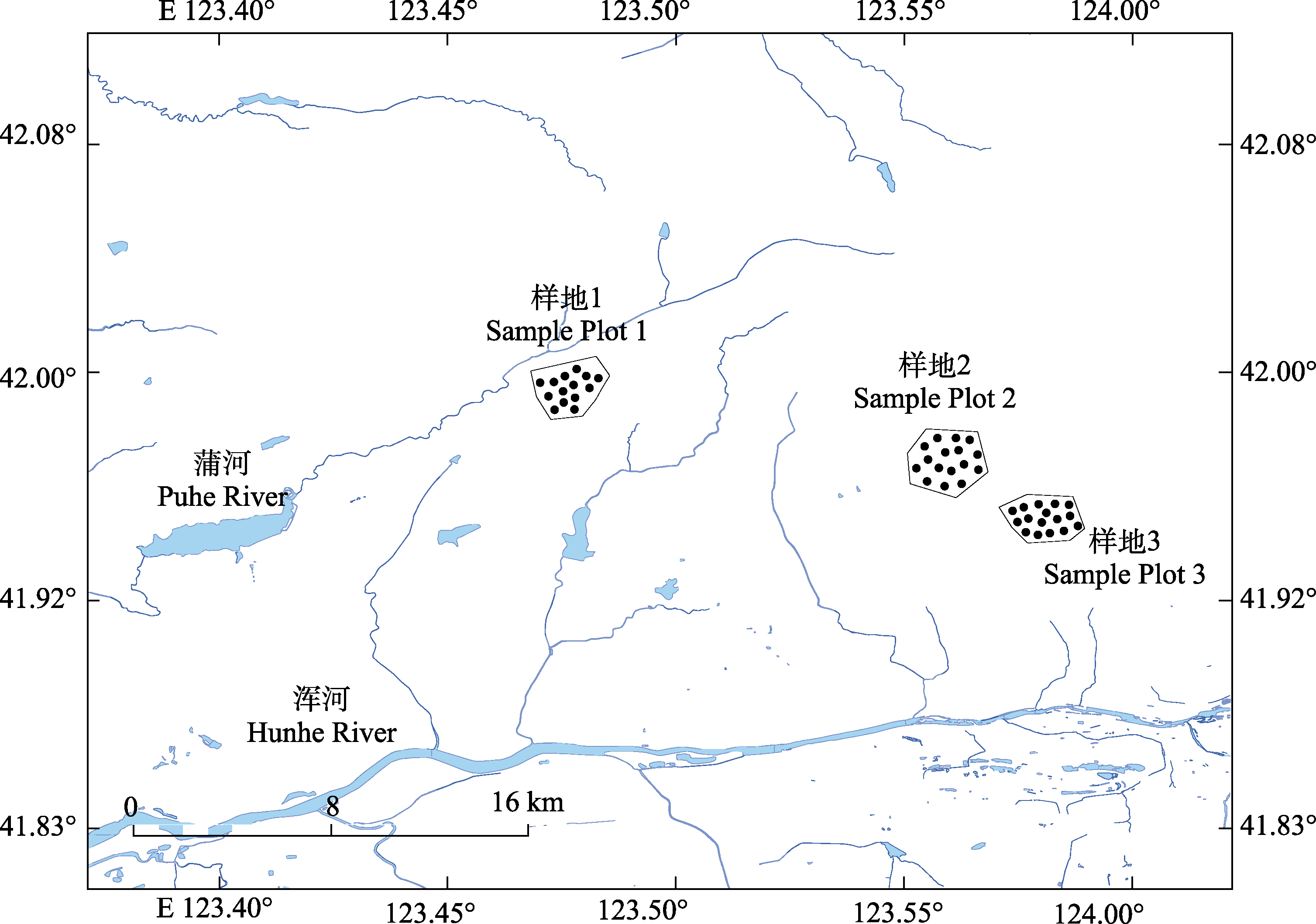
图1 沈阳近郊野大豆群落样地及样点空间位置示意图。
Fig. 1 Schematic diagram of the spatial location of sample plots and sample points of the Glycine soja community in the suburbs of Shenyang.
| 序号 Serial number | 物种名 Species name | 出现样方数 Number of quadrats present | 频度 Frequency (%) | 平均盖度 Average coverage (%) | 重要值 Importance value (%) | BL | BS |
|---|---|---|---|---|---|---|---|
| 1 | 野大豆 Glycine soja | 138 | 97.18 | 49.75 | 33.28 | 101.92 | 4.75 |
| 2 | 矮蒿 Artemisia lancea | 53 | 37.32 | 8.14 | 6.29 | 34.62 | 3.73 |
| 3 | 狗尾草 Setaria viridis | 55 | 38.73 | 3.85 | 5.41 | 31.37 | 3.68 |
| 4 | 黄花蒿 Artemisia annua | 29 | 20.42 | 6.97 | 4.31 | 22.39 | 3.22 |
| 5 | 三裂叶豚草 Ambrosia trifida | 44 | 30.99 | 4.49 | 4.30 | 23.99 | 3.42 |
| 6 | 野黍 Eriochloa villosa | 47 | 33.10 | 2.37 | 3.94 | 28.91 | 3.57 |
| 7 | 鼠掌老鹳草 Geranium sibiricum | 39 | 27.46 | 3.49 | 3.90 | 21.07 | 3.30 |
| 8 | 红蓼 Persicaria orientalis | 18 | 12.68 | 4.58 | 3.38 | 12.24 | 2.62 |
| 9 | 葎草 Humulus scandens | 35 | 24.65 | 2.84 | 2.97 | 18.43 | 3.27 |
| 10 | 大刺儿菜 Cirsium arvense var. setosum | 36 | 25.35 | 2.14 | 2.97 | 26.60 | 3.40 |
| 11 | 稗 Echinochloa crusgalli | 29 | 20.42 | 2.32 | 2.80 | 11.12 | 2.88 |
| 12 | 蒌蒿 Artemisia selengensis | 28 | 19.72 | 2.25 | 2.48 | 16.61 | 3.02 |
| 13 | 芦苇 Phragmites australis | 18 | 12.68 | 3.20 | 2.44 | 12.86 | 2.69 |
| 14 | 豆茶山扁豆 Chamaecrista nomame | 19 | 13.38 | 1.25 | 1.80 | 12.40 | 2.68 |
| 15 | 贼小豆 Vigna minima | 17 | 11.97 | 1.24 | 1.47 | 12.11 | 2.65 |
表1 沈阳近郊野大豆群落中排序前15草本植物的重要值和生态位宽度
Table 1 Important values and niche widths of the top 15 herbaceous plants of the Glycine soja community in the suburbs of Shenyang
| 序号 Serial number | 物种名 Species name | 出现样方数 Number of quadrats present | 频度 Frequency (%) | 平均盖度 Average coverage (%) | 重要值 Importance value (%) | BL | BS |
|---|---|---|---|---|---|---|---|
| 1 | 野大豆 Glycine soja | 138 | 97.18 | 49.75 | 33.28 | 101.92 | 4.75 |
| 2 | 矮蒿 Artemisia lancea | 53 | 37.32 | 8.14 | 6.29 | 34.62 | 3.73 |
| 3 | 狗尾草 Setaria viridis | 55 | 38.73 | 3.85 | 5.41 | 31.37 | 3.68 |
| 4 | 黄花蒿 Artemisia annua | 29 | 20.42 | 6.97 | 4.31 | 22.39 | 3.22 |
| 5 | 三裂叶豚草 Ambrosia trifida | 44 | 30.99 | 4.49 | 4.30 | 23.99 | 3.42 |
| 6 | 野黍 Eriochloa villosa | 47 | 33.10 | 2.37 | 3.94 | 28.91 | 3.57 |
| 7 | 鼠掌老鹳草 Geranium sibiricum | 39 | 27.46 | 3.49 | 3.90 | 21.07 | 3.30 |
| 8 | 红蓼 Persicaria orientalis | 18 | 12.68 | 4.58 | 3.38 | 12.24 | 2.62 |
| 9 | 葎草 Humulus scandens | 35 | 24.65 | 2.84 | 2.97 | 18.43 | 3.27 |
| 10 | 大刺儿菜 Cirsium arvense var. setosum | 36 | 25.35 | 2.14 | 2.97 | 26.60 | 3.40 |
| 11 | 稗 Echinochloa crusgalli | 29 | 20.42 | 2.32 | 2.80 | 11.12 | 2.88 |
| 12 | 蒌蒿 Artemisia selengensis | 28 | 19.72 | 2.25 | 2.48 | 16.61 | 3.02 |
| 13 | 芦苇 Phragmites australis | 18 | 12.68 | 3.20 | 2.44 | 12.86 | 2.69 |
| 14 | 豆茶山扁豆 Chamaecrista nomame | 19 | 13.38 | 1.25 | 1.80 | 12.40 | 2.68 |
| 15 | 贼小豆 Vigna minima | 17 | 11.97 | 1.24 | 1.47 | 12.11 | 2.65 |
| 1 | 2 | 3 | 4 | 5 | 6 | 7 | 8 | 9 | 10 | 11 | 12 | 13 | 14 | 15 | |
|---|---|---|---|---|---|---|---|---|---|---|---|---|---|---|---|
| 1 | 0.30 | 0.26 | 0.18 | 0.24 | 0.26 | 0.22 | 0.07 | 0.22 | 0.21 | 0.14 | 0.14 | 0.10 | 0.11 | 0.14 | |
| 2 | 0.35 | 0.13 | 0.11 | 0.14 | 0.12 | 0.14 | 0.03 | 0.08 | 0.15 | 0.06 | 0.15 | 0.21 | 0.15 | 0.01 | |
| 3 | 0.26 | 0.11 | 0.20 | 0.31 | 0.19 | 0.21 | 0.10 | 0.20 | 0.21 | 0.23 | 0.09 | 0.00 | 0.09 | 0.11 | |
| 4 | 0.30 | 0.10 | 0.23 | 0.03 | 0.27 | 0.06 | 0.03 | 0.00 | 0.10 | 0.06 | 0.19 | 0.00 | 0.17 | 0.07 | |
| 5 | 0.28 | 0.13 | 0.31 | 0.04 | 0.14 | 0.26 | 0.03 | 0.21 | 0.26 | 0.12 | 0.09 | 0.02 | 0.06 | 0.10 | |
| 6 | 0.31 | 0.10 | 0.19 | 0.28 | 0.11 | 0.19 | 0.06 | 0.17 | 0.11 | 0.11 | 0.09 | 0.16 | 0.14 | 0.19 | |
| 7 | 0.27 | 0.12 | 0.19 | 0.04 | 0.23 | 0.18 | 0.03 | 0.31 | 0.14 | 0.09 | 0.08 | 0.07 | 0.02 | 0.03 | |
| 8 | 0.12 | 0.03 | 0.12 | 0.02 | 0.02 | 0.06 | 0.01 | 0.12 | 0.00 | 0.32 | 0.03 | 0.01 | 0.04 | 0.00 | |
| 9 | 0.29 | 0.04 | 0.17 | 0.00 | 0.19 | 0.16 | 0.36 | 0.16 | 0.14 | 0.18 | 0.04 | 0.12 | 0.00 | 0.02 | |
| 10 | 0.30 | 0.16 | 0.28 | 0.11 | 0.31 | 0.11 | 0.09 | 0.00 | 0.17 | 0.03 | 0.26 | 0.26 | 0.04 | 0.04 | |
| 11 | 0.12 | 0.03 | 0.14 | 0.03 | 0.06 | 0.05 | 0.04 | 0.32 | 0.08 | 0.01 | 0.08 | 0.01 | 0.03 | 0.05 | |
| 12 | 0.24 | 0.18 | 0.08 | 0.28 | 0.08 | 0.09 | 0.03 | 0.02 | 0.02 | 0.31 | 0.04 | 0.14 | 0.05 | 0.12 | |
| 13 | 0.16 | 0.35 | 0.00 | 0.00 | 0.04 | 0.23 | 0.09 | 0.00 | 0.09 | 0.34 | 0.01 | 0.10 | 0.07 | 0.03 | |
| 14 | 0.22 | 0.21 | 0.11 | 0.17 | 0.10 | 0.17 | 0.02 | 0.02 | 0.00 | 0.04 | 0.01 | 0.06 | 0.06 | 0.04 | |
| 15 | 0.34 | 0.00 | 0.10 | 0.04 | 0.10 | 0.19 | 0.03 | 0.00 | 0.02 | 0.04 | 0.02 | 0.10 | 0.01 | 0.03 |
表2 沈阳近郊野大豆群落主要草本植物生态位重叠度(Oik) (对角线左)及生态位相似性(Cik) (对角线右)
Table 2 Niche overlap (Oik) (diagonal left) and niche similarity (Cik) (diagonal right) of major herbaceous plants of the Glycine soja community in the suburbs of Shenyang
| 1 | 2 | 3 | 4 | 5 | 6 | 7 | 8 | 9 | 10 | 11 | 12 | 13 | 14 | 15 | |
|---|---|---|---|---|---|---|---|---|---|---|---|---|---|---|---|
| 1 | 0.30 | 0.26 | 0.18 | 0.24 | 0.26 | 0.22 | 0.07 | 0.22 | 0.21 | 0.14 | 0.14 | 0.10 | 0.11 | 0.14 | |
| 2 | 0.35 | 0.13 | 0.11 | 0.14 | 0.12 | 0.14 | 0.03 | 0.08 | 0.15 | 0.06 | 0.15 | 0.21 | 0.15 | 0.01 | |
| 3 | 0.26 | 0.11 | 0.20 | 0.31 | 0.19 | 0.21 | 0.10 | 0.20 | 0.21 | 0.23 | 0.09 | 0.00 | 0.09 | 0.11 | |
| 4 | 0.30 | 0.10 | 0.23 | 0.03 | 0.27 | 0.06 | 0.03 | 0.00 | 0.10 | 0.06 | 0.19 | 0.00 | 0.17 | 0.07 | |
| 5 | 0.28 | 0.13 | 0.31 | 0.04 | 0.14 | 0.26 | 0.03 | 0.21 | 0.26 | 0.12 | 0.09 | 0.02 | 0.06 | 0.10 | |
| 6 | 0.31 | 0.10 | 0.19 | 0.28 | 0.11 | 0.19 | 0.06 | 0.17 | 0.11 | 0.11 | 0.09 | 0.16 | 0.14 | 0.19 | |
| 7 | 0.27 | 0.12 | 0.19 | 0.04 | 0.23 | 0.18 | 0.03 | 0.31 | 0.14 | 0.09 | 0.08 | 0.07 | 0.02 | 0.03 | |
| 8 | 0.12 | 0.03 | 0.12 | 0.02 | 0.02 | 0.06 | 0.01 | 0.12 | 0.00 | 0.32 | 0.03 | 0.01 | 0.04 | 0.00 | |
| 9 | 0.29 | 0.04 | 0.17 | 0.00 | 0.19 | 0.16 | 0.36 | 0.16 | 0.14 | 0.18 | 0.04 | 0.12 | 0.00 | 0.02 | |
| 10 | 0.30 | 0.16 | 0.28 | 0.11 | 0.31 | 0.11 | 0.09 | 0.00 | 0.17 | 0.03 | 0.26 | 0.26 | 0.04 | 0.04 | |
| 11 | 0.12 | 0.03 | 0.14 | 0.03 | 0.06 | 0.05 | 0.04 | 0.32 | 0.08 | 0.01 | 0.08 | 0.01 | 0.03 | 0.05 | |
| 12 | 0.24 | 0.18 | 0.08 | 0.28 | 0.08 | 0.09 | 0.03 | 0.02 | 0.02 | 0.31 | 0.04 | 0.14 | 0.05 | 0.12 | |
| 13 | 0.16 | 0.35 | 0.00 | 0.00 | 0.04 | 0.23 | 0.09 | 0.00 | 0.09 | 0.34 | 0.01 | 0.10 | 0.07 | 0.03 | |
| 14 | 0.22 | 0.21 | 0.11 | 0.17 | 0.10 | 0.17 | 0.02 | 0.02 | 0.00 | 0.04 | 0.01 | 0.06 | 0.06 | 0.04 | |
| 15 | 0.34 | 0.00 | 0.10 | 0.04 | 0.10 | 0.19 | 0.03 | 0.00 | 0.02 | 0.04 | 0.02 | 0.10 | 0.01 | 0.03 |
| 1 | 2 | 3 | 4 | 5 | 6 | 7 | 8 | 9 | 10 | 11 | 12 | 13 | 14 | |
|---|---|---|---|---|---|---|---|---|---|---|---|---|---|---|
| 2 | ○ | |||||||||||||
| 3 | - | - | ||||||||||||
| 4 | + | - | - | |||||||||||
| 5 | - | - | + | □ | ||||||||||
| 6 | + | - | - | + | - | |||||||||
| 7 | - | - | + | - | + | + | ||||||||
| 8 | - | - | + | - | - | - | - | |||||||
| 9 | ■ | - | + | - | + | + | ○ | + | ||||||
| 10 | + | + | - | - | + | - | + | □ | - | |||||
| 11 | - | - | + | - | + | - | + | ○ | ● | □ | ||||
| 12 | - | + | + | - | + | - | + | - | - | ● | + | |||
| 13 | + | ○ | ■ | □ | - | + | + | - | + | ○ | - | + | ||
| 14 | + | + | - | ● | - | + | - | - | □ | - | - | - | - | |
| 15 | + | ■ | + | + | - | ○ | - | - | - | - | - | + | - | + |
表3 沈阳近郊野大豆群落中主要草本植物的χ2检验半矩阵
Table 3 Chi-square test of major herbaceous plants in the Glycine soja community in the suburbs of Shenyang
| 1 | 2 | 3 | 4 | 5 | 6 | 7 | 8 | 9 | 10 | 11 | 12 | 13 | 14 | |
|---|---|---|---|---|---|---|---|---|---|---|---|---|---|---|
| 2 | ○ | |||||||||||||
| 3 | - | - | ||||||||||||
| 4 | + | - | - | |||||||||||
| 5 | - | - | + | □ | ||||||||||
| 6 | + | - | - | + | - | |||||||||
| 7 | - | - | + | - | + | + | ||||||||
| 8 | - | - | + | - | - | - | - | |||||||
| 9 | ■ | - | + | - | + | + | ○ | + | ||||||
| 10 | + | + | - | - | + | - | + | □ | - | |||||
| 11 | - | - | + | - | + | - | + | ○ | ● | □ | ||||
| 12 | - | + | + | - | + | - | + | - | - | ● | + | |||
| 13 | + | ○ | ■ | □ | - | + | + | - | + | ○ | - | + | ||
| 14 | + | + | - | ● | - | + | - | - | □ | - | - | - | - | |
| 15 | + | ■ | + | + | - | ○ | - | - | - | - | - | + | - | + |
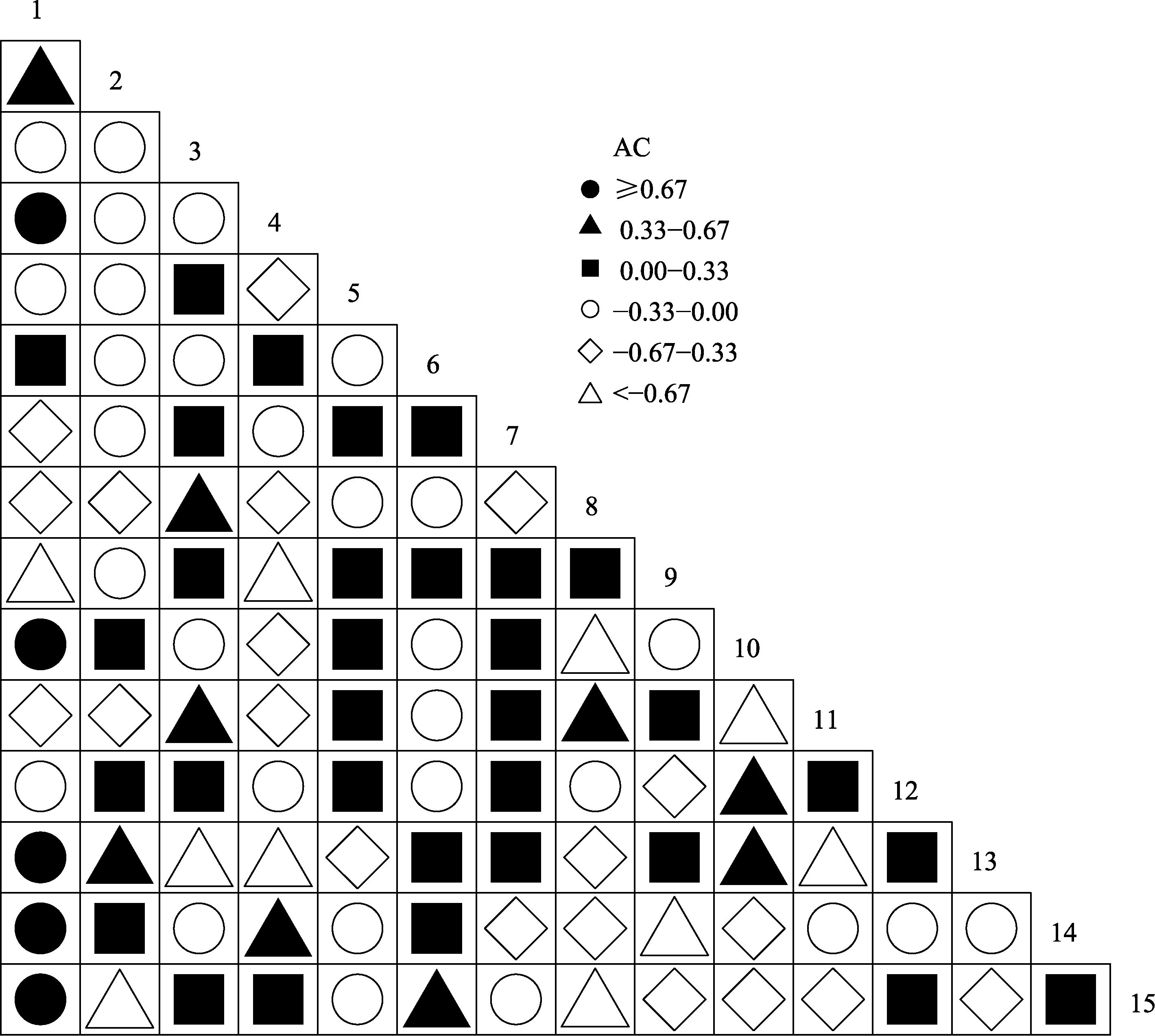
图2 沈阳近郊野大豆群落中主要草本植物的联结系数(AC)。表中序号1-15所代表的物种见表1。
Fig. 2 Correlation coefficients(AC) of major herbaceous plants in the Glycine soja community in the suburbs of Shenyang. Species represented by numbers 1-15 in the table are the same as those in Table 1.
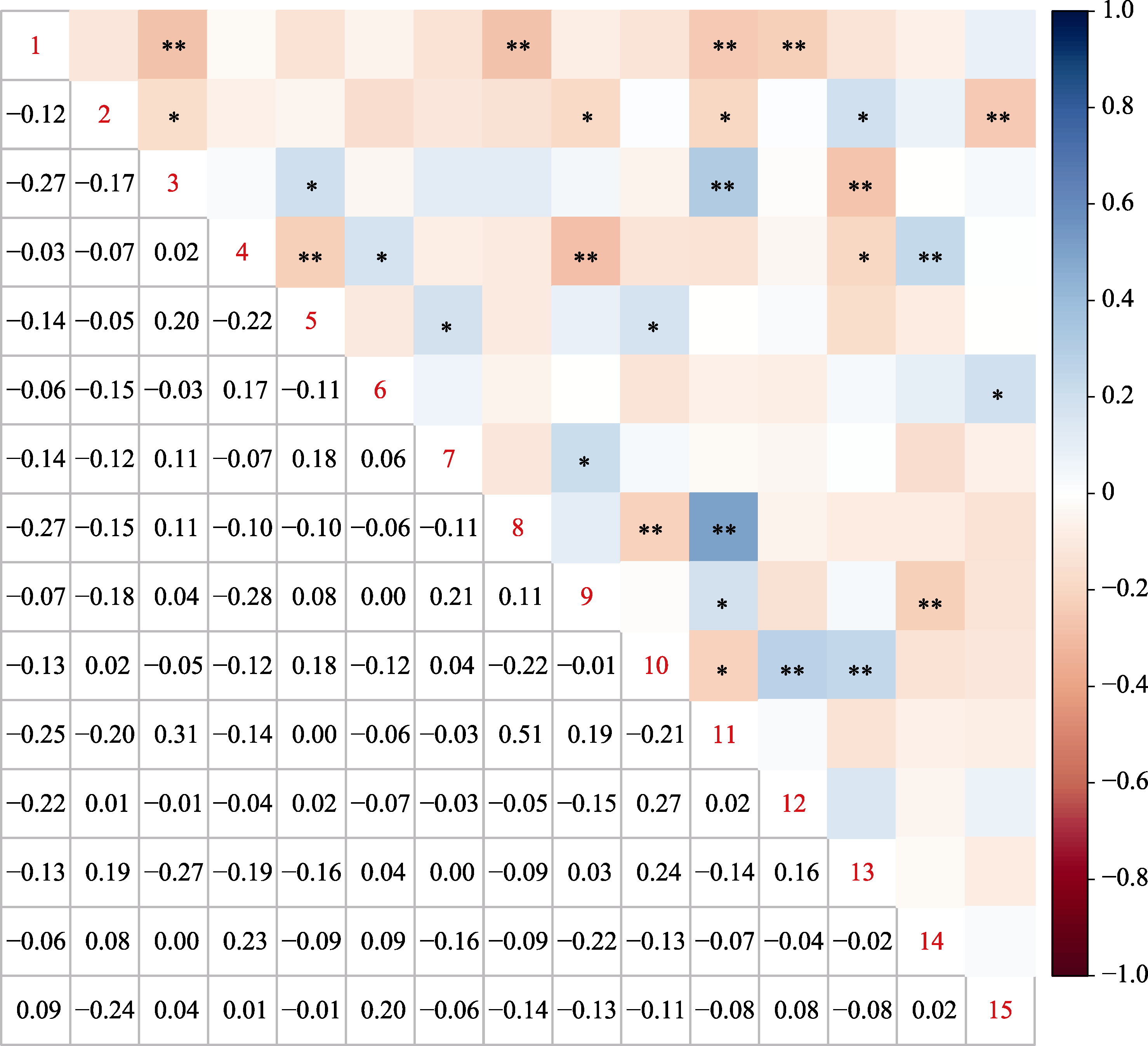
图3 沈阳近郊野大豆群落中主要草本植物的Spearman秩相关系数。*, p < 0.05; **, p < 0.01。表中序号1-15所代表的物种见表1。
Fig. 3 Spearman rank correlation coefficient of major herbaceous plants in the Glycine soja community in the suburbs of Shenyang. *, p < 0.05; **, p < 0.01. Species represented by numbers 1-15 in the table are the same as those in Table 1.
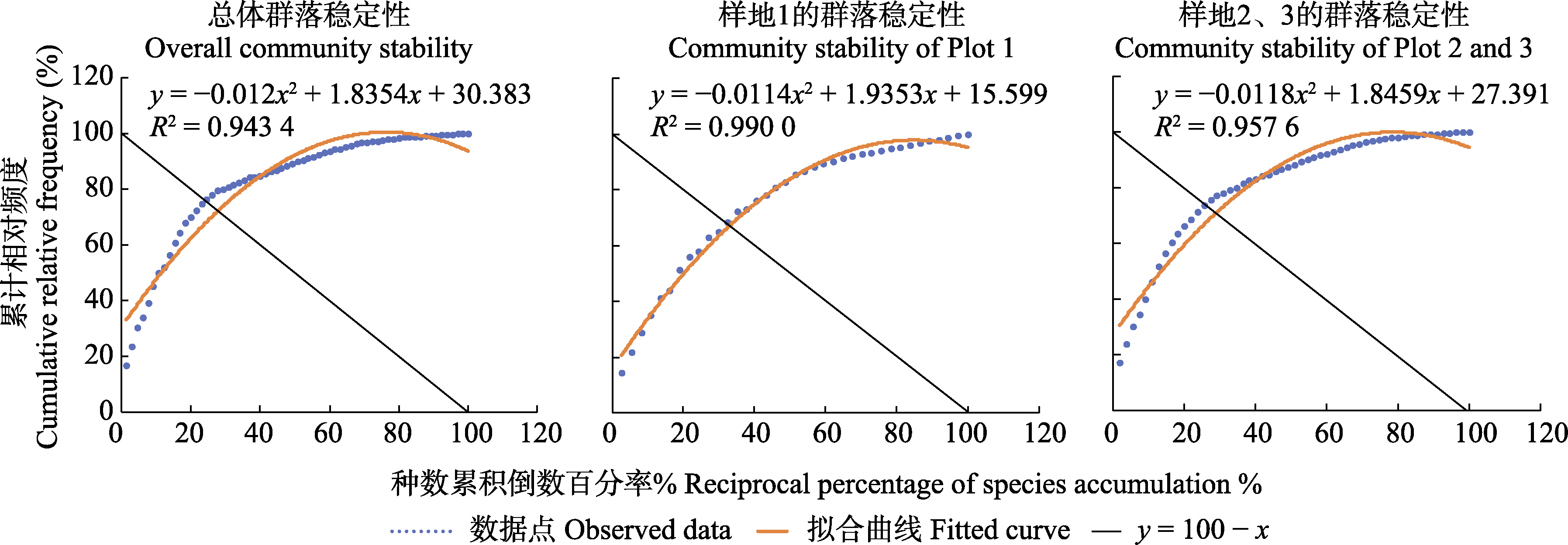
图4 沈阳近郊野大豆群落的稳定性。
Fig. 4 Stability of Glycine soja community in the suburbs of Shenyang.
| [1] |
Bishara AJ, Hittner JB (2012). Testing the significance of a correlation with nonnormal data: comparison of Pearson, Spearman, transformation, and resampling approaches. Psychological Methods, 17, 399-417.
DOI PMID |
| [2] | Chen JH, Liu XL, He F, Liu SR (2010). Niche characteristics of dominant woody populations in Quercus aquifoliodes shrub community in Balangshan Mountain in Wolong Nature Reserve. Scientia Silvae Sinicae, 46(3), 23-28. |
| [陈俊华, 刘兴良, 何飞, 刘世荣 (2010). 卧龙巴朗山川滇高山栎灌丛主要木本植物种群生态位特征. 林业科学, 46(3), 23-28.] | |
| [3] | Cheng YS, Wang TY, Xi WM, Yan M (2024). Ecological niches and interspecific associations of dominant species within an endangered Gymnadenia conopsea (L.) R. Br. community. Plant Science Journal, 42, 444-453. |
| [程永生, 王甜语, 奚为民, 闫明 (2024). 濒危植物手参生存群落主要物种的生态位特征及其种间联结. 植物科学学报, 42, 444-453.] | |
| [4] | Deng XL, Cao YS, Liang Q, Long WW (2016). Study on niche of dominant species at arbor layer in montane elfin forest of Jinggangshan. Journal of Plant Resources and Environment, 25(1), 88-93. |
| [邓贤兰, 曹裕松, 梁琴, 龙婉婉 (2016). 井冈山山顶矮林乔木层优势种的生态位研究. 植物资源与环境学报, 25(1), 88-93.] | |
| [5] | Ding SY, Guo YL, Liang GF (2012). Study on the species diversity of different habitat types in the middle Luo River riparian zone. Journal of Henan University (Natural Science), 42, 613-619. |
| [丁圣彦, 郭屹立, 梁国付 (2012). 洛河中游河岸带不同生境类型中物种多样性研究. 河南大学学报(自然科学版), 42, 613-619.] | |
| [6] |
Falinska K (1999). Seed bank dynamics in abandoned meadows during a 20-year period in the Białowieża National Park. Journal of Ecology, 87, 461-475.
DOI URL |
| [7] | Feng YL (2023). Characteristics of Secondary Successive Vegetation and Soil Changes in High Altitude Agricultural Areas in Eastern Qinghai Province. Master degree dissertation, Qinghai Normal University, Xining. |
| [冯雨露 (2023). 青海东部农业区退耕地次生演替植被特征及其生态过程. 硕士学位论文, 青海师范大学, 西宁.] | |
| [8] | Godron M (1972). Some aspects of heterogeneity in grasslands of Cantal. Statistical Ecology, 3, 397-415. |
| [9] |
Grinnell J (1917). The niche-relationships of the California Thrasher. The Auk, 34, 427-433.
DOI URL |
| [10] | Guo JQ, Chen JC, Huang X, Huang JL, Zhao LY, Li ZH (2021). Niche characteristics and interspecific associations of the dominant species of the communities invaded by Alternanthera philoxeroides. Ecology and Environmental Sciences, 30, 1607-1616. |
|
[郭佳琦, 陈俊辰, 黄旬, 黄佳乐, 赵丽娅, 李兆华 (2021). 喜旱莲子草入侵群落主要物种生态位和种间联结研究. 生态环境学报, 30, 1607-1616.]
DOI |
|
| [11] | Guo ZL, Ma YD, Zheng JP, Liu WD, Jin ZF (2004). Biodiversity of tree species, their populations’ spatial distribution pattern and interspecific association in mixed deciduous broadleaved forest in Changbai Mountains. Chinese Journal Applied Ecology, 15, 2013-2018. |
| [郭忠玲, 马元丹, 郑金萍, 刘万德, 金哲峰 (2004). 长白山落叶阔叶混交林的物种多样性、种群空间分布格局及种间关联性研究. 应用生态学报, 15, 2013-2018.] | |
| [12] | Huang XT, Wang SX, Huang BJ, Yin H, Cui KF, Zhao W, Fan YG, Gu DF (2015). Analyses of community stability and inter-specific associations between the rare plant Phyllitis scolopendrium and its associated species. Acta Ecologica Sinica, 35, 80-90. |
| [黄祥童, 王绍先, 黄炳军, 尹航, 崔凯峰, 赵伟, 范宇光, 顾德峰 (2015). 珍稀植物对开蕨与其伴生物种的联结性及群落稳定性. 生态学报, 35, 80-90.] | |
| [13] | Lei J, Cheng XP, Xue C, Liu HM, Zhao YH, Xiao MM (2024). The characteristics and stability of plant communities in the northern desert area of the middle reaches of Heihe River Basin. Journal of Desert Research, 44(6), 187-194. |
|
[雷军, 程新平, 薛春, 刘红梅, 赵玉红, 肖明敏 (2024). 黑河流域中游北部荒漠区植物群落特征与稳定性. 中国沙漠, 44(6), 187-194.]
DOI |
|
| [14] | Levins R (1968). Evolution in Changing Environments: Some Theoretical Explorations. Princeton University Press, Princeton. |
| [15] | Li CL, Zhang F, Wang LD, Zhao HR, Zhao XC, Zhang HP (2024). Soil microbial community structure and functional diversity character of abandoned farmland in Minqin oasis. Environmental Science, 45, 1821-1829. |
| [李常乐, 张富, 王理德, 赵赫然, 赵学成, 张恒平 (2024). 民勤绿洲退耕地土壤微生物群落结构与功能多样性特征. 环境科学, 45, 1821-1829.] | |
| [16] | Li FS (1993). Studies on the ecological and geographical distribution of the Chinese resources of wild soybean (G. soja). Scientia Agricultura Sinica, 26(2), 47-55. |
| [李福山 (1993). 中国野生大豆资源的地理分布及生态分化研究. 中国农业科学, 26(2), 47-55.] | |
| [17] | Li HZ, Dang H, Xu JS, Chen Y (2020). Interspecific associations of the main understory herbaceous communities across altitudinal gradients on the Taibai Mountain by different approaches. Journal of Northwest Forestry University, 35(6), 66-73. |
| [李怀珠, 党晗, 许金石, 陈煜 (2020). 不同方法研究太白山不同海拔梯度林下主要草本植物群落的种间关联. 西北林学院学报, 35(6), 66-73.] | |
| [18] | Li KJ, Cai C, Ruan GM, Ling SW, Pan BZ, Zhou JG, Liu JF, Zheng SQ (2025). Interspecific association of main tree species in Ormosia microphylla survival community and its community stability. Chinese Journal of Applied Ecology, 36, 427-436. |
|
[李珂佳, 蔡晨, 阮广鸣, 凌书伟, 潘标志, 周家贵, 刘金福, 郑世群 (2025). 小叶红豆群落主要树种的种间关系及群落稳定性. 应用生态学报, 36, 427-436.
DOI |
|
| [19] | Liu H, Du RW, Wang Y, Chen YL, Wu YK, Yuan L (2017). Effects of Eupatorium adenophorum on interspecific association and the stability of companion species in Liangshan Prefecture of Sichuan Province. Acta Ecologica Sinica, 37, 5031-5038. |
| [刘海, 杜如万, 王勇, 陈玉蓝, 吴叶宽, 袁玲 (2017). 紫茎泽兰对四川省凉山州共生植物种间联结性及稳定性的影响. 生态学报, 37, 5031-5038.] | |
| [20] | Long ZY, Wang ZC, Zhao R, Liu B, Chen GX (2024). Niches and community stability of dominant herbaceous species in the forest and creek ecotone of Dehang Geopark. Acta Botanica Boreali-Occidentalia Sinica, 44, 1954-1964. |
| [龙姿羽, 王志成, 赵蕊, 刘冰, 陈功锡 (2024). 德夯地质公园林溪交错带草本群落优势种生态位及种间联结. 西北植物学报, 44, 1954-1964.] | |
| [21] | Ma CM, Yuan YX (2004). The review of vegetation restoration on old field at home and abroad. World Forestry Research, 17(4), 24-27. |
| [马长明, 袁玉欣 (2004). 国内外退耕地植被恢复研究现状. 世界林业研究, 17(4), 24-27.] | |
| [22] | Moyo B, Ravhuhali KE (2022). Abandoned croplands: drivers and secondary succession trajectories under livestock grazing in communal areas of South Africa. Sustainability, 14, 6168. DOI: 10.3390/su14106168. |
| [23] |
Pianka ER (1973). The structure of lizard communities. Annual Review of Ecology and Systematics, 4, 53-74.
DOI URL |
| [24] |
Schluter D (1984). A variance test for detecting species associations, with some example applications. Ecology, 65, 998-1005.
DOI URL |
| [25] |
Schoener TW (1974). Resource partitioning in ecological communities. Science, 185, 27-39.
DOI PMID |
| [26] | Shannon CE, Weiner W (1949). The Mathematical Theory of Communication: Unknown Distance Function. University of Illinois Press, Urbana, USA. |
| [27] | Song YC (2017). Vegetation Ecology. 2nd ed. Higher Education Press, Beijing. |
| [宋永昌 (2017). 植被生态学. 2版. 高等教育出版社, 北京.] | |
| [28] | Tan XM, Sun LX, Du ZY, Li HR, Dang N, Xiao J, Zhang PX, Chen GC (2025). Characteristics and stability of plant communities in abandoned copper mining sites with different successional period. Acta Ecologica Sinica, 45, 1900-1912. |
| [谭许脉, 孙立祥, 杜忠毓, 李浩然, 党宁, 肖江, 张平选, 陈光才 (2025). 铜矿废弃地不同演替阶段植物群落特征及其稳定性. 生态学报, 45, 1900-1912.] | |
| [29] | Tu HR, Nong JL, Zhu J, Zhao JJ, Yang WL, Zhu QQ, Xie YJ, Liu RH (2022). Interspecific associations of main species and community stability of Myrsine seguinii in karst hills of Guilin, southwestern China. Acta Ecologica Sinica, 42, 3688-3705. |
| [涂洪润, 农娟丽, 朱军, 赵佳佳, 杨婉琳, 朱琪琪, 谢彦军, 刘润红 (2022). 桂林岩溶石山密花树群落主要物种的种间关联及群落稳定性. 生态学报, 42, 3688-3705.] | |
| [30] | Wang SY (2018). Preliminary study on utilization and protection mode of wild soybean in Liaoning Province. Agricultural Development & Equipments, (4), 46. |
| [王树宇 (2018). 辽宁省野生大豆利用途径及保护模式初探. 农业开发与装备, (4), 46.] | |
| [31] |
Ward JS, Parker GR, Ferrandino FJ (1996). Long-term spatial dynamics in an old-growth deciduous forest. Forest Ecology and Management, 83, 189-202.
DOI URL |
| [32] | Wu WH, Wu JS, Wu WX, Lyu JB, Fu GL, Zhang YH, Zheng XJ, Tu JL, Mei XD (2024). The interspecific niche and interspecific association of the rare plant Styrax zhejiangensis community. Journal of Northeast Forestry University, 52(12), 46-54. |
| [吴卫华, 吴家森, 吴文骁, 吕江波, 傅国林, 张晔华, 郑小军, 屠娟丽, 梅旭东 (2024). 珍稀植物浙江安息香群落种间生态位及种间联结. 东北林业大学学报, 52(12), 46-54.] | |
| [33] | Xie WL, Wang QY, Wang QX, Gan WY, Wu YF, Huang LJ (2024). Niche and interspecific association of spontaneous herbaceous plants in Fuzhou section of Minjiang River. Journal of Tropical and Subtropical Botany, 33, 149-158. |
| [谢婉丽, 王奇悦, 王秋雪, 甘婉怡, 武艳芳, 黄柳菁 (2024). 闽江福州段自生草本植物生态位和种间联结研究. 热带亚热带植物学报, 33, 149-158.] | |
| [34] | Xu MH, Liu M, Zhai DT, Liu T (2016). A review of contents and methods used to analyze various aspects of plant interspecific associations. Acta Ecologica Sinica, 36, 8224-8233. |
| [徐满厚, 刘敏, 翟大彤, 刘彤 (2016). 植物种间联结研究内容与方法评述. 生态学报, 36, 8224-8233.] | |
| [35] | Yang M, Yuan DM, Yan LB, Yu LF, An MT, He QQ, Mu J (2024). Interspecific relationship and community stability of Alsophila spinulosa-Phyllostachys edulis clusters. Journal of Tropical and Subtropical Botany, 32, 349-356. |
| [杨熳, 袁冬梅, 严令斌, 喻理飞, 安明态, 何琴琴, 穆君 (2024). 毛竹-桫椤群丛的种间关系与群落稳定性. 热带亚热带植物学报, 32, 349-356.] | |
| [36] | Yu F, Wang Y, Zhang GG, Ma JM (2023). Plant diversity and interspecific associations of different floodplains in the wandering Yellow River. Acta Ecologica Sinica, 43, 2429-2439. |
| [于飞, 王洋, 张岗岗, 马剑敏 (2023). 游荡型黄河滩涂植物群落多样性及种间联结性. 生态学报, 43, 2429-2439.] | |
| [37] | Zeng RK, Mo JF, Zhang SC, Zhao Q, Zhou Q, Mo QF (2024). Niches and interspecific associations of dominant trees in a Lithocarpus glaucus community. Journal of Forest and Environment, 44, 403-413. |
| [曾睿楷, 莫金凤, 张少纯, 赵倩, 周庆, 莫其锋 (2024). 粉绿柯群落优势乔木的生态位与种间关联分析. 森林与环境学报, 44, 403-413.] | |
| [38] | Zhang DM, Zhao WZ, Luo WC (2018). Niche and interspecific association of dominant plant species in saline-alkaline soils of desert steppe zone. Chinese Journal of Ecology, 37, 1307-1315. |
| [张东梅, 赵文智, 罗维成 (2018). 荒漠草原带盐碱地优势植物生态位与种间联结. 生态学杂志, 37, 1307-1315.] | |
| [39] | Zhang FH, Pan XD, Li YY (2006). Research on successional regulation of soil environment after reclamation in the manas river valley. Scientia Agricultura Sinica, 39(2), 331-336. |
| [张凤华, 潘旭东, 李玉义 (2006). 新疆玛河流域绿洲农田开垦后土壤环境演变分析. 中国农业科学, 39(2), 331-336.] | |
| [40] | Zhang JQ, Lu J, Wang SY, Lin L, Wang J, Yang CW (2024). Niches characteristics and community stability of endangered plant, Picea neoveitchii. Bulletin of Botanical Research, 44, 863-869. |
|
[张继强, 芦娟, 王三英, 林琳, 王杰, 杨昌文 (2024). 濒危植物大果青杄群落生态位特征及群落稳定性. 植物研究, 44, 863-869.]
DOI |
|
| [41] | Zhang JT (2018). Quantitative Ecology. 3rd ed. Science Press, Beijing. 147-162. |
| [张金屯 (2018). 数量生态学. 3版. 科学出版社, 北京. 147-162.] | |
| [42] | Zhang M, Zheng JM, Wan JY, Ren K, Rong JD, Zheng YS (2022). Niche and interspecific association of dominant woody plants in Dongmen Island, Fujian Province. Journal of Forestry and Environment, 42, 11-19. |
| [张盟, 郑俊鸣, 万佳艺, 任可, 荣俊冬, 郑郁善 (2022). 福建省东门屿优势木本植物的生态位与种间联结. 森林与环境学报, 42, 11-19.] | |
| [43] | Zhang MR, Su XD, Zhang XX, Ye XL (2020). Biodiversity and natural regeneration of Pistacia chinensis communities in the South Taihang Mountains. Journal of Forestry and Environment, 40, 597-604. |
| [张孟仁, 苏晓迪, 张学献, 叶先亮 (2020). 黄连木群落的生物多样性与天然更新. 森林与环境学报, 40, 597-604.] | |
| [44] |
Zhang W, Ren CJ, Deng J, Zhao FZ, Yang GH, Han XH, Tong XG, Feng YZ (2018). Plant functional composition and species diversity affect soil C, N, and P during secondary succession of abandoned farmland on the Loess Plateau. Ecological Engineering, 122, 91-99.
DOI URL |
| [45] | Zhao CL, Zhang F, Pang CH, Wang HM, Fan X (2013). Interspecific association of dominant species of Amaranth retroflexus L. community. Bulletin of Botanical Research, 33, 454-460. |
|
[赵彩莉, 张峰, 庞春花, 王慧敏, 范晓 (2013). 反枝苋群落优势种的种间关联性分析. 植物研究, 33, 454-460.]
DOI |
|
| [46] | Zheng YR (2000). Comparison of methods for studying stability of forest community. Scientia Silvae Sinicae, 36(5), 28-32. |
| [郑元润 (2000). 森林群落稳定性研究方法初探. 林业科学, 36(5), 28-32.] |
| [1] | 赵珮杉, 高广磊, 丁国栋, 张英. 林龄和生态位对樟子松人工林地下真菌群落构建的影响[J]. 植物生态学报, 2025, 49(9): 1472-1484. |
| [2] | 李冬梅, 孙龙, 韩宇, 胡同欣, 杨光, 蔡慧颖. 计划火烧对红松人工林生物多样性与生态系统多功能性关系的影响[J]. 植物生态学报, 2025, 49(3): 379-392. |
| [3] | 刘洋, 刘傲, 宋璇紫, 杨云, 安柏衡, 韩梦姣, 班玛才格尔, 米玛旺堆. 高原鼠兔干扰对高寒草甸主要植物生态位及种间联结的影响[J]. 植物生态学报, 2025, 49(12): 2054-2068. |
| [4] | 周红娟, 刘子赫, 刘柯言, 张初蕊, 胡旭, 韩璐, 陈立欣. 不同降雨条件下北京土石山区混生乔灌植物的水分吸收和生态位特征[J]. 植物生态学报, 2024, 48(9): 1089-1103. |
| [5] | 冉松松, 余再鹏, 万晓华, 傅彦榕, 邹秉章, 王思荣, 黄志群. 邻域树种多样性对杉木叶片氮磷生态化学计量比的影响[J]. 植物生态学报, 2023, 47(7): 932-942. |
| [6] | 祝维, 周欧, 孙一鸣, 古丽米热·依力哈木, 王亚飞, 杨红青, 贾黎明, 席本野. 混交林内毛白杨和刺槐根系吸水的动态生态位划分[J]. 植物生态学报, 2023, 47(3): 389-403. |
| [7] | 杨玲, 梁思琪, 潘佳明, 韦金鑫, 丁涛, 蒋日红, 邵毅贞, 张宪春, 刘勇波, 向巧萍. 濒危植物百山祖冷杉和资源冷杉的物种划分及其遗传资源的保护[J]. 植物生态学报, 2023, 47(12): 1629-1645. |
| [8] | 李杰, 郝珉辉, 范春雨, 张春雨, 赵秀海. 东北温带森林树种和功能多样性对生态系统多功能性的影响[J]. 植物生态学报, 2023, 47(11): 1507-1522. |
| [9] | 叶洁泓, 于成龙, 卓少菲, 陈新兰, 杨科明, 文印, 刘慧. 木兰科植物叶片光合系统耐热性与叶片形态及温度生态位的关系[J]. 植物生态学报, 2023, 47(10): 1432-1440. |
| [10] | 张零念, 朱贵青, 杨宽, 刘星月, 巩合德, 郑丽. 滇中云南杨梅灌丛主要木本植物生态位与种间联结[J]. 植物生态学报, 2022, 46(11): 1400-1410. |
| [11] | 王春成, 张云玲, 马松梅, 黄刚, 张丹, 闫涵. 中国扁桃亚属四种野生扁桃的系统发育与物种分化[J]. 植物生态学报, 2021, 45(9): 987-995. |
| [12] | 闫涵, 张云玲, 马松梅, 王春成, 张丹. 黑果枸杞在新疆的适宜分布模拟与局部环境适应性分化[J]. 植物生态学报, 2021, 45(11): 1221-1230. |
| [13] | 车俭, 郑洁, 蒋娅, 金毅, 乙引. 中国亚热带森林动态监测样地常绿和落叶木本被子植物谱系结构及生态习性差异[J]. 植物生态学报, 2020, 44(10): 1007-1014. |
| [14] | 胡菀,张志勇,陈陆丹,彭焱松,汪旭. 末次盛冰期以来观光木的潜在地理分布变迁[J]. 植物生态学报, 2020, 44(1): 44-55. |
| [15] | 施晶晶,赵鸣飞,王宇航,薛峰,康慕谊,江源. 黄土高原腹地人工林下草本层群落构建机制[J]. 植物生态学报, 2019, 43(9): 834-842. |
| 阅读次数 | ||||||
|
全文 |
|
|||||
|
摘要 |
|
|||||
Copyright © 2026 版权所有 《植物生态学报》编辑部
地址: 北京香山南辛村20号, 邮编: 100093
Tel.: 010-62836134, 62836138; Fax: 010-82599431; E-mail: apes@ibcas.ac.cn, cjpe@ibcas.ac.cn
备案号: 京ICP备16067583号-19

