
植物生态学报 ›› 2025, Vol. 49 ›› Issue (10): 1710-1720.DOI: 10.17521/cjpe.2024.0271 cstr: 32100.14.cjpe.2024.0271
黄智军, 甘子莹, 祝嘉新, 丘清燕*( ), 胡亚林
收稿日期:2024-08-12
接受日期:2025-01-14
出版日期:2025-10-20
发布日期:2025-03-12
通讯作者:
*丘清燕(qingyan_qiu@126.com)基金资助:
HUANG Zhi-Jun, GAN Zi-Ying, ZHU Jia-Xin, QIU Qing-Yan*(), HU Ya-Lin
Received:2024-08-12
Accepted:2025-01-14
Online:2025-10-20
Published:2025-03-12
Supported by:摘要: 凋落物质量是影响土壤激发效应强度与方向的一个重要因素。然而, 当前对于不同器官或者是同一器官不同碳氮比(C:N)凋落物输入是否对土壤激发效应产生差异化影响及其作用机理仍不清楚。为此, 该研究以13C标记的杉木(Cunninghamia lanceolata)幼苗为研究对象, 通过设置施肥与不施肥处理获取具有低C:N与高C:N杉木的叶、茎、根, 以此研究低C:N和高C:N杉木叶、茎、根输入对土壤激发效应的影响, 并通过测定土壤微生物生物量、酶活性以及土壤有效氮含量等指标阐明其作用机理。结果表明: 杉木叶输入的初始阶段诱导正激发效应, 但是从整个培养期间(180天)来看, 其对原有土壤有机碳(SOC)的矿化影响不明显; 低C:N杉木根的输入使SOC的矿化量降低10.1%, 诱导负激发效应; 而高C:N杉木根以及杉木茎的输入均对SOC的矿化影响不明显。杉木同一器官不同C:N对土壤激发效应的影响不明显, 可能是因为不同C:N杉木凋落物添加对土壤微生物生物量碳含量及碳代谢相关酶活性的影响不显著。杉木叶输入初期诱导正激发效应与其输入显著降低土壤有效氮含量有关, 当土壤有效氮含量降低时微生物为满足自身对氮的需求, 从而加速对原有SOC的分解。低C:N杉木根添加诱导负激发效应主要在于其输入显著提高了微生物对这些外源添加物的利用, 而外源添加物释放的氮能够满足微生物对氮的需求, 从而减少了对原有SOC的矿化, 因而“底物优先利用”是低C:N杉木根输入诱导土壤负激发效应的主要原因。
黄智军, 甘子莹, 祝嘉新, 丘清燕, 胡亚林. 杉木不同器官不同碳氮比对土壤激发效应的影响及其机理. 植物生态学报, 2025, 49(10): 1710-1720. DOI: 10.17521/cjpe.2024.0271
HUANG Zhi-Jun, GAN Zi-Ying, ZHU Jia-Xin, QIU Qing-Yan, HU Ya-Lin. Impacts and mechanisms of carbon to nitrogen ratios of different organs of Cunninghamia lanceolata on soil priming effect. Chinese Journal of Plant Ecology, 2025, 49(10): 1710-1720. DOI: 10.17521/cjpe.2024.0271
| 土壤理化指标 Properties of soil | 数值 Value |
|---|---|
| 土壤有机碳含量 Soil organic carbon content (g·kg-1) | 18.89 ± 0.63 |
| 全氮含量 Total nitrogen content (g·kg-1) | 1.68 ± 0.04 |
| pH | 5.15 ± 0.02 |
| 硝态氮含量 NO3--N content (mg·kg-1) | 6.53 ± 0.10 |
| 铵态氮含量 NH4+-N content (mg·kg-1) | 2.71 ± 0.11 |
| 微生物生物量碳含量 Microbial biomass carbon content (mg·kg-1) | 469.4 ± 34.2 |
| 微生物生物量氮含量 Microbial biomass nitrogen content (mg·kg-1) | 157.9 ± 13.1 |
| 土壤水分含量 Soil moisture (%) | 24.30 ± 0.39 |
表1 武夷山针阔混交林土壤(0-20 cm)基本理化性质(平均值±标准误, n = 4)
Table 1 Basic physicochemical properties of soil (0-20 cm) in Wuyi Mountain conifer-broadleaf mixed forest (mean ± SE, n = 4)
| 土壤理化指标 Properties of soil | 数值 Value |
|---|---|
| 土壤有机碳含量 Soil organic carbon content (g·kg-1) | 18.89 ± 0.63 |
| 全氮含量 Total nitrogen content (g·kg-1) | 1.68 ± 0.04 |
| pH | 5.15 ± 0.02 |
| 硝态氮含量 NO3--N content (mg·kg-1) | 6.53 ± 0.10 |
| 铵态氮含量 NH4+-N content (mg·kg-1) | 2.71 ± 0.11 |
| 微生物生物量碳含量 Microbial biomass carbon content (mg·kg-1) | 469.4 ± 34.2 |
| 微生物生物量氮含量 Microbial biomass nitrogen content (mg·kg-1) | 157.9 ± 13.1 |
| 土壤水分含量 Soil moisture (%) | 24.30 ± 0.39 |
| 器官 Tissue | 处理 Treatment | 碳(C)含量 Carbon (C) content (g·kg-1) | 氮(N)含量 Nitrogen (N) content (g·kg-1) | C:N | 碳稳定同位素组成 Carbon stable isotope composition (δ13C) (‰) | 纤维素含量 Cellulose content (g·kg-1) |
|---|---|---|---|---|---|---|
| 根 Root | 不施肥 Unfertilized | 468.36 ± 2.58a | 16.82 ± 0.91cd | 28.24 ± 1.79cd | 216.33 ± 14.50d | 1.19 ± 0.05d |
| 施肥 Fertilized | 441.61 ± 3.63d | 27.73 ± 0.78a | 16.97 ± 0.42e | 260.52 ± 21.14d | 1.41 ± 0.07bc | |
| 茎 Stem | 不施肥 Unfertilized | 462.22 ± 4.25ab | 11.48 ± 1.21e | 42.49 ± 5.43a | 248.05 ± 6.23d | 1.70 ± 0.16a |
| 施肥 Fertilized | 443.08 ± 8.45cd | 20.57 ± 1.51bc | 22.03 ± 1.67de | 358.10 ± 18.25c | 1.52 ± 0.10ab | |
| 叶 Leaf | 不施肥 Unfertilized | 453.07 ± 9.42bc | 13.63 ± 2.10de | 36.58 ± 5.56bc | 412.62 ± 18.82b | 1.27 ± 0.07cd |
| 施肥 Fertilized | 440.37 ± 5.69d | 21.11 ± 1.32b | 21.24 ± 1.52de | 600.03 ± 20.18a | 1.48 ± 0.14b |
表2 武夷山针阔混交林杉木根、茎、叶的基本化学性质(平均值±标准误, n = 4)
Table 2 Basic chemical properties of roots, stems and leaves of Cunninghamia lanceolata in Wuyi Mountain conifer-broadleaf mixed forest (mean ± SE, n = 4)
| 器官 Tissue | 处理 Treatment | 碳(C)含量 Carbon (C) content (g·kg-1) | 氮(N)含量 Nitrogen (N) content (g·kg-1) | C:N | 碳稳定同位素组成 Carbon stable isotope composition (δ13C) (‰) | 纤维素含量 Cellulose content (g·kg-1) |
|---|---|---|---|---|---|---|
| 根 Root | 不施肥 Unfertilized | 468.36 ± 2.58a | 16.82 ± 0.91cd | 28.24 ± 1.79cd | 216.33 ± 14.50d | 1.19 ± 0.05d |
| 施肥 Fertilized | 441.61 ± 3.63d | 27.73 ± 0.78a | 16.97 ± 0.42e | 260.52 ± 21.14d | 1.41 ± 0.07bc | |
| 茎 Stem | 不施肥 Unfertilized | 462.22 ± 4.25ab | 11.48 ± 1.21e | 42.49 ± 5.43a | 248.05 ± 6.23d | 1.70 ± 0.16a |
| 施肥 Fertilized | 443.08 ± 8.45cd | 20.57 ± 1.51bc | 22.03 ± 1.67de | 358.10 ± 18.25c | 1.52 ± 0.10ab | |
| 叶 Leaf | 不施肥 Unfertilized | 453.07 ± 9.42bc | 13.63 ± 2.10de | 36.58 ± 5.56bc | 412.62 ± 18.82b | 1.27 ± 0.07cd |
| 施肥 Fertilized | 440.37 ± 5.69d | 21.11 ± 1.32b | 21.24 ± 1.52de | 600.03 ± 20.18a | 1.48 ± 0.14b |
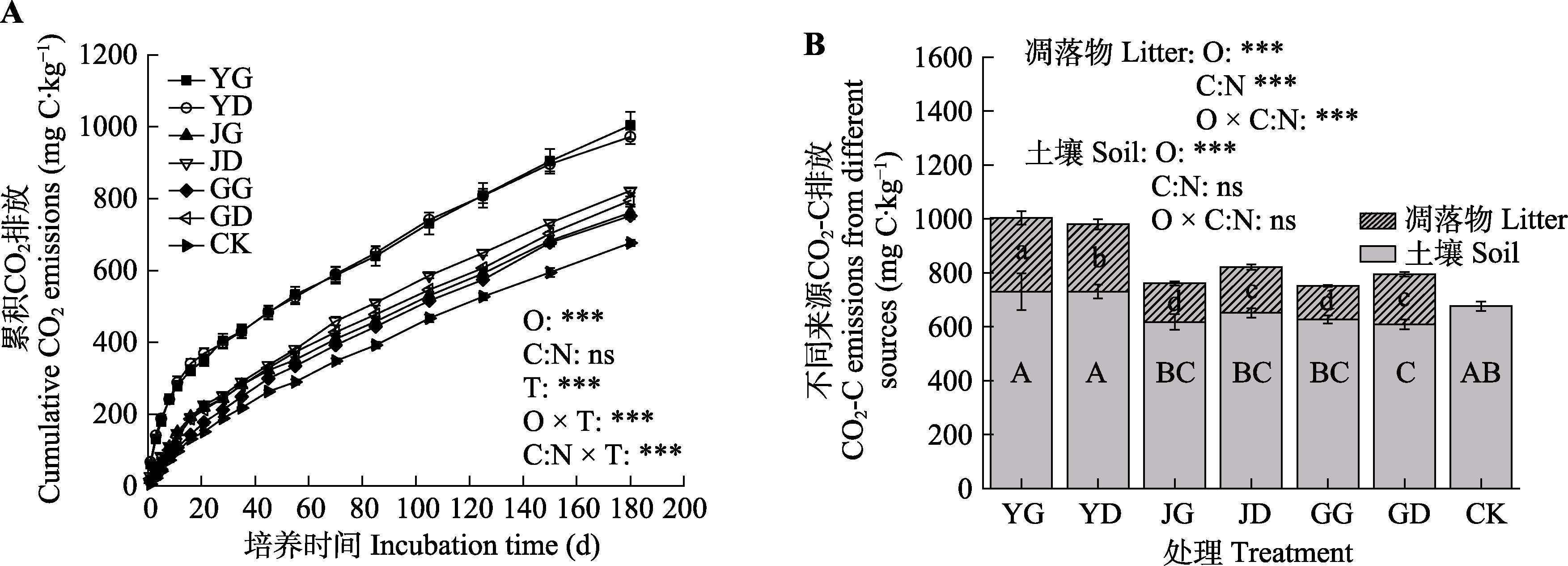
图1 杉木不同器官凋落物不同碳氮比对土壤总CO2排放、凋落物来源与土壤来源CO2排放的影响(平均值±标准误, n = 4)。B中不同小写字母和大写字母分别表示不同处理下凋落物来源CO2排放与土壤来源CO2排放量差异显著(p < 0.05)。CK, 对照; GD, 低碳氮比根; GG, 高碳氮比根; JD, 低碳氮比茎; JG, 高碳氮比茎; YD, 低碳氮比叶; YG, 高碳氮比叶。C:N, 碳氮比; O, 器官; T, 时间。***表示因子在p < 0.001水平上对该指标有显著影响, ns表示因子对该指标的影响不显著(p > 0.05)。
Fig. 1 Effects of different C:N of different organs of Cunninghamia lanceolata litter on soil total CO2 emissions, litter- and soil-derived CO2 emissions (mean ± SE, n = 4). Different lowercase and uppercase letters in B indicate significant differences in litter-derived and soil-derived CO2 emissions under different treatments, respectively (p < 0.05). CK, control; GD low C:N root; GG, high C:N root; JD, low C:N stem; JG, high C:N stem; YD, low C:N leaf; YG, high C:N leaf. C:N, carbon to nitrogen ratio; O, organ; T, time。*** represent the factor has significant effect on the index at p < 0.001 level; ns represents no significant effect (p > 0.05).
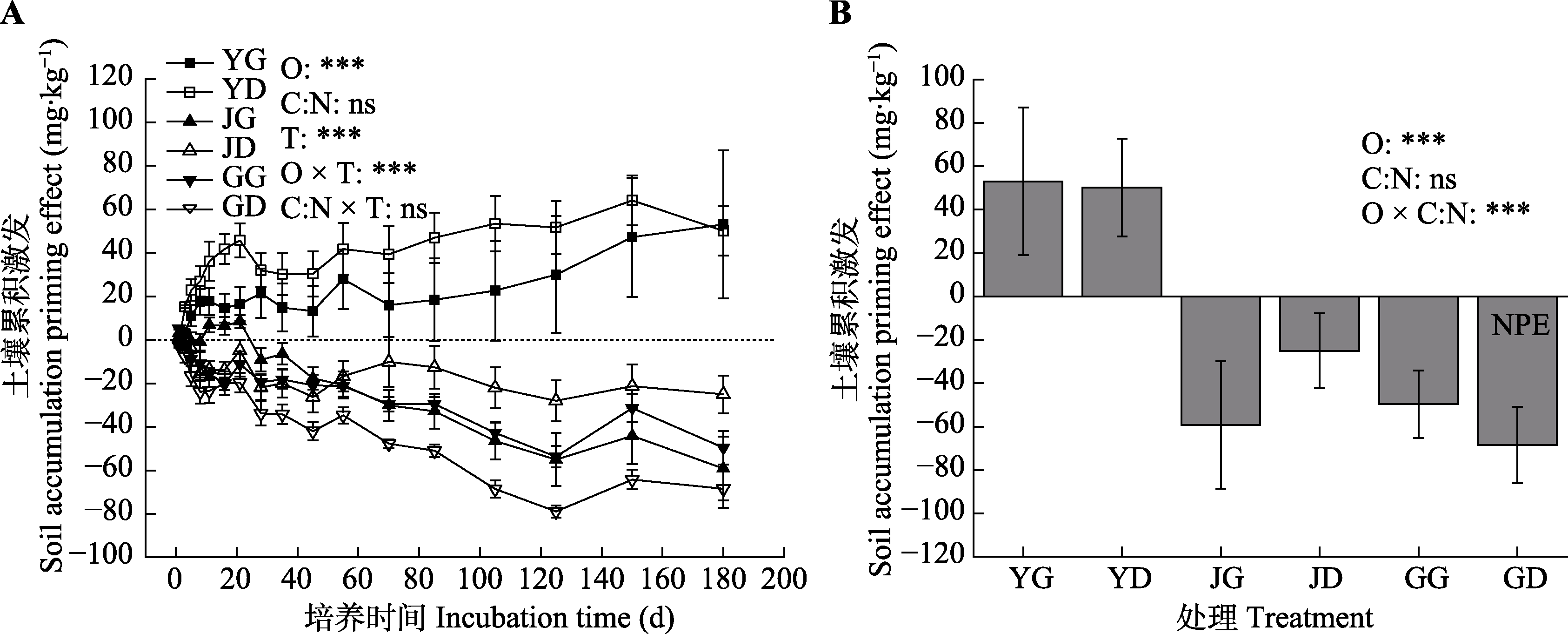
图2 杉木不同器官凋落物和不同碳氮比对土壤激发效应的影响(平均值±标准误, n = 4)。GD, 低碳氮比根; GG, 高碳氮比根; JD, 低碳氮比茎; JG, 高碳氮比茎; YD, 低碳氮比叶; YG, 高碳氮比叶。C:N, 碳氮比; O, 器官; T, 时间。***表示因子在p < 0.001水平上对该指标有显著影响, ns表示因子对该指标的影响不显著(p > 0.05)。B中NPE表示该处理产生显著负激发效应。
Fig. 2 Effects of different C:N of different organs of Cunninghamia lanceolata litter on soil priming effect (mean ± SE, n=4). GD, low C:N root; GG, high C:N root; JD, low C:N stem; JG, high C:N stem; YD, low C:N leaf; YG, high C:N leaf. C:N, carbon to nitrogen ratio; O, organ; T, time。***represent the factor has significant effect on the index at p < 0.001 level; ns represents no significant effect (p > 0.05). NPE in B indicate significant negative priming effect.
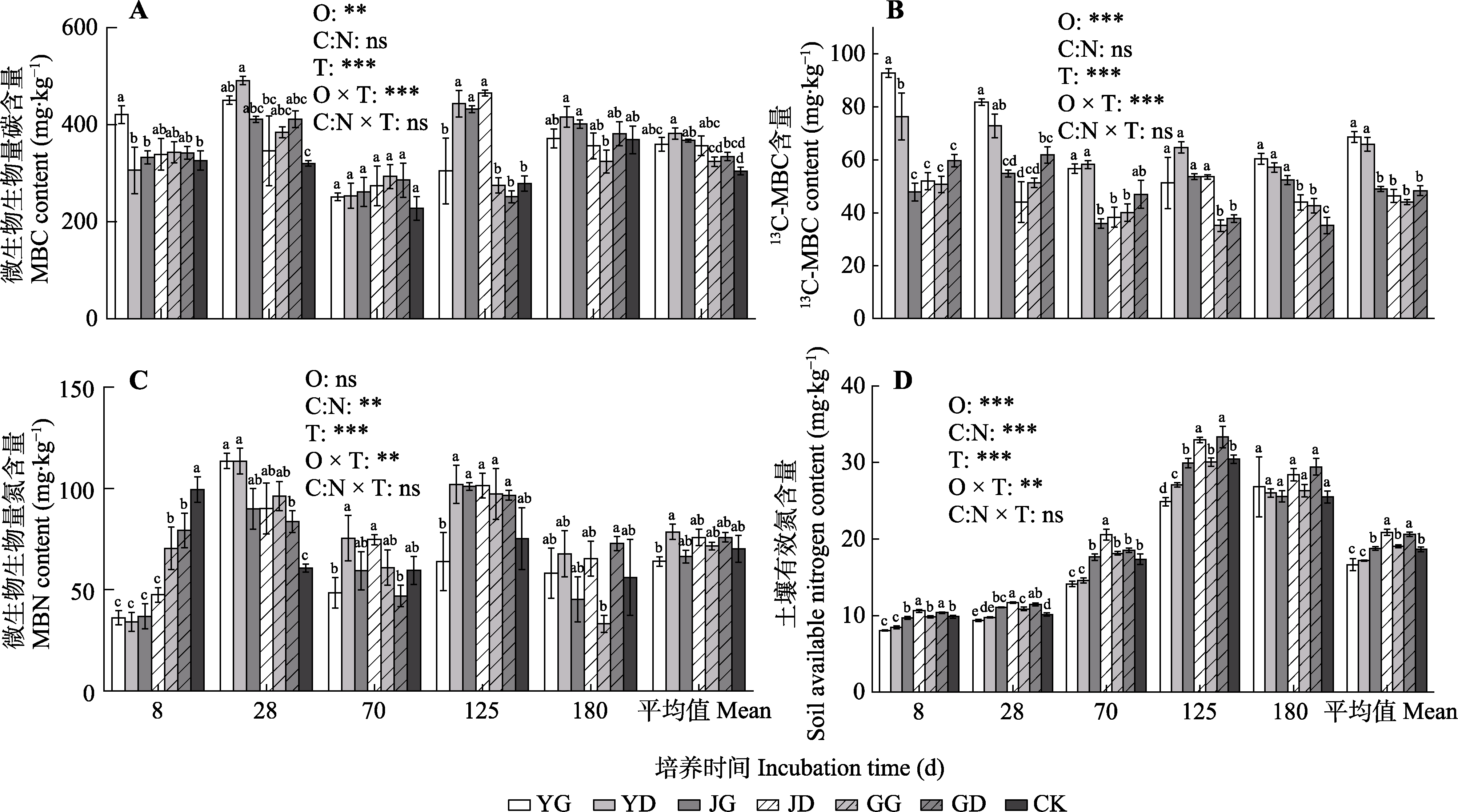
图3 杉木不同器官凋落物和不同碳氮比对土壤微生物生物量碳(MBC)、13C标记的MBC (13C-MBC)、微生物生物量氮(MBN)和有效氮含量的影响(平均值±标准误, n = 4)。不同小写字母表示不同处理下差异显著(p < 0.05)。CK, 对照; GD, 低碳氮比根; GG, 高碳氮比根; JD, 低碳氮比茎; JG, 高碳氮比茎; YD, 低碳氮比叶; YG, 高碳氮比叶。C:N, 碳氮比; O, 器官; T, 时间。***和**分别表示因子在p < 0.001和 p < 0.01水平上对该指标有显著影响, ns表示因子对该指标的影响不显著(p > 0.05)。
Fig. 3 Effects of different C:N of different organs of Cunninghamia lanceolata litter on soil microbial biomass carbon (MBC), 13C-labeled MBC (13C-MBC), microbial biomass nitrogen (MBN) and available nitrogen contents (mean ± SE, n = 4). Different lowercase letters indicate significant differences under different treatments (p < 0.05). CK, control; GD, low C:N root; GG, high C:N root; JD, low C:N stem; JG, high C:N stem; YD, low C:N leaf; YG, high C:N leaf. C:N, carbon to nitrogen ratio; O, organ; T, time. *** and ** represent the factor has significant effect on the index at p < 0.001 and p < 0.01 level; ns represents no significant effect (p > 0.05).
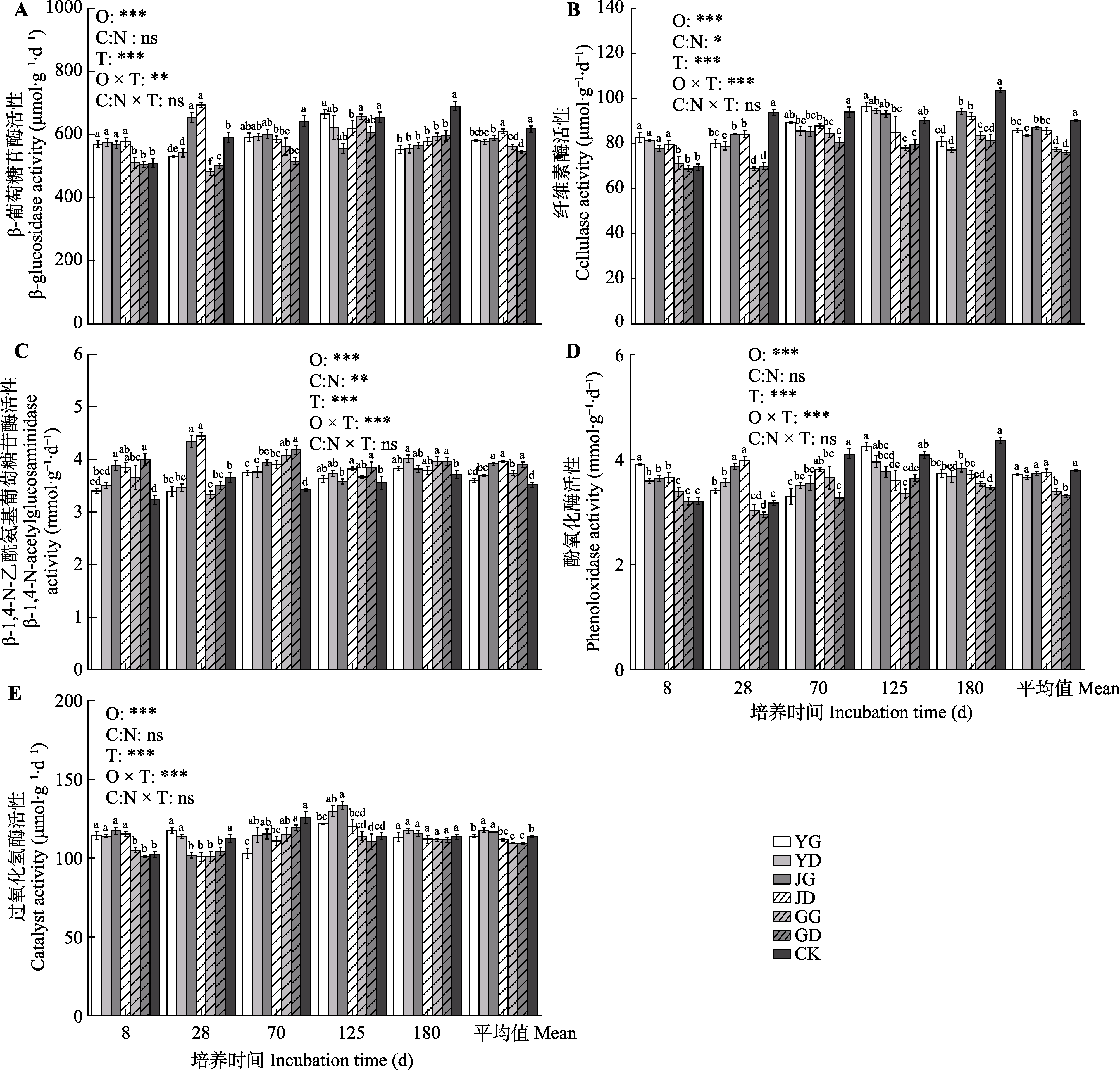
图4 杉木不同器官凋落物不同碳氮比对β-葡萄糖苷酶、纤维素酶、β-1,4-N-乙酰基葡萄糖苷酶、酚氧化酶与过氧化氢酶活性的影响(平均值±标准误, n = 4)。不同小写字母表示不同处理下差异显著(p < 0.05)。CK, 对照; GD, 低碳氮比根; GG, 高碳氮比根; JD, 低碳氮比茎; JG, 高碳氮比茎; YD, 低碳氮比叶; YG, 高碳氮比叶。O, 器官; C:N, 碳氮比; T, 时间。***, **和*分别表示因子在p < 0.001, p < 0.01和p < 0.05水平上对该指标有显著影响, ns表示因子对该指标的影响不显著(p > 0.05)。
Fig. 4 Effects of different C:N of different organs of Cunninghamia lanceolata litter on the activities of β-glucosidase, cellulase, β-1,4-N-acetyl-glucosidase, phenol oxidase and catalase (mean ± SE, n = 4). Different lowercase letters indicate significant differences under different treatments (p < 0.05). CK, control; GD, low C:N root; GG, high C:N root; JD, low C:N stem; JG, high C:N stem; YD, low C:N leaf; YG, high C:N leaf. C:N, carbon to nitrogen ratio. O, organ; T, time. ***, ** and * represent the factor has significant effect on the index at p < 0.001, p < 0.01 and p < 0.05 level, respectively; ns represents no significant effect (p > 0.05).
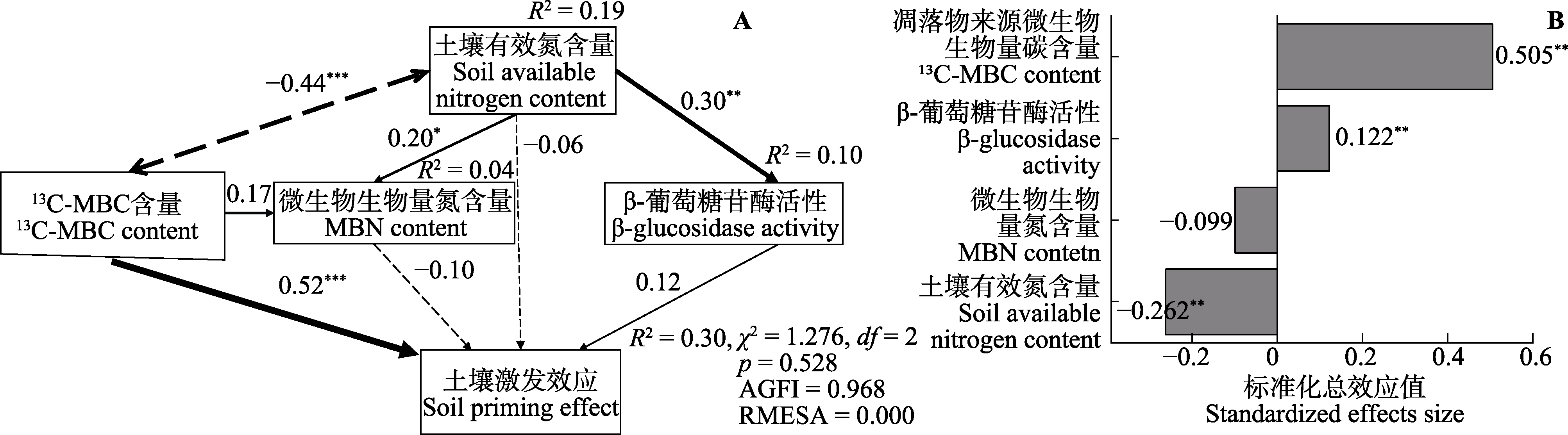
图5 土壤激发效应结构方程模型。13C-MBC, 13C标记的微生物生物量碳。实线表示正向路径, 虚线表示负向路径, 线段粗细表示因果关系的强弱。箭头相邻的数字表示关系的标准化路径系数(*, p < 0.05; **, p < 0.01; ***, p < 0.001)。模型解释的总变异量用R2表示, AGFI和RMSEA分别为调整拟合优度指数与近似误差均方根。
Fig. 5 Structural equation modelling of soil priming effect. Solid and dashed lines indicate positive and negative paths, respectively. The thickness of the line indicates the strength of the causal relationship. The numbers adjacent to the arrows represent the normalized path coefficient of the relationship (*, p < 0.05; * *, p < 0.01; ***, p < 0.001). 13C-MBC, 13C-labeled microbial biomass carbon; MBC, microbial biomass carbon; MBN, microbial biomass nitrogen. The total variance explained by the model is expressed as R2. AGFI, adjusted goodness of fit index; RMSEA, root mean square error of approximation.
| [1] |
Averill C, Hawkes CV (2016). Ectomycorrhizal fungi slow soil carbon cycling. Ecology Letters, 19, 937-947.
DOI PMID |
| [2] |
Blagodatskaya EV, Blagodatsky SA, Anderson TH, Kuzyakov Y (2007). Priming effects in Chernozem induced by glucose and N in relation to microbial growth strategies. Applied Soil Ecology, 37, 95-105.
DOI URL |
| [3] |
Blagodatskaya Е, Kuzyakov Y (2008). Mechanisms of real and apparent priming effects and their dependence on soil microbial biomass and community structure: critical review. Biology and Fertility of Soils, 45, 115-131.
DOI URL |
| [4] |
Chen RR, Senbayram M, Blagodatsky S, Myachina O, Dittert K, Lin XG, Blagodatskaya E, Kuzyakov Y (2014). Soil C and N availability determine the priming effect: microbial N mining and stoichiometric decomposition theories. Global Change Biology, 20, 2356-2367.
DOI PMID |
| [5] |
Craine JM, Morrow C, Fierer N (2007). Microbial nitrogen limitation increases decomposition. Ecology, 88, 2105-2113.
PMID |
| [6] | Cui CW, Peng LH, Ma DX, Wang JQ, Jiang XQ, Jiang XG, Ma XQ, Lin KM (2023). Effects of thinning on soil microbial necromass carbon in Cunninghamia lanceolata plantation. Scientia Silvae Sinicae, 59(5), 41-52. |
| [崔朝伟, 彭丽鸿, 马东旭, 王佳琪, 江祥庆, 江先桂, 马祥庆, 林开敏 (2023). 间伐对杉木人工林土壤微生物残体碳的影响. 林业科学, 59(5), 41-52.] | |
| [7] | Ding H, Yang YF, Xu HG, Fang YM, Chen X, Yang Q, Yi XG, Xu H, Wen XR, Xu XJ (2015). Species composition and community structure of the typical evergreen broadleaved forest in the Wuyi Mountains of Southeastern China. Acta Ecologica Sinica, 35, 1142-1154. |
| [丁晖, 杨云方, 徐海根, 方炎明, 陈晓, 杨青, 伊贤贵, 徐辉, 温小荣, 徐鲜均 (2015). 武夷山典型常绿阔叶林物种组成与群落结构. 生态学报, 35, 1142-1154.] | |
| [8] |
Fang M, Motavalli PP, Kremer RJ, Nelson KA (2007). Assessing changes in soil microbial communities and carbon mineralization in Bt and non-Bt corn residue-amended soils. Applied Soil Ecology, 37, 150-160.
DOI URL |
| [9] | Fanin N, Alavoine G, Bertrand I (2020). Temporal dynamics of litter quality, soil properties and microbial strategies as main drivers of the priming effect. Geoderma, 377, 114576. DOI: 10.1016/j.geoderma.2020.114576. |
| [10] | Fei SX (2019). Effect of Litter Addition on Soil Mineralization Under Pinus tabulaeformis Plantation. Master degree dissertation, Northwest A&F University, Yangling, Shaanxi. |
| [费诗萱 (2019). 凋落物添加对油松人工林土壤有机碳矿化的影响研究. 硕士学位论文, 西北农林科技大学, 陕西杨凌.] | |
| [11] |
Freschet GT, Cornwell WK, Wardle DA, Elumeeva TG, Liu WD, Jackson BG, Onipchenko VG, Soudzilovskaia NA, Tao JP, Cornelissen JHC (2013). Linking litter decomposition of above-and below-ground organs to plant-soil feedbacks worldwide. Journal of Ecology, 101, 943-952.
DOI URL |
| [12] |
Gan ZY, Wang H, Ding C, Lei M, Yang XG, Cai JY, Qiu QY, Hu YL (2022). Effects of dissolved organic matter derived from different plant and tissues in a subtropical forest on soil priming effect and the underlying mechanisms. Chinese Journal of Plant Ecology, 46, 797-810.
DOI URL |
|
[甘子莹, 王浩, 丁驰, 雷梅, 杨晓刚, 蔡敬琰, 丘清燕, 胡亚林 (2022). 亚热带森林不同植物及器官来源的可溶性有机质输入对土壤激发效应的影响及其作用机理. 植物生态学报, 46, 797-810.]
DOI |
|
| [13] |
Guenet B, Neill C, Bardoux G, Abbadie L (2010). Is there a linear relationship between priming effect intensity and the amount of organic matter input? Applied Soil Ecology, 46, 436-442.
DOI URL |
| [14] | Guttières R, Nunan N, Raynaud X, Lacroix G, Barot S, Barré P, Girardin C, Guenet B, Lata JC, Abbadie L (2021). Temperature and soil management effects on carbon fluxes and priming effect intensity. Soil Biology & Biochemistry, 153, 108103. DOI: 10.1016/j.soilbio.2020.108103. |
| [15] | Hong XM, Wei Q, Li MJ, Yu TW, Yan Q, Hu YL (2021). Effects of aboveground and belowground litter inputs on the balance of soil new and old organic carbon under the typical forests in subtropical region. Chinese Journal of Applied Ecology, 32, 825-835. |
|
[洪小敏, 魏强, 李梦娇, 余坦蔚, 严强, 胡亚林 (2021). 亚热带典型森林地上和地下凋落物输入对土壤新老有机碳动态平衡的影响. 应用生态学报, 32, 825-835.]
DOI |
|
| [16] |
Hu ZH, He ZM, Huang ZQ, Fan SH, Yu ZP, Wang MH, Zhou XH, Fang CM (2014). Effects of harvest residue management on soil carbon and nitrogen processes in a Chinese fir plantation. Forest Ecology and Management, 326, 163-170.
DOI URL |
| [17] | Huang WZ, Zhao XL, Zhu JG, Xie ZB, Zhu CW (2007). Priming effect of soil carbon pools. Chinese Journal of Soil Science, 38, 149-154. |
| [黄文昭, 赵秀兰, 朱建国, 谢祖彬, 朱春梧 (2007). 土壤碳库激发效应研究. 土壤通报, 38, 149-154.] | |
| [18] |
Kuzyakov Y (2002). Review: factors affecting rhizosphere priming effects. Journal of Plant Nutrition and Soil Science, 165, 382-396.
DOI URL |
| [19] |
Kuzyakov Y (2010). Priming effects: interactions between living and dead organic matter. Soil Biology & Biochemistry, 42, 1363-1371.
DOI URL |
| [20] |
Kuzyakov Y, Bol R (2006). Sources and mechanisms of priming effect induced in two grassland soils amended with slurry and sugar. Soil Biology & Biochemistry, 38, 747-758.
DOI URL |
| [21] |
Lehmann J, Kleber M (2015). The contentious nature of soil organic matter. Nature, 528, 60-68.
DOI |
| [22] | Li S, Lyu MK, Deng C, Deng W, Wang X, Cao A, Jiang Y, Liu J, Lu Y, Xie J (2024). Input of high-quality litter reduces soil carbon losses due to priming in a subtropical pine forest. Soil Biology & Biochemistry, 194, 109444. DOI: 10.1016/j.soilbio.2024.109444. |
| [23] |
Li YF, Wang ZJ, Shi WL, Yang HT (2023). Litter quality modifies soil organic carbon mineralization in an ecological restoration area. Land Degradation & Development, 34, 1806-1819.
DOI URL |
| [24] | Liu SY, Liang AZ, Yang XM, Zhang XP, Jia SX, Chen XW, Zhang SX, Sun BJ, Chen SL (2015). Effects of different residue part inputs of corn straws on CO2 efflux and microbial biomass in clay loam and sandy loam black soils. Environmental Science, 36, 2686-2694. |
| [刘四义, 梁爱珍, 杨学明, 张晓平, 贾淑霞, 陈学文, 张士秀, 孙冰洁, 陈升龙 (2015). 不同部位玉米秸秆对两种质地黑土CO2排放和微生物量的影响. 环境科学, 36, 2686-2694.] | |
| [25] |
Luo ZK, Wang EL, Sun OJ (2016). A meta-analysis of the temporal dynamics of priming soil carbon decomposition by fresh carbon inputs across ecosystems. Soil Biology & Biochemistry, 101, 96-103.
DOI URL |
| [26] |
Lyu MK, Homyak PM, Xie JS, Peñuelas J, Ryan MG, Xiong XL, Sardans J, Lin WS, Wang MH, Chen GS, Yang YS (2023). Litter quality controls tradeoffs in soil carbon decomposition and replenishment in a subtropical forest. Journal of Ecology, 111, 2181-2193.
DOI URL |
| [27] |
Lyu MK, Nie YY, Giardina CP, Vadeboncoeur MA, Ren YB, Fu ZQ, Wang MH, Jin CS, Liu XM, Xie JS (2019). Litter quality and site characteristics interact to affect the response of priming effect to temperature in subtropical forests. Functional Ecology, 33, 2226-2238.
DOI URL |
| [28] | Miao SJ, Qiao YF, Wang WT, Shi YH (2019). Priming effect of maize straw addition on soil organic matter in yellow- brown soil. Soils, 51, 622-626. |
| [苗淑杰, 乔云发, 王文涛, 施雨涵 (2019). 添加玉米秸秆对黄棕壤有机质的激发效应. 土壤, 51, 622-626.] | |
| [29] | Ndzelu BS, Dou S, Zhang XW (2020). Changes in soil humus composition and humic acid structural characteristics under different corn straw returning modes. Soil Research, 58, 452. DOI: 10.1071/sr20025. |
| [30] |
Nottingham AT, Turner BL, Stott AW, Tanner EVJ (2015). Nitrogen and phosphorus constrain labile and stable carbon turnover in lowland tropical forest soils. Soil Biology & Biochemistry, 80, 26-33.
DOI URL |
| [31] |
Perveen N, Barot S, Maire V, Cotrufo MF, Shahzad T, Blagodatskaya E, Stewart CE, Ding WX, Siddiq MR, Dimassi B, Mary B, Fontaine S (2019). Universality of priming effect: an analysis using thirty five soils with contrasted properties sampled from five continents. Soil Biology & Biochemistry, 134, 162-171.
DOI URL |
| [32] | Qin JJ, Chen N, Liu JB, Wang ZQ, Yang KJ, Yang HQ, Liu FH, Ding YY, Latif J, Jia HZ (2024). Carbon emissions and priming effects derived from crop residues and their responses to nitrogen inputs. Global Change Biology, 30, e17115. DOI: 10.1111/gcb.17115. |
| [33] |
Shahbaz M, Kuzyakov Y, Sanaullah M, Heitkamp F, Zelenev V, Kumar A, Blagodatskaya E (2017). Microbial decomposition of soil organic matter is mediated by quality and quantity of crop residues: mechanisms and thresholds. Biology and Fertility of Soils, 53, 287-301.
DOI URL |
| [34] | Song YY, Mei WK, Li MT, Wang XW, Luo SY, Feng YS, Zhu MY, Qi J, Zuo YJ, Gao CY (2024). Soil water content and Rubisco activity control the carbon storage in soil under different land uses in Sanjiang Plain, China. Catena, 243, 108211. DOI: 10.1016/j.catena.2024.108211. |
| [35] |
Sun ZL, Liu SG, Zhang TA, Zhao XC, Chen S, Wang QK (2019). Priming of soil organic carbon decomposition induced by exogenous organic carbon input: a meta-analysis. Plant and Soil, 443, 463-471.
DOI |
| [36] |
Vance ED, Brookes PC, Jenkinson DS (1987). An extraction method for measuring soil microbial biomass C. Soil Biology & Biochemistry, 19, 703-707.
DOI URL |
| [37] |
Xie NH, An TT, Zhuang J, Radosevich M, Schaeffer S, Li SY, Wang JK (2022). High initial soil organic matter level combined with aboveground plant residues increased microbial carbon use efficiency but accelerated soil priming effect. Biogeochemistry, 160, 1-15.
DOI |
| [38] |
Xu YD, Ding F, Gao XD, Wang Y, Li M, Wang JK (2019). Mineralization of plant residues and native soil carbon as affected by soil fertility and residue type. Journal of Soils and Sediments, 19, 1407-1415.
DOI |
| [39] | Xu ZJ (2021). Effects of Restoration Process of Natural Secondary Forest and Chinese Fir Plantation on Litter Volume and Decomposition. Master degree dissertation, Fujian Normal University, Fuzhou. |
| [许子君 (2021). 天然次生林与杉木人工林恢复过程对凋落物量与分解的影响. 硕士学位论文, 福建师范大学, 福州.] | |
| [40] | Zhang QF, Cheng L, Feng JG, Mei KC, Zeng QX, Zhu B, Chen Y (2021). Nitrogen addition stimulates priming effect in a subtropical forest soil. Soil Biology & Biochemistry, 160, 108339. DOI: 10.1016/j.soilbio.2021.108339. |
| [41] | Zhang Z, Cai XZ, Tang CD, Guo JF (2017). Priming effect of dissolved organic matter in the surface soil of a Cunninghamia lanceolata plantation. Acta Ecologica Sinica, 37, 7660-7667. |
| [张政, 蔡小真, 唐偲頔, 郭剑芬 (2017). 可溶性有机质输入对杉木人工林表层土壤有机碳矿化的激发效应. 生态学报, 37, 7660-7667.] |
| [1] | 陈雅轩, 韩雨音, 陈艳梅, 刘倩愿. 华北不同林龄人工林植物功能性状与碳氮化学计量[J]. 植物生态学报, 2026, 50(2): 318-333. |
| [2] | 郑琳敏, 熊小玲, 姜永孟, 王曼, 张锦秀, 曾志伟, 吕茂奎, 谢锦升. 武夷山不同海拔杉木凋落叶和细根分解规律以及驱动因素的差异[J]. 植物生态学报, 2025, 49(2): 244-255. |
| [3] | 宋思宇, 杜飘, 林琴, 齐祥, 杜柯芋, 李聪, 陈亚梅, 黄尤优, 刘洋. 高山灌木扩张梯度下植物叶片与根系酚类物质的响应特征[J]. 植物生态学报, 2025, 49(12): 2119-2136. |
| [4] | 李亚超, 张慧, 许珊珊, 李明, 马祥庆, 吴鹏飞. 低磷胁迫下外源挥发性有机化合物对杉木幼苗根系磷利用的影响[J]. 植物生态学报, 2025, 49(10): 1744-1754. |
| [5] | 全小强, 王燕茹, 李小玉, 梁海燕, 王立冬, 闫小莉. 氮添加和铵硝态氮配比对杉木幼苗光合特性及叶绿素荧光参数的影响[J]. 植物生态学报, 2024, 48(8): 1050-1064. |
| [6] | 彭思瑞, 张慧玲, 孙兆林, 赵学超, 田鹏, 陈迪马, 王清奎, 刘圣恩. 长期凋落物去除对亚热带杉木林土壤有机碳及其组分的影响[J]. 植物生态学报, 2024, 48(8): 1078-1088. |
| [7] | 龙吉兰, 蒋铮, 刘定琴, 缪宇轩, 周灵燕, 冯颖, 裴佳宁, 刘瑞强, 周旭辉, 伏玉玲. 干旱下植物根系分泌物及其介导的根际激发效应研究进展[J]. 植物生态学报, 2024, 48(7): 817-827. |
| [8] | 王梁, 赵学超, 杨少博, 王清奎. 杉木叶和细根诱导的土壤有机碳分解激发效应及其对氮添加的响应[J]. 植物生态学报, 2024, 48(11): 1434-1444. |
| [9] | 吴帆, 吴晨, 张宇辉, 余恒, 魏智华, 郑蔚, 刘小飞, 陈仕东, 杨智杰, 熊德成. 增温对成熟杉木人工林不同季节细根生长、形态及生理代谢特征的影响[J]. 植物生态学报, 2023, 47(6): 856-866. |
| [10] | 赵小祥, 朱彬彬, 田秋香, 林巧玲, 陈龙, 刘峰. 叶片凋落物分解的主场优势研究进展[J]. 植物生态学报, 2023, 47(5): 597-607. |
| [11] | 谢欢, 张秋芳, 陈廷廷, 曾泉鑫, 周嘉聪, 吴玥, 林惠瑛, 刘苑苑, 尹云锋, 陈岳民. 氮添加促进丛枝菌根真菌和根系协作维持土壤磷有效性[J]. 植物生态学报, 2022, 46(7): 811-822. |
| [12] | 甘子莹, 王浩, 丁驰, 雷梅, 杨晓刚, 蔡敬琰, 丘清燕, 胡亚林. 亚热带森林不同植物及器官来源的可溶性有机质输入对土壤激发效应的影响及其作用机理[J]. 植物生态学报, 2022, 46(7): 797-810. |
| [13] | 谢欢, 张秋芳, 曾泉鑫, 周嘉聪, 马亚培, 吴玥, 刘苑苑, 林惠瑛, 尹云锋, 陈岳民. 氮添加对杉木苗期磷转化和分解类真菌的影响[J]. 植物生态学报, 2022, 46(2): 220-231. |
| [14] | 丁凯, 张毓婷, 张俊红, 柴雄, 周世水, 童再康. 不同密度杉木林对林下植被和土壤微生物群落结构的影响[J]. 植物生态学报, 2021, 45(1): 62-73. |
| [15] | 吕中诚, 康文星, 黄志宏, 赵仲辉, 邓湘雯. 不同林龄杉木组织迁移养分的再利用[J]. 植物生态学报, 2019, 43(5): 458-470. |
| 阅读次数 | ||||||
|
全文 |
|
|||||
|
摘要 |
|
|||||
Copyright © 2026 版权所有 《植物生态学报》编辑部
地址: 北京香山南辛村20号, 邮编: 100093
Tel.: 010-62836134, 62836138; Fax: 010-82599431; E-mail: apes@ibcas.ac.cn, cjpe@ibcas.ac.cn
备案号: 京ICP备16067583号-19

