
植物生态学报 ›› 2023, Vol. 47 ›› Issue (10): 1375-1385.DOI: 10.17521/cjpe.2022.0474 cstr: 32100.14.cjpe.2022.0474
所属专题: 全球变化与生态系统; 生态遥感及应用; 草原与草业
缪丽娟1,*( ), 张宇阳1, 揣小伟2, 包刚3, 何昱1, 朱敬雯4
收稿日期:2022-11-23
接受日期:2023-04-06
出版日期:2023-10-20
发布日期:2023-05-08
基金资助:
MIAO Li-Juan1,*(), ZHANG Yu-Yang1, CHUAI Xiao-Wei2, BAO Gang3, HE Yu1, ZHU Jing-Wen4
Received:2022-11-23
Accepted:2023-04-06
Online:2023-10-20
Published:2023-05-08
Supported by:摘要:
随着全球变暖和人类活动加剧, 全球干旱区进一步扩张。干旱区植被生态系统的脆弱性和敏感性增强。因此, 探究干旱区植被长势对气候变化的响应机制及滞后效应成为了当前研究的热点。该研究基于中分辨率成像光谱仪(MODIS)提供的归一化植被指数(NDVI)资料、英国东英格利亚大学气候研究所提供的逐月网格化CRU TS4.05气候资料和干旱指数资料、ERA5 (ECMWF全球气候的第五代大气再分析资料)提供的太阳辐射资料和欧洲航天局全球基本气候变化监测项目提供的土壤水分资料, 借助于窗口交叉相关法和线性回归法, 探究了2001-2020年亚洲旱区草地NDVI对气候变化的响应及滞后效应。研究发现: 1)草地NDVI对当月平均气温和降水总量的响应最为强烈, 对太阳辐射和土壤水分则存在显著的滞后响应。具体表现为草地NDVI对太阳辐射和土壤水分的响应存在1个月的滞后; 2)草地NDVI与各气候要素响应的滞后时间在空间分布上较不均匀, 在亚洲旱区的东部和西部存在明显差异; 3)草地NDVI与自矫正帕默尔干旱指数间不存在显著的滞后效应; 4)海拔在一定程度上影响了亚洲旱区草地NDVI与各要素的响应关系。
缪丽娟, 张宇阳, 揣小伟, 包刚, 何昱, 朱敬雯. 亚洲旱区草地NDVI对气候变化的响应及滞后效应. 植物生态学报, 2023, 47(10): 1375-1385. DOI: 10.17521/cjpe.2022.0474
MIAO Li-Juan, ZHANG Yu-Yang, CHUAI Xiao-Wei, BAO Gang, HE Yu, ZHU Jing-Wen. Effects of climatic factors and their time-lag on grassland NDVI in Asian drylands. Chinese Journal of Plant Ecology, 2023, 47(10): 1375-1385. DOI: 10.17521/cjpe.2022.0474
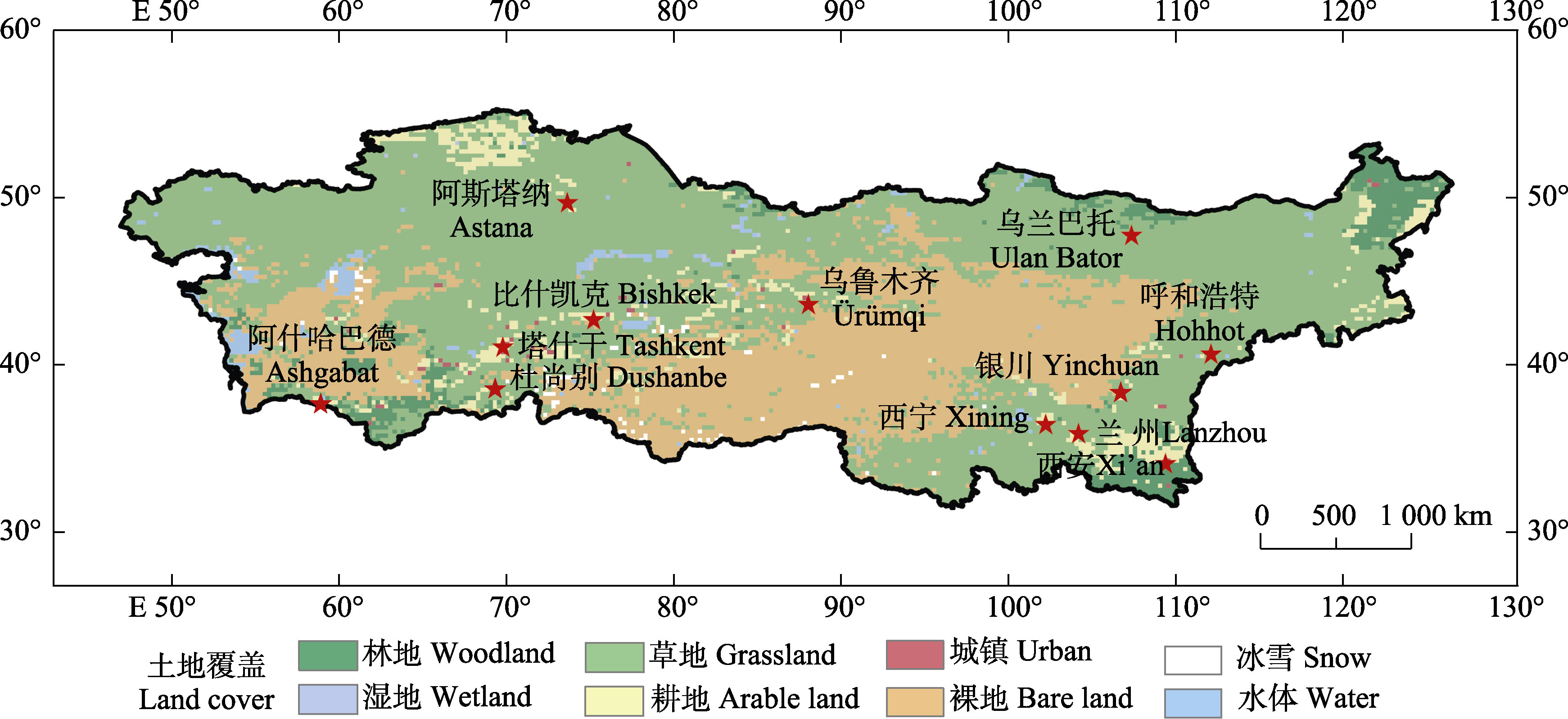
图1 亚洲旱区草地研究区示意图。
Fig. 1 Geographical location of the research area for Asian dryland grasslands.
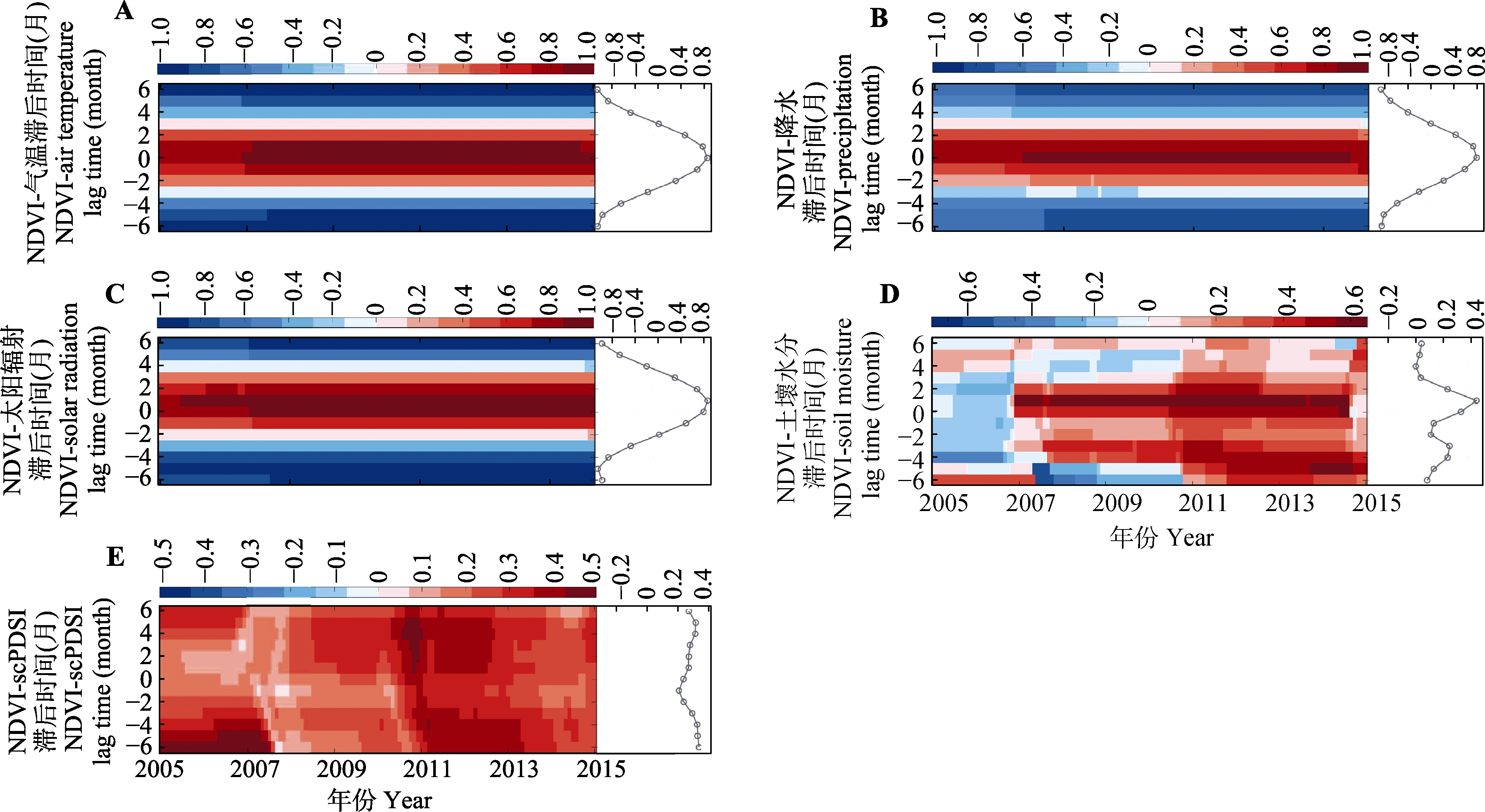
图2 不同滞后月份下亚洲旱区草地归一化植被指数(NDVI)与各要素的交叉相关系数矩阵图。图右侧的曲线表明各滞后月份下的平均相关系数。滞后时间为正, 表明草地NDVI滞后响应于影响要素; 滞后时间为负, 表明草地NDVI超前响应于影响要素。scPDSI, 自矫正帕尔默干旱指数。
Fig. 2 Matrix of cross-correlation coefficients between the normalized difference vegetation index (NDVI) and its driving factors in Asian dryland grasslands at different time lags. The curves on the right side show the average correlation coefficients at different time lags. A positive time lag indicates that grassland NDVI lags behind the driving factors, while a negative lag time indicates that grassland NDVI overresponds to the driving factors. scPDSI, self-calibrating Palmer Drought Index.
| 0个月 0-month | 1个月 1-month | 2个月 2-months | 3个月 3-months | 4个月 4-months | 5个月 5-months | 6个月 6-months | |
|---|---|---|---|---|---|---|---|
| NDVI-气温 NDVI-air temperature | 0.711 1 | 0.638 9 | 0.302 6 | 0.030 5 | - | - | - |
| NDVI-降水 NDVI-precipitation | 0.718 0 | 0.662 4 | 0.261 1 | 0.008 6 | - | - | - |
| NDVI-太阳辐射 NDVI-solar radiation | 0.680 8 | 0.738 1 | 0.414 5 | 0.284 6 | - | - | - |
| NDVI-土壤水分 NDVI-soil moisture | 0.497 9 | 0.553 6 | 0.237 5 | 0.010 3 | - | - | - |
| NDVI-干旱指数 NDVI-drought index | 0.001 5 | 0.003 8 | 1.788 1 × | 0.002 1 | 0.003 0 | 0.012 1 | 0.010 0 |
表1 亚洲旱区草地归一化植被指数(NDVI)对各要素响应的最佳滞后时间以及决定系数(R2)
Table 1 Optimal lag time and coefficient of determinations (R2) with the normalized difference vegetation index (NDVI) for Asian dryland grasslands
| 0个月 0-month | 1个月 1-month | 2个月 2-months | 3个月 3-months | 4个月 4-months | 5个月 5-months | 6个月 6-months | |
|---|---|---|---|---|---|---|---|
| NDVI-气温 NDVI-air temperature | 0.711 1 | 0.638 9 | 0.302 6 | 0.030 5 | - | - | - |
| NDVI-降水 NDVI-precipitation | 0.718 0 | 0.662 4 | 0.261 1 | 0.008 6 | - | - | - |
| NDVI-太阳辐射 NDVI-solar radiation | 0.680 8 | 0.738 1 | 0.414 5 | 0.284 6 | - | - | - |
| NDVI-土壤水分 NDVI-soil moisture | 0.497 9 | 0.553 6 | 0.237 5 | 0.010 3 | - | - | - |
| NDVI-干旱指数 NDVI-drought index | 0.001 5 | 0.003 8 | 1.788 1 × | 0.002 1 | 0.003 0 | 0.012 1 | 0.010 0 |
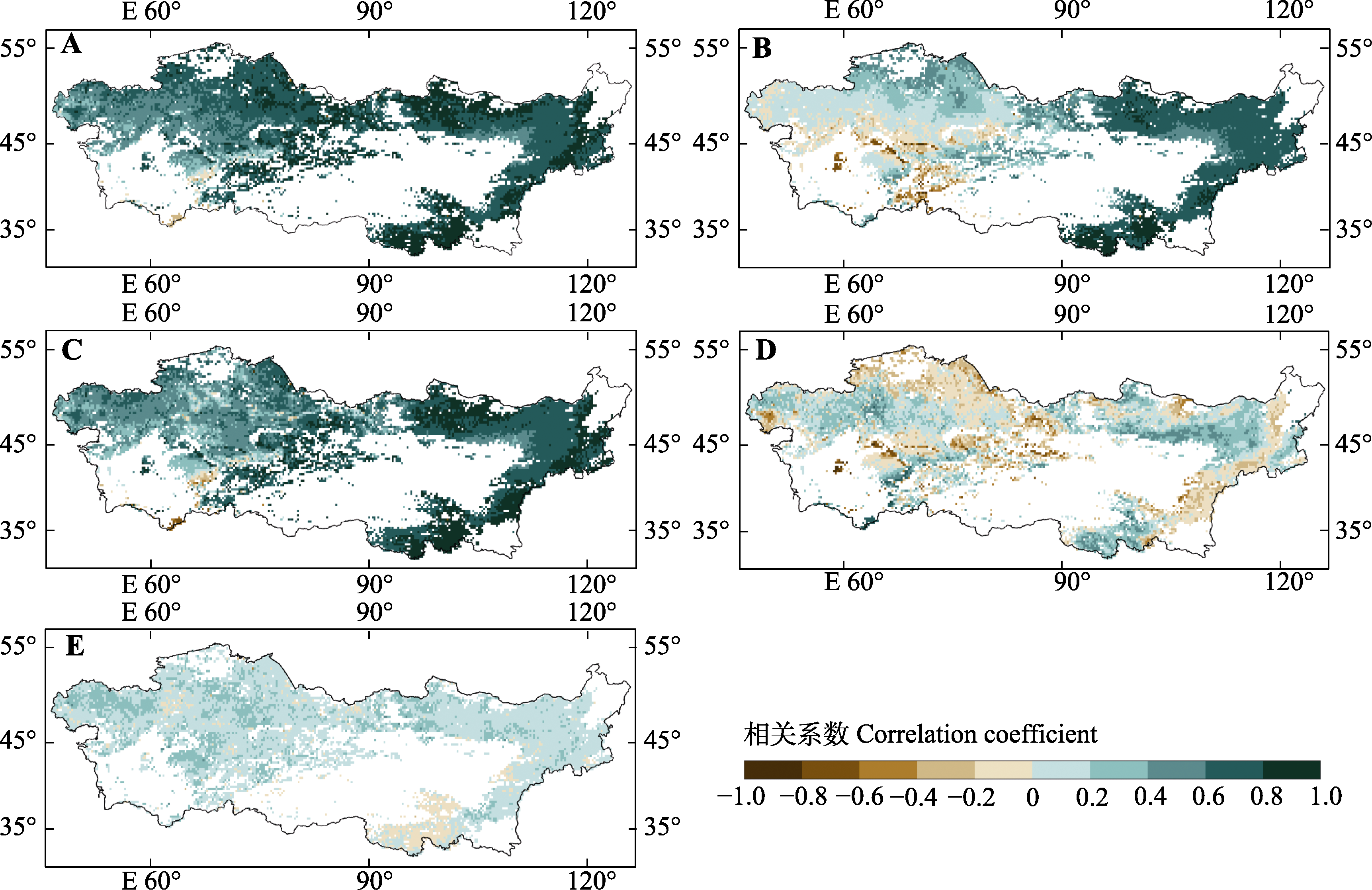
图3 基于窗口交叉相关法, 最佳滞后月份下亚洲旱区草地归一化植被指数(NDVI)与各要素相关系数的空间分布图。空白区域表示该地区为非草地。A, NDVI与气温滞后0个月的相关系数。B, NDVI与降水滞后0个月的相关系数。C, NDVI与太阳辐射滞后1个月的相关系数。D, NDVI与土壤水分滞后1个月的相关系数。E, NDVI与干旱指数滞后5个月的相关系数。
Fig. 3 Spatial distributions of correlation coefficients between normalized difference vegetation index (NDVI) and its driving factors for Asian grasslands at the best time lag by the window cross-correlation method. Blank areas indicate that the region is non-grassland. A, Correlation coefficient between NDVI and 0-month lag of air temperature. B, Correlation coefficient between NDVI and 0-month lag of precipitation. C, Correlation coefficient between NDVI and 1-month lag of solar radiation. D, Correlation coefficient between NDVI and 1-month lag of soil moisture. E, Correlation coefficient between NDVI and 5-months lag of drought index.
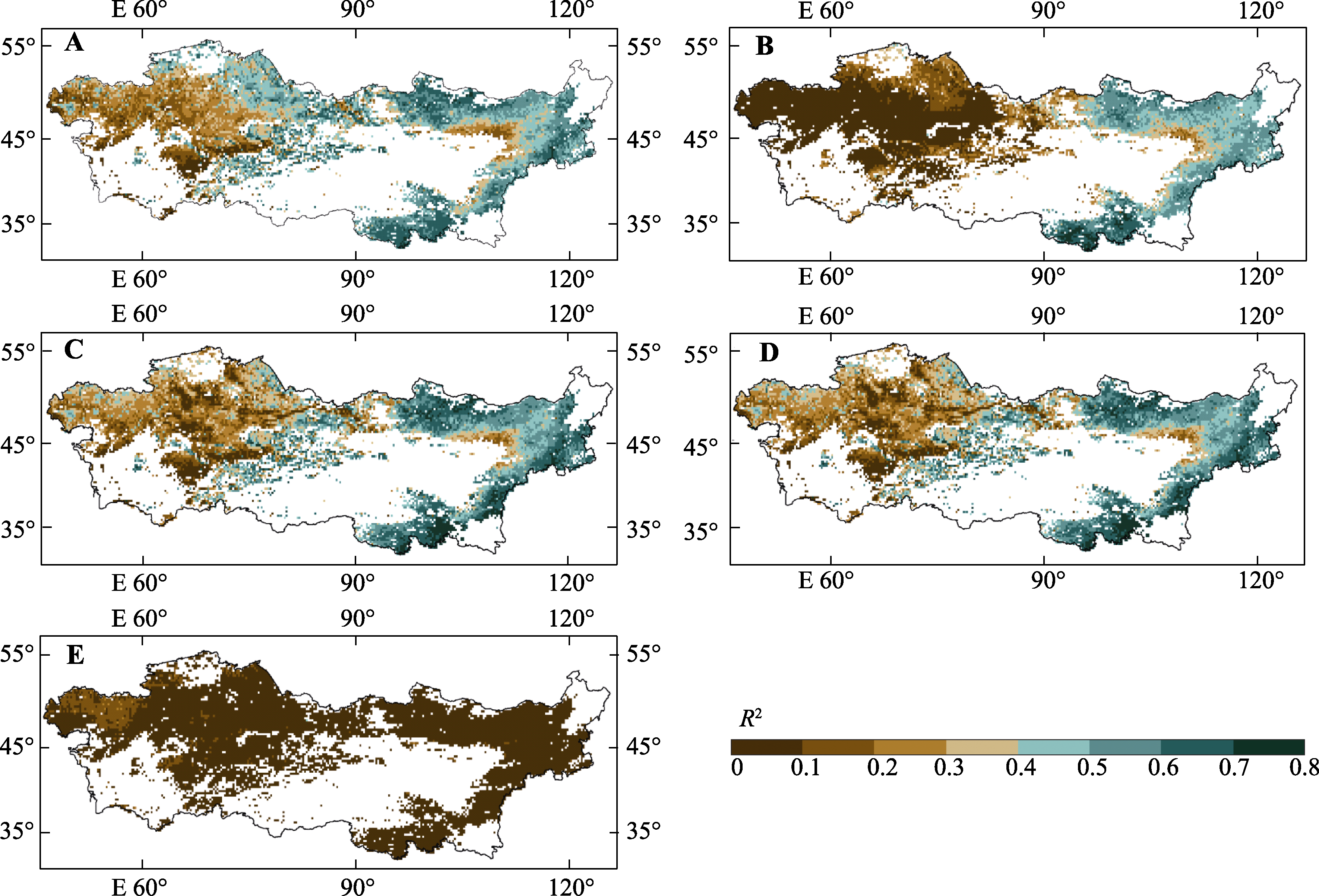
图4 基于一元线性回归法, 最佳滞后月份下亚洲干旱区内草地归一化植被指数(NDVI)与各要素决定系数(R2)的空间分布图。空白区域表示该地区为非草地。A, NDVI与气温滞后0个月的决定系数。B, NDVI与降水滞后0个月的决定系数。C, NDVI与太阳辐射滞后1个月的决定系数。D, NDVI与土壤水分滞后1个月的决定系数。E, NDVI与干旱指数滞后5个月的决定系数。
Fig. 4 Spatial distributions of determination coefficients (R2) between normalized difference vegetation index (NDVI) and its driving factors in Asian grasslands at the best time lag by the one-dimensional linear regression method. Blank areas on the map indicate non-grassland regions. A, Determination coefficient between NDVI and 0-month lag of air temperature. B, Determination coefficient between NDVI and 0-month lag of precipitation. C, Determination coefficient between NDVI and 1-month lag of solar radiation. D, Determination coefficient between NDVI and 1-month lag of soil moisture. E, Determination coefficient between NDVI and 5-months lag of drought index.
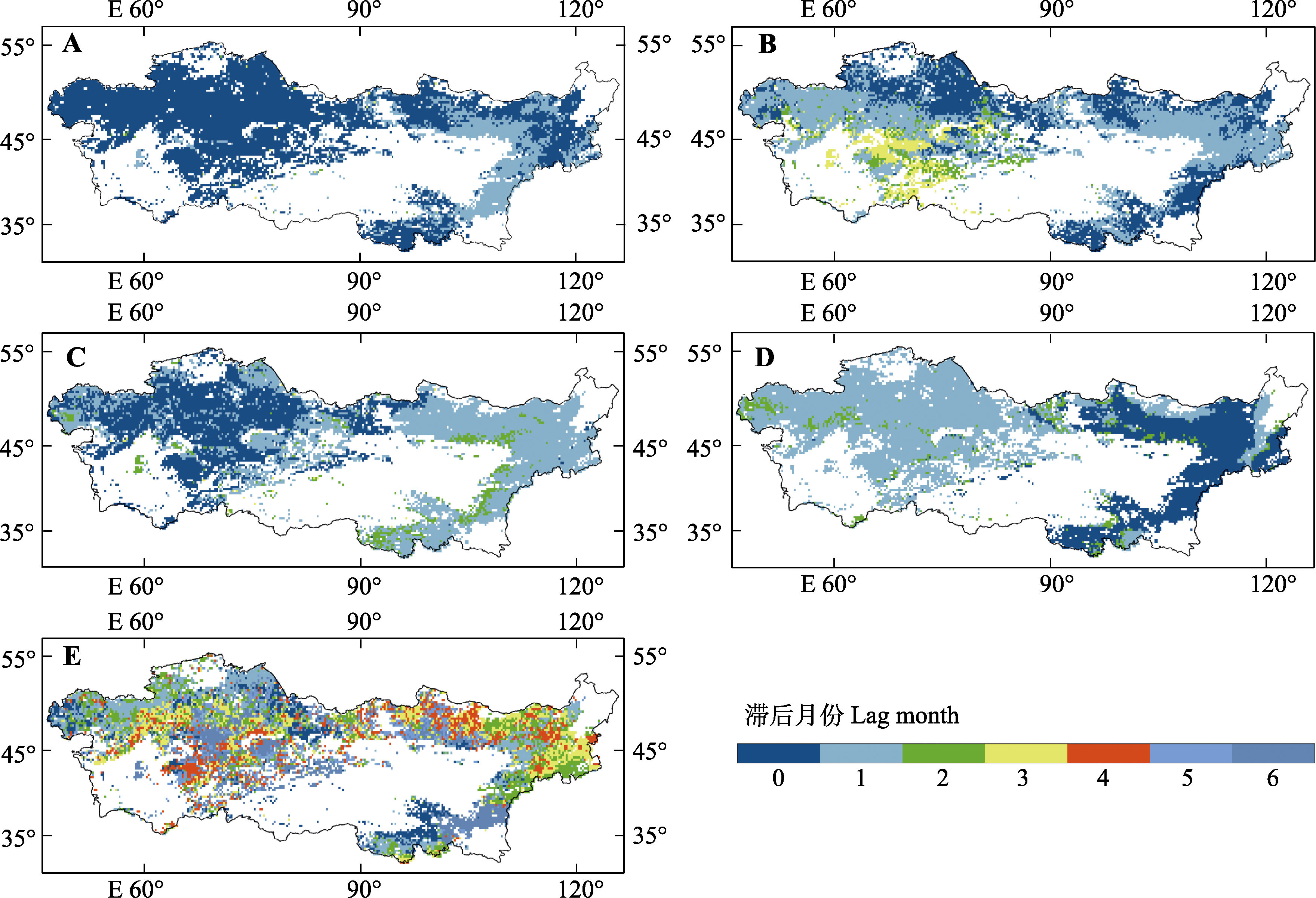
图5 亚洲干旱区草地归一化植被指数(NDVI)对各要素响应的滞后月份的空间分布图。A, NDVI-气温。B, NDVI-降水。C, NDVI-太阳辐射。D, NDVI-土壤水分。E, NDVI-干旱指数。
Fig. 5 Spatial distributions of time lag between normalized difference vegetation index (NDVI) and its driving factors in Asian grasslands. A, NDVI-air temperature. B, NDVI-precipitation. C, NDVI-solar radiation. D, NDVI-soil moisture. E, NDVI-drought index.
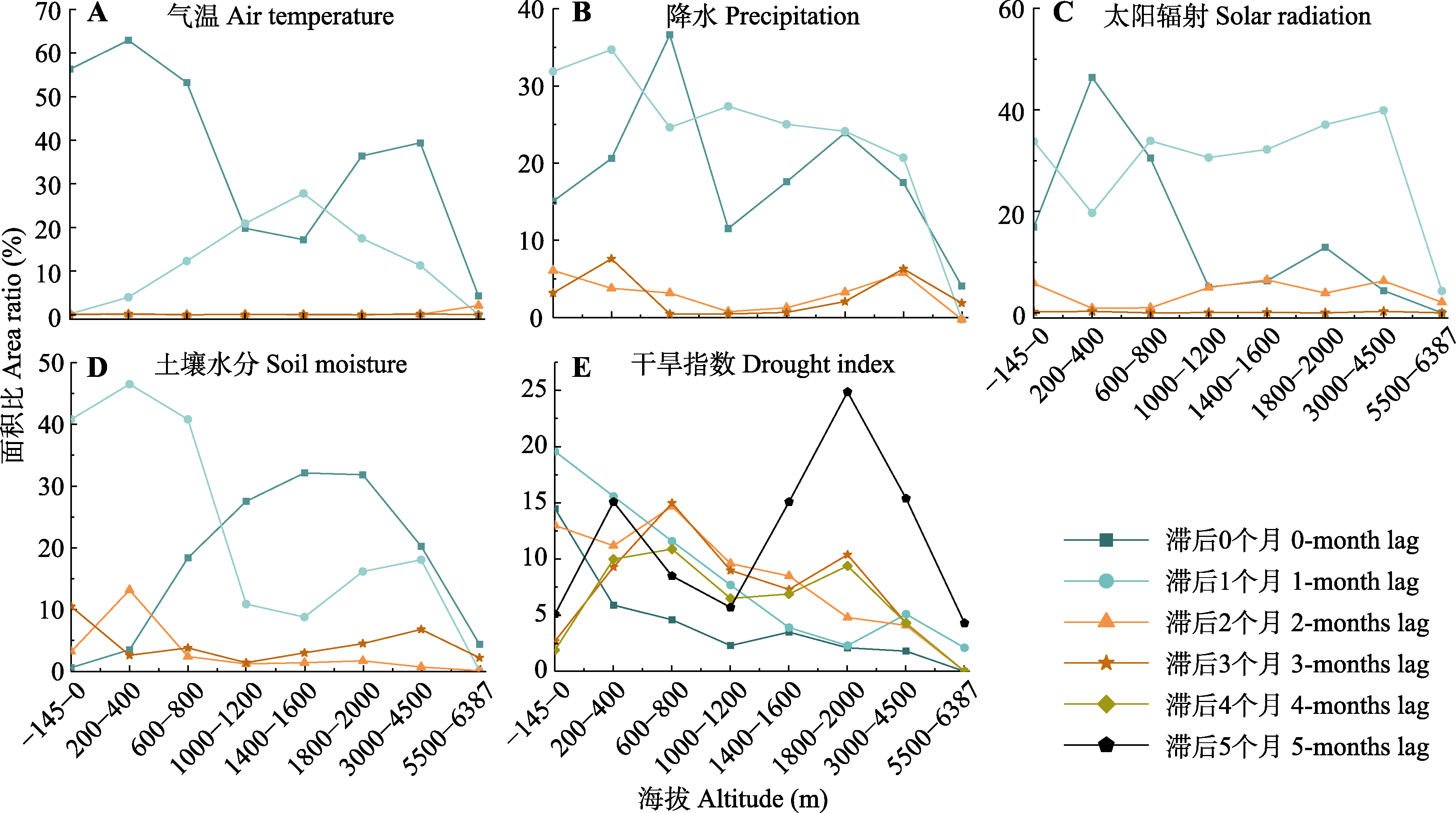
图6 亚洲旱区草地归一化植被指数(NDVI)与各影响要素滞后时间的区域面积占比随海拔高度变化的分布图。
Fig. 6 Distributions of regional area shares of normalized difference vegetation index (NDVI) and lag time of each influencing element with altitude in Asian dryland grasslands.
| [1] |
Anderson LO, Malhi Y, Aragão LEOC, Ladle R, Arai E, Barbier N, Phillips O (2010). Remote sensing detection of droughts in Amazonian forest canopies. New Phytologist, 187, 733-750.
DOI PMID |
| [2] |
Arnone III JA, Verburg PSJ, Johnson DW, Larsen JD, Jasoni RL, Lucchesi AJ, Batts CM, von Nagy C, Coulombe WG, Schorran DE, Buck PE, Braswell BH, Coleman JS, Sherry RA, Wallace LL, et al. (2008). Prolonged suppression of ecosystem carbon dioxide uptake after an anomalously warm year. Nature, 455, 383-386.
DOI |
| [3] |
Boker SM, Xu MQ, Rotondo JL, King K (2002). Windowed cross-correlation and peak picking for the analysis of variability in the association between behavioral time series. Psychological Methods, 7, 338-355.
PMID |
| [4] | Brando PM, Balch JK, Nepstad DC, Morton DC, Putz FE, Coe MT, Silvério D, Macedo MN, Davidson EA, Nóbrega CC, Alencar A, Soares-Filho BS (2014). Abrupt increases in Amazonian tree mortality due to drought-fire interactions. Proceedings of the National Academy of Sciences of the United States of America, 111, 6347-6352. |
| [5] |
Braswell BH, Schimel DS, Linder E, Moore III B (1997). The response of global terrestrial ecosystems to interannual temperature variability. Science, 278, 870-873.
DOI URL |
| [6] | Chen CB, Li GY, Peng J (2023). Spatio-temporal characteristics of Xinjiang grassland NDVI and its response to climate change from 1981 to 2018. Acta Ecologica Sinica, 43, 1537-1552. |
| [陈春波, 李刚勇, 彭建 (2023). 1981-2018年新疆草地归一化植被指数时空特征及其对气候变化的响应. 生态学报, 43, 1537-1552.] | |
| [7] | Chen SY, Guo JY, Guo ZX, Gao R, Shi YY (2009). Discipline of temporal and spatial variation of annual mean air temperature in arid and semiarid region in northwest China in the recent 46 years. Arid Land Geography, 32, 364-372. |
| [陈少勇, 郭江勇, 郭忠祥, 高蓉, 石圆圆 (2009). 中国西北干旱半干旱区年平均气温的时空变化规律分析. 干旱区地理, 32, 364-372.] | |
| [8] |
Chen TX, de Jeu RAM, Liu YY, van der Werf GR, Dolman AJ (2014). Using satellite based soil moisture to quantify the water driven variability in NDVI: a case study over mainland Australia. Remote Sensing of Environment, 140, 330-338.
DOI URL |
| [9] | Ding YX, Li Z, Peng SZ (2020). Global analysis of time-lag and-accumulation effects of climate on vegetation growth. International Journal of Applied Earth Observation and Geoinformation, 92, 102179. DOI: 10.1016/j.jag.2020.102179. |
| [10] | Fan BL, Lu J, Qian T, Gao PF, Sun K (2022). Effects of climate and soil on leaf acquisition and utilization of carbon and water resources in different grasslands. Chinese Journal of Ecology, 41, 625-632. |
| [樊宝丽, 卢晶, 钱婷, 高鹏斐, 孙坤 (2022). 不同草原类型下气候和土壤对植物叶片碳水资源获取和利用性状的影响. 生态学杂志, 41, 625-632.] | |
| [11] | Fu YS, Zhang J, Wu ZF, Chen SZ (2022). Vegetation phenology response to climate change in China. Journal of Beijing Normal University (Natural Science), 58, 424-433. |
| [付永硕, 张晶, 吴兆飞, 陈首志 (2022). 中国植被物候研究进展及展望. 北京师范大学学报(自然科学版), 58, 424-433.] | |
| [12] | Geng QL, Chen XQ, He XH, Tian ZH (2022). Vegetation dynamics and its response to climate change and human activities based on different vegetation types in China. Acta Ecologica Sinica, 42, 3557-3568. |
| [耿庆玲, 陈晓青, 赫晓慧, 田智慧 (2022). 中国不同植被类型归一化植被指数对气候变化和人类活动的响应. 生态学报, 42, 3557-3568.] | |
| [13] | Harris I, Jones P, Osborn T (2021). NERC EDS Centre for Environmental Data Analysis, University of East Angli—A Climatic Research Unit (Jan. 2001-Dec. 2020). [2022-11-20]. https://catalogue.ceda.ac.uk/uuid/c26a65020a5e4b80b20018f148556681. |
| [14] | Hu RJ, Jiang FQ, Wang YJ, Li JL, Li YM, Ablekim A, Luo GP, Zhang JM (2014). Arid ecological and geographical conditions in five countries of central Asia. Arid Zone Research, 31(1), 1-12. |
| [胡汝骥, 姜逢清, 王亚俊, 李均力, 李耀明, 阿布都米吉提·阿布力克木, 罗格平, 张建明(2014). 中亚(五国)干旱生态地理环境特征. 干旱区研究, 31(1), 1-12.] | |
| [15] |
Hu ZY, Zhang C, Hu Q, Tian HQ (2014). Temperature changes in central Asia from 1979 to 2011 based on multiple datasets. Journal of Climate, 27, 1143-1167.
DOI URL |
| [16] | Huang HB, Xu HL, Lin T, Xia GZ (2022). Spatio-temporal variation characteristics of NDVI and its response to climate change in the Altay region of Xinjiang from 2001 to 2020. Acta Ecologica Sinica, 42, 2798-2809. |
| [黄豪奔, 徐海量, 林涛, 夏国柱 (2022). 2001-2020年新疆阿勒泰地区归一化植被指数时空变化特征及其对气候变化的响应. 生态学报, 42, 2798-2809.] | |
| [17] |
Huang R, Xu LG, Liu JM (2013). Research on spatio-temporal change of temperature in the Northwest Arid Area. Acta Ecologica Sinica, 33, 4078-4089.
DOI URL |
| [黄蕊, 徐利岗, 刘俊民 (2013). 中国西北干旱区气温时空变化特征. 生态学报, 33, 4078-4089.] | |
| [18] |
Ji YH, Zhou GS, Wang SD, Wang LX, Zhou MZ (2021). Evolution characteristics and its driving forces analysis of vegetation ecological quality in Qinling Mountains region from 2000 to 2019. Chinese Journal of Plant Ecology, 45, 617-625.
DOI URL |
| [汲玉河, 周广胜, 王树东, 王丽霞, 周梦子 (2021). 2000-2019年秦岭地区植被生态质量演变特征及驱动力分析. 植物生态学报, 45, 617-625.] | |
| [19] |
Jin K, Wang F, Han JQ, Shi SY, Ding WB (2020). Contribution of climatic change and human activities to vegetation NDVI change over China during 1982-2015. Acta Geographica Sinica, 75, 961-974.
DOI |
|
[金凯, 王飞, 韩剑桥, 史尚渝, 丁文斌 (2020). 1982-2015年中国气候变化和人类活动对植被NDVI变化的影响. 地理学报, 75, 961-974.]
DOI |
|
| [20] | Li P, Wang J, Liu MM, Xue ZH, Bagherzadeh A, Liu MY (2021). Spatio-temporal variation characteristics of NDVI and its response to climate on the Loess Plateau from 1985 to 2015. Catena, 203, 105331. DOI: 10.1016/j.catena.2021.105331. |
| [21] | Liu HX, Zhang AB, Liu C, Zhao YL, Zhao AZ, Wang DL (2021). Analysis of the time-lag effects of climate factors on grassland productivity in Inner Mongolia. Global Ecology and Conservation, 30, e01751. DOI: 10.1016/j.gecco.2021.e01751. |
| [22] | Liu LM, Wang TT, Li XF, Xie ZB, Wu JZ, Song LN (2021). Spatiotemporal variations of wind prevention and sand fixation function in the sand-prevention belt in Inner Mongolia in recent 15 years. Chinese Journal of Ecology, 40, 3436-3447. |
| [刘利民, 王婷婷, 李秀芬, 谢遵博, 武金洲, 宋立宁 (2021). 近15年内蒙古防沙带防风固沙功能时空变化特征. 生态学杂志, 40, 3436-3447.] | |
| [23] | Lu QQ, Jiang T, Liu DL, Liu ZY (2020). The response characteristics of NDVI with different vegetation cover types to temperature and precipitation in China. Ecology and Environmental Sciences, 29, 23-34. |
|
[卢乔倩, 江涛, 柳丹丽, 刘智勇 (2020). 中国不同植被覆盖类型NDVI对气温和降水的响应特征. 生态环境学报, 29, 23-34.]
DOI |
|
| [24] | Miao LJ, Jiang C, He B, Liu Q, Zhu F, Cui XF (2014). Response of vegetation coverage to climate change in Mongolian Plateau during recent 10 years. Acta Ecologica Sinica, 34, 1295-1301. |
| [缪丽娟, 蒋冲, 何斌, 刘强, 朱枫, 崔雪锋 (2014). 近10年来蒙古高原植被覆盖变化对气候的响应. 生态学报, 34, 1295-1301.] | |
| [25] |
Miao LJ, Sun ZL, Ren YJ, Schierhorn F, Müller D (2021). Grassland greening on the Mongolian Plateau despite higher grazing intensity. Land Degradation & Development, 32, 792-802.
DOI URL |
| [26] |
Ni M, Zhang XY, Jiang C, Wang HS (2021). Responses of vegetation to extreme climate events in southwestern China. Chinese Journal of Plant Ecology, 45, 626-640.
DOI URL |
| [倪铭, 张曦月, 姜超, 王鹤松 (2021). 中国西南部地区植被对极端气候事件的响应. 植物生态学报, 45, 626-640.] | |
| [27] |
Pearson RG, Phillips SJ, Loranty MM, Beck PSA, Damoulas T, Knight SJ, Goetz SJ (2013). Shifts in Arctic vegetation and associated feedbacks under climate change. Nature Climate Change, 3, 673-677.
DOI |
| [28] |
Peng SS, Piao SL, Ciais P, Myneni RB, Chen AP, Chevallier F, Dolman AJ, Janssens IA, Peñuelas J, Zhang GX, Vicca S, Wan SQ, Wang SP, Zeng H (2013). Asymmetric effects of daytime and night-time warming on Northern Hemisphere vegetation. Nature, 501, 88-92.
DOI |
| [29] |
Piao SL, Fang JY (2003). Seasonal changes in vegetation activity in response to climate changes in China between 1982 and 1999. Acta Geographica Sinica, 58, 119-125.
DOI |
| [朴世龙, 方精云 (2003). 1982-1999年我国陆地植被活动对气候变化响应的季节差异. 地理学报, 58, 119-125.] | |
| [30] |
Piao SL, Liu Q, Chen AP, Janssens IA, Fu YS, Dai JH, Liu LL, Lian X, Shen MG, Zhu XL (2019). Plant phenology and global climate change: current progresses and challenges. Global Change Biology, 25, 1922-1940.
DOI PMID |
| [31] | Ren RY (2021). Spatiotemporal Distribution of Vegetation Index/NDVI and Its Response to Climate Change in Guizhou Province. Master degree dissertation, Guizhou Normal University, Guiyang. |
| [任荣仪 (2021). 贵州省植被指数/NDVI时空分布特征及对气候变化的响应. 硕士学位论文, 贵州师范大学, 贵阳.] | |
| [32] |
Schimel DS, House JI, Hibbard KA, Bousquet P, Ciais P, Peylin P, Braswell BH, Apps MJ, Baker D, Bondeau A, Canadell J, Churkina G, Cramer W, Denning AS, Field CB, et al. (2001). Recent patterns and mechanisms of carbon exchange by terrestrial ecosystems. Nature, 414, 169-172.
DOI |
| [33] |
Sterling SM, Ducharne A, Polcher J (2013). The impact of global land-cover change on the terrestrial water cycle. Nature Climate Change, 3, 385-390.
DOI |
| [34] | Wang S, Li QX, Zhang B (2021). Spatiotemporal variation of net primary productivity and its climatic driving factors in Xilingol League. Chinese Journal of Ecology, 40, 825-834. |
| [王爽, 李庆旭, 张彪 (2021). 锡林郭勒盟净初级生产力时空变化及其气候影响. 生态学杂志, 40, 825-834.] | |
| [35] |
Wells N, Goddard S, Hayes MJ (2004). A self-calibrating palmer drought severity index. Journal of Climate, 17, 2335-2351.
DOI URL |
| [36] |
Wu DH, Zhao X, Liang SL, Zhou T, Huang KC, Tang BJ, Zhao WQ (2015). Time-lag effects of global vegetation responses to climate change. Global Change Biology, 21, 3520-3531.
DOI PMID |
| [37] |
Wu XT, Wang S, Fu BJ, Feng XM, Chen YZ (2019). Socio- ecological changes on the loess plateau of China after grain to green program. Science of the Total Environment, 678, 565-573.
DOI URL |
| [38] | Yang RR, Cao GC, Cao SK, Lan Y, Zhang Z, Chen ZR (2021). Temporal and spatial variations of NDVI and analysis of influencing factors in main valleys of southern slope of Qilian Mountains. Guihaia, 41, 429-437. |
| [杨荣荣, 曹广超, 曹生奎, 兰垚, 张卓, 陈治荣 (2021). 祁连山南坡主要河谷NDVI时空变化及影响因素分析. 广西植物, 41, 429-437.] | |
| [39] | Yin G, Meng XY, Wang H, Hu ZY, Sun ZQ (2017). Spatial-temporal variation of vegetation and its correlation with climate change in Central Asia during the period of 1982-2012. Acta Ecologica Sinica, 37, 3149-3163. |
| [殷刚, 孟现勇, 王浩, 胡增运, 孙志群 (2017). 1982-2012年中亚地区植被时空变化特征及其与气候变化的相关分析. 生态学报, 37, 3149-3163.] | |
| [40] | Zhang H, Zhang X, Shang Y, Kattel G, Miao LJ (2021). Continuously vegetation greening over Inner Mongolia for the past three decades. Remote Sensing, 13, 2446. DOI: 10.3390/rs13132446. |
| [41] | Zhang J, Yuan MS, Zhang J, Li HW, Wang JY, Zhang X, Ju PJ, Jiang HB, Chen H, Zhu QA (2020). Responses of the NDVI of alpine grasslands on the Qinghai-Tibetan Plateau to climate change and human activities over the last 30 years. Acta Ecologica Sinica, 40, 6269-6281. |
| [张江, 袁旻舒, 张婧, 李函微, 王洁仪, 张贤, 鞠佩君, 蒋海波, 陈槐, 朱求安 (2020). 近30年来青藏高原高寒草地NDVI动态变化对自然及人为因子的响应. 生态学报, 40, 6269-6281.] | |
| [42] | Zhu SH, Fang X, Hang X, Xie XP, Sun LX, Cao LZ (2022). Normalized difference vegetation index (NDVI) dynamics of grassland in Central Asia and its response to climate change and human activities. Journal of Desert Research, 42, 229-241. |
|
[朱士华, 方霞, 杭鑫, 谢小萍, 孙良宵, 曹良中 (2022). 中亚草地植被指数(NDVI)对气候变化及人类活动的响应. 中国沙漠, 42, 229-241.]
DOI |
|
| [43] | Zhu W (2015). Spatial-temporal Dynamics of Vegetation Coverage and Its Response to Extreme Temperature and Precipitation Processes over the Arid Region of Northwest China. Master degree dissertation, Northwest Normal University, Lanzhou. |
| [祝稳 (2015). 西北干旱区植被覆盖动态及其对极端气温和降水过程的响应. 硕士学位论文, 西北师范大学, 兰州.] |
| [1] | 何堂庆, 王变变, 曹鑫鑫, 张康成, 汪晓东, 王浩, 白彤硕, 赵叶新, 张艺, 王益, 仇云鹏, 胡水金. 半干旱草地植物和丛枝菌根真菌群落对长期降水增加的响应[J]. 植物生态学报, 2026, 50(3): 674-684. |
| [2] | 张永军, 李敬东, 安琦, 洪翎桂, 任正炜, 张蕊, 周小龙. 氮添加和增温对天山高寒草地群落性状的影响[J]. 植物生态学报, 2026, 50(2): 417-428. |
| [3] | 吕卫东, 董全民, 孙彩彩, 刘文亭, 刘玉祯, 张振祥, 李梦棋, 杨晓霞. 牦牛和藏羊放牧对高寒草地植物和微生物碳氮库的影响[J]. 植物生态学报, 2025, 49(9): 1424-1433. |
| [4] | 常鹏飞, 李平, 纳尔斯格, 王静, 王振华, 杨森, 贾舟, 杨璐, 刘玲莉, 邓美凤. 内蒙古温带草原不同草地类型土壤有机碳和无机碳储量对总碳储量的贡献及其驱动因素[J]. 植物生态学报, 2025, 49(9): 1374-1387. |
| [5] | 张琳, 陈华阳, 黄振英. 2004-2010年鄂尔多斯沙地草地长期监测样地植物物种组成和群落特征数据集[J]. 植物生态学报, 2025, 49(8): 1263-1270. |
| [6] | 王尧, 王耀彬, 陈子彦, 伊如汉, 白永飞, 赵玉金, 金晶炜. 连续干旱对蒙古高原草地恢复力和抵抗力的影响[J]. 植物生态学报, 2025, 49(7): 1070-1081. |
| [7] | 刘强, 马鸿元, 彭云峰, 拉本, 叶得力, 张嘉宸, 赖俊华. 大规模光伏开发对高寒荒漠化草原生态系统碳储量的影响[J]. 植物生态学报, 2025, 49(11): 1791-1804. |
| [8] | 马录花, 孟宪超, 王贵强, 马子峰, 李以康, 李月梅, 周华坤, 张法伟, 林丽. 藓类结皮接种对三江源高寒草甸土壤性状和微生物的影响[J]. 植物生态学报, 2025, 49(1): 173-188. |
| [9] | 房凯, 王迎新, 黄建辉, 段俊光, 张琦, 张倩, 甘红豪, 褚建民. 内蒙古典型草原不同退化阶段植被恢复的养分限制因子解析[J]. 植物生态学报, 2025, 49(1): 7-18. |
| [10] | 杜淑辉, 褚建民, 段俊光, 薛建国, 徐磊, 徐晓庆, 王其兵, 黄建辉, 张倩. 木质素酚类物质对内蒙古退化草地土壤有机碳的影响[J]. 植物生态学报, 2025, 49(1): 30-41. |
| [11] | 马东峰, 贾存智, 王学朋, 赵鹏鹏, 胡小文. 甘南高寒退化草甸多物种组配的修复效果评估[J]. 植物生态学报, 2025, 49(1): 93-102. |
| [12] | 郝毅晴, 刘伟, 杨阳, 安冰儿, 范冰, 李超, 崔久辉, 程延彬, 孙佳美, 潘庆民. 有机肥和无机肥对退化草原羊草种群密度和个体生物量的影响[J]. 植物生态学报, 2025, 49(1): 148-158. |
| [13] | 李天琦, 曹继容, 柳小妮, 田思惠, 兰波兰, 邱颖, 薛建国, 张倩, 褚建民, 张淑敏, 黄建辉, 李凌浩, 王其兵. 内蒙古典型草原土壤酶化学计量与限制性养分对放牧的响应[J]. 植物生态学报, 2025, 49(1): 19-29. |
| [14] | 牛亚平, 高晓霞, 姚世庭, 杨元合, 彭云峰. 退化高寒草地植物多样性和功能群组成与地上生产力的关系[J]. 植物生态学报, 2025, 49(1): 83-92. |
| [15] | 许梦真, 卢正宽, 谭星儒, 王彦兵, 苏天成, 窦山德, 潘庆民, 陈世苹. 呼伦贝尔草甸草原退化特征因子识别与快速诊断指标体系构建[J]. 植物生态学报, 2025, 49(1): 42-58. |
| 阅读次数 | ||||||
|
全文 |
|
|||||
|
摘要 |
|
|||||
Copyright © 2026 版权所有 《植物生态学报》编辑部
地址: 北京香山南辛村20号, 邮编: 100093
Tel.: 010-62836134, 62836138; Fax: 010-82599431; E-mail: apes@ibcas.ac.cn, cjpe@ibcas.ac.cn
备案号: 京ICP备16067583号-19

