
植物生态学报 ›› 2023, Vol. 47 ›› Issue (12): 1646-1657.DOI: 10.17521/cjpe.2022.0449
何茜1,2, 冯秋红3, 张佩佩1,*( ), 杨涵1,2, 邓少军1,2, 孙小平4, 尹华军1
收稿日期:2022-11-08
接受日期:2023-03-13
出版日期:2023-12-20
发布日期:2023-03-13
通讯作者:
*(zhangpp@cib.ac.cn)
基金资助:
HE Xi1,2, FENG Qiu-Hong3, ZHANG Pei-Pei1,*(), YANG Han1,2, DENG Shao-Jun1,2, SUN Xiao-Ping4, YIN Hua-Jun1
Received:2022-11-08
Accepted:2023-03-13
Online:2023-12-20
Published:2023-03-13
Contact:
*(zhangpp@cib.ac.cn)
Supported by:摘要:
氮(N)和磷(P)养分有效性是制约森林生态系统林分生产力与碳汇功能的关键要素, 但目前对多变环境下森林生态系统养分限制特征还缺乏充分的科学认识。山地生态系统的气候、植被和土壤等环境因子沿海拔的垂直变化格局为深入认识森林养分限制及其驱动因素提供了天然的实验平台。该研究以青藏高原东缘典型的川西亚高山针叶林——岷江冷杉(Abies faxoniana)林为研究对象, 通过沿巴朗山2 850-3 200 m海拔梯度的多点取样, 从植物叶片N、P养分含量、化学计量变化和地下微生物胞外酶化学计量学的角度, 分析了海拔梯度下该区域森林养分限制特征变化规律及其主要驱动因素。结果表明: 1)随海拔升高, 叶片N、P含量降低而N:P由12.33升高至15.00, 表明随海拔升高该区域针叶林叶片生长由N限制转化为N-P共同限制, 且P限制随海拔升高而表现出增强趋势; 2)矢量模型分析发现不同海拔下根际土壤微生物胞外酶化学计量矢量角度均>45°, 且随海拔升高呈上升趋势, 表明该区域微生物受P限制, 且海拔越高土壤微生物P限制越强; 3)进一步通过Pearson相关分析和路径分析表明, 海拔引起的气温变化是驱动岷江冷杉林生态系统养分限制的主导因素。综上所述, 基于叶片和土壤微生物养分证据均表明川西亚高山针叶林生态系统总体表现出P限制程度随海拔升高而逐渐增强的趋势。
何茜, 冯秋红, 张佩佩, 杨涵, 邓少军, 孙小平, 尹华军. 基于叶片和土壤酶化学计量的川西亚高山岷江冷杉林养分限制海拔变化规律. 植物生态学报, 2023, 47(12): 1646-1657. DOI: 10.17521/cjpe.2022.0449
HE Xi, FENG Qiu-Hong, ZHANG Pei-Pei, YANG Han, DENG Shao-Jun, SUN Xiao-Ping, YIN Hua-Jun. Altitudinal patterns of nutrient limiting characteristics of Abies fargesii var. faxoniana forest based on leaf and soil enzyme stoichiometry in western Sichuan, China. Chinese Journal of Plant Ecology, 2023, 47(12): 1646-1657. DOI: 10.17521/cjpe.2022.0449
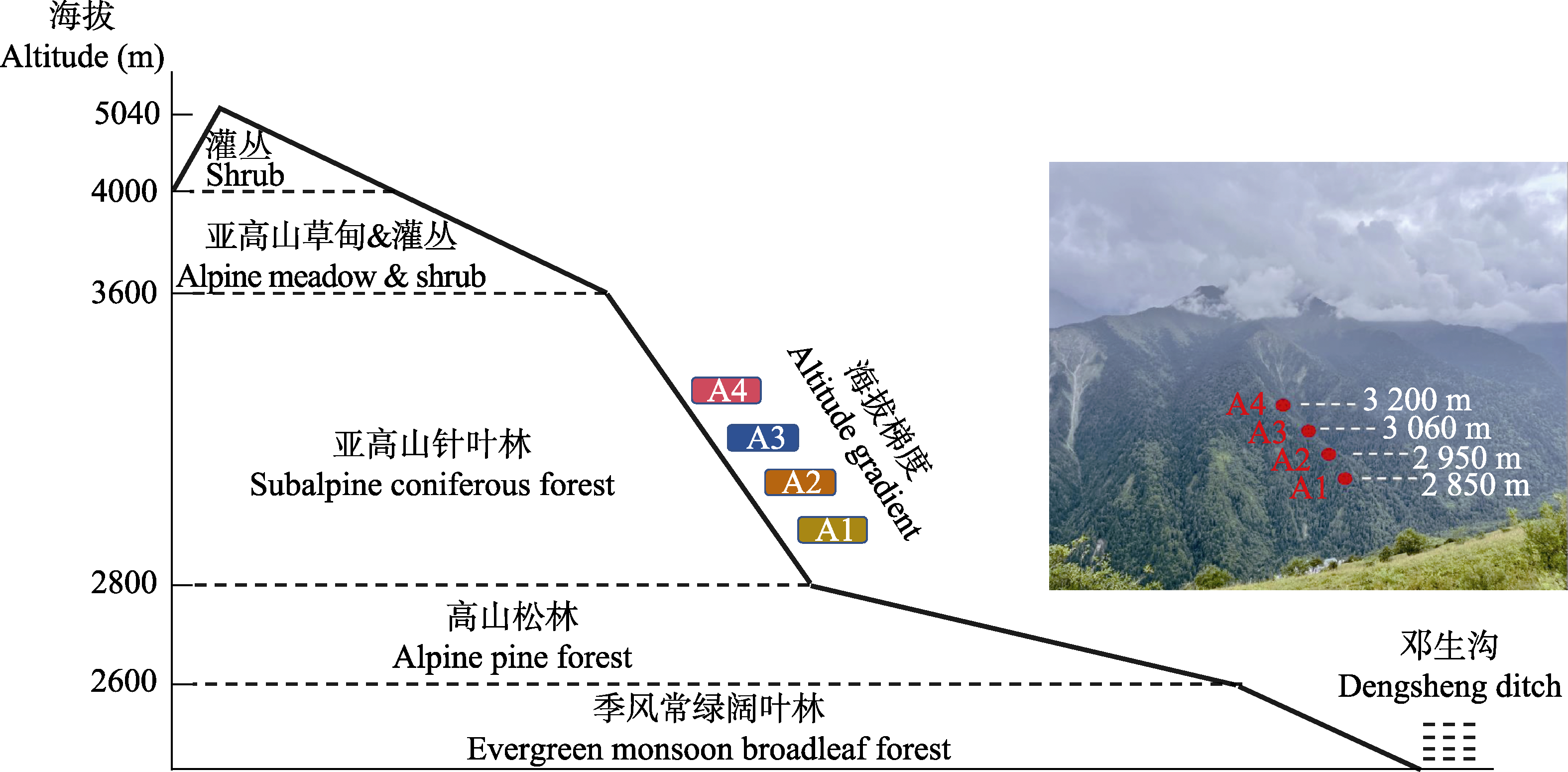
图1 川西亚高山研究区的垂直带谱和采样点分布。
Fig. 1 Vertical zonation and sampling point in the study area in subalpine mountains of western Sichuan.
| 基本性质 Basic property | 海拔 Altitude (m) | |||
|---|---|---|---|---|
| 2 850 | 2 950 | 3 060 | 3 200 | |
| 土壤含水量 Soil moisture (%) | 46.89 ± 0.36d | 54.80 ± 2.31b | 50.79 ± 0.94c | 57.51 ± 2.26a |
| 土壤pH Soil pH | 4.55 ± 0.02a | 4.15 ± 0.14b | 4.20 ± 0.05b | 3.92 ± 0.05c |
| 气温 Air temperature (°C) | 15.33 | 13.99 | 12.51 | 10.64 |
表1 川西亚高山岷江冷杉林不同海拔土壤含水量、pH及气温(平均值±标准误, n = 5)。
Table 1 Soil moisture, pH and air temperature at different altitudes of Abies fargesii var. faxoniana forest in subalpine mountains of western Sichuan (mean ± SE, n = 5)
| 基本性质 Basic property | 海拔 Altitude (m) | |||
|---|---|---|---|---|
| 2 850 | 2 950 | 3 060 | 3 200 | |
| 土壤含水量 Soil moisture (%) | 46.89 ± 0.36d | 54.80 ± 2.31b | 50.79 ± 0.94c | 57.51 ± 2.26a |
| 土壤pH Soil pH | 4.55 ± 0.02a | 4.15 ± 0.14b | 4.20 ± 0.05b | 3.92 ± 0.05c |
| 气温 Air temperature (°C) | 15.33 | 13.99 | 12.51 | 10.64 |
| 土壤基本理化性质 Basic property | 海拔 Altitudes (m) | |||
|---|---|---|---|---|
| 2 850 | 2 950 | 3 060 | 3200 | |
| TN (g·kg-1) | 5.23 ± 0.06c | 6.23 ± 0.30b | 5.36 ± 0.19c | 8.61 ± 0.99a |
| TP (g·kg-1) | 0.53 ± 0.02b | 0.56 ± 0.05b | 0.54 ± 0.03b | 0.65 ± 0.02a |
| DIN (mg·kg-1) | 17.11 ± 0.68a | 14.72 ± 1.68b | 10.14 ± 1.01d | 11.85 ± 0.83c |
| AP (mg·kg-1) | 1.65 ± 0.25b | 4.74 ± 0.75a | 1.48 ± 0.11b | 4.01 ± 0.91a |
表2 川西亚高山岷江冷杉林不同海拔下土壤养分含量(平均值±标准误, n = 5)。
Table 2 Concentration of soil nutrients at different altitudes of Abies fargesii var. faxoniana forest in subalpine mountains of western Sichuan (mean ± SE, n = 5)
| 土壤基本理化性质 Basic property | 海拔 Altitudes (m) | |||
|---|---|---|---|---|
| 2 850 | 2 950 | 3 060 | 3200 | |
| TN (g·kg-1) | 5.23 ± 0.06c | 6.23 ± 0.30b | 5.36 ± 0.19c | 8.61 ± 0.99a |
| TP (g·kg-1) | 0.53 ± 0.02b | 0.56 ± 0.05b | 0.54 ± 0.03b | 0.65 ± 0.02a |
| DIN (mg·kg-1) | 17.11 ± 0.68a | 14.72 ± 1.68b | 10.14 ± 1.01d | 11.85 ± 0.83c |
| AP (mg·kg-1) | 1.65 ± 0.25b | 4.74 ± 0.75a | 1.48 ± 0.11b | 4.01 ± 0.91a |
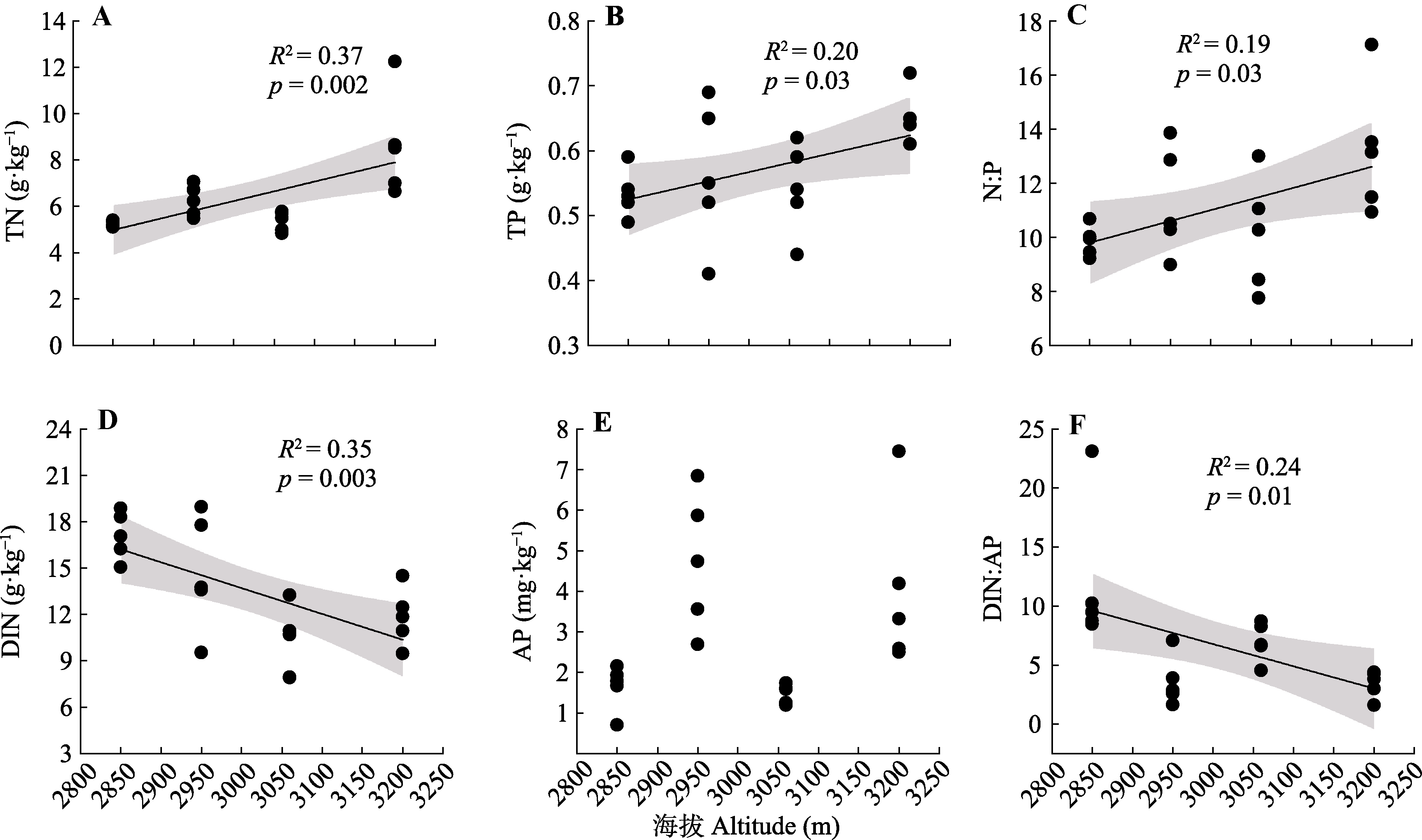
图2 川西亚高山岷江冷杉林土壤总氮(TN)、总磷(TP)、可溶性无机氮(DIN)、有效磷(AP)含量及N:P与海拔的关系。实线表示土壤养分与海拔之间的线性拟合关系, 灰色区域为模型的95%置信区间。
Fig. 2 Relationships of soil total nitrogen (TN), total phosphorus (TP), dissolved inorganic nitrogen (DIN), available phosphorus (AP) contents and N:P with altitudes of Abies fargesii var. faxoniana forest in subalpine mountains of western Sichuan. Solid lines indicate the linear fitting relationship between the soil nutrient and altitudes, and grey areas are the 95% confidence intervals of the models.
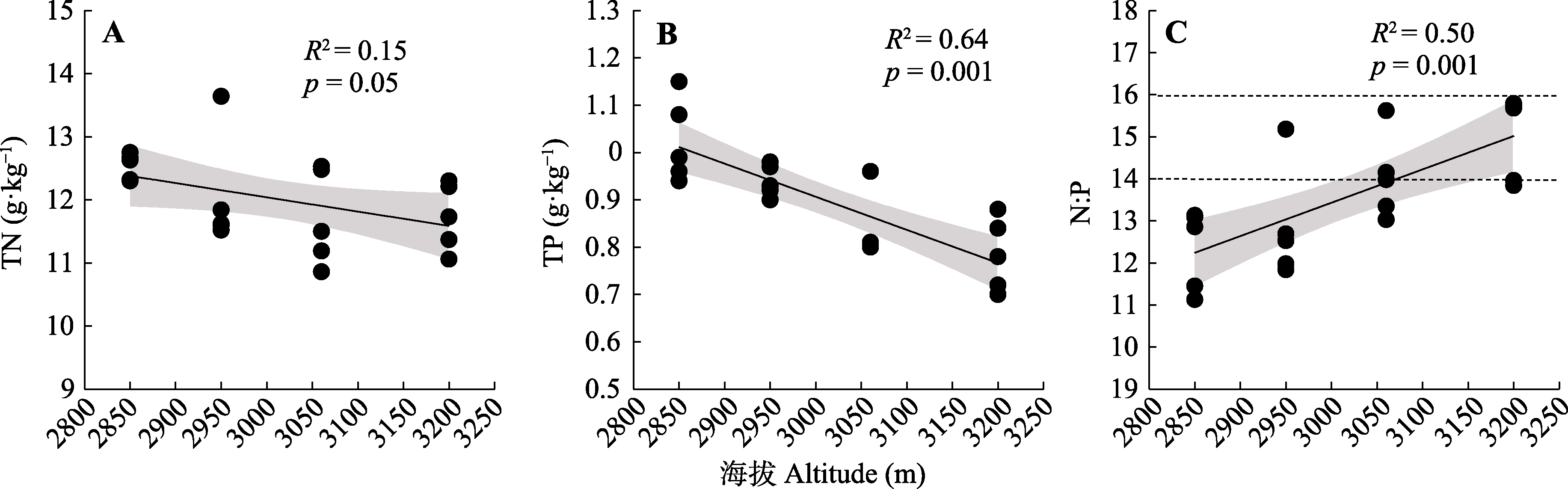
图3 川西亚高山岷江冷杉林叶片总氮(TN)、总磷(TP)含量及N:P与海拔的关系。实线表示叶片养分含量与海拔之间的线性拟合关系, 灰色区域为模型的95%置信区间。虚线代表叶片N:P为14和16。
Fig. 3 Relationships of foliar total nitrogen (TN), total phosphorus (TP) contents and N:P of coniferous forest with altitudes of Abies fargesii var. faxoniana forest in subalpine mountains of western Sichuan. Solid lines indicate the model fits between the leaf nutrient contents and altitudes, and grey areas are the 95% confidence intervals of the models. The dashed lines represent leaf N:P of 14 and 16, respectively.
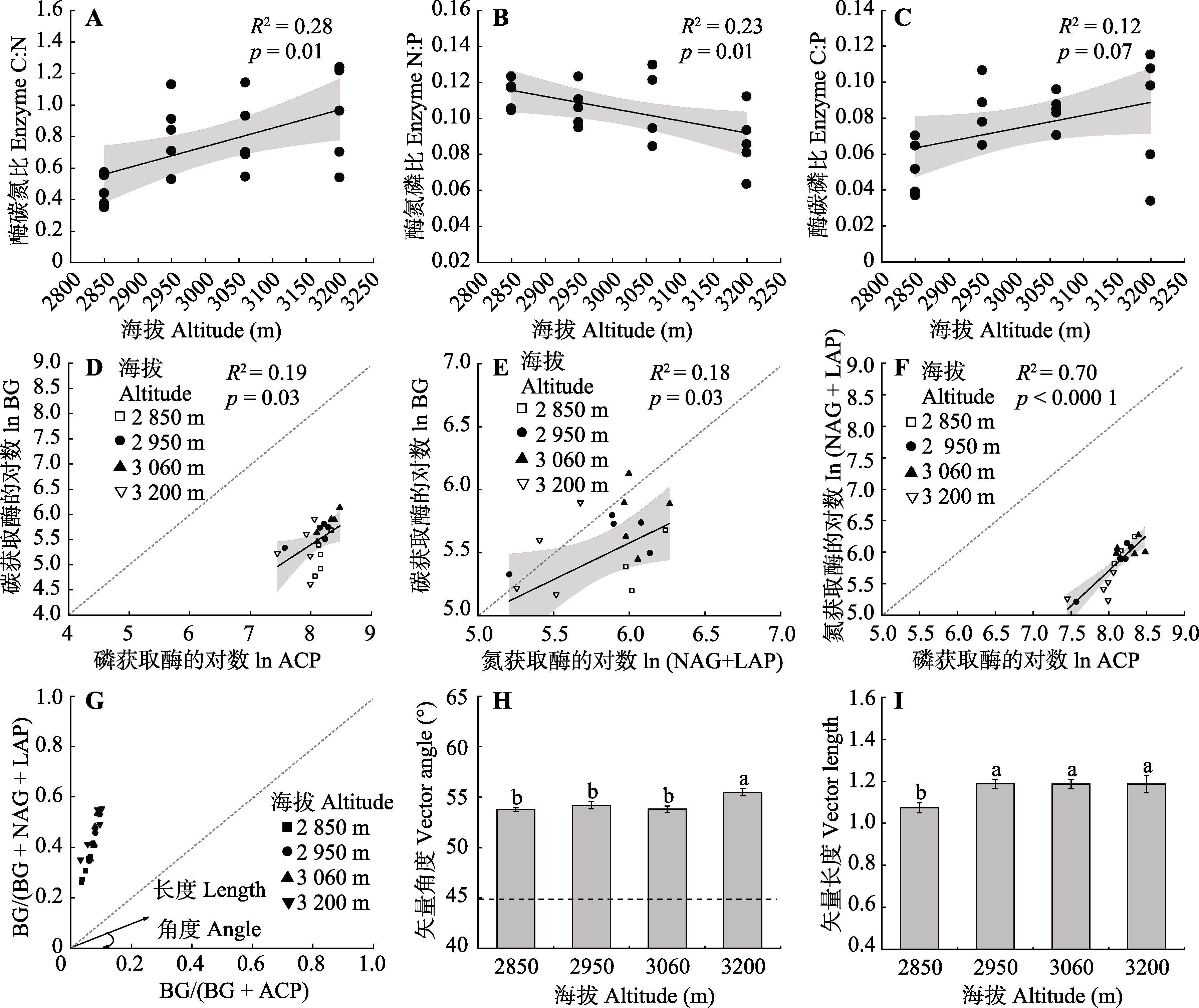
图4 川西亚高山岷江冷杉林不同海拔下土壤酶化学计量比与微生物资源限制特征(平均值±标准误, n = 5)。H、I中不同小写字母表示不同海拔间的差异显著(p < 0.05)。A-C中实线表示土壤酶化学计量比与海拔之间的线性拟合关系, 灰色区域为模型的95%置信区间。对角虚线代表1:1线, 水平虚线代表矢量角度为45°。ACP, 酸性磷酸酶活性; BG, β-1,4-葡萄糖苷酶活性; LAP, 亮氨酸氨基肽酶活性; NAG, β-1,4-N-乙酰氨基葡萄糖苷酶活性。
Fig. 4 Soil enzymatic stoichiometry and microbial resource limitation at different altitudes of Abies fargesii var. faxoniana forest in subalpine mountains of western Sichuan (mean ± SE, n = 5). Different lowercase letters in H and I indicate significant differences between different altitudes (p < 0.05). In A-C, solid lines indicate the model fits between soil nutrient and altitude, and grey areas are the 95% confidence intervals of the models. The diagonal dashed line represents the 1:1 line, the horizontal dashed line represents the vector angle of 45°. C, carbon; N, nitrogen; P, phosphorus. ACP, 4-MUB-phosphate activity; BG, 4-MUB-β-D-glucoside activity; LAP, L-leucine-7-amido-4-methylcoumarin activity; NAG, 4-MUB-N-acetyl-β-D-glucosaminide activity.
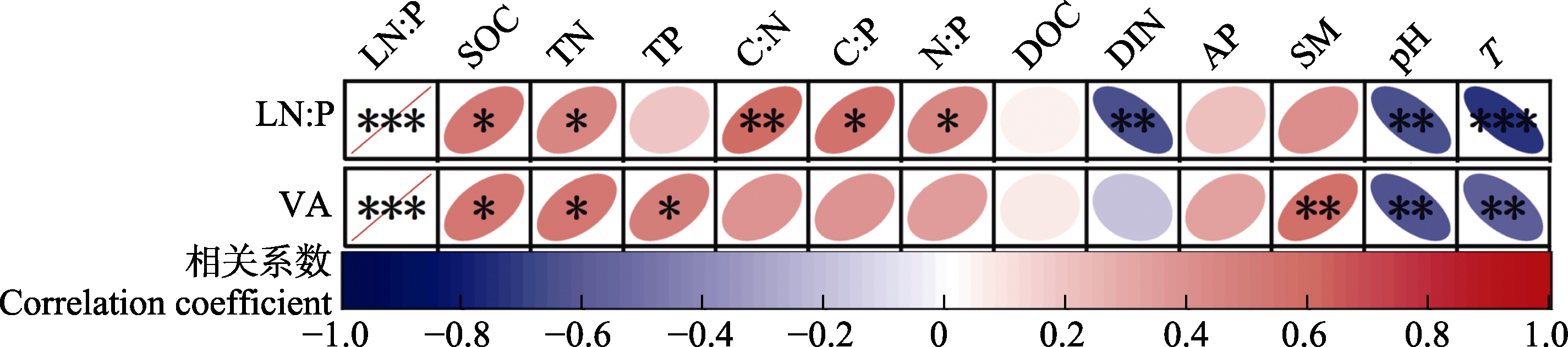
图5 川西亚高山岷江冷杉林根际土壤总养分含量及其化学计量比、有效养分含量、物理特性和气候因子与植物养分限制和微生物限制相关指标的Pearson相关矩阵。AP, 有效磷含量; C:N, 土壤总碳氮比; C:P, 土壤总碳磷比; DIN, 可溶性无机氮含量; DOC, 可溶性有机碳含量; pH, 土壤pH; LN:P, 叶片氮磷比; N:P, 土壤总氮磷比; SM, 土壤水分含量; SOC, 土壤有机碳含量; T, 气温; TN, 总氮含量; TP, 总磷含量; VA, 矢量角度。*, p < 0.05; **, p < 0.01; ***, p < 0.001; n = 5。
Fig. 5 Pearson correlation matrix between rhizosphere soil total nutrients content and its stoichiometry characteristics, available nutrients, physical properties, climate and plant nutrient limitation and microbial limitation of Abies fargesii var. faxoniana forest in subalpine mountains of western Sichuan. AP, available phosphorus content; C:N, soil total carbon to nitrogen ratio; C:P, soil total carbon to phosphorus ratio; DIN, dissolved inorganic nitrogen content; DOC, dissolved organic carbon content; pH, soil pH; LN:P, leaf total nitrogen to phosphorus ratio; N:P, soil total nitrogen to phosphorus ratio; SM, soil moisture; SOC, soil organic carbon content; T, air temperature; TN, total nitrogen content; TP, total phosphorus content; VA, vector angle. *, p < 0.05; **, p < 0.01; ***, p < 0.001; n = 5.
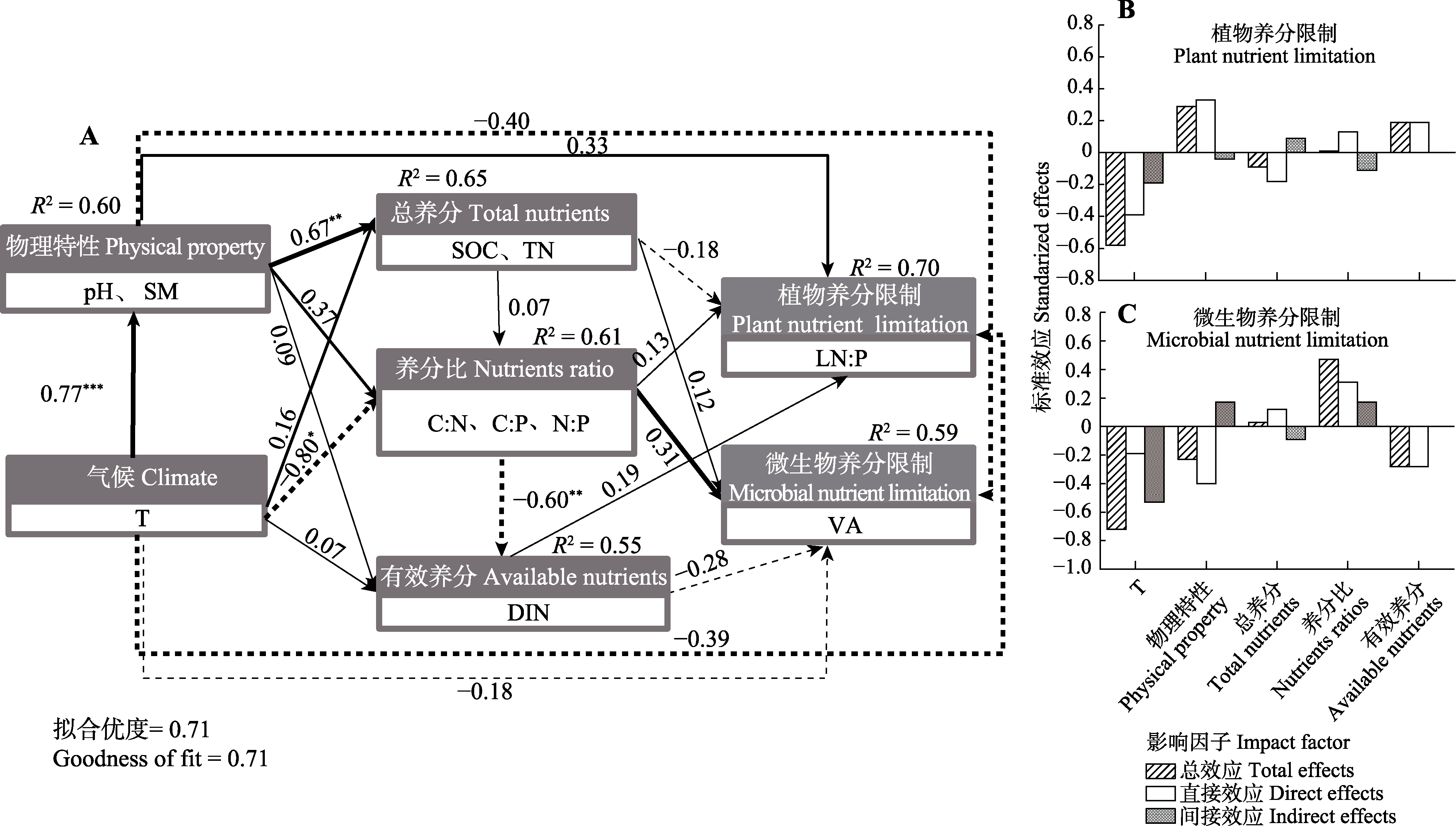
图6 川西亚高山岷江冷杉林养分限制与气温、土壤理化特性关系的偏最小二乘路径模型(A)和各因子对森林养分限制的效应值(B、C)。实线和虚线箭头分别表示因果关系的正向和负向影响(p < 0.05), 箭头上的数字表示标准化路径系数, R2表示模型解释的因变量的方差。C:N, 土壤总碳氮比; C:P, 土壤总碳磷比; DIN, 可溶性无机氮含量; pH, 土壤pH; LN:P, 叶片氮磷比; N:P, 土壤总氮磷比; SOC, 土壤有机碳含量; T, 气温; TN, 土壤总氮含量; VA, 矢量角度。
Fig. 6 Relationship between forest nutrient limitation and soil physicochemical properties partial least squares path modelling (A) and effect value of each factor on forest nutrient limitation (B, C) of Abies fargesii var. faxoniana forest in subalpine mountains of western Sichuan. Solid and dotted line arrows indicate positive and negative flows of causality (p < 0.05), respectively. Numbers on the arrow indicate significant standardized path coefficients. R2 indicates the variance of dependent variable explained by the model. C:N, soil total carbon to nitrogen ratio; C:P, soil total carbon to phosphorus ratio; DIN, dissolved inorganic nitrogen content; pH, soil pH; LN:P, leaf total nitrogen to phosphorus ratio; N:P, soil total nitrogen to phosphorus ratio; SOC, soil organic carbon content; T, air temperature; TN, soil total nitrogen content; VA, vector angle.
| [1] | Alster CJ, Baas P, Wallenstein MD, Johnson NG,von Fischer JC (2016). Temperature sensitivity as a microbial trait using parameters from macromolecular rate theory. Frontiers in Microbiology, 7, 1821. DOI: 10.3389/fmicb. 2016.01821. |
| [2] | Bao SD (2000). Soil and Agricultural Chemistry Analysis. Chinese Agriculture Press, Beijing. |
| [ 鲍士旦 (2000). 土壤农化分析. 中国农业出版社, 北京.] | |
| [3] |
Bing HJ, Wu YH, Zhou J, Sun HY, Luo J, Wang JP, Yu D (2016). Stoichiometric variation of carbon, nitrogen, and phosphorus in soils and its implication for nutrient limitation in alpine ecosystem of Eastern Tibetan Plateau. Journal of Soils and Sediments, 16, 405-416.
DOI URL |
| [4] | Bo FJ, Zhang YX, Chen HYH, Wang PG, Ren XM, Guo JP (2020). The C:N:P stoichiometry of planted and natural Larix principis-rupprechtii stands along altitudinal gradients on the Loess Plateau, China. Forests, 11, 363. DOI: 10.3390/ f11040363. |
| [5] |
Bowman WD, Bahn L, Damm M (2003). Alpine landscape variation in foliar nitrogen and phosphorus concentrations and the relation to soil nitrogen and phosphorus availability. Arctic, Antarctic, and Alpine Research, 35, 144-149.
DOI URL |
| [6] |
Bueno de Mesquita CP, Brigham LM, Sommers P, Porazinska DL, Farrer EC, Darcy JL, Suding KN, Schmidt SK (2020). Evidence for phosphorus limitation in high-elevation unvegetated soils, Niwot Ridge, Colorado. Biogeochemistry, 147, 1-13.
DOI |
| [7] |
Cao XW, Shi ZM, Chen J, Liu S, Zhang MM, Chen M, Xu GX, Wu JM, Xing HS, Li FF (2022). Extracellular enzyme characteristics and microbial metabolic limitation in soil of subalpine forest ecosystems on the eastern Qinghai- Tibetan Plateau. Plant and Soil, 479, 337-353.
DOI |
| [8] |
Chen H, Li DJ, Xiao KC, Wang KL (2018a). Soil microbial processes and resource limitation in karst and non-karst forests. Functional Ecology, 32, 1400-1409.
DOI URL |
| [9] |
Chen J, Luo Y, García-Palacios P, Cao J, Dacal M, Zhou X, Li J, Xia J, Niu S, Yang H, Shelton S, Guo W,van Groenigen KJ (2018b). Differential responses of carbon-degrading enzyme activities to warming: implications for soil respiration. Global Change Biology, 24, 4816-4826.
DOI URL |
| [10] |
Cui YX, Bing HJ, Fang LC, Jiang M, Shen GT, Yu JL, Wang X, Zhu H, Wu YH, Zhang XC (2021a). Extracellular enzyme stoichiometry reveals the carbon and phosphorus limitations of microbial metabolisms in the rhizosphere and bulk soils in alpine ecosystems. Plant and Soil, 458, 7-20.
DOI |
| [11] |
Cui YX, Fang LC, Guo XB, Wang X, Zhang YJ, Li PF, Zhang XC (2018). Ecoenzymatic stoichiometry and microbial nutrient limitation in rhizosphere soil in the arid area of the northern Loess Plateau, China. Soil Biology & Biochemistry, 116, 11-21.
DOI URL |
| [12] |
Cui Y, Moorhead DL, Guo X, Peng S, Wang Y, Zhang X, Fang L, Xu X (2021b). Stoichiometric models of microbial metabolic limitation in soil systems. Global Ecology and Biogeography, 30, 2297-2311.
DOI URL |
| [13] | Fritts HC (1976). Tree Rings and Climate. Academic Press, London. |
| [14] | Fisher JB, Malhi Y, Torres IC, Metcalfe DB, van de Weg MJ, Meir P, Silva-Espejo JE, Huasco WH (2013). Nutrient limitation in rainforests and cloud forests along a 3,000 m elevation gradient in the Peruvian Andes. Oecologia, 172, 889-902. |
| [15] | Geng Y, Wu Y, He JS (2011). Relationship between leaf phosphorus content and soil available phosphorus in Inner Mongolia grassland. Journal of Plant Ecology, 35, 1-8. |
| [ 耿燕, 吴漪, 贺金生 (2015). 内蒙古草地叶片磷含量与土壤有效磷的关系. 植物生态学报, 35, 1-8.] | |
| [16] | Givnish TJ (1986). On the Economy of Plant Form and Function. Cambridge University Press, New York. 25-55. |
| [17] |
Gonzales K, Yanai R (2019). Nitrogen-phosphorous interactions in young northern hardwoods indicate P limitation: foliar concentrations and resorption in a factorial N by P addition experiment. Oecologia, 189, 829-840.
DOI PMID |
| [18] |
Goswami S, Fisk MC, Vadeboncoeur MA, Garrison-Johnston M, Yanai RD, Fahey TJ (2018). Phosphorus limitation of aboveground production in northern hardwood forests. Ecology, 99, 438-449.
DOI PMID |
| [19] |
Güsewell S (2004). N:P ratios in terrestrial plants: variation and functional significance. New Phytologist, 164, 243- 266.
DOI PMID |
| [20] |
Han WX, Fang JY, Guo DL, Zhang Y (2005). Leaf nitrogen and phosphorus stoichiometry across 753 terrestrial plant species in China. New Phytologist, 168, 377-385.
DOI PMID |
| [21] |
He XJ, Hou EQ, Liu Y, Wen DZ (2016). Altitudinal patterns and controls of plant and soil nutrient concentrations and stoichiometry in subtropical China. Scientific Reports, 6, 24261. DOI: 10.1038/srep24261.
PMID |
| [22] |
Koerselman W, Meuleman AFM (1996). The vegetation N:P ratio: a new tool to detect the nature of nutrient limitation. Journal of Applied Ecology, 33, 1441-1450.
DOI URL |
| [23] |
Kroner Y, Way DA (2016). Carbon fluxes acclimate more strongly to elevated growth temperatures than to elevated CO2 concentrations in a northern conifer. Global Change Biology, 22, 2913-2918.
DOI PMID |
| [24] | Li CB (1990). Study on Forest Ecology in Sichuan. Sichuan Science and Technology Press, Chengdu. |
| [ 李承彪 (1990). 四川森林生态研究. 四川科学技术出版社, 成都.] | |
| [25] | Li QW, Liu Y, Gu YF, Guo L, Huang YY, Zhang J, Xu ZF, Tan B, Zhang L, Chen LH, Xiao JJ, Zhu P (2020). Ecoenzymatic stoichiometry and microbial nutrient limitations in rhizosphere soil along the Hailuogou Glacier forefield chronosequence. Science of the Total Environment, 704, 135413. DOI: 10.1016/j.scitotenv.2019.135413. |
| [26] | Liu Q, Wu Y, He H (2001). Ecological problems of subalpine coniferous forest in the southwest of China. World Sci-Tech R&D, 23(2), 63-69. |
| [ 刘庆, 吴彦, 何海 (2001). 中国西南亚高山针叶林的生态学问题. 世界科技研究与发展, 23(2), 63-69.] | |
| [27] | Liu XL, Jia C, He F, Cai XH, Pan HL, Ma WB, Feng QH, Ji HJ (2015). Characteristics of plant family composition of Quercus aquifolioides community along an altitude gradient on the Balang Mountain. Journal of Sichuan Forestry Science and Technology, 36(2), 1-9. |
| [ 刘兴良, 贾程, 何飞, 蔡小虎, 潘红丽, 马文宝, 冯秋红, 姬慧娟 (2015). 巴郎山川滇高山栎群落植物科组成的海拔梯度特征. 四川林业科技, 36(2), 1-9.] | |
| [28] |
McCain CM (2007). Could temperature and water availability drive elevational species richness patterns? A global case study for bats. Global Ecology and Biogeography, 16, 1-13.
DOI URL |
| [29] |
Moorhead DL, Sinsabaugh RL (2006). A theoretical model of litter decay and microbial interaction. Ecological Monographs, 76, 151-174.
DOI URL |
| [30] |
Moorhead DL, Sinsabaugh RL, Hill BH, Weintraub MN (2016). Vector analysis of ecoenzyme activities reveal constraints on coupled C, N and P dynamics. Soil Biology & Biochemistry, 93, 1-7.
DOI URL |
| [31] | Mori T (2020). Does ecoenzymatic stoichiometry really determine microbial nutrient limitations? Soil Biology & Biochemistry, 146, 107816. DOI: 10.1016/j.soilbio.2020. 107816. |
| [32] |
Nottingham AT, Turner BL, Whitaker J, Ostle NJ, McNamara NP, Bardgett RD, Salinas N, Meir P (2015). Soil microbial nutrient constraints along a tropical forest elevation gradient: a belowground test of a biogeochemical paradigm. Biogeosciences, 12, 6071-6083.
DOI URL |
| [33] |
Nottingham AT, Turner BL, Whitaker J, Ostle NJ, Bardgett RD, McNamara NP, Salinas N, Meir P (2016). Temperature sensitivity of soil enzymes along an elevation gradient in the Peruvian Andes. Biogeochemistry, 127, 217-230.
DOI URL |
| [34] |
Razavi BS, Liu SB, Kuzyakov Y (2017). Hot experience for cold-adapted microorganisms: temperature sensitivity of soil enzymes. Soil Biology & Biochemistry, 105, 236-243.
DOI URL |
| [35] | Reich PB, Oleksyn J (2004). Global patterns of plant leaf N and P in relation to temperature and latitude. Proceedings of the National Academy of Sciences of the United States of America, 101, 11001-11006. |
| [36] |
Rosinger C, Rousk J, Sandén H (2018). Can enzymatic stoichiometry be used to determine growth-limiting nutrients for microorganisms?—A critical assessment in two subtropical soils. Soil Biology & Biochemistry, 128, 115-126.
DOI URL |
| [37] |
Saiya-Cork KR, Sinsabaugh RL, Zak DR (2002). The effects of long term nitrogen deposition on extracellular enzyme activity in an Acer saccharum forest soil. Soil Biology & Biochemistry, 34, 1309-1315.
DOI URL |
| [38] |
Schimel JP, Weintraub MN (2003). The implications of exoenzyme activity on microbial carbon and nitrogen limitation in soil: a theoretical model. Soil Biology & Biochemistry, 35, 549-563.
DOI URL |
| [39] |
Sinsabaugh RL, Shah JJF (2012). Ecoenzymatic stoichiometry and ecological theory. Annual Review of Ecology, Evolution, and Systematics, 43, 313-343.
DOI URL |
| [40] |
Sinsabaugh RL, Hill BH, Shah JJF (2009). Ecoenzymatic stoichiometry of microbial organic nutrient acquisition in soil and sediment. Nature, 462, 795-798.
DOI |
| [41] | Song FQ, Tian XJ, Yang CL, He XB, Chen B, Zhu J, Hao JJ (2006). Ectomycorrhizal infection intensity of subalpine in forest ecosystems in western Sichuan, China. Acta Ecologica Sinica, 26, 4171-4178. |
| [ 宋福强, 田兴军, 杨昌林, 何兴兵, 陈彬, 朱静, 郝杰杰 (2006). 川西亚高山带森林生态系统外生菌根的形成. 生态学报, 26, 4171-4178.] | |
| [42] | Sterner RW, Elser JJ (2017). Ecological Stoichiometry. Princeton University Press, New Jersey, USA. |
| [43] |
Sundqvist MK, Liu ZF, Giesler R, Wardle DA (2014). Plant and microbial responses to nitrogen and phosphorus addition across an elevational gradient in subarctic tundra. Ecology, 95, 1819-1835.
PMID |
| [44] |
Vitousek PM, Farrington H (1997). Nutrient limitation and soil development: experimental test of a biogeochemical theory. Biogeochemistry, 37, 63-75.
DOI URL |
| [45] |
Vitousek PM,Porder S, Houlton BZ, Chadwick OA (2010). Terrestrial phosphorus limitation: mechanisms, implications, and nitrogen-phosphorus interactions. Ecological Applications, 20, 5-15.
PMID |
| [46] | Wang HW, Xu MX, Wang AG, Ma XX (2012). Research on soil phosphorus availability and plant adaptability in loess hilly region. Journal of Northwest A&F University (Natural Science Edition), 40(7), 149-155. |
| [ 王恒威, 许明祥, 王爱国, 马昕昕 (2012). 黄土丘陵区土壤磷有效性与植物适应性研究. 西北农林科技大学学报(自然科学版), 40(7), 149-155.] | |
| [47] | Wang SQ, Yu GR (2008). Ecological stoichiometry characteristics of ecosystem carbon, nitrogen and phosphorus elements in ecosystems. Acta Ecologica Sinica, 8, 3937-3947. |
| [ 王绍强, 于贵瑞 (2008). 生态系统碳氮磷元素的生态化学计量学特征. 生态学报, 8, 3937-3947.] | |
| [48] |
Woods HA, Makino W, Cotner JB, Hobbie SE, Harrison JF, Acharya K, Elser JJ (2003). Temperature and the chemical composition of poikilothermic organisms. Functional Ecology, 17, 237-245.
DOI URL |
| [49] |
Xu X, Thornton PE, Post WM (2013). A global analysis of soil microbial biomass carbon, nitrogen and phosphorus in terrestrial ecosystems. Global Ecology and Biogeography, 22, 737-749.
DOI URL |
| [50] |
Xu ZF, Hu R, Xiong P, Wan C, Cao G, Liu Q (2010). Initial soil responses to experimental warming in two contrasting forest ecosystems, eastern Tibetan Plateau, China: nutrient availabilities, microbial properties and enzyme activities. Applied Soil Ecology, 46, 291-299.
DOI URL |
| [51] |
Yan ZB, Tian D, Han WX, Tang ZY, Fang JY (2017). An assessment on the uncertainty of the nitrogen to phosphorus ratio as a threshold for nutrient limitation in plants. Annals of Botany, 120, 937-942.
DOI PMID |
| [52] | Yu JL, Bing HJ, Chang RY, Cui YX, Shen GT, Wang XX, Zhang SP, Fang LC (2022). Microbial metabolic limitation response to experimental warming along an altitudinal gradient in alpine grasslands, eastern Tibetan Plateau. Catena, 214, 106243. DOI: 10.1016/j.catena.2022.106243. |
| [53] | Zhang C, Wang J, Liu GB, Song ZL, Fang LC (2019). Impact of soil leachate on microbial biomass and diversity affected by plant diversity. Plant and Soil, 439, 505-523. |
| [54] |
Zhang SH, Chen DD, Sun DS, Wang XT, Smith JL, Du GZ (2012). Impacts of altitude and position on the rates of soil nitrogen mineralization and nitrification in alpine meadows on the eastern Qinghai-Tibetan Plateau, China. Biology and Fertility of Soils, 48, 393-400.
DOI URL |
| [55] | Zhang SH, Pan Y, Zhou ZH, Deng J, Zhao FZ, Guo YX, Han XH, Yang GH, Feng YZ, Ren GX, Ren CJ (2022). Resource limitation and modeled microbial metabolism along an elevation gradient. Catena, 209, 105807. DOI: 10.1016/j.catena.2021.105807. |
| [56] | Zhao N, He NP, Wang QF, Zhang XY, Wang RL, Xu ZW, Yu GR (2014). The altitudinal patterns of leaf C:N:P stoichiometry are regulated by plant growth form, climate and soil on Changbai Mountain, China. PLoS ONE, 9, 95196. DOI: 10.1371/journal.pone.0095196. |
| [57] | Zhao Q, Zeng DH (2009). Diagnosis methods of N and P limitation to tree growth: a review. Chinese Journal of Ecology, 28, 122-128. |
| [ 赵琼, 曾德慧 (2009). 林木生长氮磷限制的诊断方法研究进展. 生态学杂志, 28, 122-128.] | |
| [58] |
Zhou XQ, Chen CR, Wang YF, Xu ZH, Han HY, Li LH, Wan SQ (2013). Warming and increased precipitation have differential effects on soil extracellular enzyme activities in a temperate grassland. Science of the Total Environment, 444, 552-558.
DOI URL |
| [1] | 张文瑾 佘维维 秦树高 乔艳桂 张宇清. 氮和水分添加对黑沙蒿群落优势植物叶片氮磷化学计量特征的影响[J]. 植物生态学报, 2024, 48(5): 590-600. |
| [2] | 赵艳超, 陈立同. 土壤养分对青藏高原高寒草地生物量响应增温的调节作用[J]. 植物生态学报, 2023, 47(8): 1071-1081. |
| [3] | 吕自立, 刘彬, 常凤, 马紫荆, 曹秋梅. 巴音布鲁克高寒草甸植物功能多样性与生态系统多功能性关系沿海拔梯度的变化[J]. 植物生态学报, 2023, 47(6): 822-832. |
| [4] | 张尧, 陈岚, 王洁莹, 李益, 王俊, 郭垚鑫, 任成杰, 白红英, 孙昊田, 赵发珠. 太白山不同海拔森林根际土壤微生物碳利用效率差异性及其影响因素[J]. 植物生态学报, 2023, 47(2): 275-288. |
| [5] | 李肖, PIALUANG Bounthong, 康文辉, 冀晓东, 张海江, 薛治国, 张志强. 近几十年来冀西北山地白桦次生林径向生长对气候变化的响应[J]. 植物生态学报, 2022, 46(8): 919-931. |
| [6] | 卢晶, 马宗祺, 高鹏斐, 樊宝丽, 孙坤. 祁连山区演替先锋物种西藏沙棘的种群结构及动态对海拔梯度的响应[J]. 植物生态学报, 2022, 46(5): 569-579. |
| [7] | 吴赞, 彭云峰, 杨贵彪, 李秦鲁, 刘洋, 马黎华, 杨元合, 蒋先军. 青藏高原高寒草地退化对土壤及微生物化学计量特征的影响[J]. 植物生态学报, 2022, 46(4): 461-472. |
| [8] | 张英, 张常洪, 汪其同, 朱晓敏, 尹华军. 氮沉降下西南山地针叶林根际和非根际土壤微生物养分限制特征差异[J]. 植物生态学报, 2022, 46(4): 473-483. |
| [9] | 秦慧君, 焦亮, 周怡, 薛儒鸿, 柒常亮, 杜达石. 祁连山优势树木碳水化合物资源分配的海拔和树种效应[J]. 植物生态学报, 2022, 46(2): 208-219. |
| [10] | 牟文博, 徐当会, 王谢军, 敬文茂, 张瑞英, 顾玉玲, 姚广前, 祁世华, 张龙, 苟亚飞. 排露沟流域不同海拔灌丛土壤碳氮磷化学计量特征[J]. 植物生态学报, 2022, 46(11): 1422-1431. |
| [11] | 宋语涵, 张鹏, 金光泽. 阔叶红松林不同演替阶段灌木叶片碳氮磷化学计量特征及其影响因素[J]. 植物生态学报, 2021, 45(9): 952-960. |
| [12] | 向响, 黄永梅, 杨崇曜, 李泽卿, 陈慧颖, 潘莹萍, 霍佳璇, 任梁. 海拔对青海湖流域群落水平植物功能性状的影响[J]. 植物生态学报, 2021, 45(5): 456-466. |
| [13] | 解梦怡, 冯秀秀, 马寰菲, 胡汗, 王洁莹, 郭垚鑫, 任成杰, 王俊, 赵发珠. 秦岭锐齿栎林土壤酶活性与化学计量比变化特征及其影响因素[J]. 植物生态学报, 2020, 44(8): 885-894. |
| [14] | 冯继广, 朱彪. 氮磷添加对树木生长和森林生产力影响的研究进展[J]. 植物生态学报, 2020, 44(6): 583-597. |
| [15] | 周雄, 孙鹏森, 张明芳, 刘世荣. 西南高山亚高山区植被水分利用效率时空特征及其与气候因子的关系[J]. 植物生态学报, 2020, 44(6): 628-641. |
| 阅读次数 | ||||||
|
全文 |
|
|||||
|
摘要 |
|
|||||
Copyright © 2022 版权所有 《植物生态学报》编辑部
地址: 北京香山南辛村20号, 邮编: 100093
Tel.: 010-62836134, 62836138; Fax: 010-82599431; E-mail: apes@ibcas.ac.cn, cjpe@ibcas.ac.cn
备案号: 京ICP备16067583号-19
