
植物生态学报 ›› 2026, Vol. 50 ›› Issue (2): 461-473.DOI: 10.17521/cjpe.2024.0441 cstr: 32100.14.cjpe.2024.0441
张竟文1,2, 李晶1,2, 王汝苗1,2, 王贺年1,2, 崔丽娟1,2,*( )
)
收稿日期:2024-12-06
接受日期:2025-04-16
出版日期:2026-02-28
发布日期:2026-04-01
通讯作者:
*崔丽娟(wetlands108@126.com)基金资助:
ZHANG Jing-Wen1,2, LI Jing1,2, WANG Ru-Miao1,2, WANG He-Nian1,2, CUI Li-Juan1,2,*()
Received:2024-12-06
Accepted:2025-04-16
Online:2026-02-28
Published:2026-04-01
Contact:
*CUI Li-Juan (wetlands108@126.com)Supported by:摘要:
该研究旨在揭示纬度梯度下滨海湿地植物根系与土壤生态化学计量特征的变化规律及根系化学计量内稳性, 通过采集我国7个不同纬度(19.87°-41.03° N)滨海湿地的植物与土壤样品, 测定地上部分、根系及土壤的碳(C)、氮(N)、磷(P)含量, 分析其与环境因子的耦合关系。研究表明, 纬度驱动的环境变化显著影响了土壤养分状况, 高纬度滨海湿地土壤养分含量普遍低于低纬度地区, 杭州湾以北地区的土壤有机碳含量(<11.1 g·kg-1)、总氮含量(<1.1 g·kg-1)低于全国平均水平。滨海湿地植物根系C、N、P化学计量特征对纬度变化的响应较为敏感, 其变化与土壤养分状况密切相关且因植物种类而异, 互花米草(Spartina alterniflora)根系C含量与土壤C含量呈极显著正相关关系, 芦苇(Phragmites australis)和海三棱藨草(× Bolboschoenoplectus mariqueter)根系C含量与土壤C含量呈显著负相关关系, 盐地碱蓬(Suaeda salsa)根系的C、N、P含量及其化学计量比均与土壤C、N、P含量及其化学计量比呈显著正相关关系。6种植物根系的化学计量内稳性也存在差异, 其内稳性强弱依次为海榄雌(Avicennia marina) >芦苇>互花米草>海三棱藨草>蜡烛果(Aegiceras corniculatum) >盐地碱蓬。研究结果有助于揭示纬度梯度下植物-土壤系统的养分动态与植物适应策略, 为滨海湿地生态系统植被恢复奠定理论基础。
张竟文, 李晶, 王汝苗, 王贺年, 崔丽娟. 不同纬度滨海湿地植物根系与土壤生态化学计量特征及内稳性分析. 植物生态学报, 2026, 50(2): 461-473. DOI: 10.17521/cjpe.2024.0441
ZHANG Jing-Wen, LI Jing, WANG Ru-Miao, WANG He-Nian, CUI Li-Juan. Ecological stoichiometry characteristics and homeostasis analysis of plant roots and soil in coastal wetlands at different latitudes. Chinese Journal of Plant Ecology, 2026, 50(2): 461-473. DOI: 10.17521/cjpe.2024.0441
| 采样地 Sampling site | 纬度 Latitude (° N) | 年平均气温 Mean annual air temperature (℃) | 年降水量 Mean annual precipitation (mm) | 气候带 Climatic zone | 采集植物种类 Collection of plant species | 样品数 Number of samples |
|---|---|---|---|---|---|---|
| 盘锦辽河口 Liaohe Estuary | 41.03 | 9.5 | 655 | 暖温带 Warm temperate | 盐地碱蓬 Suaeda salsa | 10 |
| 芦苇 Phragmites australis | ||||||
| 黄河口 Huang He (Yellow River) Estuary | 37.70 | 13.2 | 535 | 盐地碱蓬 Suaeda salsa | 14 | |
| 芦苇 Phragmites australis | ||||||
| 互花米草 Spartina alterniflora | ||||||
| 江苏盐城 Yancheng Estuary | 33.57 | 14.4 | 1 015 | 亚热带 Subtropical | 盐地碱蓬 Suaeda salsa | 19 |
| 芦苇 Phragmites australis | ||||||
| 互花米草 Spartina alterniflora | ||||||
| 海三棱藨草 × Bolboschoenoplectus mariqueter | ||||||
| 杭州湾 Hangzhou Bay | 30.30 | 16.7 | 1 435 | 盐地碱蓬 Suaeda salsa | 19 | |
| 芦苇 Phragmites australis | ||||||
| 互花米草 Spartina alterniflora | ||||||
| 海三棱藨草 × Bolboschoenoplectus mariqueter | ||||||
| 闽江口 Minjiang Estuary | 26.02 | 19.9 | 1 428 | 芦苇 Phragmites australis | 16 | |
| 互花米草 Spartina alterniflora | ||||||
| 海三棱藨草 × Bolboschoenoplectus mariqueter | ||||||
| 漳江口 Zhangjiang Estuary | 23.85 | 21.7 | 1 831 | 互花米草 Spartina alterniflora | 14 | |
| 蜡烛果 Aegiceras corniculatum | ||||||
| 海榄雌 Avicennia marina | ||||||
| 东寨港 Dongzhai Harbor | 19.87 | 24.4 | 1 696 | 蜡烛果 Aegiceras corniculatum | 10 | |
| 海榄雌 Avicennia marina |
表1 滨海湿地样品采集信息
Table 1 Sampling information of coastal wetlands
| 采样地 Sampling site | 纬度 Latitude (° N) | 年平均气温 Mean annual air temperature (℃) | 年降水量 Mean annual precipitation (mm) | 气候带 Climatic zone | 采集植物种类 Collection of plant species | 样品数 Number of samples |
|---|---|---|---|---|---|---|
| 盘锦辽河口 Liaohe Estuary | 41.03 | 9.5 | 655 | 暖温带 Warm temperate | 盐地碱蓬 Suaeda salsa | 10 |
| 芦苇 Phragmites australis | ||||||
| 黄河口 Huang He (Yellow River) Estuary | 37.70 | 13.2 | 535 | 盐地碱蓬 Suaeda salsa | 14 | |
| 芦苇 Phragmites australis | ||||||
| 互花米草 Spartina alterniflora | ||||||
| 江苏盐城 Yancheng Estuary | 33.57 | 14.4 | 1 015 | 亚热带 Subtropical | 盐地碱蓬 Suaeda salsa | 19 |
| 芦苇 Phragmites australis | ||||||
| 互花米草 Spartina alterniflora | ||||||
| 海三棱藨草 × Bolboschoenoplectus mariqueter | ||||||
| 杭州湾 Hangzhou Bay | 30.30 | 16.7 | 1 435 | 盐地碱蓬 Suaeda salsa | 19 | |
| 芦苇 Phragmites australis | ||||||
| 互花米草 Spartina alterniflora | ||||||
| 海三棱藨草 × Bolboschoenoplectus mariqueter | ||||||
| 闽江口 Minjiang Estuary | 26.02 | 19.9 | 1 428 | 芦苇 Phragmites australis | 16 | |
| 互花米草 Spartina alterniflora | ||||||
| 海三棱藨草 × Bolboschoenoplectus mariqueter | ||||||
| 漳江口 Zhangjiang Estuary | 23.85 | 21.7 | 1 831 | 互花米草 Spartina alterniflora | 14 | |
| 蜡烛果 Aegiceras corniculatum | ||||||
| 海榄雌 Avicennia marina | ||||||
| 东寨港 Dongzhai Harbor | 19.87 | 24.4 | 1 696 | 蜡烛果 Aegiceras corniculatum | 10 | |
| 海榄雌 Avicennia marina |
| 植物种类 Species | 变异系数 Variation coefficient (%) | |||
|---|---|---|---|---|
| 地上部分 Aboveground | 根系 Root | 土壤 Soil | ||
| 蜡烛果 Aegiceras corniculatum | C | 6.42 | 8.79 | 18.21 |
| N | 8.48 | 13.22 | 79.18 | |
| P | 21.35 | 25.59 | 34.72 | |
| C:N | 6.68 | 8.01 | 115.08 | |
| C:P | 20.15 | 42.89 | 49.85 | |
| N:P | 14.30 | 17.03 | 73.66 | |
| 海榄雌 Avicennia marina | C | 6.23 | 8.71 | 36.50 |
| N | 6.98 | 9.42 | 49.82 | |
| P | 14.30 | 16.14 | 113.68 | |
| C:N | 9.69 | 10.13 | 45.65 | |
| C:P | 20.86 | 23.43 | 97.34 | |
| N:P | 13.23 | 21.44 | 60.05 | |
| 互花米草 Spartina alterniflora | C | 3.17 | 8.29 | 61.43 |
| N | 14.45 | 16.04 | 58.46 | |
| P | 14.15 | 21.03 | 44.63 | |
| C:N | 15.80 | 24.43 | 34.03 | |
| C:P | 13.09 | 30.36 | 82.03 | |
| N:P | 12.97 | 14.90 | 51.65 | |
| 芦苇 Phragmites australis | C | 1.74 | 6.04 | 97.72 |
| N | 10.68 | 30.71 | 87.43 | |
| P | 13.44 | 22.50 | 38.10 | |
| C:N | 10.08 | 20.35 | 74.59 | |
| C:P | 14.33 | 22.25 | 77.76 | |
| N:P | 20.16 | 31.26 | 72.73 | |
| 海三棱藨草 × Bolboschoenoplectus mariqueter | C | 4.68 | 7.97 | 93.50 |
| N | 11.39 | 13.82 | 47.54 | |
| P | 7.90 | 28.19 | 40.87 | |
| C:N | 15.73 | 21.21 | 58.88 | |
| C:P | 4.62 | 38.16 | 75.36 | |
| N:P | 13.30 | 17.60 | 33.22 | |
| 盐地碱蓬 Suaeda salsa | C | 9.88 | 9.97 | 42.05 |
| N | 15.15 | 18.48 | 55.48 | |
| P | 8.09 | 36.94 | 30.92 | |
| C:N | 15.94 | 10.69 | 27.02 | |
| C:P | 28.98 | 46.22 | 52.42 | |
| N:P | 36.83 | 52.98 | 59.61 | |
表2 不同植物地上部分-根系-土壤碳(C)、氮(N)、磷(P)含量及其化学计量比随纬度变化的变异系数
Table 2 Coefficients of latitudinal variation for carbon (C), nitrogen (N), phosphorus (P) contents and their stoichiometric ratios in different plant aboveground part-root-soil
| 植物种类 Species | 变异系数 Variation coefficient (%) | |||
|---|---|---|---|---|
| 地上部分 Aboveground | 根系 Root | 土壤 Soil | ||
| 蜡烛果 Aegiceras corniculatum | C | 6.42 | 8.79 | 18.21 |
| N | 8.48 | 13.22 | 79.18 | |
| P | 21.35 | 25.59 | 34.72 | |
| C:N | 6.68 | 8.01 | 115.08 | |
| C:P | 20.15 | 42.89 | 49.85 | |
| N:P | 14.30 | 17.03 | 73.66 | |
| 海榄雌 Avicennia marina | C | 6.23 | 8.71 | 36.50 |
| N | 6.98 | 9.42 | 49.82 | |
| P | 14.30 | 16.14 | 113.68 | |
| C:N | 9.69 | 10.13 | 45.65 | |
| C:P | 20.86 | 23.43 | 97.34 | |
| N:P | 13.23 | 21.44 | 60.05 | |
| 互花米草 Spartina alterniflora | C | 3.17 | 8.29 | 61.43 |
| N | 14.45 | 16.04 | 58.46 | |
| P | 14.15 | 21.03 | 44.63 | |
| C:N | 15.80 | 24.43 | 34.03 | |
| C:P | 13.09 | 30.36 | 82.03 | |
| N:P | 12.97 | 14.90 | 51.65 | |
| 芦苇 Phragmites australis | C | 1.74 | 6.04 | 97.72 |
| N | 10.68 | 30.71 | 87.43 | |
| P | 13.44 | 22.50 | 38.10 | |
| C:N | 10.08 | 20.35 | 74.59 | |
| C:P | 14.33 | 22.25 | 77.76 | |
| N:P | 20.16 | 31.26 | 72.73 | |
| 海三棱藨草 × Bolboschoenoplectus mariqueter | C | 4.68 | 7.97 | 93.50 |
| N | 11.39 | 13.82 | 47.54 | |
| P | 7.90 | 28.19 | 40.87 | |
| C:N | 15.73 | 21.21 | 58.88 | |
| C:P | 4.62 | 38.16 | 75.36 | |
| N:P | 13.30 | 17.60 | 33.22 | |
| 盐地碱蓬 Suaeda salsa | C | 9.88 | 9.97 | 42.05 |
| N | 15.15 | 18.48 | 55.48 | |
| P | 8.09 | 36.94 | 30.92 | |
| C:N | 15.94 | 10.69 | 27.02 | |
| C:P | 28.98 | 46.22 | 52.42 | |
| N:P | 36.83 | 52.98 | 59.61 | |
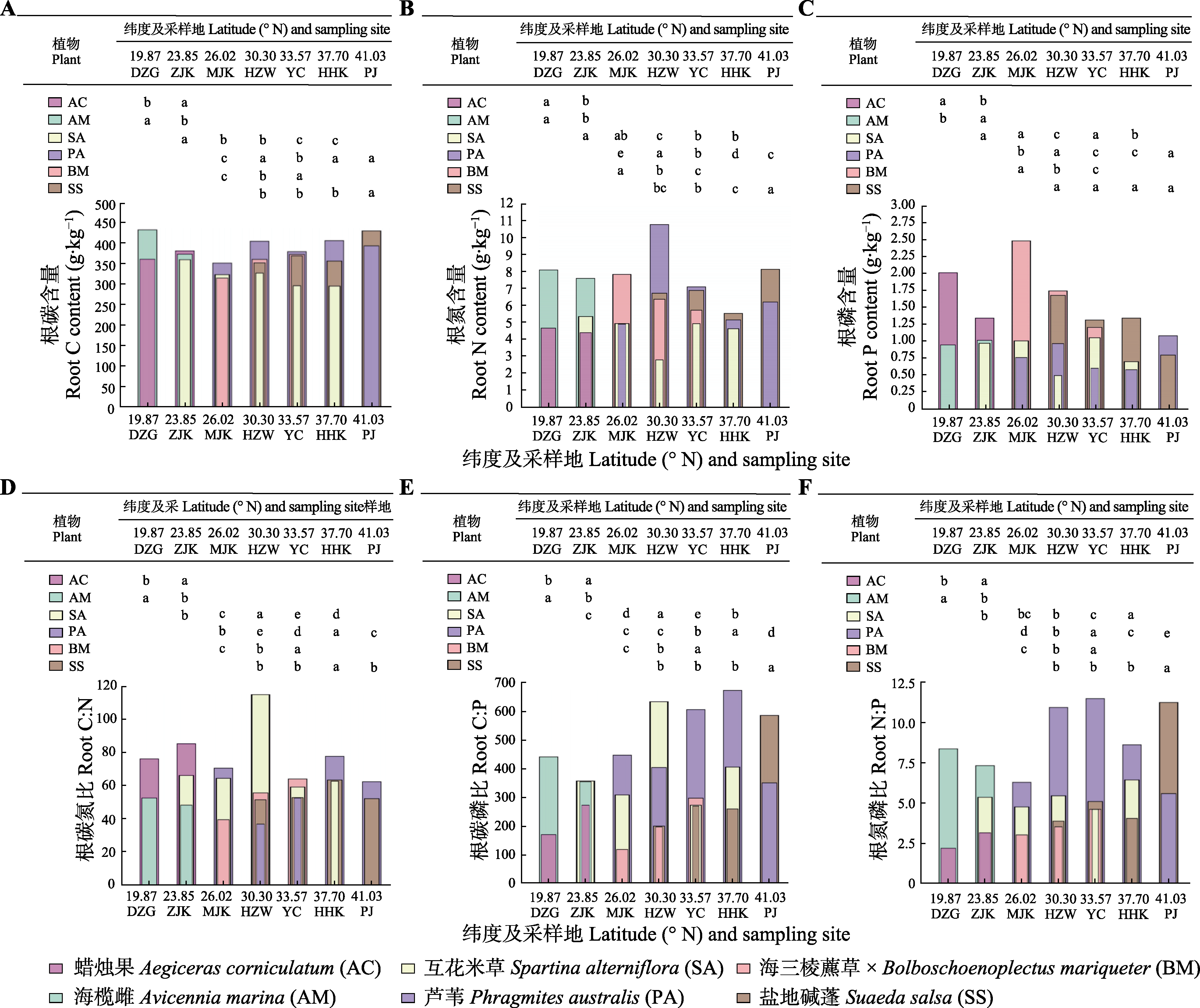
图1 不同植物根系碳(C)、氮(N)、磷(P)化学计量特征随纬度的变化。不同小写字母表示同种植物在不同纬度地区C、N、P化学计量特征的差异显著(p < 0.05)。DZG, 东寨港; HHK, 黄河口; HZW, 杭州湾; MJK, 闽江口; PJ, 辽河口; YC, 江苏盐城; ZJK, 漳江口。
Fig. 1 Latitudinal variation characteristics in root carbon (C), nitrogen (N), and phosphorus (P) stoichiometry among different plants. Different lowercase letters indicate significant differences (p < 0.05) in the C, N, and P stoichiometric characteristics of the same plant at different latitudes. DZG, Dongzhai Harbor; HHK, Huang He (Yellow River) Estuary; HZW, Hangzhou Bay; MJK, Minjiang Estuary; PJ, Liaohe Estuary; YC, Yancheng Estuary; ZJK, Zhangjiang Estuary.
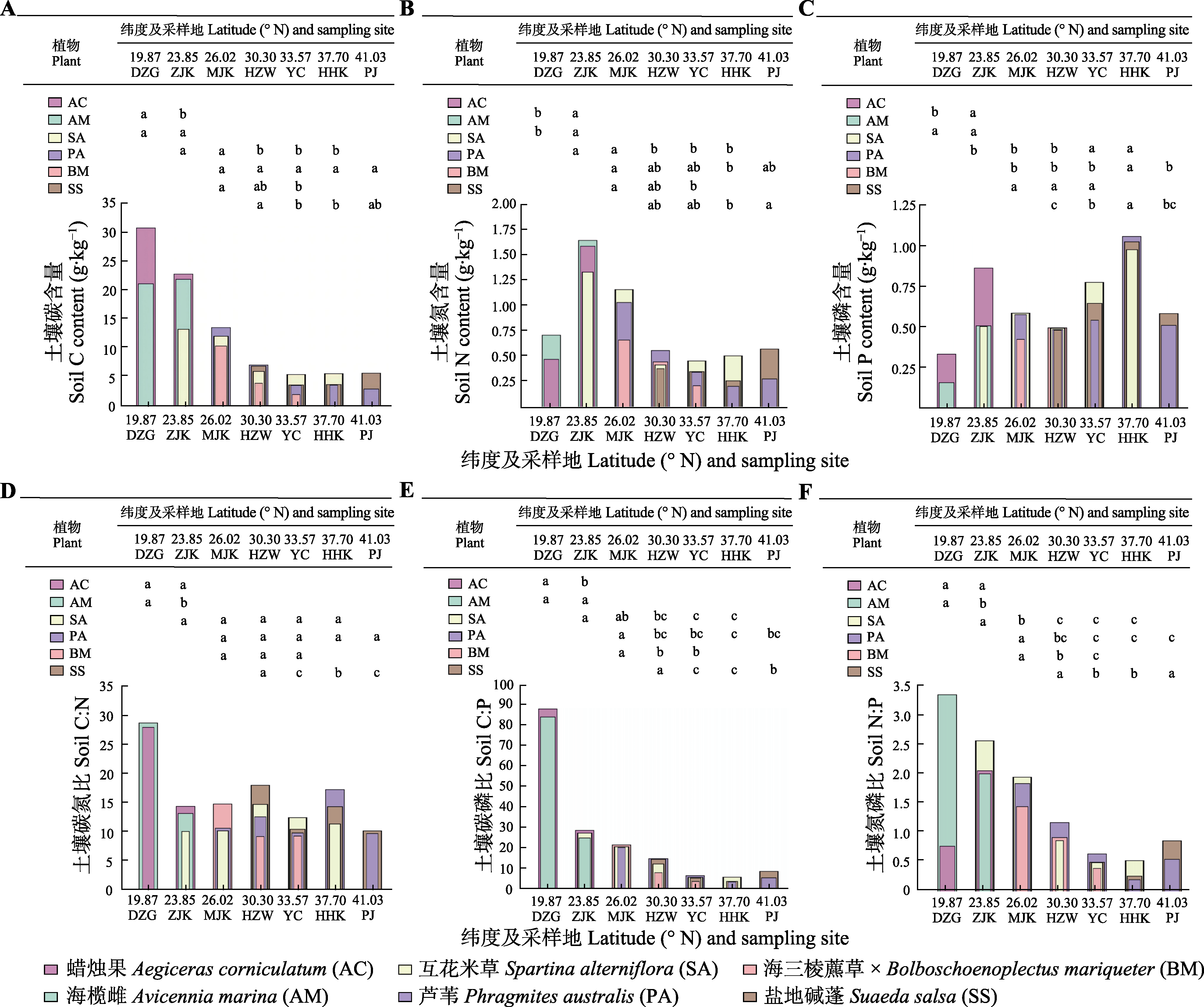
图2 不同植物下土壤碳(C)、氮(N)、磷(P)化学计量随纬度的变化特征。不同小写字母表示同种植物下的土壤在不同纬度地区C、N、P化学计量特征的显著差异(p < 0.05)。DZG, 东寨港; HHK, 黄河口; HZW, 杭州湾; MJK, 闽江口; PJ, 辽河口; YC, 江苏盐城; ZJK, 漳江口。
Fig. 2 Latitudinal variation characteristics in soil carbon (C), nitrogen (N), and phosphorus (P) stoichiometry among different plants. Different lowercase letters indicate significant differences (p < 0.05) in the C, N, and P stoichiometric characteristics of soil of the same plant species at different latitudes. DZG, Dongzhai Harbor; HHK, Huang He (Yellow River) Estuary; HZW, Hangzhou Bay; MJK, Minjiang Estuary; PJ, Liaohe Estuary; YC, Yancheng Estuary; ZJK, Zhangjiang Estuary.
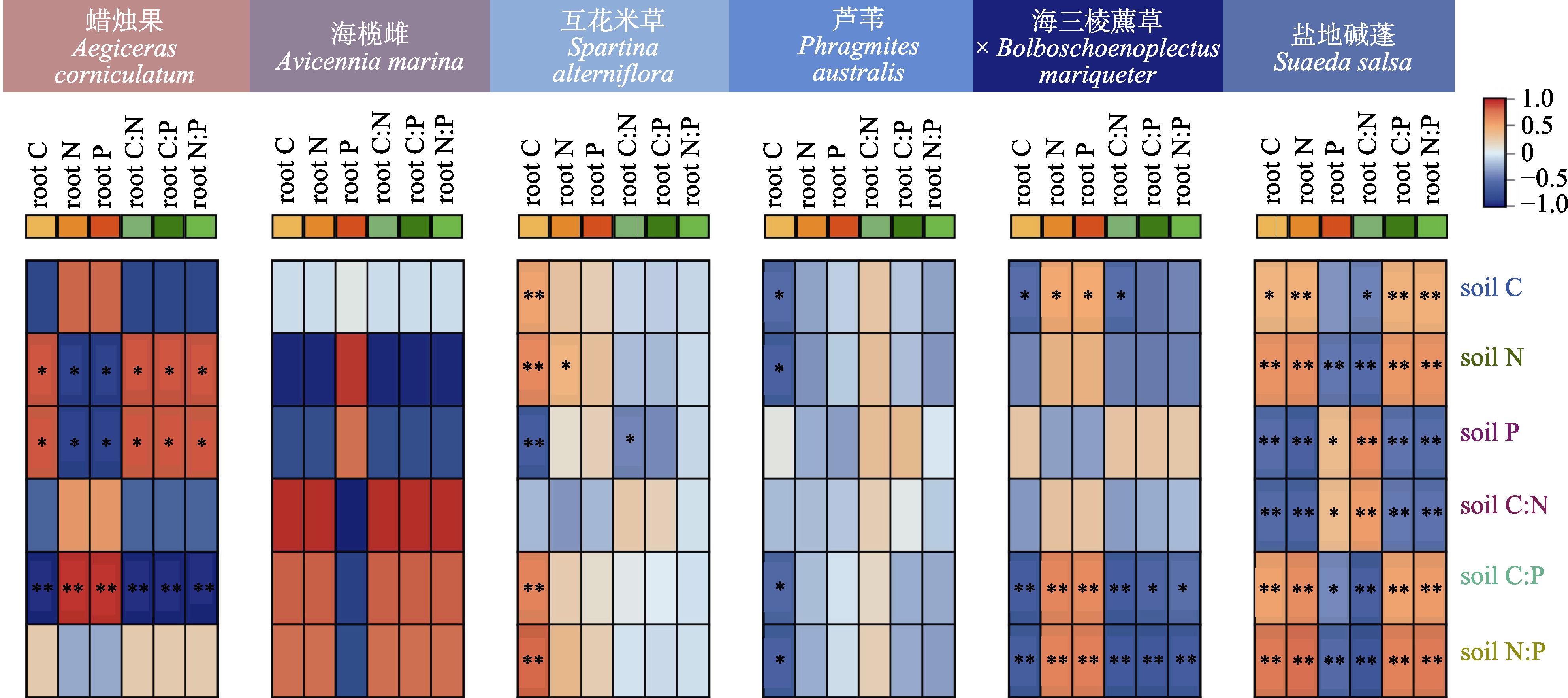
图3 植物根系与土壤间生态化学计量特征的相关性热图。C, 碳含量; N, 氮含量; P, 磷含量。root, 根系; soil, 土壤。*, p < 0.05; **, p < 0.01。
Fig. 3 Heatmap of correlations between ecological stoichiometry characteristics of plant roots and soil. C, carbon content; N, nitrogen content; P, phosphorus content. *, p < 0.05; **, p < 0.01.
| 植物种类 Species | 变量x Variable x | 变量y Variable y | R2 (p) | 内稳性指数 Homeostasis index (1/H) | 内稳性等级 Homeostasis grade |
|---|---|---|---|---|---|
| 蜡烛果 Aegiceras corniculatum | Csoil | Croot | 0.647 1 (0.054) | 0.118 4 | 绝对稳态 Strictly homeostatic |
| Nsoil | Nroot | 0.767 3 (0.029) | -0.020 1 | 稳态 Homeostatic | |
| Psoil | Proot | 0.699 2 (0.038) | -0.359 2 | 弱稳态 Weakly homeostatic | |
| C:Nsoil | C:Nroot | 0.318 2 (0.244) | -0.037 4 | 绝对稳态 Strictly homeostatic | |
| C:Psoil | C:Proot | 0.882 2 (0.005) | -0.345 1 | 弱稳态 Weakly homeostatic | |
| N:Psoil | N:Proot | 0.062 5 (0.633) | 0.084 1 | 绝对稳态 Strictly homeostatic | |
| 海榄雌 Avicennia marina | Csoil | Croot | 0.003 2 (0.943) | -0.026 7 | 绝对稳态 Strictly homeostatic |
| Nsoil | Nroot | 0.840 1 (0.083) | -0.058 5 | 绝对稳态 Strictly homeostatic | |
| Psoil | Proot | 0.573 0 (0.243) | 0.031 6 | 绝对稳态 Strictly homeostatic | |
| C:Nsoil | C:Nroot | 0.890 2 (0.056) | 0.098 1 | 绝对稳态 Strictly homeostatic | |
| C:Psoil | C:Proot | 0.680 5 (0.175) | 0.106 6 | 绝对稳态 Strictly homeostatic | |
| N:Psoil | N:Proot | 0.592 3 (0.230) | 0.085 5 | 绝对稳态 Strictly homeostatic | |
| 互花米草 Spartina alterniflora | Csoil | Croot | 0.287 6 (0.004) | 0.057 7 | 稳态 Homeostatic |
| Nsoil | Nroot | 0.190 9 (0.023) | 0.117 2 | 稳态 Homeostatic | |
| Psoil | Proot | 0.043 4 (0.297) | 0.098 5 | 绝对稳态 Strictly homeostatic | |
| C:Nsoil | C:Nroot | 0.065 5 (0.198) | 0.081 6 | 绝对稳态 Strictly homeostatic | |
| C:Psoil | C:Proot | 0.000 1 (0.958) | 0.059 0 | 绝对稳态 Strictly homeostatic | |
| N:Psoil | N:Proot | 0.002 2 (0.817) | 0.041 1 | 绝对稳态 Strictly homeostatic | |
| 芦苇 Phragmites australis | Csoil | Croot | 0.287 7 (0.039) | -0.018 3 | 稳态 Homeostatic |
| Nsoil | Nroot | 0.113 3 (0.220) | -0.009 4 | 绝对稳态 Strictly homeostatic | |
| Psoil | Proot | 0.087 8 (0.283) | -0.072 4 | 绝对稳态 Strictly homeostatic | |
| C:Nsoil | C:Nroot | 0.049 8 (0.424) | 0.051 6 | 绝对稳态 Strictly homeostatic | |
| C:Psoil | C:Proot | 0.056 3 (0.395) | -0.062 6 | 绝对稳态 Strictly homeostatic | |
| N:Psoil | N:Proot | 0.087 7 (0.284) | -0.041 2 | 绝对稳态 Strictly homeostatic | |
| 海三棱藨草 × Bolboschoenoplectus mariqueter | Csoil | Croot | 0.272 9 (0.031) | -0.010 5 | 稳态 Homeostatic |
| Nsoil | Nroot | 0.168 6 (0.102) | 0.039 5 | 绝对稳态 Strictly homeostatic | |
| Psoil | Proot | 0.084 0 (0.259) | -0.219 8 | 绝对稳态 Strictly homeostatic | |
| C:Nsoil | C:Nroot | 0.090 6 (0.240) | -0.021 8 | 绝对稳态 Strictly homeostatic | |
| C:Psoil | C:Proot | 0.358 0 (0.011) | -0.060 1 | 稳态 Homeostatic | |
| N:Psoil | N:Proot | 0.454 1 (0.003) | -0.188 2 | 稳态 Homeostatic | |
| 盐地碱蓬 Suaeda salsa | Csoil | Croot | 0.118 2 (0.012) | 0.063 1 | 稳态 Homeostatic |
| Nsoil | Nroot | 0.411 4 (0.000) | 0.204 0 | 稳态 Homeostatic | |
| Psoil | Proot | 0.141 2 (0.031) | 0.480 6 | 弱稳态 Weakly homeostatic | |
| C:Nsoil | C:Nroot | 0.320 1 (0.001) | 0.234 3 | 稳态 Homeostatic | |
| C:Psoil | C:Proot | 0.285 8 (0.001) | 0.469 1 | 弱稳态 Weakly homeostatic | |
| N:Psoil | N:Proot | 0.535 5 (0.000) | 0.609 1 | 弱敏感态 Weakly plastic |
表3 不同植物根系的生态化学计量内稳性指数分析
Table 3 Analysis of the ecological stoichiometry homeostasis index of different plant roots
| 植物种类 Species | 变量x Variable x | 变量y Variable y | R2 (p) | 内稳性指数 Homeostasis index (1/H) | 内稳性等级 Homeostasis grade |
|---|---|---|---|---|---|
| 蜡烛果 Aegiceras corniculatum | Csoil | Croot | 0.647 1 (0.054) | 0.118 4 | 绝对稳态 Strictly homeostatic |
| Nsoil | Nroot | 0.767 3 (0.029) | -0.020 1 | 稳态 Homeostatic | |
| Psoil | Proot | 0.699 2 (0.038) | -0.359 2 | 弱稳态 Weakly homeostatic | |
| C:Nsoil | C:Nroot | 0.318 2 (0.244) | -0.037 4 | 绝对稳态 Strictly homeostatic | |
| C:Psoil | C:Proot | 0.882 2 (0.005) | -0.345 1 | 弱稳态 Weakly homeostatic | |
| N:Psoil | N:Proot | 0.062 5 (0.633) | 0.084 1 | 绝对稳态 Strictly homeostatic | |
| 海榄雌 Avicennia marina | Csoil | Croot | 0.003 2 (0.943) | -0.026 7 | 绝对稳态 Strictly homeostatic |
| Nsoil | Nroot | 0.840 1 (0.083) | -0.058 5 | 绝对稳态 Strictly homeostatic | |
| Psoil | Proot | 0.573 0 (0.243) | 0.031 6 | 绝对稳态 Strictly homeostatic | |
| C:Nsoil | C:Nroot | 0.890 2 (0.056) | 0.098 1 | 绝对稳态 Strictly homeostatic | |
| C:Psoil | C:Proot | 0.680 5 (0.175) | 0.106 6 | 绝对稳态 Strictly homeostatic | |
| N:Psoil | N:Proot | 0.592 3 (0.230) | 0.085 5 | 绝对稳态 Strictly homeostatic | |
| 互花米草 Spartina alterniflora | Csoil | Croot | 0.287 6 (0.004) | 0.057 7 | 稳态 Homeostatic |
| Nsoil | Nroot | 0.190 9 (0.023) | 0.117 2 | 稳态 Homeostatic | |
| Psoil | Proot | 0.043 4 (0.297) | 0.098 5 | 绝对稳态 Strictly homeostatic | |
| C:Nsoil | C:Nroot | 0.065 5 (0.198) | 0.081 6 | 绝对稳态 Strictly homeostatic | |
| C:Psoil | C:Proot | 0.000 1 (0.958) | 0.059 0 | 绝对稳态 Strictly homeostatic | |
| N:Psoil | N:Proot | 0.002 2 (0.817) | 0.041 1 | 绝对稳态 Strictly homeostatic | |
| 芦苇 Phragmites australis | Csoil | Croot | 0.287 7 (0.039) | -0.018 3 | 稳态 Homeostatic |
| Nsoil | Nroot | 0.113 3 (0.220) | -0.009 4 | 绝对稳态 Strictly homeostatic | |
| Psoil | Proot | 0.087 8 (0.283) | -0.072 4 | 绝对稳态 Strictly homeostatic | |
| C:Nsoil | C:Nroot | 0.049 8 (0.424) | 0.051 6 | 绝对稳态 Strictly homeostatic | |
| C:Psoil | C:Proot | 0.056 3 (0.395) | -0.062 6 | 绝对稳态 Strictly homeostatic | |
| N:Psoil | N:Proot | 0.087 7 (0.284) | -0.041 2 | 绝对稳态 Strictly homeostatic | |
| 海三棱藨草 × Bolboschoenoplectus mariqueter | Csoil | Croot | 0.272 9 (0.031) | -0.010 5 | 稳态 Homeostatic |
| Nsoil | Nroot | 0.168 6 (0.102) | 0.039 5 | 绝对稳态 Strictly homeostatic | |
| Psoil | Proot | 0.084 0 (0.259) | -0.219 8 | 绝对稳态 Strictly homeostatic | |
| C:Nsoil | C:Nroot | 0.090 6 (0.240) | -0.021 8 | 绝对稳态 Strictly homeostatic | |
| C:Psoil | C:Proot | 0.358 0 (0.011) | -0.060 1 | 稳态 Homeostatic | |
| N:Psoil | N:Proot | 0.454 1 (0.003) | -0.188 2 | 稳态 Homeostatic | |
| 盐地碱蓬 Suaeda salsa | Csoil | Croot | 0.118 2 (0.012) | 0.063 1 | 稳态 Homeostatic |
| Nsoil | Nroot | 0.411 4 (0.000) | 0.204 0 | 稳态 Homeostatic | |
| Psoil | Proot | 0.141 2 (0.031) | 0.480 6 | 弱稳态 Weakly homeostatic | |
| C:Nsoil | C:Nroot | 0.320 1 (0.001) | 0.234 3 | 稳态 Homeostatic | |
| C:Psoil | C:Proot | 0.285 8 (0.001) | 0.469 1 | 弱稳态 Weakly homeostatic | |
| N:Psoil | N:Proot | 0.535 5 (0.000) | 0.609 1 | 弱敏感态 Weakly plastic |
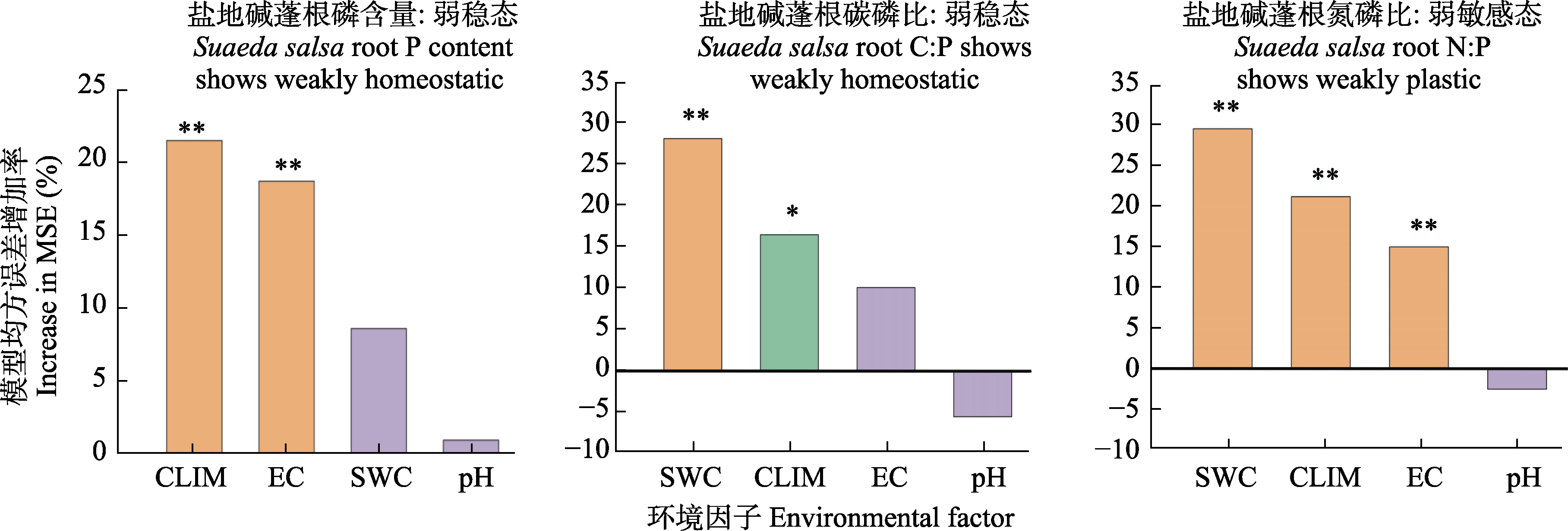
图4 随机森林模型分析影响碱蓬根系化学计量内稳性的环境因子重要性。CLIM, 气候要素; EC, 土壤盐度; pH, 土壤酸碱度; SWC, 土壤含水率。*, p < 0.05; **, p < 0.01。
Fig. 4 Random forest analysis of the importance of environmental factors influencing stoichiometric homeostasis in the roots of Suaeda salsa. C, carbon; N, nitrogen; P, phosphorus. CLIM, climatic variable; EC, soil electrical conductivity; pH, soil pH; SWC, soil water content. *, p < 0.05; **, p < 0.01.
| [1] |
Arif Y, Singh P, Siddiqui H, Bajguz A, Hayat S (2020). Salinity induced physiological and biochemical changes in plants: an omic approach towards salt stress tolerance. Plant Physiology and Biochemistry, 156, 64-77.
DOI PMID |
| [2] |
Camenzind T, Philipp Grenz K, Lehmann J, Rillig MC (2021). Soil fungal mycelia have unexpectedly flexible stoichiometric C:N and C:P ratios. Ecology Letters, 24, 208-218.
DOI PMID |
| [3] | Dibar DT, Zhang K, Yuan SQ, Zhang JY, Zhou ZZ, Ye XX (2020). Ecological stoichiometric characteristics of Carbon (C), Nitrogen (N) and Phosphorus (P) in leaf, root, stem, and soil in four wetland plants communities in Shengjin Lake, China. PLoS ONE, 15, e0230089. DOI: 10.1371/journal.pone.0230089. |
| [4] |
Freschet GT, Violle C, Bourget MY, Scherer-Lorenzen M, Fort F (2018). Allocation, morphology, physiology, architecture: the multiple facets of plant above- and below-ground responses to resource stress. New Phytologist, 219, 1338-1352.
DOI PMID |
| [5] |
Gargallo-Garriga A, Sardans J, Pérez-Trujillo M, Oravec M, Urban O, Jentsch A, Kreyling J, Beierkuhnlein C, Parella T, Peñuelas J (2015). Warming differentially influences the effects of drought on stoichiometry and metabolomics in shoots and roots. New Phytologist, 207, 591-603.
DOI PMID |
| [6] |
Guo X, Jiang YF (2019). Spatial characteristics of ecological stoichiometry and their driving factors in farmland soils in Poyang Lake Plain, Southeast China. Journal of Soils and Sediments, 19, 263-274.
DOI |
| [7] |
Guo ZJ, Wei MY, Zhong YH, Wu X, Chi BJ, Li J, Li H, Zhang LD, Wang XX, Zhu XY, Zheng HL (2023). Leaf sodium homeostasis controlled by salt gland is associated with salt tolerance in mangrove plant Avicennia marina. Tree Physiology, 43, 817-831.
DOI URL |
| [8] | Hu C, Li F, Xie YH, Deng ZM, Chen XS (2018). Soil carbon, nitrogen, and phosphorus stoichiometry of three dominant plant communities distributed along a small-scale elevation gradient in the East Dongting Lake. Physics and Chemistry of the Earth, 103, 28-34. |
| [9] | Jia T, Chen MY, Zhang L, Yi M, Guo SM, Cheng ZS, Li X, Zhong QW (2023). Ecological stoichiometry and homeostasis index of needles, branches, roots and soil in Pinus elliottii plantations of different ages. Journal of Nuclear Agricultural Sciences, 37, 397-404. |
|
[贾婷, 谌梦云, 张露, 易敏, 郭圣茂, 程子珊, 李响, 钟秋蔚 (2023). 不同林龄湿地松叶、枝、根与土壤的生态化学计量及稳态性特征. 核农学报, 37, 397-404.]
DOI |
|
| [10] |
Jiang LL, Zeng CS, Shao JJ, Zhou XH (2017). Plant nutrient dynamics and stoichiometric homeostasis of invasive species Spartina alterniflora and native Cyperus malaccensis var. brevifolius in the Minjiang River estuarine wetlands. Chinese Journal of Plant Ecology, 41, 450-460.
DOI URL |
|
[蒋利玲, 曾从盛, 邵钧炯, 周旭辉 (2017). 闽江河口入侵种互花米草和本地种短叶茳芏的养分动态及植物化学计量内稳性特征. 植物生态学报, 41, 450-460.]
DOI |
|
| [11] | Jiang WT, Gong L, Yang LH, He SP, Liu XH (2021). Dynamics in C, N, and P stoichiometry and microbial biomass following soil depth and vegetation types in low mountain and hill region of China. Scientific Reports, 11, 19631. DOI: 10.1038/s41598-021-99075-5. |
| [12] | Jisha KC, Puthur JT (2021). Ecological importance of wetland systems//Sharma S, Singh P. Wetlands Conservation: Current Challenges and Future Strategies. Wiley-Blackwell, Hoboken, USA. |
| [13] |
Julian P, Gerber S, Bhomia RK, King J, Osborne TZ, Wright AL (2020). Understanding stoichiometric mechanisms of nutrient retention in wetland macrophytes: stoichiometric homeostasis along a nutrient gradient in a subtropical wetland. Oecologia, 193, 969-980.
DOI PMID |
| [14] | Koerselman W, Meuleman AFM (1996). The vegetation N:P ratio: a new tool to detect the nature of nutrient limitation. The Journal of Applied Ecology, 33, 1441. DOI: 10.2307/2404783. |
| [15] |
Li F, Hu JY, Xie YH, Yang GS, Hu C, Chen XS, Deng ZM (2018). Foliar stoichiometry of carbon, nitrogen, and phosphorus in wetland sedge Carex brevicuspis along a small-scale elevation gradient. Ecological Indicators, 92, 322-329.
DOI URL |
| [16] |
Li J, Cui LJ, Delgado-Baquerizo M, Wang JT, Wang SK, Wang RM, Zhu YN, Li W, Singh BK (2024a). Plant species and associated root nutritional traits influence soil dominant bacteria in coastal wetlands across China. New Phytologist, 244, 683-693.
DOI URL |
| [17] | Li J, Cui LJ, Delgado-Baquerizo M, Wang JT, Zhu YN, Wang RM, Li W, Lei YR, Zhai XJ, Zhao XS, Singh BK (2022). Fungi drive soil multifunctionality in the coastal salt marsh ecosystem. Science of the Total Environment, 818, 151673. DOI: 10.1016/j.scitotenv.2021.151673. |
| [18] | Li J, Song LY, Guo ZJ, Xu CQ, Zhang LD, Wang JC, Tang HC, Dai MJ, Zhu XY, Zheng HL (2025). Salinity affects C/N ratio through differential responses of carbon and nitrogen metabolism in mangrove Avicennia marina leaves revealed by combined analysis of transcriptome and metabolome. Plant and Soil, 507, 783-806. |
| [19] | Li Q, Michalet R, Guo X, Xie HC, He MZ (2021). Variation in biomass and nutrients allocation of Corydalis hendersonii on the Tibetan Plateau with increasing rainfall continentality and altitude. Ecological Indicators, 132, 108244. DOI: 10.1016/j.ecolind.2021.108244. |
| [20] |
Li XS, Shi JL, Chen J, Tian XH (2024b). Crop straws with contrasting C/N ratios affect the organic carbon turnover and its net sequestration efficiency when solely or jointly incorporated to a fertilized soil. Journal of Soil Science and Plant Nutrition, 24, 2520-2533.
DOI |
| [21] | Liu FD, Liu YH, Wang GM, Song Y, Liu Q, Li DS, Mao PL, Zhang H (2015). Seasonal variations of C:N:P stoichiometry and their trade-offs in different organs of Suaeda salsa in coastal wetland of Yellow River Delta, China. PLoS ONE, 10, e0138169. DOI: 10.1371/journal.pone.0138169. |
| [22] | Liu L, Ji CB, Zhang M, Wang P, Zhang YW (2022). Phytogeography distribution and environmental factors from different coastal wetlands in China. Journal of Northeast Forestry University, 50(10), 44-48. |
| [刘利, 季长波, 张梅, 王鹏, 张彦文 (2022). 中国不同地区滨海湿地植物区系特点及其影响因素. 东北林业大学学报, 50(10), 44-48.] | |
| [23] |
Liu R, Yang XJ, Gao RR, Jiao BH, Huang ZY, Cornelissen JHC (2025). Testing the biogeochemical niche hypothesis using leaves, stems and roots of 62 Artemisia species across China. Journal of Ecology, 113, 459-471.
DOI URL |
| [24] |
Madhavan C, Meera SP, Kumar A (2025). Anatomical adaptations of mangroves to the intertidal environment and their dynamic responses to various stresses. Biological Reviews of the Cambridge Philosophical Society, 100, 1019-1046.
DOI URL |
| [25] | Nizam A, Meera SP, Kumar A (2022). Genetic and molecular mechanisms underlying mangrove adaptations to intertidal environments. iScience, 25, 103547. DOI: 10.1016/j.isci.2021.103547. |
| [26] |
Persson J, Fink P, Goto A, Hood JM, Jonas J, Kato S (2010). To be or not to be what you eat: regulation of stoichiometric homeostasis among autotrophs and heterotrophs. Oikos, 119, 741-751.
DOI URL |
| [27] |
Poorter H, Niklas KJ, Reich PB, Oleksyn J, Poot P, Mommer L (2012). Biomass allocation to leaves, stems and roots: meta-analyses of interspecific variation and environmental control. New Phytologist, 193, 30-50.
DOI PMID |
| [28] | Qu RS, Liu GZ, Yue M, Wang GS, Peng CH, Wang KF, Gao XP (2023). Soil temperature, microbial biomass and enzyme activity are the critical factors affecting soil respiration in different soil layers in Ziwuling Mountains, China. Frontiers in Microbiology, 14, 1105723. DOI: 10.3389/fmicb.2023.1105723. |
| [29] | Raschka S (2015). Python Machine Learning. Packt Publishing Limited, Birmingham, UK. |
| [30] | Raven JA (2022). Interactions between above and below ground plant structures: mechanisms and ecosystem services. Frontiers of Agricultural Science and Engineering, 9, 197-213. |
| [31] |
Schreeg LA, Santiago LS, Wright SJ, Turner BL (2014). Stem, root, and older leaf N:P ratios are more responsive indicators of soil nutrient availability than new foliage. Ecology, 95, 2062-2068.
DOI PMID |
| [32] | Song YM, Huang AN, Chen HS (2022). The persistence and reemergence of atmospheric anomaly signals in soil temperature. Journal of Geophysical Research: Atmospheres, 127, e2022JD037218. DOI: 10.1029/2022JD037218. |
| [33] |
Srikanth S, Lum SKY, Chen Z (2016). Mangrove root: adaptations and ecological importance. Trees, 30, 451-465.
DOI URL |
| [34] | Sterner RW, Elser JJ (2002). Ecological Stoichiometry: the Biology of Elements from Molecules to the Biosphere. Princeton University Press, Princeton, USA. |
| [35] | Su BQ, Shangguan ZP (2021). Response of water use efficiency and plant-soil C:N:P stoichiometry to stand quality in Robinia pseudoacacia on the Loess Plateau of China. Catena, 206, 105571. DOI: 10.1016/j.catena.2021.105571. |
| [36] | Sun DB, Zhou D, Guan B, Li YZ, Yu JB, Qu FZ, Yang JS, Wang XH, Li X (2024). Root disturbance effects of four halophytes on soil physiochemical characteristics in intertidal ecotone of the Yellow River Estuary. Wetlands, 44, 77. DOI: 10.1007/s13157-024-01827-2. |
| [37] |
Tian D, Yan ZB, Fang JY (2021). Review on characteristics and main hypotheses of plant ecological stoichiometry. Chinese Journal of Plant Ecology, 45, 682-713.
DOI |
|
[田地, 严正兵, 方精云 (2021). 植物生态化学计量特征及其主要假说. 植物生态学报, 45, 682-713.]
DOI |
|
| [38] |
Tian H, Chen G, Zhang C, Melillo JM, Hall CAS (2010). Pattern and variation of C:N:P ratios in China’s soils: a synthesis of observational data. Biogeochemistry, 98, 139-151.
DOI URL |
| [39] | Wang FF, Xiao K, Santos IR, Lu ZY, Tamborski J, Wang Y, Yan RF, Chen NW (2022a). Porewater exchange drives nutrient cycling and export in a mangrove-salt marsh ecotone. Journal of Hydrology, 606, 127401. DOI: 10.1016/j.jhydrol.2021.127401. |
| [40] |
Wang JS, Defrenne C, McCormack ML, Yang L, Tian DS, Luo YQ, Hou EQ, Yan T, Li ZL, Bu WS, Chen Y, Niu SL (2021). Fine-root functional trait responses to experimental warming: a global meta-analysis. New Phytologist, 230, 1856-1867.
DOI PMID |
| [41] |
Wang JY, Wang JN, Guo WH, Li YG, Wang GG, Wu TG (2018). Stoichiometric homeostasis, physiology, and growth responses of three tree species to nitrogen and phosphorus addition. Trees, 32, 1377-1386.
DOI |
| [42] |
Wang P, Mou P, Hu LY, Hu SJ (2022b). Effects of nutrient heterogeneity on root foraging and plant growth at the individual and community level. Journal of Experimental Botany, 73, 7503-7515.
DOI URL |
| [43] | Wang QY, Chen YD, Lyu GH (2022). Nutrient resorption response to different water-salt interaction gradients of Suaeda salsa. Journal of Xinjiang University (Natural Science Edition in Chinese and English), 39, 476-483. |
| [王秋燕, 陈昱东, 吕光辉 (2022). 盐地碱蓬养分重吸收对不同水盐交互梯度的响应. 新疆大学学报(自然科学版) (中英文), 39, 476-483.] | |
| [44] | Wang SK, Li J, Cui LJ, Wang RM, Li W, Wang JT (2025). Latitudinal patterns and phosphorus-driven regulation of abundant and rare fungal communities in coastal wetlands. Applied Soil Ecology, 206, 105855. DOI: 10.1016/j.apsoil.2024.105855. |
| [45] | Wang SQ, Yu GR (2008). Ecological stoichiometry characteristics of ecosystem carbon, nitrogen and phosphorus elements. Acta Ecologica Sinica, 28, 3937-3947. |
| [王绍强, 于贵瑞 (2008). 生态系统碳氮磷元素的生态化学计量学特征. 生态学报, 28, 3937-3947.] | |
| [46] | Wu JR, Yun XJ, Li F, Chun L, Li MZ, Lyu SJ (2023). Response of nitrogen and phosphorus stoichiometric homeostasis in Stipa grandis populations to latitudinal gradient. Chinese Journal of Grassland, 45(3), 1-9. |
| [吴金蕊, 运向军, 李飞, 春亮, 李梦真, 吕世杰 (2023). 大针茅种群氮磷化学计量内稳性对纬度梯度的响应. 中国草地学报, 45(3), 1-9.] | |
| [47] | Xiong J, Shao XX, Li N, Yuan HJ, Liu EJ, Wu M (2024). Effects of land-use on soil C, N, and P stocks and stoichiometry in coastal wetlands dependent on soil depth and latitude. Catena, 240, 107999. DOI: 10.1016/j.catena.2024.107999. |
| [48] | Xiong J, Shao XX, Yuan HJ, Liu EJ, Wu M (2022). Carbon, nitrogen, and phosphorus stoichiometry and plant growth strategy as related to land-use in Hangzhou Bay coastal wetland, China. Frontiers in Plant Science, 13, 946949. DOI: 10.3389/fpls.2022.946949. |
| [49] | Yan ZB (2017). Effects of Nitrogen and Phosphorus Addition on the Transgenerational Growth and Stoichiometry of Arabidopsis thaliana. PhD dissertation, Peking University, Beijing. |
| [严正兵 (2017). 氮磷添加对不同世代拟南芥生长和化学计量的影响. 博士学位论文, 北京大学, 北京.] | |
| [50] | You C (2019). The Stoichiometric Relationship and Metabolic Regulation Strategy of Suaeda salsa in Different Coastal Habitats. Master dissertation, Tianjin University of Technology, Tianjin. |
| [游冲 (2019). 滨海不同生境盐地碱蓬的化学计量关系与代谢调节策略. 硕士学位论文, 天津理工大学, 天津.] | |
| [51] |
Yu MF, Tao YX, Liu WZ, Xing W, Liu GH, Wang L, Ma L (2020). C, N, and P stoichiometry and their interaction with different plant communities and soils in subtropical riparian wetlands. Environmental Science and Pollution Research, 27, 1024-1034.
DOI |
| [52] | Zhang YX, Zhu LW, Liu N (2020). C, N, and P concentrations and their stoichiometry of leaves and roots with different life forms in Hainan Province. Journal of Tropical and Subtropical Botany, 28, 131-135. |
| [张亚兴, 朱丽薇, 刘楠 (2020). 海南不同生活型植物叶片和根系C、N、P化学计量特征. 热带亚热带植物学报, 28, 131-135.] | |
| [53] | Zhang ZS, Lv XG, Xue ZS, Liu XH (2016). Is there a redfield-type C:N:P ratio in Chinese wetland soils. Acta Pedologica Sinica, 53, 1160-1169. |
| [张仲胜, 吕宪国, 薛振山, 刘晓辉 (2016). 中国湿地土壤碳氮磷生态化学计量学特征研究. 土壤学报, 53, 1160-1169.] | |
| [54] | Zhao SS, Zhang QK, Liu MY, Zhou HP, Ma CL, Wang PP (2021). Regulation of plant responses to salt stress. International Journal of Molecular Sciences, 22, 4609. DOI: 10.3390/ijms22094609. |
| [55] | Zhao YF, Wang X, Jiang SL, Xiao JJ, Li J, Zhou XH, Liu HY, Hao ZG, Wang KC (2022). Soil development mediates precipitation control on plant productivity and diversity in alpine grasslands. Geoderma, 412, 115721. DOI: 10.1016/j.geoderma.2022.115721. |
| [56] |
Zou YH, Tang XY, Cui LJ, Li HZ, Lei YR, Zhao XS, Zhai XJ, Li J, Wang JZ, Wang RM, Li W (2025). Analysis of coupled wetland soil-plant ecological stoichiometric characteristics of carbon, nitrogen, and phosphorus under different disturbance intensities. Plant and Soil, 511, 885-902.
DOI |
| [1] | 侯霄帆, 马辰涵, 孙语倩, 高钰涵, 李品. 臭氧胁迫下叶片与细根凋落物分解的生态化学计量特征差异[J]. 植物生态学报, 2026, 50(2): 268-278. |
| [2] | 皮惠之, 张秋芳, 孙浩, 曾泉鑫, 彭园珍, 元晓春, 徐建国, 陈岳民. 微生物碳氮不平衡影响罗浮栲林土壤微生物氮利用效率对氮富集的响应[J]. 植物生态学报, 2026, 50(1): 34-44. |
| [3] | 沈会涛, 俞筱押, 秦彦杰, 武爱彬. 太行山东麓核桃林生态化学计量及碳储量随林龄变化特征[J]. 植物生态学报, 2025, 49(9): 1543-15555. |
| [4] | 刘影, 李疆枫, 吴佳琪, 王艺帆, 尹清琳, 王静. 干旱下草地植物糙隐子草根系和菌根真菌对土壤碳氮的影响[J]. 植物生态学报, 2025, 49(9): 1388-1398. |
| [5] | 陈刚刚, 朱思洁, 郭亮娜, 付芳伟, 刘昱灼, 李江荣. 藏东南色季拉山高山树线乔灌地上-地下养分分配策略[J]. 植物生态学报, 2025, 49(9): 1515-1526. |
| [6] | 刘盈麟, 李春明, 王昊, 武长路, 贺强. 长江口滨海湿地水鸟对底栖微藻群落的营养级联效应[J]. 植物生态学报, 2025, 49(3): 367-378. |
| [7] | 姚博, 陈云, 曹雯婕, 龚相文, 罗永清, 郑成卓, 王旭洋, 王正文, 李玉强. 呼伦贝尔退化沙地植被-土壤碳氮磷互馈关系及微生物驱动机制[J]. 植物生态学报, 2025, 49(1): 59-73. |
| [8] | 王燕, 张全智, 王传宽, 郭万桂, 蔺佳玮. 恢复方式对东北东部森林土壤碳氮磷计量特征的影响[J]. 植物生态学报, 2024, 48(7): 943-954. |
| [9] | 张文瑾, 佘维维, 秦树高, 乔艳桂, 张宇清. 氮和水分添加对黑沙蒿群落优势植物叶片氮磷化学计量特征的影响[J]. 植物生态学报, 2024, 48(5): 590-600. |
| [10] | 韩路, 冯宇, 李沅楷, 王雨晴, 王海珍. 地下水埋深对灰胡杨叶片与土壤养分生态化学计量特征及其内稳态的影响[J]. 植物生态学报, 2024, 48(1): 92-102. |
| [11] | 李兆光, 文高, 和桂青, 徐天才, 和琼姬, 侯志江, 李燕, 薛润光. 滇西北藜麦氮磷钾生态化学计量特征的物候期动态[J]. 植物生态学报, 2023, 47(5): 724-732. |
| [12] | 刘婧, 缑倩倩, 王国华, 赵峰侠. 晋西北丘陵风沙区柠条锦鸡儿叶片与土壤生态化学计量特征[J]. 植物生态学报, 2023, 47(4): 546-558. |
| [13] | 林少颖, 曾瑜, 杨文文, 陈斌, 阮敏敏, 尹晓雷, 阳祥, 王维奇. 添加秸秆及其生物炭对茉莉植株与土壤碳氮磷生态化学计量特征的影响[J]. 植物生态学报, 2023, 47(4): 530-545. |
| [14] | 王文伟, 韩伟鹏, 刘文文. 滨海湿地入侵植物互花米草叶片功能性状对潮位的短期响应[J]. 植物生态学报, 2023, 47(2): 216-226. |
| [15] | 吴赞, 彭云峰, 杨贵彪, 李秦鲁, 刘洋, 马黎华, 杨元合, 蒋先军. 青藏高原高寒草地退化对土壤及微生物化学计量特征的影响[J]. 植物生态学报, 2022, 46(4): 461-472. |
| 阅读次数 | ||||||
|
全文 |
|
|||||
|
摘要 |
|
|||||
Copyright © 2026 版权所有 《植物生态学报》编辑部
地址: 北京香山南辛村20号, 邮编: 100093
Tel.: 010-62836134, 62836138; Fax: 010-82599431; E-mail: apes@ibcas.ac.cn, cjpe@ibcas.ac.cn
备案号: 京ICP备16067583号-19

