
植物生态学报 ›› 2026, Vol. 50 ›› Issue (4): 907-916.DOI: 10.17521/cjpe.2025.0226 cstr: 32100.14.cjpe.2025.0226
段建林1, 孟晟1, 陈仁利2, 熊林峰1, 卢春洋1, 席念勋3,*( )(
)( )
)
收稿日期:2025-06-16
接受日期:2026-01-08
出版日期:2026-04-20
发布日期:2026-06-29
通讯作者:
*席念勋(nianxunxi@hainanu.edu.cn)基金资助:
DUAN Jian-Lin1, MENG Sheng1, CHEN Ren-Li2, XIONG Lin-Feng1, LU Chun-Yang1, XI Nian-Xun3,*()()
Received:2025-06-16
Accepted:2026-01-08
Online:2026-04-20
Published:2026-06-29
Contact:
*XI Nian-Xun(nianxunxi@hainanu.edu.cn)Supported by:摘要: 随着人类活动的不断增加, 影响全球生态系统的环境因子的强度逐渐增强, 且多个因子常常在同一生态系统中同时出现, 共同影响植物的表现。然而, 随着全球变化因子数量的增加, 对菌根植物关键功能性状的变化趋势仍知之甚少。为探讨多种全球变化因子共同作用对外生菌根和丛枝菌根植物功能性状的影响, 该研究采用盆栽控制实验的方法, 选择海南尖峰岭当地常见的6种菌根植物幼苗为对象, 探究不同数量的全球变化因子对两种类型菌根植物功能性状的影响。实验设定了对照处理(0个因子)和8个因子的4个组合处理: 1个因子、2个因子、4个因子和8个因子组合的不同处理。经过一年处理后, 测量植物的光合速率、叶片和根系的性状指标, 以评估全球变化因子数目对植物功能性状的影响。结果显示, 随着全球变化因子数量的增加, 植物光合、地上和地下性状表现出线性、非线性变化或没有显著变化。两类菌根植物的比叶面积、叶片氮含量及叶片磷含量对全球变化因子数量的响应模式显著不同。但进一步分析表明, 性状响应的差异主要源于物种差异, 而非菌根类型不同。植物功能性状与全球变化因子数目的关系中, 线性关系可能反映了多因子作用的加性效应, 而非线性关系则可能由因子间的非加性相互作用(协同或拮抗)所引起。这些结果揭示了全球变化因子对植物功能性状的复杂影响, 以及不同物种对这些环境压力的独特响应, 为理解植物在全球变化背景下的性状响应规律提供了实验依据, 同时也为应对全球变化的加剧提供了有益的研究思路。
段建林, 孟晟, 陈仁利, 熊林峰, 卢春洋, 席念勋. 全球变化因子数量对菌根植物性状的影响. 植物生态学报, 2026, 50(4): 907-916. DOI: 10.17521/cjpe.2025.0226
DUAN Jian-Lin, MENG Sheng, CHEN Ren-Li, XIONG Lin-Feng, LU Chun-Yang, XI Nian-Xun. Impact of multiple global change factors on traits of mycorrhizal plants. Chinese Journal of Plant Ecology, 2026, 50(4): 907-916. DOI: 10.17521/cjpe.2025.0226
| 植物性状 Plant trait | 因子数目 GCF number | 物种 Species | 因子数目×物种 GCF number × species | |
|---|---|---|---|---|
| df | 4 | 5 | 20 | |
| 净光合速率 Net photosynthetic rate | F | 1.451 | 26.999 | 2.230 |
| p | 0.219 | <0.001 | 0.003 | |
| 蒸腾速率 Transpiration rate | F | 2.563 | 28.548 | 2.196 |
| p | 0.300 | <0.001 | 0.004 | |
| 气孔导度 Stomatal conductance | F | 2.022 | 37.362 | 2.051 |
| p | 0.357 | <0.001 | 0.007 | |
| 叶干物质含量 Leaf dry matter content | F | 0.424 | 48.665 | 1.007 |
| p | 0.788 | <0.001 | 0.452 | |
| 比叶面积 Specific leaf area | F | 0.592 | 55.726 | 2.075 |
| p | 0.672 | <0.001 | 0.004 | |
| 比根长 Specific root length | F | 0.245 | 70.909 | 1.854 |
| p | 0.909 | <0.001 | 0.014 | |
| 细根直径 Fine root diameter | F | 0.299 | 142.703 | 0.849 |
| p | 0.879 | <0.001 | 0.653 | |
| 根组织密度 Root tissue density | F | 0.241 | 17.394 | 1.862 |
| p | 0.912 | <0.001 | 0.014 | |
| 叶片氮含量 Leaf nitrogen content | F | 1.719 | 75.591 | 2.113 |
| p | 0.358 | <0.001 | 0.004 | |
| 叶片磷含量 Leaf phosphorus content | F | 6.345 | 31.508 | 7.609 |
| p | 0.002 | <0.001 | <0.001 |
表1 全球变化因子与物种对植物功能性状影响的混合效应模型结果
Table 1 Results of mixed effects models for effects of global change factor (GCF) number and species identity on plant functional traits
| 植物性状 Plant trait | 因子数目 GCF number | 物种 Species | 因子数目×物种 GCF number × species | |
|---|---|---|---|---|
| df | 4 | 5 | 20 | |
| 净光合速率 Net photosynthetic rate | F | 1.451 | 26.999 | 2.230 |
| p | 0.219 | <0.001 | 0.003 | |
| 蒸腾速率 Transpiration rate | F | 2.563 | 28.548 | 2.196 |
| p | 0.300 | <0.001 | 0.004 | |
| 气孔导度 Stomatal conductance | F | 2.022 | 37.362 | 2.051 |
| p | 0.357 | <0.001 | 0.007 | |
| 叶干物质含量 Leaf dry matter content | F | 0.424 | 48.665 | 1.007 |
| p | 0.788 | <0.001 | 0.452 | |
| 比叶面积 Specific leaf area | F | 0.592 | 55.726 | 2.075 |
| p | 0.672 | <0.001 | 0.004 | |
| 比根长 Specific root length | F | 0.245 | 70.909 | 1.854 |
| p | 0.909 | <0.001 | 0.014 | |
| 细根直径 Fine root diameter | F | 0.299 | 142.703 | 0.849 |
| p | 0.879 | <0.001 | 0.653 | |
| 根组织密度 Root tissue density | F | 0.241 | 17.394 | 1.862 |
| p | 0.912 | <0.001 | 0.014 | |
| 叶片氮含量 Leaf nitrogen content | F | 1.719 | 75.591 | 2.113 |
| p | 0.358 | <0.001 | 0.004 | |
| 叶片磷含量 Leaf phosphorus content | F | 6.345 | 31.508 | 7.609 |
| p | 0.002 | <0.001 | <0.001 |
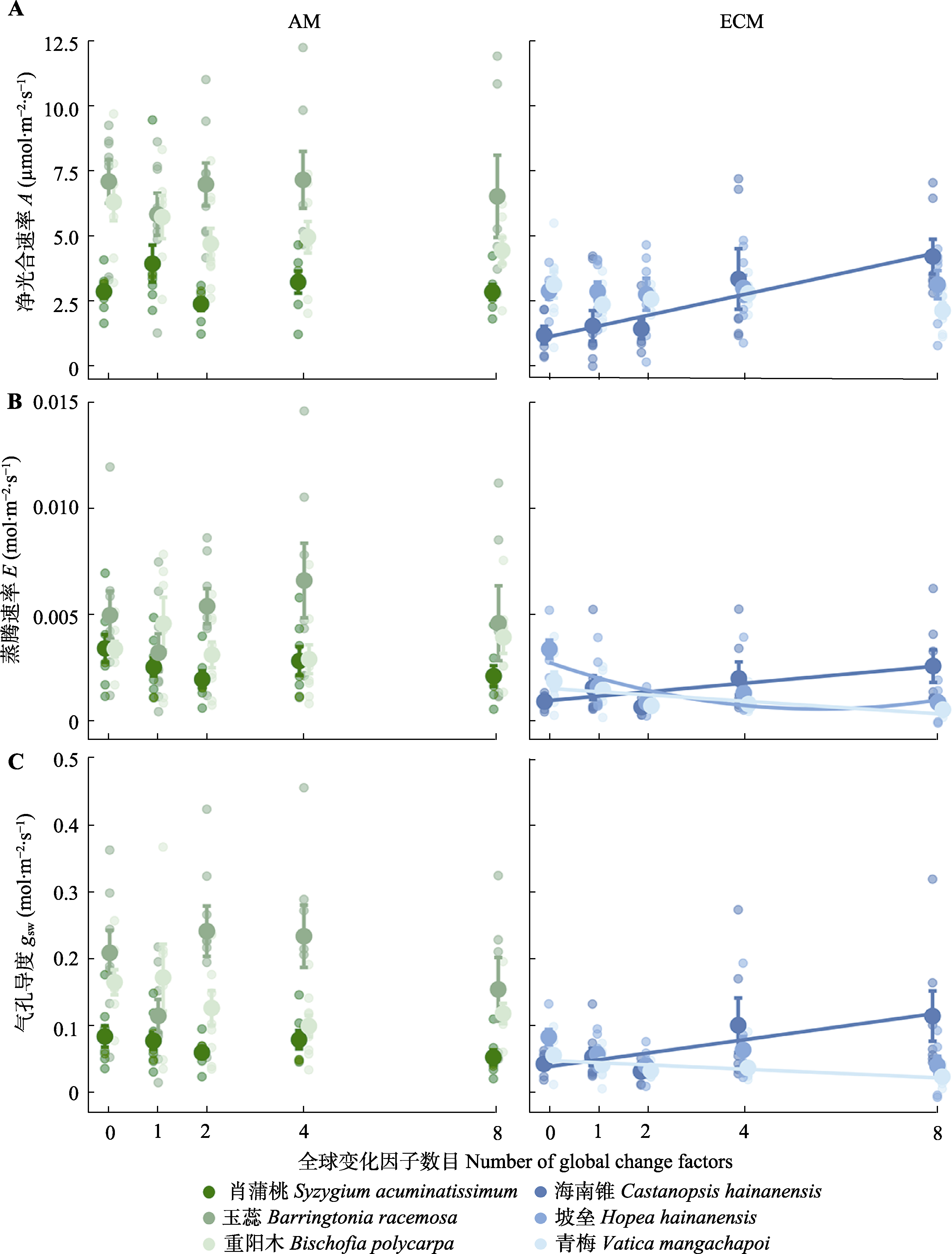
图1 海南6种丛枝菌根(AM)和外生菌根(ECM)植物光合性状与全球变化因子数目的关系(平均值±标准差)。图中实线表示关系显著(p < 0.05)。
Fig. 1 Relationships between photosynthetic traits and the number of global change factors of six arbuscular mycorrhizal (AM) and ectomycorrhizal (ECM) plant species in Hainan (mean ± SD). Solid lines indicate significant regressions (p < 0.05). A, E, and gsw indicate net photosynthetic rate, transpiration rate, and stomatal conductance, respectively.
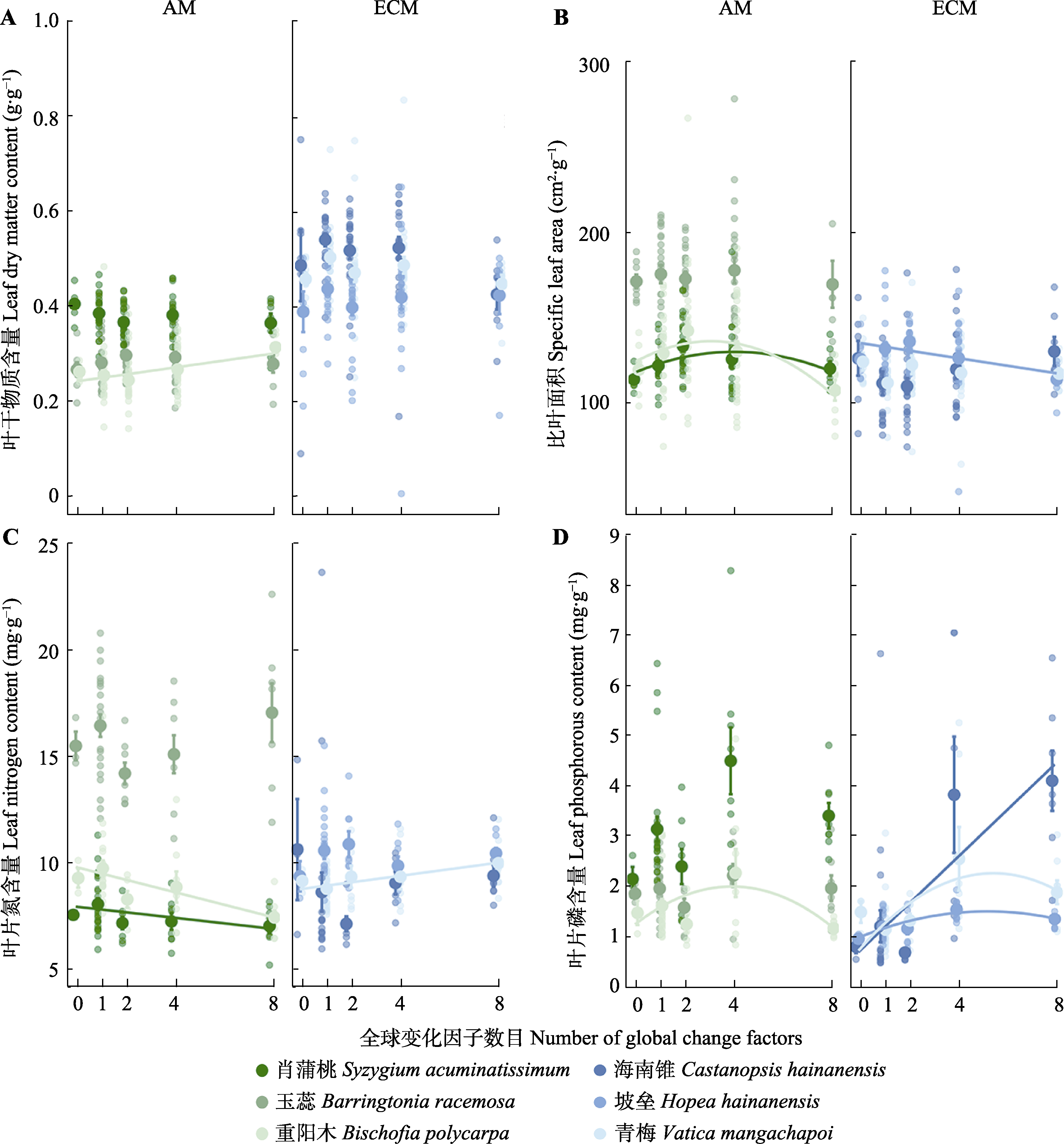
图2 海南6种丛枝菌根(AM)和外生菌根(ECM)植物地上性状与全球变化因子数目的关系(平均值±标准差)。图中实线表示关系显著(p < 0.05)。
Fig. 2 Relationships between aboveground traits and the number of global change factors of six arbuscular mycorrhizal (AM) and ectomycorrhizal (ECM) plant species in Hainan (mean ± SD). Solid lines indicate significant regressions (p < 0.05).
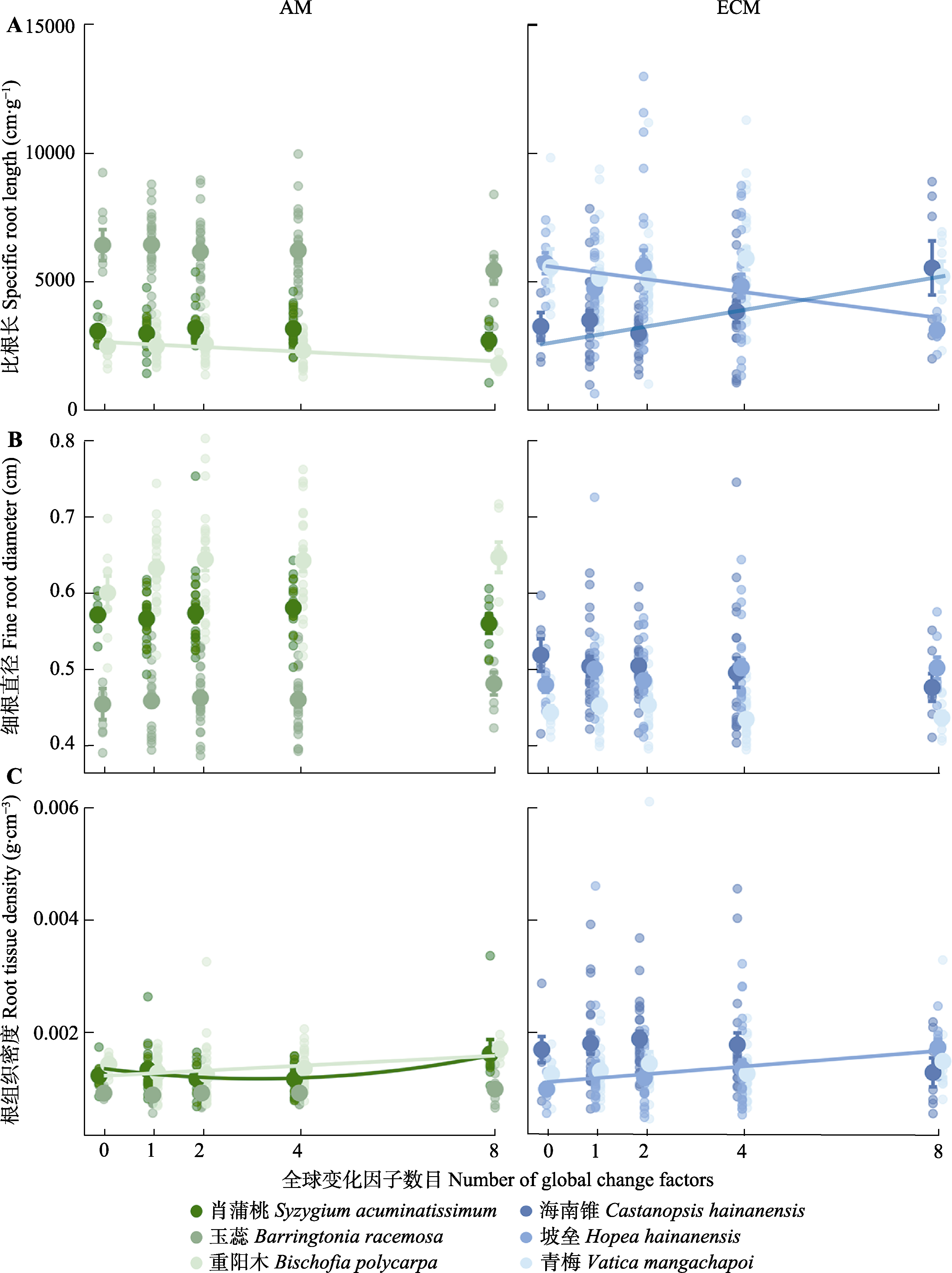
图3 海南6种丛枝菌根(AM)和外生菌根(ECM)植物地下性状与全球变化因子数目的关系(平均值±标准差)。图中实线表示关系显著(p < 0.05)。
Fig. 3 Relationships between belowground traits and the number of global change factors of six arbuscular mycorrhizal (AM) and ectomycorrhizal (ECM) plant species in Hainan (mean ± SD). Solid lines indicate significant regressions (p < 0.05).
| [1] | Bao SD (2000). Soil and Agricultural Chemistry Analysis. 3rd ed. China Agriculture Press, Beijing. |
| [鲍士旦 (2000). 土壤农化分析. 3版. 中国农业出版社, 北京.] | |
| [2] |
Brundrett MC, Tedersoo L (2018). Evolutionary history of mycorrhizal symbioses and global host plant diversity. New Phytologist, 220, 1108-1115.
DOI PMID |
| [3] | Chen BX (2020). Effects of Nitrogen and Phosphorus Addition on Growth of Rattan and Its Associated Stand in Lowland Secondary Rain Forest. PhD dissertation, Chinese Academy of Forestry, Beijing. |
| [陈本学 (2020). 氮磷添加对低地次生雨林棕榈藤及伴生林分生长的影响研究. 博士学位论文, 中国林业科学研究院, 北京.] | |
| [4] |
Crain CM, Kroeker K, Halpern BS (2008). Interactive and cumulative effects of multiple human stressors in marine systems. Ecology Letters, 11, 1304-1315.
DOI PMID |
| [5] | Cui EQ, Weng ES, Yan ER, Xia JY (2020). Robust leaf trait relationships across species under global environmental changes. Nature Communications, 11, 2999. DOI: 10.1038/s41467-020-16839-9. |
| [6] |
Du EZ, Zhou Z, Li P, Hu XY, Ma YC, Wang W, Zheng CY, Zhu JX, He JS, Fang JY (2013). NEECF: a project of nutrient enrichment experiments in China’s forests. Journal of Plant Ecology, 6, 428-435.
DOI URL |
| [7] |
Feng JG, Zhu B (2020). A review on the effects of nitrogen and phosphorus addition on tree growth and productivity in forest ecosystems. Chinese Journal of Plant Ecology, 44, 583-597.
DOI URL |
| [冯继广, 朱彪 (2020). 氮磷添加对树木生长和森林生产力影响的研究进展. 植物生态学报, 44, 583-597.] | |
| [8] |
He NP, Li Y, Liu CC, Xu L, Li MX, Zhang JH, He JS, Tang ZY, Han XG, Ye Q, Xiao CW, Yu Q, Liu SR, Sun W, Niu SL, et al. (2020). Plant Trait Networks: improved resolution of the dimensionality of adaptation. Trends in Ecology & Evolution, 35, 908-918.
DOI URL |
| [9] | Jia LQ, Chen GS, Zhang LH, Chen TT, Jiang Q, Chen YH, Fan AL, Wang X (2021) Plastic responses of fine root morphology and architecture traits to nitrogen addition in Ectomycorrhizal and arbuscular mycorrhizal tree species in an evergreen broadleaved forest. Chinese Journal of Applied Ecology, 32, 529-537. |
|
[贾林巧, 陈光水, 张礼宏, 陈廷廷, 姜琦, 陈宇辉, 范爱连, 王雪 (2021). 常绿阔叶林外生和丛枝菌根树种细根形态和构型性状对氮添加的可塑性响应. 应用生态学报, 32, 529-537.]
DOI |
|
| [10] | Liu LR, Sun K, Sun RJ, Ma QH, Wang YH, Jia BR, Zhou GS, Xu ZZ, Zhang F (2024). Effects of nitrogen deposition with phosphorus addition on desert steppe plant communities. Agriculture, Ecosystems &Environment, 366, 108954. DOI: 10.1016/J.AGEE.2024.108954. |
| [11] | Martin FM, Uroz S, Barker DG (2017). Ancestral alliances: plant mutualistic symbioses with fungi and bacteria. Science, 356, eaad4501. DOI:10.1126/science.aad4501. |
| [12] |
Medeiros JS, Tomeo NJ, Hewins CR, Rosenthal DM (2016). Fast-growing Acer rubrum differs from slow-growing Quercus alba in leaf, xylem and hydraulic trait coordination responses to simulated acid rain. Tree physiology, 36, 1032-1044.
DOI PMID |
| [13] | Meng TT, Ni J, Wang GH (2007). Plant functional traits, environments and ecosystem functioning. Journal of Plant Ecology (Chinese Version), 31, 150-165. |
|
[孟婷婷, 倪健, 王国宏 (2007). 植物功能性状与环境和生态系统功能. 植物生态学报, 31, 150-165.]
DOI |
|
| [14] |
Mohan JE, Cowden CC, Baas P, Dawadi A, Frankson PT, Helmick K, Hughes E, Khan S, Lang A, Machmuller M, Taylor M, Witt AC (2014). Mycorrhizal fungi mediation of terrestrial ecosystem responses to global change: mini-review. Fungal Ecology, 10, 3-19.
DOI URL |
| [15] |
Phillips RP, Brzostek E, Midgley MG (2013). The mycorrhizal- associated nutrient economy: a new framework for predicting carbon-nutrient couplings in temperate forests. New Phytologist, 199, 41-51.
DOI PMID |
| [16] |
Piggott JJ, Townsend CR, Matthaei CD (2015). Reconceptualizing synergism and antagonism among multiple stressors. Ecology and Evolution, 5, 1538-1547.
DOI PMID |
| [17] |
Rillig MC, Ryo M, Lehmann A, Aguilar-Trigueros CA, Buchert S, Wulf A, Iwasaki A, Roy J, Yang GW (2019). The role of multiple global change factors in driving soil functions and microbial biodiversity. Science, 366, 886-890.
DOI PMID |
| [18] |
Schäfer RB, Piggott JJ (2018). Advancing understanding and prediction in multiple stressor research through a mechanistic basis for null models. Global Change Biology, 24, 1817-1826.
DOI PMID |
| [19] | Smith SE, Read DJ (2008). Mycorrhizal Symbiosis, 3rd ed. Academic Press, London. |
| [20] | Soudzilovskaia NA, Vaessen S, Barcelo M, He JH, Rahimlou S, Abarenkov K, Brundrett MC, Gomes SIF, Merckx V, Tedersoo L (2020). FungalRoot: global online database of plant mycorrhizal associations. New Phytologist, 227, 955-966. |
| [21] | Speißer B, Wilschut RA, van Kleunen M (2022). Number of simultaneously acting global change factors affects composition, diversity and productivity of grassland plant communities. Nature Communications, 13, 7811. DOI: 10.1038/s41467-022-35473-1 |
| [22] | Tong X, Mo FM, Liu F, Tang XM, Guo B (2015). Study on heavy metal quality and assessment of rural soil of Haikou City. Journal of Hainan Normal University (Natural Science), 28, 186-189. |
| [仝霞, 莫芳敏, 刘芳, 唐小妹, 郭彬 (2015). 海口市农村土壤重金属含量状况与评价. 海南师范大学学报(自然科学版), 28, 186-189.] | |
| [23] |
Violle C, Navas ML, Vile D, Kazakou E, Fortunel C, Hummel I, Garnier E (2007). Let the concept of trait be functional! Oikos, 116, 882-892.
DOI URL |
| [24] | Wang XH, Li YY, Wang YY, Wang XW, Wang XM, Shi ZF (2019). Ecological risk assessment on heavy metals in the sediments of the river in Longhua district, Haikou. Journal of Hainan Normal University (Natural Science), 32, 349-354. |
| [王向辉, 李莹莹, 王燕莹, 王秀婉, 王香梅, 史载锋 (2019). 海口市龙华区河道底泥重金属污染生态风险评价. 海南师范大学学报(自然科学版), 32, 349-354.] | |
| [25] |
Zandalinas SI, Mittler R (2022). Plant responses to multifactorial stress combination. New Phytologist, 234, 1161-1167.
DOI URL |
| [26] |
Zandalinas SI, Sengupta S, Fritschi FB, Azad RK, Nechushtai R, Mittler R (2021). The impact of multifactorial stress combination on plant growth and survival. New Phytologist, 230, 1034-1048.
DOI PMID |
| [27] |
Zhang HX, Li WB, Adams HD, Wang AZ, Wu JB, Jin CJ, Guan DX, Yuan FH (2018). Responses of woody plant functional traits to nitrogen addition: a meta-analysis of leaf economics, gas exchange, and hydraulic traits. Frontiers in Plant Science, 9, 683. DOI:10.3389/fpls.2018.00683.
PMID |
| [28] |
Zhou XQ, Gu XY, Smaill SJ (2023). Rethinking experiments that explore multiple global change factors. Trends in Ecology & Evolution, 38, 399-401.
DOI URL |
| [1] | 陈佳乐, 赵颖菲, 昌海超, 董必成, 于飞海. 基于大语言模型的植物性状自动提取框架构建与评价体系[J]. , 2026, 50(生态统计方法专题): 0-. |
| [2] | 郑子仪, 陈江慧, 刘慧颖. 气候变暖提高青藏高原高寒草甸优势物种的根系分泌速率[J]. 植物生态学报, 2025, 49(9): 1363-1373. |
| [3] | 郭志红, 杨妮, 张涛, 李海波, 田太安, 黄小波, 李聪, 马驷驹, 苏建荣, 李帅锋. 梵净山天然林菌根植物功能多样性与群落构建沿海拔梯度的变化[J]. 植物生态学报, 2025, 49(9): 1410-1423. |
| [4] | 崔冬晴, 田晨, 宋慧敏, 鲁小名, 萨其日, 徐国庆, 杨培志, 白永飞, 田建卿. 典型草原优势植物根际细菌群落多样性和功能群组成对长期放牧的响应机制[J]. 植物生态学报, 2025, 49(7): 1163-1176. |
| [5] | 杜英杰, 范爱连, 王雪, 闫晓俊, 陈廷廷, 贾林巧, 姜琦, 陈光水. 亚热带天然常绿阔叶林乔木树种与林下灌木树种根-叶功能性状协调性及差异[J]. 植物生态学报, 2025, 49(4): 585-595. |
| [6] | 张晓婷, 王俊杰. 盐和铜处理下红树植物叶绿素荧光特性变化与叶片结构及生化组分关系[J]. 植物生态学报, 2025, 49(11): 1944-1956. |
| [7] | 童金莲, 张博纳, 汤璐瑶, 叶琳峰, 李姝雯, 谢江波, 李彦, 王忠媛. C4植物狗尾草功能性状网络沿降水梯度带的区域分异规律[J]. 植物生态学报, 2025, 49(11): 1817-1832. |
| [8] | 秦嘉晨, 王欢, 朱江, 王扬, 田晨, 白永飞, 杨培志, 郑淑霞. 基于种内与种间性状变异的放牧过滤作用及其尺度效应[J]. 植物生态学报, 2024, 48(7): 858-871. |
| [9] | 付粱晨, 丁宗巨, 唐茂, 曾辉, 朱彪. 北京东灵山白桦和蒙古栎的根际效应及其季节动态[J]. 植物生态学报, 2024, 48(4): 508-522. |
| [10] | 王思琦, 金光泽. 五角槭不同生活史阶段叶枝根性状的变异与权衡[J]. 植物生态学报, 2024, 48(11): 1510-1523. |
| [11] | 胡楚婷, 杨柳依依, 石绍林, 周琰, 陈婷婷, 郑博瀚, 杨暘, 卢小玲, 王陈玲, 倪健. 浙江金华典型人工植被的植物功能性状[J]. 植物生态学报, 2024, 48(10): 1336-1350. |
| [12] | 钟姣, 姜超, 刘世荣, 龙文兴, 孙建新. 海南长臂猿食源植物的潜在物种丰富度分布格局[J]. 植物生态学报, 2023, 47(4): 491-505. |
| [13] | 汤璐瑶, 方菁, 钱海蓉, 张博纳, 上官方京, 叶琳峰, 李姝雯, 童金莲, 谢江波. 落羽杉和池杉功能性状随高度的变异与协同[J]. 植物生态学报, 2023, 47(11): 1561-1575. |
| [14] | 张义, 程杰, 苏纪帅, 程积民. 长期封育演替下典型草原植物群落生产力与多样性关系[J]. 植物生态学报, 2022, 46(2): 176-187. |
| [15] | 罗源林, 马文红, 张芯毓, 苏闯, 史亚博, 赵利清. 内蒙古锦鸡儿属植物地理替代分布种的功能性状沿环境梯度的变化[J]. 植物生态学报, 2022, 46(11): 1364-1375. |
| 阅读次数 | ||||||
|
全文 |
|
|||||
|
摘要 |
|
|||||
Copyright © 2026 版权所有 《植物生态学报》编辑部
地址: 北京香山南辛村20号, 邮编: 100093
Tel.: 010-62836134, 62836138; Fax: 010-82599431; E-mail: apes@ibcas.ac.cn, cjpe@ibcas.ac.cn
备案号: 京ICP备16067583号-19

