
植物生态学报 ›› 2026, Vol. 50 ›› Issue (4): 959-970.DOI: 10.17521/cjpe.2025.0072 cstr: 32100.14.cjpe.2025.0072
李佳泽1,2, 贾德彬1,*( ), 郝玉胜1, 郝帅2, 尚紫琴1, 纪明宇1
收稿日期:2025-02-26
接受日期:2025-05-28
出版日期:2026-04-20
发布日期:2026-06-29
通讯作者:
*贾德彬(jdb@imau.edu)基金资助:
LI Jia-Ze1,2, JIA De-Bin1,*(), HAO Yu-Sheng1, HAO Shuai2, SHANG Zi-Qin1, JI Ming-Yu1
Received:2025-02-26
Accepted:2025-05-28
Online:2026-04-20
Published:2026-06-29
Contact:
*JIA De-Bin(jdb@imau.edu)Supported by:摘要: 为了更加深入全面地了解大兴安岭森林生态系统大气水汽浓度、水汽同位素比值以及蒸散发各组分在植物不同生长季和日尺度上的变化规律, 该研究通过水汽稳定同位素分析仪对不同高度水汽浓度及同位素比值进行了高频观测, 同时采用真空提取和液态水同位素分析仪测定植物和土壤稳定氧同位素比值(δ18O)。利用同位素稳态(ISS)和同位素非稳态(NSS)理论, 对不同时期的落叶松(Larix gmelinii)生态系统进行蒸散发组分拆分与比较。结果表明: 在落叶松生长旺盛期(7-8月)大气水汽浓度和水汽同位素富集, 而落叶松落叶期贫化; 两者在日尺度的变化上则较为复杂, 呈现高—低—高的“V”形循环。在日尺度变化上, 土壤蒸发水汽氧同位素比值的变化范围为-27.15‰- -18.31‰, 生态系统蒸散发水汽氧同位素比值的变化范围为-15.48‰- -8.05‰, 两者均呈现单峰型变化趋势。ISS下植物蒸腾水汽氧同位素比值为-10.83‰- -5.31‰, 而NSS下植物蒸腾水汽氧同位素比值为-12.21‰- -6.63‰, 其中在13:00-17:00时间段上差异最小, 蒸腾占比最为接近。总体上, 植物蒸腾量对蒸散量的贡献率在ISS下为69.48%-85.08%, NSS下为76.38%-91.05%, 这表明研究区土壤蒸发耗水远小于植被蒸腾耗水, 植被蒸腾在森林生态系统蒸散发中起主导作用。
李佳泽, 贾德彬, 郝玉胜, 郝帅, 尚紫琴, 纪明宇. 内蒙古大兴安岭地区落叶松林氧同位素比值日变化及蒸散定量区分. 植物生态学报, 2026, 50(4): 959-970. DOI: 10.17521/cjpe.2025.0072
LI Jia-Ze, JIA De-Bin, HAO Yu-Sheng, HAO Shuai, SHANG Zi-Qin, JI Ming-Yu. Diurnal variation of oxygen isotope ratio and quantitative partitioning of evapotranspiration in Larix gmelinii forest in Da Hinggan Ling of Nei Mongol, China. Chinese Journal of Plant Ecology, 2026, 50(4): 959-970. DOI: 10.17521/cjpe.2025.0072
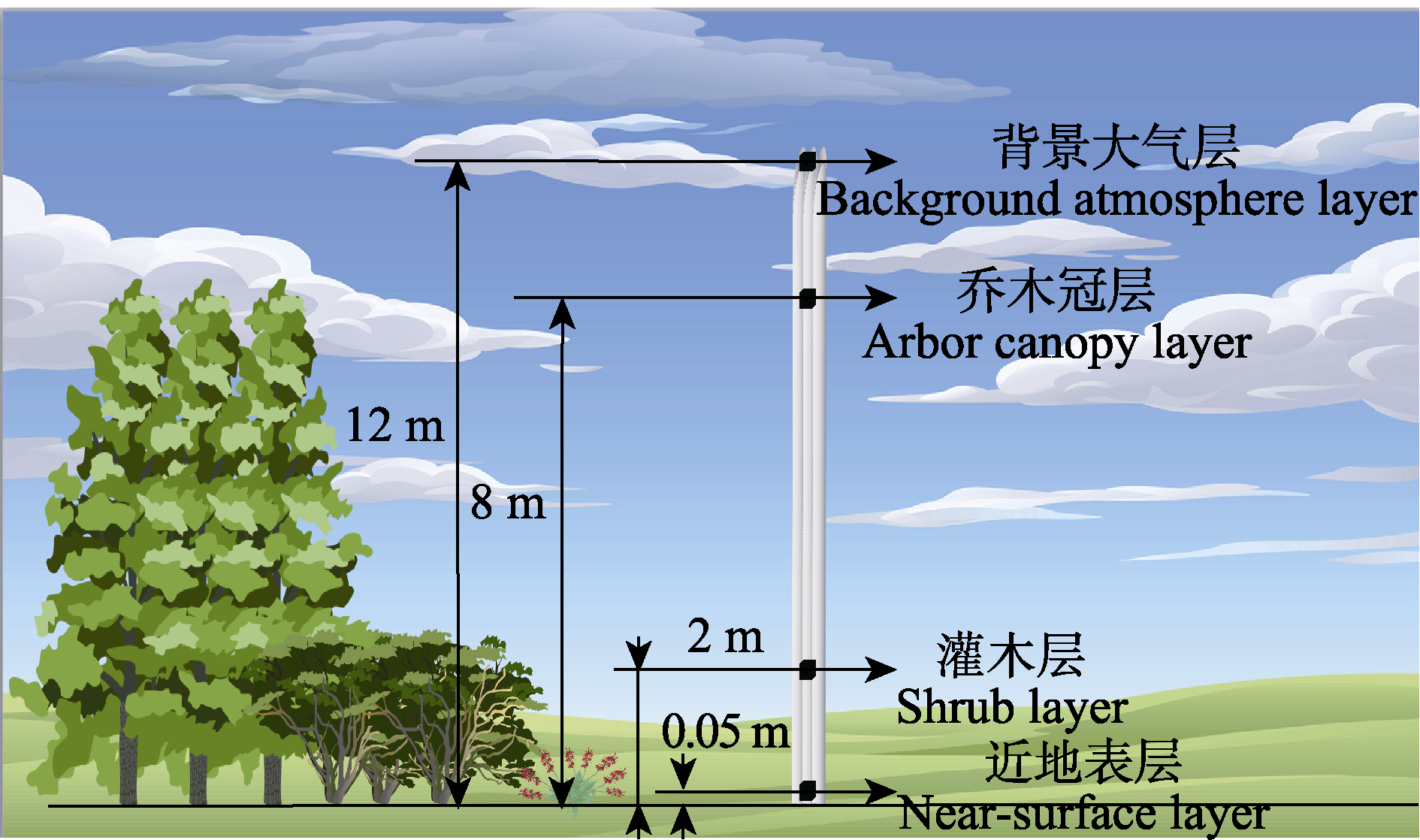
图1 实验装置及采样高度示意图。
Fig. 1 Schematic diagram of the experiment set-up and sampling heights.
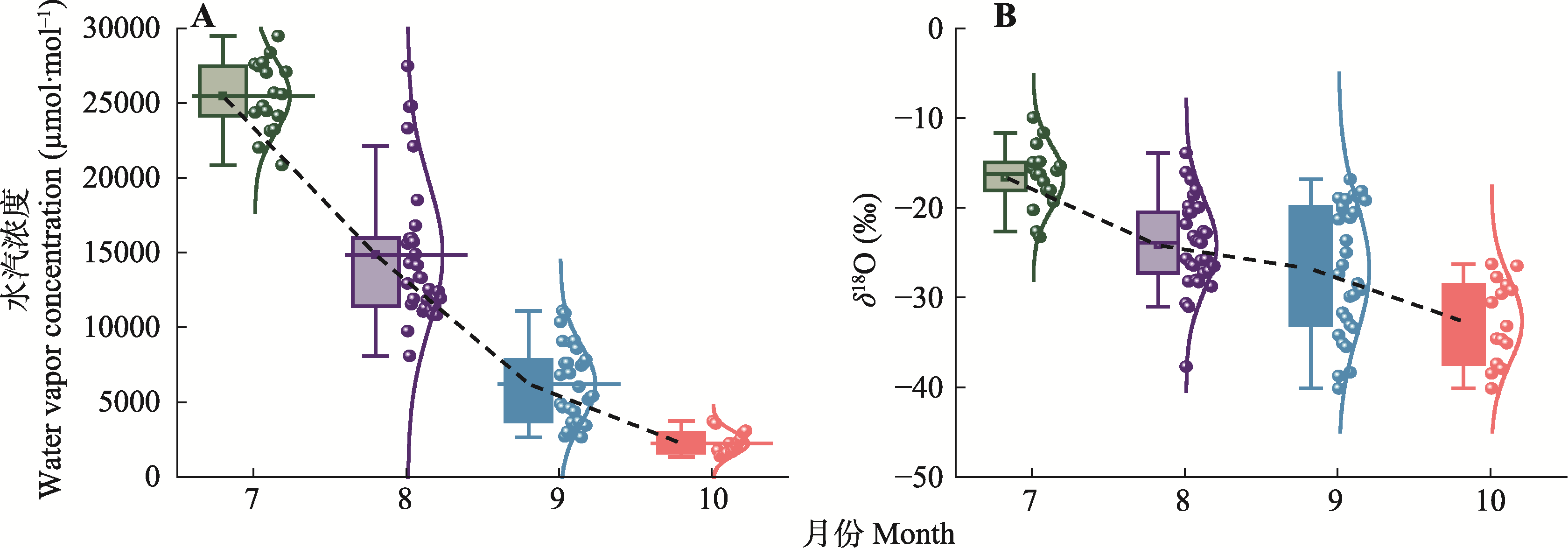
图2 内蒙古大兴安岭地区落叶松林水汽浓度及稳定氧同位素比值(δ18O)分布特征。
Fig. 2 Vapor concentration and oxygen stable isotope ratio (δ18O) distribution characteristics in the Larix gmelinii forest in the Da Hinggan Ling of Nei Mongol.
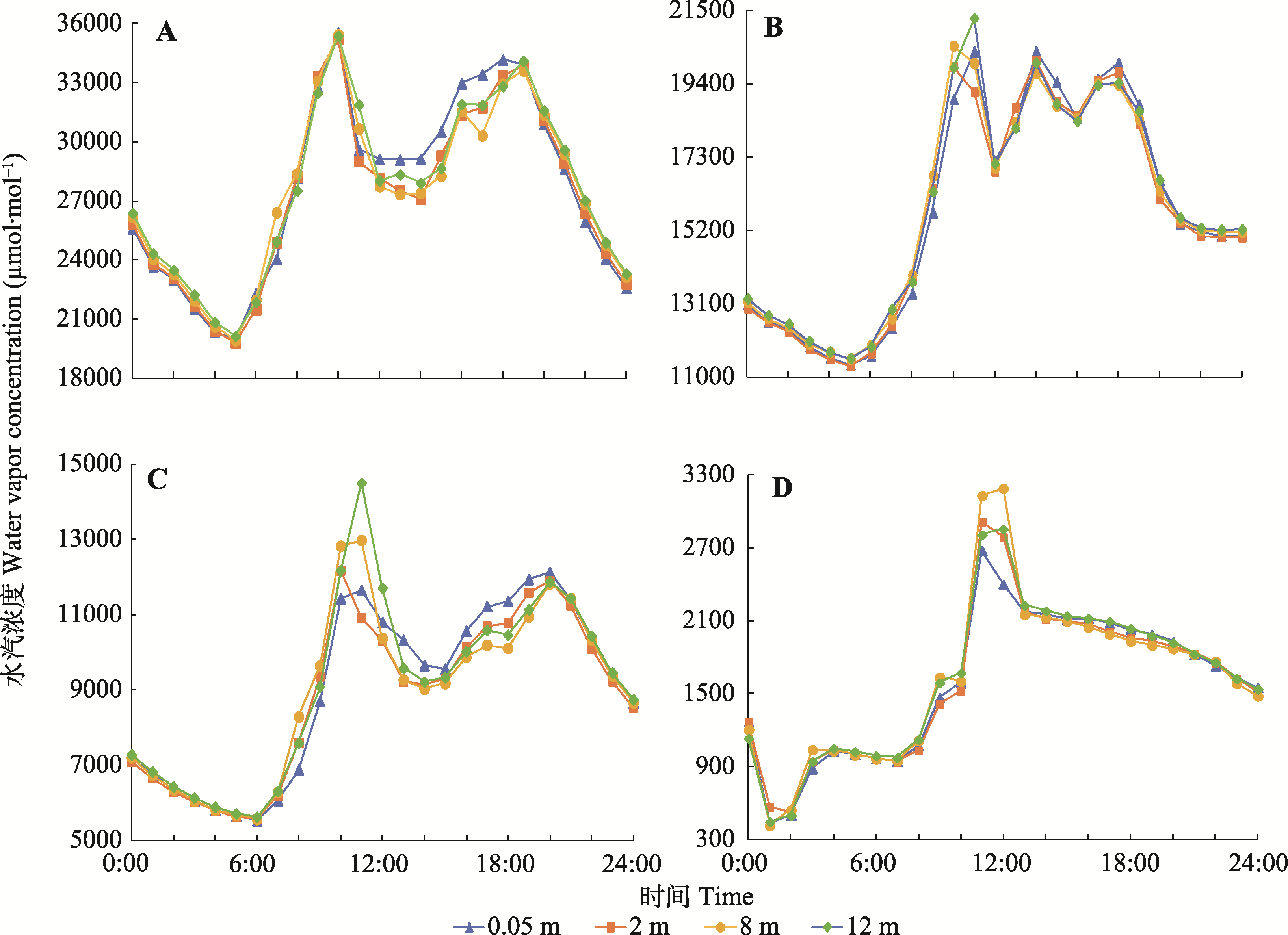
图3 内蒙古大兴安岭地区落叶松林不同高度水汽浓度日变化。A, 7月15日。B, 8月15日。C, 9月15日。D, 10月15日。
Fig. 3 Daily variation of water vapor concentration at different heights in the Larix gmelinii forest in the Da Hinggan Ling of Nei Mongol. A, July 15th. B, August 15th. C, September 15th. D, October 15th.
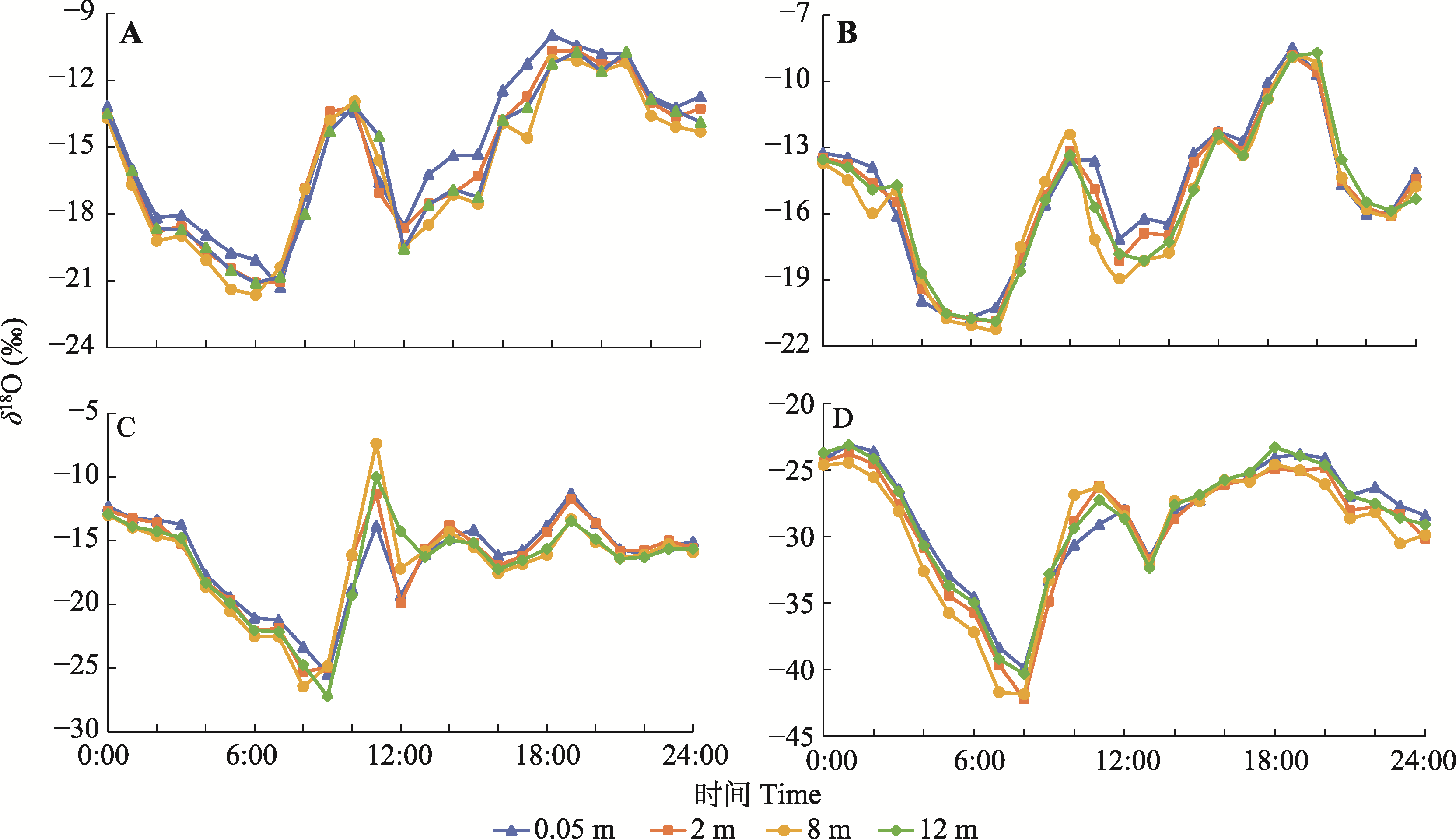
图4 内蒙古大兴安岭地区落叶松林不同高度水汽稳定氧同位素比值(δ18O)日变化。A, 7月15日。B, 8月15日。C, 9月15日。D, 10月15日。
Fig. 4 Daily variation of vapor oxygen stable isotope ratio (δ18O) at different heights in the Larix gmelinii forest in the Da Hinggan Ling of Nei Mongol. A, July 15th. B, August 15th. C, September 15th. D, October 15th.
| 日期 Date | 时间 Time | δs (‰) | δv (‰) | δE (‰) | 日期 Date | 时间 Time | δs (‰) | δv (‰) | δE (‰) |
|---|---|---|---|---|---|---|---|---|---|
| 2022-07-15 | 6:00-8:00 | -9.90 | -18.64 | -20.76 | 2022-09-15 | 6:00-8:00 | -11.69 | -21.82 | -22.91 |
| 8:00-10:00 | -8.56 | -17.37 | -18.96 | 8:00-10:00 | -11.03 | -20.21 | -21.92 | ||
| 10:00-12:00 | -8.30 | -16.52 | -18.55 | 10:00-12:00 | -10.72 | -20.21 | -21.39 | ||
| 12:00-14:00 | -8.25 | -16.81 | -18.31 | 12:00-14:00 | -10.06 | -19.56 | -20.59 | ||
| 14:00-16:00 | -9.08 | -16.74 | -19.22 | 14:00-16:00 | -10.65 | -19.74 | -21.03 | ||
| 16:00-18:00 | -9.84 | -16.82 | -20.29 | 16:00-18:00 | -11.33 | -20.37 | -21.83 | ||
| 18:00-20:00 | -10.44 | -17.35 | -21.14 | 18:00-20:00 | -12.01 | -20.86 | -23.00 | ||
| 2022-08-15 | 6:00-8:00 | -9.27 | -17.89 | -21.01 | 2022-10-15 | 6:00-8:00 | -14.39 | -24.54 | -26.76 |
| 8:00-10:00 | -8.88 | -16.36 | -19.71 | 8:00-10:00 | -13.81 | -24.60 | -26.14 | ||
| 10:00-12:00 | -8.41 | -16.44 | -18.79 | 10:00-12:00 | -13.25 | -23.81 | -25.50 | ||
| 12:00-14:00 | -8.17 | -16.06 | -18.48 | 12:00-14:00 | -13.54 | -23.11 | -25.78 | ||
| 14:00-16:00 | -8.33 | -16.17 | -18.57 | 14:00-16:00 | -13.86 | -22.92 | -26.16 | ||
| 16:00-18:00 | -8.86 | -18.00 | -19.51 | 16:00-18:00 | -14.09 | -23.66 | -26.48 | ||
| 18:00-20:00 | -9.51 | -17.90 | -20.54 | 18:00-20:00 | -14.60 | -24.19 | -27.15 |
表1 利用Craig-Gordon模型计算得到的内蒙古大兴安岭地区落叶松林δs、δv和δE
Table 1 δs, δv and δE in the Larix gmelinii forest in the Da Hinggan Ling of Nei Mongol calculated by Craig-Gordon model
| 日期 Date | 时间 Time | δs (‰) | δv (‰) | δE (‰) | 日期 Date | 时间 Time | δs (‰) | δv (‰) | δE (‰) |
|---|---|---|---|---|---|---|---|---|---|
| 2022-07-15 | 6:00-8:00 | -9.90 | -18.64 | -20.76 | 2022-09-15 | 6:00-8:00 | -11.69 | -21.82 | -22.91 |
| 8:00-10:00 | -8.56 | -17.37 | -18.96 | 8:00-10:00 | -11.03 | -20.21 | -21.92 | ||
| 10:00-12:00 | -8.30 | -16.52 | -18.55 | 10:00-12:00 | -10.72 | -20.21 | -21.39 | ||
| 12:00-14:00 | -8.25 | -16.81 | -18.31 | 12:00-14:00 | -10.06 | -19.56 | -20.59 | ||
| 14:00-16:00 | -9.08 | -16.74 | -19.22 | 14:00-16:00 | -10.65 | -19.74 | -21.03 | ||
| 16:00-18:00 | -9.84 | -16.82 | -20.29 | 16:00-18:00 | -11.33 | -20.37 | -21.83 | ||
| 18:00-20:00 | -10.44 | -17.35 | -21.14 | 18:00-20:00 | -12.01 | -20.86 | -23.00 | ||
| 2022-08-15 | 6:00-8:00 | -9.27 | -17.89 | -21.01 | 2022-10-15 | 6:00-8:00 | -14.39 | -24.54 | -26.76 |
| 8:00-10:00 | -8.88 | -16.36 | -19.71 | 8:00-10:00 | -13.81 | -24.60 | -26.14 | ||
| 10:00-12:00 | -8.41 | -16.44 | -18.79 | 10:00-12:00 | -13.25 | -23.81 | -25.50 | ||
| 12:00-14:00 | -8.17 | -16.06 | -18.48 | 12:00-14:00 | -13.54 | -23.11 | -25.78 | ||
| 14:00-16:00 | -8.33 | -16.17 | -18.57 | 14:00-16:00 | -13.86 | -22.92 | -26.16 | ||
| 16:00-18:00 | -8.86 | -18.00 | -19.51 | 16:00-18:00 | -14.09 | -23.66 | -26.48 | ||
| 18:00-20:00 | -9.51 | -17.90 | -20.54 | 18:00-20:00 | -14.60 | -24.19 | -27.15 |
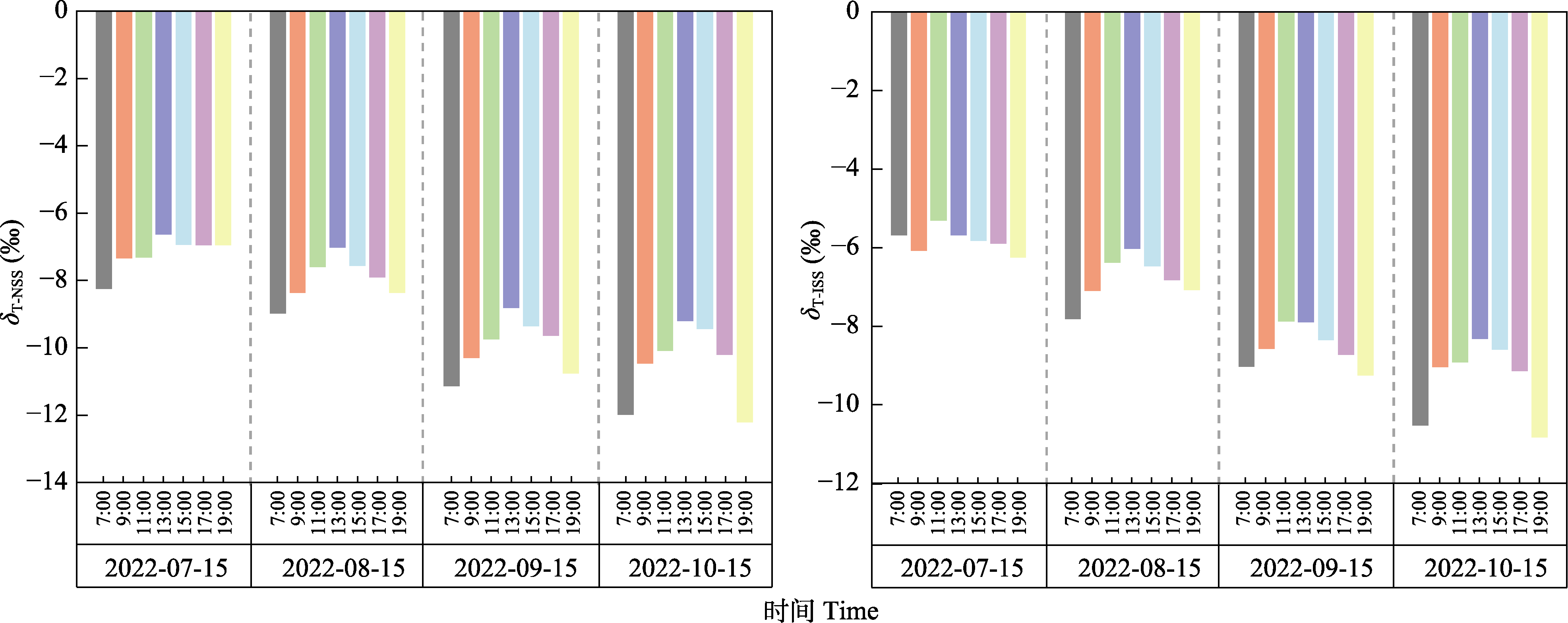
图5 非稳态和稳态假设下落叶松蒸腾水汽氧同位素比值(δT-NSS、δT-ISS)日变化。
Fig. 5 Diurnal variation of Larix gmelinii transpiration oxygen stable isotope ratio under unsteady state and steady state assumes (δT-NSS, δT-ISS).
| 日期 Date | 时间 Time | δET (‰) | δT-NSS (‰) | δT-ISS (‰) | 日期 Date | 时间 Time | δET (‰) | δT-NSS (‰) | δT-ISS (‰) |
|---|---|---|---|---|---|---|---|---|---|
| 2022-07-15 | 6:00-8:00 | -9.88 | -8.24 | -5.69 | 2022-09-15 | 6:00-8:00 | -13.27 | -11.13 | -9.03 |
| 8:00-10:00 | -9.55 | -7.33 | -6.08 | 8:00-10:00 | -12.43 | -10.30 | -8.58 | ||
| 10:00-12:00 | -8.74 | -7.31 | -5.31 | 10:00-12:00 | -11.21 | -9.74 | -7.87 | ||
| 12:00-14:00 | -8.06 | -6.63 | -5.69 | 12:00-14:00 | -10.28 | -8.81 | -7.90 | ||
| 14:00-16:00 | -8.22 | -6.94 | -5.83 | 14:00-16:00 | -10.85 | -9.36 | -8.35 | ||
| 16:00-18:00 | -9.00 | -6.95 | -5.90 | 16:00-18:00 | -11.73 | -9.64 | -8.73 | ||
| 18:00-20:00 | -9.63 | -6.95 | -6.25 | 18:00-20:00 | -13.22 | -10.75 | -9.25 | ||
| 2022-08-15 | 6:00-8:00 | -10.99 | -8.98 | -7.81 | 2022-10-15 | 6:00-8:00 | -15.48 | -11.99 | -10.53 |
| 8:00-10:00 | -10.01 | -8.36 | -7.10 | 8:00-10:00 | -13.72 | -10.47 | -9.04 | ||
| 10:00-12:00 | -8.90 | -7.59 | -6.38 | 10:00-12:00 | -12.60 | -10.08 | -8.92 | ||
| 12:00-14:00 | -8.05 | -7.02 | -6.03 | 12:00-14:00 | -11.17 | -9.20 | -8.32 | ||
| 14:00-16:00 | -8.71 | -7.56 | -6.47 | 14:00-16:00 | -11.21 | -9.44 | -8.59 | ||
| 16:00-18:00 | -9.58 | -7.90 | -6.82 | 16:00-18:00 | -12.93 | -10.21 | -9.14 | ||
| 18:00-20:00 | -10.17 | -8.36 | -7.08 | 18:00-20:00 | -15.29 | -12.21 | -10.83 |
表2 利用Keeling Plot模型估算得到的内蒙古大兴安岭地区落叶松林δET
Table 2 δET of the Larix gmelinii forest in the Da Hinggan Ling of Nei Mongol calculated by Keeling Plot
| 日期 Date | 时间 Time | δET (‰) | δT-NSS (‰) | δT-ISS (‰) | 日期 Date | 时间 Time | δET (‰) | δT-NSS (‰) | δT-ISS (‰) |
|---|---|---|---|---|---|---|---|---|---|
| 2022-07-15 | 6:00-8:00 | -9.88 | -8.24 | -5.69 | 2022-09-15 | 6:00-8:00 | -13.27 | -11.13 | -9.03 |
| 8:00-10:00 | -9.55 | -7.33 | -6.08 | 8:00-10:00 | -12.43 | -10.30 | -8.58 | ||
| 10:00-12:00 | -8.74 | -7.31 | -5.31 | 10:00-12:00 | -11.21 | -9.74 | -7.87 | ||
| 12:00-14:00 | -8.06 | -6.63 | -5.69 | 12:00-14:00 | -10.28 | -8.81 | -7.90 | ||
| 14:00-16:00 | -8.22 | -6.94 | -5.83 | 14:00-16:00 | -10.85 | -9.36 | -8.35 | ||
| 16:00-18:00 | -9.00 | -6.95 | -5.90 | 16:00-18:00 | -11.73 | -9.64 | -8.73 | ||
| 18:00-20:00 | -9.63 | -6.95 | -6.25 | 18:00-20:00 | -13.22 | -10.75 | -9.25 | ||
| 2022-08-15 | 6:00-8:00 | -10.99 | -8.98 | -7.81 | 2022-10-15 | 6:00-8:00 | -15.48 | -11.99 | -10.53 |
| 8:00-10:00 | -10.01 | -8.36 | -7.10 | 8:00-10:00 | -13.72 | -10.47 | -9.04 | ||
| 10:00-12:00 | -8.90 | -7.59 | -6.38 | 10:00-12:00 | -12.60 | -10.08 | -8.92 | ||
| 12:00-14:00 | -8.05 | -7.02 | -6.03 | 12:00-14:00 | -11.17 | -9.20 | -8.32 | ||
| 14:00-16:00 | -8.71 | -7.56 | -6.47 | 14:00-16:00 | -11.21 | -9.44 | -8.59 | ||
| 16:00-18:00 | -9.58 | -7.90 | -6.82 | 16:00-18:00 | -12.93 | -10.21 | -9.14 | ||
| 18:00-20:00 | -10.17 | -8.36 | -7.08 | 18:00-20:00 | -15.29 | -12.21 | -10.83 |
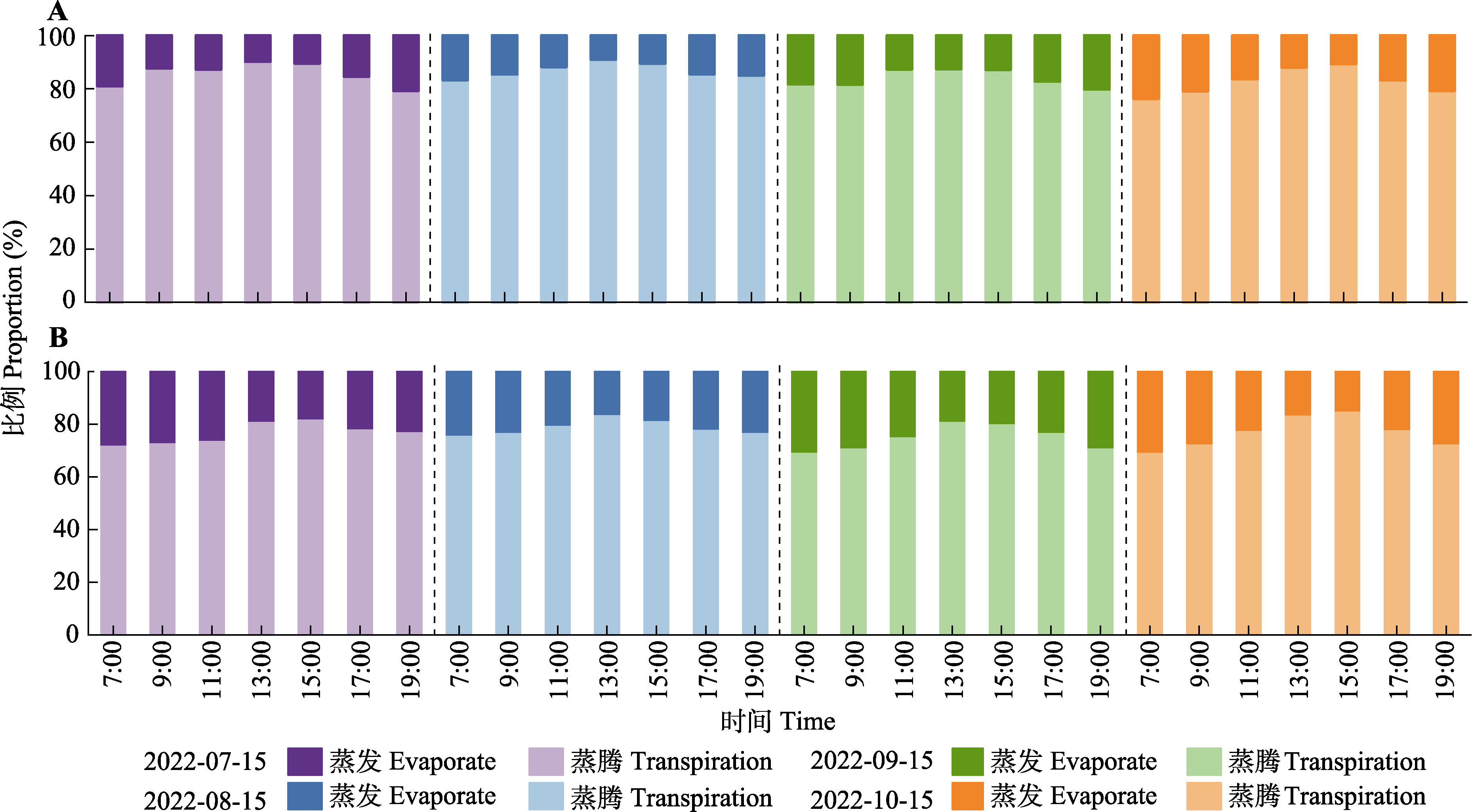
图6 非稳态(A)和稳态(B)假设下落叶松林蒸腾占蒸散的比例。
Fig. 6 Proportion of evapotranspiration in Larix gmelinii forest under unsteady (A) and steady state (B) assumption.
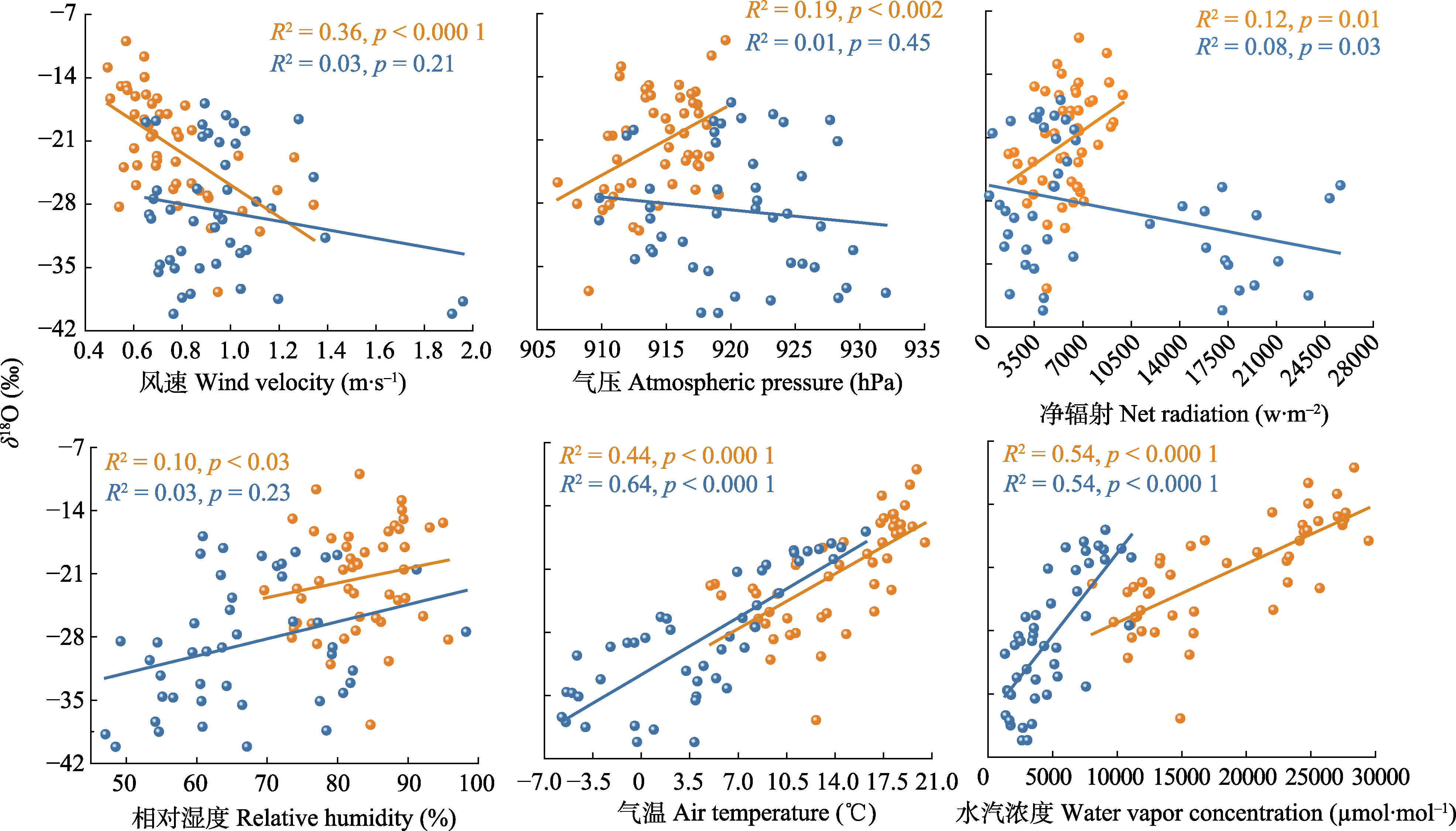
图7 大气水汽稳定氧同位素比值(δ18O)与环境因子之间的相关性。橙色代表生长季(7-8月), 蓝色代表落叶季(9-10月)。直线表示线性回归关系。
Fig. 7 Relationships of atmospheric water vapor oxygen isotope value (δ18O) with environmental factors. Orange, growing season (July to August); blue, leaf senescence period (September to October). Solid lines, linear regression fits.
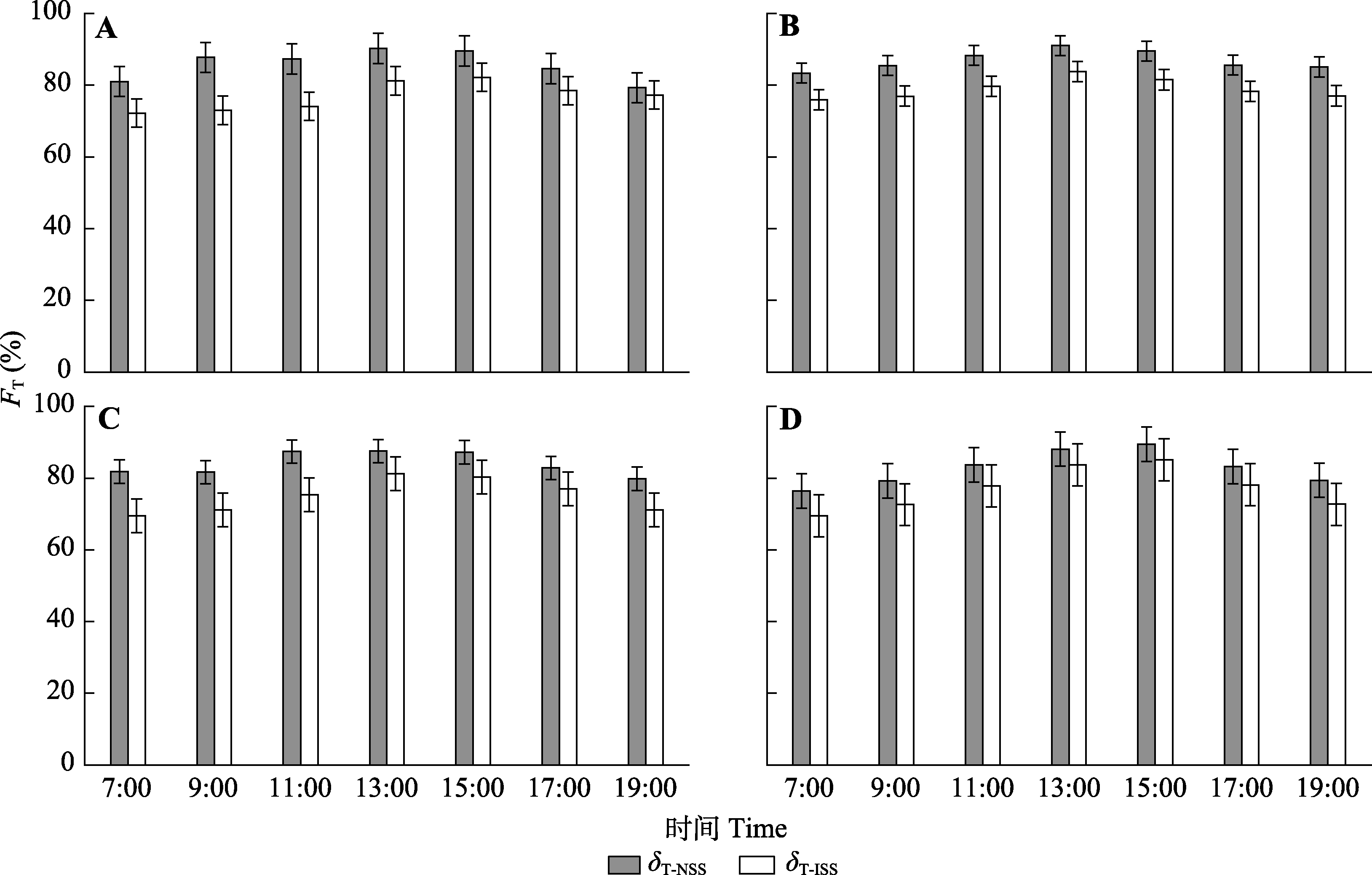
图8 落叶松林蒸腾对蒸散的贡献率(平均值±标准差)。A, 7月15日。B, 8月15日。C, 9月15日。D, 10月15日。δT-NSS, 非稳态下蒸腾水汽稳定氧同位素比值(δ18O); δT-ISS, 稳态下蒸腾水汽δ18O; FT, 植物蒸腾对蒸散发的贡献率。
Fig. 8 Contribution rate of transpiration to evapotranspiration in Larix gmelinii forest (mean ± SD). A, July 15th. B, August 15th. C, September 15th. D, October 15th. δT-NSS, oxygen stable isotope ratio (δ18O) of plant transpiration vapor under Non-Steady-Stateconditions; δT-ISS, the δ18O of plant transpiration vapor under isotope steady-stateconditions; FT, the contribution of plant transpiration to evapotranspiration.
| [1] |
Bastrikov V, Steen-Larsen HC, Masson-Delmotte V, Gribanov K, Cattani O, Jouzel J, Zakharov V (2014). Continuous measurements of atmospheric water vapour isotopes in western Siberia (Kourovka). Atmospheric Measurement Techniques, 7, 1763-1776.
DOI URL |
| [2] | Dasgupta B, Prakash P, Sen R, Noble J, Chatterjee S, Sanyal P (2024). The isotopic composition of the world’s highest river basins: role of hydrological mixing ratios and transit time. Journal of Hydrology, 638, 131544. DOI: 10.1016/j.jhydrol.2024.131544. |
| [3] |
Dongmann G, Nurnberg HW, Forstel H, Wagener K (1974). On the enrichment of H218O in the leaves of transpiring plants. Radiation and Environmental Biophysics, 11, 41-52.
PMID |
| [4] | Du J (2023). Analysis of Water Vapor Isotope Characteristics in the Monsoon Edge Region Based on Measured and WRF Models. Master degree dessertation, Northwest Normal University, Lanzhou. 77. |
| [杜佳 (2023). 基于实测和WRF模型的季风边缘区水汽同位素特征分析. 硕士学位论文, 西北师范大学, 兰州. 77.] | |
| [5] |
Farquhar GD, Cernusak LA(2005). On the isotopic composition of leaf water in the non-steady state. Functional Plant Biology, 32, 293-303.
DOI PMID |
| [6] | Farquhar GD, Lloyd J (1993). Carbon and oxygen isotope effects in the exchange of carbon dioxide between terrestrial plants and the atmosphere. Stable Isotopes and Plant Carbon-water Relations, 5, 43-70. |
| [7] | Ge ZX, Cai TJ, Duan BX, Xu ZP, Lang MH, Man XL (2023). Water use characteristics of Larix gmelinii and Betula platyphylla in the cold temperate zone during the growing season. Acta Ecologica Sinica, 43, 10142-10155. |
| [葛照欣, 蔡体久, 段北星, 徐志鹏, 郎明翰, 满秀玲 (2023). 寒温带兴安落叶松和白桦生长季水分利用特征. 生态学报, 43, 10142-10155.] | |
| [8] | Han JJ (2022). Water Isotope Eco-hydrological Process in a Pinus yunnanensis Forest in Lijiang, Southwest China. PhD dissertation, Yunnan University, Kunming. 117. |
| [韩姣姣 (2022). 丽江云南松森林稳定同位素生态水文过程研究. 博士学位论文, 云南大学, 昆明. 117.] | |
| [9] |
Lai C, Ehleringer JR, Bond BJ, Paw UKT (2006). Contributions of evaporation, isotopic non-steady state transpiration and atmospheric mixing on the δ18O of water vapour in Pacific Northwest coniferous forests. Plant, Cell & Environment, 29, 77-94.
DOI URL |
| [10] | Lee XH, Kim K, Smith R (2007). Temporal variations of the O18/O16 signal of the whole-canopy transpiration in a temperate forest. Global Biogeochemical Cycles, 21, GB3013. DOI: 10.1029/2006GB002871. |
| [11] | Li H, Chen H, Huang JJ (2024). Partitioning urban forest evapotranspiration based on integrating eddy covariance of water vapor and carbon dioxide fluxes. Science of the Total Environment, 935, 173201. DOI: 10.1016/j.scitotenv.2024.173201. |
| [12] | Li HF, Cao SK, Ji YT, Hou YF, Yang YF (2023). Spatial variation of hydrogen and oxygen stable isotope composition of soil water in Shaliu River Basin of Qinghai Lake. Ecological Science, 42, 82-91. |
| [李华非, 曹生奎, 季雨桐, 侯瑶芳, 杨羽帆 (2023). 青海湖沙柳河流域土壤水氢氧稳定同位素比值空间变化特征. 生态科学, 42, 82-91.] | |
| [13] | Li XM (2021). Evapotranspiration Partitioning and Its Influencing Factors in Arid And Semi-Arid Regions Based on L’vovich Theory. Master degree dissertation, Tianjin University, Tianjin. 104. |
| [李新梦 (2021). 基于L’vovich理论的干旱半干旱地区陆地蒸散发分割及其影响因素研究. 硕士学位论文, 天津大学, 天津. 104.] | |
| [14] | Li YY, Li YL, Ma R, He J (2025). Understanding features and laws of promoting coordinated development of water resources, economy, society and eco-environment through “planning based on water” principle. China Water Resources, 24, 21-25. |
| [李原园, 李云玲, 马睿, 何君 (2025). 以“四水四定”统筹推进水资源与经济社会及生态环境协调发展的特征及规律认识. 中国水利, 24, 21-25.] | |
| [15] | Liu WM, Li Z (2024). Research progress on groundwater circulation based on stable isotopes of hydrogen and oxygen. Heilongjiang Environmental Journal, 37, 13-15. |
| [刘闻明, 李征 (2024). 基于氢氧稳定同位素的地下水循环研究进展. 黑龙江环境通报, 37, 13-15.] | |
| [16] | Meng F (2019). A Study of Partitioning Evapotranspiration of the Alpine Meadow Eco-System in the Upper Reaches of the Shule River Basin. Master degree dissertation, Northwestern University, Xi’an. 59. |
| [孟飞 (2019). 疏勒河上游高寒草甸生态系统蒸散发分割研究. 硕士学位论文, 西北大学, 西安. 59.] | |
| [17] | Qu XB, Wang YY, Li D, Zhao YJ, Zhang LB (2024). the research of spatial and temporal variation characteristic and meteorological influencing factors of forest carbon sequestration capacity in Great Xing’an Mountains. Desert and Oasis Meteorology, 18, 117-123. |
| [曲学斌, 王雅莹, 李丹, 赵岳冀, 张岚彪 (2024). 内蒙古大兴安岭森林固碳能力时空变化及气象因素影响分析. 沙漠与绿洲气象, 18, 117-123.] | |
| [18] | Shang BJ, Gao J, Chen GBR, Wu YQ (2024). Stable isotopes in atmospheric water vapour: patterns, mechanisms and perspectives. Scientia Sinica (Terrae), 54, 3832-3859. |
| [尚白军, 高晶, 陈葛般若, 武予清 (2024). 大气水汽稳定同位素: 特征、机制与前景. 中国科学: 地球科学, 54, 3832-3859.] | |
| [19] | Sun SJ, Meng P, Zhang JS, He CX, Zheng N (2015). Variation of vapor oxygen isotopic composition and partitioning evapotranspiration of oak woodland in the low hilly area of North China. Acta Ecologica Sinica, 35, 2592-2601. |
| [孙守家, 孟平, 张劲松, 何春霞, 郑宁 (2015). 华北低丘山区栓皮栎生态系统氧同位素日变化及蒸散定量区分. 生态学报, 35, 2592-2601.] | |
| [20] | Sun W, Lin GH, Chen SP, Huang JH (2005). A Applications of stable isotope techniques and Keeling plot approach to carbon and water exchange studies of terrestrial ecosystems. Acta Phytoecologica Sinica, 29, 851-862. |
|
[孙伟, 林光辉, 陈世苹, 黄建辉 (2005). 稳定性同位素技术与Keeling曲线法在陆地生态系统碳/水交换研究中的应用. 植物生态学报, 29, 851-862.]
DOI |
|
| [21] | Tian L, Yu W, Schuster PF, Wen R, Cai Z, Wang D, Shao L, Cui J, Guo X (2019). Control of seasonal water vapor isotope variations at Lhasa, southern Tibetan Plateau. Journal of Hydrology, 580, 124237. DOI: 10.1016/j.jhydrol.2019.124237. |
| [22] | Wang LB, A TL, Wang GQ, Xue BL (2024). Improvement of evapotranspiration simulation study in the Hailar River basin under the influence of vegetation dynamics. Journal of Contaminant Hydrology, 262, 104324. DOI: 10.1016/j.jconhyd.2024.104324. |
| [23] | Wang XY (2023). Study on Water Distribution Law of Cotton Field Based on Hydrogen and Oxygen Isotopes. Master degree dissertation, Shihezi University, Shihezi, Xinjiang. 56. |
| [王鑫宇 (2023). 基于氢氧同位素探究棉田水分分布规律. 硕士学位论文, 石河子大学, 新疆石河子. 56.] | |
| [24] |
Welp LR, Lee XH, Kyounghee K, Griffis TJ, Billmark KA, Baker JM (2008). deltaO of water vapour, evapotranspiration and the sites of leaf water evaporation in a soybean canopy. Plant, Cell & Environment, 31, 1214-28.
DOI URL |
| [25] | Weng SH, Zhang FM, Lu YY, Duan CF, Ni T (2022). Spatiotemporal changes and attribution analysis of evapotranspiration in the Huai River Basin. Acta Ecologica Sinica, 42, 6718-6730. |
| [翁升恒, 张方敏, 卢燕宇, 段春锋, 倪婷 (2022). 淮河流域蒸散发时空变化与归因分析. 生态学报, 42, 6718-6730.] | |
| [26] |
Wu YX, Zhang YE, Jia GD, Wang YS, Yu XX (2021). Quantitative separation of evapotranspiration components of Platycladus orientalis ecosystem based on multiple isotope models. Chinese Journal of Applied Ecology, 32, 1971-1979.
DOI |
|
[武昱鑫, 张永娥, 贾国栋, 王渝凇, 余新晓 (2021). 基于多种同位素模型的侧柏林生态系统蒸散组分定量拆分. 应用生态学报, 32, 1971-1979.]
DOI |
|
| [27] | Xing W, Wang W, Cai Y, Yu ZB, Shao QX, Cao X, Cao MZ, Yang Z, Yong B (2024). Evapotranspiration partitioning through water stable isotopic measurements in a subtropical coniferous forest. Ecohydrology, 17, 2653. DOI: 10.1002/eco.2653. |
| [28] |
Yakir D, Sternberg LSL (2000). The use of stable isotopes to study ecosystem gas exchange. Oecologia, 123, 297-311.
DOI PMID |
| [29] | Yuan GF, Zhang N, Sun XM, Wen XF, Zhang SC (2010). Partitioning wheat field evapotranspiration using Keeling Plot method and continuous atmospheric vapor δ18O data. Chinese Journal of Plant Ecology, 34, 170-178. |
|
[袁国富, 张娜, 孙晓敏, 温学发, 张世春 (2010). 利用原位连续测定水汽δ18O值和Keeling Plot方法区分麦田蒸散组分. 植物生态学报, 34, 170-178.]
DOI |
|
| [30] |
Yuan Y, Wang L, Wei Z, Ajami H, Wang H, Du T (2024). Using median point in Keeling Plot to reduce the uncertainty of the isotopic composition of evapotranspiration. Journal of Hydrometeorology, 25, 637-649.
DOI URL |
| [31] | Zhang Y, Zhang MJ, Wang JX, Lu R, Liu LL (2024). A review of water movement process in SPAC in the semi-arid and arid regions based on stable isotopes. Acta Ecologica Sinica, 44, 1360-1373. |
| [张宇, 张明军, 王家鑫, 鲁睿, 刘灵灵 (2024). 基于稳定同位素的干旱半干旱区SPAC水分运移过程研究进展. 生态学报, 44, 1360-1373.] | |
| [32] | Zhang YE, Wang DD, Liu ZQ, Yu XX, Jia GD, Chen LH (2020). Assessment of leaf water enrichment of Platycladus orientalis using numerical modeling with different isotopic models. Ecological Indicators, 111, 105995.doi:10.1016/j.ecolind.2019.105995. |
| [33] | Zhang Z (2023). The Dynamic Changes in Water Vapor Concentration and Hydrogen and Oxygen Isotope Characteristics at Different Heights in the Larch Forest of Xing’an After Logging, and Their Responses to Environmental Factors. Master degree dissertation, Inner Mongolia Agricultural University, Hohhot. 53. |
| [张泽 (2023). 兴安落叶松过伐林不同高度水汽浓度及氢氧同位素动态变化特征及其对环境因子的响应. 硕士学位论文, 内蒙古农业大学, 呼和浩特. 53.] | |
| [34] |
Zhao MY, Zhuang HR, Xu DH, Ma GR, Ma YC, Feng KP (2024). Hydrogen and oxygen stable isotope characteristics of maize fields in arid and semi-arid oasis irrigation areas with SPAC system: variability traits and influencing factors. Chinese Journal of Plant Ecology, 49, 256-267.
DOI URL |
| [赵梦扬, 庄淏然, 许德浩, 马国荣, 马永成, 冯克鹏 (2024). 干旱半干旱绿洲灌区玉米农田SPAC系统氢氧稳定同位素特征及其影响因素. 植物生态学报, 49, 256-267.] | |
| [35] | Zhou M (2003). Research on the Hydrological Process and Laws of Larix gmelinii Ecosystem at the Greater Xing’an Mountains. PhD dissertation, Beijing Forestry University, Beijing. 231. |
| [周梅 (2003). 大兴安岭落叶松林生态系统水文过程与规律研究. 博士学位论文, 北京林业大学, 北京. 231.] | |
| [36] | Zhou YQ, Gao XD, Wang JX, Zhao XN (2021). Lycium barbarum root water uptake characteristics in the Qaidam Basin irrigation. Chinese Journal of Eco-Agriculture, 29, 400-409. |
| [周艳清, 高晓东, 王嘉昕, 赵西宁 (2021). 柴达木盆地灌区枸杞根系水分吸收来源研究. 中国生态农业学报(中英文), 29, 400-409.] | |
| [37] | Zhu SX, Xiao W, Zhang M, Wang W, Shen J, Xu JP, Hu YB, Wen XF, Li XH (2017). Hydrogen and oxygen stable isotopic composition in a deciduous forest ecosystem in Canada. Acta Ecologica Sinica, 37, 7539-7551. |
| [朱珊娴, 肖薇, 张弥, 王伟, 沈竞, 徐家平, 胡勇博, 温学发, 李旭辉 (2017). 加拿大落叶林生态系统中氢氧稳定同位素比值. 生态学报, 37, 7539-7551.] |
| [1] | 吕申, 牛云明, 王欣, 刘子赫, 余新晓, 贾国栋. 北京山区油松和栓皮栎人工纯林与混交林水分来源及其水文生态位[J]. 植物生态学报, 2026, 50(5): 1213-1226. |
| [2] | 陈淼, 陈健, 刘顺, 许格希, 冯秋红, 史作民. 外生菌根真菌对青藏高原东缘岷江冷杉和糙皮桦氮获取的贡献及其影响因素[J]. 植物生态学报, 2026, 50(3): 731-741. |
| [3] | 张诚航, 卫星, 吴纯泽, 王裕尧, 李浩楠. 大气还原态氮干湿沉降下水曲柳和兴安落叶松菌根化苗木生长响应[J]. 植物生态学报, 2026, 50(3): 649-659. |
| [4] | 田地, 迟小龙, 石亮, 刘宵含, 赵常提, 吴梅, 张玉忠, 高永亮. 塞罕坝地区优势造林树种叶片化学计量特征及其环境驱动[J]. 植物生态学报, 2026, 50(2): 362-373. |
| [5] | 于普, 张全智, 王传宽. 帽儿山水曲柳和落叶松径向变化及其影响因素[J]. 植物生态学报, 2026, 50(1): 160-172. |
| [6] | 戴允泽, 姚良锦, 陈淼, 徐小牛. 氮磷添加对常绿阔叶林土壤团聚体稳定性及其碳氮含量的影响[J]. 植物生态学报, 2026, 50(1): 55-69. |
| [7] | 杨浩林, 赵英, 胡秋丽. “两水世界”假说的研究进展与未来展望[J]. 植物生态学报, 2025, 49(9): 1344-1362. |
| [8] | 王堃莹, 邱贵福, 刘子赫, 孟君, 刘宇轩, 贾国栋. 气候变化对不同退化程度小叶杨林分生长和内在水分利用效率的调节[J]. 植物生态学报, 2025, 49(2): 343-355. |
| [9] | 赵梦扬, 庄淏然, 许德浩, 马国荣, 马永成, 冯克鹏. 干旱半干旱地区灌区玉米农田土壤植物大气连续体系统氢氧稳定同位素特征及其影响因素[J]. 植物生态学报, 2025, 49(2): 256-267. |
| [10] | 胡同欣, 石林, 窦旭, 于澄, 韩宇, 孙龙. 林火对兴安落叶松根际与非根际土壤微生物群落的影响[J]. 植物生态学报, 2025, 49(10): 1755-1766. |
| [11] | 周红娟, 刘子赫, 刘柯言, 张初蕊, 胡旭, 韩璐, 陈立欣. 不同降雨条件下北京土石山区混生乔灌植物的水分吸收和生态位特征[J]. 植物生态学报, 2024, 48(9): 1089-1103. |
| [12] | 吴风燕, 吴永胜, 陈晓涵, 冯骥, 卢丽媛, 查斯娜, 王超宇, 孟元发, 尹强. 鄂尔多斯高原3种固沙灌木水分利用效率的时空变化特征[J]. 植物生态学报, 2024, 48(9): 1180-1191. |
| [13] | 孙龙, 李文博, 娄虎, 于澄, 韩宇, 胡同欣. 火干扰对兴安落叶松种子萌发的影响[J]. 植物生态学报, 2024, 48(6): 770-779. |
| [14] | 梁逸娴, 王传宽, 臧妙涵, 上官虹玉, 刘逸潇, 全先奎. 落叶松径向生长和生物量分配对气候变暖的响应[J]. 植物生态学报, 2024, 48(4): 459-468. |
| [15] | 臧妙涵, 王传宽, 梁逸娴, 刘逸潇, 上官虹玉, 全先奎. 基于纬度移栽的落叶松叶、枝、根生态化学计量特征对气候变暖的响应[J]. 植物生态学报, 2024, 48(4): 469-482. |
| 阅读次数 | ||||||
|
全文 |
|
|||||
|
摘要 |
|
|||||
Copyright © 2026 版权所有 《植物生态学报》编辑部
地址: 北京香山南辛村20号, 邮编: 100093
Tel.: 010-62836134, 62836138; Fax: 010-82599431; E-mail: apes@ibcas.ac.cn, cjpe@ibcas.ac.cn
备案号: 京ICP备16067583号-19

