
植物生态学报 ›› 2026, Vol. 50 ›› Issue (1): 160-172.DOI: 10.17521/cjpe.2025.0036 cstr: 32100.14.cjpe.2025.0036
于普, 张全智*( ), 王传宽
收稿日期:2025-01-24
接受日期:2025-07-09
出版日期:2026-01-20
发布日期:2026-02-14
通讯作者:
*张全智(qzzhang@nefu.edu.cn)基金资助:
YU Pu, ZHANG Quan-Zhi*(), WANG Chuan-Kuan
Received:2025-01-24
Accepted:2025-07-09
Online:2026-01-20
Published:2026-02-14
Contact:
*ZHANG Quan-Zhi (qzzhang@nefu.edu.cn)Supported by:摘要:
探索不同树种或环境条件下树干径向变化的规律及影响因素, 是量化和评估森林碳汇及其碳固定过程的基础。该研究以水曲柳(Fraxinus mandshurica)和落叶松(Larix gmelinii)为研究对象, 连续高频监测树干径向变化和相关环境因子, 解析其年内和年际间的差异性, 以及环境因子对树干径向变化的影响。结果表明: 两树种的年内径向变化均符合Gompertz模型, 但在季节尺度上不完全同步, 年径向变化累积量和年平均断面积日变化速率存在显著的种间差异性。2020-2022年3年间水曲柳的径向变化起始时间早于落叶松, 年径向变化累积量达到25%的年序日(DOY25)比落叶松提前3-17天, 且2021年的高峰生长时长(LPGS)比落叶松长28天, 而径向变化终止时间较一致。两树种的径向日变化速率均表现出先增加后减小的单峰曲线趋势, 在初夏(DOY 147-DOY 157)达到峰值。两树种径向变化关键时间节点(DOY25、DOY50和DOY75)和LPGS受年际间环境因子影响。生长季两树种树干径向日变化受天气状况影响呈现出不同的变化趋势, 其中晴天呈正弦函数型波动。水曲柳和落叶松树干径向变化在树干径向增长盛期的日振幅与土壤体积含水量呈显著负相关关系, 而与光合有效辐射呈显著正相关关系, 两树种在树干径向增长盛期的树干径向日变化量与饱和水汽压差皆呈负相关关系。这表明树干径向季节动态受树种特性影响, 而日变化格局受土壤体积含水量、光照条件等环境因子的影响, 水分条件是影响水曲柳和落叶松径向变化的重要因素。
于普, 张全智, 王传宽. 帽儿山水曲柳和落叶松径向变化及其影响因素. 植物生态学报, 2026, 50(1): 160-172. DOI: 10.17521/cjpe.2025.0036
YU Pu, ZHANG Quan-Zhi, WANG Chuan-Kuan. Radial variation and its influencing factors of Fraxinus mandshurica and Larix gmelinii in Mao’ershan. Chinese Journal of Plant Ecology, 2026, 50(1): 160-172. DOI: 10.17521/cjpe.2025.0036
| 树种 Tree species | 样树编号 Sample tree No. | 胸径 DBH (cm) | 树皮厚度 BT (mm) | 树高 H (m) |
|---|---|---|---|---|
| 水曲柳 F. mandshurica | 1 | 24.79 | 9.38 | 19.53 |
| 2 | 25.27 | 8.52 | 19.65 | |
| 3 | 28.20 | 9.98 | 20.21 | |
| 落叶松 L. gmelinii | 4 | 23.80 | 8.80 | 22.90 |
| 5 | 25.62 | 10.03 | 23.23 | |
| 6 | 31.51 | 9.77 | 23.88 |
表1 水曲柳和落叶松研究样树的基本信息
Table 1 Basic information of the sample trees for Fraxinus mandshurica and Larix gmelinii
| 树种 Tree species | 样树编号 Sample tree No. | 胸径 DBH (cm) | 树皮厚度 BT (mm) | 树高 H (m) |
|---|---|---|---|---|
| 水曲柳 F. mandshurica | 1 | 24.79 | 9.38 | 19.53 |
| 2 | 25.27 | 8.52 | 19.65 | |
| 3 | 28.20 | 9.98 | 20.21 | |
| 落叶松 L. gmelinii | 4 | 23.80 | 8.80 | 22.90 |
| 5 | 25.62 | 10.03 | 23.23 | |
| 6 | 31.51 | 9.77 | 23.88 |
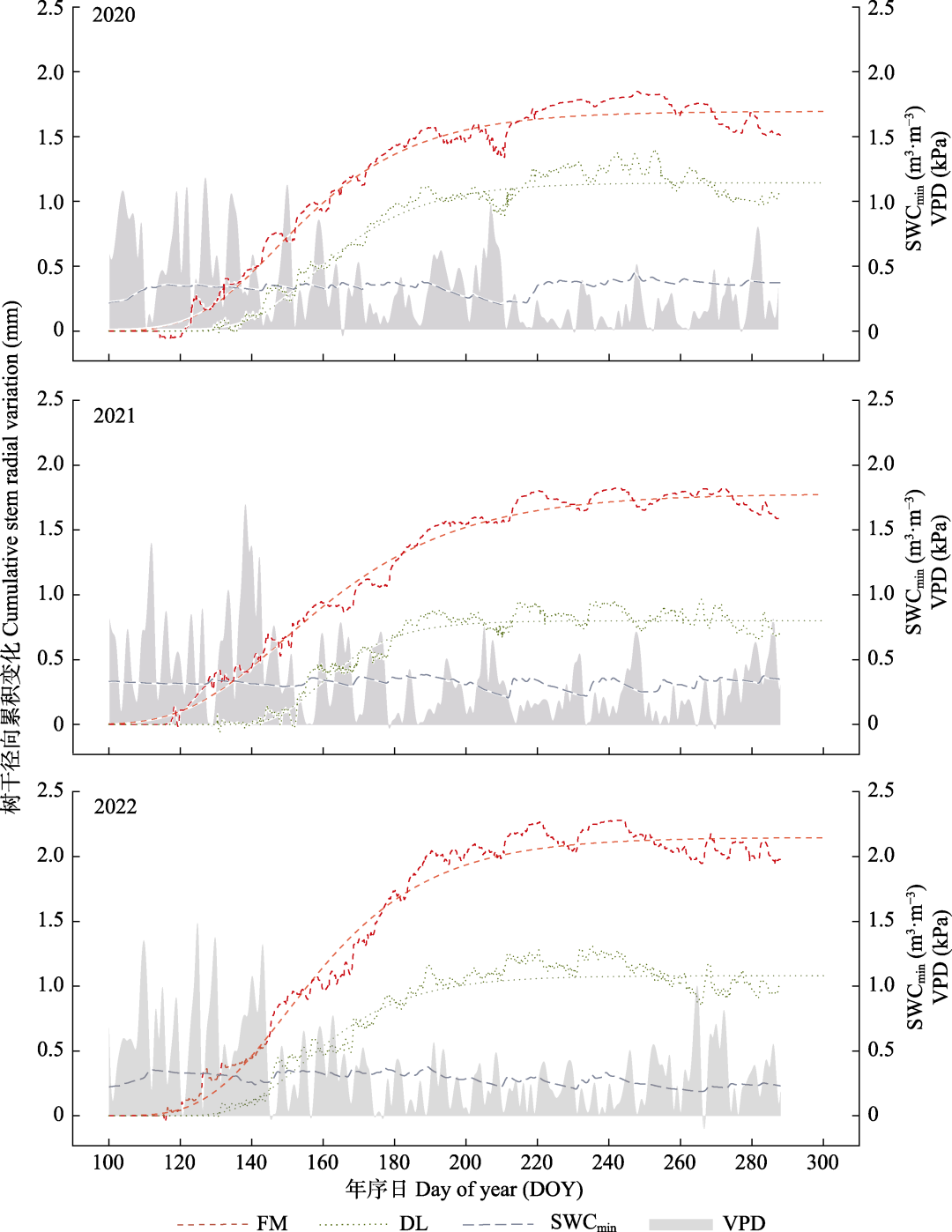
图1 采用Gompertz模型对2020-2022年生长季水曲柳(FM)和落叶松(DL)树干径向累积变化的拟合及气象因子动态。平滑虚线为拟合曲线, 波动虚线为原始测量值。SWCmin, 土壤体积含水量日最低值; VPD, 饱和水汽压差日均值。
Fig. 1 Fitting of the cumulative variation of tree stem radial increment for Fraxinus mandshurica (FM) and Larix gmelinii (DL) during the growing seasons from 2020 to 2022 using the Gompertz model and the dynamics of meteorological factors. Smooth dash lines represent fitting curves, and fluctuating dash lines indicate original measured values. SWCmin, daily minimum of soil volumetric water content; VPD, daily mean vapor pressure deficit.
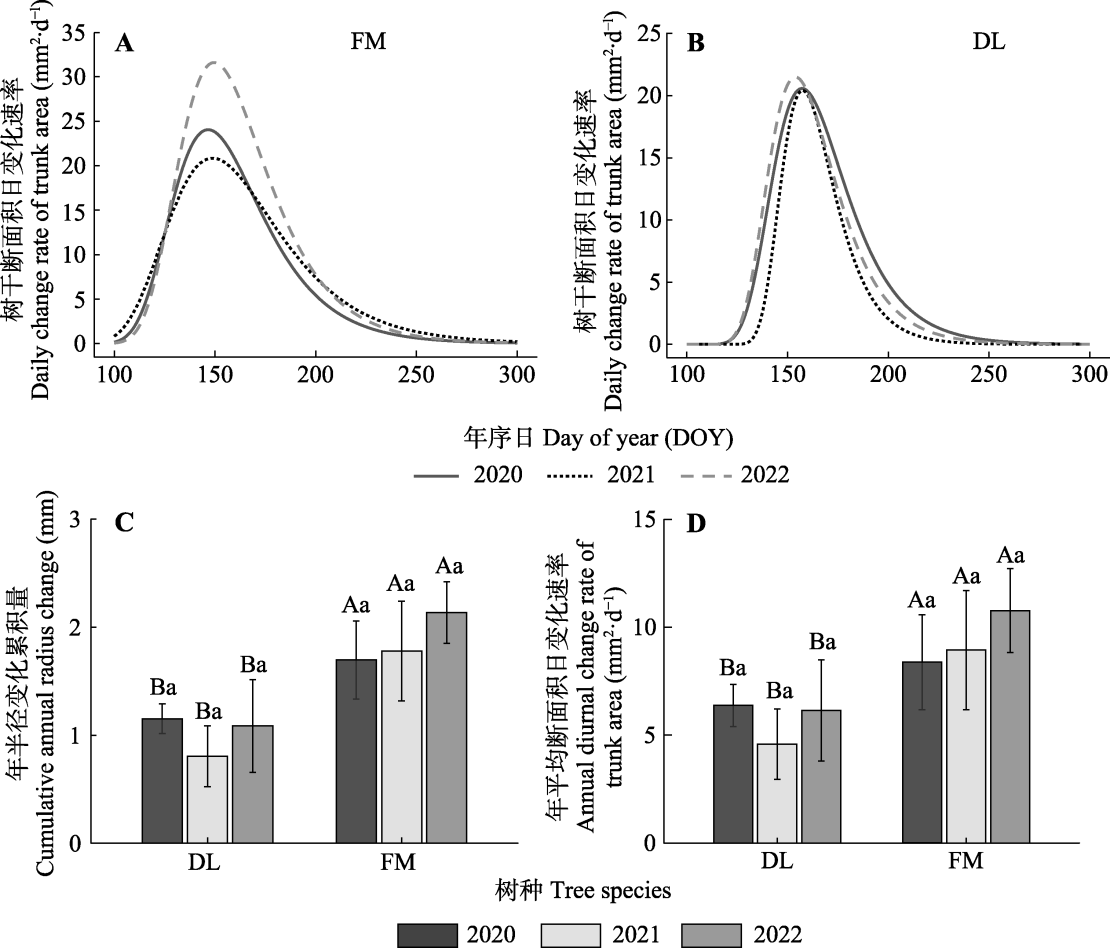
图2 水曲柳(FM)和落叶松(DL)断面积日变化速率拟合及年总径向变化累积量和年平均断面积日变化速率的差异性分析(平均值±标准差)。不同大写字母和小写字母分别表示年总径向变化累积量和年平均断面积日变化速率在树种间和年份间差异显著(p < 0.05)。
Fig. 2 Fitting of the daily variation rate of the basal area for Fraxinus mandshurica (FM) and Larix gmelinii (DL), and the analysis of differences in the annual total cumulative radial increment and the annual mean daily variation rate of basal area between FM and DL (mean ± SD). Different uppercase letters and lowercase letters indicate significant differences of the annual total cumulative radial increment and the annual mean daily variation rate of basal area among tree species and among years (p < 0.05), respectively.
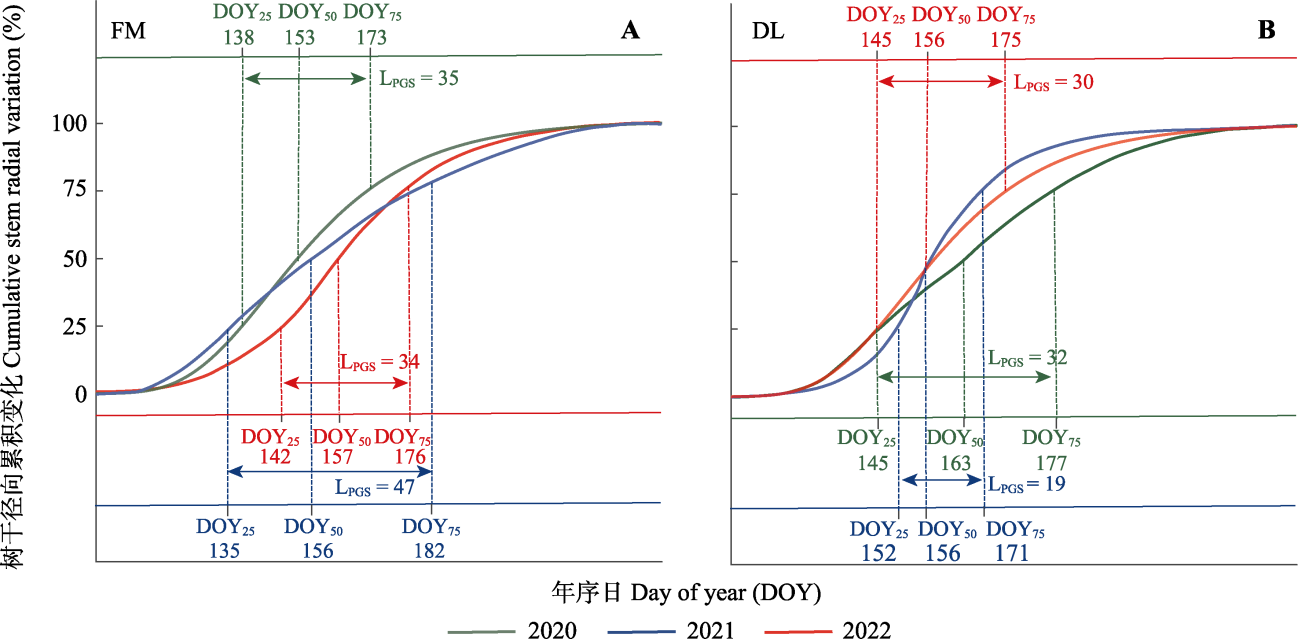
图3 2020至2022年水曲柳(FM)和落叶松(DL)径向变化关键时间节点。DOY25、DOY50和DOY75分别为年径向变化累积量达到25%、50%和75%的年序日。LPGS = DOY75 - DOY25, 为高峰生长时间长度。
Fig. 3 Key time nodes of stem radial variation for Fraxinus mandshurica (FM) and Larix gmelinii (DL) from 2020 to 2022. DOY25, DOY50, and DOY75 are the days of the year when the cumulative annual radial increment reaches 25%, 50%, and 75%. LPGS = DOY75 - DOY25, representing the length of the peak growing season.
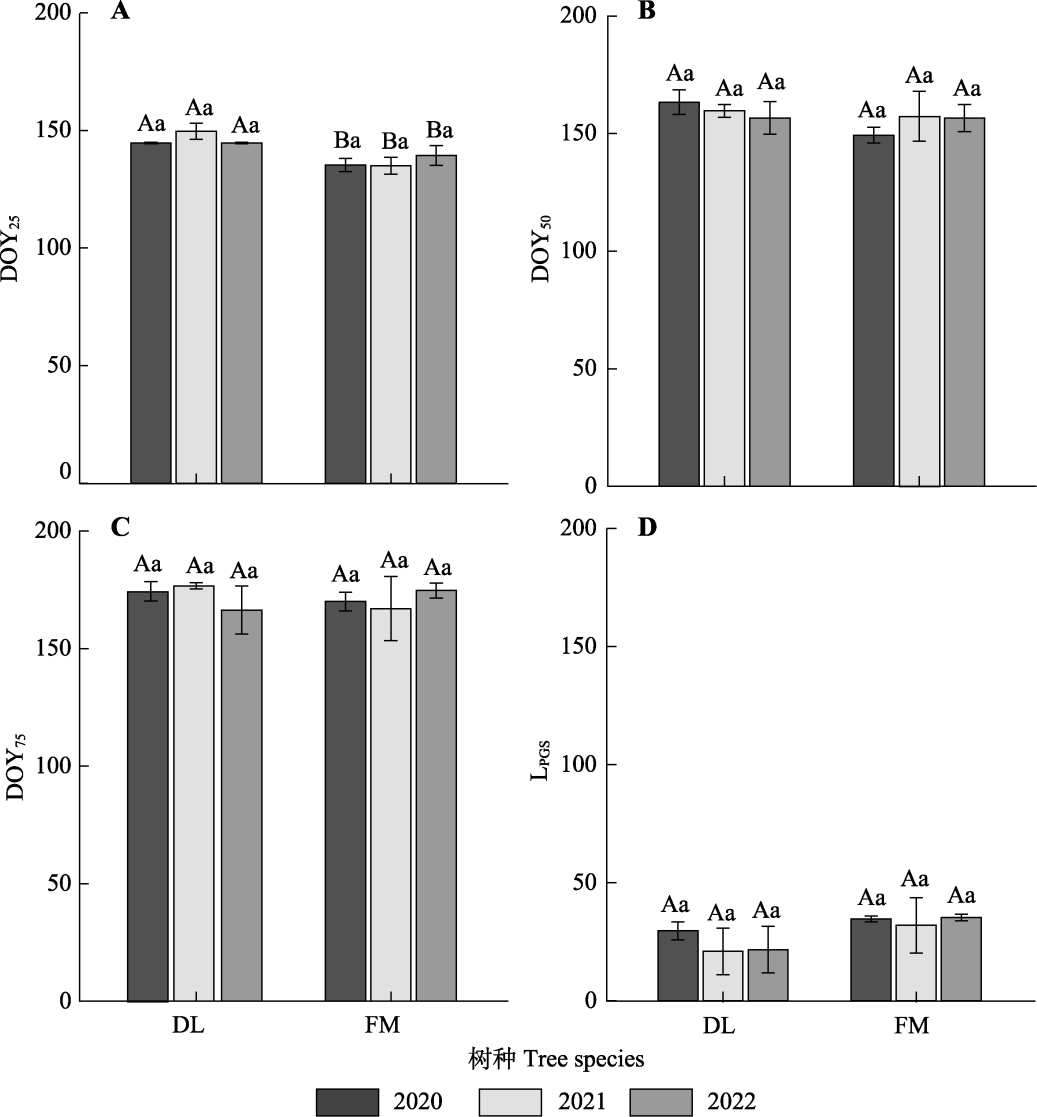
图4 2020至2022年水曲柳(FM)和落叶松(DL)径向变化关键时间节点差异性分析(平均值±标准差)。DOY25、DOY50和DOY75分别为年径向变化累积量达到25%、50%和75%的年序日。LPGS = DOY75 - DOY25, 为高峰生长时间长度。不同大写字母和小写字母分别表示DOY25、DOY50、DOY75和LPGS在树种间和年份间差异显著(p < 0.05)。
Fig. 4 Analysis of the differences in key time nodes of stem radial variation for Fraxinus mandshurica (FM) and Larix gmelinii (DL) from 2020 to 2022 (mean ± SD). DOY25, DOY50, and DOY75 are the days of the year when the cumulative annual radial increment reaches 25%, 50%, and 75%. LPGS = DOY75 - DOY25, representing the length of the peak growing season. Different uppercase letters and lowercase letters indicate significant differences of DOY25, DOY50, DOY75 and LPGS among tree species and among years (p < 0.05), respectively.
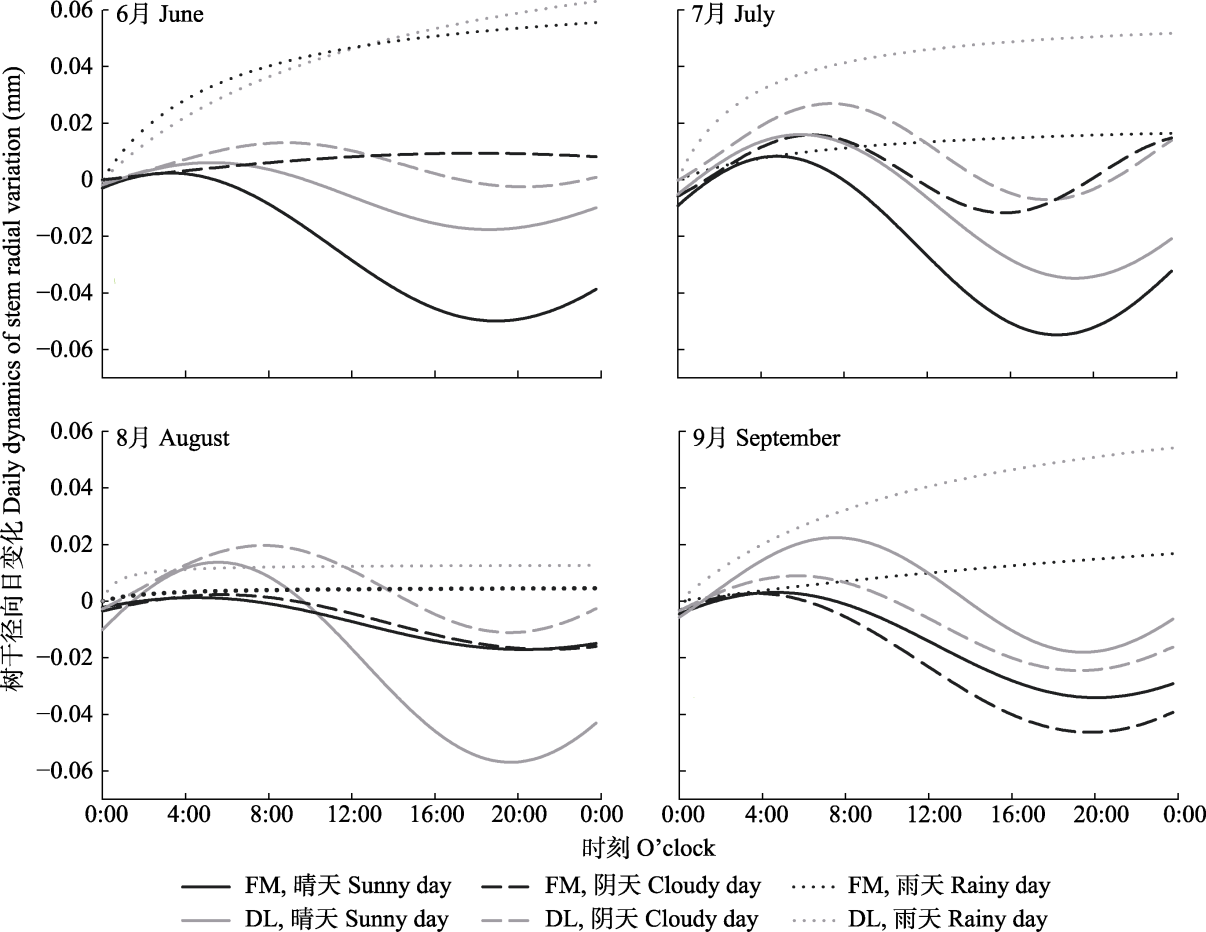
图5 不同天气条件下水曲柳(FM)和落叶松(DL)树干径向日变化(2020年6-9月)。
Fig. 5 Daily dynamics of stem radial variation of Fraxinus mandshurica (FM) and Larix gmelinii (DL) under different weather conditions (June to September 2020).
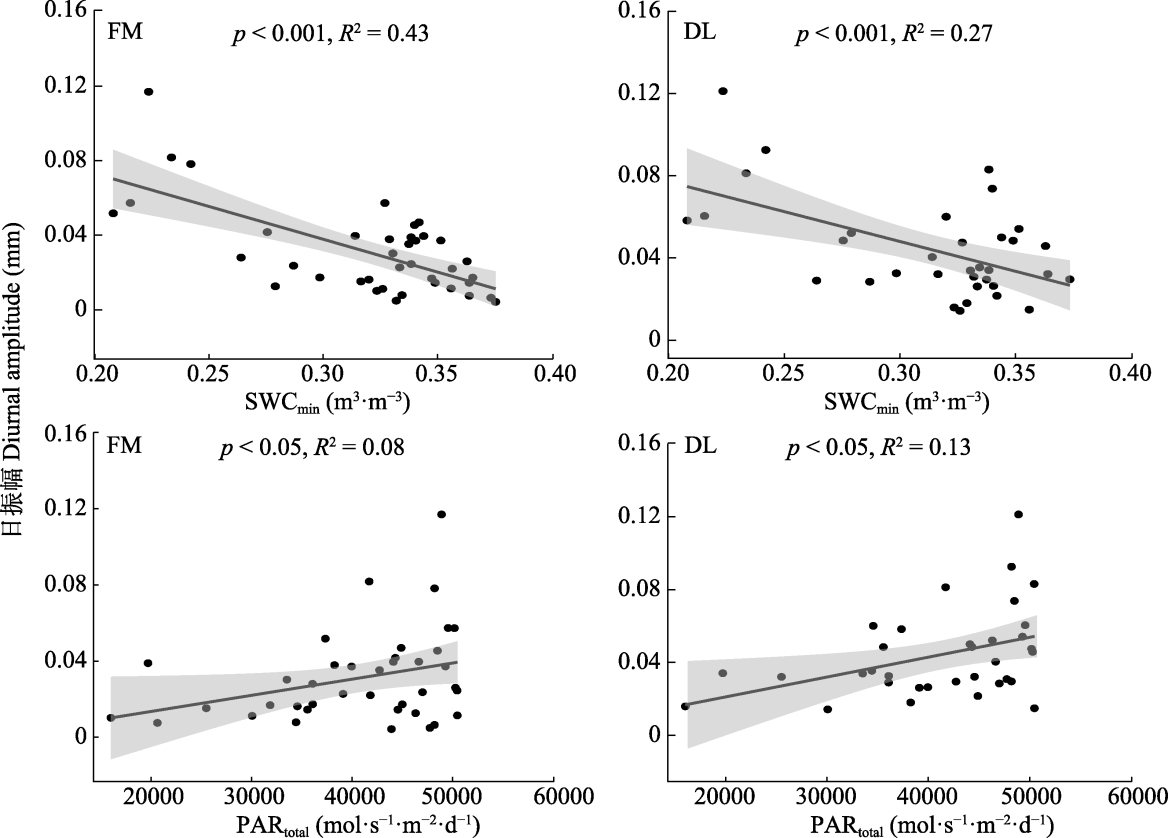
图6 增长盛期水曲柳(FM)和落叶松(DL)树干日变化振幅与环境因子的相关性。PARtotal, 光合有效辐射日总值; SWCmin, 土壤体积含水量日最低值。
Fig. 6 Correlation between the stem radial variation amplitudes and environmental factors for Fraxinus mandshurica (FM) and Larix gmelinii (DL) during the peak growth period. PARtotal, total daily photosynthetically active radiation; SWCmin, daily minimum of soil volumetric water content.
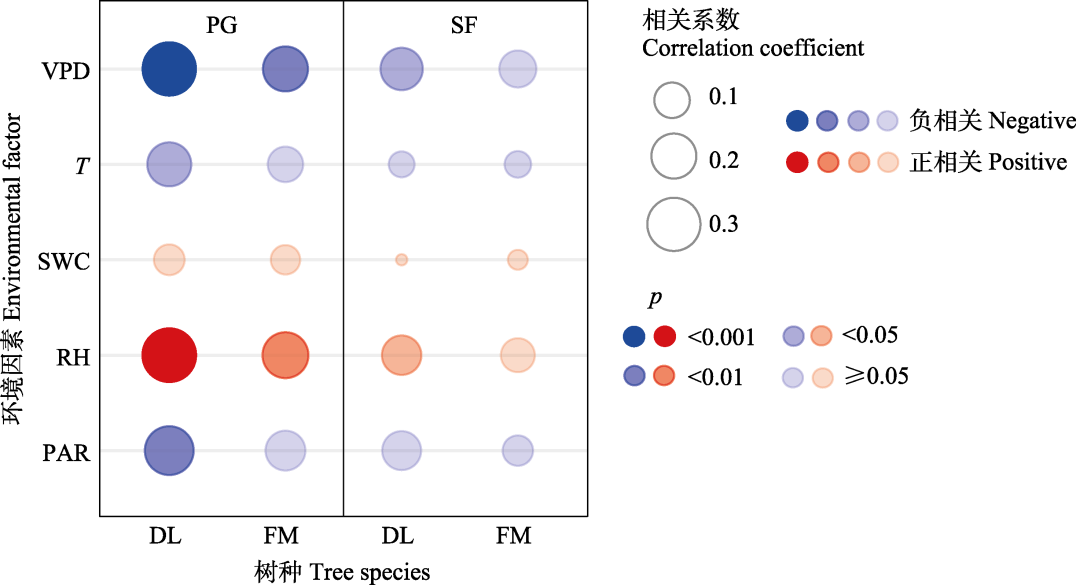
图7 增长盛期(PG)和平稳波动期(SF)水曲柳(FM)和落叶松(DL)树干径向日变化量与环境因子的相关关系。PAR, 光合有效辐射; RH, 相对湿度; SWC, 土壤体积含水量; T, 空气温度; VPD, 饱和水汽压差。
Fig. 7 Correlations between the amount of daily stem radial variation and environmental factors for Fraxinus mandshurica (FM) and Larix gmelinii (DL) during the peak growth period (PG) and steady fluctuation period (SF). PAR, photosynthetically active radiation; RH, relative humidity; SWC, soil volumetric water content; T, air temperature; VPD, vapor pressure deficit.
| [1] | Beer C, Reichstein M, Tomelleri E, Ciais P, Jung M, Carvalhais N, Rödenbeck C, Arain MA, Baldocchi D, Bonan GB, Bondeau A, Cescatti A, Lasslop G, Lindroth A, Lomas M, et al. (2010). Terrestrial gross carbon dioxide uptake: global distribution and covariation with climate. Science, 329, 834-838. |
| [2] |
Biondi F, Hartsough P (2010). Using automated point dendrometers to analyze tropical treeline stem growth at Nevado de Colima, Mexico. Sensors, 10, 5827-5844.
DOI PMID |
| [3] |
Bouriaud O, Leban JM, Bert D, Deleuze C (2005). Intra-annual variations in climate influence growth and wood density of Norway spruce. Tree Physiology, 25, 651-660.
PMID |
| [4] |
Breitsprecher A, Hughes W (1975). A recording dendrometer for humid environments. Biotropica, 7, 90-99.
DOI URL |
| [5] |
Buckley TN (2005). The control of stomata by water balance. New Phytologist, 168, 275-292.
PMID |
| [6] |
Cabon A, Fernández-de-Uña L, Gea-Izquierdo G, Meinzer FC, Woodruff DR, Martínez-Vilalta J, De Cáceres M (2020). Water potential control of turgor-driven tracheid enlargement in Scots pine at its xeric distribution edge. New Phytologist, 225, 209-221.
DOI PMID |
| [7] |
D’Orangeville L, Itter M, Kneeshaw D, Munger JW, Richardson AD, Dyer JM, Orwig DA, Pan YD, Pederson N (2022). Peak radial growth of diffuse-porous species occurs during periods of lower water availability than for ring-porous and coniferous trees. Tree Physiology, 42, 304-316.
DOI URL |
| [8] |
Dobbert S, Pape R, Löffler J (2022). The application of dendrometers to alpine dwarf shrubs—A case study to investigate stem growth responses to environmental conditions. Biogeosciences, 19, 1933-1958.
DOI URL |
| [9] | Dow C, Kim AY, D’Orangeville L, Gonzalez-Akre EB, Helcoski R, Herrmann V, Harley GL, Maxwell JT, McGregor IR, McShea WJ, McMahon SM, Pederson N, Tepley AJ, Anderson-Teixeira KJ (2022). Warm springs alter timing but not total growth of temperate deciduous trees. Nature, 608, 552-557. |
| [10] |
Drew DM, Downes GM (2009). The use of precision dendrometers in research on daily stem size and wood property variation: a review. Dendrochronologia, 27, 159-172.
DOI URL |
| [11] |
Etzold S, Sterck F, Bose AK, Braun S, Buchmann N, Eugster W, Gessler A, Kahmen A, Peters RL, Vitasse Y, Walthert L, Ziemińska K, Zweifel R (2022). Number of growth days and not length of the growth period determines radial stem growth of temperate trees. Ecology Letters, 25, 427-439.
DOI URL |
| [12] |
Fatichi S, Pappas C, Zscheischler J, Leuzinger S (2019). Modelling carbon sources and sinks in terrestrial vegetation. New Phytologist, 221, 652-668.
DOI PMID |
| [13] |
Feng YH, Schmid B, Loreau M, Forrester DI, Fei SL, Zhu JX, Tang ZY, Zhu JL, Hong PB, Ji CJ, Shi Y, Su HJ, Xiong XY, Xiao J, Wang SP, Fang JY (2022). Multispecies forest plantations outyield monocultures across a broad range of conditions. Science, 376, 865-868.
DOI PMID |
| [14] |
Gheyret G, Zhang HT, Guo YP, Liu TY, Bai YH, Li S, Schmid B, Bruelheide H, Ma KP, Tang ZY (2021). Radial growth response of trees to seasonal soil humidity in a subtropical forest. Basic and Applied Ecology, 55, 74-86.
DOI |
| [15] |
Gričar J, Zavadlav S, Jyske T, Lavrič M, Laakso T, Hafner P, Eler K, Vodnik D (2019). Effect of soil water availability on intra-annual xylem and phloem formation and non-structural carbohydrate pools in stem of Quercus pubescens. Tree Physiology, 39, 222-233.
DOI URL |
| [16] |
Ji QW, Zheng CY, Zhang L, Zeng FX (2020). Stem radial growth dynamics of Pinus sylvestris var. mongolica and their relationship with meteorological factor in Saihanba, Hebei, China. Chinese Journal of Plant Ecology, 44, 257-265.
DOI URL |
|
[季倩雯, 郑成洋, 张磊, 曾发旭 (2020). 河北塞罕坝樟子松径向生长动态变化及其与气象因子的关系. 植物生态学报, 44, 257-265.]
DOI |
|
| [17] | Jiang XY, Liu SH, Ma MM, Zhang J, Song J (2009). A wavelet analysis of the precipitation time series in Northeast China during the last 100 years. Geographical Research, 28, 354-362. |
| [姜晓艳, 刘树华, 马明敏, 张菁, 宋军 (2009). 东北地区近百年降水时间序列变化规律的小波分析. 地理研究, 28, 354-362.] | |
| [18] |
Jin Y, Wang CK (2015). Trade-offs between plant leaf hydraulic and economic traits. Chinese Journal of Plant Ecology, 39, 1021-1032.
DOI |
|
[金鹰, 王传宽 (2015). 植物叶片水力与经济性状权衡关系的研究进展. 植物生态学报, 39, 1021-1032.]
DOI |
|
| [19] | Kang J, Jiang SW, Huang JG (2020). Radial growth response of four dominant tree species to climate factors in the Sayan Range of the Altai Mountains, Russia. Acta Ecologica Sinica, 40, 6135-6146. |
| [康剑, 蒋少伟, 黄建国 (2020). 阿尔泰山萨彦岭4种优势树种径向生长对气候因子的响应. 生态学报, 40, 6135-6146.] | |
| [20] |
Kathy S, Frank S, Annie D (2015). Diel growth dynamics in tree stems: linking anatomy and ecophysiology. Trends in Plant Science, 20, 335-343.
DOI PMID |
| [21] |
Körner C, Möhl P, Hiltbrunner E (2023). Four ways to define the growing season. Ecology Letters, 26, 1277-1292.
DOI PMID |
| [22] |
Li SY, Yang FT, Wang HM, Dai XQ, Meng SW (2025). Seasonal dynamics of xylem formation in Cunninghamia lanceolata and Schima superba and its response to environmental factors. Chinese Journal of Plant Ecology, 49, 295-307.
DOI URL |
|
[李思雨, 杨风亭, 王辉民, 戴晓琴, 孟盛旺 (2025). 杉木和木荷木质部形成季节动态及其对环境因子的响应. 植物生态学报, 49, 295-307.]
DOI |
|
| [23] |
Liu MJ, Chen QW, Lü JL, Li GQ, Du S (2023). Seasonal dynamics of radial growth and micro-variation in stems of Quercus mongolica var. liaotungensis and Robinia pseudoacacia in Loess Hilly Region. Chinese Journal of Plant Ecology, 47, 227-237.
DOI URL |
|
[刘美君, 陈秋文, 吕金林, 李国庆, 杜盛 (2023). 黄土丘陵区辽东栎和刺槐树干径向生长与微变化季节动态特征. 植物生态学报, 47, 227-237.]
DOI |
|
| [24] |
Liu SL, Yang BG, Zheng L, Shu WW, Min HL, Zhang P, Li H, Yang K, Zhou BJ, Tian ZW (2024). Seasonal stem radial growth of Castanopsis hystrix plantation and its response to climatic factors in Guangxi, China. Chinese Journal of Plant Ecology, 48, 1021-1034.
DOI URL |
|
[刘士玲, 杨保国, 郑路, 舒韦维, 闵惠琳, 张培, 李华, 杨坤, 周炳江, 田祖为 (2024). 广西红锥人工林径向生长的季节格局及其对气候因子的响应. 植物生态学报, 48, 1021-1034.]
DOI |
|
| [25] | Liu YJ, Zhu LJ, Su JJ, Wang XC (2015). Impact of decreasing precipitation on Larix gmelinii radial growth in Maoershan, Xiaoxing’an Mountain, China. Acta Ecologica Sinica, 35, 4527-4537. |
| [刘玉佳, 朱良军, 苏金娟, 王晓春 (2015). 模拟降水减少对帽儿山地区兴安落叶松径向生长的影响. 生态学报, 35, 4527-4537.] | |
| [26] |
Luyssaert S, Schulze ED, Börner A, Knohl A, Hessenmöller D, Law BE, Ciais P, Grace J (2008). Old-growth forests as global carbon sinks. Nature, 455, 213-215.
DOI |
| [27] |
Martin J, Looker N, Hoylman Z, Jencso K, Hu J (2017). Hydrometeorology organizes intra-annual patterns of tree growth across time, space and species in a montane watershed. New Phytologist, 215, 1387-1398.
DOI PMID |
| [28] |
Mencuccini M, Hölttä T, Sevanto S, Nikinmaa E (2013). Concurrent measurements of change in the bark and xylem diameters of trees reveal a phloem-generated turgor signal. New Phytologist, 198, 1143-1154.
DOI PMID |
| [29] | Meng SW, Yang FT, Dai XQ, Wang HM (2021). Radial growth dynamics of Chinese fir and its response to seasonal drought. Chinese Journal of Applied Ecology, 32, 3521-3530. |
|
[孟盛旺, 杨风亭, 戴晓琴, 王辉民 (2021). 杉木径向生长动态及其对季节性干旱的响应. 应用生态学报, 32, 3521-3530.]
DOI |
|
| [30] |
Nehrbass-Ahles C, Babst F, Klesse S, Nötzli M, Bouriaud O, Neukom R, Dobbertin M, Frank D (2014). The influence of sampling design on tree-ring-based quantification of forest growth. Global Change Biology, 20, 2867-2885.
DOI PMID |
| [31] | Oberhuber W, Gruber A, Wieser G (2023). Seasonal and daily xylem radius variations in Scots pine are closely linked to environmental factors affecting transpiration. Biology, 12, 1251. DOI: 10.3390/biology12091251. |
| [32] |
Oberhuber W, Kofler W, Schuster R, Wieser G (2015). Environmental effects on stem water deficit in co-occurring conifers exposed to soil dryness. International Journal of Biometeorology, 59, 417-426.
DOI PMID |
| [33] |
Pan YD, Birdsey RA, Fang JY, Houghton R, Kauppi PE, Kurz WA, Phillips OL, Shvidenko A, Lewis SL, Canadell JG, Ciais P, Jackson RB, Pacala SW, McGuire AD, Piao SL, et al. (2011). A large and persistent carbon sink in the world’s forests. Science, 333, 988-993.
DOI URL |
| [34] | Peng XH, Yang RQ, Yin YL, Panthi S, Xu TL, Fu PL, Gesang, Fan ZX (2023). Radial growth response of Pinus densata to climate factors in the Baima Snow Mountain, Northwest Yunnan. Acta Ecologica Sinica, 43, 8884-8893. |
| [彭新华, 杨绕琼, 尹云丽, Shankar Panthi, 徐同良, 付培立, 格桑, 范泽鑫 (2023). 滇西北白马雪山高山松(Pinus densata)径向生长对气候因子的响应. 生态学报, 43, 8884-8893.] | |
| [35] |
Pfautsch S, Renard J, Tjoelker MG, Salih A (2015). Phloem as capacitor: radial transfer of water into xylem of tree stems occurs via symplastic transport in ray parenchyma. Plant Physiology, 167, 963-971.
DOI PMID |
| [36] |
Qian NP, Gao HX, Song CJ, Dong CC, Liu QJ (2024). Seasonal dynamics of radial growth of Betula platyphylla and its response to environmental factors in Changbai Mountains. Chinese Journal of Plant Ecology, 48, 1001-1010.
DOI URL |
|
[钱尼澎, 高浩鑫, 宋超杰, 董淳超, 刘琪璟 (2024). 长白山白桦径向生长季节动态及其对环境因子的响应. 植物生态学报, 48, 1001-1010.]
DOI |
|
| [37] | Qian NP, Gao HX, Xu ZZ, Song CJ, Dong CC, Zeng W, Sun Z, Siqing B, Liu QJ (2023). Cambial phenology and wood formation of Korean pine in response to climate change in Changbai Mountain, Northeast China. Dendrochronologia, 77, 126045. DOI: 10.1016/j.dendro.2022.126045. |
| [38] |
Rossi S, Deslauriers A, Griçar J, Seo JW, Rathgeber CB, Anfodillo T, Morin H, Levanic T, Oven P, Jalkanen R (2008). Critical temperatures for xylogenesis in conifers of cold climates. Global Ecology and Biogeography, 17, 696-707.
DOI URL |
| [39] |
Rossi S, Deslauriers A, Morin H (2003). Application of the Gompertz equation for the study of xylem cell development. Dendrochronologia, 21, 33-39.
DOI URL |
| [40] | Sang YR, Wang CK, Huo H (2011). Inter-specific and seasonal variations in photosynthetic capacity and water use efficiency of five temperate tree species in Northeastern China. Scandinavian Journal of Forest Research, 26, 21-29. |
| [41] | Sevanto S, Hölttä T, Markkanen T, Perämäki M, Nikinmaa E, Vesala T (2005). Relationships between diurnal xylem diameter variation and environmental factors in Scots pine. Boreal Environment Research, 10, 447-458. |
| [42] | Sun YN, Liu YJ, Sun Z, Luo M, Zhang YG, Sun YJ (2024). Radial growth of Cunninghamia lanceolata and its response to climate in Jiangle National Forest Farm, Fujian Province of Eastern China. Journal of Beijing Forestry University, 46(2), 18-27. |
| [孙雅楠, 刘亚静, 孙钊, 罗蜜, 张运根, 孙玉军 (2024). 将乐国有林场杉木径向生长及其对气候的响应. 北京林业大学学报, 46(2), 18-27.] | |
| [43] |
Tian QY, He ZB, Xiao SC, Peng XM, Ding AJ, Lin PF (2017). Response of stem radial growth of Qinghai spruce (Picea crassifolia) to environmental factors in the Qilian Mountains of China. Dendrochronologia, 44, 76-83.
DOI URL |
| [44] |
van der Maaten E, van der Maaten-Theunissen M, Smiljanić M, Rossi S, Simard S, Wilmking M, Deslauriers A, Fonti P, von Arx G, Bouriaud O (2016). dendrometeR: analyzing the pulse of trees in R. Dendrochronologia, 40, 12-16.
DOI URL |
| [45] |
van der Maaten-Theunissen M, van der Maaten E, Bouriaud O (2015). pointRes: an R package to analyze pointer years and components of resilience. Dendrochronologia, 35, 34-38.
DOI URL |
| [46] | Wang H, Wang XX, Jia JH, Zhang ZH, Guo MM (2023). Responses of radial growth of Larix principis-rupprechtii to abrupt warming. Chinese Journal of Applied Ecology, 34, 2629-2636. |
|
[王恒, 王小雪, 贾建恒, 张子航, 郭明明 (2023). 华北落叶松径向生长对升温突变的响应. 应用生态学报, 34, 2629-2636.]
DOI |
|
| [47] | Wang LL, Gou XH, Xia JQ, Wang F, Zhang F, Zhang JZ (2021). Research progress on cambial activity of trees and the influencing factors. Chinese Journal of Applied Ecology, 32, 3761-3770. |
|
[王玲玲, 勾晓华, 夏敬清, 王放, 张芬, 张军周 (2021). 树木形成层活动及其影响因素研究进展. 应用生态学报, 32, 3761-3770.]
DOI |
|
| [48] | Wei XL, Fan ZX, Kaewmano A, Lin YX, Chen LM, Fu PL (2021). Intra-annual radial growth of Garuga floribunda in tropical seasonal rain forest and its response to environmental factors in Xishuangbanna, Southwest China. Chinese Journal of Applied Ecology, 32, 3567-3575. |
|
[韦小练, 范泽鑫, Arisa Kaewmano, 林友兴, 陈礼敏, 付培立 (2021). 热带季节雨林多花白头树年内径向生长动态及其对环境因子的响应. 应用生态学报, 32, 3567-3575.]
DOI |
|
| [49] |
Wolter KE (1968). A new method for marking xylem growth.. Forest Science, 14, 102-104.
DOI URL |
| [50] | Wu LJ, Kaewmano A, Fu PL, Wang WL, Fan ZX (2020). Intra-annual radial growth of Melia azedarach in a tropical moist seasonal forest and its response to environmental factors in Xishuangbanna, southwest China. Acta Ecologica Sinica, 40, 6831-6840. |
| [吴丽杰, Arisa Kaewmano, 付培立, 王文礼, 范泽鑫 (2020). 热带季节性湿润林苦楝(Melia azedarach)径向生长季节动态及其对环境因子的响应. 生态学报, 40, 6831-6840.] | |
| [51] | Yu J, Luo CW, Xu QQ, Meng SW, Li JQ, Liu QJ (2016). Radial growth of Pinus koraiensis and carbon sequastration potential of the old growth forest in Changbai Mountain, Northeast China. Acta Ecologica Sinica, 36, 2626-2636. |
| [于健, 罗春旺, 徐倩倩, 孟盛旺, 李俊清, 刘琪璟 (2016). 长白山原始林红松径向生长及林分碳汇潜力. 生态学报, 36, 2626-2636.] | |
| [52] | Zhang H, Fu PL, Lin YX, Gesang, Yang JQ, Ge R, Fan ZX (2022). Intra-annual radial growth of Abies georgei and Larix potaninii and its responses to environmental factors in the Baima Snow Mountain, Northwest Yunnan, China. Chinese Journal of Applied Ecology, 33, 2881-2888. |
|
[张慧, 付培立, 林友兴, 格桑, 杨建强, 格茸取扎, 范泽鑫 (2022). 滇西北白马雪山长苞冷杉和大果红杉年内径向生长动态及其对环境因子的响应. 应用生态学报, 33, 2881-2888.]
DOI |
|
| [53] | Zhang QZ, Wang CK (2022). Chinese Ecosystem Positioning Observation and Research Dataset. China Agriculture Press, Beijing. |
| [张全智, 王传宽 (2022). 中国生态系统定位观测与研究数据集. 中国农业出版社, 北京.] | |
| [54] | Zhang R, Zhou ZH, Wang CK, Jin Y (2024). Xylem anatomical and hydraulic traits of trees with different wood properties in a temperate forest in Northeast China. Journal of Nanjing Forestry University (Natural Sciences Edition), 48, 229-236. |
|
[张瑞, 周正虎, 王传宽, 金鹰 (2024). 东北温带森林不同材性树种木质部解剖和水力性状. 南京林业大学学报(自然科学版), 48, 229-236.]
DOI |
|
| [55] |
Zhou B, Sterck F, Kruijt B, Fan ZX, Zuidema PA (2023). Diel and seasonal stem growth responses to climatic variation are consistent across species in a subtropical tree community. New Phytologist, 240, 2253-2264.
DOI PMID |
| [56] |
Zhu MY, Lin L, She YL, Xiao CC, Zhao TX, Hu CX, Zhao CY, Wang WL (2022). Radial growth and its low-temperature threshold of Abies georgei var. smithii at different altitudes in Jiaozi Mountain, Yunnan, China. Chinese Journal of Plant Ecology, 46, 1038-1049.
DOI URL |
|
[朱明阳, 林琳, 佘雨龙, 肖城材, 赵通兴, 胡春相, 赵昌佑, 王文礼 (2022). 云南轿子山不同海拔急尖长苞冷杉径向生长动态及其低温阈值. 植物生态学报, 46, 1038-1049.]
DOI |
|
| [57] |
Zweifel R, Sterck F, Braun S, Buchmann N, Eugster W, Gessler A, Häni M, Peters RL, Walthert L, Wilhelm M, Ziemińska K, Etzold S (2021). Why trees grow at night. New Phytologist, 231, 2174-2185.
DOI PMID |
| [58] |
Zweifel R, Zimmermann L, Zeugin F, Newbery DM (2006). Intra-annual radial growth and water relations of trees: implications towards a growth mechanism. Journal of Experimental Botany, 57, 1445-1459.
PMID |
| [1] | 李佳泽, 贾德彬, 郝玉胜, 郝帅, 尚紫琴, 纪明宇. 内蒙大兴安岭地区落叶松生态系统氧同位素日变化及蒸散定量区分[J]. , 2026, 50(预发表): 0-. |
| [2] | 张诚航, 卫星, 吴纯泽, 王裕尧, 李浩楠. 大气还原态氮干湿沉降下水曲柳和兴安落叶松菌根化苗木生长响应[J]. 植物生态学报, 2026, 50(3): 649-659. |
| [3] | 田地, 迟小龙, 石亮, 刘宵含, 赵常提, 吴梅, 张玉忠, 高永亮. 塞罕坝地区优势造林树种叶片化学计量特征及其环境驱动[J]. 植物生态学报, 2026, 50(2): 362-373. |
| [4] | 沈会涛, 俞筱押, 秦彦杰, 武爱彬. 太行山东麓核桃林生态化学计量及碳储量随林龄变化特征[J]. 植物生态学报, 2025, 49(9): 1543-15555. |
| [5] | 饶兴权, 蔡锡安, 林永标, 刘素萍. 2005-2015年鹤山马占相思林长期监测样地植物物种组成和群落特征数据集[J]. 植物生态学报, 2025, 49(8): 1246-1254. |
| [6] | 周志琼, 丁建林, 李晓明, 何其华. 2005-2010年西南山地人工林长期监测样地植物物种组成与群落特征数据集[J]. 植物生态学报, 2025, 49(8): 1255-1262. |
| [7] | 刘新月, 王立平, 刘春和, 孙艳丽, 刘鹏, 田赟, 贾昕, 查天山, 钱多. 北京不同林龄人工林生物量空间格局及其影响因素[J]. 植物生态学报, 2025, 49(6): 939-951. |
| [8] | 王堃莹, 邱贵福, 刘子赫, 孟君, 刘宇轩, 贾国栋. 气候变化对不同退化程度小叶杨林分生长和内在水分利用效率的调节[J]. 植物生态学报, 2025, 49(2): 343-355. |
| [9] | 竹万宽, 许宇星, 黄润霞, 杜阿朋, 王志超. 雷州半岛桉树人工林生态系统水分利用效率旱雨季差异及其控制因素[J]. 植物生态学报, 2025, 49(12): 2015-2029. |
| [10] | 胡同欣, 石林, 窦旭, 于澄, 韩宇, 孙龙. 林火对兴安落叶松根际与非根际土壤微生物群落的影响[J]. 植物生态学报, 2025, 49(10): 1755-1766. |
| [11] | 童郁强, 吴梦鸽, 王玲, 赵实, 韩叙, 张彤, 刘静, 秦胜金, 董英豪, 魏亚伟, 周永斌. 基于液流径向变化的樟子松蒸腾耗水量估算及影响因素[J]. 植物生态学报, 2024, 48(9): 1118-1127. |
| [12] | 李士杰, 王丽, 杜英军, 郑磊, 曾凡锁, 辛颖. 长白山天然水曲柳径向生长对气候的响应[J]. 植物生态学报, 2024, 48(8): 1011-1020. |
| [13] | 刘士玲, 杨保国, 郑路, 舒韦维, 闵惠琳, 张培, 李华, 杨坤, 周炳江, 田祖为. 广西红锥人工林径向生长的季节格局及其对气候因子的响应[J]. 植物生态学报, 2024, 48(8): 1021-1034. |
| [14] | 孙龙, 李文博, 娄虎, 于澄, 韩宇, 胡同欣. 火干扰对兴安落叶松种子萌发的影响[J]. 植物生态学报, 2024, 48(6): 770-779. |
| [15] | 杨尚锦, 范云翔, 章毓文, 韩巧玲, 赵玥, 段劼, 邸楠, 席本野. 树木夜间液流组分划分方法对比——以毛白杨为例[J]. 植物生态学报, 2024, 48(4): 496-507. |
| 阅读次数 | ||||||
|
全文 |
|
|||||
|
摘要 |
|
|||||
Copyright © 2026 版权所有 《植物生态学报》编辑部
地址: 北京香山南辛村20号, 邮编: 100093
Tel.: 010-62836134, 62836138; Fax: 010-82599431; E-mail: apes@ibcas.ac.cn, cjpe@ibcas.ac.cn
备案号: 京ICP备16067583号-19

